 Influence of loading mode on the response of a helical pile subjected to cyclic tensile loads in sand
Abstract
Helical piles are steel elements consisting of one or more helices placed along a central shaft and installed in the ground through rotation. This study describes a field investigation of the behavior of a helical pile prototype subjected to cyclic tensile loads in a site composed of pure sand layers. During the investigation, the helical pile prototype featured three helices and was equipped with electrical resistance strain gauges at three different sections along the shaft. Two cyclic tensile load tests were conducted during the investigation using quasi-static (low-frequency) cyclic loadings. In each test, cyclic loads were applied in four distinct stages. The maximum load reached in each stage was the same in both load tests. However, the cyclic amplitude between stages increased in one load test and kept constant in the other. A static load test was performed immediately after unloading one of the cyclic tests to evaluate the influence of the cycles on the static load capacity. The results revealed that the helix closest to the pile tip contributed the most to the total axial load capacity. Proportionally, the tip helix had the highest contribution among all the helices from the beginning of the test. The mode of load increment application influenced the pile response. Increasing cyclic loads between stages led to an increase in the proportion of the load mobilized at the tip helix and a decrease in the proportion mobilized at the upper helices.
Keywords:
Helical pile; Tensile load test; Cyclic loading; Aeolian sand
1. Introduction
Helical piles are metallic elements of helices arranged along a central shaft, installed into the ground by torque to resist compressive, tensile, and lateral loads. The number and diameter of the helices, defined according to soil parameters, directly influence the load-bearing capacity.
Helical piles are a versatile solution, offering benefits for both new constructions and the rehabilitation of existing structures. When correctly installed, they not only meet but often surpass design capacity (Stephenson, 2003). They can be installed at any angle, generating minimal noise and vibration, and can be loaded immediately after installation. Furthermore, they are relatively lightweight and easy to transport, providing a cost-effective solution and positioning them competitively in the market (Perko, 2000; Stephenson, 2003).
The first records of helical pile usage date back more than 150 years. At that time, they were used to anchor vessels and improve construction in soils with low bearing capacity. The piles had cylindrical or, in some cases, octagonal sections and were typically made of wood or cast iron. In Brazil, the application of helical piles commenced in 1998 with the purpose of resisting tensile forces in various structures. These structures include transmission line towers for electricity and telecommunications, as documented by Tsuha (2007). Helical piles are particularly advantageous in these applications due to their capacity to anchor in diverse soil types.
Helical piles, a common feature in foundation engineering, play a crucial role in resisting tensile forces in various structures such as communication towers, wind turbines, buried pipelines, and offshore structures. However, the loads these piles bear are often cyclic, which can lead to system failure due to the degradation of load capacity, making the investigation of their tensile behavior under cyclic loading a matter of utmost importance.
Cyclic loading can be applied unidirectionally, either in compression or tension, or bi-directionally, with alternating tension and compression loads. Cyclic loads can be considered static, quasi-static, or dynamic. Quasi-static load cycles are applied at low frequency, making inertial forces negligible, whereas dynamic load cycles have significant inertial forces. A frequency of 5 Hz is considered the threshold between quasi-static and dynamic behavior (Wichtmann, 2005).
Techniques to explore the effects of cyclic loading on load capacity include imposing uniform loading and unloading cycles, using fixed frequencies and amplitudes in each stage. The response of a pile to cyclic loading will depend on the combination of average load (Qavg) and cyclic amplitude (Qcyc) (Andersen et al., 2013), which can cause the pile to operate in a stable, metastable, or unstable zone. If maintained in a stable zone, low-frequency cycling can benefit load capacity, allowing piles to self-recover over time after modest losses in load capacity. Jardine & Standing (2012) reported gains of up to 20% in load capacity after applying stable cyclic loads to piles.
Resistance forces concentrate at the interface between intact and disturbed soil when a helical pile is subjected to cyclic loads. Under unidirectional tensile loading, after a certain number of load cycles (depending on cyclic amplitude), the disturbed soil within the cylinder formed by the helices and the ground surface is densified. Additionally, the repetitive uplift movement of a pile after applying cyclic tensile loads causes the formation of voids, which are more significant at higher cyclic amplitudes and low-density zones below the helix (Schiavon, 2016). Costa (2017) found that increasing load amplitude and mean loads reduce pile stability and system stiffness.
Cerato & Victor (2009) concluded that cyclic loads can increase tensile load capacity and minimize long-term creep, even with a reduction in shaft contribution, due to increased mobilization of resistance from the helices over cycles. They suggest that the increase in load capacity results from soil compaction above the helix during repetitive loading.
Changes in static tensile load capacity can occur after applying cyclic loads. Schiavon (2016) conducted four cyclic load tests interspersed with static tensile load tests (before and after each cyclic test). The results showed that the cyclic performance of the helical pile was affected by the static load tests. Applying static load improved the soil above the plate, eliminating accumulated cyclic displacements. However, cyclic loading did not improve static response; it only modified load distribution between the helix and the shaft. On the other hand, Costa (2017) observed a 6% increase in static load capacity after applying quasi-static cyclic loads.
Despite their increasing use in foundation engineering, the behavior of helical piles, particularly their performance under cyclic loading, remains under-researched and poorly detailed in the technical literature, especially in Brazil. This study, therefore, makes a significant contribution to the field by providing new insights into the tensile behavior of helical piles under cyclic loading in sandy soil, thereby filling a crucial gap in the existing knowledge.
Given this, the present study aims to investigate the tensile behavior of helical piles subjected to cyclic loading in sandy soil, based on field test data and instrumentation. Specifically, the study focuses on analyzing the force distribution along the helical pile using instrumentation during tensile load tests and evaluating changes in static load capacity resulting from the application of quasi-static load cycles. Researchers conducted tests using a prototype helical pile equipped with three helices to measure axial loads at three different sections along the shaft. They performed two quasi-static cyclic tensile load tests at a site composed of pure sand layers. In one test, they applied increasing cyclic load throughout the loading stages, while in the other, they maintained a constant cyclic load. Both tests had equal maximum loads in the stages. Additionally, a static tensile load test was conducted in the same installation as one of the cyclic load tests (retest) to assess the influence of cyclic loading on static load capacity.
2. Study area
2.1 Location of load tests
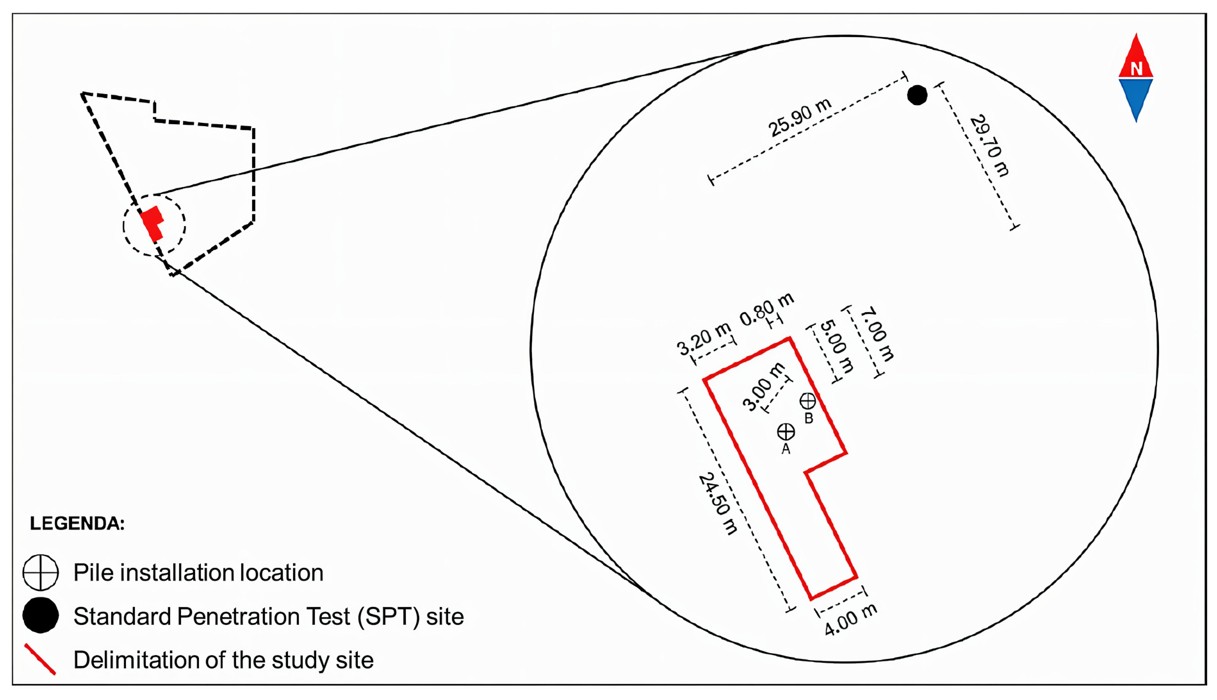
The researchers conducted tests in an experimental field at the central campus of the Federal University of Rio Grande do Norte in Natal-RN (UTM coordinates: 255829.00 m E; 93544649.48 m S). They made two installations, one at position A and another at position B (Figure 1), ensuring a distance between them more significant than five times the diameter of the most giant helix to prevent interference between the installations (Livneh & El Naggar, 2008).

2.2 Subsoil characteristics
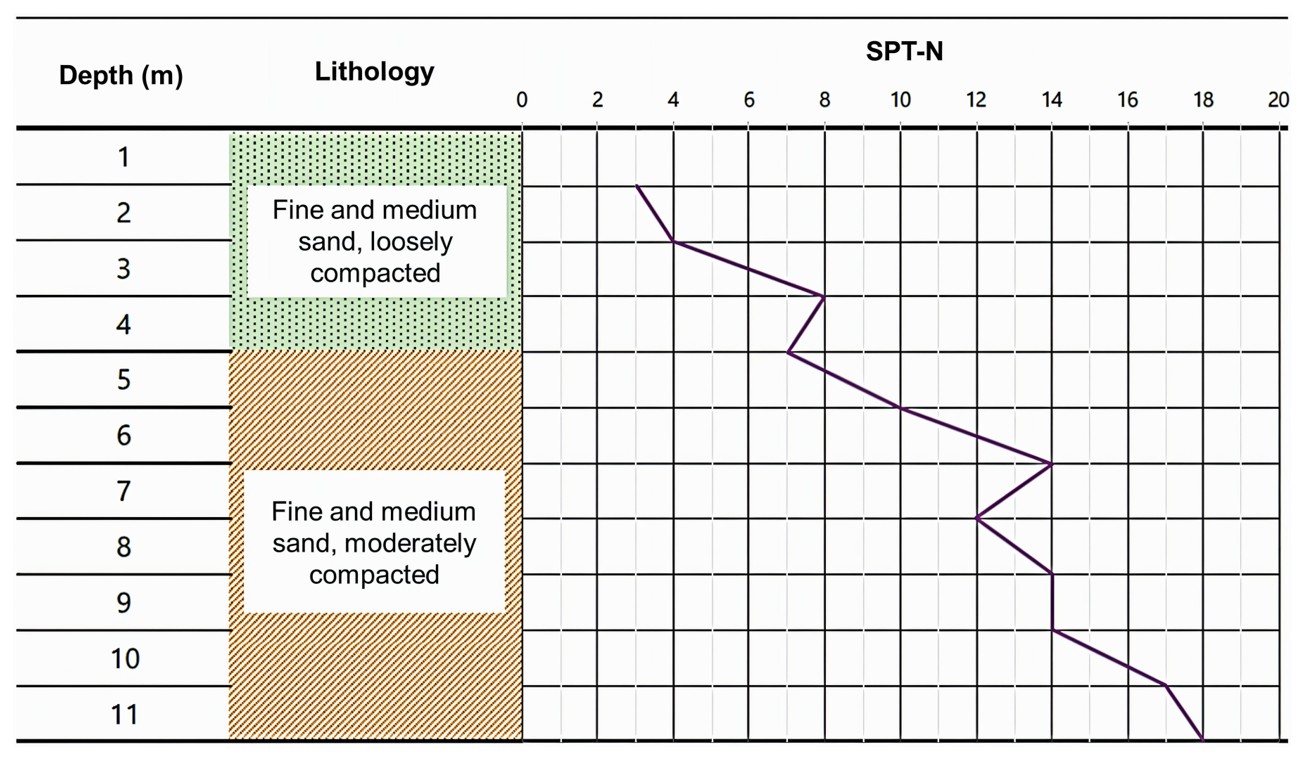
The subsoil investigation program included thirteen standard penetration tests (SPT) according to ASTM D1586 (ASTM, 2022). Figure 2 presents the results obtained from borehole SPT, which is representative of the soil at the experimental field. SPT-N values are for an assumed efficiency of 72%. The ground is composed of pure aeolian sand layers. The boreholes did not detect the water table.

Significantly, the soil, classified as poorly graded sand (SP) according to the Unified Soil Classification System (USCS), is a crucial factor in understanding the soil's behavior. It contains 27% fine sand, 72% medium sand, and 1% coarse sand. The sand's uniformity coefficient of 1.96, curvature coefficient of 0.99, and specific gravity of solids of 26.3 kN/m3 further contribute to our understanding. Direct shear tests on two samples collected from the ground at a depth of 1 m provided effective internal friction angles of 32.3° and 35.9° for relative densities of 34% and 71%, respectively, which are key geotechnical parameters for construction considerations.
3. Prototype description
A prototype, being a full-scale structure, plays a crucial role in research testing. Unlike scaled-down models, which frequently face challenges of similitude such as inadequate stress distribution and altered soil behavior, the full-scale prototype allows for the acquisition of more accurate and relevant data. The helical pile prototype used in this research was fabricated from steel and consisted of three distinct segments. The prototype features three helices with diameters of 350 mm, 300 mm, and 250 mm. The structural design was developed in compliance with the provisions of NBR 8800 (ABNT, 2008). All helices were manufactured with 12.7 mm thick plates and had a pitch of 75 mm. Figure 3a schematically illustrates the dimensions of the helical pile.

a) Schematic drawing of the prototype, indicating the dimensions of the constituent elements. Dimensions in mm, not to scale. b) Constructed prototype, indicating the instrumented sections.
For precise data collection, three sections along the pile were meticulously instrumented with electrical resistance strain gauges, designated as S1, S2, and S3. Figure 3b showcases the fabricated prototype, clearly indicating the location of these instrumented sections. Dual-rosette electrical strain gauges of 120 Ω were used to measure the normal force in the sections. The strain gauges were connected in a complete Wheatstone bridge circuit, a setup that effectively eliminates bending effects and thermal variations. Unfortunately, issues with the sensor during the installation of the prototype for Test B hindered data collection from section S2.
Costa (2017) and Queiroz (2018) provide all details regarding the design, fabrication, and instrumentation of the prototype used in this study.
3.1 Prototype installation in the ground
The prototype was inserted into the soil by applying torque at the top of the pile with the assistance of a hydraulic drill. After each test, it was removed by performing reverse rotation with the drill. The prototype reached maximum depths of 2.57 m and 2.77 m at locations A and B, respectively.
The depths reached by the helices H1, H2, and H3, which are respectively the top, intermediate, and tip helices, are presented in Table 1. Table 2 shows the depth of each instrumented section after installation.
During the installation of each prototype segment, the instrumentation cables were meticulously routed through the pile's interior and emerged through an opening made at the top of the segment, always taking utmost care to avoid entanglement. Following the installation of the prototype in both tests, soil displacement around the shaft was noted to a minimum depth of 0.5 m, ensuring the safety of the process.
3.2 Load testing execution
Two single-way quasi-static cyclic tensile load tests, Tests A and B, were conducted. Each test was divided into four stages, each receiving 60 loading and unloading cycles. The duration of each cycle was 60 seconds, corresponding to a frequency of 1 Hz. The applied load oscillated between fixed minimum (Qmin) and maximum (Qmax) values within each stage. The loading plan for the tests is presented in Table 3. In Test A, the cyclic loads (Qcyc) were programmed to increase from 5 kN to 20 kN, while in Test B, they were kept constant at 10 kN. The maximum load was uniformly applied across all stages in both tests.
Immediately after the meticulously executed quasi-static cyclic load tests, a post-cyclic static load test, named Test C, was conducted at the same location as Test B. The test was initiated immediately after unloading Test B. The procedures followed for this test were meticulously based on the universally recognized standard D3689 (ASTM, 2013). In this test, the load was meticulously kept constant for 10 minutes during each loading and unloading interval. The test was concluded after five meticulously executed cycles of loading and unloading, with increments of 5 kN until failure.
4. Results and discussions
4.1 Cyclic load tests
Figures 4 and 5 depict the axial tensile load behavior over time measured at the top and instrumented sections of the pile in Tests A and B, respectively. The exact figures also show the vertical displacement variation over time measured at the top of the pile.

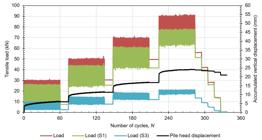
The significance of the observed pile behavior in Test A and Test B cannot be overstated. In stage A-04 of Test A (Figure 4), notable instability was witnessed, marked by a pronounced increase in vertical displacement after five cycles of loading-unloading. However, Test B (Figure 5) remained stable throughout. In this case, the permanent vertical displacement reached after unloading was a mere 21 mm, a testament to its stability.
Table 4 presents the axial loads measured at the instrumented sections. It also shows the interaction load for each instrumented section, which occurs when the minimum load of a stage is lower than the maximum load of the previous stage (i.e. when there is load overlap). In this situation, part of the load applied in a new stage consists of a reload, which can increase the soil stiffness and reduce the corresponding displacements. It was noted that the interaction load increased with the stages in Test A, while in Test B, it remained at a low and approximately constant level.
The diagrams of axial load transfer, constructed from the average load of each stage (Qavg), measured at the top and instrumented sections, are presented in Figures 6a and 6b. In both tests, the variation of axial load with depth was greater between sections S1 and S3 than between the top and section S1. However, the discrepancies in load transfer mechanisms between the geotechnical tests were pronounced. Test B showed a greater reduction in axial load with depth, and the loading stages had a more pronounced effect on the load distribution with depth in Test B, highlighting the contrast between the two tests.

Table 5, a key component of our findings, illustrates the ratio between the load reaching the instrumented section and the load applied at the top of the pile (QSi/QCap). This data is crucial as it reveals how the load is distributed along the pile, a fundamental aspect in the design and analysis of pile foundations. Notably, the load at the shallowest section (S1) showed a slight increase with the stages in both Test A and Test B. However, a contrasting trend was observed in the deepest section of the pile (S3): while in Test A there was a significant increase in load with the stages, in Test B it decreased slightly.
Ratio between the load measured in the instrumented sections and the load at the pile head (QCap).
In addition to measuring the distribution of loads in the sections, it was also possible, through instrumentation, to analyze the contributions of resistances from the shaft and helices. Initially, the evolution of the traction loads acting on the helices with the cycles was analyzed. The mobilized loads on helices H1 and H3 in Test A and H3 in Test B were determined. The analysis excluded the effects of helices H2 in Test A and H1 and H2 in Test B because they could not be isolated from the shafts. Figures 7a and 7b present the results for Tests A and B, respectively. For each cycle, the average load is presented (indicated by the darker line) along with the maximum and minimum loads (represented by the lighter lines). The results of Test A show that the load mobilized on the top helix (H1) remained at an approximately constant level with the change of stages, below 10 kN. On the other hand, the load on helix H3 substantially increased with the change of stages. In Test B, there was also a significant increase in the load on H3 with the stages.

The occurrence of interaction loads between stages is a significant finding. In Test A, the interaction loads were significant on helix H1, while they were almost nonexistent on helix H3. In Test B, helix H3 experienced interaction loads of relevant magnitudes between all stages. This observation is crucial as it indicates the behavior of the soil in contact with the helix, contributing to the increase in its stiffness for the subsequent stage. Understanding these implications is key to optimizing the design and analysis of pile foundations.
Tables 6 and 7 present the resistance contributions from the shaft and helices of the pile in Tests A and B, respectively. Due to the instrumentation configuration, only the shaft segment F1, whose length extends from the ground surface to the upper helix, could have its contribution isolated. In Test A, the instrumentation configuration did not allow for separating the contribution of helix H2 from shaft segment F2. In Test B, a problem occurred with the sensors of section S2 during the pile installation, which made it impossible to separate the contributions between helices H1, H2, and shaft segment F2. The values in the tables represent the average readings of the cycles of each stage. The corresponding ratio between the average measured load and the load applied at the top (Qavg/QCap) is indicated in parentheses.
In both tests, our findings revealed a significant proportional contribution to the pile resistance from the shaft segment F1, starting at around 15-16% of the total load applied in the first stage and gradually decreasing with the progress of stages. This is a crucial discovery, particularly when considering the observed soil detachment near the ground surface, which has the potential to reduce lateral resistance. Li et al. (2018) argue that the contribution of the shaft to the load-bearing capacity is low due to tension planes or cracks that form as the pile moves upwards. For sandy soils, the authors estimate that the upper shaft is affected to a depth from the soil surface of approximately four times the average diameter of the helix. This depth was also investigated by Li & Deng (2018) through numerical modeling, further emphasizing the importance of our findings.
The proportional contribution from the tip helix (H3) in all loading stages of Test A was always more significant than that of the top (H1) and intermediate (H2) helices. In Test B, despite the problem with the sensor during pile installation and the impossibility of separating the load from helices H1 and H2, it is still possible to notice that, similarly to Test A, the tip helix (H3) proportionally mobilized more load than the two upper helices throughout the stages. The soil surrounding the tip helix undergoes less disturbance than the soil in the helices closer to the surface because the ground typically exhibits increasing resistance with depth (as shown in the profile in Figure 2). Sakr (2009) and Tsuha et al. (2012) observed in static load tensile tests that the tip helix H3 is responsible for most of the load-bearing capacity the helical pile provides. From the beginning of the cyclic tests, it was observed that the contribution of the tip helix was superior to the others. In static load tensile tests, Carvalho (2007) found that the first helix and the shaft resist the initially applied loads. As the loading stages progress, the contribution of the second helix initiates, and in the final stages, nearing failure, the lower helix gains increased significance in mobilizing resistance.
Our analysis of tests A and B revealed distinct behaviors regarding the evolution of the proportional contribution of the helices with the loading stages. While in Test A there was a gradual increase in the proportion of contribution from the tip helix and a reduction in the contribution from the top and intermediate helices, in Test B the opposite behavior was observed. These differences in behavior have significant implications for the design and implementation of helical piles. The difference between the results of Tests A and B can be attributed to the loading method employed in each test. Although both tests reached the same maximum loads in each loading stage, the amplitudes of the stages were different. In Test A, increasing cyclic amplitudes were used, while in Test B, constant and comparatively smaller amplitudes were used, which may have caused less densification of the surrounding soil. Additionally, in the last stage of Test A, pile instability occurred, causing more transfer of load from the upper helices to the tip helix (H3) towards the end of the test. These insights highlight the need for careful consideration of loading methods and soil conditions in helical pile design.
4.2 Post-cyclic static load test
Following Test B, a static load test was conducted on the same installation, designated as Test C. The purpose was to assess how the previous cyclic loads impacted the system's static load-bearing capacity.
Figure 8 presents the result of Test C, comparing it with results from two pre-cyclic tests conducted by Queiroz (2018) at a nearby location on the same ground. For comparisons with Queiroz's (2018) data, the tensile load-bearing capacity was obtained using the method proposed in specification AC358 (ICC-ES, 2007). This specification defines the load-bearing capacity as the maximum load on the axial versus displacement curve. In Test C, failure occurred distinctly, with a measured load at the top of the pile of 117 kN. The maximum loads reached in sections S1 and S3 were 101 kN and 33 kN, respectively. The tests indicate the failure loads, as shown in Figure 8.

Comparison between the results of pre-cyclic load tests from Queiroz (2018) and post-cyclic load tests from the current study.
The results demonstrated that the loading-unloading cycles on the pile promoted an increase in the load-bearing capacity of the upper segments of the pile (near the top) and a reduction in the load-bearing capacity of the lower segments (near the tip). The load-bearing capacities obtained in the tests conducted by Queiroz (2018) were 92 kN, 87 kN, and 36 kN for the top, section S1, and section S3, respectively. Test C produced a load-bearing capacity for the system 27% higher at the top of the pile, 16% higher at section S1, and 8% lower at section S3, compared to the average results of Queiroz's (2018) pre-cyclic tests.
5. Conclusions
This study presented an experimental analysis of the behavior of a prototype helical pile subjected to cyclic loads and installed in a pure sand deposit. With three helices, the pile was instrumented at three sections along the shaft and subjected to two quasi-static cyclic tensile load tests and one static tensile load test. Cyclic loading was applied in four stages during the quasi-static load tests. The maximum load reached in each stage was the same in both tests. However, in one of the tests, the cyclic amplitude increased between stages, while in the other, it remained constant. The static load test was conducted in five stages of constant load. From this investigation, the following conclusions can be highlighted:
-
The contribution of the shaft segment between the ground surface and the upper helix was approximately 15% of the total load applied at the top of the pile in the quasi-static cyclic load tests. Despite the observed soil detachment around the shaft near the ground surface, this portion is significant.
-
The helix closest to the pile tip contributed significantly to the total axial load-bearing capacity. Reduced soil disturbance during pile installation in this region led to an increase in soil stiffness with depth. The contribution of this helix remained the highest among all from the beginning of the test.
-
The mode of application of load increments influenced the pile response. Increasing cyclic loads between stages led to an increase in the proportion of load mobilized in the tip helix and a reduction in the proportion mobilized in the upper helices. Additionally, instability of the pile occurred in the fourth stage, after five cycles. On the other hand, applying constant cyclic loads resuled in a decrease in the proportion mobilized in the tip helix and an increase in the proportion mobilized in the upper helices without causing instability to the pile.
-
The loading-unloading cycles applied to the helical pile promoted an increase in the load-bearing capacity of the upper segments (near the top) and a reduction in the load-bearing capacity of the lower segments (near the tip).
List of symbols and abbreviations
ABNT Associação Brasileira de Normas Técnicas
AC Acceptance Criteria
ASTM American Society for Testing and Materials
D Helix diameter
H Helix
ICC-ES International Code Council-Evaluation Service
N Number of cycles applied in a cyclic-loading test
NBR Norma Brasileira Regulamentadora
Qavg Average load
Qcap Load at the pile head
Qcyc Cyclic load
Qint Interaction load
Qmax Maximum load
Qmin Minimum load
QSi Load measured at the instrumented section of the pile
S Instrumented section
SP Poorly graded sand
SPT Standard Penetration Test
SPT-N Standard Penetration Test blow-count
T Period
USCS Unified Soil Classification System
UTM Universal Transverse Mercator
∅ Opening diameter in the shaft
Data availability
All data produced or examined in the course of the current study are included in this article.
Acknowledgements
We would like to thank CNPq for the financial support provided for this research.
-
Discussion open until August 31, 2025.
-
Declaration of use of generative artificial intelligence
This work was prepared with the assistance of Generative Artificial Intelligence (GenAI) ChatGPT with the aim of assisting in translation and improving the quality of the text. The entire process of using this tool was supervised, reviewed and when necessary edited by the authors. The authors assume full responsibility for the content of the publication that involved the aid of GenAI.
References
- ABNT NBR 8800. (2008). Design of steel and composite steel structures for buildings ABNT - Associação Brasileira de Normas Técnicas, Rio de Janeiro, RJ (in Portuguese).
- Andersen, K.A., Puech, A.A., & Jardine, R.J. (2013). Cyclic resistant geotechnical design and parameter selection for offshore engineering and other applications. In Y. Shin (Ed.), Proceedings of the ISSMGE conference – TC 209 Workshop – Design for cyclic loading: piles and other foundations (pp. 9-44), Paris.
-
ASTM D1586. (2022). Standard Test Method for Standard Penetration Test (SPT) and Split-Barrel Sampling of Soils ASTM International, West Conshohocken, PA. https://doi.org/10.1520/D1586_D1586M-18E01 .
» https://doi.org/ -
ASTM D3689. (2013). Standard Test Methods for Deep Foundations Under Static Axial Tensile Load ASTM International, West Conshohocken, PA. https://doi.org/10.1520/D3689-07 .
» https://doi.org/ -
Carvalho, I.P.G. (2007). Estudo teórico-experimental da capacidade de carga à tração e compressão de estacas metálicas helicoidais [Master’s dissertation]. Federal University of Minas Gerais (in Portuguese). Retrieved in August 12, 2024, from https://hdl.handle.net/1843/LMCA-782DZE
» https://hdl.handle.net/1843/LMCA-782DZE - Cerato, A.B., & Victor, R. (2009). Effects of long-term dynamic loading and fluctuating water table on helical anchor performance for small wind tower foundations. Journal of Performance of Constructed Facilities, 23(4), 251-261. http://dx.doi.org/10.1061/(ASCE)CF.1943-5509.0000013.
-
Costa, J.P.S. (2017). Uplift behaviour of helical piles in sand subjected to cyclic loading [Master’s dissertation]. Federal University of Rio Grande do Norte (in Portuguese). Retrieved in August 12, 2024, from https://repositorio.ufrn.br/jspui/handle/123456789/25166
» https://repositorio.ufrn.br/jspui/handle/123456789/25166 - ICC-ES AC358. (2007). Acceptance Criteria for Helical Pile Foundations and Devices International Code Council – Evaluation Services, Washington.
- Jardine, R.J., & Standing, J.R. (2012). Field axial cyclic loading experiments on piles driven in sand. Soil and Foundation, 52(4), 723-736. http://dx.doi.org/10.1016/j.sandf.2012.07.012.
- Li, W., & Deng, L. (2018). Axial load tests and numerical modeling of single-helix piles in cohesive and cohesionless soils. Acta Geotechnica, 14(2), 461-475. http://dx.doi.org/10.1007/s11440-018-0669-y.
- Li, W., Zhang, D.J.Y., Sego, D.C., & Deng, L. (2018). Field testing of axial performance of large-diameter helical piles at two soil sites. Journal of Geotechnical and Geoenvironmental Engineering, 144(3), 06017021. http://dx.doi.org/10.1061/(ASCE)GT.1943-5606.0001840.
- Livneh, B., & El Naggar, M. (2008). Axial testing and numerical modeling of square shaft helical piles under compressive and tensile loading. Canadian Geotechnical Journal, 45(8), 1142-1155. http://dx.doi.org/10.1139/T08-044.
-
Perko, H.A. (2000). Energy method for predicting installation torque of helical foundations and anchors. In N.D. Dennis Junior, R. Castelli & M.W. O'Neill (Eds.), New technological and design developments in deep foundations (pp. 342-352). Reston: American Society of Civil Engineers. https://doi.org/10.1061/40511(288)24 .
» https://doi.org/ -
Queiroz, F.L. (2018). Avaliação de instalação e desempenho em terreno arenoso de uma estaca helicoidal instrumentada [Master’s dissertation]. Federal University of Rio Grande do Norte (in Portuguese). Retrieved in August 12, 2024, from https://repositorio.ufrn.br/jspui/handle/123456789/25829
» https://repositorio.ufrn.br/jspui/handle/123456789/25829 - Sakr, M. (2009). Performance of helical piles in oil sand. Canadian Geotechnical Journal, 46(9), 1046-1061. http://dx.doi.org/10.1139/t09-044.
- Schiavon, J.A. (2016). Behavior of helical anchors subjected to cyclic loading [Doctoral thesis, University of São Paulo and Nantes Angers and Le Mans University]. University of São Paulo’s repository (in Portuguese). https://doi.org/10.11606/T.18.2017.tde-10072017-090437.
- Stephenson, R.W. (2003). Design and Installation of Torque Anchors for Tiebacks and Foundations (p. 45) Rolla: Missouri University of Science and Technology.
- Tsuha, C.H.C. (2007). Modelo teórico para controle da capacidade de carga a tração de estacas metálicas helicoidais em solo arenoso [Doctoral thesis, University of São Paulo]. University of São Paulo’s repository (in Portuguese). https://doi.org/10.11606/T.18.2007.tde-06052008-151518.
- Tsuha, C.H.C., Aoki, N., Rault, G., Thorel, L., & Garnier, J. (2012). Evaluation of the efficiencies of helical anchor plates in sand by centrifuge model tests. Canadian Geotechnical Journal, 49(9), 1102-1114. http://dx.doi.org/10.1139/t2012-064.
- Wichtmann, T. (2005). Explicit accumulation model for non-cohesive soils under cyclic loading [PhD thesis]. Ruhr University Bochum.
Edited by
-
Editor:
Renato P. Cunha https://orcid.org/0000-0002-2264-9711