
 MOXIBUSTION IN THE MANAGEMENT OF LYMPHEDEMA IN MASTECTOMIZED WOMEN: A RANDOMIZED CLINICAL TRIAL
ABSTRACT
Objective: To evaluate the effect of moxibustion as an adjuvant therapy in the control of lymphedema in mastectomized women.
Method: A randomized, experimental study conducted between August 2021 and July 2022. The inclusion criteria were: women aged 30 or older, diagnosed with breast cancer and who underwent unilateral mastectomy at least six months prior and radiotherapy and chemotherapy; confirmation of lymphedema by perimetry, with a difference ≥ 3 cm between the circumference of the affected arm and that of the contralateral arm. The participants were randomly assigned to shifts and allocated to two distinct groups. In the intervention group, they received (in addition to standard treatment) eight moxibustion sessions over four weeks, while the control group continued only with the institution's standard treatment. To assess lymphedema regression, the Upper Limb Lymphedema Efficacy Index was used.
Results: The study included 28 participants, showing an adherence rate of 87.5% in the intervention group and 89.3% in the control group. The intervention group demonstrated a 23.0% improvement after treatment with moxibustion, which constituted a positive result. In contrast, the control group showed improvement of only 5.3% (p=0.016), indicating a limited therapeutic response.
Conclusions: Moxibustion has shown promising results for reducing lymphedema in mastectomized women; however, the small sample size and randomization in shifts are limitations that should be considered. Further studies with diverse populations are needed to broaden the generalizability of the results.
DESCRIPTORS:
Breast cancer-related Lymphedema; Breast neoplasms; Mastectomy; Lymphedema; Traditional Chinese medicine; Nursing
RESUMO
Objetivo: avaliar o efeito da moxabustão como terapia adjuvante no controle de linfedema em mulheres mastectomizadas.
Método: estudo experimental, randomizado, realizado entre agosto de 2021 e julho de 2022. Os critérios de inclusão foram: mulheres com 30 anos ou mais, diagnosticadas com câncer de mama e que realizaram mastectomia unilateral há pelo menos seis meses; realização de radioterapia e quimioterapia; comprovação de linfedema por perimetria, com diferença ≥ 3 cm entre a circunferência do braço afetado e a do braço contralateral. As participantes foram randomizadas por turnos e alocadas em dois grupos distintos. No grupo-intervenção, elas receberam (além do tratamento-padrão) oito sessões de moxabustão durante quatro semanas, enquanto o grupo-controle seguiu apenas com o tratamento-padrão da instituição. Para avaliar a regressão do linfedema, utilizou-se o Índice de Eficácia para Linfedema de Membro Superior.
Resultados: O estudo contou com 28 participantes, apresentando uma taxa de adesão de 87,5% no grupo-intervenção e 89,3% no grupo-controle. O grupo-intervenção demonstrou melhora de 23,0% após o tratamento com moxabustão, o que se configurou um resultado positivo. Em contrapartida, o grupo-controle apresentou evolução de apenas 5,3% (p=0,016), indicando uma resposta terapêutica limitada.
Conclusões: a moxabustão apresentou resultados promissores para a redução do linfedema em mulheres mastectomizadas; entretanto, a amostra reduzida e a randomização por turno são limitações que devem ser consideradas. São necessários mais estudos com populações diversas, para ampliar a generalização dos resultados.
DESCRITORES:
Linfedema relacionado ao câncer de mama; Neoplasias da mama; Mastectomia; Linfedema; Medicina tradicional chinesa; Enfermagem
RESUMEN
Objetivo: Evaluar el efecto de la moxibustión como terapia coadyuvante en el control del linfedema en mujeres mastectomizadas.
Método: Un estudio experimental aleatorizado realizado entre agosto de 2021 y julio de 2022. Los criterios de inclusión fueron: mujeres de 30 años o más, diagnosticadas con cáncer de mama y que se habían sometido a una mastectomía unilateral al menos seis meses antes; que estuvieran recibiendo radioterapia y quimioterapia; y que presentaran linfedema confirmado mediante perimetría, con una diferencia ≥ 3 cm entre la circunferencia del brazo afectado y la del brazo contralateral. Las participantes fueron asignadas aleatoriamente a diferentes turnos y distribuidas en dos grupos distintos. En el grupo de intervención, recibieron (además del tratamiento estándar) ocho sesiones de moxibustión a lo largo de cuatro semanas, mientras que el grupo de control continuó únicamente con el tratamiento estándar de la institución. Para evaluar la regresión del linfedema, se utilizó el Índice de Eficacia del Linfedema de las Extremidades Superiores.
Resultados: El estudio incluyó a 28 participantes, mostrando una tasa de adherencia del 87,5% en el grupo de intervención y del 89,3% en el grupo de control. El grupo de intervención demostró una mejoría del 23,0% tras el tratamiento con moxibustión, lo que constituyó un resultado positivo. En cambio, el grupo de control mostró una mejoría de tan solo el 5,3% (p=0,016), lo que indica una respuesta terapéutica limitada.
Conclusiones: La moxibustión ha mostrado resultados prometedores para reducir el linfedema en mujeres mastectomizadas; sin embargo, el pequeño tamaño de la muestra y la aleatorización rotacional son limitaciones que deben tenerse en cuenta. Se necesitan más estudios con poblaciones diversas para ampliar la generalización de los resultados.
DESCRIPTORES:
Linfedema relacionado con el cáncer de mama; Neoplasias mamarias; Mastectomía; Linfedema; Medicina tradicional china; Enfermería
INTRODUCTION
Upper limb lymphedema is one of the most common complications related to mastectomy for breast cancer. Its incidence varies according to clinical and socioeconomic factors, and can reach 66.2% in more vulnerable women. This iatrogenic condition currently has no cure and can lead to lifelong limitations, such as difficulty with mobility, persistent pain, and an impact on self-image1,2.
In this context, integrative practices emerge as adjuvant therapies because they are well-tolerated, low-cost, and have few side effects, contributing to improved quality of life, pain management, and emotional support in cancer patients3. Among these practices, we highlight moxibustion: an ancient technique originating in China, which seeks to heat acupuncture points with the flame of sticks made from leaves of Artemisia vulgaris. This heating thermally stimulates sensory receptors, allowing the regulation of vital energy (qi) and the blood (xue), as well as its circulation through energy channels called "meridians"4.
In addition to the aforementioned effects, moxibustion has a proven physiological response, as it activates the inflammatory pathway, promotes dilation of peripheral vessels, increases their porosity, and facilitates blood and lymphatic circulation4,5.
With the improvement of the production technique for moxa sticks, other formulations emerged, in which medicinal herbs and/or phytotherapeutic substances were mixed with mugwort to mask its strong odor. Recently, a smokeless moxa has been developed, consisting of a small charcoal stick impregnated with mugwort oil, while maintaining properties similar to the natural version6.
Although studies indicate a possible reduction in lymphedema with moxibustion, the evidence is still limited and lacks methodological standardization; therefore, more research is needed to validate its effectiveness7-13. Considering the evidence gap and the prospect of implementing a nursing intervention aimed at promoting women's health and building new care paradigms, the present study aimed to evaluate the effect of moxibustion as an adjuvant therapy in the control of lymphedema in mastectomized women.
METHOD
This was an experimental, randomized, parallel-group study conducted in accordance with CONSORT recommendations. This single-center study took place between August 2021 and July 2022 at an oncology hospital in the city of Recife, in the state of Pernambuco (PE), Brazil.
The population (chosen for convenience) consisted of women with lymphedema related to surgical treatment for unilateral breast cancer9,11. Unilaterality was an important characteristic for the study, as it allowed for a comparison of the circumference of the affected arm with that of the contralateral arm.
The inclusion criteria were: 1) women aged 30 or older, diagnosed with breast cancer and who underwent unilateral mastectomy at least six months prior (period required for lymphedema diagnosis); 2) performance of neoadjuvant and/or adjuvant radiotherapy and chemotherapy, which can increase the risk of lymphedema development; and 3) confirmation of lymphedema by perimetry, with a difference ≥ 3 cm between the circumference of the affected arm and that of the contralateral arm.
The exclusion criteria were: 1) having diseases related to the vascular system, coagulopathies, skin infections, or any condition that contraindicated moxibustion; 2) having skin trauma on the limb, ulceration, or skin disease, as these conditions can hinder venous and lymphatic return; 3) having respiratory problems (e.g., allergy to odors), since these can be aggravated by the technique; 4) receiving other treatments for lymphedema other than those established by the service, to ensure homogeneity in the therapeutic protocol and allow comparisons; 5) having had previous contact with any modality of moxibustion; and 6) being pregnant, since there are controversies regarding the safety of moxibustion in early pregnancy.
Furthermore, the following discontinuation criteria were adopted: 1) withdrawal of consent to participate, which could occur at any stage of the research; 2) change in the routine therapeutic protocol during the intervention period, as this would directly interfere with the results; 3) occurrence of nausea related to the odor of moxibustion or any other discomforts reported by the patients; 4) death, clinical instability and/or recurrence of the disease; and 5) absence from more than 20% of the interventions.
Given that the primary outcome of the present study was the regression of lymphedema (measured by means of Effective Index for Upper-limb Lymphedema - EIUL), a power of 80% and a significance level of 5% were adopted in the sample size calculation. A "positive response" was defined as an EIUL value ≥20%, with an estimated incidence of 55% in the exposed sample14. Thus, a consecutive sample of women who attended the outpatient clinic for physiotherapy following a medical recommendation was selected. Using the sample size formula developed by Kelsey et al., 28 participants would be needed (KELSEY et al., 1996)15. To compensate for potential losses, a 10% increase was made, resulting in a final sample of 30 women, with a 1:1 match (15 in each group). All calculations were performed using the software Open Source Epidemiologic Statistics for Public Health (OpenEpi 3.02).
The determination of which group would receive the intervention and which would only follow the standard treatment was made through stratified cluster randomization according to the days of the week (Mondays, Tuesdays, Wednesdays, and Thursdays) and the shifts in which they attended the outpatient clinic (morning or afternoon). The software Randomizer was used to select the participating units.
Thus, patients receiving physiotherapy on Monday and Wednesday mornings were invited to join the intervention group; and those seen on Tuesday and Thursday afternoons joined the control group. This strategy sought to avoid contact between women from the two groups, without changing shifts during the intervention. Whenever a potential participant began attending the outpatient clinic, the team's physiotherapist would inform the person in charge of the intervention, who would then extend an invitation to participate in the study.
Participants in both groups (intervention and control) continued with the conventional treatment recommended by the institution: compression bandaging and manual lymphatic drainage twice a week. These techniques were performed by physiotherapy professionals working in the outpatient clinic who had been properly trained by the institution. Patients were instructed to keep the compression bandages on for at least two days, only removing the bandages hours before going to the outpatient clinic. The intervention group also underwent eight moxibustion sessions over four weeks, each lasting up to 20 minutes.
The intervention was performed individually by a nurse duly qualified in moxibustion therapy and a specialist in integrative and complementary practices. All sessions took place in the outpatient clinic, in a comfortable (with adjustable temperature and good air circulation) and private location. Charcoal moxa of the brand Dong Yang was used, whose sticks measured 13cm and did not release toxic substances, smoke or odors when burned.
The choice of acupoints aimed to address pain complaints and promote lymphatic and blood flow. Thus, the selected points were Jianzhen (ID 9), whose function is to clear the channel, benefit the shoulder and treat disorders in that region, as well as scapular pain; Binao (IG 14), which also clears the channel and is indicated for pain in the shoulder and arm, neck stiffness, shoulder joint disorders and paralysis of the upper limb; Shouwuli (IG 13), indicated for pain in the arm and elbow; and Waiguan (TA 5), used in the management of muscle tension and mobility problems on the side of the body, in addition to performing an important energetic function by facilitating the circulation of qi in blockages of the energy channels.
To better standardize the intervention, the technique was always performed as follows:
1. The participant was instructed to fully expose the limb affected by lymphedema, and it might be necessary to remove pieces of clothing for better access. After the limb was properly exposed, the participant was instructed to sit on a chair and rest the affected arm on a surface in a supine position, to ensure comfort and easy location of the acupoints;
2. With the participant properly positioned, the researcher lit the moxa stick using a blowtorch, ensuring that the ember was well-fed, burning steadily and with an orange color;
3. Holding the stick in her dominant hand, the researcher located the acupoints to be stimulated with the help of her non-dominant hand, resting the palm on the participant's limb, so that the index finger and thumb were on either side of the area to be heated. This technique was essential for the researcher to have a good perception of the heat intensity and thus avoid excessive thermal exposure on the participant's skin;
4. After correctly locating the first acupoint (ID 9), the researcher brought the burning ember of the stick to a distance of 2 to 3 cm from the participant's skin, making circular movements. During the application, if the participant reported excessive heat at the acupoint, the researcher would raise the stick and cover the area with her left hand, waiting until the participant felt comfortable again before resuming the application. Each acupoint was stimulated for up to five minutes, depending on the sensitivity of each participant;
5. The technique described above was repeated for the other acupoints, respectively: IG 14; IG 13, TA 5;
6. At the end of the procedure, the researcher extinguished the ember on the stick with a snuffer and helped the participant to get dressed again, so that she could then go to the physiotherapy clinic and continue with standard physiotherapy for lymphedema.
The main outcome of this study was the progression or regression of lymphedema, which was assessed based on pre-intervention and post-intervention upper limb (UL) circumference measurements to determine the EIUL. The researchers responsible for collecting this data did not know which participants belonged to the intervention group and which belonged to the control group, ensuring the blinding of the evaluators and avoiding possible biases.
Thus, the perimeter assessment was performed using a 150cm body measuring tape from the brand Sanny. The same tape was used for all participants during data collection. The measurements were taken with the limb supported, relaxed, and in the supine position, at the following points: 1) 7 cm above the elbow line, towards the armpit line; 2) 14 cm above the elbow line, towards the armpit line; 3) 7 cm below the elbow line, towards the wrist line; 4) 14 cm below the elbow line, towards the wrist line; and 5) 21 cm below the elbow line, towards the wrist line.
The EIUL was calculated and used to support the study conclusions. EIUL is a measure that allows determining the response to the applied treatment, providing a percentage of effectiveness and adjusting the results for differences in perimetry. Therefore, the following formula was applied14:
Since the area of edema varies in each subject, the location with the greatest difference between the affected and unaffected arm was used to determine the baseline and outcome assessment for each patient. This index was developed by Cassileth et al.15, with the aim of evaluating the progression of lymphedema in patients undergoing acupuncture. A response rate of ≥ 20% was considered a positive outcome for treatment, and ≤ 5% was considered a negative outcome14,16,17.
The data was entered double-entry into the software EpiData 3.1, and the statistical analysis was performed using the software Statistical Package for the Social Sciences (SPSS, version 22.0). The researcher responsible for the analysis did not know which participants belonged to the intervention group and which belonged to the control group.
Initially, the normality and homogeneity of variance of the data were analyzed using the Shapiro-Wilk and Levene tests, respectively. For descriptive analyses, continuous data were presented as mean and standard deviation (when parametric) or median and interquartile range (when non-parametric), while categorical data were presented as absolute and relative frequency.
To compare the perimetries according to the number of lymph nodes, the t independent test for parametric data and the Mann-Whitney U test were used. The comparison of proportions (categorical variables) according to the number of lymph nodes was performed using Pearson's chi-square test or Fisher's exact test. Generalized estimating equations (GEE) models were used considering time (pre vs. post) and group (intervention vs. control) as factors, and adjusted for age, surgery time, and surgical method employed. When the group*time interaction showed statistical significance, Bonferroni's post-hoc test was applied to identify where the differences occurred.
All tests were performed using the software SPSS (version 20.0); and p<0.05 was considered statistically significant in all analyses.
The study was conducted in accordance with Resolution 466/2012 of the National Health Council of the Ministry of Health of Brazil, which governs research involving human beings and safeguards the ethical principles of justice, beneficence, and non-maleficence. The project was approved by the Research Ethics Committee (CEP) with Opinion no. 4.849.199. The volunteers were guaranteed confidentiality and anonymity.
The project was registered on the Brazilian Clinical Trials Registry Platform (RBR) (www.ensaiosclinicos.gov.br/), under protocol RBR-9wkgdxp. No reward or remuneration was offered to the research participants, and the sector where the study was conducted subsequently received a report with the main results of the intervention.
Participants in all stages of the study (intervention group and control group) were informed about the objective of the research as well as its risks and benefits and were invited to sign the Free Informed Consent Form. They also had the right to withdraw from the research at any time.
RESULTS
Data collection lasted one year, involving 33 women (16 in the intervention group and 17 in the control group). Two participants were discontinued from the intervention group because they missed more than 20% of the interventions. In the control group, 3 participants discontinued treatment, of which 2 missed more than 20% of the physiotherapy sessions and 1 had the therapeutic protocol altered. Thus, 28 women completed the study (Figure 1), with an adherence rate of 87.5% in the intervention group and 89.3% in the control group.
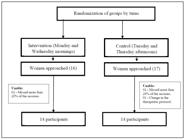
Flow of allocation of research participants, according to the shift in which they attended the outpatient clinic.
The average age was 58.9 years, with the majority being non-white and having a low level of formal education. Regarding clinical data, a significant proportion were overweight and had undergone total or modified mastectomy. They had all undergone radiotherapy and chemotherapy. The remaining sociodemographic data are presented in Table 1.
Regarding the effect of the intervention on perimetry, only the area corresponding to 7 cm below the elbow line obtained statistical significance, with p<0.05. In this region, the intervention group lost almost 1 cm in circumference in the affected limb, while the control group only reduced it by 0.1 cm. The remaining data can be found in Table 2.
Finally, the EIUL was calculated for the central regions at the elbow line and for the regions that showed the greatest difference between the perimetries to evaluate the possible therapeutic effects. Again, significance was obtained in the region located 7 cm below the elbow line and in the areas with the greatest perimeter difference, as shown in Table 3. Furthermore, only the intervention group showed positive results (≥20%), while the control group showed results close to the negative response threshold (≤5%).
DISCUSSION
In this study, moxibustion therapy was investigated as an adjuvant treatment in the management of lymphedema related to breast cancer. In the sample analyzed, a treatment adherence rate of 87.5% was observed, suggesting high acceptance and feasibility of the protocol among the participants. Regarding clinical characteristics, the intervention group was relatively younger and had a shorter time since surgery compared to the control group. However, evidence from the literature remains inconclusive regarding the association of these variables with the incidence or severity of lymphedema, and no consensus has been established18,19.
In contrast, being overweight and obese are well-established risk factors for the development of lymphedema, as are radiotherapy and axillary lymph node dissection. In our sample, it was not possible to assess the extent of lymphadenectomies due to a lack of data in the medical records; however, a high prevalence of overweight/obesity was observed among participants in both groups. This condition can compromise the lymphatic density of subcutaneous tissue, the proliferation of lymphatic endothelial cells, the permeability of lymphatic vessels, the pumping capacity of collecting vessels, and the clearance of macromolecules19,20.
Regarding perimetry, there was a significant reduction in the intervention group, with positive EIUL results (23%), while in the control group this number was slightly above 5%, showing a p value of 0.016. These findings appear to be consistent with the specialized literature, even though slightly different methods and materials were used to achieve these results12,21,22,23.
According to Traditional Chinese Medicine (TCM), the heat produced by moxibustion is able to drain fluids, aiding in bodily circulation and modulating inflammatory factors23,24. This medical rationale holds that both breast cancer and the surgical procedure to remove the tumor can obstruct the meridians, causing stagnation of qi and blood stasis. Thus, the body becomes weak and unable to properly circulate water and other fluids, culminating in the blockage of natural flow and accumulation of moisture in the form of edema25. The heat from moxibustion is effective in toning the qi and improves microcirculation, eliminating cold and stasis23,24,26.
From the perspective of Western medicine, the combustion temperature of charcoal moxa is close to that of natural moxa, and both exhibit fairly similar infrared radiation peaks6,27. Thus, an improvement in blood and lymphatic circulation is observed through vasodilation and muscle relaxation, which facilitates the elimination of inflammation and edema. Immune function may also improve, as there is increased activity of macrophages and other leukocytes8,26. These facts help support the findings presented here, since the complex pathophysiology of lymphedema involves, among other factors, fluid accumulation, immune deficiencies, and chronic inflammation28.
These findings suggest that moxibustion may be a relevant resource in the management of lymphedema, regardless of its modality. Both moxibustion with needles and moxibustion alone, and even electric moxa, have yielded positive results in existing studies. Therefore, this work adds to the available evidence by pointing to charcoal moxibustion, still little explored for this purpose, as a viable alternative with satisfactory effectiveness7-12.
Nevertheless, other important factors should be defined for the safe practice and standardization of moxibustion. There is no consensus regarding the exposure time, the number of sessions required, and the follow-up period. It is also necessary to better define which acupoints should be stimulated, although this is made difficult by the fact that TCM considers the individuality of each patient. Furthermore, studies exploring the so-called points of ashi, which are not part of the traditional meridian system, but are painful for some people due to their specific characteristics, are required. The investigation of the points of ashi can contribute to improving the technique, enhancing its effectiveness and adapting it to the needs of each patient7-12.
Due to the small sample size, the present study adopted a shift-based randomization, which may introduce selection biases. Furthermore, blinding the participants was not possible due to the active nature of the intervention. It is important to remember that lymphedema related to breast cancer treatment is a multifactorial condition. Thus, no matter how much one tries to select a homogeneous sample and control the numerous relevant variables, it is still not possible to ascertain all the nuances of this condition. In future research, it would be important to include a larger and more diverse sample.
CONCLUSION
It is concluded that moxibustion showed promising results in reducing edema, with significant improvement after eight sessions. Although charcoal moxibustion is not the purest form of mugwort, it retains satisfactory therapeutic effects. Additionally, because it produces neither smoke nor strong odor, it is more suitable for hospital environments, with greater acceptance and less discomfort, especially among women.
Especially in primary care, the integration of modern and traditional medicine can strengthen nursing through the adoption of a more holistic approach to the care of chronic conditions. Even when performed in a hospital setting, this intervention can be applied in primary care, expanding the possibilities of care by considering the health determinants.
REFERENCES
-
1. Ahn HR, Jeong HE, Jeong C, Kang SY, Jung SH, Youn HJ, et al. Incidence and risk factors of breast cancer-related lymphedema in Korea: a nationwide retrospective cohort study. Int J Surg [Internet]. 2024 [cited 2026 Apr 23];110(6):3518-26. Available from: https://doi.org/10.1097/JS9.0000000000001278
» https://doi.org/10.1097/JS9.0000000000001278 -
2. Gallegos-Alvarado M, Pérez-Sumano S, Ochoa-Estrada MC, Salinas-Torres VM. Improvement of quality of life on breast cancer-related lymphedema patients through a postmastectomy care program in Mexico: a prospective study. Support Care Cancer [Internet]. 2024 [cited 2026 Apr 23];32(11):713. Available from: https://doi.org/10.1007/s00520-024-08895-4
» https://doi.org/10.1007/s00520-024-08895-4 -
3. Dawczak-Dębicka A, Kufel-Grabowska J, Bartoszkiewicz M, Perdyan A, Jassem J. Complementary and Alternative Therapies in Oncology. Int J Environ Res Public Health [Internet]. 2022 [cited 2026 Apr 23];21;19(9):5071. Available from: https://doi.org/10.3390/ijerph19095071
» https://doi.org/10.3390/ijerph19095071 -
4. Dawes NC, Anastasi JK. The Case for Moxibustion for Painful Syndromes: History, principles and rationale. Curr Res Compliment Altern Med [Internet]. 2022 [cited 2026 Apr 23];6(1):153. Available from: https://10.29011/2577-2201.100053
» https://10.29011/2577-2201.100053 -
5. Zhao Z, Li J, Wen J, He Y, Sun Z. Effect of Moxibustion on Inflammatory Cytokines for Low Back Pain: A Systematic Review, Meta-Analysis and Meta-Regression. Therapeutics and Clinical Risk Management [Internet]. 2023 [cited 2026 Apr 23];19:811-827. Available from: https://doi.org/10.2147/TCRM.S429469
» https://doi.org/10.2147/TCRM.S429469 -
6. Chen L, Ren X, Li F, Deng H, Ding G, Yao W, et al. New smokeless moxibustion for knee osteoarthritis: A study protocol for a multicenter, single-blind, randomized controlled trial. Medicine (Baltimore) [Internet]. 2022 [cited 2026 Apr 23];7;101(40):e30700. Available from: https://doi.org/10.1097/MD.0000000000030700
» https://doi.org/10.1097/MD.0000000000030700 -
7. Wang S, Zhang F, Tang H, Ning W. The efficacy and safety of acupuncture and moxibustion for breast cancer lymphedema: a systematic review and network meta-analysis. Gland Surg[Internet]. 2023 [cited 2026 Apr 23];12(2):215-224. Available from:Available from:https://doi.org/10.21037/gs-22-767
» https://doi.org/10.21037/gs-22-767 -
8. Gao Y, Ma T, Han M, Yu M, Wang X, Lv Y, et al. Effects of Acupuncture and Moxibustion on Breast Cancer-Related Lymphedema: A Systematic Review and Meta-Analysis of Randomized Controlled Trials. Integr Cancer Ther [Internet]. 2021 [cited 2026 Apr 23];20:15347354211044107. Available from: https://doi.org/10.1177/15347354211044107
» https://doi.org/10.1177/15347354211044107 -
9. Zhang D, Zhao X, Li H, Chen W, Liu C. Effect of eight different acupuncture and moxibustion therapies on breast cancer-related lymphedema: a Bayesian network meta-analysis. Support Care Cancer [Internet]. 2025 [cited 2026 Apr 23];13;33(10):850. Available from: https://doi.org/10.1007/s00520-025-09861-4
» https://doi.org/10.1007/s00520-025-09861-4 -
10. Jin H, Xiang Y, Feng Y, Zhang Y, Liu S, Ruan S, et al. Effectiveness and Safety of Acupuncture Moxibustion Therapy Used in Breast Cancer-Related Lymphedema: A Systematic Review and Meta-Analysis. Evid Based Complement Alternat Med [Internet]. 2020 [cited 2026 Apr 23];3237451. Available from: https://doi.org/10.1155/2020/3237451
» https://doi.org/10.1155/2020/3237451 -
11. Wang C, Yang M, Fan Y, Pei X. Moxibustion as a Therapy for Breast Cancer-Related Lymphedema in Female Adults: A Preliminary Randomized Controlled Trial. Integrative cancer therapies [Internet]. 2019 [cited 2026 Apr 23];18:1-9. Available from: https://doi.org/10.1177/1534735419866919
» https://doi.org/10.1177/1534735419866919 -
12. Xu Y, Yu J, Shen R, Shan X, Zhou W, Wang J. Comparison efficacy and safety of acupuncture and moxibustion therapies in breast cancer-related lymphedema: A systematic review and network meta-analysis. PLoS One [Internet]. 2024 [cited 2026 Apr 23];19(5):e0303513. Available from: https://doi.org/10.1371/journal.pone.0303513
» https://doi.org/10.1371/journal.pone.0303513 -
13. Ji Y, Li S, Zhang X, Li Q, Lu Q, Chen W, et al. The Efficacy of Moxibustion for Breast Cancer Patients with Chemotherapy-Induced Myelosuppression during Adjuvant Chemotherapy: a randomized controlled study. Evid Based Complement Alternat Med [Internet]. 2021 [cited 2026 Apr 23];e1347342. Available from: https://doi.org/10.1155/2021/1347342
» https://doi.org/10.1155/2021/1347342 -
14. Cassileth BR, Van Zee KJ, Yeung KS, Coleton MI, Cohen S, Chan Y, et al. Acupuncture in the treatment of upper-limb lymphedema: results of a pilot study. Cancer [Internet]. 2013 [cited 2026 Apr 24];119(13):2455-2461. Available from: https://doi.org/10.1002/cncr.28093
» https://doi.org/10.1002/cncr.28093 - 15. Kelsey JL, Whittemore AS, Evans AS, Thompson WD. Methods in Observational Epidemiology. 2th ed. Oxford, (GBR): Oxford University Press; 1996.
-
16. Han K, Kwon O, Park HJ, Kim AR, Lee B, Kim M, et al. Electronic Moxibustion for Breast Cancer-Related Lymphedema: a pilot clinical trial. Integr Cancer Ther [Internet]. 2020 [cited 2026 Apr 25];19:e153473542096285. Available from: https://doi.org/10.1177/1534735420962854
» https://doi.org/10.1177/1534735420962854 -
17. Yao C, Xu Y, Chen L, Jiang H, Ki CS, Byun JS, et al. Effects of Warm Acupuncture on Breast Cancer-Related Chronic Lymphedema: a randomized controlled trial. Current Oncology [Internet]. 2016 [cited 2026 Apr 25];23(1):27-34. Available from: https://doi.org/10.3747/co.23.2788
» https://doi.org/10.3747/co.23.2788 -
18. Guliyeva G, Huayllani MT, Boczar D, Avila FR, Lu X, Forte AJ. Age as a risk factor for breast cancer-related lymphedema: a systematic review. J Cancer Surviv [Internet]. 2023 [cited 2026 Apr 25];17(1):246-253. Available from: https://doi.org/10.1007/s11764-021-00994-z
» https://doi.org/10.1007/s11764-021-00994-z -
19. Ahn HR, Jeong HE, Jeong C, Kang SY, Jung SH, Youn HJ, et al. Incidence and risk factors of breast cancer-related lymphedema in Korea: a nationwide retrospective cohort study. Int J Surg [Internet]. 2024 [cited 2026 Apr 25];110(6):3518-3526. Available from: https://doi.org/10.1097/JS9.0000000000001278
» https://doi.org/10.1097/JS9.0000000000001278 -
20. Karaman S, Lehti S, Zhang C, Taskinen MR, Käkelä R, Mardinoglu A, et al. Multi-omics characterization of lymphedema-induced adipose tissue resulting from breast cancer-related surgery. FASEB J [Internet]. 2024 [cited 2026 Apr 25];38(20):e70097. Available from: https://doi.org/10.1096/fj.202400498RR
» https://doi.org/10.1096/fj.202400498RR -
21. Wang C, Liu H, Shen J, Hao Y, Zhao L, Fan Y, et al. Effects of Tuina Combined With Moxibustion on Breast Cancer-Related Lymphedema: A Randomized Cross-Over Controlled Trial. Integr Cancer Ther [Internet]. 2023 [cited 2026 Apr 25];22:15347354231172735. Available from: https://doi.org/10.1177/15347354231172735
» https://doi.org/10.1177/15347354231172735 -
22. Zheng K, Hong X, Jiang C, Chen Y. Effects of warming needle moxibustion on postoperative rehabilitation, pain degree, immune function, and upper limb lymphedema in patients with breast cancer undergoing radical mastectomy. Am J Cancer Res [Internet]. 2025 [cited 2026 Apr 25];15(3):991-1001 Available from: https://doi.org/10.62347/YXHG6188
» https://doi.org/10.62347/YXHG6188 -
23. Yeh CH, Zhao TY, Zhao MD, Wu Y, Guo YM, Pan ZY, et al. Comparison of effectiveness between warm acupuncture with local-distal points combination and local distribution points combination in breast cancer-related lymphedema patients: a study protocol for a multicenter, randomized, controlled clinical trial. Trials [Internet]. 2019 [cited 2026 Apr 25];20(1):e403. Available from: https://doi.org/10.1186/s13063-019-3491-4
» https://doi.org/10.1186/s13063-019-3491-4 -
24. Yang Y. Mechanisms, Contraindication and Therapeutic Effect of Moxibustion. JIMR [Internet]. 2022 [cited 2026 Apr 25];1(1). Available from: https://doi.org/10.56397/JIMR/2022.07.04
» https://doi.org/10.56397/JIMR/2022.07.04 -
25. Jiang H, Li M, Du K, Ma C, Cheng Y, Wang S, et al. Traditional Chinese Medicine for adjuvant treatment of breast cancer: Taohong Siwu Decoction. Chin Med [Internet]. 2021 [cited 2026 Apr 25];16(1):129. Available from: https://doi.org/10.1186/s13020-021-00539-7
» https://doi.org/10.1186/s13020-021-00539-7 -
26. Zhang Z, Sui R, Ge L, Xia D. Moxibustion exhibits therapeutic effects on spinal cord injury via modulating microbiota dysbiosis and macrophage polarization. Aging [Internet]. 2022 [cited 2026 Apr 25];14(14):5800-5811. Available from: https://doi.org/10.18632/aging.204184
» https://doi.org/10.18632/aging.204184 -
27. Go HY, Lee JA, Park S, Park S, Park JS, Cheon C, et al. Comparative effects of artemisia vulgaris and charcoal moxa stimulating Zhongwan (CV 12) on body temperature in healthy participants: a cross-over single-blind randomized study. J Tradit Chin Med [Internet]. 2015 [cited 2026 Apr 25];35(5):551-557. Available from: https://doi.org/10.1016/s0254-6272(15)30138-2
» https://doi.org/10.1016/s0254-6272(15)30138-2 -
28. Sharifi N, Ahmad S. Breast cancer-related lymphedema: A critical review on recent progress. Surg Oncol [Internet]. 2024 [cited 2026 Apr 25];56:102124. Available from: https://doi.org/10.1016/j.suronc.2024.102124
» https://doi.org/10.1016/j.suronc.2024.102124
NOTES
-
ORIGIN OF THE ARTICLE
Extracted from the dissertation - Moxibustion as adjuvant therapy in the control of lymphedema in women who underwent mastectomy for breast cancer: a randomized study, presented to the Graduate Program in Nursing, Universidade de Pernambuco, in 2023.
-
ETHICS COMMITTEE IN RESEARCH
Approved by the Ethics Committee in Research of theHospital do Câncer de Pernambuco, Certificate of Presentation for Ethical Review 4.849.199.
-
TRANSLATED BY
Denise Costa Rodrigues.
-
DATA AVAILABILITY
The dataset supporting the findings of this study are available from the corresponding author upon request.
Edited by
The dataset supporting the findings of this study are available from the corresponding author upon request.

