
 What Kind of Public History Do We Do? Theoretical Reflections, Research Methodologies and Institutionalization of Brazilian Public History in the Postgraduate Program in Public History at the State University of Paraná, Campo Mourão (UNESPAR)
The article critically examines the rise of Public History in Brazil, especially in its academic and institutionalized form, based on publications by the Brazilian Public History Network, whose researchers played a leading role in establishing the field by engaging in dialogue with foreign authors and promoting publications that ultimately became important theoretical and methodological reflections for historiographical work in Public History in the country. It then presents the Graduate Program in Public History at the State University of Paraná (PPGHP/UNESPAR), the only one dedicated exclusively to the theme, with an in-depth analysis through a theoretical and methodological mapping of 14 dissertations defended in the program between 2021 and 2024, in which the articulation between Public History and Oral History occupies a central place. The starting point is the assumption that RBHP works played an important role in the formulation of theoretical and methodological references that guided institutionalized historiographical practice in the program, especially in research that articulates Public History and Oral History. It concludes that, despite advances in terms of practices, institutionalization, and social visibility, Brazilian Public History still has theoretical and methodological limitations, which makes it necessary to deepen the conceptual framework in order to consolidate the field as a historiographical practice in Brazil.
KEYWORDS:
theory; public history; oral history
 Thumbnail
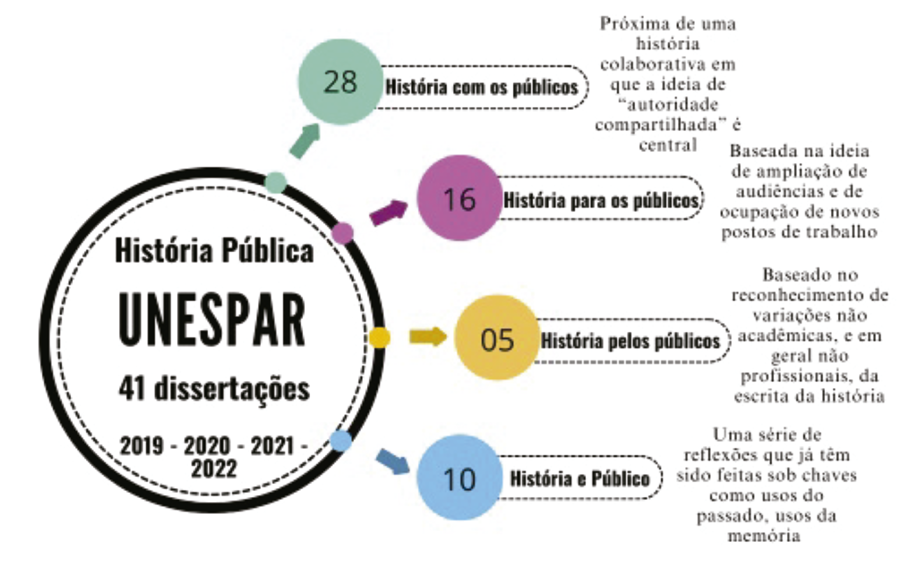 Fonte: Autores.