Redescription of Asolene meta (Caenogastropoda: Ampullariidae) from the São Francisco basin, Brazil
ABSTRACT
Ampullariids are freshwater snails distributed widely in tropical and subtropical regions of Asia, Africa, and the Americas. Asolene d’Orbigny, 1838, Felipponea Dall, 1919, Marisa Gray, 1824, and Pomacea Perry, 1810 constitute the New World genera. Despite their importance and wide distribution, the species limits are still confusing, especially in less studied genera such as Asolene. The original description of Asolene meta (Ihering, 1915) was based on a single shell, from the municipality of Barra, state of Bahia, northeast Brazil, but provided few characteristics to reliably distinguish it from congenerics. We redescribe A. meta based on topotypes and additional specimens from other localities of the São Francisco Basin, where this species is endemic. The combined characters of shell morphology (thick shell and wide and deep umbilicus), the respiratory siphon, and egg morphology (oviposition under water and non-calcareous eggs) confirmed A. meta as a valid species within Asolene. Key anatomical characters include, in males, a penis sheath with two accessory glands on the dorsal surface, one rugose apical and one smooth, a rounded internal basal gland, as well as one gland on the external basal surface; and in females, the pallial oviduct dominating the floor of the mantle cavity, a muscular, oval elongated seminal receptacle, two blind diverticula of the albumen gland and spiral lamellae on the capsule gland, embedded within a mass of parenchymal tissue, peach colored in live specimens. This is the first description of the internal anatomy of A. meta, the only species of the genus known to occur in northeast Brazil, extending from west of Bahia to Pernambuco.
KEYWORDS:
Apple snail; conchology; morphology; taxonomy
INTRODUCTION
Asolene d’Orbigny, 1838 belongs to Ampullariidae, freshwater snails distributed widely in tropical and subtropi cal regions of Asia, Africa, and the Americas. Along with three extant genera, Felipponea Dall, 1919, Marisa Gray, 1824, and Pomacea Perry, 1810, these constitute the New World clade, the more diverse of the two major lineages within the Ampullariidae (Hayes et al. 2009, 2015).
Ampullariids are often major constituents of native freshwater molluscan faunas and play important roles in food webs, as pathogen vectors, and as invasive agricultural pests when introduced (Cowie 2002, Strong et al. 2008, Joshi et al. 2017). However, a deep understanding of the various roles ampullariid species play in freshwater ecosystems is lacking because of persistent taxonomic confusion among the many species (Cazzaniga 2002, Hayes et al. 2012, Thiengo et al 2017, Barbosa et al. 2022). Such confusion exists primarily because the detailed morphology of most species is poorly known and their classification is still based solely on shell characters, which often exhibit considerable intraspecific variation (Cowie and Thiengo 2003, Thiengo et al. 2011, Cowie and Héros 2012, Cowie et al. 2015, 2017).
While several studies have focused on resolving some of this confusion among the more widespread species in Pomacea (Berthold 1991, Cowie and Thiengo 2003, Hayes et al. 2012, Barbosa et al. 2022, Ampuero and Ramirez 2023), less work has been done with the smaller and geographically restricted taxa in Asolene. Previous studies of Asolene spp. have examined a limited number of species individually and focused on shell characters and geographic distributions (e.g., Hylton-Scott 1958), internal anatomy (e.g., Tillier 1980), reproductive anatomy and egg characteristics (e.g., Bonetto and Ezcurra de Drago 1966, Martin 1984, 1987, 1988, Tiecher et al. 2013) and radulae (e.g., Martin and Negrete 2007). However, none has provided a full description of a single species within the context of a modern systematic framework such as that of Hayes et al. (2012).
Thiengo et al. (2011) reported seven South American species: Asolene platae (Maton, 1811), A. pulchella (Anton, 1838) and A. spixii (d’Orbigny, 1838) in northern Argentina, Uruguay, Paraguay, and southern Brazil; A. crassa (Swainson, 1823), A. granulosa (Sowerby, 1894) and A. petiti (Crosse, 1891) in Guyana, Suriname, French Guiana and northern Brazil and A. meta (Ihering, 1915) in northeastern Brazil.
However, the phylogenetic analysis of Hayes et al. (2009) and the preliminary morphological, anatomical, and genetic work of Léon et al. (2018) suggest that A. platae and A. pulchella may be conspecific. The need for taxonomic clarity is increased by the presence of several ampullariids, including Asolene spp., in the aquarium trade, which creates a high potential for inadvertent introduction outside of their native range (Smith 2006). Without a clear understanding of species identities, many introductions may go unnoticed, or remain difficult to control (Hayes et al. 2008).
Here we present an anatomical description of Asolene meta, based on topotypes and specimens from other localities throughout the São Francisco River Basin, Brazil, as the original description (Ihering 1915) was based on a single shell and did not include any anatomical information. In addition, we present a preliminary phylogenetic analysis of species of Asolene.
MATERIAL AND METHODS
Specimens examined include material deposited in the Coleção de Moluscos do Instituto Oswaldo Cruz (CMIOC; Mollusc Collection of the Institute Oswaldo Cruz, Rio de Janeiro, Brazil) and the Museu Nacional da Universidade Federal do Rio de Janeiro (MNRJ; National Museum of the Federal University of Rio de Janeiro, Rio de Janeiro, Brazil) (Table 1).
Seventy-seven specimens identified a priori by their shell characteristics as A. meta were collected in northeast Brazil from November 2006 to October 2012, including from the type locality, Barra, state of Bahia (Fig. 1). The snails were first relaxed in 0.06% Hypnol (Cristália, Brazil), removed from their shells and a piece of foot tissue was taken from each snail and stored in 96% ethanol for subsequent DNA extraction. The soft bodies were preserved in Railliet-Henry’s fixative (2% acetic acid, 5% formol, 0.6% NaCl) for analysis of gross anatomy, or Millonig Formalin (Carlson et al. 1973) for histological study of the penial sheath and oviduct. Specimens collected in Juazeiro and Casa Nova were heat-shocked to kill them prior to removal from the shell (Fukuda et al. 2008). All specimens analyzed are deposited in the CMIOC (Table 1).

Distribution of Asolene meta, with Brazil inset. Shaded area: range determined from sample site data; dashed line: range inferred based on habitat similarities. 1: Barra (Bahia); 2: Juazeiro (Bahia); 3: Casa Nova (Bahia); 4: Propriá (Sergipe); 5: Penedo (Alagoas).
Shells and opercula of 39 adult specimens were measured using a digital caliper (Fig. 2). For gross anatomy, the specimens were examined using a binocular microscope with camera lucida, and structural details were visualized with the aid of aqueous toluidine blue.

Shell (A) and operculum (B) measurements. (al) Aperture length, (aw) aperture width, (bw) body whorl, (ol) operculum length, (ow) operculum width, (tl) total length, (tw) total width.
For histology of the reproductive structures, the penial sheath of three males and the pallial oviduct of three females were dehydrated in ethanol and embedded in paraplast, sectioned at 5 µm, and stained with haematoxylin-eosin. For radula analysis, six individuals were dissected, and the radulae were extracted and prepared following Hayes et al. (2012). For ultrastructural analysis the samples were mounted on aluminum stubs, coated with a 20 nm layer of gold, and examined under a scanning electron microscope at 15 kV voltage (Jeol JSM 6390LV) at the Rudolf Barth Electron Microscopy Platform at the Institute Oswaldo Cruz.
Total genomic DNA (gDNA) was extracted from appro ximately 3 mm3 of foot tissue of four specimens of A. meta using the DNeasy Blood and Tissue kit (Qiagen) following Hayes et al. (2008).
A fragment of the mitochondrial cytochrome c oxidase subunit I gene (COI, ~700 bp) was amplified by the universal metazoan primers LCO1490 and HCO2198 (Folmer et al. 1994). Amplifications and the cycling parameters followed Hayes et al. (2009). The amplicons were subject to cycle sequencing in both directions with the BigDye Terminator v3.1 Cycle Sequencing kit (Applied Biosystems) and analyzed via capillary electrophoresis on the ABI 3730XL (Applied Biosystems) at the sequencing facility of the Fiocruz Technological Platform Network.
Contigs were assembled, examined for errors and ambiguities, and edited manually in Geneious Prime 2023.0.4 (http://www.geneious.com). Consensus sequences from Asolene meta and other species of Asolene, as well as Marisa, Pomacea, and Felipponea were retrieved from GenBank and aligned using the MUSCLE plugin (Edgar 2004) in Geneious Prime 2023.0.4.
Phylogenetic relationships were reconstructed using Maximum-Likelihood (ML) in PhyML 3.0 (Guindon et al. 2010) and Bayesian Inference (BI) in MrBayes 3.2 (Ronquist et al. 2012). The best-fit nucleotide substitution model for both was selected via the Bayesian Information Criterion (BIC) estimated using Smart Model Selection (SMS, Lefort et al. 2017) for ML and jModelTest v2.1.10 (Darriba et al. 2012) for BI. Node support was determined by the bootstrap (BS) over 1,000 resamplings for ML and by the posterior Bayesian probabilities (BPP) for BI. For the BI, the trees were sampled after manually removing the first 20% of trees as burn-in and the effective sample size estimates of truly independent samples were determined using the Tracer software, v. 1.7 (Rambaut et al. 2018) and were > 200, as is typical in phylogenetic analyses, indicating robustness of the sampling (Lanfear et al. 2016); and both trees were visualized in FigTree 1.4.4 (Rambaut 2012).
The software Molecular Evolutionary Genetics Analysis version 11 (MEGA, Tamura et al. 2021) was used to calculate Kimura-2-parameter (K2P, Kimura 1980) inter-specific genetic distances, and the application DeSigNate (Hütter et al. 2020) was used to detect the signature molecular characters and their positions diagnostic for each species.
TAXONOMY
Asolene d’Orbigny, 1838
Type species. Helix platae Maton, 1811, by subsequent designation of Gray (1847: 148).
Asolene d’Orbigny, 1838 [in 1835-1847]: 364.
Ampulloidea d’Orbigny, 1841 [in 1835-1847]: 379. New name for Asolene.
Ampulloides d’Orbigny, 1842 [in 1842-1853]: 1. Incorrect spelling of Ampulloidea d’Orbigny, 1841.
AsolenaHerrmannsen, 1846: 84. Incorrect spelling of Asolene d’Orbigny, 1838.
AmpullaroidesGray, 1847: 148. Incorrect spelling of Ampulloidea d’Orbigny, 1841.
Asolene meta (Ihering, 1915)
Ampullaria metaIhering, 1915: 12, figs 6, 7.
Pomacea meta (Ihering, 1915), Cowie and Thiengo 2003: 69.
Pomacea meta (Ihering, 1915), Simone 2006: 55, fig. 2.
Asolene meta (Ihering, 1915), Schilithz et al. 2013: 288.
Holotype: MNRJ 12861 (Fig. 3A).
Type locality: Barra, Bahia State, Brazil (Ihering 1915).
Description. Shell: Shell globose, thick, yellowish to brown with dark brown spiral bands variable in number and thickness, when present (Fig. 3). Ranging in size from 23 to 32 mm in adult shell height and 26 to 35 mm in adult shell width. Periostracum thick and yellowish. Shell comprising three to four rounded whorls, increasing rapidly in size. Spire low, with ratio of spire height to overall shell height ranging from 0.05 to 0.15; apex usually eroded. Body whorl rounded, ranging in height from 22 to 29 mm. Umbilicus deep and wide. Aperture oval, ranging in size from 10 to 23 mm in height and from 12 to 17 mm in width; inside of shell lip usually white.

Shells of Asolene meta: (A) Holotype (MNRJ 12861), (B) shell from Penedo, Alagoas, Brazil (CMIOC 5838), (C) shell from Barra, Bahia, Brazil (CMIOC 7742). Scale bars: 10 mm.
Operculum: Operculum corneous with concentric nucleus, thick, less flexible than that of Pomacea canaliculata (Lamarck, 1822), dark brown, tightly sealing aperture (Fig. 4); ranging in size from 14 to 20 mm in height and from 10 to 13 mm in width.

Operculum of Asolene meta from Barra, state of Bahia, Brazil: (A) male, (B) female. Scale bar: 5 mm.
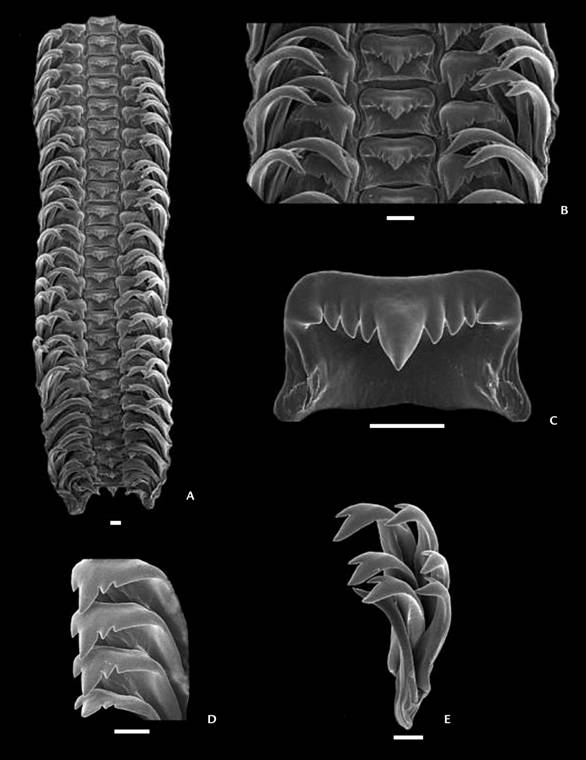
Radula: Radula taenioglossate, 3 to 6 mm long, 1 to 2 mm wide, with a mean of 32 rows (Fig. 5A-B). Rachidian rectangular with a concave base and lateral edges and apex convex, one prominent, sharply pointed, triangular central cusp, bounded by three to four minors sharply pointed, triangular denticles on each side (Fig. 5C). Lateral teeth with a long base, with four triangulate sharply pointed cusps, one major and three minor (Fig. 5D). Marginal teeth elongated with two sharply pointed cusps, one major and one minor (Fig. 5E).

Radular morphology of Asolene meta: (A, B) radula, (C) rachidian tooth, (D) lateral teeth, (E) marginal teeth. Scale bars: 100 µm.
Reno-pericardial system: Pericardium small, bounding base of mantle cavity at left. Auricle oval anterodorsal to ventricle, with thin walls; two veins, the branchial-pulmonary efferent vein and the efferent renal vein; connected to ventricle through atrioventricular valve. Ventricle quadrangular, larger than the auricle and denser; connected to bulbous aorta, which splits forming the anterior and posterior aortae. Ampulla voluminous, oval elongated, extending along floor of pericardial cavity (Fig. 6B). Siphon approximately half the size compared to Pomacea species, formed by two folds, the left end connects to the right end, thus forming an extendable cylindrical tube (Fig. 6B). Osphradium (Fig. 6A, C) anterior to lung and posterior to siphon, elongate oval, stalked, with bipectinate ridges on its anterior portion, following a single central crest with longitudinal ridges. Kidney formed by two interconnected chambers, anterior and posterior (Fig. 6D), communicating via small aperture at anterior left of posterior chamber. Anterior chamber located at mantle roof below ctenidium, dense, wider than long, with rounded borders, smaller than posterior chamber; excretory tissue forming two unequal sets of lamellae occupying entire lumen, regularly arranged transversely on both sides of anterior afferent renal vein; posterior set of lamellae overhanging broad nephropore. Nephridial gland absent. Posterior chamber located superficially on visceral mass, above sets of loops of intestine, elongate, larger and thinner than anterior chamber; internal lamellae spaced irregularly along two branches of two major veins, the renal afferent vein and posterior renal efferent vein; posterior afferent renal vein longer than the anterior afferent renal vein, following the central region of the posterior chamber with numerous branches along its length; efferent renal vein along left of posterior afferent renal vein, subdivided into numerous branches.

External morphology of Asolene meta: (A) dorsal view, (B) left side view, (C) osphradium, (D) kidney.(ak) Anterior kidney, (amp) ampulla, (au) auricle, (cm) columellar muscle, (ct) ctenidium, (dg) digestive gland, (f) foot, (int) intestine, (lp) labial palp, (ls) lung sac, (me) mantle edge, (nl) nuchal lobe, (ov) ovary, (os) osphradium, (pc) pyloric caecae, (per) pericardium, (pg) pedal gland, (pk) posterior kidney, (pn) pneumostome, (rg) rectal gland, (rt) rectum, (si) siphon, (ss) style sac, (sto) stomach, (t) tentacle, (v) ventricle. Scale bars: 10 mm (A, B), 1 mm (C), 5 mm (D).
Reproductive system (male): Testis voluminous, cream colored, occupying the anterior three whorls of the spire, surrounding digestive gland; thin vas deferens emerging ventrally from testis, continuing along ventral midline of whorl, until entering the rounded seminal vesicle at base of mantle cavity; seminal vesicle separated from the prostate by a small constriction; prostate cylindrical and compact, following along the rectum on the right side of the mantle cavity; anterior end of prostate crossing over rectum, connecting to rounded, muscular penis bulb; wall of penis bulb thinning anteriorly, forming thin-walled penis pouch at right of penis bulb, containing the coiled, whip-like penis when retracted; penis pouch opening to medial channel on the dorsal surface of penis sheath, allowing passage of penis during copulation (Fig. 7A). Penis long and cylindrical with the diameter gradually decreasing from the base to the apex, formed by a simple epithelium with cubic cells and an extensive layer of muscular fibers; spermatic channel closed (Fig. 7B-D). Penis sheath curved to the right, broad-based with width decreasing gradually from base to apex; medial channel at ventral surface of penis sheath, formed by two folds, the left overlapping the right one, starting at base of penis sheath and extending to almost the apical gland; penis sheath with two accessory glands on ventral surface-one apical and one basal-and one gland on dorsal surface; apical gland with rugose surface formed by tall, prismatic epithelium cells, occupying distal one quarter of penis sheath ventral surface (Fig. 7E, F); internal basal gland, smooth and rounded, at right side of penis sheath near medial channel; basal dorsal gland occupying proximal third of sheath base (Fig. 7G), formed by conjunctive tissue consisting of rounded to oval cells, numerous ducts and a central duct, surrounded by acini, single pore opening externally (Fig. 7H).

Male reproductive morphology of Asolene meta: (A) overall system, (B) penis, (C, D) penis histology, (E) penis sheath ventral view, (F) apical penis sheath gland, (G) penis sheath dorsal view, (H) ventral basal gland.(ag) Apical gland, (bg) basal gland, (ct) ctenidium, (me) mantle edge, (mc) medial channel, (pe) penis, (pp) penis pouch, (pr) prostate, (ps) penis sheath, (sc) spermatic channel, (sv) seminal vesicle, (te) testis, (vd) vas deferens, (vbg) ventral basal gland. Scale bars: 10 mm (A), 1 mm (B), 500 µm (C), 100 µm (D, F, H), 1 mm (E, G).
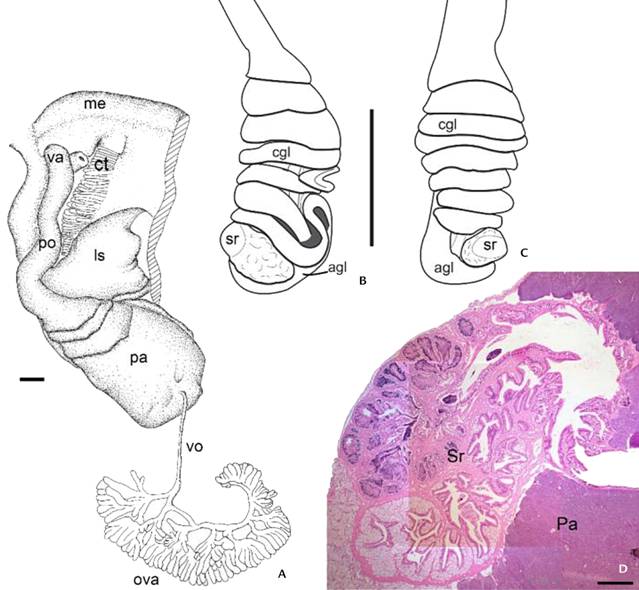
Reproductive system (female): Ovary arborescent occupying similar position to the testis in males, formed by numerous diverticula embedded in the digestive gland; diverticula connected to one another, forming three to four branches that merge into the thin visceral oviduct, extending through the floor of mantle cavity, connecting to seminal receptacle. Pallial oviduct dominating floor of mantle cavity, comprising muscular, oval elongated seminal receptacle, two blind diverticula of albumen gland and spiral lamellae of capsule gland, embedded within a mass of parenchymal tissue, peach colored in live specimens (Fig. 8A-D); copulatory bursa lacking; seminal receptacle lies transversely to pallial oviduct, exposed at the surface of parenchymal mass, with highly convoluted lumen bearing orientated sperm (Fig. 8D); posterior end of seminal receptacle abruptly turning to left into a thin channel; albumen gland flattened forming two concave diverticula extending around periphery, one diverticulum anterodorsally at left and the other posteriorly at right, forming a U-shaped curve to connect to capsule gland; capsule gland completing three revolutions coiling counterclockwise, doubling back and completing four clockwise revolutions, with three of these emerging from parenchymal tissue, to connect with elongate, voluminous vagina; vagina narrowing anteriorly, communicating to mantle cavity via small opening adjacent to rectum (Fig. 8A).

Female reproductive morphology of Asolene meta: (A) overall system, (B) pallial oviduct dorsal view, (C) pallial oviduct ventral view, (D) histology of seminal receptacle. (agl) Albumen gland, (cgl) capsule gland, (ct) ctenidium, (ls) lung sac, (me) mantle edge, (pa) parenchymal tissue, (po) pallial oviduct, (sr) seminal receptacle, (ova) ovary, (va) vagina, (vo) visceral oviduct. Scale bars: 1 mm (A), 5 mm (B, C), 20 µm (D).
Eggs: Eggs non calcareous, rounded, unpigmented, becoming more translucent before hatching, allowing visualization of juveniles inside eggs; laid under water, on submerged vegetation embedded in gelatinous mass (Fig. 9); one clutch of 72 eggs was recovered in the laboratory; eggs 3.5 to 4.0 mm in diameter; 44 juveniles hatched approximately nine days after clutch was laid.

Egg mass of Asolene meta laid in the laboratory by an adult snail from Barra, state of Bahia, Brazil. Scale bar: 10 mm.
Biogeography: Asolene meta is native to northeast Brazil, in the Rio São Francisco Basin, from west of Bahia to Pernambuco. We expect that its range may extend south-west of Bahia (Fig. 1).
Phylogenetic analysis: The topologies of the ML and BI trees are almost identical. We choose to show the ML tree, on which the BPP values are included for those clades recovered in both phylogenies (Fig. 10). The COI gene was sequenced from four individuals from the type locality of A. meta, which were identical and for this reason, we chose to use one of them for this study. The complete matrix included 18 sequences from eight species and lengths from 573 to 657 bp including missing data. Both phylogenetic trees recovered A. meta in a well-resolved and strongly supported clade of other Asolene species (Fig. 10). However, in the BI phylogeny a single specific sister species to A. meta was not recovered, while in the ML tree a clade of A. platae and A. pulchella with low support was recovered as sister to A. meta, with low node support for the three-species clade. The complete alignment contained 120 parsimoniously informative sites, including 51 between A. meta and A. platae-pulchella, 31 between A. meta and A. spixii, and 39 between A. spixii and A. platae-pulchella. This entire Asolene clade was sister to Felipponea iheringi (Pilsbry, 1933). The mean K2P interspecific distance between A. meta and A. spixii was 5.38 ± 0.29% (5.18-5.88%) and 7.02 ± 0.51% (6.12-7.93%) between A. meta and A. platae-pulchella. We detected through the DeSigNate analysis 15 binary and 1 asymmetric molecular character between A. meta and A. platae-pulchella/A. spixii (Table 2).

Phylogenetic tree obtained from Maximum likelihood topology for New World genera of Ampullariidae using the MT-COI gene demonstrating the position of Asolene meta among Asolene species. Sequences from Asolene meta were obtained in this study and all the other sequences were retrieved from GenBank. Node values are bootstrap (BS) from the Maximum likelihood analysis and Bayesian Posterior Probability (BPP) from the Bayesian inference analysis. *MT-COI sequence generated from the sample from this study.
The 15 binary and 1* asymmetric molecular diagnostic characters for Asolene meta and Asolene pulchella-platae/Asolene spixii determined by DeSigNate.
DISCUSSION
Asolene meta was first described by Ihering (1915) in Ampullaria Lamarck, 1799, often used at that time in the lite rature to refer to species now placed in Pomacea, although Ampullaria is in fact a junior objective synonym of Pila Röding, 1798 (Cowie 1997, ICZN 1999, Cowie and Thiengo 2003), an Old World genus of Ampullariidae. Our analysis showed that A. meta formed a monophyletic group with the other Asolene species, as a distinct species. In addition, there were clear molecular diagnostic characters and the genetic K2P distances were high, reaching values similar to that between the sister species Pomacea sordida (Swainson, 1823) and Pomacea intermedia (Férussac in Quoy & Gaimard, 1825) (Barbosa et al. 2022), as well as only slightly less than that between the clearly distinct species Pomacea maculata Perry, 1810 and P. canaliculata (Hayes et al. 2012). Based on shell morphology (thick shell and wide and deep umbilicus), the lack of sexual dimorphism in shell shape, the shape of the kidney, the ampulla, only slightly extensible respiratory siphon and egg morphology (oviposition under water and non-calcareous eggs), all previously described as characte ristics of Asolene (Thiele 1929, Hylton-Scott 1958, Tillier 1980, Thiengo 1995), we confirm the generic placement of A. meta in Asolene previously reported by Schilithz et al. (2013).
Radula morphology of A. meta exhibited no intraspecific variation. Comparatively, it seems similar to that of A. platae, studied by Martin and Negrete (2007), who proposed that radula characters can be used to differentiate species of Pomacea and to distinguish them from species of the other genera studied, Asolene and Felipponea. Hayes et al. (2012) suggested that the base of the rachidian tooth differed between P. maculata and P. canaliculata. However, the apparent similarity between A. meta and A. platae suggests a lack of interspecific radula variation within Asolene. Additional comparative studies are needed to investigate these possible patterns.
The shape of the penis sheath and position of the associated glands of A. meta are very similar to those of A. platae (Martin 1984), A. granulosa, and A. crassa (Tillier 1980), although the shape of the glands on the dorsal surface appears to differ among these species. Further comparative studies are needed to verify the variation in penis sheaths among Asolene species and its taxonomic value both within Asolene and between Asolene and other ampullariid genera.
As for the female morphology, A. meta lacked the copulatory bursa seen in P. maculata and P. canaliculata (Hayes et al. 2012). A similar condition in A. meta has been observed in A. spixii and A. platae (K.A. Hayes personal communication), suggesting that this condition may be shared among Asolene species.
The eggs of A. meta are rounded, non-calcareous, unpigmented, and deposited under water in a gelatinous mass. They are similar to those of A. platae, which differ only in being yellowish rather than unpigmented (Tiecher et al. 2013, A. platae misidentified as A. pulchella). However, this information for A. pulchella may refer to A. platae, as A. platae and A. pulchella may be conspecific, based on the analyses of Hayes et al. (2009), and on the preliminary work of Léon et al. (2018). However, the taxonomic differentiation of A. platae and A. pulchella and the identification of a single sister species for A. meta are beyond of the scope of the present study.
Asolene meta is restricted to the São Francisco basin and is the only species of Asolene known to occur in northeast Brazil. The São Francisco basin occupies an area of 639 km2, divided into four regions: Upper, Middle, Submiddle and Lower São Francisco, distinct ecologically and biogeographically (cbhsaofrancisco.org.br). We found A. meta in the Submiddle and Lower São Francisco, but based on the geographic similarities, we expect it to occur in the Middle São Francisco, southwest of Bahia.
This is the first anatomical description of Asolene meta and additional comparative studies with congeneric species are needed in order to expand taxonomic knowledge of the genus and of Neotropical ampullariids in general.
ACKNOWLEDGEMENTS
We thank Marta Chagas Pinto, technician in the Labo ratório de Malacologia do Instituto Oswaldo Cruz/Fiocruz, for helping us with maintenance of the specimens; Sonia Barbosa dos Santos and colleagues of the Laboratório de Malacologia Límnica e Terrestre of the Universidade do Estado do Rio de Janeiro for donating the specimens of Asolene meta from Juazeiro and Casa Nova; Suzana Amato and her students at the Universidade Federal do Rio Grande do Sul and Aecio Dantas and his colleagues at Secretaria Estadual de Saúde da Bahia for helpful support during the field work. We are grateful to Kenneth A. Hayes for comments on this paper. We also thank the Coordenação de Aperfeiçoamento de Pessoal do Nível Superior (CAPES finance code 001) and United States National Science Foundation (grant number DEB 0949061) for financial support.
LITERATURE CITED
-
Ampuero A, Ramirez R (2023) Description of two new species of apple snail (Ampullariidae: Pomacea) from Peruvian Amazonia. Zootaxa 5258(1): 76-98. https://doi.org/10.11646/zootaxa.5258.1.3
» https://doi.org/10.11646/zootaxa.5258.1.3 -
Barbosa KP, Hayes KA, Vilela RDV, Barbosa HS, Marchi CR, Thiengo SC (2022) Phylogenetic systematics and distribution of Pomacea sordida (Swainson, 1823) and Pomacea intermedia (Férussac in Quoy & Gaimard, 1825) (Caenogastropoda: Ampullariidae). Malacologia 65(1-2): 1-23. https://doi.org/10.4002/040.065.0101
» https://doi.org/10.4002/040.065.0101 - Berthold T (1991) Vergleichende Anatomie, Phylogenie und historische Biogeographie der Ampullariidae (Mollusca, Gastropoda). Abhandlungen des Naturwissenschaftlichen Vereins in Hamburg (n.f.) 29: 1-256.
- Bonetto AA, Ezcurra de Drago I (1966) Notas Malacológicas IV. 1) Moluscos Paranenses en aguas Uruguayas y del Sur de Brasil. 2) Notas sobre desoves de algunos gasteropódos dulceacuícolas. Physis 26: 121-127.
- Carlson FL, Martin JH, Lynn JA (1973) Formalin fixation for electron microscopy. American Journal of Clinical Pathology 59: 365-373.
- Cazzaniga NJ (2002) Minireview: old species and new concepts in the taxonomy of Pomacea (Gastropoda: Ampullariidae). Biocell 26(1): 71-81.
- Cowie RH (1997) Case 2996. Pila Röding, 1798 and Pomacea Perry, 1810 (Mollusca, Gastropoda): proposed placement on the Official List, and Ampullariidae Gray, 1824: proposed confirmation as the nomenclaturally valid synonym of Pilidae Preston, 1915. Bulletin of Zoological Nomenclature 54(2): 83-88.
- Cowie RH (2002) Apple snails (Ampullariidae) as agricultural pests: their biology, impacts and management. In: Barker GM (Ed.) Molluscs as Crop Pests. CABI Publishing, Wallingford, 145-192.
- Cowie RH, Thiengo SC (2003) The apple snails of the Americas (Mollusca: Gastropoda: Ampullariidae: Asolene, Felipponea, Marisa, Pomacea, Pomella): a nomenclatural and type catalog. Malacologia 45: 41-100.
-
Cowie RH, Héros V (2012) Annotated catalogue of the types of Ampullariidae (Mollusca, Gastropoda) in the Muséum national d’Histoire naturelle, Paris, with lectotype designations. Zoosystema 34(4): 793-824. https://doi.org/10.5252/z2012n4a8
» https://doi.org/10.5252/z2012n4a8 - Cowie RH, Hayes KA, Strong EE (2015) Types of Ampullariidae (Mollusca: Gastropoda) in the U.S. National Museum of Natural History, Smithsonian Institution, with lectotype designations. Smithsonian Contributions to Zoology 645: 1-13.
-
Cowie RH, Strong EE, Rosenberg G, Hayes KA (2017) Types of Ampullariidae (Mollusca: Gastropoda) in the Academy of Natural Sciences of Philadelphia. Proceedings of the Academy of Natural Sciences of Philadelphia 165(1): 175-194. https://doi.org/10.1635/053.165.0110
» https://doi.org/10.1635/053.165.0110 - Darriba D, Taboada GL, Doallo R, Posada D (2012) jModelTest 2: more models, new heuristics and high-performance computing. Nature Methods 9(8): 772.
- d’Orbigny A (1835-1847) Voyage dans l’Amérique Méridionale (le Brésil, la république orientale de l’Uruguay, la république Argentine, la Patagonie, la république du Chili, la république de Bolivia, la république du Pérou), exécuté pendant les années 1826, 1827, 1828, 1829, 1839, 1831, 1832 et 1833. Tome cinquième. 3.e partie: mollusques. P Bertrand, Paris; V.e Levrault, Strasbourg, 758 pp.
- d’Orbigny A (1842-1853) Mollusques. Tome second. In: de la Sagra R (Ed.) Histoire physique, politique et naturelle de l’ile de Cuba. Arthus Bertrand, Paris, 1-380.
- Edgar RC (2004) MUSCLE: multiple sequence alignment with high accuracy and high throughput. Nucleic Acids Research 32(5): 1792-1797.
- Folmer O, Black M, Hoeh M, Lutz R, Vrijenhoek R (1994) DNA primers for amplification of mitochondrial cytochrome c oxidase subunit I from diverse metazoan invertebrates. Molecular Marine Biology and Biotechnology 3(5): 294-299.
- Fukuda H, Haga T, Tatara Y (2008) Niku-nuki: a useful method for anatomical and DNA studies on shell-bearing molluscs. Zoosymposia 1: 15-38.
- Gray JE (1847) A list of the genera of Recent Mollusca, their synonyma and types. Proceedings of the Zoological Society of London 15: 129-219.
- Guindon S, Dufayard JF, Lefort V, Anisimova M, Hordijk W, Gascuel O (2010) New algorithms and methods to estimate maximum-likelihood phylogenies: assessing the performance of PhyML 3.0. Systematic Biology 59(3): 307-321.
-
Hayes KA, Joshi RC, Thiengo SC, Cowie RH (2008) Out of South America: multiple origins of non-native apple snails in Asia. Diversity and Distributions 14(4): 701-712. https://doi.org/10.1111/j.1472-4642.2008.00483.x
» https://doi.org/10.1111/j.1472-4642.2008.00483.x -
Hayes KA, Cowie RH, Thiengo SC (2009) A global phylogeny of apple snails: Gondwanan origin, generic relationships, and the influence of outgroup choice (Caenogastropoda: Ampullariidae). Biological Journal of the Linnean Society 98: 61-76. https://doi.org/10.1111/j.1095-8312.2009.01246.x
» https://doi.org/10.1111/j.1095-8312.2009.01246.x -
Hayes KA, Cowie RH, Thiengo SC, Strong EE (2012) Comparing apples to apples: clarifying the identities of two highly invasive Neotropical Ampullariidae (Caenogastropoda). Zoological Journal of the Linnean Society 166: 723-753. https://doi.org/10.1111/j.1096-3642.2012.00867.x
» https://doi.org/10.1111/j.1096-3642.2012.00867.x -
Hayes KA, Burks RL, Castro-Vazquez A, Darby PC, Heras H, Martín PR, et al. (2015) Insights from an integrated view of the biology of apple snails (Caenogastropoda: Ampullariidae). Malacologia 58(1-2): 245-302. https://doi.org/10.4002/040.058.0209
» https://doi.org/10.4002/040.058.0209 - Herrmannsen AN (1846-1849) Indicis generum malacozoorum primordia. Nomina subgenerum, generum, familiarum, tribuum, ordinum, classium; adjectis auctoribus, temporibus, locis systematicis, atque literariis, etymis, synonymis. Praetermittuntur cirripedia, Tunicata et Rhizopoda. T. Fischer, Cassellis, vol. 1, 637 pp.
-
Hütter T, Ganser MH, Kocher M, Halkic M, Agatha S, Augsten N (2020) DeSignate: detecting signature characters in gene sequence alignments for taxon diagnoses. BMC Bioinformatics 21(151): 1-9. https://doi.org/10.1186/s12859-020-3498-6
» https://doi.org/10.1186/s12859-020-3498-6 - Hylton-Scott M (1958) Estudio morfológico y taxonómico de los ampulláridos de la República Argentina. Revista del Museo Argentino de Ciencias Naturales “Bernardino Rivadavia” e Instituto Nacional de Investigación de las Ciencias Naturales Ciencias Zoológicas 3: 231-333.
- ICZN (1999) Opinion 1913. Pila Röding, 1798 and Pomacea Perry, 1810 (Mollusca, Gastropoda): placed on the Official List, and Ampullariidae Gray, 1824: confirmed as the nomenclaturally valid synonym of Pilidae Preston, 1915. Bulletin of Zoological Nomencalature 56(1): 74-76.
- Ihering HV (1915) Annexo N. 5. Molluscos. Commissão de Linhas Telegraphicas Estrategicas de Matto-Grosso ao Amazonas, Rio de Janeiro, 14 pp.
- Joshi RC, Cowie RH, Sebastian LS (2017) Biology and Management of Invasive Apple Snails. Philippine Rice Research Institute (PhilRice), Muñoz, 405 pp.
- Kimura M (1980) A simple method for estimating evolutionary rates of base substitutions through comparative studies of nucleotide sequences. Journal of Molecular Evolution 16: 111-120.
- Lanfear R, Hua X, Warren DL (2016) Estimating the effective sample size of tree topologies from Bayesian phylogenetic analyses. Genome Biology and Evolution 8(8): 2319-2332.
- Lefort V, Longueville JE, Gascuel O (2017) SMS: smart model selection in PhyML. Molecular Biology and Evolution 34(9): 2422-2424.
- Léon JA, Hayes KA, Cowie RH (2018) Ampullariidae revisionary systematics: claryifying the taxanomic status of Asolene platae (Maton, 1811) and Asolene pulchella (Anton, 1838). The Western Society of Malacologists Annual Report 47: 81-82.
- Martin SM (1984) Estudio del complejo penial de Asolene platae (Maton) (Mollusca: Prosobranchia, Ampullariidae). Neotropica 30: 107-110.
- Martin SM (1987) Ciclo reprodutivo de Asolene (A.) platae Maton (Gastropoda: Ampullariidae) del Arroyo Miguelin (Punta Lara, Buenos Aires). Neotropica 33: 19-28.
- Martin SM (1988) Morfologia genital de Asolene (Asolene) platae Maton (Mollusca: Gastropoda: Ampullariidae). Revista de La Asociacion de Ciencias Naturales del Litoral 19: 209-213.
-
Martin SM, Negrete LHL (2007) Radular ultrasctructure of South American Ampullariidae (Gastropoda: Prosobranchia). Brazilian Journal of Biology 67: 721-726. https://doi.org/10.1590/S1519-69842007000400019
» https://doi.org/10.1590/S1519-69842007000400019 -
Rambaut A (2012) FigTree: tree figure drawing tool version 1.4.4. http://tree.bio.ed.ac.uk/software/figtree/ [Accessed: 03/2024]
» http://tree.bio.ed.ac.uk/software/figtree/ -
Rambaut A, Drummond AJ, Xie D, Baele G, Suchard MA (2018) Posterior summarization in Bayesian phylogenetics using Tracer 1.7. Systematic Biology 67(5): 901-904. https://doi.org/10.1093/sysbio/syy032
» https://doi.org/10.1093/sysbio/syy032 -
Ronquist F, Teslenko M, Van Der Mark P, Ayres DL, Darling A, Ohna SH, et al. (2012) MrBayes 3.2: efficient Bayesian phylogenetic inference and model choice across a large model space. Systematics and Evolution 61(3): 539-542. https://doi.org/10.1093/sysbio/sys029
» https://doi.org/10.1093/sysbio/sys029 - Schilithz AG, Hayes KA, Cowie RH, Thiengo SC (2013) Taxonomy of Asolene meta (Ihering, 1915) and Asolene spixii (d’Orbigny, 1838) (Caenogastropoda: Ampullariidae) from Brazil. In: Martins de Frias A (Ed.) World Congress of Malacology 2013, Ponta Delgada, Portugal, July 2013, Sociedade Afonso Chaves Publishers. Açoreana (Suppl. 8): 288-289.
- Simone LRL (2006) Land and Freshwater Molluscs of Brazil. EGB, Fapesp, São Paulo, 390 pp.
- Smith JW (2006) Ampullariidae pathways. In: Joshi RC, Sebastian LS (Eds) Global Advances in ecology and management of golden apple snails. Philippine Rice Research Institute (PhilRice), Muñoz, 113-120.
-
Strong EE, Gargominy O, Ponder WF, Bouchet P (2008) Global diversity of gastropods (Gastropoda; Mollusca) in freshwater. In: Balian EV, Lévêque C, Segers H, Martens K (Eds) Freshwater Animal Diversity Assessment. Springer, Dordrecht, Developments in Hydrobiology, vol. 198, 149-166. https://doi.org/10.1007/978-1-4020-8259-7_17
» https://doi.org/10.1007/978-1-4020-8259-7_17 -
Tamura K, Stecher G, Kumar S (2021) MEGA11: Molecular Evolutionary Genetics Analysis version 11. Molecular Biology and Evolution 38(7): 3022-3027. https://doi.org/10.1093/molbev/msab120
» https://doi.org/10.1093/molbev/msab120 - Thiele J (1929) Handbuch der Systematischen Weichtierkunde. Erster Band. Erster Teil. Gustav Fischer, Jena, 376 pp.
- Thiengo SC (1995) Família Pilidae Connoly [sic], 1927 (Ampullariidae Gray, 1824). In: Barbosa FS (Ed.) Tópicos em Malacologia Médica. Editora Fiocruz, Rio de Janeiro, 50-69.
- Thiengo SC, Hayes KA, Mattos AC, Fernandez MA, Cowie RH (2011) Família Ampullariidae no Brasil: aspectos morfológicos, biológicos e taxonômicos. In: Tópicos em Malacologia. Ecos do XIX Encontro Brasileiro de Malacologia. FAPERJ, Sociedade Brasileira de Malacologia, Rio de Janeiro, 95-111.
- Thiengo SC, Fernandez MA, Pimpão DM (2017) Diversity of Amazon Ampullariidae (Mollusca; Caenogastropoda). In: Sant’Anna BS, Hattori GY (Eds) Amazonian Apple Snails. Nova Science Publishers, New York, 1-20.
-
Tiecher MJ, Burela S, Martín PR (2013) Mating behavior, egg laying, and embryonic development in the South American apple snail Asolene pulchella (Ampullariidae, Caenogastropoda). Invertebrate Reproduction & Development 58(1): 13-22. https://doi.org/10.1080/07924259.2013.793624
» https://doi.org/10.1080/07924259.2013.793624 - Tillier S (1980) Gastéropodes terrestres et fluviatiles de Guyane Française. Mémoires du Muséum national d’Histoire naturelle 118: 1-18.
ADDITIONAL NOTES
-
Funding
Coordenação de Aperfeiçoamento de Pessoal do Nível Superior (CAPES finance code 001) United States National Science Foundation (grant number DEB0949061). Coordenação de Aperfeiçoamento de Pessoal do Nível Superior (CAPES finance code 001) and United States National Science Foundation (grant number DEB 0949061) for financial support.
- ZooBank register
-
How to cite this article
Schilithz AG, Barbosa KP, Cowie RH, Mota EM, Barbosa HS, Thiengo SC (2025) Redescription of Asolene meta (Caenogastropoda: Ampullariidae) from the São Francisco basin, Brazil. Zoologia 42: e24034. https://doi.org/10.1590/S1984-4689.v42.e24034
-
Published by
Sociedade Brasileira de Zoologia at Scientific Electronic Library Online - https://www.scielo.br/zool