South American species of Chyliza (Diptera: Psilidae): descriptions of eight new species, a new synonymy, and an identification key
ABSTRACT
The South American species of Chyliza Fallén are revised. As a result, eight new species are described and illustrated: Chyliza bella sp. nov., C. curta sp. nov., C. falciformis sp. nov., C. linearis sp. nov., C. spinescens sp. nov., C. spuria sp. nov., C. triangularis sp. nov., and C. zebrina sp. nov. In addition, C. rubronigra Albuquerque, 1957 is synonymized with Chyliza angrensis Albuquerque, 1957; the male of C. consanguinea Schiner, 1868 is described for the first time; C. consanguinea and C. angrensis Albuquerque, 1957 are redescribed, including descriptions and illustrations of their terminalia; and C. compedita Wiedemann, 1830 is recharacterized. An identification key to males is provided for all 11 South American species currently included in the genus.
KEYWORDS
Chylizinae; Neotropical Region; taxonomy
INTRODUCTION
Psilidae are distributed worldwide but are predominantly Holarctic. The family includes seven genera and approximately 340 species (Shatalkin and Merz 2010). Three subfamilies are recognized: Belobackenbardiinae Shatalkin, from South Africa; Chylizinae Rondani, distributed worldwide but mainly in the Oriental and Afrotropical regions; and Psilinae Macquart, which is mainly Holarctic (Shatalkin 2002, 2021, Freidberg and Shatalkin 2008).
The Psilidae fauna of the Neotropical Region is poorly known and appears to be poorly diversified, with approximately 12 species and only three genera recorded: Chyliza Fallén, Loxocera Meigen, and Psila Meigen (Prado 1975, Buck 2010). Chylizinae is the only subfamily recorded for South America.
Chyliza is most diverse in the Afrotropical and Oriental regions and is the largest genus in Psilidae, comprising 118 species (Freidberg and Shatalkin 2008, Shatalkin 2021).
The most recent publication on Chyliza in the Neotropical Region (Albuquerque 1957) described two species from Brazil and redescribed C. consanguinea Schiner, 1868. Currently, eight Neotropical species of Chyliza are known, four of which are recorded from South America: C. consanguinea, C. angrensis Albuquerque, 1957, C. compedita Wiedemann, 1830, and C. rubronigra Albuquerque, 1957 (Prado 1975). In this study, eight new species of Chyliza from South America are described, C. rubronigra is synonymized with C. angrensis, the male of C. consanguinea is described for the first time, C. consanguinea and C. angrensis are redescribed, C. compedita is recharacterized, and an identification key for the South American species is provided.
MATERIAL AND METHODS
This study was based on the following collections: INPA - Instituto Nacional de Pesquisas da Amazônia, Manaus, Amazonas, Brazil; MPEG - Museu Paraense Emílio Goeldi, Belém, Pará, Brazil; CZMA - Coleção Zoológica do Maranhão, Caxias, Maranhão, Brazil; NMNH - Smithsonian National Museum of Natural History, Washington, D.C., USA; MNRJ - Museu Nacional do Rio de Janeiro, Rio de Janeiro, Brazil; MZUSP - Museu de Zoologia da Universidade de São Paulo, São Paulo, Brazil; DZUP - Coleção Entomológica Padre Jesus Santiago Moure, Curitiba, Paraná, Brazil; NHMW - Naturhistorisches Museum Wien, Vienna, Austria; MUSM - Museo de Historia Natural, Universidad Nacional Mayor de San Marcos, Lima, Peru.
For analysis and illustration, the abdomen was detached from the rest of the body, macerated in hot 85% lactic acid, and then the terminalia were removed. The parts were stored in microvials with glycerin and pinned together with their respective specimens.
For label data of type material, all information is given exactly as written on the labels. Information within square brackets ([ ]) indicates additional data not present on the specimen labels. An asterisk (*) is used to indicate new records.
Specimens were photographed with a Leica MC170 HD camera attached to a Leica M165C stereomicroscope. Multiple images were stacked and combined using Leica Application Suite V4.11. Distribution maps were created with QGIS (version 3.24; QGIS Development Team 2016) using geographical coordinates from specimen labels and literature.
Two head ratios used in the descriptions are defined below (all ratios were measured from the holotype): (1) Frontal Height-Width ratio (FHW) - height of the frons measured from the anterior margin to the vertex, divided by the width of the frons measured at mid-height; (2) Frontal Index (FI) (Shatalkin 2014) - the ratio between the height of the frons measured from the ventral margin to the posterior ocellus, and from the posterior ocellus to the vertex.
Morphological terminology follows Cumming and Wood (2017), and the interpretation of structures in male genitalia follows Shatalkin (2021).
The holotypes of C. angrensis and C. rubronigra were not examined directly and were instead assessed using photographs provided by the MNRJ. The photographs, original descriptions, and illustrations made it possible to identify other non-type specimens. A specimen misidentified as C. consanguinea by Albuquerque (1957), deposited at the MNRJ, was also studied through photographs. All specimens of Psilidae housed in the MNRJ, including types and non-types, were destroyed in the fire of September 2, 2018. The holotype of Chyliza compedita is housed in the Zoological Museum, University of Copenhagen; type information was taken from photographs available on the museum’s website.
TAXONOMY
Chyliza Fallén, 1820
ChylizaFallén, 1820: 6. Type species Musca leptogaster Panzer, 1798 (by subsequent designation of Westwood 1840: 14).
TetradiscusBigot, 1886: 370. Type species Tetradiscus pictusBigot, 1886 (by subsequent designation of Coquillett 1910: 613 = Chyliza apicalis Loew, 1860).
Diagnosis. Posterior margin of eye indented on lower 1/2; posterior portion of head strongly appressed to thorax; face receding below antennae in profile, forming an angle at anterior margin of subcranial cavity; anatergite strongly bulging and densely pubescent; metathorax with a narrow sclerotized postmetacoxal bridge posterior to hind coxae; six distinct scutellar setae, basal pair often minute; hind femur with a shallow, tomentose, ventrodistal, oval sensorial pit; wing cell cua (anal cell) distinctly shorter than bm; male sternite 6 well developed, with spinules; surstyli present; hypandrium with a pair of lateral lobes (hypandrial apodemes), hypandrial arms fused posterodorsally forming a hypandrial bridge around phallapodeme; subepandrial sclerite developed; phallapodeme developed, rod-like, divided posteriorly into two lobes (phallapodemic arms) laterally articulated with phallus, caudal third concave ventrally, attached ventrally to hypandrial arm by a weakly sclerotized membrane; distiphallus with a pair of lobes; pregonite thin, band-like; postgonite developed or reduced; female abdomen with sternite 6 poorly discerned, forming a small plate; epiproct, hypoproct, and cerci not fused with each other; spermathecae sac-like (Buck and Marshall 2006, Freidberg and Shatalkin 2008, Buck 2010, Ovtshinnikova et al. 2015, Lonsdale 2020, Shatalkin 2021).
Distribution. Chyliza occurs in all biogeographical regions except Antarctica and is the most diverse genus of Psilidae in the Neotropical Region.
Remarks. Chyliza is the only genus of Chylizinae and the sister group of Psilinae (Lonsdale 2020, Zhou and Yang 2022). Analyses based on morphological (Lonsdale 2020) and molecular data (Zhou and Yang 2022) have recovered it as a monophyletic group.
Biology. The larvae are phytophagous (Steyskal 1987, Iwasa 1989), feeding on various plant species belonging to at least ten families of angiosperms and gymnosperms (Sueyoshi 2013). The egg of Chyliza consanguinea was described by Albuquerque (1957).
Key to South American species of Chyliza (males)
-
1. Pleuron dark brown to black except for yellow proepimeron, proepisternum, and a broad vertical yellow band extending from notopleuron to ventral margin of katepisternum, giving the pleura a striped appearance (Figs 36, 72) .......... 2
-
1’. Pleuron dark brown to black, sometimes katepisternum with a small yellow spot (Figs 48, 96) .......... 4
-
2. Scutum predominantly black, with a post-sutural sickle-shaped yellow stripe on each side (Fig. 73); fronto-orbital plate with a distinct oval black spot (Fig. 74); anterior bridge of hypandrium incomplete, sclerotized only at the base and membranous ventrally, U-shaped hypandrium (Figs 77, 79) .......... Chyliza spinescens sp. nov.
-
2’. Scutum predominantly yellow, with a pair of parallel post-sutural dorsocentral stripes; fronto-orbital plate without distinct spot (Fig. 38); anterior bridge of hypandrium completely sclerotized, ring-shaped hypandrium .......... 3
-
3. Frons with a long, narrow, triangular medial brown spot extending from ocellar triangle to anterior margin of frons (Fig. 38); distal segment of abdomen dark brown (Fig. 36); all femora pale yellow with a preapical brown ring (Fig. 36); tibiae brown with yellow bases; phallapodeme short, hypandrial apodeme long and slender in lateral view, reaching the apex of the phallapodeme (Figs 40, 41, 43, 44) .......... Chyliza curta sp. nov.
-
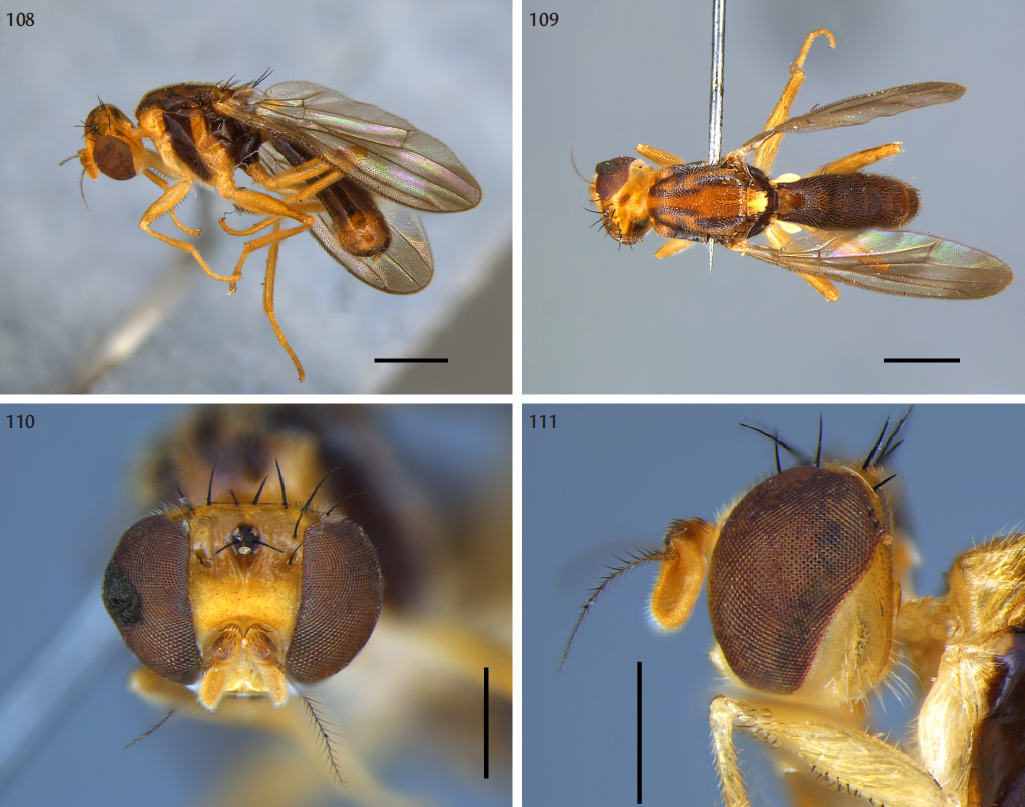
3’. Frons lacking medial spot anterior to ocellar triangle (Fig. 110); distal segments of abdomen yellowish (Fig. 108); fore and mid femora entirely yellow, only hind femur with a preapical brown ring; tibiae yellow (Fig. 108); phallapodeme long, hypandrial apodeme short and wide in lateral view, not reaching the apex of phallapodeme (Figs 116, 117) .......... Chyliza zebrina sp. nov.
-
4. Scutum black, with yellow stripes or spots (Figs 49, 97) .......... 5
-
4’. Scutum variable in color, yellow, dark yellow or orange-yellow, with or without black stripes or spots .......... 6
-
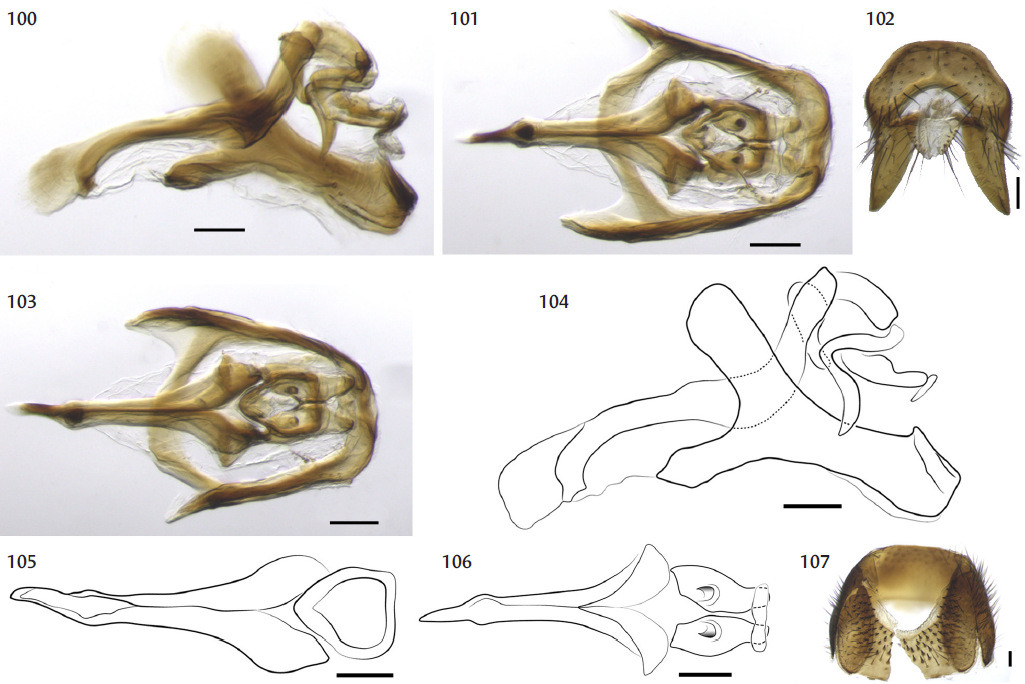
5. Scutum black, posterior margin with a short medial triangular yellow spot (Fig. 97) and a discrete short narrow yellowish stripe in intra-alar region; hypandrial apodeme short, not reaching half the length of phallapodeme in ventral view (Fig. 101); hypandrial apodeme wide, with parallel sides, not constricted basally in lateral view; anterior bridge of hypandrium broad and short in lateral view (Figs 100, 101, 104) .......... Chyliza triangularis sp. nov.
-
5’. Scutum black with a post-sutural sickle-shaped yellow stripe on each side (Fig. 49); hypandrial apodeme long, exceeding half the length of phallapodeme in ventral view (Fig. 55); hypandrial apodeme constricted basally and strongly enlarged distally, spatula-shaped in lateral view; anterior bridge of hypandrium long and slender in lateral view (Figs 52, 56) .......... Chyliza falciformis sp. nov.
-
6. Scutum with a complete acrostichal black stripe widened medially to form a rectangle, and a short narrow post-sutural dorsocentral area with a dark brown to black stripe (Figs 9, 85) .......... 7
-
6’. Acrostichal stripe, when present, straight, not widened medially; post-sutural dorsocentral stripe present or absent .......... 8
-
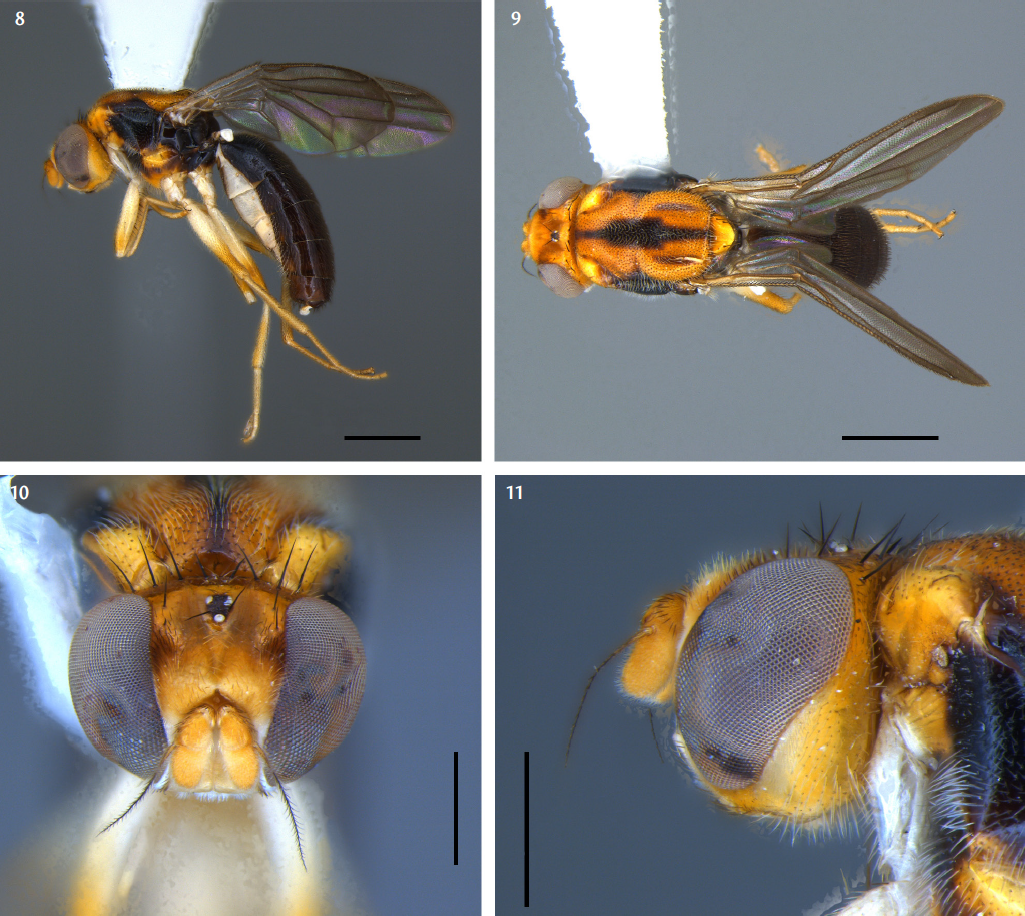
7. Katepisternum mostly yellow, postpronotal lobe yellow (Fig. 8), anterior margin of scutum yellow (Fig. 9); distal 1/2 of femora and distal 2/3 of tibiae orange-yellow (Fig. 8); hypandrial apodeme constricted at base with truncate apex in lateral view, completely sclerotized; phallapodemic arm strongly enlarged near base in ventral/dorsal view, with elongate triangular flaps forming two finger-like processes in ventral view (Figs 13, 16, 18) .......... Chyliza bella sp. nov.
-
7’. Katepisternum and postpronotal lobe dark brown to black (Fig. 84), anterior margin of scutum black (Fig. 85); distal 1/2 of femora and distal 3/4 of tibiae dark brown (Fig. 84); hypandrial apodeme not constricted at the base, not sclerotized apically, with rounded apex in lateral view; phallapodemic arm with a weakly sclerotized inconspicuous triangular flap at base shaped as a jacket lapel in ventral view (Figs 89, 92, 94) .......... Chyliza spuria sp. nov.
-
8. Hind tibia pale brown in distal 1/2, whitish-yellow in remaining portion; scutum yellow, without brown acrostichal stripe (Fig. 24); katepisternum on dorsal half with a large longitudinal yellow spot (Fig. 23); hind coxa brown to black .......... Chyliza consanguinea Schiner, 1868
-
8’. Hind tibia unicolor, yellow to brown (Fig. 1); scutum dark yellow with brown acrostichal stripe (Fig. 3); katepisternal spot absent or reduced to a small spot; hind coxa with a discrete oval spot on dorsal margin (Fig. 1) .......... 9
-
9. Legs with basal 2/3 of femora yellowish-white, with a broad dark brown preapical ring and yellow apex; hind tibia brown; tarsi yellowish-white (Figs 20, 21) .......... Chyliza compedita Wiedemann, 1830
-
9’. Legs with basal 1/2 to 2/3 of femora yellow, brown ring absent or reduced to a small preapical dorsal brown spot not forming a complete ring; hind tibia yellow (Fig. 1); tarsi yellow (Fig. 1) .......... 10
-
10. Acrostichal stripe very narrow, about 1/5 of the width of the scutum between the postpronotal lobes, usually present (Fig. 61); basal 1/2 of all femora yellow and apical 1/2 orange-yellow (Fig. 60); sternite 6 long, with central portion comprising approximately 2/3 of total length, anterior margin straight (Fig. 71) .......... Chyliza linearis sp. nov.
-
10’. Acrostichal stripe broad, about 1/3 of the width of scutum between postpronotal lobes (Fig. 3); basal 2/3 of all femora yellow, with a preapical brown dorsal spot not forming a complete ring and yellow apex (Fig. 1); sternite 6 short, with central portion comprising approximately 1/2 of total length, anterior margin slightly concave (Fig. 5) .......... Chyliza angrensis Albuquerque, 1957

Chyliza angrensis, holotype male: (1) lateral habitus; (2) frontal habitus; (3) dorsal habitus; (4) phallus and phallapodeme, ventral view; (5) sternites, ventral view; (6) epandrium and surstyli, posterior view; (7) labels of holotype.

Chyliza bella sp. nov., holotype male: (8) lateral habitus; (9) dorsal habitus; (10) head, frontal view; (11) head, lateral view. Scale bars: 1-4 = 1.0 mm; 5, 6 = 0.5 mm. Scale bars: 8, 9 = 1.0 mm; 10, 11 = 0.5 mm.

Chyliza bella sp. nov., holotype male, genitalia: (12) internal genitalia, lateral view; (13) internal genitalia, ventral view; (14) epandrium and surstyli, posterior view; (15) same, dorsal view; (16) illustration of internal genitalia, lateral; (17) phallus and phallapodeme, dorsal view; (18) same, ventral view; (19) sternite 6, ventral view. Scale bars: 0.1 mm.

Chyliza compedita, holotype male: (20) lateral habitus; (21) dorsal habitus; (22) holotype’s labels. Scale bars: 2.0 mm.

Chyliza consanguinea. (23-27) Lectotype male: (23) lateral habitus; (24) dorsal habitus; (25) head, frontal view; (26) head, anterolateral view; (27) labels of holotype. (28-35) male genitalia: (28) genitalia, lateral view; (29) genitalia, dorsal view; (30) epandrium and surstyli, posterior view; (31) genitalia, ventral view; (32) illustration of genitalia, lateral; (33) phallus and phallapodeme, dorsal view; (34) same, ventral view; (35) sternite 6, ventral view. Scale bars: 0.1 mm.

Chyliza curta sp. nov., holotype male: (36) lateral habitus; (37) dorsal habitus; (38) head, frontal view; (39) head, lateral view. Scale bars: 36, 37 = 1.0 mm; 38, 39 = 0.5 mm.
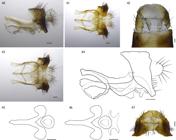
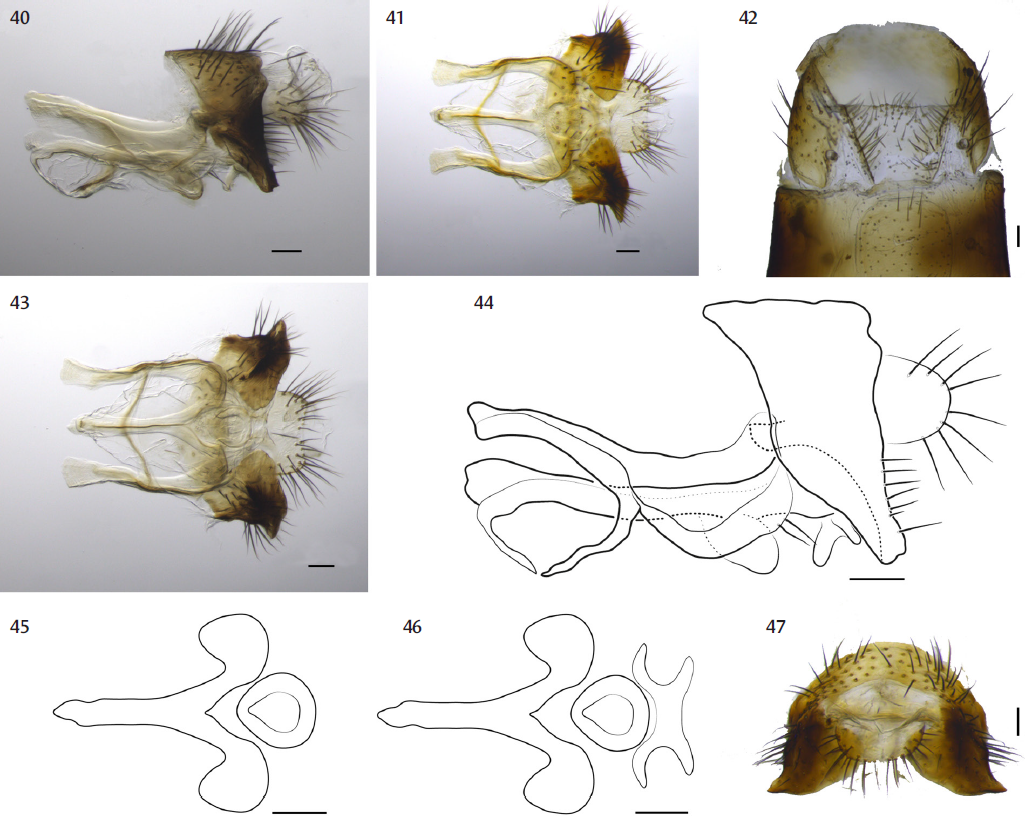
Chyliza curta sp. nov.; paratype male, genitalia: (40) genitalia, lateral view; (41) genitalia, dorsal view; (42) sternite 6, ventral view; (43) genitalia, ventral view; (44) illustration of genitalia, lateral view; (45) illustration of phallus and phallapodeme, dorsal view; (46) same, ventral view; (47) epandrium and surstyli, posterior view. Scale bars: 0.1 mm.

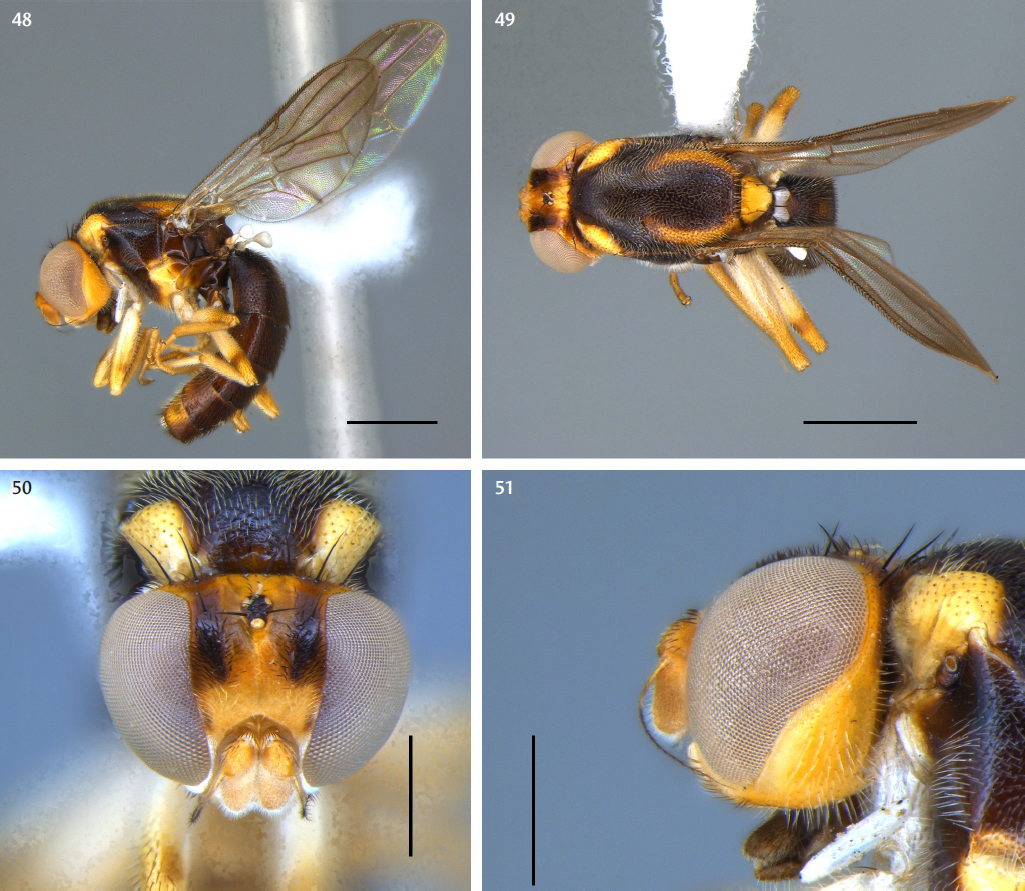
Chyliza falciformis sp. nov., holotype male: (48) lateral habitus; (49) dorsal habitus; (50) head, frontal view; (51) head, lateral view. Scale bars: 48, 49 = 1.0 mm; 50, 51 = 0.5 mm.

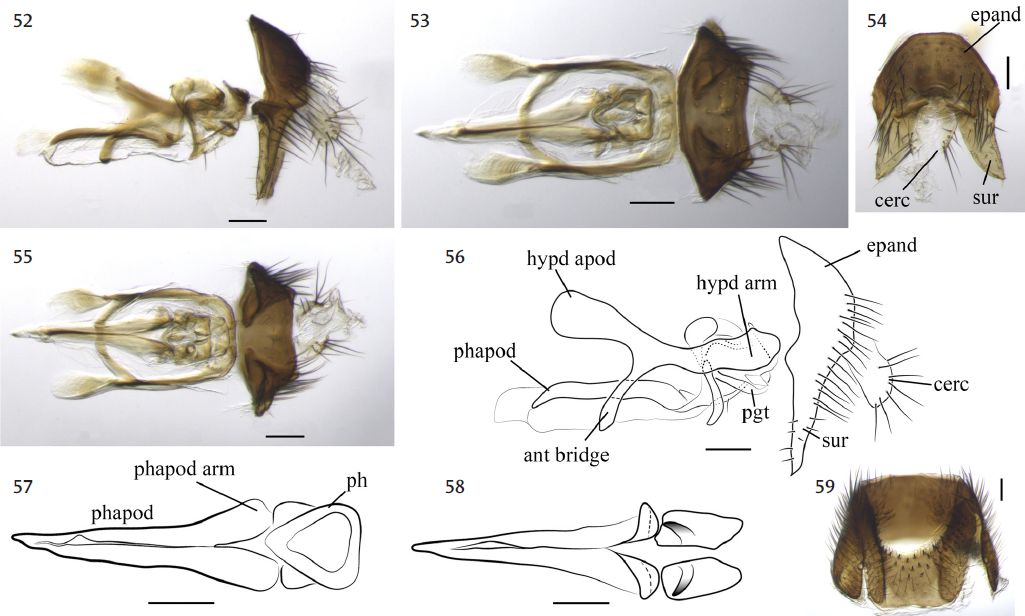
Chyliza falciformis sp. nov., holotype male, genitalia: (52) genitalia, lateral view; (53) genitalia, dorsal view; (54) epandrium and surstyli, posterior view; (55) genitalia, ventral view; (56) illustration of genitalia, lateral view; (57) phallus and phallapodeme, dorsal view; (58) same, ventral view; (59) sternite 6, ventral view. (ant bridge) anterior bridge, (cerc) cercus, (epand) epandrium, (hypd apod) hypandrial apodeme, (hypd arm) hypandrial arm, (ph) phallus, (phapod) phallapodeme, (phapod arm) phallapodemic arm, (pgt) postgonite, (sur) surstyllus. Scale bars: 0.1 mm.

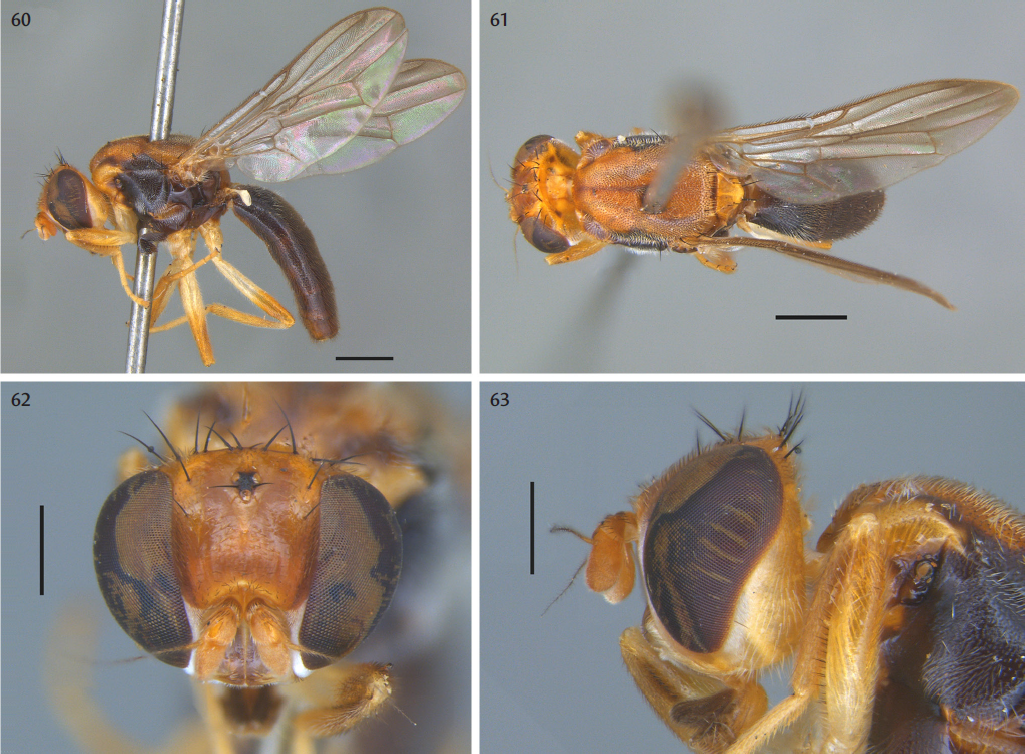
Chyliza linearis sp. nov., holotype male: (60) lateral habitus; (61) dorsal habitus; (62) head, frontal view; (63) head, lateral view. Scale bars: 60, 61 = 1.0 mm; 62, 63 = 0.5 mm.

Chyliza linearis sp. nov., paratype male, genitalia: (64) genitalia, lateral view; (65) same, ventral view; (66) epandrium and surstyli, posterior view; (67) genitalia, dorsal view; (68) illustration of genitalia, lateral view; (69) phallus and phallapodeme, dorsal view; (70) same, ventral view; (71) sternite 6, ventral view. Scale bars: 0.1 mm.

Chyliza spinescens sp. nov., holotype male: (72) lateral habitus; (73) dorsal habitus; (74) head, frontal view; (75) head, lateral view. Scale bars: 73, 73 = 1.0 mm; 74, 75 = 0.5 mm.

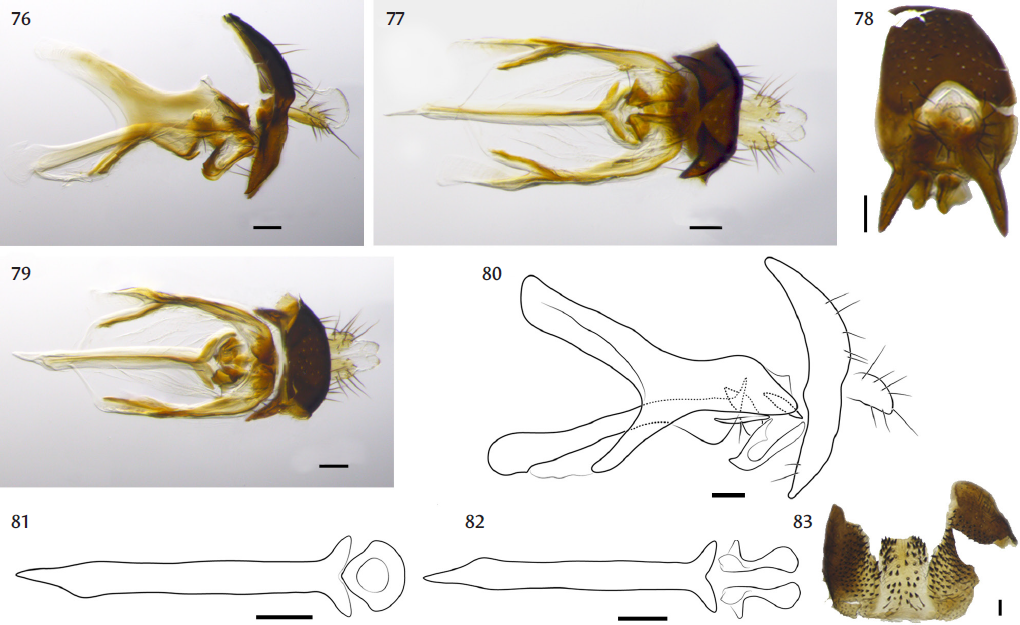
Chyliza spinescens sp. nov., holotype male, genitalia: (76) genitalia, lateral view; (77) same, ventral view; (78) epandrium and surstyli, posterior view - (79) genitalia, dorsal view - (80) illustration of genitalia, lateral view - (81) illustration of phallus and phallapodeme, dorsal view; (82) same, ventral view; (83) sternite 6, ventral view. Scale bars: 0.1 mm.

Chyliza spuria sp. nov.; holotype male: (84) lateral habitus; (85) dorsal habitus; (86) head, frontal view; (87) head, lateral view. Scale bars: 84, 85 = 1.0 mm; 86, 87 = 0.5 mm.
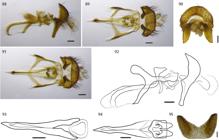
Chyliza spuria sp. nov., holotype male, genitalia: (88) genitalia, lateral view; (89) same, ventral view; (90) epandrium and surstyli, posterior view; (91) genitalia, dorsal view; (92) illustration of genitalia, lateral view; (93) illustration of phallus and phallapodeme, dorsal view; (94) same, ventral view; (95) sternite 6, ventral view. Scale bars: 0.1 mm.

Chyliza triangularis sp. nov., paratype female: (96) lateral habitus; (97) dorsal habitus; (98) head, frontal view; (99) head, lateral view. Scale bars: 96, 97 = 1.0 mm; 98, 99 = 0.5 mm.

Chyliza triangularis sp. nov., holotype male, genitalia: (100) internal genitalia, lateral view; (101) same, ventral view; (102) epandrium and surstyli, posterior view; (103) internal genitalia, dorsal view; (104) internal genitalia, lateral view; (105) illustration of phallus and phallapodeme, dorsal view; (106) same, ventral view; (107) sternite, ventral view. Scale bars: 0.1 mm.

Chyliza zebrina sp. nov., holotype male: (108) lateral habitus; (109) dorsal habitus; (110) head, frontal view; (111) head, lateral view. Scale bars: 108, 109 = 1.0 mm; 110, 111 = 0.5 mm.

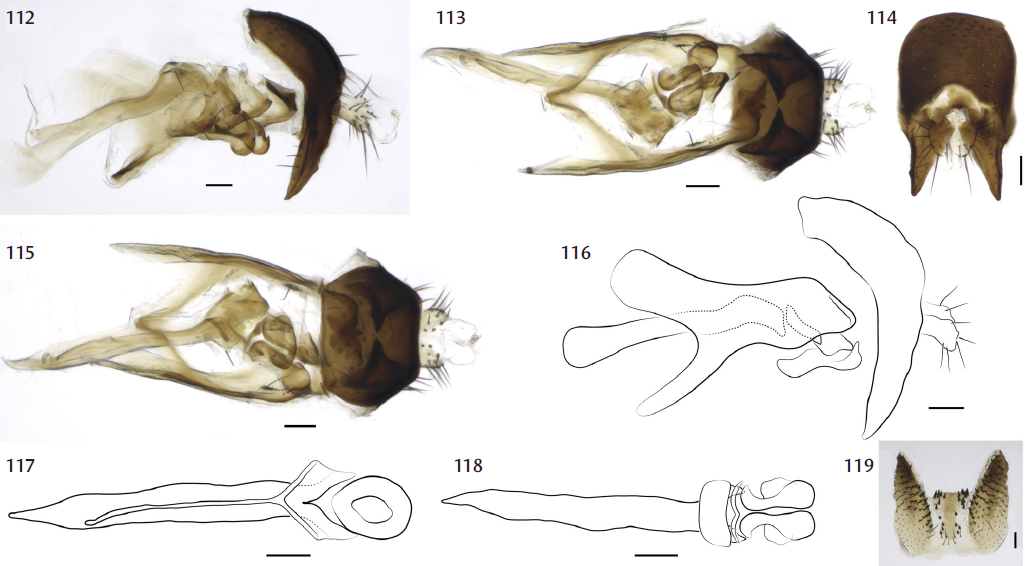
Chyliza zebrina sp. nov., holotype male, genitalia: (112) genitalia, lateral view; (113) same, ventral view; (114) epandrium and surstyli, posterior view; (115) genitalia, dorsal view; (116) illustration of genitalia, lateral view; (117) illustration of phallus and phallapodeme, dorsal view; (118) same, ventral view; (119) sternite 6, ventral view. Scale bars: 0.1 mm.

Chyliza angrensis Albuquerque, 1957
Chyliza angrensis Albuquerque, 1957 : 4, Figs 9-15 (illustrations of wing, male terminalia); Prado, 1975 : 1 (catalog).
Chyliza rubronigra Albuquerque, 1957 : 6, Figs 10, 17-21 (illustrations of wing, male terminalia); Prado, 1975 : 2 (catalog). Syn. nov.
Diagnosis. Frons bright dark yellow-reddish to orange; lateral margin of frons (fronto-orbital plate) with a narrow dark brown stripe on anterior 1/2 (Fig. 2); scutum dark yellow to orange, with a diffuse black acrostichal stripe of variable width, sometimes absent (Fig. 3); postpronotal lobe entirely yellow or with a small dark brown to black spot on posterior margin; pleura dark brown to black, with a small yellow spot on dorsal margin of katepisternum; wing with faint brown spot at end of cell r1 and at vein r-m; legs yellow, except femora and tibiae with apical 1/3 dark yellow to light brown, hind femur sometimes with a more distinct preapical brown ring (Fig. 1).
Redescription (based on the original description and photographs of the male holotype). Body length: 5.0 mm. FHW = 1.1; FI = 3.4.
Head. Frons shiny; frontal vitta dark yellow to brown on posterior 1/2 and yellow on anterior 1/2, around base of antennae; lateral margin of frons with a narrow dark brown stripe on anterior 1/2 (Fig. 2). Ocellar tubercle black (Fig. 3). Face mostly yellow, with a large brown oval spot medially, divided longitudinally by a very slender yellow stripe (Fig. 2). Gena and postgena yellow. Occiput yellow, with a large rounded brown lateral spot above the foramen and silvery pruinescence along orbital margin. Mouthparts: proboscis and palpus dark brown (Fig. 1). Chaetotaxy: short pale brown setulae between vertex and ocellar tubercle. Antenna golden yellow; arista brown with short brown pilosity (Figs 2, 3), 1 pair of strong divergent ocellar setae; 2 upper frontal setae; 1 inner and 1 outer vertical seta, both divergent; 1 short divergent postocellar seta.
Thorax. Scutum dark yellow to orange, with a diffuse dark brown acrostichal stripe, rather inconspicuous, extending from anterior to posterior margin of scutum, and a narrow post-sutural dorsocentral stripe not reaching the posterior margin of scutum (Fig. 3); notopleuron dark brown (Fig. 1); transverse suture dark brown tinged, not reaching the acrostichal stripe; postpronotal lobe pale brown, with posterodorsal margin black; scutellum dark yellow (Fig. 3). Pleuron dark brown, slightly pale on posterior 1/2 of katepisternum, and on anepimeron, meron, and metapleuron (Fig. 1). Chaetotaxy: 1 strong notopleural seta, same length as vertical setae; 1 long and strong post-sutural supra-alar; 1 postalar; 1 pre-scutellar acrostichal; 1 pre-scutellar dorsocentral longer than acrostichal. Setae coating the thorax yellow on scutum, silvery and more conspicuous on pleuron, especially on central portion of anepisternum and katepisternum, and entire anatergite; remaining parts bare. Scutellum with 1 apical pair of strong upward-directed crossing setae and 2 lateral slender setae, same length as dorsocentrals. Wing. Semi-hyaline, gently brownish, with more conspicuous brown infuscation apically (at the end of cell r1). Legs (Figs 1, 2). Yellow, except for fore and mid femora with distal 1/2 gently brownish; hind femur with preapical brown ring and dark yellow apex. Highlighted setae: fore femur with 2 rows of short brown setae ventrally; mid femur with short anteroventral and ventral setae on basal 1/2; hind tibia bearing 1 yellow anteroventral seta. Legs covered with short thin yellow setae; apical spur of midtibia dark yellow.
Abdomen. Dark brown to black, shiny, with pale reddish-brown setae. Sternite 6 short, deeply concave on posterior margin, with sparse short spines on posterior 1/2 and sparse slender setae on anterior 1/2 (Fig. 5; observed in additional specimens and in holotype of C. rubronigra). Sternite 6 short, with central portion approximately 1/2 of sternite length, anterior margin slightly concave (Fig. 5).
Terminalia. Epandrium rather short, somewhat U-shaped, dorsally rounded (Fig. 6), approximately 1.5 times wider than high; surstylus triangular, slightly divergent, approximately three times longer than width of base and equal to height of epandrium (Fig. 6); cercus membranous, fused, and bristly (observed in recent material and in holotype of C. rubronigra). Hypandrial apodeme enlarged distally and conspicuously sclerotized in lateral view (Fig. 6). Phallapodeme widened toward base in ventral/dorsal view (Fig. 4); phallapodemic arm slightly enlarged basally in ventral/dorsal view, with a narrow flap at base shaped as a jacket lapel in ventral view. Apical lobe of phallus not examined; only dorsal view available (Fig. 4).
Female. Similar to male, except for slightly darker antennae, yellow face with two oval-elongate longitudinal brown spots, and fore femur bearing dark brown setae on anteroventral apical 1/3 (Albuquerque 1957).
Material examined. The types were studied through photographs produced and sent to the first author by Dr. Marcia Souto Couri in 2016. All types were destroyed in the National Museum fire on September 2, 2018. Holotype: ♂ of C. angrensis, n 4824. [Brasil, Rio de Janeiro], Angra [dos Reis], Rio Japuhiba, x.[1]936, Trav[assos] e S. Lopes. Holotype: ♂ of C. rubronigra, n 4826. D.F. [Distrito Federal, Rio de Janeiro], Pao[Pão] da Fome, Rocha, Barros, Machado, Dalci, Santos & Emanuel col., 4.viii.[1]944.
Distribution. Brazil, state of Rio de Janeiro (Fig. 120).
Remarks. The last study on Neotropical Chyliza was published by Albuquerque (1957), with descriptions of two new species and a review of C. consanguinea. Here we synonymize the two species described by Albuquerque: Chyliza rubronigra = Chyliza angrensis. The similarity between C. angrensis and C. rubronigra had previously been noted by the author, who observed that “there is no way to distinguish these two species based on external morphological characters” and proposed that “only the study of the terminalia could allow this”. We examined the terminalia of both species. In the photographs received from the Museu Nacional do Rio de Janeiro (MNRJ), the male terminalia of C. rubronigra had been dissected and the parts mounted on a slide as a permanent preparation. These structures appear to be identical to those of C. angrensis; all parts of the male terminalia are preserved and were photographed. Based on examination of a considerable number of specimens and our knowledge of species-level variation in the genus, we conclude that the subtle differences between C. angrensis and C. rubronigra are insufficient to maintain them as two distinct species. Therefore, we synonymize them and designate C. rubronigra as a junior synonym of C. angrensis.
Chyliza bella sp. nov.
https://zoobank.org/3F7266C0-FE92-4CDE-8E4B-6B4727F77EB3
Diagnosis. Proboscis yellow; palpus black; fore femur with ventral rows of conspicuous black setae on entire length (Fig. 8); mid femur with black setae forming 2 or 3 ventral rows on basal 1/2; scutum orangish yellow with dark brown to black longitudinal stripes: acrostichal stripe complete, narrow on basal and distal 1/3, widened in medial 1/3 forming a rectangle; short and narrow post-sutural dorsocentral stripe (Fig. 9); all coxae, trochanters, and basal 2/3 of femora whitish yellow; hypandrial arms and anterior bridge long and narrow in ventral view (Figs 13, 15, 16); hypandrial apodeme short, constricted at base and widened distally with truncate apex in lateral view (Figs 12, 16); phallapodemic arm with elongate triangular flaps forming two finger-like processes in ventral view (Figs 13, 16, 18).
Description. Head. Frons bright orangish yellow, lighter anteriorly, with a short triangular brown lateral spot below anterior frontal seta, and black ocellar triangle (Fig. 10); as long as wide, FHW = 1.0, FI = 3.7; frons with thin short pale brown to yellow setae, darker on lateral triangular spot. Face uniformly light yellow. Antenna yellow; scape with short marginal brown setae; pedicel with short yellow setae on inner side and brown setae on outer side (Figs 10, 11); postpedicel twice as long as wide, apically rounded, with short yellow setulae; arista brown, lighter at base, with short black pubescence. Gena and postgena yellow, with thin yellow setae (Figs 8, 11). Occiput yellow, with a small rounded lateral spot above midline; lateral margin with a narrow band of silvery pruinescence under certain light. Chaetotaxy: setae black; 1 short divergent ocellar pair; 1 short divergent postocellar pair; 3 vertical pairs longer than postocellars, inner pair convergent and the others divergent; 2 frontal setae at the level of ocellar triangle. Mouthparts: proboscis yellow; palpus black.
Thorax. Predominantly orangish yellow; postpronotal lobe lighter yellow; scutellum yellow with small black basal spot; acrostichal stripe black, complete, narrow on basal and distal 1/3, widened medially forming a rectangle; and a narrow post-sutural dorsocentral stripe, dark brown, short, not reaching posterior margin of scutum (Fig. 9); notopleuron black. Pleuron black, except yellow proepisternum, lower margin of anepisternum with small yellow area, katepisternum with two large yellow spots, one on upper 1/2 and one ventral (Fig. 8). Chaetotaxy: setae black and short: 1 supra-alar; 1 postalar; 1 notopleural; 1 acrostichal and 1 dorsocentral pairs near posterior margin of scutum (weaker); scutellum with 1 long strong apical pair and 2 distinctly shorter thinner lateral pairs (1/3-1/2 height of apical pair). Thorax bright; dorsum with short yellow setae and pleura with whitish setae, except bare areas on anepimeron, meron, anterior and posterior margins of katepisternum and katatergite bare. Anatergite strongly protruding, densely covered with black setae. Wing (Figs 8, 9). Semi-hyaline, softly brownish at the end of cell r1. Legs (Fig. 8). Whitish yellow except for femora dark yellow on apical 1/3, tibiae yellow, base of hind tibia lighter, hind femur with a partially complete preapical brown ring, and tarsi yellow. Legs covered with short thin yellow setae; apical spur of midtibia dark yellow; fore femur with thin conspicuous ventral black setae throughout; mid femur with thin black setae forming 2 or 3 ventral rows on basal 1/2.
Abdomen (Figs 8, 19). Black, distal segments with slightly lighter lateral margins; shiny, densely covered with short reddish-brown fine setulae. Sternite 6 with deeply concave posterior margin, posterior 2/3 with sparse short spines extending close to sides of posterior margin, and narrow lateral margin and anterior margin with sparse slender setae.
Male terminalia (Figs 12-19). Epandrium broken during genitalia preparation (Fig. 14); surstylus triangular, broad, with inner margin slightly convex, about twice as long as basal width, apex slightly divergent (Fig. 14); cercus membranous, fused. Hypandrial arms and anterior bridge narrow in lateral view, anterior bridge completely sclerotized (Figs 13, 15); hypandrial apodeme constricted near base and widened distally with truncate apex in lateral view. Phallapodeme weakly sclerotized apically; phallapodemic arm strongly enlarged near base in ventral/dorsal view (Figs 13, 15, 17, 18), in lateral view almost straight with apex slightly expanded and weakly sclerotized, in ventral view with elongate triangular flaps forming two finger-like processes (Figs 13, 15). Apical lobe of phallus developed in lateral view, divergent apically in ventral view (Figs 16, 18).
Female. Similar to male, except for absence of preapical brown ring on mid femur.
Material examined. Holotype ♂, Brasil, MG [Minas Gerais], Berizal, Faz. [Fazenda] Veredão, 15°39’54”S, 41°39’56”W, Malaise/ 859m, 12.xii.2017, (INPA), J.A. Rafael, & E.J. Grossi leg.
Condition of holotype. Dissected; terminalia stored in a microvial with glycerin, attached to the pin of the specimen.
Variation. Not noted.
Distribution. Brazil [Minas Gerais] (Fig. 120).
Etymology. From the Latin bellus (pretty), referring to the general appearance of the species.
Remarks. At first glance, this species can be confused with Chyliza spuria sp. nov. because both species have an acrostichal stripe widened medially to form a rectangle and brown post-sutural dorsocentral stripes on the scutum. However, in C. bella sp. nov. the katepisternum is almost completely yellow, the postpronotal lobe is yellow, the wing has brown spots, and the tibiae are yellow to dark yellow, while in C. spuria sp. nov. the katepisternum and postpronotal lobe are dark brown, the wing is hyaline, and the tibiae are brown. The male terminalia also contribute to the separation of these species: in C. bella sp. nov., the phallapodemic arm is strongly enlarged near the base in ventral/dorsal view, with two elongate finger-like strongly sclerotized processes at the base in ventral view, and the hypandrial apodeme is slightly widened distally, completely sclerotized, with a truncate apex in lateral view; in C. spuria sp. nov., the phallapodemic arm bears a very slender weakly sclerotized triangular flap and the hypandrial apodeme has a desclerotized rounded apex in lateral view.
Chyliza compedita Wiedemann, 1830
Chyliza compedita Wiedemann, 1830 : 531; Schiner, 1868 : 246; Prado, 1975 : 2 (catalog).
Diagnosis (based on original diagnosis and photographs of the holotype ♀). Frons reddish-yellow, brownish above, lateral margin with a brown stripe; antennae yellowish-red (rusty); occiput reddish yellow with a rounded brown spot on each side (Fig. 21); scutum reddish brown with a wide black acrostichal stripe (Fig. 21); pleuron dark brown (Fig. 20); legs yellowish-white, except for femora with a dark brown to black preapical ring at apical 1/3 and yellow apex, tibiae pale brown to brown (Figs 20, 21); wing yellowish, costal margin and apex brownish (Fig. 21).
Material examined (based on high-resolution photographs provided by ZMUC). Holotype ♀ deposited in ZMUC, 00024905, Type, “Chylyza compedita W.”, “Südamerika” (Figs 20-22).
Condition of holotype. Left wing partially torn; body covered with granules of unknown origin.
Distribution. South America.
Remarks. This species cannot be recognized based solely on the original description. The similarities among C. compedita, C. linearis sp. nov., and C. angrensis are discussed in the remarks of C. linearis sp. nov. Of these, C. compedita is most likely to be confused with C. angrensis, as both species have a brown acrostichal stripe and a fronto-orbital plate with a brown stripe. C. compedita can be distinguished from the latter by leg coloration: the legs are light yellow, almost white, with a distinct brown ring on the hind femur and brown tibiae. In C. angrensis, the legs are yellow, the preapical ring of the hind femur is not well defined, and the tibiae are yellow. It is possible that these differences result from color fading in specimens of C. compedita that had been previously preserved in alcohol. To determine with certainty whether the two species are valid, examination of the male terminalia of C. compedita is necessary; however, the male of this species is unknown.
Chyliza consanguinea Schiner, 1868
Chyliza consanguinea Schiner, 1868 : 246; Albuquerque, 1957 : 2 (erroneous identification = Chyliza triangularis sp. nov.).
Diagnosis. Palpus pale brown with distal 1/3 pale yellow; frons yellow with a lateral fronto-orbital triangular black spot; scutum dark yellow, post-sutural dorsocentral stripe pale brown, faintly conspicuous, narrow and short (Fig. 24); scutellum yellow (Fig. 24); postpronotal lobe dark yellow, with dorsal and posterior margins brown; pleuron brown, except for a large irregular yellow spot on katepisternum; legs predominantly whitish-yellow (Fig. 23), except hind coxa and hind trochanter brown, fore femur with distal 2/3 brown, mid and hind femora with a preapical brown ring and yellow apex, fore tibia brown with yellow base, mid and hind tibiae with distal 1/2 brown; hypandrial apodeme short, slightly shorter than hypandrial arms, wide, with rounded apex in lateral view; phallapodemic arm with a very broad flap shaped as a jacket lapel in ventral view (Figs 29, 32, 34).
Redescription (based on photographs of the types of C. consanguinea deposited in the NHMW). Lectotype and paralectotype ♀ (here designated).
Head. Frons shiny, yellow, with a fronto-orbital triangular black spot above the middle; ocellar tubercle black; FHW = 1.3, FI = 2.4; frons densely pilose on lateral and ventral margins (Fig. 25), bare medially, with 2 rows of setae between ocellar tubercle and vertex, mostly yellow, darker and denser on lateral spot. Face pale yellow with two elongate parallel longitudinal brown spots (Fig. 25). Antenna yellow (Figs 25, 26); scape with short brown marginal setae; pedicel with short yellow setae on inner side and pale brown setae on outer side; postpedicel with short yellow pilosity, 1.5 times longer than wide, slightly narrowed toward rounded apex; arista yellow on basal 1/3, otherwise black, with short pilosity. Gena and postgena yellow, with short yellow setae (Fig. 26). Occiput yellow with a small pale brown ovate spot laterad to foramen; lateral margin with a narrow band of silvery pruinescence under certain light; ventral margin with pale fine dense setae. Chaetotaxy: setae black; 1 ocellar pair and 1 postocellar pair short and divergent; 3 vertical pairs longer than postocellar pair, inner pair convergent and 2 outer pairs divergent; 2 fronto-orbital setae inserted above middle of frons. Mouthparts: proboscis brown; palpus dark brown with distal 1/3 pale yellow.
Thorax. Scutum dark yellow, with pale brown post-sutural dorsocentral stripe, faintly conspicuous, narrow and short, not reaching posterior margin of scutum (Fig. 24); scutellum yellow (Fig. 24), subscutellum brown; postpronotal lobe dark yellow with dorsal and posterior margins brown, contiguous with brown notopleuron and extending briefly over transverse suture. Pleuron dark brown except for a large irregular yellow spot occupying upper 2/3 of katepisternum and extending ventrally, becoming narrower and less distinct; proepisternum and proepimeron yellow (Fig. 23). Chaetotaxy: scutum with short black setae: 1 supra-alar; 1 postalar; 1 notopleural; 1 developed acrostichal pair and 1 dorsocentral posterior pair; scutellum with 1 elongate and strong apical pair and 2 slightly shorter and slender lateral pairs. Thorax shiny, covered with short yellow setae dorsally and whitish-yellow setae on pleuron, except anepimeron, meron, posterior 1/2 of katepisternum, and katatergite bare. Anatergite protuberant and densely pilose. Wing. Semi-hyaline with light brown infuscation at end of cell r1. Legs (Fig. 23). Predominantly whitish-yellow, with hind coxa and hind trochanter brown, fore femur with distal 2/3 brown and apex yellow, mid and hind femora with preapical brown ring and yellow apex, fore tibia brown with yellow base and apex, mid and hind tibiae with distal 1/2 brown; tarsi whitish-yellow, slightly darkened on apical three tarsomeres. Legs covered with short slender yellow pilosity; midtibia with apical yellow spur; fore and mid femora with short ventral brown setae; fore tibia with ventral row of black spines (observed in recent material).
Abdomen (Figs 23, 24). Dark brown to black, becoming light brown from T4 onward; yellowish laterally, with a small narrow yellow dorsal longitudinal spot on tergite 1+2; shiny, with dense short fine yellow pruinescence.
Male. Similar to female.
Terminalia. Epandrium dorsally truncated, trapezoidal, 2.25 times wider than high (Fig. 30); surstylus robust, triangular, approximately 2.8 times longer than width of base, parallel, 1.5 times longer than epandrium height (Fig. 30); cercus membranous, fused, and bristly. Hypandrial apodeme short, slightly shorter than hypandrial arms, wide, with rounded apex in lateral view; anterior bridge completely sclerotized (Figs 29, 31). Phallapodeme distinctly narrow on apical 1/2 in ventral/dorsal view, widened basally; phallapodemic arm with a very broad posterior flap shaped as a jacket lapel in ventral view. Apical lobe of phallus developed, divergent apically in ventral view (Figs 32, 34).
Material examined. Lectotype ♀ (here designated), deposited in NHMW, labeled: “Lindig 1864, Venezuela”; “consanguinea, Alte Sammlung”; Paralectotype ♀ (here designated), deposited in NHMW, same data of lectotype. BRAZIL, Pará, Serra Norte, Manganês, 6-9.ix.1985, W. França, Armadilha Malayse, 2 ♂ (MPEG); 2-5.ix.1985, Armadilha Suspensa 1.6m, 1♀ (MPEG); 2-5.ix.1983, Armadilha Malaise, 1♀ (MPEG), M.F. Torres leg.; 7-9.ix.1983, Armadilha Malaise, 1♀ (MPEG), R.B. Neto leg.; 2-6.ix.1983, Armadilha 1.6m Suspensa, 1♀ (MPEG); 6-9.ix.1985, Armadilha Suspensa 20, 1♀ (MPEG), W. França leg.; N-3, 9-12.ii.1985, Malaise, 1♀(MPEG); E. Velha SEPR, 06-07.1987, Armadilha Suspensa 1.6m, 2 ♀ (MPEG); Estrada do Fofoca, Arm. funil isca carne, 19.iv.1983, 1♀ (MPEG), I. Gorayeb leg.; Armadilha Suspensa com isca 2.0m, 19.iv.1983, 1♀ (MPEG), F.F. Ramos leg.; 19.iv.1983, Isca fezes humanas, 1♀ (MPEG), Mascarenhas e equipe leg.; Caldeirão, 20.x.1984, 1♀ (MPEG), T. Pimentel leg.; Pojuca, 21.x.1984, Armadilha Suspensa 20m, 1 ♂, 3♀ (MPEG); Rio Salobo, 16.v.1984, Armadilha Suspensa 18m, 1♀ (MPEG); Paragominas, Faz. Cachoeira do Rio Vermelho, 15-18.i.1991, Armadilha Malaise, 4♀ (MPEG), J. Dias leg.; Santarém Novo, Fazenda Jabaru, 7-9.i.1983, Arma Malaise, 1♀ (MPEG), , J. Dias; São João de Pirabas, Japerica, 18-20.xii.1992, Armadilha Suspensa 1.6m, 1♀ (MPEG), J. Dias leg; Tucurui, Rio Tocantins, Saúde, 9-11.vi.1984, Armadilha Suspensa 2m, 2♀ (MPEG); Morro do Senador, 035923S-494445W, 01.xii.2001, Malaise, 4♀ (INPA), J.A. Rafael e Vidal leg.; Primavera, Quatiapuru, Fazenda Feitoria, 16-27.xi.1992, Armadilha Malaise, 1♀ (MPEG), J. Dias leg.; Mun. Barcarena, Caripi, 012940S, 484235W, Mata, 13-222.xi.2021, Armadilha Malaise, 1♀ (MPEG), Gorayeb, Tavares, Bittencourt a Dias leg.; Vitória do Xingu, Margem esq. Rio Xingu, 18-20.xii.2000, Mata prim[ária] residual, Armadilha Malaise 15, 18020.xii., 1♀ (MPEG), C. Maciel e J. Dias leg.; Rio Xingu, Camp. (5222W, 339S), ca 60km S. Altamira, 2-8 Oct. 1986, Malaise, 1♀ (USNM), P. Spangler & Flint leg.; C. Araguaia, 19-31.i.1983, Arm. Malaise, 2♀ (INPA), J.A. Rafael leg.; Fazenda Taperinha, próx. Santarém, 1-11.ii.1968, Exp. Perm. Amaz., 1♀ (MZSP); Area caracol, Rio Xingu, Arm. Malaise, 20-23.xi.[20]07, 1♀ (INPA); Amapá, Serra do Navio, 18.v.1984, Armadilha Suspensa 1.6m, I. 2 ♀ (MPEG), Gorayeb leg.; 12-15.v.1984, Armadilha Suspensa 1.6m, 1♀ (MPEG), N. Bittencout leg.; Amapari, Tucano 2, 5-7.xi.1983, Armadilha Malaise, 2♀ (MPEG), N. Bittencourt leg.; Armadilha Malaise, 1♀ (MPEG), I. Gorayeb leg.; 9-11.v.1989, Malaise, 1♀ (MPEG), W. França leg.; 7-9.xi.1993, Arm. Malaise, 1♀ (MPEG), F. Ramos leg.; Amazonas, Barcelos, Serrinha, 102505N, 632305W, vii-viii.2007, Malaise, Floresta, 1♀ (INPA), A.S. Filho, T. Krolow cols,; Rio Padauari, Com[unidade] Ararinha, 003018N, 640330W, 04-08.vi.2010, [Armadilha] Suspensa septo amarelo 2m, 2♀ (INPA), J.A. Rafael & R. Freitas-Silva leg.; 05-08.vi.2010, Malaise, 1♀ (INPA), R. Machado, P. Dias, J.A. Rafael leg.; Novo Airão, Igarapé Mato Grosso, 2 49 00S, 60 56 08W, 7-9.xii.2013, Arm. Malaise, 3♀ (INPA), J.A.Rafael, J.T. Camara & F.F. Xavier leg.; São Gabriel da Cachoeira, Pico da Neblina, BR 307 Km 65, 4-12.viii.2010, Malaise sobre igarapé, 1♀ (INPA), Ale-Rocha e Vidal leg.; Borba, Rio Abacaxis, Paxiuba, 042848S, 583424W, 2-4.vi.2008, 1♀ (INPA), J.A.Rafael e equipe; Manaus, Reserva Ducke, 25.iv-28.iv.1988, Isca de Fruta, Y. Camara, J.F. Vidal; Ig. Bolivia, i.2003, Malaise, Vidal, J., 1♀ (INPA); Arm[adilha] susp[ensa] 7m, 05-16.viii.1994, 1♀ (INPA), J.A. Rafael & J. Vidal leg.; Manaus, Res[erva] Km 41, PDBFF, 24-25.xi.2004, Trilha J B - SB, 4♀ (INPA), R. Querino leg.; Trilha C - BD, 24-25.ii.2004, 1♀ (INPA); Manaus, ZF 2, km 14, 2 35 21S, 600644W, 17.viii.2016, Malaise perto da Torre, 1♀ (INPA), J.A Rafael & F.F. Xavier leg.; Manaus, Campus Universitário, 20.viii.1982, 1♀ (INPA), J.A Rafael leg.; EMBRAPA, 05.i.2013, Guaraná orgânico, 2 53 29S, 59 58 45W, MALAISE BORDA, 1♀ (INPA); Coari, Rio Urucu, Petrobrás RUC-30, 27-30.x.1994, Malaise, 2♀ (INPA), L.E.S. Rocha e Silva leg.; Novo Aripuanã, Res[erva] Soka, 0515535S-6000708W, 17-25.viii.1999, Malaise mata, 1♀ (INPA), J. Vidal leg.; 6-10.xii.1999, Suspensa 5m, 1♀ (INPA); Ipixuna, Rio Liberdade, Estirão da Preta, 07 21 46.7S, 71 52 07W, 11-15.v.2011, Arm. Malaise, J.A Rafael e equipe, 1♀ (INPA); Rio Nhamundá, Ig Areias, 01°35’11’’S, 57°37’32’’W, 25m, 17-20.v.2008, coleta manual, 1♀ (INPA), R. Ale-Rocha leg.; Alvarães, Ramal São Joaquim, 02 26 21S, 644821W, 19-25.iv.2015, Malaise, 1♀ (INPA), F.F. Xavier, G. Miranda leg.; Acre, Porto Acre, Humaitá, 15.vi-02.vii.[19]92, Armadilha Suspensa 1.6m, 4♀ (MPEG), Gorayeb, Pena, Henriques, Edmar leg.; Rio Branco, 25.x-8.xi.[19]91, Armadilha Suspensa 1.6m, Mata trilha, 4♀ (MPEG), F. Ramos, A. Henriques, I. Gorayeb, N. Bittencourt leg.; Bujari, FES Antimary, 92001S, 681917W, 3.viii-8.ix.2016, Malaise peq., E.F. Morato & J.A. Rafael - Rede Bia, 1♂, 1♀ (INPA); Rondônia, Ouro Preto do Oeste, Linha 62, Km 16, 8-11.xi.1984, Armadilha Suspensa, 1.6, 1♀ (MPEG); Ouro Preto D’Oeste, 25.viii.1987, C. Elias POLONOROESTE, 1♀ (DZUP); Vilhena, 22.x.1986, C. Elias, POLONOROESTE, 1♀ (DZUP); Itapuã do Oeste, Flona Jamari, Trilha Pedra Grande, 091139.4S, 630455.3W, 06.x.2014, Malaise, 2♀ (INPA), J.A Rafael, F.F. Xavier, R.M. Vieira e L. R. Aquino leg.; Guajará Mirim, Rio Ouro Preto, Bananal, 105823S, 650539W, 22-27.x.1995, Arm. Malaise, 1♂ (INPA), J.A.Rafael leg.; Roraima, Serra Pacaraima, 800m, 1-7.ix.1995, 042704N, 610756W, Malaise Terra Firme, 2♀ (INPA), J.A Rafael; Amajari, Tepequém SESC, 3 44 45N, 614340W, 1-15.ii.2016, Malaise, 1♂, 3♀ (INPA), R. Boldrini & J.A. Rafael leg.; Maranhão, Açailandia, P. Maranhas, 23.ix.1986, 1♀ (MPEG), Marcia Zanulo leg.; Riachão, Fazenda Altos, varredura, 17-22; viii.2009, 1♀ (CZMA), F. Limeira de Oliveira leg.; 18-22.vii.2009, Malaise, 1♀ (CZMA); São Pedro da Água Branca, Fazenda Santa Rosa, 050707S, 481519W, 06.xii.2001, Malaise em igarapé, 1♀ (INPA), J.A. Rafael, F. Oliveira, J. Vidal leg.; 07.xii.2001, Malaise em mata, 1♀, 5♂ (INPA), J.A. Rafael & J. Vidal leg.; Vila Nova dos Martícios, Fazenda Santa Rosa, 050707N, 481519W, 6.xii.2001, Malaise, 1♀ (INPA), J.A. Rafael leg.; Bom Jardim REBIO-Reserva Biológica Gurupi, Armadilha Shannon, 17-27.i.2010, 1♀ (CZMA), F. Limeira-de Oliveira, A.A.T. Sousa & M.B. Aguiar Neto leg.; Carolina, PARNA Chapada das Mesas, Riacho Sucuruiu, Malaise, 2-31.iii.2014, 1♀ (CZMA), J.A Rafael, F. Limeira de Oliveira, T.L. Rocha & G.A. Reis leg.; Ceará, Ubajara, Parque Nacional de Ubajara, Cachoeira do Cafundó, 035013S, 405435W, Armadilha Malaise, 18-30.xi.2012, 1♀ (CZMA), F. Limeira de Oliveira & J. Pinto Jr. Leg.; 21-24.iv.2012, 2♀ (CZMA); 16-31.xii.2012, 1♀(CZMA). PERU, Madre de Dios, Manu, Erika (near Slavacion), 550m, 5-6 sept 1988, 1♂, 3♀ (USNM), A. Freidberg leg.; Rio Manu, 250m, Pakitza, 12 17S, 70 58W, 9-23 Sep 1988, 1♀, 3♂ (USNM), Amnon Freidberg leg.; Mazuko, 130251S, 70 20 45.9W, 382m, 18.viii.2012, sweep, 1♀ (UNMSM), J.A. Rafael, RR Cavichioli, D.M. Takyia leg.; Cusco, Puente Inambari, 13 10 52.4S, 702306W, 365m, 19.viii.2012, light trap, 1♀ (INPA), J.A. Rafael, R.R. Cavichioli, D.M. Takyia, APM Santos leg.; Quincemil, 13 13 03.4S, 704340W, 633m, 23-31.viii.2012, sweep, 1♂ (INPA), J.A.Rafael, R.R. Cavichioli, D. Takyia leg.; 19 rd Km W Quincemil, Rio Araza tributary, 13 20 10S, 705057W, 07. 874m, 23-31.viii.2012, Malaise, 1♀ (UNMSM), RR Cavichioli, JA Rafael, M. Santos, DM Takyia leg.; GUYANA, Mazaruni, Potato District, Takutu Montains, 6 15N, 59 5 W, 3-10.Dec. 1983, Malaise trap near stream in montane rainforest, EARTHMATCH Research Expedition, 2 ♀ (USNM), W.E. Steiner & P.J. Spangler leg.; ECUADOR, Zamora Cumbarata, 970m, 21.xi.1970, 3♀ (MZSP), L.E. Pena leg.
Condition of types. The lectotype here designated is in perfect condition, except for the base of the abdomen, which bears a few scattered hyphae; the paralectotype has lost the hind legs and presents some hyphae on the body.
Variation. The facial spot may be shorter; a small acrostichal brown spot can be present at the anterior margin of the scutum, between the postpronotal lobes, and may appear divided into two narrow parallel stripes; the narrow post-sutural dorsocentral stripes may be absent; the brown rings on the legs may vary in width; and the black spot covering the notopleuron may extend to the anterior margin of the scutum, sometimes fused with the anterior acrostichal spot. The median longitudinal yellow dorsal spot at the base of the abdomen may be slightly wider and more distinct. The number of frontal setae ranges from 1 to 2. However, the large number of specimens available for study allowed comparison of the terminalia among different specimens, revealing insignificant variation and corroborating that the color variations are intraspecific.
Distribution. Brazil* (Acre, Amapá, Amazonas, Maranhão, Pará, Rondônia, Roraima), Ecuador*, Guyana*, Peru*, and Venezuela (Fig. 122).
Remarks. Supernumerary setae may occur between the vertical setae on the right side of the head. According to Schiner (1868), this species is very similar to Chyliza compedita but differs mainly in the black notopleuron, shiny black pleuron, the completely isolated rust-yellow spot beneath the scutellum, a small triangular black spot above mid-height on the lateral margin of the frons, and femora with a brown to black preapical ring and yellow-orange apex. The wings are similar to those of C. compedita, but the slight darkening at the wing tip is more extensive, extending from the radial vein to the posterior margin and gradually becoming diffuse. The record of C. consanguinea by Albuquerque (1957) from Rio de Janeiro was based on a misidentified specimen. Therefore, the occurrence of this species is currently considered restricted to northern South America, where it is widely distributed.
Chyliza curta sp. nov.
https://zoobank.org/97BE7392-EE2E-41CB-A2C0-AD378648A64B
Diagnosis. Frons bright yellow-orange, with a long medial triangular brown spot below ocellar triangle (Fig. 38); antenna yellow, except postpedicel pale brown (Figs 38, 39); postpedicel 3 times longer than wide, with rounded apex; gena brown with dorsal and ventral margins pale yellow, and postgena yellow (Figs 36, 39); femora pale yellow with a brown ring at apical 1/3 and yellow-orange apex (Fig. 36); hypandrial apodeme elongate, reaching apex of phallapodeme (Figs 40-44); phallapodemic arm short, with base expanded and rounded in ventral view (Figs 45, 46).
Description. Head. Frons bright orangish yellow, with a long narrow medial triangular brown spot extending from the ocellar triangle to the anterior margin of the frons, ocellar triangle black (Fig. 38); frons as long as wide, FHW = 1.0, FI = 3.3, with short fine setae, except in the area surrounding ocellar triangle, which is bare; region from ocellar triangle to vertex with short thin black setae. Face pale yellow with a narrow brown longitudinal stripe medially. Antenna yellow, except postpedicel pale brown (Figs 38, 39); scape with short marginal black setae; pedicel with short black setae on both lateral surfaces; postpedicel with short yellow setae, 3 times longer than wide, with rounded apex; arista yellow with short setulae. Gena brown with dorsal and ventral margins pale yellow, and postgena yellow (Figs 36, 39), both with short fine dense yellow setae. Occiput yellow (Fig. 37); lateral margin with a narrow band of silvery pruinescence under certain light. Chaetotaxy: setae black; 1 long divergent ocellar pair; 1 short divergent postocellar pair; 2 vertical pairs, the inner convergent and the outer divergent (1 additional convergent seta on left side); 1 frontal seta thicker than the others, above upper 1/2 of frons. Mouthparts: proboscis dark brown (Fig. 39); palpus yellow.
Thorax (Figs 36, 37). Bright; scutum dark yellow (copper) on dorsum with a short narrow longitudinal black spot merging with postpronotal lobe; post-sutural dorsocentral stripe brown; dark brown spot between postpronotal lobe and transverse suture, narrowing anteriorly and widening toward notopleuron; postpronotal lobe light yellow with dorsal subrectangular black spot; scutellum pale yellow with dark brown lateral spot; subscutellum dark brown; notopleuron black, except posterior margin dark yellow. Pleuron black, except pale yellow proepimeron and proepisternum, a broad vertical yellow band from notopleuron to ventral margin of katepisternum, and ventral margin of meron. Chaetotaxy: setae black, slightly elongate: 1 notopleural, 1 supra-alar, and 1 postalar, all as long as lateral scutellar pair; 1 stout acrostichal and 1 dorsocentral seta near posterior margin of scutum; scutellum with 1 elongate strong apical convergent pair and 2 shorter thinner lateral pairs (2/3 height of apical pair). Thorax covered with short yellow setae dorsally and whitish elongate setae on pleura, except anterior 1/2 of anepisternum and katepisternum, anepimeron, posterior 1/2 of katepimeron, and meron bare. Anatergite strongly protruding and densely covered with whitish setae. Wing (Figs 36, 37). Semi-hyaline with faint infuscation near apex. Legs (Fig. 36). Light yellow, except black hind coxa and trochanter, femora with a brown ring on apical 1/3 and orange-yellow apex, and tibiae brown with pale yellow base. Legs with short thin yellow setae and brown apical spur on midtibia.
Abdomen (Figs 36, 43). Black, shiny, with dense short fine whitish setae; sternite 6 trapezoidal, bearing slender setae (Fig. 42).
Male terminalia (Figs 40-47). Epandrium very short, flattened, approximately 3.3 times wider than high, rounded dorsally in posterior view (Fig. 47); surstylus broad, short, subtriangular, approximately as wide as long, apex pointed and curved outward, strongly divergent in posterior view (Fig. 47); cercus membranous, fused, with long strong numerous marginal setae reaching apex of surstylus (Fig. 47). Hypandrium with anterior bridge completely sclerotized (Figs 41, 43); hypandrial apodeme elongate, slightly expanded apically with truncate apex in lateral view, reaching apex of phallapodeme (Figs 40, 41, 43, 44). Phallapodeme slender, weakly sclerotized, short, not exceeding the hypandrial apodeme in dorsal/ventral view (Figs 41, 43, 45, 46), apex weakly sclerotized, rounded, slightly expanded; connection with hypandrial arm distinct and sclerotized, resembling a hook bent downward (Figs 40, 44); phallapodemic arm short, with base expanded and rounded in ventral view. Apical lobe of phallus imperceptible (Figs 45, 46).
Female. Unknown.
Material examined. Holotype ♂, Peru, Madre de Dios: Manu, Rio Manu, Cocha Salvador, 240 m, 14 Sep 1988, Amnon Freidberg [leg.] (USNM). Paratype: same data as holotype, 1♂ (INPA).
Condition of holotype. Not dissected; left wing with a small tear on dorsal margin near apex.
Variation. Paratype with slightly darker postpedicel; dorsocentral stripe posterior to transverse suture darker, black; spots on anterior region of scutum connected, surrounding postpronotal lobe; upper dark yellow margin on katepimeron not closely connected to its lower margin.
Distribution. Peru [Madre de Dios] (Fig. 123).
Etymology. From the Latin curtus (short), referring to the overall appearance of the male genitalia, in which the structures are shorter than usual.
Remarks. In the specimens examined, including the holotype, a supernumerary vertical seta was observed on the left side. Chyliza curta sp. nov. is the only species with a brown central subtriangular frontal spot extending below the ocellar triangle to the lunula and the only species lacking a developed apical lobe of the phallus.
Chyliza falciformis sp. nov.
https://zoobank.org/7BF6FB8F-3849-4779-ACB5-991591E2208C
Diagnosis. Fore tibia with a row of short black ventral spines (Fig. 48); scutum black with postpronotal lobe and scutellum yellow, and a post-sutural dorsolateral longitudinal falciform yellow stripe (Fig. 49); legs yellow with preapical brown ring on femora, and basal 2/3 of femora, coxae, and trochanters whitish-yellow (Fig. 48); hypandrial arms with dorsal and ventral margins slightly wavy and widened posteriorly in lateral view; hypandrial apodeme strongly enlarged distally, spatula-shaped in lateral view (Figs 52, 56); phallapodemic arm slightly widened basally, with a small triangular flap at base in ventral view (Fig. 58).
Description. Head. Frons bright yellow, with a brown lateral stripe reaching the vertex (Fig. 50), wider on upper 2/3 and abruptly narrowing on anterior 1/3; ocellar triangle black (Fig. 50); frons 1.2 times longer than wide; short thin setae laterally and between ocellar triangle and vertex. Face yellow. Antenna yellow (Figs 50, 51); scape with short marginal black setae; pedicel with yellow setae on inner side and black setae on outer side; postpedicel 2.5 times longer than wide, slightly narrowed toward apex and rounded apically, with short thin yellow setae; arista yellow on basal 1/3, remaining portion black, with short pilosity. Gena and postgena yellow (Figs 48, 51). Occiput yellow centrally, with a broad brown lateral stripe continuous with frontal stripe (Figs 48, 51); lateral margin with a narrow band of silvery pruinescence under certain light. Chaetotaxy: setae black; 1 short divergent ocellar pair; 1 short divergent postvertical pair; 3 pairs of vertical setae longer than postvertical pair; 2 frontal setae above upper 1/2 of frons. Mouthparts: proboscis and palpus brown.
Thorax (Figs 48, 49). Scutum dark brown to black, with postpronotal lobe, a broad dorsocentral post-sutural falciform band extending to posterior margin of scutum, and scutellum yellow; notopleuron black. Pleuron dark brown to black, except whitish-yellow proepimeron and proepisternum, a broad vertical medial katepisternal yellow band, and lower margin of anepisternum with narrow yellow portion (Fig. 48). Chaetotaxy: setae black and short: 1 supra-alar; 1 postalar; 1 posterior notopleural; 1 acrostichal pair and 1 dorsocentral pair near posterior margin of scutum; scutellum with 1 long strong apical pair and 2 distinctly shorter thinner lateral pairs (1/3 to 1/2 the height of apical pair). Thorax shiny, covered with short setae, yellow dorsally and whitish on pleura, except bare anterior portion of anepisternum, anepimeron, meron, and anterior and posterior margins of katepisternum and katatergite. Anatergite protruding and densely covered with black setae. Wing. Semi-hyaline with faint infuscation on apical 1/3. Legs (Figs 48, 49). Coxae, fore and mid trochanters, basal 2/3 of femora, and entire hind tibia and tarsi light yellow; apical 1/3 of fore and mid femora yellow; hind femur with preapical brown ring and yellow apex; apex of femora and tibiae dark yellow; fore femur with small preapical anterodorsal brown spot; hind coxa and hind trochanter dark brown. Legs covered with short thin yellow setae; apical spur of midtibia dark yellow; fore tibia with a row of short black ventral spines.
Abdomen (Figs 48, 59). Dark reddish-brown, distal segments slightly lighter laterally, tergite 1 with a narrow dorsal dark yellow longitudinal stripe; shiny, with dense short fine reddish-brown setae. Sternite 6 with sparse short spines centrally on posterior 1/2 and sparse thin elongate setae elsewhere (Fig. 59).
Male terminalia (Figs 52-56). Epandrium dorsally flattened, trapezoidal, 1.7 times wider than high (Fig. 54); surstylus triangular, slightly divergent, inner margin slightly convex, approximately 1.6 times longer than basal width, as long as height of epandrium (Fig. 54); cercus membranous, fused, with long marginal setae. Hypandrium with anterior bridge completely sclerotized (Fig. 55); hypandrial apodeme elongate and strongly enlarged distally, spatula-shaped in lateral view (Figs 52, 56). Phallapodeme elongate (Figs 53, 55, 56), gently arched in lateral view, apex expanded and weakly sclerotized (Figs 52, 56); phallapodemic arm slightly widened, with a small triangular flap at base in ventral view. Apical lobe of phallus long and slender in lateral view (Figs 57, 58).
Female. Similar to male, except for absence of short black ventral spines on fore tibia; scutellum with darkened lateral margin; dorsolateral falciform yellow spot on scutum pale brown, almost inconspicuous.
Material examined. Holotype ♂, Brasil, AM [Amazonas], Manaus, Res [Reserva] Km 41, PDBFF, [2°24’26”S, 59°45’50”’W], 10-12/xi/2004, Trilha AB B-SB, R. Querino [leg.] (INPA). Paratypes: BRA [Brazil], Amazonas, Manaus, Reserva Ducke, 26.vi-06.vii.2004, Arm [Armadilha] Suspensa, Baixio-Dossel, 1♂ (INPA), Freitas, G. leg.; idem, Suspensa 7 mts, 05-16.vii.1994, 1♀ (INPA), J.A. Rafael & J. Vidal leg.; Parnajaú, Rio Papagaio, vi.2001, Mata, Terra Firme, Arm[Armadilha]. Suspensa, 25m, 1♀ (INPA), Henriques, Vidal & Silva leg.; Novo Aripuanã, Entrada para Apuí km 60, Campina fechada, 18-25.viii.1999, Suspensa Baixa, 1♀ (INPA), J. Vidal leg.
Condition of holotype. Dissected; terminalia stored in a microvial with glycerin, attached to the pin of the specimen.
Variation. The post-sutural dorsolateral falciform yellow band of the scutum may be only slightly curved.
Distribution. Brazil [Amazonas] (Fig. 123).
Etymology. From the Latin falx, falcis (sickle) and formis (shape), referring to the sickle-shaped yellow post-sutural lateral stripe on the scutum.
Remarks. This species has a pattern of spots on the scutum similar to that of Chyliza spinescens sp. nov. However, it differs in the distinct color pattern of the pleura, which lacks a yellow stripe in C. falciformis sp. nov. (Fig. 49), as well as in the morphology of the male terminalia.
Chyliza linearis sp. nov.
https://zoobank.org/C123CA03-222E-4E84-B39B-DBE3F3C0583A
Diagnosis. Dark yellow or orange scutum with a narrow black acrostichal stripe, about 1/5 of the width of scutum between postpronotal lobes (Fig. 61); postpronotal lobe yellow with a small dark brown to black spot on posterior margin, or completely yellow; pleura dark brown to black with a small yellow spot on dorsal margin of katepisternum (Fig. 60); wing with a faint brown spot at end of cell r1 and vein r-m (Figs 60, 61); legs with basal 1/2 of all femora yellow and apical 1/2 yellow-orange (Fig. 60); hind tibia yellow-orange; sternite 6 long, with central portion approximately 70% of total length, anterior margin straight (Fig. 71).
Description. Head (Figs 62, 63). Frons bright yellow-orange, darker centrally (dark yellow-reddish) and ocellar triangle black (Fig. 62); as long as wide, FHW = 1.0, FI = 2.6; with short thin brownish-yellow setae, except around frontal triangle, which is bare. Face yellow, paler at ventral margin, with two wide parallel longitudinal pale yellow spots. Antenna yellow-orange (Figs 62, 63); scape with short marginal black setae; pedicel with short yellow setae on inner side and black setae on outer side; postpedicel with short yellow setulae, 1.25 times longer than wide, with rounded apex; arista yellow at basal 1/5, black distally, with short pilosity. Gena and postgena yellow, with short fine dense yellow setae (Figs 60, 63). Occiput yellow with a small rounded dark brown lateral spot above middle; lateral margin with a narrow band of silvery pruinescence visible under certain light. Chaetotaxy: setae black; 1 short divergent ocellar pair; 1 short divergent postocellar pair; 3 pairs of vertical setae longer than postocellar pair, two outermost divergent, inner pair convergent; 2 slender frontal setae above upper 1/2 of frons. Mouthparts: proboscis dark yellow; palpus dark brown.
Thorax. Bright; scutum dark yellow (coppery) dorsally, with a narrow black acrostichal stripe extending from near anterior to posterior margin (Fig. 61); postpronotal lobe yellow anteriorly, with a rounded black dorsal posterior spot; scutellum yellow (Fig. 61); subscutellum dark yellow; notopleuron black. Pleuron black, except for yellow proepisternum, a small yellow spot on anterior margin of proepimeron, and a small horizontal yellow spot on antero-upper margin of katepisternum and antero-lower margin of anepisternum (Fig. 60). Chaetotaxy: setae black and discreetly elongate: 1 notopleural, 1 supra-alar, and 1 postalar, all elongate and as long as apical scutellar pair; 1 acrostichal pair and 1 dorsocentral pair near posterior margin of scutum, thin, acrostichal pair thinner; scutellum with 1 elongate strong apical pair of parallel setae and 2 distinctly shorter thinner lateral pairs (1/3 to 1/2 the height of apical pair). Thorax covered with short setae: yellow dorsally; whitish and elongate on pleura, except anepimeron, meron, anterior and posterior margins of katepisternum, and katatergite bare. Anatergite strongly protruding and densely covered with black setae. Wing (Figs 60, 61). Hyaline, with gentle darkening around vein r-m and at end of cells r1 and r2+3. Legs (Fig. 60). Basal 1/2 of all femora and tarsi yellow; coxae and apical 1/2 of all femora yellow-orange; hind tibia yellow-orange; remaining parts yellow. Legs covered with short thin yellow setae; apical spur of midtibia dark yellow; fore femur with short thin unaligned black setae ventrally.
Abdomen (Figs 60, 71). Black, shiny, with dense short thin reddish-brown setae. Lateral margin of tergite 5 with a small inconspicuous yellow spot. Sternite 6 long, with central portion approximately 70% of sternite length, anterior margin straight (Fig. 71).
Male terminalia (Figs 64-71). Epandrium slightly tapered and rounded dorsally, 1.3 times wider than high (Fig. 66); surstylus robust, triangular, approximately twice as long as basal width, divergent distally, slightly shorter than epandrium height (Fig. 66); cercus membranous, fused, bristly. Hypandrium with anterior bridge completely sclerotized (Figs 65, 67); hypandrial apodeme wide and short, slightly shorter than hypandrial arms in lateral view, with rounded apex (Figs 64, 68). Phallapodeme narrow in ventral/dorsal view, widened toward base (Figs 65, 67, 68, 69); phallapodemic arm weakly sclerotized, with very narrow flap in ventral view. Apical lobe of phallus short, convergent, and distinctly sclerotized in ventral view (Figs 69, 70).
Female. Similar to male, except for small brown spot on dorsal margin of katepisternum, almost inconspicuous; legs variable, homogeneously yellow or with basal 1/2 of femora paler.
Material examined. Holotype ♂, Brasilien [Brazil], [Santa Catarina], Nova Teuntonia, xi.1967, 27°11’B[S], 52°23’L[W], 300-500, Fritz Plaumann (MZSP[MZUSP]). Paratypes: same data as holotype, 10♂, 8♀ (MZSP[MZUSP]), 8♂, 5♀ (INPA); São Paulo, Cassia dos Coqueiros, Cajuru, iii.1955, M.L. Barreto col.[leg], 5♂, 4♀ (MZSP[MZUSP]); Paraguay, Villarica, Nov.[19]37, 2♂, 2♀ (MZSP[MZUSP]), F. Schade leg.; idem, Aug. 1938 (1♂); idem Sept., 1938 (1♀).
Condition of holotype. Good condition; not dissected.
Variation. Specimens variable mainly in coloration of scutum and legs. Abdomen slightly lighter on sides of most distal segments in some paratypes; postpronotal lobe completely yellow ventrally or with a brown ventral margin; scutum without black longitudinal acrostichal stripe; apical scutellar pair crossing. In the abdomen and genitalia, some paratypes present a slightly shorter sternite 6, slightly more sclerotized apex of phallapodeme, and surstylus may be extended parallel. In some specimens, including the holotype, a supernumerary vertical or postocellar seta was observed on the right side of the head.
Distribution. Brazil [Santa Catarina, São Paulo], Paraguay (Fig. 120).
Etymology. From the Latin linea (line), referring to the narrow black acrostichal stripe extending from the anterior to the posterior margin of the scutum.
Remarks. Very similar to C. angrensis but differs from the latter by its dark yellow frons without a black spot; brown parallel facial bands narrower and not occupying almost the entire face as in C. angrensis; acrostichal stripe very narrow or absent; post-sutural stripe, if present, indistinct; femora yellow, only slightly dark yellow toward the apex; hind femur without a brown ring. Chyliza compedita, C. linearis sp. nov., and C. angrensis are very similar species with a black longitudinal acrostichal stripe that can be relatively wide or very narrow and linear. Externally, these species can be distinguished by leg color and the width of the black acrostichal stripe, as shown in the identification key. C. linearis sp. nov. and C. angrensis can also be distinguished by the shape of sternite 6, which is longer in C. linearis sp. nov., and by the shape of the epandrium, which is shorter in C. angrensis.
Chyliza spinescens sp. nov.
https://zoobank.org/B58A3F91-D4BA-4C49-A0C4-C7CC7BD9C7C8
Diagnosis. Pleuron black with a broad yellow vertical band extending from notopleuron to ventral margin of katepisternum (Fig. 72); scutum black with a yellow sickle-shaped post-sutural longitudinal lateral stripe (Fig. 73); hind femur with preapical black ring (Fig. 72); wing banded: brown with basal and preapical transverse hyaline bands (Fig. 73); surstylus narrow, apically tapering (Fig. 74); epandrium tall, dorsally rounded (Fig. 78); hypandrial arm widened in lateral view, anterior bridge partially sclerotized with distal 1/2 membranous, making the hypandrium U-shaped (Figs 77, 79); phallapodeme slender and almost straight in dorsal/ventral view; phallapodemic arm very short, not expanded (Figs 77, 80, 81); sternite 6 with numerous spines covering almost its entire length (Fig. 83).
Description. Head (Figs 74, 75). Frons bright yellow, with median portion light brown, a distinct oval fronto-orbital black spot, and a black ocellar triangle (Fig. 74); frons as long as wide, FHW = 1.0, FI = 1.7. Face light yellow (Fig. 74). Antenna with scape and postpedicel yellow (Fig. 74), pedicel brown with yellow inner lateral surface; scape with short marginal black setae; pedicel with short black setae on outer side, inner surface without detached setae; postpedicel approximately twice as long as wide, apically rounded, with short yellow setulae; arista with short black setae. Gena and postgena yellow (Figs 73, 75). Occiput yellow with a large rounded black spot on each side above foramen; lateral margin with a narrow band of silvery pruinescence under certain light. Chaetotaxy: setae black; 1 short divergent ocellar pair; 1 short divergent postvertical pair; 3 pairs of vertical setae longer than postvertical pair; 2 frontal setae approximately on upper 1/2 of frons; anterior 1/2 of frons with short thin setae. Mouthparts: proboscis yellow; palpus dark brown (Fig. 75).
Thorax (Figs 72, 73). Scutum dark brown to black, with yellow postpronotal lobe and scutellum, and a dark yellow sickle-shaped lateral stripe extending from transverse suture to posterior margin of scutum (Fig. 73); notopleuron black with yellow posterior corner. Pleuron black, except for yellow proepimeron and proepisternum and a broad yellow vertical band extending from notopleuron to ventral margin of katepisternum, giving the pleura a striped appearance (Fig. 72). Chaetotaxy: setae black and short: 1 supra-alar; 1 postalar; 1 notopleural; 1 acrostichal pair and 1 dorsocentral pair near posterior margin of scutum; scutellum with 1 elongate strong apical pair and 2 distinctly shorter thinner lateral pairs (1/2 to 2/3 the height of apical pair). Thorax covered with short setae: yellow on dorsum and whitish on pleura, except anepimeron, meron, anterior margin of anepisternum, anterior and posterior margins of katepisternum, and katatergite bare. Anatergite protruding and densely covered with black setae. Wing (Fig. 73). Semi-hyaline with a large rounded apical spot and a central band on basal 1/3 of cell r4+5, soft brown. Legs (Fig. 72). Yellow, with light yellow coxae, trochanters, and base of femora; posterior surface of fore femur with a small preapical oval brown spot; hind femur with black preapical ring. Legs covered with short thin yellow setae; midtibia apical spur dark yellow; fore femur with short black setae ventrally, restricted to basal 1/2 on mid femur; fore tibia with a row of short black ventral spines.
Abdomen (Figs 72, 83). Black with a longitudinal diamond-shaped yellow spot on tergite 1, a narrow apical yellow band on tergite 5, and a small dark yellow lateral spot on tergite 6; shiny, with dense short thin yellow setae and a tuft of black setae projecting from the side of tergite 2. Sternite 6 strongly spinous, with spines distributed over almost its entire length and sparse thin setae restricted to narrow lateral and anterior margins (Fig. 83).
Male terminalia (Figs 76-82). Epandrium tall, slightly narrowed dorsally and nearly truncated at apex, trapezoidal, 1.3 times wider than high (Fig. 78); surstylus slender, apically tapering, slightly curved inward, approximately 3.5 times longer than basal width, slightly divergent (Fig. 78); cercus membranous, fused, with conspicuous long strong marginal setae. Hypandrial arms widened in lateral view, anterior bridge narrow, incomplete, sclerotized only at base and membranous medially, making the hypandrium U-shaped (Figs 77, 79); hypandrial apodeme long, wide, nearly straight with an almost truncate apex in lateral view. Phallapodeme slender and almost straight in dorsal/ventral view (Figs 77, 79-81), slightly arched near base in lateral view, apex rounded, slightly expanded, and weakly sclerotized (Figs 76, 80); phallapodemic arm very short, not expanded, lacking a distinct basal flap in ventral view. Apical lobe of phallus short, ovate in ventral view (Figs 77, 81).
Female. Similar to male, except for a paler and almost inconspicuous ring on femora.
Material examined. Holotype ♂, Brasil, Pará, Serra Norte, Caldeirão, 13-16.ix.1985, armadilha suspensa 1.6 m, F.F. Ramos leg. (MPEG 12171095). Paratypes: Brasil, Pará, Serra Norte, estrada Serraria, 7.viii.1984, armadilha suspensa 1.6 m, 1♀, F.F. Ramos leg. (MPEG 12171104); Amazonas, Manaus, Reserva PDBFF, km 14, Trilha AB B-SB, 30.iii-01.iv.2005, 1♀, R. Querino leg. (INPA); same locality, PDBFF 1208 RLL, 20.xi.2004, 1♀, Bert Klein leg. (INPA).
Condition of holotype. Dissected; terminalia stored in a microvial with glycerin, attached to the pin of the specimen.
Variation. Not noted.
Distribution. Brazil (Pará, Amazonas) (Fig. 120).
Etymology. From the Latin spina (thorn), referring to the spinous aspect of sternite 6.
Remarks. Similar to Chyliza zebrina sp. nov. due to the vertical yellow stripes on the pleura, banded wing, and black ring on the hind femur, but differs in the color pattern of the scutum and in having a black spot on each side of the ocellar tubercle on the frons. The following differences can also be observed in the genitalia: in C. spinescens sp. nov., the anterior bridge of the hypandrium is membranous on the distal half, the hypandrial apodeme is long, approximately 3.5 times longer than wide, with an almost truncate apex in lateral view; in C. zebrina sp. nov., the anterior bridge of the hypandrium is entirely sclerotized, the hypandrial apodeme is short, approximately twice as long as wide, with a rounded apex in lateral view. Furthermore, Chyliza spinescens sp. nov. shares a similar scutal spot pattern with Chyliza falciformis sp. nov., including a yellow postpronotal lobe, yellow scutellum, sickle-shaped lateral post-sutural stripe, and black preapical ring on the hind femur, with geographical overlap in the occurrence of these two species. However, the color patterns of the pleura and wing are completely different (Figs 72, 73), as are the male terminalia.
Chyliza spuria sp. nov.
https://zoobank.org/0F32B88C-D3B8-4274-B1C4-9F7A2B76D7C0
Diagnosis. Antenna brown, except for a small darker central spot on inner surface of postpedicel (Fig. 86), which has short yellow setulae and is as long as wide, apically subsquare; proboscis brown, palpus black (Figs 84, 87); scutum dark yellow with a complete black acrostichal stripe widened medially forming a rectangle, and a short narrow post-sutural dorsocentral dark brown stripe; tibiae dark brown with light yellow basal portion, femora distinctly dark brown on apical 1/2 (Fig. 84); hypandrial apodeme short, with apex not sclerotized and spatulate in lateral view; phallapodeme long, slightly widened basally in dorsal/ventral view; phallapodemic arm with a weakly sclerotized inconspicuous triangular flap at base shaped as a jacket lapel in ventral view (Fig. 94).
Description. Head (Figs 86, 87). Frons shiny, brown, darker on lower 1/2 of fronto-orbital area (Fig. 86); approximately 1.5 times wider than long, FHW = 1.0, FI = 3.3. Face brown, with a wide dark brown central stripe. Antenna pale brown, with a small darker central spot on inner surface of postpedicel (Fig. 86); scape with short marginal black setae; postpedicel with short yellow setae, as long as wide, apically subsquare; arista with short black branches. Gena and postgena brown (Fig. 87). Occiput brown, with a small rounded black lateral spot above foramen; lateral margin with a narrow band of silvery pruinescence under certain light. Chaetotaxy: setae black; 1 divergent elongate ocellar pair; 1 short divergent postocellar pair; 3 pairs of vertical setae longer than postocellar pair, inner pair convergent, outer pair divergent; 2 thicker frontal setae above mid-frons; frons with short fine setae mainly on lower 1/2 of fronto-orbital area. Mouthparts: proboscis brown; palpus black.
Thorax (Figs 84, 85). Scutum predominantly dark yellow (coppery) with black areas (Fig. 85): posterior 2/3 of postpronotal lobe black; anterior region of scutum black, surrounding postpronotal lobe; a complete acrostichal stripe, narrowed on anterior 1/5 and posterior 2/5, and widened on medial 2/5; posterior margin of scutum black; a narrow post-sutural dorsocentral stripe; notopleuron completely black (Fig. 84). Scutum shiny, covered with short yellow setae. Anatergite protruding and densely covered with black setae. Pleuron black, shiny, covered with short silvery setae, except anterior region of anepisternum, anepimeron, and meron bare. Chaetotaxy: setae black and short: 1 notopleural; 1 supra-alar; 1 postalar; 1 dorsocentral pair near posterior margin of scutum; scutellum with 1 elongate strong apical pair and 2 distinctly shorter thinner lateral pairs (1/2 to 2/3 the height of apical pair). Wing (Figs 84, 85). Semi-hyaline with faint infuscation near apex. Legs (Fig. 84). Light yellow, except hind coxa and apical 1/2 of femora dark brown; tibiae dark brown with light yellow base. Legs covered with short thin yellow setae; dark yellow apical spur on midtibia; fore femur with short black setae ventrally; mid femur with setae restricted to basal 1/2.
Abdomen (Figs 84, 95). Segments 1-3 shiny black, segments 4-7 brown; sternite 6 U-shaped; abdomen with dense short thin brown setae. Sternite 6 short, with posterior margin deeply excavated, almost entirely covered with elongate thin setae, with only a few sparse spines on anterior margin (Fig. 95).
Male terminalia (Figs 88-94). Epandrium semicircular, broad, short, approximately 1.9 times wider than high in posterior view (Fig. 90); surstylus triangular, parallel-sided, outer margin straight, inner margin bulging in posterior view (Fig. 90); cercus membranous, fused, with short marginal setae. Hypandrial arms thin in lateral view, anterior bridge narrow, completely sclerotized (Fig. 88); hypandrial apodeme with apex rounded and not sclerotized, spatulate in lateral view. Phallapodeme long, slightly widened basally in dorsal/ventral view (Figs 89, 91-93); in lateral view, sclerotized part strongly curved downward at apex, forming a hook, apex weakly sclerotized, expanded and rounded (Figs 88, 92); phallapodemic arm with a weakly sclerotized inconspicuous triangular flap at base shaped as a jacket lapel in ventral view. Apical lobe of phallus long and slender in lateral view (Figs 88, 92).
Female. Unknown.
Material examined. Holotype ♂, Peru, Madre de Dios: Manu, Rio Manu, Cocha Salvador, 250 m, Pakitza, 12 7 S, 70 58 W[12°07’S, 70°58’W], 9-23 Sep 1988, Amnon Freidberg [leg.] (USNM).
Condition of holotype. Dissected; terminalia stored in a microvial with glycerin, attached to the pin of the specimen; left hind leg lost.
Variation. Not noted.
Distribution. Peru [Madre de Dios] (Fig. 120).
Etymology. From the Latin spurius (false), referring to the similarity of this species to Chyliza bella sp. nov., which may lead to misidentification if the male genitalia are not examined.
Remarks. This species has black acrostichal spots on the scutum similar to those of Chyliza bella sp. nov., but is distinguishable based on the characters discussed under that species. Chyliza spuria sp. nov. is the only Neotropical species of Chyliza with dark brown tibiae with a yellow basal portion and distinctly dark brown femora on apical 1/2. Other Neotropical species of the genus have predominantly yellow legs, often with a narrow preapical dark brown ring on the femora (mainly the hind femur) and with the basal portion whitish-yellow, or legs that are yellow, becoming dark yellow or orange toward the apex from distal 1/2 of the femora and completely so on the tibiae. The male genitalia and sternite 6 also differ between the two species.
Chyliza triangularis sp. nov.
https://zoobank.org/1CE96084-FA9F-4782-801B-C75B7C1CA31F
Chyliza consanguinea; Albuquerque, 1957: 2, figs 1-8 (illustrations of wing, male terminalia - misidentification).
Diagnosis. Frons yellow medially, from anterior ocellus to anterior margin of frons, with wide black fronto-orbital stripe over entire height of frons, merging with black ocellar triangle above the middle and continuing to occiput (Figs 97, 98); gena yellow, with a small rounded brown spot on buccal margin (Fig. 99); occiput yellow with a broad dark brown lateral stripe continuous with black lateral stripe of frons; scutum dark brown to black, with yellow postpronotal lobe and a small triangular yellow acrostichal spot on posterior margin; scutellum yellow (Fig. 97); legs whitish-yellow, with black hind coxa and trochanter, and all femora bearing a broad dark brown to black preapical ring and yellow apices (Fig. 96); hypandrial apodeme elongate, as long as hypandrial arms, wide, with almost truncate apex in lateral view; anterior bridge of hypandrium broad and short in lateral view (Figs 100, 101, 104).
Description. Head. Frons bright yellow medially, from anterior ocellus to anterior margin of frons, with a wide lateral black fronto-orbital stripe over entire height of frons to occiput (Figs 97, 98), narrow on lower 1/3 and wider on dorsal 2/3, merging with black ocellar triangle above mid-frons; FHW = 1.0, FI = 3.7. Face pale yellow, with two light brown parallel rectangular spots. Antenna yellow; pedicel with short thin yellow setae on inner side and black setae on outer side (Figs 98, 99); arista yellow at basal 1/5 and black distally, with short brown pilosity. Gena yellow, with a rounded brown spot on buccal margin (Fig. 99). Occiput yellow, with broad dark brown lateral stripe continuous with lateral frontal stripe; frontal setae above upper 1/2 of frons. Mouthparts: proboscis brown; palpus dark brown with whitish-yellow apex.
Thorax (Figs 96, 97). Scutum dark brown to black, with a narrow triangular medial post-sutural yellowish spot on posterior margin, a discrete short narrow yellowish spot in intra-alar region, and a yellow post-alar callus (Fig. 97); notopleuron black (Fig. 96); postpronotal lobe dark yellow with brown posterior margin; scutellum yellow. Pleuron black, except for a broad yellow vertical katepisternal rectangular spot (Fig. 96). Thorax with short setae: light brown to yellow on dorsum and whitish on pleura, except bare anepimeron, meron, katepimeron, posterior 1/2 of katepisternum, and katatergite. Wing. Semi-hyaline (Fig. 97), gently tinged with brown at end of cell r1 and vein r-m. Legs (Fig. 96). Light yellow, with hind coxa and trochanter black; all femora with a broad dark brown to black preapical ring and yellow apices; fore tibia mostly brown with yellow base and apex; mid tibia yellow; hind tibia with brown apex; tarsi yellow.
Abdomen (Figs 96, 107). Black, slightly lighter on sides of distal segments; shiny, with dense short thin light brown setae. Sternite 6 with numerous short spines on posterior 2/3, extending laterally, and sparse thin setae on lateral and anterior margins.
Male terminalia (Figs 100-106). Epandrium distinctly truncate dorsally, trapezoidal, approximately 1.7 times wider than high (Fig. 102); surstylus triangular, parallel-sided, slightly divergent apically, approximately 1.7 times longer than basal width (Fig. 102), as long as height of epandrium; cercus membranous, fused, with bristly surface and longer marginal setae. Hypandrial arms broad in lateral view, anterior bridge completely sclerotized, wide and short in lateral view (Figs 101, 103, 104); hypandrial apodeme elongate, as long as hypandrial arm, wide, with almost truncate apex in lateral view. Phallapodeme long, broad in lateral view (Figs 100, 104), distinctly narrowed on apical 2/3 in ventral/dorsal view (Figs 101, 103-105), broadened basally; phallapodemic arm sclerotized, with a very broad flap in ventral view. Apical lobe of phallus slender and elongate in lateral view (Figs 104, 105).
Female. Similar to male.
Material examined. Holotype ♂, Brasil, Paraíba, João Pessoa, Reserva do Buraquinho - IBDF, 24 A 29.i.1989, Armadilha Malaise; Yukari Okada [leg.] (MPEG). Paratypes: same data as holotype, 1♀ (INPA); Brasil, ES [Espírito Santo], Linhares, Reserva Natural Vale, Estrada Oiticica próximo ponte PT 18, 20-29.v.2010, Malaise, 1♀ (INPA), A.L. Aguiar leg.; Brasil, Rio de Janeiro, Jan. [19]30, R.C. Shannon, [leg.], 1♀ (USNM).
Condition of holotype. Specimen covered with small scales; dissected; terminalia stored in a microvial with glycerin, attached to the pin of the specimen.
Variation. The fronto-orbital spot may be narrower.
Distribution. Brazil (Paraíba, Espírito Santo, Rio de Janeiro) (Fig. 121).
Etymology. From the Latin adjective triangularis (triangular), referring to the triangular shape of the yellow medial post-sutural spot on the scutum.
Remarks. Frons and pleura with a pattern of spots similar to those of Chyliza falciformis sp. nov., but easily distinguished by the black scutum lacking dorsocentral spots, leg coloration, and male genitalia.
Chyliza zebrina sp. nov.
https://zoobank.org/35197E2C-4718-4EF6-AB4D-FD0B332378E7
Diagnosis. Pleuron black with a broad yellow vertical band extending from notopleuron to ventral margin of katepisternum (Fig. 108); scutum yellow with a pair of parallel pre-sutural acrostichal stripes with slightly divergent apices, a pair of parallel post-sutural dorsocentral stripes, and a short lateral transverse band over the transverse suture, not reaching acrostichal stripe (Fig. 108); wing banded: brown with basal and preapical transverse hyaline bands (Fig. 109); hind femur with black preapical ring; surstylus triangular, strongly widened at base (Fig. 114); epandrium quadrangular, dorsally truncated in posterior view (Fig. 114); sternite 6 with sparse medially localized spines (Fig. 119).
Description. Head. Frons bright yellow with black ocellar triangle (Fig. 110); approximately as long as wide, FHW = 1.5, FI = 1.9. Face light yellow. Antenna with scape and postpedicel yellow, pedicel brown with yellow inner lateral surface (Figs 110, 111); scape with short marginal black setae; pedicel with short black setae on outer side, inner side without detached setae; postpedicel with short yellow setulae, approximately twice as long as wide, rounded apically; arista with elongate black branches. Gena and postgena yellow (Fig. 111). Occiput yellow with small rounded lateral spot above foramen (Fig. 109); lateral margin with narrow band of silvery pruinescence under certain light. Chaetotaxy: setae black; 1 divergent elongate ocellar pair; 1 short divergent postvertical pair; 3 vertical pairs longer than postvertical pair; 2 frontal setae above mid-frons; frons with short thin setae mainly on anterior 1/2 and between ocellar triangle and vertex. Mouthparts: proboscis yellow; palpus dark brown.
Thorax (Figs 108, 109). Scutum yellow, with the following dark brown markings: narrow elongate spot bordering posterodorsal edge of postpronotal lobe; pair of parallel pre-sutural acrostichal stripes with slightly divergent apices; pair of parallel post-sutural dorsocentral stripes; short lateral transverse band over transverse suture, not reaching acrostichal stripe (Fig. 109); notopleuron and supra-alar region brown. Pleuron dark brown, except for yellow proepimeron, proepisternum, anterior portion of katepisternum, broad vertical yellow band from notopleuron to ventral margin of katepisternum, and ventral margin of meron, appearing striped (Fig. 108). Chaetotaxy: setae short and black: 1 supra-alar; 1 postalar; 1 notopleural; 1 acrostichal pair and 1 dorsocentral pair near posterior margin of scutum; scutellum with 1 strong elongate apical pair and 2 distinctly shorter thinner lateral pairs (1/2 to 2/3 height of apical pair). Thorax bright, covered with short yellow setae, except anepimeron, meron, anterior margin of anepisternum, anterior and posterior margins of katepisternum, and katatergite bare. Anatergite protruding, densely covered with black setae. Wing (Figs 108, 109). Semi-hyaline, with a central brownish spot at basal 1/3 of cell r4+5 and a large rounded spot at wing apex. Legs (Fig. 108). Yellow, with light yellow coxae, trochanters, and bases of femora, and hind femur with black preapical ring. Legs with short thin yellow setae; apical spur of midtibia dark yellow; fore femur with short ventral black setae, restricted to basal 1/2 on mid femur; fore tibia with rows of short black ventral spines.
Abdomen (Figs 108, 109, 119). Black, with base of tergite 1 yellowish; tergite 5 with narrow yellow distal margin; tergite 6 with yellow lateral spot. Surface shiny, with dense short thin brown setulae and a tuft of black setae on lateral side of tergite 2. Sternite 6 with sparse spines, bare central area, and sparse thin setae restricted to lateral and anterior margins (Fig. 119).
Male terminalia (Figs 112-118). Epandrium quadrangular, dorsally truncated in posterior view (Fig. 114); surstylus triangular, strongly widened basally, approximately 1.3 times longer than basal width, only slightly shorter than epandrium height (Fig. 114); cercus membranous, fused, with long strong apical seta reaching apex of surstylus. Hypandrial arm broad in lateral view, anterior bridge narrow and completely sclerotized (Figs 113, 115); hypandrial apodeme twice as long as wide, with rounded apex in lateral view. Phallapodeme slender and almost straight in dorsal/ventral view (Figs 117, 118); in lateral view, slightly curved near base, apex rounded, slightly expanded, weakly sclerotized (Figs 112, 116); phallapodemic arm very short, with small triangular posterior flap in ventral view (Figs 113, 115). Apical lobe of phallus short, robust, and laterally directed in ventral view (Figs 116, 118).
Female. Similar to male.
Material examined. Holotype ♂, Peru, Madre de Dios, Manu, Rio Manu, 250m, Pakitiza, 12 7 S, 70 58 W[12°07’S, 70°58’W], 9-23 Sep 1988, Amnon Freidberg [leg.] (USNM). Paratypes: same data as holotype, 1♂, 1♀ (USNM); Cusco. Quincemil, Pte La Cigarra, 13 08 27S, 70 23 14 W[13°08’27”S, 70°23’14”W], 350m, 01.ix.2012, sweep, 2♂ (1 INPA, 1 UNMSM), J. A. Rafael, R.R. Cavichioli leg.; VENEZUELA, T.F. Amazonas, Puerto Ayacucho (40 km S), El Tobogán, Caño Coromoto, 14 January 1989, malaise collected, 1♀ (USNM), R.J. Spangler & R.A. Faitoute & C.B. Barr leg.; Brasil, AM [Amazonas], Manaus, Res, Ducke, 19-23.iii.2009, Mata, isca de fruta, 1♀ (INPA), Ale-Rocha, R. leg.
Condition of holotype. Good condition; not dissected.
Variation. Not noted.
Distribution. Brazil [Amazonas], Peru, Venezuela (Fig. 121).
Etymology. From the Latin zebra (the striped African equine, Equus zebra), referring to the striped appearance of the pleura in this species.
Remarks. Chyliza zebrina sp. nov. shares several characters with Chyliza spinescens sp. nov., such as the pleura striped with yellow and brown bands and a black preapical ring on the hind femur. However, the scutal color pattern, with two longitudinal pre-sutural acrostichal stripes and two post-sutural dorsocentral stripes, is unique and clearly distinguishes C. zebrina sp. nov. from C. spinescens sp. nov. and all other Neotropical Chyliza species. There is geographic overlap in the distribution of C. spuria sp. nov., C. curta sp. nov., and C. zebrina sp. nov., all collected at the Manu River, Madre de Dios, exemplifying the great diversity of that region.
DISCUSSION
Before this study, only four species of Chyliza had been described from South America. Here we describe eight new species based on specimens deposited in natural history collections, provide detailed morphological descriptions combined with illustrations and photographs to facilitate species delimitation and comparison, and present the first identification key encompassing all South American species of the genus.
The presence of postgonite in Chyliza has been discussed by Lonsdale (2020). Shatalkin (2021) found that in Afrotropical species the postgonite may be well developed or reduced to weak. In South American species of Chyliza, the postgonite is a well-developed, elongate, slender lobe adjacent to the base of the phallus and phallapodeme, curved and directed posteriorly in lateral view.
Given the significant number of specimens examined in this study, the diversity of Chyliza is most likely underestimated, with additional species likely awaiting description from areas such as Central America, Colombia, and the southern Amazon - geographic areas in the Neotropical Region without representatives in the collections examined. Our work highlights the need for taxonomic revisions of neglected groups and is expected to serve as a basis for future taxonomic research on the genus Chyliza.
The new species described herein are distributed predominantly across two broad areas within South America: the Atlantic Forest domain (C. triangularis sp. nov., C. linearis sp. nov.) and the Amazon basin (C. curta sp. nov., C. falciformis sp. nov., C. spuria sp. nov., C. spinescens sp. nov., C. zebrina sp. nov.). C. bella sp. nov. was collected in the Cerrado-Caatinga ecotone. Notably, three species - C. curta sp. nov., C. spuria sp. nov., and C. zebrina sp. nov. - were all collected at the same locality along the Manu River, Madre de Dios, Peru, within the Manu Biosphere Reserve, one of the most biodiverse regions in the Neotropical Region (Catenazzi et al. 2013). The sympatric occurrence of these morphologically distinct species suggests that local habitat heterogeneity may support higher species richness of Chyliza than currently documented, further reinforcing that the diversity of the genus in South America is underestimated.
Data Availability Statement
All data generated and/or analyzed are included in this article.
ACKNOWLEDGMENTS
We thank the curators Márcio Oliveira, Orlando T. Silveira, Allen L. Norrbom, Günther Wöss, Marcia S. Couri, Carlos Lamas, Francisco Limeira de Oliveira, and Luciane Marinoni for the loan of specimens.
LITERATURE CITED
- Albuquerque DO (1957) Fauna do Distrito Federal. XXXVII - Redescrição de Chyliza consanguinea Schiner, 1858 e descrição de duas espécies novas (Diptera - Psilidae). Boletim do Museu Nacional do Rio de Janeiro 162: 1-11.
- Bigot JMF (1886) Diptères nouveaux ou peu connus. 29e partie (suite). XXXVII: 2e. Essai d’une classification synoptique du groupe des Tanypezidi (mihi) et description de genres et d’espèces inédits. Annales de la Société Entomologique de France 6(6): 369-392.
- Buck M (2010) Psilidae. In: Brown BV, Borkent A, Wood DM, Zumbado M (Eds) Manual of Central American Diptera. NRC Research Press, Ottawa, vol. 2., 837-842.
- Buck M, Marshall SA (2006) The identity of Pseudopsila, description of a new subgenus of Psila, and redefinition of Psila sensu lato (Diptera: Psilidae). European Journal of Entomology 103: 183-192.
-
Catenazzi A, Lehr E, May R von (2013) The amphibians and reptiles of Manu National Park and its buffer zone, Amazon basin and eastern slopes of the Andes, Peru. Biota Neotropical 13(4): 269-283. https://doi.org/10.1590/S1676-06032013000400024
» https://doi.org/10.1590/S1676-06032013000400024 - Coquillett DW (1910) The type-species of the North American genera of Diptera. Proceedings of the United States National Museum 37: 499-647.
- Cumming JM, Wood DM (2017) Adult morphology and terminology. In: Kirk-Spriggs AH, Sinclair BJ (Eds) Manual of Afrotropical Diptera. South African National Biodiversity Institute, Pretoria, vol. 1, 89-113.
- Fallén CF (1820) Opomyzides Sveciae. Quarum descriptionem Venia Ampl. Facult. Philos. Academy Lundae Berlingianis, Lundae, 12 pp.
- Freidberg A, Shatalkin AI (2008) The Psilidae (Diptera) of Israel, with emphasis on the Chamaepsila hebraica group. Israel Journal of Entomology 38: 35-60.
- Iwasa M (1989) The Japanese species of the genus Chyliza (Diptera, Psilidae). Japanese Journal of Entomology 57: 148-162.
-
Lonsdale O (2020) Family groups of Diopsoidea and Nerioidea (Diptera: Schizophora). Definition history and relationships. Zootaxa 4735(1): 1-177. https://doi.org/10.11646/zootaxa.4735.1.1
» https://doi.org/10.11646/zootaxa.4735.1.1 - Ovtshinnikova OG, Galinskaya TV, Shatalkin AI (2015) Musculature of the Male Genitalia of Chyliza vittata Meigen (Diptera, Psilidae). Entomological Review 95 (7): 874-880.
- Prado AD (1975) Family Psilidae. A Catalogue of Diptera of the Americas south of the United States. Museu de Zoologia, Universidade de São Paulo, vol. 50, 3 pp.
-
QGIS Development Team (2016) QGIS Geographic Information System, version 3.24. https://www.qgis.org/project/visual-changelogs/visualchangelog324/ [Accessed: 30/04/2025]
» https://www.qgis.org/project/visual-changelogs/visualchangelog324/ - Schiner IR (1868) Diptera. In: B. von Wullerstorf-Urbair. Reise der Osterreichischen Fregatte Novara. Zool. 2(1). B.K. Gerold’s Sohn, Wien, 388 pp.
- Shatalkin AI (2002) Afrotropical Psilidae (Diptera). 1. Genera Belobackenbardia gen. n. and Psila Meigen, 1803. Russian Entomological Journal 10: 417-424.
- Shatalkin AI (2014) Chyliza gavryushini sp.n. (Psilidae) and Cypselosoma tibialis sp.n. (Cypselosomatidae) - two new dipterous species from Vietnam. Russian Entomological Journal 23(2): 151-154.
- Shatalkin AI (2021) Psilidae. Manual of Afrotropical Diptera. In: Krik-Spriggs AH, Sinclair BJ (Eds) Brachycera-Cyclorrhapha, Excluding Calyptratae. South African National Biodiversity Institute, Pretoria , vol. 3, 1545-1556.
- Shatalkin AI, Merz B (2010) The Psilidae (Diptera, Acalyptrata) of Switzerland, with description of two new species from Central Europe. Revue Suisse de Zoologie 117(4): 771-800.
- Steyskal GC (1987) Psilidae. In: McAlpine JF, Peterson BV, Shewell GE, Teskey HJ, Vockeroth JR, Wood DM (Coords) Manual of Nearctic Diptera. Biosystematics Research Institute, Ottawa, vol. 2, 781-784.
-
Sueyoshi M (2013) Orchidophaga gastrodiacola Kato, 2006, is Chyliza vittata Meigen, 1826 (Diptera: Psilidae): discussion on its taxonomy and biology. Zootaxa 3620(3): 473-480. https://doi.org/10.11646/zootaxa.3620.3.7
» https://doi.org/10.11646/zootaxa.3620.3.7 - Westwood JO (1840) An introduction to the modern classification of insects: founded on the natural habits and corresponding organization of the different families. Longman, Orme, vol. 2.
- Wiedemann CRW (1830) Aussereuropäische zweiflügelige Insekten 2: 1-684.
-
Zhou J, Yang D (2022) Mitochondrial Genomes Provide New Phylogenetic and Evolutionary Insights into Psilidae (Diptera: Brachycera). Insects 13: 518. https://doi.org/10.3390/insects13060518
» https://doi.org/10.3390/insects13060518
-
Funding Statement
This study was supported in part by the Conselho Nacional de Desenvolvimento Científico e Tecnológico (CNPq, 312351/2021-6 to RAR; fellowship to LMB) and by the Fundação de Amparo à Pesquisa do Estado do Amazonas (FAPEAM) through the Programa de Fixação de Jovens Doutores (FIXAM).
-
Ethical Statement
Not applicable. This study was based exclusively on specimens deposited in scientific collections and did not involve field collection or handling of live vertebrate animals.
-
AI Statement
Artificial intelligence tools were used solely to assist with language editing and grammar.
-
How to cite this article
Ale-Rocha R, Barros LM (2026) On the South American Chyliza (Diptera: Psilidae): descriptions of eight new species, a new synonymy, and an identification key. Zoologia 43: e25082. https://doi.org/10.1590/S1984-4689.v43.e25082
-
Published by
Sociedade Brasileira de Zoologia at Scientific Electronic Library Online - https://www.scielo.br/zool