Spatial composition differences and diversity of gut eukaryotes in white-lipped deer in Xizang, China
ABSTRACT
The microbiome plays an important role in human health and biodiversity conservation. However, the gut microbial composition of many wild animals is still unknown due to the difficulty in sampling. To explore and describe the microbiome of white-lipped deer, we conducted 18S rRNA gene sequencing and analyzed the gut eukaryotes in 20 fecal samples in both GBJD (white-lipped deer populations from Gongbujiangda White-lipped deer National Nature Reserve) and ND (Naidong district) regions of Xizang, China. From a total of 161.78G clean data, 313 genera were identified, belonging to 25 phyla. Nematoda, Evosea, Basidiomycota, Cercozoa, and Ascomycota were the dominant phyla in GBJD, while Evosea, Nematoda, Ascomycota, Basidiomycota, and Cercozoa were dominant in ND. Moreover, alpha diversity indexes differed significantly between the two regions (ACE: p = 0.000; Sobs: p = 0.001; Chao1: p = 0.001; Shannon: p = 0.038). Principal coordinate analysis (PCoA) and non-metric multidimensional scaling (NMDS) analysis indicated significant differences in the beta diversity of the gut eukaryotes between the two regions. These results showed that the composition and the alpha and beta diversity of the gut eukaryotes in white-lipped deer differed significantly between GBJD and ND. Additionally, food resources and human disturbance could impact the composition and diversity of gut eukaryotes in wild white-lipped deer. Our results suggested that gut eukaryotes can facilitate their host to adapt to different environments during the coevolution with their hosts.
KEYWORDS:
18S rRNA gene; feces; gut eukaryotes; Qinghai-Xizang Plateau; white-lipped deer
INTRODUCTION
The gut microbiota plays an important role in the microbiome-host coevolution and is considered “the second genome” (Wei 2016, Obeng et al. 2021). With the advancements in bioinformatics technology, the coevolution relationship between gut microbiota and the host has become one of the research hotspots in the field of biology (Maritan et al. 2022, Griem-Krey et al. 2023, Small et al. 2023). Studies have shown that exploring the function of gut microbiota and the coevolution relationship between the gut microbiota and host can provide new insights into the species eco-security of wild animals (Lee et al. 2022, Buthgamuwa et al. 2023, Huang et al. 2024).
Gut microbes are deeply involved in various functional processes of the host body, including digestion (Masasa et al. 2023), metabolism (Lin and Ma 2023), immunity (Kartjito et al. 2023), and nervous system regulation (Cook and Mansuy-Aubert 2022, Miri et al. 2023). Therefore, the stability of the gut microsystem is an important index to measure the health status of the host, and dysbiosis of gut microbes may lead to the occurrence of host diseases, such as inflammations, epidemic or zoonotic diseases (Moor et al. 2021, Fleischer et al. 2024, Yuan et al. 2023). Research indicates that approximately 98% of gut microbes are bacteria, whereas eukaryotes, viruses, and archaea constitute the remaining 2% (Hoffmann et al. 2013, Wang et al. 2019, Guzzo et al. 2022). In recent decades, most research on gut microbes has focused on the gut bacterial community (Akbar et al. 2020, Lu et al. 2024, Zhang et al. 2024), but the importance of gut eukaryotes of wild animals has been underexplored.
Both internal and external factors can affect the composition and diversity of gut microbes. The internal factors mainly include genetic background (Fan et al. 2020), age (Sun et al. 2023), and sex (Decandia et al. 2024), while diet (Bornbusch et al. 2023), time and spatial factors (Song et al. 2023, Patangia et al. 2024), habitat (Liu et al. 2024), and environmental microbes (Yang et al. 2022) are important external factors. Among them, geographical distribution is considered one of the vital factors influencing the composition and diversity of the gut microbial community. Spatial differences in the composition and diversity of gut microbes have been reported in wild animals (Moeller et al. 2013, Van Veelen et al. 2023). Due to the difference in food resource, the Milu deer, Elaphurus davidianus Milne-Edwards, 1866, populations in Beijing and Shishou cities, China, have different compositions and diversity of gut microbes (Zhang et al. 2018). Thus, exploring the spatial differences in the composition and diversity of gut eukaryotes of wild animals can aid in further understanding of the coevolution relationship between gut microbes and hosts.
White-lipped deer, Cervus albirostris Przewalski, 1883, an endemic deer species to the Chinese Qinghai-Xizang Plateau, was once widely distributed in Xizang, Qinghai, Gansu, Sichuan, and Yunnan provinces of China (Sheng et al. 1992, Wu and Wang 1999). However, due to the historic over-poaching, habitat fragmentation, and competition with livestock, the population of white-lipped deer plummeted in recent decades (Wu and Wang 1999, Li et al. 2022). White-lipped deer has been listed as vulnerable (VU) by the International Union for Conservation of Nature (IUCN - Harris 2015) and as endangered (EN) on China’s Red List of Biodiversity (Jiang 2021). Previous studies on white-lipped deer were mainly focused on their morphology and distribution (Hughes et al. 2015, Da et al. 2019), diet (Zheng et al. 1989, Li et al. 2014), habitat (You et al. 2014, Tang et al. 2022), behavior and activity rhythm (Wang et al. 2018, Liu et al. 2023), genetic diversity (Zhao et al. 2017, Han et al. 2020), and gut bacteria composition (Li et al. 2017, 2022, You et al. 2022). However, the gut eukaryotes of white-lipped deer have not been well-explored.
Here, we hypothesized that there are significant spatial differences in the composition and diversity of gut eukaryotes between the white-lipped deer populations from Gongbujiangda White-lipped Deer National Nature Reserve (GBJD) and Naidong District (ND). To test this hypothesis, we conducted a comparative analysis of the gut eukaryotic community of white-lipped deer in two different regions using the 18S rRNA high-throughput sequencing data. We investigated the gut eukaryotes of wild white-lipped deer for the first time, and the findings could aid the conservation of this endangered species. In addition, this study provides new insights into the coevolution relationship between gut eukaryotes and wild animals.
MATERIAL AND METHODS
Study sites
Fecal samples were collected from the Gongbujiangda White-lipped Deer National Nature Reserve (GBJD) and Naidong district (ND) in the hinterland of the Qinghai-Tibetan Plateau, China (Fig. 1), where most of the local Tibetans are nomadic. Vegetation resources are more abundant in GBJD than in ND due to the hydrothermal and climatic conditions differences between the two sites (Liu 2012, Luo et al. 2014). Therefore, residents in GBJD mainly rely on harvesting Cordyceps and Fritillaria for income. However, Tibetans in ND engage in agricultural production due to poor vegetative resources. Such differences in production activities lead to different levels of human-animal conflicts in the two sampling sites. For example, agricultural land in ND has been fenced using barbed wires to prevent wild animals from grazing crops, while no fences were observed in GBJD. Wild white-lipped deer are often found grazing, drinking and resting near or within the village in GBJD, where we observed some licking human fecal-urine mixture during our field investigation. Unlike in GBJD, wild white-lipped deer rarely appear in the villages and agricultural land in the ND region. As far as we know, this is the first report of the human fecal-urine licking behavior in white-lipped deer.

Sample collection
Fecal samples were collected from white-lipped deer in May 2022 using a non-invasive sampling method. To ensure that the fecal samples came from different individuals, only one sample was collected from a dung mound, and the distance between the two samples was greater than 2.0 m (You et al. 2022). A total of 20 fresh fecal samples were obtained, with 10 samples from each area. The gender and age of the deer whose fecal samples were collected were not identified because of the harsh climatic conditions and high vigilance of white-lipped deer. These samples were provisionally frozen at -20 °C in a portable freezer during the field work, and subsequently transported to the laboratory, and stored at -80 °C for microbiome analyses.
All animal procedures were approved by the Animal Care and Use Committee of Mianyang Normal University (Permit MSL202401).
DNA extraction, 18S rRNA amplification, and sequencing
Genomic DNA was extracted from each sample using the E.Z.N.A.® soil DNA Kit (Omega Bio-tek, Norcross, GA, U.S.) following the protocol of the manufacturer. The quality and concentration of the DNA were quantified using the NanoDrop2000 spectrophotometer (Thermo Fisher Scientific Inc., Waltham, MA, USA) and 1% agarose gels for electrophoresis. The hypervariable region V3-V4 of the 18S rRNA gene were amplified with primer pairs TAReuk454FWD1F (5’-CCAGCASCYGCGGTAATTCC-3’) and TAReukREV3R (5’-ACTTTCGTTCTTGATYRA-3’) by T100 Thermal Cycler PCR thermocycler (BIO-RAD, USA) (Li et al. 2018). The PCR reaction mixture including 4 μL 5 × Fast Pfu buffer, 2 μL 2.5 mM dNTPs, 0.8 μL each primer (5 μM), 0.4 μL Fast Pfu polymerase, 10 ng of template DNA, and ddH2O to a final volume of 20 µL. PCR amplification cycling conditions were as follows: initial denaturation at 95 °C for 3 min, followed by 35 cycles of denaturing at 95 °C for 30 s, annealing at 55 °C for 30 s and extension at 72 °C for 45 s, and single extension at 72 °C for 10 min, and end at 4 °C. The PCR product was extracted from 2% agarose gel and purified using the PCR Clean-Up Kit (YuHua, Shanghai, China) according to manufacturer’s instructions and quantified using Qubit 4.0 (Thermo Fisher Scientific, USA).
Purified amplicons were pooled in equimolar amounts and paired-end sequenced on an Illumina PE300 platform (Illumina, San Diego, USA) according to the standard protocols by Majorbio Bio-Pharm Technology Co. Ltd. (Shanghai, China). Sequences generated in this study have been deposited into the National Genomics Data Center (CNCB-NGDC Members and Partners 2022), China National Center for Bioinformation with accession number CRA015877.
Sequence analysis
After demultiplexing, the resulting sequences were quality filtered with fastp (0.19.6) (Chen et al. 2018b) and merged with FLASH (v1.2.11) (Magoč and Salzberg 2011). Then the high-quality sequences were de-noised using DADA2 (Callahan et al. 2016) plugin in the Qiime2 pipeline with recommended parameters, which obtains single nucleotide resolution based on error profiles within samples (Callahan et al. 2016). DADA2 denoised sequences are usually called amplicon sequence variants (ASVs). Taxonomic assignment of ASVs was performed using the Blast consensus taxonomy classifier implemented in Qiime2 and the UNITE rRNA database (v8; Köljalg et al. 2013). All statistical analyses were performed on the Majorbio Bio-Pharm Technology Co., Ltd. platform.
Statistical analysis
The ACE (abundance-based coverage), Sobs, Chao1, and Shannon indices were calculated using Mothur Software, and the significant differences between the two regions were determined by the Wilcoxon rank-sum test. Beta diversity was assessed using PCoA (Principal Coordinate Analysis) and NMDS (nonmetric multidimensional scaling), which were performed based on unweighted unifrac distance matrices using QIIME (Quantitative Insights Into Microbial Ecology) Software (version 1.9.1, Caporaso et al. 2010). Analysis of similarities (ANOSIM) was used to determine the significant difference between the two regions, and the Wilcoxon rank-sum test was used to verify the significant differences between the two regions at the phylum and genus level. LEfSe (Linear discriminant analysis effect size - Segata et al. 2011) was utilized to analyze the potential biomarkers with statistical differences between the two regions.
All statistical analyses were performed on the Majorbio Bio-Pharm Technology Co., Ltd. platform (Majorbio Bio-Pharm Technology Co., Ltd., Shanghai, China: https://cloud.majorbio.com/). Values are presented as mean ± standard error, and the significance level used in all tests was p < 0.05.
RESULTS
Assessment of sequencing data
A total of 273.11G raw data were obtained from the 20 fresh fecal samples of white-lipped deer, from which 161.78G clean data were obtained after quality control, with a mean of 59,378 sequences per sample (Table 1). The overall filtering efficiency following quality control was 59.24%. On average, 99.19% of the data met the Q20 threshold, while 96.72% of the data exceeded the Q30 threshold (Table 1). These me trics indicate that the data quality is robust and suitable for downstream bioinformatics analyses. The Sobs, Shannon index, and rank abundance curves for all samples indicated the sequencing data were sufficient for further analyses (Fig. 2). At a 97% sequence identity threshold, a total of 1187 valid ASVs were identified and classified into 25 phyla, 69 classes, 143 orders, 229 families, and 313 genera.

Gut eukaryotic composition in white-lipped deer
In total, 25 phyla were obtained from the fecal samples of white-lipped deer, of which 23 were identified. Nematoda (26.36 ± 9.66%), Evosea (21.76 ± 7.55%), Basidiomycota (16.12 ± 4.05 %), Cercozoa (13.42 ± 3.98%), and Ascomycota (6.49 ± 3.75%) were the predominant phyla in GBJD (Relative abundance >5%). The predominant phyla in ND were Evosea (32.30 ± 7.08%), Nematoda (30.93 ± 6.42%), Ascomycota (15.93 ± 6.54%), Parabasalia (5.71 ± 3.64%), Basidiomycota (5.10 ± 1.47%) (Relative abundance >5%; Fig. 3A-D).
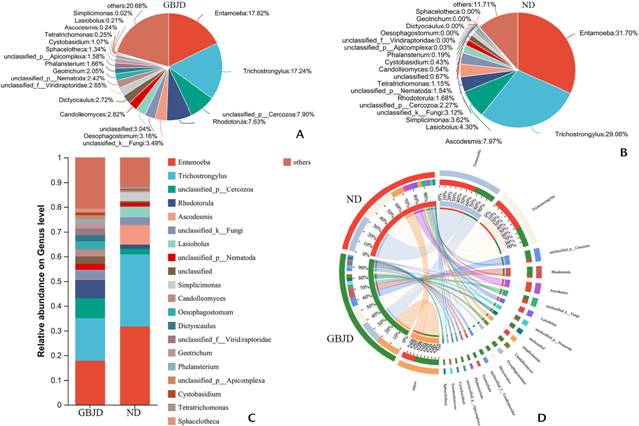
Furthermore, 313 genera were obtained in this study, of which 291 were identified. Entamoeba (17.82 ± 7.94%), Trichostrongylus (17.24 ± 6.74%), Rhodotorula (7.63 ± 2.03%) were the predominant genera in GBJD (Relative abundance >5%). Similarly, the predominant genera in ND were Entamoeba (31.70 ± 7.14%), Trichostrongylus (29.08 ± 6.45%), Ascodesmis (7.97 ± 3.56%) (Relative abundance >5%; Fig. 4A-D).

The composition of gut eukaryotes of white-lipped deer on phylum level: (A) community analysis pieplot of GBJD region on the phylum level; (B) community analysis pieplot of ND region on the phylum level; (C) relative abundance of gut eukaryotes on phylum level; (D) circos diagram on phylum level.

The composition of gut eukaryotes of white-lipped deer on genera level: (A) community analysis pieplot of GBJD group on the genera level; (B) community analysis pieplot of ND group on the genera level; (C) relative abundance of gut eukaryotes on genera level; (D) circos diagram on genera level.
Gut eukaryotic diversity in white-lipped deer
Alpha diversity indices, including ACE, Sobs, Chao1, and Shannon, were computed to compare the diversity in the gut eukaryotic community between the two regions. The ACE (p = 0.000), Sobs (p = 0.001), Chao1 (p = 0.001), and Shannon (p = 0.038) indices in GBJD were significantly greater than those in ND (Fig. 5A-D). The Good’s coverage (> 99.68%) indicated that most gut eukaryotic communities containing diverse species were retrieved from the samples.

The diversity of gut eukaryotes of white-lipped deer in the two regions. The differences in α diversity between the two regions based on ACE (A), Sobs (B), Shannon (C), and Chao1 (D) indices. PCoA (E) and NMDS (F) analyses of the two regions. *p < 0. 05, ***p < 0. 001.
PCoA analysis was conducted to assess the differences in beta diversity between the two regions. The resulting plot demonstrated distinct clustering of the GBJD and ND samples, indicating contrasting structures of the gut eukaryotes in the two regions (ANOSIM tests, R = 0.660, p = 0.001; Fig. 5E).
The NMDS analysis results better reflected the information on the true alignment of the data and the degree of difference in the gut eukaryotic composition of white-lipped deer in the two regions (ANOSIM tests, stress = 0.163, R = 0.660, p = 0.001; Fig. 5F).
Spatial composition difference of gut eukaryotes in white-lipped deer
Venn diagram analysis indicated that there were 21 phyla of the gut eukaryotes shared between the white-lipped deer in both GBJD and ND, while 3 and 1 were endemic to GBJD and ND populations, respectively (Fig. 6A). At the genus level, 115 genera were shared between the two populations, while 135 and 63 were endemic to GBJD and ND populations, respectively (Fig. 6B).

Among the 25 phyla, 12 differed significantly between the two study populations, of which 11 were identified (p < 0.05). The top five phyla were Basidiomycota, Cercozoa, Parabasalia, Ciliophora, and Apicomplexa. The relative abundance of Basidiomycota (p < 0.05), Cercozoa (p < 0.05), Ciliophora (p < 0.01), and Apicomplexa (p < 0.01) was significantly higher in GBJD than that in ND. By contrast, the relative abundance of Parabasalia in ND was significantly higher than that in GBJD (p < 0.01; Fig. 7A).

Differences of the relative abundance of the dominant gut eukaryotes between the two regions: (A) differences of relative abundance on the phylum level; (B) differences of relative abundance on the genera level. *p < 0. 05, **p < 0. 01, ***p < 0. 001.
Among the 313 genera, 36 differed significantly between the two study groups, of which 28 were identified (p < 0.05). The top ten genera were Rhodotorula, Ascodesmis, Simplicimonas, Candolleomyces, Oesophagostomum, Dictyocaulus, Phalansterium, Sphacelotheca, Colpoda, and Aphidius. Among them, Rhodotorula (p < 0.05), Candolleo myces (p < 0.05), Oesophagostomum (p < 0.05), Dictyocaulus (p < 0.05), Phalansterium (p < 0.05), Sphacelotheca (p < 0.001), Colpoda (p < 0.001), and Aphidius (p < 0.001) were significantly higher in GBJD than in ND. Contrarily, Ascodesmis (p < 0.05) and Simplicimonas (p < 0.001) were significantly lower in GBJD than in ND (Fig. 7B).
The LEfSe analysis showed that 26 biomarkers were significantly different in the two regions (LDA ≥ 4.0, p < 0.05, Fig. 6A). The Nematoda, Evosea, Basidiomycota, and Cercozoa biomarkers were significantly enriched in GBJD, whereas Ascomycota was significantly enriched in ND (Fig. 8A). At the genus level, Oesophagostomum, Phalansterium and Sphacelotheca were significantly enriched in GBJD, whereas Ascodesmis was significantly enriched in ND (Fig. 8A). The core gut eukaryotic species with significant differences (p < 0.05) at all levels are shown in Fig. 8B.

Linear discriminant analysis effect size (LEfSe) analysis of the gut eukaryotic composition of white-lipped deer in the two regions: (A) the tree map of LEfSe at multilevel species level; (B) LDA discriminant histogram. LDA ≥ 4.0, p < 0.05.
DISCUSSION
We found that the composition and the alpha and beta diversity of the white-lipped deer gut eukaryotes differed significantly between GBJD and ND. The white-lipped deer in GBJD had a higher alpha diversity of gut eukaryotes than those in ND. Moreover, significantly different gut eukaryotes were observed between two the regions at both phylum and genus levels.
Alpha diversity indices (ACE, Sobs, Chao1, and Shonnon) of GBJD were significantly higher than those of ND. The ACE, Sobs, and Chao1 indices were used to estimate species richness, while Shannon indices revealed species diversity (You et al. 2022). Higher ACE, Sobs and Chao1 indices indicate higher species richness, while a higher Shannon index indicates higher species diversity. Food resource is considered an important factor impacting the gut microbial composition and diversity of wild animals (Schwab et al. 2011). Vegetation resources in GBJD are more abundant than in ND due to the differences in the hydrothermal and climatic conditions of the two sites (Liu 2012, Luo et al. 2014). Although the diet of white-lipped deer populations in GBJD and ND was not investigated, previous studies have demonstrated that diet could be influenced by food resource availability and diversity (You et al. 2022). We observed that white-lipped deer in GBJD often eat food scraps of residents in the village, and lick human fecal-urine mixture in dry latrines. Thus, we proposed that food scraps of residents and human fecal-urine mixture can also increase the gut eukaryotic diversity of white-lipped deer.
At the phylum level, white-lipped deer had higher relative abundances of Basidiomycota, Cercozoa, Ciliophora, and Apicomplexa in GBJD, and only phylum Parabasalia had higher relative abundance in ND (Fig. 7A). Basidiomycota is one of the dominant gut fungi in mammals, and many studies have shown that the genus is associated with lipid metabolism and glycogenolysis in the host (Bozkurt et al. 2023, Yue et al. 2023). Similarly, Cercozoa may be associated with catabolic processes of organic matter in the host (Huang et al. 2022). Ciliophora, widely distributed in the rumen and other fermentation zones of the digestive tract of herbivores, is an important protozoa involved in the breakdown of plant cellulose in ruminants (Gürelli 2014, Da Silva et al. 2022). The rich natural food resource and the eating of food scraps have changed the gut microbial composition and proportion of deer in GBJD, especially the higher fat and energy content of the food scraps from the residents (Chen et al. 2018a). Thus, the white-lipped deer may need more gut microbes to aid fat metabolism and other functions. In addition, the relative abundance of Apicomplexa in the gut was significantly higher in GBJD, indicating that the white-lipped deer in GBJD have the potential risk of zoonotic diseases. Many Apicomplexa species, such as Toxoplasma gondii, Cryptosporidium spp., Eimeria spp., can parasitize the digestive tracts of humans or domestic animals (cats, dogs, cows, sheep) causing intestinal inflammation, vomiting, developmental delay, dehydration, and even death of the host (Martins et al. 2022, Garcia-R et al. 2023, Pastiu et al. 2023). In GBJD, white-lipped deer not only ate food scraps of residents, but also licked human fecal-urine mixture from dry latrines. Limited sanitation and half-cooked food can promote the propagation of pathogenic microorganisms, which might have been the reason for high Apicomplexa in GBJD.
Moreover, significantly different gut eukaryotes were found between the two regions at the genus level. Among the top ten genera, Rhodotorula, Candolleomyces, Oesophagostomum, Dictyocaulus, Phalansterium, Sphacelotheca, Colpoda, and Aphidius were significantly higher in GBJD than in ND. Three of them (Rhodotorula, Oesophagostomum, and Dictyocaulus) are pathogens that can infect both humans and animals. Rhodotorula commonly causes central nervous system, ocular and bloodstream, infections, such as fungemia, as well as peritoneal dialysis-associated peritonitis in humans (Ioannou et al. 2019, Huang and Xu 2020). Oesophagostomum are common intestinal parasites found in cattle, pigs, primates, and humans, which can cause severe illnesses, resulting in the formation of granulomas, caseous lesions, and abscesses in the intestinal wall (Polderman and Blotkamp 1995, Guillot et al. 2012). Dictyocaulus are known to be the pathogens causing large intestine bronchitis, resulting in cough, nasal discharge, emphysema, pneumonia, and even death in bovine (Johnson et al. 2003, Mahmood et al. 2014). Thus, the higher abundance of these three genera in white-lipped deer in GBJD may increase the potential risk of zoonosis between humans and white-lipped deer. The highly abundant Candolleomyces, Sphacelotheca, Colpoda, and Aphidius genera in white-lipped deer in GBJD were likely obtained from natural food and environments. For example, Sphacelotheca is a widespread parasitic fungus in Poaceae vegetation (Liu 2012). In GBJD, the main vegetation taxa included Poaceae, Gentianaceae, Rosaceae, and Cyperaceae (Liu 2012). Moreover, some studies found that white-lipped deer prefer to graze on Cyperaceae and Poaceae vegetations, which are characterized by early greening, sufficient nutrients, and large quantities and can provide sufficient nutrition for white-lipped deer (Wu and Wang 1999, You et al. 2014). Therefore, white-lipped deer may obtain abundant Sphacelotheca upon eating Poaceae plants. Interestingly, we found that the abundance of Simplicimonas was significantly higher in ND. Simplicimonas were recently found in some domestic animals (chickens and cows) and some wildlife (wetland birds and rodents) (Kamaruddin et al. 2014, Frey et al. 2017, Landman et al. 2021). Thus, the present study is the first to report Simplicimonas as gut eukaryotes in white-lipped deer. However, further studies are needed to explore the influences of Simplicimonas in the physiology of white-lipped deer.
According to our results, food resources and human disturbance (including food scraps from the residents and human fecal-urine mixture from dry latrines) could impact the composition and diversity of gut eukaryotes in wild white-lipped deer. Moreover, eating food scraps from the residents and licking human fecal-urine mixture from dry latrines may promote the transmission of some pathogens between residents and white-lipped deer. Therefore, we suggest that the contact between humans and wild animals in GBJD National Nature Reserve should be reduced.
ACKNOWLEDGMENTS
Thanks to Jingjing Yu of Xizang Agricultural and Animal Husbandry University, and guide Dobje and Nima for their help in field sampling for this study. And we would like to thank MogoEdit (https://www.mogoedit.com) for its English editing during the preparation of this manuscript.
LITERATURE CITED
-
Akbar N, Siddiqui R, Sagathevan K, Khan NA (2020) Gut bacteria of animals living in polluted environments exhibit broad-spectrum antibacterial activities. International Microbiology 23(4): 511-526. https://doi.org/10.1007/s10123-020-00123-3
» https://doi.org/10.1007/s10123-020-00123-3 -
Bornbusch SL, Muletz-Wolz CR, Lopez-Bondarchuk E, Maslanka MT, Kendrick EL (2023) Gut microbiomes of captive primates show phylosymbiosis, respond to dietary sugar reduction, and select for host-specific dietary microbes. Fems Microbiology Ecology 99(8): fiad069. https://doi.org/10.1093/femsec/fiad069
» https://doi.org/10.1093/femsec/fiad069 -
Bozkurt B, Terlemez G, Sezgin E (2023) Basidiomycota species in Drosophila gut are associated with host fat metabolism. Scientific Reports 13(1): 13807. https://doi.org/10.1038/s41598-023-41027-2
» https://doi.org/10.1038/s41598-023-41027-2 -
Buthgamuwa I, Fenelon JC, Roser A, Isini B, Jane CF, Alice R, et al. (2023) Gut microbiota in the short-beaked echidna (Tachyglossus Aculeatus) shows stability across gestation. MicrobiologyOpen 12(6): e1392. https://doi.org/10.1002/mbo3.1392
» https://doi.org/10.1002/mbo3.1392 -
Callahan BJ, Mcmurdie PJ, Rosen MJ, Han AW, Johnson AJA, Holmes SP (2016) DADA2: high-resolution sample inference from Illumina amplicon data. Nature Methods 13: 581-583. https://doi.org/10.1038/nmeth.3869
» https://doi.org/10.1038/nmeth.3869 -
Caporaso JG, Kuczynski J, Stombaugh J, Bittinger K, Bushman FD, Costello EK, et al. (2010) QIIME allows analysis of high-throughput community sequencing data. Nature Methods 7: 335-336. https://doi.org/10.1038/nmeth.f.303
» https://doi.org/10.1038/nmeth.f.303 -
Chen L, Hu JH, Jin LM, Yu J, Mu TT, Zhang SN, et al. (2018a) Study on the relationship between diet habits and essential hypertension of Zang nationality in Gannan Tibetan Autonomous Prefecture. Journal of Gansu University of Chinese Medicine 35(1): 118-121. https://doi.org/10.16841/j.issn1003-8450.2018.01.32
» https://doi.org/10.16841/j.issn1003-8450.2018.01.32 -
Chen S, Zhou Y, Chen Y, Gu J (2018b) fastp: an ultra-fast all-in-one FASTQ preprocessor. Bioinformatics 34(17): i884-i890. https://doi.org/10.1093/bioinformatics/bty560
» https://doi.org/10.1093/bioinformatics/bty560 -
CNCB-NGDC Members and Partners (2022) Database Resources of the National Genomics Data Center, China National Center for Bioinformation. Nucleic Acids Research 50(D1): D27-D38. https://doi.org/10.1093/nar/gkab951
» https://doi.org/10.1093/nar/gkab951 -
Cook TM, Mansuy-Aubert V (2022) Communication between the gut microbiota and peripheral nervous system in health and chronic disease. Gut Microbes 14(1): 2068365. https://doi.org/10.1080/19490976.2022.2068365
» https://doi.org/10.1080/19490976.2022.2068365 -
Da B, Ding YH, Se YJ, Dou ZG, Ma ZB, Dong K (2019) Investigation and Monitoring of Cervus albirostris in Yanchiwan National Nature Reserve of Gansu Province. Journal of Gansu Forestry Science and Technology 44(1): 1-4. https://doi.org/10.3969/j.issn.1006-0960.2019.01.001
» https://doi.org/10.3969/j.issn.1006-0960.2019.01.001 -
Da Silva ZRJ, Cedrola F, Rossi MF, Costa FDS, Dias RJP (2022) Rumen ciliates (Alveolata, Ciliophora) associated with goats: checklist, geographic distribution, host specificity, phylogeny and molecular dating. Zootaxa 5165(2): 191-216. https://doi.org/10.11646/zootaxa.5165.2.3
» https://doi.org/10.11646/zootaxa.5165.2.3 -
Decandia AL, Adeduro L, Thacher P, Crosier A, Marinari P, Bortner R, et al. (2024) Gut bacterial composition shows sex-specific shifts during breeding season in exsitu managed black-footed ferrets. Journal of Heredity 15(4): 385-398. https://doi.org/10.1093/jhered/esad065
» https://doi.org/10.1093/jhered/esad065 -
Fan P, Bian B, Teng L, Nelson CD, Driver J, Elzo MA, Jeong KC (2020) Host genetic effects upon the early gut microbiota in a bovine model with graduated spectrum of genetic variation. ISME Journal 14(1): 302-317. https://doi.org/10.1038/s41396-019-0529-2
» https://doi.org/10.1038/s41396-019-0529-2 -
Fleischer R, Jones C, Ledezma-Campos P (2024) Gut microbial shifts in vampire bats linked to immunity due to changed diet in human disturbed landscapes. Science of the Total Environment 907: 167815. https://doi.org/10.1016/j.scitotenv.2023.167815
» https://doi.org/10.1016/j.scitotenv.2023.167815 -
Frey CF, Müller N, Stäuber N, Marreros N, Hofmann L, Hentrich B, Hirsbrunner G (2017) Simplicimonas-like DNA in vaginal swabs of cows and heifers cross-reacting in the real-time PCR for T-foetus. Veterinary Parasitology 237: 30-36. https://doi.org/10.1016/j.vetpar.2017.02.024
» https://doi.org/10.1016/j.vetpar.2017.02.024 -
Garcia-R JC, Pita AB, Velathanthiri N, Pas A, Hayman DTS (2023) Mammal-related Cryptosporidium infections in endemic reptiles of New Zealand. Parasitology 122(5): 1239-1244. https://doi.org/.10.1007/s00436-023-07824-4
» https://doi.org/.10.1007/s00436-023-07824-4 -
Griem-Krey H, Petersen C, Hamerich IK, Schulenburg H (2023) The intricate triangular interaction between protective microbe, pathogen and host determines fitness of the metaorganism. Proceedings of The Royal Society, Series B: Biological Sciences 290(2012): 20232193. https://doi.org/10.1098/rspb.2023.2193
» https://doi.org/10.1098/rspb.2023.2193 -
Guillot J, Vermeulen B, Lafosse S, Chauffour S, Cibot M, Narat V, et al. (2012) Nematodes of the genus Oesophagostomum: an emerging risk for humans and apes in Africa? Bulletin de L’Academie Nationale de Medecine 195(8): 1955-1963. https://doi.org/10.1001/jama.2011.1577
» https://doi.org/10.1001/jama.2011.1577 -
Gürelli G (2014) Rumen ciliate fauna (Ciliophora, Protista) of Turkish domestic goats living in Izmir, Turkey. Turkish Journal of Zoology 38(2): 136-143. https://doi.org/10.3906/zoo-1303-21
» https://doi.org/10.3906/zoo-1303-21 -
Guzzo GL, Andrews JM, Weyrich LS (2022) The Neglected Gut Microbiome: Fungi, Protozoa, and Bacteriophages in Inflammatory Bowel Disease. Inflammatory Bowel Diseases 28(7): 1112-1122. https://doi.org/10.1093/ibd/izab343
» https://doi.org/10.1093/ibd/izab343 -
Han RB, Zhao HN, Li DF, Li HP (2020) Assessment of genetic diversity of Cervus albirostris (white-lipped deer) by microsatellite markers. Animal Biotechnology 33(4): 739-744. https://doi.org/10.1080/10495398.2020.1832104
» https://doi.org/10.1080/10495398.2020.1832104 -
Harris RB (2015) Cervus albirostris The IUCN Red List of Threatened Species 2015: e.T4256A61976756. https://doi.org/10.2305/IUCN.UK.2015-2.RLTS.T4256A61976756.en
» https://doi.org/10.2305/IUCN.UK.2015-2.RLTS.T4256A61976756.en -
Hoffmann C, Dollive S, Grunberg S, Chen J, Li HZ, Wu GD, et al. (2013) Archaea and Fungi of the Human Gut Microbiome: Correlations with Diet and Bacterial Residents. Plos One 8(6): e66019. https://doi.org/10.1371/journal.pone.0066019
» https://doi.org/10.1371/journal.pone.0066019 -
Huang GP, Qi DW, Yang ZS, Hou R, Shi WY, Zhao FQ, et al. (2024) Gut microbiome as a key monitoring indicator for reintroductions of captive animals. Conservation Biology 38(1): e14173. https://doi.org/10.1111/cobi.14173
» https://doi.org/10.1111/cobi.14173 -
Huang JJ, Xu YC (2020) Epidemiology and drug sensitivity of red yeast infection. Chinese Journal of Mycology 15(4): 244-247. https://doi.org/10.27648/d.cnki.gzxhu.2022.000007
» https://doi.org/10.27648/d.cnki.gzxhu.2022.000007 -
Huang K, Guan MX, Chen J, Xu JJ, Xia H, Li YW (2022) Biochars modify the degradation pathways of dewatered sludge by regulating active microorganisms during gut digestion of earthworms. Science of the Total Environment 828: 154496. https://doi.org/10.1016/j.scitotenv.2022.154496
» https://doi.org/10.1016/j.scitotenv.2022.154496 -
Hughes J, Alexander J, Shi K, Riordan P (2015) Confirmation of threatened white-lipped deer (Przewalskium albirostris) in Gansu and Sichuan, China, and their overlap with livestock. Mammalia 79(2): 241-244. https://doi.org/10.1515/mammalia-2014-0038
» https://doi.org/10.1515/mammalia-2014-0038 -
Ioannou P, Vamvoukaki R, Samonis G (2019) Rhodotorula species infections in humans: A systematic review. Mycoses 62(2): 90-100. https://doi.org/10.1111/myc.12856
» https://doi.org/10.1111/myc.12856 - Jiang ZG (2021) China’s Red List of Biodiversity: Vertebrates. Science Press, Beijing, 458 pp.
-
Johnson M, Mackintosh CG, Labes RE, Taylor MJ, Wharton DA (2003) Dictyocaulus species: cross infection between cattle and red deer. New Zealand Veterinary Journal 51(2): 93-98. https://doi.org/10.1080/00480169.2003.36346
» https://doi.org/10.1080/00480169.2003.36346 -
Kamaruddin M, Tokoro M, Rahman MM, Arayama S, Hidayati APN, Syafruddin D, et al. (2014) Molecular characterization of various trichomonad species isolated from humans and related mammals in Indonesia. Korean Journal of Parasitology 52(5): 471-478. https://doi.org/10.3347/kjp.2014.52.5.471
» https://doi.org/10.3347/kjp.2014.52.5.471 -
Kartjito MS, Yosia M, Wasito E, Soloan G, Agussalim AF, Basrowi RW (2023) Defining the Relationship of Gut Microbiota, Immunity, and Cognition in Early Life-A Narrative Review. Nutrients 15(12): 2642. https://doi.org/10.3390/nu15122642
» https://doi.org/10.3390/nu15122642 -
Köljalg U, Nilsson RH, Abarenkov K, Tedersoo L, Taylor AFS, Bahram M, et al. (2013) Towards a unified paradigm for sequence-based identification of fungi. Molecular Ecology 22(21): 5271-5277. https://doi.org/10.1111/mec.12481
» https://doi.org/10.1111/mec.12481 -
Landman WJM, Gantois N, Sawant M, Majoor FA, van Eck JHH, Viscogliosi E (2021) Prevalence of trichomonads in the cloaca of wild wetland birds in the Netherlands. Avian Pathology 50(6): 465-476. https://doi.org/10.1080/03079457.2021.1967876
» https://doi.org/10.1080/03079457.2021.1967876 -
Lee S, Fan PX, Liu T, Yang A, Boughton RK, Pepin KM, et al. (2022) Transmission of antibiotic resistance at the wildlife-livestock interface. Comunication Biology 5(1): 585. https://doi.org/10.1038/s42003-022-03520-8
» https://doi.org/10.1038/s42003-022-03520-8 -
Li B, Gao HM, Song PF, Liang CB, Jiang F, Xu B, et al. (2022) Captivity Shifts Gut Microbiota Communities in White-Lipped Deer (Cervus albirostris). Animals 12(4): 431. https://doi.org/10.3390/ani12040431
» https://doi.org/10.3390/ani12040431 -
Li B, Lin GH, Xie JX, Yang CH, Su JP, Zhang TZ (2014) Feeding habits of white-lipped deer (Cervus albirostris) in a semi-natural enclosure of Tuole Nanshan. Sichuan Journal of Zoology 33(6): 840-845. https://doi.org/10.3969/i.issn.1000-7083.2014.06.006
» https://doi.org/10.3969/i.issn.1000-7083.2014.06.006 -
Li JG, Wang CD, Tang ZH, Guo YQ, Zheng TC, Li YZ, You ZQ (2017) The Gut Bacterial Community Composition of Wild Cervus albirostris (White-Lipped Deer) Detected by the 16S Ribosomal RNA Gene Sequencing. Current Microbiology 74(9): 1100-1107. https://doi.org/10.1007/s00284-017-1288-9
» https://doi.org/10.1007/s00284-017-1288-9 -
Li K, Jiang JH, Muhammad S, Khalid M, Jiang X, Zhao XD, et al. (2018) Revealing the parasitic infection in diarrheic yaks by piloting high-throughput sequencing. Microbial Pathogenesis 117: 153-156. https://doi.org/10.1016/j.micpath.2018.02.033
» https://doi.org/10.1016/j.micpath.2018.02.033 -
Lin ZS, Ma X (2023) Dietary nutrients mediate crosstalk between bile acids and gut microbes in animal host metabolism. Critical Reviews in Food Science and Nutrition 63(28): 9315-9329. https://doi.org/10.1080/10408398.2022.2067118
» https://doi.org/10.1080/10408398.2022.2067118 -
Liu SL, Imad S, Hussain S, et al. (2024) Sex, health status and habitat alter the community composition and assembly processes of symbiotic bacteria in captive frogs. BMC Microbiology 24(1): 34. https://doi.org/10.1186/s12866-023-03150-y
» https://doi.org/10.1186/s12866-023-03150-y -
Liu T (2012) The research on distribution and living habits of Cervus albirostris in Tibet Gongbujiangda Cervus albirostris Nature Reserve. Hunan Normal University, Changsha, 12. https://doi.org/10.7666/d.y2148427
» https://doi.org/10.7666/d.y2148427 -
Liu YJ, Huang K, Wang XY, et al. (2023) Research on space occupancy, activity rhythm and sexual segregation of White-Lipped Deer (Cervus albirostris) in forest habitats of Jiacha Gorge on Yarlung Zangbo River Basin based on infrared camera technology. Biology 12(6): 815. https://doi.org/10.3390/biology12060815
» https://doi.org/10.3390/biology12060815 -
Lu YW, Zhang L, Liu X, Lan Y, Wu LX, Wang J, et al. (2024) Red pandas with different diets and environments exhibit different gut microbial functional composition and capacity. Integrative Zoology 19(4): 662-682. https://doi.org/10.1111/1749-4877.12813
» https://doi.org/10.1111/1749-4877.12813 -
Luo SWM, La Z, Chi SDJ, Zha L, Ba Z (2014) Analysis of climatic characteristics in Naidong, Shannan in Tibet, China. Xizang Science and Technology 6: 67-70. https://doi.org/10.3969/j.issn.1004-3403.2010.08.025
» https://doi.org/10.3969/j.issn.1004-3403.2010.08.025 -
Magoč T, Salzberg SL (2011) FLASH: fast length adjustment of short reads to improve genome assemblies. Bioinformatics 27(21): 2957-2963. https://doi.org/10.1093/bioinformatics/btr507
» https://doi.org/10.1093/bioinformatics/btr507 - Mahmood F, Khan A, Hussain R, Anjum MS (2014) Prevalence and pathology of Dictyocaulus viviparous infection in cattle and buffaloes. Journal of Animal and Plant Sciences 24(3): 743-748.
-
Maritan E, Gallo M, Srutkova D (2022) Gut microbe Lactiplantibacillus plantarum undergoes different evolutionary trajectories between insects and mammals. BMC Biology 20(1): 290. https://doi.org/10.1186/s12915-022-01477-y
» https://doi.org/10.1186/s12915-022-01477-y -
Martins NS, da Motta SP, dos Santos CC, da Silva MA, Evaristo TA, da Rosa FNA, Ruas JL (2022) Ovine Eimeria infections in southern Brazil - prevalence and risk factors. Semina Ciências Agrárias 43(1): 229-240. https://doi.org/10.5433/1679-0359.2022v43n1p229
» https://doi.org/10.5433/1679-0359.2022v43n1p229 -
Masasa M, Kushmaro A, Nguyen D, Chernova H, Shashar N, Guttman L (2023) Spatial succession underlies microbial contribution to food digestion in the gut of an algivorous Sea Urchin. Microbiology Spectrum 11(3): e00514-23. https://doi.org/10.1128/spectrum.00514-23
» https://doi.org/10.1128/spectrum.00514-23 -
Miri S, Yeo JD, Abubaker S, Hammami R (2023) Neuromicrobiology, an emerging neurometabolic facet of the gut microbiome? Frontiers in Microbiology 14: 1098412. https://doi.org/10.3389/fmicb.2023.1098412
» https://doi.org/10.3389/fmicb.2023.1098412 -
Moeller AH, Peeters M, Ndjango JB, Li YY, Hahn BH, Ochman H (2013) Sympatric chimpanzees and gorillas harbor convergent gut microbial communities. Genome Research 23(10): 1715-1720. https://doi.org/10.1101/gr.154773.113
» https://doi.org/10.1101/gr.154773.113 -
Moor J, Wüthrich T, Aebi S, Mostacci N, Overesch G, Oppliger A, Hilty M (2021) Influence of pig farming on human Gut Microbiota: role of airborne microbial communities. Gut Microbes 13(1): 1927634. https://doi.org/10.1080/19490976.2021.1927634
» https://doi.org/10.1080/19490976.2021.1927634 -
Obeng N, Bansept F, Sieber M (2021) Evolution of Microbiota-Host Associations: The Microbe’s Perspective. Trends in Microbiology 29(9): 779-787. https://doi.org/10.1016/j.tim.2021.02.005
» https://doi.org/10.1016/j.tim.2021.02.005 -
Pastiu AI, Mircean V, Mercier A, PasseboscFaure K, Plault N, Dardé ML, et al. (2023) Toxoplasma gondii infection in sheep from Romania. Parasites & Vectors 16(1): 24. https://doi.org/10.1186/s13071-022-05634-8
» https://doi.org/10.1186/s13071-022-05634-8 -
Patangia DV, Grimaud G, Wang SP, Ross RP, Catherine S (2024) Influence of age, socioeconomic status, and location on the infant gut resistome across populations. Gut Microbes 16(1): 2297837. https://doi.org/10.1080/19490976.2023.2297837
» https://doi.org/10.1080/19490976.2023.2297837 -
Polderman AM, Blotkamp J (1995) Oesophagostomum infections in humans. Parasitology Today 11(12): 451-456. https://doi.org/10.1016/0169-4758(95)80058-1
» https://doi.org/10.1016/0169-4758(95)80058-1 -
Schwab C, Cristescu B, Northrup JM, Stenhouse GB, Gänzle M (2011) Diet and environment shape fecal bacterial microbiota composition and enteric pathogen load of grizzly bears. Plos One 6(12): e27905. https://doi.org/10.1371/journal.pone.0027905
» https://doi.org/10.1371/journal.pone.0027905 -
Segata N, Izard J, Waldron L, Gevers D, Miropolsky L, Garrett WS, Huttenhower C (2011) Metagenomic biomarker discovery and explanation. Genome Biology 12: R60. https://doi.org/10.1186/gb-2011-12-6-r60
» https://doi.org/10.1186/gb-2011-12-6-r60 - Sheng HL, Xu HF, Zhang ED (1992) The deer in China. East China Normal University Press, Shanghai, 305 pp.
-
Small CM, Beck EA, Currey MC, Tavalire HF, Bassham S, Cresko WA (2023) Host genomic variation shapes gut microbiome diversity in threespine stickleback fish. MBIO 14(5): e00219-23. https://doi.org/10.1128/mbio.00219-23
» https://doi.org/10.1128/mbio.00219-23 -
Song FC, Ma SB, Zhang YJ (2023) Seasonal Variation in Gut Microbiota of the Wild Daurian Ground Squirrel (Spermophilus dauricus): Metagenomic insights into seasonal breeding. Animals 13(13): 2235. https://doi.org/10.3390/ani13132235
» https://doi.org/10.3390/ani13132235 -
Sun L, Li ZM, Hu CY, Ding JH, Zhou Q, Pang GF, et al. (2023) Age-dependent changes in the gut microbiota and serum metabolome correlate with renal function and human aging. Aging Cell 22(12). https://doi.org/10.1111/acel.14028
» https://doi.org/10.1111/acel.14028 -
Tang ZH, Luo HL, Wang JH, Liu JL, You ZQ (2022) Potential suitable habitat and protection gap analysis of white-lipped deer (Cervus albirostris) based on GIS and Maxent model. Ecologica 42(22): 1-10. https://doi.org/10.5846/stxb202106071503
» https://doi.org/10.5846/stxb202106071503 -
Van Veelen HPJ, Ibáñez-Alamo JD, Horrocks NPC, Hegemann A, Ndithia HK, Shobrak M, Tieleman BI (2023) Cloacal microbiota are biogeographically structured in larks from desert, tropical and temperate areas. BMC Microbiology 23: 40. https://doi.org/10.1186/s12866-023-02768-2
» https://doi.org/10.1186/s12866-023-02768-2 -
Wang KB, You ZQ, Xie HX, Zhen TC, Li QZ (2018) Vigilance behavior of Cervus albirostris during breeding season in Chaqingsongduo White-lipped deer National Nature Reserve, Sichuan. Sichuan Journal of Zoology 37(3): 305-310. https://doi.org/10.11984/j.issn.1000-7083.20180016
» https://doi.org/10.11984/j.issn.1000-7083.20180016 -
Wang XF, Tsai TC, Deng FL, Wei XY, Jianmin C, Joshua K, et al. (2019) Longitudinal investigation of the swine gut microbiome from birth to market reveals stage and growth performance associated bacteria. Microbiomes 7: 109. https://doi.org/10.1186/s40168-019-0721-7
» https://doi.org/10.1186/s40168-019-0721-7 - Wei FW (2016) New angle to study the adaptive evolution: animal gut microbiome. Sci Sin Vitae 46: 1338-1340.
- Wu JY, Wang W (1999) The white-lipped deer of China. China Forestry Publishing House, Beijing, 167 pp.
-
Yang HL, Wu JM, Du H, Zhang H, Li JY, Wei QW (2022) Quantifying the Colonization of Environmental Microbes in the Fish Gut: A Case Study of Wild Fish Populations in the Yangtze River. Frontiers in Microbiology 12: 828409. https://doi.org/10.3389/FMICB.2021.828409
» https://doi.org/10.3389/FMICB.2021.828409 -
You ZQ, Deng J, Liu JL, Fu JH, Xiong H, Luo W, Xiong JI (2022) Seasonal variations in the composition and diversity of gut microbiota in white-lipped deer (Cervus albirostris). PeerJ 10: e13753. https://doi.org/10.7717/peerj.13753
» https://doi.org/10.7717/peerj.13753 -
You ZQ, Tang ZH, Yang YB, Yang LL, Shi HY, Liu H, et al. (2014) Summer habitat selection by white-lipped deer (Cervus albirostris) in Chaqingsongduo White-lipped Deer National Nature Reserve. Acta Theriologica Sinica 34(1): 46-53. https://doi.org/10.16829/j.slxb.2014.01.006
» https://doi.org/10.16829/j.slxb.2014.01.006 -
Yuan S, Wang KS, Meng H, Hou XT, Xue JC, Liu BH, et al. (2023) The gut microbes in inflammatory bowel disease: Future novel target option for pharmacotherapy. Biomedicine & Pharmacotherapy 165: 114893. https://doi.org/10.1016/j.biopha.2023.114893
» https://doi.org/10.1016/j.biopha.2023.114893 -
Yue R, Chen HJ, Xu XJ, Xia YN, Sun Y, Xia MY, et al. (2023) Maternal and infantile gut mycobiome during the weaning period in free ranging Tibetan macaques (Macaca thibetana). Ecology and Evolution 13(5): e10108. https://doi.org/10.1002/ece3.10108
» https://doi.org/10.1002/ece3.10108 -
Zhang M, Shi M, Fan M, Xu HH, Li YM, Zhang TX, et al. (2018) Comparative analysis of gut microbiota changes in Père Davids deer populations in Beijing Milu Park and Shishou, Hubei Province in China. Frontiers in Microbiology 9: 1258. https://doi.org/10.3389/fmicb.2018.01258
» https://doi.org/10.3389/fmicb.2018.01258 -
Zhang XY, Xiang XJ, Liu T, Wu YN, Wu YL, Wang GY, et al. (2024) Semi-captive Przewalski’s gazelles cope with winter adversity by adjusting their gut bacterial communities. Journal of Wildlife Management 88(3): e22545. https://doi.org/10.1002/jwmg.22545
» https://doi.org/10.1002/jwmg.22545 -
Zhao P, Xu HL, Li DY, Xu HM, Wu JY, Wen AX, et al. (2017) The complete mitochondrial genome sequence and phylogenetic analysis of white-lipped deer (Cervus albirostris). Conservation Genetics Resources 10(4): 741-745. https://doi.org/10.1007/s12686-017-0919-6
» https://doi.org/10.1007/s12686-017-0919-6 -
Zheng SW, Wu JY, Han YP (1989) Preliminary investigation on the food habits and reproduction of the white-lipped deer. Acta Theriologica Sinica (2): 45-51. https://doi.org/10.16829/j.slxb.1989.02.008
» https://doi.org/10.16829/j.slxb.1989.02.008
ADDITIONAL NOTES
-
Funding
Mianyang Normal University (QD2023A02), Qinghai Provincial Key Laboratory of Animal Ecological Genomics (QHEG-2024-05), Natural Science Foundation of Sichuan Province (2022NSFSC1756). This study was supported by the Scientific research initiation project of Mianyang Normal University (QD2023A02), the 2023 award fund of Qinghai Provincial Key Laboratory of Animal Ecological Genomics (QHEG-2024-05), and Natural Science Foundation of Sichuan Province (2022NSFSC1756).
-
Data Availability
The data of this study have been deposited into National Genomics Data Center (CNCB-NGDC Members and Partners 2022), China National Center for Bioinformation with accession number CRA015877.
- ZooBank register
-
How to cite this article
Yang Y, Luo W, Luo P, He M, Jiang F, Xiong J, You Z (2025) Spatial composition differences and diversity of gut eukaryotes in white-lipped deer in Xizang, China. Zoologia 42: e24038. https://doi.org/10.1590/S1984-4689.v42.e24038
-
Published by
Sociedade Brasileira de Zoologia at Scientific Electronic Library Online - https://www.scielo.br/zool
The data of this study have been deposited into National Genomics Data Center (CNCB-NGDC Members and Partners 2022), China National Center for Bioinformation with accession number CRA015877.
Data citations
Harris RB (2015) Cervus albirostris The IUCN Red List of Threatened Species 2015: e.T4256A61976756. https://doi.org/10.2305/IUCN.UK.2015-2.RLTS.T4256A61976756.en