Conservation status assessment of Scolopendromorpha (Chilopoda) species in Chile
ABSTRACT
This study presents the first assessment of the conservation status of Chilean species of the order Scolopendromorpha, a group rarely included in conservation policies. Eleven species were identified (three from Akymnopellis and eight from Cryptops) through a literature review and databases such as CHILOBASE and GBIF. IUCN and NatureServe criteria were applied, estimating the extent of occurrence (EOO) and area of occupancy (AOO) using tools like GeoCAT. Results indicate that all species face some degree of threat, with Cryptops armatus Silvestri, 1899, Cryptops detectus Silvestri, 1899, Cryptops nahuelbuta Chamberlin, 1955, and Cryptops triserratus Attems, 1903 classified as critically endangered. The most frequent threats include urbanization, deforestation, and land use change. The discussion highlights the urgent need to include these species in official conservation lists, promote research on their biology, and propose measures such as the creation of microreserves and environmental education programs, given their limited distribution, ecological vulnerability, and ecological importance.
KEYWORDS:
Biological conservation; chilean arthropods; IUCN categories; NatureServe categories; threatened species
INTRODUCTION
Invertebrates, with several million species, represent nearly 97% of the described animal species ‘(Schuldt and Assmann 2010). However, efforts for their protection and/or conservation are rarely developed (Karam-Gemael et al. 2020). According to the International Union for Conservaion of Nature’s Red List, their small size, generally limited distribution ranges, low dispersal capacity, and the small number of experts working on the group create a negative bias when it comes to their representation in conservation lists, despite their critical role in various ecological processes (Snyder and Hendryx 2008, Zamin et al. 2010, IUCN 2024).
European countries, such as Germany and Slovenia, are considered advanced in conservation policies for myriapods, as evidenced by their lists of centipede species and their respective conservation categories (Kos 1992, Spelda 1999, Voigtländer et al. 2011, Decker et al. 2014). However, the conservation and protection criteria for myriapods are still widely scarce worldwide. In Latin America, for instance, only Brazil and Cuba, through speleological studies, have proposed sites for the protection and conservation of centipede species by including them in conservation categories based on their known distributions (Martínez 2018, Karam-Gemael et al. 2020).
In Chile, efforts for the protection and conservation of arthropods have been minimal. Barahona-Segovia (2019) notes that it was only in 2009 that the first insect with conservation criteria, Chiasognathus grantii Stephens, 1831 (Coleoptera: Lucanidae) was documented (Vergara and Jerez 2009), despite the absence of conservation plans for this species. Subsequently, the desert beetle Gyriosomus granulipennis Pizarro-Araya & Flores, 2004 (Coleoptera: Tenebrionidae), endemic to Choros Island, was presented as the first insect to be classified under the criteria of the Chilean Ministry of the Environment (MMA) (Jerez et al. 2015).
Currently, more and more specialists are working to establish conservation criteria for arthropod species. Dipterans, cockroaches, hemipterans, odonates, scorpions (Scorpiones: Bothriuridae) and spiders (Araneae: Theraphosidae) have been included in Chile’s conservation lists (Barahona-Segovia 2019), with management manuals even being proposed for the development of inventories of this fauna (Aguilera et al. 2019). In Chile, myriapods have yet to be considered under any conservation criteria, despite several species being endemic and used in human medicine (Hakim et al. 2015). Furthermore, in the 16th species classification process, none of the thousands of categorized species belonged to the subphylum Myriapoda, highlighting the significant gap in knowledge about this group.
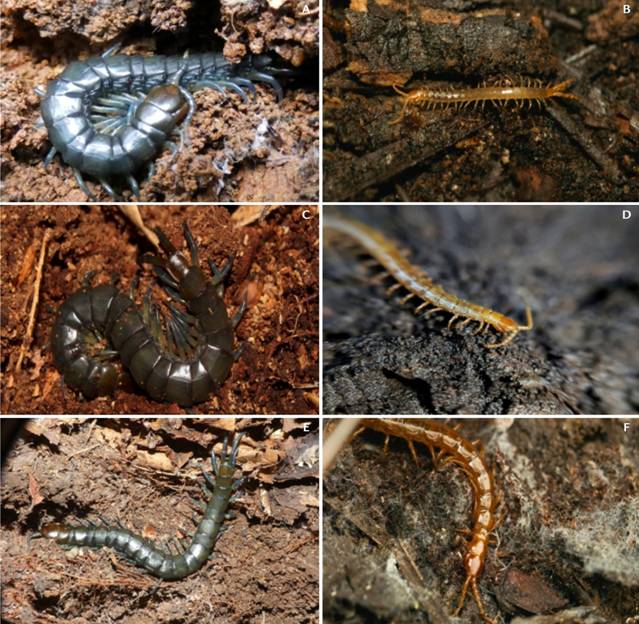
According to Vega-Román et al. (2018), knowledge of myriapods in Chile remains limited, particularly regarding scolopendromorphs, which represent a highly understudied group (Fig. 1) and lack up-to-date information on their distribution and conservation status. Currently, species within this order are not assigned any conservation status by the MMA (2024), and existing data on these species in the country are outdated.

Representatives of the order Scolopendromorpha in Chile. (A) Akymnopellis chilensis; (B) Cryptops patagonicus; (C) Akymnopellis platei; (D) Cryptops triserratus; (E) Akymnopellis laevigata; (F) Cryptops sp. Photos source iNaturalist: (A) Natalia Rebolledo, (B) Francia Álvares, (C) Edgardo Flores, (D) Benjamín Silva, (E) Mauricio Contreras, (F) Francia Álvares.
Therefore, the aim of this study is to assess the conservation status of Chilean species of the order Scolopendromorpha (Chilopoda) by applying the categorization criteria of the International Union for Conservaion of Nature (IUCN) and NatureServe. Specifically, we identify their extent of occurrence, area of occupancy, and major threats, in order to provide baseline information for their inclusion in conservation policies and management programs.
MATERIAL AND METHODS
Scolopendromorph species in Chile
The study was conducted through a bibliographic search containing information on scolopendromorph species recorded in Chile. The search was carried out on web servers such as “Web of Knowledge” (https://www.webofscience.com/wos/woscc/basic-search), “SciELO” (https://scielo.org), “CHILOBASE 2.0” (https://chilobase.biologia.unipd.it), Google Scholar (https://scholar.google.com), and the Myriatrix database (http://myriatrix.myspecies.info/), which has updated bibliography on myriapods worldwide. Keywords and thesauri used in the information search included: “Myriapoda + Chilopoda + Scolopendromorpha + Chile”, “Myriapods + Chilopods + Scolopendromorphs + Chile”, “Scolopendromorpha + Chile”, “Scolopendromorphs + Chile”, and also, “Chile + target taxon”.
After obtaining information, the currently accepted literature was followed, documenting two families, two genera, and 11 species (Gervais 1847, 1849, Silvestri 1899, 1905, 1909, Porter 1912, Verhoeff 1934, 1938, Chamberlin 1955, 1962, Vega-Román et al. 2011, 2018, Vega-Román and Ruiz 2018). GBIF (2024) records were also included (Fig. 1).
Conservation status
Localities without geographical coordinates were georeferenced using the point-radius method. This procedure involves establishing a central point within the area reported in the respective publication and defining a circumference around it that encompasses the most probable collection site and its associated uncertainty (Wieczorek et al. 2004, Escobar et al. 2016). The geographical coordinates and the radius of uncertainty were obtained using Google Earth software (v.7.3.3.7786; Google Inc.).
To infer the conservation status of scolopendromorph species in Chile according to IUCN criteria, Criterion B on geographic range was considered. Within criterion B, the sub-criteria B1, extent of occurrence [EOO], corresponds to the area covered by the polygon formed by a connecting line that encloses all occurrences of a species, and sub-criteria B2, area of occupancy (AOO), corresponds to the sum of estimated areas around each occurrence. In the latter case, a grid cell of 2 km2 was used (Bland et al. 2016, IUCN 2024). To obtain a preliminary IUCN categorization, the geographical coordinates of each species were entered into the GeoCAT program (Bachman et al. 2011). The final category was estimated by applying the thresholds established by the organization, considering subcriteria (a) and (b) under Criteria B1 (EOO) and B2 (AOO). In addition, we applied subcriterion D2 (Criterion D) to species with few locations (≤ 5), an AOO <20 km2, and at least one plausible threat. The other criteria (A, C, D, E) were not considered due to the lack of available information for this group.
In turn, the categorization of species was carried out using NatureServe standards (Master et al. 2012, Faber-Langendoen et al. 2012) utilizing the rank calculator tool. This tool incorporated data on distribution (equivalent to EOO), area of occupancy (AOO), number of occurrences, ecological viability, population trends, and presumed threats. This methodology allows assigning the species to one of five categories: Critically Endangered (G1/N1/S1), Endangered (G2/N2/S2), Vulnerable (G3/N3/S3), Apparently Secure (G4/N4/S4), and Secure (G5/N5/S5). We determined ecological viability in terms of habitat quality using satellite images in Google Earth, exploring whether the occurrence records and surrounding areas of scolopendromorph species still have natural coverage, thus providing a suitable environment to live in (“good habitat”). However, some of these species are synanthropic and therefore capable of withstanding anthropized environments.
It is important to emphasize that the results presented in this work are merely suggestions based on the criteria proposed by the IUCN. Therefore, they should be complemented by a comprehensive study conducted in collaboration with specialists and experts in each taxon and in conservation.
RESULTS
Akymnopellis Shelley, 2008, and Cryptops Leach, 1815, were recorded, comprising three and eight species, respectively. The species with the most records is A. chilensis (Gervais, 1847), 18 in total, followed by A. platei (Attems, 1903) and A. laevigata (Porat, 1876) with 10 and five records. On the other hand, species of Cryptops have fewer records. Cryptops detectus Silvestri, 1899 is documented from nine places, followed by C. patagonicus Meinert, 1886, C. nivicomes Verhoeff, 1938 and C. gynnis Chamberlin, 1956 with four, three and two records, respectively. The species C. armatus Silvestri, 1899, C. detectus, C. nahuelbuta Chamberlin, 1955 and C. triserratus Attems, 1903 each have a single occurrence record.
Considering historical records, the species of the order Scolopendromorpha are primarily distributed in the central-southern zone region of Chile. However, there are species such as A. platei that have been recorded further north, in coastal areas. The regions where the species have historically been documented may still support their pre sence. The species with the largest geographical distribution are A. chilensis, A. platei, and Cryptops monilis Gervais, 1849, which range between Coquimbo and Punta Arenas, Copiapó and Coquimbo, Viña del Mar and Temuco, respectively. The species C. armatus, C. detectus, C. nahuelbuta, and C. triserratus have only been recorded once (Figs 2, 3).

The preliminary results from GeoCAT showed EOO values ranging from 0.002 km2 (C. armatus) to 390.870 km2 (A. chilensis) and AOO values ranging from 4 km2 to 56 km2 (C. armatus and A. chilensis). According to EOO, five species were classified as Critically Endangered (CR), one species as Endangered (EN), two as Least Concern (LC), and one as Vulnerable (VU). In contrast, using AOO, six species were classified as Endangered (EN) and five as Critically Endangered (CR). According to NatureServe standards, the impact of threats obtained using the Rank Calculator categorized all species as endangered or critically endangered (Table 1).
Cryptops armatus meets all the conditions to be classified as CR due to its extremely limited distribution and high vulnerability. Its EOO and AOO are 0 km2 and 4 km2, respectively, and it has one location. Cryptops detectus, C. nahuelbuta, and C. triserratus present identical conditions to C. armatus, with an extremely restricted range and susceptibility to fluctuations. As all these species meet condition (a) with one location, have an EOO = 0 km2 (<100 km2), an AOO = 4 km2 (<10 km2), and meet condition (b)(iii), inferred decline in habitat quality, they are listed as CR B1ab(iii)+2ab(iii). All these species are also listed as VU D2 (see Table 2 for threats).
Cryptops gynnis shares similar characteristics with the previously mentioned species, having few locations and meeting condition (b)(iii). However, as it has two locations (a), an EOO = 0 km2 (<5,000 km2), and an AOO = 8 km2 (<500 km2), it is listed as EN B1ab(iii)+2ab(iii). In addition, the species is also listed as VU D2. On the other hand, as C. monilis has nine locations (a), an EOO = 65,579 km2 (> 20,000 km2), AOO = 36 km2 (< 2,000 km2), and also meets condition (b)(iii), it is finally listed as LC and VU B2ab(iii).
Cryptops nivicomes meets condition (a), with three locations, and condition (b)(iii), inferred decline in habitat quality. As its EOO is 54,367 km2 (> 20,000 km2), exceeding critical thresholds, and its AOO is 12 km2 (< 500 km2), it is listed as LC based on criterion B1 and EN B2ab(iii). In addition, the species is also listed as VU D2.
Cryptops patagonicus meets condition (a), with four reported localities, EOO= 989 km2 (< 5,000 km2), AOO= 16 km² (< 500 km2), plus condition (b)(iii); therefore, it is listed as EN B1ab(iii)+2ab(iii). In addition, the species is also listed as VU D2.
On the other hand, A. chilensis does not meet any of the conditions to be considered under threat categories according to B1/B2, as it exhibits a wide distribution range and numerous occurrence records (18). It is therefore listed as LC. Akymnopellis platei meets criterion (a) with 10 locations, has an EOO of 91,801 km2 (> 20,000 km2), an AOO of 44 km2 (< 2,000 km2), and satisfies subcriterion b(iii); it is listed as LC under criterion B1 and VU B2ab(iii) under criterion B2. Finally, Akymnopellis laevigata has five occurrence records (a), an EOO = 15 km2 (< 5,000 km2), AOO = 16 km2 (< 500 km2), meeting subcriterion b(iii); it is therefore listed as EN B1ab(iii)+2ab(iii). The species is also listed as VU D2.
No scientific documents were found that record specific threats to Chilean scolopendromorph species. However, some potential threats to Chilean chilopods can be indicated based on their records: forestry activities, illegal logging of native forests, soil erosion, urbanization, mining, and the development of roads and highways (Table 2). The most common threats affecting scolopendromorph species in Chile are urbanization and roads.
DISCUSSION
The evaluation of the conservation status of Chilean species indicates that A. chilensis, A. platei, and A. laevigata should be categorized as Least Concern (LC), Vulnerable (VU), and Endangered (EN), respectively, according to the IUCN criteria, and as Imperiled (N2) according to NatureServe. Among these species, A. laevigata may be considered the most threatened, giving its fewer records and limited distribution. The IUCN considers that species with few records should not be treated as if they are not threatened, taking into account all the possible threats they face. None of the species of Akymnopellis have been documented within protected areas.
Regarding the species of Cryptops, C. armatus, C. de tectus, C. nahuelbuta, and C. triserratus each had only one record, and were classified as Critically Endangered (CR) based on the AOO and EOO criteria While they could potentially be categorized as data deficient (DD), the IUCN recommends considering the distribution of these species at the recorded places, taking into account the threats they may face. Cryptops gynnis, C. nivicomes and C. patagonicus were classified as Endangered (EN) while C. monili as Vulnerable (VU). None of them have been documented within biodiversity protection areas, such as national parks or reserves.
None of the chilopod species have been evaluated by the MMA (2024) in Chile. This is also the first time these species are categorized following IUCN and NatureServe criteria. However, the conservation of arthropods is becoming increasingly common as they are the most diverse taxa on the planet and are important for decomposition processes (Karam-Gael et al. 2020).
Recommended conservation measures
To date, no studies have addressed the genetic diversity of Chilean species of Scolopendromorpha, and the existence of gene flow between populations of widely distributed species, such as A. chilensis or A. platei, for instance, remains unknown. Additionally, there are also significant knowledge gaps regarding basic biology, particularly the species life cycle, reproduction, ontogeny, vagility, and population size. Considering these knowledge gaps, and according to the degree of risk reported here, our first recommendation is to conduct basic studies on the biology of these species, prioritizing those that may be more threatened.
In various regions of the world, myriapods are being considered in biodiversity conservation lists. Germany, Slovenia, and other European countries include chilopods in their lists (Voigtländer et al. 2011, Decker et al. 2014). In Latin America, Brazil is the exception as it is the only country that lists scolopendromorph species as Vulnerable (VU) and Endangered (EN) according to the IUCN Red List. The mining activies and the hydroelectricity complex have been indicated as the main threats for these species (Chagas and Bichuette 2018, Martínez-Muñoz 2018, Karam-Gemael et al. 2020).
From conservation biology, various ex situ and in situ measures have been proposed for the protection and conservation of species. These include the establishment, care, and protection of protected areas to promote and preserve ecosystems, as well as the control and eradication of exotic species. However, despite these efforts, the protection and conservation of epigean arthropods are generally deficient. We propose to develop mitigation measures to help avoid or reduce the identified negative ecological effects on the documented populations to date, such as habitat destruction and fragmentation, soil erosion, roads, changes in land use, for ins tance (Fig. 4) (Pizarro-Araya and Ojanguren-Affilastro 2018).

Documented threats in the field for the records of scolopendromorph species in Chile: (A) Subdivisions and land parceling; (B) construction of roads and highways in collection areas; (C) forest plantations to replace native coastal forest; (D) changes in land use.
To address the above issues, the creation of “micro reserves” has proven to be effective for the conservation of less vagile species. Micro reserves are easier to create and can benefit the area and its species, although to be successful, they need to be established as a network of reserves (Lumbreras 2001). Their success with plant species could be a good indicator for arthropods with low vagility (Laguna et al. 2016).
Another area to consider is education and public awareness about arthropods. We suggest developing educational programs in both schools and local communities to increase understanding of the importance of epigean arthropods, particularly myriapods. In this regard, involving local communities in conservation projects can foster a sense of responsibility and active participation, contributing to the conservation of these species.
Final remarks
The most common threats identified include urbanization, habitat destruction, soil erosion, and other anthropogenic activities.
To address the lack of specific biological data, we recommend prioritizing basic biological studies, such as genetic diversity, life cycles, reproduction, and population dynamics. This information is crucial for developing effective conservation strategies, particularly for species like A. laevigata, which is at high risk of extinction due to its limited distribution and few known records.
In line with global trends, Chile should consider including scolopendromorph species in its national conservation lists, following the examples of Germany, Slovenia, and Brazil. Establishing protected areas-both in situ and ex situ-is essential. Specifically, the creation of “micro-reserves” may serve as an effective strategy for conserving less vagile species. Ideally designed as a network, these reserves can provide critical habitats and protect species from threats such as habitat fragmentation and urbanization.
We also propose implementing educational programs targeted at schools, high schools, and local communities. These programs should integrate recreational activities, field trips, and interdisciplinary content that connects local biodiversity to people’s daily lives.
In this context, environmental education in both formal and informal settings not only conveys knowledge but also fosters ecological awareness from an early age. Furthermore, incorporating local knowledge and fostering collaboration with community stakeholders can strengthen cultural ties to the natural environment-an important factor in regions with high biodiversity or significant conservation challenges.
ACKNOWLEDGMENTS
We express our sincere gratitude to all the photo graphers who kindly provided their images to illustrate the fauna of Scolopendromorpha in Chile. Their collaboration has been essential in enriching this study. We are grateful to Moisés Grimberg (CONAF, Corporación Nacional Forestal, Chile) for the authorization to collect, projects numbers 18/2011, 006/2014, 028/2015, 053/2015, 008/2017 (CONAF-SIMEF), 056/2017 (CONAF-SIMEF) 85/2019 (CONAF-SIMEF) 44/2022 (CONAF-SIMEF), 045/2022 (CONAF-SIMEF) and 04/2023 (CONAF-SIMEF). To Laura Tavera, curator of the Museum of Zoology of the University of Concepción and to the curator of the Museum of Natural History of Chile, Mario Elgueta for the facilities in reviewing the collections. In addition, we would like to thank all those who have participated in the expeditions we have carried out to various locations in the country: Fermín M. Alfaro, Pablo Agusto, Juan E. Barriga-Tuñon, Juan E. Calderón, Carla Louit, y Pablo Arróspide (Islas Choros y Damas, CONAF, Coquimbo). This research was funded by DIDULS PR232128 and to the project Climate Change and Sustainability in Coastal Zones of Chile (PFUE-RED21992) of the Ministry of Education of Chile. Finally, we would like to thank the Myriatrix (https://myriatrix.myspecies.info) and ChiloBase platforms (https://chilobase.biologia.unipd.it), which have been fundamental in the development of this work. Thanks to the valuable resources they provide and their significant contribution to the knowledge of myriapods, it has been possible to advance research and promote the conservation of the diversity of Chilean scolopendromorphs. The authors are solely responsible for any language inadequacies.
LITERATURE CITED
-
Aguilera M, Montenegro R, Casanueva ME (2019) Impact of disturbed areas on Theraphosidae spiders’ diversity (Araneae) and first population data of Grammostola rosea (Walckenaer) in Panul Park. Ecology and Evolution 9: 5802-5809. https://doi.org/10.1002/ece3.5163
» https://doi.org/10.1002/ece3.5163 -
Bachman S, Moat J, Hill AW, De la Torre J, Scott B (2011) Supporting red list threat assessments with Geo Cat: geospatial conservation assessment tool. ZooKeys 150: 117-126. https://doi.org/10.3897/zookeys.150.2109
» https://doi.org/10.3897/zookeys.150.2109 - Barahona-Segovia R (2019) Conservación biológica de invertebrados en los bosques de la cordillera de la costa de Chile: amenazas y propuestas. In: Biodiversidad y ecología de los bosques costeros de Chile. Editorial Universidad de los Lagos, Osorno, Chile, 640 pp.
-
Bland L, Nicholson E, Miller R, Andrade A, Carré A, Ferrer-París JR, et al. (2016) Impacts of the IUCN red list of ecosystems on conservation policy and practice. Conservation Letters 12: e12666. https://doi.org/10.1111/conl.12666
» https://doi.org/10.1111/conl.12666 -
Chagas A, Bichuette MA (2018) A synopsis centipede in Brasilian caves: hidden species diversity that needs conservation (Myriapoda, Chilopoda). ZooKeys 737: 13-56. https://doi.org/10.3897/zookeys.737.20307
» https://doi.org/10.3897/zookeys.737.20307 - Chamberlin R (1955) Reports of the Lund University Chile Expedition 1948-1949. 18. The Chilopoda of the Lund University and California Academy of Science Expeditions. Acta Universitatis Lundensis N.S. 215(4): 1-61.
- Chamberlin R (1962) Chilopods secured by the Royal Society Expedition to southern Chile in 1958-59. University of Utah Biological Series 12(4): 1-5.
- Decker P, Voigtlander K, Spelda J, Reips H, Lindner N (2014) Rote list und Gesamtartenliste der Hundertfuber (Myriapoda: Chilopoda) deutschlands. Naturschutz und Biologische Viefalt 70(4): 327-346.
-
Escobar D, Jojoa LM, Díaz SR, Rudas E, AlbarracIín RD, Ramírez C, et al. (2016) Georreferenciación de localidades: Una guía de referencia para colecciones biológicas, versión 4.0. Instituto de Investigación de Recursos Biológicos Alexander von Humboldt y Instituto de Ciencias Naturales, Universidad Nacional de Colombia, Bogota, 144 pp. https://hdl.handle.net/20.500.11761/35180 [Accessed: 30/04/2024]
» https://hdl.handle.net/20.500.11761/35180 -
Faber-Langendoen D, Nichols J, Master L, Snow K, Tomaino A, Bittman R, et al. (2012) NatureServe Conservation Status Assessments: Methodology for Assigning Ranks. NatureServe, Arlington, 52 pp. https://www.natureserve.org/sites/default/files/natureserveconservationstatusmethodology_jun12.pdf
» https://www.natureserve.org/sites/default/files/natureserveconservationstatusmethodology_jun12.pdf -
Hakim A, Yang S, Lai R (2015) Centipede venoms and their components: Resources for potential therapeutic applications. Toxins 7: 4832-4851. https://doi:10.3390/toxins7114832
» https://doi:10.3390/toxins7114832 - Gervais P (1847) Miriápodos. In: Gay C (Ed.) Historia Física y Política de Chile. Zoología, Fauna chilena, vol. 4, 53-72.
- Gervais P (1849) Myriapodes. In : Walckenaer CA, Gervais FLP (Eds) Histoire naturelle des Insectes Aptères, Tome 4. Librairie Encyclopédique de Roret, Paris, vols 1-57, 210-623.
-
GBIF (2024) Akymnopellis Shelley, 2008. Global Biodiversity Information Facility, occurrence dataset. https://www.gbif.org/es/species/2231572 [Accessed: 30/04/2024]
» https://www.gbif.org/es/species/2231572 -
IUCN (2024) Guidelines for using the IUCN Red List Categories and Criteria. Version 14. Standards and Petitions Committee. http://www.iucnredlist.org/documents/RedListGuidelines.pdf [Accessed: 30/04/2024]
» http://www.iucnredlist.org/documents/RedListGuidelines.pdf -
Jerez V, Zuñiga-Reinoso A, Muñoz-Escobar C, Pizarro-Araya J (2015) Acciones y avances sobre la conservación de insectos en Chile. Gayana 79(1): 1-3. https://doi.org/10.4067/S0717-65382015000100001
» https://doi.org/10.4067/S0717-65382015000100001 -
Karam-Gemael M, Decker P, Stoev P, Marques M, Chagas A (2020) Conservation of terrestrial invertebrates: a review of IUCN and regional Red Lists for Myriapoda. ZooKeys 930: 221-239. https://doi.org/10.3897/zookeys.930.48943
» https://doi.org/10.3897/zookeys.930.48943 - Kos I (1992) Rdeči seznam ogroženih strig (Myriapoda: Chilopoda) v Sloveniji. The Red List of Endangered Chilopoda (Myriapoda) in Slovenia. Varstvo Narave 17: 137-146.
-
Laguna E, Fos S, Jiménez J, Volis S (2016) Role of micro-reserves in conservation of endemic, rare and endangered plants of the Valencian region (Eastern Spain). Israel Journal of Plant Sciences 63(4): 320-332. https://doi.org/10.1080/07929978.2016.1256131
» https://doi.org/10.1080/07929978.2016.1256131 - Lumbreras EL (2001) The micro-reserves as a tool for conservation of threatened plants in Europe. Council of Europe, Nature and Environment Series 121, 103 pp.
-
Martínez-Muñoz CA (2018) Preliminary conservation assessment of Cuban giant centipedes (Chilopoda: Scolopendromorpha). In: 5th European Congress of Conservation Biology. Open Science Centre, University of Jyväskylä, Jyväskylä. https://doi.org/10.17011/conference/eccb2018/107670
» https://doi.org/10.17011/conference/eccb2018/107670 -
Master L, Faber-Langendoen D, Bittman R, Hammerson GA, Heidel B, Nichols J, et al. (2012) NatureServe conservation status assessments: Factors for assessing extinction risk. NatureServe, Arlington, 76 pp. https://www.natureserve.org/sites/default/files/natureserveconservationstatusfactors_apr12.pdf
» https://www.natureserve.org/sites/default/files/natureserveconservationstatusfactors_apr12.pdf -
MMA (2024) Listado de especies clasificadas desde el 1° al 19° proceso de clasificación RCE (actualizado a mayo de 2024). Chilean Ministry of the Environment. https://clasificacionespecies.mma.gob.cl [Accessed: 08/08/2024]
» https://clasificacionespecies.mma.gob.cl -
Pizarro-Araya J, Ojaguren-Affilastro A (2018) Brachistosternus cepedai (Scorpiones: Bothriuridae), primer escorpión clasificado en peligro de extinción para el Desierto de Atacama: Fundamentos y consecuencias. Gayana 81(1): 8-14. https://doi.org/10.4067/S0717-65382018000100008
» https://doi.org/10.4067/S0717-65382018000100008 - Porter C (1912) Introducción al estudio de los miriápodos. Catálogo de las especies chilenas. Boletín del Museo Nacional de Historia Natural 4(1): 16-68.
-
Schuldt A, Assmann T (2010) Invertebrate diversity and national responsibility for species conservation across Europe - A multi taxon approach. Biological Conservation 143: 2747-2756. https://doi.org/10.1016/j.biocon.2010.07.022
» https://doi.org/10.1016/j.biocon.2010.07.022 - Silvestri F (1899) Contribución al estudio de los quilópodos chilenos. Revista Chilena de Historia Natural 3(10-11): 141-152.
- Silvestri F (1905) Myriapoda. In: Fauna chilensis. Zoologische Jahrbücher, Abteilung für Systematik, Ökologie und Geographie der Tiere, Supplement 6(2): 715-772.
- Silvestri F (1909) Descrizione preliminari di vari artropodi specialmente d’America. Rendiconti della R. Accademia dei Lincei. Classe di Scienze Fisiche Matematiche e Naturali 18(5/6): 267-271.
-
Snyder BA, Hendrix PF (2008) Current and potential roles of soil macroinvertebrates (Earthworms, Millipedes, and Isopods) in ecological restoration. Restoration Ecology 16(4): 629-636. https://doi.org/10.1111/j.1526-100X.2008.00484.x
» https://doi.org/10.1111/j.1526-100X.2008.00484.x - Spelda J (1999) Provisorische rote liste der in baden-Wurttemberg gefahrdeten hundert-und Tausendfuber (Myriapoda, Chilopoda, Diplopoda) stand, 1997. In: Koppel C, Rennwald E, Hirneisen N (Orgs) Rote listen auf CD-ROM. Vol 1. Mitteleuropa.
- Vega-Román E, Ruiz VH (2018) Catalogue of Chilean centipedes (Myriapoda, Chilopoda). Soils Organisms 90(1): 27-37.
-
Vega-Román E, Ruiz VH, Arancibia-Ávila P (2018) The genus Akymnopellis Shelley, 2008 (Chilopoda, Scolopendromorpha, Scolopendridae) in Chile. Graellsia 74(1): 67-71. https://doi.org/10.3989/graellsia.2018.v74.188
» https://doi.org/10.3989/graellsia.2018.v74.188 - Vega-Román E, Ruiz VH, Soto R (2011) Primer registro de Cryptops patagonicus Meinert, 1886 (Chilopoda: Scolopendromorpha: Cryptopidae) en Chile. Revista BIOCYT: Biología, Ciencia y Tecnología 4(16): 307-310.
-
Vergara OE, Jerez V (2009) Estado de conservación de Chiasognathus granti Stephens 1831 (Coleoptera: Lucanidae) en Chile. Revista Chilena de Historia Natural 82: 565-576. https://doi.org/10.4067/S0716-078X2009000400010
» https://doi.org/10.4067/S0716-078X2009000400010 - Verhoeff K (1934) Beiträge zur Systematik und Geographie der Chilopoden. Zoologische Jahrbücher Abteilung für Systematik 66(1): 1-112.
- Verhoeff KW (1938) Über einige Chilopoden des zoologischen Museums in München. Zoologischer Anzeiger 123: 123-130.
-
Voigtländer K, Reip HS, Decker P, Spelda J (2011) Critical reflections on German Red Lists of endangered myriapod species (Chilopoda, Diplopoda) (with species list for Germany). International Journal of Myriapodology 6: 85-105. https://doi.org/10.3897/ijm.6.2175
» https://doi.org/10.3897/ijm.6.2175 -
Wieczorek J, Guo Q, Hijmans R (2004) The point-radius method for georeferencing locality descriptions and calculating associated uncertainty. International Journal of Geographical Information Science 745: 767. https://doi.org/10.1080/13658810412331280211
» https://doi.org/10.1080/13658810412331280211 -
Zamin TJ, Baillie JE, Miller RM, Rodríguez JP, Ardid A, Collen B (2010) National Red Listing Beyond the 2010 Target. Conservation Biology 24: 1012-1020. https://doi.org/10.1111/ j.1523-1739.2010.01492v
» https://doi.org/10.1111/ j.1523-1739.2010.01492v
ADDITIONAL NOTES
-
Data Availability
Datasets related to this article will be available upon request to the corresponding author.
-
Funding
DIDULS PR232128 (PFUE-RED21992) Ministry of Education of Chile. This research was funded by DIDULS PR232128 and to the project Climate Change and Sustainability in Coastal Zones of Chile (PFUE-RED21992) of the Ministry of Education of Chile.
- ZooBank register
-
How to cite this article
Vega-Román E, Collado GA, Pizarro-Araya J (2025) Evaluation of the conservation status of the species of Scolopendromorpha (Chilopoda) in Chile. Zoologia 42: e24055. https://doi.org/10.1590/S1984-4689.v42.e24055
-
Published by
Sociedade Brasileira de Zoologia at Scientific Electronic Library Online - https://www.scielo.br/zool
Datasets related to this article will be available upon request to the corresponding author.
Data citations
GBIF (2024) Akymnopellis Shelley, 2008. Global Biodiversity Information Facility, occurrence dataset. https://www.gbif.org/es/species/2231572 [Accessed: 30/04/2024]