Trends in anuran mate choice (Amphibia) in the scientific literature
ABSTRACT
Anura, one of the most studied taxa regarding intersexual selection, has been considered a model for experiments on female preferences for decades. Despite this, there is still much to learn about most species and different topics. We describe the current state of knowledge on anuran intersexual selection (e.g., most studied taxa, themes, types of signals, and traits) through a scientometric review. Our survey identified and classified 521 studies published between 1975 and 2022, and a yearly publication rate of 10.85 articles. Most studies were classified into the research themes of mating preferences (314) or mating success (180), while only a few fit into selection analysis (52) or signal recognition (22). In studies on mating preferences, acoustic features were the most explored, especially the female’s preference for the dominant frequency (79). Even though a considerable diversity was embraced in our survey (203 species), we found that most efforts concentrate on a small set of species (nearly 40% of the records are about the 10 most studied species). Of those, Engystomops pustulosos (63) and Dryophytes versicolor (60) are by far the most studied. Considering the type of signal, acoustic communication was explored more often (292 studies) in comparison to visual (35), acoustic-visual (23), and chemical (2) signals. Our findings in this review point to a considerable bias in anuran intersexual selection studies regarding species, themes, and types of signals studied, which we discuss. We also make recommendations for future studies.
KEYWORDS:
Female preferences; frogs; mating choice; mating preferences; sexual selection
INTRODUCTION
Darwin identified two distinct components driving the evolution of sexual characters: inter- and intrasexual selection (Darwin 1871). Intersexual selection (or mate choice) can be described as the process in which one of the sexes (usually the female) will choose a mate based on a specific phenotype (Andersson 1994). Despite the controversy over its real contribution to the sexual selection process (Huxley 1938), mate choice is an extremely relevant theme for behavioral ecology and evolutionary biology fields (Rosenthal 2017, Rosenthal and Ryan 2022). As the subject of numerous sexual selection studies conducted over many years (Wells 1977, Howard 1978, Fellers 1979, Ryan 1980), Anura has been one of the most studied taxa on this topic (Gerhardt and Huber 2002).
Females of most anurans (particularly in species with long reproductive seasons; Woolbright 1983), evaluate and choose their mates (Wells 2007) based on several traits, such as territory quality (Wells 1977, Howard 1978, Roithmair 1994, Rocha et al. 2018), parental ability (Márquez 1993, Pettitt et al. 2020), morphology (Robertson 1986, Zhu et al. 2016, Zhang et al. 2020), and, more importantly, by their acoustic features (Yasumiba et al. 2015, Oliva et al. 2018, Chen et al. 2022). In the field, males often aggregate in choruses and constantly emit a call known as “advertisement call” to attract females (Castellano et al. 2002, Wells 2007). They are chosen based on the characteristics of their call (Gerhardt and Huber 2002). Several playback experiments in which females are exposed to two different acoustic stimuli, have shown that females do exhibit preferences for different call properties like dominant frequency, calling rate, and call duration (Bee 2008, Moreno-Gómez et al. 2015, Yu et al. 2020). Since those acoustic characteristics might also reflect some individual qualities (e.g., body size; Rodríguez et al. 2015), the females may benefit both directly (e.g., avoiding parasites; Madelaire et al. 2013) and indirectly (e.g., genetic quality; Jaquiéry et al. 2010). In the long-term, female preferences not only confer advantages at the individual level, but they also shape the evolutionary history of the species (Ptacek 2000, Boul et al. 2007).
Despite the fact that anurans are a traditional model for mating preference studies, there is still much to explore. For instance, many questions remain about the real impact of female choice in nature. Furthermore, the available literature focuses on well-known species, thus generating knowledge on a few species while most species remain to be studied. Here, we evaluate the state of knowledge of anuran sexual selection through a scientometric review, and provide research recommendations.
MATERIAL AND METHODS
Systematic Search
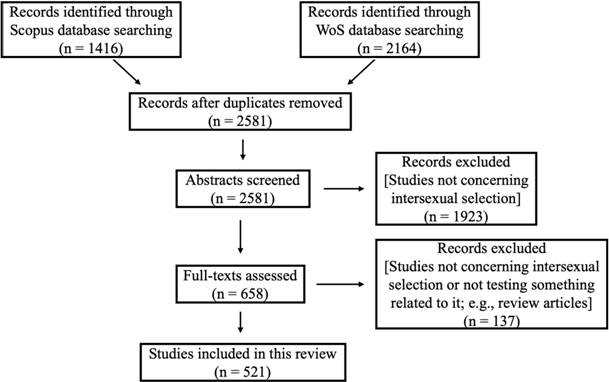
We conducted a systematic search on anuran intersexual selection using the bibliographic survey tools of Web of Science (https://www.webofknowledge.com) and Scopus (https://www.scopus.com). We searched for scientific articles in English containing the following combination of terms in their abstract, keywords, or title: (Anura* OR frog* OR treefrog* OR toad* OR (all anuran families)) AND (“sexual select*” OR “mat* choic*” OR “mat* preference*” OR “female choic*” OR “female preference*” OR “assortative mat*” OR “mat* success” OR “reproductive success”). This search included records published until December 2022 and spanned all years on record of each database, resulting in 2581 records after removing duplicates between databases (Fig. 1). These records were next submitted to a filtering and classification procedure, which is summarized in Fig. 1 and described in detail in the following sections. All filtering and analytical procedures described next were performed in R (R Core Team 2020), using the packages bibliometrix (Aria and Cuccurullo 2017) and metagear (Lajeunesse 2016), and are adapted from the PRISMA protocol for systematic reviews (Page et al. 2021).

Abstract screening
After gathering literature records, we conducted an abstract-based analysis on the retrieved articles (Fig. 1). This first filter aimed to exclude records that are irrelevant to our purposes (i.e., studies that do not concern Anura intersexual selection but which were included in the search results). Studies that do not explicitly separate intersexual from intrasexual selection were kept. After screening abstracts, we removed 1923 studies, and the 658 remaining records were submitted to a full-text assessment and were classified as described below.
Articles full-text assessment
We evaluated the records that were included after screening the abstracts. First, we excluded articles we did not have full access to. Second, we re-assessed whether the study concerned intersexual selection and excluded review articles. After the full-text assessment, 137 studies were excluded, whereas 521 studies were taken to the next step.
Studies classification and data analysis
We classified the remaining studies and built a database according to three items, summarized in Fig. 2 and Table 1: 1) research theme, 2) study species, and 3) research type. 1) is a general description of the scope of the study. Each study may be included in one or more themes. Each research theme could provide different outputs that are further explored in this review (e.g., from studies in the “mating preference” theme, we extracted which mating preference trait was tested in the study). 2) we registered which species was studied in each record and their respective family (following Frost 2024). Those species were then classified as tropical, temperate, or mixed (species occurring both in temperate and tropical zones) based on their countries of occurrence, according to AmphibiaWeb (https://amphibiaweb.org). 3) studies were classified according to their experimental design. Each variable extracted during the classification procedure and the possible relationships between them are described in the results.

Studies classification procedures with categories and descriptions with their specific possible outputs.
Finally, the total publications on anurans were estimated and compared to the total publications on anuran intersexual selection per year. Total publications were obtained by searching the Web of Science database using the word “Anura” and other designations to it (frog, toad, treefrog, and all anuran family names).
To test the relationship between experimental and observational research types and research themes, we performed a chi-square test. Additionally, to test the relationship between the number of publications and species zone (tropical or temperate), we performed a Mann-Whitney test, a non-parametric alternative, since that data was not normally distributed. All assumptions of the statistical tests were checked, and the significance level was set at p-value <0.05.
RESULTS
General bibliometric information
Our systematic review included 521 studies on frog intersexual selection published between 1975 and 2022 (Supplementary S1 data), distributed among 741 authors (Ryan, M. published the most, with 64 articles) and 99 different sources (Animal Behavior was the most common source, with 81 articles). As expected, scientific production has sped up over the years, resulting in an average of 10.85 documents published per year, with the subject becoming increasingly more prevalent in anuran research (Fig. 3).

Number of publications per year on anuran intersexual selection and anurans in general. Black line represents anuran intersexual selection publications (this review) while the red line represents total publications on anurans. Black line dot sizes represent the proportion of Anura intersexual selection publications in relation to total Anura publications in each year.
Publications per research theme
Most studies were classified into two themes, Mating preferences (314) and Mating success (180) (Fig. 4). The other three categories (Selection analysis, Signal recognition and Others), together, summed up only 77 studies. A few records were considered multidisciplinary (46) and were included in more than one research theme.

Number of publications on anuran intersexual selection per research theme. Numbers inside circles intersections indicate the number of publications classified in two or more themes.
Publications per research type
Almost 90% of the studies were experimental (311) or observational (153) while the rest were distributed among mixed (43), model (12), and literature (2) research types. There is also a clear association between research types and specific themes (Table 2), in which most mating preference and signal recognition studies were associated with experimental designs, while mating success and selection analysis studies were mostly observational (Chi-square: χ2 = 391.35, df = 3, p < 0.001).
Anura intersexual selection publications by research theme and type. Note that the sum of each column and row differs from the total number of publications as studies could fit into more than one research theme (as mentioned in the methods section).
Publications per species
There is a considerable concentration of studies around a small number of species: almost 40% of the records pertain the 10 most studied species (Fig. 5). Engystomops pustulosus (Cope, 1864) and Dryophytes versicolor (LeConte, 1825) appeared in 63 and 60 studies, respectively. Additionally, because the most productive authors in our records focus on one species, those species are amongst the most studied (Fig. 5, Table 3). For instance, Ryan, M.J., the most prolific author according to our data, published 64 articles, of which 54 were about E. pustulosus, representing more than 85% of the publications mentioning this species.

Anuran species most studied regarding intersexual selection and their zones of occurrence, considering those with five or more publications.
Authors with more publications on anuran intersexual selection with their respective most studied species.
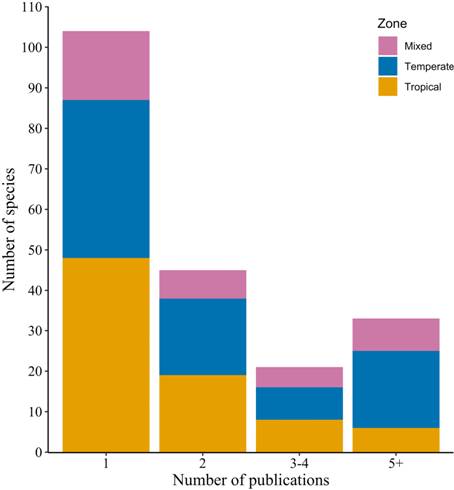
Our records embrace a considerable number of species (203). However, more than half (104) appear in a single study (Fig. 6). Most studies involved members of the family Hylidae (Table 4), encompassing the greatest number of species (49, representing less than 5% of the family total diversity) and most publications (233, approximately 4.75 publications per species on average). Considering the proportion of species studied, Mantellidae was the least represented, with two out of the approximately 271 known species studied (less than 1% studied). In contrast, three out of six known species (50%) of Pelobatidae are represented in our data.

Although the most studied species (E. pustulosus) is tropical in distribution, most species in our records are from temperate zones (85 species, totaling 387 appearances in studies). Even though the number of tropical species studied is close to that (81), they were present in only 230 studies. On average, there were approximately 60% more publications on species from temperate zones than on tropical species (4.55 versus 2.83 studies per species, respectively; Mann-Whitney: W = 4075, p = 0.026). Thirty-four species occurred both in temperate and tropical zones.
Only a small portion of the diversity of most countries is covered in our records (Fig. 7). Tropical zone countries, with an average of less than 10% of their diversity studied, are particularly disfavored in studies. In temperate zone countries, by contrast, more than 50% of the diversity is represented in studies. Additionally, on average, temperate zone countries have more species studied (~7.45 against ~4.77) with more publications than tropical countries (~42.3 against ~20.4 studies per species). Some countries had a single species studied with only one publication (31), mostly from tropical zones (21). The greatest number of studied species was in China, with 55 (average of 2.33 studies per species), representing ~10% of the country’s anuran diversity. Considering countries with 100 or more anuran species, Cameroon had the smallest proportion of its’ diversity covered in our records, with less than 0,5% of its diversity explored (1 out of 218). In contrast, the United States had the most significant proportion among those countries, with more than 31% of the species studied (36 out of 115).

Number of studied species and average publication per species by country. Circle size represents the proportion of anuran diversity studied in the country. Circle shade represents the standard deviation of publications among species. The circle color represents the zone in which each country is located (tropical, temperate, or mixed). The following countries are highlighted: the country with the most species studied (China); countries with at least 100 anuran species with the highest and lowest proportion of their diversity studied (United States and Cameroon respectively); all countries with at least 400 known anuran species (Brazil, Colombia, Peru, Ecuador, India, Indonesia, and Madagascar); most diverse countries from Oceania and Europe (Australia and Spain respectively).
Publications per signal type
Acoustic signals, represented in 292 documents, were the most studied in our records. Only a few studies explored visual (35), acoustic-visual (23), and chemical (2) signals. Two or more signals were explored in the same study 17 times.
Publications per mating preference trait
Mating preference records covered 65 traits, mostly tested in females (300) and less in males (24). Acoustic traits were frequently analyzed (305 times), with dominant frequency (79) being the most tested, followed by call rate (43) and call duration (35). Among non-acoustic traits, body size (25) and species identity (21) were the most examined (Fig. 8). Thirty-one traits were studied only once.

Number of publications on anuran intersexual selection by trait category, considering those with five or more publications: (8) shows publications per mating preference trait, with acoustic traits highlighted in blue; (9) presents publications per mating success trait; (10) displays publications per variation source.
Publications per mating success trait
Mating success studies tested 60 traits, prioritizing how morphological features influence mate number (178 times, e.g., body size, hindlimb length, body mass). Body size was the most studied (141 publications), followed by chorus tenure (39) and body mass (15) (Fig. 9). Unlike mating preference studies, these paid much less attention to acoustic traits (60), with dominant frequency being the most tested (15). Thirty-two traits were studied only once.
Publications per variation source
Finally, 48 different variation sources were explored among all mating preference and success studies. Here, individuals’ morphological and acoustic characteristics are not as relevant as in the mating success and mating preference studies, respectively. These studies generally focus on environmental, spatiotemporal, and demographic variation sources, with populational variation (19) and background noise (19) being the most studied (Fig. 10).
DISCUSSION
Overview
Over the 48 years covered in this review, research on anuran intersexual selection has shown a significant and increasing effort, with 521 publications in the field, averag ing more than 10 records published per year. However, that effort has been biased towards specific themes (e.g., mating preferen ces), species (e.g., temperate zone species), and traits (e.g., acoustic signals in mating preferences studies). Themes like signal recognition and selection analysis were far less studied. Even though anuran diversity is concentrated in tropical zones, studies on tropical fauna are fewer. Additionally, while it is well documented, it is still unclear whether the association between mating preference and acoustic signals are reflected in mating success. The uneven research effort across the topic may limit future conservation planning (Hortal et al. 2015). Moreover, considering the importance of sexual selection in anuran’s natural history (Gerhardt and Huber 2002), data deficits in this area, at the very least, compromise ecological and evolutionary data.
Research themes
Mating preference and success themes are the most studied among frogs in the intersexual selection area. In contrast, selection analysis and signal recognition studies were less frequent in our records. If we look at how those different themes are usually approached regarding methods, we might gain insight into the reason behind that pattern. For instance, most mating preference and success studies involve catching pairs in amplexus (mating success) or playback experimentations (mating preference) performed in the field. These are very traditional and known methods (Wells 1977, 1979, McGregor 1992) that generate primary data. However, selection analysis studies commonly try to ascertain sexual selection and/or its evolutionary implications, involving methods (e.g., sexual selection measures, Wade and Arnold 1980, phylogenetic comparative methods, Felsenstein 1985) that directly depend on primary data generated by other studies (Zeng et al. 2016). Finally, measuring neurological responses to signals, a recurrent objective in signal recognition studies, usually involves laboratory procedures (Fang et al. 2012, Zhao et al. 2017) with equipment requirements (e.g., digital processor), demanding at least a minimal infrastructure level to perform those studies.
Research types
As discussed above, most mating preference and success studies have been conducted in a very traditional way. Mating preference studies usually follow an experimental approach (in the field or the lab), while mating success studies are based on observations. It is also important to highlight that only a few studies have explored literature data or models in their methods. Considering the number of studies and especially the amount of primary data generated by mating success and preference studies, it was expected that those studies would be used in broader studies (e.g., meta-analysis), a common trend in ecology disciplines (Cadotte et al. 2012, Pullin 2012).
Species
Although a considerable number of species were studied across all records (203 species), there is a taxonomic bias towards a small group that concentrates most of the study effort. Concentrating efforts on a set of species means that solid knowledge is built around it. However, it may be difficult to draw, from those studies, valid general conclusions (Rosenthal et al. 2017). Phylogenetic comparative methods, for example, often require data for many species (Bernardy et al. 2024a), which would be impossible for one single researcher or research group to collect.
Most literature publications in our data were on Hylidae and Bufonidae, encompassing almost half of species and appearances in studies. Still, as both families are highly diverse, this represents only a small proportion of their known diversity. In contrast, although there have been fewer studies on Alytidae, a considerable part of their diversity is explored. Many publications are concentrated in Alytes, probably due to the peculiar reproductive behavior of its species: males carry the eggs on their back until they hatch. An important research topic, therefore, is how male acoustic cues and parental care drive female choices (Raxworthy 1990, Márquez 1995, Dyson et al. 1998).
Several families remain to be studied. For example, less than 1% of the diversity of Microhylidae, Eleutherodactylidae, and Mantellidae, all with more than 200 known species, have been studied. It is also worth mentioning that families like Ceratobatrachidae and Hemiphractidae were not studied in our records, even though both have more than 100 known species.
As shown by Silva et al. (2020), there are several reasons why a set of amphibian species has been studied whereas others have not. For instance, some species are part of long-term research programs, like the Túngara frog (E. pustulosus, 63 publications), which Michael J. Ryan and his collaborators have studied since the 80’s in Panama (Ryan 1980, Cronin et al. 2019). This results from the historical influence of professors training students and the fact that studies are often based on or are intended to test the results from previous studies (dos Santos et al. 2020, Silva et al. 2020). Also, sometimes a species is studied because it is easy to find, resulting in a bias towards abundant species with large bodies and wide distribution, a pattern also observed in other taxa (dos Santos et al. 2020, Freitas et al. 2021).
Even though most species are found in the tropics (Gaston 2000), the studies distribution does not match the number of species or threatened species. Instead, these numbers reflect a country’s Gross Domestic Product (Titley et al. 2017). Developed countries, usually in temperate zones, concentrate most research efforts. This pattern is very concerning because anuran species from highly diverse tropical regions, including many of the World’s biodiversity hotspots, are simultaneously the most threatened (Luedtke et al. 2023) and the less studied taxa.
A common characteristic among the 10 most studies species in our records is their wide geographical distribution, probably also related to their conservation status, all of which are classified as Least Concern (IUCN 2021). From all species included in our records (203), only 26 are considered threatened, with an average of 1.35 studies per species, contrasting with 3.86 average studies for non-threatened species. As anuran sexual selection is linked to conservation aspects (Gerhardt and Mudry 1980, Bee and Swanson 2007, McCallum 2010), the fact that endangered species are also less studied might aggravate this situation, because effective conservation actions require solid scientific knowledge (Canessa et al. 2019).
Signal types
Acoustic signals represented almost 85% of the signals studied in our records. This was expected considering the tradition of bioacoustical studies and the importance of this type of communication for sexual selection in frogs (Gerhardt and Huber 2002). Visual signals were underexplored in our records and focused on a few species (15), with three species concentrating more than half of the studies-Bufo gargarizans Cantor, 1842, Oophaga pumilio (Schmidt, 1857), and E. pustulosus. Visual signals are occasionally considered (Hödl and Amézquita 2001). According to our records, studies exploring visual signals in anuran mating preferences are much more recent (Marco et al. 1998, Summers et al. 1999) than studies on acoustic signals (Whitney and Krebs 1975). For a long time, visual signals were considered relevant only to diurnal species inhabiting unobstructed view sites (Endler 1992). Accordingly, O. pumilio, the most studied species regarding visual signal, has diurnal habits (Pröhl 1997). However, when visual signals alone and their interaction with acoustic signals were tested in frogs, they were shown to be important (Kaiser et al. 2018), even in nocturnal situations (Gomez et al. 2009). The few number of species explored in visual signals studies may also be explained by the fact that those signals in frogs are expected to be associated with aggressive interactions among males (Amézquita and Hödl 2004, Narins et al. 2005, Furtado and Nomura 2014). The latter, however, was not within the scope of our study. Expanding visual preferences studies to cover more species might help clarify the importance of visual communication in frog intersexual selection.
There are even more diversity gaps when we look at studies that consider both acoustic and visual signals simultaneously (i.e., multimodal signaling). Only eight species have been studied. Female mating decisions result from the evaluation of many characteristics signaled by different modalities (Bro-Jørgensen 2010). Females of O. pumilio, for example, base their mating decisions mainly on the colors of the male, a visual cue (Maan and Cummings 2008, 2009, Richards-Zawacki et al. 2012). However, females from this same species also choose their mates based on acoustic signals, for instance calling activity and positioning (Pröhl and Hödl 1999, Meuche et al. 2013). Studies on other species have shown that different modalities can interact and determine female mating decisions. For instance, in Amolops torrentis (Smith, 1923), males use limb displays to enhance the attractiveness of their acoustic signal (Zhao et al. 2022). Still, female preferences are yet to be explored in a multimodal signaling context for several species.
Studied traits
As discussed above, the importance of acoustic signals, and the long tradition of playback studies with anurans (McGregor 1992), explains why these traits are the most tested in mating preferences studies. Acoustic signals indeed play a major role in frog communication (Gerhardt and Huber 2002). However, how mate choices are made in an acoustic multivariate perspective has been explored in very few species (Ryan and Rand 2003). Most of those studies concentrate on a single acoustic trait or a few traits treated separately (Wagner and Sullivan 1995, Bosch et al. 2002, Lüddecke 2002).
In contrast to mating preference, studies on mating success were frequently associated with morphological traits. Most studies estimating mating success result from capturing amplectant pairs in the field (Mi 2013, Dreher et al. 2017, Wang et al. 2018), and for this reason, they do not sample acoustic information. Studying acoustic signals in this context requires researchers to record and mark the individuals beforehand, a more complex and less practical approach, which is likely why acoustic signals are less studied in mating success. Indeed, the morphological aspects of frogs (e.g., body size, body mass) are related to their acoustic features (Fletcher 2004, Gingras et al. 2013, Rodríguez et al. 2015). For example, the dominant frequency of calls is modulated by body size: larger frogs produce lower frequencies. This pattern has been extensively tested in frogs (Gingras et al. 2013, Bernardy et al. 2024b). Only a few studies verified whether those acoustic preferences turn into mating advantages (i.e., mating success) for specific individuals in a natural environment (Lesbarrères et al. 2008, Botto and Castellano 2016). Moreover, only a minority of studies have explored how anuran intersexual selection varies in different conditions (159 out of 470 mating preference and or success studies) such as light (Underhill and Höbel 2017), temperature (Humfeld and Grunert 2015) and background noise (Zhu et al. 2022). This remains an important research topic.
Future directions
The number of Anuran intersexual selection studies have increased in terms of the number of publications per year. However, these studies are biased in species, signals, and traits investigated, limiting generalizations. Increasing coverage and better distributing efforts in this research field are essential to develop evolutionary studies with broad comparative approaches (e.g., phylogenetic comparative methods). Since only a small portion of the frog diversity has been studied in tropical countries, it is necessary to increase the number of species studied. In the case of well-studied species, which are frequently associated with temperate zones, we suggest that future studies try to use all available information to deepen our knowledge by using the large amount of primary data. Targeting specific families should also be considered in future studies. For example, only a small portion of the diversity of some extremely diverse families like Mantellidae, Eleutherodactylidae, and Microhylidae has been studied, and families like Ceratobatrachidae and Hemiphractidae were not studied at all. Additionally, visual cues and their interaction with acoustic signals must be explored and expanded for more species. Finally, studies should focus on how different traits interact to determine mating preferences and how those preferences translate into the mating success of males in nature.
LITERATURE CITED
-
Amézquita A, Hödl W (2004) How, when, and where to perform visual displays: The case of the Amazonian frog Hyla parviceps Herpetologica 60(4): 420-429. https://doi.org/10.1655/02-51
» https://doi.org/10.1655/02-51 -
Andersson M (1994) Sexual Selection. Princeton University Press, Princeton, vol. 72. https://books.google.com.br/books?id=QV65DwAAQBAJ
» https://books.google.com.br/books?id=QV65DwAAQBAJ -
Aria M, Cuccurullo C (2017) bibliometrix: An R-tool for comprehensive science mapping analysis. Journal of Informetrics 11(4): 959-975. https://doi.org/10.1016/j.joi.2017.08.007
» https://doi.org/10.1016/j.joi.2017.08.007 -
Bee MA (2008) Parallel female preferences for call duration in a diploid ancestor of an allotetraploid treefrog. Animal Behaviour 76(3): 845-853. https://doi.org/10.1016/j.anbehav.2008.01.029
» https://doi.org/10.1016/j.anbehav.2008.01.029 -
Bee MA, Swanson EM (2007) Auditory masking of anuran advertisement calls by road traffic noise. Animal Behaviour 74(6): 1765-1776. https://doi.org/10.1016/j.anbehav.2007.03.019
» https://doi.org/10.1016/j.anbehav.2007.03.019 -
Bernardy JV, Llusia D, Maciel NM, De Marco P, Bastos RP (2024a) Do body size and habitat shape call frequencies of Brazilian hylids (Amphibia: Anura)? Journal of Ethology 42(3): 197-207. https://doi.org/10.1007/s10164-024-00819-3
» https://doi.org/10.1007/s10164-024-00819-3 -
Bernardy JV, Melo I, Llusia D, Diniz-Filho JAF, Bastos RP (2024b) Female preferences for dominant frequency in frogs: constraints and impact on sexual size dimorphism. Behavioral Ecology and Sociobiology 78(1): 4. https://doi.org/10.1007/s00265-023-03418-3
» https://doi.org/10.1007/s00265-023-03418-3 - Bosch J, Rand AS, Ryan MJ (2002) Response to variation in chuck frequency by male and female túngara frogs. Herpetologica 58(1): 95-103. https://doi.org/10.1655/0018-0831(2002)058[0095:RTVICF]2.0.CO;2
-
Botto V, Castellano S (2016) Signal reliability and multivariate sexual selection in a lek-breeding amphibian. Behavioral Ecology 27(6): 1797-1807. https://doi.org/10.1093/beheco/arw115
» https://doi.org/10.1093/beheco/arw115 -
Boul KE, Funk WC, Darst CR, Cannatella DC, Ryan MJ (2007) Sexual selection drives speciation in an Amazonian frog. Proceedings of the Royal Society B: Biological Sciences 274(1608): 399-406. https://doi.org/10.1098/rspb.2006.3736
» https://doi.org/10.1098/rspb.2006.3736 -
Bro-Jørgensen J (2010) Dynamics of multiple signalling systems: animal communication in a world in flux. Trends in Ecology and Evolution 25(5): 292-300. https://doi.org/10.1016/j.tree.2009.11.003
» https://doi.org/10.1016/j.tree.2009.11.003 -
Cadotte MW, Mehrkens LR, Menge DNL (2012) Gauging the impact of meta-analysis on ecology. Evolutionary Ecology 26(5): 1153-1167. https://doi.org/10.1007/s10682-012-9585-z
» https://doi.org/10.1007/s10682-012-9585-z -
Canessa S, Spitzen-van der Sluijs A, Martel A, Pasmans F (2019) Mitigation of amphibian disease requires a stronger connection between research and management. Biological Conservation 236: 236-242. https://doi.org/10.1016/j.biocon.2019.05.030
» https://doi.org/10.1016/j.biocon.2019.05.030 - Castellano S, Cuatto B, Rinella R, Rosso A, Giacoma C (2002) The advertisement call of the European treefrogs (Hyla arborea): a multilevel study of variation. Ethology 108: 75-89.
-
Chen P, Wang J, Miao J, Dong H, Bao J, Wu Y, Zhang F (2022) Female large odorous frogs (Odorrana graminea) prefer males with higher nonlinear vocal components. Ecology and Evolution 12(2): e8573. https://doi.org/10.1002/ece3.8573
» https://doi.org/10.1002/ece3.8573 -
Cronin AD, Ryan MJ, Page RA, Hunter KL, Taylor RC (2019) Environmental heterogeneity alters mate choice behavior for multimodal signals. Behavioral Ecology and Sociobiology 73: 43. https://doi.org/10.1007/s00265-019-2654-3
» https://doi.org/10.1007/s00265-019-2654-3 -
Darwin C (1871) The descent of man, and Selection in relation to sex. John Murray, vol. 1, 423 pp. https://doi.org/10.1037/12293-000
» https://doi.org/10.1037/12293-000 -
dos Santos JW, Correia RA, Malhado ACM, Campos-Silva JV, Teles D, Jepson P, Ladle RJ (2020) Drivers of taxonomic bias in conservation research: a global analysis of terrestrial mammals. Animal Conservation 23(6): 679-688. https://doi.org/10.1111/acv.12586
» https://doi.org/10.1111/acv.12586 -
Dreher CE, Rodríguez A, Cummings ME, Pröhl H (2017) Mating status correlates with dorsal brightness in some but not all poison frog populations. Ecology and Evolution 7(24): 10503-10512. https://doi.org/10.1002/ece3.3531
» https://doi.org/10.1002/ece3.3531 -
Dyson ML, Bush SL, Halliday TR (1998) Phonotaxis by female Majorcan midwife toads, Alytes muletensis Behaviour 135(2): 213-230. https://doi.org/10.1163/156853998793066366
» https://doi.org/10.1163/156853998793066366 - Endler J (1992) Signals, Signal Conditions, and the Direction of Evolution. Evolution 139: S125-153.
-
Fang G, Yang P, Cui J, Yao D, Brauth SE, Tang Y (2012) Mating Signals Indicating Sexual Receptiveness Induce Unique Spatio-Temporal EEG Theta Patterns in an Anuran Species. Plos One 7(12): e52364. https://doi.org/10.1371/journal.pone.0052364
» https://doi.org/10.1371/journal.pone.0052364 -
Fellers GM (1979) Mate Selection in the Gray Treefrog, Hyla versicolor Copeia 1979(2): 286-290. https://doi.org/10.2307/1443416
» https://doi.org/10.2307/1443416 - Felsenstein J (1985) Phylogenies and the Comparative Method. The American Naturalist 125(1): 1-15.
-
Fletcher NH (2004) A simple frequency-scaling rule for animal communication. The Journal of the Acoustical Society of America 115(5): 2334-2338. https://doi.org/10.1121/1.1694997
» https://doi.org/10.1121/1.1694997 -
Freitas TMS, Stropp J, Calegari BB, Calatayud J, De Marco P, Montag LFA, Hortal J (2021) Quantifying shortfalls in the knowledge on Neotropical Auchenipteridae fishes. Fish and Fisheries 22(1): 87-104. https://doi.org/10.1111/faf.12507
» https://doi.org/10.1111/faf.12507 -
Frost DR (2024) Amphibian Species of the World: an Online Reference. American Museum of Natural History, New York, v. 6.2, https://doi.org/10.5531/db.vz.0001
» https://doi.org/10.5531/db.vz.0001 -
Furtado R, Nomura F (2014) Visual signals or displacement activities? The function of visual displays in agonistic interactions in nocturnal tree frogs. Acta Ethologica 17(1): 9-14. https://doi.org/10.1007/s10211-013-0160-6
» https://doi.org/10.1007/s10211-013-0160-6 -
Gaston KJ (2000) Global patterns in biodiversity. Nature 405(6783): 220-227. https://doi.org/10.1038/35012228
» https://doi.org/10.1038/35012228 - Gerhardt HC, Huber F (2002) Acoustic Communication in Insects and Anurans: Common Problems and Diverse Solutions. The University of Chicago Press, Chicago, 542 pp.
-
Gerhardt HC, Mudry KM (1980) Temperature effects on frequency preferences and mating call frequencies in the green treefrog, Hyla cinerea (Anura: Hylidae). Journal of Comparative Physiology A 137(1): 1-6. https://doi.org/10.1007/BF00656911
» https://doi.org/10.1007/BF00656911 -
Gingras B, Boeckle M, Herbst CT, Fitch WT (2013) Call acoustics reflect body size across four clades of anurans. Journal of Zoology 289(2): 143-150. https://doi.org/10.1111/j.1469-7998.2012.00973.x
» https://doi.org/10.1111/j.1469-7998.2012.00973.x -
Gomez D, Richardson C, Lengagne T, Plenet S, Joly P, Léna JP, Théry M (2009) The role of nocturnal vision in mate choice: Females prefer conspicuous males in the European tree frog (Hyla arborea). Proceedings of the Royal Society B: Biological Sciences, 276(1666): 2351-2358. https://doi.org/10.1098/rspb.2009.0168
» https://doi.org/10.1098/rspb.2009.0168 - Hödl W, Amézquita A (2001) Visual signaling in Anuran Amphibians. Anuran Communication: 121-141.
-
Hortal J, de Bello F, Diniz-Filho JAF, Lewinsohn TM, Lobo JM, Ladle RJ (2015) Seven Shortfalls that Beset Large-Scale Knowledge of Biodiversity. Annual Review of Ecology, Evolution, and Systematics 46(1): 523-549. https://doi.org/10.1146/annurev-ecolsys-112414-054400
» https://doi.org/10.1146/annurev-ecolsys-112414-054400 -
Howard RD (1978) The Evolution of Mating Strategies in Bullfrogs, Rana catesbeiana Evolution 32(4): 850-871. https://doi.org/10.2307/2407499
» https://doi.org/10.2307/2407499 - Humfeld SC, Grunert B (2015) Effects of temperature on spectral preferences of female gray treefrogs (Hyla versicolor). Herpetological Conservation and Biology 10(3): 1013-1020.
-
Huxley JS (1938) Darwin’s Theory of Sexual Selection and the Data Subsumed by it, in the Light of Recent Research. The American Naturalist 72(742): 416-433. http://www.jstor.org/stable/2457442
» http://www.jstor.org/stable/2457442 -
IUCN (2021) The IUCN Red List of Threatened species (No. 2020-3). https://www.iucnredlist.org
» https://www.iucnredlist.org -
Jaquiéry J, Broquet T, Aguilar C, Evanno G, Perrin N (2010) Good genes drive female choice for mating partners in the lek-breeding European treefrog. Evolution 64(1): 108-115. https://doi.org/10.1111/j.1558-5646.2009.00816.x
» https://doi.org/10.1111/j.1558-5646.2009.00816.x -
Kaiser K, Boehlke C, Navarro-Pérez E, Vega A, Dudgeon S, Robertson JM (2018) Local preference encoded by complex signaling: mechanisms of mate preference in the red-eyed treefrog (Agalychnis callidryas). Behavioral Ecology and Sociobiology 72(12): 182. https://doi.org/10.1007/s00265-018-2597-0
» https://doi.org/10.1007/s00265-018-2597-0 -
Lajeunesse MJ (2016) Facilitating systematic reviews, data extraction and meta-analysis with the metagear package for R. Methods in Ecology and Evolution 7(3): 323-330. https://doi.org/10.1111/2041-210X.12472
» https://doi.org/10.1111/2041-210X.12472 -
Lesbarrères D, Merilä J, Lodé T (2008) Male breeding success is predicted by call frequency in a territorial species, the agile frog (Rana dalmatina). Canadian Journal of Zoology 86(11): 1273-1279. https://doi.org/10.1139/Z08-121
» https://doi.org/10.1139/Z08-121 -
Lüddecke H (2002) Male and female responses to call playback in the Andean frog Colostethus subpunctatus Amphibia Reptilia 23(2): 141-150. https://doi.org/10.1163/156853802760061787
» https://doi.org/10.1163/156853802760061787 -
Luedtke JA, Chanson J, Neam K, Hobin L, Maciel AO, Catenazzi A, et al. (2023) Ongoing declines for the world’s amphibians in the face of emerging threats. Nature 622(7982): 308-314. https://doi.org/10.1038/s41586-023-06578-4
» https://doi.org/10.1038/s41586-023-06578-4 -
Maan ME, Cummings ME (2008) Female preferences for aposematic signal components in a polymorphic poison frog. Evolution 62(9): 2334-2345. https://doi.org/10.1111/j.1558-5646.2008.00454.x
» https://doi.org/10.1111/j.1558-5646.2008.00454.x -
Maan ME, Cummings ME (2009) Sexual dimorphism and directional sexual selection on aposematic signals in a poison frog. Proceedings of the National Academy of Sciences 106(45): 19072-19077. https://doi.org/10.1073/pnas.0903327106
» https://doi.org/10.1073/pnas.0903327106 -
Madelaire CB, Silva RJ, Gomes FR (2013) Calling Behavior and Parasite Intensity in Treefrogs, Hypsiboas prasinus Journal of Herpetology 47(3): 450-455. https://doi.org/10.1670/11-315
» https://doi.org/10.1670/11-315 -
Marco A, Kiesecker JM, Chivers DP, Blaustein AR (1998) Sex recognition and mate choice by male western toads, Bufo boreas Animal Behaviour 55(6): 1631-1635. https://doi.org/10.1006/anbe.1997.0711
» https://doi.org/10.1006/anbe.1997.0711 -
Márquez R (1993) Male reproductive success in two midwife toads, Alytes obstetricans and A. cisternasii Behavioral Ecology and Sociobiology 32(4): 283-291. https://doi.org/10.1007/BF00166518
» https://doi.org/10.1007/BF00166518 -
Márquez R (1995) Female choice in the midwife toads (Alytes obstetricans and A. cisternasii). Behaviour 91(5): 1689-1699. https://doi.org/10.1017/CBO9781107415324.004
» https://doi.org/10.1017/CBO9781107415324.004 -
McCallum ML (2010) Future climate change spells catastrophe for Blanchard’s cricket frog, Acris blanchardi (Amphibia: Anura: Hylidae). Acta Herpetologica 5(1): 119-130. https://doi.org/10.13128/Acta_Herpetol-8541
» https://doi.org/10.13128/Acta_Herpetol-8541 -
McGregor PK (1992) Playback and studies of animal communication. Springer, New York, NATO Science Series A, vol. 228, 231 pp. https://doi.org/10.1007/978-1-4757-6203-7
» https://doi.org/10.1007/978-1-4757-6203-7 -
Meuche I, Brusa O, Linsenmair KE, Keller A, Pröhl H (2013) Only distance matters - non-choosy females in a poison frog population. Frontiers in Zoology 10: 29. https://doi.org/10.1186/1742-9994-10-29
» https://doi.org/10.1186/1742-9994-10-29 -
Mi Z (2013) Sexual dimorphism in the hindlimb muscles of the Asiatic toad (Bufo gargarizans) in relation to male reproductive success. Asian Herpetological Research 4(1): 56-61. https://doi.org/10.3724/SP.J.1245.2013.00056
» https://doi.org/10.3724/SP.J.1245.2013.00056 -
Moreno-Gómez FN, Bacigalupe LD, Silva-Escobar AA, Soto-Gamboa M (2015) Female and male phonotactic responses and the potential effect of sexual selection on the advertisement calls of a frog. Animal Behaviour 104: 79-86. https://doi.org/10.1016/j.anbehav.2015.03.010
» https://doi.org/10.1016/j.anbehav.2015.03.010 -
Narins PM, Grabul DS, Soma KK, Gaucher P, Hödl W (2005) Cross-modal integration in a dart-poison frog. Proceedings of the National Academy of Sciences 102(7): 2425-2429. https://doi.org/10.1073/pnas.0406407102
» https://doi.org/10.1073/pnas.0406407102 -
Oliva MV, Kaiser K, Robertson JM, Gray DA (2018) Call recognition and female choice in a treefrog with a multicomponent call. Ethology 124(5): 331-337. https://doi.org/10.1111/eth.12736
» https://doi.org/10.1111/eth.12736 -
Page MJ, McKenzie JE, Bossuyt PM, Boutron I, Hoffmann TC, Mulrow CD, et al. (2021) The PRISMA 2020 statement: an updated guideline for reporting systematic reviews. Systematic Reviews 10(1): 89. https://doi.org/10.1186/s13643-021-01626-4
» https://doi.org/10.1186/s13643-021-01626-4 -
Pettitt BA, Bourne GR, Bee MA (2020) Females prefer the calls of better fathers in a Neotropical frog with biparental care. Behavioral Ecology 31(1): 152-163. https://doi.org/10.1093/beheco/arz172
» https://doi.org/10.1093/beheco/arz172 -
Pröhl H (1997) Territorial behaviour of the strawberry poison-dart frog, Dendrobates pumilio Amphibia-Reptilia 18(4): 437-442. https://doi.org/10.1163/156853897X00495
» https://doi.org/10.1163/156853897X00495 -
Pröhl H, Hödl W (1999) Parental Investment, Potential Reproductive Rates, and Mating System in the Strawberry Dart-Poison Frog, Dendrobates pumilio Behavioral Ecology and Sociobiology 46(4): 215-220. http://www.jstor.org/stable/pdf/4601666.pdf
» http://www.jstor.org/stable/pdf/4601666.pdf -
Ptacek MB (2000) The role of mating preferences in shaping interspecific divergence in mating signals in vertebrates. Behavioural Processes 51(1-3): 111-134. https://doi.org/10.1016/S0376-6357(00)00123-6
» https://doi.org/10.1016/S0376-6357(00)00123-6 -
Pullin AS (2012) Realising the potential of environmental data: A call for systematic review and evidence synthesis in environmental management. Environmental Evidence 1(1): 2-4. https://doi.org/10.1186/2047-2382-1-2
» https://doi.org/10.1186/2047-2382-1-2 -
R Core Team (2020) R: A Language and Environment for Statistical Computing (3.3.2). R Foundation for Statistical Computing. https://www.r-project.org/
» https://www.r-project.org/ -
Raxworthy CJ (1990) Non-random mating by size in the midwife toad Alytes obstetricans: Bigger males carry more eggs. Amphibia-Reptilia 11(3): 247-252. https://doi.org/10.1163/156853890X00168
» https://doi.org/10.1163/156853890X00168 -
Richards-Zawacki CL, Wang IJ, Summers K (2012) Mate choice and the genetic basis for colour variation in a polymorphic dart frog: inferences from a wild pedigree. Molecular Ecology 21(15): 3879-3892. https://doi.org/10.1111/j.1365-294X.2012.05644.x
» https://doi.org/10.1111/j.1365-294X.2012.05644.x -
Robertson JGM (1986) Female choice, male strategies and the role of vocalizations in the Australian frog Uperoleia rugosa Animal Behaviour 34(3): 773-784. https://doi.org/10.1016/S0003-3472(86)80061-6
» https://doi.org/10.1016/S0003-3472(86)80061-6 -
da Rocha SMC, Lima AP, Kaefer IL (2018) Territory size as a main driver of male-mating success in an Amazonian nurse frog (Allobates paleovarzensis, Dendrobatoidea). Acta Ethologica 21(1): 51-57. https://doi.org/10.1007/s10211-017-0280-5
» https://doi.org/10.1007/s10211-017-0280-5 -
Rodríguez RL, Araya-Salas M, Gray DA, Reichert MS, Symes LB, Wilkins MR, et al. (2015) How acoustic signals scale with individual body size: Common trends across diverse taxa. Behavioral Ecology 26(1): 168-177. https://doi.org/10.1093/beheco/aru174
» https://doi.org/10.1093/beheco/aru174 - Roithmair ME (1994) Male Territoriality and Female Mate Selection in the Dart-Poison Frog Epipedobates trivittatus (Dendrobatidae, Anura). Copeia 1994(1): 107-115.
-
Rosenthal GG (2017) Mate Choice: The Evolution of sexual decision making from microbes to humans. Princeton University Press, Princeton, 648 pp. https://doi.org/10.2307/j.ctt1vwmhb0
» https://doi.org/10.2307/j.ctt1vwmhb0 -
Rosenthal GG, Ryan MJ (2022) Sexual selection and the ascent of women: Mate choice research since Darwin. Science 375(6578): eabi6308. https://doi.org/10.1126/science.abi6308
» https://doi.org/10.1126/science.abi6308 -
Rosenthal MF, Gertler M, Hamilton AD, Prasad S, Andrade MCB (2017) Taxonomic bias in animal behaviour publications. Animal Behaviour 127: 83-89. https://doi.org/10.1016/j.anbehav.2017.02.017
» https://doi.org/10.1016/j.anbehav.2017.02.017 -
Ryan MJ (1980) Female mate choice in a neotropical frog. Science 209(4455): 523-525. https://doi.org/10.1126/science.209.4455.523
» https://doi.org/10.1126/science.209.4455.523 -
Ryan MJ, Rand AS (2003) Sexual selection in female perceptual space: How female túngara frogs perceive and respond to complex population variation in acoustic mating signals. Evolution 57(11): 2608-2618. https://doi.org/10.1111/j.0014-3820.2003.tb01503.x
» https://doi.org/10.1111/j.0014-3820.2003.tb01503.x -
Silva AFD, Malhado ACM, Correia RA, Ladle RJ, Vital MVC, Mott T (2020) Taxonomic bias in amphibian research: Are researchers responding to conservation need? Journal for Nature Conservation 56: 125829. https://doi.org/10.1016/j.jnc.2020.125829
» https://doi.org/10.1016/j.jnc.2020.125829 - Summers K, Symula R, Clough M, Cronin T (1999) Visual mate choice in poison frogs. Proceedings of the Royal Society of London 266: 2141-2145.
-
Titley MA, Snaddon JL, Turner EC (2017) Scientific research on animal biodiversity is systematically biased towards vertebrates and temperate regions. Plos One 12(12): e0189577. https://doi.org/10.1371/journal.pone.0189577
» https://doi.org/10.1371/journal.pone.0189577 -
Underhill VA, Höbel G (2017) Variation in nocturnal light levels does not alter mate choice behavior in female eastern gray treefrogs (Hyla versicolor). Behavioral Ecology and Sociobiology 71: 151. https://doi.org/10.1007/s00265-017-2386-1
» https://doi.org/10.1007/s00265-017-2386-1 -
Wade M, Arnold S (1980) The intensity of sexual selection in relation to male sexual behaviour, female choice, and sperm precedence. Animal Behaviour 28(2): 446-461. https://doi.org/10.1016/S0003-3472(80)80052-2
» https://doi.org/10.1016/S0003-3472(80)80052-2 -
Wagner WE, Sullivan BK (1995) Sexual selection in the Gulf Coast toad, Bufo valliceps: Female choice based on variable characters. Animal Behaviour 49(2): 305-319. https://doi.org/10.1006/anbe.1995.0044
» https://doi.org/10.1006/anbe.1995.0044 -
Wang T, Jia L, Zhai X, Cui J, Wang J (2018) Atypical assortative mating based on body size in an explosive-breeding toad from a tropical island of southern China. Behavioural Processes 151: 1-5. https://doi.org/10.1016/j.beproc.2018.02.018
» https://doi.org/10.1016/j.beproc.2018.02.018 - Wells KD (1977) Territoriality and Male Mating Success in the Green Frog (Rana clamitans). Ecology 58(4): 750-762.
- Wells KD (1979) Reproductive Behavior and Male Mating Success in a Neotropical Toad, Bufo typhonius Biotropica 11(4): 301-307.
-
Wells KD (2007) The Ecology & Behavior of Amphibians. University of Chicago Press, Chicago. https://doi.org/10.1086/596276
» https://doi.org/10.1086/596276 -
Whitney CL, Krebs JR (1975) Mate selection in Pacific tree frogs. Nature 255(5506): 325-326. https://doi.org/10.1038/255325a0
» https://doi.org/10.1038/255325a0 -
Woolbright LL (1983) Sexual Selection and Size Dimorphism in Anuran Amphibia. The American Naturalist 121(1): 110-119. http://www.jstor.org/stable/2461048
» http://www.jstor.org/stable/2461048 -
Yasumiba K, Alford RA, Schwarzkopf L (2015) Why do male and female cane toads, Rhinella marina, respond differently to advertisement calls? Animal Behaviour 109: 141-147. https://doi.org/10.1016/j.anbehav.2015.08.015
» https://doi.org/10.1016/j.anbehav.2015.08.015 -
Yu Y, Hu Y, Zhang Q, Zheng R, Shen B, Kong S, Li K (2020) Female preferences for call properties of giant spiny frog (Quasipaa spinosa). Pakistan Journal of Zoology 52(3): 825-834. https://doi.org/10.17582/journal.pjz/20180503100508
» https://doi.org/10.17582/journal.pjz/20180503100508 -
Zeng Y, Lou SL, Liao WB, Jehle R, Kotrschal A (2016) Sexual selection impacts brain anatomy in frogs and toads. Ecology and Evolution 6(19): 7070-7079. https://doi.org/10.1002/ece3.2459
» https://doi.org/10.1002/ece3.2459 -
Zhang F, Yuan C, Feng AS (2020) Female concave-eared torrent frogs prefer smaller males. Journal of Zoology 311(4): 239-245. https://doi.org/10.1111/jzo.12775
» https://doi.org/10.1111/jzo.12775 -
Zhao L, Wang J, Yang Y, Zhu B, Brauth SE, Tang Y, Cui J (2017) An exception to the matched filter hypothesis: A mismatch of male call frequency and female best hearing frequency in a torrent frog. Ecology and Evolution 7(1): 419-428. https://doi.org/10.1002/ece3.2621
» https://doi.org/10.1002/ece3.2621 -
Zhao L, Wang J, Zhang H, Wang T, Yang Y, Tang Y, et al. (2022) Parasite defensive limb movements enhance acoustic signal attraction in male little torrent frogs. ELife 11: e76083. https://doi.org/10.7554/eLife.76083
» https://doi.org/10.7554/eLife.76083 -
Zhu B, Wang J, Zhao L, Sun Z, Brauth SE, Tang Y, Cui J (2016) Bigger is not always better: Females prefer males of mean body size in Philautus odontotarsus Plos One 11(2): e0149879. https://doi.org/10.1371/journal.pone.0149879
» https://doi.org/10.1371/journal.pone.0149879 -
Zhu B, Zhang H, Chen Q, He Q, Zhao X, Sun X, et al. (2022) Noise affects mate choice based on visual information via cross-sensory interference. Environmental Pollution 308: 119680. https://doi.org/10.1016/j.envpol.2022.119680
» https://doi.org/10.1016/j.envpol.2022.119680
ADDITIONAL NOTES
-
Funding
Coordenação de Aperfeiçoamento de Pessoal e Nível Superior (EAVESTROP-661408), European Commission (H2020); Conselho Nacional de Desenvolvimento Científico e Tecnológico (309894/2017-4); Fundação de Amparo à Pesquisa do Estado de Goiás, Conselho Nacional de Desenvolvimento Científico e Tecnológico (201710267000507). This work was supported by: Coordenação de Aperfeiçoamento de Pessoal e Nível Superior (CAPES) Ph.D. scholarship to JVB; Global Marie S. Curie Fellowship (EAVESTROP-661408 to DL) granted by the European Commission (Program H2020); Conselho Nacional de Desenvolvimento Científico e Tecnológico (CNPq grant 309894/2017-4 to RPB); and Fundação de Amparo à Pesquisa do Estado de Goiás, Conselho Nacional de Desenvolvimento Científico e Tecnológico (FAPEG/CNPq/PRONEX 201710267000507 to RPB).
- ZooBank register
-
How to cite this article
Bernardy JV, Llusia D, Bastos RP (2025) Trends in anuran mate choice (Amphibia) in the scientific literature. Zoologia 42: e24021. https://doi.org/10.1590/S1984-4689.v42.e24021
-
Published by
Sociedade Brasileira de Zoologia at Scientific Electronic Library Online - https://www.scielo.br/zool
Supplementary material
Authors: J.V. Bernardy, D. Llusia, R.P. Bastos.
Data type: Database.
Copyright notice: This dataset is made available under the Open Database License (http://opendatacommons.org/licenses/odbl/1.0/). The Open Database License (ODbL) is a license agreement intended to allow users to freely share, modify, and use this Dataset while maintaining this same freedom for others, provided that the original source and author(s) are credited.
Data citations
Frost DR (2024) Amphibian Species of the World: an Online Reference. American Museum of Natural History, New York, v. 6.2, https://doi.org/10.5531/db.vz.0001
IUCN (2021) The IUCN Red List of Threatened species (No. 2020-3). https://www.iucnredlist.org