
 Taxonomic Catalog of the Brazilian Fauna: The Brazilian acarofauna (Arachnida: Holothyrida, Ixodida, Mesostigmata, Opilioacarida, Sarcoptiformes, and Trombidiformes)
ABSTRACT
The diversity of organisms is one of the most fundamental questions in sciences. Here, we inventory species distributed in 273 families of mites from Brazil. Taxonomic information is provided for all 88 superfamilies in Brazil, accompanied by relevant publications for the families, including notes on their identification and importance. However, despite recent taxonomic improvement in a few groups, particularly in Mesostigmata (Dermanyssoidea, Phytoseioidea and Uropodoidea), Ixodida (Ixodoidea), Sarcoptiformes (Analgoidea, Galumnoidea, Oppioidea, Oripodoidea, Phthiracaroidea, Pterolichoidea and Sarcoptoidea) and Trombidiformes (Arrenuroidea, Bdelloidea, Cheyletoidea, Eriophyoidea, Hygrobatoidea, Pygmephoroidea, Tarsonemoidea, Tetranychoidea, Trombiculoidea and Tydeoidea), knowledge remains limited for most other taxa. This limitation underscores the urgent need for taxonomic revisions and improvements in describing new species. Based on groups of host-specificity, we estimate nearly 50,000 species of mites occurring in Brazil, but the diversity could be greater. This enormous gap in our taxonomic knowledge of mites suggests that greater investment in training and hiring acarologists, is essential. In this context, the Taxonomic Catalog of the Brazilian Fauna (TCBF) should serve as a key platform for compiling, updating, and disseminating taxonomic data, ensuring that mite diversity in Brazil is systematically documented and accessible for future research and conservation efforts.
KEY WORDS:
Acari; Mites; ticks; taxonomy; biodiversity; Neotropics; Brazil; checklist
INTRODUCTION
The traditional group Acari Leach, 1817, in class Arachnida Lamarck, 1801, was proposed to accommodate mites and ticks. It is organized into six orders: Holothyrida Thon, 1909; Ixodida Leach, 1815; Mesostigmata Canestrini, 1891; Opilioacarida With, 1902; Sarcoptiformes Reuter, 1909 and Trombidiformes Reuter, 1909. In a recent study by Zhang (2011), the number of described mite species worldwide was estimated to be about 55,000. This number shows that mites and ticks, along with spiders, are the most diverse subclasses of the class Arachnida (Zhang 2011).
Brief historical accounts of the development of Acarology in Brazil and its importance were presented by Flechtmann et al. (2006) and Moraes and Flechtmann (2008). As stated in those publications, the first Brazilian Symposium of Acarology, bringing together 180 professionals and students interested in this topic, was held in May, 2006, at Universidade Federal de Viçosa, Minas Gerais State. One of the main themes selected for discussion was the state of knowledge on mite diversity in the country, in an attempt to establish a list of priorities for studies, given the assumed importance of this type of information for the general development of acarology (Pallini et al. 2007).
That symposium generated interest in conduncting a series of works in Brazilian research institutions, such as of biodiversity studies, including the description of new taxa and the preparation of catalogs and checklists dealing specifically with the Brazilian mite fauna of the following groups: Analgoidea Trouessart & Mégnin, 1884 and Ptero lichoidea Trouessart & Mégnin, 1884 (Valim et al. 2011), Sarcoptoidea Murray, 1877 (Bochkov and Valim 2016), Tetranychidae Donnadieu, 1875 (Flechtmann and Moraes 2017), Ixodida (Barros-Battesti et al. 2006), Oribatida Dugès, 1834 (Oliveira et al. 2017), Trombiculidae Ewing, 1929, and Leeuwenhoekiidae Womersley, 1944 (Jacinavicius et al. 2018), Eriophyoidea Nalepa, 1898 (Navia et al. 2021), and Macronyssidae Oudemans, 1936 (Bassini-Silva et al. 2021).
In 2015, the “Taxonomic Catalog of the Brazilian Fauna (TCBF)”, an interactive tool, was created to host information gathered by over 500 specialists to constitute an online catalogue of the animal species reported from Brazil, presently accounting for over 125,138 valid species (Boeger et al. 2024). Concerning the Acari, the present status of that catalog was constructed by the effort of about 50 researchers, who accepted the invitation and became committed to establishing a list of the mite species reported to be present in the country. The maintenance of that catalog is a never-ending task, given the need for its continuous updating, as new data become available.
The objective of this publication is to present an initial account of the Brazilian Acari fauna within the scope of TCBF, including references to about 3,678 species. This publication is not intended to provide a taxonomic review of mite groups but rather to compile literature information on extant Brazilian mite biodiversity, with brief diagnosis of their suprageneric features. Fossil and unpublished species records will be treated in a different publication.
MATERIAL AND METHODS
In the “Taxonomic Catalog of the Brazilian Fauna”, an effort has been made to place each species in the most up to date classification. Thus, as in any database of this type, changes in generic or family placement are expected to occur, according to the publication of new findings.
Mites were classified into six orders based on Krantz and Walter (2009), and the number of species considered in this manuscript is based on the latest survey proposed by Zhang (2011), although these numbers are nearly 15 years out of date. We use this data as an indicator of diversity rather than an estimate of the total number of currently known species. Thus, based on the cited works, this study includes six orders: Holothyrida, Ixodida, Mesostigmata, Opilioacarida, Sarcoptiformes, and Trombidiformes.
Mesostigmata is divided into three suborders, while Trombidiformes is divided into two suborders (Krantz and Walter 2009, Beaulieu et al. (2011), Zhang et al. (2011). Although Krantz and Walter (2009) divided Sarcoptiformes into just two suborders (Endeostigmata and Oribatida, with the latter including Astigmata), some molecular studies (e.g., Dabert et al. 2010, Bolton et al. 2017, 2023) have placed Astigmata within Desmonomata (Oribatida), while others do not support its origin within Oribatida (Domes et al. 2007, Ban et al. 2022). Until the classification of Astigmata is better elucidated, we follow Krantz (1978) in maintaining Sarcoptiformes divided into three suborders (Astigmata, Endeostigmata, and Oribatida) as a matter of convenience, without reflecting phylogenetic relationships among these groups.
In the online system of TCBF (http://fauna.jbrj.gov.br/), we are limited to using the following taxonomic groups above family: superfamily, infraorder, suborder, order, superorder, infraclass, subclass, up to the class Arachnida. Taxonomic groups not used in TCBF are marked with an asterisk (*) in the list below.
RESULTS
The data presented include publications up to July 19, 2024. The numbers of valid genera and species at the suprageneric level reported in Brazil are provided in Appendix 1, compared with the respective global numbers. Other details about each species (distribution, hosts/substrates, type data, and references of mite records) are still being uploaded to the system by each expert. The entire dataset is updated periodically.
So far, 3,678 named mite species (about 6.5% of the total for the world) in 273 families of 88 superfamilies have been reported from Brazil. Twenty-two of the superfamilies have been reported to contain more than 50 species in the country. The accumulation curve of species per year shows a significant rise in rates of acarofauna records in Brazil from 1758 for Trombidiformes and Sarcoptiformes, 1772 for Mesostigmata, 1787 for Ixodida (Ixodidae), 1844 for Ixodida (Argasidae), 1905 for Opiliocarida and only 1999 for Holothyrida onwards. (Figs 1, 2).

Accumulation curves of description year (1758-2024) of (1) Opilioacarida, Ixodida, and Holothyrida; and (2) Mesostigmata, Sarcoptiformes, and Trombidiformes reported in Brazil.
In the Parasitiformes Reuter, 1909, the most diverse superfamilies in Mesostigmata are the Dermanyssoidea Kolenati, 1859 (292 species), Phytoseioidea Berlese, 1916 (267), and Uropodoidea Kramer, 1881 (221), followed by Ixodoidea Dugès, 1834 (80) in Ixodida; each of the other Parasitiformes superfamilies have less than 50 species (Fig. 3). Within this superorder, the superfamilies best represented in the country are Opilioacaroidea Redikorzev, 1937 (51% of the world species), followed by Heterozerconoidea Berlese, 1892 (38%), each of the other superfamilies represents at most 20% of the world diversity (Fig. 4).

(3) Number of Brazilian species per superfamily of the superorder Parasitiformes; and (4) proportion of Para sitiformes species per superfamily occurring in Brazil compared with world diversity. Red bar: Holothyrida, orange bar: Ixodida, yellow bars: Mesostigmata (Monogynaspida: Gamasina), green bars: Mesostigmata (Monogynaspida: Uropodina), light blue bars: Mesostigmata (Sejida), dark blue bars: Mesostigmata (Trigynaspida), and purple bar: Opilioacarida.
Concerning the Acariformes Zakhvatkin, 1952, in Sarcoptiformes the most diverse superfamilies are the feather mites Analgoidea (227) and Pterolichoidea (104), followed by the Sarcoptoidea (85) and the oribatidid Oripodoidea Jacot, 1925 (83), Phthiracaroidea Perty, 1841 (77), Oppioidea Grandjean, 1951 (70), and Galumnoidea Jacot, 1925 (50); each of the other superfamilies have at most 50 species (Fig. 5). In comparison with the world diversity of the order, the Ctenacaroidea Grandjean, 1954 accounts for 45% of the species, followed by the Caleremaeoidea Grandjean, 1965 (43%) and Nematalycoidea Strenzke, 1954 (33%) (Fig. 6). In Trombidiformes, the best represented superfamilies are Eriophyoidea (265), Hygrobatoidea Koch, 1842 (245), Tetranychoidea Donnadieu, 1875 (173), Arrenuroidea Thor, 1900 (151), Trombiculoidea Ewing, 1929 (89), Pygmephoroidea Cross, 1965 (67), Tydeoidea Kramer, 1877 (66), Cheyletoidea Leach, 1815 (60), Bdelloidea Dugès, 1834 (51), and Tarsonemoidea Canestrini and Fanzago, 1877 (50) (Fig. 7). In comparison with the world diversity of groups in the order, the Trochometridioidea Mahunka, 1970 accounts for 29%, followed by Arrenuroidea Thor, 1900 (11%), Labidostomatoidea Ewing, 1934 (12%), and Hygrobatoidea Koch, 1842 (10%) (Fig. 8).
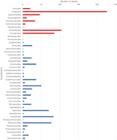
Number of Brazilian species per superfamily of the order Sarcoptiformes. Red bars: Astigmata, yellow bar: Endeostigmata, and blue bars: Oribatida.
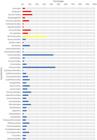
Proportion of Sarcoptiformes species per superfamily occurring in Brazil in comparison with the world diversity. Red bars: Astigmata, yellow bar: Endeostigmata, and blue bars: Oribatida.

Number of Brazilian species per superfamily of the order Trombidiformes. Red bar: Labidostommatina, yellow bars: Eupodina, blue bars: Anystina, and green bars: Eleutherengona.

Proportion of Trombidiformes species per superfamily occurring in Brazil compared with the world diversity. Red bar: Labidostommatina, yellow bars: Eupodina, blue bars: Anystina, and green bars: Eleutherengona.
Class Arachnida Lamarck, 1801
Superorder Parasitiformes Reuter, 1909*
This superorder comprises the orders Holothyrida, Ixodida, Mesostigmata and Opilioacarida.
Order Holothyrida Thon, 1905
Holothyrida is a small order. The free-living edaphic mites of this order are found in forests and comprise only the superfamily Holothyroidea Thorell, 1882.
Holothyroidea Thorell, 1882
Holothyroidea is divided into Allothyridae Hammen, 1972, Holothyridae Thorell, 1882; and Neothyridae Lehtinen, 1981 (Lehtinen 1991). In Brazil, only Neothyridae is presented, represented by two species of the genus Diplothyrus Lehtinen, 1999 (Lehtinen 1999, Vázquez et al. 2016).
Order Ixodida Leach, 1815
Ixodida is the order comprising the mites commonly known as ticks. They are cosmopolitan ectoparasites of terrestrial vertebrates (amphibians, reptiles, birds and mammals) and some species accidentally attack humans (Guglielmone and Robbins 2018, Nogueira et al. 2022). Ixodida comprises a single superfamily, Ixodoidea. In Brazil, 77 species from two families have been reported.
Ixodoidea Dugès, 1834
Ixodoidea is organized into three families, of which Argasidae Murray, 1877 and Ixodidae Murray, 1877 are repre sented in Brazil (Nava et al. 2017, Guglielmone et al. 2014). Argasidae comprises a group commonly referred to as soft ticks, containing 222 species (Nava et al. 2017, Muñoz-Leal et al. 2023). Ixodidae, commonly called hard ticks, contains 760 species (Guglielmone et al. 2014, 2021). The Brazilian tick fauna currently comprises 24 species of Argasidae and 53 species of Ixodidae (Guglielmone et al. 2021, Muñoz-Leal et al. 2023, Soares et al. 2023).
In Brazil, soft and hard ticks are the main arachnid vectors of pathogenic agents to humans and domesticated and wild animals. Therefore, some species are highly relevant to animal welfare and public health (Guglielmone and Robbins 2018, Nogueira et al. 2022). They vector bacteria such as Anaplasma Theiler, Borrelia Swellengrebel, Ehrlichia Moroshkowsky and Rickettsia da Rocha-Lima, as well as protozoa, such as Babesia Starcovici, Cytauxzoon Neitz & Thomas, Hepatozoon Miller, Rangelia Carini & Maciel and Theileria Bettencourt, Franca & Borges (Barros-Battesti et al. 2006, Nava et al. 2017).
Order Mesostigmata Canestrini, 1891
Mites of this order have long been known as potential biological control agents of agricultural pests; species of Phytoseiidae have been most widely studied for that purpose. Other mesostigmatids are known as important parasites of vertebrates and invertebrates. In Brazil, 990 species of 55 families have been reported. Species of the three suborders of Mesostigmata (Monogynaspida, Sejida and Trigynaspida) have been reported from Brazil.
Suborder Monogynaspida Camin & Gorirossi, 1955
This is the most diverse mesostigmatid suborder, in terms of morphology, biology and ecology. They are commonly found on plants, in the soil and litter, in stored products, or associated with insects or vertebrates. Although mostly known as predators, many feed on fungi, pollen, and sweet substrates or are parasites of invertebrates and vertebrates. The suborder comprises two infraorders: Gamasina Kramer, 1881 and Uropodina Kramer, 1881 (Lindquist et al. 2009). Representatives of both infraorders have been reported from Brazil, comprising 724 and 238 species, respectively.
Infraorder Gamasina Kramer, 1881
Gamasina are organized into four hyporders and, 11 superfamilies, of which seven superfamilies have been known to occur in Brazil. One of these belongs to the hyporder Parasitiae (Parasitoidea Oudemans, 1901) while the remaining belong to the hyporder Dermanyssiae (Ascoidea Voigts & Oudemans, 1905; Eviphidoidea Berlese, 1913; Dermanyssoidea Kolenati, 1859; Phytoseioidea Berlese, 1916; Rhodacaroidea Oudemans, 1902; and Veigaioidea Oudemans, 1939). Dermanyssoidea contains many parasitic mite groups and some predators, whereas other superfamilies consist predominantly of predators (except Ameroseiidae Evans, 1961, mostly fungivorous and pollinivorous). Representatives of the remaining hyporders, Arctacariae and Epicriiae, have not been reported from Brazil. Among other aspects, Gamasina are characterized by having the epigynal shield not surrounded by fused sternal, endopodal and ventral shields, usually bearing st5.
Ascoidea Voigts & Oudemans, 1905
This superfamily comprises four families, three of which have been reported from Brazil, namely Amerosei idae, Ascidae Voigts and Oudemans, 1905, and Melicharidae Hirschmann, 1962 (Lindquist et al. 2009, Lindquist and Moraza 2014). In addition to the predatory habit, they are also known to be fungivorous and pollinivorous.
Eight species of Ameroseiidae have been reported from the country. A world catalog of mites of this family was published by Mašán (2017), and included 138 species in 12 genera. One new genus and three new species were des cribed since that publication (Abo-Shnaf et al., 2023), when these authors also recharacterized the family. Biological studies and observations have suggested that some species exhibit a fungivorous habit (Flechtmann 1985, Mohamed et al. 1985, Moustafa and El-Hady 2006), and less often a predacious habit (Elhalawany et al. 2021). In contrast, other species are nectar and pollen feeders (Seeman and Walter 1995, Seeman 1996, Kar et al. 2015).
Ascidae species have been described from a wide range of habitats mostly from edaphic environments but also from plants or associated with and phoretic upon insects and mammals. Most species have been cited as predators, feeding on other mites or small arthropods. In Brazil, 22 species have been reported (Moraes et al. 2016, Santos et al. 2023a).
Most Melicharidae species have been cited as predators of small arthropods or consuming sugary substrates or pollen (Moraes et al. 2016). In Brazil, 24 species have been reported (Moraes et al. 2016, Santos et al. 2023b). Morpholo gical details of each genus of both Ascidae and Melicharidae can be found in the catalog published by Moraes et al. (2016), which refers respectively to 372 and 206 species. Databases concerning world distribution and substrates of mites of these families are available on line (Santos et al. 2023a, 2023b, 2023c).
Dermanyssoidea Kolenati, 1859
Mites of this group have diverse feeding habits, and many species are associated with vertebrates or invertebrates (parasitically or phoretically), while many others are free-living (Dowling and O’Connor 2010). In Brazil, representatives of 12 of the 17 families listed by Beaulieu et al. (2011) have been reported: Dasyponyssidae Fonseca, 1940, Dermanyssidae Kolenati, 1859, Entonyssidae Ewing, 1923, Haemoga masidae Oudemans, 1926, Halarachnidae Oudemans, 1906, Ixodorhynchidae Ewing, 1923, Laelapidae Berlese, 1892, Macronyssidae Oudemans, 1936, Rhinonyssidae Trouessart, 1895, Spelaeorhynchidae Oudemans, 1902, Spinturnicidae Oudemans, 1901 and Varroidae Delfinado & Baker, 1974. Representatives of Hystriconyssidae Keegan, Yunker & Baker, 1960, Larvamimidae Elzinga, 1993, Manitherionyssidae Radovsky & Yunker, 1971, and Omentolaelapidae Fain, 1961, cited by Beaulieu et al. (2011) as members of Dermanyssoidea have not been reported from Brazil. Iphiopsididae Kramer, 1886, also included by Beaulieu et al. (2011) is in this work included in Laelapidae, as done in Moraes et al. (2022).
Dasyponyssidae is a small family consisting of only three species in two genera (Dasyponyssus Fonseca, 1940 and Xenarthronyssus Radovsky & Yunker, 1971), which has been little studied (Radovsky and Yunker 1971). This family is only found in the Neotropical region, exclusively as armadillo parasites (Dowling 2006). One of the three species of this family has been reported from Brazil.
Dermanyssidae is a slightly larger family, consisting of about 26 species also in two genera: Dermanyssus Dùges, 1834 (bird parasites), and Liponyssoides Hirst, 1913 (mainly rodent parasites) (Roy and Chauve 2007, 2009). Only two species of this family have been reported from Brazil, including Dermanyssus gallinae (DeGeer, 1778), and Liponyssoides sangineus (Hirst, 1914). The first species has a global distribution and is commonly reported as chicken mite or poultry red mite, a serious parasite worldwide (Tucci 1997).
Entonyssidae is a group of parasites inhabiting the respiratory system of snakes, including the bronchi, trachea and lungs. Fain (1961b) divided the family into two subfami lies, namely Entonyssinae Ewing, 1923, with representatives in Africa, Asia, Europe and North America, and Pneumophionyssinae Fonseca, 1940, which has been reported from South America. This family contains eight genera and 27 species (Fajfer 2012). Two of these species belong to Pneumophionyssinae and are the only entonyssids reported from Brazil: Entophioptes liophis Fain, 1960, and Pneumophionyssus aristoterisi Fonseca, 1940.
Halarachnidae consists of species commonly reported from the respiratory system of marine and terrestrial mammals. They are known to feed on blood as well as on other tissues, causing heavy infections that can lead to the host’s death. Of the seven genera listed in Beaulieu et al. (2011), four have been reported from Brazil, Orthohalarachne Ne well, 1947; Pneumonyssoides Fain, 1955; Pneumonyssus Banks, 1901; and Raillietia Trouessart, 1902. Orthohalarachne is represented in Brazil by O. attenuata (Banks, 1910) and O. diminuata (Doetschman, 1944), parasites of marine mammals of the order Pinnipedia (Gastal et al. 2016). Pneumonyssus Fonseca, 1940 and Pneumonyssoides Fain, 1955 are represented by one species each, Pneumonyssus simicola Banks, 1901, a parasite of rhesus monkeys, Macaca mulatta (Zimmermann, 1780), collected from a research breeding colony of Institute Oswaldo Cruz, Rio de Janeiro, and Pneumonyssoides caninum (Chandler & Ruhe, 1940), associated with domestic dogs (Andrade and Marchevsky 2007, Parraz et al. 2010). Raillietia species, namely Raillietia auris (Leidy, 1872), R. caprae Quintero, Bassols & Acebedo, 1980, and R. flechtmanni Faccini, Leite & Costa, 1992 (Faccini et al. 1992, Faccini and Ribeiro 2008). Unlike, Beaulieu et al. (2011), some researchers consider Raillietia to belong to Raillietidae Vitzthum, 1943.
Ixodorhynchidae is represented by approximately 30 species of six genera, all snake ectoparasites. They are fixed under the host’s scales, often attached to the head, around the eyes or in the gular region. Four of the six world genera are represented in Brazil, Chironobius Lombert & Moss, 1983, Ixobioides Fonseca, 1934, Ophiogongylus Lombert & Moss, 1983, and Strandtibbettsia Fain, 1961 (Fonseca 1934, Fain 1961a, Lizaso 1983).
Laelapidae is one of the most numerous and species-rich mesostigmatid families, has highly variable feeding habits. Many species are free-living while others are associated with invertebrates, birds and mammals. Moraes et al. (2022) published a catalog of the free-living and arthropod-associated laelapids, some of which also contained some species of parasitic habits. The vertebrate parasites are commonly found on the hosts and in nests and other microhabitats where they live (Strandtmann and Wharton 1958, Radovsky 1985, Dowling 2006, Dowling and O’Connor 2010). Among the laelapids recorded from Brazil, Laelaps echidninus Berlese, 1887; L. nuttalli Hirst, 1915 and Androlaelps fahrenholzi (Berlese, 1911) are cosmopolitan species (Linardi et al. 1984), while species of Gigantolaelaps Fonseca, 1939; Mysolaelaps Fonseca 1936 and Tur Baker & Wharton, 1952, have an almost exclusively Neotropical distribution (Strandtmann and Wharton 1958, Furman 1972). In Brazil, a total of 109 species of Laelapidae have been recorded.
Macronyssidae constitute a large group of over 230 parasitic species organized into 35 genera (Radovsky 2010, Bassini-Silva et al. 2021). The most ancestral species are apparently bat (Chiroptera) associated, whereas the most derived species are associated with other vertebrates (Radovsky 2010). More than 30 macronyssid species have been reported from Brazil (Bassini-Silva et al. 2021), including six of Ornithonyssus Sambon, 1928, four of Parichoronyssus Radovsky, 1967, three of Macronyssus Kolenati, 1858, two each of Chiroptonyssus Augustson, 1945, Lepronyssoides Fonseca, 1941, Pellonyssus Clark & Yunker, 1956 and Radfordiella Fonseca, 1948, and one each of Acanthonyssus Yunker & Radovsky, 1966, Chiasmanyssus Gomes-Almeida & Pepato, 2021, Macronyssoides Radovsky, 1966, Mitonyssoides Yunker, Lukoschus & Giesen, 1990, Mitonyssus Yunker & Radovsky, 1980, Ophionyssus Mégnin, 1884, Steatonyssus Kolenati, 1858 and Thigmonyssus Radovsky, 2010. In addition to their importance as parasites, Bassini-Silva et al. (2019a, 2021) considered the possibility that some species could cause dermatitis to their definitive and accidental hosts, for example, Ornithonyssus bursa (Berlese, 1888) lives in nests and parasitizes birds and bites human, such as when these nests are abandoned. Some species are also been suspected to be involved in the epidemiological cycle of pathogens affecting their usual hosts (Fonseca 1935, Reeves et al. 2007, Hornok et al. 2012, Amaral et al. 2018).
Rhinonyssidae is a large family of parasitic mites that inhabit bird respiratory systems, being found preferentially on the membrane covering the nasal turbinates. There are approximately 600 species described worldwide (Domrow 1969, Dimov 2020), of which 123 species have been reported from Brazil. Ptilonyssus Berlese & Trouessart, 1889 is the genus with the highest number of species recorded in the country (70 species), followed by Sternostoma Berlese & Trouessart, 1889 (16 species), TinaminyssusStrandtmann & Wharton, 1958 (15 species), Rhinonyssus Trouessart, 1894 (seven species), Passeronyssus Fain, 1960, Rallinyssus Strandtmann, 1948, Rhinoecius Cooreman, 1946 (two species each), Larinyssus Strandtmann, 1948, Pipronyssus Fain & Aitken, 1967 and Sternoecius Fain & Aitken, 1967 (one species each). Although the majority of the hosts are native birds, some mites have been reported parasitizing captive exotic birds, and introduced species (Santos et al. 2018, Mascarenhas et al. 2018, 2022).
Spelaeorhynchidae is a small family consisting of just seven species of the single genus Spelaeorhychus Neuman, 1902, all parasites of Neotropical chiropterans (Peracchi 1990). Three of the species of this family have been reported from Brazil: Spelaeorhynchus hutsoni Martyn, 1988; S. jimi Peracchi, 1990; and S. praecursor Neumann, 1902. Spinturnicidae Oudemans, 1902 are also obligate parasites of bats of all groups, usually living mainly on the wings or tail membranes of their hosts (Rudnick 1960); rarely the adult females of some species are found on the face, ears, and anal orifices of their hosts (Rudnick 1960, Herrin and Tipton 1975). Spinturnicids have a worldwide distribution. This family comprises about 110 species of 12 genera (Beron 2020a). In Brazil, 17 spinturnicid species of four genera have been reported, including 13 in Periglischrus Kolenati, 1857, two in Spinturnix Von Heyden, 1826 and one each in Cameronieta Machado-Allison, 1965 and Mesoperiglischrus Dusbábek, 1968.
Varroidae Delfinado & Baker, 1974 are also known as bee mites or varroa mites. This is a small family of only six species in two genera, Euvarroa Delfinado and Baker, 1974 and Varroa Oudemans 1904 (Delfinado and Baker 1974). A single species was recorded from Brazil, Varroa destructor Anderson & Trueman, 2000, formerly identified as Varroa jacobsoni Oudemans, 1904 (Anderson and Trueman 2000), and is the species that causes economic impact to honey bees (Rosenkranz et al. 1988, De Jong 1997, Sammataro et al. 2000). It is worth noting that the validity of this family has been recently questioned based on advances in molecular technology, with it being considered a subfamily within Laelapidae (Oh et al. 2024).
Eviphidoidea Berlese, 1913
Mites of this superfamily are mainly edaphic preda tors. However, many species inhabit ephemeral habitats such as dung and decaying dead organisms and therefore have phoretic relationships with various arthropods for dispersal from deteriorating habitats. This superfamily comprises Eviphididae Berlese, 1913, Leptolaelapidae Karg, 1978, Macrochelidae Vitzthum, 1930, Pachylaelapidae Berlese, 1913 and Parholaspididae Evans, 1956 (Beaulieu et al. 2011). Although not explicitly stated, the comparison by Fonseca (1946) and Cómbita-Heredia et al. (2018) of Pachylaelapidae with Megalolaelapidae Fonseca, 1946 suggests that the latter is best placed within Eviphidoidea.
Eviphididae includes both non-phoretic forms inhabiting relatively stable substrates and phoretic forms inhabiting ephemeral habitats. Members of this family are predators of nematodes and other organisms such as insect larvae and eggs (Castilho et al. 2015, Rueda-Ramírez et al. 2023). Of the 108 world species of this family, only one has been reported from Brazil.
Macrochelidae is by far the largest family of this superfamily. It comprises mites that inhabit most humus or temporary habitats such as excrement and decaying animals. Several species of this family are found phoretic upon other animals, mainly insects, but also mammals and occasionally birds (Lindquist et al. 2009, Azevedo et al. 2015). Several studies have suggested that adults of macrochelid species prefer feeding on fly larvae or eggs, while immatures of the same species prefer feeding on nematodes (Rodriguez et al. 1962, Axtell 1969, Ito 1977, Rueda-Ramírez et al. 2023). About 470 species are placed in this family, with Macrocheles Latreille, 1829 being the most diverse genus (Azevedo et al. 2015). In Brazil, 46 species have been reported, of which Macrocheles is the most diverse, with 27 reported species.
Megalolaelapidae is a group of large mites commonly associated with dung beetles. Studies with Megalolaelaps colossusCómbita-Heredia & Quintero-Gutierrez, 2018 established that its association with Coleoptera is necessary for the survival of the mite, although it seems not to be parasitic on insects, as no feeding punctures have been observed (Cómbita-Heredia et al. 2020). The same authors suggested that this species feeds on nematodes as well as on fly larvae and eggs. Currently, this family comprises a single genus with seven species, three of which have been reported from Brazil (Mašán and Halliday 2014, Cómbita-Heredia et al. 2018).
Parholaspididae includes predominantly edaphic pre datory mites, but some species have been reported from moss or tree holes. In contrast with other Eviphidoidea, phoresis has not been reported in parholaspidids (Lindquist et al. 2009). This family is reported to comprise 163 species, two of which have been reported from Brazil. Morphological details of each genus can be found in the catalog published by Quintero-Gutiérrez and Halliday (2021).
Leptolaelapidae is a group of morphologically very diverse mites found in soil, associated with insects and bird nests (Costa 1975, Karg 1997, Beaulieu and Walter 2007). Pachylaelapidae includes edaphic species and species found on mosses and in nests of social insects, mammals and birds. Mites of this family are known as predators of the microfauna in their habitats (Lindquist et al. 2009, Mašán and Halliday 2014, Castilho et al. 2015). A review of the Pachylaelapidae was published by Mašán and Halliday (2014). No species of these last two families have been reported from Brazil.
Parasitoidea Oudemans, 1901
This superfamily contains a single family, Parasitidae Oudemans, 19101. This family is divided into two subfamilies, Parasitinae and Pergamasinae (Krantz and Walter 2009). Altogether, the family contains 420 species. These mites are most numerous in temperate habitats, and they have not been extensively collected in Brazil. Parasitids are found mostly in soils and mosses, whereas some live in freshwater, and saltwater marshes or beaches. They prey on microarthropods and nematodes, but parasitines are frequently found as deutonymphs phoretically on insects. No species of this family has been nominally reported from Brazil, although unidentified parasitid species have occasionally been reported.
Phytoseioidea Berlese, 1916
This group comprises the families Blattisociidae Garman, 1948, Otopheidomenidae Treat, 1955, Phytoseiidae Berlese, 1916, and Podocinidae Berlese, 1913. It includes preda tory, parasitic, fungivorous and pollinivorous species from plants, animals and edaphic habitats (Lindquist et al. 2009).
Blattisociidae constitutes a diverse group of mites associated with plants, fungi, soil and other animals (invertebrates and vertebrates) (Moraes et al. 2015). It includes two subfamilies: Blattisociinae and Platyseiinae (Lindquist et al. 2009). This family presently contains more than 400 described species, about half of them from a single genus, Lasioseius Berlese, 1916 (Moraes et al. 2015, 2016, Santos et al. 2016, 2023a, 2023b, 2023c). Due to the large number of endemic species (approximately 80%), it seems that this family originated from the Neotropical region (Santos et al. 2016). In Brazil, 33 species of five genera have been reported, with Lasioseius being the most diverse genus (17 species) (Santos et al. 2023c). Morphological details of each genus of Blattisociidae can be found in the catalog published by Moraes et al. (2016). A database concerning world distribution and substrates of blattisociid mites is available on-line (Santos et al. 2023c).
Otopheidomenidae comprises a distinct group of insect parasites found in temperate and tropical regions of the world (Lindquist et al. 2009). This problematically phytoseioid family comprises 28 species (Beaulieu et al. 2011). However, some species are revised by Lindquist et al. (2020) and are actually replaced in other families (eg., Laelapidae: Dermanyssoidea), also suggesting that Otopheidomenidae be included within Dermanyssoidea. We will maintain the classification proposed by Krantz and Walter (2009), including Otopheidomenidae in Phytoseioidea, until the placement of the Phytoseioidea families, including molecular data, is carried out for validation of the placement of these groups of mites inside the gamisine. In Brazil, only two species are reported.
Podocinidae consists of species that inhabit humus and litter habitats in temperate and tropical regions (Lindquist et al. 2009), with one report on a rodent (Yan et al. 2011) and a small genus, Africoseius Krantz, 1962, found on plants (Rueda-Ramirez et al. 2019). Some species have been found to feed on springtails, nematodes and other mites (Wong 1967, Lindquist et al. 2009, Rueda-Ramírez et al. 2019). Podocinidae is divided into two subfamilies (Rueda-Ramírez et al. 2019), Africoseiinae and Podocininae. Currently the family has 38 species, 31 of which are in Podicinum Berlese, 1882 (Barros et al. 2020). In Brazil, six species have been reported (Santos et al. 2017, 2019, Rueda-Ramirez et al. 2019).
Phytoseiidae is the largest family of Phytoseioidea. It is of major economic importance, composed primarily of predatory mites found most commonly on aerial plant parts (McMurtry et al. 2015). Despite their practical importance as natural ene mies of small arthropods (mostly mites and insects), species of this group are known to consume pollen, plant exudates and fungi as part of their diets or as alternative food in the absence of the prey (McMurtry et al. 2013). Some phytoseiid species have been produced and commercialized worldwide (including Brazil) for the biological control of phytophagous mites and small insects (McMurtry et al. 2013, 2015, Knapp et al. 2018). This family is currently composed of approximately 2,650 valid species (Demite et al. 2023) organized in three subfamilies: Amblyseiinae, Phytoseiinae and Typhlodrominae (Chant and McMurtry, 2007). Amblyseiinae is the largest, with approximately 65% of the described species (Demite et al. 2014). Almost 250 species have been reported from Brazil. Amblyseius Berlese 1914, with 47 species, is the most diverse genus recorded in this country (Lofego et al. 2024).
Rhodacaroidea Oudemans, 1902
This superfamily is composed of the families Digamasellidae Evans, 1957, Halolaelapidae Karg, 1965, Laelaptonyssidae Womersley, 1956, Ologamasidae Ryke, 1962, Rhodacaridae Oudemans, 1902, and Teranyssidae Halliday, 2006 (Castilho et al. 2012). These are free-living and cosmopolitan mites, generally reported as predators (Lindquist et al. 2009, Castilho et al. 2012, 2015, 2016). They are widespread in soil, litter, mosses, lichens, manure, decaying wood, galleries of bark beetles, associated with termites, in nests of birds and small mammals, and other types of organic matter (Castilho et al. 2012, 2015, 2016). According to Beaulieu et al. (2011), the three largest families are Digamasellidae, Ologamasidae and Rhodacaridae. Only representatives of these families have been reported from Brazil.
Digamasellidae includes about 277 species worldwide, of which well over half belongs to Dendrolaelaps Halbert, 1915 (Castilho 2012). About 65% of the digamasellids were described from the Palearctic region. Ologamasidae is a much larger family, including 470 species worldwide (Castilho et al. 2016). Most ologamasids were described from the Australasian and Neotropical regions (about 32% each) (Castilho et al. 2015). Rhodacaridae includes about 160 species worldwide. Most rhodacarids were described from the Afrotropical (about 42%) and Palearctic (about 27%) regions. Some species have been reported as potential biological control agents of soil pests (Castilho et al. 2009, Rossini et al. 2022). In Brazil, these three families comprise 3, 25, and 11 species, respectively. World catalogs of the Rhodacaridae and Ologamasidae were published by Castilho et al. (2012, 2016).
Veigaioidea Oudemans, 1939
This superfamily consists of a single family, Veigaiidae Oudemans, 1939, containing about 100 species. They are predatory soil-inhabitants, common in temperate forests. They are not common in Brazil, from where a single species, Gamasolaelaps whartoni (Farrier, 1957), has been reported.
Infraorder Uropodina Kramer, 1881
The second infraorder of Monogynaspida, Uropodina, is more homogeneous than the, Gamasina, and it is not divided into hyporders. Among other aspects, these mites are characterized by having the epigynal shield surrounded by the fused sternal, endopodal and ventral shields, usually bearing no setae. It is divided into four superfamilies (Diarthrophalloidea Trägårdh, 1946, Microgynioidea Trägårdh, 1942, Thinozerconoidea Halbert, 1915, and Uropodoidea Kramer, 1881). Only representatives of the first and the last of these have been reported from Brazil.
Diarthrophalloidea Trägårdh, 1946
This is a small superfamily consisting of a single family, Diarthrophallidae, which contains about 63 species worldwide. All developmental stages of these mites are found in association with beetles of Passalidae, suggesting that the beetles provide them some nourishment. In Brazil, six species have been reported.
Uropodoidea Kramer, 1881
This is a much more diverse superfamily, consisting of 30 families, with species richness varying from three species in Baloghjkaszabiidae Hirschmann, 1979 to 401 species in Trematuridae Berlese, 1917, for a total of 2,209 species. Commonly found in decaying organic substrates, but also occasionally in nests or different animals, especially as phoretic deutonymphs on arthropods, to which each deutonymph attaches by a pedicel secreted through the anal opening. They are predators of nematodes, fly larvae, bacteria, fungi, and organic debris. The Uropodoidea is rather well represented in Brazil, with 232 mite species in 16 families.
Suborder Sejida Kramer, 1885
Mites of this group are characterized, among other aspects, by having the oviporus covered by a single plate usually bearing at least six setae (rarely 2-4), tarsus IV with 20 pairs of setae (with setae av4 and pv4 on an intercalary sclerite between basitarsus and telotarsus) and movable cheliceral digit without excrescences. A phylogenetic study of this group, based on morphological and molecular data, was published by Lekveishvili and Klompen (2004). Species of this group have been reported as predators of small arthropods and nematodes, especially in litter of moist tropical and subtropical forests, under bark, in tree holes and in mammal nests. This suborder comprises two superfamilies Heterozerconoidea Berlese, 1892 and Sejoidea Berlese, 1885, with a total of about 80 species.
Heterozerconoidea Berlese, 1892
Heterozerconoidea consists of only two families, Discozerconidae Berlese, 1910 and Heterozerconidae Berlese, 1892, the latter being commonly associated with smooth and cylindrical hosts of very different groups, millipedes, snakes and worm-lizards (Klompen and Gerdeman 2023). Discozerconidae has not been reported from Brazil. Worldwide, Heterozerconidae consists of 13 species, five of which have been reported from Brazil: two species each of Amheterozercon Fain, 1989 and Heterozercon Berlese, 1892, and one species of Maracozercon Fain, 1989 (Fain 1989).
Sejoidea Berlese, 1885
Lindquistet al. (2009) included three families in this superfamily, namely Ichthyostomatogasteridae Sellnick, 1953, Sejidae Berlese, 1885 and Uropodellidae Berlese, 1888. Walter (2013) described a new family, Regina charlottiidae Walter, 2013, which was included in this superfamily. Currently, this latter family contains a single species, described from Brazil, whereas Uropodellidae Camin, 1955 contains six species, one of which was reported from Brazil. According to H. Klompen (pers. communication, november 2023), no sejid species has been reported from Brazil, probably because of insufficient efforts in looking for them, given their known common occurrence on Cerambycidae in tropical areas. A key to the species of Uropodella Berlese, 1888 was presented by Lindquist and Vorontsov (2023). A diagnosis of Sejidae Berlese, 1885 and of the genera included in it was published by Lekveishvili and Klompen (2006).
Suborder Trigynaspida Camin & Gorirossi, 1955
This suborder ir divided in two infraorders (Lindquist et al. 2009): Antennophorina Camin & Gorirossi, 1955 (seven superfamilies) and Cercomegistina Camin & Gorirossi, 1955 (one superfamily). Members of the following superfamilies of Antennophorina were reported from Brazil: Antennophoroidea Camin & Gorirossi, 1955, Celaenopsoidea Berlese, 1892, Fedrizzioidea Trägårdh, 1937, Megisthanoidea Berlese, 1914 and Parantennuloidea Willmann, 1941. Aenictequoidea Kethley, 1977 and Paramegistoidea Trägårdh, 1946, of Antennophorina, as well as the single superfamily of Cercomegistina (Cercomegistoidea Trägårdh, 1937) have not been reported from Brazil.
Antennophoroidea Camin & Gorirossi, 1955
The superfamily contains a single family, Antennophoridae Berlese, 1892, containing 19 species, two of which are reported from Brazil.
Celaenopsoidea Berlese, 1892
This superfamily contains eight families, of which Euzerconidae Trägårdh, 1938, Diplogyniidae Trägårdh, 1941, Celaenopsidae Berlese, 1892 and Triplogyniidae Funk, 1977 have been reported from Brazil, comprising 15 species.
Fedrizzioidea Trägårdh, 1937
This superfamily contains two families, of which only two species of Klinckowstroemiidae Camin & Gorirossi, 1955, Antennurella trouessarti Berlese, 1904 and Klinckowstroemiella helleri (Oudemans, 1929), have been reported from Brazil.
Megisthanoidea Berlese, 1914
This superfamily contains two families, of which only Hoplomegistidae Camin and Gorirossi, 1955 have been reported from Brazil, with only one representative, Stenosternum armiger (Berlese, 1888).
Parantennuloidea Willmann, 1941
This superfamily contains three families, of which only Parantennulidae Willmann, 1941 have been reported from Brazil, also with only one representative, Micromegistus bakeri Tragardh, 1948.
Order Opilioacarida Zakhvatkin, 1952
Opilioacarida is represented by a single superfamily, Opilioacaroidea Redikorzev, 1937, with one family of free-living edaphic mites, Opilioacaridae With, 1904. The group consists of 13 genera and 65 described species (Araújo et al. 2020, Bernardi et al. 2023).
They are found in forests (Araújo et al. 2022), deserts (Vázquez et al. 2022) and caves (Bernardi et al. 2023), with records from most zoogeographic zones, except of the Antarctica, Pacific Islands, and Eastern Palearctic regions (Araújo et al. 2020). Many of its taxa are considered endemic (Bernardi et al. 2012, Vázquez and Klompen 2015), with restricted distribution and sparse occurrences (Vázquez and Klompen 2010, Bernardi et al. 2014).
In Brazil, Opilioacaridae is known from 19 described species, distributed across the North, Northeast, South and Southeast regions, with no species described for the Central-West region. These account for about 28% of the world known species, belonging to four genera: Neocarus Chamberlin & Mulaik, 1942 (15 species), Amazonacarus Vázquez, De Araújo & Feres, 2014 (two species) and one species each of Brazilacarus Vázquez, De Araújo& Feres, 2015 and Caribeacarus Vázquez & Klompen, 2009.
Superorder Acariformes Zakhvatkin, 1952*
This superorder comprises the orders Sarcoptiformes and Trombidiformes.
Order Sarcoptiformes Reuter, 1909
The Sarcoptiformes are here organized into three groups to comply the TCBF system and does not reflect the current phylogenetic relationships of these groups: Astigmata, the greatest economic and health importance to humans and other animals, the soil mites (Oribatida), and the small and enigmatic Endeostigmata. This group is mostly found in terrestrial environments, although less commonly also found in aquatic environments. In Brazil, 1,122 species belonging to 138 families have been reported.
Suborder Astigmata Canestrini, 1891
This group is organized into ten superfamilies: Acaroidea Latreille, 1802, Analgoidea Trouessart & Mégnin, 1884, Canestrinioidea Berlese, 1884, Glycyphagoidea Berlese, 1897, Hemisarcoptoidea Oudemans, 1904, Histiostomatoidea Berlese, 1897, Hypoderatoidea Murray, 1877, Pterolichoidea Trouessart & Mégnin, 1884, Sarcoptoidea Murray, 1877 and Schizoglyphoidea Mahunka, 1978. All except the last superfamily have been reported from Brazil.
Acaroidea Latreille, 1802
Members of Acaroidea infest stored food products, decaying organic matter, plant pests and inhabitants of vertebrate or insect nests (Khaing et al. 2014). This superfamily comprises six families, of which Acaridae Latreille, 1802, Gaudiellidae Atyeo, Baker & Delfinado, 1974 and Suidasiidae Hughes, 1948 have been reported from Brazil, with respectively 14, four and two species.
Analgoidea Trouessart & Mégnin, 1884
Together with the Pterolichoidea, part of these mites constitutes what has been termed the “true feather mites”. In Brazil, 15 of the 19 analgoidean families of feather mites have been reported: Alloptidae Gaud, 1957, Analgidae Trouessart & Mégnin, 1884, Avenzoariidae Oudemans, 1905, Dermationidae Fain, 1965, Dermoglyphidae Mégnin & Trouessart, 1884, Epidermoptidae Trouessart, 1892, Proctophyllodidae Trouessart & Mégnin, 1884, Psoroptoididae Gaud, 1958, Pteronyssidae Oudemans, 1941, Ptyssalgidae Atyeo & Gaud, 1979, Pyroglyphidae Cunliffe, 1958, Thysanocercidae Atyeo & Peterson, 1972, Trouessartiidae Gaud, 1957 and Xolalgidae Dubinin, 1953. Although feather mites from various families have been described on passerine birds (Hernandes and Valim 2015, Mironov et al. 2016), recent years have seen notable contributions to the improved understanding of mites commonly collected on the wings of Passeriformes birds, particularly the Proctophyllodidae (Hernandes and Valim 2005, 2006, 2012, Hernandes et al. 2007, Valim and Hernandes 2006, 2008, 2009, 2010, Hernandes 2021). These studies have revealed that dozens of new Brazilian species await description. The main references reporting analgoidean mites in Brazil can be found in Valim et al. (2011), Pedroso and Hernandes (2016), Hernandes (2020, 2021) and Hernandes and Flechtmann (2020).
Besides the feather mites, some families are endopa rasites. The species in Cytoditidae Oudemans, 1908 have been found in the air sacs and respiratory tracts of birds, as well as in the coelomic cavity (Fain and Bafort 1964). Large infestations can be responsible for granulomatous pneumonia, aerosaculitis and peritonitis (Herpich et al. 2012). Of three species in Brazil, two were described from native birds, the white-bellied parrot and the grey-breasted martin (Mascarenhas et al. 2018) and one from domestic chicken (Smaniotto et al. 2014). Mites of Laminosioptidae Vitzthum, 1931 parasitize the connective tissues of birds. They invade the subcutaneous tissue causing the formation of small nodules (Fain 1981). They have occasionally been reported to cause lesions in the abdomen, lungs and peritoneum. After the death of the mite, a nodule of calcareous infiltration is formed. In Brazil, only the worldwide important fowl cyst mite, Laminosioptes (Laminosioptes) cysticola (Vizioli, 1870) has been reported, on domesticated chickens (Martins et al. 2010, Herpich et al. 2012). The family Turbinoptidae Fain, 1957 is composed exclusively of mites living in the nasal passages of birds worldwide. In Brazil, only two species have been reported, one parasitizing the waved woodpecker and another described from domestic chicken (Castro and Pereira 1951, Fain and Aitken 1970).
Canestrinioidea Berlese, 1884
Canestrinioidea comprises three families, Canestriniidae Berlese, 1884, Heterocoptidae Fain, 1967, and Lemanniellidae Wurst, 2001, with the first being the most representative of the three (Haitlinger 2012). Members of this family are beetle associates or parasites. In Brazil, 46 species have been reported. The Brazilian Canestrinioidea are mostly unknown, considering the few species described and the many (35,699) species of Coleoptera reported from the country (Caron et al. 2024).
Glycyphagoidea Berlese, 1897
Members of Glycyphagoidea comprises seven families, of which Aeroglyphidae Zakhvatkin, 1941, Chortoglyphidae Berlese, 1897, Echimyopodidae Fain, 1967, Glycyphagidae Berlese, 1897, and Rosensteiniidae Cooreman, 1954 have been reported from Brazil by one, one, five, seven and three species, respectively.
As typical glycyphagoids, species of Rosensteiniidae and Echimyopodidae are inhabitants of vertebrate nests that share a suite of characters common to early nidicolous taxa (Acaroidea and Hypoderatoidea) suggesting a common ancestry (Krantz and Walter 2009). In Brazil, three species of Rosensteiniidae have been reported, directly associated with bats or with their guano (Fain 1963, Fain and Flechtmann 1978). Echimyopodidae Fain, 1967 are also mostly nest-associated, but all genera - with the exception of Blomia - have follicular or subcutaneous deutonymphs. In Brazil, three of these have been reported, two from rodents’ tails and the other from a rodent’s stomach, and other two species from house dust and often related with allergic symptoms in humans (Galvão and Guitton 1986, Binotti et al. 2001). Glycyphagidae, Aeroglyphidae and Chortoglyphidae have been reported from house dust and stored products and some species are known to be the sources of allergens (Binotti et al. 2001, Arlian et al. 2009).
Hemisarcoptoidea Oudemans, 1904
Hemisarcoptoidea comprises seven families, Algophagidae Fain, 1975, Carpoglyphidae Oudemans, 1923, Chaetodactylidae Zachvatkin, 1941, Hemisarcoptidae Oudemans, 1904, Hyadesiidae Halbert, 1915, Meliponocoptidae Fain & Rosa, 1983, and Winterschmidtiidae Oudemans, 1923. In Brazil, Carpoglyphidae, Chaetodactylidae, Hyadesiidae, Meliponocoptidae, and Winterschmidtiidae are recorded with 33 species.
Histiostomatoidea Berlese, 1897
Members of Histiostomatoidea comprise two families: Guanolichidae Fain, 1968 and Histiostomatidae Berlese, 1897. In Brazil only Histiostomatidae has been reported with seven species listed.
Hypoderatoidea Murray, 1877
This superfamily consists of a single family, Hypoderatidae Murray, 1877, reported to contain a total of 77 species (Seeman and Walter 2023), and divided in two subfamilies. One of these, Hypoderatinae Murray, 1877, has been found on birds and in their nests (O’Connor 1985, Mironov and O’Connor 2013). The other, Muridectinae Fain, 1968, consists of five species distributed in two genera and are associated with desert rodents (Fain and Lukoschus 1986). Most species of this family are known only by their parasitic deutonymphal stage (hypopus) found in the subcutaneous tissues of the hosts, while the other stages (larva, protonymph, tritonymph and adults) live in the host’s nest (Mironov and Kivganov 2010). The only species reported from Brazil is Hypodectes propus (Nitzsch, 1861), in the nest of Zenaida auriculata (Aves: Columbiformes: Columbidae) (Boas Filho et al. 2006).
Pterolichoidea Trouessart & Mégnin, 1884
Together with the Analgoidea, mites of this group constitute what has been called the “true feather mites”, which live permanently on birds. In their monograph about the feather mites of the world, Gaud and Atyeo (1996) included a third superfamily, Freyanoidea Dubinin, 1953, but later authors have demonstrated this taxon to be part of the Pterolichoidea (Ehrnsberger et al. 2001, Klimov and O’Connor 2008). Feather mites are associated with all major bird orders worldwide and from the 33 orders in Brazil (Pacheco et al. 2021), feather mites have been reported from at least 27 orders (Valim et al. 2011, Enout et al. 2012, Pedroso et al. 2015, Hernandes et al. 2015, Hernandes and O’Connor 2015, Hernandes 2019).
Members of 10 of the 18 pterolichoidean families have been reported from Brazil, namely: Ascouracaridae Gaud & Atyeo, 1976 (four species in Brazil), Crypturoptidae Gaud, Atyeo & Berla, 1973 (11 species), Eustathiidae Oudemans, 1905 (six species), Falculiferidae Oudemans, 1905 (eight species), Freyanidae Dubinin, 1953 (six species), Gabuciniidae Gaud and Atyeo, 1975 (17 species), Kramerellidae Gaud & Mouchet, 1961 (one species), Pterolichidae Trouessart & Mégnin, 1884 (50 species), Ptiloxenidae Gaud, 1982 (one species), and Syringobiidae Trouessart, 1897 (one species).
Sarcoptoidea Murray, 1877
This superfamily contains obligate and permanent symbionts of therian mammals, as commensals or parasites. These mites and the bird-associated symbionts (Analgoidea and Pterolichoidea) constitute three major phylogenetic branches within the psoroptidian Astigmata (O’Connor 1982, 2009). Sarcoptoidea currently includes about 1,100 species in 12 families (Bochkov 2010, Bochkov and Mironov 2011). In Brazil, 87 species of the following 11 families have been reported: Atopomelidae Gunther, 1942, Chirodiscidae Trouessart, 1892, Listrophoridae Mégnin & Trouessart, 1884, Psoroptidae Canestrini, 1892, Sarcoptidae Murray, 1877, Gastronyssidae Fain, 1956, Lemurnyssidae Fain, 1957, Listropsoralgidae Fain, 1965, Lobalgidae Fain, 1965, Myocoptidae Gunther, 1942, and Rhyncoptidae Lawrence, 1956 (Bochkov and Valim 2016).
Sarcoptoidea comprises parasitic species belonging to five main ecological groupings: (I) the fur-mites or pilico lous mites, including Atopomelidae and Listrophoridae on therian mammals, and Lobalgidae on placental mammals, are adapted to live on hairs of their diverse small mammal hosts; (II) mites inhabiting the hairs of therian mammals including Chirodiscidae with species exclusively occurring on bats; (III) mite inhabitants of the skin of therian mammals, including Myocoptidae, Listropsoralgidae, Psoroptidae and Sarcoptidae, with species specialized to live on superficial skin layers (stratum spinosum and stratum corneum); (IV) intracutaneous mites inhabitants of hair follicles of therian mammals including Rhyncoptidae; and (V) the endoparasites, Gastronyssidae and Lemurnyssidae, inhabitants of the nasal passages of Primates (Bochkov et al. 2008, Bochkov 2010).
Infestation of domestic animals with one of the several genera of parasitic mites causes mange, a skin condition. Some species of this superfamily are mange agents of medical and/or veterinary importance. The species reported from Brazil include: Sarcoptidae - Sarcoptes scabiei (Linnaeus, 1758) (sarcoptic mange, zoonotic); Notoedres (Notoedres) cati (Hering, 1838) (notoedric mange); Trixacarus caviae Fain, Howell and Hyatt, 1972 (guinea pig mange); Psoroptidae - Psoroptes ovis (von Hering, 1838) (psoroptic mange); Otodectes cynotis (von Hering, 1838) (otodectic mange); Chorioptes bovis (von Hering, 1845) (chorioptic mange); Atopomelidae - Chirodiscoides caviae Hirst, 1917 (guinea pig fur mite); Myocoptidae - Myocoptes (Myocoptes) musculinus (Koch, 1844) (fur mite of mice).
Suborder Endeostigmata Reuter, 1909
Endeostigmata is probably a paraphyletic group presumed to include the most primitive Acariformes. They are organized in four infraorders, namely Bimichaeliida O’Connor, 1984, Nematalycina Lindquist, Krantz & Walter, 2009, Terpnacarida O’Connor, 1984 and Alicorhagiida O’Connor, 1984 (Walter et al. 2011). In Brazil, only members of the Nematalycina have been recently reported. This infraorder comprises the single superfamily Nematalycoidea Strenke, 1954.
Nematalycoidea Strenke, 1954
Nematalycoidea comprises three families, Micropsammidae Coineau & Theron, 1983, Nematalycidae Strenke, 1954 and Proteonematalycidae Kethley, 1989. In Brazil, only Nematalycidae has been reported. This is an unusual family of soil mites with vermiform body adapted for living in small interstitial spaces in the mineral soil fraction (Haupt and Coineau 1999). Two species of this family have been reported from Brazil, namely Gordialycus tuzetae Coineau, Fize and Delamare Deboutteville, 1967 and Psammolycus delamarei Schubart, 1973 (Schubart 1973, Norton at al. 2008). Recent molecular phylogenetic evidence, suggests that Eriophyoidea is a sister group of Nematalycidae (Klimov et al. 2018), instead of a member of the infraorder Eupodina Krantz, 1978.
Suborder Oribatida van der Hammen, 1968
Members of this suborder are often well-sclerotized and dark brown, however, colorless, lightly sclerotized, and yellowish species also occur (Behan-Pelletier and Lindo 2023). They exhibit K-style life history traits, including low reproductive output and long-life spans (on average 1-2 years) (Norton and Behan-Pelletier 2009). Evolutionarily, their long life-span partly resulted in selection for defenses, especially camouflage, cuticular hardening and defensive structures like glands and diverse body forms (Norton and Behan-Pelletier 2009, Peschel et al. 2006).
Oribatid mites inhabit most terrestrial environments and are often the dominant or most abundant arthropod group. In natural ecosystems, they often occur in high densities (Norton and Behan-Pelletier 2009). They are very diverse, with >11,500 named species in 163 families (Subías 2023) in most soils and other organic-rich detrital systems, like moss-dominated habitats (Barreto et al. 2021, 2023).
Most oribatid mite species are particle-feeding sapro phages (i.e., they consume dead plants and animals) and mycophages (i.e., they consume fungi) (Norton 2007). However, some species have been shown to feed on mosses, protozoans and nematodes (Lehmitz and Maraun 2016). Members of all five infraorders of Oribatida are present in Brazil. In total, 582 species have been reported, as summarized by Oliveira et al. (2017).
Infraorder Desmonomata Woolley, 1973
This is the most diverse infraorder, with two hyporders (Nothrina van der Hammen, 1982 and Brachypylina Hull, 1918). Brachypylina (colloquially ‘higher oribatids’) are the oribatid mites that have the traditional aspect of the Oribatida, and comprise the bulk of species (Behan-Pelletier and Lindo 2023). In Brazil, 430 species of Nothrina and Brachypylina have been reported, classified into 24 superfamilies and 67 families as summarized below in the Appendix 1.
Achipterioidea Thor, 1929
Achipterioidea is composed of three families worldwide: Epactozetidae Grandjean, 1930, Tegoribatidae Grandjean, 1954, Achipteriidae Thor, 1929 (Subías 2023). In Brazil, the superfamily is represented by the family Epactozetidae, with the species Epactozetes setosus Balogh and Mahunka 1969 and Truncozetes mucronatus Balogh and Mahunka 1969 recorded from the Amazon (Franklin et al. 2006).
Ameroidea Bulanova-Zachvatkina 1957
Of the 14 families known in this superfamily, Damaeolidae Grandjean, 1965, Eremobelbidae Balogh, 1961, Eremulidae Grandjean, 1965, Heterobelbidae Balogh, 1961, Rhynchoribatidae Balogh, 1961, and Staurobatidae Grandjean, 1966 have been reported from Brazil, comprising 25 species. Among them, six are believed to be endemic, including Suctoribates crassisetosus Franklin & Woas, 1992, described from specimens collected in the Amazon (Franklin and Woas 1992). Many Ameroidea species have been recorded by de Moraes et al. (2011), Ferreira et al. (2012) and Oliveira et al. (2005).
Ameronothroidea Vitzthum 1943
This superfamily is composed of five families, Ameronothroidea which also includes Ameronothridae Vitzthum, 1943, Podacaridae Grandjean, 1955, Selenoribatidae Schuster, 1963 and Tegeocranellidae Balogh & Balogh, 1988 (Behan-Pelletier and Lindo 2023). Only members of Selenoribatidae are known to occur in Brazil, represented by Schusteria littorea Grandjean, 1968 (Grandjean 1968, Oliveira et al. 2017).
Caleremaeoidea Grandjean 1965
The monofamilial Caleremaeoidea Grandjean 1965 is part of a paraphyletic cluster of superfamilies in Oribatida requiring revision (Norton and Behan-Pelletier 2020). In Brazil, Anderemaeus hidasii Balogh, 1995, Epieremulus braziliensis Balogh & Mahunka, 1969 and Epieremulus longicarinatus Balogh & Mahunka, 1978 represent this superfamily.
Carabodoidea Koch 1837
This is a species-rich superfamily requiring revision due to phylogenetic uncertainty which families belong whthin the superfamily (e.g., Subías 2023, Behan-Pelletier and Lindo 2023, Norton and Behan-Pelletier 2009). In Brazil, members of Carabodidae Koch, 1837, Dampfiellidae Balogh, 1961 and Otocepheidae Balogh, 1961 have been reported, with a total of 24 species.
Ceratozetoidea Jacot, 1925
This is also a highly widespread and diverse superfamily, estimated to contain 600 species (Subías 2023), although its taxonomy also needs revision. Some species in this superfamily are of economic importance, including Humerobates rostrolamellatus Grandjean, 1936 (De Giosa and Barreto 2022) for its association with crops, and others for being intermediate hosts of anoplocephalid tapeworms (Denegri 1993). In Brazil, Ceratokalummidae Balogh, 1970, Ceratozetidae Jacot, 1925, Chamobatidae Grandjean, 1954, Humerobatidae Grandjean,1971, and Punctoribatidae Thor, 1937 are represented by 12 species.
Crotonioidea Thorell, 1876
The taxonomic relationships within Crotonioidea are not entirely resolved (see also Woas 2002), but Behan-Pelletier and Lindo (2023) list in it Crotoniidae Thorell, 1876 (incl. Camisiidae auct.), Hermanniidae Sellnick, 1928, Malaconothridae Berlese, 1916, Nanhermanniidae Sellnick, 1928, Nothridae Berlese, 1896, and Trhypochthoniidae Willmann, 1931. Members of all of these families have been found in Brazil, for a total of 36 species. It is important to note that Archegozetes longisetosus Aoki, 1965 (Trhypochtoniidae), is among the best studied oribatids due to its high fecundity and short generation time (Norton and Palmer 1991), which makes it a model species for studies on development (Brückner et al. 2018), ecotoxicology (Seniczak and Seniczak 2002) and morphology (Alberti et al. 2003).
Cymbaeremaeoidea Sellnick, 1928
This superfamily includes a single family, Cymbaeremaeidae Sellnick, 1928 (Norton and Behan-Pelletier 2009). It is represented in Brazil by a single species.
Eremaeozetoidea Piffl, 1972
The taxonomic relationships within this superfamily are inconclusive, and some authors do not recognize it as a valid taxon (e.g., Subías 2023), while Norton and Behan-Pelletier (2009) included Eremaeozetidae Piffl, 1972 and Idiozetidae Aoki, 1976 in it, pending on the discovery of idiozetid immatures. Eremaeozetes arboreus Nübel-Reidelbach & Woas, 1992, Eremaeozetes lineatus Mahunka, 1985, and Eremaeozetes woelkei Piffl, 1972 (Eremaeozetidae) are found in Brazil.
Eutegaeoidea Balogh, 1965
The complicated taxonomic relationships in this superfamily have been recently reviewed by Colloff (2023), who listed 84 species worldwide. However, we still follow Oliveira et al. (2017) in this publication. In Brazil, six species are recorded in the families Brazilobatidae Koçak & Kemal, 2008, Compactozetidae Luxton, 1988 and Microtegeidae Balogh, 1972.
Galumnoidea Jacot, 1925
Subías (2023) recognized about 700 species of Galumnoidea in the families Galumnidae Jacot, 1925 and Galumnellidae Piffl, 1970. Mites of this superfamily have as a distinct feature the notogaster with hinged and auriculate pteromorphs with alary furrow (Norton and Behan-Pelletier 2009). In Brazil, Galumnoidea is represented by 50 species in both Galumnidae and Galumnellidae.
Gustavioidea Oudemans, 1900
Of the nine families containing about 400 species included in Gustavioidea by Subías (2023), members of Astegistidae Balogh, 1961, Liacaridae Sellnick, 1928 and Peloppiidae Balogh, 1943 are represented in Brazil by 25 species, 19 of which belong to Xenillus Robineau-Desvoidy, 1839 (Liacaridae). Species of this genus as well as of Ceratoppia Berlese, 1908 (Peloppiidae) and Liacarus Michael, 1898 (Liacaridae) have been shown to host tapeworms (Denegri 1993).
Hermannielloidea Grandjean, 1934
Hermannielloidea are ornamented mites with distinct paired opisthonotal glands opening on funnel-shaped tubes or large apophyses of their notogaster (Norton and Behan-Pelletier 2009). Subías (2023) listed 85 valid species in this superfamily, which includes the families Hermanniellidae Grandjean, 1934 and Plasmobatidae Grandjean, 1961, both of which have been reported from Brazil from a total of nine species.
Licneremaeoidea Grandjean, 1931
This superfamily includes five families containing in total about 175 species (Subías 2023). Of these, 10 species representing the following families have been reported from Brazil: Charassobatidae Grandjean, 1958, Eremellidae Balogh, 1961, Licneremaeidae Balogh, 1943 and Scutoverticidae Grandjean, 1954.
Limnozetoidea Thor, 1937
This superfamily contains two families: Hydrozetidae Grandjean, 1954 and Limnozetidae Grandjean, 1954 (Oliveira et al. 2017, Behan-Pelletier and Lindo 2023). Both are represented in Brazil by the following species: Hydrozetes dimorphus Hammer, 1962, Hydrozetes paulista Pérez-Íñigo & Baggio, 1989, Hydrozetes uberabensis Pérez-Íñigo & Baggio, 1996, and Limnozetes similis Pérez-Íñigo & Baggio, 1989. The latter three are considered endemic from to the Atlantic Forest.
Microzetoidea Grandjean, 1936
This superfamily comprises a single family, Microzetidae Grandjean, 1936, with over 200 species worldwide (Subías 2023). This family is represented in Brazil by 23 species all of which have only been collected from forested areas. Woas (2002) suggested that mites of this family are particularly diverse in Neotropical rain forests.
Neoliodoidea Sellnick, 1928
These are heavily sclerotized and large mites (1,000-2000 μm) belonging to the single family Neoliodidae Sellnick, 1928 (Norton and Behan-Pelletier 2009). Subías (2023) listed 52 species worldwide, three of which have been reported from Brazil: Neoliodes terrestris Wallwork, 1963, Teleioliodes ghanensis Wallwork, 1963, and Teleioliodes zikani Sellnick, 1930.
Oppioidea Grandjean, 1951
This is the largest oribatid superfamily (Norton and Behan-Pelletier 2009), consisting of over 1,300 species worldwide (Subías 2023). In Brazil, the families Machadobelbidae Balogh, 1972, Machuellidae Balogh, 1983, Oppiidae Sellnick, 1937, Quadroppiidae Balogh, 1983, Sternoppiidae Balogh & Mahunka, 1969, Teratoppiidae Balogh, 1983 are represented by 70 species. Importantly, the cosmopolitan species Oppiella nova (Oudemans, 1902), of the family Oppiidae, is considered to be the most intensively studied oribatid species (Marshall et al 1987, Kaneko 1988), occurring from remote islands such as Svalbard (Seniczak et al 2014) to large urban areas (Barreto et al. 2020).
Oribatelloidea Jacot, 1925
This superfamily presently comprises only Oribatellidae Jacot, 1925, but in the past was a repository for a mixture of unrelated taxa (Norton and Behan-Pelletier 2009). Oribatella serrata Balogh & Mahunka, 1969 and Oribatella serrulaPérez-Íñigo & Baggio, 1985 are the only representatives of this group in Brazil.
Oripodoidea Jacot, 1925
According to different authors, this superfamily comprises between 15 and 18 families (e.g., Norton & Behan-Pelletier 2009, Subías 2023). In Brazil, a rich diversity of these mites is found, with 83 species of nine families recorded. This research not only provides a comprehensive understanding of mite diversity but also highlights the importance of Rostrozetes ovulum (Berlese, 1908) being used as a model species for studies of temperature-size relationships (Pequeno et al. 2018), as well as null models (Pequeno and Franklin 2014) and population dynamics (Pequeno et al. 2020). Alongside R. ovulum, Scheloribates curvialatus Hammer, 1961, also present in Brazil, is known to damage roots of pineapple (Sanyal and Das 1989).
Plateremaeoidea Trägårdh, 1926
In Brazil, the families Aleurodamaeidae Paschoal & Johnston, 1985, Pheroliodidae Paschoal, 1987 and Plateremaeidae Trägårdh, 1926 are represented by 13 species.
Tectocepheoidea Grandjean, 1954
This group consists of a single family, Tectocepheidae Grandjean, 1954 (Norton and Behan-Pelletier 2009, Behan-Pelletier and Lindo 2023). Subías (2023) recognized 17 species in this family, but only Tectocepheus americanus Pérez-Íñigo & Baggio, 1989, Tectocepheus velatus Michael, 1880 and Tegeozetes tunicatus Berlese, 1913 have been reported from Brazil. Interestingly, T. velatus is a cosmopolitan species present in a variety of ecosystems, but also often found in the plumage of birds (Lebedeva and Krivolutsky 2003) and in disturbed or early successional habitats (Norton and Behan-Pelletier 2009). This species has also been reported to be infected by anoplocephalid cysticercoids (Fritz 1995).
Trizetoidea Ewing, 1917
This superfamily consists of three families. Suctobelbidae Jacot, 1938 is the only trizetoid family represented in Brazil, by 16 species of Neosuctobelba Balogh & Mahunka, 1969, Parasuctobelba Hammer, 1977, Suctobelbella Jacot, 1937, and Suctobelbila Jacot, 1937. Súbias (2023) lists over 300 species for this family worldwide.
Zetorchestoidea Michael, 1898
This superfamily is recognized by Subías (2023) and Behan-Pelletier and Lindo (2023), although Lienhard et al. (2013) considered it paraphyletic. In Brazil, it is represented by species of Arceremaeidae Balogh, 1972, Eremaeidae Oudemans, 1900 and Zetorchestidae Michael, 1898. Arceremaeus cubanus Balogh & Mahunka, 1980, Tecteremaeus anoporosus Balogh & Mahunka, 1969, Tecteremaeus cachoeirensisFranklin & Woas, 1992, Tecteremaeus cristatus Balogh & Mahunka, 1969, Eremaeus translamellatus Hammer, 1952, and Zetorchestes schusteri Krisper, 1984 have been recorded from this country.
Infraorder Enarthronota Grandjean, 1969
This infraorder is a highly plastic group in terms of body form (Norton 2001). They range from pale to vibrant yellow, orange or red species, all with different degrees of mineralization (Behan-Pelletier and Lindo 2023). In Brazil, this group is represented by 30 species in eight families.
Brachychthonioidea Thor, 1934
This superfamily only includes Brachychthoniidae Thor, 1934. These small mites (about 250 μm in length) are considered the most geographically and ecologically widespread family of Oribatida (Norton and Behan-Pelletier 2009), occurring in a multitude of habitats including savanna (Santos et al. 2008), forests (Meehan et al. 2020), woodlands (Ashwood et al. 2022), peatlands (Barreto and Lindo 2021) and other habitats. In Brazil, it is represented by Liochthonius unilateralis Hammer, 1962 and Sellnickochthonius oliates Hammer, 1958.
Hypochthonioidea Berlese, 1910
This superfamily is composed by Eniochthoniidae Grandjean, 1947, Hypochthoniidae Berlese, 1910, Lohmanniidae Berlese, 1916, Mesoplophoridae Ewing, 1917 and Psammochthoniidae Fuangarworn and Norton, 2013. This superfamily has both dichoid (free articulation of prodosoma and hysterosoma) and ptychoid (mite body can close like a seed when disturbed; box mites) body forms, with different levels of cuticle mineralization (Fuangarworn and Norton 2013). For instance, Hypochthonius rufulus Koch, 1835 has calcium phosphate whereas species of Eniochthoniidae and Mesoplophoridae have calcium oxalate in their cuticle (Norton and Behan-Pelletier 1991). Species of Mesoplophora Berlese, 1904 are known to be phoretic on beetles and cockroaches (Norton 1980). With the exception of Eniochthoni idae, all families are present in Brazil, where the superfamily is represented by 22 species.
Protoplophoroidea Ewing, 1917
This is another group in need of taxonomic revision (Norton and Behan-Pelletier 2009). Six species of Cosmochthoniidae Grandjean, 1947, Haplochthoniidae van der Hammen, 1959 and Sphaerochthoniidae Grandjean, 1947 have been reported from Brazil.
Infraorder Mixonomata Grandjean, 1969
This group is a paraphyletic infraorder comprising both dichoid and ptychoid forms (Behan-Pelletier and Lindo 2023). In Brazil, it is represented by 116 species in the fami lies Epilohmanniidae Oudemans, 1923, Euphthiracaridae Jacot, 1930, Oribotritiidae Balogh, 1943, and Phthiracaridae Perty, 1841, of which only Epilohmanniidae does not consist of box mites.
Epilohmannioidea Oudemans, 1923
Epilohmanniidae is the single family in the widespread Epilohmannioidea, with 56 species listed worldwide (Subías 2023). Epilohmannia minuta Berlese, 1920, Neoepilohmannia dolosaPérez-Íñigo & Baggio, 1985 and Neoepilohmannia lenkoi Balogh & Mahunka, 1977 are recorded for Brazil, but Franklin et al. (2013) list other Epilohmannia species morphotyped at the genus level.
Euphthiracaroidea Jacot, 1930
This speciose superfamily comprises the families Euphthiracaridae Jacot, 1930, Oribotritiidae Grandjean, 1954, and Synichotritiidae Walker, 1965, which together have about 400 species worldwide (Subías 2023). In Brazil, Euphthiracaroidea is represented by 36 species of Euphthiracaridae and Oribotritiidae. Niedbała (2004) has improved the knowledge of the fauna of ptyctimous mites for the Neotropical region.
Phthiracaroidea Perty, 1841
This superfamily of ptyctimous mites consists of almost 1,000 species worldwide, all in the family Phthiracaridae Perty, 1841. In Brazil, 77 species of mites of this group have been recorded. Niedbała (2004) has improved the knowledge of the fauna of ptyctimous mites for the Neotropical region. Immature mites of this superfamily are endophages in spruce needles (Edsberg and Hagvar 1999).
Infraorder Palaeosomata Grandjean, 1969
This group consists of two superfamilies, Acaronychoidea Grandjean, 1932 and Palaeacaroidea Grandjean, 1932 of pale and lightly sclerotized mites (Behan-Pelletier and Lindo 2023). These mites are represented in Brazil by six species in the two barely studied superfamilies.
Acaronychoidea Grandjean, 1932
This superfamily comprises a single family, Acaronychidae Grandjean, 1932, and 23 species worldwide (Subías 2023). A single species of this group (Acaronychus proximus Schubart, 1968) has been recorded from Brazil; some authors place this species in the superfamily Archeonothroidea Grandjean, 1932 (e.g., Behan-Pelletier and Lindo 2023). Norton and Behan-Pelletier (2009) consider mites of this superfamily to be one of the most plesiomorphic oribatids.
Ctenacaroidea Grandjean, 1954
Adelphacaridae Grandjean, 1954 and Ctenacaridae Grandjean, 1954 compose the Ctenacaroidea (Behan-Pelletier and Lindo 2023). Both of these families are represented in Brazil by five species: Aphelacarus acarinus Berlese, 1910, Aphelacarus sellnicki Grandjean, 1952, Beklemishevia barbata Schubart, 1968, Ctenacarus araneola Grandjean, 1932.
Infraorder Parhyposomata Grandjean, 1969
Parhyposomata comprises a single superfamily (Parhy pochthonioidea Grandjean, 1932). These mites are weakly sclerotized and white or pale yellow (Behan-Pelletier and Lindo 2023).
Parhypochthonioidea Grandjean, 1932
Parhypochthonioidea comprises two families, only one of which, Parhypochthoniidae Grandjean, 1932, is present in Brazil. In this family, only one species has been recorded in the country, Parhypochthonius aphidinus Berlese, 1904, although its record requires confirmation (Ferreira et al. 2012).
Order Trombidiformes Reuter, 1909
This order is organized into two suborders, Prostigmata Kramer, 1877 and Sphaerolichida O’Connor, 1984, but the latter has not been reported from Brazil. Prostigmata contains most of the serious agricultural pests (e.g., Eriophyoidea, Tetranychoidea, and Tarsonemoidea), but many species are predominantly predatory, attacking small plant feeding arthropods. Some of these species have the potential or have been demonstrated as effective biological control agents (e.g., Cheyletidae Leach, 1815, Iolinidae Pritchard 1956, and Stigmaeidae Oudemans, 1931). In addition, some are parasites of invertebrates (e.g., Tarsonemidae Canestrini & Fanzago, 1877 and Trombidioidea Leach, 1815) or vertebrates (e.g., Myobiidae Mégnin, 1877 and Trombiculidae), while others are fungivorous (e.g., Pygmephoridae Cross, 1965) or pollinivorous. Many Trombidiformes are aquatic, acting as predators or parasites, mostly of arthropods. In Brazil, 1,469 species of 73 families have been reported.
Suborder Prostigmata Kramer, 1877
This is a large group consisting of four infraorders: Anys tina van der Hammen, 1972, Eleutherengona Oudemans, 1909, Eupodina Krantz, 1978, and Labidostommatina Krantz, 1978. It has a wide variation in morphological characteristics, inhabiting terrestrial and aquatic environments, and having diverse feeding behavior, such as predators, parasites, phytophages, and fungivores, among others (Krantz and Walter 2009).
Infraorder Anystina van der Hammen, 1972
Anystina is organized in 21 superfamilies, with appro ximately 11,500 species (Zhang 2011). They are traditionally separated into three groups according to their biology and ecology: Anystae, aquatic Parasitengona and terrestrial Parasitengona. As these groups are not used in TCBF, the superfamilies are listed in alphabetical order within the infraorder.
Anystae, include terrestrial mites thought to be predatory in all life stages, with 255 species. These are divided into five superfamilies Adamystoidea Cunliffe, 1957, Anystoidea Oudemans, 1936, Caeculoidea Berlese, 1883, Paratydeoidea Baker, 1949, and Pomerantzioidea Baker, 1949. Among these, Adamystoidea and Pomerantzioidea have not been reported from Brazil.
In aquatic and terrestrial Parasitengona, the larvae are parasites and the active post-larval stages (deutonymphs and adults) are predators. Larvae of aquatic Parasitengona attach to immature and adult insects that spend at least part of their life cycle in the water, while, the active post-larval stages are predators of aquatic invertebrates. In few species, larvae act as commensals in freshwater sponges and mussels. The “true water-mites” form a monophyletic group, known as Hydrachnidia, comprising seven superfamilies: Arrenuroidea Thor, 1900, Eylaoidea Leach, 1815, Hydrachnoidea Leach, 1815, Hydrovolzioidea Thor, 1905, Hydryphantoidea Piersig, 1896, Hygrobatoidea Koch, 1842, and Lebertioidea Thor, 1900. Although representatives of Stygothrombidioidea Thor, 1935 share an aquatic lifestyle with the water mites, they are more phylogenetically related to the terrestrial Parasitengona (Dabert et al. 2016). Hydrovolzioidea and Stygothrombidioidea have not been reported from Brazil.
Terrestrial Parasitengona are parasites of terrestrial arthropods and tetrapods in the larval stage and predators of small arthropods in the post-larval stages. Additionally, some species, such as Balaustium, are pollenophagous and have free-living larvae, which may represent an evolutionary reversion from parasitism. They are again divided into two groups. The first, Erythraeina, is organized in two superfamilies, Calyptostomatoidea Oudemans, 1923 and Erythraeoidea Robineau-Desvoidy, 1828, and only the latter is represented in Brazil. The second, Trombidiina, consists of seven superfamilies, Amphotrombioidea Zhang, 1998, Allotanaupodoidea Zhang & Fan, 2007, Chyzerioidea Womersley, 1954, Tanaupodoidea Thor, 1935, Trombiculoidea Ewing, 1929, Trombidioidea Leach, 1815, and Yurebilloidea Southcott, 1996. Of these, only Trombiculoidea and Trombidioidea, have been reported from Brazil.
Anystoidea Oudemans, 1936
These are long-legged and agile predators found on vegetation, litter or on the soil surface. They are divided into five families: Anystidae Oudemans, 1936, Chulacaridae Fuangarworn et al., 2016, Erythracaridae Oudemans, 1936, Pseudocheylidae Oudemans, 1909, and Teneriffiidae Thor, 1911. The Brazilian Anystoidea are mostly unknown and are represented by five species distributed in three families, Anystidae Oudemans, 1902, Pseudocheylidae Oudemans, 1909, and Teneriffiidae Thor, 1911.
Arrenuroidea Thor, 1900
These mites are organized in 19 families worldwide (Smit 2020), of which only four have been recorded from Brazil: Arrenuridae Thor, 1900, Athienemanniidae Viets, 1922, Krendowskiidae Viets, 1926, and Mideopsidae Koenike, 1910.
Arrenuridae is a cosmopolitan family whose members are found in aquatic water bodies and phytotelmata (Walter and Proctor 2013, Proctor et al. 2015). Larvae are active and swim rapidly, searching their hosts beneath the water surface and parasitizing insects of the orders Diptera, Coleoptera, and Odonata (Zawal 2006, Proctor et al. 2015). This is the most diverse family of water mites in Brazil, with 99 valid species, followed by Krendowskiidae (24 species), Mideopsidae (24) and Athienemanniidae (two).
Caeculoidea Berlese, 1883
This superfamily contains a single family, Caeculidae Berlese, 1883, consisting of seven genera worldwide (Zhang et al. 2011). These are known as rake-legged mites; they have been recorded from the Cenomanian aged Burmese amber (Porta et al. 2019).
Only Andocaeculus (Andocaeculus) caioi Ott & Ott, 2014 and Neocaeculus setecidades Ott & Ott, 2018 were reported from Brazil.
Erythraeoidea Robineau-Desvoidy, 1828
Erythraeoidea is organized into two living families, Erythraeidae Robineau-Desvoidy, 1828 and Smarididae Kra mer, 1878, both of which are reported from Brazil. Species of these families can be found on plants, caves, humus and on open ground, walking quickly. The larvae of some species are potential vectors of pathogens, while the larvae of others are biological control agents of harmful insects (Welbourn 1983, DiBlasi et al. 2011, González-Moraga et al. 2015, Jacinavicius et al. 2019). In Brazil, 32 species of Erythraeidae have been recorded attacking different arachnids and insects. However, only four species of Smarididae are represented in Brazil.
Eylaoidea Leach, 1815
Eylaoidea is the superfamily of ancient water mites comprising the families Eylaidae Leach, 1815, Limnocharidae Grube, 1859, Piersigiidae Oudemans, 1902, and Aphevideruli cidae Gerecke, Smith & Cook, 1999. Only Eylaidae and Limnocharidae, with seven species each, were reported in Brazil.
Hydrachnoidea Leach, 1815
Hydrachnoidea comprises the monotypic family Hydrachnidae Leach, 1815. Seven species of this family have been reported from Brazil, all from Hydrachna Müller, 1٧٧٦. Larvae of species of this genus are known as ectoparasites of aquatic Hemiptera and Coleoptera (Davids 1973, Proctor et al. 2015).
Hydryphantoidea Piersig, 1896
Members of Hydryphantoidea are found in all types of freshwater environments (Smit 2020). This superfamily comprises seven families, four of which are represented in South America (Castro LAS et al. 2023). Three of them have been recorded in Brazil: Hydryphantidae Piersig, 1896 (five species), Rhynchohydracaridae Lundblad, 1936 (seven species) and Hydrodromidae Viets, 1936 (five species).
Hygrobatoidea Koch, 1842
The water mites of this superfamily constitute 12 families, seven of which have been reported from Brazil, namely Aturidae Thor, 1900, Frontipodopsidae Viets, 1931, Hygrobatidae Koch, 1842, Pionidae Thor, 1900, Pontarachnidae Koenike, 1910, Unionicolidae Oudemans, 1909, and Wettinidae Cook, 1956. This is the most diverse Anystina superfamily in Brazil, with 242 valid species. Within it, Unionicolidae is the best represented family, with 128 species, followed by Hygrobatidae with 54 species.
Lebertioidea Thor, 1900
This water mite superfamily comprises 11 families, of which four have been reported from Brazil: Anisitsiellidae Koenike, 1910 (three species), Limnesiidae Thor, 1900 (55 species), Sperchontidae Thor, 1900 (one species), and Oxidae Viets, 1926 (five species).
Paratydeoidea Baker, 1949
Paratydeoidea is a small group of edaphic and arboreal mites of worldwide distribution (Khaustov 2017). This superfamily comprises the families Paratydeidae Baker, 1949 and Stigmocheylidae Kethley, 1990. Within this superfamily, only one species of Paratydeidae has been recorded from Brazil, represented only by Scolotydaeus corticicola Flechtmann, 1992 (Flechtmann 1992).
Trombiculoidea Ewing, 1929
Trombiculoidea is organized in seven families, Audyanidae Southcott, 1987, Johnstonianidae Thor, 1935, Leeuwenhoekiidae Womersley, 1944, Neotrombidiidae Feider, 1959, Trombellidae Leach, 1815, Trombiculidae Ewing, 1929, and Walchiidae Ewing, 1946. Only a few species of Johnstonianidae, Neotrombidiidae, and Trombellidae have been recorded in Brazil, all parasitizing arthropods. Additionally, about 80 species of chiggers of the families Leeuwenhoekiidae and Trombiculidae have been recorded parasitizing vertebrates. Species of these last two families are of great veterinarian and public health importance. Within the first, Apolonia tigipioensis Torres & Braga, 1938 causes what has been termed nodular trombiculiasis in humans and birds, in northeastern Brazil (Bassini-Silva et al. 2018). In the second, some species of Eutrombicula Ewing, 1938 have been reported causing human trombiculiasis in northern and southeastern Brazil (Bassini-Silva et al. 2019b, 2022).
Trombidioidea Leach, 1815
This superfamily consists of four families worldwide, namely Achaemenothrombiidae Saboori, Wohltmann & Hakimitabar, 2010, Neothrombiidae Feider, 1959, Microtrombidiidae Thor, 1935, and Trombidiidae Leach, 1815 (Zhang et al. 2011). Although representatives of these families are very common and easily found in soils, the Brazilian Trombidioidea are mostly unknown and are represented by few species formally ascribed to the families Microtrombidiidae and Trombidiidae.
Infraorder Eleutherengona Oudemans, 1909
Eleutherengona are divided traditionally into two groups (not in TCBF): Raphignathina and Heterostigmata. The first comprises five superfamilies including predators (mainly Raphignathoidea Kramer, 1877 and Cheyletoidea Leach, 1815), phytophages (Tetranychoidea Donnadieu, 1875), and specialized animal parasites (Myobioidea Mégnin, 1877 and Pterygosomatoidea Oudemans, 1910). In contrast, Heterostigmatina comprises seven superfamilies, including some that are predominantly fungivorous (Dolichocyboidea Mahunka, 1970, Heterocheyloidea Trägårdh, 1950, Pygmephoroidea, Tarsocheyloidea Atyeo & Baker, 1964, and Trochometridioidea), arthropod parasites (Podapolipidae Ewing, 1922 and Pyemotoidea Oudemans, 1937), turtle parasites (Cloacaroidea Camin, Moss, Oliver & Singer, 1967) and of variable feeding habits (Tarsonemoidea Kramer, 1877). Tarsocheyloidea and Cloacaroidea have not been reported from Brazil.
Cheyletoidea Leach, 1815
This superfamily comprises the families Cheyletidae, Demodicidae Nicolet, 1855, Harpirhynchidae Dubinin, 1957, Psorergatidae Dubinin, 1955, and Syringophilidae Lavoipierre, 1953 (Bochkov 2002, Walter et al. 2009). Cheyletidae contains species that are ectoparasites or endoparasites of vertebrates (mammals, birds or reptiles), or predators of arthropods, including other mites. Only Psorergatidae has not been reported from Brazil.
Most of the 19 cheyletids species reported from Brazil were collected from house dust (Rosa and Flechtmann 1979a, Galvão and Guitton 1986, Binotti et al. 2001), plants (Feres and Flechtmann 1995, Buosi et al. 2006) and parasitically associated with domestic rabbits and dogs (Londero et al. 1964, Alvim et al. 2005, Barros-Battesti et al. 2020); few species live on bird skin (Fain 1972, Rosa and Flechtmann 1979b, Fain and Bochkov 2002) or are phoretic on louse flies (Valim and Gazêta 2007).
A recent checklist of demodicids reported three Demodex species (D. bovis Stiles, 1892, D. cati Megnin, 1877 and D. injai Desch & Hillier, 2003) from Brazil (Izdebska and Rolbiecki 2020), although in a more recent publication, Beron (2021) listed only two species (D. bovis and D. phylloides Csokor, 1879). In an effort to review the literature, Valim (2023) confirmed the existence of eleven species of Demodex in Brazil, all considered important agents of folliculitis (demodicosis) in domestic animals (Gazi et al. 2019).
Mites of the family Harpirhynchidae are highly specialized permanent monoxenic or narrowly oligoxenic para sites (Bochkov et al. 1999). This family includes permanent skin parasites inhabiting the feather follicles and epidermis of birds (Harpirhynchinae) and the area under snake scales (Ophioptinae). In Brazil, these mites are represented by five species in each subfamily. Beron (2021) reported nine species from the country, overlooking the record of Ophioptes tropicalis Ewing, 1933 by Fain (1964).
Syringophilidae consists of mites mostly adapted as endoparasites of quill feathers, and the 27 reported species are an underestimation of the diversity of this family in Brazil, considering the highly diverse Brazilian bird fauna (Pacheco et al. 2021, Fain et al. 2000, Bochkov and Fain 2003b, Skoracki et al. 2016, Marciniak-Musial and Sikora 2022).
Dolichocyboidea Mahunka, 1970
This heterostigmatid superfamily consists of two fami lies Dolichocybidae Mahunka, 1970 and Crotalomorphidae Lindquist & Krantz, 2002. Only Dolichocybidae has been reported from Brazil. This is a small group of poorly studied early-derivative heterostigmatid mites. They are possibly fungivorous (Khaustov and Viacheslav 2018). Only the genera Pavania Lombardini, 1949 and Formicomotes Sevastianov, 1980 have been recorded from Brazil, associated with scarab beetles and termites, respectively (Mahunka 1970, Khaustov and Frolov 2017, 2018).
Heterocheyloidea Trägårdh, 1950
This superfamily comprises the single family Hetero cheylidae Trägårdh, 1950 and one genus, Heterocheylus Lombardini, 1926. All known species are subelytral parasites of passalid beetles. They occur with their hosts in decaying wood of tropical and warm temperate forests throughout the world (Lindquist and Kethley 1975). In Brazil, only Hete rocheylus fusiformis Lombardini, 1938 have been recorded (Lombardini 1938).
Myobioidea Mégnin, 1877
Myobioidea comprises only the family Myobiidae, which is distributed worldwide. It is a relatively large fami ly, with more than 600 species (Bochkov and Fain 2003a, Bochkov 2009). Species of this family are characterized by the strongly modified first pair of legs, bearing clasping structures used for attachment to the hairs of the hosts when feeding on lymph and cell content. Myobia musculi (Schrank, 1781) is an ectoparasite of worldwide importance as agent of pruriginous dermatitis in laboratory rodents. Mites of this family are known as fur mites, having parasitic specificity defined at different taxonomic levels of the mammal host; they have monoxenous or oligoxenous parasitic habits (Dusbábek 2002). They are divided into five subfamilies, of which Archemyobiinae Fain, 1973 and Myobiinae Ewing, 1938 have been reported from Brazil (Jacinavicius and Bassini-Silva 2021), the first as ectoparasites of opossums and the second, of bats and rodents. The number of species so far reported in Brazil fewer than expected, as more than 500 species of susceptible mammals are known to occur in this country.
Pterygosomatoidea Oudemans, 1910
This superfamily includes only Pterygosomatidae Oudemans, 1910. Almost all species of this family are external permanent parasites of lizards and are highly specific to their host (Fajfer 2012). Despite the high diversity of lizards in Brazil, only two species of pterygosomatids have been reported from this country; one native, Geckobiella harrisi Davidson, 1985, and one introduced, G. hemidactyli Lawrence, 1936, parasitic on introduced geckos. Some records need to be reviewed as they do not provide taxonomic information to confirm the identifications.
Pyemotoidea Oudemans, 1937
According to Krantz and Walter (2009) and Zhang et al. (2011), it is presently considered to include four families. The largest family is Acarophenacidae Cross, 1965 (31 species) and Pyemotidae Oudemans, 1937 (24 species) and the smallest are Caraboacaridae Mahunka, 1970 (seven species) and Resinacaridae Mahunka, 1976 (two species). Where known, adult females of these mites are parasitoids of insects of different orders (Krantz and Walter 2009). Only species of Acarophenacidae and Pyemotidae have been reported from Brazil, by three and one species, respectively.
Pygmephoroidea Cross, 1965
Krantz and Walter (2009) considered Pygmephoroidea to be composed of two families, Pygmephoridae and Siteroptidae Mahunka, 1970, they do not consider Neopygmephoridae Cross, 1965 to be a separate family. Zhang et al. (2011) considered Siteroptidae to be a synonym of the Pygmephoridae (based on Khaustov 2008) and included Neopygmephoridae as a valid family (based on Khaustov 2004). While Krantz and Walter (2009) considered Microdispidae Cross, 1965 and Scutacaridae Oudemans, 1916 to constitute the superfamily Scutacaroidea, we are following Zhang et al. (2011) and including these two families in Pygmephoroidea.
Most species of Pygmephoroidea appear to be fungivorous; some are known to have phoretic associations with insects (mainly), and occasionally also with Chilopoda, Diplopoda or groups of Arachnida. A few microdispids and pygmephorids have been cited as pests of cultivated mushrooms. Most pygmephoroids are soil inhabitants, especially in places where the substrate favors fungal development; some are found in the nests of insects, birds and small mammals, while others are common on plants. Physogastry (wherein the abdomen becomes greatly enlarged and membranous) is known to occur in pygmephorids, but is not common in microdipids or scutacarids (although some small degree of physogastry has been reported in microdispids).
Representatives of the four pygmephoroid families are reported from Brazil: 11 of Microdispidae, 15 of Neopygmephoridae, 11 of Pygmephoridae, and 36 of Scutacaridae. Two species of the first family Pediculaster flechtmanni (Wicht Jr., 1970) and Siteroptes reniformes Krantz, 1957 have been reported respectively on cultivation substrates or on plants in Brazil, the first as a pest of mushrooms and the second feeding on the fungus Nigrospora Zimmerman on orchids. The pygmephoroids from Brazil were mostly studied by Mahunka (1969, 1970, and 1977).
Raphignathoidea Kramer, 1877
This superfamily is diverse and widely distributed, consisting of about 1,112 species organized in 12 families. Barbutiidae Robaux, 1975, Caligonellidae Grandjean, 1944, Camerobiidae Southcott, 1957, Cryptognathidae Oudemans, 1902, Dasythyreidae Walter & Gerson, 1998, Dytiscacaridae Hajiqanbar & Lindquist, 2018, Eupalopsellidae Willmann, 1952, Homocaligidae Wood, 1970, Mecognathidae Gerson & Walter, 1998, Raphignathidae Kramer, 1877, Stigmaeidae, and Xenocaligonellididae Gonzalez, 1978 (Zhang et al. 2011). Stigmaeidae is the largest family, accounting for about half of the genera and the majority of the species (Fan et al. 2016, 2019, Beron, 2020b). In Brazil, only six fami lies have been reported: Caligonellidae (two genera, three species), Cryptognathidae (one genus with two species), Eupalopsellidae (one species), Camerobiidae (one species), Stigmaeidae (seven genera, 33 species) and Raphignathidae (only to genus level).
Mites of this superfamily are mostly cited as predators of small arthropods in habitats such as soil, moss, lichen, leaf litter, plants, tree bark, mushrooms, stored food and bird nests. Some cryptognathids have also been reported as microphytophages (Swift 1996, Swift and Goff 2001), being speculated to feed on fungal spores, moss, algae and even pierce plant cells and drain the contents (Luxton 1973, 1993). Some raphignathids have been reported from pigeon nests and intestine of a wedded seal, plants, house dust and even in the urine of humans (Atyeo et al. 1961, Atyeo 1963, Chaudhri et al. 1979, Rosa and Flechtmann 1979a, Meyer and Ueckermann 1989, Outhouse and Castro 1990).
Many members of Stigmaeidae are considered economically important predators of plant feeding mites and small insects (Santos and Laing 1985, Gerson et al. 2003, Fan and Zhang 2005, Fan and Flechtmann 2015, Bizarro et al. 2020b, 2022). A world catalog of the mites of this family was published by Fan et al. (2016). Over 35% of the stigmaeid species are free-living predators on plants, while approximately 27% of the species are edaphic, feeding on moss or lichen (Gerson 1972).
Tarsonemoidea Canestrini & Fanzago, 1877
Tarsonemoidea is composed of two families (Lindquist 1986): Podapolipidae and Tarsonemidae, both reported from Brazil. Tarsonemids are mostly known from plants, while mites of the two families are commonly found in association with insects. The tarsonemids constitute one of the most important mite groups of agricultural pests (Gerson et al. 2003), especially Phytonemus pallidus (Banks, 1899) and Polyphagotarsonemus latus (Banks, 1904) (Lindquist 1986). Podapolipids have been found externally and internally on several insect orders, including Blattaria, Orthoptera, Heteroptera, Hymenoptera and, mainly, Coleoptera (Walter et al. 2009).
The family Podapolipidae includes around 32 genera and more than 306 species (Seeman and Walter 2023, Seeman and Katlav 2024). In Brazil, nine genera are registered: Bombacarus Stammer, 1951, Buprestapolipus Husband, Ochoa & Naskrecki, 1995, Chrysomelobia Regenfuss, 1968, Cydnipolipus Husband & Husband, 2017, Eutarsopolipus Berlese, 1913, Kurosapolipus Husband & Li, 1993, Podapolipus Rovelli & Grassi, 1888, Rhynchopolipus Husband & Flechtmann, 1972, and Tetrapolipus Feldman-Muhsam & Mumcuoglu, 1981 (Husband and Flechtmann 1972, Feldman-Muhsam and Mumcuoglu 1981, Fain 1987, Husband 1987, Husband and Li 1993, Husband and Eidelberg 1996, Husband and Husband 2017).
Tarsonemids comprises around 45 genera and 624 species (Seeman and Walter 2023). Adults of most species are only about 200 μm long. These are divided into three subfamilies, namely Acarapinae Schaarschmidt, 1959, Pseudotarsonemoidinae Lindquist, 1986 and Tarsoneminae Canestrini & Fanzago, 1877. Twenty tarsonemid genera are reported from Brazil, seven of which have been described based on Brazilian specimens: AmcortarsonemusFain, 1987, BiscutulumnemusLofego & Feres 2006, Crossacarapis Ochoa & O’Connor, 1996, Flechtmannus Moraes, Lindquist & Lofego, 2002, Kaliszewskia Lofego, Demite & Moraes, 2015, Ochoanemus Lofego, Pitton & Rezende, 2016, and Pseudo tarsonemus Lindquist, 1986 (Lin and Zhang 2002, Lofego and Feres 2006, Lofego et al. 2015, 2016). A catalog of the world tarsonemid species was published by Lin and Zhang (2002).
Tetranychoidea Donnadieu, 1875
This superfamily includes approximately 2,500 described species of plant-feeding mites in five families: Tetranychidae, Tenuipalpidae Berlese, 1913, Tuckerellidae Baker & Tuttle, 1953, Linotetranidae Baker & Pritchard, 1953, and Allochaetophoridae Reck, 1959 (Lindquist 1985, Walter et al. 2009). The majority of species of this superfamily belong to the families Tetranychidae and Tenuipalpidae, while Allochaetophoridae, Linotetranidae, and Tuckerellidae contain relatively few species. Tetranychidae and Tenuipalpidae include species that cause great economic losses to many crops worldwide (Jeppson et al. 1975, Bolland et al. 1998, Moraes and Flechtmann 2008). Allochaetophoridae has not been reported from Brazil (Meyer and Ueckermann 1997, Walter et al. 2009). Characteristics shared by the tetranychoids are the reduction of the fixed digit in parallel with the fusion of the cheliceral bases, forming a stylophore, which bears the movable cheliceral digits modified into whip-like structures able to pierce and withdraw plant cell contents for nourishment (Lindquist 1985, Meyer and Ueckermann 1997, Walter et al. 2009).
Tetranychidae includes around 1,300 described species in 71 genera, six tribes and two subfamilies, Bryobinae and Tetranychinae (Bolland et al. 1998, Migeon and Dorkeld 2023). Members of the Tetranychinae are the only tetranychoids able to produce web, hence the common name spider mites for the whole family (Lindquist 1985). The largest genera of the Tetranychidae are Oligonychus Berlese, 1876 (211 species), Eotetranychus Oudemans, 1931 (200), Tetranychus Dufor, 1832 (153) and Bryobia Koch, 1835 (147). A taxonomic data base is available on the internet for the world tetranychid mites (Migeon and Dorkeld 2023). In Brazil, 126 species of 22 genera are reported, with Oligonychus, Tetranychus, and Eotetranychus being the most diverse, with 31, 26, and 12 species, respectively. A similar database dealing specifically with the species reported from Brazil species is maintained by Flechtmann and Moraes (2017).
Tenuipalpidae includes about 1,100 described species distributed in 41 genera (Mesa et al. 2009, Castro et al. 2020, 2023, Beard et al. 2022). They have a worldwide distribution but are especially diverse in subtropical and tropical regions (Mesa et al. 2009, Walter et al. 2009). Mites of this family are distinguishable from other tetranychoids by having simple palps, without the structure known as the “thumb-claw” complex, and with a variable number of segments. Many species have the body flattened dorsoventrally, and for this reason they are known as flat mites. The genera with the largest number of valid species are Tenuipalpus Donnadieu, 1875 (329), Brevipalpus Donnadieu, 1875 (292), Aegyptobia Sayed, 1950 (104) and Cenopalpus Pritchard and Baker, 1958 (70). These four genera alone represent about 80% of the described tenuipalpid species worldwide (Castro et al. 2020, 2023). In Brazil, 41 species of seven genera have been reported, with Tenuipalpus (26 species) and Brevipalpus (10 species) the most speciose genera. A database of mites of this family is maintained by Castro et al. (2023).
Tuckerellidae includes about 30 species in a single genus, Tuckerella Womersley, 1940 (Beard et al. 2013, Khadem and Asadi 2018). Most of these appear to have restricted distributions, contrasting in this regard with Tuckerella ornata (Tucker, 1926), T. pavoniformis (Ewing, 1922), T. knorri Baker & Tuttle, 1975 and T. japonica Ehara, 1975, of relatively wide distribution (Walter et al. 2009, Beard et al. 2013). Only three tuckerellid species have been reported from Brazil: T. ornata, T. pavoniformis, and T. knorri (Flechtmann 1979, Barbosa et al. 2003, Mineiro et al. 2005, Brito et al. 2023). Recently, T. ornata was reported causing damage on cocoa fruits (Theobroma cacao L.) in the Amazon Region, Pará State, Brazil (Brito et al. 2023).
Linotetranidae includes only 18 species in four genera, namely: AfrolinotusMeyer & Ueckermann, 1997, Anoplopalpus Meyer & Ueckermann, 1997, Austrolinus Beard & Walter, 2004 and Linotetranus Berlese, 1910 (Beard and Walter 2004, Walter et al. 2009, Tassi et al. 2020). Linotetranus is the largest genus, with 14 described species worldwide (Walter et al. 2009, Tassi et al. 2020). Linotetranidae differs from the other Tetranychoidea by the presence of ventral setae 2a and the absence of ocelli (Baker and Pritchard 1953, Beard and Walter 2004). They have been reported from moss, soil and rotting trees, but most collections indicated an association with crown and roots of grasses or sedges in dryland habitats (Beard and Walter 2004). Recently, Tassi et al. (2020) described a new species from Brazil, Linotetranus faemensis Tassi & Duarte, 2020 based on specimens collected in soil from a native pasture in Rio Grande do Sul, which represents the first record of the family for the country.
Trochometridioidea Mahunka, 1970
Trochometridioidea comprises two fungivorous families Trochometridiidae Mahunka, 1970 and Athyreacaridae Lindquist, Kaliszewski & Rack, 1990. Of these, only Trochometridiidae has been reported from Brazil. This family is phoretically associated with Coleoptera, Dermaptera, Diptera and Hymenoptera (Loghmani et al. 2014). In Brazil, only a non-endemic species, Trochometridium tribulatum Cross, 1965, associated with the velvet ant (Hymenoptera: Mutillidae) has been recorded (Jacinavicius et al. 2018).
Infraorder Eupodina Krantz, 1978
Eupodina is a rather morphologically and ecologi cally diverse mite group, constituted by five superfamilies: Bdelloidea Dugès, 1834, Eriophyoidea Nalepa, 1898, Eupodoidea Koch, 1842, Halacaroidea Murray, 1877, and Tydeoidea Kramer, 1877. Behaviorally they can be predators, parasites, fungivores and phytophagous. The superfamily Halacaroidea comprise mites of mostly marine and estuarine habitats, while mites of other superfamilies are terrestrial. All superfamilies are represented in Brazil.
Bdelloidea Dugès, 1834
Members of this superfamily are organized in two families of strictly predatory mites, found mainly in the soil and on plants: Bdellidae, with 278 species (Hernandes et al. 2016) and Cunaxidae Thor, 1902, with more than 400 species (Skvarla et al. 2014) worldwide. These families are presently represented in Brazil by nine and 42 species, respectively.
Eriophyoidea Nalepa, 1898
Eriophyoid mites usually have an intimate relationship with their host plants and, thus, high host specificity and great diversity (Lindquist et al. 1996, Oldfield 2002, 2005, Skoracka et al. 2010, 2012). They surpass all other groups of phytophagous mites in the extent of their morphological and biological specialization for obligate phytophagy and specificity to their hosts (Lindquist et al. 1996). Morphologically, eriophyoids are distinguishable from other mites by being vermiform, four-legged organisms (hence, the vernacular name, ‘four-legged mites’) and are among the smallest known arthropods, less than 0.25 millimeters long (Lindquist et al. 1996, Klimov et al. 2018).
Eriophyoidea constitutes an exclusively phytophagous lineage representing one of the largest chelicerate radiations, with fossils known from the Triassic (Schmidt et al. 2012). Although previously considered a sister group to a lineage including Tydeidae Kramer, 1877, Ereynetidae Oudemans, 1931, and Eupodidae, recent molecular phylogenetic evidence, supported by the rDNA and CO1 partitions, indicate eriophyoids as the sister group of the deep soil-dwelling, vermiform family Nematalycidae in the suborder Endeostigmata (Klimov et al. 2018, Bolton et al. 2017, 2023).
The host plants include angiosperms (flowering plants) and gymnosperms (e.g., conifers). Eriophyoid mites can be found on leaf buds, stems, bulbs and fruits. Most eriophyoid species (ca. 80-95%) are highly host-specific, colonizing only a single host plant species or a few hosts within a single genus (Oldfield 1996, Skoracka et al. 2010).
Some eriophyoid species can seriously damage their host plants, assuming pest status in crops of social or economic importance (Ueckermann 2010, Hoy 2011). In number of species, Eriophyidae Nalepa, 1898 is the main family of phytophagous mites that can transmit plant viruses; de Lillo et al. (2021) listed 23 species confirmed as plant virus vectors and 37 different viruses.
The Eriophyoidea consist of three families: Diptilomiopidae Keifer, 1944, Eriophyidae, and Phytoptidae Murray, 1877. Worldwide, Eriophyidae is the most diverse family, comprising around 3,880 species of 330 genera, divided into 11 tribes (Colopodacini, Nothopodini, Cecidophyini, Colomerini, Aceriini, Eriophyimi, Acaricalini, Calacarini, Tegonotini, Phyllocoptini, and Anthocoptini) in turn distributed into six subfamilies (Nothopodinae, Cecidophyinae, Eriophyinae, Phyllocoptinae, Aberoptinae and Ashieldophyinae) (J.W. Amrine, pers. comm.). The Diptilomiopidae consists of approximately 513 valid species distributed into 78 genera; these are divided into two subfamilies: Diptilomiopinae and Rhycaphytoptinae (Amrine et al. 2003). The Phytoptidae consists of 193 valid species in 28 genera; these are divided into five subfamilies: Phytoptinae, Sierraphytoptinae, Nalepellinae, Novophytoptinae and Prothricinae; and five tribes: Sierraphytoptini, Mackielini, Trisetacini, Nalepellini and Pentasetacini.
In Brazil, 198 species of 77 genera, 11 tribes and five subfamilies of Eriophyidae, 25 species of nine genera and two subfamilies of Diptilomiopidae, and 18 species of eight genera, four tribes and four subfamilies of Phytoptidae have been reported (Navia et al. 2021).
Eupodoidea Koch, 1842
This superfamily comprises nine families of soil mites, Cocceupodidae Jesionowska, 2010, Eupodidae, Dendrochaetidae Olivier, 2008, Eriorhynchidae Qin & Halliday, 1997, Pentapalpidae Olivier & Theron, 2000, Penthaleidae Oudemans, 1931, Penthalodidae Thor, 1933, Rhagidiidae Oudemans, 1922, and Strandtmanniidae Zacharda, 1979. Most of these are mycophagous, but some are predacious (e.g., Rhagidiidae) or phytophagous (e.g., Penthaleidae and Penthalodidae) (Laniecki and Magowski 2023). Some species of Penthaleidae are serious pests. The Brazilian Eupodoidea are mostly unknown and represented by only one species of each of the following families: Eupodidae, Penthaleidae and Rhagidiidae. The penthaleid species is Penthaleus major (Dugès, 1834), considered a major pest of different crops in several countries and only recently reported for the first time in Brazil.
Halacaroidea Murray, 1877
The Halacaroidea are a cosmopolitan meiobenthic group with the majority of marine and a few freshwater mite species that are organized in two families, Halacaridae Murray, 1877 and Pezidae Harvey, 1990. The Brazilian Halacaroidea are represented by 16 species of Halacaridae.
Tydeoidea Kramer, 1877
André and Fain (2000) reorganized Tydeoidea to comprise four families: Ereynetidae, Iolinidae, Triophtydeidae André, 1979 (= Edbakerellidae) and Tydeidae. Many species are free-living or parasitic, but most species are poorly known in relation to their feeding habits, life cycle, and distribution (Kazmierski 1998, André and Fain 2000, Silva et al. 2016a). These mites are fungivores, phytophages, preda tors, scavengers, or even endoparasites (e.g., Ereynetidae) (Gerson et al. 2003, Sadeghi et al. 2012, Bernardon et al. 2015). The Triophtydeidae and Tydeidae, and to some extent Iolinidae and Ereynetidae, are most often reported from plants (Zacarias and Moraes 2002, Spongoski et al. 2005, Hernandes and Feres 2006, Silva et al. 2014, Tempfli et al. 2015), but are also found in caves, mosses, lichens, stingless bees, stored products and in the soil (Walter et al. 2009, Walter and Proctor 2013, Silva et al. 2016a, 2016b, Da-Costa et al. 2019, Bernardi et al. 2022). Members of the Tydeidae are the most widely studied. This is the largest family of the superfamily, comprising about 332 species (Krantz and Walter 2009, Silva et al. 2016a, Nuvoloni et al. 2020, Bizarro et al. 2020a), with 26 species in Brazil.
Iolinidae comprises about 135 species of three subfamilies: Iolininae Pritchard, Pronematinae André, 1980 and Tydaeolinae André, 1908 and this group is the most likely group in Tydeoidea to form relationships with insects (Rosa and Flechtmann 1983, Rosa et al. 1985, André and Fain 2000, Zhang et al. 2011, Theron et al. 2012, Ahmad-Hosseini et al. 2017, Silva et al. 2017, Da-Costa et al. 2020). Their bioecology is still poorly known (Sadeghi et al. 2012, Silva et al. 2017). However, a species of this family has recently been considered promising as a biological control agent of a pest eriophyid (Duarte et al. 2021, Pijnakker et al. 2021). In Brazil, only ten species have been recorded.
Ereynetidae comprises around 180 species of four subfamilies. Speleognathinae Fain, 1957 is the most commonly reported subfamily in Brazil as bird intranasal parasites (Zhang et al. 2011, André and N’Dri 2013). Triophtydeidae is presently known only from a single report in Brazil.
Infraorder Labidostommatina Krantz, 1978
Mites of this infraorder comprise a single superfamily (Labidostommatoidea Oudemans, 1904) containing a single family, Labidostommatidae Oudemans, 1904. This is one of the few well sclerotised prostigmatid mites; prodorsum with two pairs of trichobothria; usually with a pair of anterolate ral ocelli and an unpaired anteromedian ocellus; coxal fields expanded and contiguous mesally. They are predators and have a worldwide distribution (Bertrand 1990). Six species of this group, one in the genus Labidostomma Kramer, 1879 and five Sellnickiella Feider & Vasiliu, 1969 species have been reported from Brazil.
Suborder Sphaerolichida O’Connor, 1984
In contrast to the Prostigmata, Sphaerolichida, the only other Trombidiformes order, is a small suborder consisting of two superfamilies, Lordalychoidea Grandjean, 1939 and Sphaerolichoidea Berlese, 1913, each containing a single family, Lordalychidae Grandjean, 1939 and Sphaerolichidae Berlese, 1913. These mites are characterized by having chelicera usually chelate and denticulate; stigma and tracheal system absent; prodorsum with three or six pairs of setae, including two pairs of filamentous trichobothria. Representatives of both superfamilies were collected in Brazil by Antony (2004) and Bernardi et al. (2022). However, in both cases, the mites were not identified to the species level.
DISCUSSION
Earth’s biodiversity is among the most fundamental topics in science and requires collective action to document, understand, and conserve. Mora et al. (2011) estimated that approximately 8.7 million eukaryotic species exist worldwide, based on the 1.2 million species already described, suggesting that nearly 86 % of terrestrial species and 91 % of marine species remain to be described. The global taxonomic workforce is unevenly distributed: about one-third of taxonomists focus on vertebrates, which represent only ~1 % of all species; another third study plants (~10 % of species); and the remaining taxonomists address invertebrates, which comprise roughly 90 % of species worldwide (May 2010).
The data presented in this document show the current state of knowledge of the mite fauna reported from Brazil in the published literature. We record 3,678 species belonging to six mite orders within the two superorders Acariformes and Parasitiformes. This makes mites the most diverse arachnid group reported from Brazil, with the following numbers of species per order: 2 (Holothyrida), 77 (Ixodida), 990 (Mesostigmata), 18 (Opilioacarida), 1,122 (Sarcoptiformes), and 1,469 (Trombidiformes). Despite our efforts, these numbers likely underestimate the actual published diversity, proba bly due especially to missing records in older literature. Considering the estimated numbers of species in different mite groups reported by Beaulieu et al. (2011), Schatz et al. (2011), Walter et al. (2011), Zhang (2011) and Zhang et al. (2011), the total number of species determined so far from Brazil represents only about 7 % of the estimated global total. The true diversity is expected to be much greater, as evidenced by recent surveys in which undescribed species from several families (e.g., Chyzeriidae, Lordalychidae, and Neothrombiidae) have been collected and remain to be described (Antony 2004, Bernardi et al. 2022).
A preliminary analysis of the data indicates that a few species of public health importance, listed by Linnaeus (1758) in Systema Naturae, such as the respiratory allergy mites - Acarus siro Linnaeus, 1758 (Acaridae); scabies - Sarcoptes scabiei (cited as Acarus scabiei) (Sarcoptidae); anthropophilic ectoparasites that cause trombiculiasis - Eutrombicula batatas (Linnaeus, 1758) (cited as Acarus batatas) (Trombiculidae), as well as one of agricultural pest - Tetranychus urticae (Linnaeus, 1758) (cited as Acarus telarius) (Tetranychidae), were among the first to be confirmed to be part of the Brazilian mite fauna. It can also be observed that, as one would expect, the bulk of the early efforts to determine the Brazilian oribatid mites’ fauna were done by European researchers, especially A. Berlese, M. Sellnick, R. Schuster, K. Märkel, J. Balogh, P. Balogh, S. Mahunka, W. Niedala, C. Pérez-Iñigo, L. Beck, and S. Woas. H. Schubart was the first oribatid mite Brazilian specialist working in Brazil.
Erwin (1982) extrapolated data on the richness of Coleoptera and other insects from tropical forets based on host-specificity and spatial ratio. According to Mora et al. (2011), this methodology is adequate other organisms. Applying these methods to the Brazilian mite fauna is highly informative; for instance, by estimating the number of unknown species in Brazil for mite groups with high host specificity. Myobioidea, a group of mammal parasites. Based on the fact that only 16 species of these mites have been recorded from Brazil and knowing of the existence of 556 species of potentially susceptible hosts (sum of the Chiroptera, Didelphimorphia and Rodentia recorded in Brazil), it can be estimated that only about 2.9% of the Myobioidea species have been reported. This proportion could be even lower, considering that more than one parasitic species can be found on each host species. Similar calculations to estimate the proportion of known species of feather mites in Brazil, taking into account the reported number of species of each species to date (228 and 104 species, respectively) and the presently known number of susceptible host species in the same country (according to Pacheco et al. 2021, there are 1,971 bird species) suggest that only 11.6% of the Analgoidea and 5.3% of Pterolichoidea present in the country have been identified. Likewise, for plant mites with host-specificity, for example the Eriophyoidea, that attack angiosperms, gymnosperms and ferns, we can calculate the same ratio. These plant groups are represented in Brazil by 2,665 species (BFG 2015, Prado et al. 2015), while the number of Eriophyoidea recorded from this country is 265 species. Hence, the reported mites of this superfamily correspond to only 9.9% of the number that could be present in Brazil. Based on the average of these percentages and extrapolating this information to the other groups, considering the 3,678 species and a knowledge rate of 7.24%, we can roughly estimate the Brazilian acarofauna at about 50,000 species. These findings highlight the urgent need for further research in this area.
Brazil is the fifth largest country on Earth, yet mites remain widely unexplored across much of its territory. This initial survey highlights the urgent need for targeted exploration of habitats and hosts, as well as the incorporation of molecular data to validate and discover species. With the possible exception of Ixodoidea, whose diversity is relatively well known, information gaps persist across most mite taxa in the country. For many groups, specialists are unavailable to compile or update species lists necessary for the preparation and maintenance of the TCBF. In these cases, available records were added and validated by the coordinators-who are not specialists in those groups-until expert evaluations can be conducted.
Historically, this database is highly informative. It reveals the main contributors to mite diversity studies in Brazil, the geographic and taxonomic scope of research efforts, and temporal trends in faunal surveys. In practical terms, the results support updates to quarantine species lists, the development of teaching curricula, and initiatives for faunal conservation.
From a scientific perspective, the objective of the Taxonomic Catalog of the Brazilian Fauna extends well beyond the mere listing of records. It is designed as a comprehensive data source to advance knowledge of Brazil’s mite fauna by documenting species distributions, assessing levels of endemism, identifying typical habitats, and recording associated hosts and prey. The effective use of such information will require substantial additional efforts and the active participation of researchers, students, and citizen scientists. Achieving these goals will require the continuous involvement of new personnel engaged in scientific work at Brazilian institutions or at collaborating institutions abroad. This initiative also has the potential to generate numerous undergraduate and graduate research projects and to foster coordinated, integrated research efforts. The authors welcome information on overlooked literature to ensure that this ongoing endeavor remains as comprehensive and productive as possible-an essential contribution in view of the urgent need for taxonomic revisions and the description of new species.
ACKNOWLEDGEMENTS
The Smithsonian Natural History Museum and National Agricultural Library (NAL-USDA), SEL-USDA for support and assistance with specimens and references. Mention of trade names or commercial products in this publication is solely for purpose of providing specific information and does not imply recommendation or endorsement by the USDA; USDA is an equal opportunity provider and employer.
LITERATURE CITED
-
Abo-Shnaf R, Castilho RC, Marticorena JLM, Moraes GJ (2023) A new genus and three new species of mites, with a revised concept of the family Ameroseiidae (Acari: Mesostigmata: Ascoidea). Zootaxa 5231(3): 249-272. https://doi.org/10.11646/zootaxa.5231.3.2
» https://doi.org/10.11646/zootaxa.5231.3.2 -
Ahmad-Hosseini M, Khanjani M, Karamian R (2017) A new species of Neopronematus and a re-description of Pronematus rykei Meyer & Rodrigues (Acari: Iolinidae) from Iran. Zootaxa 4337: 493-508. https://doi.org/10.11646/zootaxa.4337.4.2
» https://doi.org/10.11646/zootaxa.4337.4.2 - Alberti G, Seniczak A, Seniczak S (2003) The digestive system and fat body of an early-derivative oribatid mite, Archegozetes longisetosus Aoki (Acari: Oribatida, Trhypochthoniidae). Acarologia 43: 149-219.
- Alvim NC, Bonadia GO, Pena SB, Bissoli EAG (2005) Queiletielose em cão. Revista Científica Eletrônica de Medicina Veteterinária 5: 1-3.
-
Amaral RB, Lourenço EC, Famadas KM, Garcia AB, Machado RZ, André MR (2018) Molecular detection of Bartonella spp. and Rickettsia spp. in bat ectoparasites in Brazil. Plos One 13(6): e0198629. https://doi.org/10.1371/journal.pone.0198629
» https://doi.org/10.1371/journal.pone.0198629 - Amrine JW, Stasny TAH, Flechtmann CHW (2003) Revised keys to world genera of Eriophyoidea (Acari: Prostigmata). Indira Publishing House, West Bloomfield, 244 pp.
-
Anderson DL, Trueman JW (2000) Varroa jacobsoni (Acari: Varroidae) is more than one species. Experimental and Applied Acarology 24(3): 165-189. https://doi.org/10.1023/a:1006456720416
» https://doi.org/10.1023/a:1006456720416 -
Andrade MCR, Marchevsky RS (2007) Histopathologic findings of pulmonary acariasis in a rhesus monkeys breeding unit. Revista Brasileira de Parasitologia Veterinária 16(4): 229-234. https://doi.org/10.1590/S1984-29612007000400009
» https://doi.org/10.1590/S1984-29612007000400009 -
André HM, Fain A (2000) Phylogeny, ontogeny and adaptive radiation in the superfamily Tydeoidea (Acari: Actinedida), with a reappraisal of morphological characters. Zoological Journal of the Linnean Society 130: 405-448. https://doi.org/10.1111/j.1096-3642.2000.tb01636.x
» https://doi.org/10.1111/j.1096-3642.2000.tb01636.x - André HM, N’Dri JK (2013) Bréviaire de taxonomie des acariens. Abc Taxa 13, Bruxelles, xiv + 186 pp.
- Antony LMK (2004) Sobre a diversidade de Acari em ecossistemas da Amazônia Brasileira. In: Cintra R (Ed.) História natural, ecologia e conservação de algumas espécies de plantas e animais da Amazônia. EDUA/INPA/FAPEAM, Manaus, 123-131.
-
Araújo MS, Di Palma A, Feres RJF (2020) Catalog of the Opilioacarida (Acari: Parasitiformes) Zootaxa 4895: 332-356. https://doi.org/10.11646/zootaxa.4895.3.2
» https://doi.org/10.11646/zootaxa.4895.3.2 -
Araújo MS, Bernardi LFO, Ferreira RL (2022) Two new sympatric species of cave-dwelling Neocarus (Acari: Opilioacaridae) from the Bambuí limestone group, Brazil. Systematic and Applied Acarology 27: 2386-2402. https://doi.org/10.11158/saa.27.12.2
» https://doi.org/10.11158/saa.27.12.2 -
Arlian LG, Morgan MS, Vyszenski-Moher DL, Sharra D (2009) Cross-reactivity between storage and dust mites and between mites and shrimp. Experimental and Applied Acarology 47(2): 159-72. https://doi.org/10.1007/s10493-008-9199-x
» https://doi.org/10.1007/s10493-008-9199-x -
Ashwood F, Barreto C, Butt KR, Lampert M, Doick K, Vanguelova EI (2022) Earthworms and soil mesofauna as early bioindicators for landfill restoration. Soil Research 61(4): 311-328. https://doi.org/10.1071/SR21286
» https://doi.org/10.1071/SR21286 - Atyeo WT (1963) New and redescribed species of Raphignathidae (Acarina) and a discussion of the chaetotaxy of the Raphignathoidea. Journal of the Kansas Entomological Society 36(3): 172-186.
- Atyeo WT, Baker EW, Crossley DA (1961) The genus Raphignathus Dugès (Acarina, Raphignathidae) in the United States with notes on the Old-World species. Acarologia 3(1): 14-20.
- Axtell RC (1969) Macrochelidae (Acarina: Mesostigmata) as biological control agents for synanthropic flies. Proceedings of the 2nd International Congress of Acarology (1967): 401-416.
- Azevedo LH, Emberson RM, Esteca FCN, Moraes GJ (2015) Macrochelid mites (Mesostigmata: Macrochelidae) as biological control agents. In: Carrillo D, Moraes GJ, Peña JE (Eds) Prospects for biological control of plant feeding mites and other harmful organisms. Springer International Publishing, Switzerland, 103-132.
-
Baker EW, Pritchard AE (1953) The family categories of tetranychoid mites, with a review of the new families Linotetranidae and Tuckerellidae. Annals of the Entomological Society of America 46: 243-257. https://doi.org/10.1093/aesa/46.2.243
» https://doi.org/10.1093/aesa/46.2.243 -
Ban X-C, Shao Z-K, Wu L-J, Sun J-T, Xue X-F (2022) Highly diversified mitochondrial genomes provide new evidence for interordinal relationships in the Arachnida. Cladistics 38: 452-464. https://doi.org/10.1111/cla.12504
» https://doi.org/10.1111/cla.12504 -
Barbosa DGF, Gondim Jr MGC, Barros R, Oliveira JV (2003) Diversidade de ácaros em aceroleira (Malpighia emarginata A.DC.) na Universidade Federal Rural de Pernambuco em Recife, PE. Neotropical Entomology 32: 577-583. https://doi.org/10.1590/S1519-566X2003000400007
» https://doi.org/10.1590/S1519-566X2003000400007 -
Barreto C, Lindo Z (2021) Checklist of oribatid mites (Acari: Oribatida) from two contrasting boreal fens: an update on oribatid mites of Canadian peatlands. Systematic and Applied Acarology 26: 866-884. https://doi.org/10.11158/saa.26.5.4
» https://doi.org/10.11158/saa.26.5.4 -
Barreto C, Rillig MC, Lindo Z (2020) Addition of polypropylene and polyester in soil affects decomposition rates but not microarthropod communities. Soil Organisms 92: 109-119. https://doi.org/10.25674/so92iss2pp109
» https://doi.org/10.25674/so92iss2pp109 -
Barreto C, Branfireun BA, McLaughlin JW, Lindo Z (2021) Responses of oribatid mites to warming in boreal peatlands depend on fen type. Pedobiologia 89: e150772. https://doi.org/10.1016/j.pedobi.2021.150772
» https://doi.org/10.1016/j.pedobi.2021.150772 -
Barreto C, Conceição PHS, de Lima ECA, Stievano LC, Zeppelini D, Kolka RK, et al. (2023) Large-scale experimental warming reduces soil faunal biodiversity through peatland drying. Frontiers in Environmental Science 11: 508. https://doi.org/10.3389/fenvs.2023.1153683
» https://doi.org/10.3389/fenvs.2023.1153683 -
Barros ARA, Castilho RC, Moraes GJ (2020) Catalogue of the mite family Podocinidae Berlese (Acari: Mesostigmata) Zootaxa 4802(1): 141-156. https://doi.org/10.11646/zootaxa.4802.1.9
» https://doi.org/10.11646/zootaxa.4802.1.9 - Barros-Battesti DM, Arzua M, Bechara GH (2006) Carrapatos de importância médico-veterinária da Região Neotropical: Um guia ilustrado para identificação de espécies. Vox/ICTTD-3/Butantan, São Paulo, 223 pp.
-
Barros-Battesti DM, Bassini-Silva R, Jacinavicius FC, André MR, Ochoa R, Ramos RV, Allegretti SM (2020) New record of Cheyletiella parasitivorax (Mégnin, 1878) (Trombidiformes: Cheyletidae) from Brazil with an illustrated key to species for the genus. Revista Brasileira de Parasitologia Veterinária 29(2): e018819. https://doi.org/10.1590/s1984-29612020016
» https://doi.org/10.1590/s1984-29612020016 -
Bassini-Silva R, Jacinavicius FC, Welbourn WC, Ochoa R, Barros-Battesti DM (2018) Redescription of Apolonia tigipioensis Torres and Braga, 1938 (Trombidiformes: Leeuwenhoekiidae). Acarina 26(2): 197-204. https://doi.org/10.21684/0132-8077-2018-26-2-197-204
» https://doi.org/10.21684/0132-8077-2018-26-2-197-204 -
Bassini-Silva R, Jacinavicius FC, Hernandes FA, Ochoa R, Bauchan GR, Dowling APG, Barros-Battesti DM (2019a) Dermatitis in humans caused by Ornithonyssus bursa (Berlese 1888) (Mesostigmata: Macronyssidae) and new records from Brazil. Revista Brasileira de Parasitologia Veterinária 28(1): 134-139. https://doi.org/10.1590/S1984-296120180097
» https://doi.org/10.1590/S1984-296120180097 -
Bassini-Silva R, Jacinavicius FC, Pinter A, Fournier GFSR, Lugarini C, Ferreira A (2019b) Eutrombicula tinami (Oudemans, 1910) (Trombidiformes: Trombiculidae) in Brazil: a neglected ectoparasite of several animals including humans. Acarologia 59(4): 412-423. https://doi.org/10.24349/acarologia/20194343
» https://doi.org/10.24349/acarologia/20194343 -
Bassini-Silva R, Jacinavicius FC, Huang-Bastos M, Dowling APG, Barros-Battesti DM (2021) A checklist of macronyssid species (Mesostigmata: Macronyssidae) from Brazil. Journal of Medical Entomology 58: 625-633. https://doi.org/10.1093/jme/tjaa245
» https://doi.org/10.1093/jme/tjaa245 -
Bassini-Silva R, Barros-Battesti DM, Jacinavicius FC (2022) Reinstatement of Eutrombicula butantanensis (Fonseca, 1932) (Trombidiformes: Trombiculidae). Systematic Parasitology 99(5): 557-562. https://doi.org/10.1007/s11230-022-10045-5
» https://doi.org/10.1007/s11230-022-10045-5 -
Beard JJ, Ochoa R, Childers CC, Bauchan GR, Shepard M (2013) Travelling with tea: a Tuckerella’s tale. Experimental and Applied Acarology 59: 177-202. https://doi.org/10.1007/s10493-012-9627-9
» https://doi.org/10.1007/s10493-012-9627-9 -
Beard JJ, Ueckermann EA, Seeman OD (2022) A new tribe Obuloidini Beard, Ueckermann & Seeman (Acari: Tenuipalpidae): a review of the genera Krugeria and Obuloides, with descriptions of two new genera and nine new species. Systematic and Applied Acarology 27: 269-346. https://doi.org/10.11158/saa.27.2.8
» https://doi.org/10.11158/saa.27.2.8 -
Beard JJ, Walter DE (2004) Cryptic false spider mites: a new genus, Austrolinus and a review of the family Linotetranidae (Acari: Prostigmata: Tetranychoidea) Invertebrate Systematics 18: 593-606. https://doi.org/10.1071/IS02049
» https://doi.org/10.1071/IS02049 - Beaulieu F, Walter DE (2007) Predation in suspended and forest floor soils: Observations on Australian mesostigmatic mites. Acarologia 47(1-2): 43-54.
- Beaulieu F, Dowling APG, Klompen H, Moraes GJ, Walter DE (2011) Superorder Parasitiformes Reuter, 1909. In: Zhang Z-Q (Ed.) Animal biodiversity: an outline of higher-level classification and survey of taxonomic richness. Zootaxa 3148: 123-128.
- Behan-Pelletier V, Lindo Z (2023) Oribatid mites. Biodiversity, taxonomy and ecology. Taylor and Francis, Boca Raton, 508 pp.
-
Bernardi LFO, Zacarias MS, Ferreira RL (2012) A new species of Neocarus Chamberlin & Mulaik, 1942 (Acari: Opilioacarida) from Brazilian caves of karst area. Zootaxa 68(3416): 53-68. https://doi.org/10.11646/zootaxa.3416.1.5
» https://doi.org/10.11646/zootaxa.3416.1.5 -
Bernardi LFO, Klompen H, Ferreira RL (2014) Neocarus caipora, a new mite species (Parasitiformes: Opilioacarida: Opilioacaridae) from Brazilian amazon caves. Acarologia 54: 47-56. https://doi.org/10.1051/acarologia/20142113
» https://doi.org/10.1051/acarologia/20142113 - Bernardi LFO, Ribeiro DB, Almeida BKG, Bernardes SC, Costa SGS, Pepato AR (2022) Acari. In: Zampaulo RA, Xavier P (Eds) Fauna Cavernícola do Brasil. Rupestre, Belo Horizonte, 147-169.
-
Bernardi LFO, Araújo MS, Ferreira RL (2023) A new species of cave-dwelling Neocarus (Opilioacaridae) from Brazil with highly modified dimorphic characters in males. Systematic and Applied Acarology 28: 1095-1108. https://doi.org/10.11158/saa.28.6.7
» https://doi.org/10.11158/saa.28.6.7 -
Bernardon FF, Müller G, Mascarenhas CS (2015) Ereynetidae (Acari: Prostigmata) in Chrysomus ruficapillus (Passeriformes: Icteridae) from Brazil. Revista Mexicana de Biodiversidad 86(3): 829-831. https://doi.org/10.1016/j.rmb.2015.05.010
» https://doi.org/10.1016/j.rmb.2015.05.010 - Beron P (2020a) Acarorum Catalogus VI. Order Mesostigmata, Gamasina: Dermanyssoidea (Rhinonyssidae, Spinturnicidae) Pensoft, National Museum of Natural History, Sofia, 265 pp.
- Beron P (2020b) Acarorum Catalogus VII. Trombidiformes, Prostigmata, Raphignathoidea (Fam. Barbutiidae, Caligonellidae, Camerobiidae, Cryptognathidae, Dasythyreidae, Dytiscacaridae, Eupalopsellidae, Homocaligidae, Mecognathidae, Raphignathidae, Stigmaeidae, Xenocaligonellididae) Pensoft, National Museum of Natural History, Sofia, 306 pp.
- Beron P (2021) Acarorum Catalogus VIII. Superfamilia Cheyletoidea (Cheyletidae, Psorergatidae, Demodecidae, Harpyrhynchidae, Syringophilidae) Superfamilia Cloacaroidea (Cloacaridae, Epimyodicidae). Pensoft, National Museum of Natural History, Sofia, 465 pp.
- Bertrand M (1990) La Famille des Labidostomidae Oudemans, 1904 (Acari: Actinedida): Révision des genres et sous-genres et catalogue des espéces décrites. Acarologia 31: 31-38.
-
BFG (2015) Growing knowledge: an overview of Seed Plant diversity in Brazil. Rodriguesia 66(4): 1085-1113. https://doi.org/10.1590/2175-7860201566411
» https://doi.org/10.1590/2175-7860201566411 -
Binotti RS, Muniz JRO, Paschoal IA, Prado AP, Oliveira CH (2001) House dust mites in Brazil - an annotated bibliography. Memórias do Instituto Oswaldo Cruz 96(8): 1177-1184. https://doi.org/10.1590/s0074-02762001000800027
» https://doi.org/10.1590/s0074-02762001000800027 -
Bizarro GL, Wurlitzer WB, Britto EPJ, Johann L, Ferla NJ, Moraes GJ, Silva GL (2020a) Two new species (Acari: Tydeidae: Eupodidae) from Mato Grosso, Brazil. International Journal of Acarology 46: 1-6. https://doi.org/10.1080/01647954.2020.1825527
» https://doi.org/10.1080/01647954.2020.1825527 -
Bizarro GL, Da Silva Noronha AC, Da Silva GL, Ferla NJ, Johann L (2020b) A new species of Eustigmaeus Berlese (Acari: Stigmaeidae) from Brazil. Acarologia 60(4): 825-830. https://doi.org/10.24349/acarologia/20204403
» https://doi.org/10.24349/acarologia/20204403 -
Bizarro GL, Melo EA, Oliveira AR, Johann L (2022) New records and a new species of Agistemus Summers (Raphignathoidea: Stigmaeidae) from Bahia, Brazil. Systematic and Applied Acarology 27(5): 855-864. https://doi.org/10.11158/saa.27.5.3
» https://doi.org/10.11158/saa.27.5.3 - Boas Filho DV, Benatto JCR, Prado AP (2006) Detecção dos estágios de vida livre de Hypodectes (Hypodectoides) propus (Acari: Hypoderidae) em ninho de avoante, Zenaida auriculata (Des Murs) (Aves: Columbiformes: Columbidae), em Campinas, SP. Anais do I Simpósio Brasileiro de Acarologia, Viçosa, 134-134.
- Bochkov AV (2002) Classification and phylogeny of mites of the superfamily Cheyletoidea (Acari: Prostigmata). Entomological Review 81: 488-513.
- Bochkov AV (2009) A review of mites of the parvorder Eleutherengona (Acariformes: Prostigmata) - permanent parasites of mammals. KMK Scientific Press, Moscow, 149 pp.
- Bochkov AV (2010) A review of mammal-associated Psoroptidia (Acariformes: Astigmata). Acarina 18: 99-260.
- Bochkov AV, Fain A (2003a) New observations on mites of the family Myobiidae Megnin, 1877 (Acari: Prostigmata) with special reference to their host-parasite relationships. Bulletin de L’Institut Royal des Sciences Naturelles de Belgique 73: 5-50.
- Bochkov AV, Fain A (2003b) New and little known species of the family Syringophilidae (Acari: Cheyletoidea) from parrots (Aves: Psittaciformes). Acarina 11: 37-44.
-
Bochkov AV, Mironov SV (2011) Phylogeny of mammal-associated psoroptidian mites (Acariformes: Astigmata: Psoroptidia): view of morphologists. Invertebrate Systematics 25: 22-59. https://doi.org/10.1071/IS10023
» https://doi.org/10.1071/IS10023 -
Bochkov AV, Valim MP (2016) New species and records of mites of the superfamily Sarcoptoidea (Acariformes: Psoroptidia) from mammals in Brazil. Acta Parasitologica 61(1): 22-41. https://doi.org/10.1515/ap-2016-0003
» https://doi.org/10.1515/ap-2016-0003 - Bochkov AV, Mironov SV, Fain A (1999) Phylogeny and host-parasite relationships of the Family Harpirhynchidae (Acari, Prostigmata) Acarina 7: 69-87.
-
Bochkov AV, Zabludovskaya S, O’Connor BM (2008) Phylogeny and systematics of the endoparasitic astigmatid mites (Acari: Sarcoptiformes) of mammals: families Gastronyssidae, Lemurnyssidae, and Pneumocoptidae. Zootaxa 1951: 1-152. https://doi.org/10.11646/zootaxa.1951.1.1
» https://doi.org/10.11646/zootaxa.1951.1.1 -
Boeger WA, Valim MP, Zaher H, Rafael JA, Forzza RC, Percequillo AR, et al. (2024) Catálogo Taxonômico da Fauna do Brasil: setting the baseline knowledge on the animal diversity in Brazil. Zoologia 41: e24005. https://doi.org/10.1590/S1984-4689.v41.e24005
» https://doi.org/10.1590/S1984-4689.v41.e24005 - Bolland HR, Gutierrez J, Flechtmann CHW (1998) World Catalogue of the Spider Mite Family (Acari: Tetranychidae) Koninklijke Brill, Leiden, 392 pp.
-
Bolton SJ, Chetverikov PE, Ochoa R, Klimov PB (2023) Where Eriophyoidea (Acariformes) Belong in the Tree of Life. Insects 14(6): 527. https://doi.org/10.3390/insects14060527
» https://doi.org/10.3390/insects14060527 - Bolton SJ, Chetverikov PE, Klompen H (2017) Morphological support for a clade comprising two vermiform mite lineages: Eriophyoidea (Acariformes) and Nematalycidae (Acariformes). Systematic and Applied Acarology 22(8): 1096-1131.
-
Buosi R, Feres RJF, Oliveira AR, Lofego AC, Hernandes FA (2006) Ácaros plantícolas (Acari) da “Estação Ecológica de Paulo de Faria”, Estado de São Paulo, Brasil. Biota Neotropica 6(1) 1-20. https://doi.org/10.1590/S1676-06032006000100009
» https://doi.org/10.1590/S1676-06032006000100009 -
Brito EAS, Castro IS, Vinhas NAN, Santana RR, Pinheiro GM, Ferla NJ (2023) Damage caused by Tuckerella ornata (Acari: Tuckerellidae) on cocoa fruits (Theobroma cacao) in the Amazon region, state of Pará, Brazil. Systematic and Applied Acarology 28: 11-19. https://doi.org/10.11158/saa.28.1.2
» https://doi.org/10.11158/saa.28.1.2 - Brückner A, Schuster R, Wehner K, Heethoff M (2018) Effects of nutritional quality on the reproductive biology of Archegozetes longisetosus (Actinotrichida, Oribatida, Trhypochthoniidae). Soil Organisms 90(1): 1-12.
-
Caron E, Monné ML, Ferreira VS, Costa C, Cupello M, Aloquio S, et al. (2024) Coleoptera of Brazil: what we knew then and what we know now. Insights from the “Catálogo Taxonômico da Fauna do Brasil”. Zoologia 41: e23072. https://doi.org/10.1590/S1984-4689.v41.e23072
» https://doi.org/10.1590/S1984-4689.v41.e23072 -
Castilho RC (2012) Taxonomy of Rhodacaroidea mites (Acari: Mesostigmata). PhD Thesis, Universidade de São Paulo, Piracicaba, 579 pp. https://doi.org/10.11606/T.11.2012.tde-23032012-085844
» https://doi.org/10.11606/T.11.2012.tde-23032012-085844 -
Castilho RC, Moraes GJ, Halliday B (2012) Catalogue of the mite family Rhodacaridae Oudemans, with notes on the classification of the Rhodacaroidea (Acari: Mesostigmata). Zootaxa 3471: 1-69. https://doi.org/10.11646/zootaxa.3471.1.1
» https://doi.org/10.11646/zootaxa.3471.1.1 -
Castilho RC, Venancio R, Narita JPZ (2015) Mesostigmata as biological control agents, with emphasis on Rhodacaroidea and Parasitoidea. In: Carrillo D, Moraes GJ, Peña JE (Eds) Prospects for biological control of plant feeding mites and other harmful organisms. Springer International Publishing, New York, 1-31. https://doi.org/10.1007/978-3-319-15042-0_1
» https://doi.org/10.1007/978-3-319-15042-0_1 -
Castilho RC, Moraes GJ, Silva ES, Silva LO (2009) Predation potential and biology of Protogamasellopsis posnaniensis Wisniewski & Hirschmann (Acari: Rhodacaridae). Biological Control 48: 164-167. https://doi.org/10.1016/j.biocontrol.2008.10.004
» https://doi.org/10.1016/j.biocontrol.2008.10.004 -
Castilho RC, Silva ES, Moraes GJ, Halliday B (2016) Catalogue of the family Ologamasidae Ryke (Acari: Mesostigmata). Zootaxa 4197: 1-147. https://doi.org/10.11646/zootaxa.4197.1
» https://doi.org/10.11646/zootaxa.4197.1 -
Castro EB, Mesa NC, Feres RJF, Moraes GJ, Ochoa R, Beard JJ, Demite PR (2020) A newly available database of an important family of phytophagous mites: Tenuipalpidae Database. Zootaxa 4868: 577-583. https://doi.org/10.11646/zootaxa.4868.4.7
» https://doi.org/10.11646/zootaxa.4868.4.7 -
Castro EB, Mesa NC, Feres RJF, Moraes GJ, Ochoa R, Beard JJ, Demite PR (2023) Tenuipalpidae Database. Available at: Available at: http://www.tenuipalpidae.ibilce.unesp.br [Accessed on 20/10/2023]
» http://www.tenuipalpidae.ibilce.unesp.br - Castro LAS, Goldschmidt T, Proctor HC, Ramirez-Sanchez MM, Lofego AC (2023) A catalogue of Hydryphantoidea from South America, with information on their geographic distribution and a key to families, subfamilies, genera, subgenera and species (Acariformes, Parasitengonina, Hydrachnidia). Spixiana 2: 177-230.
- Castro MP, Pereira C (1951) Rhinoptes gallinae, n.g., n.sp. (Acari - Sarcoptiformes: Epidermoptidae) das fossas nasais da galinha, e crítica do conceito de cohortes nos Acaridiae Latr.) Arquivos do Instituto Biológico de São Paulo 20: 67-72.
- Chant DA, McMurtry JA (2007) Illustrated keys and diagnoses for the genera and subgenera of the Phytoseiidae of the world (Acari: Mesostigmata) Indira Publishing House, West Bloomfield , 219 pp.
- Chaudhri WM, Akbar S, Rasool A (1979) Studies on the predatory leaf inhabiting mites of Pakistan. University of Agriculture, Faisalabad, Tech Bulletin 2: 1-243.
-
Colloff MJ (2023) The oribatid mite superfamily Eutegaeoidea (Acari, Oribatida), with descriptions of new taxa from Australia and New Caledonia and a re-assessment of genera and families. Zootaxa 5365(1): 1-93. https://doi.org/10.11646/zootaxa.5365.1.1
» https://doi.org/10.11646/zootaxa.5365.1.1 - Cómbita-Heredia O, Quintero-Gutiérrez EJ, Klompen H (2018) Ontogeny of Megalolaelaps colossus sp. nov. (Acari: Megalolaelapidae), an enigmatic symbiont of dung beetles (Coleoptera: Scarabaeidae) in Colombia. Systematic and Applied Acarology 23(6): 1102-1124.
-
Cómbita-Heredia O, Quintero-Gutiérrez EJ, Romero-García N, Klompen H (2020) The biology of Megalolaelaps colossus (Acari: Dermanyssina). Experimental and Applied Acarology 80(2): 167-181. https://doi.org/10.1007/s10493-019-00462-5
» https://doi.org/10.1007/s10493-019-00462-5 - Costa M (1975) Hunteracarus womersleyi gen. n., sp. n., a laelapid mite (acari) associated with Cephalodesmius armiger Westwood (Coleoptera: Scarabaeidae). Journal of the Australian Entomological Society 14: 263-269.
- Dabert M, Witalinski W, Kazmierski A, Olszanowski Z, Dabert J (2010) Molecular phylogeny of acariform mites (Acari, Arachnida): strong conflict between phylogenetic signal and long-branch attraction artifacts. Molecular Phylogenetic and Evolution 56: 222-241.
-
Dabert M, Proctor H, Dabert J (2016) Higher-level molecular phylogeny of the water mites (Acariformes: Prostigmata: Parasitengonina: Hydrachnidiae). Molecular Phylogenetics and Evolution 101: 75-90. https://doi.org/10.1016/j.ympev.2016.05.004
» https://doi.org/10.1016/j.ympev.2016.05.004 -
Da-Costa T, Rodighero LF, Da Silva GL, Ferla NJ, Blochtein B (2019) Two new species of Tydeidae (Acari: Prostigmata) associated with stingless bees. Zootaxa 4652: 101-112. https://doi.org/10.11646/zootaxa.4652.1.4
» https://doi.org/10.11646/zootaxa.4652.1.4 -
Da-Costa T, Rodighero LF, Da Silva GL, Monjaras-Barrera JI, Blochtein B, Ferla NJ (2020) Three new species of the genus Proctotydaeus (Acari: Iolinidae) associated with Brazilian stingless Bees. Systematic and Applied Acarology 25: 1032-1049. https://doi.org/10.11158/saa.25.6.7
» https://doi.org/10.11158/saa.25.6.7 -
Davids G (1973) The water mite Hydrachna conjecta Koenike, 1895 (Acak, Hydrachnellae), bionomics and relation to species of Corixidae (Hemiptera). Netherlands Journal of Zoology 23(4): 363-429. https://doi.org/10.1163/002829673X00012
» https://doi.org/10.1163/002829673X00012 -
De Giosa M, Barreto C (2022) New host plant records of Humerobates rostrolamellatus Grandjean, 1936 (Oribatida: Humerobatidae) in Italy. Entomology Beginners 3: e040. https://doi.org/10.12741/2675-9276.v3.e040
» https://doi.org/10.12741/2675-9276.v3.e040 - De Jong D (1997) Mites: Varroa and other parasites of brood. In: Morse RA, Flottum K (Eds) Honey bee pests, predators, and diseases. The A.I. Root, Ohio, 279-327.
-
de Lillo E, Freitas-Astúa J, Kitajima EW, Ramos-González PL, Simoni S, Tassi AD, Valenzano D (2021) Phytophagous mites transmitting plant viruses: update and perspectives. Entomologia Generalis 41(5): 439-462. https://doi.org/10.1127/entomologia/2021/1283
» https://doi.org/10.1127/entomologia/2021/1283 - Delfinado MD, Baker EW (1974) Varroidae, a new family of mites on honey bees (Mesostigmata: Acarina). Journal of the Washington Academy of Sciences 64: 4-10.
-
Demite PR, McMurtry JA, Moraes GJ (2014) Phytoseiidae Database: a website for taxonomic and distributional information on phytoseiid mites (Acari). Zootaxa 3795(5): 571-577. https://doi.org/10.11646/zootaxa.3795.5.6
» https://doi.org/10.11646/zootaxa.3795.5.6 -
Demite PR, Moraes GJ, McMurtry JA, Denmark HÁ, Castilho RC (2023) Phytoseiidae Database. http://www.lea.esalq.usp.br/phytoseiidae [Accessed: 09/09/2023]
» http://www.lea.esalq.usp.br/phytoseiidae -
Denegri GM (1993) Review of oribatid mites as intermediate hosts of tapeworms of the Anoplocephalidae. Experimental and Applied Acarology 17: 567-580. https://doi.org/10.1007/BF00053486
» https://doi.org/10.1007/BF00053486 -
DiBlasi E, Morse S, Mayberry JR, Avila LJ, Morando M, Dittmar K (2011) New Spiroplasma in parasitic Leptus mites and their Agathemera walking stick hosts from Argentina. Journal of Invertebrate Pathology 107: 225-228. https://doi.org/10.1016/j.jip.2011.05.013
» https://doi.org/10.1016/j.jip.2011.05.013 - Dimov I (2020) Taxonomic diversity and morphology of mites of the family Rhinonyssidae of the northwest of Russia. Zhigulin, Pechatnya, 108 pp.
-
Domes K, Althammer M, Norton RA, Scheu S, Maraun M (2007) The phylogenetic relationship between Astigmata and Oribatida (Acari) as indicated by molecular markers. Experimental and Applied Acarology 42(3): 159-171. https://doi.org/10.1007/s10493-007-9088-8
» https://doi.org/10.1007/s10493-007-9088-8 - Domrow R (1969) The nasal mites of Queensland birds (Acari: Dermanyssidae, Ereynetidae, and Epidermoptidae). Proceedings of the Linnean Society of New South Wales 93: 297-426.
- Dowling APG (2006) Mesostigmatid mites as parasites of small mammals: Systematics, ecology, and the evolution of parasitic associations. In: Morand S, Krasnov BR, Poulin R (Eds) Micromammals and Macroparasites from evolutionary ecology to management. Springer, Tokyo, 103-117.
-
Dowling APG, O’Connor BM (2010) Phylogeny of Dermanyssoidea (Acari: Parasitiformes) suggests multiple origins of parasitism. Acarologia 50: 113-129. https://doi.org/10.1051/acarologia/20101957
» https://doi.org/10.1051/acarologia/20101957 -
Duarte MVA, Vangansbeke D, Pijnakker J, Moerkens R, Benavente A, Arijs Y, et al. (2021) Evaluation of natural and factitious food sources for Pronematus ubiquitus on tomato plants. Insects 12(12): 1111. https://doi.org/10.3390/insects12121111
» https://doi.org/10.3390/insects12121111 -
Dusbábek F (2002) Adaptation of mites and ticks to parasitism. Medical and veterinary aspects. In: Bernini F, Nannelli R, Nuzzaci G, Lillo E (Eds) Acarid phylogeny and evolution: Adaptation in mites and ticks. Springer, Dordrecht, 399-418. https://doi.org/10.1007/978-94-017-0611-7
» https://doi.org/10.1007/978-94-017-0611-7 -
Edsberg E, Hagvar S (1999) Vertical distribution abundance, and biology of oribatid mites (Acari) devoloping inside decomposing spruce needless in a podsol soil profile. Pedobiologia 43: 413-421. https://doi.org/10.1016/S0031-4056(24)00563-8
» https://doi.org/10.1016/S0031-4056(24)00563-8 - Ehrnsberger R, Mironov SV, Dabert J (2001) A preliminary analysis of phylogenetic relationships of the feather mite family Freyanidae Dubinin, 1953 (Acari: Astigmata) Biological Bulletin of Adam Mickiewicz University, Zoology 38(2): 181-201.
-
Elhalawany AS, Saleh FM, Mesbah AE (2021) Biological aspects, life table parameters, predation capacity and release of the predatory mite, Kleemannia kosi El-Badry, Nasr & Hafez (Mesostigmata: Ameroseiidae) for controlling three garlic (Allium sativum L.) pests. Acarines 15: 23-32. https://doi.org/10.21608/AJESA.2021.240502
» https://doi.org/10.21608/AJESA.2021.240502 -
Enout AMJ, Lobato DNC, Diniz FC, Antonini Y (2012) Chewing lice (Insecta, Phthiraptera) and feather mites (Acari, Astigmata) associated with birds of the Cerrado in Central Brazil. Parasitology Research 111: 1731-1742. http://doi.org/10.1007/s00436-012-3016-5
» http://doi.org/10.1007/s00436-012-3016-5 - Erwin TL (1982) Tropical forests: their richness in Coleoptera and other arthropod species. The Coleopterists Bulletin 36: 74-75.
-
Faccini JLH, Leite RC, Costa AL (1992) Description of Raillietia flechtmanni sp.n. (Acari: Gamasida). Memórias do Instituto Oswaldo Cruz 87(Suppl. 1): 95-96. https://doi.org/10.1590/S0074-02761992000500018
» https://doi.org/10.1590/S0074-02761992000500018 -
Faccini JLH, Ribeiro VR (2008) Raillietia caprae (Acari: Raillietidae) and Psoroptes ovis (Acari: Psoroptidae) in the ears of goats in the state of Rio de Janeiro, Southeast Brazil. Revista Brasileira de Parasitologia Veterinária 17(1): 59-61. https://doi.org/10.1590/S1984-29612008000100014
» https://doi.org/10.1590/S1984-29612008000100014 - Fain A (1961a) Espèces et genres nouveaux dans la famille Ixodorhynchidae Ewing 1922. Revue de Zoologie et de Botanique Africaines 64: 175-182.
- Fain A (1961b) Les acariens parasites endopulmonaires des serpents (Entonyssidae: Mesostigmata) Bulletin de L’Institut Royal des Sciences Naturelles de Belgique 27(6): 1-135.
- Fain A (1963) Les Tyroglyphides commensaux des chauves-souns insectivores. Description de cinq espèces nouvelles. Revue de Zoologie et de Botanique Africaines 67(1-2): 33-58.
- Fain A (1964) Les Ophioptidae acariens parasites des ecailles des serpents (Trombidiformes) Bulletin of the Institut royal des Sciences naturelles de Belgique 40(15): 1-57.
- Fain A (1972) Notes sur les acariens des famillies Cheyletidae et Harpyrhynchidae producteurs de gale chez les oiseaux ou les mammifères. Acta Zoologica et Pathologica Antverpiensia 56: 37-60.
-
Fain A (1981) Notes on the genus Laminosioptes Megnin, 1880 (Acari, Astigmata) with description of three new species. Systematic Parasitology 2: 123-132. https://doi.org/10.1007/BF00009900
» https://doi.org/10.1007/BF00009900 - Fain A (1987) Chrysomelobia elytrosphaerae nov. spec. (Acari: Podapolipidae) parasite d’un Chrysomelidae neotropical. Bulletin de L’Institut Royal des Sciences Naturelles de Belgique 57: 191-195.
- Fain A (1989) Notes on mites associated with Myriapoda. IV. New taxa in the Heterozerconidae (Acari, Mesostigmata). Bulletin de L’Institut Royal des Sciences Naturelles de Belgique, Entomologie 59: 145-156.
- Fain A, Aitken TH (1970) Acariens nasicoles d’oiseaux et de mammifères du Brésil. IV. Nouveaux Ereynetidae (Trombidiformes) et Turbinoptidae (Sarcoptiformes) de la région de Belem (Nord Brésil). Acarologia 12(2): 327-338.
- Fain A, Bafort J (1964) Les acariens de la famille Cytoditidae (Sarcoptiformes) description de sept espèces nouvelles. Acarologia 6(3): 504-528.
- Fain A, Bochkov AV (2002) On some new or little known species of parasitic Cheyletidae (Acari: Prostigmata). Acarologia 42(2): 145-160.
- Fain A, Bochkov AV, Mironov SV (2000) New genera and species of quill mites of the family Syringophilidae (Acari: Prostigmata). Bulletin de L’Institut Royal des Sciences Naturelles de Belgique 70: 33-70.
- Fain A, Flechtmann CHW (1978) A new genus and two new species of Nycteriglyphinae from batguano in Brazil. Revista Brasileira de Biologia 38: 555-558.
-
Fain A, Lukoschus FS (1986) Observation on the life cycle of Neottialges (Pelecanectes) evansi Fain, 1966 and Phalacrodectes whartoni Fain, 1967 with description of new taxa (Acari, Hypoderatidae). Systematic Parasitology 8(4): 291-316. https://doi.org/10.1007/BF00009738
» https://doi.org/10.1007/BF00009738 - Fajfer M (2012) Acari (Chelicerata) - parasites of reptiles. Acarina 20(2): 108-129.
-
Fan Q-H, Flechtmann CHW (2015) Stigmaeidae. In: Carrillo D, Moraes GJ, Peña J (Eds) Prospects for biological control of plant feeding mites and other harmful organisms. Springer, New York, 185-206. https://doi.org/10.1007/978-3-319-15042-0
» https://doi.org/10.1007/978-3-319-15042-0 -
Fan Q-H, Zhang Z-Q (2005) Raphignathoidea (Acari: Prostigmata). Fauna of New Zealand 52: 1-400. https://doi.org/10.7931/J2/FNZ.52
» https://doi.org/10.7931/J2/FNZ.52 -
Fan Q-H, Flechtmann CHW, Moraes GJ (2016) Annotated catalogue of Stigmaeidae (Acari: Prostigmata), with a pictorial key to genera. Zootaxa 4176: 1-199. https://doi.org/10.11646/zootaxa.4176.1.1
» https://doi.org/10.11646/zootaxa.4176.1.1 -
Fan Q-H, Flechtmann CHW, de Moraes GJ (2019) Emendations and updates to “Annotated catalogue of Stigmaeidae (Acari: Prostigmata), with a pictorial key to genera”. Zootaxa 4647: 88-103. https://doi.org/10.11646/zootaxa.4647.1.9
» https://doi.org/10.11646/zootaxa.4647.1.9 - Feldman-Muhsam B, Mumcuoglu Y (1981) A new species (Acarina , Podapolipidae). Acarologia 22: 25-29.
-
Feres RJF, Flechtmann CHW (1995) Mites (Acari) associated with bamboo (Bambusa sp., Poaceae) in a wood area from northwestern São Paulo State, Brazil. Revista Brasileira de Zoologia 12(3): 533-546. https://doi.org/10.1590/S0101-81751995000300008
» https://doi.org/10.1590/S0101-81751995000300008 -
Ferreira RNC, Franklin E, Souza JLP, de Moraes J (2012) Soil oribatid mite (Acari: Oribatida) diversity and composition in semi-deciduous forest fragments in eastern Amazonia and comparison with the surrounding savanna matrix. Journal of Natural History 46(33-34): 2131-2144. https://doi.org/10.1080/00222933.2012.707245
» https://doi.org/10.1080/00222933.2012.707245 - Flechtmann CHW (1979) Tuckerella ornata (Tucker): um ácaro novo para o Brasil e outros Tetranychoidea (Acari) do Estado do Pará. Anais da Escola Superior de Agricultura Luiz de Queiroz 36: 615-619.
-
Flechtmann CAH (1985) On the biology of Ameroseius dendrovagans (Acari, Mesostigmata, Ameroseiidae). Revista Brasileira de Zoologia 2: 397-399. https://doi.org/10.1590/S0101-81751984000200012
» https://doi.org/10.1590/S0101-81751984000200012 -
Flechtmann CHW (1992) First record of a Paratydeidae (Acari, Prostigmata) in South America with description of Scolotydaeus corticicola sp.n. Revista Brasileira de Zoologia 9(3-4): 299-304. https://doi.org/10.1590/S0101-81751992000200017
» https://doi.org/10.1590/S0101-81751992000200017 -
Flechtmann CHW, Moraes RCB (2017) Tetranychidae Database. http://www.lea.esalq.usp.br/tetranychidae/ [Accessed: 05/04/2023]
» http://www.lea.esalq.usp.br/tetranychidae/ - Flechtmann CHW, Moraes GJ, Barros-Battesti DM (2006) Histórico da Acarologia no Brasil. Anais do I Simpósio Brasileiro de Acarologia, Universidade Federal de Viçosa, Viçosa, 27-40.
-
Fonseca F (1934) Der Schlangenparasit Ixobioides butantanensis novi generis n. sp. (Acarina, Ixodorhynchidae nov. fam.). Parasitology Research 6(4): 508-527. https://doi.org/10.1007/BF02121431
» https://doi.org/10.1007/BF02121431 - Fonseca F (1935) Notas deAcarologia. X - Ocorrência, em S. Paulo, da acarianos transmissores de várias modalidades de febre exantemática e suas possíveis relações com a Rickettsiose neotropica paulista. Memórias do Instituto Butantan 9: 27-41.
- Fonseca F (1946) Notas de acareologia. XXXV. Descrição do macho de Megalolaelaps immanis Berlese, 1910, e comentários sobre a família Pachylaelaptidae Vitzthum, 1931 (Acari). Livro de Homenagem a R. F. d’Almeida 16: 177-186.
- Franklin E, de Moraes J, Landeiro VL, Souza JLP, Pequeno PACL, Morais JW (2013) Geographic position of sample grid and removal of uncommon species affect multivariate analyses of diverse assemblages: the case of oribatid mites (Acari: Oribatida). Ecological Indicators 34: 172-180.
-
Franklin E, Santos EMR, Albuquerque MIC (2006) Diversity and distribution of oribatid mites (Acari: Oribatida) in a lowland rain forest of Peru and in several environments of the Brazilians states of Amazonas, Rondônia, Roraima and Pará. Brazilian Journal of Biology 66: 999-1020. https://doi.org/10.1590/S1519-69842006000600007
» https://doi.org/10.1590/S1519-69842006000600007 - Franklin E, Woas S (1992) Some basic opioid-like taxa (Acari: Oribatei) from Amazonia. Andrias 9: 57-74.
-
Fritz GN (1995) Oribatid mites infected with cysticercoids of Moniezia expansa (Cestoda: Anoplocephalidae). International Journal of Acarology 21(4): 233-238. https://doi.org/10.1080/01647959508684065
» https://doi.org/10.1080/01647959508684065 -
Fuangarworn M, Norton RA (2013) Psammochthoniidae n. fam., a paedomorphic family of oribatid mites (Oribatida: Enarthronota) from sandy soil in Thailand, Brazil and the U.S.A. Zootaxa 3691: 473-499. https://doi.org/10.11646/zootaxa.3691.4.7
» https://doi.org/10.11646/zootaxa.3691.4.7 - Furman DP (1972) Laelapid mites (Laelapidae: Laelapinae) of Venezuela. Brigham Young University Science Bulletin, Biological Series 27: 1-58.
-
Galvão AB, Guitton N (1986) Ácaros em poeira domiciliar das capitais brasileiras e ilha Fernando de Noronha. Memórias do Instituto Oswaldo Cruz 81(4): 417-430. https://doi.org/10.1590/S0074-02761986000400009
» https://doi.org/10.1590/S0074-02761986000400009 -
Gastal SB, Mascarenhas CS, Ruas JL (2016) Infection rates of Orthohalarachne attenuata and Orthohalarachne diminuata (Acari: Halarachnidae) in Arctocephalus australis (Zimmermann, 1783) (Pinipedia: Otariidae). Comparative Parasitology 83(2): 245-249. https://doi.org/10.1654/4797s.1
» https://doi.org/10.1654/4797s.1 - Gaud J, Atyeo WT (1996) Feather mites of the world (Acarina, Astigmata): The supraspecific Taxa. Annales du Musée Royal de l’Afrique Centrale, Sciences Zoologiques 277 (Pt.1): 1-193, (Pt.2): 1-436.
-
Gazi U, Taylan-Ozkan A, Mumcuoglu KY (2019) Immune mechanisms in human and canine demodicosis: a review. Parasite Immunology 41(12): e12673. https://doi.org/10.1111/pim.12673
» https://doi.org/10.1111/pim.12673 - Gerson U (1972) Mites of the genus Ledermuelleria (Prostigmata: Stigmaeidae) associated with mosses in Canada. Acarologia 13: 319-343.
-
Gerson U, Smiley RL, Ochoa R (2003) Mites (Acari) for Pest Control. Blackwell Science, Oxford, 556 pp. https://doi.org/10.1002/9780470750995
» https://doi.org/10.1002/9780470750995 -
González-Moraga MF, Yañez-Mezaa A, Caresa RA, Welbourn C, Botto-Mahana C (2015) First report of mites of the genus Leptus (Trombidiformes: Erythraeidae) on the endemic kissing bug Mepraia spinolai (Hemiptera: Reduviidae). International Journal of Acarology 41: 1-2. https://doi.org/10.1080/01647954.2015.1047404
» https://doi.org/10.1080/01647954.2015.1047404 - Grandjean F (1968) Schusteria littorea n. g., n. sp. and the Selenoribatidae (Oribates). Acarologia 10(1): 116-150.
- Guglielmone AA, Robbins RG (2018) Hard ticks (Acari: Ixodida: Ixodidae) parasitizing humans. A global overview. Springer, Cham, 314 pp.
- Guglielmone AA, Nava S, Robbins R (2021) Neotropical hard ticks (Acari: Ixodida: Ixodidae); A critical analysis of their taxonomy, distribution, and host relationships. Springer International Publishing, Berlin, 486 pp.
- Guglielmone AA, Robbins RG, Apanaskevich DA, Petney TN, Estrada-Peña A, Horak IG (2014) The hard ticks of the world: (Acari: Ixodida: Ixodidae). Springer, Dordrecht , 738 pp.
-
Haitlinger R (2012) Canestriniidae (Acari, Astigmata) of Poland, with key to species of the genus Photia Oudemans, 1904. Fragmenta Faunistica 55(2): 185-193. https://doi.org/10.3161/00159301FF2012.55.2.185
» https://doi.org/10.3161/00159301FF2012.55.2.185 -
Haupt J, Coineau Y (1999) Ultrastructure and functional morphology of a nematalycid mite (Acari: Actinotrichida: Endeostigmata: Nematalycidae): adaptations to mesopsammal life. Acta Zoologica 80: 97-111. https://doi.org/10.1046/j.1463-6395.1999.80220002.x
» https://doi.org/10.1046/j.1463-6395.1999.80220002.x -
Hernandes FA (2019) Microspalax atlanticus sp. nov. (Acariformes: Alloptidae), the first feather mite from a Procellariform bird in Brazil (Aves: Procellariiformes) Systematic and Applied Acarology 24(3): 414-422. http://doi.org/10.11158/saa.24.3.7
» http://doi.org/10.11158/saa.24.3.7 -
Hernandes FA (2020) A review of the feather mite family Gabuciniidae Gaud & Atyeo (Acariformes: Astigmata: Pterolichoidea) of Brazil, with descriptions of eleven new species. Zootaxa 4747: 1-53. http://doi.org/10.11646/zootaxa.4747.1.1
» http://doi.org/10.11646/zootaxa.4747.1.1 -
Hernandes FA (2021) New records of feather mites (Sarcoptiformes: Proctophyllodidae) on tanagers (Passeriformes: Thraupidae) from Brazil. Entomological Communications 3: 1-4. http://doi.org/10.37486/2675-1305.ec03039
» http://doi.org/10.37486/2675-1305.ec03039 -
Hernandes FA, Feres RJF (2006) Review about mites (Acari) of rubber trees (Hevea spp., Euphorbiaceae) in Brazil. Biota Neotropica 6: 1-24. https://doi.org/10.1590/S1676-06032006000100005
» https://doi.org/10.1590/S1676-06032006000100005 -
Hernandes FA, Flechtmann CHW (2020) New records of feather mites (Acariformes: Analgoidea, Pterolichoidea) in Piracicaba, SP, Brazil. Entomological Communications 2: 1-3. http://doi.org/10.37486/2675-1305.ec02006
» http://doi.org/10.37486/2675-1305.ec02006 -
Hernandes FA, O’Connor BM (2015) Cystoidosoma hermaphroditus sp. n., the first representative of the quill mite family Ascouracaridae (Acari: Astigmata: Pterolichoidea) from an owl (Aves: Strigiformes) Folia Parasitologica 62: 1-7. http://doi.org/10.14411/fp.2015.037
» http://doi.org/10.14411/fp.2015.037 -
Hernandes FA, Skvarla MJ, Fisher JR, Dowling AP, Ochoa R, Ueckermann EA, Bauchan GR (2016) Catalogue of snout mites (Acariformes: Bdellidae) of the world. Zootaxa 4152(1): 1-83. https://doi.org/10.11646/zootaxa.4152.1.1
» https://doi.org/10.11646/zootaxa.4152.1.1 -
Hernandes FA, Valim MP (2005) A new species of Pterodectes Robin, 1877 (Proctophyllodidae: Pterodectinae) from the pale-breasted thrush, Turdus leucomelas (Passeriformes: Turdidae). Zootaxa 1081: 61-68. https://doi.org/10.11646/zootaxa.1081.1.4
» https://doi.org/10.11646/zootaxa.1081.1.4 -
Hernandes FA, Valim MP (2006) Two new species of the feather mite subfamily Pterodectinae (Acari: Astigmata: Proctophyllodidae) from Brazil. Zootaxa 1235: 49-61. https://doi.org/10.11646/zootaxa.1235.1.2
» https://doi.org/10.11646/zootaxa.1235.1.2 -
Hernandes FA, Valim MP (2012) The genus Nanopterodectes Mironov, 2009 (Acari, Proctophyllodidae), with descriptions of three new species from antbirds (Passeriformes: Thamnophilidae) in Brazil. Systematic Parasitology 83: 227-242. https://doi.org/10.1007/s11230-012-9385-4
» https://doi.org/10.1007/s11230-012-9385-4 -
Hernandes FA, Valim MP (2015) A new species of the genus Trouessartia Canestrini (Acari: Trouessartiidae) from Neotropical passerines (Aves: Tyrannidae). International Journal of Acarology 41(5): 382-388. https://doi.org/10.1080/01647954.2015.1046921
» https://doi.org/10.1080/01647954.2015.1046921 - Hernandes FA, Valim MP, Mironov SV (2007) Two new genera and five new species of the feather mite subfamily Proctophyllodinae (Astigmata: Proctophyllodidae) from suboscine birds in Brazil. Journal of Natural History 41(41-44): 2653-2681.
- Hernandes FA, Valim MP, Pedroso LGA (2015) New records of feather mites (Acari: Astigmata) from Pelecaniformes (Aves) in Brazil. Acarina 23(1): 81-84.
-
Herpich JI, Borges KA, Cesco MAO, Furian TQ, Zimermann FC, Fallavena LCB, et al. (2012) Infestação simultânea por Cytodites nudus e Laminosioptes cysticola e seus aspectos patológicos em galinha de subsistência. Ciência Rural 42(5): 858-861. https://doi.org/10.1590/S0103-84782012005000020
» https://doi.org/10.1590/S0103-84782012005000020 - Herrin CS, Tipton VJ (1975) Spinturnicid mites of Venezuela (Acarina: Spinturnicidae) Brigham Young University Science Bulletin, Biological Series 20(2): 1-72.
- Hornok S, Kovács R, Meli ML, Gönczi E, Hofmann-Lehmann R, Kontschán J, Molnár V (2012) First detection of bartonellae in a broad range of bat ectoparasites. Veterinary Microbiology 3(159): 541-543.
- Hoy MA (2011) Agricultural Acarology: introduction to integrated mite management. CRC Press, Florida, 114 pp.
-
Husband RW (1987) A new species of Podapolipus (Acari: Podapolipidae) from Lophacris olfersii (Acrididae) from South America. International Journal of Acarology 13: 61-64. https://doi.org/10.1080/01647958708683481
» https://doi.org/10.1080/01647958708683481 -
Husband RW, Eidelberg M (1996) A new species of Eutarsopolipus (Acari: Podapolipidae) from Trichognathus marginipennis (Coleoptera: Carabidae) from Brazil. International Journal of Acarology 22: 193-197. https://doi.org/10.1080/01647959608684095
» https://doi.org/10.1080/01647959608684095 - Husband RW, Flechtmann CHW (1972) New genus of mite, Rhynchopolipus, associated with the palm weevil in Central and South America (Acarina, Podapolipodidae). Revista Brasileira de Biologia 32: 519-522.
-
Husband RW, Husband DO (2017) A new species of Cydnipolipus (Acari: Heterostigmata: Podapolipidae), parasite of Cydnidae (Hexapoda: Hemiptera), Cydnipolipus patpsalmondsae on Lobostoma giganteum (Burmeister) in Honduras and on Onalips bisinuatus Froeschner in Brazil. Systematic and Applied Acarology 22: 702-710. https://doi.org/10.11158/saa.22.5.9
» https://doi.org/10.11158/saa.22.5.9 -
Husband RW, Li Y (1993) New Podapolipidae (Acari) from South America associated with Macropophora spp. (Cerambycidae), and a new genus associated with Orthoptera and Blattodea in the western pacific region. International Journal of Acarology 19: 287-300. https://doi.org/10.1080/01647959308683555
» https://doi.org/10.1080/01647959308683555 -
Ito Y (1977) Predatory activity of mesostigmatid mites (Acarina: Mesostigmata) for house fly eggs and larvae under feeding of nematodes. Medical Entomology and Zoology 28(2): 167-173. https://doi.org/10.7601/mez.28.167
» https://doi.org/10.7601/mez.28.167 -
Izdebska JN, Rolbiecki L (2020) The biodiversity of demodecid mites (Acariformes: Prostigmata), specific parasites of mammals with a global checklist and a new finding for Demodex sciurinus Diversity 12(7): 261. https://doi.org/10.3390/d12070261
» https://doi.org/10.3390/d12070261 - Jacinavicius FC, Bassini-Silva R (2021) Family Myobiidae Mégnin 1877. In: Barros-Battesti DM, Machado RZ, André MR (Eds) Brazilian ectoparasite fauna of veterinary importance. CBPV, Jaboticabal, vol. 1, 57-65.
-
Jacinavicius FC, Bassini-Silva R, Roldan JAM, Pepato AR, Ochoa R, Welbourn C, Barros-Battesti DM (2018) A checklist of chiggers from Brazil, including new records (Acari: Trombidiformes: Trombiculidae and Leeuwenhoekiidae). Zookeys 743: 1-41. https://doi:10.3897/zookeys.743.22675
» https://doi:10.3897/zookeys.743.22675 -
Jacinavicius FC, Silva RA, Bassini-Silva R, Lopez VM, Silvestre R, Khaustov AA (2018) A new species of Petalomium Cross, 1965 (Heterostigmata: Neopygmephoridae) and records of Trochometridium tribulatum Cross, 1965 (Heterostigmata: Trochometridiidae) from Brazil. Acarina 26(2): 167-174. https://doi.org/10.21684/0132-8077-2018-26-2-167-174
» https://doi.org/10.21684/0132-8077-2018-26-2-167-174 -
Jacinavicius FC, Bassini-Silva R, Soares JF, Virginio F, Welbourn C, Barros-Battesti DM (2019) Description of Leptus (Leptus) haitlingeri n. sp. (Trombidiformes: Erythraeidae), parasitising horse flies (Diptera: Tabanidae), and a key to the larvae of Leptus spp. in Brazil. Systematic Parasitology 96(8): 723-734. https://doi.org/10.1007/s11230-019-09878-4
» https://doi.org/10.1007/s11230-019-09878-4 - Jeppson LR, Keifer HH, Baker EW (1975) Mites Injurious to Economic Plants. University of California Press, Berkeley, 614 pp.
- Kaneko N (1988) Life history of Oppiella nova (Oudemans) (Oribatei) in cool temperate forest soils in Japan. Acarologia 29(2): 215-221.
-
Kar F, Lin S, Zhang ZQ (2015) Neocypholaelaps novaehollandiae Evans (Acari: Ameroseiidae) rediscovered: experiments on its life history and behavior. New Zealand Entomologist 38: 126-133. https://doi.org/10.1080/00779962.2015.1043043
» https://doi.org/10.1080/00779962.2015.1043043 - Karg W (1997) Die Raubmilbenfamilie Leptolaelapidae Karg (Acarina, Parasitiformes). Acarologia 38(3): 207-218.
-
Khadem SH, Asadi M (2018) A new species of the genus Tuckerella (Acari: Trombidiformes: Tuckerellidae) from Iran. Acarologia 58: 15-30. https://doi.org/10.24349/acarologia/20184224
» https://doi.org/10.24349/acarologia/20184224 -
Khaing TM, Shim J-K, Lee K-Y (2014) Molecular identification of acaroid mites. Entomological Research 44: 331-337. https://doi.org/10.1111/1748-5967.12085
» https://doi.org/10.1111/1748-5967.12085 - Khaustov AA (2004) Mites of the family Neopygmephoridae Cross, 1965 stat. n. and their position in Heterostigmata. In: Balashov YS (Ed.) VIII Russian Acarological Conference. Zoological Institute of RAS, St. Petersburg, 137 pp.
- Khaustov AA (2008) Mites of the family Scutacaridae of Eastern Palaearctic. Akademperiodyka, Kiev, 291 pp.
-
Khaustov AA (2017) Review of the Paratydeidae (Acari: Prostigmata), with description of three new species. Zootaxa 4303: 151-212. https://doi.org/10.11646/zootaxa.4303.2.1
» https://doi.org/10.11646/zootaxa.4303.2.1 -
Khaustov AA, Frolov AV (2017) New species of heterostigmatic mites (Acari: Heterostigmata: Athyreacaridae, Dolichocybidae, Pygmephoridae) associated with scarab beetles (Coleoptera: Geotrupidae, Scarabaeidae) from Brazil. Zootaxa 4294: 501-521. https://doi.org/10.11646/zootaxa.4294.5.1
» https://doi.org/10.11646/zootaxa.4294.5.1 -
Khaustov AA, Frolov AV (2018) A new species of Formicomotes Sevastianov (Acari: Heterostigmata: Dolichocybidae) associated with termites (Isoptera: Termitidae) from Brazil, with redescription of Formicomotes octipes Sevastianov, 1980. Zootaxa 4382: 393-400. https://doi.org/10.11646/zootaxa.4382.2.10
» https://doi.org/10.11646/zootaxa.4382.2.10 -
Khaustov AA, Viacheslav A (2018) Revision of the family Dolichocybidae (Acari: Heterostigmata) from the collection of V.D. Sevastianov. Acarologia 58(4): 897-918. https://doi.org/10.24349/acarologia/20184295
» https://doi.org/10.24349/acarologia/20184295 - Kazmierski A (1998) Tydeinae of the world: generic relationships, new and redescribed taxa and keys to all species. A revision of the subfamilies Pretydeinae and Tydeinae (Acari: Actinedida: Tydeidae) - part IV. Acta Zoologica Cracoviensia 41: 283-455.
-
Klimov P, O’Connor BM (2008) Origin and higher-level relationships of psoroptidian mites (Acari: Astigmata: Psoroptidia): Evidence from three nuclear genes. Molecular Phylogenetics and Evolution 47(3): 1135-1156. http://doi.org/10.1016/j.ympev.2007.12.025
» http://doi.org/10.1016/j.ympev.2007.12.025 -
Klimov PB, O’Connor BM, Chetverikov PE, Bolton SJ, Pepato AR, Mortazavi AL, et al. (2018) Comprehensive phylogeny of acariform mites (Acariformes) provides insights on the origin of the four-legged mites (Eriophyoidea), a long branch. Molecular Phylogenetics and Evolution 119: 105-117. https://doi.org/10.1016/j.ympev.2017.10.017
» https://doi.org/10.1016/j.ympev.2017.10.017 -
Klompen H, Gerdeman BS (2023) Genus-level revision of the Heterozerconoidea (Parasitiformes: Mesostigmata). Zootaxa 5322(1): 1-66. https://doi.org/10.11646/zootaxa.5322.1.1
» https://doi.org/10.11646/zootaxa.5322.1.1 -
Knapp M, van Houten Y, van Baal E, Groot T (2018) Use of predatory mites in commercial biocontrol: current status and future prospects. Acarologia 58 (Suppl.): 72-82. https://doi.org/10.24349/acarologia/20184275
» https://doi.org/10.24349/acarologia/20184275 - Krantz GW (1978) Manual of acarology. Oregon State University Book Stores, Corvallis, 2nd ed., 509 pp.
- Krantz GW, Walter DE (2009) A manual of acarology. Texas Tech University Press, Lubbock, 3rd ed., 807 pp.
-
Laniecki R, Magowski WL (2023) New definition of Neoprotereunetes Fain et Camerik, its distribution and description of the new genus in Eupodidae (Acariformes: Prostigmata: Eupodoidea) Animals 13: 2213. https://doi.org/10.3390/ani13132213
» https://doi.org/10.3390/ani13132213 -
Lebedeva NV, Krivolutsky DA (2003) Birds spread soil microarthropods to Arctic islands. Doklady Biological Sciences 391: 329-332. https://doi.org/10.1023/a:1025150500875
» https://doi.org/10.1023/a:1025150500875 -
Lehmitz R, Maraun M (2016) Small-scale spatial heterogeneity of stable isotopes signatures (δ15N, δ13C) in Sphagnum sp. transfers to all trophic levels in oribatid mites. Soil Biology and Biochemistry 100(C): 242-251. https://doi.org/10.1016/j.soilbio.2016.06.005
» https://doi.org/10.1016/j.soilbio.2016.06.005 - Lehtinen PT (1991) Morphology and phylogeny of the Holothyrida. In: Dusbábek F, Bukva V (Eds) Modern Acarology. SPB Academic, The Hague, vol. 2, 101-113.
-
Lehtinen PT (1999) A new genus of Holothyrina: Neothyridae (Arachnida, Anactinotrichida) from the Manaus area, Amazonas state, Brazil. Acta Amazonica 29(2): 325-330. https://doi.org/10.1590/1809-43921999292330
» https://doi.org/10.1590/1809-43921999292330 -
Lekveishvili M, Klompen H (2004) Phylogeny of infraorder Sejina (Acari: Mesostigmata). Zootaxa 629: 1-19. https://doi.org/10.11646/zootaxa.629.1.1
» https://doi.org/10.11646/zootaxa.629.1.1 -
Lekveishvili M, Klompen H (2006) New classification of the family Sejidae (Acari: Mesostigmata) based on morphological analyses. Journal of Natural History 40: 2317-2339. https://doi.org/10.1080/00222930601068950
» https://doi.org/10.1080/00222930601068950 -
Lienhard A, Schäffer S, Krisper G, Sturmbauer C (2013) Reverse evolution and cryptic diversity in putative sister families of the Oribatida (Acari). Journal of Zoological Systematics and Evolutionary Research 52: 86-93. https://doi.org/10.1111/jzs.12037
» https://doi.org/10.1111/jzs.12037 - Lin J-Z, Zhang Z-Q (2002) Tarsonemidae of the world: key genera, geographical distribution, Systematic catalogue and annotated bibliography. Systematic and Applied Acarology Society, London, 440 pp.
-
Linardi PM, Botelho JR, Cunha HC, Moreira NS (1984) Ectoparasitos de roedores da região urbana de Belo Horizonte, MG. I. Interação entre ectoparasitos e hospedeiros. Memórias do Instituto Oswaldo Cruz 79: 239-247. https://doi.org/10.1590/S0074-02761984000200011
» https://doi.org/10.1590/S0074-02761984000200011 - Lindquist EE (1985) External anatomy. In: Helle W, Sabelis MW (Eds) Spider mites: their biology, natural enemies and control. Elsevier Science Publishers, Amsterdam, 3-28.
-
Lindquist EE (1986) The world genera of Tarsonemidae (Acari: Heterostigmata): a morphological, phylogenetic, and systematic revision, with a reclassification of family-group taxa in the Heterostigmata. Memoirs of the Entomological Society of Canada 136: 1-517. https://doi.org/10.4039/entm118136fv
» https://doi.org/10.4039/entm118136fv -
Lindquist EE, Kethley JB (1975) The systematic position of the Heterocheylidae Trägårdh (Acari: Acariformes: Prostigmata). The Canadian Entomologist 107(8): 887-898. https://doi.org/10.4039/ent107887-8
» https://doi.org/10.4039/ent107887-8 - Lindquist EE, Krantz GW, Walter DE (2009) Classification. In: Krantz GW, Walter DE (Eds) A manual of acarology . Texas Tech University Press, Lubbock , 97-103.
-
Lindquist EE, Moraza ML (2014) Mites coexistent with neotropical hispine beetles in unfurled leaves of Heliconia: a new genus and family of the Ascoidea (Acari: Mesostigmata: Gamasina). Journal of Natural History 48(27-28): 1611-1651. http://doi.org/10.1080/00222933.2013.877995
» http://doi.org/10.1080/00222933.2013.877995 - Lindquist EE, Sabelis MW, Bruin J (1996) Eriophyoid mites - their biology, natural enemies and control (World crop pests). Elsevier, Amsterdam, 790 pp.
-
Lindquist EE, Vorontsov DD (2023) Uropodella (Acari: Mesostigmata: Sejidae), mites unchanged from Eocene past to Holocene present. Acarologia 63(2): 346-355. https://doi.org/10.24349/y1ey-edzd
» https://doi.org/10.24349/y1ey-edzd - Lindquist EE, Krantz GW, Walter DE (2009) Order Mesostigmata. In: Krantz GW, Walter DE (Eds) Manual of Acarology, Texas Tech University Press, Lubbock , 3rd ed., 124-232.
-
Lindquist EE, O’Connor BM, Shaw MD, Sidorchuk EA (2020) Review of the genera Berlesia Canestrini, 1884, and Katydiseius Fain amp; Lukoschus, 1983, the subfamily Katydiseiinae Fain amp; Lukoschus, 1983, and their family group relationships (Acari: Mesostigmata: Gamasina), with description of three new species parasitic on gryllacridid crickets (Orthoptera). Zootaxa 4857: zootaxa.4857.1.4. https://doi.org/10.11646/zootaxa.4857.1.4
» https://doi.org/10.11646/zootaxa.4857.1.4 - Linnaeus C (1758) Systema naturae per regna tria naturae, secundum classes, ordines, genera, species, cum characteribus, differentiis, synonymis, locis. Editio decima, reformata. Laurentii Salvii, Holmiae, 824 pp.
-
Lizaso NM (1983) Levantamento da fauna acarológica ectoparasita de serpentes não venenosas do Estado de São Paulo. Revista Brasileira de Zoologia 1(3): 203-209. https://doi.org/10.1590/S0101-81751982000300010
» https://doi.org/10.1590/S0101-81751982000300010 - Lofego AC, Feres RJF (2006) A new genus and species of tarsonemid mite (Acari: Tarsonemidae) from Brazil. Zootaxa 1299: 45-55.
-
Lofego AC, Barbosa MFC, Demite PR, Moraes GJ (2024) Phytoseiidae (Acari: Mesostigmata) of the subfamily Amblyseiinae from Brazil. Zootaxa 5439(1): 1-306. https://doi.org/10.11646/zootaxa.5439.1.1
» https://doi.org/10.11646/zootaxa.5439.1.1 -
Lofego AC, Demite PR, Moraes GJ (2015) A new genus and species of Tarsonemidae (Acari: Heterostigmata) from the Atlantic Forest, Brazil. Zootaxa 3986: 561-568. https://doi.org/10.11646/zootaxa.3986.5.3
» https://doi.org/10.11646/zootaxa.3986.5.3 -
Lofego AC, Pitton T, Rezende JM (2016) A new genus and new species of Tarsonemidae (Acari: Heterostigmata) from the Brazilian rainforests. Systematic and Applied Acarology 21: 307-319. https://doi.org/10.11158/saa.21.3.6
» https://doi.org/10.11158/saa.21.3.6 -
Loghmani A, Hajiqanbar H, Talebi AA (2014) An illustrated key to world species of the mite family Trochometridiidae (Acari: Prostigmata), with description of a new species and new insect host records. The Canadian Entomologist 146: 471-480. https://doi.org/10.4039/tce.2014.3
» https://doi.org/10.4039/tce.2014.3 - Lombardini G (1938) Acari nuovi. Memorie della Società Entomologica Italiana 17: 44-46.
- Londero AT, Azevedo AV, Santiago M (1964) Epizootia da sarna em coelhos no Rio Grande do Sul. Revista da Faculdade de Farmácia 10(1): 23-28.
- Luxton M (1973) Mites of the genus Cryptognathus from Australia, New Zealand and Niue Island. Acarologia 15: 53-75.
-
Luxton M (1993) New species cryptognathid mites from Israel (Acari: Prostigmata: Cryptognathidae). Journal of Natural History 27: 1213-1217. https://doi.org/10.1080/00222939300770711
» https://doi.org/10.1080/00222939300770711 - Mahunka S (1969) The scientific results of the Hungarian soil zoological expeditions to South America. 13. Acari: Pygmephoridae and Scutacaridae from the material of the second expedition (Brazil and Bolivia). Acta Zoologica Academiae Scientiarum Hungaricae 15(3-4): 333-4370.
- Mahunka S (1970) The scientific results of the Hungarian soil zoological expeditions to South America. 21. Acari: Tarsonemine species from Brazil. Acta Zoologica Academiae Scientiarum Hungaricae 16(3-4): 371-408.
- Mahunka S (1977) The examination of myrmecophilous tarsonemid mites based on the investigations of Dr. C.W. Rettenmeyer (Acari). I. Acta Zoologica Academiae Scientiarum Hungaricae 23(1-2): 99-132.
-
Marciniak-Musial N, Sikora B (2022) Quill mites of the family Syringophilidae (Acariformes: Prostigmata) associated with the New World and African parrots (Psittaciformes: Psittacidae) with the description of eight new species. Journal of Medical Entomology 59(5): 1562-1588. https://doi.org/10.1093/jme/tjac087
» https://doi.org/10.1093/jme/tjac087 - Marshall VG, Reeves RM, Norton RA (1987) Catalogue of the Oribatida (Acari) of Continental United States and Canada. Entomological Society of Canada, Ottawa, 623 pp.
-
Martins NRS, Resende JS, Marques MVR, Barrios PR, Fernandes AA, Montresor LC, Cunha LM (2010) Laminosioptes cysticola in free-range chickens in Minas Gerais, Brazil. Ciência Rural 40(6): 1460-1463. https://doi.org/10.1590/S0103-84782010000600038
» https://doi.org/10.1590/S0103-84782010000600038 -
Mašán P (2017) A revision of the family Ameroseiidae (Acari, Mesostigmata), with some data on Slovak fauna. ZooKeys 704: 1-228. https://doi.org/10.3897/zookeys.704.13304
» https://doi.org/10.3897/zookeys.704.13304 -
Mašán P, Halliday B (2014) Review of the mite family Pachylaelapidae (Acari: Mesostigmata). Zootaxa 3776(1): 1-66. https://doi.org/10.11646/zootaxa.3776.1.1
» https://doi.org/10.11646/zootaxa.3776.1.1 -
Mascarenhas CS, Bernardon FF, Gastal S, Müller G (2018) Checklist of the parasitic nasal mites of birds in Brazil. Systematic and Applied Acarology 23(8): 1672-1692. https://doi.org/10.11158/saa.23.8.15
» https://doi.org/10.11158/saa.23.8.15 -
Mascarenhas CS, Porto CC, Dos Santos LSS, Dos Santos CC, da Rosa Farias NA, Müller G (2022) The relation between columbiform birds (Columba livia) age and gender and infection indices of rhinonyssid and ereynetid mites. Parasitology Research 121(8): 2233-2239. https://doi.org/10.1007/s00436-022-07543-2
» https://doi.org/10.1007/s00436-022-07543-2 -
May RM (2010) Tropical Arthropod Species, More or Less? Science 329: 41-42. https://doi.org/10.1126/science.1191058
» https://doi.org/10.1126/science.1191058 - McMurtry JA, Famah Sourassou N, Demite PR (2015) The Phytoseiidae (Acari: Mesostigmata) as biological control agents. In: Carrilo D, Moraes GJ, Peña JE (Eds) Prospects for biological control of plant feeding mites and other harmful organisms . Springer, Cham , 133-149.
-
McMurtry JA, Moraes GJ, Famah Sourassou N (2013) Revision of the lifestyles of phytoseiid mites (Acari: Phytoseiidae) and implications for biological control strategies. Systematic and Applied Acarology 18(4): 297-320. https://doi.org/10.11158/saa.18.4.1
» https://doi.org/10.11158/saa.18.4.1 -
Meehan ML, Barreto C, Turnbull MS, Bradley RL, Bellenger JP, Darnajoux R, Lindo Z (2020) Response of soil fauna to simulated global change factors depends on ambient climate conditions. Pedobiologia 83: e150672. https://doi.org/10.1016/j.pedobi.2020.150672
» https://doi.org/10.1016/j.pedobi.2020.150672 -
Mesa NC, Ochoa R, Welbourn WC, Evans GA, Moraes GJ (2009) A catalog of the Tenuipalpidae (Acari) of the World with a key to genera. Zootaxa 2098: 1-185. https://doi.org/10.11646/zootaxa.2098.1.1
» https://doi.org/10.11646/zootaxa.2098.1.1 - Meyer MKP, Ueckermann EA (1989) African Raphignathoidea (Acari: Prostigmata). Entomology Memoirs Entomology Memoirs, Department of Agriculture and Water Supply 74: 1-58.
-
Meyer MKP, Ueckermann EA (1997) A review of some species of the families Allochaetophoridae, Linotetranidae and Tuckerellidae (Acari: Tetranychoidea) International Journal of Acarology 23: 67-92. https://doi.org/10.1080/01647959708683103
» https://doi.org/10.1080/01647959708683103 -
Migeon A, Dorkeld F (2023) Spider Mites Web: a comprehensive database for the Tetranychidae. http://www1.montpellier.inra.fr/CBGP/spmweb [Accessed: 20/10/2023]
» http://www1.montpellier.inra.fr/CBGP/spmweb -
Mineiro JLC, Lofego AC, Raga A, Moraes GJ (2005) Primeiros registros de ácaros Amblyseiella setosa Muma (Phytoseiidae) e Tuckerella pavoniformis (Ewing) (Tuckerellidae) no Brasil. Arquivos do Instituto Biológico 72: 395-397. https://doi.org/10.1590/1808-1657v72p3952005
» https://doi.org/10.1590/1808-1657v72p3952005 - Mironov SV, Kivganov DA (2010) Descriptions of adult instars of new and little known mite species of family Hypoderatidae (Acari: Astigmata) from nests of aquatic birds. Acarina 18: 37-59.
-
Mironov SV, O’Connor BM (2013) Two new genera of mites of the family Hypoderatidae (Acari: Astigmata) from swifts and their nests (Apodiformes: Apodidae) from the Philippines. International Journal of Acarology 39: 209-234. https://doi.org/10.1080/01647954.2012.758654
» https://doi.org/10.1080/01647954.2012.758654 -
Mironov SV, Hernandes FA, Valim MP (2016) A new feather mite of the genus Pteronyssoides Hull, 1931 (Astigmata: Pteronyssidae) from thrushes (Passeriformes: Turdidae) in the New World. Systematic Parasitology 93: 83-89. https://doi.org/10.1007/s11230-015-9607-7
» https://doi.org/10.1007/s11230-015-9607-7 - Mohamed MI, Zaher MA, Mabrouk AM (1985) Biological and morphological studies on Kleemannia kosi El-Badry, Nasr & Hafez (Ameroseiidae: Gamasida). Zoological Society of Egypt 35: 98-107.
- Moustafa MA, El-Hady MM (2006) Biocontrol of some sclerotia forming fungi attacking green beans plant using two fungivorous mites and Trichoderma harzianum Journal of Agricultural Science, Mansoura University 31: 3239-3245.
-
Mora C, Tittensor DP, Adl S, Simpson AGB, Worm B (2011) How many species are there on earth and in the ocean? Plos Biology 9(8): e1001127. https://doi.org/10.1371/journal.pbio.1001127
» https://doi.org/10.1371/journal.pbio.1001127 - Moraes GJ, Flechtmann CHW (2008) Manual de Acarologia: Acarologia básica e ácaros de plantas cultivadas no Brasil. Holos Editora, Ribeirão Preto, 288 pp.
- Moraes GJ, Venancio R, Santos VLV, Paschoal AD (2015) Potential of Ascidae, Blattisociidae and Melicharidae (Acari: Mesostigmata) as biological control agents of pest organisms. In: Carrilo D, Moraes GJ, Peña JE (Eds) Prospects for biological control of plant feeding mites and other harmful organisms . Springer, Cham , 33-74.
-
Moraes GJ, Britto EPJ, Mineiro JFC, Halliday B (2016) Catalogue of the mite families Ascidae Voigts & Oudemans, Blattisociidae Garman and Melicharidae Hirschmann (Acari: Mesostigmata). Zootaxa 4112(1): 1-299. http://doi.org/10.11646/zootaxa.4112.1
» http://doi.org/10.11646/zootaxa.4112.1 -
Moraes GJ, Moreira GF, Freira AR, Beaulieu FP, Klompen H, Halliday B (2022) Catalogue of the free-living and arthropod-associated Laelapidae Canestrini (Acari: Mesostigmata), with revised generic concepts and a key to genera. Zootaxa 5184: 1-509. https://doi.org/10.11646/zootaxa.5184.1.1
» https://doi.org/10.11646/zootaxa.5184.1.1 - Moraes J, Franklin E, de Morais JW, de Souza JL (2011) Species diversity of edaphic mites (Acari: Oribatida) and effects of topography, soil properties and litter gradients on their qualitative and quantitative composition in 64 km2 of forest in Amazonia. Experimental and Applied Acarology 55(1): 39-63. https://doi.org/10.1007/s10493-011-9451-7
-
Muñoz-Leal S, Venzal JM, Kneubehl AR, Lopez JE, Martins TF, Labruna MB (2023) Description of a new Pavlovskyella species (Acari: Argasidae) from Chile. Journal of Medical Entomology 60(5): 968-977. https://doi.org/10.1093/jme/tjad091
» https://doi.org/10.1093/jme/tjad091 - Nava S, Venzal JM, González-Acuña D, Martins TF, Guglielmone AA (2017) Ticks of the Southern Cone of America: diagnosis, distribution and hosts with taxonomy, ecology and sanitary importance. Elsevier, London, 348 pp.
-
Navia D, Duarte ME, Flechtmann CHW (2021) Eriophyoid mites (Acari: Prostigmata) from Brazil: an annotated checklist. Zootaxa 4997(1): 1-152. https://doi.org/10.11646/zootaxa.4997.1.1
» https://doi.org/10.11646/zootaxa.4997.1.1 - Niedbała W (2004) Ptyctimous mites (Acari, Oribatida) of the Neotropical region. Annales Zoologici 54(1): 1-288.
-
Nogueira BCF, Campos AK, Muñoz-Leal S, Pinter A, Martins TF (2022) Soft and hard ticks (Parasitiformes: Ixodida) on humans: A review of Brazilian biomes and the impact of environmental change. Acta Tropica 234: e106598. https://doi.org/10.1016/j.actatropica.2022.106598
» https://doi.org/10.1016/j.actatropica.2022.106598 -
Norton RA (1980) Observations on phoresy by oribatid mites (Acari: Oribatei), International Journal of Acarology 6(2): 121-130. https://doi.org/10.1080/01647958008683206
» https://doi.org/10.1080/01647958008683206 - Norton RA (2001) Systematic relationships of Nothrolohmanniidae, and the evolutionary plasticity of body form in Enarthronota (Acari: Oribatida). In: Halliday RB, Walter DE, Proctor HC, Norton RA, Colloff MJ (Eds) Acarology X, Proceedings of the International Congress. CSIRO Publishing, Melbourne, 58-75.
- Norton RA (2007) Holistic acarology and ultimate causes: examples from the oribatid mites. In: Morales-Malacara JB, Behan-Pelletier V, Ueckermann E, Pérez TM, Estrada-Venegas EG, Badii M (Eds) Acarology XI, Proceedings of the International Congress. Instituto de Biología, Facultad de Ciencias, Universidad Nacional Autónoma de México, Mexico City, 3-20.
-
Norton RA, Behan-Pelletier VM (1991) Calcium carbonate and calcium oxalate as cuticular hardening agents in oribatid mites (Acari: Oribatida). Canadian Journal of Zoology 69(6): 1504-1511. https://doi.org/10.1139/z91-210
» https://doi.org/10.1139/z91-210 - Norton RA, Behan-Pelletier VM (2009) Oribatida. In: Krantz GW, Walter DE (Eds) A manual of acarology . Texas Tech University Press, Lubbock , 430-564.
-
Norton RA, Behan-Pelletier VM (2020) Two unusual new species of Caleremaeus (Acari: Oribatida) from eastern North America, with redescription of C. retractus and reevaluation of the genus. Acarologia 60(2): 398-448. https://doi.org/10.24349/acarologia/20204375
» https://doi.org/10.24349/acarologia/20204375 -
Norton RA, Palmer SC (1991) The distribution, mechanisms and evolutionary significance of parthenogenesis in oribatid mites. In: The Acari. Springer, Dordrecht . https://doi.org/10.1007/978-94-011-3102-5_7
» https://doi.org/10.1007/978-94-011-3102-5_7 -
Norton RA, Oliveira AR, Moraes GJ (2008) First Brazilian records of the acariform mite genera Adelphacarus and Gordialycus (Acari: Adelphacaridae and Nematalycidae). International Journal of Acarology 34: 91-94. https://doi.org/10.1080/01647950808683709
» https://doi.org/10.1080/01647950808683709 -
Nuvoloni FM, Mondin AS, Feres RJF (2020) Review of Lorryia Oudemans, 1925 (Acari: Tydeidae: Tydeinae) associated with Hevea spp. in Brazil. International Journal of Acarology 46(4): 235-240. https://doi.org/10.1080/01647954.2020.1760931
» https://doi.org/10.1080/01647954.2020.1760931 - O’Connor BM (1982) Acariformes, Astigmata. In: Parker SP (Ed.) Synopsis and classification of living organisms. McGraw-Hill, New York, 146-169.
-
O’Connor BM (1985) Hypoderatid mites (Acari) associated with Cormorants (Aves: Phalacrocoracidae), with description of a new species. Journal of Medical Entomology 22(3): 324-331. https://doi.org/10.1093/jmedent/22.3.324
» https://doi.org/10.1093/jmedent/22.3.324 - O’Connor BM (2009) Cohort Astigmatina. In: Krantz GW, Walter DE (Eds) A manual of acarology . Texas Tech University Press, Lubbock , 3rd ed., 565-657.
-
Oh J, Lee S, Kwon W, Joharchi O, Kim S, Lee S (2024) Molecular phylogeny reveals Varroa mites are not a separate family but a subfamily of Laelapidae. Scientific Reports 14: 13994. https://doi.org/10.1038/s41598-024-63991-z
» https://doi.org/10.1038/s41598-024-63991-z - Oldfield G (1996) Diversity and host plant specificity. In: Lindquist EE, Sabelis MW, Bruin J (Eds) Eriophyoid mites-their biology, natural enemies and control. World crop pests 6. Elsevier, Amsterdam , 199-216.
- Oldfield G (2002) Biology, ecology, and evolution of gall-inducing arthropods. Science Publishers, Endfield, 780 pp.
- Oldfield G (2005) Biology of gall inducing Acari. In: Raman A, Schaefer CW, Withers TM (Eds) Biology, ecology and evolution of gall inducing arthropods. Science Publishers, Enfield, 35-57.
- Oliveira AR, Norton RA, Moraes GJ (2005) Edaphic and plant inhabiting oribatid mites (Acari: Oribatida) from cerrado and Mata Atlântica ecosystems in the State of São Paulo, southeast Brazil. Zootaxa (1049): 49-68.
-
Oliveira AR, Argolo PS, Moraes GJ, Norton RA, Schatz H (2017) A checklist of the oribatid mite species (Acari: Oribatida) of Brazil. Zootaxa 4245(1): 1-89. http://doi.org/10.11646/zootaxa.4245.1.1
» http://doi.org/10.11646/zootaxa.4245.1.1 - Outhouse SL, Castro SD (1990) Occurrence of house dust mites in central Texas. Texas Journal of Science 42(1): 104-106.
-
Pacheco JF, Silveira LF, Aleixo A, Agne CE, Bencke GA, Bravo GA, et al. (2021) Annotated checklist of the birds of Brazil by the Brazilian Ornithological Records Committee - second edition. Ornithology Research 29(2): 1-123. http://doi.org/10.1007/s43388-021-00058-x
» http://doi.org/10.1007/s43388-021-00058-x - Pallini A, Fadini MAM, Venzon M, Moraes GJ, Barros-Battesti DM (2007) Demandas e perspectivas para a Acarologia no Brasil. Neotropical Biology and Conservation 2(3): 169-175.
- Parraz T, Lourenço P, Yoshitoshi FN, Pantela EL, DeMarco V (2010) Pneumonyssoides caninum: relato de caso em cães. Nosso Clínico 13(76): 28-32.
-
Pedroso LGA, Hernandes FA (2016) New records of feather mites (Acariformes: Astigmata) from non-passerine birds (Aves) in Brazil. Check List 12(6): 1-25. http://doi.org/10.15560/12.6.2000
» http://doi.org/10.15560/12.6.2000 -
Pedroso LGA, Hernandes FA, Mironov SV (2015) New records of feather mites (Acari: Astigmata) from Brazil, with description of a new species from the Black Vulture (Aves: Cathartidae). International Journal of Acarology 41: 181-188. http://doi.org/10.1080/01647954.2015.1021558
» http://doi.org/10.1080/01647954.2015.1021558 -
Pequeno PACL, Franklin E (2014) What drives the dynamics of a soil mite population under seasonal flooding? A null model analysis. Experimental and Applied Acarology 62: 215-224. https://doi.org/10.1007/s10493-013-9731-5
» https://doi.org/10.1007/s10493-013-9731-5 -
Pequeno PACL, Franklin E, Norton RA, Morais JW (2018) A tropical arthropod unravels local and global environmental dependence of seasonal temperature-size response. Biology Letters 14: e20180125. https://doi.org/10.1098/rsbl.2018.0125
» https://doi.org/10.1098/rsbl.2018.0125 -
Pequeno PACL, Franklin E, Norton RA (2020) Determinants of intra-annual population dynamics in a tropical soil arthropod. Biotropica 52: 129-138. https://doi.org/10.1111/btp.12731
» https://doi.org/10.1111/btp.12731 -
Peracchi AL (1990) Contribuição ao estudo da Família Spelaeorhynchidae Oudemanas, 1902 (Acarina, Mesostigmata). Revista Brasileira de Zoologia 7(1-2): 1-29. https://doi.org/10.1590/S0101-81751990000200001
» https://doi.org/10.1590/S0101-81751990000200001 -
Pijnakker J, Moerkens R, Vangansbeke D, Duarte M, Bellinkx S, Benavente A, et al. (2021) Dual protection: A tydeoid mite effectively controls both a problem pest and a key pathogen in tomato. Pest Management Science 78: 355-361. https://doi.org/10.1002/ps.6647
» https://doi.org/10.1002/ps.6647 -
Peschel K, Norton RA, Scheu S, Maraun M (2006) Do oribatid mites live in enemy-free space? Evidence from feeding experiments with the predatory mite Pergamasus septentrionalis Soil Biology and Biochemistry 38(9): 2985-2989. https://doi.org/10.1016/j.soilbio.2006.04.035
» https://doi.org/10.1016/j.soilbio.2006.04.035 -
Porta AO, Proud DN, Franchi E, Porto W, Epele MB, Michalik P (2019) The first record of caeculid mites from the Cretaceous amber of Myanmar with notes on the phylogeny of the family. Zootaxa 4647(1): 23-43. https://doi.org/10.11646/zootaxa.4647.1.5
» https://doi.org/10.11646/zootaxa.4647.1.5 -
Prado J, Sylvestre LS, Labiak PH, Windisch PG, Salino A, Barros ICL, et al. (2015) Diversity of ferns and lycophytes in Brazil. Rodriguésia 66(4): 1073-1083. https://doi.org/10.1590/2175-7860201566410
» https://doi.org/10.1590/2175-7860201566410 - Proctor HC, Smith IM, Cook DR, Smith BP (2015) Subphylum Chelicerata, Class Arachnida. In: Thorp J, Rogers DC (Eds) Thorp and Covich’s freshwater invertebrates: ecology and general biology. Elsevier Academic Press, Amsterdam, 4th ed., vol. 1, 599-660
-
Quintero-Gutiérrez EJ, Halliday B (2021) Review of the mite family Parholaspididae Evans, 1956 (Acari: Mesostigmata). Zootaxa 5005(4): 401-459. https://doi.org/10.11646/zootaxa.5005.4.1
» https://doi.org/10.11646/zootaxa.5005.4.1 - Radovsky FJ (1985) Evolution of mammalian mesostigmatid mites. In: Kim KC (Ed.) Coevolution of parasitic arthropods and mammals. Wiley, New York, 441-504.
- Radovsky FJ (2010) Revision of genera of the parasitic mite family Macronyssidae (Mesostigmata: Dermanyssoidea) of the world. Indira Publishing House, West Bloomfield , 160 pp.
-
Radovsky FJ, Yunker CE (1971) Xenarthronyssus furmani, n. gen., n. sp. (Acarina: Dasyponyssidae), parasites of armadillos, with two subspecies. Journal of Medical Entomology 8: 135-142. https://doi.org/10.1093/jmedent/8.2.135
» https://doi.org/10.1093/jmedent/8.2.135 -
Reeves WK, Loftis AD, Szumlas DE, Abbassy MM, Helmy IM, Hanafi HA, Dasch GA (2007) Rickettsial pathogens in the tropical rat mite Ornithonyssus bacoti (Acari: Macronyssidae) from Egyptian rats (Rattus spp.). Experimental and Applied Acarology 41(1-2): 101-107. https://doi.org/10.1007/s10493-006-9040-3
» https://doi.org/10.1007/s10493-006-9040-3 -
Rodriguez JG, Wade CF, Wells CN (1962) Nematodes as a natural food for Macrocheles muscaedomesticae (Acarina: Macrochelidae), a predator of the house fly egg. Annals of the Entomological Society of America 55(5): 507-511. https://doi.org/10.1093/aesa/55.5.507
» https://doi.org/10.1093/aesa/55.5.507 - Rosa AE, André H, Flechtmann CHW (1985) Acari domun meliponirarum brasiliensium habitantes. 8. Proctotydaeus alvearii sp. n. (Acari: Acariformes: Tydeidae). Revista Brasileira de Biologia 45: 79-83.
- Rosa AE, Flechtmann CHW (1983) Acari domum meliponinarum brasilienisum habitantes. III. Proctotydaeus partamonae, sp. n. (Acari: Acariformes, Tydeidae). Revista Brasileira de Biologia 43: 273-276.
-
Rosa AE, Flechtmann CHW (1979a) Mites in house dust from Brazil. International Journal of Acarology 5(3): 195-198. https://doi.org/10.1080/01647957908683149
» https://doi.org/10.1080/01647957908683149 - Rosa AE, Flechtmann CHW (1979b) Ocorrência de Ornithocheyletia hallae Smiley, 1970 (Acari: Prostigmata: Cheyletiellidae) parasitando Columbigallina sp. (Aves) no Brasil. Ecossistema 4: 121-122.
- Rosenkranz P, Issa MRC, Rachinsky A, Strambi A, Stambi C (1988) Honeybee-Varroa relationships: A comparison of Africanized and Carniolan colonies. Proceedings of a meeting of the ECExperts’ Group, Udine, 193-198.
-
Rossini LACJ, Prado TJ, Ferreira RJ, Soares PLM, Moraes GJ, Castilho RC (2022) Suitability of the soybean cyst nematode as prey to Protogamasellopsis zaheri (Acari: Mesostigmata: Rhodacaridae). Biological Control 170: 104905. https://doi.org/10.1016/j.biocontrol.2022.104905
» https://doi.org/10.1016/j.biocontrol.2022.104905 -
Roy L, Chauve CM (2007) Historical review of the genus Dermanyssus Duges, 1834 (Acari: Mesostigmata: Dermanyssidae). Parasite 14: 87-100. https://doi.org/10.1051/parasite/2007142087
» https://doi.org/10.1051/parasite/2007142087 - Roy L, Chauve CM (2009) The genus Dermanyssus (Mesostigmata: Dermanyssidae): history and species characterization. In: Sabelis MW, Bruin J (Eds) Trends in Acarology. Springer, Netherlands, 49-55.
- Rudnick A (1960) A revision of the mites of the family Spinturnicidae (Acarina). University of California Publications in Entomology 17(2): 157-284.
-
Rueda-Ramirez D, Santos JC, Famah Sourassou N, Demite PR, Puerta-González A, Moraes GJ (2019) Complementary description of Africoseius lativentris and placement of Africoseius in Podocinidae (Acari, Mesostigmata) based on molecular and morphological evidences. Systematic and Applied Acarology 24(12): 2369-2394. https://doi.org/10.11158/saa.24.12.7
» https://doi.org/10.11158/saa.24.12.7 -
Rueda-Ramírez D, Palevsky E, Ruess L (2023) Soil nematodes as a means of conservation of soil predatory mites for biocontrol. Agronomy 13(1): 32. https://doi.org/10.3390/agronomy13010032
» https://doi.org/10.3390/agronomy13010032 -
Sadeghi H, Laniecka I, Kaźmierski A (2012) Tydeoid mites (Acari: Triophtydeidae, Iolinidae, Tydeidae) of Razavi Khorasan Province, Iran, with description of three new species. Annales Zoologici 62: 99-114. http://doi.org/10.3161/000345412X633685
» http://doi.org/10.3161/000345412X633685 -
Sammataro D, Gerson U, Needham G (2000) Parasitic mites of honey bees: life history, implications and impact. Annual Review of Entomology 45: 519-548. http://doi.org/10.1146/annurev.ento.45.1.519
» http://doi.org/10.1146/annurev.ento.45.1.519 -
Santos EMR, Franklin E, Magnusson WE (2008) Cost-efficiency of subsampling protocols to evaluate oribatid-mite communities in an Amazonian savanna. Biotropica 40: 728-735. https://doi.org/10.1111/j.1744-7429.2008.00425.x
» https://doi.org/10.1111/j.1744-7429.2008.00425.x -
Santos JC, Demite PR, Moraes GJ (2023a) Ascidae Database. http://www.lea.esalq.usp.br/acari/ascidae [Accessed: 09/09/2023]
» http://www.lea.esalq.usp.br/acari/ascidae -
Santos JC, Demite PR, Moraes GJ (2023b) Melicharidae Database. http://www.lea.esalq.usp.br/acari/melicharidae [Accessed: 09/09/2023]
» http://www.lea.esalq.usp.br/acari/melicharidae -
Santos JC, Demite PR, Moraes GJ (2023c) Blattisociidae Database. http://www.lea.esalq.usp.br/acari/blattisociidae [Accessed: 09/09/2023]
» http://www.lea.esalq.usp.br/acari/blattisociidae -
Santos JC, Mineiro JLC, Moraes GJ (2019) Complementary description of Podocinella misella (Berlese, 1913) (Acari: Podocinidae) and a key to world species of the genus. Acarologia 59(2): 181-187. http://doi.org/10.24349/acarologia
» http://doi.org/10.24349/acarologia -
Santos JC, Rueda-Ramirez D, Demite PR, Moraes GJ (2016) Ascidae, Blattisociidae and Melicharidae (Acari: Mesostigmata): zoogeographic analyses based on newly available databases. Zootaxa 4377(4): 542-564. https://doi.org/10.11646/zootaxa.4377.4.4
» https://doi.org/10.11646/zootaxa.4377.4.4 -
Santos JC, Martins JPI, Britto EPJ, Moraes GJ (2017) A new species of Podocinum (Acari: Podocinidae) from Brazil, and supplementary descriptions of three species of this genus. Zootaxa 4920(3): 444-458. http://doi.org/10.11646/zootaxa.4290.3.2
» http://doi.org/10.11646/zootaxa.4290.3.2 -
Santos LSSD, Mascarenhas CS, Santos PRSD, Farias NADR (2018) Rhinonyssidae (Acari) in the house sparrows, Passer domesticus (Linnaeus, 1758) (Passeriformes: Passeridae), from southern Brazil. Revista Brasileira de Parasitologia Veterinária 27(4): 597-603. http://doi.org/10.1590/S1984-296120180064
» http://doi.org/10.1590/S1984-296120180064 - Santos NA, Laing JE (1985) Stigmaeid predators. In: Hell W, Sabelis MW (Eds) Spider mites, their biology, natural enemies and control. Elsevier Science Publications, Amsterdam, vol. 1B, 197-203.
- Sanyal AK, Das TK (1989) Oribatid mites (Acari, Cryptostigmata) associated with pineapple (Ananas cosmosus) root at Kalyani, West Bengal. Environment and Ecology 7: 971-972.
- Schatz H, Behan-Pelletier VM, O’Connor BM, Norton RA (2011) Suborder Oribatida van der Hammen, 1968. In: Zhang Z-Q (Ed.) Animal biodiversity: an outline of higher-level classification and survey of taxonomic richness. Zootaxa 3148: 141-148.
-
Schmidt AR, Jancke S, Lindquist EE (2012) Arthropods in amber from the Triassic Period. Proceedings of the National Academy of Sciences 109(37): 14796-14801. https://doi.org/10.1073/pnas.1208464109
» https://doi.org/10.1073/pnas.1208464109 -
Schubart HOR (1973) The occurrence of Nematalycidae (Acari: Prostigmata) in Central Amazonia with a description of a new genus and species. Acta Amazonica 3: 53-57. https://doi.org/10.1590/1809-43921973033053
» https://doi.org/10.1590/1809-43921973033053 -
Seeman OD (1996) Flower mites and phoresy: the biology of Hattena panopla Domrow and Hattena cometis Domrow (Acari: Mesostigmata: Ameroseiidae). Australian Journal of Zoology 44: 193-203. https://doi.org/10.1071/ZO9960193
» https://doi.org/10.1071/ZO9960193 -
Seeman OD, Walter DE (1995) Life history of Afrocypholaelaps africana (Evans) (Acari: Ameroseiidae), a mite inhabiting mangrove flowers and phoretic on honeybees. Journal of the Australian Entomological Society 34: 45-50. https://doi.org/10.1111/j.1440-6055.1995.tb01277.x
» https://doi.org/10.1111/j.1440-6055.1995.tb01277.x -
Seeman OD, Walter DE (2023) Phoresy and Mites: More than just a free ride. Annual Review of Entomology 68: 69-88. https://doi.org/10.1146/annurev-ento-120220-013329
» https://doi.org/10.1146/annurev-ento-120220-013329 -
Seeman OD, Katlav A (2024) Podapolipid mites (Acari: Heterostigmata): key to genera, biogeographical history and description of four new Australian species of Eutarsopolipus Zootaxa 5448(3): 301-347. https://doi.org/10.11646/zootaxa.5448.3.1
» https://doi.org/10.11646/zootaxa.5448.3.1 -
Seniczak A, Seniczak S (2002) The effect of cadmium on Archegozetes longisetosus (Acari, Oribatida) in laboratory conditions. European Journal of Soil Biology 38(3-4): 315-317. https://doi.org/10.1016/S1164-5563(02)01166-4
» https://doi.org/10.1016/S1164-5563(02)01166-4 -
Seniczak S, Seniczak A, Gwiazdowicz DJ, Coulson SJ (2014) Community structure of oribatid and gamasid mites (Acari) in moss-grass tundra in Svalbard (Spitsbergen, Norway). Arctic, Antarctic, and Alpine Research 46(3): 591-599. https://doi.org/10.1657/1938-4246-46.3.591
» https://doi.org/10.1657/1938-4246-46.3.591 -
Silva GL, Cunha US, Rocha MDS, Panou EN, Ferla NJ (2014) Tydeid and triophtydeid mites (Acari: Tydeoidea) associated with grapevine (Vitaceae: Vitis spp.) in Brazil, with the descriptions of species of Prelorryia André, 1980 and Tydeus Koch, 1835. Zootaxa 3814: 495-511. https://doi.org/10.11646/zootaxa.3814.4.3
» https://doi.org/10.11646/zootaxa.3814.4.3 -
Silva GL, Metzelthin MH, Silva OS, Ferla NJ (2016a) Catalogue of the mite family Tydeidae (Acari: Prostigmata) with the world key to the species. Zootaxa 4135: 1-68. http://doi.org/10.11646/zootaxa.4135.1.1
» http://doi.org/10.11646/zootaxa.4135.1.1 -
Silva GL, Radaelli TFS, Metzelthin MH, Ferla JJ, Ferla NJ (2016b) Two new species of Tydeidae (Acari: Prostigmata) records of species of this family and Triophtydeidae from Brazil. Zoologia 33: e20150130. https://doi.org/10.1590/S1984-4689zool-20150130
» https://doi.org/10.1590/S1984-4689zool-20150130 -
Silva GL, Da-Costa T, Ferraz CS, Pallini A, Ferla NJ (2017) First description of Iolinid mites (Acari: Tydeoidea) from Brazil. Systematic and Applied Acarology 22: 694-701. https://doi.org/10.11158/saa.22.5.8
» https://doi.org/10.11158/saa.22.5.8 -
Skoracka A, Kuczyński L, de Mendonça RS, Dabert M, Szydło W, Knihinicki D, et al. (2012) Cryptic species within the wheat curl mite Aceria tosichella (Keifer) (Acari: Eriophyoidea), revealed by mitochondrial, nuclear and morphometric data. Invertebrate Systematics 26: 417-433. https://doi.org/10.1071/IS110 37
» https://doi.org/10.1071/IS110 37 -
Skoracka A, Smith L, Oldfield G, Cristofaro M, Amrine Jr JW (2010) Host-plant specificity and specialization in eriophyoid mites and their importance for the use of eriophyoid mites as biocontrol agents of weeds. Experimental and Applied Acarology 51: 93-113. https://doi.org/10.1007/s10493-009-9323-6
» https://doi.org/10.1007/s10493-009-9323-6 -
Skoracki M, Mironov SV, Hernandes FA, Valim MP (2016) Syringophilid quill mites (Acari: Syringophilidae) parasitizing passerines (Aves: Passeriformes) in Brazil. International Journal of Acarology 42(5): 252-257. https://doi.org/10.1080/01647954.2016.1179673
» https://doi.org/10.1080/01647954.2016.1179673 -
Skvarla MJ, Fisher JR, Dowling AP (2014) A review of Cunaxidae (Acariformes, Trombidiformes): Histories and diagnoses of subfamilies and genera, keys to world species, and some new locality records. Zookeys 20(418): 1-103. https://doi.org/10.3897/zookeys.418.7629
» https://doi.org/10.3897/zookeys.418.7629 - Smaniotto BD, Okamoto ASS, Silva TM, Andreatti Filho RL (2014) Ácaro de saco aéreo (Cytodites nudus) em galinhas de subsistência - Relato de caso. Veterinária e Zootecnia 21(2): 265-268.
- Smit H (2020) Water mites of the world, with keys to the families, subfamilies, genera and subgenera (Acari: Hydrachnidia). Monografieën van de Nederlandse Entomologische Vereniging 12: 1-774.
-
Soares JF, Labruna MB, Amorim DB, Baggio-Souza V, Fagundes-Moreira R, Girotto-Soares A, et al. (2023) Description of Amblyomma monteiroae n. sp. (Acari: Ixodidae), a parasite of the great horned owl (Strigiformes: Strigidae) in southern Brazil. Ticks and Tick-Borne Disease 14: e102239. https://doi.org/10.1016/j.ttbdis.2023.102239
» https://doi.org/10.1016/j.ttbdis.2023.102239 -
Spongoski S, Reis PR, Zacarias MS (2005) Acarofauna da cafeicultura de cerrado em Patrocínio, Minas Gerais. Ciência e Agrotecnologia 29(1): 9-17. https://doi.org/10.1590/S1413-70542005000100001
» https://doi.org/10.1590/S1413-70542005000100001 - Strandtmann RW, Wharton GW (1958) Manual of mesostigmatid mites. Contribution N°4 of the Institute of Acarology. University of Maryland, College Park, 330 pp.
- Subías LS (2023) Listado sistemático, sinonímico y biogeográfico de los ácaros oribátidos (Acariformes: Oribatida) del mundo (Excepto Fósiles). Sociedad Entomológica Aragonesa, Zaragoza, Monografías electrónicas S.E.A., 12, 1-538.
-
Swift SF (1996) Hawaiian Raphignathoidea: Family Cryptognathidae (Acariformes: Prostigmata), with descriptions of three new species of the genus Favognathus International Journal of Acarology 22: 83-99. https://doi.org/10.1080/01647959608684083
» https://doi.org/10.1080/01647959608684083 -
Swift SF, Goff ML (2001) Mite (Acari) communities associated with ‘Ohi’a, Metrosideros polymorpha (Myrtaceae), at Hono O Na Pali and Kui’a Natural Area Reserves on Kaua’i Island, Hawaiian Islands. Pacific Science 55: 23-40. https://doi.org/10.1353/psc.2001.0008
» https://doi.org/10.1353/psc.2001.0008 -
Tassi AD, Duarte AF, Cunha US, Ochoa R (2020) First record of family Linotetranidae in Brazil, with a redescription of Linotetranus achrous Baker and Pritchard and description of a new species. International Journal of Acarology 46: 579-588. https://doi.org/10.1080/01647954.2020.1831590
» https://doi.org/10.1080/01647954.2020.1831590 -
Tempfli B, Pénzes B, Fail J, Szabó Á (2015) The occurrence of tydeoid mites (Acari: Tydeoidea) in Hungarian vineyards. Systematic and Applied Acarology 20(8): 937-954. https://doi.org/10.11158/saa.20.8.9
» https://doi.org/10.11158/saa.20.8.9 -
Theron N, Roets F, Dreyer LL, Esler KJ, Ueckermann EA (2012) A new genus and eight new species of Tydeoidea (Acari: Trombidiformes) from Protea species in South Africa. International Journal of Acarology 38: 257-273. https://doi.org/10.1080/01647954.2011.619576
» https://doi.org/10.1080/01647954.2011.619576 - Tucci EC (1997) A laboratory method for the rearing of Dermanyssus gallinae (DeGeer, 1778) (Acari, Dermanyssidae). Arquivos do Instituto Biológico 64(1): 1-4.
-
Ueckermann EA (2010) Preface. Experimental and Applied Acarology 51: 1-2. https://doi.org/10.1007/s10493-010-9345-0
» https://doi.org/10.1007/s10493-010-9345-0 -
Valim MP (2023) Demodecidae. In: Catálogo Taxonômico da Fauna do Brasil. PNUD. Available in: Available in: http://fauna.jbrj.gov.br/fauna/faunadobrasil/195677 [Accessed: 29/10/2023]
» http://fauna.jbrj.gov.br/fauna/faunadobrasil/195677 -
Valim MP, Gazêta GS (2007) Phoretic association of the mites Myialges anchora Sergeant & Trouessart (Acaridida, Epidermoptidae) and Ornithochyletia hallae Smiley (Actinedida, Cheyletiellidae) with Pseudolynchia canariensis (Macquart) (Diptera, Hippoboscidae). Revista Brasileira de Entomologia 51(4): 518-519. https://doi.org/10.1590/S0085-56262007000400019
» https://doi.org/10.1590/S0085-56262007000400019 - Valim MP, Hernandes FA (2006) Redescriptions of four species of the feather mite genus Pterodectes Robin, 1877 (Acari: Proctophyllodidae: Pterodectindae) described by Herbert F. Berla. Acarina 14(1): 41-55.
- Valim MP, Hernandes FA (2008) Redescriptions of five species of the feather mite genus Pterodectes Robin, 1877 (Acari: Proctophyllodidae: Pterodectindae), with the proposal of a new genus and a new species. Acarina 16(2): 131-157.
-
Valim MP, Hernandes FA (2009) A new species of the feather mite genus Cotingodectes and a new genus of Pterodectinae (Astigmata: Proctophyllodidae). International Journal of Acarology 35(3): 265-272. https://doi.org/10.1080/01647950903071143
» https://doi.org/10.1080/01647950903071143 - Valim MP, Hernandes FA (2010) A systematic review of feather mite of the Pterodectes generic complex (Acari: Proctophyllodidae: Pterodectindae) with redescriptions of species described by Vladimír Černý. Acarina 18(1): 3-35.
-
Valim MP, Hernandes FA, Proctor HC (2011) Feather mites of Brazil (Acari: Astigmata: Analgoidea e Pterolichoidea). International Journal of Acarology 37: 293-324. https://doi.org/10.1080/01647954.2010.519719
» https://doi.org/10.1080/01647954.2010.519719 -
Vázquez MM, Araújo MS, Feres RJF (2016) A new species of Diplothyrus (Parasitiformes: Neothyridae) from Brazil. Acarologia 56: 269-278. https://doi.org/10.1051/acarologia/20162243
» https://doi.org/10.1051/acarologia/20162243 -
Vázquez MM, Castaño-Meneses G, Rodríguez A (2022) The family Opilioacaridae (Parasitiformes: Opilioacarida) in Mexico, description of two new species and notes on biology and geographical distribution. Zootaxa 5200: 201-231. https://doi.org/10.11646/zootaxa.3957.5.3
» https://doi.org/10.11646/zootaxa.3957.5.3 -
Vázquez MM, Klompen H (2010) The genus Salfacarus (Acari: Opilioacarida) in Madagascar. Zootaxa 2482: 1-21. https://doi.org/10.11646/zootaxa.2482.1.1
» https://doi.org/10.11646/zootaxa.2482.1.1 -
Vázquez MM, Klompen H (2015) The family Opilioacaridae (Parasitiformes: Opilioacarida) in Mexico, description of two new species and notes on biology and geographical distribution. Zootaxa 3957: 535-552. https://doi.org/10.11646/zootaxa.3957.5.3
» https://doi.org/10.11646/zootaxa.3957.5.3 -
Walter DE (2013) A new genus and family of sejine mites (Acari, Parasitiformes, Mesostigmata, Sejoidea) based on new species from Lord Howe Island and Brazil, and a redescription of Sejus americanus (Banks, 1902). Zootaxa 3691(3): 301-323. https://doi.org/10.11646/zootaxa.3691.3.1
» https://doi.org/10.11646/zootaxa.3691.3.1 -
Walter DE, Proctor HC (2013) Mites: Ecology, Evolution and Behaviour: Life at a Microscale. Springer Science+Business Media, Dordrecht, 494 pp. https://doi.org/10.1007/978-94-007-7164-2
» https://doi.org/10.1007/978-94-007-7164-2 - Walter DE, Lindquist EE, Smith IM, Cook DR, Krantz GW (2009) Order Trombidiformes. In: Krantz GW, Walter DE (Eds) A manual of acarology . Texas Tech University Press, Lubbock , 3rd ed., vol. 13, 233-420.
- Walter DE, Bolton S, Uusitalo M, Zhang Z-Q (2011) Suborder Endeostigmata Reuter, 1909. In: Zhang Z-Q (Ed.) Animal biodiversity: an outline of higher-level classification and survey of taxonomic richness. Zootaxa 3148: 139-140.
- Welbourn WC (1983) Potential use of trombidioid and erythraeoid mites as biological control agents of insect pests. In: Hoy MA, Cunningham GL (Eds) Biological Control of Pests by Mites. Agricultural Experimental Station, Division of Agriculture and Natural Resources, University of California, Berkeley, 103-140.
- Woas S (2002) Acari: Oribatida. In: Adis J (Ed.) Amazonian Arachnida and Myriapoda. Pensoft Publishers, Sofia, 21-291.
- Wong CL (1967) A study of the biology of two species of Podocinidae (Acarina: Mesostigmata). University of Kansas Scientific Bulletin 68: 575-600.
-
Yan Y, Jin D-C, Guo X-G, Guo J-J (2011) A new species of Podocinum Berlese (Acari: Podocinidae) and a key to species of the genus from China. Zootaxa 3001: 49-56. https://doi.org/10.11646/zootaxa.3001.1.3
» https://doi.org/10.11646/zootaxa.3001.1.3 -
Zacarias MS, Moraes GJ (2002) Mite diversity (Arthropoda: Acari) on euphorbiaceous plants in three localities in the state of São Paulo. Biota Neotropica 2: 1-12. https://doi.org/10.1590/S1676-06032002000200004
» https://doi.org/10.1590/S1676-06032002000200004 - Zawal A (2006) Phoresy and parasitism: water mite larvae of the genus Arrenurus (Acari: Hydrachnidia) on Odonata from lake Binowskie (NW Poland). Biology Letters 43: 257-276.
- Zhang Z-Q (2011) Phylum Arthropoda von Siebold, 1848. In: Zhang Z-Q (Ed.) Animal biodiversity: an outline of higher-level classification and survey of taxonomic richness. Zootaxa 3148(1): 99-103.
- Zhang Z-Q, Fan Q-H, Pesic V, Smit H, Bochkov AV, Khaustov AA, et al. (2011) Order Trombidiformes Reuter, 1909. In: Zhang Z-Q (Ed.) Animal biodiversity: an outline of higher-level classification and survey of taxonomic richness. Zootaxa 3148(1): 129-138.
ADDITIONAL NOTES
ZooBank register
Data Availability
Funding
How to cite this article
Published by
Appendix
Taxonomic list of the mite diversity up to their families reported in Brazil. The total mite estimations are from Beaulieu et al. (2011), Schatz et al. (2011), Walter et al. (2011), and Zhang et al. (2011) and are given as an indicator of global diversity and not current diversity. *Cases where the number of Brazilian species doubles the total diversity mentioned above.


