
 Huddling alleviates the decrease in glycogen and lipid content in the liver of Brandt’s vole caused by mild cold environment
ABSTRACT
Low/cold ambient temperatures can induce hepatic damage in mammals, prompting the evolution of huddling as an adaptive strategy among small mammals to survive cold conditions in the wild. However, the specific mechanisms by which low/cold ambient temperatures and huddling influence the liver remain poorly characterized. This study examined the impact of huddling on liver glycogen and lipid metabolism in wild Brandt’s vole, Lasiopodomys brandtii (Radde, 1861) under low/cold ambient conditions. Results indicated that: (1) Compared to the Control group (CON), the Resting Metabolic Rate of the Cool separated group (CS) increased, whereas the Cool huddling group (CH) exhibited no change; (2) Liver glycogen content decreased, and glycogen phosphorylase activity increased in both the CH and CS groups compared to the CON group. However, CH showed a less pronounced reduction in glycogen content and attenuated glycogen phosphorylase hyperactivity compared to CS. Glycogen synthase activity remained consistent across all groups; (3) Compared with the CON group, the CS group exhibited decreased triglyceride content, fatty acid synthase activity, and acetyl-coenzyme A carboxylase activity. Conversely, triglyceride content and fatty acid synthase activity in CH were unchanged, while acetyl-coenzyme A carboxylase activity was higher compared to CS. Hepatic lipase activity was stable across all experimental groups. These results indicate that low/cold ambient temperatures decrease hepatic glycogen and lipid reserves in the livers of Brandt’s voles. However, huddling mitigates these effects by inhibiting glycogen breakdown and promoting lipid synthesis, thereby enhancing physiological resilience to cold stress.
KEYWORDS:
Brandt’s vole; glycogen; lipid; liver; metabolism; huddling
INTRODUCTION
Temperature is a critical environmental factor that significantly affects the physiological and metabolic processes of mammals, shaping energy acquisition strategies, energy requirements, and physical adaptations (Kawate et al. 1994). Low/cold ambient temperatures pose a substantial challenge to small mammals, inducing stress that necessitates metabolic and behavioral adaptations for survival. The liver is one of the most active and important thermogenic organs, accounting for approximately 20%-30% of total metabolic activity (Villarin et al. 2003). Exposure to cold environments can alter hepatic enzyme activity, driving processes such as lipid peroxidation, hepatic glycogenolysis, and xenobiotic metabolism (Sahin and Gümüşlü 2004, Stocks et al. 2004). Glycogen serves as the primary storage form of glucose in mammals, while triglycerides (TG) represent a vital reservoir of lipids. Experimental studies have demonstrated that cold exposure can significantly impact hepatic glucose and lipid metabolism. For example, rats exposed to 2 °C for one hour exhibit increased hepatic TG concentrations (Górski et al. 1988). Similarly, cold stress at 8 °C for four hours leads to elevated consumption of liver glycogen and lipids compared to rats maintained at thermoneutral conditions of 22 °C (Ferreira et al. 2010). Despite these insights, the effects of low/cold ambient temperatures on liver glucose and lipid metabolism in small mammals remains an active area of research, requiring further investigation to elucidate underlying mechanisms and adaptive responses.
The regulation of glycogen and lipid metabolism in mammals involves a complex interplay of enzymatic activities. Glycogen synthase (GS) is a key enzyme responsible for glycogen synthesis (Hers 1976, Watts and Malthus 1980, Pederson 2019), while glycogen phosphorylase (GYPL) facilitates glycogen breakdown (Henke and Sparks 2006, Donnier-Maréchal and Vidal 2016, Mathieu et al. 2017). Evidence suggests that refrigeration at 4 °C for 12 hours reduces GS mRNA expression in the mouse liver (Zhu et al. 2020), whereas GYPL activity remains stable in the livers of rats born at 5 and 20 °C (Hyvarinen et al. 1976). Hepatic lipase (HL) is a lipolytic enzyme that hydrolyzes TG and phospholipids in circulating plasma lipoproteins (Fan and Watanabe 1998, Thuren 2000, Santamarina-Fojo et al. 2004). Fatty acid synthase (FASN) is a critical enzyme involved in the ‘de novo’ synthesis of fatty acids in mammals (Roy et al. 2006, Horiguchi et al. 2008, Fhu and Ali 2020), while Acetyl-CoA carboxylase (ACC) serves as the primary rate-limiting enzyme in fatty acid synthesis (Kim 1983, Chen et al. 2019, Wang et al. 2022). Studies have shown that prolonged exposure to 4 °C for seven days reduces both FASN protein expression and FASN and ACC mRNA expression in rat livers (Sepa-Kishi et al. 2018). Investigating the activity and regulation of these enzymes is crucial to understanding the regulatory mechanisms underlying glycogen and lipid metabolism in mammalian livers under low/cold ambient temperature conditions, helping elucidate the adaptive metabolic responses of mammals to cold environments.
Brandt’s voles, Lasiopodomys brandtii (Radde, 1861), small non-hibernating herbivorous rodents, are widely distributed across the Inner Mongolian grasslands of China, Mongolia, and the southeastern Baikal region of Russia (Zhang et al. 2018). This species plays a crucial role in grassland ecosystems due to its strong social behavior, ecological importance, and potential for human-wildlife conflict (Zhong et al. 2007). As these regions experience harsh winters, Brandt’s voles live in colonies throughout the year and employ huddling as a social thermoregulatory strategy to minimize energy expenditure and heat loss. Huddling behavior has been demonstrated to confer significant energetic benefits under cold conditions (Brenner 1965, Case 1973, Putaala et al. 1995). Studies indicate that individuals kept isolated under low/cold ambient temperatures exhibit reduced Resting Metabolic Rate (RMR) and heat production but increased activity compared to those in groups (Sukhchuluun et al. 2018). Our previous research has shown that cold exposure increases myocardial glycogen content in the myocardium of Brandt’s voles, while huddling mitigates this accumulation (Xu et al. 2021). However, whether similar effects occur in liver glycogen and lipid metabolism remains unclear.
The liver is a central organ for regulating energy meta bolism, particularly glycogen and lipid storage, yet studies on the impact of huddling under low/cold ambient conditions in small mammals have predominantly focused on other organs, such as the heart and intestines, or on behavioral responses (Sanchez et al. 2015, Zhang et al. 2018, Xu et al. 2021). Given the critical role of the liver in energy homeostasis, it is essential to determine whether huddling behavior impacts hepatic glycogen and lipid metabolism in response to cold stress. Brandt’s voles can serve as an ideal model for investigating this phenomenon (Zhang et al. 2018). We hypothesized that exposure to low/cold ambient temperatures would decrease hepatic energy reserves, such as glycogen and lipids, and that huddling would alleviate these reductions. To test these hypotheses, we analyzed the glycogen and lipid content of vole livers under two conditions: huddling versus isolation. The experiments were conducted during autumn at normal temperatures (22 ± 2 °C) and under low/cold ambient temperatures (15 °C). Additionally, we measured the activities of key enzymes involved in glycogen and lipid metabolism to further elucidate the underlying mechanisms (Fig. 1).

Graphical summary of research background. (GYPL) Glycogen phosphorylase, (GS) glycogen synthase, (FASN) Fatty Acid Synthase, (ACC) Acetyl-coA Carboxylase, (HL) hepatic lipase.
MATERIAL AND METHODS
Ethics Statement
All procedures followed the Laboratory Animal Guidelines for the Ethical Review of Animal Welfare (GB/T 35892-2018) and were approved by the Biomedical Ethics Committee of Qufu Normal University (Permit Number: 2023115). The authors declare that the study was carried out in compliance with the ARRIVE guidelines.
Animals and groups
Forty-eight adult voles (thermal neutral zone: 28-38 °C) were captured and housed as described previously (Lu et al. 2007, Wang et al. 2020). The voles were acclimated to laboratory conditions for two weeks. They were housed four animals per cage (28 × 18 × 12 cm) at an ambient temperature of 22 ± 2 °C, relative humidity of 55 ± 5%, and light ⁄ dark regime of 12:12 h (light on from 06:00 am to 06:00 pm). Food (standard rabbit chow, Pengyue Experimental Animal Breeding Co., Ltd., China) and water was provided ad libitum and wood shavings were used as bedding. Based on body weight, a total of 24 males (28-50 g, average 38 g) adult voles were randomly divided into three groups, respectively. Control group (CON): Voles were continuously housed under an ambient temperature of 22 ± 2 °C, with four animals in each cage, similar to their normal state in autumn. Cool huddling group (CH): Voles were housed together in a cage under an ambient temperature of 15 °C. The group size (four voles in each cage) ensured most animals remained inactive in a huddle (Zhang et al. 2018). Cool separated group (CS): Voles were housed individually in cages at an ambient temperature of 15 °C. The three treatment groups were maintained under the same relative humidity (55 ± 5%) and light regime (12:12 h light ⁄dark, light on from 06:00 am to 06:00 pm). Animal treatment started in late September and lasted eight weeks (Wang et al. 2020).
Sample preparation
All animals were sacrificed by CO2 asphyxiation between 08:00 and 11:00 am on the last day of the experiment. A portion of liver tissue was embedded and stored at −80 °C for use in frozen sections. The remaining liver tissue was frozen in liquid nitrogen and stored at −80 °C. All procedures were carried out in accordance with the approved guidelines.
Detection of RMR
RMR was measured by groups of voles both huddling (four voles in a transparent plastic chamber with a volume of 5.8L) and separated (four voles in the same chamber but separated by double-layered dividing meshes) for three hours at their acclimation Tas 4 and 22 °C in open-circuit respirometry system (TSE labmaster, Germany). The air flow rate was 3 L/min. The open circuitry respirometry system monitored four metabolic chambers in one running of the measurement. Three metabolic chambers were used for oxygen consumption of group voles and one blank chamber used for a baseline in sequence, but all sampled in every 6 min. We took the average of consecutive, stable and minimum three readings of oxygen consumption as the RMR at least after one hour acclimation to the chamber.
Glycogen and triglyceride content detection
Samples stored at −80 °C were used to detect glycogen and triglycerides content. The glycogen amount in the livers of the three groups was determined with a Glycogen Assay Kit (BC0345, Solarbio, Beijing, China) by the anthrone method (Cai et al. 2022). Triglyceride content was determined using a triglyceride content kit (BC0625, Solarbio) by measuring the absorbance at 420 nm (Tao et al. 2021).
Paraffin sectioning and Periodic Acid-Schiff staining (PAS)
PAS staining was performed to detect glycogen distribution in the liver. Liver samples were fixed in 4% paraformaldehyde and embedded in paraffin before being sectioned into 6-μm tissue slides using a paraffin slicer (HistoCore Autocut, Leica). The sections were mounted on glass slides and washed in 0.5% periodate solution for 10 min, followed by three rinses in distilled water for 10 s each. Next, the sections were immersed in Schiff’s reagent, shielded from light, for 30 min and subsequently rinsed under running water for 5 min. The slides were then dehydrated, sealed with neutral gum, and stored. The sealed slides were visualized using a confocal laser scanning microscope (Olympus, Osaka, Japan) at an objective magnification of 40×. Grayscale analysis of the images was performed using Image-Pro Plus v6.0 software to quantify the relative glycogen content.
Frozen sectioning and Oil Red O staining
Oil Red O staining is used to detect the distribution of TG in liver. Liver tissues fixed in 4% paraformaldehyde were subjected to gradient sucrose immersion, cryo-embedded, and sectioned into 10-μm tissue slices using a cryostat (CM1950, Leica). The tissue slices, brought to room temperature, were immersed in Oil Red O working solution (G1260, Solarbio) for 8-10 min (Wang et al. 2021). After staining, the sections were briefly drained for 3 s and then differentiated by sequential immersion in two vats of 60% isopropyl alcohol for 3-5 s. The sections were sequentially immersed in two vats of pure water for 10 s. Finally, the slides were sealed with glycerol gelatin and stored. The sealed slides were visualized using a confocal laser scanning microscope (Olympus, Osaka, Japan) at an objective magnification of 40×. Grayscale analysis of the images was performed using Image-Pro Plus v6.0 software to quantify relative TG content.
Detection of enzyme activities related to glycogen and lipid metabolism
Samples stored at −80 °C were used to detect GYPL, GS, FASN, ACC, and HL activities. GYPL activity was determined by measuring the rate of NADPH increase at 450 nm with a Glycogen Phosphorylase Activity Assay Kit (BC3345, Solarbio, Beijing, China) according to the manufacturer’s instructions (Zhang et al. 2021). GS activity was determined by measuring the rate of NADH decline at 340 nm using a Glycogen.
Synthase Assay Kit (BC3335, Solarbio) according to the manufacturer’s instructions (Zhang et al. 2021). FASN activity was determined by measuring the rate of decrease in light absorption at 340 nm using the Fatty Acid Synthase Activity Assay Kit (BC0555, Solarbio) (Meng et al. 2021). ACC Activity was determined by ammonium molybdate phosphate determination of increased inorganic phosphorus using the Acetyl Coenzyme A Carboxylase Activity Assay Kit (BC0410, Solarbio) (Cai et al. 2022). HL activity was determined by measuring the absorbance at 595 nm using the Hepatic Lipase Activity Kit (BC2380, Solarbio) (Tang et al. 2021).
Statistical analyses
All data were analyzed using SPSS v22.0 and presented as mean ± standard deviation (SD). Overall and group diffe rences were determined using one-way analysis of variance (ANOVA) and Fisher’s least significant difference (LSD) post-hoc test, respectively. Under circumstances where no homogeneity was detected, ANOVADunnett’s T2 method was applied. Results were considered significant at p < 0.05.
RESULTS
Body weight, liver mass, liver mass/body weight and RMR
Compared to the CON group, the body weight and liver mass decreased in the two low/cold ambient temperature groups (Fig. 2A, B), but the ratio of liver mass to body weight did not change among the three groups (Fig. 2C). Compared to the CON group, the RMR of individuals increased in the CS group, but remained unchanged in the CH group (Fig. 2D).

Effects of huddling on body weight, liver mass, liver mass/body weight and Resting Metabolic Rate in Brandt’s voles under low/cold ambient temperatures: (A) Change in body weight; (B) Change in liver mass; (C) Change in liver mass/body weight ratio; (D) Change in Resting Metabolic Rate. Values are means ± standard deviation. n = 8. (CON) Control group, (CS) cool separated group, (CH) cool huddling group.
Changes in glycogen content and activities of enzymes involved in glycogen synthesis and degradation
The distribution of liver glycogen in Brandt’s vole is shown in Fig. 3A, B. Compared to the CON group, liver glycogen content decreased in both low/cold ambient temperature groups. However, the reduction in liver glycogen content induced by low/cold ambient temperatures was less pronounced in the CH group compared to the CS group (Fig. 3C, D). Compared to the CON group, the GYPL activity increased in both low/cold ambient temperature groups. However, the increase in the GYPL activity induced by low/cold ambient temperatures was less pronounced in the CH group compared to the CS group (Fig. 3E). The GS activity remained stable across all three groups (Fig. 3F).
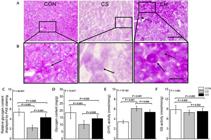
Effects of huddling on liver glycogen-related indices in Brandt’s voles under low/cold ambient temperatures: (A) Scale bar = 100 μm. (B) Scale bar = 25 μm. PAS staining of glycogen in liver. Arrows point to glycogen staining location. Dashed Arrows point to nucleus. Enlarged part is inside the box. (C) Relative glycogen content displayed by PAS staining. (D) Change in glycogen content. (E) GYPL activity level. (F) GS activity level. Values are means ± standard deviation. n = 8. (CON) Control group, (CS) cool separated group, (CH) cool huddling group.
Changes in TG content and activities of enzymes involved in TG synthesis and degradation
The distribution of liver TG in Brandt’s vole is shown in Fig. 4 A, B. Compared to the CON group, TG content decreased in the CS group, whereas no change was observed in the CH group (Fig. 4C, D). Compared to the CON group, the FASN activity decreased in the CS group, whereas no change was observed in the CH group (Fig. 4E). Compared to the CON group, the ACC activity decreased in both lowtemperature groups. However, the reduction in the ACC activity induced by low/cold ambient temperatures was less pronounced in the CH group compared to the CS group (Fig. 4F). The activity of HL remained stable across all three groups (Fig. 4G).

Effects of huddling on liver lipid-related indices in Brandt’s voles under low/cold ambient temperatures. (A) Scale bar = 100 μm. (B) Scale bar = 25 μm. Oil red staining of TG in liver. Arrows point to TG staining location. Enlarged part is inside the box. (C) Relative TG content displayed by Oil Red O staining. (D) Change in TG content. (E) FASN activity level. (F) ACC activity level. (G) HL activity level. Values are means ± standard deviation. n = 8. (CON) Control group, (CS) cool separated group, (CH) cool huddling group.
DISCUSSION
The key findings revealed that exposure to low/cold ambient temperatures increased GYPL activity while decreasing FASN and ACC activities. Importantly, huddling behavior mitigated these metabolic alterations, highlighting its adaptive role in cold environments.
Exposure to low/cold ambient temperatures resulted in synchronized reductions in body weight and liver mass in the voles, while huddling behavior did not influence these parameters. Reducing body weight to lower heat demand and minimize heat dissipation may represent an adaptive strategy employed by Brandt’s voles to cope with cold environments (Li and Wang 2005, Zhu et al. 2012).
Low/cold ambient temperatures of 15 °C caused a decrease in hepatic glycogen content in the Brandt’s voles. This reduction may be attributed to unchanged GS activity combined with increased GYPL activity, which maintains glycogen synthesis capacity while enhancing glycogen breakdown. The increased consumption of glycogen likely supports the heightened thermogenic demands imposed by cold stress (Jakus et al. 2008). Consistent with these findings, previous studies have demonstrated that 24-hour hypothermia (body temperature Tb = 20.4 ± 0.4 °C) in rats leads to substantial glycogen depletion (Prokop’eva and Ivleva 1986). As an important thermogenic organ in the body, the liver plays a pivotal role in sustaining body temperature under cold conditions. At 15 °C, Brandt’s voles likely rely on enhanced glycogen utilization in the liver to support heat production and maintain body temperature.
Huddling behavior plays a crucial role in preserving liver glycogen in Brandt’s voles under cold conditions by suppressing GYPL activity. This suppression alleviates the depletion of liver glycogen induced by exposure to a low/cold ambient temperature of 15 °C. Previous studies have shown that huddling reduces body temperature in Brandt’s voles compared to isolated individuals under similar cold conditions (Sukhchuluun et al. 2018). By lowering body temperature, huddling reduces the temperature gradient between the body and surrounding environment, thereby reducing heat loss. RMR is a widely used indicator of energy expenditure (McClune et al. 2015). In the present study, voles engaged in huddling exhibited lower RMR at 15 °C compared to their isolated counterparts. This reduction in energy expenditure likely contributes to the inhibition of glycogen breakdown in the liver, as lower metabolic demands diminish the need for rapid glycogen mobilization
Exposure to low/cold ambient temperature led to a reduction in hepatic TG content in Brandt’s voles. This decline was primarily attributed to decreased activities of FASN and ACC, critical enzymes involved in lipid synthesis. The suppression of these enzymatic activities under cold conditions weakened lipid biosynthesis capacity. Supporting evidence from previous research indicates that one hour of exposure to 2 °C in rats leads to an increase in total cholesterol levels in the liver (Górski et al. 1988). The reduction in lipid synthesis at 15 °C can be explained by two factors. First, the relatively moderate cold stress of 15 °C may elicit a less pronounced physiological response compared to exposure to more extreme temperatures. Second, the energy demands for thermogenesis at 15 °C may outweigh the requirements for heat conservation, redirecting metabolic resources toward immediate energy production rather than lipid storage.
Huddling behavior effectively promotes lipid synthesis in the liver of Brandt’s voles by enhancing the activities of FASN and ACC. At a low/cold ambient temperature of 15 °C, the TG content in the liver of voles in the CH group was higher than in the CS group and showed no difference compared to the CON group. This observation aligns with studies on chinchilla-strain domestic rabbits, Oryctolagus cuniculus (Linnaeus, 1758), where individuals at the center of a huddle under acute cold stress (9-11 °C) exhibited elevated serum TG concentrations relative to those at the periphery (García-Torres et al. 2015). The reduction in energy expenditure associated with huddling likely contributes to enhanced lipid synthesis by preserving metabolic resources that would otherwise be directed toward thermogenesis. Additionally, no differences in HL activity were observed among the groups, suggesting that cold exposure at 15 °C and huddling behavior did not influence lipid degradation in the liver. In conclusion, huddling behavior improves lipid synthesis in the liver of Brandt’s voles, leading to an increase in lipid content.
In summary, this study investigated the enzymatic mechanisms governing glycogen synthesis and degradation, as well as lipid synthesis and decomposition, in the livers of huddling and isolated Brandt’s voles exposed to low/cold ambient temperatures. The findings demonstrated that cold conditions reduced hepatic glycogen and lipid storage. However, huddling behavior effectively mitigated these effects by suppressing glycogen decomposition and promoting TG synthesis, thereby alleviating these changes and enhancing cold tolerance. These results emphasize the ecological importance of huddling as a behavioral adaptation among small mammals. By regulating glycogen and lipid metabolism, huddling supports individual physiological resilience and promotes population-level survival during harsh winters. These results emphasize the ecological importance of huddling as a behavioral adaptation among small mammals. By regulating glycogen and lipid metabolism, huddling supports individual physiological resilience and promotes population-level survival during harsh winters. This population-level and individual-level dual-level strategy exemplifies an effective survival mechanism for social species facing adverse environmental conditions. By enhancing overwinter survival and ensuring reproductive continuity, huddling contributes to the long-term persistence of the species, highlighting its critical role in the adaptive toolkit of small mammals.
LITERATURE CITED
-
Brenner FJ (1965) Metabolism and Survival Time of Grouped Starlings at Various Temperatures. The Wilson Bulletin 77(4): 388-395. https://www.jstor.org/stable/4159423
» https://www.jstor.org/stable/4159423 -
Cai B, Ma M, Zhang J, Kong S, Zhou Z, Li Z, et al. (2022) Long noncoding RNA ZFP36L2-AS functions as a metabolic modulator to regulate muscle development. Cell Death & Disease 13(4): 389. https://doi.org/10.1038/s41419-022-04772-2
» https://doi.org/10.1038/s41419-022-04772-2 - Case RM (1973) Bioenergetics of a covey of bobwhites. The Wilson Bulletin 85(1): 52-59.
-
Chen L, Duan Y, Wei H, Ning H, Bi C, Zhao Y, et al. (2019) Acetyl-CoA carboxylase (ACC) as a therapeutic target for metabolic syndrome and recent developments in ACC1/2 inhibitors. Expert Opinion on Investigational Drugs 28(10): 917-930. https://doi.org/10.1080/13543784.2019.1657825
» https://doi.org/10.1080/13543784.2019.1657825 - Donnier-Maréchal M, Vidal S (2016) Glycogen phosphorylase inhibitors: a patent review (2013-2015). Expert Opinion on Therapeutic Patents 26(2): 199-212.
- Fan J, Watanabe T (1998) Hepatic lipase. Journal of Atherosclerosis and Thrombosis 5(1): 41-45.
-
Ferreira M (2010) Electric countershock and cold stress effects on liver and adrenal gland. Clinics 65(3): 291-296. https://doi.org/10.1590/S1807-59322010000300009
» https://doi.org/10.1590/S1807-59322010000300009 -
Fhu CW, Ali A (2020) Fatty acid synthase: An emerging target in cancer. Molecules 25(17): 3935. https://doi.org/10.3390/molecules25173935
» https://doi.org/10.3390/molecules25173935 -
García-Torres E, Hudson R, Castelán F, Martínez-Gómez M, Bautista A (2015) Differential metabolism of brown adipose tissue in newborn rabbits in relation to position in the litter huddle. Journal of Thermal Biology 51: 33-41. https://doi.org/10.1016/j.jtherbio.2015.03.003
» https://doi.org/10.1016/j.jtherbio.2015.03.003 - Górski J, Górska M, Hryniewicz A (1988) Effect of cold exposure on the concentration of triglyceride in the liver of the rat. Acta Physiologica Polonica 39(2): 136-142.
-
Henke BR, Sparks SM (2006) Glycogen phosphorylase inhibitors. MiniReviews in Medicinal Chemistry 6(8): 845-857. https://doi.org/10.2174/138955706777934991
» https://doi.org/10.2174/138955706777934991 -
Hers HG (1976) The control of glycogen metabolism in the liver. Annual Review of Biochemistry 45: 167-189. https://doi.org/10.1146/annurev.bi.45.070176.001123
» https://doi.org/10.1146/annurev.bi.45.070176.001123 -
Horiguchi A, Asano T, Asano T, Ito K, Sumitomo M, Hayakawa M (2008) Fatty acid synthase over expression is an indicator of tumor aggressiveness and poor prognosis in renal cell carcinoma. Journal of Urology 180(3): 1137-1140. https://doi.org/10.1016/j.juro.2008.04.135
» https://doi.org/10.1016/j.juro.2008.04.135 - Hyvarinen H, Pasanen S, Heikura H, Heinineva R, Laru H (1976) Effects of a cold environment on energy-related enzyme activities in the postnatal rat. Growth 40(1): 41-52.
-
Jakus PB, Sandor A, Janaky T, Farkas V (2008) Cooperation between BAT and WAT of rats in thermogenesis in response to cold, and the mechanism of glycogen accumulation in BAT during reacclimation. Journal of Lipid Research 49(2): 332-339. https://doi.org/10.1194/jlr.m700316-jlr200
» https://doi.org/10.1194/jlr.m700316-jlr200 -
Kawate R, Talan MI, Engel BT (1994) Sympathetic nervous activity to brown adipose tissue increases in cold-tolerant mice. Physiology & Behavior 55(5): 921-925. https://doi.org/10.1016/0031-9384(94)90080-9
» https://doi.org/10.1016/0031-9384(94)90080-9 -
Kim KH (1983) Regulation of acetyl-CoA carboxylase. Current Topics in Cellular Regulation 22: 143-176. https://doi.org/10.1016/b978-0-12-152822-5.50009-9
» https://doi.org/10.1016/b978-0-12-152822-5.50009-9 -
Li X-S, Wang D-H (2005) Seasonal adjustments in body mass and thermogenesis in Mongolian gerbils (Meriones unguiculatus): the roles of short photoperiod and cold. Journal of Comparative Physiology, Series B: Biochemical, Systemic, and Environmental Physiology 175(8): 593-600. https://doi.org/10.1007/s00360-005-0022-2
» https://doi.org/10.1007/s00360-005-0022-2 -
Lu Q, Zhong W-Q, Wang D-H (2007) Individual variation and repeatability of the aerobic performance in Brandt’s voles (Lasiopodomys brandtii). Journal of Thermal Biology 32(7-8): 413-420. https://doi.org/10.1016/j.jtherbio.2007.08.001
» https://doi.org/10.1016/j.jtherbio.2007.08.001 -
Mathieu C, Dupret J-M, Lima FR (2017) The structure of brain glycogen phosphorylase-from allosteric regulation mechanisms to clinical perspectives. The FEBS Journal 284(4): 546-554. https://doi.org/10.1111/febs.13937
» https://doi.org/10.1111/febs.13937 -
McClune DW, Kostka B, Delahay RJ, Montgomery WI, Marks NJ, Scantlebury DM (2015) Winter is coming: Seasonal variation in resting metabolic rate of the European Badger (Meles meles). Plos One 10(9): e0135920. https://doi.org/10.1371/journal.pone.0135920
» https://doi.org/10.1371/journal.pone.0135920 -
Meng X, Jayasundara N, Zhang J, Ren X, Gao B, Li J, et al. (2021) Integrated physiological, transcriptome and metabolome analyses of the hepatopancreas of the female swimming crab Portunus trituberculatus under ammonia exposure. Ecotoxicology and Environmental Safety 228: 113026. https://doi.org/10.1016/j.ecoenv.2021.113026
» https://doi.org/10.1016/j.ecoenv.2021.113026 -
Pederson BA (2019) Structure and regulation of glycogen synthase in the brain. Advances in Neurobiology 23: 83-123. https://doi.org/10.1007/978-3-030-27480-1_3
» https://doi.org/10.1007/978-3-030-27480-1_3 - Prokop’eva LP, Ivleva VV (1986) Characteristics of the early recovery period and the level of carbohydrate-lipid metabolic substrates after 24-hour immobilization hypothermia. Byulleten’ Eksperimental’noi Biologii i Meditsiny 102(12): 697-699.
-
Putaala A, Hohtola E, Hissa R (1995) The effect of group size on metabolism in huddling grey partridge (Perdix perdix). Comparative Biochemistry and Physiology, Part B: Biochemistry and Molecular Biology 111(2): 243-247. https://doi.org/10.1016/0305-0491(94)00246-Q
» https://doi.org/10.1016/0305-0491(94)00246-Q -
Roy R, Ordovas L, Zaragoza P, Romero A, Moreno C, Altarriba J, et al. (2006) Association of polymorphisms in the bovine FASN gene with milk-fat content. Animal Genetics 37(3): 215-218. https://doi.org/10.1111/j.1365-2052.2006.01434.x
» https://doi.org/10.1111/j.1365-2052.2006.01434.x -
Sahin E, Gümüşlü S (2004) Cold-stress-induced modulation of antioxidant defence: role of stressed conditions in tissue injury followed by protein oxidation and lipid peroxidation. International Journal of Biometeorology 48(4): 165-171. https://doi.org/10.1007/s00484-004-0205-7
» https://doi.org/10.1007/s00484-004-0205-7 -
Sanchez ER, Solis R, Torres-Contreras H, Canals M (2015) Self-organization in the dynamics of huddling behavior in Octodon degus in two contrasting seasons. Behavioral Ecology and Sociobiology 69(5): 787-794. https://doi.org/10.1007/s00265-015-1894-0
» https://doi.org/10.1007/s00265-015-1894-0 -
Santamarina-Fojo S, González-Navarro H, Freeman L, Wagner E, Nong Z (2004) Hepatic lipase, lipoprotein metabolism, and atherogenesis. Arteriosclerosis, Thrombosis, and Vascular Biology 24(10): 1750-1754. https://doi.org/10.1161/01.atv.0000140818.00570.2d
» https://doi.org/10.1161/01.atv.0000140818.00570.2d -
Sepa-Kishi DM, Katsnelson G, Bikopoulos G, Iqbal A, Ceddia RB (2018) Cold acclimation reduces hepatic protein Kinase B and AMP-activated protein kinase phosphorylation and increases gluconeogenesis in Rats. Physiological Reports 6(5): e13592. https://doi.org/10.14814/phy2.13592
» https://doi.org/10.14814/phy2.13592 - Stocks JM, Taylor NA, Tipton MJ, Greenleaf JE (2004) Human physiological responses to cold exposure. Aviation, Space, and Environmental Medicine 75(5): 444-457.
-
Sukhchuluun G, Zhang XY, Chi QS, Wang DH (2018) Huddling Conserves energy, decreases core body temperature, but increases activity in Brandt’s voles (Lasiopodomys brandtii). Frontiers in Physiology 9: 563. https://doi.org/10.3389/fphys.2018.00563
» https://doi.org/10.3389/fphys.2018.00563 -
Tang Y, Wang D, Zhang H, Zhang Y, Wang J, Qi R, et al. (2021) Rapid responses of adipocytes to iron overload increase serum TG level by decreasing adiponectin. Journal of Cellular Physiology 236(11): 7544-7553. https://doi.org/10.1002/jcp.30391
» https://doi.org/10.1002/jcp.30391 -
Tao L, Yi Y, Chen Y, Zhang H, Orning P, Lien E, et al. (2021) RIP1 kinase activity promotes steatohepatitis through mediating cell death and inflammation in macrophages. Cell Death and Differentiation 28(4): 1418-1433. https://doi.org/10.1038/s41418-020-00668-w
» https://doi.org/10.1038/s41418-020-00668-w -
Thuren T (2000) Hepatic lipase and HDL metabolism. Current Opinion in Lipidology 11(3): 277-283. https://doi.org/10.1097/00041433-200006000-00008
» https://doi.org/10.1097/00041433-200006000-00008 -
Villarin JJ, Schaeffer PJ, Markle RA, Lindstedt SL (2003) Chronic cold exposure increases liver oxidative capacity in the marsupial Monodelphis domestica Comparative Biochemistry and Physiology , Part A, Molecular & Integrative Physiology 136(3): 621-630. https://doi.org/10.1016/s1095-6433(03)00210-1
» https://doi.org/10.1016/s1095-6433(03)00210-1 -
Wang Y, Li W, Zhao T, Zou Y, Deng T, Yang Z, et al. (2021) Interleukin-17-Producing CD4(+) T cells promote inflammatory response and Foster Disease progression in hyperlipidemic patients and atherosclerotic mice. Frontiers in Cardiovascular Medicine 8: 667768. https://doi.org/10.3389/fcvm.2021.667768
» https://doi.org/10.3389/fcvm.2021.667768 -
Wang Y, Yu W, Li S, Guo D, He J, Wang Y (2022) Acetyl-CoA Carboxylases and Diseases. Frontiers in Oncology 12: 836058. https://doi.org/10.3389/fonc.2022.836058
» https://doi.org/10.3389/fonc.2022.836058 -
Wang Z, Xu JH, Mou JJ, Kong XT, Zou JW, Xue HL (2020) Novel ultrastructural findings on cardiac mitochondria of huddling Brandt’s voles in mild cold environment. Comparative Biochemistry and Physiology , Part A: Molecular & Integrative Physiology 249: 110766. https://doi.org/10.1016/j.cbpa.2020.110766
» https://doi.org/10.1016/j.cbpa.2020.110766 -
Watts C, Malthus RS (1980) Liver glycogen synthase in rats with a glycogenstorage disorder. The role of glycogen in the regulation of glycogen synthase. European Journal of Biochemistry 108(1): 73-77. https://doi.org/10.1111/j.1432-1033.1980.tb04697.x
» https://doi.org/10.1111/j.1432-1033.1980.tb04697.x -
Xu JH, Wang Z, Mou JJ, Wang CL, Huang WM, Xue HL, et al. (2021) Up-Regulation of glycogen synthesis and degradation enzyme level maintained myocardial glycogen in huddling Brandt’s voles under cool environments. Frontiers in Physiology 12: 593129. https://doi.org/10.3389/fphys.2021.593129
» https://doi.org/10.3389/fphys.2021.593129 -
Zhang XY, Sukhchuluun G, Bo TB, Chi QS, Yang JJ, Chen B, et al. (2018) Correction to: Huddling remodels gut microbiota to reduce energy requirements in a small mammal species during cold exposure. Microbiome 6(1): 126. https://doi.org/10.1186/s40168-018-0509-1
» https://doi.org/10.1186/s40168-018-0509-1 -
Zhang Z, Pan T, Sun Y, Liu S, Song Z, Zhang H, et al. (2021) Dietary calcium supplementation promotes the accumulation of intramuscular fat. Journal of Animal Science and Biotechnology 12(1): 94. https://doi.org/10.1186/s40104-021-00619-6
» https://doi.org/10.1186/s40104-021-00619-6 -
Zhong W, Wang G, Zhou Q, Wang G (2007) Communal food caches and social groups of Brandt’s voles in the typical steppes of Inner Mongolia, China. Journal of Arid Environments 68(3): 398-407. https://doi.org/10.1016/j.jaridenv.2006.06.008
» https://doi.org/10.1016/j.jaridenv.2006.06.008 -
Zhu L, Feng S, Wu Y, Mu J, Jing T, Xie Y, et al. (2020) Changes to liver structure and energy metabolism during cold storage of transplanted liver in mice. Experimental and Clinical Transplantation 18(1): 71-82. https://doi.org/10.6002/ect.2019.0193
» https://doi.org/10.6002/ect.2019.0193 -
Zhu WL, Jia T, Cai JH, Xiao L, Wang ZK (2012) The effect of cold-acclimation on energy strategies of Apodemus draco in Hengduan Mountain region. Journal of Thermal Biology 37(1): 41-46. https://doi.org/10.1016/j.jtherbio.2011.10.008
» https://doi.org/10.1016/j.jtherbio.2011.10.008
ADDITIONAL NOTES
-
Funding
National Natural Science Foundation of China (32201276). This work was supported by funds from the National Natural Science Foundation of China (no. 32201276).
-
Data Availability
The authors confirm that the data supporting the findings of this study are available within the article and in its Supplementary Table S1.
- ZooBank register
-
How to cite this article
Xu J-H, Li L-F, Zhang X-L, Kong X-T, Wang X-C, Jiang L-N, Wang Z (2025) Huddling alleviates the decrease in glycogen and lipid content in the liver of Brandt’s vole caused by mild cold environment. Zoologia 42: e24042. https://doi.org/10.1590/S1984-4689.v42.e24042
-
Published by
Sociedade Brasileira de Zoologia at Scientific Electronic Library Online - https://www.scielo.br/zool
Supplementary material
Supplementary Table S1. Original data of kit detection.
Authors: Li Lufan.
Data type: Database.
Copyright notice: This dataset is made available under the Open Database License (http://opendatacommons.org/licenses/odbl/1.0/). The Open Database License (ODbL) is a license agreement intended to allow users to freely share, modify, and use this Dataset while maintaining this same freedom for others, provided that the original source and author(s) are credited.
Link: https://doi.org/10.1590/S1984-4689.v42.e24042
The authors confirm that the data supporting the findings of this study are available within the article and in its Supplementary Table S1.


