 Distribution patterns, richness, endemism and conservation of Phyllanthaceae in the Atlantic Forest of Northeastern Brazil
Abstract
Brazil’s Atlantic Forest is one of the most important biodiversity hotspots on the planet, home to several rare and endemic species. The Phyllanthaceae family harbors great richness of endemic species in this area, including some recently described in the Northeastern Atlantic Forest. However, this biome faces serious threats due to human activity, habitat loss and species extinction. This study analyzed the distribution, richness and endemism of Phyllanthaceae species in the Northeastern Atlantic Forest, investigated the relationship between species richness and climatic characteristics, and delimited the centers of endemism and the main threats and pressures. Data from Reflora, Specieslink, herbaria from the Brazilian Northeast and specialized literature were used. Generalized linear models analyzed the relationship between species richness and climate variables. Forty-two species were identified in the study area, 13 of which are endemic. The south of Bahia state stood out for its greater species richness, with 23 species described, including 11 endemic ones. Three centers of endemism were identified: two in southern Bahia and one in Pernambuco state. Most endemic species face threats, with few protected areas. Deforestation, agriculture and urban expansion represent the main pressures on these species in the region.
Key words
biogeography; climate change; Malpighiales; Phyllanthoideae
INTRODUCTION
The Brazilian Atlantic Forest is the second largest tropical rainforest in the Americas and one of the five main biodiversity hotspots on the planet (Myers et al. 2000, Tabarelli et al. 2005). The Atlantic Forest has a rich concentration of endemic species (Gaston 2000, Boyero 2011). It is believed that environmental characteristics, such as the latitudinal gradient, the presence of different climatic zones and different types of vegetation (Mantovani 2003), are responsible for the high levels of endemism, richness and diversity of species in this biome (Myers et al. 2000).
Understanding patterns of richness and endemism is essential for understanding the spatial distribution of species (Morrone 2001) and for unravelling the biotic and abiotic factors associated with these processes and their causes (Kerr 1997, Pinto et al. 2006). The study of richness and endemism allows a more in-depth analysis of the variation in the number of species in different geographic regions, and of the occurrence of exclusive species in certain areas (Myers et al. 2000). Abiotic factors, such as altitude, latitude, temperature and precipitation, play an important role in the distribution of these species; therefore, understanding these aspects is crucial for the management and conservation of these areas (Donoghue & Moore et al. 2003).
In the tropics, between 23.5ºN and 23.5ºS, high rainfall and constantly hot temperatures contribute to the maintenance of relative climatic stability, which explains the greater productivity and diversity of habitats in the region (Bowman et al. 2017). These conditions provide a more accentuated specialization of organisms, and therefore also increase the process of speciation (emergence of new species) (Myers 2000, Allan & Castillo 2007, Bowman et al. 2017), which may explain the high diversity of endemic species as habitats diversify (Myers et al. 2000).
The Phyllanthaceae family comprises around 2,000 species and almost 70 genera, predominantly tropical (Kathriarachchi et al. 2005, Bouman et al. 2022). The family is especially notable for its medicinal importance, since several species have antitumor, anti-inflammatory, antiparasitic and antimicrobial actions (e.g. Moeroris amara (Schumach & Thonn) R.W. Bouman, P. acuminatus Vahl and Margaritaria spp.), while others (e.g. P. niruri L. and Moeroris tenella (Roxb.) R.W. Bouman) can be used in the treatment of kidney stones and Hepatitis B (Lorenzi & Matos 2002, Nishiura 2004, Moraes et al. 2015).
Recently, the tribe Phyllantheae was reorganized into 18 monophyletic genera, resolving the paraphyly of the genus Phyllanthus. These genera include Breynia J.R. Forst & G. Forst, Cathetus Lour., Cicca L., Dendrophyllanthus S. Moore, Emblica Gaertner, among others (Bouman et al. 2022). In Brazil, the tribe is represented by 18 genera and 136 species, whith 40 species being endemic to the Atlantic Forest (Funez et al. 2018, Flora e Funga do Brasil 2024, Orlandini et al. 2021, Torres et al. 2022). This diversity is comparable to other centers of family diversity in tropical rainforests around the world, such as the Caribbean Islands, where 83 species of Phyllanthaceae occur (Acevedo-Rodríguez & Strong 2012), and the Guineo-Congolese Forest in Congo, where 47 species of the family have been recorded, of which 29 are endemic (Breteler et al. 2013).
Due to the diversity of the family in tropical forests, it represents a model for studying species distribution patterns for the Brazilian Atlantic Forest. These patterns are indicative of cradles of species diversification and can reveal how environmental factors influence the presence of these taxa in specific ecosystems in the Atlantic Forest domains, including microendemic species from this region (Orlandini et al. 2021, Torres et al. 2022).
Within the Atlantic Forest biome, the Northeastern region holds a great diversity of species in the family Phyllanthaceae, with seven genera and 37 species recorded. The following genera have been recorded, with the number of species indicated within parentheses: Amanoa Aubl. (1), Astrocasia B.L. Rob. & Mill. (1); Discocarpus Klotzsch (1); Hieronyma Allemão (2); Margaritaria L. f. (1); Phyllanthus L. (30); and Richeria Vahl. (1) (Mendes et al. 2021, Orlandini et al. 2021, Torres et al. 2022). Furthermore, 10 of these species are endemic to the Northeastern Atlantic Forest, namely: D. pedicellatus Fiaschi & Cordeiro, P. almadensis Müll. Arg., P. carmenluciae R.T.M. Ribeiro & Loiola, P. carvalhoi G.L. Webster, P. gradyi M.J. Silva & M.F. Sales, P. itamarajuensis Marques-Torres & M.J. Silva, P. longipedicellatus M.J. Silva, P. tuberculatus Marques-Torres & M.J. Silva, P. dardanoi J.C.R.Mendes & M.J.Silva and P. dracaenoides P.Orlandini & I.Cordeiro and P. hypoleucus Müll. Arg. (Torres et al. 2020, Mendes et al. 2021, Orlandini et al. 2021). In fact, results presented by Orlandini et al. (2021) influenced our research and led us to investigate distribution patterns, the correlation between species richness and climatic characteristics, and the endemism of Phyllanthaceae species in the Northeastern Atlantic Forest.
In areas already identified as centers of endemism in the Brazilian Northeast (Silva et al. 2004), there are several species of Phyllanthaceae, including some recently discovered (Mendes et al. 2021, Orlandini et al. 2023, Torres et al. 2020). Although there is still a lack of consensus on the definition of a “center of endemism”, such regions are generally considered to be places where there is congruence in the spatial distributions of monophyletic groups (Szumik et al. 2002, Szumik & Golobof 2004). This occurs because centers of endemism are understood as historical and biogeographical entities within large areas of endemism (Harold & Mooi 1994). Thus, in areas where endemic species occur, centers of endemism can be identified as specific regions where there is an overlap of two or more related endemic species (Myers et al. 2000).
The centers of endemism of the Northeastern region (Brejos Nordestinos Endemism Center, Pernambuco Endemism Center, Diamantina Endemism Center and Bahia Endemism Center), are located on the coast and in the center of the Brazilian Northeast (Silva et al. 2004, Tabarelli et al. 2005). They encompass a mosaic of tropical forests, with seasonal forests, semi-deciduous forests, dense rainforests and high-altitude Brejos, which are swampy enclaves of Atlantic Forest in areas of dry, scrubby Caatinga (Pôrto et al. 2004), such as the Ibiapaba mountain range, the Baturité mountain range and the Araripe plateau in Ceará state, and the Serra Negra, in the interior of Pernambuco state.
Unfortunately, these areas have been heavily impacted by various human activities, such as deforestation, agricultural expansion and urbanization (Rêgo & Hoeflich 2001), which has led to the fragmentation of habitats and the loss of diversity, including the extinction of endemic species (Myers et al. 2000, Tabarelli et al. 2005).
Understanding the distribution patterns, species richness and areas of endemism of Phyllanthaceae in the Northeastern Atlantic Forest is crucial for the conservation of this region’s biodiversity. This understanding allows researchers to identify priority areas for conservation of the family (Cracraft 1985, Morrone 1994, Kerr 1997), protecting these unique species that are important for biological diversity (Myers et al. 2000). Furthermore, distribution patterns can serve as indicators of environmental impacts, such as deforestation and climate change, guiding conservation interventions (Cardoso-Leite et al. 2013). All this information supports management and conservation decisions, ensuring effectiveness in the allocation of resources for choosing priority areas for the conservation of the family and the Atlantic Forest.
In this study, we identified: a) the distribution patterns of Phyllanthaceae species in the Northeastern Atlantic Forest, including their association with different types of vegetation; b) the general species richness and endemic species richness of Phyllanthaceae in the Northeastern Atlantic Forest; c) the relationship between species richness and abiotic factors such as latitude, altitude, temperature and precipitation; d) the areas of endemism for Phyllanthaceae species in the Northeastern Atlantic Forest; e) the main pressures that threaten Phyllanthaceae species in the region of the Atlantic Forest of the Northeast; and f) we investigated the coincidence of the centers of endemism of Phyllanthaceae with the areas of endemism previously identified for this region of the biome.
MATERIALS AND METHODS
Study area
The Northeastern Atlantic Forest is an extension of the Atlantic Forest biome, located in the coastal region of the States of Alagoas, Bahia, Sergipe, Paraíba, Pernambuco and Rio Grande do Norte, in Brazil (Veloso et al. 1991), covering an area of approximately 97,596 km² (MMA 2007). The region encompasses not only the coastal area, but also the high-altitude Brejos in the semi-arid regions of the Northeast, in the states of Ceará and Piauí (Tabarelli et al. 2005), extending to the interior of Pernambuco and Paraíba (Pôrto et al. 2004), and the seasonal forests of Chapada Diamantina (IBGE 2022).
Its territory comprises an extensive range of tropical to subtropical vegetation formations, with formations of Dense Ombrophylous Forest, Open Ombrophylous Forest and Mixed Ombrophylous Forest; Deciduous Seasonal Forest; Semideciduous Seasonal Forest (Rizzini 1979), in addition to the pioneer formations, such as mangroves, restingas, Campestre formations and the aforementioned high-altitude swamps in the midst of semi-arid regions (Pôrto et al. 2004, Tabarelli et al. 2005). Precipitation varies between 1,000 and 4,000 mm (Mantovani 2003), and it presents a predominantly hot and humid climate with temperatures around 24° C (Rêgo & Hoeflich 2001).
Data acquisition and cleaning
More than 2,000 specimens referring to the Atlantic Forest of Brazil’s Northeast were analyzed, using the filters “Phyllanthaceae”, “Mata Atlântica” and “Nordeste”, from different herbaria available in the online databases Global Biodiversity Information Facility (GBIF: http://www.gbif.org), speciesLink (http://www.splink.org.br/), and Reflora Virtual Herbarium (http://reflora.jbrj.gov.br/). The collections of the following herbaria were also consulted: ALCB!, ASE!, BHCB, CAS-BOT, CBPM, CEN!, CEPEC!, CESJ, CPMA, CSTR, CVRD, EAC!, ESA!, ESAL, FCAB, FLOR, FUEL, FURB, GCPP, HBV, HCDAL, HCF, HEPH, HFSL, HPL, HRSN, HST! (not indexed), HUCPE, HUCS, HUEFS!, HUENF, HUESB!, HUFABC, HUNI, HURB!, HUTO, HVASF!, HVC, IAC!, IAN, ICN!, INPA, JPB!, MAC!, MBM!, MO, NY, PEUFR!, R, RBR, RN, RON, SP!, SPF!, SPSF, TEPB, UB!, UEC!, UESC!, UFG, UFP!, UPCB, US and VIES, including the type specimens (acronyms according to Thiers 2024, continuously updated), in addition to the data present in the taxonomic treatments carried out by Torres et al. (2022), Orlandini et al. (2021) and Mendes et al. (2021). Additionally, our own collections were carried out, following the usual methodology of plant taxonomy (Mori et al. 1998), in under-sampled locations and where endemic species are found. The classification proposed by Bouman et al. (2022) was adopted in the present study.
Initially, the names of the species recorded for the study area were checked, seeking greater precision in taxonomic identification, as data from collections are often not reliable in identifying their material. For this, only materials with photos and those without photos that had been identified by regional experts were considered (Silva & Sales 2007, Torres et al. 2022). Subsequently, duplicate records were removed.
For data with valid coordinates (latitude and longitude), we checked whether the point corresponds to the collection location indicated on the exsiccate label. In the case of records that were not georeferenced, the coordinate was obtained manually, according to the collection location indicated on the specimen label, with the help of Google Maps (https://www.google.com.br/maps). In some cases, the geoLoc tool was also used (http://splink.cria.org.br/geoloc?criaLANG=pt) from the SpeciesLink database, always seeking greater precision regarding the location indicated in the collection.
Distribution patterns, richness and endemism
To determine species distribution patterns, we defined four categories based on extent of occurrence (EOO) and areas of occupancy (AOO). The categories were defined as broad (continuous or disjunct), according to the methodology suggested by Maciel et al. (2009), and restricted (endemic or rare). Species with records were separated by up to 150 km2 (approximately 1° of latitude and longitude) and covered an occurrence area of up to 10,000 km2 (Giulietti et al. 2019).In this work, species were considered to be rare, whether endemic or not, if their AOO and EOO were between 4,000 and 8,000 km2 (Kruckeberg & Rabinowitz 1985, Gomes-Klein et al. 2009). Species were classified as broad when they had an extensive geographic distribution. Within ‘broad’, they could be continuous or disjunct when separated by long distances or geographic limits (Cabrera & Willink 1973). Restricted species were divided into endemic and rare subcategories. Endemic species occur exclusively in a specific geographic area, while rare species have a limited geographic occupancy, regardless of whether they are endemic or not (Gomes-Klein et al. 2009).
Geospatial analyses were carried out using the QGIS software version 3. 34. 1 ‘Las Palmas’ (QGIS Development Team 2020) and the DIVAGis program to calculate richness based on the Jacknife estimator (Quenouille 1949). Furthermore, the influence of climate variables on the distribution of richness was analyzed using generalized linear models (GLMs) in R.
To investigate the correlation of species richness among species endemic to the Atlantic Forest with abiotic factors—latitude, altitude, average annual temperature, and average precipitation—Generalized Additive Models (GAMs) were employed (Hastie & Tibshirani 1990). The models were selected based on the lowest AICc (Akaike information criterion corrected for small samples; Burnham & Anderson 2004) and their performance relative to the null model (i.e., higher adjusted R²). GAMs were implemented using the ‘mgcv’ package (Marra & Wood 2011), and adjusted R² values were measured with the ‘rsq’ package (R Core Team 2022).
The NDM/VNDM program was used to identify centers of endemism in the study area. This program applies algorithms based on the concept of area of endemism (Szumik & Goloboff 2004), to evaluate the presence of two or more endemic taxa in a given geographic unit (grid). Different square sizes were tested (0.50° x 0.50°; 0.75° x 0.75° and 1° x 1°), to ensure results that were more congruent with the spatial distribution of taxa in the study area. This division into smaller squares allows for better representation and a more precise analysis of the spatial distribution of taxa, facilitating the identification of centers of endemism. Furthermore, by using NDM/VNDM it was possible to calculate the relative endemicity of the species, which indicates the degree of endemism of each species in the study area and allows areas where the species are more concentrated (overlapping) to be identified. The resulting score for endemicity varies from 0 to 1, reflecting the distribution of species within a grid. The smaller the distribution of the species in these grids, the lower the endemicity score, indicating that the species is more restricted to a specific area (Szumik & Goloboff 2004).
Furthermore, we investigated the presence of protection units with different levels of protection within the limits of the areas of endemism established here. The aim was to evaluate the degree of protection of species in these regions and the anthropic pressures on them through the analysis of occupancy and use of the land in these specific areas.
RESULTS
After our revision and update of the names, we identified 13 genera and 42 species (Table I), most of which are found in the states of Bahia (35 spp.), Pernambuco (21 spp.) and Alagoas (20 spp.). The genus Phyllanthus stands out as the most representative in terms of number of species, where it is represented by 27 species, 10 of which are endemic to this region.
List of Phyllanthaceae species in the Atlantic Forest of Northeastern Brazil according to the new classification proposed by Bouman et al. (2022). Distribution patterns: AC= Wide continuous; AD= Wide disjoint; ENBR= Endemic to Brazil; ENNE= Endemic to the Northeast, ENMNE = Endemic to the Northeastern Atlantic Forest.
We observed the occurrence of representatives of the family in different phytophysiognomies of the Atlantic Forest, such as pioneer formations (Alagoas, Pernambuco, Paraíba and Ceará), Seasonal Deciduous Forest (in Chapada Diamantina and along the coastal region), Dense and Mixed Ombrophylous Forests (along the coast), in addition to the high-altitude Brejos in the interior of Pernambuco, Paraíba and Ceará.
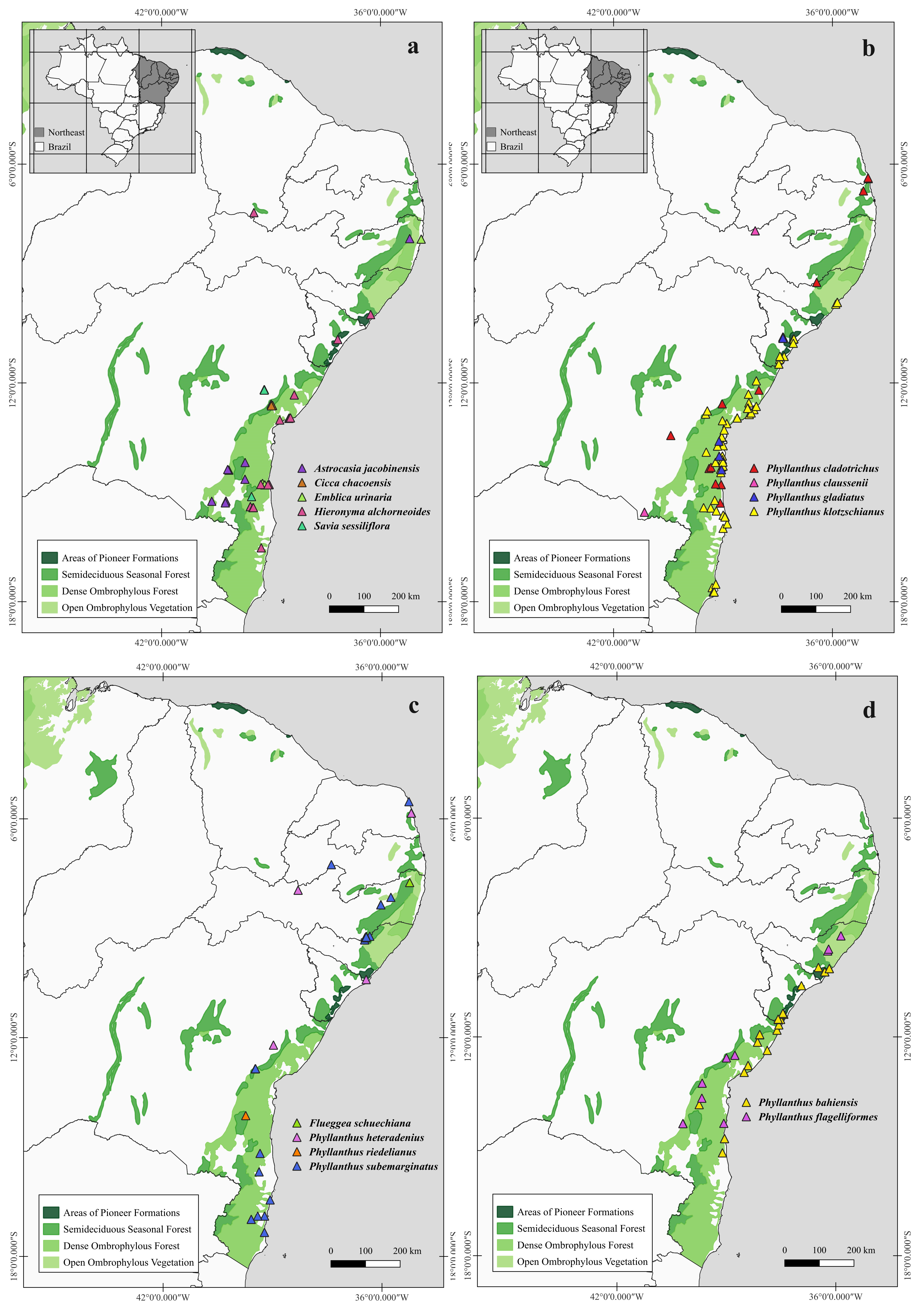
Figures 1, 2 and 3 present maps with the current distribution of Phyllanthaceae species in the Northeastern Atlantic Forest, revealing a variety of distinct patterns, as described in Table I. These patterns include broad and continuous distributions, as well as broad and disjunct distributions. Furthermore, endemic species stand out, and they may have wide or disjunct distributions; there were also rare species, characterized by a very low number of records (1 to 3 specimens) and an occupation area of around 4,000 km2.

Distribution maps of Phyllanthaceae species in the Atlantic Forest of Northeastern Brazil. Amanoa guianensis, Margaritaria nobilis, Moeroris minutula and Moeroris stipulata (a). Phyllanthus acuminatus, P. niruri, P. orbiculatus, Richeria grandis (b). Moeroris tenella, P. caroliniensis, P. hyssopifolioides, P. juglandifolius (c). Hieronyma oblonga, Moeroris amara, Meineckia neogranatensis (d).
The broad and continuous distribution pattern stands out in the study region, since 16 species with this pattern were recorded. Eleven species endemic to the Northeastern Atlantic Forest were identified, seven of which are considered rare. Ten species are considered endemic to Brazilian territory and have wide and continuous distribution in the biome. Phyllanthus bahiensis Müll.Arg. is restricted to the Northeast; however, it is widely and continuously distributed, while Cicca chacoensis (Morong) R.W. Bouman is rare in the Atlantic Forest but is widely distributed throughout the biome. Emblica urinaria R.W. Bouman and A. jacobinensis (Müll.Arg.) G.L. Webster emerge as species with wide and disjunct distribution (Table I).

Distribution maps of Phyllanthaceae species in the Atlantic Forest of Northeastern Brazil. Astrocasia jacobinensis, Cicca chacoensis, Emblica urinaria, Hieronyma alchorneoides, Savia sessiliflora (a). Phyllanthus cladotrichus, P. claussenii, P. gladiatus, P. klotzschianus (b). Flueggea schuechiana, P. heteradenius, P. riedelianus, P. subemarginatus (c). P. bahiensis, P. flagelliformis (d).
The results show that species with wide and continuous distribution can be found growing both in Dense and Mixed Ombrophilous Forest environments, as well as in Deciduous and Semideciduous Seasonal Forests and associated with pioneer vegetations such as mangroves and restingas, as well as in transition areas with the Caatinga biome. On the other hand, the endemic species are, for the most part, associated with the same vegetation type, as they were recorded in Dense Ombrophilous Forest environments, except for Discocarpus pedicellatus Fiaschi & Cordeiro (Fig. 2-b) and P. hypoleucus Müll.Arg. (Fig. 3 -a), whose populations are scarce and restricted to environments outside the Dense Ombrophilous Forest.

Distribution maps of Phyllanthaceae species in the Atlantic Forest of Northeastern Brazil. Discocarpus pedicellatus, Phyllanthus augustinii, P. dardanoi, P. gradyi, P. Hypoleucus (a). P. almadensis, P. carmenluciae, P. carvalhoi, P. dracaenoides, P. itamarajuensis, P. longipedicellatus, P. tuberculatus (b).
The richness analysis (Fig. 4) corroborates the aforementioned data, as it reveals that the majority of species are located in areas of Dense Ombrophilous Forest, which occur, especially, within an altitudinal gradient ranging from 300 to 600 m.a.s.l. It is worth mentioning that the highest concentration of species in the family is observed in the Southeast and South of Bahia, on the Coast and Zona da Mata of Pernambuco and in Eastern Alagoas. The Atlantic Forest region in southern Bahia stands out for housing the greatest diversity of species in the family in the domain, with 23 species identified (Amanoa guianensis Aubl., A. jacobinensis, D. pedicellatus, E. urinaria, Hieronyma alchorneoides Allemão, H. oblonga (Tul.) Müll.Arg., Moeroris stipulata (Raf.) G.L. Webster, M. tenella (Roxb.) R.W. Bouman, M. amara (Schumach. & Thonn.) R.W. Bouman, Margaritaria nobilis L.f., P. acuminatus Vahl., P. bahiensis, P. caroliniensis Walter, P. cladotrichus Müll.Arg., P. niruri, P. almadensis Müll.Arg., P. flagelliformis Müll.Arg., P. gladiatus Müll.Arg., P. hypoleucus Müll.Arg., P. klotzschianus Müll.Arg., P. riedelianus Müll.Arg. and Savia sessiliflora (Sw.) Willd.), of which seven are restricted to this specific area.


Richness map of endemic Phyllanthaceae species in the Atlantic Forest of Northeastern Brazil.
The application of the optimality criterion to identify areas of endemism (NDM/VNDM) revealed three distinct regions in the Northeastern Atlantic Forest consistent with the estimated richness areas for the family, with two located in the South of Bahia and one on the North Coast of Pernambuco (Fig. 6). Squares measuring 0.75° x 0.75° proved to be more efficient for geographical delimitation of Phyllanthaceae species in the study area.

Consensus areas of Phyllanthaceae endemism in the Atlantic Forest of Northeastern Brazil (NDM/VNDM).
The Pernambuco Endemism Center (Fig. 6, area 1, in red) is home to two of the 13 endemic species found in the study area: P. dardanoi J.C.R. Mendes & M.J. Silva and P. gradyi M.J. Silva & M.F. Sales. In relation to the South of Bahia, the first area of endemism, the South-Bahia Endemism Center (Fig. 6, ar2, in blue) covers the South coast, the Jiquiriça Valley, Rio de Contas and Itapetinga, while the Extreme South Bahia Endemism Center (Fig. 6, area 3, in red) is in the extreme south of the State and includes the limits of Itabuna, Ilhéus, Itapetinga, Canavieiras, Porto Seguro, Itamaraju and Caravelas. These areas of endemism are home to seven of the 10 endemic species of the Northeastern Atlantic Forest, with P. almadensis, P. dracaenoides P. Orlandini & I. Cordeiro, P. hypoleucus and P. longipedicellatus M.J. Silva located in Area 2, and P. carvalhoi G.L. Webster, P. itamarajuensis Marques-Torres & M.J. Silva and P. tuberculatus A.M. Torres & M.J. Silva in Area 3.
In the three areas of endemism, significant rates of endemicity were recorded, highlighting the restriction of these species to these specific geographic areas (Table II).
Occupancy and Land Use Maps in the Phyllanthaceae Endemism Centers in the South and Extreme South of Bahia.

Occupancy and Land Use Maps in the Phyllanthaceae Endemism Centers in the South and Extreme South of Bahia.
During the investigation of the relationship between the richness of endemic species of Phyllanthaceae and environmental factors in the Atlantic Forest region, we tested the connection between the richness of endemic species and altitude, latitude, average annual temperature and annual precipitation in the study area. We found that species distribution is influenced by all these abiotic parameters (Fig. 10).
In relation to altitude, we observed a tendency towards a decrease in the concentration of species as altitude increases, with the highest richness values observed between sea level and around 750 meters in height. In Fig. 10, which represents the gradient of species richness in relation to latitude, we see that up to a certain limit (-8), the increase in latitude favors the diversity of species endemic to the family, with the latitudinal range from -16 to -8 the one with the greatest species richness. When it comes to the average annual temperature (Fig. 10), we noticed a positive trend, indicating that higher average temperature values are associated with greater species richness. Finally, the relationship between average annual precipitation and richness (Fig. 10) shows a greater concentration of species in regions with average precipitation varying from 7 to 9 mm.
An analysis of the threats faced by species in the southern region of Bahia, where two centers of endemism for the family were identified, reveals that most endemic species are at risk of extinction (Table III) and remain outside the boundaries of any protected area in the state (e.g. P. carvalhoi and P. itamarajuensis) (Fig. 9). Additionally, land use and occupation maps (Fig. 7 and 8) indicate that forest cover has declined significantly over the past 50 years, primarily due to urban expansion and the growth of pasturelands. These changes further exacerbate the risks to both the species and the ecological integrity of this region.
Endemicity score of Phyllanthaceae species in the Centers of Endemism of the Atlantic Forest of Northeastern Brazil.


Phyllanthus tuberculatus is found in the protected area of Ponta da Baleia, P. hypoleucus has some individuals within the protected area of Baía de Camamu, P. longipedicelatus can be found within the protected area of Caminhos Ecológicos da Boa Esperança (Fig. 9) and P. dracaenoides appears within the scope of the protected area of Costa de Itacaré, although other authors (Orlandini et al. 2021) have studied this last species and reported it is not found within this conservation unit.
DISCUSSION
The results obtained corroborate the diversity reported for the family in tropical forest environments in Africa, the Americas, Asia and Australia (Kathriarachchi et al. 2005, Acevedo-Rodríguez & Strong 2012, Breteler et al. 2013, Orlandini et al. 2021, 2023, Torres et al. 2022). However, the composition of Phyllanthaceae taxa identified in this study differs from that presented by Torres et al. (2022), who reported 35 species belonging to the family, distributed in seven genera (Amanoa, Astrocasia, Discocarpus, Hieronyma, Margaritaria, Phyllanthus and Richeria). The updated list of Phyllanthaceae species for the Northeastern Atlantic Forest includes 13 genera, with emphasis on the new occurrence of Flueggea schuechiana (Müll.Arg.) G.L. Webster, previously considered an erroneous record for the region (Torres et al. 2022). Furthermore, recently discovered species were added to the list, namely P. dardanoi and P. dracaenoides, as well as P. claussenii Müll.Arg, which occurs in a high-altitude swamp in Pernambuco (Pôrto et al. 2004).
Table IV Conservation status of Phyllanthaceae species endemic to the Atlantic Forest of Northeastern Brazil (IBGE 2022, Pôrto et al. 2004). Adapted data (Torres et al. 2022).| Variable/ Test | Model 1 (M1) P value | Model 3 (M3) P value | Model 4 (M4) P value | Model 5 (M5) P value |
|---|---|---|---|---|
| Altitude | 6.35e-08 | 2.28e 07 | 8.29e-10 | 2.25e-09 |
| Latitude | 5.34e-05 | 0.0226 | 0.00192 | 4.54e-06 |
| Temperature | 4.2 e-07 | 0.510 | 0.886 | 6.7e-09 |
| Precipitation | 2.99e-09 | 0.665 | 0.126 | 6.18e-11 |
Regarding species distribution patterns, a relationship can be noted between the patterns presented by Phyllanthaceae species - broad-disjunct or broad-continuous - and an increase in richness the farther one moves from the coast (Jarenkow & Budke 2009). This pattern is considered common in seasonal forests in Brazil and was reported by Jarenkow & Waechter (2001), Budke et al. (2004) and Oliveira-Filho (2006). Silva & Sales (2007), when analyzing the taxonomy of the family, observed an association between species of the family and forest fragments that have characteristics of the Atlantic Forest but are distant from coastal environments. Similar results were presented for the species of Paspalum L. occurring in Pernambuco (Maciel et al. 2009).
Despite variations in taxonomic composition, the results obtained corroborate the findings of Torres et al. (2022) for the Northeastern Atlantic Forest, indicating that the greatest diversity of species occurs in the State of Bahia, where 35 of the 42 species cited for the Northeastern region are recorded, followed by Pernambuco and Alagoas, with 28 and 25 species, respectively. The high diversity of species in the family in the Northeastern Atlantic Forest can be attributed to climatic and environmental characteristics considered ideal for these taxa, such as temperature and precipitation, in addition to the latitudinal and altitudinal gradients that provide the development of a variety of habitats and niches in this environment (Rizzini 1979, Buzzetti 2000).
In general, species are not distributed homogeneously across the study area, and some regions throughout the domain present concentrations and overlaps of species at different scales. In this context, richness analyses pinpointed the areas to the south of Bahia as having the greatest diversity of Phyllanthaceae. Several studies have highlighted this remarkable diversity of species in the southern region of Bahia (Neves & Viana 1997, Prado et al. 2003, Silvano & Pimenta 2003, Giulietti et al. 2006, Amorim et al. 2009). This region has a large concentration of plant and animal species, with emphasis on the municipalities of Alcobaça, Belmonte, Canavieiras, Ilhéus, Itacaré, Maraú, Porto Seguro, Prado, Santa Cruz de Cabrália, Una and Uruçuca as places of greatest richness (Prado et al. 2003). Coincidentally, these municipalities are also home to the areas where the greatest diversity of Phyllanthaceae specimens analyzed was recorded.
Several factors can explain the richness of species in the Atlantic Forest of southern Bahia, including the humid to super-humid climate, with annual precipitation varying from 500 to 2,000 mm, and the presence of different rivers that cross the state, such as the São Francisco, Paraguaçu and Rio de Contas, which are considered important determinants of local diversity (Giulietti et al. 2006). The specific points of species concentration along these rivers are in line with the results of our distribution analyses for the family, highlighting the importance of conserving these priority areas within the Northeastern Atlantic Forest.
The potential for endemism in the Northeastern Atlantic Forest has already been mentioned by Tabarelli et al. (2005), and previous studies suggest the existence of four centers of endemism for the Brazilian Northeast (Brejos Nordestinos, Pernambuco, Diamantina and Bahia) (Tabarelli et al. 2005). These indicated areas are home to a great richness of endemic species and are therefore considered areas of endemism (Myers et al. 2000). Different studies show that this region is rich in endemic mammal species (Asfora & Pontes 2009), birds (Bocalini et al. 2019), lizards and snakes (Lima et al. 2021). Furthermore, several botanical families, such as Salicaceae (Nepomuceno & Alves 2020), Aristolochiaceae (Araújo 2013) and Melastomataceae (Araújo & de Vasconcellos 2015), present different species restricted to this region. In a complementary way, the Atlantic Forest also stands out for its high levels of Phyllanthaceae endemism in the Northeast (Silva & Sales 2007, Mendes et al. 2021, Orlandini et al. 2021, Torres et al. 2022). As observed in our analyses, the three areas of endemism detected here corroborate the large areas of endemism already mentioned for the Northeast in Pernambuco and Bahia (Silva et al. 2004, Tabarelli et al. 2005).
The large number of endemic taxa in this region can be attributed to several factors, especially the diverse geographic and climatic conditions, since these factors play an important role in determining distribution patterns and contribute to the formation of areas of endemism (Gillung 2011). Different families also show notable richness in the Atlantic Forest of Southern Bahia: Fabaceae (37 spp.), Myrtaceae (31 spp.), Sapotaceae (22 spp.), Meliaceae (13 spp.), Moraceae and Lauraceae (12 species each) and Rubiaceae (11 spp.) (Thomas et al. 2009), a richness that is equivalent to that found for Phyllanthaceae species in the area in question.
The same abundance is observed for the endemic species of the family. However, most endemic species found in the southern region of Bahia occur in geographically restricted areas. Some of these species are known only by their type material, as is the case of P. tuberculatus (Torres et al. 2022). Several factors can explain the occurrence of these species in such restricted areas, such as geographic isolation, humidity and elevation (Mota et al. 2011).
Correlation analyses (Fig. 10) between the richness of endemic species and latitude reveal a strong association of these areas of endemism with this factor, since the taxa were found in a specific latitudinal range, with the greatest richness concentrated between -16° and -8° (Tab. IV), corroborating what other authors suggest about the existence of a latitudinal gradient determining the richness and diversity of species (Boyero 2011). Furthermore, the data presented here indicate that environmental characteristics play an important role in the distribution and diversity of endemic species of Phyllanthaceae in the area in question. These characteristics include the altitudinal variation already pointed out by Rocha & Amorim (2012) as a determinant of the heterogeneity of the Atlantic Forest in this region and the type of vegetation.
The richness of species is related to latitudes between -16° and -8°, a range that coincides with areas of high rainfall and stable temperatures, characteristic of the dense rainforests of southern Bahia. These favorable climatic conditions, together with the high primary productivity of equatorial regions, support greater species specialization, as discussed by several authors (Gaston 2000, Cox & Moore 2008, Brown & Lomolino 1998). The transition between different vegetation formations in this latitudinal range creates a diversity of microhabitats, promoting specialization and endemism, especially for groups such as Phyllanthaceae, which benefit from these conditions for their maintenance and diversity.
The Atlantic Forest in southern Bahia is distinguished by its Dense Ombrophilous Forest formations, which are recognized as the South-Bahian Hygrophilous Forest (Gouvêa et al., 1976). These forests are characterized by their evergreen canopy, high biodiversity, and dependence on high and consistent rainfall. Unlike other vegetational formations of the Atlantic Forest, such as the Semi-deciduous Forests, which experience seasonal leaf shedding due to drier periods, and the coastal restinga or mangrove formations, which are adapted to sandy soils and saline environments, the Dense Ombrophilous Forest thrives in humid conditions with minimal seasonal variation. This region is a conservation priority due to its exceptional biodiversity and high rate of endemism (Prance 1982, Thomas & Carvalho, 1997). Despite this ecological importance, the Dense Ombrophilous Forest is under significant threat, as much of it has been reduced to fragmented remnants, heavily impacted by urbanization, agriculture, logging, and illegal deforestation (Alger & Caldas 1996, Paciência & Prado 2004). Such anthropogenic pressures pose a critical risk to endemic species, including members of the Phyllanthaceae family, which inhabit southern Bahia. Indeed, approximately 86% of species in the family are classified as Critically Endangered (CR) and 14% as Endangered (EN) (Torres et al. 2022), and some of these species are unprotected, thus increasing their vulnerability (such as P. dracaenoides and P. itamarajuensis).
CONCLUSIONS
This study offers important insights into the richness, distribution and endemism of Phyllanthaceae species in the Northeastern Atlantic Forest, highlighting the importance of protection and management measures adopted to preserve this rich region. The results confirm that the diversity of Phyllanthaceae in the Northeastern Atlantic Forest has been underestimated. Despite this, the richness of species reinforces previous discoveries, especially highlighting Bahia, Pernambuco and Alagoas. The richness of endemic species is associated with the region’s geographic and climatic factors, including altitude, latitude, temperature and average annual precipitation. The southern region of Bahia presented high diversity and endemism, possibly since it has the most preserved Atlantic Forest area. However, it is important to consider that collection biases can influence the distribution of species richness. We therefore reinforce the need for greater collection efforts in other regions of the Atlantic Forest, as well as in other tropical forests, to address under-sampled areas and obtain information on the current distribution of species in different parts of the biome.
Acknowledgements
The authors thank The Coordenação de Aperfeiçoamento de Pessoal de Nível Superior (CAPES) for granting a scholarship to the main author (Financial Code 001). We would also like to express our gratitude to the Fundação de Amparo à Ciência e Tecnologia de Pernambuco (FACEPE) for the financial support (APQ-0995-2.03/21 and APQ-1512-2.03/22). Additionally, we extend our thanks to the Conselho Nacional de Desenvolvimento Científico e Tecnológico (CNPq) for the financial support (CNPq 405265/2021-2).
References
- ACEVEDO-RODRÍGUEZ P & STRONG MT. 2012. Catalogue of Seed Plants of the West Indies. Washington, D.C.: Smithsonian Institution.
- ALLAN JD & CASTILLO MM. 2007. Stream ecology: structure and function of running waters 2, 436 p.
- ALGER K & CALDAS M. 1996. Cacau na Bahia: decadência e ameaça à Mata Atlântica. Ciência Hoje 1: 28-35.
- AMORIM AM, JARDIM JG, LOPES MMM, FIASCHI P, BORGES RAX, PERDIZ RDO & THOMAS WW. 2009. Angiospermas em remanescentes de floresta montana no sul da Bahia, Brasil. Biota Neotrop 9: 313-348.
- ASFORA PH & PONTES ARM. 2009. The small mammals of the highly impacted North-eastern Atlantic Forest of Brazil, Pernambuco Endemism Center. Biota Neotrop 9: 31-35.
- ARAÚJO AAM. 2013. Aristolochiaceae Juss. Na Floresta Atlântica do Nordeste do Brasil. Dissertação de Mestrado. Universidade Federal de Pernambuco, Pernambuco. 102p.
- ARAÚJO CMLR & DE VASCONCELLOS MRB. 2015. A tribo Melastomeae Bartl. (Melastomataceae) na Mata Atlântica do Nordeste Oriental do Brasil. Iheringia, Série Botânica 70: 7-24.
- BOCALINI F. 2019. Biogeografia e filogeografia comparada das aves do Centro de Endemismo Pernambuco utilizando Elementos Ultra Conservados (UCEs). Tese (Doutorado) – Universidade de São Paulo, São Paulo, 216 p.
- BOUMAN RW, KLEBER PJA, TELFORD IRH, BRUHL JB, STRIJK JS, SAUNDERS RMK, ESSER HJ, FÁLCON-HIDALGO B & WELZEN TCV. 2022. A revised phylogenetic classification of tribe Phyllantheae (Phyllanthaceae). Phytotaxa, 540: 1-100.
- BOWMAN WD, HACKER SD & CAIN ML. 2017. Ecology, 4th ed., Sunderland, Massachusetts: Sinauer.
- BOYERO L. 2011. Gradientes latitudinais na biodiversidade. Ecologia. Informações 32.
- BRETELER FJ. 2013. Uapaca (Phyllanthaceae) in the Guineo-Congolian forest region: a synoptic revision. J Plant Ecol 146: 75-94.
- BROWN JH & LOMOLINO MV. 1998. Biogeography. Sinuer Assoc Pub 2: 691.
- BUDKE JC, GIEHL ELH, ATHAYDE EA, EISINGER SM & ZÁCHIA RA. 2004. Florística e fitossociologia do componente arbóreo de uma floresta ribeirinha, arroio Passo das Tropas, Santa Maria, RS, Brasil. Acta bot bras 18: 581-589.
- BURNHAM KP & ANDERSON DR. 2004. Multimodel inference: understanding AIC and BIC in model selection. Sociol Meth Res 2: 261-304.
- BUZZETTI DRC. 2000. Distribuição altitudinal de aves em Angra dos Reis e Parati, sul do Estado do Rio de Janeiro, Brasil. In: Alves MAS, Silva JMC, Van Sluys M, Bergallo HG, Rocha CFD (Eds), A ornitologia do Brasil: pesquisa atual e perspectivas 1, p. 131-148.
- CABRERA AL & WILLINK A. 1973. Biogeografía de América latina. Washington DC: Programa Regional de Desarrollo Científico y Tecnológico 13, p. 120.
- CARDOSO-LEITE E, PODADERA DS, PERES JC & CASTELLO ACD. 2013. Analysis of floristic composition and structure as an aid to monitoring protected areas of dense rain forest in southeastern Brazil. Acta Bot Bras 27: 180-194.
- COX CB & MOORE PD. 2008. Biogeografia: Uma abordagem ecológica e evolucionária , 7th ed., Livros Técnicos e Científicos Editora SA, 352 p.
- CRACRAFT J. 1985. Historical biogeography and patterns of differentiation within the South American avifauna: areas of endemism. Ornithol Monogr: 49-84.
- DONOGHUE MJ & MOORE BR. 2003. Toward an integrative historical biogeography. Integr Comp Biol 43: 261-270.
-
FLORA E FUNGA DO BRASIL. 2024. Jardim Botânico do Rio de Janeiro. Phyllanthaceae in Flora e Funga do Brasil 2024. https://floradobrasil.jbrj.gov.br/FB186 01 Dec. 2024.
» https://floradobrasil.jbrj.gov.br/FB186 - FUNEZ LA, FERREIRA JPR & HASSEMER G. 2018. Phyllanthus timboënsis (Phyllanthaceae), a new species from Santa Catarina, southern Brazil. Webbia 73: 63-69.
- GASTON KJ. 2000. Global patterns in biodiversity. Nature 405: 220-227.
- GIULIETTI AM ET AL. 2019. Edaphic endemism in the Amazon: vascular plants of the canga of Carajás, Brazil Bot Rev 85: 357-383.
- GILLUNG JP. 2011. Biogeografia: a história da vida na Terra. Revista da Biologia, p. 1-5.
- GIULIETTI AM, QUEIROZ LP, SANTOS-SILVA TR, FRANÇA F, GUEDES ML & AMORIM AM. 2006. Flora da Bahia. Sitientibus Série Ciênc Biol 6: 169-173.
- GOMES-KLEIN VL & SANTANA JRO. 2009. Cucurbitaceae. In: Giulietti AM, Rapini A, Andrade MJG, Queiroz LP & Silva JMC (Eds), Plantas Raras do Brasil. Conservação Internacional, Belo Horizonte, p. 150-152.
- GOUVÊA JBS, MATTOS-SILVA LA & HORI M. 1976. Fitogeografia. In Diagnóstico socioeconômico da região cacaueira. Recursos florestais. Comissão Executiva do Plano da Lavoura Cacaueira and the Instituto Interamericano de Ciências Agricolas-OEA. Ilhéus. 7: 1-7.
- HAROLD AS & MOOI RD. 1994. Areas of endemism: definition and recognition criteria. Syst Biol 43: 261-266.
- HASTIE TJ & TIBSHIRANI RJ. 1990. Generulized Addirive Models. Chapman and Hall. London.
-
IBGE - INSTITUTO BRASILEIRO DE GEOGRAFIA E ESTATÍSTICA. 2022. Mapa de Biomas do Brasil. https://www.ibge.gov.br/geociencias/cartas-e-mapas/informacoesambientais 01 Dec. 2024.
» https://www.ibge.gov.br/geociencias/cartas-e-mapas/informacoesambientais - JARENKOW JA & BUDKE JC. 2009. In: Fonseca CSD et al. (Eds), Floresta com Araucária: Ecologia, Conservação e Desenvolvimento Sustentável. Ribeirão Preto, SP, Brazil: Holos, p. 54-83.
- JARENKOW JA & WAECHTER JL. 2001. Composição, estrutura e relações florísticas do componente arbóreo de uma floresta estacional no Rio Grande do Sul, Brasil. Rev Bras Bot 24: 263-272.
- KATHRIARACHCHI H, HOFFMANN P, SAMUEL R, WURDACK KJ & CHASE MW. 2005. Molecular phylogenetics of Phyllanthaceae inferred from five genes (plastid atpB, matK, 3’ ndhF, rbcL, and nuclear PHYC). Mol Phylogenet Evol 36: 112-134.
- KERR JT. 1997. Species richness, endemism, and the choice of areas for conservation. Cons Biol 11: 1094-1100.
- KRUCKEBERG AR & RABINOWITZ D. 1985. Biological aspects of endemism in higher plants. Ann Rev Ecol Syst 16: 447-479.
- LIMA JHA, DIAS EG, COSTA RDL, SILVA FJ, LIMA ESM, SANTOS EM & KOKUBUM MNC. 2021. Lizards and snakes of Refúgio de Vida Silvestre Matas do Siriji, an Atlantic Forest hotspot of the Pernambuco Endemism Center, Northeastern Brazil. Biota Neotrop 21(2): e20201106.
- LORENZI H, MATOS FJA, CAVALLEIRO AS, BROCHINI VFG & SOUZA VC. 2002. Plantas Medicinais no Brasil: nativas e exóticas. Nova Odessa, Plantarum, 544 p.
- MACIEL JR, OLIVEIRA RC & ALVES M. 2009. Paspalum L. (Poaceae: Panicoideae: Paniceae) no estado de Pernambuco, Brasil. Acta Bot Bras 23: 1145-1161.
- MANTOVANI W. 2003. Delimitação do bioma Mata Atlântica: implicações legais e conservacionistas. In: Claudino-Sales V (Eds), Ecossistemas Brasileiros: Manejo e Conservação, 1st ed., Expressão Gráfica e Editora, Fortaleza, p. 287-298.
- MARRA G & WOOD SN. 2011. Practical variable selection for generalized additive models. Comp Stat Data Anal 7: 2372-2387.
- MENDES JCR, SILVA M, ATHIÊ-SOUZA SM & SALES MF. 2021. Phyllanthus dardanoi, a new species of Phyllanthaceae from northeastern Brazil. Syst Bot 46: 96-101.
-
MMA – MINISTÉRIO DO MEIO AMBIENTE. 2007. Áreas prioritária para conservação, uso sustentável e repartição dos benefícios da biodiversidade Brasileira. http://www.mma.gov.br/. 01 Dec. 2024.
» https://www.gov.br/mma/ - MORAES LS, DONZA MRH, RODRIGUES APD, SILVA BJM, BRASIL DSB, ZOGHBI MGB, ANDRADE EHA, GUILHON GMSP & SILVA EO. 2015. Leishmanicidal Activity of (+)-Phyllanthidine and the Phytochemical Profile of Margaritaria nobilis (Phyllanthaceae). Molecules 20(12): 22157-22169.
- MORI SA, SILVA LAM, LISBOA G & CORADIN L. 1989. Manual de Manejo do Herbário Fanerogâmico. Ilhéus: Centro de Pesquisas do Cacau, 103 p.
- MORRONE JJ. 1994. On the identification of areas of endemism. Syst Biol 43: 438-441.
- MORRONE JJ. 2001. Homology, biogeography and areas of endemism. Divers Distrib 7: 297-300.
- MYERS N, MITTERMEIER RA, MITTERMEIER CG, FONSECA GAB & KENT J. 2000. Biodiversity hotspots for conservation priorities. Nature 403: 853-858.
- NEPOMUCENO A & ALVES M. 2020. Salicaceae na porção norte da Mata Atlântica. Rodriguésia 71: e01232018.
- NEVES EL & VIANA BF. 1997. Inventário da fauna de Euglossinae (Hymenoptera, Apidae) do baixo sul da Bahia, Brasil. Rev Bras Zool 14: 831-837.
- NISHIURA JL, CAMPOS AH, BOIM MA, HEILBERG IP & SCHOR N. 2004. Phyllanthus niruri normalizes elevated urinary calcium levels in calcium stone forming (CSF) patients. Urological Res 32: 362-366.
- OLIVEIRA-FILHO AT. 2006. Catálogo das árvores nativas de Minas Gerais - Mapeamento e inventário da flora nativa e dos reflorestamentos de Minas Gerais. Editora UFLA, Lavras, 423 p.
- ORLANDINI P, CORDEIRO I, MENDES JCR, CAMPOS-ROCHA A & SOUZA VC. 2021. A new species of phyllocladiferous Phyllanthus (Phyllanthaceae) from the Atlantic Rain Forest. Syst Bot 46: 1011-1015.
- ORLANDINI P, SILVA OLM, CORDEIRO I & SOUZA VC. 2023. Phylogenetics of Brazilian phyllocladiferous Phyllanthus (Phyllanthaceae): a new section exclusive from the Atlantic Rain Forest, with morphological and molecular support. Pl Syst Evol 309: 36.
- PACIENCIA MLB & PRADO J. 2004. Efeitos de borda sobre a comunidade de pteridófitas na Mata Atlântica da região de Una, sul da Bahia, Brasil. Rev Bras Bot 27: 641-653.
- PINTO LP, BEDÊ L, PAESE A, FONSECA M, PAGLIA A & LAMAS I. 2006. Mata Atlântica Brasileira: os desafios para conservação da biodiversidade de um hotspot mundial. In: Rocha CFD, Bergallo HG, Sluys MV & Alves MAS (Eds), Biologia da conservação: essências. São Carlos: RiMa, p. 91-118.
- PÔRTO KC, GERMANO SR & BORGES GM. 2004. Avaliação dos brejos de altitude de Pernambuco e Paraíba, quanto à diversidade de briófitas, para a conservação. In: Pôrto KC, Cabral JJP & Tabarelli M (Eds), Brejos de altitude em Pernambuco e Paraíba: história natural, ecologia e conservação. Brasília, Ministério do Meio Ambiente, p. 79-97.
- PRADO PI, PINTO LP, MOURA RT, CARVALHO AM, THOMAS WW, AMORIM A & AGUIAR C. 2003. Caracterização dos registros de ocorrência de espécies de plantas e mamíferos no sul da Bahia, Brasil. Corredor de Biodiversidade na Mata Atlântica do Sul da Bahia. IESB/CI/CABS/UFMG/UNICAMP, Ilhéus, Bahia, Brasil. CD-Room.
- PRANCE G. 1982. A review of the Phytogeographic evidence for Pleistocene climate changes in the neotropics. Ann Missouri Bot Gard 69: 594-624.
-
QGIS DEVELOPMENT TEAM 2020. QGIS Geographic Information System. Version 3.16. Open Source Geospatial Foundation. https://qgis.org. 19 Jul. 2023.
» https://qgis.org. - QUENOUILLE MH. 1949. Approximate tests of correlation in time series. J. Royal Statis Soc Series B(11): 68-84.
-
R CORE TEAM. 2022. R: A Language and Environment for Statistical Computing https://www. R-project. org. R Foundation for Statistical Computing.
» https://www.R-project. org. R Foundation for Statistical Computing - RÊGO GM & HOEFLICH V. 2001. Contribuição da pesquisa florestal para um ecossistema em extinção: floresta atlântica do Nordeste do Brasil.
- RIZZINI CT. 1979. Tratado de Fitogeografia do Brasil: aspectos ecológicos, sociológicos e florísticos. Âmbito Cultural Edições LTDA, Rio de Janeiro.
- ROCHA DSB & AMORIM AMA. 2012. Heterogeneidade altitudinal na Floresta Atlântica setentrional: um estudo de caso no sul da Bahia, Brasil. Acta Bot Bras 26: 309-327.
- SILVA JMC, SOUSA MC & CASTELLETTI CHM. 2004. Areas of endemism for passerine birds in the Atlantic Forest Glob Ecol Biogeogr 13: 85-92.
- SILVA MJ & SALES MF. 2007. Phyllanthus L. (Phyllanthaceae) em Pernambuco, Brasil. Acta Bot Bras 21: 79-98.
- SILVANO DL & PIMENTA BVS. 2003. Diversidade e distribuição de anfíbios na Mata Atlântica do Sul da Bahia. In: Prado PI, Landau EC, Moura RT, Pinto LPS, Fonseca GAB & Anger K (Eds), Corredor de biodiversidade da Mata Atlântica do sul da Bahia.Ilhéus, Bahia, Brazil, Instituto de Estudos Sócio-Ambientais do Sul da Bahia.
- SZUMIK CA, CUEZZO F, GOLOBOFF PA & CHALUP AE. 2002. An optimality criterion to determine areas of endemism. Syst Biol 51: 806-816.
- SZUMIK CA & GOLOBOFF PA. 2004. Areas of endemism: an improved optimality criterion. Syst Biol 53: 968-977.
- TABARELLI M, PINTO LP, SILVA JMC, HIROTA MM & BEDÊ LC. 2005. Desafios e oportunidades para a conservação da biodiversidade na Mata Atlântica brasileira. Megadiversidade 1: 132-138.
-
THIERS B. 2024. [continuously updated]. Index herbariorum: a global directory of public herbaria 376 and associated staff. New York Botanical Garden’s Virtual Herbarium. http://sweetgum.nybg.org/science/ih/. 05 Aug. 2024.
» http://sweetgum.nybg.org/science/ih/.05 Aug. 2024 - THOMAS WW & CARVALHO AM. 1997. Atlantic moist forest of southern Bahia. In: Davis SD, Heywood VH, Macbryde OH & Hamilton AC (Eds), Centres of Plant Diversity: A Guide and Strategy for their Conservation 3: 364-368.
- THOMAS WW, JARDIM JG, FIASCHI P, MARIANO NETO E & AMORIM AM. 2009. Composição florística e estrutura do componente arbóreo de uma área transitória de Floresta Atlântica no sul da Bahia, Brasil. Rev Bras Bot 32: 65-78.
- TORRES AM, ATHIÊ-SOUZA SM, CORDEIRO WPFS & SALES MF. 2022. Phyllanthaceae in the Atlantic Forest of northeastern Brazil. Biota Neotrop 22(2): e20211246.
- TORRES AM, SILVA MJ, CORDEIRO, WPFS, ATHIE-SOUZA SM & SALES MF. 2020. Two new species of Phyllanthus (Phyllanthaceae) endemic to the Brazilian Atlantic Rainforest. Phytotaxa, 458: 173-181.
- VELOSO HP, RANGEL FILHO ALR & LIMA JCA. 1991. Classificação da Vegetação Brasileira, adaptada a um Sistema Universal. IBGE, Rio de Janeiro.