 Vriesea museunacionalii, a new species of bromeliad named in homage to the oldest scientific institution in Brazil
Abstract
Here we describe and illustrate <italic>Vriesea museunacionalii</italic>, a newly discovered bromeliad species endemic to the Serra do Mar in southern Rio de Janeiro, Brazil. We compare this new species with <italic>V. erythrodactylon</italic>, enlightening the differences especially in growth pattern, color of leaf sheaths and general inflorescence size. Additionally, we provide nomenclatural, taxonomic, conservation, and etymological notes, as well as photographs and illustrations. The taxon is named in tribute to the oldest scientific institution in Brazil, the Museu Nacional da Universidade Federal do Rio de Janeiro. <italic>V. museunacionalii</italic> is a small-ranged new species, described as critically endangered.
Key words
Atlantic Forest; Bromeliaceae; taxonomy; Museu Nacional
INTRODUCTION
Bromeliaceae is the largest plant family that is nearly exclusive to the Neotropics (Givnish 2017). With almost 4,000 species, this group is primarily distributed in the Americas, with one exception in West Africa (Smith & Downs 1974, Gouda et al. 2024). The Brazilian Atlantic Forest is one of the three main centers of species richness of the group, with several endemic species and genera (Martinelli et al. 2008, Flora e Funga do Brasil 2024). With impressive richness in the Atlantic Forest, with more than 950 species already described (Flora e Funga do Brasil 2024), new species of bromeliads are still constantly being discovered (see Gouda et al. 2024).
In this context, Vriesea Lindl. is the fifth richest genus in Bromeliaceae, encompassing more than 200 species, especially diversified in the Atlantic Forest (Martinelli et al. 2008, Kessous & Costa 2023, Gouda et al. 2024), with a few species occurring in northern and central South America and Central America (Kessous & Costa 2023). The genus is recognized by its species complexes (Costa et al. 2014), likely resulting from recent and rapid radiation (Kessous et al. 2020, Loiseau et al. 2021, Neves et al. 2023), and its several cases of sympatric hybridization (Zanella et al. 2016, Neri et al. 2017, Loiseau et al. 2021). Recent revisions, especially in the last years, have shed light on the limits of these species complexes (Costa et al. 2009, Moura 2011, Gomes-da-Silva et al. 2011, Versieux 2011, Moura & Costa 2014, Kessous et al. 2018, Neves et al. 2018, Uribbe et al. 2020) and geographic delimitations (Kessous & Costa 2023). However, several groups are still poorly known in the field and in the literature.
During the nomenclatural revision of the genus between 2016 and 2020, herbarium collections yielded several specimens attributed to Vriesea erythrodactylon É.Morren ex Mez. However, many of these specimens lacked key diagnostic characteristics of this taxon, such as the presence of stolon and dark-purple leaf sheaths, in addition to clear differences in inflorescence size in most of the individuals observed. During this period, we encountered this morphospecies in the field but did not collect it due to the poor condition of the inflorescence. In a new collection expedition in June 2023, we found this taxon in a nearby population at the end of the flowering period. After meticulous analysis of the specimens, we confirmed that the taxon represents a new species to science.
The expedition was conducted in the municipality of Rio Claro, Rio de Janeiro, in the region of the Serra do Mar of the Atlantic Forest. The number of species recognized in this region has dramatically increased over the past few years. This increase reflects the heightened collection efforts and the training of taxonomists focusing on this group, particularly in the countries where this family occurs. In this context, scientific institutions in Latin America have played a crucial role in recognizing the biodiversity of these countries. Thus, we describe and illustrate this new species collected on June 6th, 2023, on the 205th anniversary of the Museu Nacional da Universidade Federal do Rio de Janeiro, which is hereby honored.
MATERIALS AND METHODS
We collected specimens from a natural population of the new taxon (previously recognized as Vriesea erythrodactylon) within the Atlantic Forest, near private properties in Rio Claro, Rio de Janeiro, Brazil, in June 2023. We conducted an extensive survey of primary monographs within the family and Vriesea species, and examined herbarium collections (HB, POCA, R, and RB, acronyms according to Thiers 2024) to confirm the identity of the new species. The new taxon was described using standard botanical terminology (Stearn 1973, Radford 1986), for the family (Smith & Downs 1977, Scharf & Gouda 2008) and for the subfamily (Barfuss et al. 2016). The conservation assessment was estimated in accordance with the IUCN Red List criteria (IUCN 2012), based on the estimated EOO (extent of occurrence) using the online software GeoCat (https://geocat.iucnredlist.org/editor). The map was produced using QGIS 3.36.1 and the MapBiomas 8.0 layer (MapBiomas Project 2024).
RESULTS AND DISCUSSION
Taxonomic treatment
Vriesea museunacionalii Kessous, N.G.Silva & A.F.Costa, sp. nov.
TYPE: BRAZIL. Rio de Janeiro: Rio Claro, região de Lídice, próximo ao caminho para o Rio das Pedras, 580 m.a.s.l., 22°52’33.1” S, 44°13’13.9” W, 6 Jun 2023, Kessous et al. 433 (holotype R!; isotypes: RB!, POCA!). Figures 1, 2 and 3.

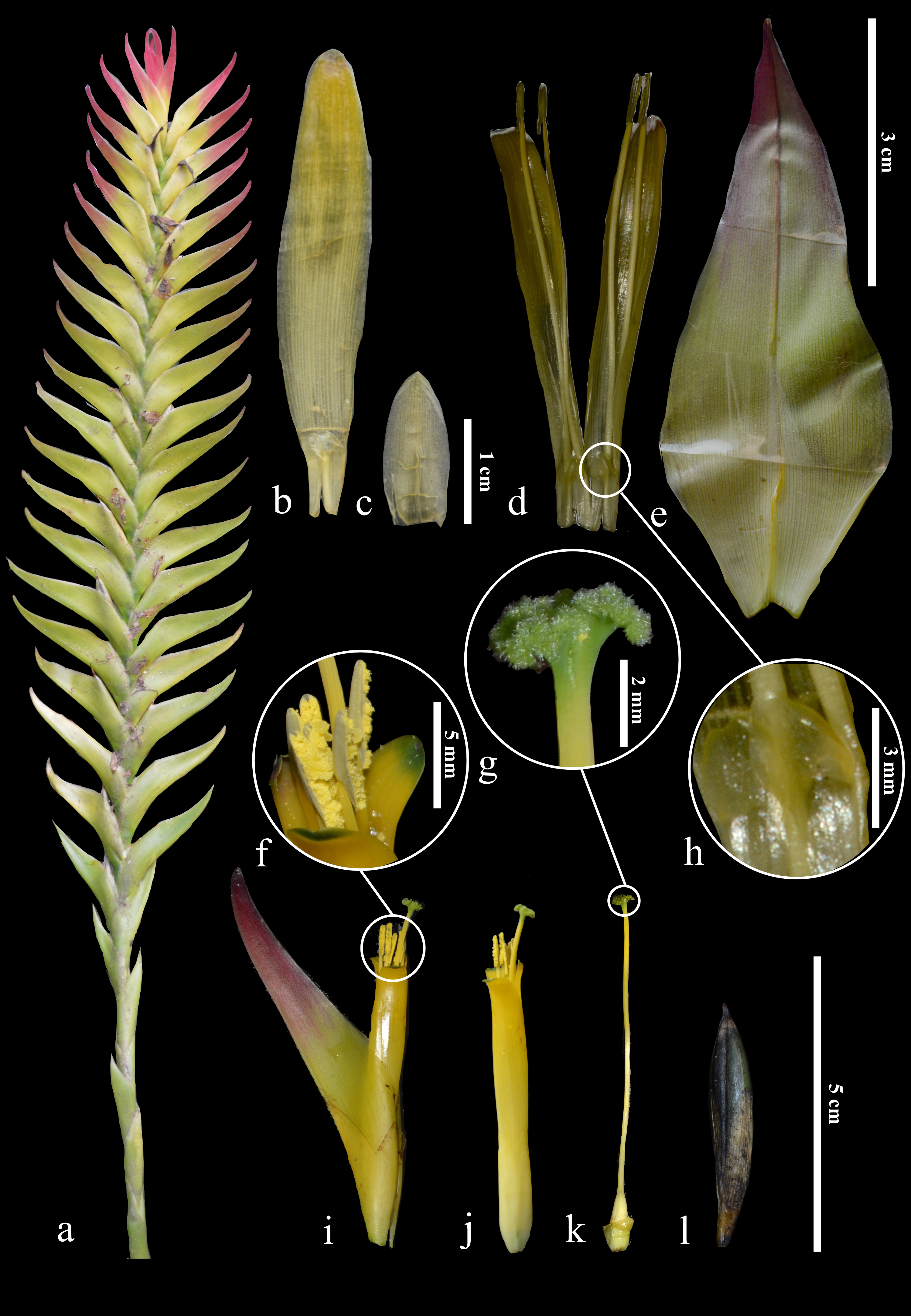
Vriesea museunacionalii Kessous, N.G.Silva & A.F.Costa. a - inflorescence; b - petal; c - sepal; d - detail of two sepals and connation; e - floral bract; f- detail of the anthers; g - detail of the stigma; h - detail of the petal appendages; i - flower and floral bract: j - flower: k - gynoecium; l - capsule. Art and photos: Igor M. Kessous and Alessandra R. Pinto.

Habitat of Vriesea museunacionalii Kessous, N.G.Silva & A.F.Costa. a - Habit; b - detail of the flower and upper part of the inflorescence; c - detail of the fruit and the lower part of the inflorescence; d - Epiphytic habitat, cohabiting the same phorophyte with Vriesea carinata Wawra. Photos: Igor M. Kessous and Alessandra R. Pinto.
Diagnosis: Vriesea museunacionalii differs from V. erythrodactylon especially by the presence of green leaf sheaths (vs. dark purple, brownish at the base); entirely green leaf blades (vs. green with dark purple spot on the apex); grow through lateral shoots emerging from the base of the leaf sheaths (vs. shoots emerging from stolons); petals yellow green-tipped (vs. green).
Plants epiphytic on shaded forest, close to rivers or watercourses, propagating by axillary shoots developed at the base of the leaf sheaths, flowering 40–100 cm tall. Roots 0.5–1 (–2) mm diameter, present at the base of the rosettes. Leaves 15–25 in number, suberect, forming an infundibuliform rosette; sheaths (7–) 8–12 × 4.2–5.5 cm, elliptic-oblong, pale-green adaxially, green abaxially, lepidote on both surfaces; blades 14–33 × 1.8–2.8 cm, linear to slightly ligulate, green, slightly greenish-silver when dry, chartaceous, lepidote on the abaxial side, sparsely lepidote to glabrescent on the adaxial side, obtuse or acute. Inflorescence simple, 38–88 cm long at anthesis, erect to slightly suberect; peduncle erect, 22–36 cm long and 3–5 mm in diameter, glabrous; peduncle bracts 8–12 in number, 4–7.5 × 1.8–3 cm, erect to suberect, imbricate covering the whole peduncle, narrow-ovate, green, sparsely lepidote on both sides, densely on the adaxial sides. Spike 10–40-flowered, 16–52 cm long, strongly complanate; rachis straight to geniculate, 2–5 mm in diameter, hidden by the floral bracts when flowering, partially exposed when fruiting, bearing 2–4 apical and 2 basal sterile bracts. Floral bracts 50–80 × 18–38 mm, narrow-ovate, acute-acuminate, sharply carinate toward the apex, incurvate to strongly incurvate apex, involute when fruiting, green, sometimes basally yellow, being ¾ wine-red toward the apex, completely green or pale green when fruiting, much longer than the flower and the fruits, bearing mucilage inside, sparsely lepidote on the adaxial side, glabrescent on the abaxial side. Flowers 55–60 mm long, 5–10 mm apart, scentless, distichous, suberect, being the distal ones erect; corolla tubular, straight, slightly zygomorphic; sepals linear-oblong, 15–16 × 5–7 mm, free, slightly carinate, entire, symmetric, sparsely lepidote on adaxial side, glabrous abaxially; petals linear to narrow-oblong, 42–50 × 6–7 mm, rounded to slightly emarginate, two slightly recurved, one almost straight, yellow with green apex, connate for 3.5–5 mm; petal appendages 6–7.3 × 1.3–2 mm, adnate to the basal part of the petals by 3.5–4.8 mm, entire, with free part obtuse; stamens exserted, exceeding the stigma; filaments 40–45 mm long, the antepetalous adnate to the base of the petals by ca. 6 mm, anthers dorsifixed, 5–8.5 × 0.9–1.1 mm, erect; ovary semi-inferior, being ½ to ¾ inserted into the receptacle, conical, 4.7 × 1.7–2 mm; style exserted, 39–45 mm long; stigma convolute-blade type II, green. Capsules 30–40 ×6–7 mm, cylindrical, suberect, exceeded by the floral bract; seeds ca. 30 mm long; apical coma ca. 1 mm long or absent; basal coma 13–15 mm long.
Taxonomic notes: The new species can be frequently encountered in herbarium collections under the name Vriesea erythrodactylon, primarily due to the colors and curvature of the floral bracts (incurvate). However, V. museunacionalii differs from that taxon by the presence of whitish-green sheaths (as opposed to entirely dark purple sheaths, typical of this species); color of the leaf blade apex (green vs. dark purple), general length of the inflorescence (longer in V. museunacionalii) and the absence of stolons. Additionally, individuals of V. erythrodactylon frequently present secund flowers, differing from the non-secund flowers observed in V. museunacionalii. It is noteworthy that, despite its type location being more than 400 km apart (Paranaguá, Paraná), V. erythrodactylon also occurs in Rio de Janeiro, in the proximity of the locations of V. museunacionalii, in Angra dos Reis, on the Trail to Pedra do Frade (specimen Kessous 305 (R)). Upon observing herbarium collections of V. erythrodactylon, we also noted that some specimens are misidentified as V. carinata Wawra and especially as V. incurvata Wawra. The general pattern of some Vriesea sect. Vriesea species with simple inflorescences can lead to misidentifications due to the presence of complanate inflorescences, carinate and incurvate floral bracts, and very similar flowers—tubular, yellow, being green toward the apex. Additionally, in herbarium specimens, some important information, such as color, is often missing from labels, making accurate identification more difficult. Another possible misidentification involves V. taritubensis, especially for those without a thorough understanding of the group, as this species occurs nearby. Compared to the V. taritubensis protologue (Pereira & Penna, 1983), V. museunacionalii differs, particularly in peduncle length (equal or longer than 22 cm vs. 20 cm), inflorescence width (V. museunacionalii being proportionally wider; see Est. 4 in Pereira & Penna 1983), floral bract color (green, sometimes basally yellow, turning ¾ wine-red toward the apex vs. yellow or pink), apex (incurved to strongly incurved vs. slightly incurved) and shape (narrow-ovate vs. broad-ovate), flower length (55–60 mm vs. 70 mm) and shape (straight vs. curved; see Est. 4 in Pereira & Penna 1983), and style length (39–45 mm vs. 60 mm).
Nomenclatural notes: Vriesea erythrodactylon (É.Morren) É.Morren ex Mez was first described as Vriesea psittacina var. erythrodactylon É.Morren, in Belgique Horticole 1882. Morren (1882) did not mention any material for V. psittacina var. erythrodactylon, only mentioned the difference in the color of the bracts from the typical variety, which was described as pinkish-red. Instead, he cited as a reference the work published in 1875 in the same journal, where he mentions Vriesea erythrodactylon as one of the specimens drawn by Platzmann during an expedition to Brazil, in Paranaguá, Paraná. Smith & Downs (1977) cited this plate by Platzmann, deposited in the LG herbarium, as the type of the species, based on Morren’s citation in Belgique Horticole. However, Platzmann’s plate wasn’t found during the first author visit to the LG herbarium in 2019. Despite the material cited in Platzmann’s work not yet having been found, we verified several collections from the Paranaguá region (e.g., Britez 1811 (MBM), Silva s.n. (MBM113359)), and all of them leave no doubt that they correspond to Vriesea erythrodactylon, with purplish leaf sheaths and conspicuous stolons (Figure S1). Vriesea erythrodactylon var. rubropunctata E.Pereira & Moutinho was described from Santa Maria Madalena, Rio de Janeiro, differing from the type variety by its floral bracts red dotted and leaf sheaths green (Pereira & Moutinho 1981). We examined the type specimen J.L. Moutinho s.n. (holotype HB71213!) and conclude that it strongly differs from Vriesea museunacionalii and Vriesea erythrodactylon, possibly belonging to another taxon that has already been described or remains undescribed. We were unable to properly identify it due to its post-anthesis stage of the inflorescence. However, the visible characteristics, along with its geographical distribution, suggest that this specimen potentially belongs to V. fluviatilis Kessous & A.F.Costa.
Phenology: We observed the initial fruiting season and the final flowering season in June. Thus, the flowering period of V. museunacionalii is in the first semester, while the fruiting peak is in the second semester. During the collections performed in the beginning of June, we observed a few specimens in the final stage of flowering, with the remainder beginning to fruit.
Distribution and habitat:V. museunacionalii is endemic to the mountains of the southern coast of Rio de Janeiro, in the region known as Costa Verde, within the bordering municipalities of Angra dos Reis, Mangaratiba, and Rio Claro, especially along the margins of the Rio Grande (Figure 3). V. museunacionalii grows epiphytically in trees in the edges of forests.

Distribution map of Vriesea museunacionalii Kessous, N.G.Silva & A.F.Costa. Collections without coordinate points were estimated by locality using Google Earth. Layer obtained from MapBiomas collection 8.0.
Conservation status: The holotype/isotypes were collected at the border of a farm road, in a highly fragmented forest surrounded by rural properties (Figure 3). Despite the lack of precise geographic coordinates for the paratypes, the estimated localities in GeoCat resulted in an area of less than 100 km2, indicating that this species is potentially classified as Critically Endangered, according to the IUCN criteria [B1ab (i, ii, iii) B2ab (i, ii, iii)].
Etymology: The epithet “museunacionalii” is the genitive latinized form of the fused Portuguese words “Museu Nacional”, in honor to that institution, which belongs to the Universidade Federal do Rio de Janeiro. The holotype of this species was collected on the exact day the Museum was celebrating its 205th anniversary. The historical trajectory of the Museu Nacional differs from that of many other institutions created for the same purpose, due to the unique circumstances surrounding its complex establishment. Founded as the Museu Real on June 6th, 1818, by King Dom João VI of Portugal, its first headquarters were located in Campo de Santana, in the central region of the city of Rio de Janeiro (Dantas 2018, Kellner 2018). As the first Brazilian museum, founded even before discussions on museological and museographic standards had begun, it became a reference for other museums in the country and in the Latin America (Serejo 2020). Since the beginning, the museum focused on collections of natural sciences and other areas, with the aim of disseminating knowledge in the Kingdom of Brazil, marking the birth of Brazilian science (Sily 2012, Kellner 2018). Following Brazil’s independence in 1822, the museum’s significance grew. Key figures such as mineralogist José Bonifácio de Andrada e Silva and Empress Maria Leopoldina, an enthusiast of science and minerals, made significant contributions. Leopoldina brought European naturalists to Brazil, enhancing the museum’s collections and scientific studies. Dom Pedro I, on the other hand, also enriched the collection with Ancient Egyptian artifacts (Kellner 2018). The Paço de São Cristóvão, which today houses the Museu Nacional, has a history that begins with the donation of land to the Jesuits in the 16th century. This period was notably marked by the expulsion of the Jesuits by an action coordinated by Marquês de Pombal in the 18th century (Moreira 2016). In the early 19th century the property was acquired by a merchant who later gifted the residence to King Dom João VI in 1809 (Moreira 2016). The Paço de São Cristóvão, located at Quinta da Boa Vista, underwent several modifications to house the royal family and became the imperial palace. With the proclamation of the Republic in 1889 and the subsequent banishment of the imperial family, the Paço de São Cristóvão was repurposed. In 1892, it became the Museu Nacional or Palácio da Quinta da Boa Vista (Dantas 2007, 2018, Moreira 2016). In 1946, with 128 years of existence and named the Museu Nacional, the institution was incorporated into the Universidade do Brasil, now recognized as Universidade Federal do Rio de Janeiro - UFRJ (Kellner 2018). Throughout its history, the museum has played a significant role in research, education, and public outreach, focusing on disciplines such as Anthropology, Archaeology, Botany, Geology, Paleontology, and Zoology. The museum housed a library and biological and documentary collections, frescoes, fossils, and artifacts from various pre-Columbian, Amerindian, indigenous, African, Egyptian, and Etruscan societies (Serejo 2020). The Museu Nacional not only houses a vast collection but is also a center for generating knowledge and training new scientists, especially since the creation of its graduate programs in the 1960s (Duarte 2019). The activity of researchers and students has contributed to the continuous growth of the museum’s collections and to science. With more than two centuries of history, the Museu Nacional has emerged as one of the world’s foremost natural history and anthropology museums, boasting around twenty million items in its collection prior to the devastating 2018 fire (Serejo 2020). Tragically, during its bicentennial year, a devastating fire engulfed the museum’s main building, reducing its interior to ruins on September 2, 2018 (Escobar 2018). Approximately 85-90% of its collection was lost in the fire, including items on display and in the technical reserve, severely impacting the entire building. However, it is noteworthy that entire collections in the fields of botany, vertebrates, specific sectors of invertebrates, and archaeology were preserved (Serejo 2020). Fortunately, some collections, such as the Herbarium R in the Department of Botany, had already been relocated before the fire, ensuring the preservation. The Herbarium of the National Museum, founded in 1831, was the first in Brazil and is recognized as a heritage of humanity. Known internationally by the acronym “R” (Thiers 2024), it comprises scientific collections of botanical material, including contributions from notable figures such as members of the Brazilian Royal Family and renowned naturalists. The oldest specimens date back to the late 1700s (Alves et al. 2015). The herbarium was moved from the Imperial Palace to a new 500m² building for the Department of Botany in 2007. The Herbarium R contains approximately 550,000 specimens, including around 6,500 type specimens, many cited in the seminal work Flora Brasiliensis (Alves et al. 2015). It predominantly features neotropical species, especially from Brazil, but also includes specimens from around the world through donations and exchanges with other herbaria. The collection is essential for species listings in Brazil and supports various research projects by students and professors of the Programa de Pós-Graduação em Botânica do Museu Nacional, as well as studies by national and international universities. The history of the Museu Nacional intertwines with the creation of Brazil as an independent country. Beyond its institutional role, the palace has witnessed several pivotal moments in the history of the Federative Republic of Brazil. The institution itself has nurtured many of Brazil’s leading scientists and continues its legacy through its postgraduate programs and high-impact research.
Additional specimen analyzed (paratypes): BRAZIL. Rio de Janeiro: Mangaratiba Margem do Rio Grande, 18–19 Aug 1996, Neto, Bovini & Braga 337 (paratype RB!); idem, ibidem, Neto, Bovini & Braga 338 (paratype RB!); Margem do Rio Grande, proximidades da trilha do Cambucá, 18 Aug 1996, Braga, Bovini & Neto 3458 (paratype RB!); idem, ibidem, Bovini 1029 (paratype RB!); Reserva Ecológica do Rio das Pedras, 19 Aug 1994, Costa 479 (paratype RB!). Angra dos Reis, Serra da Água, 21 Jan 1974, Reitz 7587 (paratype RB!).
Acknowledgements
We thank Museu Nacional and IFSULDEMINAS - Campus Poços de Caldas for the research support in laboratories and field trips; the Coordenação de Aperfeiçoamento de Pessoal de Nível Superior (CAPES, Project CAPES-STINT 88887.304775/2018-00), Fundação Carlos Chagas Filho de Amparo à Pesquisa do Estado do Rio de Janeiro (FAPERJ; E-26/200.073/2019) and Conselho Nacional de Desenvolvimento Científico e Tecnológico (CNPq; 478345/2013-5 and 313.333/2021-1) for funding this work.
References
- ALVES RJV, COSTA AF, SENNA-VALLE L, MENEZES M & MARTINS VLCM. 2015. Herbário do Museu Nacional, Rio de Janeiro (R). Unisanta BioScience 4(6): 389-392.
- BARFUSS MH, TILL W, LEME EM, PINZÓN JP, MANZANARES JM, HALBRITTER H, SAMUEL R & BROWN GK. 2016. Taxonomic revision of Bromeliaceae subfam. Tillandsioideae based on a multi-locus DNA sequence phylogeny and morphology. Phytotaxa 279(1): 1-97.
- COSTA AF, GOMES-DA-SILVA J & WANDERLEY MGL. 2014. Vriesea (Bromeliaceae, Tillandsioideae): taxonomic history, and morphology of the Brazilian lineage. J Torrey Bot Soc 141(4): 338-352.
- COSTA AF, RODRIGUES PJFP & WANDERLEY MGL. 2009. Morphometric analysis and taxonomic revision of the Vriesea paraibica complex (Bromeliaceae). Bot J Linn Soc 159(1): 163-181.
- DANTAS RMMC. 2007. A casa do Imperador: do Paço de São Cristóvão ao Museu Nacional. In: A Universidade e os múltiplos olhares de si mesma. Rio de Janeiro: Walprint, p. 173-190.
- DANTAS RMMC. 2018. Museu Nacional: 200 anos de história. Inst Bras Museus-Ibram, p. 64.
- DUARTE LFD. 2019. O Museu Nacional: ciência e educação numa história institucional brasileira. Horiz Antropol 25: 359-384.
- ESCOBAR H. 2018. In a ‘foretold tragedy,’ fire consumes Brazil museum. Science 361(6406): 960.
-
FLORA DO BRASIL. 2024. Jard Bot Rio Janeiro. Available at: http://floradobrasil.jbrj.gov.br/ Accessed 10 July 2022.
» http://floradobrasil.jbrj.gov.br/ - GIVNISH TJ. 2017. A New World of plants. Science 358(6370): 1535-1536.
-
GOUDA EJ, BUTCHER D & GOUDA CS. 2024. Encyclopaedia of Bromeliads, Version 4. Univ Bot Gard Utrecht. Available at: http://bromeliad.nl/encyclopedia/ Accessed 19 Jan 2024.
» http://bromeliad.nl/encyclopedia/ - GOMES-DA-SILVA J & COSTA AF. 2011. A taxonomic revision of Vriesea corcovadensis group (Bromeliaceae: Tillandsioideae) with description of two new species. Syst Bot 36(2): 291-309.
- IUCN. 2012. IUCN Red List Categories and Criteria: Version 3.1. Second edition. Gland, Switzerland and Cambridge, UK.
- KELLNER AW. 2018. 200 anos do Museu Nacional/UFRJ–desafios e perspectivas. Inst Bras Museus-Ibram: 41.
- KESSOUS IM & COSTA AF. 2023. Novelties in “incertae sedis” Vriesea (Bromeliaceae: Tillandsioideae): Redescriptions, new combinations and nomenclatural revision. Phytotaxa 585(2): 71-101.
- KESSOUS IM, NEVES B, COUTO DR, PAIXÃO-SOUZA B, PEDERNEIRAS LC, MOURA RL, BARFUSS MH, SALGUEIRO F & COSTA AF. 2020. Historical biogeography of a Brazilian lineage of Tillandsioideae (subtribe Vrieseinae, Bromeliaceae): the Paranaean Sea hypothesized as the main vicariant event. Bot J Linn Soc 192(4): 625-641.
- KESSOUS IM, SALGUEIRO F & COSTA AF. 2018. Nomenclature and epitypification of Vriesea (Bromeliaceae) species described in Vellozo’s Flora fluminensis. Phytotaxa 350(1): 24-32.
- LOISEAU O, MOTA MACHADO T, PARIS M, KOUBÍNOVÁ D, DEXTER KG, VERSIEUX LM, LEXER C & SALAMIN N. 2021. Genome skimming reveals widespread hybridization in a Neotropical flowering plant radiation. Front Ecol Evol 9: 668281.
-
MAPBIOMAS PROJECT. 2024. Collection 8 of the Annual Series of Land Use and Land Cover Maps of Brazil. Available at: https://brasil.mapbiomas.org/ Accessed 1 Jun 2024.
» https://brasil.mapbiomas.org/ - MARTINELLI G, VIEIRA CM, GONZALEZ M, LEITMAN P, PIRATININGA A, COSTA AF & FORZZA RC. 2008. Bromeliaceae da Mata Atlântica brasileira: lista de espécies, distribuição e conservação. Rodriguésia 59(1): 209-258.
- MOURA RL. 2011. Revisão Taxonômica do Grupo Vriesea platynema Gaudich. (Bromeliaceae). PhD Thesis, Univ Fed Rio de Janeiro - Museu Nacional, Rio de Janeiro. Available at: http://objdig.ufrj.br/71/teses/853378.pdf.
- MOURA RL & COSTA AF. 2014. Taxonomic notes on Vriesea Sect. Xiphion (Bromeliaceae) with descriptions of three new species. Syst Bot 39(3): 791-803.
- MOREIRA AC. 2016. O Paço de São Cristóvão. Rev Quinta 1(1).
- MORREN É. 1882. Sur le Vriesea psittacina Lindl., var. morreniana Belg Hort 32: 287-290.
- NERI J, WENDT T, LELES B, DOS SANTOS MF & PALMA-SILVA C. 2017. Variation in reproductive systems facilitates species boundaries of sympatric Vriesea (Bromeliaceae). Bot J Linn Soc 184(2): 272-279.
- NEVES B, FERREIRA PDL, PROSDOCIMI F, KESSOUS IM, COUTO DR, MOURA RL, SALGUEIRO F, COSTA AF, BACON CD & ANTONELLI A. 2023. Repeated evolution of pollination syndromes in a highly diverse bromeliad lineage is correlated with shifts in life form and habitat. Bot J Linn Soc 203(2): 111-122.
- NEVES B, URIBBE FP, JACQUES SSA, ZANELLA CM & COSTA AF. 2018. Species boundaries in the Vriesea incurvata (Bromeliaceae) complex after a broad morphometric and taxonomic study. Syst Bot 43(4): 870-888.
- PEREIRA E & MOUTINHO JL. 1981. Species novae in Brasilia Bromeliacearum – XVIII. Bradea 3(27): 209-220.
- PEREIRA E & PENNA IA. 1983. Species novae in Brasilia Bromeliacearum – XXIII. Bradea 4(1): 1-8.
-
RADFORD AE. 1986. Fundamentals of plant systematics. Harper & Row, New York. Available at: https://archive.org/details/fundamentalsofpl0000radf_n5o1
» https://archive.org/details/fundamentalsofpl0000radf_n5o1 - SCHARF U & GOUDA EJ. 2008. Bringing Bromeliaceae Back to Homeland Botany. J Bromeliad Soc 58(3): 123-129.
-
SEREJO CS. 2020. Museu Nacional: panorama dos acervos: passado, presente e futuro. Série Livros Digital. Available at: https://www.museunacional.ufrj.br/destaques/docs/panorama_de_acervos/livro_acervos_museu_nacional.pdf
» https://www.museunacional.ufrj.br/destaques/docs/panorama_de_acervos/livro_acervos_museu_nacional.pdf - SILY PRM. 2012. Casa de ciência, casa de educação: ações educativas do Museu Nacional (1818-1935). ISBN: 9788571084742.
- SMITH LB & DOWNS RJ. 1974. Pitcairnioideae (Bromeliaceae). Fl Neotrop Monogr 14(1): 1-658.
- SMITH LB & DOWNS RJ. 1977. Tillandsioideae (Bromeliaceae). Fl Neotrop Monogr 14(2): 661-1492.
- STEARN WT. 1973. Botanical Latin, 2nd ed., David and Charles, Newton Abbot. ISBN: 0715356453.
-
THIERS B. 2024. Index herbariorum: a global directory of public herbaria and associated staff. New York: BotanicalGardens Virtual Herbarium. Available at: http://sweetgum.nybg.org/ih/ Accessed 10 May 2024.
» http://sweetgum.nybg.org/ih/ - URIBBE FP, NEVES B, JACQUES SSA & COSTA AF. 2020. Morphological variation in the Vriesea procera complex (Bromeliaceae, Tillandsioideae) in the Brazilian Atlantic Rainforest, with recognition of new taxa. Syst Bot 45(1): 53-68.
- VERSIEUX LM. 2011. Brazilian plants urgently needing conservation: the case of Vriesea minarum (Bromeliaceae). Phytotaxa 28: 35-49.
- ZANELLA CM, PALMA-SILVA C, GOETZE M & BERED F. 2016. Hybridization between two sister species of Bromeliaceae: Vriesea carinata and V. incurvata Bot J Linn Soc 181(3): 491-504.