 Silver nitrate, light spectrum and gas exchange on in vitro flowering of Capsicum frutescens
ABSTRACT
The study aimed to evaluate the influence of silver nitrate on the in vitro flowering of Capsicum frutescens cv. Cayenne associated with different light spectra and gas exchange. After 36 days of germination in MS medium, two seedlings previously germinated, were subjected to experiments in glass flasks containing two types of culture medium: I) MS culture medium; or II) Culture medium with the addition of 40 µM of AgNO3. The explants were maintained in a growth room with a 16-hour photoperiod, temperature of 25 ± 2 °C, light intensity (72 μmol m-2 s-1) from different light spectra. The experiment was conducted in a completely randomized design, 4 x 2 factorial scheme, with eight replicates, and the experimental unit composed of two seedlings. After 74 days of in vitro cultivation, the following parameters were evaluated: number of bifurcations, number of oxidized buds, number of open buds, number of green buds, number of aborted buds, number of leaves, root length, shoot length, total fresh and dry mass of shoots, and total fresh and dry mass of root. Thus, the combination of light spectrum, addition of gas exchange and AgNO3 favors the growth and development of Capsicum frutescens cv. Cayenne.
Keywords
light-emitting diodes; gas-permeable membranes; spectral quality; pepper production; tissue culture
INTRODUCTION
The genus Capsicum belongs to the Solanaceae family, with about 38 described species, six of which are considered domesticated: C. annuum, C. assamicum, C. baccatum, C. chinense, C. frutescens and C. pubescens.(1) The crop has great economic importance for Brazil, with a planted area of about 19,070 hectares, with a production of 462,955 tons of the fruit.(2) Because it is a species whose main form of reproduction is sexual, it is susceptible to pathogens that cause a significant reduction in the yield and quality of the final product.(3) Considering the susceptibility of peppers, in vitro cultivation has been gaining space for the supervision of plant species, helping in improvement methods, among which in vitro flowering stands out.
In vitro flowering allows perfecting crosses for genetic improvement and development of new cultivars; however, this event is considered a complex process regulated by environmental and physiological factors, and its occurrence under these conditions is rare.(4) In the conventional in vitro culture environment, sealed flasks with reduced gas exchange are adopted, which can lead to morphophysiological disturbances in the plants, accumulation of ethylene and other volatile gases, and reduction of CO2, which can limit the photosynthetic process, generating physiological anomalies in the plants.(5,6) To avoid these disturbances, natural ventilation of the internal atmosphere of the flasks can be adopted, using gas-permeable membranes capable of allowing gas exchange between the in vitro and ex vitro culture environment, promoting improvements in photosynthetic conditions, increased growth rates, reduction of problems with leaf senescence and benefits during ex vitro plant acclimatization.(7) Indeed, gas exchange is important in the morphogenic responses of plants of the genus Capsicum; in Capsicum frutescens it reduced leaf senescence,(8) and in Capsicum annuum it promoted the increase of biomass and ex vitro acclimatization.(9)
The flowering process can induce seedling senescence due to the accumulation of ethylene in the in vitro culture environment.(10) One of the alternatives that have been used to overcome the negative effects of this hormone is the addition of anti-ethylene compounds, such as AgNO3, to the culture medium, gas-permeable membranes, and the spectral quality with different wavelengths.(11)
With advances in lighting technology, researchers began to use light-emitting diodes (LEDs) in tissue culture, due to their specificity in emitting spectral qualities, Pawlowska,(12) being used to regulate the levels of photosynthetically active radiation and photomorphogenesis radiation necessary for plant growth and development.(13)
The light absorbed through the plant photoreceptors is the form of energy that the plant uses to carry out photosynthesis, being influenced by the red LED, blue LED and red + blue LED.(14) As they are the main energy sources for photosynthetic CO2 assimilation in plants.(15) According to the intensity, wavelength and direction in which they are being emitted, they can generate a series of morphophysiological responses.(16)
The wavelengths in the red light range (660 nm) and blue light range (400-500 nm) are the main focus of current research. Due to their regulatory effects on plant development, red light is efficiently absorbed by photosynthetic pigments and stimulates phytochrome. Blue light plays important morphogenic roles, including stomatal opening, stem elongation, and phototropism.(17)
The light spectrum and the effect of gas exchange are some of the necessary factors for the success of in vitro cultivation. As for the effects of in vitro flowering associating the techniques of light qualities, use of gas-permeable membranes and different AgNO3 concentrations, few reports are found in the literature. Therefore, the study aimed to evaluate the influence of silver nitrate on the in vitro flowering of Capsicum frutescens cv. Cayenne associated with different light spectra and gas exchange.
MATERIAL AND METHODS
Study location and experimental design
The study was carried out in a growth room belonging to the Aromatic Extractives laboratory at the Federal University of Santa Maria, Frederico Westphalen, Rio Grande do Sul, Brazil.
The experiment was conducted in a completely randomized design (CRD), in a 4 x 2 factorial scheme, with four spectral qualities, from light-emitting diode (LED); white LED, red LED (660 nm), blue LED (450 nm) and red+blue LED in the proportion of 60 and 40%, respectively, and two concentrations of AgNO3 (without AgNO3 and with 40 µM of AgNO3), with eight repetitions, and the experimental unit consisting of two seedlings per flask.
For the variables of photosynthetic pigments, chlorophyll a, chlorophyll b, total chlorophyll and total chlorophyll/carotenoids (Chlt/Crt), CRD was performed in a 4 x 2 factorial scheme, four replications, with the experimental unit consisting of a test tube containing five leaf discs.
Plant material and growing conditions
Under laminar flow hood conditions, seeds of Capsicum frutescens cv. Cayenne (ISLA®) were disinfected in 70% alcohol for one minute, followed by sodium hypochlorite (NaClO) at a concentration of 0.8% active chlorine, for 15 minutes, followed by four washes in autoclaved distilled water. After disinfestation, the seeds were inoculated into glass flasks (350 mL) containing 50 mL of MS culture medium(18) plus 100 mg L-1 of myo-inositol, 30 g L-1 of sucrose, gelled with 6.0 g L-1 of agar and pH adjusted to 5.7 ± 0.1 before autoclaving.
They were kept in a growth room with a photoperiod of 16 hours, temperature of 25 ± 2 °C, with light intensity of (72 μmol m-2 s-1) from white LED. After 30 days of germination, two seedlings with about 10 leaves each were transferred to 350 mL glass flasks containing 50 mL of two types of culture medium: I) MS medium or II) MS medium + 40 µM of AgNO3, following the methodology of Sharma.(19) These were added to the same reagents mentioned above and also autoclaved at 120 °C, 108 kPa, for 15 minutes and sealed with rigid metal lids with two holes of 8 mm each covered by gas-permeable membranes, following the methodology of Saldanha et al.(20) for making the membranes.
Variables analyzed
The evaluation was performed 74 days after in vitro cultivation, and the following characteristics were analyzed: number of bifurcations, number of oxidized buds, number of open buds, number of greenish buds, number of aborted buds, number of leaves, root length (cm), shoot length (cm), total fresh and dry mass of the shoot (g), total fresh and dry mass of the root (g) and photosynthetic pigments (chlorophyll a and b, total chlorophylls and carotenoids given in µg cm-2). For the dry mass, the material was placed in an oven with forced air ventilation and a temperature of 60 ºC until it reached a constant weight, which was later measured on a precision scale.
Quantification of photosynthetic pigments
For the determination of photosynthetic pigments, chlorophyll a and b, total chlorophyll and carotenoids, five leaf discs from the second to third leaves from the apex to the base of the plants, with 5 mm in diameter each, were incubated in 5 mL of dimethyl sulfoxide (DMSO) saturated with calcium carbonate (CaCO3), remaining in glass tubes covered with aluminum and kept in the dark for 48 hours, following the methodology of Santos.(21) After this period, the absorbance of the samples was determined in a Bel Photonics® SP 1105 spectrophotometer using a 10 mm quartz cuvette with an optical path. The wavelengths and equations for calculating the concentrations of chlorophylls a, b, total chlorophylls and carotenoids were also based on the methodology described by Wellburn.(22)
Statistical analysis
The variables were subjected to the Shapiro-Wilk test to check the normality of the data, and because they did not follow the assumptions of normality, the variables number of bifurcations, number of oxidized buds, number of open buds, root length, shoot length, number of leaves, shoot fresh mass, root fresh mass and shoot dry mass were transformed to √(𝑥 + 0.5).
Variables were subjected to analysis of variance and, when significant, means were compared using Tukey’s test at 5% probability level. Figures are presented with untransformed means. Statistical analyses were performed using the SISVAR software.(23)
RESULTS
In the first 21 days of establishment, green buds and fully open flowers were observed, and up to 74 days at the end of the experiment, it was possible to observe green buds, open flowers and oxidized buds, confirming that the flowering pattern does not follow a constant chronological rhythm (Figure 1).

In vitro flowering of Capsicum frutescens cv. Cayenne. Normal flower at 35 days (a); internal top view of the culture flasks showing two flowers exposed and fully opened at 35 days (b); visualization of green buds at 35 days (c); flowers fully opened in vitro at 21 days (d); top view of the flower and green buds still closed at 35 days (e).
According to the analysis of variance, the number of bifurcations showed a significant difference only for AgNO3 concentrations, at 5% probability level by the F test, and for the number of oxidized buds there was a significant difference caused by the interaction between light spectra and AgNO3 concentration. For number of leaves, shoot and root length, total fresh and dry mass of shoots and roots, there was a significant difference only for the AgNO3 concentration factor.
For photosynthetic pigments, carotenoids, there was a significant difference for the interaction between light spectra and AgNO3 concentrations. There was a significant difference for the Chlt/Crt ratio caused by light spectra and AgNO3 concentrations.
For in vitro flowering variables, it was observed that the addition of AgNO3 induced a greater number of bifurcations in the plants (6.74) (Figure 2a). For the number of oxidized buds, the use of blue LED and red LED stood out (1.63 and 2.50, respectively), leading to a lower number of oxidized buds (Figure 2b). Regarding the concentrations of AgNO3, the treatments without the presence of the reagent showed a smaller number of oxidized buds compared to the treatments that contained AgNO3 (2.61 and 6.71) (Figure 2b). For the number of flowers in relation to the different light spectra, it was possible to observe that there was a greater production of flowers under blue LED and white LED (0.57 and 0.51), respectively (Figure 2c), and in the presence of AgNO3 there was greater formation of flowers (Figure 2d).

Flowering of Capsicum frutescens cv. Cayenne submitted to different spectral qualities in the presence or absence of AgNO3. Number of bifurcations for the factor presence or absence of AgNO3 (a); number of oxidized buds for the spectral quality factor and for the presence or absence of AgNO3 factor (b); number of flowers for the spectral qualities factor (c); and number of flowers for the factor presence or absence of AgNO3 (d). *Equal and lowercase letters do not differ by Tukey’s test at 5% probability level.
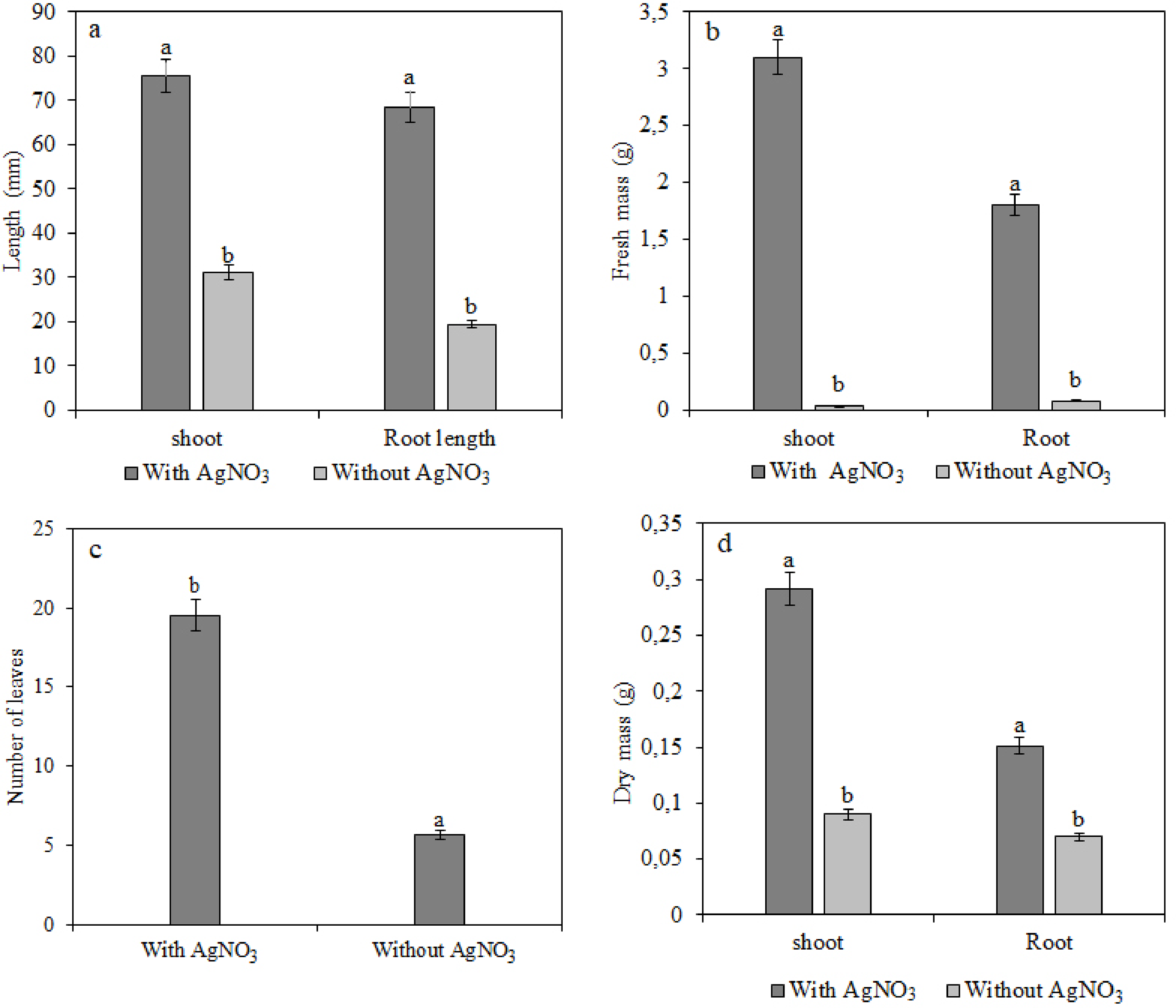
In the presence of AgNO3, greater root length and shoot length (75.42 and 68.44 mm, respectively) were observed (Figure 3a). The same result was observed for fresh mass of shoots and roots (Figure 3b), number of leaves (Figure 3c), and dry mass of shoots and roots (Figure 3d).

Growth of peppers Capsicum frutescens cv. Cayenne subjected to different spectral qualities and in the presence (40 μM) or absence of AgNO3. Shoot length and root length for spectral qualities factor (a); shoot fresh mass and root fresh mass (b); number of leaves (c); and shoot dry mass and root dry mass (d) all for factor and in the presence or absence of AgNO3. Lowercase letters for do not differ from each other by Tukey’s test, at 5% probability level.
Carotenoids, when evaluating the AgNO3 factor decomposed within the light spectrum factor, in the absence of AgNO3, there was no significant difference between the spectral qualities. However, when AgNO3 was added, it was possible to observe that plants kept under blue LED had a greater increase in carotenoids when compared to those under red + blue LED. When comparing the decomposition of spectral qualities within AgNO3 concentrations, there was a significant difference only for the blue LED, in which there was superiority with the addition of AgNO3 (Figure 4a).
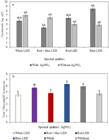
Photosynthetic pigments from peppers Capsicum frutescens cv. Cayenne in vitro subjected to different spectral qualities, in the presence or absence of AgNO3. Carotenoids under different spectral qualities and in the presence (40 μM) or absence of AgNO3 (a); Total chlorophyll/carotenoids under different spectral qualities and in the presence or absence of AgNO3 (b). Equal small letters indicate no difference between the qualities of light at each concentration of AgNO3 (a and b); Equal capital letters in the same quality of light indicate no difference between the concentrations of AgNO3 by the Tukey test, at 5% probability level.
For the Chlt/Crt variable, there was superiority for the blue LED and red LED + blue LED, when compared to the white LED. For the AgNO3 concentration factor, without its addition, there was a greater increase in this ratio, being significantly higher (Figure 4b).
DISCUSSION
This work describes for the first time the in vitro flowering development of Capsicum frutescens cv. Cayenne under light spectra and in the absence and presence of 40 µM of AgNO3 when added to the culture medium, resulting in seedlings with significant differences.
Vegetative development is the stage in which the plant can develop lateral structures that allow its establishment in the middle. Reproductive development occurs in the transition from vegetative development when floral meristems are formed to flower formation.(24) Valera(25), when setting up the phenological scale of the ‘biquinho’ pepper (Capsicum chinense), defined that the ideal temperature for the beginning of the bifurcation and subsequent flowering is 24.5 °C, and this bifurcation is defined after the plant changes from a structure containing only a main stem to a second-order and third-order stem, commonly called bifurcations under field conditions.
From the moment the plant begins its bifurcation process, it will soon be ready to produce its first flowers. In the present work, when in the presence of AgNO3, there was a greater number of bifurcations, in opposition to the treatments without AgNO3, which favored the flowering of the plant, since the presence of new stems will lead to new floral buds (Figure 2a).
According to Silva(26), the phenomenon of in vitro flowering is divided into three stages: induction to flowering, floral determination and extension of floral structure. At the stage of floral determination for the flowering variable, number of oxidized buds, and light spectra, a higher number of oxidized buds occurred for seedlings under white LED and lower number for those under blue LED (Figure 1b).
For the presence or absence of AgNO3 in MS medium, the number of oxidized buds was higher for the 40 µM AgNO3 concentration when compared to MS medium without AgNO3 (Figure 1b), which contrasts with the work of Gammoudi(27) , who observed the influence of ethylene on bud induction and development of eight pepper cultivars, where MS medium was added with 58.86 μM of AgNO3, and observed that oxidation was higher in the media without AgNO3.
De Oliveira(28) found that adding AgNO3 at a concentration of 2.0 μmol L-1 to the culture medium favored the emergence and permanence of green leaves in explants of Annona glabra L.(29), were able to improve the in vitro flowering protocol to achieve a maximum of seven flowers per plant, using 40 µM of AgNO3 in C. frutescens. In another study with ten different cultivars of the Capsicum genus, Haque(30) observed on average 15 flowers per plant, also in the presence of AgNO3, which is higher than the values reported in previous studies. In the present study, it was possible to reach a maximum of four flowers per plant at 72 days of cultivation in the presence of the 40 µM concentration of AgNO3 under the white LED spectral quality. The result achieved can be attributed to the constant presence of ethylene in the flasks of the light spectra, which influenced the in vitro flowering of the species under study. Similar data were observed during in vitro flowering studies in different genotypes of pea (Pisum sativum), where accumulated ethylene prevented the growth and development of flower buds ready for flowering.(31)
In the present study, it was observed that in culture medium with 40 µM AgNO3 Capsicum frutescens seedlings responded better to flowering (Figure 1d) and, regarding the number of flowers in the different light spectra, there was a better response under the blue and white LED in MS medium plus 40 µM AgNO3 (Figure 1c).
About the use of auxins and cytokinins combined with AgNO3 for plant regeneration, Venkatachalam et al.(32), when working with Prosopis cineraria plants, verified the increase in the number of shoots at the concentration of 0.59 µmol L-1 of AgNO3, which consequently influences the emergence of new leaves, which agrees with the results found in the present study, in which, in the presence of 40 µM of AgNO3, the number of leaves tends to increase when compared to plants not subjected to the medium without AgNO3 (19.536 and 5.628, respectively) (Figure 3b). Moreover, it was favorable for root and shoot length (75.416 and 68.437 cm, respectively) (Figure 3a).
The growth variables are influenced by the presence of AgNO3. The fresh mass of the shoot and root, in the presence of AgNO3, obtained superior results compared to the absence of AgNO3 (Figure 3c). High values of shoot and root dry mass (0.292 g and 0.151 g, respectively) were observed (Figure 3d). Kumar(33) , found contrasting results in a study with cotton (Gossypium hirsutum) culture, in which from cotyledonary nodes inoculated in culture medium with the addition of 11.77 µM of AgNO3 and under gas exchange conditions, there was a reduction in seedling shoot dry mass, which was possibly influenced by the levels of Ag+ ions, which can elevate ethylene production(34) , and consequently have detrimental effects on seedling development.
The increase in carotenoids in seedlings grown under AgNO3 concentration was higher than in those grown without the addition and in the presence of blue LED (8.44 µg cm-2) (Figure 4a). Carotenoids can limit the damage caused to membranes due to excess light, as they are free radical scavengers and can efficiently dissipate energy causing chlorophyll excitation, i.e., they are able to increase the photosynthetic efficiency of the plant.(35)
The Blue light is also necessary to promote the opening of stomata, improve access to CO2, transpiration and nutrient uptake.(36) For Chlt/Crt, under the presence of AgNO3, higher values were observed, indicating that seedlings under these conditions become more tolerant to possible environmental stresses, and without silver nitrate this ratio is higher (Figure 4b).
The light source provided by blue LED and red LED and their associating with the culture medium in the addition of 40 µM of AgNO3 decreased the number of oxidized buds, promoting a greater number of green buds. Plant responses are triggered by changes in light intensity, direction, and quality, and are driven by specific photoreceptors.(37) Thus, the use of spectral qualities and AgNO3 can be an alternative in the in vitro production of Capsicum frutescens, seeking healthy seedlings, but more studies with different concentrations of AgNO3 associated with spectral qualities are needed, in order to find a protocol that is efficient for the production of the crop.
CONCLUSION
The use of AgNO3 resulted in greater flower production in Capsicum frutescens cv. Cayenne. The growth and development of the seedlings cultivated under white LED and blue LED, both with the presence of 40µM silver nitrate in the culture medium, were superior to the others, so their use is suggested for in vitro cultivation.
ACKNOWLEDGMENTS FINANCIAL SUPPORT AND FULL DISCLOSURE
The authors thank the scientific initiation, doctoral, and level 1D productivity grants granted by the Conselho Nacional de Desenvolvimento Científico e Tecnológico (CNPq) and Fundação Coordenação de Aperfeiçoamento de Pessoal de Nível Superior (CAPES).
REFERENCES
- 1 Lee J. Development and Evolution of Molecular Markers and Genetic Maps in Capsicum Species. The Capsicum Genome. 2019;1(1):85–103.
-
2 FAO. Food and Agriculture Organization of the United Nations. Statistics Division [internet]. 2018. Rome: FAO; 2018. [cited: 2018 ago 22]. Available from: http://faostat3. fao.org/browse/q/qc/e
» http://faostat3. fao.org/browse/q/qc/e - 3 Gris T, Pinheiro MV, Thiesen LA, Webler AR, Junges DL, Holz E, et al. Light quality and sealing type affect in vitro growth and development of Capsicum frutescens cultivars. Anais Acad Bras Cienc. 2021;93(3):e20190061.
- 4 Sharma A, Kumar V, Giridhar P, Ravishankar GA. Induction of in vitro flowering in Capsicum frutescens under the influence of silver nitrate and cobalt chloride and pollen transformation. Electron J Biotechnol. 2008;11(4):84–89.
- 5 Saldanha CW, Otoni CG, Notini MM, Kuki KN, da Cruz AC, Neto AR, et al. A CO2-enriched atmosphere improves in vitro growth of Brazilian ginseng [Pfaffia glomerata (Spreng.) Pedersen]. In Vitro Cell Dev Biol - Plant. 2013;49(5):433–444.
- 6 Batista DS, Dias LL, Rêgo MM, Saldanha CW, Otoni WC. Flask sealing on in vitro seed germination and morphogenesis of two types of ornamental pepper explants. Ciênc Rural. 2017;47(6): e20150245.
- 7 Pinheiro MV, Ríos-Ríos AM, da Cruz AC, Rocha DI, Orbes MY, Saldanha CW, et al. CO2 enrichment alters morphophysiology and improves growth and acclimatization in Etlingera elatior (Jack) RM Smith micropropagated plants. Braz J Bot. 2021;44(7):799–809.
- 8 Gris T, Pinheiro MV, Thiesen LA, Webler AR, Junges DL, Holz E, et al. Light quality and sealing type affect in vitro growth and development of Capsicum frutescens cultivars. Anais Acad Bras Cienc. 2021;93(8): e20190061.
- 9 Batista DS, Dias LL, Rêgo MM, Saldanha CW, Otoni WC. Flask sealing on in vitro seed germination and morphogenesis of two types of ornamental pepper explants. Ciênc Rural. 2017;47(9): e20150245.
- 10 Sreelekshmi R, Siril EA. Investigation on in vitro bouquets and flower longevity of micropropagated Dianthus chinensis L. Scientia Horticulturae. 2021;275(10):109708.
- 11 De Oliveira F, Gallo CM, De Oliveira JD, Santos HR, Rezende LP, Lemos EE. Nitrato de prata e tiossulfato de prata como inibidores da ação do etileno em cultivo in vitro de Annona glabra L. Diversitas Journal. 2020;5(11):2768–2778.
- 12 Pawłowska B, Żupnik M, Szewczyk-Taranek B, Cioć M. Impact of LED light sources on morphogenesis and levels of photosynthetic pigments in Gerbera jamesonii grown in vitro. Hortic Environ Biotechnol. 2018;59(12):115–123.
- 13 Ferreira LT, Silva MM, Ulisses C, Camara TR, Willadino L. Using LED lighting in somatic embryogenesis and micropropagation of an elite sugarcane variety and its effect on redox metabolism during acclimatization. Plant Cell Tissue Organ Cult. 2017;128(13):211–221.
- 14 Manivannan A, Soundararajan P, Park YG, We H, Kim S, Jeong BR. Blue and red light-emitting diodes improve the growth and physiology of in vitro-grown carnations ‘green beauty’ and ‘purple beauty’. Hortic Environ Biotechnol. 2017;58(14):12–20.
- 15 McCree KJ. The action spectrum, absorptance and quantum yield of photosynthesis in crop plants. Agric Meteorol. 1971;9:(15)191–216.
- 16 Lazzarini LE, Pacheco FV, Silva ST, Coelho AD, Medeiros AP, Bertolucci SK, et al. Uso de diodo emissor de luz (LED) na fisiologia de plantas cultivadas–revisão. Scientia Agraria Paranaensis. 2017;16(16):137–144.
- 17 Pawłowska B, Żupnik M, Szewczyk-Taranek B, Cioć M. Impact of LED light sources on morphogenesis and levels of photosynthetic pigments in Gerbera jamesonii grown in vitro. Hortic Environ Biotechnol. 2018;59(17):115–123.
- 18 Murashige T, Skoog F. A revised medium for a rapid growth and bioassays with tobacco tissues cultures. Physiol Plant. 1962;15(18):473–479.
- 19 Sharma A, Kumar V, Giridhar P, Ravishankar GA. Induction of in vitro flowering in Capsicum frutescens under the influence of silver nitrate and cobalt chloride and pollen transformation. Electron J Biotechnol. 2008;11(19):84–89.
- 20 Saldanha CW, Otoni CG, Azevedo JL, Dias LL, Rêgo MM, Otoni WC. A low-cost alternative membrane system that promotes growth in nodal cultures of Brazilian ginseng [Pfaffia glomerata (Spreng.) Pedersen]. Plant Cell Tissue Organ Cult. 2012;110(20):413–422.
- 21 Santos RP, Cruz AC, Iarema L, Kuki KN, Otoni WC. Protocolo para extração de pigmentos foliares em porta-enxertos de videira micropropagados. Rev Ceres. 2008;55(21):356–364.
- 22 Wellburn AR. The spectral determination of chlorophylls a and b, as well as total carotenoids, using various solvents with spectrophotometers of different resolution. J Plant Physiol. 1994;144(22):307–313.
- 23 Ferreira DF. Sisvar: a computer statistical analysis system. Ciênc Agrotec. 2011;35(23):1039–1042.
- 24 Taiz L, Zeiger E, Møller IM, Murphy A. Fundamentos de Fisiologia Vegetal. 6th ed. Porto Alegre: Artmed; 2021.
- 25 Valera SV. Temperatura base, soma térmica, plastocromo e duração das fases fenológicas de cultivares de pimenta biquinho [master dissertation]. Frederico Westphalen: Universidade Federal de Santa Maria; 2017. 71 p.
- 26 da Silva JA, Kerbauy GB, Zeng S, Chen Z, Duan J. In vitro flowering of orchids. Crit Rev Biotechnol. 2014;34(26):56–76.
- 27 Gammoudi N, Pedro TS, Ferchichi A, Gisbert C. Melhoria da regeneração em pimenta: uma espécie recalcitrante. In Vitro Cell Dev Biol - Plant. 2018;54(27):145–153.
- 28 De Oliveira F, Gallo CM, De Oliveira JD, Santos HR, Rezende LP, Lemos EE. Nitrato de prata e tiossulfato de prata como inibidores da ação do etileno em cultivo in vitro de Annona glabra L. Diversitas Journal. 2020;5(28):2768–2778.
- 29 Sharma A, Kumar V, Giridhar P, Ravishankar GA. Induction of in vitro flowering in Capsicum frutescens under the influence of silver nitrate and cobalt chloride and pollen transformation. Electron J Biotechnol. 2008;11(29):84–89.
- 30 Haque SM, Paul S, Ghosh B. High-frequency in vitro flowering, hand-pollination and fruit setting in ten different cultivars of capsicum, spp. (C. annuum, C. chinense, and C. frutescens): an initial step towards in vitro hybrid production. Plant Cell Tissue Organ Cult. 2016;127(30):1–13.
- 31 Ribalta FM, Croser JS, Erskine W, Finnegan PM, Lulsdorf MM, Ochatt SJ. Antigibberellin-induced reduction of internode length favors in vitro flowering and seed-set in different pea genotypes. Plant Biol. 2014;58(31):39-46.
- 32 Venkatachalam P, Jinu U, Gomathi M, Mahendran D, Ahmad N, Geetha N, et al. Role of silver nitrate in plant regeneration from cotyledonary nodal segment explants of Prosopis cineraria (L.) Druce: A recalcitrant medicinal leguminous tree. Biocatal Agric Biotechnol. 2017;12(32):286–291.
- 33 Kumar GP, Sivakumar S, Siva G. Silver nitrate promotes high-frequency multiple shoot regeneration in cotton (Gossypium hirsutum L.) by inhibiting ethylene production and phenolic secretion. In Vitro Cell Dev Biol - Plant. 2016;52(33):408–418.
- 34 Aharoni N, Lieberman M. Ethylene as a regulator of senescence in tobacco leaf discs. Plant Physiol. 1979;64(34):801–804.
- 35 Davies CB, Markey CE, Busch MA, Busch KW. Determination of capsaicinoids in habanero peppers by chemometric analysis of UV spectral data. J Agric Food Chem. 2007;55(35):5925–5933.
- 36 Savvides A, Fanourakis D, van Ieperen W. Co-ordination of hydraulic and stomata conductances across light qualities in cucumber leaves. J Exp Bot. 2012;63(36):1135–1143.
- 37 Kami C, Lorrain S, Hornitschek P, Fankhauser C. Light-regulated plant growth and development. Curr Top Dev Biol. 2010;91(37):26–66.
Edited by
-
Editors:
Marihus BaldottoWagner Luiz Araújo