 Sampling methods for insect pests in wheat grains stored in bulk
Abstract
The objective of this work was to compare methods of sampling insect pests in wheat (Triticum aestivum) grains stored in bulk. The data were collected in three agricultural seasons (2012, 2016, and 2020), 90 days after phosphine fumigation, in 10 replicates. Three treatments were evaluated: pitfall traps, manual probe, and pneumatic probe. During the entire evaluation period, the manual probe showed an inferior performance in sampling live insect pests. The pneumatic probe is more efficient for the collection of maize weevils (Sitophilus zeamais), and the pitfall trap, for capturing the rusty grain beetle (Cryptolestes ferrugineus).
Index terms:
Cryptolestes ferrugineus
;
Sitophilus zeamais
;
Triticum aestivum
; trap
Resumo
O objetivo deste trabalho foi comparar métodos de amostragem de insetos-praga em grãos de trigo (Triticum aestivum) armazenados a granel. Os dados foram coletados em três safras agrícolas (2012, 2016 e 2020), 90 dias após o expurgo, em 10 repetições. Foram avaliados três tratamentos: armadilhas de queda, sonda manual e sonda pneumática. Em todo o período avaliado, a sonda manual apresenta desempenho inferior na amostragem de insetos-praga vivos. A sonda pneumática é mais eficiente na coleta de caruncho (Sitophilus zeamais), e a armadilha de queda, na captura de besouro-dos-grãos (Cryptolestes ferrugineus).
Termos para indexação:
Cryptolestes ferrugineus
;
Sitophilus zeamais
;
Triticum aestivum
; armadilha
Wheat (Triticum aestivum L.) represents about 34% of world grain production (Cramer & Wailes, 2021; USDA, 2024). Wheat grain masses are mostly stored in bulk-storage facilities, becoming complex ecosystems with abiotic and biotic elements; the latter are living organisms, such as mites, microorganisms, and insect pests (Kumar et al., 2021; Olorunfemi & Kayode, 2021).
Among the insect pests found in stored products, the following stand out: rusty grain beetle (Cryptolestes ferrugineus), sawtoothed grain beetle (Oryzaephilus surinamensis), lesser grain borer (Rhyzopertha dominica), weevil (Sitophilus spp.), and red flower beetle (Tribolium castaneum) (Riudavets et al., 2014; Finck et al., 2015; Vendl et al., 2022). The average life cycle of these insects is 25 days (Hill, 1990).
Understanding insect behavior in bulk-stored facilities helps to control their infestation. Therefore, several studies have been conducted on insect movement. However, describing these patterns is difficult because insect responses depend on factors such as species and life stage, as well as storage conditions (Anukiruthika et al., 2021).
The weevil stands out as one of the primary pests in bulk-stored wheat. In their study, Zhang et al. (2020) concluded that the relationship between adult weevil densities and capture frequencies at sampling sites differed significantly at different grain temperatures, but not at varying moisture contents, grain depths, and locations.
Another common pest in bulk-stored wheat is the rusty grain beetle. Bharathi et al. (2023) investigated the movement of this pest in 300 tons of stored wheat, observing individuals throughout the stored mass, but mainly at a depth of approximately 1.0 m from grain surface. Also examining the movement of the rusty grain beetle in wheat, Anukiruthika et al. (2021) found that adults exhibited a non-oriented distribution in dry or moist wheat (less than 15% moisture content) and a partially biased distribution in moistened wheat (17.5% moisture content) due to a slight increase in temperature or the deterioration of the moistened wheat.
The occurrence of insect pests in the grain mass may disqualify the product for commercialization. Specifically according to the Brazilian legislation, wheat grains that present live or dead insect pests must be disqualified when destined directly for human consumption, but will be considered as “out of type” and must be subjected to appropriate treatment and a new classification when destined for milling and other purposes (Brasil, 2010). Trematerra (2013) highlighted the challenge of sampling insect pests in stored grains, which requires strategies of integrated pest management, such as monitoring by sample.
The objective of this work was to compare methods of sampling insect pests in wheat grains stored in bulk.
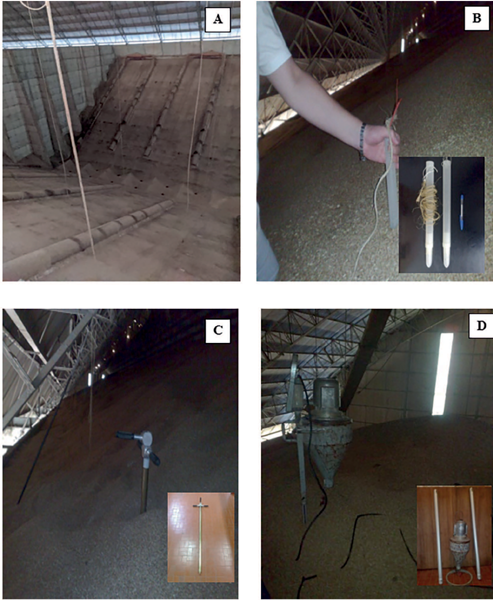
The research was carried out at the storage facility of Companhia Nacional de Abastecimento, located in the municipality of Ponta Grossa, in the state of Paraná, Brazil. The storage unit, with a length of 45 m and a width of 40 m, was equipped with an aeration and thermometry system. The storage capacity of the facility was of 15,000 tons of wheat, and the grain mass had different depths, with a “V” shape profile (Figure 1).

Wheat (Triticum aestivum) storage unit when empty (A) and filled with grains used for sampling of insect pests with the following methods: pitfall trap (B), manual probe (C), and pneumatic probe (D), in the municipality of Ponta Grossa, in the state of Paraná, Brazil. Photos by Bruno Francisco Sartori.
The study was carried out in 2012, 2016, and 2020, agricultural seasons when the grain mass remained at least 100 days stored, without being moved due to adverse conditions, such as transilage because of high temperatures or commercialization. During these three storage years, the data collection period was from December to March, with an average temperature of 22°C and a relative air humidity of 61% inside the storage unit.
The experimental design was completely randomized, with 10 replicates. The treatments were three sampling methods for monitoring the insect pest populations: pitfall traps, manual probe, and pneumatic probe. The collections of the insect pests in the grain mass were carried out at distance of at least 10 m between sampling points and at different parts of the storage facility (center and sides), at different depths according to each treatment.
Sampling was carried out 90 days after fumigation in order to allow more than one complete evolutionary cycle of the insect (Hill, 1990). The chemical used for fumigation was Fertox (56% aluminum phosphide), in the form of 0.6 g tablets, at a rate of 6.0 g m−3 (Paraná, 2012). Grain mass was covered with polyethylene tarpaulins, with a thickness of 150 μm, suitable for fumigation; sand snakes were put on the sides of the tarpaulins to hold them in place. The lateral air openings of the storage unit and the bottom holes used to ship the grains through conveyor belts were externally sealed. After fumigation, no live insects were identified.
The sampling depths, according to the investigated methods, were: 0.5 m for pitfall traps (0.03 m diameter × 0.5 m length = 0.00035 m3), 1.8 m for the manual probe (0.03 m diameter × 1.8 m length = 0.00127 m3 = 1.02 kg of wheat per hectoliter weight), and up to 7.5 m for the pneumatic probe (0.03 m diameter × 7.5 m length = 0.00530 m3 = 4.24 kg of wheat per hectoliter weight).
The pitfall trap remained in the grain mass for 10 days, from 80 to 90 days after fumigation. The number of live insect pests captured in these traps was quantified by direct counting in a 1.0x1.0 m white metal tray with a 0.2 m border. Samplings through the manual and pneumatic probes were performed 90 days after fumigation, on the same day. All collections were carried out at daylight.
The data on the number of live insects collected using the different sampling methods were subjected to testing of statistical assumptions. Normality, homoscedasticity, and independence of errors were checked using Shapiro-Wilk’s, Hartley’s, and Durbin-Watson’s tests, respectively. All assumptions were met. The measured variables were subjected to the one-way analysis of variance using Fisher-Snedecor’s test. In case of significance, means were compared by Duncan’s test, with a confidence level of 95%. Data analyzes were carried out separately for each year.
The captured insect pests were the weevil and rusty grain beetle. Duncan’s test showed significant differences among the means for number of live insects for each sampling method (Table 1).
Mean number, coefficient of variation (CV), and results of the mean-comparison test for live insects collected through different sampling methods in wheat (Triticum aestivum) grains stored in a facility, with a capacity of 15 thousand tons, in 2012, 2016, and 2020, in the municipality of Ponta Grossa, in the state of Paraná, Brazil(1).
For the capture of the live weevil, the pneumatic probe stood out in the three experimental years, which can be attributed to the greater depth reached and the volume of grains aspirated. In 2012, it collected approximately 2 times more insect pests than the pitfall trap and 18 times more than the manual probe. In 2016, the same performance ranking was observed among the evaluated methods, but with differences in the proportion of insect pests collected: 3 times more than the pitfall trap and 6 times more than the manual probe. In 2020, the same performance ranking was verified, but with differences in the collected proportions: 1.5 times more than the pitfall trap and 7 times more than the manual probe. Therefore, the pitfall trap had an intermediate performance, and the manual probe was less efficient in the three studied years. Bharathi et al. (2023) and Anukiruthika et al. (2024) concluded that insect movement in the grain mass toward the surface and other locations with a greater availability of oxygen and humidity favors the collection of grain weevils. Therefore, the different habits of insect pests in the bulk-stored grains affect the efficiency of the investigated sampling methods.
For the monitoring of the rusty grain beetle, the pitfall trap showed the best performance. In 2012, it was 13 times more efficient in collecting live beetles than the manual and pneumatic probes, which performed similarly. In 2016, a greater number of live insect pests was collected compared to 2012. Both the pitfall trap and pneumatic probe were more efficient than the manual probe, collecting 3.6 and 2.5 times more live beetles, respectively. In 2020, the number of collected insect pests was the highest out of the three study years. The pitfall trap captured more than 40 times more insects than the other sampling methods, whereas the manual probe showed the worse performance. This could be explained by two facts: although it can reach a larger sample area than the pitfall trap, the manual probe collected a small volume of grains compared to the size of the storage unit; and the pitfall trap, whose volume is the lowest among the tested methods, was used for the longest time (10 days) to collect the insect pests.
In the literature, grain weevils and the rusty grain beetle were confirmed as key insect pests in the ecosystem of loosely stored grain (Riudavets et al., 2014; Finck et al., 2015; Vendl et al., 2022). This highlights the importance of monitoring insect pests in stored grain, especially for commodities of major economic value in the international market such as wheat (Cramer & Wailes, 2021; USDA, 2024). Over the years, surveillance by sampling was confirmed as one of the widely used strategies for an integrated pest management (Trematerra, 2013).
Overall, the results obtained in the present study show that the pneumatic probe was more efficient in the collection of weevils and the pitfall trap was more effective in the capture of the rusty grain beetle, whereas the manual probe had the worst performance in sampling live insect pests during the experimental period. Despite this, all methods were successful in identifying live insect pests in wheat in bulk storage, allowing of their control and, consequently, improving wheat for human consumption, milling, and other purposes.
References
-
ANUKIRUTHIKA, T.; JAYAS, D.S.; JIAN, F. Synergistic and antagonistic effects of temperature and moisture differences on movement and distribution of Cryptolestes ferrugineus (Coleoptera: Laemophloeidae) adults in horizontal columns of wheat. Journal of Economic Entomology, v. 117, p.333-347, 2024. DOI: https://doi.org/10.1093/) ee/toad224
» https://doi.org/10.1093/) ee/toad224 -
ANUKIRUTHIKA, T.; JIAN, F.; JAYAS, D.S. Movement and behavioral response of stored product insects under stored grain environments: a review. Journal of Stored Products Research, v.90, art.101752, 2021. DOI: https://doi.org/10.1016/j.jspr.2020.101752
» https://doi.org/10.1016/j.jspr.2020.101752 -
BHARATHI, V.S.K.; JAYAS, D.S., JIAN, F. Study on 300 t of wheat stored in corrugated steel bin for two years in Canada. Part II - Movement and distribution of Cryptolestes ferrugineus (Stephens) and Tribolium castaneum (Herbst). Journal of Stored Products Research, v. 100, art.102062, 2023. DOI: https://doi.org/10.1016/j.jspr.2022.102062
» https://doi.org/10.1016/j.jspr.2022.102062 - BRASIL. Ministério da Agricultura, Pecuária e Abastecimento. Instrução Normativa nº 38, de 30 de novembro de 2010. Estabelece o Regulamento Técnico do Trigo, definindo o seu padrão oficial de classificação, com os requisitos de identidade e qualidade, a amostragem, o modo de apresentação e a marcação ou rotulagem. Diário Oficial da União, 1 dez. 2010. Seção 1.
-
CRAMER, L.G.; WAILES, E.J. (Ed.). Grain marketing. 2nd ed. New York: Routledge, 2021. 478p. DOI: https://doi.org/10.1201/9780429037368
» https://doi.org/10.1201/9780429037368 -
FINCK, C.; SANTANA, K.; OLIVEIRA, E.B. de; WEIRICH NETO, P.H.; GARCIA, L.C. Scouring of wheat in camera bag. Ciência Rural, v.45, p.2157-2160, 2015. DOI: https://dx.doi.org/10.1590/0103-8478cr20141150
» https://doi.org/10.1590/0103-8478cr20141150 - HILL, D.S. Insects of stored products and their control. Boca Raton: CRC Press, 1990. 274p.
-
KUMAR, C.; RAM, C.L.; JHA, S.N.; VISHWAKARMA, R.K. Warehouse storage management of wheat and their role in food security. Frontiers in Sustainable Food Systems, v.5, art.675626, 2021. DOI: https://doi.org/10.3389/fsufs.2021.675626
» https://doi.org/10.3389/fsufs.2021.675626 -
OLORUNFEMI, B.J.; KAYODE, S.E. Post-harvest loss and grain storage technology: a review. Turkish Journal of Agriculture - Food Science and Technology, v.9, p.75-83, 2021. https://doi.org/10.24925/turjaf.v9i1.75-83.3714
» https://doi.org/10.24925/turjaf.v9i1.75-83.3714 -
PARANÁ. Secretaria da Agricultura e do Abastecimento. Agrotóxicos no Paraná. Fertox. 2012. Available at: <http://www.agricultura.pr.gov.br/arquivos/File/defis/DFI/Bulas/Inseticidas/FERTOX.pdf> Accessed on: Jan. 14 2012.
» http://www.agricultura.pr.gov.br/arquivos/File/defis/DFI/Bulas/Inseticidas/FERTOX.pdf -
RIUDAVETS, J.; PONS, M.J.; GABARRA, R.; CASTAÑÉ, C.; ALOMAR, O.; VEGA, L.F.; GURI, S. The toxicity effects of atmospheres with high content of carbon dioxide with addition of sulphur dioxide on two stored-product pest species: Sitophilus oryzae and Tribolium confusum. Journal of Stored Products Research, v.57, p.58-62, 2014. DOI: http://dx.doi.org/10.1016/j.jspr.2013.12.003
» https://doi.org/10.1016/j.jspr.2013.12.003 -
TREMATERRA, P. Aspects related to decision support tools and integrated pest management in food chains. Food Control, v.34, p.733-742 , 2013. DOI: https://doi.org/10.1016/j.foodcont.2013.06.020
» https://doi.org/10.1016/j.foodcont.2013.06.020 -
USDA. United States Department of Agriculture World Agricultural Production. Washington, 2024. 42p. (Circular Series WAP 9-24). Available at: <https://apps.fas.usda.gov/psdonline/circulars/production.pdf>. Accessed on: Oct. 9 2024.
» https://apps.fas.usda.gov/psdonline/circulars/production.pdf -
VENDL, T.; SHAH, J.A.; AULICKY, R.; STEJSKAL, V. Effect of grain excavation damages by Sitophilus granarius on the efficacy of grain protectant insecticides against Cryptolestes ferrugineus and Tribolium castaneum. Journal of Stored Products Research, v.99, art.102022, 2022. DOI: https://doi.org/10.1016/j.jspr.2022.102022
» https://doi.org/10.1016/j.jspr.2022.102022 -
ZHANG, H.; WANG, D.; JIAN, F. Movement and distribution of Sitophilus zeamais adults and relationship between their density and trapping frequency in wheat bulks under different grain temperatures and moisture contents. Journal of Stored Products Research, v.87, art.101590, 2020. DOI: https://doi.org/10.1016/j.jspr.2020.101590
» https://doi.org/10.1016/j.jspr.2020.101590