
 Root growth, infiltration and sand proportion in hass avocado of the colombian andean tropics
Abstract:
The production of Hass avocados in Colombia has been increasingly threatened by the high and persistent rainfall observed in recent years, which has led to restrictions in root growth, yield reductions, and, in some cases, tree mortality. This study aimed to evaluate the relationship between root growth in Hass avocado trees and the influence of certain soil physical variables in the Colombian Andean tropic. The evaluations were conducted in two commercial 5-year-old Hass avocado plantations, with trees grafted onto rootstocks derived from native seeds. Root growth was assessed through monthly root extractions in each orchard. Additionally, infiltration tests were performed in the drip zones of the trees and along the cultivation paths in each area. Furthermore, laboratory analysis of sand grading was conducted to determine the particle size distribution. Statistical differences in root growth were observed between the two orchards. However, no significant differences were found in drip zone and path infiltration rates or between the overall infiltration rates of the orchards. Root growth was restricted in soils with lower infiltration rates and higher proportion of fine sands.
Index terms
Persea americanaMill; precipitation; soil tension; texture; waterlogging
Resumo:
A produção colombiana de abacate Hass tem sido ameaçada pelas chuvas altas e constantes registradas nos últimos anos, o que tem causado restrições no crescimento das raízes, reduções de rendimento e até, em alguns casos, a morte das árvores. O objetivo deste estudo foi avaliar a relação entre o crescimento da raiz em abacateiros Hass e o efeito de algumas variáveis físicas do solo no trópico andino colombiano. As avaliações foram realizadas em duas plantações comerciais de abacate Hass com 5 anos de idade, com árvores enxertadas em porta-enxertos de sementes nativas. Para avaliar o crescimento das raízes, foram realizadas extrações mensais de raízes em cada pomar. Além disso, foram realizados testes de infiltração nas zonas de gotejamento das árvores e nos caminhos de cultivo de cada zona. Além disso, foi realizadauma classificação laboratorial da areia para determinar a proporção em função do tamanho. Foram observadas diferenças estatísticas no crescimento da raiz, nos dois pomares. No entanto,não houve diferenças estatísticas nas taxas de infiltração na copa/caminho ounas taxas de infiltração por pomar. O crescimento da raiz foi restrito em solos com menor infiltração e maior proporção de areias finas.
Termos para indexação
Persea americana Mill; precipitação; tensão do solo; textura; alagamento
Introduction
Colombia has seen significant growth in land allocated to ‘Hass’ avocado production, expanding from 13,000 hectares in 2015 to over 50,000 hectares in 2021 (MADR, 2022).
However, this rapid expansion has not always been accompanied by adequate technical support. This lack of support has resulted in suboptimal land selection for planting, as soil and environmental characteristics have not been fully considered (RAMÍREZ, 2018). Given that avocado is a perennial crop, selecting suitable land for a new orchard should be a carefully considered decision to minimize the risk of future, difficult-to-manage problems that could render the crop economically unviable (GRUNENNVALDT, 2022).
Although avocado trees are native to soils with high macroporosity (Andisols) and high precipitation, roots are shallow, highly suberized, and have very low hydraulic conductivity.
These roots also possess a low number of root hairs, a high oxygen demand, and limited water absorption capacity (RAMÍREZ; MORALES, 2018). Additionally, it is important to note that numerous physical, chemical, and biological factors influence root growth. These factors interact to determine the conditions for root system development (CROWLEY, 2013). Therefore, any factors that may impede root growth should ideally be identified and addressed before planting begins. One of the most critical considerations for the success of an avocado plantation is the physical properties of the soil that affect water availability to the roots. In this context, a substantial body of research reports the detrimental effects of excess water in the soil on avocado trees. These effects include decreased soil aeration, which impairs the roots’ ability to absorb oxygen (BLANK et al., 2023), reduced leaf and root biomass, and root rot. Other reported adverse effects include the inhibition of gas diffusion through soil pores (MORALES et al., 2015), reduced photosynthesis (LIN et al., 2022), and difficulties in nutrient uptake (TZATZANI et al., 2020), among others.
In Colombia, due to the La Niña phenomenon, there has been a generalized increase in accumulated rainfall over the past three years (2021, 2022, 2023) (IDEAM, 2023).
This increase correlates positively with a higher incidence of flooding and landslide throughout the country (BOTERO; BARNES, 2022). As a result, many avocado plantations have experienced significant soil water saturation, leading to economic losses of varying degrees. This is largely because many crops were planted in soils with high clay content, extreme compaction, or abundant fine sands. These factors create waterlogging conditions, restrict the roots’ oxygen uptake, and ultimately subject the trees to stressful conditions far from ideal.
In response to the urgent need for a deeper understanding of the environmental impacts on Hass avocado plantations and in pursuit of mitigation strategies against climate change events currently affecting Colombian avocado production, this study aimed to evaluate the effects of soil texture, infiltration rates, soil tension, sand proportion and classification, and the influence of climate on the root growth of Hass avocado.
The study was conducted in two commercial orchards located in the Colombian Andean tropics.
The study was conducted in two 5-year-old commercial Hass avocado orchards located in different altitudinal zones: Villamaría, situated at 2,400 meters above sea level (5º01’05’’ N 75°29’54.9 “W) and Aranzazu, situated at 1,900 meters above sea level (5º18’40’’ N 75°29’13.1 “W). According to the Köppen climate classification, both locations fall under the equatorial mountainous Csbi climate. The trees are planted at a spacing of 6 meters between rows and 6 meters between plants, with rootstock derived from native seed. Both orchards are located in the department of Caldas, Colombia and neither has an irrigation system. The soils of the two orchards are classified as loam (USDA, 2014), and agronomic management followed the guidelines established by the ICA (Colombian Agricultural Institute) in resolutions 448 and 30021 for export orchards.
To determine the specific texture of the soils and the proportion of sands, silts, and clays, soil samples were collected from each orchard and transported to the laboratory for subsequent physicochemical analysis.
Similarly, to monitor the presence of new roots, random samples were collected monthly from two trees in each orchard, starting in the east quadrant. These root samples were extracted from beneath the canopy by digging 40x40x40 cm holes. Only light brown roots that with a thickness ≤ 5 mm were selected. Once gathered, the root samples were washed, dried in an oven at 70°C for 72 hours, and then their dry weights were recorded using an analytical balance (ROCHA et al., 2011).
Additionally, in both orchards, soil samples were collected at depths of 5 and 10 cm in the tree’s drip zones and along the cultivation paths to classify the sands and determine their sizes. The sieving method was used to define soil texture (RODRÍGUEZ, 2023) while the hydrometer method was employed for particle size determination (BOWMAN; HUTKA, 2002). Infiltration tests were also performed in both orchards, with data collected from the tree drip zones and along the crop paths using the single-cylinder infiltration meter technique (BOUWER, 1986). Four tests were conducted on the paths and ten in the tree drips zones at various depths in each orchard.
In each orchard, an experimental area of 2,000 m2 with flat topography was selected.
A completely randomized design (CRD) was used to assess soil infiltration rate and root growth variables. Four points were randomly selected along the crop path and 10 points in the tree drip for infiltration tests in each orchard. Similarly, three monthly samples per orchard were collected to measure root growth over a 12-month period. For the infiltration rate variable, each sample represented an experimental unit with four replicates along the path and 10 replicates in the tree drip zones for each orchard. For the root growth variable, each tree served as an experimental unit with three replicates per month in each orchard.
For the analysis of sand classification, soil tension, and general climate variables, descriptive tools were employed, focusing on the averages obtained and their behavior over time. The results were evaluated using analysis of variance (ANOVA) and Tukey’s test for comparison of means (p≤0.05). The statistical analysis was conducted using the SAS software (SAS Inst, Cary N.C. Version 9.4).
The growth of avocado tree roots is closely related to the surrounding soil conditions and their interactions; therefore, alterations in soil moisture due to waterlogging can lead to deficiencies in air circulation through the soil pores, consequently restricting root growth.
Although it is well known that soils with a clay content higher than 10% can retain large amounts of water (RAWLS, 1992) and that low oxygen levels in the rhizosphere have been associated with orchards cultivated in clay soils—conditions that could impair root function (ASSOULINE et al., 2020)—it is estimated that avocado tree can develop well in soils with 20 to 40% clay content, provided there is good drainage. However, in agricultural soils in Colombia, where high rainfall is common in producing areas, clay content should not exceed 20 to 25%, as higher levels could lead to edaphic issues associated with excessive water retention.
Despite the fact that the clay content in both areas studied does not exceed 20%, the sand content in the Aranzazu area is 50% (Table 1). This could be associated with potential waterlogging problems, especially given the high precipitation levels, as previous studies have indicated that a higher proportion of fine sands in the soil can lead to pore clogging and reduced infiltration rates (TODISCO et al., 2023). This underscores the importance of classifying sands by size when their proportion in the soil texture is high, to assess their potential impact on soil pore behavior.
Soil texture and proportion of sand, silt, and clay in two soils of the Colombian Andean tropics cultivated with Hass avocados.
The effect of soil texture on water storage and movement depends on the proportions of clay and sand in the soil. Soils with a predominantly sandy texture are characterized by low nutrient and water retention (FAO, 2023). However, soils with significant sand and silt contents, such as those in the Aranzazu area, tend to be more compact than sandy soils because most of the silt particles fill the voids between the sand grains, reducing porosity and, consequently, permeability (BRUAND et al., 2005). The water saturation observed in the Aranzazu area is likely due to the high proportion of fine sands (71.42%) present at a 10 cm depth in the tree drip zone (Table 2), as fine sands can limit water drainage. Although the proportion of fine sands is also high in Villamaría (64.06%), the overall sand content according to texture is lower than in Aranzazu 30% compared to 50%—which could facilitate better drainage of excess water in the soil.
Sand classification by size in two soils of the Colombian Andean tropics cultivated with Hass avocados.
Soil tension values represent the energy that a plant’s root system uses to extract water from the soil (SHOCK; WANG, 2011).
In avocados, field capacity is achieved at values close to 10-15 kPa (ROMÁN et al., 2009). Lower values indicate an excess of water in the soil, while higher values associated with field capacity imply a reduction in the amount of water available to the roots. In this study, Figure 1B shows that during the study period, soil tension in the Aranzazu area at 40 cm depth never exceeded the field capacity threshold, and this level was only reached at 20 cm depth in November. In the Villamaría area (Figure 1A), soil stress values exceeded the field capacity threshold only in September at 40 cm depth.

Soil tension and precipitation in two soils of the Colombian Andean tropics cultivated with Hass avocados. A (Villamaría) - B (Aranzazu). T1: Soil tension at 20 cm depth. T2: Soil tension at 40 cm depth. P: Precipitation.
The results indicate that soil moisture conditions throughout the year did not necessitate irrigation on either farms. This is largely due to the consistent rainfall recorded in both areas throughout the year. In fact, during several months, rainfall exceeded 100 mm/month, indicating excess water conditions in the soil, consequently, stress conditions for the trees (TZATZANI et al., 2020; BLANK et al., 2023).
Infiltration is the process by which the soil absorb water from precipitation or irrigation (ALMEIDA et al., 2018). Therefore, understanding the infiltration rate of soils cultivated with Hass avocado, especially given the high precipitation regimes in the two study areas, is crucial for making informed decisions about soil and crop management. In Figure (2A-B), the first bars show the mean infiltration values obtained for the two soils evaluated. These values align with those reported by Béjar et al. (2021), recorded an initial infiltration rate of 620mm/h of in an andosol soil cultivated with avocado under conventional management. Considering that infiltration rates above 50mm/h are classified as high (ALVARADO; BARAHONA, 2017), it is concluded that the infiltration rate in the two study areas is high.
In this study, the infiltration rate was evaluated at two different locations on each farm: one at the tree drip zone and the other along the roads crossing the farm.
The constant trampling by field personnel during daily work significantly reduced the infiltration capacity at high-traffic areas, decreasing from 945.02 mm/h in the tree drip zone to 150 mm/h on the crop roads in the Villamaría area, and from 586.8 mm/h in the tree drip zone to 357 mm/h on the crop roads in the Aranzazu area (Figure 2A-B).
At this point, the increase in runoff due to soil compaction is also significant, particularly in the areas studied and in generally in avocado-producing regions of Colombia, where topography often features varying slope levels that can facilitate water movement through runoff. In this context, Youlton et al. (2010), identified soil compaction from worker trampling as a key factor in increased runoff in avocado crops.
Similarly, Suescún et al. (2017) found that in mountainous areas cultivated in Colombia, rainfall leads to soil and nutrient loss as they are carried away by runoff, a process exacerbated by the slopes common in these regions.
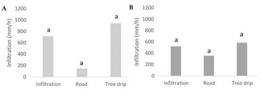
Average infiltration rate in roads and in the drip zones of Hass avocado trees in two soils of the Colombian Andean tropics. A. Villamaría B. Aranzazu. Identical letters above the bars indicate no significant differences (Tukey p= 0.05).
Various studies have demonstrated the restrictive effect of excess water on root growth (TZATZANI et al., 2020). The findings in this study further support a possible relationship between the proportion of fine sands, lower infiltration rates, and restricted root growth in the Aranzazu area, as shown in figure 3A.
This research also documented the progression of root growth over time and the precipitation patterns in the two study zones.
As shown in Figure 3B, root growth was consistent in Villamaría, whereas in Aranzazu, root growth was absent for three months, coinciding with the second half of the year.
Precipitation was consistent in both zones, with peaks occurring at different times in each zone and not aligning with the typical bimodal rainfall regime of Colombia.
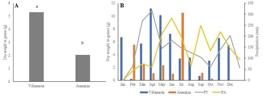
A. Root growth of Hass avocado in two soils of the Colombian Andean tropics. Different letters denote significant differences (Tukey p= 0.05). B. Hass avocado root growth over time and precipitation behavior in two zones of the Colombian Andean tropics. PV: Precipitation Villamaria. PA: Precipitation Aranzazu
Prior research indicates that root growth in avocado trees can be stimulated by precipitation or irrigation (SALAZAR-GARCÍA et al., 2018). Other studies suggest that it may be more closely associated with changes in both ambient and soil temperature (REYES et al., 2021), or even that the primary root production fluxes are not linked to soil temperature, rainfall, or irrigation water usage (ROCHA et al., 2011). In this study, the highest peaks of root growth in the Villamaría area generally coincided with periods of high precipitation; however, it cannot be conclusively stated that high precipitation stimulated root growth. In the Aranzazu area, no correlation was observed between the months of highest precipitation and the months of the highest root growth. This suggests that in the areas studied it is not possible to attribute root growth stimulation to water availability, and that in the Aranzazu area, excess water may have restricted. In Villa María, root growth was constant over time averaging 5.31 g, whereas in Aranzazu, root growth averaged 2.04 g, with some months showing no root growth at all, indicating a possible soil condition that limited root development.
References
-
ALMEIDA, E.; SUÁREZ, M.; PÉREZ, J.; NARANJO, M.; ROBALINO, O.; MANZANO, T. Tasa de infiltración de agua en suelos agrícolas. Ciencia Digital, Florianópolis, v.2, p.662-71, 2018. https://doi.org/10.33262/cienciadigital.v2i3.183
» https://doi.org/10.33262/cienciadigital.v2i3.183 - ALVARADO, C.; BARAHONA, M. Comparación de tres métodos de infiltración para calcular el balance hídrico del suelo, en la cuenca del río Suquiapa El Salvador: UNED, 2017. p.23-33. https://www.scielo.sa.cr/pdf/cinn/v9n1/1659-4266-cinn-9-01-00023.pdf
-
ASSOULINE, S.; KAMAI, T.; ŠIMUNEK, J.; NARKIS, K.; SILBER, A. Mitigating the impact of irrigation with effluent water: Mixing with freshwater and/or adjusting irrigation management and design. Water Resources Research, Washington, v.56, p.e2020WR027781, 2020. https://doi.org/10.1029/2020WR027781
» https://doi.org/10.1029/2020WR027781 -
BÉJAR, S.; CANTÚ, I.; YÁÑEZ, M.; LUNA-ROBLES, E. Evaluación y predicción de la infiltración en un Andosol bajo diferentes usos de suelo. Revista Mexicana de Ciencias Agrícolas, México, v.12, p.1171-83. 2021. https://doi.org/10.29312/remexca.v12i7.2327
» https://doi.org/10.29312/remexca.v12i7.2327 -
BLANK, L.; EZRA, D.; FOOKS, J.; SHULHANI, R.; KRASNOV, H.; SHTIENBERG, D. Within orchard spatial distribution of mature avocado trees mortality. Phytoparasitica, Rehovot, v.51, p.131-9, 2023. https://doi.org/10.1007/s12600-022-01038-7
» https://doi.org/10.1007/s12600-022-01038-7 -
BOTERO, H.; BARNES, A. The effect of ENSO on common bean production in Colombia: a time series approach. Food Security, Amsterdam, v.14, p.1417-30, 2022. https://doi.org/10.1007/s12571-022-01290-z
» https://doi.org/10.1007/s12571-022-01290-z - BOUWER, H. Intake rate: cylinder infiltrometer. In: KLUTE, A. Methods of soil analysis: physical and mineralogical methods. Madison: SSSA Book Series, 1986. v.5, p.825-44. https://doi.org/10.2136/sssabookser5.1.2ed.c32
- BOWMAN, G.; HUTKA, J. Particle size analysis. In: NEIL, M.; COUGHLAN, K.; HAMISH, C. Soil physical measurement and interpretation for land evaluation Clayton: Csiro Publishing, 2022. p.224-39.
- BRUAND, A.; HARTMANN, C.; LESTURGEZ, G. Physical properties of tropical sandy soils: a large range of behaviours. In : MANAGEMENT OF TROPICAL SANDY SOILS FOR SUSTAINABLE AGRICULTURE, 2005, Khon Kaen, Thailand. Proceedings […]. 2005. 148p.
- CROWLEY, D.; ESCALERA, J. Optimizing avocado irrigation practices through soil water monitoring San Juan Capistrano: California Avocado Society, 2013. p.55-65. Available from: http://www.avocadosource.com/CAS_Yearbooks/CAS_96_2013/CAS_2013_V96_PG_055-065.pdf
-
FAO - Food and Agriculture Organization. Manejo de suelos arenosos Rome, 2023. Available from: https://www.fao.org/soils-portal/soil-management/manejo-de-suelos-problematicos/suelos-arenosos/es/ Cited in: 10 may 2023.
» https://www.fao.org/soils-portal/soil-management/manejo-de-suelos-problematicos/suelos-arenosos/es/ - GRUNENNVALDT, R. Avocado soil health literature Brisbane: Queensland Department of Agriculture and Fisheries, 2022. 55p. (Extension horticulturist). Available from: https://avocado.org.au/wp-content/uploads/2022/11/Soil-health-literature-review_NOV-22.pdf
-
IDEAM. Tiempo y clima - fenómenos el niño y la niña 2023. Available from: http://www.ideam.gov.co/web/tiempo-y-clima/clima/fenomenos-el-nino-y-la-nina Cited in: 10 may 2023.
» http://www.ideam.gov.co/web/tiempo-y-clima/clima/fenomenos-el-nino-y-la-nina -
LIN, S.; CHEN, P.; ZHUANG, B. The stomatal conductance and Fv/Fm as the indicators of stress tolerance of avocado seedlings under short-term waterlogging. Agronomy, Madison, v.12, p.1084, 2022. https://doi.org/10.3390/agronomy12051084
» https://doi.org/10.3390/agronomy12051084 -
MADR - Ministry of Agriculture and Rural Development of Colombia. Cadena productiva Aguacate. SIOC, 2022. Available from: https://sioc.minagricultura.gov.co/Aguacate/Documentos/2021-03-31%20Cifras%20Sectoriales.pdf Cited in: 11 Apr 2023.
» https://sioc.minagricultura.gov.co/Aguacate/Documentos/2021-03-31%20Cifras%20Sectoriales.pdf -
MORALES, M.; ORTIZ, M.; SELLÉS, G. Effects of transient soil waterlogging and its importance for rootstock selection. Chilean Journal of Agricultural Research, Santiago, v.75, p.45-56, 2015. http://dx.doi.org/10.4067/S0718-58392015000300006
» http://dx.doi.org/10.4067/S0718-58392015000300006 -
RAMÍREZ, J. Avocado wilt complex disease, implications and management in Colombia. Revista Facultad Nacional de Agronomía Medellín, Medellín, v.71, p.8525-41, 2018. https://doi.org/10.15446/rfna.v71n2.66465
» https://doi.org/10.15446/rfna.v71n2.66465 -
RAMÍREZ, J.; MORALES, J. Microbial dynamics in the soil and presence of the avocado wilt complex in plots cultivated with avocado cv.Hass under ENSO phenomena (El Niño–La Niña). Scientia Horticulturae, New York, v.240, p.273-80, 2018. https://doi.org/10.1016/j.scienta.2018.06.047
» https://doi.org/10.1016/j.scienta.2018.06.047 - RAWLS, W.; AHUJA, L.; BRAKENSIEK, D.; SHIRMOHAMMADI, A. Infiltration and soil water movement New York: McGraw-Hill, 1992. p.5-51.
-
REYES, J.; MEJÍA, J.; MONTEAGUDO, O.; VALDEZ, M.; GONZÁLEZ, J.; ESPÍNDOLA, M. Phenology of the ‘Hass’ avocado in the State of Mexico, Mexico.Revista Chapingo. Serie Horticultura, Chapingo, v.27, p.113-34. 2021. https://doi.org/10.5154/r.rchsh.2020.09.020
» https://doi.org/10.5154/r.rchsh.2020.09.020 - ROCHA, J.; SALAZAR-GARCÍA, S.; BÁRCENAS, A.; GONZÁLEZ, I.; COSSIO, L. Fenología del aguacate ‘Hass’ en Michoacán. Revista Mexicana de Ciencias Agrícolas, Texcoco, v.2, p.303-16, 2011.
-
RODRÍGUEZ, W. Ensayo granulométrico de los suelos mediante el método del tamizado. Ciencia Latina Revista Científica Multidisciplinar, Ciudad de México, v.7, p.6908-27, 2023. https://doi.org/10.37811/cl_rcm.v7i2.5834
» https://doi.org/10.37811/cl_rcm.v7i2.5834 -
ROMÁN, E.; ROMÁN, F.; ZAMORA, J. Evaluation of microirrigation levels for growth and productivity of avocado trees. Journal of Agriculture of the University of Puerto Rico, San Juan, v.93, 173-86. 2009. https://doi.org/10.46429/jaupr.v93i3-4.5465
» https://doi.org/10.46429/jaupr.v93i3-4.5465 - SALAZAR-GARCÍA, S.; IBARRA, M.; GONZÁLEZ, J. Phenology of ‘Méndez’avocado in southern Jalisco, México. Agrociencia, Montecillo, v.52, 991-1003. 2018.
-
SHOCK, C.; WANG, F. Soil water tension, a powerful measurement for productivity and stewardship. HortScience, Alexandria, v.46, p.178-85, 2011. https://doi.org/10.21273/HORTSCI.46.2.178
» https://doi.org/10.21273/HORTSCI.46.2.178 -
SUESCÚN, D.; VILLEGAS, J.; LEÓN, J.; FLÓREZ, C.; GARCÍA, V.; CORREA, G. Vegetation cover and rainfall seasonality impact nutrient loss via runoff and erosion in the Colombian Andes. Regional Environmental Change, Berlin, v.17, p.827-39, 2017. https://doi.org/10.1007/s10113-016-1071-7
» https://doi.org/10.1007/s10113-016-1071-7 -
TODISCO, F.; VERGNI, L.; CEPPITELLI, R. Modelling the dynamics of seal formation and pore clogging in the soil and its effect on infiltration using membrane fouling models. Journal of Hydrology, Amsterdam, v.618, p.129208, 2023. https://doi.org/10.1016/j.jhydrol.2023.129208
» https://doi.org/10.1016/j.jhydrol.2023.129208 -
TZATZANI, T.; KAVROULAKIS, N.; DOUPIS, G.; PSARRAS, G.; PAPADAKIS, I. Nutritional status of ‘Hass’ and ‘Fuerte’avocado (Persea americana Mill.) plants subjected to high soil moisture. Journal of Plant Nutrition, New York, v.43, p.327-34, 2020. https://doi.org/10.1080/01904167.2019.1683192
» https://doi.org/10.1080/01904167.2019.1683192 - USDA - United States Department of Agriculture. Claves para la taxonomía de suelos12th ed. Washington: Soil Survey Staff, 2014 p.1-336. Available from: https://www.nrcs.usda.gov/sites/default/files/2022-10/Spanish-Keys-to-Soil-Taxonomy.pdf
-
YOULTON, C.; ESPEJO, P.; BIGGS, J.; NORAMBUENA, M.; CISTERNAS, M.; NEAMAN, A.; SALGADO, E. Cuantificación y control de la escorrentía y erosión en huertos de paltos, cultivados en camellones a favor de pendientes escarpadas. Ciencia e Investigación Agraria, Santiago, v.37, p.113-23. 2010. http:// doi.org/10.4067/S0718-16202010000300010
» http:// doi.org/10.4067/S0718-16202010000300010
Edited by
-
Raul Castro Carriello Rosa


