
 Transitioning from Remote to In-Person Learning: Medical Students’ Perspectives after the COVID-19 Pandemic
ABSTRACT
Introduction: The return to post-pandemic in-person teaching in Brazilian medical schools required adjustments on the part of students and teachers, to readjust to the traditional teaching model after the remote regime was implemented.
Objective: This study determined, from the student’s perspective, the post-pandemic pedagogical strategies, challenges during the transition period, benefits of returning to in-person learning, faculty performance in this context, and recommendations for post-pandemic in-person medical education in a public university in Rio Grande do Norte, Brazil.
Method: Both quantitative and qualitative approaches were employed for data collection and analysis. The research involved 185 medicine students, and their responses were gathered between November 2022 and May 2023.
Result: According to the data, the use of information and communication technologies (ICTs) persisted in in-person education. The main challenges encompass increased expenses, uncertainty regarding learning, and fatigue. Nevertheless, students valued interactivity, motivation, and the opportunity to clarify doubts with instructors during in-person classes. Emphasis was placed on the need for dynamic classes, the adoption of a hybrid teaching approach, and the ubiquitous use of technology in medical education. Additionally, the importance of schedule organization, assessment diversification, and investment in instructors and infrastructure is highlighted.
Conclusion: In summary, the study reveals that key remote teaching strategies, such as online platforms and asynchronous access to resources, seamlessly transitioned into in-person education. However, challenges such as financial burdens and adapting to the in-person format were notable. Despite this, students emphasized the benefits of increased engagement and improved learning outcomes, underscoring the importance of maintaining a dynamic and adaptive approach to post-pandemic education.
Keywords:
Medical Education; Covid-19 pandemic; Medical students; Faculty; Information and communication technology
RESUMO
Introdução: O retorno ao ensino presencial pós-pandemia nas escolas médicas brasileiras careceu de adequações por parte de estudantes e professores, no sentido de eles se reajustarem ao modelo de ensino tradicional após o regime remoto implantado.
Objetivo: Este estudo determinou, sob a perspectiva dos estudantes, as principais estratégias pedagógicas pós-pandêmicas utilizadas, os desafios durante o período de transição, os benefícios do retorno ao presencial, o desempenho docente nesse contexto e as recomendações para a educação médica presencial pós-pandemia em uma universidade pública no Rio Grande do Norte, no Brasil. Método: Abordagens quantitativas e qualitativas foram utilizadas para coleta e análise de dados. A pesquisa envolveu 185 estudantes de Medicina, e suas respostas foram coletadas entre novembro de 2022 e maio de 2023.
Resultado: De acordo com os dados, o uso de tecnologias de informação e comunicação (TIC) persistiu no ensino presencial. Os principais desafios incluíram aumento de despesas, incerteza em relação ao aprendizado e fadiga. No entanto, os estudantes valorizaram a interatividade, a motivação e a oportunidade de esclarecer dúvidas com os instrutores durante as aulas presenciais. Destacaram-se a necessidade de aulas dinâmicas, a adoção de uma abordagem de ensino híbrido e o uso ubíquo de tecnologia no ensino médico. Além disso, sobressaíram a importância da organização de horários, a diversificação das avaliações e o investimento em instrutores e infraestrutura.
Conclusão: O estudo revela que as estratégias-chave de ensino remoto, como plataformas online e acesso assíncrono a recursos, integraram-se facilmente à educação presencial. No entanto, desafios como encargos financeiros e adaptação ao formato presencial foram notáveis. Apesar disso, os alunos enfatizaram os benefícios do aumento do engajamento e os melhores resultados de aprendizagem, destacando a importância de manter uma abordagem dinâmica e adaptativa à educação pós-pandêmica.
Palavras-chave:
Educação Médica; Pandemia por Covid-19; Estudantes de Medicina; Corpo Docente; Tecnologia da Informação e Comunicação
INTRODUCTION
The return to in-person education unfolded as a natural progression following the stabilization of COVID-19 in Brazil1. Medical education provided at the higher education institution investigated, which had been conducted remotely, has almost entirely resumed in-person activities, with only a few hybrid or distance learning initiatives on the campus.
After the pandemic, the experience gained in teaching strategies suggests the possibility of using face-to-face meetings, fully online classes, and blended learning approaches2. Understanding how the return to in-person activities will unfold after the pandemic is an important area of analysis, as research suggests that both medical students and teachers prefer adopting a hybrid teaching model3.
The understanding and interpretations of the (re)adaptation to the previously practiced in-person teaching become apparent, especially from a student’s perspective.
This study aimed to assess the transition from remote to in-person education at the Faculty of Medicine at a university in Rio Grande do Norte, from the student’s perspective. The key post-pandemic pedagogical strategies that persisted even upon the resumption of in-person activities, the primary challenges encountered by students during the transitional phase, the benefits they associate with returning to face-to-face learning, the assessment of teaching performance by the student body within this context, and provided recommendations for post-pandemic, in-person medical education were identified.
METHOD
The study employed a mixed-method approach, incorporating quantitative methods and an analysis of discursive responses given by students. The research was conducted within the Faculty of Medicine in a public university situated in the northeastern region of Brazil. The medicine course analyzed was established in 2004 and holds accreditation from both the Brazilian Ministry of Education and the State Council of Education of Rio Grande do Norte. It is affiliated with a public university, with an annual authorization of 60 new vacancies, evenly distributed across two semesters.
The course mainly follows traditional teaching methods, with an emphasis on teacher-centered techniques. Nevertheless, some teachers are taking the initiative to incorporate active teaching methods and utilize technology in their classes. As for the students, the sample included those with an active connection to the university, aged at least 18, and willing to respond to data collection instruments through remote tools. The exclusion criteria consisted of students enrolled in the first and second semesters of the program, who had not been exposed to remote instruction within the institution at the time, and respondents providing incomplete or inaccurate survey responses. The minimum sample size was determined to be 177 responses using the sample size calculation formula, considering the finite eligible population of 257 students, and incorporating a 15% allowance for potential loss. Data collection and analysis methods adhered to previously described protocols4.
The quantitative data underwent descriptive analysis. The qualitative data were coded, categorized, and analyzed using content analysis to assess responses from research participants. Remote data collection was carried out by utilizing the Google Forms platform to distribute questionnaires to the research participants. The instrument included items with multiple-choice questions in the investigation phase regarding the advantages and disadvantages of returning to in-person teaching. Opinions about the teachers’ performance after the pandemic were gathered using Likert-scale questions. Responses to open-ended questions focused on the students’ suggestions and recommendations for the smooth operation of the medicine course after the return to in-person classes.
The research obtained approval from the Ethics Committee on Research at the University of the State of Rio Grande do Norte before data collection. The approval protocol, CAAE: 39196220.3.0000.5294, bears the number 4.357.461.
RESULTS
Study participants
A total of 185 responses from students (comprising 72% of the target population) were collected, encompassing students from the 3rd to the 12th academic periods, with an average age of 25 years. Data collection occurred between November 2022 and May 2023. Among the participants, 50.3% had experienced in-person classes before the pandemic, while 49.7% commenced their studies during the pandemic period.
Teaching and learning strategies that persisted after the resumption of in-person classes
The primary teaching and learning strategies adopted during remote education that successfully continued during the in-person regime included the use of online platforms for student communication and pedagogical organization of curricular components, asynchronous access to audiovisual resources, as well as occasional remote teaching episodes. Detailed descriptions of these strategies can be found in Table 1.
Challenges and difficulties inherent to the resumption of in-person classes
Concerning the main challenges and obstacles associated with the return to in-person classes (refer to Graphic 1), the following were observed: increased financial burdens (47%), students perceiving their knowledge levels as falling short of expectations (46.5%), issues related to fatigue and burnout (44.9%), struggles in adapting to the in-person format (38.9%), and the emergence or worsening of psychological disorders (25.9%).

Challenges and difficulties of returning to in-person classes, according to medical students.
Benefits of returning to in-person education
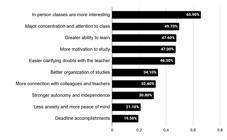
Regarding the key advantages associated with the transition to in-person education, students predominantly highlighted finding classes more engaging (65.9%), achieving heightened concentration and focus (49.7%), enhanced learning outcomes (47.6%), increased motivation for studying (47%), and improved accessibility for seeking clarification from instructors (46.5%) (refer to Graphic 2).
Perceptions of teaching performance upon returning to in-person instruction
Among the statements that received partial or full disagreement from students, almost 80% disagreed with the obsolescence of the teacher’s presence in the post-pandemic era. A total of 49.7% disagreed that there was no difference in the teacher’s dynamics or teaching style upon the return to in-person classes, and 51.9% disagreed that the teacher became stricter and less open to suggestions after the return to in-person teaching. In terms of statements that received partial or full agreement from students, 50.2% of the students agreed that the teacher started using digital technologies more easily, 42.7% agreed that the teacher neither got worse nor improved with the experience of remote teaching, and 54.6% agreed that the teacher did not take advantage of remote teaching to modernize their classes (refer to Figure 1).

Analysis of content from open-ended responses
Of the 185 responding students, 78 answered the open-ended question inquiring about suggestions for improving medical education after the return to in-person instruction. The key recommendations derived from the responses, following coding and categorization, are depicted in Box 1. Notably, students expressed a desire for more interactive and dynamic lessons and advocated for the implementation of a hybrid approach to teaching and learning upon the resumption of normal campus activities.
DISCUSSION
According to the current research, it was observed that there were pedagogical strategies and tools adopted in the remote education context that remained successful even after the return to in-person learning. These included virtual learning environments like “Google Classroom,” instant messaging applications, asynchronous class recording and sharing, social media, and occasional synchronous remote classes. It is evident that these pro-pedagogical tools are straightforward to implement and could have been applied to medical education even before the pandemic-driven shift to remote learning. This supports the argument that the pandemic acted as a catalyst for modernizing the traditional classroom setting5.
Among the factors that hindered the adaptation to in-person learning, increased financial expenses stood out. This might be linked to the fact that a significant portion of the medical students come from various states across Brazil and, during the pandemic, returned to their hometowns. This reality aligns with a previous study6, which identified different cost-related factors that challenged the cost-saving measures implemented during remote learning: transportation costs, food expenses, access to academic resources, as well as home maintenance costs in the city where the university is located.
Factors affecting the students’ physical and psychological well-being, such as fatigue, exhaustion, and the development or exacerbation of psychological disorders, negatively influenced the adaptation to in-person learning. University students in the post-pandemic era experienced issues related to anxiety, depression, and insomnia. It is recommended that students participate in programs to manage sleep and anxiety-related conditions7.
In addition to the adaptation challenges, students highlighted the main benefits associated with the return to in-person learning. The statement that declared in-person classes were more interesting than remote ones received the highest percentage of agreement. This viewpoint is in line with expectations, as it is supported by numerous studies in the field of medical education highlighting the importance of face-to-face interactions for medical students8. Moreover, the advancement of information and communication technologies (ICTs) and the global reach of the internet have made it possible to remotely engage in practical activities9. However, it is argued that for the comprehensive development of medical practices, healthcare professionals in training must be exposed to social experiences grounded in physical presence. Empathy and the ability to interact with patients are primary requirements for the practice of medicine8 .
Another positive aspect of returning to in-person classes is the improved concentration, attention, increased learning, and enhanced motivation for studying. In a post-pandemic scenario, students exhibit higher cognitive and emotional engagement, associated with curiosity, attention, interest, and optimism in their learning process10.
Students also found it easier to solve doubts with their teachers during the post-pandemic period, which is another positive aspect pointed out by a significant portion of the students. A notable enhancement in traditional teaching methods after the pandemic, as reported by the students, was the personalized support offered by instructors11.
Regarding the students’ perceptions of the teaching staff in the post-pandemic period, certain aspects warrant discussion. Despite the teachers being capable of handling digital technologies in the classroom upon the return to in-person learning, they seemed not to leverage this expertise to modernize their teaching. According to students, there was no significant change in the way teachers conducted classes before the pandemic or after returning to in-person instruction. This poses a point of reflection since medical education has been evolving in recent decades to incorporate active learning methodologies, meaningful learning, and digital technologies into its curricula12 . The reluctance of the teaching staff to actively implement these innovations despite experiencing them during the pandemic may be related to a certain resistance to more contemporary teaching models.
This resistance is observed when the teaching staff is unfamiliar with remote teaching methods or lacks digital equipment and software handling skills, as seen at the onset of remote teaching by some instructors13. Therefore, the observed absence of alterations or enhancements in teaching approaches by the assessed teachers reinforces the embracing of conventional and technical medical education, which no longer corresponds to the societal transformations resulting from the COVID-19 pandemic14 .
Despite these signs of apparent dissatisfaction with the post-pandemic teaching performance, it is undeniable that the teacher’s presence in the classroom is indispensable. Notably, 80% of students either partially or entirely disagree with the statement that the teacher’s presence has become obsolete and optional. Despite the emergence of digital technologies in the educational realm, more recently exemplified by artificial intelligence (AI), research shows that most students regard the presence and involvement of teachers in the learning process as indispensable15. They believe that only the teacher can provide learning experiences that integrate the necessary socio-emotional skills and promote critical thinking for solving 21st-century problems.
In response to inquiries about potential enhancements in medical education after the pandemic, the most frequently mentioned topic pertained to the dynamism and interactivity of classes. This corresponds to the additional findings presented in this study, suggesting that classes are likely as (un)dynamic and interactive as they were before the pandemic, despite the significant transformation in the teaching and learning process during the period of remote instruction16.
Another aspect of the suggested improvement in medical education was related to practical classes. According to the students, these practical classes should occur more frequently, be more immersive, and be better integrated with the theory taught in the classroom. This is an interesting suggestion, considering that the students reported that there were few or no practical sessions during the remote learning periods. Competency-based medical education, in which clinical and laboratory practices are essential, should be more strongly emphasized to ensure that these medical students do not miss out on learning opportunities that only “hands-on” methods can offer17.
The incorporation of effective remote teaching practices into the traditional face-to-face approach was a topic of discussion. It was noted that some students suggested maintaining the medical program in a hybrid format. This is a practical initiative supported by scientific literature that highlights curriculum adjustments in medical education across various domains, including medical surgery internships18 family and community medicine19, military medicine and disaster education practices20, and radiology internships21, among numerous other adaptations.
Furthermore, students value the possibility of revisiting asynchronously recorded lectures and using different digital platforms and virtual learning environments that enable more technological, organized, and agile teaching. Students view online education as customizable, replicable, offering greater flexibility in terms of time and location, and accessible to students who, due to medical reasons, cannot physically attend traditional classes22.
Some students raised the possibility of using face-to-face classroom time to create an active learning environment with Q&A sessions, quizzes, practical procedures, and other activities that move away from content-based teaching. This model is similar to the well-known and widely used flipped classroom method23. The stimulating environment for reflection fostered by the instructor in a face-to-face classroom is deemed more advantageous, as it can enhance motivation, student engagement, participation, and the development of social skills, problem-solving abilities, and the perception of multiple intelligences, among other aspects24.
It is particularly noteworthy that students have several suggestions regarding adherence to schedules by instructors and the reorganization of the course timetable based on the implemented curriculum. There is a recurring complaint about teachers not following established schedules, rescheduling classes on the eve of their occurrence without justification, and postponing practical sessions without prospects for makeup, among other habits that do not align with the semester planning. Some students believe that responsibility should be a two-way street: students should be careful not to miss deadlines for their academic responsibilities, while instructors should fulfill their obligations with the same rigor and commitment expected from the students25.
In this context of delays and irregular timetables, a situation emerges that could undermine the value and credibility of hybrid education: remote classes conducted at the discretion of individual instructors. It was reported in some students’ statements that they disagreed with the maintenance of online classes because they believed that teachers, even after returning to in-person classes, were not willing to conduct face-to-face lessons, instead opting for improvised video calls and recorded classes. There are several post-pandemic education recommendations, which include well-structured interactive, responsive, and authentic virtual experiences meticulously designed to actively engage students, provide real-time feedback from instructors, introduce authentic clinical cases, and conduct virtual experiments26. Consequently, delivering remote classes opportunistically, merely transferring the traditional instructor-centered approach to the online environment, is not an approach that resonates with the students.
Methods of assessment received suggestions for improvement from the participating students. There is a recurring need to diversify assessment methods beyond the classic theoretical exam. In the literature, various possibilities for assessing a curriculum component in a medical course are discussed27. Assessment in medical education serves to support the learner’s development in line with the curriculum, identify areas for educational improvement, and act as a feedback tool between students and instructors28. Restricting assessment to a single method, as reported by the students, obstructs the attainment of these objectives and may be viewed as demotivating and counterproductive.
CONCLUSION
The study revealed that the pedagogical strategies employed during remote learning, such as the use of online platforms and asynchronous access to materials, were effectively integrated into in-person education. This continuity underscores the value of these tools in the post-pandemic educational environment.
The students encountered significant challenges, including increased financial costs and the need to readapt to in-person learning. These challenges led to uncertainty and fatigue but were largely mitigated by the return to the classroom environment. Despite these difficulties, the students appreciated the return to in-person education, noting benefits such as greater interest, improved concentration, motivation, and more meaningful interaction with the faculty.
Faculty performance was generally satisfactory, particularly in the use of digital technologies. However, the students expressed a preference for reducing reliance on these technologies during in-person classes, advocating for a more interactive and face-to-face approach.
Based on the findings, it is recommended that post-pandemic medical education adopt dynamic teaching methods, strategically incorporate hybrid ICT use, improve class scheduling, diversify assessment methods, and enhance faculty support and recruitment to better meet evolving educational demands
References
-
1 Stancati MMMS. O ensino durante e pós-pandemia no Brasil: relatos de experiência na docência superior. SCIAS - Educação, Comunicação e Tecnologia [Internet]. 2022 [cited 2024 Jan 31];4(2):3-14. Available from: Available from: https://revista.uemg.br/index.php/sciasedcomtec/article/view/6195
» https://revista.uemg.br/index.php/sciasedcomtec/article/view/6195 - 2 Haworth A, Fielding AL, Marsh S, Rowshanfarzad P, Santos A, Metcalfe P, et al. Will COVID-19 change the way we teach medical physics post pandemic? Physical and Engineering Sciences in Medicine. 2020 Jul 27;43(3):735-8.
- 3 Roth LT, Mogilner L, Talib H, Silver EJ, Friedman S. Where Do We Go from here? Post-pandemic Planning and the Future of Graduate Medical Education. Medical Science Educator. 2023 Feb 6;33.
-
4 Mota J da S. Utilização do google forms na pesquisa acadêmica. Humanidades & Inovação [Internet]. 2019;6(12):371-3. Available from: https://revista.unitins.br/index.php/humanidadeseinovacao/article/view/1106
» https://revista.unitins.br/index.php/humanidadeseinovacao/article/view/1106 -
5 Silva DSM da, Sé EVG, Lima VV, Borim FSA, Oliveira MS de, Padilha R de Q. Metodologias ativas e tecnologias digitais na educação médica: novos desafios em tempos de pandemia. Revista Brasileira de Educação Médica [Internet]. 2022 Mar 11;46(2). Available from: https://www.scielo.br/j/rbem/a/fyC3cYbkkxKNDQWbFRxGsnG/?lang=pt
» https://www.scielo.br/j/rbem/a/fyC3cYbkkxKNDQWbFRxGsnG/?lang=pt -
6 Oliveira RTN de. A escola aprende? Avaliação das percepções dos alunos do curso de engenharia de produção da Universidade Federal Fluminense/Niterói sobre a imposição de retorno imediato à modalidade presencial após a pandemia COVID-19 [Internet] [Monography]. Repositório Institucional UFF. [Universidade Federal Fluminense]; 2023 [cited 2024 Jan 31]. p. 86. Available from: Available from: https://app.uff.br/riuff/handle/1/29890
» https://app.uff.br/riuff/handle/1/29890 - 7 Duan H, Gong M, Zhang Q, Huang X, Wan B. Research on sleep status, body mass index, anxiety and depression of college students during the post-pandemic era in Wuhan, China. Journal of Affective Disorders. 2022 Mar;301(2022):189-92.
- 8 Nahian A, Suteja RC, Shellah D, Egan C, Găman M, Bonilla-Escobar FJ. The State of Learning Patterns within Medical Education in a Post-pandemic World: Reflection from IJMS Authors and an Overview of the IJMS Volume 10 Issue 3. International Journal of Medical Students. 2022 Sep 28;10(3):233-5.
- 9 Wendt C, Adam M, Benlian A, Kraus S. Let’s Connect to Keep the Distance: How SMEs Leverage Information and Communication Technologies to Address the COVID-19 Crisis. Information Systems Frontiers. 2021 Oct 13;24(2022).
- 10 Sartika SH, Nirbita BN. Academic resilience and students engagement in higher education: study on post-pandemic behaviour. Edu sciences journal. 2023 Feb 27;4(1):29-34.
- 11 Keshan P, Rastogi A, Bansal A, Jindal A, Prakash A, Kumar V. Medical education in post-pandemic times: Online or offline mode of learning? Journal of Family Medicine and Primary Care. 2022;11(9):5375.
- 12 Thomas PA, Kern DE, Hughes MT, Tackett SA, Chen BY. Curriculum Development for Medical Education. JHU Press; 2022.
-
13 Hayat AA, Keshavarzi MH, Zare S, Bazrafcan L, Rezaee R, Faghihi SA, et al. Challenges and opportunities from the COVID-19 pandemic in medical education: a qualitative study. BMC Medical Education [Internet]. 2021 Apr 29;21(1):247. Available from: https://pubmed.ncbi.nlm.nih.gov/33926439/
» https://pubmed.ncbi.nlm.nih.gov/33926439/ - 14 Serra ST, Taquette SR, Bteshe M, Corrêa LM, Mattos AVV. Necessidade de mudanças na educação médica e a percepção de professores antes da pandemia da Covid-19. Interface - Comunicação, Saúde, Educação. 2021;25(suppl 1).
-
15 Chan CKY, Tsi LHY. The AI Revolution in Education: Will AI Replace or Assist Teachers in Higher Education? [Internet]. arXiv.org. 2023. Available from: https://arxiv.org/abs/2305.01185
» https://arxiv.org/abs/2305.01185 -
16 Feitosa LRC, Gusso HL. Ensino superior e formação profissional: debates acerca da universidade pós-pandemia [Internet]. UFSC; 2022 [cited 2024 Jan 31]. Available from: Available from: https://repositorio.ufsc.br/handle/123456789/243472
» https://repositorio.ufsc.br/handle/123456789/243472 - 17 Ryan MS, Holmboe ES, Chandra S. Competency-Based Medical Education: Considering Its Past, Present, and a Post-COVID-19 Era. Academic Medicine. 2022 Feb 23;97(3S):S90-7.
-
18 Schumm MA, Dacey MJ, Moore AM, Graham DS, Tillou A, Chen DC, et al. A hybrid remote surgery clerkship curriculum during the COVID-19 pandemic: Lessons learned and future perspectives . The American Journal of Surgery [Internet]. 2021 Oct 12 [cited 2024 Jan 31];223(5). Available from: Available from: https://www.americanjournalofsurgery.com/article/S0002-9610(21)00666-8/fulltext
» https://www.americanjournalofsurgery.com/article/S0002-9610(21)00666-8/fulltext - 19 Suresh A, Wighton NM, Sorensen TE, Palladino TC, Pinto-Powell R. A hybrid educational approach to service learning: impact on student attitudes and readiness in working with medically underserved communities. Medical Education Online. 2022 Sep 18;27(1).
-
20 Hsu CC, Tsai SH, Tsai PJ, Chang YC, Tsai YD, Chen YC, et al. An Adapted Hybrid Model for Hands-On Practice on Disaster and Military Medicine Education in Undergraduate Medical Students During the COVID-19 Pandemic. PubMed [Internet]. 2022 Dec 1 [cited 2024 Jan 31];12(4):145-57. Available from: Available from: https://www.ncbi.nlm.nih.gov/pmc/articles/PMC9815997/
» https://www.ncbi.nlm.nih.gov/pmc/articles/PMC9815997/ - 21 Musick A, Malhotra D, French R, Carrico C, Martin J. Return to the Reading Room: Implementation of a Hybrid Radiology Clerkship Model after Emergent Conversion to Remote Learning in the COVID-19 Pandemic. Academic Radiology. 2022 Aug;30(8).
-
22 Li D. The Shift to Online Classes during the COVID-19 Pandemic: Benefits, Challenges, and Required Improvements from the Students’ Perspective. Electronic Journal of e-Learning [Internet]. 2022;20(1):1-18. Available from: https://eric.ed.gov/?id=EJ1333732
» https://eric.ed.gov/?id=EJ1333732 - 23 Phillips J, Wiesbauer F. The flipped classroom in medical education: A new standard in teaching. Trends in Anaesthesia and Critical Care. 2022 Jan 6;42(February 2022).
-
24 Hosein A, Hashemi G, Alsadaji A, Mohammed Z, Masoudi S. The Effect of Flipped Classroom on Student Learning Outcomes; An Overview. Med Edu Bull [Internet]. 2022 [cited 2023 Jun 26];3(2). Available from: Available from: https://www.medicaleducation-bulletin.ir/article_145743_77e25f64318d2933be398d3371172441.pdf
» https://www.medicaleducation-bulletin.ir/article_145743_77e25f64318d2933be398d3371172441.pdf -
25 Carvalho DC de. Como ser um bom professor características de professores efetivos e professores modelos pela perspectiva de alunos de medicina [Internet] [Dissertation]. Universidade Unifenas. [UNIFENAS]: Universidade José do Rosário Vellano; 2021 [cited 2024 Jan 31]. p. 80. Available from: Available from: http://tede2.unifenas.br:8080/jspui/handle/jspui/323
» http://tede2.unifenas.br:8080/jspui/handle/jspui/323 - 26 Tang KHD. Impacts of COVID-19 on primary, secondary and tertiary education: a comprehensive review and recommendations for educational practices. Educational Research for Policy and Practice. 2022 Jun 23;22(2023).
-
27 Tabish SA. Assessment Methods in Medical Education. International Journal of Health Sciences [Internet]. 2006;2(2). Available from: https://pmc.ncbi.nlm.nih.gov/articles/PMC3068728/
» https://pmc.ncbi.nlm.nih.gov/articles/PMC3068728/ -
28 Morrison J. Evaluation. BMJ: British Medical Journal [Internet]. 2003 Feb 15;326(7385):385-7. Available from: https://www.ncbi.nlm.nih.gov/pmc/articles/PMC1125244/
» https://www.ncbi.nlm.nih.gov/pmc/articles/PMC1125244/

 Source: Prepared by the authors.
 Source: Prepared by the authors.
 Source: Prepared by the authors.