
 Clinical interview guide aimed at primary care: a three-dimensional approach
ABSTRACT
Introduction: Teaching skills for interviewers to effectively integrate and conduct a medical consultation is essential in medical education. However, early-year medical students face challenges in producing high-quality clinical records without proper guidance. Thus, an interview guideline was developed to collect information during medical consultations and improve care. This guideline is based on the patient-centered clinical method, seven-step framework for consultation, and problem-oriented medical record to standardize documentation and integrate patients into the electronic health record.
Experience report: An extensive literature review was conducted using PubMed, SciELO, and Virtual Health Library databases with the descriptors “clinical record”, “medical education”, “anamnesis”, and “family health history.” Also, specialized books were used for the theoretical framework. The initial interview guideline was reviewed by experts in medical education and clinical practice and discussed with undergraduate students.
Discussion: The interview guideline combined three distinct and complementary methodological approaches, expanding the learning scope and systematizing the medical consultation into defined stages. The guideline initially describes Preparation and First minutes steps, focused on organization and welcoming the patient. In the Subjective step, the demand and relevant topics for a comprehensive understanding of the patient are explored, including sociocultural context, previous and family medical history, and health promotion and disease prevention. In the Objective step, the interviewer records the observed data, including physical and complementary test results. The Assessment step involves defining a list of problems to develop diagnostic, therapeutic, follow-up, and health education plans, which are recorded in the Plan. Finally, any remaining questions are addressed, and final instructions are provided. After the consultation, a moment for self-reflection and mental rest is suggested for the interviewer.
Conclusion: The use of this interview guideline aims to enhance the communication skills of interviewers for effective data collection, supporting students in managing the consultation. Also, this guideline may be a tool for humanizing and strengthening patient-professional relationships.
Keywords:
Medical Records; Education; Medical; Undergraduate; Primary Health Care
RESUMO
Introdução: O ensino de competências que capacitem entrevistadores para integrar e executar eficientemente uma consulta é essencial na formação médica. No entanto, sem orientação adequada, os alunos dos anos iniciais da graduação em Medicina enfrentam desafios para produzir um registro clínico qualificado. Para aprimorar o cuidado oferecido, foi desenvolvido um roteiro de orientação para a coleta de dados durante as consultas médicas. Esse roteiro é baseado no método clínico centrado na pessoa, na consulta em sete passos e no registro clínico orientado por problemas, visando padronizar o registro e integrar o usuário ao Prontuário Eletrônico do Cidadão.
Relato de experiência: Foi realizada uma pesquisa extensa nas bases de dados PubMed, SciELO e BVS com os descritores “registro clínico”, “educação médica”, “anamnese” e “anamnese de saúde familiar”. Além disso, utilizaram-se livros especializados como arcabouço teórico. O roteiro inicial foi analisado por especialistas em educação médica e prática clínica, e discutido com estudantes da graduação.
Discussão: O roteiro combina três abordagens metodológicas distintas e complementares, de modo a ampliar o escopo de aprendizagem e sistematizar a consulta em etapas definidas. Inicialmente, são descritas etapas preparatórias e de primeiros minutos, focadas na organização e no acolhimento do paciente. Em seguida há a fase subjetivo, em que se colhe a demanda e se exploram tópicos relevantes à compreensão integral do paciente, como contexto sociocultural, histórico patológico pregresso e familiar, e aspectos de prevenção de doença e promoção da saúde. Na fase objetivo, são registrados os dados observados pelo entrevistador, incluindo resultados de exames físicos e complementares. Na avaliação, define-se a lista de problemas para a elaboração dos planos diagnósticos, terapêuticos, de seguimento e de educação em saúde, que são registrados no plano. Finalmente, são verificadas as dúvidas e dadas as últimas orientações. Após a consulta, sugere-se um momento de autoavaliação e relaxamento mental para o entrevistador.
Conclusão: Com a utilização desse roteiro, pretende-se aprimorar as habilidades de comunicação dos entrevistadores, de modo a tornar a coleta de informações mais eficaz e oferecer suporte aos estudantes na gestão da consulta. Esse roteiro também funciona como uma ferramenta de humanização da relação entre entrevistador e entrevistado e do vínculo paciente-profissional de saúde.
Palavras-chave:
Registros Médicos; Educação de Graduação em Medicina; Atenção Primária à Saúde
INTRODUCTION
Family and Community Medicine stands out in the global medical education scenario for its comprehensive and patient-centered approach. In Brazil, the 2014 National Curricular Guidelines1) highlighted the importance of forming physicians with skills to provide care beyond the individual, reaching their families and communities. However, this approach requires a curriculum structure that emphasizes clinical and communication skills aligned with the principles of the Brazilian Unified Health System (SUS).
In this context, the patient-centered clinical method (PCCM) is established as a patient care paradigm to promote high-quality healthcare2),(3),(4, with an impact on the educational processes adopted by several academic institutions worldwide, including in Europe, Latin America, North America, and Asia5),(6),(7. The Brazilian Association for Medical Education and Brazilian Society of Family and Community Medicine have played a crucial role in promoting guidelines that support the development of political-pedagogical projects incorporating the PCCM to adapt it to the Brazilian healthcare system, emphasizing the early integration of students into supervised clinical practice settings8.
Family and community-centered medical education faces significant challenges9, particularly in integrating students into family health units, where they can experience the reality of the Brazilian public healthcare system10),(11. Although exposure to these settings is essential for developing communication skills and empathy, it is often characterized by disorganized units, inconsistent preceptorships, and difficulties in performing home visits. Thus, these factors can negatively impact the perception of students regarding the healthcare system and reduce overall satisfaction with the educational process10)-(13.
The stress associated with learning interview techniques without the support of a robust, theoretical, and practical model is considered a barrier. The complexity of simultaneously interviewing and providing patient-centered care requires students to develop the ability to conduct an efficient anamnesis, considering patients needs while exploring an unpredictable clinical environment14)-(16.
The electronic health record of the e-SUS Primary Care Strategy was implemented as a unified digital system to improve data integration and optimize care management17. Within this strategy, the problem-oriented medical record (POMR), proposed by Lawrence L. Weed in the 1960s18, has been adapted to enhance communication and organization of clinical records within the SUS, linking each patient data to a specific problem and improving continuity and collaboration across specialties17.
The seven-step framework for consultation (7SC), proposed by the Portuguese physician Vítor Ramos, provides a useful structure for inexperienced interviewers. Although this plan guides clinical care and reinforces the importance of an integral approach that values the sociocultural context of the patient19, no studies have examined the effectiveness of its application in clinical and educational settings.
A significant gap persists in teaching techniques for elaborating medical records and conducting clinical interviews that truly reflect the complexity of primary care in Brazil. The translation and validation of instruments, such as the McGill Illness Narrative Interview and Calgary-Cambridge Guide, have been important steps in this context19)-(27. However, more instruments need to be developed and adapted to specifically address local needs and improve the applicability in the Brazilian context4),(20.
In response to these needs, this study presented the experience and results of a clinical record model that integrated the PCCM, POMR, and 7SC into the Brazilian context of medical education and clinical practice. This model aimed to promote the development of dynamic and qualified medical records and serve as a clinical interview guideline adapted for students in supervised primary care practices. This initiative was aligned with the e-SUS Primary Care record system and was grounded in the principle of integrality of primary care in Brazil, representing a significant advance in patient-, family-, and community-centered medical education.
EXPERIENCE REPORT
A qualitative and exploratory methodological approach based on analysis of specialized literature was employed to develop an innovative guideline for clinical interviews in medical education. The theoretical framework was based on books related to PCCM27, communication skills in healthcare28)-(31, POMR32, and anamnesis19, 25 articles selected from PubMed, SciELO, and Virtual Health Library databases. The articles were selected using the descriptors “clinical record”, “medical education”, “anamnesis”, and “family health anamnesis” in Portuguese and English, published in the last 15 years, and with a perspective that incorporated PCCM, POMR, or 7SC. The authors critically and reflectively analyzed the selected articles, identifying elements that could be adapted or improved for the construction of an effective interview guideline, which resulted in eight articles19)-(26. Based on the literature review, a preliminary interview guideline was developed and submitted for evaluation by experts in the fields of medical education and clinical practice. In the first phase, four experts were selected by considering their teaching experience in medical schools and more than 10 years of experience in primary healthcare, specifically family and community medicine. These experts provided feedback on the interview guideline, which was discussed with the authors and incorporated as needed. In the second phase, the guideline and its application were discussed with medical students in an extension project since they were the intended target of the guideline. During this phase, a questionnaire was applied to collect feedback from students regarding the use of the guideline, its advantages, and challenges. Both phases aimed to refine the guideline by incorporating feedback and suggestions and enhancing its applicability and pedagogical effectiveness. The criteria included ease of use, coherence with the family and community medicine practice, and suitability for use in medical education. The interview guideline has been in use for two years in a course focused on family and community medicine within the medical program at the Universidade Federal de Minas Gerais, and a study is currently being conducted to document the progress of this experience.
DISCUSSION
The three pillars of the guideline (i.e., PCCM, POMR, and 7SC) provide a robust framework for improving learning and the quality of clinical consultations6),(7),(33)-(36. This methodological combination broadens the scope of learning by providing a problem-based approach (POMR), promoting the humanization of care (PCCM), and offering clear, well-defined, and sequenced steps that assist medical students in acquiring knowledge (7SC). Also, the combination of the three methods enhances clinical interviews, and the visual aids facilitate teaching and learning, allowing the humanization of the data collection process in healthcare as the primary focus.
Questions were designed to assist in syndromic or probabilistic diagnosis based on the initial statement of the patient, while emphasizing guidelines for establishing a healthy patient-professional relationship and a patient-centered approach. However, these questions are neither rigid nor self-sufficient; students are encouraged to exercise autonomy in formulating new or similar questions as they feel ready to develop their approach to collect information. Considering that most medical diagnoses (70% to 90%) are based solely on the clinical history of the patient, the ability to collect information in an objective and organized manner is essential for an accurate diagnosis37.
The design of the interview guideline incorporated three main components: summary chart, visual guideline, and descriptive guideline. Each component was developed to meet the specific educational needs of medical students in an integrated and complementary manner.
The summary chart provided a concise overview of the steps involved in the medical interview, serving as a quick reference for students. The visual guideline presented graphic elements to guide students through the sequence and focal aspects of each step for an intuitive understanding of the procedure. Moreover, the descriptive guideline provided a detailed explanation of each step, outlining the questions to be asked, topics to be explored, and the rationale behind each step.
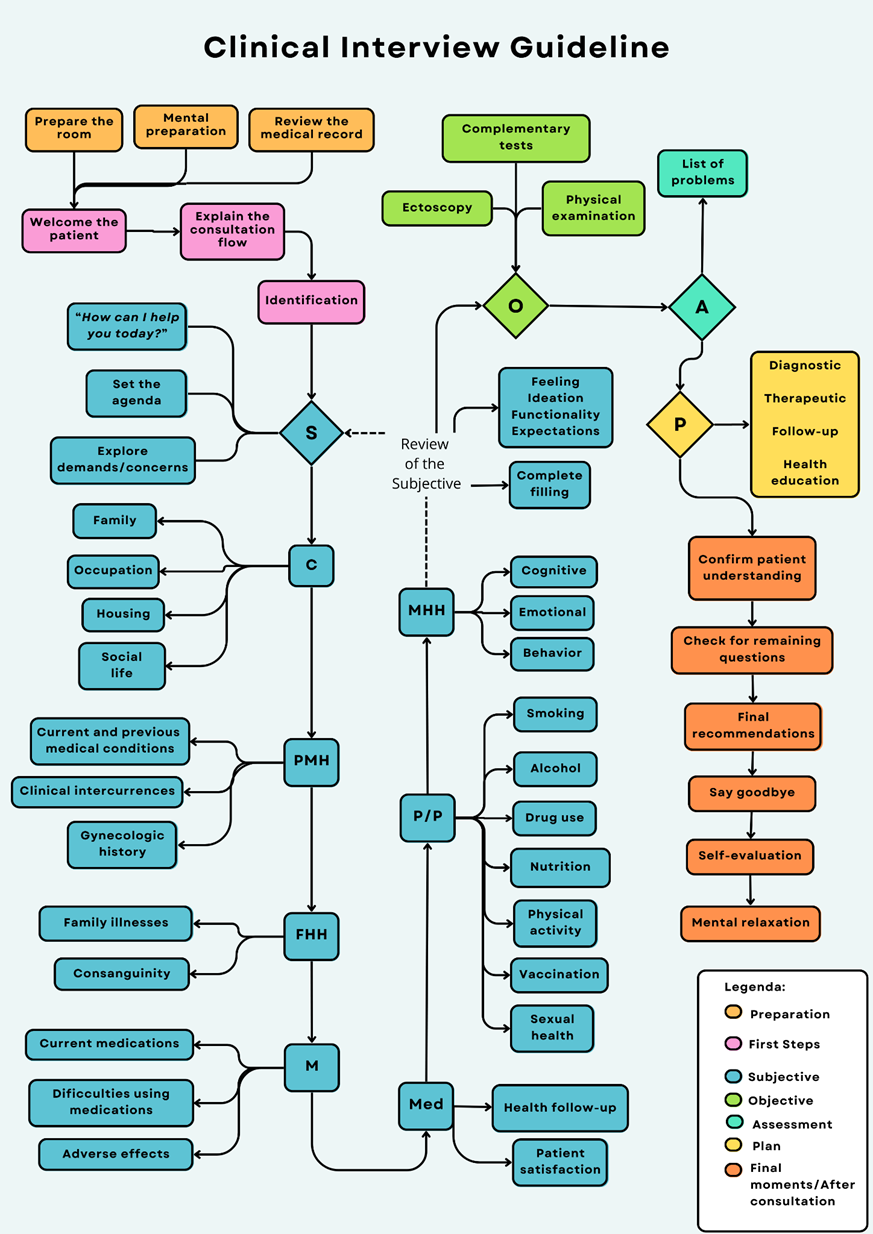
The visual guideline (Figure 1) outlined each step and its sequential progression and was maintained within the body of the article text for concision, allowing readers to reflect on the complexity and structure of this innovative clinical interview guideline. Also, Figure 2 highlights the cyclical and non-hierarchical nature of exploring the Subjective (S) section. Finally, Figures 3 and 4 present the topics and questions to be addressed in the Context (C) and Prevention/Promotion (P/P) sections (respectively) due to their richness and complexity.


Diagram of the topics to be explored in the Prevention/Promotion section, with assisting questions.
The interview guideline suggested that the consultation should start only when the interviewer is prepared, fostering the establishment of rapport and creation of a trust-based relationship with the patient. The interview is initially organized by listening to subjective demands (S)1, which allows exploring the life history of the patient. The history may include sociocultural context (C), previous medical history (PMH), family health history (FHH), medication use (M), follow-up by other professionals (Med), health promotion and disease prevention practices (P/P), and specific topics depending on the demand, such as mental health history (MHH) or gynecologic history (GH). Return to the initial subjective demand is the main element of the process (Figure 2), now based on a broader understanding of the patient and their context. This cyclical movement is initiated gradually and complemented in a second phase of the cycle after the rapport, enhancing the listening and understanding of the condition experienced beyond the immediate demands. In follow-up consultations, previously addressed demands can be revisited or further explored as needed (longitudinality).
The subjective section is complemented by objective data (O) obtained using ectoscopy, physical examination, and complementary tests, which allow for a comprehensive assessment (A) of the clinical condition and identification of a list of problems. After assessment, care plans (P) are structured, encompassing diagnosis, treatment, follow-up, and educational actions. The active participation of the patient is encouraged through the communication of findings and shared construction of clinical decisions, strengthening the relationship and ensuring greater adherence to the proposed strategies.
The conclusion of the consultation also follows a structured flow, including the clarification of any remaining questions, reinforcement of positive behaviors, and provision of final instructions. The interviewer should request feedback on the experience of the patient and reserve time for self-reflection and mental rest, promoting self-care practices between consultations. Chart 1 presents a visual summary of this process, including the consultation stages, guiding questions, and associated recommendations.
Medical students are encouraged to develop skills in time management, flexibility, and adaptability when formulating questions to succeed in constructing the clinical history. They are also instructed to ensure accurate documentation and maintain eye contact throughout the consultation. The longitudinal nature of care is highly valued since follow-up consultations play a key role in allowing the interviewer to revisit and complement clinical records and the list of problems while strengthening the patient-professional relationship. Therefore, interviewers do not need to collect all information during the first consultation since the patient history can be gradually constructed over subsequent consultations, allowing exploration of other topics that may be less accessible during the initial consultation.
This interview guideline aimed to promote a humanized approach to patient interaction, ensuring empathetic and logical progression through the various phases of the medical interview. Also, the guideline facilitates the development and effective application of clinical interview skills among medical students by integrating descriptive, summary, and visual modalities, fostering effective communication and a deeper understanding of patient needs. The goal was to prepare future physicians with the essential competencies to conduct medical interviews that not only collect relevant information but also build trust and empathy with patients.
This study presented a pedagogical proposal for teaching clinical interviews by using a structured guideline that can be adapted to various medical education contexts. The guideline may support student autonomy in conducting consultations and promote the development of competencies related to clinical communication, diagnostic reasoning, and humanization of care. Also, the structure of the guideline (based on PCCM, POMR, and 7SC frameworks) may contribute to a systematic and empathetic approach, enhancing medical record quality and strengthening the patient-professional relationship. The figures (especially Figure 1) should be used as a visual aid for students to avoid reading the guideline and losing eye contact with the patient, who is the focus during the consultation.
The guideline provides practical support for conducting the interview and a formative space for students to practice essential medical skills, such as active listening, perception of non-verbal signs, appropriate eye contact, and time management in clinical settings. Thus, it may contribute to the technical and ethical development of future professionals and is aligned with national curricular guidelines and principles of integrality and longitudinal care.
Further evaluation of the effectiveness of this guideline proposal is needed. In this sense, a study is being conducted with undergraduate students by using quantitative and qualitative methods to assess the applicability of the interview guideline and its perceived contribution to improving the quality of the consultation.
References
-
1 Brasil. Resolução nº 3, de 20 de junho de 2014. Institui Diretrizes Curriculares Nacionais do curso de graduação em Medicina e dá outras providências. Diário Oficial da União, Brasília, 23 jun 2014. Seção 1, p. 8-11 [acesso em 18 fev 2025]. Disponível em: Disponível em: https://www.gov.br/saude/pt-br/acesso-a-informacao/acoes-e-programas/pnsp/legislacao/resolucoes/rces003_14.pdf/view
» https://www.gov.br/saude/pt-br/acesso-a-informacao/acoes-e-programas/pnsp/legislacao/resolucoes/rces003_14.pdf/view -
2 Yu C, Xian Y, Jing T, Bai M, Li X, Li J, et al. More patient-centered care, better healthcare: the association between patient-centered care and healthcare outcomes in inpatients. Front Public Health. 2023;11:1148277. doi: https://doi.org/10.3389/fpubh.2023.1148277.
» https://doi.org/https://doi.org/10.3389/fpubh.2023.1148277 -
3 Giusti A, Pukrittayakamee P, Alarja G, Farrant L, Hunter J, Mzimkulu O, et al. Developing a global practice-based framework of person-centred care from primary data: a cross-national qualitative study with patients, caregivers and healthcare professionals. BMJ Glob Health. 2022 Jul;7(7):e008843. doi: https://doi.org/10.1136/bmjgh-2022-008843.
» https://doi.org/https://doi.org/10.1136/bmjgh-2022-008843 -
4 Guanais F, Doubova SV, Leslie HH, Perez-Cuevas R, Garcia-Elorrio E, Kruk ME. Patient-centered primary care and self-rated health in 6 Latin American and Caribbean countries: analysis of a public opinion cross-sectional survey. PLoS Med. 2018;15(10):e1002673. doi: https://doi.org/10.1371/journal.pmed.1002673.
» https://doi.org/https://doi.org/10.1371/journal.pmed.1002673 -
5 Barbosa MS, Ribeiro MMF. O método clínico centrado na pessoa na formação médica como ferramenta de promoção de saúde. Rev Med Minas Gerais. 2016;26(8):S216-S222 [acesso em 19 fev 2025]. Disponível em: Disponível em: https://www.rmmg.org/artigo/detalhes/2152
» https://www.rmmg.org/artigo/detalhes/2152 -
6 Ratanawongsa N, Federowicz MA, Christmas C, Hanyok LA, Record JD, Hellmann DB, et al. Effects of a focused patient-centered care curriculum on the experiences of internal medicine residents and their patients. J Gen Intern Med. 2012;27:473-7. doi: https://doi.org/10.1007/s11606-011-1881-8.
» https://doi.org/https://doi.org/10.1007/s11606-011-1881-8 -
7 Shah S, Andrades M, Basir F, Jaleel A, Azam I, Islam M, et al. Has the inclusion of a longitudinally integrated communication skills program improved consultation skills in medical students? A pilot study. J Family Med Prim Care. 2016;5(1): 45-50. doi: https://doi.org/10.4103/2249-4863.184622.
» https://doi.org/https://doi.org/10.4103/2249-4863.184622 -
8 Demarzo MMP, Almeida RCC de, Marins JJN, Trindade TGD da, Anderson MIP, Stein AT, et al. Diretrizes para o ensino na atenção primária à saúde na graduação em medicina. Rev Bras Educ Med. 2012;36(1):143-8. doi: https://doi.org/10.1590/S0100-55022012000100020.
» https://doi.org/https://doi.org/10.1590/S0100-55022012000100020 -
9 Bansal A, Greenley S, Mitchell C, Park S, Shearn K, Reeve J. Optimising planned medical education strategies to develop learners’ person‐centredness: a realist review. Med Educ. 2022;56(5):489-503. doi: https://doi.org/10.1111/medu.14707.
» https://doi.org/https://doi.org/10.1111/medu.14707 -
10 Oliveira SF, Cunha AJLA, Trajman A, Teixeira C, Gomes MK, Halfoun V. Percepção sobre o internato de medicina da Universidade Federal do Rio de Janeiro pelos preceptores do serviço na atenção básica: um estudo de caso. Rev Bras Educ Med . 2017;41(1):79-85. doi: https://doi.org/10.1590/1981-52712015v41n1RB20160031.
» https://doi.org/https://doi.org/10.1590/1981-52712015v41n1RB20160031 -
11 Neumann CR, Miranda CZ. Ensino de atenção primária à saúde na graduação: fatores que influenciam a satisfação do aluno. Rev Bras Educ Med . 2012;36:42-9. doi: https://doi.org/10.1590/S0100-55022012000300007.
» https://doi.org/https://doi.org/10.1590/S0100-55022012000300007 -
12 Castro RCLD, Knauth DR. Papel dos atributos dos profissionais médicos na produção da abordagem centrada na pessoa em atenção primária à saúde. Cienc Saude Colet 2022;27(2):803-12. doi: https://doi.org/10.1590/1413-81232022272.00392021.
» https://doi.org/https://doi.org/10.1590/1413-81232022272.00392021 -
13 Castro RCLD, Knauth DR. Associação entre a abordagem médica centrada na pessoa e a satisfação com a consulta em atenção primária à saúde. Rev Bras Med Fam Comunidade. 2021;16(43):2702. doi: https://doi.org/10.5712/rbmfc16(43)2702.
» https://doi.org/https://doi.org/10.5712/rbmfc16(43)2702 -
14 Costa GPO, Herculano TB, Gama ALH, Cabral RP, Campos DB, Oliveira DNSD. Enfrentamentos do estudante na iniciação da semiologia médica. Rev Bras Educ Med . 2018;42(2):79-88. doi: https://doi.org/10.1590/1981-52712015v42n2RB20170070.
» https://doi.org/https://doi.org/10.1590/1981-52712015v42n2RB20170070 -
15 Balduino PM, Palis FP, Paranaíba VF, Almeida HO, Trindade EMV. A perspectiva do paciente no roteiro de anamnese: o olhar do estudante. Rev Bras Educ Med . 2012;36(3):335-42. doi: https://doi.org/10.1590/S0100-55022012000500007.
» https://doi.org/https://doi.org/10.1590/S0100-55022012000500007 -
16 Soares MOM, Higa EFR, Passos AHR, Ikuno MRM, Bonifácio LA, Mestieri CP, et al. Reflexões contemporâneas sobre anamnese na visão do estudante de medicina. Rev Bras Educ Med . 2014;38:314-22. doi: https://doi.org/10.1590/S0100-55022014000300005.
» https://doi.org/https://doi.org/10.1590/S0100-55022014000300005 -
17 Brasil. e-SUS Atenção Primária à Saúde: Manual do Sistema com Prontuário Eletrônico do Cidadão PEC - versão 5.2. Brasília: Ministério da Saúde; 2023 [acesso em 20 fev 2025]. Disponível em: Disponível em: https://saps-ms.github.io/Manual-eSUS_APS/docs/PEC
» https://saps-ms.github.io/Manual-eSUS_APS/docs/PEC -
18 Weed LL. Medical records that guide and teach. N Engl J Med. 1968 Mar 14;278(11):593-600. doi: https://doi.org/10.1056/NEJM196803142781105.
» https://doi.org/https://doi.org/10.1056/NEJM196803142781105 -
19 Ramos V. A consulta em 7 passos. Execução e análise crítica de consultas em medicina geral e familiar. Revista Portuguesa de Medicina Geral e Familiar. 2009;25(2):208-20. doi: https://doi.org/10.32385/rpmgf.v25i2.10609.
» https://doi.org/https://doi.org/10.32385/rpmgf.v25i2.10609 -
20 Constand MK, MacDermid JC, Dal Bello-Haas V, Law M. Scoping review of patient-centered care approaches in healthcare. BMC Health Serv Res. 2014;14:271. Doi: https://doi.org/10.1186/1472-6963-14-271.
» https://doi.org/https://doi.org/10.1186/1472-6963-14-271 -
21 Leal EM, Souza AND, Serpa Júnior ODD, Oliveira ICD, Dahl CM, Figueiredo AC, et al. McGill Entrevista Narrativa de Adoecimento - MINI: tradução e adaptação transcultural para o português. Cienc Saude Coletiva. 2016;21(8):2393-402. doi: https://doi.org/10.1590/1413-81232015218.08612015.
» https://doi.org/https://doi.org/10.1590/1413-81232015218.08612015 -
22 Campos CFC, Rios IC. Qual guia de comunicação na consulta médica é o mais adequado para o ensino de habilidades comunicacionais na atenção primária à saúde brasileira? Rev Bras Educ Med . 2018;42(3):108-18. doi: https://doi.org/10.1590/1981-52712015v42n2RB20170138.
» https://doi.org/https://doi.org/10.1590/1981-52712015v42n2RB20170138 -
23 Abud CC, Zimmermann VB, Lucchese AC, Marco MAD. Metodologia de ensino em psicologia médica e atenção integral ao paciente. Rev Bras Educ Med . 2012;36(3):436-41. doi: https://doi.org/10.1590/S0100-55022012000500020.
» https://doi.org/https://doi.org/10.1590/S0100-55022012000500020 -
24 Wenceslau LD, Fonseca VKT da, Dutra L de A, Caldeira LG. Um roteiro de entrevista clínica centrada na pessoa para a graduação médica. Rev Bras Med Fam Comunidade . 2020;15(42):2154. doi: https://doi.org/10.5712/rbmfc15(42)2154.
» https://doi.org/https://doi.org/10.5712/rbmfc15(42)2154 -
25 Donnelly W. Patient-centered medical care requires a patient-centered medical record. Acad Med. 2005;80:33-8. doi: https://doi.org/10.1097/00001888-200501000-00009.
» https://doi.org/https://doi.org/10.1097/00001888-200501000-00009 -
26 França BCC, Figueiredo-Soares TD, Toledo Júnior AC, Souza NM, Faria RMDD. Validação de instrumento de registro do atendimento clínico centrado na pessoa. Rev Bras Educ Med . 2015;39(2):233-9. doi: https://doi.org/10.1590/1981-52712015v39n2e00862014.
» https://doi.org/https://doi.org/10.1590/1981-52712015v39n2e00862014 - 27 Fortin AH, Dwamena FC, Frankel RM, Smith RC. Smith’s patient centered interviewing: an evidence-based method. 4th ed. United States- New Haven, Connecticut: McGraw Hill LLC; 2018.
- 28 Carrió FB. Entrevista clínica: habilidades de comunicação para profissionais de saúde. Porto Alegre: Artmed; 2012. 346 p.
-
29 Smith M. The medical interview: the three-function approach. Yale J Biol Med. 1991;64(5):546-7 [acesso em 20 fev 2025]. Disponível em: Disponível em: https://pmc.ncbi.nlm.nih.gov/articles/PMC2589485/
» https://pmc.ncbi.nlm.nih.gov/articles/PMC2589485/ - 30 Ho Tam K. Learning communication skills in general practice: from self-directed, transformative learning to develop personal style. In: Çakmur H, organizer. Primary care medicine: theory and practice. Macau SAR, China: IntechOpen; 2023 [cited 2025 Feb 20]. Available from: https://www.intechopen.com/chapters/1150430.
- 31 Fine M. The Inner Consultation - how to develop an effective and intuitive consulting style (2e). Health Expect. 2005;8(4):362-3 [acesso em 20 fev 2025]. Disponível em: https://pmc.ncbi.nlm.nih.gov/articles/PMC5060308/.
- 32 Maldonado DC, Zúñiga C. SOAP for family medicine. Philadelphia, PA, USA: Blackwell; 2005.
-
33 Mehta R, Radhakrishnan NS, Warring CD, Jain A, Fuentes J, Dolganiuc A, et al. The use of evidence-based, problem oriented templates as a clinical decision support in an inpatient electronic health record system. Appl Clin Inform. 2016;7(1):15-27. doi: https://doi.org/10.4338/ACI-2015-11-RA-0164.
» https://doi.org/https://doi.org/10.4338/ACI-2015-11-RA-0164 -
34 Margolis CZ, Mendelssohn I, Barak N, Beinart T, Goldsmith JR. Increase in relevant data after introduction of a problem-oriented record system in primary pediatric care. Am J Public Health. 1984;74:1410-2. doi: https://doi.org/10.2105/AJPH.74.12.1410.
» https://doi.org/https://doi.org/10.2105/AJPH.74.12.1410 -
35 Sales ICB, Barros Filho EM, Oliveira CMC. Registro clínico baseado em problemas como instrumento para desenvolver competências em programa de residência médica. Rev Bras Educ Med . 2021;45(2):e052. doi: https://doi.org/10.1590/1981-5271v45.2-20200289.
» https://doi.org/https://doi.org/10.1590/1981-5271v45.2-20200289 -
36 Simons SMJ, Cillessen FHJM, Hazelzet JA. Determinants of a successful problem list to support the implementation of the problem-oriented medical record according to recent literature. BMC Med Inform Decis Mak. 2016;16:102. doi: https://doi.org/10.1186/s12911-016-0341-0.
» https://doi.org/https://doi.org/10.1186/s12911-016-0341-0 -
37 Benseñor IM. Anamnese, exame clínico e exames complementares como testes diagnósticos. Rev Med (São Paulo). 2013;92(4):236. doi: https://doi.org/10.11606/issn.1679-9836.v92i4p236-241.
» https://doi.org/https://doi.org/10.11606/issn.1679-9836.v92i4p236-241
Research data are available in the body of the document.

 Source: the authors.
 Source: the authors.
 Source: the authors.
 Source: the authors.