
 Expansion and changes in medical education in Brazil in the 20th and 21st centuries
ABSTRACT
Introduction: More than two centuries after the first medical courses were created, Brazil ranks second in the world for the number of medical schools in a scenario that continues to expand rapidly. At the same time, advances in technical and scientific knowledge in the area of biological and health sciences and reflections on the professionalization of teaching have led to changes in teaching, with emphasis on the use of active methods, basic-clinical integration, multi-professional training, university extension, attention to the local-regional context and the incorporation of ethical, humanistic and scientific reflections related to the health not only of each individual but also of the community and the entire planet.
Development: This essay reflects on the changes in medical education in Brazil in the 20th and 21st centuries, with emphasis on the expansion of medical schools, the main policies inducing change, the democratization of access to medical education, pedagogical innovations and the challenges for the future.
Conclusion: Despite the inducing policies and changes over the last few decades, most Brazilian medical courses have failed to professionalize teaching, with few initiatives to invest in new technologies and continuing teacher training. Thus, in view of the technological, digital and educational revolution that the whole world has been going through, although the trend for the future of medical education in Brazil is promising, its success is dependent on urgent changes in the infrastructure of teaching and learning scenarios, in the organization of curricula and in the continuing training of teachers with institutional support.
Keywords:
Medical education; History of medicine; Higher education
RESUMO
Introdução: Mais de dois séculos após a criação dos primeiros cursos de Medicina, o Brasil ocupa a segunda posição mundial em número de escolas médicas, em um cenário que segue em expansão acelerada. Ao mesmo tempo, o avanço no conhecimento técnico e científico na área de ciências biológicas e da saúde e as reflexões acerca da profissionalização da docência têm induzido mudanças no ensino, com destaque para o uso de métodos ativos, a integração básico-clínica, a formação multiprofissional, a extensão universitária, a atenção ao contexto locorregional e a incorporação de reflexões éticas, humanísticas e científicas e relacionadas à saúde não só de cada indivíduo, mas também da coletividade e de todo o planeta.
Desenvolvimento: Este ensaio reflete sobre as mudanças no ensino de medicina no Brasil nos séculos XX e XXI, com destaque para a expansão das escolas médicas, as principais políticas indutoras de mudanças, a democratização do acesso ao ensino de medicina, as inovações pedagógicas e os desafios para o futuro.
Conclusão: Apesar das políticas indutoras e das mudanças ao longo das últimas décadas, a maioria dos cursos de Medicina brasileiros tem falhado em profissionalizar o exercício da docência, com poucas iniciativas de investimentos nas novas tecnologias e na formação continuada dos professores. Dessa forma, tendo em vista a revolução tecnológica, digital e educacional que o mundo todo tem atravessado, embora a tendência para o futuro do ensino de medicina no Brasil seja promissora, o sucesso deste está condicionado a mudanças urgentes na infraestrutura dos cenários de ensino e aprendizagem, na organização dos currículos e na formação continuada de professores com apoio institucional.
Palavras-chave:
Educação Médica; História da Medicina; Ensino Superior
INTRODUCTION
More than two centuries after the first medical courses were created, Brazil ranks second in the world for the number of medical schools, in a scenario that continues to expand rapidly due to public policies that have encouraged the opening of new courses, especially in regions with a short supply of doctors and health services1. Recent decades have also seen unprecedented advances in scientific knowledge, techniques and technologies applied to medical education and practice. This progress has led to a reorientation of teaching-learning processes and educational infrastructure, imposing new challenges for managers and educators linked to educational institutions and the various practice scenarios, such as, for example, teaching hospitals and basic health units.
In this context, the curricula of medical courses in Brazil have been progressively geared towards valuing the competencies and skills that are essential for practising the profession today. Among the priorities are the use of active teaching methods, basic-clinical integration, multi-professional training, university outreach programs, attention to the local-regional context and the incorporation of ethical, humanistic and scientific reflections related to planetary health. It is therefore hoped that medical training will go beyond technical mastery of the health-disease process, also promoting the development of skills such as adaptability, communication, empathy, leadership, critical and creative thinking, systemic vision, time management and critical analysis of information.
DEVELOPMENT
How did Brazil begin the 20th century with three medical schools and become the country with the second largest number of courses in the world?
From just three schools in 1910, in 2025 Brazil has around 400, trailing only India2, which has a population that is six times greater. Although the numerical increase has been continuous, it has not been linear, but marked by booms in specific periods, as a consequence of political and socio-economic scenarios3.
The factors associated with the expansion of medical education in the 20th century include population growth, the urbanisation process, advances in technical and scientific knowledge in the biological and health sciences, and inductive policies. Between 1872 and 2025, Brazil’s population grew from around 10 million to over 200 million4. Furthermore, the 20th century saw a real reversal in the place of residence of the Brazilian population, which left the countryside and increasingly moved to the cities. Between 1940 and 1980, the urbanisation rate in Brazil rose from 26% to 69%, and in the first quarter of the 21st century it has already surpassed 80%5.
The significant advance of technical and scientific knowledge in the 20th century had an important impact on public health and led to changes in teaching. Although mortality from infectious and parasitic diseases has declined considerably since the 1940s, there has been an unprecedented increase in the rate of diseases related to the urbanisation process and changes in labour relations, such as those associated with poverty, social exclusion, ageing, obesity and chronic non-communicable diseases6.
In the first half of the 20th century, the new medical courses authorised in Brazil were audited by the federal government and maintained their elitist and centralising characteristics, guided by Decree 11.530 of 18 March 1915 and Decree 20.179 of 6 June 1931. By the end of the 1940s there were 13 medical schools in the country, all public and located in the capital cities.
The 1946 constitution led to discussions that consolidated the understanding that education is a universal right. These discussions led President João Goulart to decree the first National Education Guidelines and Bases Law (LDB) in 1961, which, among other measures, guaranteed the freedom of private initiative to provide education at all levels. As a result of the new constitution, the LDB and the movement to expand medical schools, 14 new courses were created in the 1950s, 4 of them private, and 41 in the 1960s, 25 of them private7, meaning that in 20 years the number of medical courses in Brazil jumped from 13 to 68, an increase of more than 500%.
From the 1950s onwards, the growth of the youth population, combined with greater access to schools, meant that the number of students achieving the average grades required to enter universities was five times greater than the number of places available, generating intense social pressure to expand the university network8. Around the same period, faced with the recognised national shortage of health professionals and Brazil’s accelerated industrialisation and urbanization9, concerns emerged regarding the health of the working class, an essential driving force to ensure the nation’s economic progress. Thus, legal measures stimulated the first major expansion of medical schools in the country8),(10.
As a result, new courses were opened in a disorderly fashion and in 1973 the Brazilian Ministry of Education and Culture restricted the opening of new courses until the existing ones had been assessed and a proposal made to homogenise training between them. In the 25 years that followed, only 10 new courses were authorised in the country11.
In 1988, the promulgation of the new Brazilian constitution, enshrining health as a right of the population and a duty of the state12, paved the way for the implementation of the current national health system, called the “Unified Health System” (SUS)13. With the principles of universality, equity and comprehensive healthcare for the population laid down by the SUS14, it became necessary to increase the number of doctors, leading to the second peak in the expansion of courses in the country. From 1997 to 2008, 93 new courses were created15.
Despite this growth in medical schools, in 2013 the ratio of doctors to inhabitants was 1.9/1000, short of the government target of 2.7/1000. In an effort to make up for this shortage of professionals, the More Doctors Programme (Programa Mais Médicos) was created with three lines of action: 1. emergency supply of professionals, 2. infrastructure and 3. Medical training16. The “emergency provision” front selected professionals with degrees from Brazil and abroad to work in the neediest areas. The “infrastructure” part expanded funding for the construction of new basic care units and the expansion of existing ones. Finally, the “medical training” line authorised the creation of new medical schools and additional places on existing courses. From 2013 to the present day, the biggest boom in medical education has been witnessed in Brazil, with more than 150 new schools created and more than 20,000 vacancies for new students1.
Two other phenomena developed in step with the growth of Brazilian medical courses: the privatisation of training, and its shift away from the big cities. Since the foundation of the first public school in 1951, the expansion of the private network has been encouraged by a variety of measures including: government tax incentives (at federal, state and municipal level); funding and scholarships for needy students; loans from the National Bank for Economic and Social Development (BNDES) for adjustments to physical structures; and recommendations for partnerships with existing health establishments, without the need for costly construction of teaching hospitals by educational institutions1.
In the 1980s, the proportion of private medical schools overtook that of public schools and has been on the rise ever since. Currently, 77% of the total number of places offered for medical training belong to the 268 private courses and less than a quarter to the 121 public schools. It is noteworthy that another important incentive for the privatisation of medical education is the profitability for the entrepreneurs. In addition to the income from the high tuition fees paid by students, the expansion of courses boosts other strategic businesses that exploit the medical training market1.
In order to reduce the inequality of access to health services due to the concentration of professionals and medical schools in large urban centres, the government has, in recent decades, been incentivizing medical courses to break into the interior of the country. As of 2018, the total number of vacancies in the interior exceeded those in the capitals plus the metropolitan regions, reaching 52.9% of the total number of vacancies for medical training in Brazil by 20221.
Interestingly, the expansion, shift to the interior and privatisation of medical courses in Brazil has, over the last 20 years, led to an equalisation of the rate of medical undergraduate places per 100,000 inhabitants in all regions of the country. Currently, this rate is 18.15 in the Northeast, 20.77 in the Centre-West, 20.2 in the North, 20.44 in the Southeast and 18.94 in the South1.
How have the international context and public educational and health policies influenced the construction of the curriculum guidelines for medical courses in Brazil?
Throughout the 19th century, the pedagogical model of medical education in Brazil was marked by French academicism and research by the German school17, having been replaced, from the 20th century onwards, by the American model based on the postulates of the Flexner report18.
The creation of medical schools based on university structures, the implementation of a selection process for student admission, the construction of equipped laboratories, the replacement of core professorship subjects with departments, the segmentation of the course into a basic cycle and a professional cycle, the creation of teaching hospitals, the integration of teaching and research and the implementation of medical residency are examples of the Flexnerian paradigms adopted by Brazilian medical education, especially after the 1940s19.
Despite the recognised importance of Flexner’s ideas in the process of regulation and scientific development of medical schools, his emphasis on mechanicism, biologicism, the uniqueness of diseases, early specialisation and hospital-based, curative and individual medical care raised questions about the professionals who would be trained, since it contradicted the new global conceptions of the mid-century about the importance of biopsychosocial factors in the health-disease process and the need for basic care with the incorporation of collective prevention and health promotion practices, in addition to purely curative and individual approaches19.
In Brazil, from the 1960s onwards, and more intensely after the creation of the SUS, joint actions by the Ministries of Health and Education emphasised the importance of organising medical education with a focus on interdisciplinarity, basic health care and generalist and humanist training20, setting a new course for national medical education, consolidated in 2001 with the publication of the first National Curriculum Guidelines for Medical Courses (DCN) and reaffirmed in 2014 with the publication of the new DCNs.
Currently, all Brazilian medical schools follow the new DCNs, although the curriculum may vary. The programmes include a minimum of 7,200 hours of training over six years, at least two of which (called internships) are in-service training under the supervision of teachers, with at least 30% of their total workload dedicated to primary care and urgent and emergency care. The teaching of basic sciences is contextualised to practice (real or simulated), and practical skills training takes place in outpatient clinics and hospitals. Theoretical-practical knowledge should be centred on active methodologies and follow a “spiralling” trajectory, in which from the first years of undergraduate studies, students interact with professionals and users of health services, having opportunities to associate theoretical content with that absorbed in practice, building autonomy, capacity for reflection and meaningful learning21. This curricular proposal seeks to ensure that newly graduated medics are competent for immediate professional work, removing the obligation to specialise, although this has been encouraged and expanded in the area of Family Health.
For those who opt to do a specialisation, there are three possibilities: i) medical residency programmes, like the American model22, regulated by the Ministry of Education; ii) specialisation programmes, like the Taiwanese model23, with criteria approved by the Scientific Council of the Brazilian Medical Association (AMB); iii) exams administered by the AMB to obtain the title of specialist, similar to the German model24. While the duration of residency and specialisation varies between two and six years, depending on the speciality, a minimum of five years’ prior training, supervised by specialists, is required of the professional before they can take the exams to obtain the title.
The selection process to enter the Medical Residency or Specialisation includes a written test on basic areas of activity (Internal Medicine, Paediatrics, Surgery, Gynaecology and Obstetrics, Family Medicine and Public Health), and may also involve CV analysis and interview. The use of oral or performance tests is uncommon.
How is Brazil progressing in democratising access to medical education?
The public debate on access to higher education has gained importance in Brazil and has encouraged the adoption of inclusion policies based on affirmative action, including government or institutional resolutions. These policies aim to benefit minorities who are historic victims of discrimination, especially blacks, indigenous people, people on low incomes and people with disabilities.
Since 2012, as determined by Law No. 12.711/2012, 50% of the places at universities and federal institutes of education are reserved for students who completed their basic education in public schools, with the aim of minimising the inequality of access to university education in the country. Places are distributed in sub-groups that take into account criteria such as low income, students who self-declare as black, brown or indigenous and candidates with disabilities. Even before the so-called “Quota Law”, admission policies were already in place at various institutions, which, supported by state laws, adopted a percentage reservation for students who attended public schools from 2002 onwards. In 2004, the University of Brasilia was the first federal university to adopt similar affirmative action. The approval of the quota law at the federal level had repercussions for many educational institutions that were not required by law to offer quotas, but which began to adopt affirmative entry policies, thus expanding the number of places on offer to those who would qualify through quotas25.
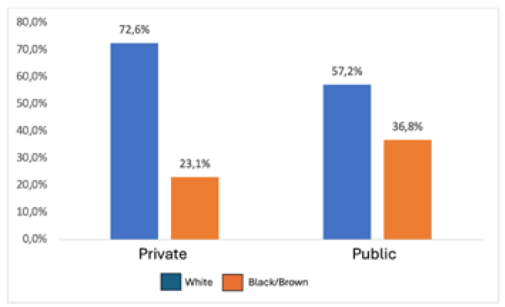
The implementation of bonus and place reservation systems has had a significant impact on the profile of Brazilian university students. The following graphs show data on students who were completing medical courses, and it is possible to observe the progressive increase in students who self-declared as black or brown completing medical courses, particularly in public institutions, between 2013 and 201926.


Self-declared colour or race of students graduating in medicine by type of institution - public or private in 2013 and 2019.
Affirmative action has also been adopted to meet the demands of indigenous movements and guarantee access to medical schools for this population. Currently 43 courses at public institutions have indigenous students. There are several positive aspects about this experience, including the contribution to transformations in medical education and opening up a space for roles in the academic, scientific and political environment27.
As well as acting to democratise access to places in higher education, it is also essential to adopt measures to help students stay in and complete their courses. Evaluations of dropout rates show that dropout among quota students was lower or similar to rates among non-quota students, demonstrating the success of these measures.
As for the quality of students’ training, Brazil has adopted the ENADE - National Student Performance Examinations - since 2004 to assess university students, and specifically for the Medicine course since 2025 the exam has been called ENAMED - National Exam for the Assessment of Medical Education. The ENADE results obtained in recent years show that the average marks varied between quota and non-quota students by between 5% and 10%, a statistically close figure25.
Currently, 73.8% of the places available on medical courses in Brazil are in the private sector and the financial cost of tuition is high for the Brazilian reality. Government programmes such as FIES and PROUNI help students to stay on private courses FIES, the Higher Education Student Financing Fund, offers financing to higher education students enrolled on courses that have received good evaluations from the Ministry of Education, and PROUNI - the University for All Programme, awards partial and full scholarships, encouraging institutional participation through tax exemptions. Both programmes have a positive impact on access to private education: in 2014, 35% of private higher education places were taken up through this type of funding28.
How are women gaining a foothold in medicine in Brazil?
The history of female participation in medical courses in Brazil begins in the 19th century, when women were seen as incapable of formally exercising professions in scientific areas and did not have access to university courses. Some pioneers endeavoured to courageously break down barriers, earning the title of doctor. Maria Augusta Generoso Estrela and Rita Lobato Velho Homem were the first Brazilian women to graduate in medicine. Maria Augusta Estrela studied abroad, as Brazilian universities still refused to accept women. She graduated in 1879 and is currently the Patroness of the São Paulo Academy of Medicine29. The year of her graduation was a historic milestone in the conquest of female space in universities, as it marked the moment when women were given the right to attend higher education courses, including medicine, enabling Rita Lobato to become the first Brazilian woman to graduate in medicine in Brazil. Another important figure was Maria Odília Teixeira, the first black woman to graduate in medicine in Brazil in 1909. As well as being a pioneer for an unprecedented achievement for her race, Maria Odília also became an example for all women by becoming the first black professor at the Faculty of Medicine in Bahia30.
These pioneers, examples of courage and persistence, paved the way for Brazilian women who have been gaining ground in the profession for decades. The participation of women, which began timid, with little representation, has gradually grown and is currently gaining unprecedented prominence in Brazil’s history.
According to the demographic data survey conducted by the Federal Council of Medicine, although men are still the majority of practising professionals in the country, the number of women entering medical courses has increased progressively, particularly since 2009, when women became the majority. In 2000, women accounted for 44% and men 56% respectively. In 2009, 50.4% were women and 49.6% men. Since then, women have represented the majority of medical graduates in the country: in 2019, of the 21,941 new doctors in Brazil, 57.5% were women26.
Despite the ongoing feminisation of medicine, there remain identifiable barriers to women’s professional progress. The structure of medical training requires a great deal of time and effort, from entering undergraduate courses to medical residency and postgraduate studies. It is in this context that women who choose medicine as a profession are faced with dilemmas common to their gender, such as the choice of motherhood and dedication to family and profession. In the case of a medical student, the challenges will be great and the need for a support network that includes the participation of family, friends and institutions stands out.
The selection criteria for medical residency programmes and other types of postgraduate studies are extremely demanding and, despite not being an explicit criterion, let alone a legal one, maternity can be the first factor in cutting off candidates for places and scholarships and one consequence is the discrepancy in the presence of women in certain specialities, especially surgical ones. The small representation of women on the teaching staff of specialities considered “male” exacerbates this situation, as female doctors are unlikely to find a tutor or advisor to encourage them. This marks the importance of the presence of women in academic positions, both teaching and administrative, helping to break down ingrained gender stereotypes in medical culture31.
Despite the fact that we are witnessing a moment that is not yet ideal, society is experiencing a significant transition in medical history and, in this context, medical schools have a fundamental role to play. Creating opportunities for discussion among the students, managers and teachers, as well as affirmative policies that support women in their student careers, can significantly contribute to achieving gender equity in medical education in Brazil32.
How are medical schools in Brazil adapting to pedagogical and technological innovations in the 21st century?
Medical education is facing the great challenge of adapting to the transformations we are witnessing in the first decades of the 21st century, in a dynamic and constantly evolving scenario. Changes in individual and collective health needs, technological advances, the growing amount of scientific information and changes in health care scenarios require institutions, teachers and students to work together to meet the needs of this new stage. Brazil has been adopting measures to encourage this adaptation, both on the initiative of medical schools and the Brazilian Association of Medical Education (ABEM), as well as government directives.
All courses in the country, whether public or private, have their curricular matrices steered by the National Curriculum Guidelines. The guidelines for the course structure include, notably from a didactic point of view, some that are especially in line with these needs, such as the adoption of teaching methods that support the student’s active participation in knowledge construction, content integration and the early introduction of the student to practical activities relevant to their future professional life.
A student-centred approach and their active participation in the teaching and learning process is currently fundamental to their adequate training. The application of active teaching methods fulfils these premises and the guidelines contained in the curriculum encourage courses to adopt this type of practice. The range of courses on offer in Brazil includes a variety of methods. There are courses that still favour lectures, as well as those that prioritise the adoption of active teaching methods in all or part of the curriculum.
According to the DCNs, in addition to the use of active methods, medical courses must have teacher development and improvement programmes. Teaching on a medical course has always been a challenge because it requires a professional who combines knowledge of the medical field with didactic and pedagogical skills. To meet these expectations, teachers must be able to convey knowledge clearly and objectively, create a stimulating learning environment and be prepared to guide students in practical activities, both in laboratories and in a variety of teaching scenarios in the health area. The guidelines advise on the creation of programmes that encourage teacher training and the development of centres that stimulate the development of the teaching staff’s educational competencies, thus contributing to the constant updating of medical school teaching staff.
More than 60 years since it was founded, ABEM - the Brazilian Association of Medical Education - has played a key role in the development of medical education in Brazil. Its mission is to develop medical education. Among its activities, it organises courses and congresses, encourages the training of tutors, maintains publications and information repositories and promotes student and institutional evaluation processes. It has a national reach and promotes pedagogical improvement in medical training33.
Both in Brazil and around the world, the role of the education system has been questioned, and a reorganisation of the pillars of knowledge is necessary, and it is up to medical courses to adapt to this new reality. An analysis of Brazilian medical schools reveals that most of the courses evaluated (80.7%) are at advanced or innovative levels of curricular structure34. These results point to a tendency for Brazil’s medical courses to adapt to the current situation, a fundamental factor if the country is to be ready to face the coming decades, absorb the use of technologies, adapt to the acceleration of the digital age and train professionals with competences suited to the 21st century from both a humanistic and technical point of view.
What is the impact of educational policies on access to health services in Brazil?
A major global obstacle to universal health coverage is undoubtedly the unequal geographical distribution of doctors, with a greater concentration in urban centres to the detriment of rural communities35. Brazil is no exception to this rule and the situation is exacerbated by its vast territory and the socio-economic, cultural and epidemiological differences between its regions1),(36.
Following the example of other countries37, measures such as expanding the number of undergraduate places and opening schools outside the capitals, democratising education with policies to include historically discriminated minorities and adopting educational policies aimed at training generalist, humanist professionals who are able to work in primary and emergency care immediately after graduation have been advocated nationally, with the aim of promoting equal access to health services for all citizens.
Although the effects of these measures may take time to manifest themselves and more robust studies will only be possible in the future to assess their real results for society, preliminary analyses point to positive impacts. Recently, there has been a 65% increase in the density of doctors per inhabitant in municipalities in the interior of the country1, in addition to the finding that approximately 60% of doctors working in the poorest regions are graduates who have benefited in some way from public policies to democratise education. It is also important to emphasise the association between training in medical schools located in smaller cities and the work of graduates in primary health care in remote areas and in municipalities with fewer than 20,000 inhabitants38.
CONCLUSION
Understanding the changes of the past and the challenges of the present allows us to reflect on what to expect from the future of medical education in Brazil. In 2020 the global COVID-19 pandemic changed the dynamics of teaching around the world due to the need for social isolation, giving new meaning to the use of simulators and resources associated with information and communication technologies, which have become widespread as tools to optimise teaching and learning39. In medical education it was no different, teachers and students were instructed to use virtual learning environments to discuss theoretical content and to conduct assessments, accelerating the inclusion of these technologies in their teaching practices. However, although some positive experiences should remain in the post-pandemic period, others should be rejected, because due to the need to contain the contagious nature of the disease, the opportunity for students to gain experience in clinical settings was temporarily limited, negatively impacting the acquisition of procedural and attitudinal skills desired for medical practice40.
The hybrid teaching model, whereby virtual learning environments are used in parallel with face-to-face activities, is currently a trend and should be consolidated in the future, as well as the use of resources arising from the popularisation of technologies and the internet, such as virtual libraries and laboratories, online assessment forms and the use of simulators and applications associated with artificial intelligence41. In addition, medical schools in Brazil, where the lecture method still predominates, have been encouraged to diversify their dynamics and value the adoption of active student-centred methods, such as, for example, problem-based, team-based and peer learning, design thinking and flipped classroom42.
Breaking with the Flexnerian model, based on isolated disciplines and the fragmentation of the teaching process, the future points to flexible curricula for medical courses, which value inter- and transdisciplinary activities, the integration of content, community outreach activities, the expansion of practice scenarios and the inclusion of disciplines that discuss ethics and humanities43.
The current Curriculum Guidelines for undergraduate medical programmes in Brazil state that medical graduates should have:
[...] a general, humanist, critical, reflective and ethical training, with the capacity to act at the different levels of health care, with actions to promote, prevent, recover and rehabilitate health, in the individual and collective spheres, with social responsibility and commitment to the defence of citizenship, human dignity, the integral health of the human being and always having the social determination of the health and disease process as transversal in their practice. 21
In order to comply with the current guidelines, modernise teaching practices and prepare teaching spaces to accommodate both new technologies and active teaching methods, Brazilian medical schools need continuing training programmes for teachers and managers, which update them and allow them to reflect on teaching practice, as well as policies for investing in infrastructure and valuing teaching careers so that they are stimulating to retain good professionals, whether they are doctors or professionals in the basic areas of the health sciences.
We must emphasise, however, that the majority of courses in Brazil do not currently encourage people to enter and stay in teaching, offering unattractive salaries when compared to the earnings obtained from practising the medical profession outside academia, and with few initiatives to invest in new technologies and continuing training for teachers. Thus, in view of the technological, digital and educational revolution that the whole world has been undergoing, although the trend for the future of medical education in Brazil is promising, its success is dependent on changes that need to be made from the present time onwards.
References
- 1 Scheffer M, Guilloux AGA, Miotto BA, Almeida C, Guerra A, Cassenote A, et al. Demografia médica no Brasil 2023. São Paulo: FMUSP, AMB; 2023.
- 2 Supe A. NEET: India’s single exam for admission to medical school promises transparency and quality. BMJ. 2016;354:i4051.
- 3 Lopes AC. A explosão numérica das escolas médicas brasileiras. Educ Med. 2018;19:19-24.
- 4 Instituto Brasileiro de Geografia e Estatística. Censo Demográfico 2010: características gerais dos indígenas - resultado do universo. Rio de Janeiro: IBGE; 2012.
- 5 Santos M. A urbanização brasileira. 5a ed. São Paulo: Edusp; 2008.
- 6 Duarte EC, Barreto SM. Transição demográfica e epidemiológica: a epidemiologia e serviços de saúde revisita e atualiza o tema. Epidemiologia e Serviços de Saúde. 2012;21(4):529-32.
- 7 Batista NA, Vilela RQB, Batista, SHSS. Educação médica no Brasil. São Paulo: Cortez; 2015.
- 8 Braghini KMZ. A história dos estudantes “excedentes” nos anos 1960: a superlotação das universidades e um torvelinho de situações improvisadas. Educar em Revista. 2014;51:123-44.
- 9 Hadda AE, Morita MC, Pierantoni CR, Brenelli SL, Passarella T, Campos FE. Formação de profissionais de saúde no Brasil: uma análise no período de 1991 a 2008. Rev Saude Publica. 2010; 44:383-93.
-
10 Nassif ACN. Placar de criação das escolas médicas no Brasil. Curitiba: CRM-PR; 2008 [acesso em 1 de dezembro de 2025]. Disponível em: Disponível em: http://www.escolasmedicas.com.br/index.php
» http://www.escolasmedicas.com.br/index.php -
11 Bueno RDRL, Pieruccini MC. Abertura de escolas de medicina no Brasil: relatório de um cenário sombrio. 2a ed. Brasília: AMB, CFM; 2005 [acesso em 1 de dezembro de 2025]. Disponível em: Disponível em: https://l1nq.com/oAkpt
» https://l1nq.com/oAkpt - 12 Brasil. Constituição da República Federativa do Brasil. Brasília: Senado Federal; 1988.
- 13 Amaral JL. O exame terminal salvaguarda a medicina. São Paulo Med J. 2016;682(1):16-7.
- 14 Paim JS. O que é o SUS. Rio de Janeiro: Fiocruz; 2015.
- 15 Sampaio de Carvalho M, de Sousa MF. Como o Brasil tem enfrentado o tema provimento de médicos? Interface. 2013;17(47):913-26.
- 16 Pinto HA, Sales MJT, Oliveira FPD, Brizolara R, Figueiredo AMD, Santos JTD. O Programa Mais Médicos e o fortalecimento da atenção básica. Divulg Saúde Debate. 2014;51:105-20.
- 17 Gonçalves MB, Benevides-Pereira AMT. Considerações sobre o ensino médico no Brasil: consequências afetivo-emocionais nos estudantes. Rev Bras Educ Med . 2009;33(3):482-93.
- 18 Flexner A. Medical education in the United States and Canada. From the Carnegie Foundation for the Advancement of Teaching. Bulletin of the World Health Organization. 1910;80(7):594-602.
- 19 González AD, Almeida MJ. Integralidade da saúde: norteando mudanças na graduação dos novos profissionais. Cienc Saude Colet. 2010;15(3):757-762.
- 20 Lampert JB, Costa NMSC, Perim GL, Abdalla IG, Aguilar-da-Silva RH, Stella RCR. Tendências de mudanças em um grupo de escolas médicas brasileiras. Rev Bras Educ Med . 2009; 33(1):19-34.
- 21 Brasil. Resolução CNE/CES nº 3, de 20 de junho de 2014. Institui as Diretrizes Curriculares Nacionais do Curso de Graduação em Medicina e dá outras providências. Diário Oficial da União; 23 jun 2014.
- 22 Dezee KJ, Artino AR, Elnicki DM, Hemmer PA, Durning SJ. Medical education in the United States of America. Med Teach. 2012;34(7):521-5.
- 23 Chou JY, Chiu CH, Lai E, Tsai D, Tzeng CR. Medical education in Taiwan. Med Teach . 2012;34:187-91.
- 24 Nikendei C, Weyrich P, Jünger J, Schrauth M. Medical education in Germany. Med Teach . 2009; 31(7):591-600.
- 25 Guimarães EDF, Zelaya M. A política de cotas raciais nas universidades públicas do Brasil duas décadas depois: uma análise. Trabalho & Educação. 2022;30(3):133-48.
- 26 Scheffer M, Cassenote A, Guerra A, Guilloux A, Brandão A, Miotto B, et al. Demografia médica no Brasil 2020. São Paulo: Departamento de Medicina Preventiva da Faculdade de Medicina da USP; 2020.
- 27 Luna WF, Teixeira KC, Lima GK. Mapeamento e experiências de indígenas nas escolas médicas federais brasileiras: acesso e políticas de permanência. Interface . 2021;25:e200621.
- 28 Nassar IM, Couto MHDC, Pereira Júnior GA. Financiamento público (Fies e Prouni) para o ensino de medicina no brasil: uma revisão da literatura e as distorções criadas. Educação em Revista. 2021;37:e25246.
-
29 Academia de Medicina de São Paulo. Biografias do acadêmico Helio Begliomini. AMSP; 2025 [acesso em 1 de dezembro de 2025]. Disponível em: Disponível em: https://www.academiamedicinasaopaulo.org.br/?pg=download&acao=1&id=91&biografia=Maria%20Augusta%20Generoso%20Estrela#gsc.tab=0
» https://www.academiamedicinasaopaulo.org.br/?pg=download&acao=1&id=91&biografia=Maria%20Augusta%20Generoso%20Estrela#gsc.tab=0 - 30 Santos MPJ. Maria Odília Teixeira: a primeira médica negra da Faculdade de Medicina da Bahia (1884-1937) [dissertação]. Salvador: Universidade Federal da Bahia; 2019.
- 31 Ávila RC. Formação das mulheres nas escolas de medicina. Rev Bras Educ Med . 2014;38:142-49.
- 32 Reigada CLL, Oliveira DOPS, Carrijo APB, Chueiri PS, Moherdaui JH, Albuquerque N P. Liderança feminina: relato do primeiro encontro de mulheres Médicas de Família e Comunidade do Brasil. Saúde em Debate. 2021;45(1):212-23.
- 33 Nemi A, Santos IV, Almeida TA. A educação médica e a arena política: os 60 anos da ABEM. Brasília: Associação Brasileira de Educação Médica; 2022.
- 34 Aguilar-da-Silva RH, Perim GL, Abdalla IG, Costa NMSC, Lampert JB, Stella RCR. Abordagens pedagógicas e tendências de mudanças nas escolas médicas. Rev BrasEduc Med . 2009; 33(1):53-62.
- 35 Dussault G, Franceschini MC. Not enough there, too many here: understanding geographical imbalances in the distribution of the health workforce. Hum Resour Health. 2006;4:12.
- 36 Figueiredo AM, Lima KC de, McKinley DW, Carmen JGM del, Azevedo GD. Impact of educational policies on access to health care in Brazil. A cross-sectional study. Med Educ. 2023; 57(6):587-94.
- 37 Garces LM, Mickey-Pabello D. Racial diversity in the medical profession: the impact of affirmative action bans on underrepresented student of color matriculation in medical schools. J Higher Educ. 2015;86(2):264-94.
- 38 Figueiredo AM, McKinley DW, Lima KC, Azevedo GD. Medical scholl expansion policies: educational access and physician distribuition. Med Educ . 2019:53(11):1121-31.
- 39 Coelho BM, Meira EB, Araújo LS, Araújo PTF, Tenisi SS, Santos AC, et al. O impacto da pandemia da covid-19 na formação médica: uma revisão integrativa. Revista Ibero-Americana de Humanidades, Ciências e Educação. 2021;7(12):522-45.
- 40 Papapanou M, Routsi E, Tsamakis K, Fotis L, Marinos G, Lidoriki I, et al. Medical education challenges and innovations during covid-19 pandemic. Postgrad Med J. 2022;98(1159):321-7.
- 41 Lobo LC. Inteligência artificial, o futuro da medicina e a educação médica. Rev Bras Educ Med . 2018;42(3):3-8.
- 42 Moura HFN, Oliveira, LAB, Venosa AR, Lourenço LHM, Baroneza JE. Uma estratégia para avaliação da percepção de docentes e discentes acerca dos métodos de ensino. Rev Bras Educ Med . 2022;46(2):e088.
- 43 Machado CDB, Wuo A, Heinzle M. Educação médica no Brasil: uma análise histórica sobre a formação acadêmica e pedagógica. Rev Bras Educ Med . 2018;42(2):66-73.
Research data is available in the body of the document.

 Source: the authors, 2025.
 Source: the authors, 2025.