 DESIGN AND PARAMETER OPTIMIZATION OF A DOUBLE-CONE WHEAT PLOT SEED-METERING DEVICE BASED ON EDEM
ABSTRACT
The traditional wheat plot seed-metering device is hampered by poor seed dispersion uniformity and a long seed falling time. To improve upon these characteristics, in this paper, we designed a double-cone combined seed-metering device. Motion analysis was conducted of wheat seeds sliding down the device, and it was concluded that the motion of wheat seed grains is affected by the cone diameter (D), cone angle (θ), and cone compartment tray rotational speed (n). The D, θ, and n were listed as test factors, and the variation coefficient of seed dispersion uniformity (VCU) and the speed of seed entry into the compartment tray (SC) were used as test indexes to conduct a test with discrete element simulation software. The results of the simulation test showed that the best performance of the seed-metering device, a VCU of 8.75% and an SC of 1.03 m s-1, was obtained when the D was 173.23 mm, θ was 45.78°, and n was 4.43r min-1, and the bench verification test was carried out under the optimal parameters, a VCU of 9.10% and an SC of 1.05 m s-1. It was shown that the simulation test was consistent with the bench test. The results of this paper provide a reference for optimizing the design of the seed-metering device and improving the seed dispersion uniformity of the wheat plot seeder.
Plot seed-metering device; wheat seeds; DEM; seeding performance; optimal design
INTRODUCTION
Wheat is one of the three major grain crops, and variety selection is the key determinant of a high and stable yield. Plot seeding breeding field trials are an effective way to select wheat varieties, and sowing operations are a vital component of the process (Shang et al., 2010; Gao et al., 2022). For a long time, the sowing process of wheat plot breeding field experiments has been dominated by traditional artificial sowing operations, which are labor intensive and inefficient, and thus there is an urgent need to mechanize their operation (Adefris Legesse et al., 2021; Wang et al., 2023b). The mechanized operation of plot seeding can ensure scientific and accurate breeding test results, and the selection of wheat varieties is highly significant (Minfeng et al., 2018; Tang et al., 2023).
Beginning in the 1930s, some countries began to study planting machinery in the community, and related research was performed on a special seed-metering device for breeding. Egil Oyjord of the Norwegian University of Agriculture developed the cone compartment tray-type seed-metering device to achieve portion sowing and to meet the requirements of plot breeding field trials, a technology that is still in use today (Lian et al., 2012). As countries continue to perform research on plot seeding machines, the seed discharge device in the cone-compartment tray-type seed-metering device based on the emergence of the cone canvas belt seed-metering device, these two types of seed discharge structure have become the core of the plot seeding machinery technology. Currently, companies such as Wintersteiger and Haldrup have well-established technologies and equipment for mechanized plot sowing, which have been widely promoted and applied globally. To improve the uniformity of plot sowing, many researchers have conducted significant studies. El-kolaly (2017) conducted experimental research on the operational performance of plot seeders using wheat, lentils, and flax as test crops, aiming to meet the plot sowing requirements for different types of crops. Yang et al. (2016) designed a cone canvas belt-type seed-metering device and optimized the key parameters. Although the effect on the broken seeds was reduced, the uniform coefficient of variation was as high as 27.43%. Yang et al. (2012), through the orthogonal seeding test, found that the number of sweeper blades was one of the main factors influencing the coefficient of variation of seeding uniformity; the coefficient of variation of Pacesetter’s seeding uniformity reached a minimum value of 16.46%. However, the seed-metering device mainly used grass seeds, which made it difficult to meet the requirements of wheat seeds. Liu et al. (2023) designed a double-row seed-metering device for buckwheat breeding to meet the plant-to-row seeding requirements, and the coefficient of variation for sowing uniformity was 14.56%. Wang et al. (2023a) designed a kind of planter arrangement device for Chinese wheat plots, using a centrifugal cone-type seed discharging device, which improves the dispersion of seeds. However, the uniform coefficient of variation of the seed-metering device was too high, and the seed dispersion uniformity was poor. Additionally, research on the speed and duration of seed descent along the cone surface is lacking. The prolonged descent time leads to delayed sowing. Based on the above literature reviews, it is evident that most plot breeding seeders use a cone-compartment tray-type seed-metering device, which is poor in terms of seed dispersion uniformity and has a long seed-falling time.
To solve those problems, the present research aims to design a double-cone combined compartment tray-type seed-metering device. A simulation conducted to simulate the falling motion of seeds on the cone-round based on the discrete element method (DEM), and to optimize the combination of structural parameters. Finally, the feasibility and effectiveness of the double-cone combined compartment tray-type seed-metering device were verified by simulation and bench tests. The results of this paper can improve the performance of the wheat plot seed-metering device and provide a reference for the development of a wheat plot seeder.
MATERIAL AND METHODS
Structure and working principle of the double-cone combined seed-metering device
The structural composition of the seed-metering device is shown in Figure 1(A). The device is composed of a funnel, seed storage cylinder lifting bracket, seed storage cylinder, seed storage cylinder bracket, seed arrangement bracket, motor bracket, electric push rod bracket, drive motor, coupling, double-cone combined compartment tray-type seeding meter, and electric push rod. In particular, the core component of the seed-metering device is the double-cone combined compartment tray-type seeding meter, which consists of a double-cone combination, compartment tray, and bottom plate. The double cone consists of an upper cone and a lower cone, as shown in Figure 1(B).

Schematic diagrams of the device. (A) Overall structural diagram. (B) A partially enlarged view in (A).
In this work, the seed-metering device can be divided into five links: ‘lift’, ‘fall’, ‘throw’, ‘disperse’, and ‘discharge’. Lift means that the seed storage cylinder is lifted upward, which produces a certain gap with the double-cone combination. Falling refers to the wheat seeds in the seed storage cylinder sliding downward along the upper cone under the effect of gravity. Throw is the throwing of wheat seed kernels in the form of a parabola under the action of rotation after the wheat seeds slide down to the bottom of the upper cone. Dispersal refers to the process of throwing down the wheat seeds and the lower cone platform for collision impact; the concentration of wheat seeds is again dispersed to enhance the dispersion of wheat into the circumferential distribution uniformity of the compartment tray. Discharge means that wheat seeds fall into the compartment tray, the compartment tray rotates to the discharge port, and the seeds are discharged through the port.
Motion characteristic analysis
To investigate the motion characteristics of wheat seeds, the fall of wheat seeds is divided into two stages of motion.
In the first stage, after the seed storage cylinder is lifted, the wheat seed is thrown along the path of a parabola from the bottom of the upper cone to the surface of the lower cone under the force of gravity and the rotational action of the cone. The wheat seed is regarded as a mass point, and the interaction between the wheat seeds and their spin nature are not considered in the analysis process. For force analysis, the parabolic motion of wheat seeds, as shown in Figure 2, and the OXYZ spatial coordinate system are established with the center of the cone as the coordinate origin. The wheat seeds in the air are subject to air resistance F and gravity mg, where F can be decomposed into the horizontal direction of air resistance Fx and the vertical direction of air resistance Fz (Przywara, 2015; Yinyan et al., 2018; Zinkevičienė et al., 2021; Fan et al., 2024).

According to Newton's second law, the force in the vertical direction is decomposed, as shown in [eq. (1)]:
The expression for t is obtained from [eq. (1)], as shown in [eq. (2)]:
Where:
H is the vertical displacement of wheat seed parabolic motion, m;
t is the seed movement time, s;
C is the air resistance coefficient;
Sf is wheat seed windward area, m2;
ρ is the air density, kg m-3;
v is the velocity during seed motion, m s-1;
vz is the vertical component velocity of seed motion, m s-1.
The horizontal force is decomposed, as shown in [eq. (3)]:
Where:
vs is the horizontal component velocity in the process of seed motion, m s-1;
L is the horizontal displacement of wheat seed parabolic motion, m.
By substituting [eq. (2)] into [eq. (3)], the horizontal displacement of wheat can be found, as shown in [eq. (4)]:
From [eq.(1)-(4)], it can be seen that the L of throwing down the wheat seed is related to the falling speed of the wheat seed and the vertical height of the fall. To ensure that the seed lands on the lower cone surface, a cone diameter (D) of 160 mm–190 mm was selected based on pre-tests.
The second stage of motion is the uniform and continuous scattering of wheat seeds along the surface of the lower cone. The stress model of wheat seed on the surface of the lower cone is shown in Figure 3. The mass center of the wheat seed grain is set as the origin to establish the coordinate system O1X1Y1Z1 (Van Liedekerke et al., 2006, 2009; Przywara et al., 2020).

Analyzing the force on the wheat seed grain sliding down the surface of a lower cone in the Z1O1Y1 plane, as shown in [eq. (5)]:
Where:
N is the supporting force, N;
Fv is centrifugal inertia, N;
mg is gravity, N;
Ff is the force of friction, N;
αy is the acceleration of the seed in the Y-direction, m s-2;
αz is the acceleration of the seed in the Z-direction, m s-2.
Since the wheat seed is regarded as a proton, the radius of seed rotation, which is the distance from the center of mass to the central axis of the cone is r, then there are:
Where:
ω is the angular velocity of cone rotation, rad s-1;
vz is the linear velocity of cone rotation, m s-1.
Substituting [eq. (6)] and [eq. (7)] into [eq. (5)] gives
From the analysis of [eq. (8)], it can be seen that as the wheat seeds slide along the surface of the lower cone, the factors that have the greatest influence on their movement are the cone angle (θ) and cone compartment tray rotational speed (n). Combined with the commonly used cone-compartment tray-type seed-metering device and related experience, the θ is selected to be in the range of 30°–50°, and the n is selected to be in the range of 3 r min-1–5 r min-1.
Materials and methods of discrete element simulation
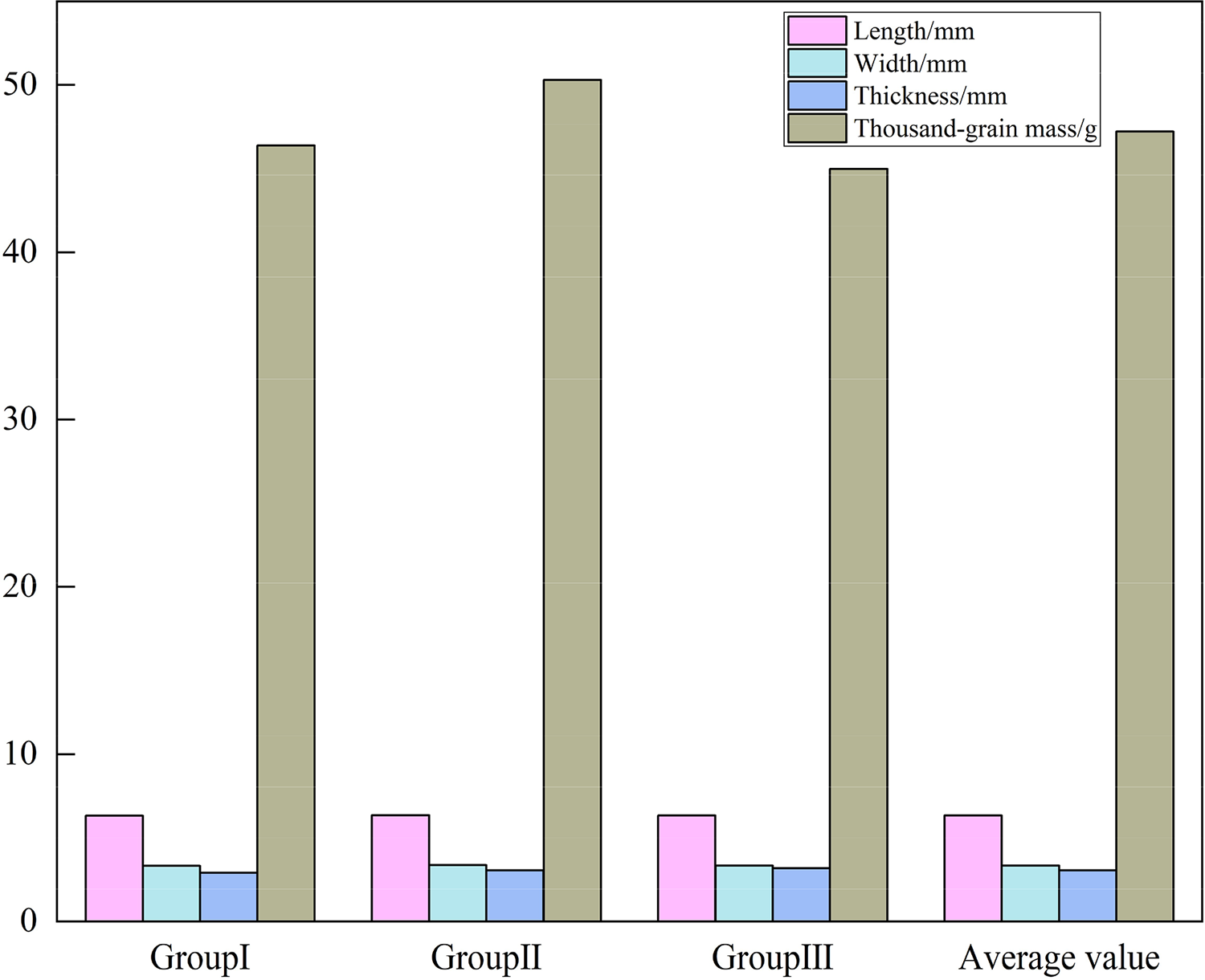
In this work, the wheat seeds were selected from Jimai 22. To make the simulation more realistic, 1000 grains of wheat were randomly selected for quality measurement, and 100 grains of wheat were selected for length, width, and thickness measurement. The grains were tested in three groups, as shown in Figure 4. The mean value of measurement of wheat was selected as the 3D seed size, and the length of 6.33 mm, width of 3.35 mm, and thickness of 3.06 mm were set successively. The established 3D model of a wheat seed is shown in Figure 5(A). To facilitate the simulation analysis, unnecessary components in the solid model were removed, and the seed storage cylinder was set to be transparent, as shown in Figure 5(B).


The double-cone combined compartment tray-type seed-metering device is made of resin. To simulate seed dispersion more realistically, the EDEM parameters used for wheat particles and the feeding device have been determined by reviewing relevant literature and experimental measurements (Bangura et al., 2020), as shown in Table 1. Based on a wheat field seeding rate of 150 kg hm-2 and a plot area of 6.3 m2, the corresponding number of wheat seeds to be set is approximately 2,000 (Wen et al., 2023). The generation rate of the particle factory in the EDEM was 1,000 grains s-1, and the generation time was 2 s. The fixed time step of the simulation test is 20% of the Rayleigh time step for a total simulation time of 4s. The factors and levels are shown in Table 2.
The VCU and SC are used as the evaluation indexes of the test. The calculation equation for VCU is given in [eq. (9)](Bangura et al., 2020):
The SC is calculated as follows:
Where:
SD is the standard deviation of the wheat particle number;
x̄ is the average number of wheat particles in each compartment tray;
𝑥i is the number of wheat particles in the ith compartment tray of the compartment;
𝑚 is the number of compartment trays;
∆𝑥 is the displacement of the wheat seed in the lower cone surface as it is about to enter compartment tray, m;
∆𝑡 is the time required for seed displacement, s.
RESULTS AND DISCUSSION
Simulation test results
Different data for the three test factors D, θ, and n were selected for 23 groups of simulation tests, and the results are shown in the table below. Nine sets of replicate experiments were conducted at the center point. Figure 6 shows the falling decentralized diagram of multiple wheat grain particles on the cone during simulation, and each purple line is the movement trajectory of a single wheat particle.

Impact of various factors on the VCU
To analyze the influence of test factors on the VCU accurately, particularly the relative importance of the various factors, an analysis of variance (ANOVA) was performed on the test results, as shown in Table 4. From the ANOVA results, it is obvious that D had no significant effect (p = 0.4307), θ had a significant effect (p = 0.0152), and n had no significant effect on the VCU (p = 0.0986). The influence of the test factors on the VCU was, in order of importance, θ, n, and D.
The θ had the greatest effect on the VCU, which may be attributed to the fact that when the D and n were held constant, changes in the θ caused changes in the decline in cone height and the decline distance, which affected the degree of discrete seed particle uniformity in the cone. It cannot be ignored that the quadratic of D and n also significantly affect seed grain dispersion uniformity, which indicates that the effects of D and n should still be considered when optimizing the design of the seed-metering device.
The regression equation of the VCU clarifies the correlation between the parameters and VCU, as shown in [eq. (11)]:
The VCU model was significant (p = 0.0169), the missing item p = 0.0624, and the regression equation did not lose fitting. Based on the results of the analysis, the effect of the interaction of factors on VCU was plotted using Design-Expert 8.0.6, as shown in Figure 7.

Response surface plots of the effect of each factor on the VCU interaction. (A) A surface plot of the response of the D and θ to VCU. (B) A surface plot of the response of the D and n to VCU. (C) A surface plot of the response of the θ and n to VCU.
A further analysis of the causes shows that D had no direct significant effect on dispersal uniformity. However, variation in D influenced the height and length of seed grains sliding down, thereby altering the uniformity of seed dispersion. θ significantly influenced dispersion uniformity performance. When the D and θ were held constant, VCU increased consistently with increasing θ, which means that the uniformity of seed dispersion was worse. Therefore, choosing a lower θ can improve seed dispersion performance under certain conditions. However, if θ is too small, the falling speed of the wheat seeds will be reduced, and the wheat seeds will be retained on the surface of the lower cone, leading to deterioration of the VCU. IF θ is too large, on the one hand, it will increase the time taken for the seeds to drop down and enter the compartment tray, and on the other hand, the disorder of seed movement will increase. The combined effect of these two reasons may result in poor uniformity of seed dispersion. Therefore, θ is the most critical factor affecting VCU, and a proper θ can increase the dispersion uniformity of wheat seeds. The n of the cone compartment tray is an important operational parameter that affects the performance of seed discharge. With the increase in n, the motility of seeds increases, which will affect seed dispersion. When n is small, the centrifugal force on the seeds is small, the mobility of the seeds is poor, and the seeds are not completely dispersed. When n is larger, the centrifugal force on the seeds increases, which improves seed mobility. At this time, the uniformity of seed dispersion is also improved. However, when n is too large, the seeds are detached from the cone, which can easily confuse the movement of seeds; in particular, it will produce the splashing phenomenon, which is undesirable in plot seeding. Therefore, an appropriate n can moderately disperse the seeds in the process of sliding down along the cone and thus evenly distribute them in the compartment tray.
Impact of various factors on SC
To accurately analyze the influence of experimental factors on the SC, especially the importance of factors, ANOVA was performed on the test results, as shown in Table 5. From the ANOVA results, it is obvious that D had no significant effect on SC (p = 0.1090 > 0.05), θ had an extremely significant effect on SC (p < 0.0001 < 0.05), and n had no significant effect on SC (p = 0.3130 > 0.05). The influence of the test factors on SC was θ, D, and n, respectively.
The regression equation of SC clarifies the correlation between parameters and SC, as shown in [eq. (12)]:
p<0.0001,SC model and its significance, missing item p = 0.3005, regression equation without loss of fit. Based on the results of the analysis, the effect of the interaction of factors on SC was plotted using Design-Expert 8.0.6, as shown in Figure 8.

Response surface plots of the effect of each factor on the SC interaction. (A) A surface plot of the response of the D and θ to SC. (B) A surface plot of the response of the D and n to SC. (C) A surface plot of the response of the θ and n to SC.
Further analysis of the causes shows that D has no direct impact on the variation in wheat seed sliding speed. However, changes in D indeed leads to an increase in the distance and height of wheat seed sliding. In this case, the wheat seed sliding speed is still affected, though not as significantly as by θ. This is because, on one hand, the increase in height and slip distance due to D is smaller than the increase due to θ. On the other hand, the impact on the strength of the seed drop caused by changes in D is also lower than that caused by changes in θ. There is a very significant effect of θ on wheat seed velocity. Specifically, as θ increases, the SC value increases, and the time for the wheat seed to enter the compartment tray decreases accordingly, which is favorable for rapid seed discharge. The reason for this phenomenon is that as θ increases, the overall height of the cone increases, and the more gravitational potential energy is converted into kinetic energy. At the same time, the impact of the seeds colliding as they slide down will also increase, increasing the seed movement speed. As the primary operational parameter of seed-metering device, n is reflected in its impact on wheat seed normal velocity, subsequently affecting wheat seed sliding speed. The n of the seed-metering device varies over a small range from 3 r min-1 to 5 r min-1, in other words, Fv does not vary significantly. Therefore, it may be difficult to reflect the effect of n on the seed sliding speed if the speed change is not large. Although a higher n has a greater impact on reducing seed sliding time, it is important to note that an increase in n affects the uniformity of seed dispersion. Increasing the speed too fast produces splashing, which can lead to poor seed dispersion.
Quadratic optimization
To obtain the optimal combination of structural performance parameters for the double-cone combined compartment tray-type seed-metering device, we used the minimum VCU and maximum SC as the objective function. The optimization objective function and constraints were as follows:
Using Design-Expert software, the optimal combination of structural performance parameters of the seed arrangement device was obtained as follows: D is 173.27 mm, θ is 45.78°, and n is 4.43r min-1(Sun et al., 2020b, 2020a; Yuan et al., 2024). The optimal structural performance parameters of the seed-metering device were set, and the EDEM simulation was carried out. The VCU was 8.75%, and the SC was 1.03m s-1.
Bench test validation
To verify the accuracy of simulation test results, a test bench was set up on the self-propelled two-row wheat plot planter to carry out the seed discharge performance test, as shown in Figure 9, and Figure 10 shows the falling decentralized diagram of wheat seeds on the cone during bench test the picture taken by a high-speed camera.

Bench test. (A) The main part of the bench test. (B) Control board and upper computer. (C) High-speed camera image cross-section.

The wheat variety selected for the bench experiment was Jimai 22. To enable the double-cone combined compartment tray seed-metering device to adapt to the needs of different plot areas and sowing capacities, three different specifications of plot areas – 3.15 m2, 6.3 m2, and 9.45 m2 – were selected, and three bench tests were carried out for each specification, totaling nine groups of bench tests. The sowing rates after conversion according to the mass of 1000 seeds were rounded to 1000 grains, 2000 grains, and 3000 grains respectively. The validation results of the bench tests are shown in Table 6.
The results of the bench test showed that the average values of the VCU were 8.66%, 9.06%, and 9.59%, respectively, when the wheat seeds were 1000, 2000, and 3000. The average VCU value from the nine sets of bench tests is 9.10%. It can be seen that the VCU is higher when there are more wheat seeds, and the dispersion uniformity of seed grains decreases. In the bench tests, seed motion was influenced by the installation deviation of the device, vibration, and seed distribution in the seed storage cylinder. These led to discrepancies in the outcomes of the bench experiment and the simulation. However, these differences were not significant, and the simulation results are basically consistent with the experiments. Consequently, it can be concluded that the DEM simulation running with the suggested parameters can produce accurate data for analysis. For SC, the average values of SC were 1.01 m s-1, 1.06 m s-1, and 1.07 m s-1 at three different grain size gradients. The average SC value from the nine sets of bench tests was 1.05 m s-1, and it can be seen that the experimental and simulation results are basically the same.
CONCLUSIONS
-
In this study, the DEM approach was used to study the uniformity of seed grain dispersion and the motions of seed grains in the double-cone combined-compartment tray seed-metering device under the influences of three main structural parameters D, θ, and n.
-
Processing through analysis, the optimal combination of structural performance parameters of the seed arrangement device was obtained as follows: D was 173.27 mm, θ was 45.78°, and n was 4.43 r min-1.
-
VCU and SC were chosen as the test indexes. The results of simulation test showed that the VCU was 8.75% and the SC was 1.03 m s-1. The results of bench tests showed that under the optimized parameter combinations, the average values of the VCU were 8.66%, 9.06%, and 9.59%, and the average values of SC were 1.01m s-1, 1.06m s-1, and 1.07m s-1 when the number of wheat seeds was 1000, 2000, and 3000, respectively, which aligns closely with the simulated test results.
REFERENCES
- Adefris Legesse A, Paramasivam V, Selvaraj SK (2021) Design of manually operated multiple-seed planting machine for an Ethiopian environment. Materials Today: Proceedings 46:7375-7379.
- Bangura K , Gong H , Deng R , Tao M , Liu C , Cai Y , Liao K , Liu J , Qi L (2020) Simulation analysis of fertilizer discharge process using the Discrete Element Method (DEM). Plos One 15:e0235872.
- El-kolaly W (2017) Development and performance evaluation of a plot seeder to suit some different certified seed production. PhD Thesis, Tanta University, Faculty of Agriculture.
- Fan C, He R, Shi Y, He L (2024) Structure and operation mode of centrifugal side-throwing organic fertilizer spreader for greenhouses. Powder Technology 438:119457.
- Gao X , Zhao P , Li J , Xu Y , Huang Y , Wang L (2022) Design and experiment of quantitative seed feeding wheel of air-assisted high-speed precision seed metering device. Agriculture 12:1951.
- Lian Z, Wang J, Yang Z, Shang S (2012) Development of plot-sowing mechanization in China. Transactions of the Chinese Society of Agricultural Engineering: 140-145.
- Liu D , Ma J , Qiao X , Xin P , Zhang X , Wang J , Zheng D (2023) The design of and experiments with a double-row seed-metering device for buckwheat breeding in an experimental area. Agronomy 13:2857.
- Minfeng J, Yongqian D, Hongfeng Y, Haitao L, Yizhuo J, Xiuqing F (2018) Optimal structure design and performance tests of seed metering device with fluted rollers for precision wheat seeding machine. IFAC-PapersOnLine 51:509-514.
- Przywara A (2015) The impact of structural and operational parameters of the centrifugal disc spreader on the spatial distribution of fertilizer. Agriculture and Agricultural Science Procedia 7:215-222.
- Przywara A , Santoro F , Kraszkiewicz A , Pecyna A , Pascuzzi S (2020) Experimental study of disc fertilizer spreader performance. Agriculture 10:467.
- Shang S, Yang R, Yin Y, Guo P, Sun Q (2010) Current situation and development trend of mechanization of field experiments. Transactions of the Chinese Society of Agricultural Engineering 26:5-8.
- Sun J, Chen H, Duan J, Liu Z, Zhu Q (2020a): Mechanical properties of the grooved-wheel drilling particles under multivariate interaction influenced based on 3D printing and EDEM simulation. Computers and Electronics in Agriculture 172:105329.
- Sun J, Chen H, Wang Z, Ou Z, Yang Z, liu Z, Duan J (2020b): Study on plowing performance of EDEM low-resistance animal bionic device based on red soil. Soil and Tillage Research 196:104336.
- Tang H, Xu F, Guan T, Xu C, Wang J (2023) Design and test of a pneumatic type of high-speed maize precision seed metering device. Computers and Electronics in Agriculture 211:107997.
- Van Liedekerke P, Tijskens E, Dintwa E, Anthonis J, Ramon H (2006) A discrete element model for simulation of a spinning disc fertilizer spreader I. Single particle simulations. Powder Technology 170:71–85.
- Van Liedekerke P, Tijskens E, Dintwa E, Rioual F, Vangeyte J, Ramon H (2009) DEM simulations of the particle flow on a centrifugal fertilizer spreader. Powder Technology 190:348–360.
- Wang R, Dai Y, Li J, Ge F, Miao N, Shan S, Shang S (2023a): Design and simulation analysis of centrifugal conical seeding device in wheat plot. China Agricultural Machinery Equipment:27-31.
- Wang X, Mao W, Wang Y, Lou H, Guan P, Chen Y, Peng H, Wang J (2023b) Breeding design in wheat by combining the QTL information in a GWAS panel with a general genetic map and computer simulation. The Crop Journal 11:1816-1827.
-
Wang T, Xiong S (2023): Adaptability of wheat to future climate change: Effects of sowing date and sowing rate on wheat yield in three wheat production regions in the North China Plain. Science of The Total Environment 25:901:165906. https://doi.org/10.1016/j.scitotenv.2023.165906
» https://doi.org/10.1016/j.scitotenv.2023.165906 - Yang R, Zhang X, Li J, Shang S, Chai H (2016) Parameter Optimization and Experiment on Cone Canvas Belt Type Seed-Metering Device. Transactions of the Chinese Society of Agricultural Engineering 32:6-13.
- Yang S, Zhang S, Yi J tao, Weng Q (2012) Development and experiment of seed metering for grass plot seeder. Transactions of the Chinese Society of Agricultural Engineering 28:72-77.
- Yinyan S, Man C, Xiaochan W, Odhiambo MO, Weimin D (2018) Numerical simulation of spreading performance and distribution pattern of centrifugal variable-rate fertilizer applicator based on DEM software. Computers and Electronics in Agriculture 144:249-259.
- Yuan L, He X, Zhu C, Wang W, Wang M, Wu S (2024): Design and test of tangential and longitudinal-axial threshing and separating unit for wheat. Results in Engineering 21:101774.
- Zinkeviciene R , Jotautiene E , Juostas A , Comparetti A , Vaiciukevicius E (2021) Simulation of granular organic fertilizer application by centrifugal spreader. Agronomy 11:247.