
 SPRAY DEPOSITION FROM AN UNMANNED AERIAL VEHICLE ON A COFFEE CROP
ABSTRACT
The use of unmanned aerial vehicles (UAVs) to apply pesticides has grown significantly, but technical data to support improvements in application efficiency are lacking, especially for perennial crops. This study aimed to determine the best operational parameters for the application of pesticides to coffee plants using UAVs. The experiment consisted of 8 treatments and 4 replicates in a 2x2x2 factorial design: two spray mixture compositions (solutions with spreading adjuvant and mineral oil), two spray nozzles (XR flat-fan nozzle and Airmix flat-fan nozzle with air induction) and two spray volumes (10 and 20 L ha-1). Spray solution deposition was evaluated by spectrophotometric detection of a tracer in leaves from the upper and lower parts of the coffee canopy, and spray coverage, droplet density and droplet size were evaluated using water-sensitive paper. The surface tension, pH and electrical conductivity of the solutions were also evaluated. The air induction nozzle was more suitable than the standard nozzle for UAV application, as the former yielded greater deposition of spray solution. Mineral oil improved the spray deposition on the coffee leaves, although the spreader reduced the surface tension to a greater extent. The higher spray volume increased the droplet density, as well as the coverage, which is very relevant, especially whit contact pesticides.
application technology; Coffea arabica; drone; droplet spectrum
INTRODUCTION
The use of unmanned aerial vehicles (UAVs), commonly called drones, for the application of crop protection products has increased worldwide (Wang et al., 2022). Hu et al. (2022) noted that this equipment can adapt to various terrains, does not require specific take-off platforms and is highly efficient. Wang et al. (2020) and Yang et al. (2022) found that the downward airflow, called downwash, generated by the rotors can promote droplet penetration inside the canopy, improving application inside the cultivation area and the control of pests and diseases.
However, UAV application is a relatively new technology in many countries, and limited research data are available. Richardson et al. (2020) noted that even with the increasing use of UAVs, uncertainties remain regarding their uniformity of spray deposition and application efficiency. Therefore, additional research is needed to better understand this technology. Because UAV application uses a reduced spray volume, air flow, and an elevated height relative to the plants, among other characteristics, it is relatively complex and still needs to be better understood, especially for perennial crops such as coffee (Coffea arabica).
One of the common problems faced by coffee growers is the susceptibility of the crop to insects and phytopathogenic microorganisms. Thus, crop protection products must be applied so that the active ingredient is deposited on the biological target at the most appropriate time, in the correct amount, and with minimal waste (Cunha et al., 2011). Coffee plants present a series of challenges in terms of application technology, as they have a high leaf density, must be sprayed inside the canopy and have an irregular canopy arrangement. In this context, the spraying equipment and plant structure must be well characterized to obtain maximum efficiency.
In UAV application methods, the choice of spray nozzle, spray volume and adjuvant is essential for optimizing the arrival of the product at the target. Appropriate selection of these parameters can realize the generation of adequately sized droplets and reduce losses, providing good coverage of the target. Thus, this study aimed to determine the appropriate operational parameters, including spray nozzle type, spray volume and adjuvant, for the application of crop protection products in coffee using UAVs.
MATERIAL AND METHODS
This work was performed in the Coffee Sector of the Experimental Farm of Glória (Federal University of Uberlândia (UFU), Uberlândia, MG, Brazil). The agricultural area has an altitude of 912 m, with geographical coordinates of 18°58'52”S latitude and 48°12'24”W longitude. The region has a tropical humid megathermal climate (Aw, according to the Köppen classification) characterized by hot and humid summers and cold and dry winters. The average monthly air temperature ranges from 20.9 to 23.1 °C. The average annual rainfall is 1,500-1,600 mm (Rodrigues & Lima, 2019). The terrain has a slightly undulating topography.
The UAV used was an AGRAS MG-1P octocopter (DJI, China) with a 10 L sprayer tank, 4 spray nozzles and 8 engines (Figure 1). Initially, the calibration of the aircraft was checked, determining the volume applied in 10,000 m2. It was used an effective swath of 4.0 m, based on the work of Cunha & Silva (2023) and the manufacturer recommendation (The deposition range recommended by the manufacturer is 4.0 to 6.0 m). A working height of 1.5 m in relation to the coffee canopy, and a ground speed of 10.2 km h-1 were also used.

The spray solution deposition experiments were performed in an area containing the coffee cultivar Topázio, with a row spacing of 3.8 m, 0.6 m between plants, an average height of 2.7 m and a crown projection diameter of 1.8 m (Figure 2).

The experimental plots were 40 m long and 16 m wide, with a useful plot 30 m long and 8 m wide, and the remainder was considered a border. Spray solution deposition was evaluated by detection of a tracer on leaves from the upper and lower parts of the coffee canopy and by using water-sensitive paper.
The experiment consisted of 8 treatments (Table 1) and 4 replicates. A completely randomized 2x2x2 factorial design was used: two spray mixtures (solution with a spreading adjuvant and mineral oil), two spray nozzles (XR and Airmix) and two spray volumes (10 and 20 L ha-1).
Two types of nozzles were used: the original flat fan spray nozzles (XR 11001, Teejet, USA) included with the UAV equipment, with a spectrum of very fine to fine droplets depending on the working pressure, and air induction flat fan nozzles (Airmix 11001, Agrotop, Germany), with a fine to coarse droplet spectrum, depending on the pressure (Figure 3). All droplet spectra were reported by the manufacturers.

The two adjuvants used were Break-Thru® (Evonik, Brazil), a polyether-polymethyl siloxane copolymer with a concentration of 1000 g L-1 (spreader), and Assist® (BASF, Brazil), a mixture of paraffinic, cyclic and aromatic hydrocarbons with a concentration of 756 g L-1 (mineral oil). The first is a nonionic surfactant in the chemical class of organomodified trisiloxanes and was used at a concentration of 0.1% (v/v). The second is an adjuvant based on mineral oil (aliphatic hydrocarbons), which was used at a concentration of 0.5% (v/v).
During application, the temperature, relative air humidity and wind speed were monitored. The temperature ranged from 27 to 29 °C, the relative humidity ranged from 48% to 51%, and the average wind speed ranged from 4.1 to 9.6 km h-1.
To evaluate deposition, a tracer composed of the food coloring Azul Brilhante, internationally cataloged by the Food, Drug and Cosmetic Act as FD&C Blue No. 1, was added to the spray solution at a fixed dose of 500 g ha-1, and its absorbance was measured via spectrophotometry.
A spectrophotometer with 3.5 mL glass cuvettes, a 10 mm optical path and a tungsten halogen lamp was used to perform the readings. Detection was performed by measuring the absorbance at 630 nm.
After spraying, 10 plants were tagged at random in each replicate, and for each plant, one leaf was collected at the top and one leaf was collected at the bottom, as shown in Figure 4, according to a methodology adapted from Palma et al. (2023). The plants were placed in plastic bags, which were placed in thermally insulated containers with light protection for transport to the laboratory.
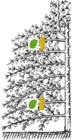
In the laboratory, 100 mL of distilled water was added to each plastic bag containing leaves. The bags were closed and shaken for 15 min in a TE-240 pendulum shaker (Tecnal, Brazil) at 120 rpm to extract the tracer in the samples (from the adaxial and abaxial side of the leaves). Then, the liquid was removed and transferred to plastic beakers, which were refrigerated in the dark for 24 hours prior to reading of the absorbance in the spectrophotometer. The leaf area was measured with a LICOR LI 3100C leaf area meter (LICOR, USA).
The spectrophotometric absorbance data were transformed into concentrations (μg L-1) through a calibration curve prepared from tracer standard solutions. The mass of dye retained in the collected leaves was determined on the basis of the initial spray solution concentration and sample dilution volume. The total deposited amount was divided by the area of each sample to obtain the amount (in μg) of tracer per cm2 of leaf area.
The coverage and droplet spectrum provided by the different treatments were also evaluated. Water-sensitive paper labels (76 × 26 mm) (Syngenta, Switzerland) were placed in locations at the top and bottom of the cultivation area (Figure 4). Soon after application in each plot, the labels were collected and placed inside marked paper envelopes, which were then taken to the laboratory, where the papers were scanned and analyzed using a DropScope® system (SprayX, Brazil). The coverage (%), droplet density (droplets cm-2), volume median diameter (VMD, μm) and relative amplitude (RA) were analyzed.
To characterize the solutions used in the field, laboratory tests were performed under controlled temperature (25 °C) and relative humidity (55%), and the surface tension, pH and electrical conductivity were measured. The test samples consisted of water with added spreader (0.1%) and mineral oil (0.5%).
The surface tension was determined using a benchtop tensiometer (K6, Kruss, Germany) using the Du Nouy ring method. In this method, a ring is placed on the surface of the liquid, and the force required to separate the ring from the surface is measured. Electrical conductivity and pH were measured directly using an AK59 digital device (Akso, Brazil) that had been previously calibrated with standard solutions.
In the statistical analysis, the assumptions of the linear model were evaluated by using the Shapiro‒Wilk (W) test to assess the homogeneity of variance and the Levene (L) and Durbin–Watson (DW) tests to assess the independence of residuals. Once these variable assumptions were satisfied, an analysis of variance was performed for the completely randomized design with 4 replicates, followed by the Snedecor F test at a 0.05 significance level. Tukey's test was used to compare the variables studied in the laboratory at a 0.05 significance level.
RESULTS AND DISCUSSION
The interactions between the factors nozzle type, adjuvant and spray volume were not significant (p> 0.05); thus, each factor was analyzed separately. Table 2 shows the results of spray solution deposition on the coffee canopy. Applications with the air induction nozzle and mineral oil resulted in the highest deposition values in the upper and lower parts. There was no difference between spray volumes. It should be noted that the solutions were always prepared with the same tracer dose, which reduced the effect of the spray volume on the deposition value evaluated on the basis of mass per unit area.
During application, the wind speed approached 10 km h-1. This horizontal force tends to cause droplet displacement, which explains why the nozzle that produced larger droplets (air induction nozzle) provided better results. Similarly, Wang et al. (2021) observed that application with a flat fan nozzle with air induction effectively promoted the distribution of deposition and reduced spray drift in UAV application to artificial vines (Vitis sp.). Among adjuvants, mineral oil reduces drift more than trisiloxanes do, while trisiloxanes are better at reducing surface tension (Oliveira, 2011), which also helps in increasing the amount of deposition. Van Zyl et al. (2014) evaluated the effect of trisiloxane surfactants on spray deposition by ground application on citrus plants and found that depending on the canopy characteristics, the adjuvants did not increase spray deposition and even impaired the quality of the treatments.
Table 3 shows the coverage and density of droplet on the water-sensitive paper. In contrast to tracer deposition on leaves, water-sensitive paper is sensitive to water and therefore tends to respond more to application with greater water volume (Cunha & Silva, 2023). In the upper part of the canopy, the highest coverage was obtained with mineral oil and a spray volume of 20 L ha-1. There was no difference between the nozzles. At the bottom part of the canopy, the only difference was observed between the two volumes of spray solution. The droplet density exhibited the same trend, especially for applications with mineral oil and a 20 L ha-1 spray volume.
As mentioned above, these results should be critically analyzed because water-sensitive paper naturally tends to produce a greater response to treatments with higher spray volume, as observed in the present study. Generally, greater target coverage tends to result in better efficacy, especially when working with contact pesticides (Viret et al., 2003). The drift reduction effect of the oil likely contributed to greater droplet arrival at the target, with consequent greater coverage of the upper canopy. Break-Thru® has a very pronounced spreading effect that can lead to greater coverage of the target (Zandonadi et al., 2018). However, the drag effect of the wind may have reduced the number of droplets that arrived, decreasing the droplet density at the target, as well as the coverage.
Table 4 shows the VMD and RA of the droplet spectrum. RA was not affected by the treatments and had an overall average of 0.88 and 0.93 in the upper and lower parts, respectively, indicating a uniform droplet spectrum (Cunha et al., 2010). The Airmix nozzle generated larger droplets than did the XR nozzle. The induction of air at this nozzle inserts air inside the droplets, increasing their size and their resistance to drift. It should be noted that according to the manufacturer, the Airmix nozzle generates fine to coarse drops, depending on the working pressure; therefore, this nozzle differs from most air induction nozzles, which generate coarse to ultracoarse droplets. Based on the VMD, the Airmix nozzle produced a spectrum of coarse droplets, while the XR nozzle produced a spectrum of medium droplets (Asabe S572.3, 2020). These spectral classifications differ from those in the manufacturers’ catalogs because they were determined on the basis of field evaluation; in the field, some droplets, especially fine droplets, are lost by drift, failing to impact the target and therefore not contributing to the VMD calculation.
Table 5 shows the results of the laboratory tests of the surface tension, pH and electrical conductivity of the solutions. The distilled water used had a pH close to neutral (6.6), and the adjuvants had little effect on this value (mineral oil resulted in a small decrease to 6.2). Regarding surface tension, the two sprays differed from the sample containing only water, exhibiting a hypotensive effect. The spreader reduced the surface tension to the greatest extent (23.5 mN m-1). Melo et al. (2019) evaluated the effect of trisiloxane surfactants on surface tension and coverage and found an increase in the covered area associated with the high ability of these surfactants to reduce tension.
The mixture containing mineral oil increased the electrical conductivity, while the spreader did not change the electrical conductivity. The increase was relatively small when compared to that of other adjuvants (Ribeiro et al., 2021). According to Carlson & Burnside (1984), high electrical conductivity indicates the presence of large amounts of ions, which can decrease the biological efficacy of pesticides.
CONCLUSIONS
Under field conditions, the Airmix air induction nozzle was more suitable for application via UAV than was the standard XR flat jet nozzle, as it increased the deposition of spray solution in the coffee canopy.
Mineral oil improved spray solution deposition on coffee leaves, although the spreader reduced the surface tension of the spray to a greater extent.
The higher spray volume (20 L ha-1) increased the density of droplets deposited on the target, as well as the coverage, which is very important, especially when using contact pesticides.
The Airmix nozzle produced larger droplets than did the XR nozzle, which represents an important strategy for reducing drift, especially in windy field situations.
ACKNOWLEDGEMENTS
The authors would like to thank FMC Agricultural Solutions, FAPEMIG (Research Foundation of the State of Minas Gerais) and CNPq (National Council of Scientific and Technological Development) for supporting this study.
REFERENCES
- ASABE S572.3 (2020) Spray nozzle classification by droplet spectra. St. Joseph, American Society of Agricultural Biological Engineers.
- Carlson KL, Burnside OC (1984) Comparative phytotoxicity of ghyphosate, SC-0224, SC-0545, and HOE-00661. Weed Science 32: 841-884.
-
Cunha JPAR, Bueno MR, Ferreira MC (2010) Espectro de gotas de pontas de pulverização com adjuvantes de uso agrícola. Planta Daninha 28:1153-1158. https://doi.org/10.1590/S0100-83582010000500023
» https://doi.org/10.1590/S0100-83582010000500023 - Cunha JPAR, Gitirana Neto J, Bueno MR (2011) Evalution of a device for the application of pesticides on mechanized coffee crops ( Coffea arabica L.) Interciência 36(4):312-316.
-
Cunha JPAR, Silva MRA (2023) Spray deposition from a remotely piloted aircraft on the corn crop. Revista Ciência Agronômica 54:e20217862. https://doi.org/10.5935/1806-6690.20230027
» https://doi.org/10.5935/1806-6690.20230027 -
Hu H, Kaizu Y, Huang J, Furuhashi K, Zhang H, Li M, Imou K (2022) Research on methods decreasing pesticide waste based on plant protection unmanned aerial vehicles: a review. Frontiers in Plant Science 13:811256. https://doi.org/10.3389/fpls.2022.811256
» https://doi.org/10.3389/fpls.2022.811256 -
Melo AA, Hunsche M, Guedes JVC, Hahn L, Feltrin NM (2019) Study of the effects of adjuvants associated with insecticides on the physicochemical properties of the spray solution and characterization of deposits on wheat and maize leaves under simulated rain. Engenharia Agrícola 39(3):315-322. https://doi.org/10.1590/1809-4430-Eng.Agric.v39n3p315-322/2019
» https://doi.org/10.1590/1809-4430-Eng.Agric.v39n3p315-322/2019 - Oliveira RB (2011) Caracterização funcional de adjuvantes em soluções aquosas. PhD Thesis, Universidade Estadual Paulista, Faculdade de Ciências Agronômicas.
-
Palma RP, Cunha JPAR, Santana DG (2023) Leaf sample size for pesticide application technology trials in coffee crops. Plants 12:1093. https://doi.org/10.3390/plants12051093
» https://doi.org/10.3390/plants12051093 -
Ribeiro RPM, Costa LL, Araújo EFL, Oliveira A (2021) Physical and chemical compatibility of fungicides and adjuvante. Scientific Electronic Archives 13(5):35-41. http://dx.doi.org/10.36560/14520211275
» http://dx.doi.org/10.36560/14520211275 -
Richardson B, Rolando CA, Somchit C, Dunker C, Strand TM, Kimberley MO (2020) Swath pattern analysis from a multi-rotor unmanned aerial vehicle configured for pesticide application. Pest Management Science 76(4):1282-1290. https://doi.org/10.1002/ps.5638
» https://doi.org/10.1002/ps.5638 -
Rodrigues EA, Lima SC (2019) Associação entre a incidência do levantamento de índice rápido de Aedes aegypti (Liraa) e as condições climáticas em Uberlândia, Minas Gerais, Brasil, entre 2014 a 2016. Caminhos de Geografia 20(72):251-263. http://dx.doi.org/10.14393/RCG207245265
» http://dx.doi.org/10.14393/RCG207245265 -
Van Zyl JG, Sieverding EG, Viljoen DJ, Fourie PH (2014) Evaluation of two organosilicone adjuvants at reduced foliar spray volumes in South African citrus orchards of different canopy densities. Crop Protection 64:198-206. https://doi.org/10.1016/j.cropro.2014.06.024
» https://doi.org/10.1016/j.cropro.2014.06.024 -
Wang C, Herbst A, Zeng A, Wongsuk S, Qiao B, Qi P, Bonds J, Overbeck V, Yang Y, Gao W, He X (2021) Assessment of spray deposition, drift and mass balance from unmanned aerial vehicle sprayer using an artificial vineyard. Science of The Total Environment 777:146181. https://doi.org/10.1016/j.scitotenv.2021.146181
» https://doi.org/10.1016/j.scitotenv.2021.146181 -
Wang C, Liu Y, Zhang Z, Han L, Li Y, Zhang H, Wongsuk S, Li Y, Wu X, He X (2022) Spray performance evaluation of a six-rotor unmanned aerial vehicle sprayer for pesticide application using an orchard operation mode in apple orchards. Pest Management Science 78(6):2449-2466. https://doi.org/10.1002/ps.6875
» https://doi.org/10.1002/ps.6875 -
Wang J, Lan Y, Wen S, Hewitt AJ, Yao W, Chen P (2020) Meteorological and flight altitude effects on deposition, penetration, and drift in pineapple aerial spraying. Asia-Pacific Journal of Chemical Engineering 15(1):e2382. https://doi.org/10.1002/apj.2382
» https://doi.org/10.1002/apj.2382 -
Viret O, Siegfried W, Holliger E, Raisigl U (2003) Comparison of spray deposits and efficacy against powdery mildew of aerial and ground-based spraying equipment in viticulture. Crop Protection 22:1023-1032. https://doi.org/10.1016/S0261-2194 (03)00119-4
» https://doi.org/10.1016/S0261-2194 (03)00119-4 -
Yang S, Xu P, Jiang S, Zheng Y (2022) Downwash characteristics and analysis from a six-rotor unmanned aerial vehicle configured for plant protection. Pest Management Science 78(4):1707-1720. https://doi.org/10.1002/ps.6790
» https://doi.org/10.1002/ps.6790 -
Zandonadi CHS, Burkhardt J, Hunsche M, Cunha JPAR (2018) Tank-mix of chlorantraniliprole and manganese foliar fertilizers: Impact on rheological characteristics, deposit properties and cuticular penetration. Crop Protection 106:50-57. https://doi.org/10.1016/j.cropro.2017.12.011
» https://doi.org/10.1016/j.cropro.2017.12.011
Edited by
-
Area Editor:
Murilo Mesquita Baesso


