 STRUCTURING A COMPUTATIONAL TOOL FOR DEFINING MULTICRITERIA METHODS: A PROPOSAL FOR A SYSTEMATIC LITERATURE REVIEW
ABSTRACT
The growing demand for a computational tool to support the selection of multicriteria decision-making (MCDM) methods, or families of methods, based on problem structuring has become a significant concern for researchers. The study addresses this need by conducting a Systematic Literature Review (SLR), which identified and stratified twenty-seven relevant papers according to four predefined research questions. This stratification clarified commonly used computational tools and their specific application to the proposed MCDM methods. Furthermore, the review revealed that existing tools are often tailored to individual methods, highlighting a gap in tools designed to recommend the appropriate MCDM or family of methods based on problem characteristics. Consequently, the SLR identified a clear opportunity for further research and the development of a computational tool that facilitates method selection based on the structured problem. This paper describes the development process, methodological framework, and refined analysis of the findings with a robust protocol for this SLR.
Keywords:
multicriteria; software engineering; computer application; computational tools
INTRODUCTION
Considering the existing gap, where computational platforms with multicriteria method approaches highlight the application of a specific method, is the starting point of this research.
This proposal aimed to establish elements of the multicriteria algorithm (requirements and problem structuring) so that the decision-maker could analyze the feasibility of applying families of methods or a specific method with Natural Language Processing and Machine Learning.
The choice process entails selecting an option from several alternatives (Rotnitzy and Jewell 1990). This process can involve comparing criteria, values, or personal preferences, ultimately resulting in a decision based on evaluating the available options. Both internal factors, such as desires and emotions, and external factors, including information, available resources, and constraints, can influence this process (Lee and Lautenbach 2016). The outcome of the choice process can have significant impacts and consequences, so, as noted by (Imai et al. 2008), it is crucial to thoroughly consider the criteria and alternatives before making a decision. Emotional aspects, particularly in corporate settings, may distort this process and lead to suboptimal decisions.
In today’s academic environment, characterized by dynamic research processes and the rapid availability of data, there is a tendency to encourage instantaneous decision-making. However, having access to transparent, precise, and up-to-date information on the subject matter is crucial for making well-informed decisions.
At least four types of hypotheses are commonly employed in research and daily decision-making contexts (Lerner and Tiedens 2006). The research hypothesis posits an assumed relationship between variables, while the null hypothesis asserts that no difference or relationship exists between variables. The alternative hypothesis, in contrast, states the opposite of the null hypothesis. Lastly, the distribution hypothesis pertains to statements regarding data distribution within a sample.
The traditional decision-making process is grounded in the classical model of rational choice theory, which operates within a normative framework. Normative theory explores how decisions should be made under optimal conditions, where individuals are assumed to act rationally and consistently to maximize utility. According to this framework, the preferred option is the one that yields the highest possible utility (Luppe and Angelo 2010).
Decision-making is an integral part of human daily life. These decisions are typically made by evaluating individual decision options, often based on preferences, experience, and other data available to the decision-maker (Sałabun et al. 2020). The decision-making process requires a set of feasible alternatives from which to choose. Each decision (selecting a viable alternative) is associated with gains and losses (Santos 2023). Moreover, complex decision-making can be regarded as one of the most challenging tasks individuals or groups face.
Multicriteria Decision Analysis (MCDA) can be defined as the activity of someone who, based on clearly presented but not necessarily formalized models, helps to obtain an element of response to the questions of a decision-maker during a process (Gomes and Gomes 2019b).
The decision analysis process involves several alternatives that must be carefully evaluated to choose the most appropriate decision for the context in which the problem was modeled (Gomes and Costa 2013a). To do this, it is necessary to have correct and precise information; when the decisions are put into practice, the decision maker must be convinced that the decision-making process was robust and correctly implemented.
The foundations of the decision are a theory that is sometimes prescriptive and sometimes normative, based on the assumption that it seeks to assist decision-makers (individuals, groups, organizations, or countries) (Gomes and Gomes 2019b). Decision theory is a set of procedures and analysis methods that seek to assertively enable the coherence, effectiveness, and efficiency of the decisions, respective to the information aggregated in the analysis process (Watróbski et al. 2019).
MCDA models allow the comparison between alternatives using an axiomatic model, indicating a satisfactory solution to the problem. It is essential to highlight that the primary purpose of MCDA methods is not to propose a formatted solution to the decision-maker regarding resolving a problem but to support the decision-making process, satisfying the restrictions required in the context analyzed (Gomes and Costa 2013a).
MCDA can address the different problems α, β , γ, or δ (choice, classification, ordering, or description) among several possible alternatives, have multiple criteria, present conflicts between the criteria, and present different units of measurement for the criteria (Gomes and Costa 2013b).
The problems defined above are not independent of each other. In particular, ordering alternatives (P. γ) can serve as a basis for solving the problem P. α or P. β . Many multicriteria methods, especially those developed in the 1970s and early 1980s, have prioritized the problem P. γ (Gomes and Gomes 2019b).
The structure of the multicriteria method must be composed of several steps (Figure 1), each of which will play an essential role in the process (Costa et al. 2022):
-
Problem definition;
-
Problem delimitation;
-
Objective;
-
Priority;
-
Alternatives.

Several relevant factors must be considered based on the problem’s modeling to reach a decision. Several factors accompany each decision and must be carefully weighed (Caggy and Almeida 2020). MCDM problems are generally divided into two classes concerning the problem solution space: continuous and discrete. Multiobjective decision-making methods (MODM) deal with continuous problems (Rezaei 2015).
Based on classification of the family of multicriteria algorithms, according to the American school, where the cardinal value of an alternative ai is formed by a set of values v1 i , v2 i , ..., vn i , in which each vn i is the value assumed by the alternative ai in each of the n criteria (Gomes and Gomes 2019a). Regarding origin of the Multi-Attribute Utility Theory (MAUT) and its characteristics is from the American school (compensatory), which in turn allows the definition of a global value for each alternative, indicating the relative position of a final ordering (Costa et al. 2022). From this line of thought, the concept of comparison (preference and indifference) arises when hierarchical structuring is practiced.
Regarding the methods of subordination and synthesis (French or European school or noncompensatory), where the comparison between discrete alternatives is applied and where there is a relation of the prevalence of synthesis that accepts incomparability and one alternative is preferred to the other with strong preference (Gomes and Gomes 2019a). Alternatively, one alternative is preferred over the other with weak preference.
The first structural step of this method consists of formulating and modeling the question that can be answered with an initial study on the problem addressed, then defining the objectives of the proposed study (Tenório et al. 2022).
Process optimization is constantly needed in engineering, especially in industrial environments and large-scale projects (Diniz et al. 2024). The increasing complexity of the problems to be solved when applying the elements of multicriteria methods and optimized algorithms, which involve several simultaneous dimensions (Silva et al. 2022), requires a practical approach to computational platforms, which is necessary when dealing with these variables.
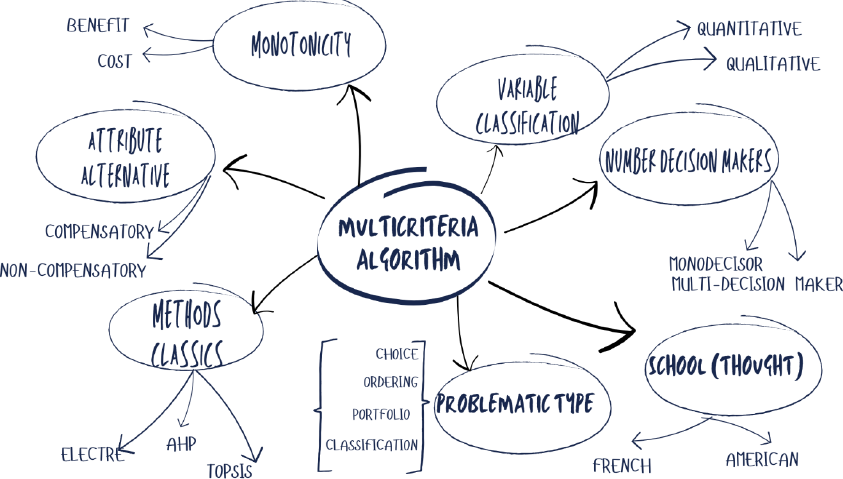
In order to seek a matrix understanding of this approach, we sought to build, understanding the limitations of the proposal, a mental map (https://mm.tt/app/map/3467537901?t=LPPDexsuxS) where it was possible to identify possible structural requirements.
The main objective was to answer the following research questions:
-
What are the most widely used multicriteria methods in the literature?
-
What are the leading computational platforms, with an emphasis on engineering, that exist in the literature?
-
What is the most common language applied to computational platforms in engineering software?
-
How can the practical application of the developed algorithm positively impact decisionmaking in real contexts?
It is possible to identify some computational tools aimed at the engineering context in the literature used for modeling, simulation, and optimization of industrial processes and engineering projects (MATLAB, ANSYS, Simulink). These allow the creation of virtual models of real systems, enabling the analysis of scenarios, the prediction of failures, the simulation of extreme operational conditions, and the identification of better operational strategies (Guan et al. 2020) and better decisions.
In the existing literature, the approach to computational platforms, specifically focused on multicriteria methods to support decision-making, is centered on the respective methods. Therefore, this proposal contemplates the elements of the algorithm in order to indicate, based on the structuring of the problem, which method or family of methods may be suitable for the respective situation.
PROTOCOL FOR THE SYSTEMATIC MAPPING
The methodological proposal for this protocol followed the concept of content analysis by (Bardin 2011), which was subdivided into topics, starting with the structuring of the problem and its restrictions, the adaptation of the research review protocol, the assignment of document searches in databases with due academic relevance, the analysis of these documents using computational tools to refine them and, finally, the formalization of the review.
This structure includes three main phases:
-
Pre-analysis: where a cursory reading is done to understand the general context and formulate initial hypotheses;
-
Exploring the Material: categories are defined, and the content is coded to create thematic groups that facilitate analysis.
-
Treatment of Results and Interpretation: the researcher can make inferences and relate the findings to the theoretical framework based on the coded data.
Thus, this structure is considered a methodological rigor appropriate to the proposal, which allows organizing information to ensure the objective interpretation of the data. This protocol outlines the methodology for conducting a SLR on developing computational tools for multicriteria method selection.
-
1. Definition of theme and research question
-
Theme: development of computational tools for multicriteria method selection.
-
Research Question: what are the primary multicriteria methods used in the literature, and how can they be applied in computational tools?
-
2. Restrictions
-
Consider only the top three multicriteria methods.
-
Include only studies in English and Portuguese.
-
Publication period: 2010-2024.
-
3. Review Protocol Preparation
-
Define inclusion and exclusion criteria.
-
Select databases: Scopus, Village, IEEE, WoS.
-
4. Use search string: (multicriteri*) AND (“software engineering” OR “computer application” OR “program application” OR “decision support systems” OR “computational tools” OR “algorithmic development” OR “systems engineering”)
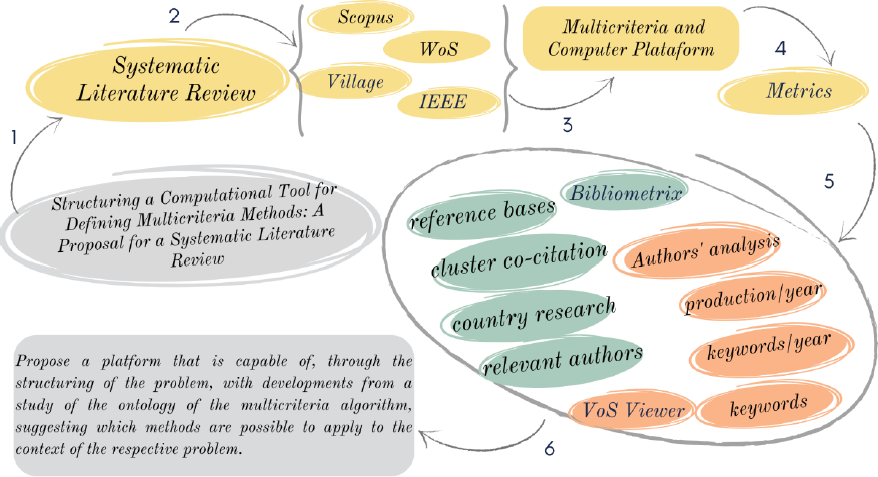
Thus, the methodological proposal was summarized in a flow (Figure 2). Therefore, we can divide this review planning into four modules:
-
Planning (gray);
-
Structuring the problem (green);
-
Methods (blue);
-
Justification (yellow).

In order to identify research opportunities among the proposed themes, we sought to analyze the existing literature where it was identified that there are works in this direction. Thus, when analyzing such literature, with the help of the Parsifal platform, the relevance of the string was noticed, considering that the referred result uses different databases (WoS, Scopus, IEEE, and Village).
Therefore, it was identified that the proposals in the respective platforms aim to meet the methodological approach only. This way, the basis for adapting this proposal was structured (Figure 3).

This string follows the respective structure: the first stage is the population, then the intervention, and finally, the objective, based on the PICOC Methodology (Galvão and Pereira 2014) Population [Multicriteria methods and Engineering software], Intervention [Computational platform] Comparison [], Outcome [Multicriteria algorithm] Context [Soft Operational Researchers and Problem Modeling]. Thus, specifically, this framework refers to the respective stages: The initial stage, understanding the reported problem and the research questions as the central object, as follows:
-
What are the most used multicriteria methods in the literature?
-
What are the leading computational platforms emphasizing engineering existing in the literature?
-
What is the most common language applied to computational platforms in engineering software?
-
How can the practical application of the developed algorithm positively impact decisionmaking in real contexts?
SCIENTOMETRIC ANALYSIS
This database shows that the theme involving multicriteria methods and computational platforms are current approaches in academia (Figure 4).

However, according to this time frame and basis, it is possible to identify that such platforms are focused on applying specific multicriteria methods (Table 1).
In this bibliometric study, with elements of scientometrics, it was noted that Brazil and China are two prominent centers in this approach (Figure 5).

There are at least four research clusters on this topic, with Brazil and China being relevant but distinct groups. We can consider three significant clusters: Brazil, France, Italy, and Portugal. In another group, China, Pakistan, Germany, and Poland. And finally, the United States, India, Taiwan and Australia. It is worth noting that there is an initial formation between Ireland and Tu¨rkiye (Figure 6).

It was noted that the emphasis is on the multicriteria structure approach as an element of support and decision-making and application of specific multicriteria methods. It was also noted that the software development proposal appears in the emerging themes quadrant (software engineering). This primary approach can be classified as an emerging theme, given its location in the quadrant graph (Figure 7), and it is possible to have specific approaches to develop exclusive themes.

After initial analysis, following the methodology proposed, it was found that the number of duplicate documents in the different databases was nineteen articles, corresponding to 6.30%. Eighteen documents corresponded to the Village database, equivalent to 78.94% of the duplicate articles (Table 2).
The analysis of the respective documents, based on the aforementioned databases, showed that the Scopus database presented a utilization rate (adherence to the theme) of 82.93% (Graph 1).

When analyzing the data from the different databases, we sought to understand the relevance of the countries, authors, educational institutions, and conferences; with the help of (RStudio Team 2020) and resources from the Bibliometrics and VosViewer platforms, we found that this theme is thriving in the academic environment, being a target of interest from the scientific community, with an annual growth rate of 13.62%, involving 433 authors and more than 7,100 references (Table 3).
It was identified that the bases with the most significant academic relevance, considering production volume, were the European Journal of Operational Research (EJOR) and the International Journal of Decision Support System Technology (IJDSST), respectively (Table 4).
Thus, the publications were analyzed, specifically those related to the creation of software proposals or computational platforms, where some recent publications with this proposal were identified, but their emphasis was on certain specific methods and not on a global platform where it is aimed at specifying the appropriate method, depending on the problem in question (Figure 8).

After analyzing the articles, 27 documents were obtained, which are ordered in descending order by year of publication (Figure 9).

With this, the respective findings were obtained (Table 5).
Therefore, an ordering was generated relating the findings to the respective research questions in order to explore details and constructs for this research, considering scientific relevance (citation index) as a quality metric, as proposed by (Linhares et al. 2019) (Table 6). Thus, given the research questions, we sought to answer them in each finding.
Given the aforementioned analysis, it was possible to infer, considering this time frame and scope, that it was possible to align with the respective research questions (Table 7).
The existing literature, as analyzed in this time frame on computational platforms, addresses certain multicriteria methods in a specific way as an alternative to popularize and encourage the use of these respective methods.
Therefore, the need was perceived for an algorithm capable of interpreting, based on the structuring of fundamental elements in the multicriteria approach, the steps to direct which family of methods, or which multicriteria method would be possible for the respective approach, being the object of this research.
The legacy of this article is to offer a multicriteria algorithm framework that will enable the decision maker, by structuring the problem, to reduce the cognitive load to find a suitable method as an alternative. Thus, it offers the academic community and the corporate environment a tool to support decision-making in choosing families of multicriteria methods or a specific multicriteria method.
In order to propose a suitable computational platform for indicating multicriteria methods as a family of methods, it is necessary to understand the structure of the multicriteria algorithm (Table 8).
Given the above, an architectural proposal (Figure 10) was structured to indicate the introduction of descriptive elements of this Multicriteria algorithm (Gomes 2006). This framework begins with problem modeling, where to understand it, it is necessary to understand the context and apply methodological elements of problem structuring. With this, it is possible to determine possible methods or families of methods, this being a selection method, ordering, or classification.

Thus, it was realized that the proposal to implement a computational platform focused on the specific approach of indication, proposing a multicriteria method or a family of methods is timely, and there is such a gap in the bases listed in this proposal for SLR. The proposal for this computational tool is to apply machine learning elements and automate this framework to suggest which families of multicriteria methods or specific methods may be indicated for a respective problem.
PRACTICAL IMPLICATIONS
The practical implications of this research reveal significant elements for decision-makers, especially those without technical expertise in multicriteria algorithms. By eliminating the need for in-depth knowledge of specific methods, the tool promotes accessibility and agility in decision-making, providing precise results based on robust data. Thus, managers can focus on organizational strategies and objectives, relying on the multicriteria methodology for accurate and well-founded analyses, which facilitates the implementation of solutions and optimizes resources efficiently. This approach also democratizes access to advanced decision-making methods, contributing to an organizational culture that values scientific basis in decision-making.
To ensure consistency and clarity in analyses, it is advisable to use separate sessions or configurations for each decision task, which helps to avoid the influence of previous configurations or data. This approach allows users to experiment with different configurations, refining their methods before making final decisions. While these platforms provide substantial support, the responsibility for interpreting the results and making informed decisions remains with the user. Therefore, a dedicated summary session in report format could be an additional feature when designing such platforms. However, it is crucial to consider the limitations and scope of each platform carefully.
References
- ALI SI, LALJI SM & HASHMI S. 2024. Risk quantification and ranking of oil fields and wells facing asphaltene deposition problem using fuzzy TOPSIS coupled with AHP. Ain Shams Engineering Journal, 15(102289).
- ALQAHTANI J, SIDDIQUE A & ASEERE AM. 2024. Evaluating Success Factors of Software Project Management in Global Software Development. IEEE Access, 12: 22345-22358.
- ANGAMUTHU S & TROJOVSKÝ P. 2023. Integrating multi-criteria decision-making with hybrid deep learning for sentiment analysis in recommender systems. PeerJ Comput Sci, 9:e1497.
- ASHRAF S, RAZZAQUE H, NAEEM M & BOTMART T. 2023. Spherical q-linear Diophantine fuzzy aggregation information: Application in decision support systems. AIMS Mathematics, 8: 6651-6681.
- BARDIN L. 2011. Análise de conteúdo. Edições, 70.
- BARRERA F, SEGURA M & MAROTO C. 2024. Multiple criteria decision support system for customer segmentation using a sorting outranking method. Expert Syst Appl, 238(122310).
- BHATT N, KAUR J, ANAND A, ALHAZMI H & O. 2022. Selecting Best Software Vulnerability Scanner Using Intuitionistic Fuzzy Set TOPSIS. Computers, Materials & Continua, 72: 3613-3629.
- CAGGY AL & DE ALMEIDA ES. 2020. AHP & fuzzy logic hybrid method for decision making in project management in a forestry industry. Gestão & Produção, 27.
- COSTA IP, COSTA AP & SANSEVERINO AM. 2022. Bibliometric studies on multi-criteria decision analysis (MCDA) methods applied in military problems. Pesquisa Operacional, 42.
- CREMEN G & GALASSO C. 2021. A decision-making methodology for risk-informed earthquake early warning. Computer-Aided Civil and Infrastructure Engineering, 36: 747-761.
- DINIZ BP, MOURA PEREIRA DA & SANTOS M. 2024. New Approach to Choosing an Aircraft Carrier for Brazil from the AHP and WISP Multicriteria Decision Methods. Procedia Comput Sci, 242: 544-551.
- DJELLOUL AB & HAMDADOU D. 2023. An ontology-based spatial group decision support system for site selection application. International Journal of Electrical and Computer Engineering (IJECE, 13(4488).
- FALLAHPOUR A, WONG KY & RAJOO S. 2020. A fuzzy decision support system for sustainable construction project selection: an integrated FPP-FIS Model. Journal of civil engineering and management, 26: 247-258.
- GALVÃO TF & PEREIRA MG. 2014. Revisões sistemáticas da literatura: passos para sua elaboração. Epidemiologia e Serviços de Saúde, 23: 183-184.
- GOMES CFS. 2006. Modelagem analítica aplicada à negociação e decisão em grupo. Pesquisa Operacional , 26: 537-566.
- GOMES CFS & COSTA HG. 2013a. Aplicação de métodos multicritério ao problema de escolha de modelos de pagamento eletrônico por cartão de crédito. Production, 25: 54-68.
- GOMES CFS & COSTA HG. 2013b. Aplicação de métodos multicritério ao problema de escolha de modelos de pagamento eletrônico por cartão de crédito. Production, 25: 54-68.
- GOMES CFS & GOMES LFAM. 2019a. Princípios e métodos para tomada de decisão. Editora Atlas. Rio de Janeiro.
- GOMES CFS & GOMES LFAM. 2019b. Princípios e Métodos para Tomada de Decisão Enfoque Multicritério, Atlas. Rio de Janeiro.
- GUAN X, BURTON H & SABOL T. 2020. Python-based computational platform to automate seismic design, nonlinear structural model construction and analysis of steel moment resisting frames. Eng Struct, 224(111199).
- HAO Q, NAZIR S & GAO X. 2021. A Review on Multicriteria Decision Support System and Industrial Internet of Things for Source Code Transformation. Sci Program, 2021: 1-9.
- IMAI K, KING G & STUART EA. 2008. Misunderstandings between experimentalists and observationalists about causal inference. J R Stat Soc Ser A Stat Soc, 171: 481-502.
- JOMHARI N, AHMAD ALIAS NA & ELLAH AAA. 2024. A Multi-Criteria Decision-Making for Legacy System Modernization With FUCOM-WSM Approach. IEEE Access , 12: 48608-48619.
- KIZIELEWICZ B, SHEKHOVTSOV A & SAŁABUN W. 2023. pymcdm-The universal library for solving multi-criteria decision-making problems. SoftwareX, 22(101368).
- LEE H & LAUTENBACH S. 2016. A quantitative review of relationships between ecosystem services. Ecol Indic, 66: 340-351.
- LERNER JS & TIEDENS LZ. 2006. Portrait of the angry decision maker: how appraisal tendencies shape anger’s influence on cognition. J Behav Decis Mak, 19: 115-137.
- LEYVA-LÓPEZ JC, SOLANO-NORIEGA JJ, GASTÉLUM-CHAVIRA DA & GAXIOLA-VALENZUELA T. 2022. A Personnel Selection Model for a Software Development Company based on the ELECTRE III Method and a Variant of NSGA-II. Innovar, 32: 117-132.
- LIAQAIT RA, WARSI SS & AGHA MH. 2022. A multi-criteria decision framework for sustainable supplier selection and order allocation using multi-objective optimization and fuzzy approach. Engineering Optimization, 54: 928-948.
- LINHARES JE, PESSA SLR, BORTOLUZZI SC & DA LRP. 2019. Capacidade para o trabalho e envelhecimento funcional: análise Sistêmica da Literatura utilizando o PROKNOW-C (Knowledge Development Process Constructivist. Cien Saude Colet, 24: 53-66.
- LUPPE MR & DE ACF. 2010. As decisões de consumo e a heurística da ancoragem: uma análise da racionalidade do processo de escolha. RAM Revista de Administração Mackenzie, 11: 81-106.
- MA J, SIDDHPURA M & HADDAD A. 2024. A Multi-Criteria Decision-Making Approach for Assessing the Sustainability of an Innovative Pin-Connected Structural System. Buildings, 14(2221).
- MOSLEM S, TEZEL BT, OVGU KINAY A & PILLA F. 2024. A hybrid approach based on magnitude-based fuzzy analytic hierarchy process for estimating sustainable urban transport solutions. Eng Appl Artif Intell, 137(109112).
- NGUYEN PH, DANG TT, NGUYEN KA & PHAM HA. 2022. Spherical Fuzzy WASPAS-based Entropy Objective Weighting for International Payment Method Selection. Computers, Materials & Continua , 72: 2055-2075.
- OTTENBURGER SS, MÖHRLE S, MÜLLER TO & RASKOB W. 2022. A Novel MCDA-Based Methodology Dealing with Dynamics and Ambiguities Resulting from Citizen Participation in the Context of the Energy Transition. Algorithms, 15(47).
- PODVESOVSKII A, ZAKHAROVA A, KOROSTELYOV D & KUZIN A. 2021. DecisionMaster: A multi-criteria decision support system with ability to combine different decision rules. SoftwareX , 16(100814).
- REZAEI J. 2015. Best-worst multi-criteria decision-making method. Omega (Westport, 53: 49-57.
- ROTNITZY A & JEWELL NP. 1990. Hypothesis testing of regression parameters in semiparametric generalized linear models for cluster correlated data. Biometrika, 77: 485-497.
- RSTUDIO TEAM. 2020. RStudio.
- S SMJ, PPM T & BP D. 2022. A Comparative Analysis of Multicriteria Methods AHPTOPSIS-2N, PROMETHEE-SAPEVO-M1 and SAPEVO-M: Selection of a Truck for Transport of Live Cargo. Procedia Comput Sci , 214: 86-92.
- SANTOS M. 2023. Ferramentas Computacionais de Apoio à Tomada de Decisão. Rio de Janeiro.
- SAŁABUN W, WATRÓBSKI J & SHEKHOVTSOV A. 2020. Are MCDA Methods Benchmark-able? A Comparative Study of TOPSIS, VIKOR, COPRAS, and PROMETHEE II Methods. Symmetry (Basel, 12(1549).
- TEIVE RCG, RESE ALR & PARREIRA JP. 2022. An Intelligent System for Operators Performance Multicriteria Evaluation of Distribution Networks. Applied Artificial Intelligence, 36.
- TENÓRIO FM, MOREIRA MAL & A CIP. 2022. SADEMON: The Computational Web Platform to the SAPEVO-M Method. Procedia Comput Sci , 214: 125-132.
- VAHIDNIA MH, MINAEI M & BEHZADI S. 2024. An ontology-based web decision support system to find entertainment points of interest in an urban area. Geo-spatial Information Science, 27: 505-522.
- VASEGAARD AE, PICARD M, NIELSEN P & SAHA S. 2024. A Three-Stage MCDM and Extended Longest Path Algorithm for the Satellite Image Acquisition Scheduling Problem. IEEE Access , 12: 28169-28185.
- WATRÓBSKI J, JANKOWSKI J & ZIEMBA P. 2019. Generalised framework for multi-criteria method selection. Omega (Westport, 86: 107-124.
- XIDONAS P, DOUKAS H & SARMAS E. 2021. A python-based multicriteria portfolio selection DSS. RAIRO Operations Research, 55: S3009-S3034.
- YAYLALI G, POLAT NÇ & TANAY B. 2021. A Soft Interval Based Decision Making Method and Its Computer Application. Foundations of Computing and Decision Sciences, 46: 273-296.
- YOUSSEF AE & SALEEM K. 2023. A Hybrid MCDM Approach for Evaluating Web-Based E-Learning Platforms. IEEE Access , 11: 72436-72447.
- YU G, ZHAO Y, CUI Z & YU Z. 2021. A QPSO algorithm based on hierarchical weight and its application in cloud computing task scheduling. Computer Science and Information Systems, 18: 189-212.
- ZYTOON MA. 2020. A Decision Support Model for Prioritization of Regulated Safety Inspections Using Integrated Delphi, AHP and Double-Hierarchical TOPSIS Approach. IEEE Access , 8: 83444-83464.