 Allamanda cathartica leaves do not contain cardioactive glycosides
ABSTRACT
Allamanda cathartica, a plant used in traditional medicine for different purposes, has been considered a cardiotoxic plant. However, the alleged cardiac glycoside was not further studied. Thus, the present study aimed to determine whether the leaves of A. cathartica contain any cardioactive glycosides. The search for cardioactive glycosides in the leaves of A. cathartic was carried out in two parts: the first was the screening of cardioactive glycosides by high-performance liquid chromatography (HPLC), and the second was the analysis of the plant extract by the Legal reaction and thin-layer chromatography (TLC) with development using Kedde's reagent. The present study did not find any cardioactive glycoside in the leaves of A. cathartica. This plant probably does not promote significant cardiotoxic effects.
Keywords:
poisonous plants; toxic plants; cardiotoxic plants; Apocynaceae; cardenolides
RESUMO
Allamanda cathartica, uma planta usada na medicina tradicional para diversos fins, é considerada uma planta cardiotóxica. No entanto, o suposto glicosídeos cardiotóxico dessa planta nunca foi estudado. Assim, o presente estudo teve por objetivo determinar se as folhas de A. cathartica contêm algum glicosídeo cardiotóxico. A pesquisa de foi feita em duas etapas: a primeira foi a triagem para glicosídeos cardiotóxicos, utilizando-se cromatografia líquida de alta eficiência (CLAE), e a segunda foi a análise do extrato da planta pela reação Legal e por cromatografia em camada delgada (CCD) com revelação pelo reagente de Kedde. Não foi encontrado nenhum glicosídeo cardioativo nas folhas de A. cathartica. Essa planta provavelmente não possui efeito cardiotóxico.
Palavras-chave:
plantas tóxicas; intoxicação por plantas; plantas cardiotóxicas; Apocynaceae; cardenolídeos
INTRODUCTION
Allamanda cathartica Linn. (Fig. 1), known as Golden Trumpet, Buttercup Flower, and Yellow Bell, is a climbing shrub from the Apocynaceae family. It is native to Brazil but is found in tropical and subtropical areas worldwide (Petricevich and Abarca-Vargas, 2019; Tomar et al., 2024). A. cathartica is used in traditional medicine for different purposes and has been shown to have several pharmacological effects, including cathartic, antibacterial, antifungal, antiviral, antimalarial, anti-inflammatory, anticancer, antioxidant, anti-diabetic, and antidepressive-like activities (Akah and Offiah, 1992; Tiwari et al., 2002; Bonomini et al., 2017; Petricevich and Abarca-Vargas, 2019; Tomar et al., 2024).
A. cathartica has been referred as a cardiotoxic plant based on a study that reported the presence of cardiac glycoside in A. cathartica leaves after using two digoxin immunoassays (Radford et al., 1994). However, the alleged cardiac glycoside was not further studied, without any chemical characterization. Thus, the present study aimed to determine whether the leaves of A. cathartica contain any cardioactive glycosides.

MATERIAL AND METHODS
The search for cardioactive glycosides in the leaves of A. cathartic was carried out in two parts: the first was the screening of cardioactive glycosides by high-performance liquid chromatography (HPLC), and the second was the analysis of the plant extract by the Legal reaction and analysis by thin-layer chromatography (TLC) with development using Kedde's reagent.
To screen cardioactive glycosides by HPLC, 20 samples of A. cathartica leaves were collected in Belo Horizonte and Brumadinho municipalities, MG, Brazil (10 in each city). The extraction technique was based on the work of Pedroza et al. (2015). The ground dried plant (50mg) was mixed with 12mL of 70% methanol in a 15mL Falcon tube, and after agitation in a vortex for one minute, the tube was incubated in a sonicator bath for 20 minutes and then centrifuged. A total of 6mL of the supernatant was transferred to another tube, and 4mL of 2% monosodium phosphate was added. After mixing, the mixture was applied to a previously conditioned C8 cartridge (5 mL of water, methanol, and water) and washed with 2 mL of deionized water. The cartridge was eluted two times with 1mL of methanol. One ml of the combined eluate was transferred to a vial for HPLC analysis.
HPLC analysis was performed according to Petschenka et al. (2022). Chromatographic analyses were performed on an HPLC system (Shimadzu Prominence LC-20A) equipped with a diode array detector (SPD-M20A), a C18 column (Welch Welchrom, 4.6 x 100 mm, 5μm), and a C18 guard column (Welch Welchrom Guard cartridge, 4.6 x 10mm, 5μm). The mobile phase consisted of acetonitrile and water in a gradient (0-2 min: 16% acetonitrile; 2-25 min: from 16% to 70%; 25-30 min: from 70% to 95%; 30-35 min: 95%; 35-45 min: 16%), flow rate of 0.7mL/minute. The UV absorbance spectra of the eluted compounds were recorded in the range of 190 to 400nm. Compounds presenting a single maximum absorption in the UV range of 214 to 280nm were investigated (Ahmad and Basha, 2006; Petschenka et al., 2022).
An extract of 40g of A. cathartic crushed dried leaves was prepared for Legal reaction and TLC analysis. For the Legal reaction, 50mg of the residue was dissolved in 1mL of distilled water and transferred to a test tube, and 2mL of pyridine, 2mL of 0.3% sodium nitroprusside, and drops of 10% sodium hydroxide were added. The result was considered positive when a dark red color was formed. The positive standard was made with digoxin.
The TLC analysis was based on Wagner and Bladt (1996). A total of 10 mg of the extract and the digoxin standard were dissolved in 1.0 mL of methanol, and 10 µL of the solution was applied to a glass chromatographic plate (0.25mm, 10x10cm) coated with unmodified silica gel (ADAMANT UV254, Macherey-Nagel, Düren, Germany). The mobile phase was ethyl acetate, methanol, and water (81:11:80). After the chromatographic run, the plates were sprayed with Kedde's reagent (5mL of 3% 3,5-dinitrobenzoic acid in ethanol and 5mL 2M NaOH, prepared just before use) for further observation under natural light.
RESULTS
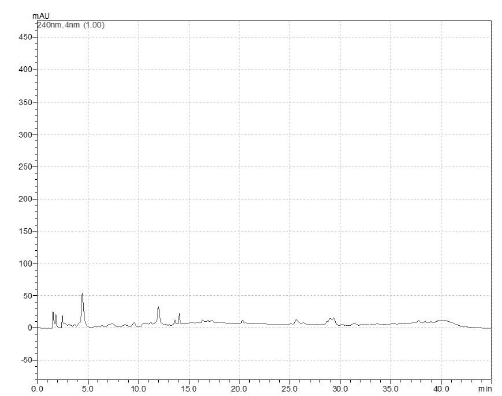
The screening analysis of cardioactive glycosides using HPLC showed that none of the samples evaluated samples presented any compound with characteristics compatible with cardioactive glycoside (Fig. 2).

For Legal reaction and TLC analysis, an extract was prepared using 40 g of crushed dried leaves, which were macerated with 500mL of methanol for 72 hours. The extract was separated by filtration, and the solvent was removed in a rotary evaporator to obtain 9.5g of dry extract. The extract was dissolved in 100mL of 70% methanol and filtered, and 10mL of 10% lead acetate was added for pigment precipitation. The supernatant was mixed with 100mL of 4% monopotassium phosphate and extracted twice with 50mL of dichloromethane: isopropanol (3:2). This extract was filtered in sodium sulfate, and the solvent was volatilized to obtain 705mg of dry residue.
The residue was subjected to Legal reaction. The result was considered positive with the formation of a dark red color. A positive reaction, characterized by the formation of a dark red color, was obtained with digoxin. On the other hand, A. cathartica residue showed a negative reaction. In TLC analysis, a positive reaction was obtained with digoxin (red-violet spot), but no positive reaction was seen in A. cathartica extract.
DISCUSSION
The present study did not find any cardioactive glycoside in the leaves of A. cathartica. This result differs from that reported by Radford et al. (1994), who found cardioactive glycoside at a concentration of 0.04µg/g in the leaves using two immunoassays for digoxin determination, a commercial immunoassay analyzer and an in-house radioimmunoassay. It is possible that the assays used by these authors generated false positive results due to the nonspecific reaction of anti-digoxin antibodies with another compound of the plant.
Spontaneous consumption of the leaves or the latex results in digestive clinical signs due to irritation of digestive mucosa (Burrows and Tyrl, 2013; Anadón et al., 2018; Nelson and Balick, 2020); these disturbances may lead to dehydration and electrolyte abnormalities (Nelson and Balick, 2020). The purgative effect of A. cathartica is widely known (Akah and Offiah, 1992; Tiwari et al., 2002; Petricevich and Abarca-Vargas, 2019; Tomar et al., 2024). Furthermore, the sap latex irritates the skin (Burrows and Tyrl, 2013; Anadón et al., 2018). These irritative effects have been attributed to alkyliridoid-type terpenoids (allamdin, allamandin, and allamandicin) and iridoids (plumericin and plumieride) (Burrows and Tyrl, 2013).
The toxic effects of A. cathartica leaves were evaluated in cattle (Tokarnia et al., 1996) and sheep (Armién and Tokarnia, 1994). Cattle dosed with 20 or 30g/kg of fresh leaves showed digestive signs such as lack of appetite, ruminal hypomotility or atony, and dry feces. Lethal poisoning occurred in two of three cattle dosed 30g/kg; the two cattle that died also had tachycardia, while the one that survived showed mild cardiac arrhythmia at auscultation. Pathological examination of dead cattle revealed gastroenteritis and hepatocyte degeneration and necrosis, while the hearts showed only subendocardial hemorrhages in the left ventricle (Tokarnia et al., 1996). The administration of the leaves to six sheep at doses of 7.5 to 25g/kg caused anorexia and hypomotility or ruminal atony in five sheep. Cardiac auscultation revealed that one had arrhythmia, two had tachycardia, and the other three had doubling of the first heartbeat (Armién and Tokarnia, 1994).
Unfortunately, these studies did not perform more precise assessments of cardiac function, such as electrocardiograms or echocardiograms. Despite this, the clinical and pathological changes reported show a discreet effect on the heart. These effects are likely not the result of any direct activity on cardiomyocytes but rather of an indirect action, such as dehydration resulting from the action of A. cathartica on the digestive tract.
The absence of cardioactive glycosides and the probable absence of cardiotoxicity are also important for using A. cathartica as a phytotherapeutic drug. In fact, this plant is used in traditional medicine for different purposes (Nayak et al., 2006; Rahman and Akter, 2015; Petricevich and Abarca-Vargas, 2019). Several pharmacological studies using several A. cathartica extracts have been shown the purgative (Akah and Offiah, 1992), antibacterial (Karunakaran et al., 2016; Matignon et al., 2023; Tomar et al., 2024), antifungal (Tiwari et al., 2002; Silva and Souza et al., 2020; Matignon et al., 2023), antiviral (Mathew et al., 2016), antimalarial (Conrad et al., 2013), antinematode (Alen et al., 2000), anti-inflammatory (Boeing et al., 2018), thrombolytic (Sarker et al., 2012), anticancer (Wong et al., 2011; Tomar et al., 2024), antioxidant (Conrad et al., 2013; Karunakaran et al., 2016; Boeing et al., 2018; Tomar et al., 2024), wound healing (Nayak et al., 2006), antifertility (Gupta et al., 2004; Singh and Singh, 2008), anti-diabetic (Chaithra Amin et al., 2017), antihyperlipidaemic (Bonomini et al., 2017), analgesic (Petricevich and Abarca-Vargas, 2019), antidepressive-like (Bonomini et al., 2017), and anxiogenic-like (Dalmagro et al., 2021) activities. Furthermore, an A. catharthica extract neutralized 72% of the in vitro hemorrhagic effect of Bothrops atrox venom (Otero et al., 2000).
In summary, the evaluated A. cathartica leaves do not contain cardioactive glycosides. This plant probably does not promote significant cardiotoxic effects.
ACKNOWLEDGEMENTS
The project was funded by the Conselho Nacional de Desenvolvimento Científico e Tecnológico - CNPq, Brazil (grant numbers 400843/2021-8 and 403739/2021-7).
REFERENCES
- AHMAD, V.U.; BASHA, A. Spectroscopic Data of Steroid Glycosides: : Spirostanes, Bufanolides, Cardenolides. New York: Springer, 2006. 686p.
- AKAH, P.A.; OFFIAH, V.N. Gastrointestinal effects of Allamanda cathartica leaf extracts. Int. J. Pharmacogn., v.30, p.213-217, 1992.
- ALEN, Y.; NAKAJIMA, S.; NITODA, T. et al. Antinematodal activity of some tropical rainforest plants against the pinewood nematode, Bursaphelenchus xylophilus. Z. Naturforsch. C. J. Biosci., v.55, p.295-299, 2000.
- ANADÓN, A.; MARTÍNEZ-LARRAÑAGA, M.R.; ARES, I.; MARTÍNEZ, M.A. Poisonous plants of the Europe. In: GUPTA, R.C. (Ed.). Veterinary Toxicology: basic and clinical principles. 3.ed. San Diego: Academic Press, 2018. p.891-909.
- ARMIÉN, A.G.; TOKANIA, C.H. Experimentos sobre a toxidez de algumas plantas ornamentais em ovinos. Pesqui. Vet. Bras., v.14, p.69-73, 1994.
- BOEING, T.; SOUZA, P.; BONOMINI, T.J. et al. Antioxidant and anti-inflammatory effect of plumieride in dextran sulfate sodium-induced colitis in mice. Biomed. Pharmacother., v.99, p.697-703, 2018.
- BONOMINI, T.J.; HOLZMANN, I.; THIESEN, L.C. et al. Neuropharmacological and acute toxicological evaluation of ethanolic extract of Allamanda cathartica L. flowers and plumieride. Regul. Toxicol. Pharmacol., v.91, p.9-19, 2017.
- BURROWS, G.E.; TYRL, R.J. Toxic plants of North America. 2.ed. Ames: Wiley-Blackwell; 2013. 1383p.
- CHAITHRA AMIN, B.; SATISH, S.; ABHISHEK, N.; AJAY KUMAR, K. An investigation on anti-diabetic activity in aqueous extract of aerial parts of Allamanda cathartica Linn in streptozotocin induced diabetic rats. Int. J. Pharm. Chem. Res., v.3, p.242-247, 2017.
- CONRAD, O.A.; DIKE, I.P.; AGBARA, U. In vivo antioxidant assessment of two antimalarial plants-Allamamda cathartica and Bixa orellana. Asian Pac. J. Trop. Biomed., v.3, p.388-394, 2013.
- DALMAGRO, A.P.; CAMARGO, A.; ZIMATH, P.L. et al. Plumieride exerts anxiolytic-like effect mediated by GABAergic and monoaminergic systems. Nat. Prod. Res., v.35, p.4849-4852, 2021.
- GUPTA, R.S.; BHATNAGER, A.K.; JOSHI, Y.C.; SHARMA, R.; SHARMA, A. Effects of plumieride, an iridoid on spermatogenesis in male albino rats. Phytomedicine, v.11, p.169-174, 2004.
- KARUNAKARAN, G.; JAGATHAMBAL, M.; GUSEV, A. et al. Allamanda cathartica flower’s aqueous extract-mediated green synthesis of silver nanoparticles with excellent antioxidant and antibacterial potential for biomedical application. MRS Commun., v.6, p.41-46, 2016.
- MATHEW, S.; SREEKUMAR, S.; BIJU, C.K. Identification of lead compounds against human hepatitis B viral capsid protein in three medicinal plants through in silico method. IOSR J. Pharm. Biol. Sci., v.11, p.1-6, 2016.
- MATIGNON, L.; LO, M.M.; MONPIERRE, M. et al. Phytochemical and biological study of trophic interaction between Pseudosphinx tetrio L. larvae and Allamanda Cathartica L. Plants, v.12, art.520, 2023.
- NAYAK, S.; NALABOTHU, P.; SANDIFORD, S.; BHOGADI, V.; ADOGWA, A. Evaluation of wound healing activity of Allamanda cathartica. L. and Laurus nobilis. L. extracts on rats. BMC Complement. Altern. Med., v.6, art.12, 2006.
- NELSON, L.S.; BALICK, M.J. Handbook of poisonous and injurious plants. 3.ed. New York: Springer, 2020. 336p.
- OTERO, R.; NÚÑEZ, V.; BARONA, J. et al. Snakebites and ethnobotany in the northwest region of Colombia. Part 3: neutralization of the haemorrhagic effect of Bothrops atrox venom. J. Ethnopharmacol., v.73, p.233-241, 2000.
- PEDROZA, H.P.; FERREIRA, M.G.; CARVALHO, J.G. et al. Concentrações de oleandrina nas folhas de Nerium oleander de diferentes cores da floração. Ciência Rural, v.45, p.864-866, 2015.
- PETSCHENKA, G.; ZÜST, T.; HASTINGS, A.P. et al. Quantification of plant cardenolides by HPLC, measurement of Na+/K+-ATPase inhibition activity, and characterization of target enzymes. Methods Enzymol., v.680, p.275-302, 2023.
- PETRICEVICH, V.L.; ABARCA-VARGAS, R. Allamanda cathartica: a review of the phytochemistry, pharmacology, toxicology, and biotechnology. Molecules, v.24, p.1238, 2019.
- RADFORD, D.J.; CHEUNG, K.; URECH, R.; GOLLOGLY, J.R.; DUFFY, P. Immunological detection of cardiac glycosides in plants. Aust. Vet. J., v.71, p.236-238, 1994.
- RAHMAN, A.H.M.; AKTER, M. Taxonomy and traditional medicinal uses of Apocynaceae (Dogbane) family of Rajshahi District, Bangladesh. Res. Rev. J. Bot. Sci., v.4, p.5-13, 2015.
- SARKER, R.; SHARMIN, T.; CHOWDHURY, S.R.; ISLAM, F. Thrombolytic activity and preliminary cytotoxicity of five different fractions of methanol extract of Allamanda cathartica leaf. J. Appl. Pharm. Sci., v.2, p.129-132, 2012.
- SILVA E SOUZA, E.; BARCELLOS, V.A.; SBARAINI, N. et al. A plumieridine-rich fraction from Allamanda polyantha inhibits chitinolytic activity and exhibits antifungal properties against Cryptococcus neoformans. Front. Microbiol., v.11, art.2058, 2020.
- SINGH, A.; SINGH, S.K. Reversible antifertility effect of aqueous leaf extract of Allamanda cathartica L. in male laboratory mice. Andrologia, v.40, p.337-345, 2008.
- TIWARI, T.N.; PANDEY, V.B.; DUBEY, N.K. Plumieride from Allamanda cathartica as an antidermatophytic agent. Phytother. Res., v.16, p.393-394, 2002.
- TOKARNIA, C.H.; ARMIÉN, A.G.; PEIXOTO, P.V. et al. Estudo experimental sobre a toxidez de algumas plantas ornamentais em bovinos. Pesqui. Vet. Bras., v.16, p.5-20, 1996.
- TOMAR, R.; DAS, S.S.; SAHU, V. et al. Allamanda cathartica (Linn.) leaf extract-encapsulated phytoemulsions: formulation, characterization and in vitro-in vivo biological evaluations. Sustainable Food Technol., v.2, p.1490-1505, 2024.
- WAGNER, H.; BLADT, S. Cardiac glycoside drugs. In: WAGNER, H.; BLADT, S.; ZGAINSKI, E.M. Plant drug analysis - a thin layer chromatography atlas. 2.ed. Heidelberg: Springer, 1996. p.99-123.
- WONG, S.K.; LIM, Y.Y.; ABDULLAH, N.R.; NORDIN, F.J. Antiproliferative and phytochemical analyses of leaf extracts of ten Apocynaceae species. Pharmacogn. Res., v.3, p.100-106, 2011.