 Influence of milk in the in vitro photoinactivation of Staphylococcus aureus isolated from bovine mastitis
RESUMO
Neste estudo, foi investigada a ação fotodinâmica de fotossensibilizadores (PS) catiônicos porfirínicos em terapia fotodinâmica antimicrobiana (APDT) para a fotoinativação de Staphylococcus aureus resistente à meticilina (MRSA) isolado de mastite bovina. Para avaliar o efeito fotodinâmico na presença de leite, os experimentos de fotoinativação foram realizados em placas de ágar para eliminar o efeito de opacidade do leite, pois uma fina película de amostra é obtida na placa, e os resultados foram comparados com as placas utilizando PBS. Em placas de ágar PBS, os PS com contribuições estruturais hidrofóbicas (P2, ZnP2) mostram um efeito fotodinâmico significativo em concentrações consideravelmente menores do que os PS mais hidrofílicos (P1, ZnP1). Os PS hidrofílicos em placas de ágar leite apresentam o mesmo comportamento mostrado em ágar PBS, com concentrações idênticas às que resultam na ausência de viabilidade, enquanto os PS mais hidrofóbicos são menos eficazes, exigindo concentrações maiores do que as encontradas em ágar PBS. Esses resultados refletem a contribuição da estrutura dos substituintes alquilpiridínio nas interações resultantes com as bactérias em PBS e Leite. Portanto, entender a atividade dos PS com base em sua estrutura e correlacionar com as propriedades do meio é extremamente importante no desenvolvimento de estratégias para usar APDT em problemas específicos nos quais ocorrem infecções.
Palavras-chave:
mastite bovina; métodos alternativos ao uso de antibióticos; terapia fotodinâmica antimicrobiana (APDT); fotossensibilizadores catiônicos; porfirinas e metaloporfirinas
Palavras-chave:
mastite bovina; métodos alternativos ao uso de antibióticos; terapia fotodinâmica antimicrobiana (APDT); fotossensibilizadores catiônicos; porfirinas e metaloporfirinas
Palavras-chave:
mastite bovina; métodos alternativos ao uso de antibióticos; terapia fotodinâmica antimicrobiana (APDT); fotossensibilizadores catiônicos; porfirinas e metaloporfirinas
Bovine mastitis is the most important disease of dairy cattle in Brazil and worldwide. Mastitis is defined as inflammation of the mammary gland or udder, and has multiple etiologies, and may be affected by microorganisms such as bacteria, viruses, fungi, yeast and microalgae (Angelopoulou et al., 2019). Bovine mastitis is an endemic disease and its prevalence in herds is very high, reducing the quality and production of milk from infected cows, and consequently bringing lower profits.
Staphylococcus aureus is the major pathogen causing intramammary infections in dairy cattle worldwide (Aarestrup et al., 2001).
Among the factors that contribute to its spread and infectious potential is the ability to overcome the mechanisms of antimicrobials activity (Pribul et al., 2011) mainly as a consequence of the indiscriminate and large use of antibiotics resulting in the emergence of multidrug-resistant microorganisms (MDR).
Therefore, different strategies for the use of antibiotics are necessary and, in this sense, Antimicrobial Photodynamic Therapy - APDT emerges as an interesting approach since light-activated molecules denoted photosensitizers (PS) act locally via the in-situ production of highly reactive oxygen species (ROS), which simultaneously and not specifically attack multiple and variable pathogen´s biomolecular sites, precluding in this way specific mutations that leads to microorganism resistance (Wainwright et al., 2017).
APDT has been used for veterinary infections issues in vivo, as for example, in adjunctive periodontal diseases treatment in equines (Dias et al., 2020) and in subclinical bovine mastitis (Moreira et al., 2018) using respectively methylene blue (MB) and toluidine blue (TOB) PS. An in vitro study shows that pathogens isolated from bovine mastitis, regardless of their antibiotic resistance phenotype, were effectively inactivated using the MB PS (Sellera et al., 2016).
One of the inherent problems in the application of APDT in bovine mastitis is that the infectious process of the mammary glands or udder occurs in the presence of milk. Therefore, to evaluate the APDT process, it is necessary to test the effectiveness of PS in the presence of milk. Milk is made up of a complex mixture of proteins, fats, sugars and salts, which implies a series of new interactions that can occur between these components and the PS, as well as with microorganisms. Another important aspect related to APDT is that milk is not transparent, which considerably influences the propagation of light in the medium, altering the availability of light for the excitation of PS compared to water or PBS solutions.
In the present study, taking into account the problems associated with performing APDT in milk, were compared the known tetra-cationic porphyrin PS TMPyP (P1) (Garcia-Sampedro et al., 2020) and its corresponding Zinc(II) complex (ZnTMPyP; ZnP1) with the PS TBzPyP (P2) and ZnTBzPyP (ZnP2) in the photoinactivation of Methicillin-resistant Staphylococcus aureus (MRSA) isolated from bovine mastitis in agar plates in the presence and absence of milk. P2 and ZnP2 are also tetra-cationic and present additional hydrophobic contributions by its alkyl-substituents. The photoinactivation studies were carried out in agar plates to evaluate the influence of milk on the microorganism-PS interaction excluding the variable of milk medium opacity since only a thin layer is formed. In this way, there is no considerable loss of incident light in the medium, thus allowing only the effect of the influence of milk components on the process to be evaluated without compromising effectively the light absorption properties. This procedure can be envisioned too as a convenient initial screening to evaluate PS behavior in function of the medium properties.
The porphyrinic PS used in this work; i) 5,10,15,20-tetrakis(1-methylpyridinium-4-yl)-porphyrin (TMPyP - P1); ii) 5,10,15,20-tetrakis(1-benzylpyridinium-4-yl)-porphyrin (TBzPyP - P2); iii) 5,10,15,20-tetrakis(1-methylpyridinium-4-yl)-porphyrin Zinc (II) (ZnTMPyP - ZnP1); iv) 5,10,15,20-tetrakis(1-benzylpyridinium-4-yl)-porphyrin Zinc (II) (ZnTBzPyP - ZnP2) have been previously synthesized and fully characterized (Ribeiro and Azzellini, 2003), (Ribeiro et al., 2009) and their structures along correspondent abbreviations are presented in Fig. 1.

Microorganism: Methicillin-resistant Staphylococcus aureus (MRSA) isolated from bovine mastitis was gently supplied by Profa Alice Maria Melville Paiva Della Libera - Faculdade de Medicina Veterinária e Zootecnia da USP.
This study with CEP-ICB Protocol nº 1014/2019 was approved by the Animal Use Ethics Committee (CEUA) and the Human Research Ethics Committee (CEPSH).
Growing and counting have been conducted by standard methodologies using Luria Bertani (LB) broth and LB agar at 37ºC.
Photoinactivation Studies: MRSA suspensions of (107 CFU/mL inoculated in PBS (pH = 7,4) or milk (Nestlè - Ninho®) were serially diluted 1:10 (10-1 to 10-6). Each 10 µL sample was plated in triplicate on LB agar and allowed to fix for the required time, then observing the formation of a spot. Sequentially to the formation of the spot, 20 µL of porphyrin solution were added, thoroughly covering each spot, and then the agar plates were incubated in an oven at 37 °C for 5 minutes. Immediately, the spots of microorganisms were irradiated with the light of a tungsten-halogen lamp from a Kodak slide projector - Kodak Ektagraphic III, for 30 minutes at room temperature.
An arrangement was made so that the light falls perpendicularly on the bottom of the Petri plate; and the unabsorbed light is reflected to the surface of the dish by placing a flat mirror above the dish. To filter infrared radiation, a glass container with water (water column = 3 cm) was placed between the light source and the Petri plate. During the irradiation periods, no change was observed in the temperature of the Petri plate measured with a laser thermal sensor, and no variation greater than 2 °C occurred in the temperature of the water in the glass container The photoinactivation studies in PBS are referenced in the text as Agar - PBS and those of the inoculums in milk are referenced as Agar - Milk. Finally, the plates were incubated at 37 °C overnight. The controls were divided into two groups: only microorganisms in PBS or milk, without porphyrin and without irradiation (control 1, c1); microorganisms in milk, with porphyrins and without irradiation in PBS or milk (control 2, c2) kept in the dark; finally, the control of microorganisms irradiated with a tungsten-halogen lamp without porphyrin (control 0, c0). The viable cell counts in CFU/mL were evaluated, interpreted as logarithmic decay, for the effect of photoinactivation. All experiments were performed in separate triplicate.
Photoinactivation in Agar - PBS: The results of photoinactivation in Agar - PBS plates are presented in Table 1.
Logarithmic decay of MRSA in Agar - PBS plates after irradiation in function of PS concentration
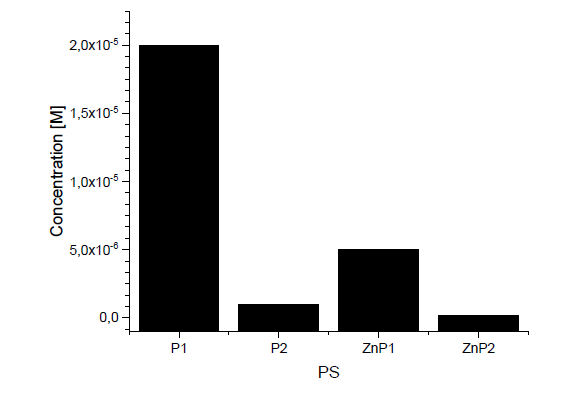
All PS are effective in the total photoinactivation of MRSA in Agar - PBS, however this effect is concentration dependent for each PS. Comparing the Free Bases, P2 is more effective than P1 since total photoinactivation is obtained in a considerably lower concentration (P2:P1 = 1:20). The same trend is observed in their correspondent Zincporphyrins; ZnP2 is more effective in a lower concentration than ZnP1 (ZnP2:ZnP1 = 1:25). It should be mentioned that significant drops in cell viability (3-4 log) are observed for lower concentrations than those leading to total photoinactivation.
Table 2 summarizes the minimal concentrations required for each PS resulting in no viable cells in Agar - PBS and Fig. 2 graphically compares these concentrations.

Comparison of the minimal PS concentration for no MRSA viable cells in Agar - PBS after irradiation
ZnP2 is the most effective PS in this series promoting total inactivation in Agar - PBS in submicromolar concentration (2x10⁻⁷ M).
Since there is no appreciable difference in the molar absorptivity (() of these compounds in the visible region and there is no significant difference in the quantum yields of singlet oxygen formation, except for ZnP1 (quantum yield measurements in our laboratory show that in water the quantum yields for P1, P2 and ZnP2 are approximately in the order of 0,72; while ZnP1 has a quantum yield of approximately 0,9; obviously changes may occur in Agar - PBS), then the difference in the photoinactivation efficiencies arises from different interactions and/or incorporation between the PS and S. aureus.
Bacterial inactivation depends on the association of PS with the pathogen. The first step is the interaction of the PS with the bacterial cell surface. Both Gram-positive and Gram-negative bacteria have a negatively charged cell wall composed of different surface structures. The anionic surface therefore acts as an electro-attractive platform for cationic PS, which are more efficiently bound and taken up by bacteria than neutral or anionic PS and additionally Gram-positive bacteria, such as S. aureus, are more susceptible to APDT than Gram-negative bacteria due to the absence of a complex outer membrane (Hamblin, 2017). The interaction between PS and bacteria is dependent on an intricate balance of hydrophobic - hydrophilic factors and specific interactions (Almeida et al., 2015). The results obtained are indicative that the contribution of the alkyl substituents in P2 and ZnP2 along the presence of four positive charges establish a more prone interaction with bacteria than P1 and ZnP1 which enables a preferred inactivation behavior for these porphyrin derivatives with benzylic substituents.
Photoinactivation in Agar - Milk: The results of photoinactivation in Agar - Milk plates are presented in Table 3; and Table 4 shows minimal PS concentration for no viable cells in Agar - Milk after irradiation as well as a comparison with the values found in Agar - PBS.
Logarithmic decay of MRSA in Agar - Milk plates after irradiation in function of PS concentration
Minimal PS concentration for no MRSA viable cells in Agar - Milk plates and ratio minimal concentration Agar - Milk / Agar - PBS
As can be observed, in Table 3 and Table 4, the minimal concentrations required for total inactivation for P1 and ZnP1 in Agar - Milk are the same that in Agar - PBS; otherwise for P2 and ZnP2 in the presence of milk are required higher concentrations than in Agar - PBS and noticeable the activity drop for ZnP2, with just 4log decrease in milk, no reaching total inactivation as occurs in Agar - PBS as the compound with the lower concentration of the series for total photoinactivation.
These results can be explained by the structure of the substituents of these PS. P2 and ZnP2 have benzyl substituents (benzyl-pyridinium) that are considerably more hydrophobic than the methyl substituents (methylpyridinium) of P1 and ZnP1. Therefore, these results are indicative that P2 and ZnP2, due to their greater hydrophobicity, have a more effective interaction with the hydrophobic components of milk, consequently minimizing the interaction with microorganisms. P1 and ZnP1, in turn, do not interact appreciably with milk, maintaining the degree of interaction with bacteria. The behavior in Agar - PBS and Agar - Milk is compared graphically in Fig. 3.

Comparison of the minimum PS concentrations for no MRSA viable cells in Agar - PBS and Agar - Milk plates.
Conclusions: The structure of the alkyl-pyridinium substituents present in these porphyritic PS show to be determinant in the photoinactivation processes in function of the medium properties where the photoinactivation is carried out. In aqueous medium (PBS), the hydrophilic-hydrophobic balance of P2 and ZnP2 favors interaction with the bacteria and photoinactivation is obtained under low concentration conditions, particularly for ZnP2, when compared to P1 and ZnP1. In the presence of milk, a strong interaction occurs between P2 and particularly ZnP2 with the milk components due to their hydrophobic benzyl-pyridinium substituents, which inhibits the interaction of these PS with the bacteria. P1 and ZnP1, being more hydrophilic, are not affected by the milk components, and exhibit the same behavior shown in aqueous medium. Therefore, understanding the activity of PS based on its structure and correlating it with the properties of the medium is extremely important in developing strategies for using APDT in specific problems in which infections occur. These studies on agar plates have proven to be a simple and effective test to verify the influence of milk on the properties of PS without the need to test its various individual components and exclude possible results dependent on the power of light in the process.
ACKNOWLEDGEMENTS
FAPESP Proc.: 2021/08111-2; FAPESP Proc. 2021/11062-3, and Capes for student scholarship.
REFERENCES
- AARESTRUP, F.M.; PYLES, M.D.; ALONSO, J.; FRANÇA, D.Q. Effect of abolishment of the use of antimicrobial agents for growth promotion on occurrence of antimicrobial resistance in fecal enterococci from food animals in Denmark. Antimicrob. Agents Chemother., v.45, p.2054-2059, 2001.
- ALMEIDA, A.; FAUSTINO, M.A.; TOMÉ, J.P. Photodynamic inactivation of bacteria: finding the effective targets. Future Med.Chem., v.7, p.1221-1224, 2015.
- ANGELOPOULOU, A.; HOLOHAN, R.; REA, M.C. et al. Bovine mastitis is a polymicrobial disease requiring a polydiagnostic approach. Int. Dairy J., v.99, P.104539, 2019.
- DIAS, L.L.R.; GUERREIRO, J.C.; GARDINI, J.C. et al. Terapia fotodinamica como adjuvante no tratamento da doença periodontal em equinos. Arq. Bras. Med. Vet. Zootec., v.72, p.1599-1608, 2020.
- GARCIA-SAMPEDRO, A.; TABERO, A.; ACEDO, P. Multimodal use of the porphyrin TMPyP: From cancer therapy to antimicrobial applications. Porphyrin Sci. Women, v.3, p.11-27, 2020.
- HAMBLIN, M.R. To kill resistant microbes. Curr. Opin. Microbiol., v.33, p.67-73, 2017.
- MOREIRA, L.H.; SOUZA, J.C.P.; LIMA, C.J. et al. Use of photodynamic therapy in the treatment of bovine subclinical mastitis. Photodiagnosis Photodyn. Ther., v.21, p.246-251, 2018.
- PRIBUL, B.; PEREIRA, I.A.; SOARES, L.C. et al. Staphylococcus aureus isolados de mastite bovina. Arq. Bras. Med. Vet. Zootec., v.63, p.744-748, 2011.
- RIBEIRO, M. G.; AZZELLINI, G. C. Synthesis of New Cationic Metalloporphyrins and Heterodimer Formation with Anionic Metallophthalocyanines. J. Braz. Chem. Soc., v.14, p.914-921, 2003.
- RIBEIRO, M.G.; LIEGEL, R.M.; AZZELLINI, G.C. Supramolecular assemblies of a new class of nonplanar cationic metalloporphyrins and anionic metallophthalocyanines. Inorganica Chim. Acta, v.362, p.307-317, 2009.
- SELLERA, F.P.; CAETANO, P.S.; RIBEIRO, M.S. et al. In vitro photoinactivation of bovine mastitis related pathogens. Photodiagnosis Photodyn. Ther., v.13, p.276-281, 2016.
- WAINWRIGHT, M.; MAISCH, T.; NONELL, S. et al. Photoantimicrobials-are we afraid of the light? Lancet Infect. Dis., v.17, p.e49-e55, 2017.