
 Small spatial intervals, big environmental variation: Restinga ecosystems are potential inducers of ecological speciation in the tropical tree Protium icicariba (Burseraceae)
Abstract
Restingas are ecosystems formed by diverse environments and plant populations separated by small spatial intervals. In this sense, we investigated the morphological, anatomical, and physiological characteristics of two populations of Protium icicariba, one occurring in a flooded forest and the other in an open restinga. Our objective was to determine if the phenotypic responses are related to the local adaptation of each population to its respective habitat and to evaluate a possible incipient case of ecological speciation. We found that individuals in flooded forests are taller and have a higher leaf area, mainly due to the greater availability of water and nutrients. The population in open restinga has individuals with higher wood density and smaller and thicker leaves. Sandy, deep, and oligotrophic soils likely induce these characteristics. The reproductive phase of the open restinga population is earlier than the flooded forest population, culminating in a certain asynchrony between them. Germination and initial seedling growth performed better when seeds and seedlings were grown in their respective habitats. Our results demonstrate evidence for the development of ecological speciation among P. icicariba populations, such as distinct selective pressures and local phenotypic adaptations, pre-zygotic reproductive isolation, and inviability of immigrants.
Keywords:
Anatomy; common garden; ecological speciation; morphology; Protium icicariba; reproductive phenology; restinga
Introduction
Ecological speciation represents an important mechanism in understanding how species evolve (Nosil, 2012). For the ecological speciation model to develop, the evolution of reproductive isolation must occur between adjacent populations or subsets of a single population by adapting to different environments (Schluter, 2000). Natural selection must be divergent across environments, fixing different advantageous alleles in one location, but which would be disadvantageous alleles in the other (Schluter, 2009). This can occur even among continuous populations and with gene flow if the environments are contrasting (Rundle & Nosil, 2005). Since the environment selects phenotypes, it is suggested that there is often a common genetic basis between the selection of phenotypes and genes involved in the evolution of reproductive isolation (Schluter, 2009). Although the ecological speciation model is well-explored (Nosil et al., 2005), few studies have investigated the real impact of environmental induction (Gilbert & Epel, 2009), especially for tree species (Leigh et al., 2004; Stacy et al., 2017).
One potential mechanism for generating reproductive isolation is immigrant infeasibility, which arises from differences in habitat-associated traits (Rundle & Nosil, 2005). Even if crossing occurs between populations or subpopulations adapted to contrasting environments, with seeds dispersed to new areas, reproduction will not be random between native and immigrant individuals. It is expected that individuals will reproduce more frequently with members of the same population compared to members of the immigrant population. This is because migrant individuals have lower survival rates than native individuals, which reduces the possibility of crossbreeding between local and immigrant genotypes (Nosil, 2004). In addition, phenotypes experiencing acclimation to contrasting environments could generate asynchrony between populations’ reproductive periods. In this way, gene flow can be totally or partially interrupted between local and migrant populations if each populations have a non-equivalent flowering period (Pfennig et al., 2010). Flowering time is often affected by soil water and nutrient availability, leading to accelerated or delayed flowering in different genotypes (Levin, 2009).
Notably, heterogeneous environments can generate disruptive forces and cause intrapopulation divergences (Nosil, 2012). The Atlantic Forest Biome emerges as an important natural laboratory for research related to ecological speciation. It includes many different ecosystems and is classified as a global diversity hotspot (Myers et al., 2000). Among its mosaic of ecosystems, the restingas, coastal vegetation types, respond to considerable climatic, edaphic, and ecological variation (Pereira, 2003). They form a set of distinct communities with different forest structures, influenced mainly by variations in the soil's water table level and nutrient composition (Magnago et al., 2013; Lourenço Jr et al., 2021). Restingas are herbaceous, shrubby, and forest vegetation, which can also be differentiated according to the influence of floods and their floristic composition (Pereira, 2003; Magnago et al., 2013). In the periodically flooded forest formation or flooded forest, for example, there are tree-sized individuals colonizing shallow, humid, acidic soil rich in organic matter and with higher concentrations of nutrients (Lourenço Jr et al., 2021). In contrast, non-flooded open shrub formations or open restingas, even adjacent to forest habitats, have deep, highly sandy soil, are nutrient-poor, and feature shrubby vegetation distributed in thickets (CEPEMAR, 2007). In both habitats, plant populations are habitat specialists and habitat generalists. Among the habitat generalists, Protium icicariba (DC.) Marchand var. icicariba (Burseraceae) is one of the most common species (Lourenço Jr et al., 2020).
Popularly known as almécega or almesca, P. icicariba is described as an arboreal, dioecious species endemic to Brazil, with a distribution spanning the states of Bahia, Espírito Santo, and Rio de Janeiro (Daly, 2014). A remarkable characteristic of this species is its high production of aromatic and volatile resins, used by people, among other purposes, as an insect repellent, and in traditional medicine (Rüdiger et al., 2007). It is insect-pollinated (Matallana et al., 2005), and its seeds are dispersed by birds (Gomes et al., 2008), lizards, and ants (Pereira et al., 2020). It is often listed as one of the most common woody species in the restinga communities of Espírito Santo (Ferreira et al., 2010; Ferreira & Silva, 2014; Lourenço Jr et al., 2020). Kurtz et al. (2013) state that P. icicariba can inhabit open restinga and flooded forest areas. Such adaptive ability suggests that this species is a habitat generalist.
Our objectives in this study were: (i) to investigate the properties of the soils of the flooded forest habitat and in the open restinga habitat, (ii) to investigate whether populations of P. icicariba, distributed in the two habitats, exhibit functional differences in morphological and anatomical traits in their leaves and branches; (iii) to analyze the synchrony between the reproductive phenology of the two populations and, (iv) utilizing germination analysis and the initial growth of seedlings, to verify the viability of immigrants across the two habitat types. We do not intend to test for the factors causing lineage divergence directly. Instead, we aim to document the conditions consistent with ecological speciation. Our predictions are: (I) morphological and anatomical differences of the two populations in each habitat will be mainly associated with differences in nutrient concentrations and soil water availability of each habitat; (II) there will be asynchrony in the reproductive phenology and (III) sub-optimal performance in the development and survival of immigrants.
Materials and Methods
Study area
The study area is in Paulo Cesar Vinha State Park, at Km 37.5 of the ES-060 highway ('Rodovia do Sol'), (20° 35'25" S; 40° 25'24" W), municipality of Guarapari, state of Espírito Santo, Brazil (Fig. 1). According to the Köppen-Geiger climate classification system, the climate in the region is Aw, tropical hot and humid with a rainy season (summer) and a dry season (winter). The average annual rainfall for the capital Vitória is 1,276 mm, and the average annual temperature is 24.2°C (INMET, 2022).

Study area in Paulo Cesar Vinha State Park (PEPCV). Individuals of P. icicariba in the open restinga habitat are represented by red spheres. Individuals of P. icicariba in the flooded forest habitat are represented by blue spheres.
Two restinga habitats were selected, on average 150 m apart. The first habitat, open restinga, is situated between the flooded forest and the ES-060 highway (Fig. 1). The vegetation cover consists of thickets of low stature and sparse populations of herbaceous species colonizing strips of white sand. The soil is predominantly quartz with a sandy texture and a deep-water table (CEPEMAR, 2007). The second is a flooded forest, and it is in a relief depression area between a flooded herbaceous habitat and a non-flooded forest habitat. This forest zone has a flat topography, visually dark soil, and a characteristic odor of decaying organic matter. Compared to other forest areas of the same restinga, it has a higher accumulation of organic matter, acidity, aluminum and salt concentrations, poor drainage, and a shallow water table (CEPEMAR, 2007; Magnago et al., 2013; Lourenço Jr et al., 2020).
Climatic data and soil analysis
We recorded temperature and precipitation data from June 2018 to June 2021 during the experimental period to compare them with historical averages. The climatic variables were obtained from the automated weather station A634 in the municipality of Vila Velha-ES (INMET, 2022). During the experimental period, there were no significant variations in air temperature and precipitation in relation to historical data for the region (Figure S1).
We collected soil samples in each tree or shrub's canopy projection. Using a drill, we extracted four single samples at 0 to 20 cm depth. Then, we homogenized the four sub-samples and stored them in plastic bags for forwarding to the laboratory. We performed chemical, physical, and organic matter analyses (Table S1) using the analytical method used by Teixeira et al. (2017).
Determination of Sample Populations, Height, and Stem Circumference
We sampled 20 individuals of P. icicariba from the open restinga habitat and 20 individuals from the flooded forest habitat (Fig. 1). We selected adult individuals with a stem diameter at height (DBH) ≥ 5 cm, respecting a minimum spacing of 15 meters between individuals from the same sampled population. For the shrub population, the stem diameter was determined at ground level due to the small length of the aerial stem and the beginning of branching at ground level (Fig. 2C). Height and circumference were determined using a tape measure. All subjects were georeferenced and marked with numbered aluminum plates for monitoring phenological events.

Individuals and branches of P. icicariba. (A) and (C) - Individual of the open restinga population; (B) and (D) - Individual of the flooded forest population.
Morphological and anatomical analyses
For all morphological and anatomical analyses of the leaf and stem, we used a sample size of 20 individuals per population. We collected all samples on the same day and analyzed them in the laboratory. Morphological data were obtained with fresh samples. Three fully expanded leaves exposed to the sun per individual were collected along the canopy. We analyzed the number of leaflets per leaf by adding all leaflets on each leaf and calculating the average number. The blade thickness was determined with the aid of a digital caliper in three leaflets per leaf, the fresh mass utilizing a precision scale, and the leaf area with the aid of the leaf area meter (LICOR-3100C Area Meter). Leaf dry mass was obtained by drying the leaves in an oven at 60°C (Leucadema-LM300) for 7 days. The specific leaf area was obtained by calculating the ratio between the leaf area and its dry mass (cm2 g-1).
Three leaflets from each individual (one per leaf) were fixed in FAA 70 (37% formaldehyde, glacial acetic acid, 70% ethanol, in a 5:5:90 ratio) (Johansen, 1940) and stored in 70% ethyl alcohol. Cross-sections were performed freehand, and after double staining with safrablau (Kraus & Arduin, 1997), they were mounted in pure glycerin. In the interveinal region, quantitative analyses were performed by measuring the thickness of the adaxial and abaxial cuticles, the epidermal cells of the adaxial and abaxial faces, and the palisade and spongy parenchyma. We measured each variable using one leaflet per individual, using a slice to perform twenty thickness measurements per anatomical structure. Then, we calculated the meaning of the variable per individual and population. We determined the stomatal density (number mm-²) and the diameter of the stomata utilizing the epidermal impression technique using a drop of universal instant adhesive (Tek Bond®) on the abaxial face of the leaflets on a glass slide to obtain the impression of the epidermis for analysis. The stomatal length was determined based on the average length of the guard cells (one leaflet per individual, 40 stomata per leaflet). All slides were analyzed using image analysis software (Nikon NIS-Elements, Tec. Behavior, Tokyo, Japan) and documented using a Nikon model photomicroscope (Eclipse 50i, Japan).
The sampling of branch segments was standardized concerning their position along the tree (first basal branch), their position along the branch (~1 m from the branch tip), their diameter (1.10 ± 0.37 cm, without the bark), and their maturity. To determine the wood density, the samples were hydrated for 12 hours, and the wood volume was calculated according to the water displacement method (Chave, 2006) with the support of a precision balance. Then, the samples were dried in an oven at 60° C until constant weight. The wood density was determined by dividing the dry mass by its volume.
From samples of branches stored in 70% ethyl alcohol, sections of approximately 15 to 20 μm thick cross-sections were obtained with a Jung microtome for wood. The sections were stained with 1% aqueous safranin and 1% alcian blue (1:9) (Kraus & Arduin, 1997). Histological slides were permanently mounted with stained glass varnish. We determined all samples’s vessel frequency and diameter from an image using TSview software. The vessels present partially or totally in 1 mm² were counted, and their diameter was determined from the average of two cross-sectional measurements in each cell.
Reproductive phenology
We recorded reproductive phenological events biweekly for 24 months (September 2018 to August 2020) in 20 individuals per population. We observed flowering and fruiting with the aid of binoculars and a camera. The flowering and fruiting times were quantified in terms of their activity index, which indicates the percentage of individuals in the population manifesting the phenological event and the synchronous comparison of these events between populations (Bencke & Morellato, 2002). Flowering was defined as the period in which individuals presented buds until the anthesis of the last flowers, and fruiting was defined as the period from the appearance of the first fruits until ripening.
Germination
Fruits were harvested during the dispersal period from ten individuals in the open restinga and five in the flooded forest. Subsequently, the fruits were transferred for processing in the laboratory to remove the epicarp and mesocarp. The seeds were then placed in fine mesh polyester envelopes and buried in the soil to a depth of 2-3 cm, following (with modifications) the methods adopted by Porceddu et al. (2013) and Sarmiento et al. (2017). We filled eight envelopes with seeds from open habitats and eight envelopes with seeds from flooded forest habitat individuals, each containing 30 seeds (Figure S2). We selected four germination sites in each habitat to increase the experimental area. Each site was located beneath the canopy of a P. icicariba tree, containing one envelope with seeds collected from the same habitat and one envelope with immigrant seeds collected from the alternative habitat. The envelopes were exhumed at 20-day intervals, with a maximum duration of 80 days, according to the results of Zamith & Scarano (2004). At each exhumation, the germinated seeds were counted to determine the percentage and stage of germination. We considered germination to be the protrusion of the radicle or the emission of shoots by the seedling.
Survival and emission of new leaves
Seedlings measuring 20 and 30 centimeters were cultivated in common gardens from September 2020 to March 2021. We extracted 40 seedlings from the open restinga and 40 from the flooded forest, keeping part of the soil in the rhizosphere. Afterward, 50% of the individuals were replanted in their environment of occurrence (native) and 50% in the opposite environment to their occurrence (immigrant). In each habitat, four planting sites were established. The seedlings were replanted circularly and in pairs at each site, with five immigrant seedlings and five local ones (Figure S3). We watered the seedlings at the time of planting and, in the absence of precipitation, at three-day intervals during the first month. All seedlings were marked with wire and aluminum tags.
We monitored all transplanted seedlings from planting through the six-month study period, recording survival rates and measuring new leaf production monthly. Only fully expanded leaves were included in the leaf count.
Statistical analysis
We evaluated the normality of the data using the Shapiro-Wilk test. Data sets that showed normal distribution were submitted to the Student's t-test for independent samples (P ≤ 0.05). The means of variables that were not normally distributed were analyzed using the Mann-Whitney test for independent samples (P ≤ 0.05). To better understand the morphological and anatomical variations between populations, we used principal component analysis (PCA). All statistical analyses were conducted in R version 4.1.0 (R Core Team, 2021) using exclusively the base stats package.
Results
Soil analysis
Soil data showed considerable chemical and physical significant differences between restinga habitats. The flooded forest, in relation to the open restinga, presents higher relative concentrations of potassium (64.5%), sulfur (70.4%), calcium (70.4%), magnesium (59.2%), aluminum (285.4%), potential acidity - H+Al (235.9%), organic matter (143.3%), iron (119.2%), zinc (158.7%), boron (31.6%), sodium (134.23%), fine sand (117.9%), silt (1,841.3%) and clay (169.0%) (Table 1). On the other hand, the soil of the open restinga presented higher averages of pH (9.2%) and total sand (57.2%), with a higher proportion of coarse sand (97.1%). As for the textural classification, the soil of the flooded forest was defined as loam-silty, while the soil of the open restinga was classified as sand (Table 1).
Morphological and anatomical variables
In the flooded forest habitat, individuals are significantly larger in height (221.1%), leaf area (124.5%), specific leaf area (38.1%), and leaflets per leaf (47.2%) compared to those in the open restinga habitat (Table 2). The individuals in the open restinga have branched stems with larger diameters (35.4%). Their leaves are composed of a thicker blade (12.5%), and their wood is denser (8.6%) (Table 2).
Populations did not show significant differences in woody anatomy (Table 3). However, the leaf traits indicated that the open restinga population presents all the highest relative averages (Table 3). These are stomatal length (19.8%), abaxial (46.3%) and adaxial (65.9%) cuticles, abaxial (14%) and adaxial (34.9%) epidermis, in addition to spongy parenchyma (11.5%) and palisade (30.8%) (Table 3, Figure S4).
The first principal components (PC1 and PC2) explained 68.9% of the variation between P. icicariba populations among morphological characteristics (Fig. 3A). while the same components explained a variation of 55% for the anatomical features. The distribution of the values of all individuals’s morphological and anatomical variables within the multivariable space highlights that the individuals of the open restinga are displaced and grouped in a region opposite to that occupied by the flooded forest. Individuals from open restinga were characterized by distinct stem diameter, wood density, blade thickness, and almost all anatomical variables. Meanwhile, the individuals in the flooded forest were associated with greater height, leaf area, fresh mass, specific leaf area, and the number of leaflets per leaf.

Principal component analysis (PCA) for quantitative morphological and anatomical variables of two populations of P. icicariba, open restinga (yellow circles) and flooded forest (green circles). H = height; LA = total leaf area; SLA = specific leaf area; LL = number of leaflets per leaf; STD = stem diameter; WD = wood density; LT = limb thickness; VF = vessel frequency; VD = vessel diameter; SF = stomatal frequency; SD = stomatal diameter; AdC = adaxial cuticle; AbC = abaxial cuticle; AdE = adaxial epidermis; AbE = abaxial epidermis; PP = palisade parenchyma; SP = spongy parenchyma.
Reproductive phenology
The flowering peak of the open restinga population is concentrated between September and December, during which up to 85% of the individuals flower (Fig. 4). Fruiting in this population is also concentrated between the months of October and January, with fruits found in 75% of the individuals sampled. The percentage of individuals from the flooded forest population that presented inflorescences and fruits was limited to 45% and 35%, respectively. The flowering peaks in the forest population are concentrated between December and January, with some individuals flowering until March. Fruiting occurs between the months of November to March, with peaks between December and February.
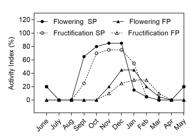
Reproductive activity index of two populations of P. icicariba distributed in the open restinga and flooded forest in Paulo Cesar Vinha State Park, municipality of Guarapari, state of Espírito Santo, Brazil. SP = shrub population; FP = forest population.
Germination, survival, and growth
In general, P. icicariba seeds germinated during the period of 80 days. However, they presented low germination rates (Figs. 5A, 5B). The flooded forest had a significantly higher average germination rate (32.1%) than the open restinga (16.7%) when considering native and immigrant seeds. However, native seeds consistently showed higher germination rates, regardless of the area. The first thirty days after transplanting had the highest seedling mortality rates in both plant habitats (Figs. 5C, 5D). Among the eighty seedlings, nineteen died in the first month (23.8%). Mortality was significantly higher in the open restinga habitats compared to the flooded forest. In the open restinga habitat, the immigrant seedlings showed a significantly higher number of losses (75%), with only five individuals left alive compared to eleven individuals from the native population at the end of the experiment. In the flooded forest, mortality was lower during the same period, with little difference between native and immigrant seedlings. In this environment, fourteen native seedlings survived after six months of the experiment, compared to twelve seedlings from the immigrant population.
In the open restinga habitat, the native seedlings produced a significantly higher number of leaves for 180 days (Fig. 5E). On average, native seedlings produced 4.8 leaves, while immigrant seedlings produced only 2.4 new leaves. The transplanted seedlings in the flooded forest habitat showed the same pattern (Fig. 5F), with native seedlings producing a significantly higher number of leaves. On average, the native ones produced 6.8 leaves, while the immigrant seedlings produced only 3.6 new leaves.

Germination (A and B), issue of new leaves (C and D), and survival (E and F) of P. icicariba seedlings in open restinga and flooded forest habitat. The solid line represents seeds from the open restinga population and the dashed lines represent seeds from the flooded forest population. The letters compare the means of individuals from each population, Student’s t-test or Mann-Whitney (P ≤ 0.05).
Discussion
Environmental correlates with morphological and anatomical traits
As expected, the flooded forest habitat presents greater availability of macro and micronutrients essential for plant development. This is because, in deeper soils, such as those on the open restinga, there is greater nutrient leaching (Lourenço Jr & Cuzzuol, 2009; Magnago et al., 2010), mainly due to sandy soil texture (Rodrigues et al., 2013). This nutritional difference, associated with the variation in the depth of the water table and the water retention capacity in the soil, largely explains the specific morphological and anatomical adaptations of each population, corroborating the first hypothesis. We highlight that selecting phenotype combined with significant environmental differences is the first condition for developing ecological speciation (West-Eberhard, 2003).
The forest environment has a better water supply due to the higher concentration of clay and organic matter, but mainly due to the reduced depth of the water table. This condition, combined with higher concentrations of essential nutrients, certainly contributes to the presence of taller individuals in an environment with greater competition for resources (Kunstler et al., 2016). Investing in growth, for example, would be necessary to reach the canopy in an environment of competition for light. On the other hand, the higher levels of salts and high concentrations of aluminum, together with the low pH, could limit the distribution of species (Magnago et al., 2013), acting as filters in the functional and taxonomic composition of the plant community (Poorter et al., 2009; Lourenço Jr et al., 2020). However, individuals from the forest population could circumvent this limitation using salt tolerance and exclusion mechanisms (Poorter et al., 2009) or having exclusion and tolerance to Al available in acidic soils (Schmitt et al., 2016).
The higher number of leaflets per leaf and leaf fresh mass reinforce the development of larger leaves in the flooded forest habitat, and the former can become an important taxonomic classification character. This is because the availability of water and nutrients allows investment in expanding the leaf area (Kozuka et al., 2005). In addition, larger and thinner leaves in forest individuals can facilitate light penetration throughout the palisade parenchyma and optimize photosynthetic activity (Da Silveira et al., 2015). The shaded environment also stimulates an increase in leaf area and biomass accumulation to optimize the interception of the low light penetrating the canopy (Niinemets, 2010; Poorter et al., 2012), a characteristic reflected in higher rates of specific leaf area. Due to the more excellent supply of water, individuals in the flooded forest do not need to have greater stocks of water in the spongy parenchyma, influencing a smaller blade thickness and, consequently, an increase in the biomass concentration and the specific leaf area index (Da Silveira et al., 2015).
On the other hand, the open restinga is an environment with xeric characteristics. The soil in the open restinga presents characteristics observed in soils that retain low amounts of water (Cooper et al., 2017). It is mainly composed of coarse sand, with low concentrations of clay and organic matter and a deeper water table than that observed in the flooded forest (Lourenço Jr et al., 2021). For these reasons, P. icicariba individuals have common strategies of plants adapted to drought, such as investing in lower height, leaf area, and specific leaf area (Cornwell & Ackerly, 2009; Katabuchi et al., 2012), production of thick leaves and scleromorphic tissues (Wright et al., 2004), and greater wood density (Sur et al., 2018). The smaller specific leaf area is related to oligotrophic and low-humidity soils, with the development of scleromorphic leaves (Turner, 1994), as observed in some woody plants that grow in sandbank soils (Melo Jr & Boeger, 2016). This characteristic can promote longer leaf longevity in a resource-poor environment. Thick leaves prevent oxidative damage to the photosynthetic apparatus, increasing resistance to irradiance penetration (Rossatto & Kolb, 2010; Todorovski et al., 2015). With thick, spongy parenchyma, the plant has greater water accumulation in the leaf, and the smaller leaf area reduces water loss through transpiration (Boeger & Gluzezak, 2006).
Although not analyzed in this research, the leaves of shrub individuals were commonly found to be rolled up (Fig. 2A). This attribute is known to reduce light interception, transpiration, and leaf dehydration (Kadioglu et al., 2012). Thus, leaf rolling in shrubs may be related to the indifference to the size and frequency of stomata among populations, as we expected the shrub population to have smaller and more numerous stomata. Leaves with smaller and more numerous stomata are more efficient in water use in xeric environments (Abrams et al., 1994; Rossatto & Kolb, 2010). In this case, leaf rolling could mitigate xeric effects by altering the microclimate on the leaf surface, regulating water loss (Matthews et al., 1990).
Some results appear to be more specific and would not be expected based on the large differences in height of the individuals. Despite being considerably smaller, shrubs have a larger stem diameter. However, this characteristic could be explained by the species presenting vegetative propagation and underground stems (Ferreira et al., 2010). Therefore, we consider nearby stems belonging to the same individual, which considerably increase their diameter together. However, the higher wood density observed in these individuals aligns with our expectations. This is a common strategy in trees subjected to xeric environments, as it provides higher survival probabilities by avoiding cavitation (Chave et al., 2009). However, the higher density of wood is not accompanied by a lower diameter or frequency of vessels in the shrub population. Alternatively, higher wood density may be related to fibers with thicker walls (Pratt et al., 2007) and, consequently, higher concentrations of structural polymers.
Reproductive phenology
The differences observed between the flowering peaks support our second hypothesis, as there is asynchrony between the reproductive periods of populations of P. icicariba among the investigated habitats. Reproductive phenology then favors crosses between individuals of the same population, allowing for the establishment of genetic variations related to their adaptive phenotypic traits. In this model, partial reproductive asynchrony is a strong assumption for ecological speciation under disruptive selection and gene flow (Fry, 2003; Kopp et al., 2018). That is, if there are variable adaptive phenotypes between populations, they can be maintained preferentially through local crossbreeding. The first individuals to flower will tend to interbreed with other "early" ones, and the late ones with other "late" ones (Weis et al., 2005). In this case, the chemical and physical composition of the soil could induce inconsistent reproductive cycles between continuous populations. Brady et al. (2005) suggest that adapting plants to contrasting edaphic conditions is important for isolating varieties in reproductive character. In P. subserratum growing parapatrically throughout western Amazonia, genetic differentiation and morphological variation among populations were correlated with soil type (Misiewicz & Fine, 2014). Contrary to our findings, populations of P. subserratum growing in different soil types did not exhibit asynchrony in flowering time; however, five potential barriers to reproduction were identified, including ecogeographic isolation, phenological differences, differences in pollinator assemblages, differential pollen adhesion, and low levels of hybrid seed development. However, ecogeographic isolation accounted for most of the observed isolation among ecotypes (Misiewicz et al., 2020).
Considering that the flowering peak of the shrub population is earlier in relation to the forest population, we assume this may be a drought avoidance strategy. When the species disperses its seeds during the rainy season, it guarantees a better germination rate in the shrub environment. Otherwise, germination would be compromised in the drier months because the sandy soil of this habitat retains less moisture and has greater exposure to sunlight. On the other hand, the dispersion of seeds from the forest population in their natural environment can occur at the end of the rainy season, as the soil characteristics in this habitat must guarantee sufficient moisture, even during the dry season. In addition, not dispersing the seeds during the rainiest period may be a strategy so that their seeds are not subjected to flooded summer environments, a condition that would make the survival of the embryos unviable. This may occur due to a predictability mechanism that matrices develop in their habitats (Fenner, 2017; Bhatt et al., 2020), where plants reproduce under more favorable conditions.
Immigrant performance
The sub-optimal performance of immigrants corresponds to our third hypothesis because even if germination and seedling development are possible, they present inferior performance in relation to native individuals. Therefore, highly antagonistic environments, such as open restinga and flooded forest habitats of restinga, hinder the generalist habit of species in the ecosystem. The flooded forest offers the best conditions for the initial establishment of the species since, in general, germination, survival, and the emission of new leaves are significantly better in this environment. However, it is generally noted that seeds or seedlings submitted to their native environment outperform immigrants. These observations follow the same pattern found in a similar study model with Metrosideros polymorpha (Myrtaceae), where seeds generally germinated at higher rates in more humid environments, and young individuals generally performed better in their places of origin (Barton et al., 2020). In another study, using a reciprocal transplant experiment with Protium subserratum (Burseraceae), Fine et al. (2013) observed that plants in terra firme (non-flooded) forests exhibited significantly greater height and leaf growth than the white-sand forest populations in both soil types.
Some characteristics of the forest environment may have disadvantaged the germination performance of the shrub population, indicating that local seeds are better adapted to these conditions. The higher concentration of salts, for example, can reduce the osmotic potential of the soil, making it difficult for the seed to absorb water (Munns, 2002), and soil acidity can reduce germination rates (Belmehdi et al., 2018). In contrast, in the open restinga environment, the seeds had to deal with low humidity, higher temperatures, and light exposure. Water deficiency causes the soil matric potential to be more negative, making it difficult for the seed to absorb water (Guedes et al., 2013), and the interaction between light and temperature influences the reactions that regulate the metabolism necessary to initiate germination (Baskin & Baskin, 2014). Therefore, due to the specific performance of seeds in their environment of origin, it is not ruled out that there may be interpopulation genetic variation that meets the requirements for germination in each environment (Murru et al., 2017). Or, as already mentioned, during seed production and maturation, parental individuals can perceive and adjust their phenotypes according to environmental requirements and optimize embryo development (Gutterman, 2000).
The environmental conditions of the open restinga habitat cause greater difficulties in establishing P. icicariba in the initial phase of seedling growth. Water stress, for example, can affect the production of new leaves (Nascimento et al., 2011). The reduced nitrogen supply can direct resource allocation for root development (Poorter et al., 2012). However, because native seedlings perform better on islands of vegetation in the open restinga habitat, it suggests some physiological adaptation regarding the use of resources or investment in protection mechanisms against local stresses (Orchard et al., 2010). Young individuals could, for example, adopt a more conservative growth strategy than those native to forest habitats due to the low supply of abiotic resources or the influence of biotic factors, such as herbivores. In studies in the Amazon Forest using species of the genus Protium sp., Fine et al. (2004) found significant differences in growth and mortality between species that occupy white sand or clay soil habitats. In the reciprocal transplant experiment, each species performed better in its habitat than in the opposite habitat, whether investing in defenses against herbivory and adopting conservative growth or investing in rapid growth in a more competitive environment and greater supply of resources (Fine et al, 2006).
In summary, while preliminary, our study presents significant results consistent with ecological speciation occurring in restinga environments. However, future studies will benefit from molecular analyses to test for genetic differences between populations and identify genes involved in reproductive isolation mechanisms. Our results also provide potentially helpful information for improving procedures for collecting seeds and transplanting seedlings for restoring degraded areas in restinga habitats. Depending on the origin of seeds and seedlings, their use may not be appropriate for plant restoration if the collection and destination environments are from mismatched habitats. In addition, planting seedlings in the wrong habitats can interfere with the local adaptation of species and ecological speciation.
We studied the initial stages of ecological speciation in restinga ecosystems for the first time in Protium icicariba. The fantastic environmental heterogeneity of restinga ecosystems represents an important driver of diversity, and our study contributes considerably to our understanding of the mechanisms of evolution in tropical plants. We conclude that environmental differences influence the flowering and fruiting period of the ecotypes, culminating in a partial asynchrony between the reproductive activity peaks of each population. Immigrant seeds demonstrate inferior germination performance in each habitat compared to native seeds. The growth and survival of seedlings were significantly better in the home habitat than in the contrasting habitat. These results are consistent with the hypothesis that habitat-mediated performance and survival reinforce local adaptation for habitat-specialist morphotypes. Given these results, we suggest the existence of basic conditions for the development of ecological speciation among populations of P. icicariba that occupy different restinga habitats.
Supplementary Material
The following online material is available for this article:
Table S1.
Figure S1.
Figure S2.
Figure S3.
Figure S4.
Acknowledgements
We thank Paulo Cesar Vinha State Park (PEPCV) and Environment and Water Resources State Institute (IEMA) for logistical support and licensing for the collection of biological material. We also thank the Post-Graduate Program in Plant Biology of the Federal University of Espírito Santo (UFES) for providing equipment and technical support. The first author thanks Coordination for the Improvement of High Education Personnel (CAPES) for financial support (Financing Code 001).
References
-
Abrams MD, Kubiske ME, Mostoller SA. 1994. Relating wet and dry year ecophysiology to leaf structure in contrasting temperate tree species. Ecology 75: 123-133. doi: 10.2307/1939389
» https://doi.org/10.2307/1939389 -
Barton KE, Jones C, Edwards KF, Shiels AB, Knight T. 2020. Local adaptation constrains drought tolerance in a tropical foundation tree. Journal of Ecology 108: 1540-1552. doi: 10.1111/1365-2745.13354
» https://doi.org/10.1111/1365-2745.13354 - Baskin CC, Baskin JM. 2014. Seeds: Ecology, biogeography and evolution of dormancy and germination. 2nd. edn. San Diego, Academic Press.
-
Belmehdi O, El Harsal A, Benmoussi M, Laghmouchi Y, Senhaji NS, Abrini J. 2018. Effect of light, temperature, salt stress, and pH on seed germination of medicinal plant Origanum elongatum (Bonnet) Emb. & Maire. Biocatalysis and Agricultural Biotechnology 16: 126-131. doi: 10.1016/j.bcab.2018.07.032
» https://doi.org/10.1016/j.bcab.2018.07.032 -
Bencke CSC, Morellato LPC. 2002. Comparação de dois métodos de avaliação da fenologia de plantas, sua interpretação e representação. Brazilian Journal of Botany 25: 269-275. doi: 10.1590/S0100-84042002000300003
» https://doi.org/10.1590/S0100-84042002000300003 -
Bhatt A, Gairola S, Carón MM et al 2020. Effects of light, temperature, salinity, and maternal habitat on seed germination of Aeluropus lagopoides (Poaceae): An economically important halophyte of arid Arabian deserts. Botany 98: 117-125. doi: 10.1139/cjb-2019-0096
» https://doi.org/10.1139/cjb-2019-0096 - Boeger MRT, Gluzezak RM. 2006. Adaptações estruturais de sete espécies de plantas para as condições ambientais da área de dunas de Santa Catarina, Brasil. Iheringia. Série Botânica 61: 73-82.
-
Brady KU, Kruckeberg AR, Bradshaw Jr HD. 2005. Evolutionary ecology of plant adaptation to serpentine soils. Annual Review of Ecology, Evolution 36: 243-266. doi: 10.1146/annurev.ecolsys.35.021103.105730
» https://doi.org/10.1146/annurev.ecolsys.35.021103.105730 -
CEPEMAR - Serviços De Consultoria Em Meio Ambiente Ltda., 2007. Plano de manejo do Parque Estadual Paulo César Vinha. Relatório Técnico CPM RT 307/07. https://www.meioambiente.es.gov.br/download/PCV_CAP3.pdf 20 Feb. 2022.
» https://www.meioambiente.es.gov.br/download/PCV_CAP3.pdf - Chave J. 2006. Measuring wood density for tropical forest trees a field manual. Toulouse, Lab. Toulouse, Evolution et Diversité Biologique/Université Paul Sabatier.
-
Chave J, Coomes D, Jansen S, Lewis SL, Swenson NG, Zanne AE. 2009. Towards a worldwide wood economics spectrum. Ecology Letters 12: 351-366. doi: 10.1111/j.1461-0248.2009.01285.x
» https://doi.org/10.1111/j.1461-0248.2009.01285.x -
Cooper M, Boschi RS, Silva LFSD, Toma RS, Vidal-Torrado P. 2017. Hydro-physical characterization of soils under the Restinga Forest. Scientia Agricola 74: 393-400. doi: 10.1590/1678-992X-2016-0103
» https://doi.org/10.1590/1678-992X-2016-0103 -
Cornwell WK, Ackerly DD. 2009. Community assembly and shifts in plant trait distributions across an environmental gradient in coastal California. Ecological Monographs 79: 109-126. doi: 10.1890/07-1134.1
» https://doi.org/10.1890/07-1134.1 -
Daly DC. 2014. Burseraceae in lista de espécies da flora do Brasil. Jardim Botânico do Rio de Janeiro 88. https://floradobrasil.jbrj.gov.br/jabot/floradobrasil/FB65 20 May 2022.
» https://floradobrasil.jbrj.gov.br/jabot/floradobrasil/FB65 -
Da Silveira TI, Boeger MRT, Maranho LT, De Melo JCF, Soffiatti P. 2015. Functional leaf traits of 57 woody species of the Araucaria Forest, Southern Brazil. Brazilian Journal of Botany 38: 357-366. doi: 10.1007/s40415-014-0111-0
» https://doi.org/10.1007/s40415-014-0111-0 - Fenner M. 2017. Ecology of seed banks. In: Seed development and germination. New York, Routledge. p. 507-528.
- Ferreira LC, Thomazi RD, Oliveira DAC, Silva AG. 2010. Estrutura populacional e padrão espacial de Protium icicariba (DC.) Marchand na Área de Proteção Ambiental de Setiba, Espírito Santo, sudeste do Brasil. Natureza Online 8: 39-45.
- Ferreira P, Silva AG. 2014. A vegetação arbustiva aberta em regeneração espontânea dentro de uma Unidade de Conservação de Proteção Integral, numa restinga após impacto de extração de areia. Natureza Online 12: 51-60.
-
Fine PV, Mesones I, Coley PD. 2004. Herbivores promote habitat specialization by trees in Amazonian forests. Science 305: 663-665. doi: 10.1126/science.1098982
» https://doi.org/10.1126/science.1098982 -
Fine PV, Miller ZJ, Mesones I et al 2006. The growth-defense trade‐off and habitat specialization by plants in Amazonian Forests. Ecology 87: S150-S162. doi: 10.1890/0012-9658(2006)87[150:tgtahs]2.0.co;2
» https://doi.org/10.1890/0012-9658(2006)87[150:tgtahs]2.0.co;2 -
Fine PV, Metz MR, Lokvam J et al 2013. Insect herbivores, chemical innovation, and the evolution of habitat specialization in Amazonian trees. Ecology 94: 1764-1775. doi: 10.1890/12-1920.1
» https://doi.org/10.1890/12-1920.1 -
Fry JD. 2003. Multilocus models of sympatric speciation: Bush versus Rice versus Felsenstein. Evolution 57: 1735-1746. doi: 10.1111/j.0014-3820.2003.tb00582.x
» https://doi.org/10.1111/j.0014-3820.2003.tb00582.x -
Gilbert SF, Epel D. 2009. Ecological developmental biology: Integrating epigenetics, medicine, and evolution. The Yale Journal of Biology and Medicine 82: 231-232. doi: 10.1093/icb/icp106
» https://doi.org/10.1093/icb/icp106 -
Gomes VSM, Loiselle BA, Alves MA. 2008. Birds foraging for fruits and insects in shrubby resting vegetation, southeastern Brazil. Biota Neotropica 8: 021-031. doi: 10.1590/S1676- 06032008000400001
» https://doi.org/10.1590/S1676- 06032008000400001 -
Guedes RS, Alves EU, Viana JS, Gonçalves EP, Lima CRD, Santos SRN. 2013. Germinação e vigor de sementes de Apeiba tibourbou submetidas ao estresse hídrico e diferentes temperaturas. Ciência Florestal 23: 45-53. doi: 10.5902/198050988438
» https://doi.org/10.5902/198050988438 -
Gutterman Y. 2000. Maternal effects on seeds during development. In: Fenner M (ed.). Seeds: The ecology of regeneration in plant communities. Wallingford, CABI Publishing. p. 59-84. doi: 10.1079/9780851994321.0059
» https://doi.org/10.1079/9780851994321.0059 -
INMET - Instituto Nacional de Meteorologia, 2022. BDMEP - Banco de Dados Meteorológicos para Ensino e Pesquisa. Normais Climatológicas (1990-2021). https://www.gov.br/agricultura/pt-br/assuntos/inmet?r=bdmep/bdmep 19 Oct. 2022.
» https://www.gov.br/agricultura/pt-br/assuntos/inmet?r=bdmep/bdmep - Johansen DA. 1940. Plant microtechnique. New York, Mcgraw-Hill Book.
-
Kadioglu A, Terzi R, Saruhan N, Saglam A. 2012. Current advances in the investigation of leaf rolling caused by biotic and abiotic stress factors. Plant Science 182: 42-48. doi: 10.1016/j.plantsci.2011.01.013
» https://doi.org/10.1016/j.plantsci.2011.01.013 -
Katabuchi M, Kurokawa H, Davies SJ, Tan S, Nakashizuka T. 2012. Soil resource availability shapes community trait structure in a species‐rich dipterocarp forest. Journal of Ecology 100: 643-651. doi: 10.1111/j.1365-2745.2011.01937.x
» https://doi.org/10.1111/j.1365-2745.2011.01937.x -
Kopp M, Servedio MR, Mendelson TC et al 2018. Mechanisms of assortative mating in speciation with gene flow: Connecting theory and empirical research. The American Naturalist 191: 1. doi: 10.1086/694889
» https://doi.org/10.1086/694889 -
Kozuka T, Horiguchi G, Kim GT, Ohgishi M, Sakai T. 2005. The different growth responses of the Arabidopsis thaliana leaf blade and the petiole during shade avoidance are regulated by photoreceptors and sugar. Plant and Cell Physiology 46: 213-223. doi: 10.1093/pcp/pci016
» https://doi.org/10.1093/pcp/pci016 - Kraus JE, Arduin M. 1997. Manual básico de métodos em morfologia vegetal. Rio de Janeiro, EDUR.
-
Kunstler G, Falster D, Coomes DA et al 2016. Plant functional traits have globally consistent effects on competition. Nature 529: 204-207. doi: 10.1038/nature16476
» https://doi.org/10.1038/nature16476 -
Kurtz BC, Gomes JC, Scarano FR. 2013. Structure and phytogeographic relationships of swamp forests of Southeast Brazil. Acta Botanica Brasilica 27: 647-660. doi: 10.1590/S0102-33062013000400002
» https://doi.org/10.1590/S0102-33062013000400002 -
Leigh Jr EG, Davidar P, Dick CW et al 2004. Why do some tropical forests have so many species of trees? Biotropica 36: 447-473. doi: 10.1111/j.1744-7429.2004.tb00342.x
» https://doi.org/10.1111/j.1744-7429.2004.tb00342.x -
Levin DA. 2009. Flowering‐time plasticity facilitates niche shifts in adjacent populations. New Phytologist 183: 661-666. doi: 10.1111/j.1469-8137.2009.02889.x
» https://doi.org/10.1111/j.1469-8137.2009.02889.x -
Lourenço Jr J, Cuzzuol GRF. 2009. Caracterização de solos de duas formações de restinga e sua influência na constituição química foliar de Passiflora mucronata Lam. (Passifloraceae) e Canavalia rosea (Sw.) DC. (Fabaceae). Acta Botanica Brasilica 23: 239-246. doi: 10.1590/S0102-33062009000100025
» https://doi.org/10.1590/S0102-33062009000100025 -
Lourenço Jr J, Newman EA, Milanez CRD, Thomaz LD, Enquist BJ. 2020. Assessing trait driver theory along abiotic gradients in tropical plant communities. bioRxiv. doi: 10.1101/2020.02.15.950139
» https://doi.org/10.1101/2020.02.15.950139 -
Lourenço Jr J, Newman EA, Milanez CRD, Thomaz LD, Enquist BJ. 2021. Soil‐associated drivers of plant traits and functional composition in Atlantic Forest coastal tree communities. Ecosphere 12: e03629. doi: 10.1002/ecs2.3629
» https://doi.org/10.1002/ecs2.3629 -
Magnago LFS, Martins SV, Schaefer CEGR, Neri AV. 2010. Gradiente fitofisionômico-edáfico em formações florestais de Restinga no sudeste do Brasil. Acta Botanica Brasilica 24: 734-746. doi: 10.1590/S0102-33062010000300017
» https://doi.org/10.1590/S0102-33062010000300017 -
Magnago LFS, Martins SV, Schaefer CEGR, Neri AV. 2013. Structure and diversity of restingas along a flood gradient in southeastern Brazil. Acta Botanica Brasilica 27: 801-809. doi: 10.1590/S0102-33062013000400020
» https://doi.org/10.1590/S0102-33062013000400020 -
Matallana G, Wendt T, Araujo DS, Scarano FR. 2005. High abundance of dioecious plants in a tropical coastal vegetation. American Journal of Botany 92: 1513-1519. doi: 10.3732/ajb.92.9.1513
» https://doi.org/10.3732/ajb.92.9.1513 -
Matthews RB, Azam-Ali SN, Peacock JM. 1990. Response of four sorghum lines to mid-season drought. II. Leaf characteristics. Field Crops Research 25: 297-308. doi: 10.1016/0378-4290(90)90011-Y
» https://doi.org/10.1016/0378-4290(90)90011-Y -
Melo Jr JCF, Boeger MRT. 2016. Leaf traits and plastic potential of plant species in a light-edaphic gradient from restinga in southern Brazil. Acta Biológica Colombiana 21: 51-62. doi: 10.15446/abc.v21n1.47621
» https://doi.org/10.15446/abc.v21n1.47621 -
Misiewicz TM, Fine PV. 2014. Evidence for ecological divergence across a mosaic of soil types in an Amazonian tropical tree: Protium subserratum (Burseraceae). Molecular Ecology 23: 2543-2558. doi: 10.1111/mec.12746
» https://doi.org/10.1111/mec.12746 -
Misiewicz TM, Simmons TS, Fine PV. 2020. The contribution of multiple barriers to reproduction between edaphically divergent lineages in the Amazonian tree Protium subserratum (Burseraceae). Ecology and Evolution 10: 6646-6663. doi: 10.1002/ece3.6396
» https://doi.org/10.1002/ece3.6396 -
Munns R. 2002. Comparative physiology of salt and water stress. Plant, Cell & Environment 25: 239-250. doi: 10.1046/j.0016-8025.2001.00808.x
» https://doi.org/10.1046/j.0016-8025.2001.00808.x -
Murru V, Santo A, Gallo M, Cardona C, Boi M, Bacchetta G. 2017. Comparative germination ecology and seedling growth of two Ibero-Levantine endemic species belonging to the Silene mollissima aggregate (Caryophyllaceae). Flora 227: 10-17. doi: 10.1016/j.flora.2016.12.002
» https://doi.org/10.1016/j.flora.2016.12.002 -
Myers N, Mittermeier RA, Mittermeier CG, Da Fonseca GA, Kent J. 2000. Biodiversity hotspots for conservation priorities. Nature 403: 853-858. doi: 10.1038/35002501
» https://doi.org/10.1038/35002501 -
Nascimento HHCD, Nogueira RJMC, Silva ECD, Silva MAD. 2011. Análise do crescimento de mudas de jatobá (Hymenaea courbaril L.) em diferentes níveis de água no solo. Revista Árvore 35: 617-626. doi: 10.1590/S0100-67622011000400005
» https://doi.org/10.1590/S0100-67622011000400005 -
Niinemets Ü. 2010. A review of light interception in plant stands from leaf to canopy in different plant functional types and in species with varying shade tolerance. Ecological Research 25: 693-714. doi: 10.1007/s11284-010-0712-4
» https://doi.org/10.1007/s11284-010-0712-4 -
Nosil P. 2004. Reproductive isolation caused by visual predation against migrants between divergent environments. Proceedings of the Royal Society of London B - Biological Sciences 271: 1521-1528. doi: 10.1098/rspb.2004.2751
» https://doi.org/10.1098/rspb.2004.2751 -
Nosil P, Vines TH, Funk DJ. 2005. Reproductive isolation caused by natural selection against immigrants from divergent habitats. Evolution 59: 705-719. doi: 10.1111/j.0014-3820.2005.tb01747.x
» https://doi.org/10.1111/j.0014-3820.2005.tb01747.x - Nosil P. 2012. Ecological speciation. Oxford, Oxford University Press.
-
Orchard KA, Cernusak LA, Hutley LB. 2010. Photosynthesis and water-use efficiency of seedlings from northern Australian monsoon forest, savanna and swamp habitats grown in a common garden. Functional Plant Biology 37: 1050-1060. doi: 10.1071/FP09306
» https://doi.org/10.1071/FP09306 -
Pereira IF, Da Costa APF, Srbek-Araujo AC, Guimarães LJ, Merencio AF, Da Silva AG. 2020. The dispersion of diaspores of Protium icicariba (Burseraceae) - a networked or multifactorial system? Journal of Chemical Ecology 46: 163-175. doi: 10.1007/s10886-019-01140-x
» https://doi.org/10.1007/s10886-019-01140-x - Pereira OJ. 2003. Restinga: Origem, estrutura e diversidade. Desafios da botânica brasileira no novo milênio: inventário, sistematização e conservação da biodiversidade vegetal. Belém, Sociedade Brasileira de Botânica.
-
Pfennig DW, Wund MA, Snell-Rood EC, Cruickshank T, Schlichting CD, Moczek AP. 2010. Phenotypic plasticity’s impacts on diversification and speciation. Trends in Ecology & Evolution 25: 459-467. doi: 10.1016/j.tree.2010.05.006
» https://doi.org/10.1016/j.tree.2010.05.006 -
Poorter H, Niinemets Ü, Poorter L, Wright IJ, Villar R. 2009. Causes and consequences of variation in leaf mass per area (LMA): A meta-analysis. New Phytologist 182: 565-588. doi: 10.1111/j.1469-8137.2009.02830.x
» https://doi.org/10.1111/j.1469-8137.2009.02830.x -
Poorter H, Niklas KJ, Reich PB, Oleksyn J, Poot P, Mommer L. 2012. Biomass allocation to leaves, stems and roots: Meta-analyses of interspecific variation and environmental control. New Phytologist 193: 30-50. doi: 10.1111/j.1469-8137.2011.03952.x
» https://doi.org/10.1111/j.1469-8137.2011.03952.x -
Porceddu M, Mattana E, Pritchard HW, Bacchetta G. 2013. Thermal niche for in situ seed germination by Mediterranean mountain streams: Model prediction and validation for Rhamnus persicifolia seeds. Annals of Botany 112: 1887-1897. doi: 10.1093/aob/mct238
» https://doi.org/10.1093/aob/mct238 -
Pratt RB, Jacobsen AL, Ewers FW, Davis SD. 2007. Relationships among xylem transport, biomechanics and storage in stems and roots of nine Rhamnaceae species of the California chaparral. New Phytologist 174: 787-798. doi: 10.1111/j.1469-8137.2007.02061.x
» https://doi.org/10.1111/j.1469-8137.2007.02061.x -
R Core Team 2021. R: A language and environment for statistical computing. R Foundation for Statistical Computing, Vienna. https://www.R-project.org 10 May 2021.
» https://www.R-project.org - Rodrigues J, Almeida Filho JR, Casagrande JC, Bonilha RM, Roberto M. 2013. Soil quality of Restinga forest: Organic matter and aluminum saturation. Geophysical Research Abstracts 15: 6096.
-
Rossatto DR, Kolb RM. 2010. Gochnatia polymorpha (Less.) Cabrera (Asteraceae) changes in leaf structure due to differences in light and edaphic conditions. Acta Botanica Brasilica 24: 605-612. doi: 10.1590/S0102-33062010000300002
» https://doi.org/10.1590/S0102-33062010000300002 - Rüdiger AL, Siani AC, Junior VFV. 2007. The chemistry and pharmacology of the South America genus Protium Burm. f. (Burseraceae). Pharmacognosy Reviews 1: 93-104.
-
Rundle HD, Nosil P. 2005. Ecological speciation. Ecology Letters 8: 336-352. doi: 10.1111/j.1461-0248.2004.00715.x
» https://doi.org/10.1111/j.1461-0248.2004.00715.x -
Sarmiento C, Zalamea PC, Dalling JW et al 2017. Soilborne fungi have host affinity and host-specific effects on seed germination and survival in a lowland tropical forest. Proceedings of the National Academy of Sciences 114: 11458-11463. doi: 10.1073/pnas.1706324114
» https://doi.org/10.1073/pnas.1706324114 - Schluter D. 2000. The ecology of adaptive radiation. Oxford, OUP Oxford.
-
Schluter D. 2009. Evidence for ecological speciation and its alternative. Science 323: 737-741. doi: 10.1126/science.1160006
» https://doi.org/10.1126/science.1160006 -
Schmitt M, Watanabe T, Jansen S. 2016. The effects of aluminium on plant growth in a temperate and deciduous aluminium accumulating species. AoB Plants 8: plw065. doi: 10.1093/aobpla/plw065
» https://doi.org/10.1093/aobpla/plw065 -
Stacy EA, Paritosh B, Johnson MA, Price DK. 2017. Incipient ecological speciation between successional varieties of a dominant tree involves intrinsic postzygotic isolating barriers. Ecology and Evolution 7: 2501-2512. doi: 10.1002/ece3.2867
» https://doi.org/10.1002/ece3.2867 -
Sur GL, Keating R, Snow N, Stacy EA. 2018. Leaf micromorphology aids taxonomic delineation within the hypervariable genus Metrosideros (Myrtaceae) on O‘ahu1. Pacific Science 72: 345-361. doi: 10.2984/72.3.6
» https://doi.org/10.2984/72.3.6 - Teixeira PC, Donagemma GK, Fontana A, Teixeira WG. 2017. Manual de métodos de análise de solo. Brasília, Embrapa.
- Todorovski EC, Melo Jr JCF, Amorim MW. 2015. Potencial plástico de Nectandra oppositifolia Nees. (Lauraceae) em fisionomias de floresta ombrófila densa e restinga. Natureza Online 13: 70-76.
-
Turner IM. 1994. Sclerophylly: Primarily protective? Functional Ecology 8: 669-675. doi: 10.2307/2390225
» https://doi.org/10.2307/2390225 - Weis AE, Winterer J, Vacher C, Kossler TM, Young CA, Lebuhn GL. 2005. Phenological assortative mating in flowering plants: The nature and consequences of its frequency dependence. Evolutionary Ecology Research 7: 161-181.
- West-Eberhard MJ. 2003. Developmental plasticity and evolution. Oxford, Oxford University Press .
-
Wright IJ, Reich PB, Westoby M et al 2004. The worldwide leaf economics spectrum. Nature 428: 821-827. doi: 10.1038/nature02403
» https://doi.org/10.1038/nature02403 -
Zamith LR, Scarano FR. 2004. Produção de mudas de espécies das Restingas do município do Rio de Janeiro, RJ, Brasil. Acta Botanica Brasilica 18: 161-176. doi: 10.1590/S0102-33062004000100014
» https://doi.org/10.1590/S0102-33062004000100014


