 Irrigation Strategies and Interannual Variability in Maize Yield in Southern Brazil
Abstract
Maize plays a fundamental role in the economy of Rio Grande do Sul. However, the occurrence of droughts has impacted the maize yield. To mitigate these effects, investment in irrigation and the adoption of efficient strategies for irrigation management are essential. Thus, the aim of the study was to evaluate the water balance and maize yield data, analyze their relationship with the ENSO phenomenon, and propose region-specific irrigation strategies for Rio Grande do Sul. This study was developed based on historical series of maize yield and meteorological data from weather stations in ten municipalities. Three irrigation management strategies were studied. The interannual variability in maize yield across the studied cities can be attributed to fluctuations in water availability according water balance during the crop cycle. In El Niño years, maize yield was above average in 85% of the years, while in La Niña years yield below the mean yield in 78% of the cases. The adoption of deficit irrigation can be an alternative in scenarios where water efficiency is prioritized while maintaining yield levels similar to full irrigation. Adopting irrigation practices in the state of Rio Grande do Sul can result in an average yield increase of 21.8 kg mm-1.
Keywords
Zea mays L.; water deficit; irrigation management; agrometeorology; ENSO phenomenon
Resumo
O milho desempenha um papel fundamental na economia do Rio Grande do Sul. No entanto, a ocorrência de secas tem impactado significativamente a produtividade do milho. Para mitigar esses efeitos, o investimento em irrigação e a adoção de estratégias eficientes de manejo da irrigação são essenciais. Assim, o objetivo do estudo foi determinar as necessidades de irrigação com base no balanço hídrico e na produtividade do milho, relacionando-as ao fenômeno ENSO, bem como propor estratégias de manejo da irrigação para diferentes regiões do Rio Grande do Sul. Este estudo foi desenvolvido com base em séries históricas de dados de produtividade do milho e dados meteorológicos de estações meteorológicas em dez municípios. Três estratégias de manejo da irrigação foram estudadas. A variabilidade interanual na produção de milho nas cidades estudadas pode ser atribuída às flutuações na disponibilidade de água de acordo com o balanço hídrico durante o ciclo da cultura. Em anos de El Niño, a produtividade do milho foi acima da média em 85% dos anos, enquanto em anos de La Niña a produtividade caiu 78%. A adoção da irrigação deficitária pode ser uma alternativa em cenários onde a conservação da água e a eficiência são priorizadas, mantendo níveis de produtividade semelhantes à irrigação plena. A adoção de práticas de irrigação no estado do Rio Grande do Sul pode resultar em um aumento médio de produtividade de 21,8 kg mm-1.
Palavras-chave
Zea mays L.; déficit hídrico; manejo da irrigação; agrometeorologia; fenômeno ENOS
1. Introduction
The maize crop (Zea mays L.) is widely adapted to diverse soil and climatic conditions across Brazil, which is currently the third-largest maize producer in the world, following the United States and China. Maize is considered a strategic crop for food security due to its multiple uses in human nutrition, animal feed, and bioethanol production. Like most Brazilian agricultural systems, maize cultivation is highly dependent on weather conditions, which are among the primary factors causing interannual variability in crop yields.
In Brazil, maize is predominantly grown under rainfed conditions, making it especially vulnerable to climatic extremes, particularly water stress (Nóia Junior and Sentelhas, 2019; Bigolin and Talamini, 2024). Even short-term droughts during critical periods of high water demand can significantly reduce the crop's productive potential (Taiz et al., 2017). Water stress alters the physiological responses of the plant by activating defense mechanisms that help it escape or tolerate drought conditions. However, these adaptations often lead to reductions in growth and yield (Aydinsakir et al., 2013). Water deficits can impair development and physiological processes such as photosynthesis and nutrient transport, ultimately decreasing biomass accumulation and grain yield-mainly by reducing kernel number per ear or kernel weight (Yang et al., 2017; Laudien et al., 2020).
In Rio Grande do Sul, water availability is the most frequent and severe limiting factor for maize production (Andrioli and Sentelhas, 2009). Variability in rainfall distribution throughout the growing season largely explains the fluctuations in yield across years (Matzenauer et al., 2021). The El Niño-Southern Oscillation (ENSO) phenomenon is one of the main determinants of rainfall variability in Rio Grande do Sul (Berlato et al., 2024). In general, the warm phase of El Niño tends to cause more intense rainfall in the South and drought in the North and Northeast of the country. While in La Niña (cold phase) years, it promotes increased rainfall in the North and Northeast regions and reduced rainfall in the South, harming crop productivity, especially maize (Berlato et al., 2024). Therefore, it is important to understand the effects of ENSO on the different maize-producing regions of Rio Grande do Sul to aid agricultural planning and climate risk mitigation.
Considering the importance of mitigating the risks associated with the water factor in maize cultivation, farmers have increasingly invested in irrigation systems to sustain yields during dry periods. Therefore, understanding the yield response to irrigation is essential for guiding crop choice, conducting economic viability analyses, and developing efficient irrigation strategies. In water-limited regions, proper irrigation planning is key to improving both yield and water use efficiency while ensuring the profitability of maize production.
In this context, assessing crop water requirements and analyzing water availability are fundamental to understanding the water dynamics within the soil-plant-atmosphere system. These evaluations support crop planning, the identification of optimal sowing dates, irrigation project design, and the improvement of agroclimatic zoning. A key tool for assessing soil water conditions is the sequential water balance, which tracks daily changes in soil moisture. By comparing potential and actual crop evapotranspiration, it estimates water deficits-an important determinant of yield reduction (Doorenbos and Kassam, 1994). The greater the water deficit, the more pronounced the yield loss, which is quantified using the crop yield response factor (Ky), a water deficit sensitivity coefficient for different development stages.
The model developed by Doorenbos and Kassam (1994), which relates relative yield reduction to the relative evapotranspiration deficit using Ky, is one of the most widely used approaches to estimate yield losses under water-limited conditions. Thus, applying this model is valuable for quantifying maize yield losses and assessing year-to-year variability in Rio Grande do Sul.
One strategy to minimize yield loss from water scarcity is adjusting planting dates, such as advancing sowing to cooler months like August, so that peak water demand does not coincide with periods of low rainfall. Another approach is the adoption of irrigation, which can take two main forms: full irrigation, where all crop water demands are met, and deficit irrigation, where only a portion of the demand is supplied. Full irrigation is typical in regions with distinct rainy and dry seasons, aiming for maximum yield. However, in southern Brazil, where rainfall deficits are sporadic but frequent, deficit irrigation is a more common and practical solution.
While full irrigation can lead to near-potential productivity, it often entails high water consumption, environmental concerns (Fereres and Soriano, 2007), and elevated financial costs. In contrast, deficit irrigation has gained global recognition as a strategy for water conservation in the face of increasing scarcity and competition for water resources (Comas et al., 2019). It can also reduce both capital and operating costs (Moreno et al., 2012; Scardigno, 2020). Furthermore, it enhances sustainability by improving water use efficiency, optimizing the use of rainfall, decreasing dependence on irrigation water, and maintaining yields at economically viable levels-often increasing net farm income (Farré and Faci, 2009; Gheysari et al., 2017).
This study addresses two key questions: (i) How does annual water balance variability impact maize yield, and how is this related to the El Niño-Southern Oscillation (ENSO)? and (ii) What is the most suitable irrigation management strategy for maize cultivation in Rio Grande do Sul? Therefore, the objective of this study was to evaluate the water balance and maize yield data, analyze their relationship with the ENSO phenomenon, and propose region-specific irrigation strategies for Rio Grande do Sul.
2. Materials and Methods
This study was developed based on historical series of maize yield data and meteorological data from weather stations in ten municipalities in the state of Rio Grande do Sul. Table 1 shows the geographical locations, climate classification, sampling periods, and the number of complete maize crop cycles that were simulated in the respective locations. According to the climatic classification of Köppen, the climate of the region is of type Cfa (subtropical humid) with average annual temperatures of 19.1 °C and minimum and maximum temperatures ranging from 0 °C to 38 °C (Alvares et al., 2013).
Latitude, longitude, altitude, climate type and initial and final year of the observation period for the meteorological elements used, along with the number of years in the historical series (number of simulated maize crop cycles), for the ten municipalities located in the state of Rio Grande do Sul.
For the simulation of crops and the development of the water balance, meteorological data for maximum air temperature (Tx, °C) and minimum air temperature (Tn, °C), as well as rainfall (R, mm day-1), both on a daily scale, were extracted from the Meteorological Database for Teaching and Research (BDMEP) of the National Institute of Meteorology (INMET).
To develop the water balance, it was necessary to determine the available water capacity (AWC), which was obtained using the models proposed by Reichert et al. (2009), considering the soil's sand, silt, and clay content at each location (Table 2). The AWC varied depending on the soil characteristics of each site and the effective rooting depth of maize (Ze), which was considered a constant value of 50 cm (Bassoi et al., 1994). The equations used are listed below (Reichert et al., 2009):
where θcc refers to the field capacity (m3 m-3), θpmp to the permanent wilting point (m3 m-3), and Ae to the specific available water capacity (mm cm-1); and Tclay, Tsilt, and Tsand to the clay, silt, and sand contents (kg kg-1), respectively.Soil classes, clay, silt and sand (kg kg-1) contents corresponding to the ten municipalities located in the state of Rio Grande do Sul.
The water balance was developed using the method proposed by Thornthwaite and Mather (1955). The initialization of the water balance calculation was performed at the moment when there was a soil saturation condition (where ARM = AWC). The analysis considered a sequential water balance, where each cycle was calculated specifically, that is, the initial water is reset at each crop cycle.
From the water balance, it was possible to determine the variation in soil water storage and consequently the actual crop evapotranspiration (ETr, mm day-1). Reference potential evapotranspiration (ETo, mm day-1) was estimated using the Hargreaves and Samani model (Hargreaves and Samani, 1985) due to its good performance in the Southern region of Brazil (Pilau et al., 2012). Also, the maximum crop evapotranspiration (ETc) was calculated by the product between ETo and crop coefficient (Kc). The standard Kc was used according the crop phase: 0.40 for establishment, 0.80 for vegetative growth, 1.10 for flowering, 0.90 for yield formation and 0.55 for ripening (Andrioli and Sentelhas, 2009).
The estimation of Attainable Productivity (AP) is determined by penalizing potential productivity (PP) due to water deficit occurring in each phase of crop development. Thus, potential productivity values (PP, kg ha-1) for maize were extracted from the study conducted by Bonecarrére et al. (2007), who estimated PP using stochastic simulation with the use of an agroecological zone model for cities in Rio Grande do Sul. The calculations were performed using the equation:
where Ky is the water deficit sensitivity coefficient for each development stage according Table 3. The Ky values adopted were 0.4 for the vegetative period, 1.5 during flowering, 0.5 during grain filling, and 0.2 during the maturation period (Doorembos and Kassam, 1994).2.1. Irrigation simulation
The irrigation simulations considered three different strategies, using water balance data and water availability conditions to meet total and/or partial deficit demand. For both irrigation strategies, an irrigation depth of 10 mm/day was adopted, considering the design of central pivot systems for the region, which are designed to apply this depth over a working period of approximately 21 h.
The management strategies were composed of different objectives, with the first being the use of meteorological forecasts and adoption of more realistic monitoring based on soil water extraction, highly dependent on weather conditions. The second objective aimed for higher productivity, while the third focused on supplementing the crop's water demand during periods of peak demand.
Thus, to meet the objective of rational water use, management strategies had as decision criteria (when to apply) the maintenance of readily available water (RAW) based on the soil water depletion factor (p) proposed by Allen et al. (1998), the value of p is given by the expression:
where p is the water depletion factor in the crop root zone, p tabulated is the tabulated depletion factor for different crops. For the conditions of this study, a value of 0.55 was used, and ETc is the crop evapotranspiration on the day of assessment.The decision criteria followed the following conditions:
For Management A: If δAi < RAW, and also if the sum of precipitation over the next three days after the assessment date was less than the product of δAi × RAW, then 10 mm of irrigation was added to the water balance on the respective day of the maize crop cycle. Management B and C: Application of irrigation depth (10 mm/day) whenever δAi < RAW (maintaining field capacity at 80%), throughout all days of the cycle for Management B and for the days between flowering and physiological maturity for Management C, without considering future rainfall. Where δAi refers to initial water storage (mm); RAW to readily available water (mm).
The irrigation depth (mm) was considered to be the sum of the simulated irrigations throughout the cycle. The water balance was recalculated for each location, thus obtaining new ETr values, which were used to determine productivity under irrigated conditions (Pi, kg ha-1).
2.2. Yield gain with irrigation management strategies
The yield gains using irrigation (YG, kg mm-1) were calculated based on the difference between irrigated yield and that penalized by water deficit (Rainfed), considering the values of irrigation depth simulated by the equation:
where YG is the yield gain (kg ha-1 mm-1), Pi is the irrigated productivity for each irrigation management strategy (kg ha-1), AP is the productivity penalized by water deficit or Attainable Productivity (kg ha-1), and TI is the estimated irrigation depth for the respective irrigation management strategy (mm).2.3. ENSO phenomenon and maize yield analysis
The data regarding the classification of years in relation to the ENSO Phenomenon was carried out based on data from (NOAA, 2021). These data were used to relate maize yield at different locations to El Niño, La Niña and Neutral years. The maize yield data from farmers used in this analysis were obtained from the IBGE database (IBGE, 2025).
The three-month ENSO classification is based on the Oceanic Niño Index (ONI), following the criteria established by NOAA. A given growing season, starting in July of the first year and ending in June of the second year, is classified as a La Niña event when the Sea Surface Temperature Anomaly (SSTA) is equal to or less than −0.5 °C for five consecutive overlapping three-month periods (Table 4). The same criteria apply to classify an event as El Niño; however, in this case, the SSTA must be equal to or greater than +0.5 °C for five consecutive overlapping three-month periods. A Neutral year is identified when the SSTA remains between −0.5 °C and +0.5 °C throughout the five consecutive overlapping three-month periods.
Classification of ENSO phases for the period between 1984 and 2016, according to the U.S. NOAA sea surface temperature anomaly threshold.
2.4. Statistical analysis
The results regarding irrigation management strategies were subjected to analysis of variance using the Statistical Analysis System (SAS, 2003) software. Parameters showing statistically significant differences at p < 0.05% were compared using regression analysis for planting times and Tukey's test for strategies and between locations.
3. Results and Discussion
3.1. Maize yield variability in different regions of Rio Grande do Sul
The results presented here highlight the variability in maize yield as a function of water availability according water balance fluctuations and their association with the El Niño and La Niña phenomena. Furthermore, the simulations and evaluation of irrigation strategies demonstrated that yield gains can be achieved through the adoption of optimal irrigation management practices.
Figure 1 illustrates the interannual variability of attainable yield across ten cities in the state of Rio Grande do Sul during the study period. Over the years of observation, the frequency (%) of below-average grain yields was 56%, 52%, 48%, 65%, 52%, 48%, 44%, 56%, 68%, and 48% for the cities of Bagé, Cruz Alta, Encruzilhada do Sul, Ibirubá, Iraí, Júlio de Castilhos, Passo Fundo, Santa Maria, Santa Rosa, and São Luiz Gonzaga, respectively. Among these, Encruzilhada do Sul and Passo Fundo showed the highest frequency of above-average yield years, whereas Santa Rosa had the highest occurrence of below-average yield years.
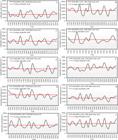
Interannual variability of attainable yield for the state of Rio Grande do Sul for the ten planting locations: (A) Bagé, (B) Cruz Alta, (C) Encruzilhada do Sul, (D) Ibirubá, (E) Iraí, (F) Júlio de Castilhos, (G) Passo Fundo, (H) Santa Maria, (I) Santa Rosa, and (J) São Luiz Gonzaga, for their respective observation periods.
The interannual variability in attainable yield is linked to limitations in water availability during the crop cycle. Maize requires approximately 600 mm of water over its growing season to achieve optimal development (Fancelli and Dourado Neto, 2000). This water requirement can vary depending on the crop cycle length, genotype, developmental stage, and local environmental conditions. Under typical conditions in Rio Grande do Sul, maize consumes about 7 mm of soil-available water per day (Bergamaschi et al., 2001).
The occurrence of climatic extremes, reflected in the attainable yields above or below average as shown in Fig. 1, is influenced by ocean-atmosphere interactions in the Tropical Pacific, specifically the ENSO (El Niño-Southern Oscillation) phenomenon. Rio Grande do Sul, located in southern Brazil, is part of the Southeastern South America region-which includes southern Brazil, northeastern Argentina, Uruguay, and southern Paraguay-and exhibits a strong ENSO signal, particularly in relation to rainfall variability (Grimm and Ferraz, 1998; Valente et al., 2023).
The attainable yield values estimated in this study are consistent with those reported by Battisti et al. (2012), who analyzed the agricultural efficiency of maize, soybean, and wheat in Rio Grande do Sul. They found an average attainable maize yield of approximately 2,474 kg ha-1 across different locations and years. Similarly, Matzenauer et al. (1995) obtained comparable results and identified Passo Fundo as one of the locations with the lowest risk of yield loss due to water deficit in Rio Grande do Sul.
The findings of this study offer insights into the spatiotemporal variability of key agricultural variables, providing a basis for informed decision-making. Such decisions should be supported by economic analyses that consider all components of the production process, especially sowing dates and the adoption or non-adoption of irrigation. These strategies are essential to optimize maize productivity across different regions of Rio Grande do Sul. Lastly, to better understand the influence of the ENSO phenomenon on maize yield variability, a focused analysis was conducted on the cities that exhibited the most pronounced fluctuations in yield over the study period.
3.2. ENSO phenomenon and maize yield
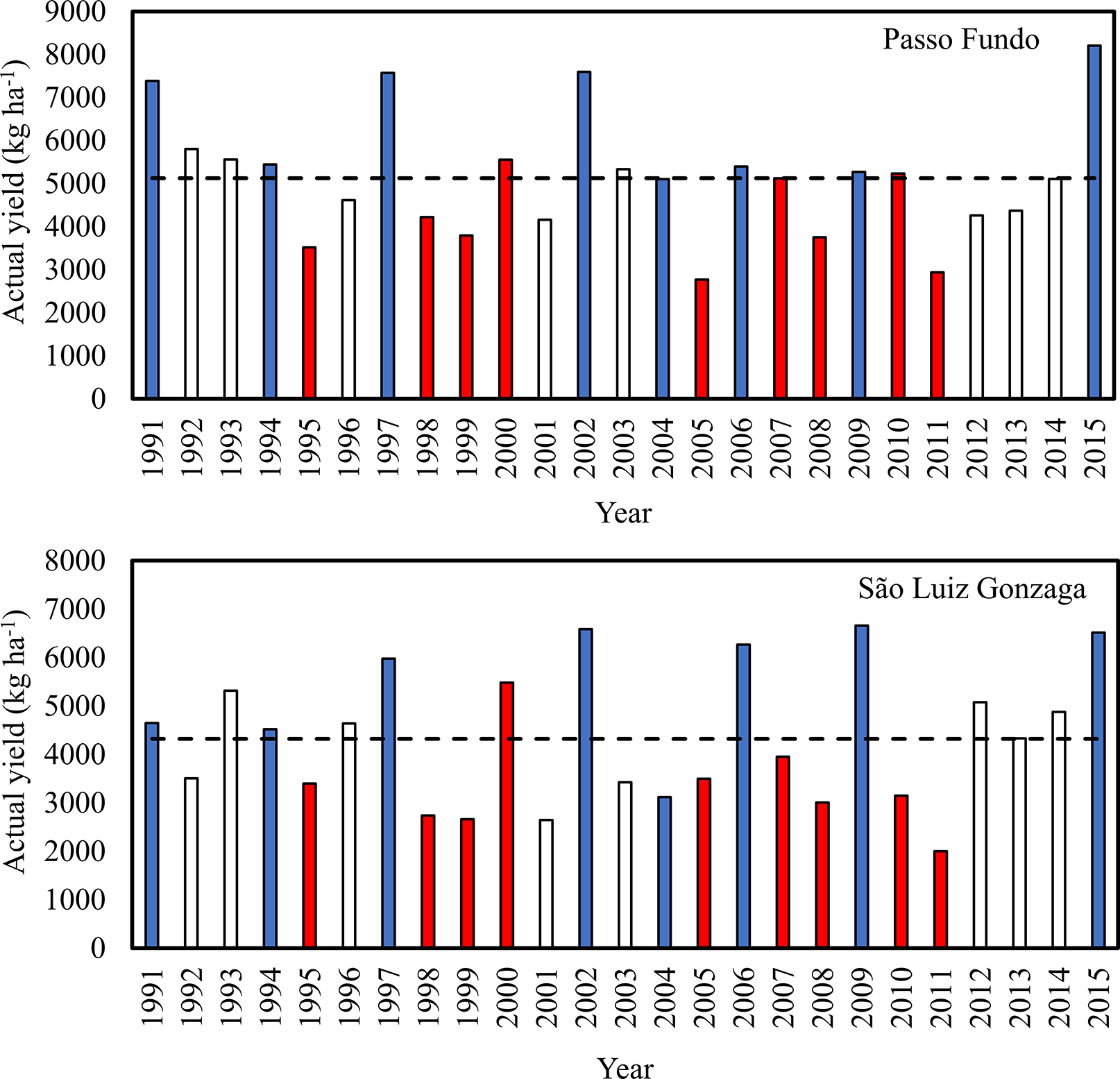
The relationship between the ENSO phenomenon and maize yield was evident in the regions analyzed. As shown in Fig. 2, significant variability in maize productivity was observed during El Niño and La Niña years for the cities of Passo Fundo and São Luiz Gonzaga. In 87.5% of El Niño years, maize yields were above the historical average. In contrast, during La Niña years, this occurred in only 22.2% of cases, while in Neutral years, yields were above average in 50% of the years. These results underscore the positive impact of El Niño and the adverse effects of La Niña on maize yield.

Maize yield and the occurrence of ENSO events for the cities of Passo Fundo and São Luiz Gonzaga.
This pattern reflects the high interannual variability in maize productivity observed in Rio Grande do Sul, which is largely attributed to water availability fluctuations influenced by the ENSO phenomenon. El Niño events are typically associated with positive rainfall anomalies in the region, creating favorable conditions for maize development. Conversely, La Niña events often lead to negative rainfall anomalies, which reduce water availability and negatively affect yield (Berlato et al., 2005).
Similar trends were observed in Santa Maria and Bagé (Fig. 3). In El Niño years, maize productivity exceeded the average in 75% of the years in Santa Maria and 62.5% in Bagé. For both La Niña and Neutral years, yield patterns were more variable and generally less favorable. During Neutral years, yield variability was high due to uncertainty in both the volume and distribution of rainfall, combined with limited predictability of short-term weather conditions (Berlato et al., 2024).

Figure 4 presents the statistical comparison of maize yields across El Niño, La Niña, and Neutral years for the four cities studied. The results confirm that El Niño years are associated with significantly higher productivity, followed by Neutral years, and finally La Niña years, which show the lowest yields. These findings highlight the substantial risk posed by La Niña events and reinforce the concern among producers regarding their impact on maize production.

Average maize yield for each ENSO events for the cities studied. *Averages followed by the same letter do not differ statistically from each other, according to the Tukey test at 5 % probability.
One of the key practical applications of this study lies in identifying and quantifying the effects of El Niño and La Niña years on maize productivity, as well as leveraging ENSO forecasts to inform decision-making. Given the current capacity to predict ENSO phases with reasonable accuracy several months in advance, maize producers can proactively plan their planting schedules and adopt appropriate strategies to mitigate risks or capitalize on favorable climatic conditions (Matzenauer et al., 2021; Berlato et al., 2024).
3.3. Necessity and management strategies for irrigation
The irrigation strategies and their simulated effects on maize yield were evaluated. The data were subjected to analysis of variance, considering the main effects of location and irrigation management strategy. Significant differences were observed between the irrigation strategies across locations.
Simulated irrigated yields ranged from 6,000 to 8,000 kg ha-1 for Management A, 11,000 to 12,000 kg ha-1 for Management B, and 8,000 to 10,000 kg ha-1 for Management C (Table 5). Among the strategies, Management B, which provided full irrigation throughout the entire maize cycle, resulted in the highest yields. Among the cities analyzed, Passo Fundo exhibited the highest simulated irrigated yields under all three irrigation strategies.
Effect of irrigation management strategy on simulated irrigated productivity (Pi, kg ha-1) for maize crops in 10 cities in the state of Rio Grande do Sul.
On average, yield increases across all locations were approximately 70% for Management A, 180% for Management B, and 129% for Management C. These results suggest that the potential yield gains from irrigation vary by strategy and region and must be considered alongside local water availability when selecting an appropriate approach.
Field studies, such as Pegorare et al. (2009), have shown that irrigation strategies that meet crop evapotranspiration (ETc) throughout the entire cycle can substantially increase yield. However, despite the agronomic benefits, economic gains were not always observed. Consequently, deficit irrigation, where water is supplied only during periods of peak crop demand, may offer higher profitability due to reduced water use and lower operational costs.
Deficit irrigation has been widely studied as a sustainable production strategy in water-limited environments. Rather than aiming to maximize yield, this practice seeks to optimize water productivity, thereby stabilizing yields under constrained conditions (Trout et al., 2020; Geerts and Raes, 2009). The effectiveness of deficit irrigation depends heavily on understanding the crop's sensitivity to water stress, which varies with genotype and phenological stage. Therefore, combining field trials with crop modeling is essential for optimizing irrigation scheduling.
Several studies in semi-arid regions (Juan et al., 1996; Ortega et al., 2004; Payero et al., 2009; Domínguez et al., 2012; Nascimento et al., 2019) have explored irrigation under water constraints. Among these, the MOPECO model (Ortega et al., 2004) stands out for its ability to define optimal irrigation strategies by relating yield to applied irrigation depth while accounting for irrigation uniformity. Deficit irrigation can enhance the feasibility of irrigation systems in maize-producing regions or allow for strategic redistribution of water to other crops, ultimately improving farm profitability (Nascimento et al., 2019).
Producers with limited water resources must often decide between reducing the irrigated area and applying full irrigation, adopting deficit irrigation over a larger area, switching to crops with lower water requirements, or investing in more efficient irrigation technologies. Selecting the best option requires detailed economic and agronomic analyses. For example, while yields under full or no irrigation are relatively predictable, yields under deficit irrigation can vary substantially based on management choices (Payero et al., 2009).
Figure 5 illustrates how different irrigation strategies significantly increased maize yield, reinforcing the role of water as a critical limiting factor. Simulations considering the results from the crop season 2015 for Passo Fundo, São Luiz Gonzaga, Santa Maria, and Bagé showed that Management B, which maintains soil water availability throughout the crop cycle, produced the highest yields, approaching potential productivity. However, this strategy also required the greatest water input.
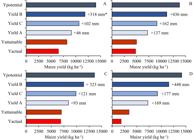
Potential maize yield, irrigated yield with the three management strategies A, B and C, attainable and actual yield for the cities of Passo Fundo (A), São Luiz Gonzaga (B), Santa Maria (C) and Bagé (D) for the crop season 2015. *irrigation used in each management strategy.
Alternatively, Management C with supplemental irrigation during the reproductive stage, emerged as a practical option for producers facing water constraints. This approach used significantly less water while maintaining competitive yields, highlighting its potential in regions with limited water availability.
This study offers important insights for improving irrigation management. Management B required an average irrigation depth of 433.5 mm while achieving 81% of potential yield (Table 6). In contrast, Management C used only 171.5 mm and maintained 77% of yield. Supplemental irrigation throughout the crop cycle based on soil water depletion (Management A) used 155.8 mm and sustained 51% of yield. Among the evaluated cities, Bagé showed the highest irrigation depths, while Passo Fundo, Santa Rosa, and Júlio de Castilhos required the least. These findings are consistent with those of Kopp et al. (2015), who reported irrigation requirements between 189 mm and 551 mm based on ETc estimates.
Effect of irrigation management strategy on total irrigation (TI, mm cycle-1) for maize crops in 10 cities in the state of Rio Grande do Sul.
The choice of irrigation strategy can lead to markedly different agronomic and economic outcomes. Therefore, selecting the most appropriate system must balance profit margins with the rational use of natural resources. In addition to increasing yield, irrigation enables crop cultivation during periods traditionally considered unsuitable due to water limitations.
Adopting irrigation practices in Rio Grande do Sul could increase maize yield by an average of 21.8 kg mm-1. Among the strategies, Management C provided the highest yield gain (Table 7), with yield gains ranging from 34.34 kg mm-1 in Santa Rosa to 27.15 and 27.66 kg mm-1 in Iraí and São Luiz Gonzaga, respectively. In contrast, Management B resulted in lower yield gains per mm of water due to its higher water demand. For instance, in Santa Rosa, the yield gain under Management B was approximately 19.6 kg mm-1.
Yield gain based on irrigation management strategy (YG, kg mm-1) for maize crops in 10 cities in the state of Rio Grande do Sul.
These results align with findings by Ben et al. (2016), who observed increased maize yields with irrigation up to 100% of ETc, although maximum water-use efficiency was achieved at 75% of ETc. Similarly, Parizi et al. (2016), using a calibrated model for Santiago-RS, reported diminishing yield gain as irrigation depths exceeded 70% of seasonal rainfall, indicating that higher irrigation volumes do not necessarily translate into higher efficiency.
Under limited water availability, Management C emerges as a viable strategy for increasing yield while conserving water. This approach can achieve up to 77% of potential yield, with water productivity ranging from 27.15 to 34.34 kg mm-1 across the regions studied. In a study by Paredes et al. (2014), comparisons between modeled and field-based yield estimates confirmed the high precision of the methodology used here to simulate attainable yield under different irrigation scenarios, including deficit irrigation.
4. Conclusions
The interannual variability in maize yield across the studied cities can largely be attributed to fluctuations in water availability according water balance during the crop cycle. Among the locations analyzed, Passo Fundo presented the lowest risk of yield loss, whereas Santa Rosa exhibited the highest risk, with 68% of the years recording below-average yields due to water deficits.
Maize productivity showed a strong relationship with the ENSO phenomenon. During El Niño years, yields were above average in 85% of cases. In contrast, during La Niña years, 78% of the growing seasons resulted in yields below the historical average. These findings emphasize the importance of monitoring ENSO conditions for each growing season, allowing producers to implement preventive strategies. For instance, during La Niña years, irrigation becomes a critical tool to mitigate yield losses.
The irrigation management strategy that led to the highest simulated yields involved maintaining soil moisture at 80% of field capacity throughout the entire maize growth cycle. However, the most efficient yield gains, in terms of water use, were observed under a deficit irrigation strategy, where soil moisture was maintained at 80% of field capacity specifically from the flowering stage to physiological maturity.
Deficit irrigation presents a viable alternative in scenarios where water conservation and resource-use efficiency are priorities, as it can sustain yields comparable to those under full irrigation while reducing water consumption. Nevertheless, implementing this strategy in real-world conditions requires a careful cost-benefit analysis to assess the economic feasibility for each production system.
In this context, the adoption of irrigation practices in Rio Grande do Sul has the potential to increase maize yield by an average of 21.8 kg mm-1, reinforcing the value of strategic irrigation planning to enhance productivity and resilience to climatic variability.
Data Availability Statement
The data that support the findings of this study are available from the corresponding author, upon reasonable request.
References
- ALLEN, R.G.; PEREIRA, L.S.; RAES, D.; SMITH, M. Crop Evapotranspiration. Guidelines for Computing Crop Water Requirements Irrigation and Drainage Paper n. 56. Roma: FAO Irrigation and Drainage, 297 p, 1998.
-
ALVARES, C.A.; STAPE, J.L.; SENTELHAS, P.C.; GONçALVES, J.L.M.; SPAROVEK, G. Köppen's climate classification map for Brazil. Meteorologische Zeitschrift, v. 22, p. 711-728, 2013. doi
» https://doi.org/10.1127/0941-2948/2013/0507 -
ANDRIOLI, K.G.; SENTELHAS, P.C. Brazilian maize genotypes sensitivity to water deficit estimated through a simple crop yield model. Pesquisa Agropecuária Brasileira, v. 44, p. 653-60, 2009. doi
» https://doi.org/10.1590/S0100-204X2009000700001 -
AYDINSAKIR, K.; ERDAL, S.; BUYUKTAŞ, D.; BAŞTUğ, R.; TOKER, R. The influence of regular deficit irrigation applications on water use, yield, and quality components of two corn (Zea mays L.) genotypes. Agricultural Water Management, v. 128, p. 65-71, 2013. doi
» https://doi.org/10.1016/j.agwat.2013.06.013 - BASSOI, L.H.; FANTE JúNIOR, L.; JORGE, L.A.C.; CRESTANA, S.; REICHARDT, K. Distribuição do sistema radicular do milho em terra roxa estrutura latossólica: II. Comparação entre cultura irrigada e fertirrigada. Scientia Agricola, v. 51, p. 541-548, 1994.
-
BATTISTI, R.; SENTELHAS, P.C.; PILAU, F.G. Eficiência agrícola da produção de soja, milho e trigo no estado do Rio Grande do Sul entre 1980 e 2008. Ciência Rural, v. 42, p. 24-30, 2012. doi
» https://doi.org/10.1590/S0103-84782012000100005 - BEN, L.H.B.; PEITER, M.X.; ROBAINA, A.D.; PARIZI, A.R.C.; SILVA, G.U.D. Influence of irrigation levels and plant density on “second-season” maize. Revista Caatinga, v. 29, n. 3, p. 665-676, 2016.
- BERGAMASCHI, H.; RADIN, B.; ROSA, L.M.G.; BERGONCI, J.I.; ARAGONéS, R.; et al Estimating maize water requirements using agrometeorological data. Revista Argentina de Agrometeorologia, v. 1, p. 23-27, 2001.
- BERLATO, M.A.; FARENZENA, H.; FONTANA, D.C. Associação entre El Nino Oscilação Sul e a produtividade do milho no Estado do Rio Grande do Sul. Pesquisa Agropecuária Brasileira, v. 39, p. 423-432, 2005.
- BERLATO, M.A.; CUNHA, G.R.; FONTANA, D.C. El Niño Oscilação Sul: Clima, Vegetação e Agricultura Passo Fundo: Edição do autor, 214 p., 2024.
-
BIGOLIN, T.; TALAMINI, E. Impacts of climate change scenarios on the corn and soybean double-cropping system in Brazil. Climate, v. 12, n. 3, p. 42, 2024. doi
» https://doi.org/10.3390/cli12030042 - BONECARRéRE, R.A.G.; DOURADO NETO, D.; MARTIN, T.N.; PEREIRA, A.R.; MANFRON, P.A. Estimativa das produtividades potencial e deplecionada da cultura do milho no Estado do Rio Grande do Sul em função das condições climáticas. Revista Brasileira de Agrometeorologia, v. 15, p. 280-287, 2007.
-
COMAS, L.H.; TROUT, T.J.; DEJONGE, K.C.; ZHANG, H.; GLEASON, S.M. Water productivity under strategic growth stage-based deficit irrigation in maize. Agricultural Water Management, v. 212, p. 433-440, 2019. doi
» https://doi.org/10.1016/j.agwat.2018.07.015 - CUNHA, N.G.; SILVEIRA, R.J.C.; SEVERO, C.R.S.; MENDES, R.G.; SILVA, J.B.; et al Estudo dos Solos do Município de Pedras Altas-RS Circular Técnica, Embrapa Clima Temperado, Pelotas, 43 p., 2005.
-
DOMíNGUEZ, A.; MARTíNEZ, R.S.; DE JUAN, J.A.; MARTíNEZ-ROMERO, A.; TARJUELO, J.M. Simulation of maize crop behaviour under deficit irrigation using MOPECO model in a semi-arid environment. Agricultural Water Management, v. 107, p. 42-53, 2012. doi
» https://doi.org/10.1016/j.agwat.2012.01.006 - DOORENBOS, J.; KASSAM, A.H. Efeito da água na Produtividade das Culturas Campina Grande: UFPB, 306 p., 1994.
- FANCELLI, A.L.; DOURADO NETO, D. Produção de Milho Guaíba: Agropecuária, 360 p., 2000.
-
FARRé, I.; FACI, J.M. Deficit irrigation in maize for reducing agricultural water use in a Mediterranean environment. Agricultural Water Management, v. 96, n. 3, p. 383-394, 2009. doi
» https://doi.org/10.1016/j.agwat.2008.07.002 -
FERERES, E.; SORIANO, M.A. Deficit irrigation for reducing agricultural water use. Journal of Experimental Botany, v. 58, n. 2, p. 147-159, 2007. doi
» https://doi.org/10.1093/jxb/erl165 -
GEERTS, S.; RAES, D. Deficit irrigation as an on-farm strategy to maximize crop water productivity in dry areas. Agricultural Water Management, v. 96, n. 9, p. 1275-1284, 2009. doi
» https://doi.org/10.1016/j.agwat.2009.04.009 -
GHEYSARI, M.; SADEGHI, S.H.; LOESCHER, H.W.; AMIRI, S.; ZAREIAN, M.J.; et al Comparison of deficit irrigation management strategies on root, plant growth and biomass productivity of silage maize. Agricultural Water Management, v. 182, p. 126-138, 2017. doi
» https://doi.org/10.1016/j.agwat.2016.12.014 -
GRIMM, A.; FERRAZ, S.E.T.; GOMES, J. Precipitation anomalies in southern Brazil associated with El Niño and La Niña events. Journal of Climate, v. 11, p. 2863-2880, 1998. doi
» https://doi.org/10.1175/1520-0442(1998)011<2863:PAISBA>2.0.CO;2 - HARGREAVES, G.H.; SAMANI, Z.A. Reference crop evapotranspiration from ambient air temperature. Applied Engineering in Agriculture, v. 1, n. 2, p. 96-99, 1985.
-
IBGE - Instituto Brasileiro de Geografia e Estatística. Produção Agrícola Municipal, 2025. Disponível em https://sidra.ibge.gov.br/pesquisa/pam/tabelas, acesso em 25/7/2025.
» https://sidra.ibge.gov.br/pesquisa/pam/tabelas -
JUAN, J.A.; TARJUELO, J.M.; VALIENTE, M.; GARCíA, P. Model for optimal cropping paterns within the farm based on crop water production functions and irrigation uniformity I: Development of a decision model. Agricultural Water Management, v. 31, p. 115-193, 1996. doi
» https://doi.org/10.1016/0378-3774(95)01219-2 - KOPP, L.M.; PEITER, M.X.; BEN, L.H.B.; NOGUEIRA, H.M.C.D.M.; PADRON, R.A.R.; et al Simulação da necessidade hídrica e estimativa de produtividade para cultura de milho em municípios do estado do Rio Grande do Sul. Revista Brasileira de Milho e Sorgo, v. 14, n. 2, p. 235-246, 2015.
-
LAUDIEN, R.; SCHAUBERGER, B.; GLEIXNER, S.; GORNOTT, C. Assessment of weather-yield relations of starchy maize at different scales in Peru to support the NDC implementation. Agricultural and Forest Meteorology, v. 295, e108154, 2020. doi
» https://doi.org/10.1016/j.agrformet.2020.108154 - MARCOLIN, C.D. Uso de Funções de Pedotransferência entre Atributos Físicos de Solos sob Plantio Direto. Tese de Doutorado, Universidade de Passo Fundo, Passo Fundo, 187 p., 2009.
- MATZENAUER, R.; MALUF, J.R.T.; RADIN, B. Regime de Chuvas e Produção de Grãos no Rio Grande do Sul: Impacto das Estiagens e Relação com o Fenômeno El Niño Oscilação Sul Porto Alegre: Emater/RS-Ascar, 218 p., 2021.
- MATZENAUER, R.; RADIN, B.; FRANçA, S.; BERGAMASCHI, H.; BERGONCI, J.I. Estimating maize water requirements using agrometeorological data. Revista Brasileira de Agrometeorologia, v. 13, p. 65-71, 2005.
-
MORENO, M.A.; MEDINA, D.; ORTEGA, J.F.; TARJUELO, J.M. Optimal design of center pivot systems with water supplied from wells. Agricultural Water Management, v. 107, p. 112-121, 2012. doi
» https://doi.org/10.1016/j.agwat.2012.01.016 -
NASCIMENTO, A.K.; SCHWARTZ, R.C.; LIMA, F.A.; LóPEZ-MATA, E.; DOMíNGUEZ, A.; et al Effects of irrigation uniformity on yield response and production economics of maize in a semi-arid zone. Agricultural Water Management, v. 211, p. 178-189, 2019. doi
» https://doi.org/10.1016/j.agwat.2018.09.051 - NICOLOSO, R.D.S.; AMADO, T.J.C.; SCHNEIDER, S.; LANZANOVA, M.E.; GIRARDELLO, V.C.; et al Eficiência da escarificação mecânica e biológica na melhoria dos atributos físicos de um Latossolo muito argiloso e no incremento da produtividade de soja. Revista Brasileira de Ciência do Solo, v. 32, p. 1723-1734, 2008.
-
NOAA - National Oceanic and Atmospheric Administration. Historical El Niño/La Niña episodes, 2021. Disponível em http://www.cpc.ncep.noaa.gov/products/analysis_monitoring/ensostuff/ensoyears.shtml, acesso em 22/7/2025.
» http://www.cpc.ncep.noaa.gov/products/analysis_monitoring/ensostuff/ensoyears.shtml -
NóIA JúNIOR, R.D.S.; SENTELHAS, P.C. Soybean-maize succession in Brazil: impacts of sowing dates on climate variability, yields and economic profitability. European Journal of Agronomy, v. 103, p. 140-151, 2019. doi
» https://doi.org/10.1016/j.eja.2018.12.008 - NUNES, M.C.M.; CASSOL, E.A. Estimativa da erodibilidade em entre sulcos de Latossolos do Rio Grande do Sul. Revista Brasileira de Ciência do Solo, v. 32, p. 2839-2845, 2008.
- ORTEGA, J.F.; DE JUAN, J.A.; MARTíN-BENITO, J.M.; LóPEZ-MATA, E. MOPECO: an economic optimization model for irrigation water management. Irrigation Science, v. 23, n. 2, p. 61-75, 2004.
-
PAREDES, P.; RODRIGUES, G.C.; ALVES, I.; PEREIRA, L.S. Partitioning evapotranspiration, yield prediction and economic returns of maize under various irrigation management strategies. Agricultural Water Management, v. 135, p. 27-39, 2014. doi
» https://doi.org/10.1016/j.agwat.2013.12.010 - PARIZI, A.R.; ROBAINA, A.D.; GOMES, A.C.D.S.; PEITER, M.X.; SOARES, F.C. Corn yield under various simulated irrigation depths. Engenharia Agrícola, v. 36, n. 3, p. 503-514, 2016.
-
PAYERO, J.O.; TARKALSON, D.D.; IRMAK, S.; DAVISON, D.; PETERSEN, J.L. Effect of timing of a deficit-irrigation allocation on corn evapotranspiration, yield, water use efficiency and dry mass. Agricultural Water Management, v. 96, n. 10, p. 1387-1397, 2009. doi
» https://doi.org/10.1016/j.agwat.2009.03.022 -
PEGORARE, A.B.; FEDATTO, E.; PEREIRA, S.B.; SOUZA, L.C.; FIETZ, C.R. Irrigação suplementar no ciclo do milho “safrinha” sob plantio direto. Revista Brasileira de Engenharia Agrícola e Ambiental, v. 13, p. 262-271, 2009. doi
» https://doi.org/10.1590/S1415-43662009000300007 - PILAU, F.G.; BATTISTI, R.; SOMAVILLA, L.; RIGHI, E.Z. Desempenho de métodos de estimativa da evapotranspiração de referência nas localidades de Frederico Westphalen e Palmeira das Missões, RS. Ciência Rural, v. 42, n. 2, p. 283-290, 2012.
-
REICHERT, J.M.; ALBUQUERQUE, J.A.; KAISER, D.R.; REINERT, D.J.; URACH, F.L.; et al Estimation of water retention and availability for Rio Grande do Sul soils. Revista Brasileira de Ciência do Solo, v. 33, n. 6, p. 1547-1560, 2009. doi
» https://doi.org/10.1590/S0100-06832009000600004 - SAS Learning Edition. Getting Started with the SAS Learning Edition Cary: SAS Institute, 200 p., 2003.
-
SCARDIGNO, A. New solutions to reduce water and energy consumption in crop production: a water-energy-food nexus perspective. Current Opinion in Environmental Science & Health, v. 13, p. 11-15, 2020. doi
» https://doi.org/10.1016/j.coesh.2019.09.007 - STORCK, L.; CARGNELUTTI FILHO, A.; LOPES, S.J.; TOEBE, M.; SILVEIRA, T.R. Duração do subperíodo semeadura-florescimento, crescimento e produtividade de grãos de milho em condições climáticas contrastantes e produtividade de grãos de milho em condições climáticas contrastantes. Revista Brasileira de Milho e Sorgo, v. 8, p. 27-39, 2009.
- TAIZ, L.; ZEIGER, E.; MøLLER, I.M.; MURPHY, A. Fisiologia e Desenvolvimento Vegetal Artmed: Porto Alegre, 888 p., 2017.
- THORNTHWAITE, C. W.; MATHER, J. R. The Water Balance Centerton: Drexel Institute of Technology, 104 p. 1955.
-
TROUT, T.J.; HOWELL, T.A.; ENGLISH, M.J.; MARTIN, D.L. Deficit irrigation strategies for the western U.S. Transactions of the ASABE, v. 63, n. 6, p. 1813-1825, 2020. doi
» https://doi.org/10.13031/trans.14114 -
VALENTE, P.T.; VIANA, D.R.; AQUINO, F.E.; SIMõES, J.C. Classification of precipitation anomalies in the Rio Grande do Sul in ENSO events in the 20th century. Sociedade e Natureza, v. 35, e66073, 2023. doi
» https://doi.org/10.14393/SN-v35-2023-66073 -
YANG, C.; FRAGA, H.; VAN IEPEREN, W.; SANTOS, J.A. Assessment of irrigated maize yield response to climate change scenarios in Portugal. Agricultural Water Management, v. 184, p. 178-190, 2017. doi
» https://doi.org/10.1016/j.agwat.2017.02.004
-
Scientific Editor:
Carlos Frederico Mendonça Raupp.