
 Challenges to teamwork from the perspective of Primary Health Care professionals in a municipality in Southern Brazil
Abstract
Introduction: Teamwork in Primary Health Care (PHC) requires professionals to work collaboratively, yet persistent challenges remain, including fragmented care, limited interaction, and rigid hierarchical structures.
Objective: To identify teamwork challenges from the perspective of professionals in Family Health teams (eSF) in a municipality in Southern Brazil.
Methods: This qualitative study included 69 eSF professionals in Criciúma, Santa Catarina, Brazil. Data were collected through semi-structured interviews, and the analytic process used thematic content analysis, informed by Jürgen Habermas’s Theory of Communicative Action.
Results: Teamwork challenges within eSF include limited incentives and time for meetings, difficulty engaging with management, a tendency toward individual work, inconsistent communication among professionals, siloed practice areas, ineffective meetings, heavy workload, and high staff turnover, compounded by structural and resource constraints.
Conclusion: Limited incentives and personal engagement, difficulties in interprofessional relationships, weaknesses in work organization, and structural constraints are challenges to teamwork in eSF.
Keywords:
Primary Health Care; Family Health Strategy; Teamwork; Interprofessional Work; Qualitative Research
Resumo
Introdução: O trabalho em equipe na Atenção Primária à Saúde requer profissionais que atuem colaborativamente, mas ainda há muitos desafios, como ações fragmentadas, baixa interação e estruturas hierárquicas rígidas.
Objetivo: Identificar os desafios para a realização do trabalho em equipe sob a ótica dos profissionais que compõem as equipes Saúde da Família em um município do sul do Brasil.
Métodos: Trata-se de uma pesquisa qualitativa, realizada com 69 profissionais das equipes de Saúde de Família (eSF) no município de Criciúma-SC. Os dados foram coletados por entrevistas semiestruturadas e o processo analítico foi permeado pela análise temática de conteúdo com o olhar teórico sustentado pela Teoria do Agir Comunicativo de Jürgen Habermas.
Resultados: Os desafios do trabalho em equipe no âmbito das eSF perpassam pelo pouco incentivo e tempo para reuniões, dificuldade de aproximação da gerência, predisposição para o trabalho individual, comunicação incongruente entre profissionais, compartimentalização das áreas, reuniões ineficazes, sobrecarga de trabalho e alta rotatividade, que se complementam com a dificuldades estruturais e de recursos.
Conclusão: O déficit de incentivo e mobilização pessoal, dificuldades de relações interprofissionais, fragilidade na organização do trabalho e aspectos estruturais são desafios para o trabalho em equipe em eSF.
Palavras-chave:
Atenção Primária à Saúde; Estratégia Saúde da Família; Trabalho em equipe; Trabalho interprofissional; Pesquisa Qualitativa
Introduction
Primary Health Care (PHC)-referred to in Brazil as Atenção Básica (AB) or Atenção Primária à Saúde (APS)-is the principal entry point to health care. It involves user embracement, listening, and providing effective responses to most health problems in the population (Brasil, 2017). The Family Health teams (equipes de Saúde da Família - eSF) are the foundation of this broader model of care, integrating and organizing health activities within a defined catchment area (Morais, 2020; Souza, Roncalli, 2021).
The Family Health teams have emerged as the country’s principal PHC strategy, grounded in PHC’s essential and derivative attributes (Trindade et al., 2021), with features of community engagement, interprofessional collaboration, disciplinary diversity (Giovanella, 2021), and a person- and family-centered focus. They have established relationships with patients, promoted comprehensiveness and care coordination, and worked across sectors to transform the complaint- and disease-centered biomedical model of care (Gomes et al., 2021). For PHC to be effective, a fundamental element is achieving interdisciplinary teamwork that integrates knowledge (Faria, 2022), alongside collaborative practices that expand the capacity to address social and environmental determinants of health and improve living conditions (Silva et al., 2014).
In contrast, work in health units is often carried out with a low level of interaction across professional groups, largely limited to team meetings (Colomé et al., 2008). The work process is characterized by each professional performing their function without critical reflection or pursuit of shared understanding (Machado et al., 2021), resulting in fragmented, uncoordinated, and individualistic care (Sousa et al., 2019). This characteristic limits not only teamwork but also PHC effectiveness and the care delivered to the population.
Although studies have identified barriers to teamwork in PHC-such as lack of collaboration among professionals, overly hierarchical organizational structures, and high staff turnover (Kano et al., 2023)-few investigations delve, from the perspective of professionals from different disciplines, into the relational, organizational, and structural aspects that interfere with communicative action in teams’ daily work. In this context, Jürgen Habermas’s Theory of Communicative Action provides a robust theoretical framework for analyzing these issues by emphasizing the importance of communication and mutual understanding for collaborative work (Habermas, 1984; Gonçalves, 1999).
Relationships among health professionals are as complex as health care itself. The state of Santa Catarina (SC) is known for its investment capacity and PHC coverage, and this must translate into improvements in implementation and work processes. Therefore, this study aims to identify the challenges to achieving effective teamwork from the perspective of professionals working in the eSF in a municipality in southern SC.
Method
Study design
This was a qualitative, exploratory, and descriptive study that adhered to the Consolidated criteria for reporting qualitative research (COREQ) to ensure methodological coherence (Tong, Sainsbury, and Craig, 2007).
Setting
The study took place in the municipality of Criciúma, in the state of SC, Southern Brazil, with a population of 214,493 (IBGE, 2023). The municipality has 48 Basic Health Units (BHUs) with eSF distributed across six health districts: Santa Luzia, Rio Maina, Boa Vista, Centro, Quarta Linha, and Próspera (Criciúma, 2022).
Twelve eSF from Criciúma, SC, were included-two from each health district. The eSF were selected at random by district using a web-based randomization tool (available at https://sorteador.com.br/sorteio-de-nomes) after listing all eligible eSF in the municipality.
Participants
Participants were recruited by convenience sampling after the study setting was defined. Upon arriving at each BHU, the researcher introduced themselves to eSF management and then to the professionals, asking whether they were interested in participating. No invited professionals declined.
The study included 69 participants who met the following criteria: at least one year of work experience in health care and in the eSF, and no work absence lasting more than one month in the previous year. The sample size was determined by data saturation criteria typically used in qualitative research, that is, when responses add little or nothing substantively new to the analysis (Fontanella et al., 2008).
Participant profile: 12 community health workers, 12 physicians, 12 nurses, 12 dentists, 12 nursing technicians, and 9 dental assistants. The majority of participants were female (60.9%), White (89.8%), married (60.9%), in the 35-39-year age group (21.7%), and had completed higher education (56.5%). The predominant type of employment was civil service appointment through competitive examination (76.8%), with a 40-hour workweek (95.8%), length of experience on the team of 1-4 years (43.6%), and overall professional experience of 5-9 years (31.9%) (Table 1).
Data collection
A male, cisgender dentist (the researcher) collected the data. He was trained in two 90-minute workshops conducted by the study coordinator. The interviewer worked in the same municipality as the data collection site as a first-year resident (R1) in Primary Health Care and Family Health, but at a BHU different from those included in this study.
Data were gathered through a semi-structured interview that covered participants’ sociodemographic profiles and addressed teamwork, interaction with colleagues, joint activities, and other topics aligned with the study objective. Before beginning data collection, the researcher and the study coordinator conducted two pilot interviews to refine the interview guide.
Individual interviews were conducted in person between April 10 and June 16, 2023, at the selected BHUs, in a private room and at a time previously arranged with the unit manager.
During the interviews, notes were taken in a field journal to record pauses, any discomfort, and situations that drew the researcher’s attention. These notes supported the transcription process and were not used for analytic purposes.
Audio was captured with a cell phone and later transcribed into a text document. Each interview lasted an average of 15 minutes. The lead researcher transcribed all interviews in full using the Transcribe application, and the study coordinator checked them; transcripts were not returned to participants for comment or correction.
Data analysis
Data analysis was conducted by the lead researcher, a dentist with training in Public Health and experience in the Family Health Strategy (ESF), with support from the study coordinator, a faculty member experienced in qualitative research and thematic analysis.
Thematic content analysis was performed with support from ATLAS.ti 23 and divided into three phases: pre-analysis, exploration of the material, and treatment of results (Minayo, 2012; Soratto; Pires; Friese, 2020).
Pre-analysis involved meticulous transcription of all interviews, followed by an initial reading, spelling corrections, and file saving. Each file was named with the letter “P” followed by two numerals to uniquely identify each interviewee and ensure anonymity.
During the exploration of the material, coding was undertaken. Similar codes were created and merged as needed, and each code was assigned a specific color to facilitate visual selection and differentiation of the data. This approach enabled detailed, systematic analysis of the accounts and a deeper understanding of the dynamics and key elements of teamwork. ATLAS.ti features for code co-occurrence and frequency counts, among others, were also used, and the researcher and the study coordinator conducted two rounds of review to establish consensus on the codes.
Finally, for inference/interpretation of results, the defined codes were grouped into categories based on thematic similarity. In the software, we assigned a color to each code to facilitate the analytic process. Codes sharing a color were then clustered, thereby establishing the analytic categories. The researcher and the study coordinator conducted two additional rounds of review to ensure analytic rigor and reach consensus on the analytic categories. This step followed the principles of reflexivity and methodological coherence outlined in COREQ, ensuring traceability and transparency in the interpretive process.
The results were presented using network visualization and the relative (%) and absolute (n) frequencies of categories, subcategories, and codes. Quoted excerpts linked to the selected codes were chosen based on higher frequency, co-occurrence (i.e., connections with other codes), and the researcher’s judgment of their representativeness of the theme within each subcategory. Network visualization was used to synthesize the findings.
The theoretical lens was grounded in Habermas’s Theory of Communicative Action (Habermas, 1984; Gonçalves, 1999), which guided data interpretation to consider not only structures and resources but also the human relationships and dynamics that influence teamwork quality. To support the authors’ inferences, we also considered scholarship on health work processes (Pires, 2000), multiprofessional work, interprofessional work, and collaborative practices (Peduzzi, 2001; Peduzzi et al., 2020).
Ethical aspects
The Research Ethics Committee of the Universidade do Extremo Sul Catarinense (approval no. 5.821.159) approved the project. Participant consent was obtained by signing two copies of the Informed Consent Form (ICF), which included methodological information, risks, benefits, and ethical considerations related to the study.
Anonymity was ensured by assigning each interview an alphanumeric code (“P” for “participant” plus a sequential number), followed by an abbreviation of the professional category: community health worker (CHW), physician (PHY), nurse (NUR), dentist (DENT), nursing technician (NT), and dental assistant (DA). For example, P4-PHY denotes participant 4, a physician.
Audio recordings were deleted after transcription, and the transcripts were stored on an external hard drive held by the study coordinator.
Artificial intelligence tools were used to check references according to the journal’s author guidelines, verify alignment between in-text citations and the reference list, and confirm the percentages reported in the tables.
Results and Discussion
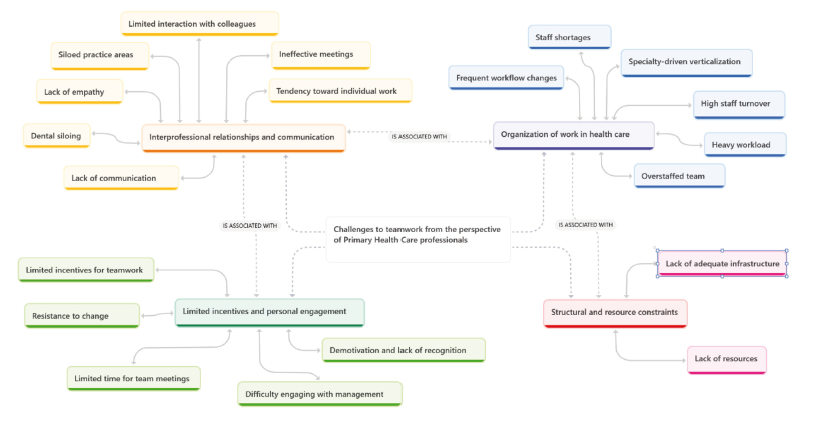
Teamwork challenges among professionals working in the eSF were grouped into the following categories: Limited incentives and personal engagement; Interprofessional relationships and communication; Organization of work in health care; and Structural and resource constraints (Figure 1).
These categories are interconnected and form a self-reinforcing network in which communication directly affects work organization and team mobilization, while structural constraints interfere with the work process. A co-management stance is needed to address these issues by promoting motivation and professional recognition, restructuring organizational processes, strengthening interprofessional communication, and improving structural conditions.

To corroborate and complement these findings, we present the number of quoted excerpts associated with the codes and subcategories related to teamwork challenges in BHUs in the study municipality (Table 2).
Limited incentives and personal engagement
This category reflects a lack of leadership encouragement or recognition for collaborative work, which ultimately demotivates professionals.
Our unit management is very good; they always value teamwork. However, in general terms-City Hall, the municipal administration - there’s no incentive for this at all. Sometimes we ask ourselves what we’re doing here. Sometimes I ask myself that. (P05 - NT)
The account reveals tensions within the BHU’s organizational context and team management, highlighting a contrast between the value placed on teamwork by the service’s direct management (the BHU) and the lack of incentives perceived at the level of municipal management as a whole. The worker also expresses demotivation and questions the relevance of the work performed.
Although participants reported a lack of incentives for teamwork from municipal management, some statements diverged from this pattern. In certain accounts, respondents perceived a more active role by the Municipal Health Department. These exceptions underscore the heterogeneity of the municipal context and suggest that, although the challenges are structural, specific positive experiences can inform broader institutional strategies.
When I started, there wasn’t any of this; everyone did their own thing. Over time, things changed-you know, I don’t know who started it, but the reality at the clinics changed. (P12 -NUR)
The presence of these dissonant statements does not invalidate the predominant findings but points to opportunities for future studies to explore territorial variation.
Another factor highlighted was the shortage of time available for meetings, which undermines communication and problem-solving as a team. From a teamwork perspective, meetings are tools to promote dialogue and knowledge exchange; therefore, when there is not enough time for them, interdisciplinary work is hindered.
Meetings could be more effective if we had more time. We only have an hour-there are 12 of us. It used to be two hours, which was fine. Everyone has their opinions, we exchange ideas and so on, and in one hour the manager barely has time to pass along information; there isn’t time left to discuss. (P07 - DA)
We only have a one-hour meeting; it’s too little time to discuss patient cases. We end up addressing day-to-day unit tasks and relaying important information; there’s no time to sit down and talk about patients. (P15 - DA)
Participants emphasized that a one-hour meeting is insufficient to discuss patient cases and foster the exchange of ideas, leading to a superficial, task-oriented emphasis on administrative matters and on relaying managerial information, rather than deeper, collaborative case discussions.
We identified the need for closer alignment between health system management and PHC realities, since PHC should coordinate care and serve as the hub for demand management. The excerpts below present participants’ views on management-led improvements and incentives for teamwork.
Here’s how I see it: they [the Municipal Health Department] ask a lot. Sometimes patients file a complaint with the ombudsman, and they stress that we should deliver higher-quality care and communicate more effectively. Sometimes they don’t really speak our language, because the reality is different, but they do seek improvements. (P02 - CHW)
This professional underscores the disconnect between the Municipal Health Department’s demands and the teams’ day-to-day realities. The expression “don’t really speak our language” points to communication difficulties across hierarchical levels, revealing a gap between public policy and operational practice.
By contrast, the following account indicates that while local management promotes participation and team cohesion, municipal management is perceived as sporadic and reactive-suggesting a centralized, low-participation model that prioritizes crisis response over continuous, proactive engagement.
I do see support from unit management; in the meetings she invites us to be part of management and always tries to bring us together. Municipal management shows up here infrequently-only when a problem comes up, when people go there to complain. (P58 - NT)
Several elements identified here act as disincentives to sustaining interdisciplinary practice within the eSF. Fundamentally, these challenges often stem from a lack of recognition and insufficient incentives, indicating the need for strategies to promote and strengthen teamwork and for management to acknowledge its importance in building robust work processes.
This recognition should take concrete form through actions that support the ongoing expansion and strengthening of the ESF (Rocha et al., 2023).
Work settings involving health teams are often characterized by long hours, limited professional recognition, and a sense of personal, professional, and environmental insecurity. In addition, exposure to occupational accidents, greater susceptibility to infections, and risks of physical and psychological illness further complicate this context (Machado et al., 2023; Miranda et al., 2020).
Coupled with the reported lack of incentives, these conditions pose a major barrier to interdisciplinary work because health professionals’ well-being directly affects their ability to engage in the communicative processes essential to communicative action (Habermas, 1984).
Another challenge was time pressure around scheduling meetings, underscoring the constant demands on team managers, who have limited time to make them happen. Although multiprofessional practices are woven into teams’ daily routines, they become truly tangible during work meetings (Kano et al., 2023).
According to Habermas, meetings represent potential spaces for building consensus and integrating professionals. However, time constraints and an operational focus reduce these spaces to one-way information transmission, undermining dialogue and collaboration. Restructuring meetings can transform them into moments of genuine communicative interaction, where the exchange of ideas promotes better practices and strengthens teamwork.
Moreover, meetings are a facilitative strategy for planning, serving as mechanisms to achieve specific objectives. In these encounters, professionals share information to support decision-making and build connections with one another despite distinct roles and particularities, as actors from diverse professional backgrounds. This collaborative interaction underscores the importance of these moments for fostering synergy among team members (Macedo; Oliveira, 2023).
Regarding incentives for teamwork in the ESF context, health system management needs to respond to PHC demands, since PHC should coordinate the health network. Reports of weak alignment between management and PHC realities-and the lack of a clear shared language-emerge as a barrier to advancing health care delivery.
Despite PHC’s notable progress in Brazil from the 20th century to the present, challenges remain to meeting national policy goals and enabling primary care to effectively fulfill its roles as the system’s integrator and coordinator of care (Lima et al., 2024).
Interprofessional relationships and communication
This category emphasizes that effective communication and interpersonal relationship building are critical domains that directly affect team performance. A preference for working individually was reported as a challenge that hinders collaboration and shared responsibility; it may reflect an organizational culture that rewards individual performance over teamwork.
There are barriers-some professionals don’t accept directives, don’t like having to enforce anything, and don’t like being questioned. (P43 - NUR.)
A lack of openness to dialogue, coupled with issuing orders, can generate friction among team members and undermine consensus building.
Sometimes when there’s an arrogant person who thinks they’re above others, they create conflict. That’s why everyone is equal here. There was a situation where someone wouldn’t let the CHW into the room to present cases, but CHWs are our eyes on the streets-that’s essential. Arrogance makes things much harder. (P55 - PHY)
In PHC teams, where each member has a specific yet interdependent role, individualistic behavior creates strong potential for exclusion and conflict, thereby compromising teamwork effectiveness.
Recognizing the CHW as essential-captured in the phrase “our eyes on the streets”-reinforces that integration grounded in mutual respect is fundamental to team success. Arrogance, however, obstructs this integration, leading to fragmented work and a decline in quality of care.
Team members also highlighted a lack of communication. Vague, unfocused communication can lead to misunderstandings and conflict, impairing coordination of health activities, as noted below:
Communication is our weakest area here; the professionals are excellent (that is, they do very well on the technical side when no interaction with other professionals is needed. (P14 - CHW)
Sometimes, there’s a communication breakdown-it happens a lot here. Something happens and no one tells the team; the patient shows up and no one knows about it. (P33 - PHY)
The communication problem involves not only a lack of communication but also communicative misalignment. We observed little inclination toward dialogue and only nominal acknowledgment of its necessity; a preference for fragmented, individual work runs counter to interdisciplinarity, which depends on understanding one another’s fields to achieve specific aims.
Dialogue occurs when there is a mutual exchange of questions and answers, and a communicative situation requires symmetrical participation-with equal rights and no coercion-conditions that are unattainable without reciprocal recognition among participants (Habermas, 1984; Gadamer et al. 2008).
Thus, reason and argument-not force or external pressures-should determine action; rather than coercive organizations, there should be social interactions committed to communication among individuals (Habermas, 1984). Grounded in interpersonal relationships, bonds are formed within institutions, providing the foundation for building health care networks (Ayres, 2004).
Even so, structures in health work perpetuate the prevailing model-for example, training oriented toward the hegemonic biomedical paradigm and a managerialist, neoliberal approach-both of which privilege production indicators that remain reductionist and are poorly aligned with the ESF model (Giovanella et al. 2020; Duarte et al. 2023).
Communication difficulties among health professionals are among the main contributors to medical errors and adverse events, thereby reducing the quality of care (Bagnasco et al. 2013). In this context, researchers highlight that the way communication occurs among professionals is fundamental to ensuring patient safety (Lee et al. 2012).
Communication, knowledge, and interactions among professionals are primary drivers of coordination, directly influencing the continuity and quality of care (Souza, 2019; Jesus et al. 2018).
Several elements facilitate effective communication within health care teams, including eye contact, active listening, confirmation of message understanding, clear and goal-directed leadership, participation by all team members, constructive discussion of relevant information, and situational awareness-the latter referring to understanding the current environment and the ability to accurately anticipate potential problems (Prado et al. 2023).
This evidence underscores the need to enhance communication skills and resolve interpersonal conflicts; fostering these skills should be a strategy for achieving effective teamwork through Permanent Health Education (PHE) (Fornereto et al. 2023).
Organization of work in health care
In this category, understaffing emerged as a concrete challenge, which can overload existing teams and compromise teamwork.
One problem is short staffing. We’re a large team, but we’re not complete, so someone is always overloaded. Our nursing team is complete now, but there were times with just one nurse on. You can’t do excellent work like that-someone always ends up carrying a much heavier load. (P01 - NUR)
A lack of administrative support, coupled with understaffing, burdens health professionals with tasks outside their core scope, such as appointment scheduling and referrals, which compromises not only service efficiency but also the focus on quality of care.
Sure, some things are routine-unforeseen issues happen-but other problems have been around for a long time. For example, we don’t have admin staff at reception to direct patients to the right services and schedule appointments. That wears us down because we have to stop what we’re doing and go to the front desk. (P24 - NUR)
Excessive demand generates stress and fatigue among professionals, negatively affecting the entire work environment.
I think people were exhausted, stressed, overloaded; in January and February, everyone was just doing their own tasks and wasn’t available to help. It’s getting better now, but we were under heavy pressure, and when we asked for help, everyone already had a pile of work and was overloaded. (P21 - DENT)
Staff shortages are a vulnerability in any institution; in health care, however, they can undermine the quality of services delivered in PHC (Costa et al., 2020).
Understaffing poses challenges for members of the eSF, given that the work requires an interprofessional approach; an inadequate skill mix disrupts workflows and overburdens health professionals (Reis et al., 2024). This problem is particularly acute at critical junctures, generating frustration and dissatisfaction for both professionals and patients (Dejours, 2012).
The effectiveness of innovations such as the ESF is intrinsically tied to working conditions, including adequate team size and qualifications (Lima et al., 2014).
Linked to understaffing, work overload also undermines teamwork. Workforce management factors are closely tied to working conditions and include workforce size and qualifications, pay, and working hours (Soratto et al., 2017).
Among the contributors to overload are organizational and administrative constraints inherent to mental health services, low pay, scarcity of qualified professionals, and excessive job demands (Trevisan et al., 2019).
An important step in this regard is workforce planning (staffing), which is essential for accurately projecting workforce requirements (both headcount and skill mix) to meet population needs across diverse service contexts, thereby ensuring quality of care and the safety of both patients and workers (Santos et al., 2019).
In PHC, teamwork should be recognized and operationalized as an organizing principle for work processes-grounded in effective communication and interpersonal relationships; integrating collaboratively developed practices and knowledge; and involving patients and the community in care planning (Guimarães; Castelo Branco, 2020).
Structural and resource constraints
Finally, the last category, “Structural and resource constraints”, concerns challenges tied to the physical and material conditions of BHUs. Safety and a healthy environment are paramount in health care. Thus, inadequate infrastructure underscores the need to invest in facilities that meet the needs of professionals and patients.
[...] the environment itself doesn’t have a room; sometimes it doesn’t even accommodate the team. (P51 - NT)
Designated spaces for interaction facilitate communication among different health professionals (physicians, nurses, community health workers, dentists, and other team members) and help strengthen working relationships.
When the physical structure and the supply of essential equipment are inadequate or constrain task performance, workers tend to become demotivated due to frustration with how work is organized (Dario; Lourenço, 2017).
The concept of healthcare ambience, as advocated by the Ministry of Health, should guide BHU design and construction. In practice, it means creating a welcoming, humane physical environment for health care, serving both health workers and patients (Brasil, 2017).
With an adequate physical structure in place, teams can carry out their work as designed, with teamwork embedded in the process.
An inadequate number of professionals per team, lack of standardized work processes, undefined catchment areas, equipment maintenance deficits, non-interoperable information systems, lack of vehicles, and precarious infrastructure in some BHUs were principal structural factors influencing the quality of care in PHC (Scherer et al. 2024).
Study limitations include being conducted in a single municipality with specific characteristics and relying solely on professionals’ accounts, without including other stakeholders. These factors may limit the transferability of the findings to other contexts or regions with different PHC configurations. Nevertheless, as a qualitative study, broad generalization was not the primary aim.
Key strengths included recruiting participants from diverse professional fields, which increased the breadth and relevance of the findings, and using Jürgen Habermas’s Theory of Communicative Action as the theoretical framework.
Conclusion
Teamwork in PHC in the study municipality faces multiple challenges. These include limited encouragement and limited time for collaborative work, compounded by gaps between management and teams, demotivation, and resistance to change. Interprofessional relationships and communication are hindered by a tendency toward individual work, communication difficulties, and limited empathy, which fragment interactions across professional groups. In addition, the organization of work in health care is affected by overload, high staff turnover, and unstable workflows that hinder continuity of care.
Overcoming these challenges requires mutual commitments from management and health professionals to strengthen practices that foster collective work, so that disciplinary silos do not fragment activities within the eSF and shared practice prevails over individual work and care delivered in isolation.
Practical, locally driven measures can also help counter work fragmentation: setting fixed schedules for interprofessional meetings with support from local management; implementing co-management practices inspired by the Expanded Clinic and the National Policy on Permanent Health Education; and continuously promoting interprofessional training through team-based clinical case discussions and the development of individualized therapeutic plans.1
Acknowledgments
We thank the Fundação de Amparo à Pesquisa e Inovação do Estado de Santa Catarina (FAPESC) for financial support under public call no. 21/2024 - grant agreement 2024TR002229.
References
- AYRES, J. R. de C. M. O cuidado, os modos de ser (do) humano e as práticas de saúde. Saúde e Sociedade, v. 13, n. 3, p. 16-29, 2004.
- BRASIL. Ministério da Saúde. Portaria no 2.436, de 21 de setembro de 2017. Aprova a Política Nacional de Atenção Básica, estabelecendo a revisão de diretrizes para a organização da Atenção Básica, no âmbito do Sistema Único de Saúde (SUS). Diário Oficial da União. 2017 Set 22; Seção 1:68.
- BAGNASCO, A.; TUBINO, B.; PICCOTTI, E. et al. Identifying and correcting communication failures among health professionals working in the Emergency Department. International Emergency Nursing, v. 21, n. 3, p. 168-172, 2013.
- COLOMÉ, I. C. dos S.; LIMA, M. A. D. da S.; DAVIS, R. Visão de enfermeiras sobre as articulações das ações de saúde entre profissionais de equipes de saúde da família. Revista da Escola de Enfermagem da USP, v. 42, n. 2, p. 256-261, 2008.
-
COSTA, E.; FERRAZ, F.; TRINDADE, L. L. et al. Challenges in the work process in the Family Health Strategy. Revista CEFAC, v. 22, n. 2, p. e7619, 2020. Disponível em: https://www.scielo.br/j/rcefac/a/4ThRY8f8L49ZGXZbvxnyVkh/?format=html⟨=en Acesso em: 18 out 2025.
» https://www.scielo.br/j/rcefac/a/4ThRY8f8L49ZGXZbvxnyVkh/?format=html⟨=en -
CRICIÚMA. Plano municipal de saúde de Criciúma 2018-2021. Criciúma, 2022. Disponível em: https://transparencia.criciuma.sc.gov.br/outros/60be69f32234b-plano-municipal-de-saude_2018_2021.pdf Acesso em: 09 ago. 2024.
» https://transparencia.criciuma.sc.gov.br/outros/60be69f32234b-plano-municipal-de-saude_2018_2021.pdf - DARIO, V. C.; LOURENÇO, M. L. Cultura organizacional e vivências de prazer e sofrimento no trabalho: um estudo com professores de instituições federais de ensino superior. Revista Organizações em Contexto, v. 14, n. 27, p. 345, 2017.
- DE MACEDO, J. F. S.; OLIVEIRA, P. R. de. Potencialidades da reunião de equipe no território: um relato de experiência de uma residente de Medicina de Família e Comunidade no Rio de Janeiro. Revista Brasileira de Medicina de Família e Comunidade, v. 18, n. 45, p. 3878, 2023.
- DEJOURS, C. Psicodinâmica do trabalho e teoria da sedução. Psicologia em Estudo, v. 17, p. 363-371, 2012.
-
DUARTE, L. S.; VIANA, M. M. de O.; SCALCO, N. et al. Incentivos financeiros para mudança de modelo na atenção básica dos municípios paulistas. Saúde e Sociedade, v. 32, n. 1, p. e210401pt, 2023. Disponível em: https://www.scielo.br/j/sausoc/a/sZYBrYxpztDC4DSXnXHT8fy/?lang=pt Acesso em: 18 out 2025.
» https://www.scielo.br/j/sausoc/a/sZYBrYxpztDC4DSXnXHT8fy/?lang=pt - FARIA, L. Educação em saúde e qualidade-equidade: sobre o cuidado realizado nas redes de atenção no contexto da Covid-19. Salvador: Edufba, 2022. (Partituras).
- FERNANDES, H. N.; THOFEHRN, M. B.; PORTO, A. R. et al. Interpersonal relationships in work of multiprofessional team of family health unit. Revista de Pesquisa Cuidado é Fundamental Online, v. 7, n. 1, p. 1915-1926, 2015.
- FONTANELLA, B. J. B.; RICAS, J.; TURATO, E. R. Amostragem por saturação em pesquisas qualitativas em saúde: contribuições teóricas. Cadernos de Saúde Pública, v. 24, n. 1, p. 17-27, 2008.
-
FORNERETO, A. de P. N.; SOUSA, D. F. de; MARTINI, L. C. Educação Permanente em Saúde como estratégia para trabalho colaborativo na Rede de Atenção Psicossocial. Interface - Comunicação, Saúde, Educação, v. 27, p. e220221, 2023. Disponível em: https://www.scielo.br/j/icse/a/pDB5gxQg63dY55NYQxwnBtB/?lang=pt Acesso em: 18 out 2025.
» https://www.scielo.br/j/icse/a/pDB5gxQg63dY55NYQxwnBtB/?lang=pt - GADAMER, H-G.; MEURER, F. P.; GADAMER, H-G. Verdade e método I: traços fundamentais de uma hermenêutica filosófica. 9. ed. Petrópolis: Vozes, 2008. (Coleção pensamento humano, 16).
- GIOVANELLA, L.; BOUSQUAT, A.; SCHENKMAN, S. et al. Cobertura da Estratégia Saúde da Família no Brasil: o que nos mostram as Pesquisas Nacionais de Saúde 2013 e 2019. Ciência & Saúde Coletiva, v. 26, n. supl 1, p. 2543-2556, 2021.
- GIOVANELLA, L.; FRANCO, C. M.; ALMEIDA, P. F. de. Política Nacional de Atenção Básica: para onde vamos? Ciência & Saúde Coletiva, v. 25, n. 4, p. 1475-1482, 2020.
- GOMES, K. de O.; COTTA, R. M. M.; ARAÚJO, R. M. A. et al. Atenção Primária à Saúde - a “menina dos olhos” do SUS: sobre as representações sociais dos protagonistas do Sistema Único de Saúde. Ciência & Saúde Coletiva, v. 16, n. supl 1, p. 881-892, 2011.
- GONÇALVES, M. A. S. Teoria da ação comunicativa de Habermas: possibilidades de uma ação educativa de cunho interdisciplinar na escola. Educação & Sociedade, v. 20, n. 66, p. 125-140, 1999.
- GUIMARÃES, B. E. de B.; CASTELO BRANCO, A. B. de A. Trabalho em Equipe na Atenção Básica à Saúde: Pesquisa Bibliográfica. Revista Psicologia e Saúde, p. 143-155, 2020.
- HABERMAS, J. Consciência moral e agir comunicativo. [s.l.]: Tempo Brasileiro, 1984. (Biblioteca Tempo Universitário).
-
INSTITUTO BRASILEIRO DE GEOGRAFIA E ESTATÍSTICA. Panorama de Criciúma, SC. Disponível em: https://cidades.ibge.gov.br/brasil/sc/riciúma/panorama Acesso em: 09 ago. 2024.
» https://cidades.ibge.gov.br/brasil/sc/riciúma/panorama - JESUS, R. P. F. S. de; SANTO, A. C. G. do E.; MENDES, M. F. de M. et al. Percepção dos profissionais sobre a coordenação entre níveis de atenção à saúde em dois municípios pernambucanos de grande porte. Interface - Comunicação, Saúde, Educação, v. 22, n. 65, p. 423-434, 2018.
-
KANNO, N. P.; PEDUZZI, M.; GERMANI, A. C. C. G. et al. A colaboração interprofissional na atenção primária à saúde na perspectiva da ciência da implementação. Cadernos de Saúde Pública, v. 39, n. 10, p. e00213322, 2023. DOI: https://doi.org/10.1590/0102-311XPT213322
» https://doi.org/10.1590/0102-311XPT213322 - LEE, P.; ALLEN, K.; DALY, M. A ‘Communication and Patient Safety’ training programme for all healthcare staff: can it make a difference? BMJ Quality & Safety, v. 21, n. 1, p. 84-88, 2012.
-
LIMA, L. de; PIRES, D. E. P. de; FORTE, E. C. N. et al. Job satisfaction and dissatisfaction of primary health care professionals. Escola Anna Nery - Revista de Enfermagem, v. 18, n. 1, 2014. Disponível em: <http://www.gnresearch.org/doi/10.5935/1414-8145.20140003>. Acesso em: 19 abr. 2022.
» http://www.gnresearch.org/doi/10.5935/1414-8145.20140003 -
LIMA, J. P. M.; SOEIRO, A. C. V.; FOLHA, D. R. da S. C. Integralidade como diretriz formativa na atenção primária sob a perspectiva dos residentes em Saúde da Família. Trabalho, Educação e Saúde, v. 22, p. e02679252, 2024. Disponível em: https://www.scielo.br/j/tes/a/wDW7ZNjkG8fTPk4VpKw7mJN/?format=html⟨=pt Acesso em: 18 out 2025.
» https://www.scielo.br/j/tes/a/wDW7ZNjkG8fTPk4VpKw7mJN/?format=html⟨=pt - MACHADO, M. de F. A. S.; XAVIER, S. P. L.; RODRIGUES, A. de L. et al. Trabalho em equipes multiprofissionais na atenção primária no Ceará: porosidade entre avanços e desafios. Saúde em Debate, v. 45, n. 131, p. 987-997, 2021.
- MACHADO, M. H.; CAMPOS, F.; HADDAD, A. E. et al. Transformações no mundo do trabalho em saúde: os(as) trabalhadores(as) e desafios futuros. Ciência & Saúde Coletiva, v. 28, n. 10, p. 2773-2784, 2023.
- MINAYO, M. C. de S. Análise qualitativa: teoria, passos e fidedignidade. Ciência & Saúde Coletiva, v. 17, n. 3, p. 621-626, 2012.
-
MIRANDA, F. M. D’A.; SANTANA, L. de L.; PIZZOLATO, A. C. et al. Condições de trabalho e o impacto na saúde dos profissionais de enfermagem frente à Covid-19. Cogitare Enfermagem, v. 25, 2020. Disponível em: <https://revistas.ufpr.br/cogitare/article/view/72702>. Acesso em: 17 nov. 2023.
» https://revistas.ufpr.br/cogitare/article/view/72702 - MORAIS, H. G. de F.; BARROS, J. M. de; SILVA, W. R. da et al. Saúde bucal no Brasil: uma revisão integrativa do período de 1950 a 2019. Revista Baiana de Saúde Pública, v. 44, n. 1, p. 181-196, 2020.
- PEDUZZI, M. Equipe multiprofissional de saúde: conceito e tipologia. Revista de Saúde Pública, v. 35, n. 1, p. 103-109, 2001.
-
PEDUZZI, M.; AGRELI, H. L. F.; SILVA, J. A. M. da et al. Trabalho em equipe: uma revisita ao conceito e a seus desdobramentos no trabalho interprofissional. Trabalho, Educação e Saúde, v. 18, n. supl 1, p. e0024678, 2020. Disponível em: https://www.scielo.br/j/tes/a/RLtz36Ng9sNLHknn6hLBQvr/?format=html⟨=pt Acesso em: 18 out 2025.
» https://www.scielo.br/j/tes/a/RLtz36Ng9sNLHknn6hLBQvr/?format=html⟨=pt - PIRES, D. Reestruturação produtiva e consequências para o trabalho em saúde: implicações para o trabalho em saúde. Revista Brasileira de Enfermagem, v. 53, n. 2, p. 251-263, 2000.
-
PRADO, C. L. S. R.; PEDUZZI, M.; AGRELI, H. L. F. et al. Comunicação interprofissional e participação do usuário na Estratégia Saúde da Família. Saúde e Sociedade, v. 32, n. supl 2, p. e220823pt, 2023. Disponível em: https://www.scielo.br/j/sausoc/a/KWMrwf4CFvX8nxgBZqrPkJJ/?lang=pt Acesso em: 18 de out 2025.
» https://www.scielo.br/j/sausoc/a/KWMrwf4CFvX8nxgBZqrPkJJ/?lang=pt -
REIS, B. M. R.; ROCHA, G. B.; SALGADO, M. C. dos S. et al. Desafios e caminhos para a equidade em saúde na atenção primária. Revista Eletrônica Acervo Saúde, v. 24, n. 8, p. e14473, 2024. Disponível em: https://acervomais.com.br/index.php/saude/article/view/14473 Acesso em: 18 out 2025.
» https://acervomais.com.br/index.php/saude/article/view/14473 - ROCHA, A. A. et al. Motivação dos profissionais para o ingresso e permanência na Estratégia Saude da Família. Revista de Aps, Juiz de Fora, v. 3, n. 16, p. 269-277, abr. 2014.
-
SANTOS, L. C. dos; ANDRADE, J.; SPIRI, W. C. Dimensioning of nursing professionals: implications for the work process in the family health strategy. Escola Anna Nery, v. 23, n. 3, p. e20180348, 2019. Disponível em: https://www.scielo.br/j/ean/a/By9Yz6ZL767wGkvWCVcVCVn/?format=html⟨=en Acesso em: 18 out 2025.
» https://www.scielo.br/j/ean/a/By9Yz6ZL767wGkvWCVcVCVn/?format=html⟨=en -
SCHERER, M. D. dos A.; FORTE, E.; ABREU, B. F. et al. Influência do componente estrutura na qualidade da Atenção Primária à Saúde do Distrito Federal. Saúde em Debate, v. 48, n. spe2, p. e8643, 2024. Disponível em: https://www.scielo.br/j/csp/a/45DWPg6xBf99zWHR57q4hcK/?format=html⟨=pt Acesso em: 18 out 2025.
» https://www.scielo.br/j/csp/a/45DWPg6xBf99zWHR57q4hcK/?format=html⟨=pt - SILVA, K. L.; SENA, R. R.; AKERMAN, M. et al. Intersetorialidade, determinantes socioambientais e promoção da saúde. Ciência & Saúde Coletiva, v. 19, n. 11, p. 4361-4370, 2014.
-
SORATTO, J.; PIRES, D. E. P. de; FRIESE, S. Thematic content analysis using ATLAS.ti software: Potentialities for researchs in health. Revista Brasileira de Enfermagem, v. 73, n. 3, p. e20190250, 2020. Disponível em: https://www.scielo.br/j/reben/a/mrGZpcKHYbyK5sKSKvRB58D/?lang=en&format=html Acesso em: 18 out 2025.
» https://www.scielo.br/j/reben/a/mrGZpcKHYbyK5sKSKvRB58D/?lang=en&format=html -
SORATTO, J.; PIRES, D. E. P. de; TRINDADE, L. L. et al. Insatisfação no trabalho de profissionais da saúde na Estratégia da Saúde da Família. Texto & Contexto - Enfermagem, v. 26, n. 3, 2017. Disponível em: <http://www.scielo.br/scielo.php?script=sci_arttext&pid=S0104-07072017000300325&lng=pt&tlng=pt>. Acesso em: 15 dez. 2022.
» http://www.scielo.br/scielo.php?script=sci_arttext&pid=S0104-07072017000300325&lng=pt&tlng=pt - SOUSA, M. F. de; PRADO, E. A. de J.; LELES, F. A. G. et al. Potencialidades da Atenção Básica à Saúde na consolidação dos sistemas universais. Saúde em Debate, v. 43, n. spe5, p. 82-93, 2019.
-
SOUZA, C. M. de. Coordenação, uniformidade e autonomia na formulação de políticas públicas: experiências federativas no cenário internacional e nacional. Cadernos de Saúde Pública, v. 35, n. supl 2, p. e00046818, 2019. Disponível em: https://www.scielo.br/j/csp/a/45DWPg6xBf99zWHR57q4hcK/?format=html⟨=pt Acesso em: 18 out 2025.
» https://www.scielo.br/j/csp/a/45DWPg6xBf99zWHR57q4hcK/?format=html⟨=pt - SOUZA, T. M. S. de; RONCALLI, A. G. Saúde bucal no Programa Saúde da Família: uma avaliação do modelo assistencial. Cadernos de Saúde Pública, v. 23, n. 11, p. 2727-2739, 2007.
- TONG, A.; SAINSBURY, P.; CRAIG, J. Consolidated criteria for reporting qualitative research (COREQ): a 32-item checklist for interviews and focus groups. International Journal for Quality in Health Care, v. 19, n. 6, p. 349-357, 2007.
- TREVISAN, E.; HAAS, V. J. et al. Satisfaction and work overload at Psychosocial Care Centers - Alcohol and Drugs in the Minas Triangle region, Brazil. Revista Brasileira de Medicina do Trabalho, v. 17, n. 4, p. 511-520, 2019.
-
All research data are available in this text.
-
1
N.G. de L. João, A. A. Schäfer, M. M. de O. Viana e J. Soratto: study conception and design; data analysis and interpretation; drafting the manuscript; critical revision of the manuscript for important intellectual content; final approval of the version to be published; and accountability for all aspects of the work, ensuring that questions related to the accuracy or integrity of any part are appropriately investigated and resolved.
All research data are available in this text.

 Source: study data.