 Planococcus citri in coffee trees by supervised classification using multispectral images
ABSTRACT:
One of the obstacles to the cultivation of coffee trees is the occurrence of the mealybug Planococcus citri. These insects occur in clusters, and can infest branches, leaves, flower buds, and fruits, reaching all the rosettes of the plant and leading to partial drying or total loss of these branches. This study determined the use of low-cost multispectral images to identify coffee plants infested with P. citri. Two study areas were used in the municipality of Coromandel, Minas Gerais, Brazil. One had a high infestation rate of mealybugs and the other had no mealybugs. Another area, in the municipality of Monte Carmelo, Minas Gerais, Brazil, had mealybugs on some plants and not on others. In each study area, 50 plants were randomly sampled, with a minimum distance of 10 m between them. Then, we counted the number of mealybugs in two plagiotropic branches in the middle third portion of the plants. The images were obtained using a drone attached to a Mapir Survey 3W camera at a height of 100 m. The classifications were made using Artificial Neural Networks (ANN), Support Vector Machine (SVM), and Random Forest algorithms. The results confirmed the possibility of distinguishing between healthy and P. citri infested plants using algorithms based on machine learning. The best differentiation of healthy and infested plants was achieved using the Random Forest algorithm in areas with variable infestation (EG = 90% and K = 0.80), followed by SVM (EG = 83.34% and K = 0.67), and ANN (EG = 73.34% and K = 0.47).
Key words:
machine learning; coffee tree; mealybug; low-cost imaging
RESUMO:
Entre os entraves para o cultivo do cafeeiro, pode-se citar a ocorrência da cochonilha Planoccous citri. São insetos que ocorrem em reboleiras, podendo infestar ramos, folhas, botões florais e frutos, chegando a infestar todas as rosetas da planta e levando ao chochamento parcial ou perda total destes ramos. Teve-se como objetivo utilizar imagens multiespectrais de baixo custo na discriminação de plantas de cafeeiro infestadas por P. citri. Foram utilizadas duas áreas de estudo no município de Coromandel, MG, Brasil, sendo uma com alta infestação de cochonilha e uma com ausência de cochonilha e uma área no município de Monte Carmelo, MG, Brasil, com presença e ausência de cochonilha nas plantas avaliadas. Em cada área de estudo foram amostradas aleatoriamente 50 plantas, com distância mínima de 10 metros entre plantas, avaliando a quantidade de cochonilhas presentes em dois ramos plagiotrópicos localizados no terço médio das plantas. As imagens foram obtidas utilizando um drone acoplado a uma câmera Mapir Survey 3W com voo a uma altura de 100 metros. As classificações foram feitas utilizando os algoritmos Redes Neurais Artificiais (RNA), Support Vector Machine (SVM) e Florestas Aleatórias. Os resultados confirmaram a possibilidade de discriminação entre plantas sadias e infestadas por P. citri utilizando algoritmos baseados em aprendizado de máquina. Com relação à discriminação de plantas sadias e infestadas, o algoritmo Random Forest apresentou o melhor resultado em áreas com variabilidade de infestação (EG = 90% e K = 0,80), seguido pelo SVM (EG = 83,34% e K = 0,67) e RNA (EG = 73,34% e K = 0,47).
Palavras-chave:
Aprendizado de máquina; cafeeiro; cochonilha; imagens de baixo custo
INTRODUCTION
One of the obstacles to the cultivation of coffee trees is the occurrence of mealybugs. Known as the citrus mealybug, Planococcus citri (Risso) (Hemiptera: Pseudococcidae) is a polyphagous and cosmopolitan insect that causes damage to several plant species of economic importance. In coffee trees, it occurs in clusters and can infest branches, leaves, flower buds, and fruits, occasionally reaching all the rosettes of the plant. The main damage is due to the continuous suction of sap, which can lead to plant depletion, depending on the intensity of the infestation. When the rosettes are attacked during their fruiting, partial drying or total loss of these fruits may occur (MESQUITA et al., 2016).
Planococcus citri is mainly controlled using chemical insecticides; this control method is unsustainable due to the potential of this pest to develop resistance to different chemical groups (FLAHERTY et al., 1982). Moreover, the action of these products on the insects is impaired by the fact that they are usually sheltered in the plant and have a waxy covering on their body (DEMIRCI et al., 2011). Insecticides to control P. citri are applied considering only the presence of the insect, and not population indices, which could be obtained through conventional sampling in crops (in loco monitoring). However, farmers have not adopted conventional sampling owing to high costs and the time required for this practice. Therefore, the applications occur most of the time in the total area and at time intervals determined by application calendars, increasing the production costs, which could have been avoided or directed to the clusters.
Given the obstacles to the conventional monitoring of P. citri populations and the problems arising from the presence of P. citri in coffee trees, it is necessary to introduce technologies that provide information for better decision-making to manage this insect and reduce the costs with inputs, aiming an adequate production according to ecological and economic criteria (FORMAGGIO & SANCHES, 2017). The use of aerial images and the consideration of the agronomic characteristics of plants can contribute to achieving more sustainable agriculture (RESENDE et al., 2020).
Multispectral images, the use of algorithms based on machine learning, information collected in situ, and the correct characterization of the environment for the development of the pest allow to identify attributes that facilitate the identification of the pest in coffee trees. These attributes are later classified through the supervised classification method (WEISS et al., 2020).
Various studies have demonstrated the potential of multispectral images and machine learning algorithms in detecting diseases and pests in different crops. The use of machine learning algorithms in plant diseases was reported in the literature to detect anthracnose rot using the k-nearest neighbors (KNN) algorithm in China and to predict the Verticillium fungus using Artificial Neural Networks (ANN) in the United States of America (LU et al., 2017; WHEELER et al., 2019). However, the use of algorithms to predict coffee pests is still scarce.
Insect pests have been causing a reduction in coffee production quality and productivity in Brazil (SPONGOSKI et al., 2005). Few studies have examined pest indices in coffee trees, not only in Brazil, but in all countries where the plant is cultivated. The most common strategy for pest control is the application of foliar insecticides, depending on their frequency in the region. The data obtained using machine learning algorithms allow for better decision-making regarding the appropriate location and time to apply phytosanitary products for pest control (APARECIDO et al., 2020).
The architecture of coffee trees and the location of mealybugs on the plants raises doubts on the possibility of identifying coffee plants infested with P. citri using multispectral images to enable a more adequate management of the pest in terms of direction and timing of insecticide application when compared to the on-site monitoring methodology.
Furthermore, it is important to highlight the economic and environmental relevance of coffee as a high-value crop in Brazil and other countries. The use of advanced technologies to monitor and manage pests can not only increase productivity but also contribute to more sustainable agricultural practices, reducing the indiscriminate use of pesticides and their negative environmental impacts.
This study assessed the feasibility of using low-cost multispectral images, obtained by drones, for the early detection of Planococcus citri infestation in coffee plants, utilizing machine learning classifiers. Specifically, we aimed to compare the performance of three algorithms - Artificial Neural Networks (ANN), Support Vector Machine (SVM), and Random Forest - in discriminating between healthy and infested plants in different cultivation areas. This study seeks to contribute to more efficient pest management in coffee crops, promoting more sustainable agricultural practices.
MATERIALS AND METHODS
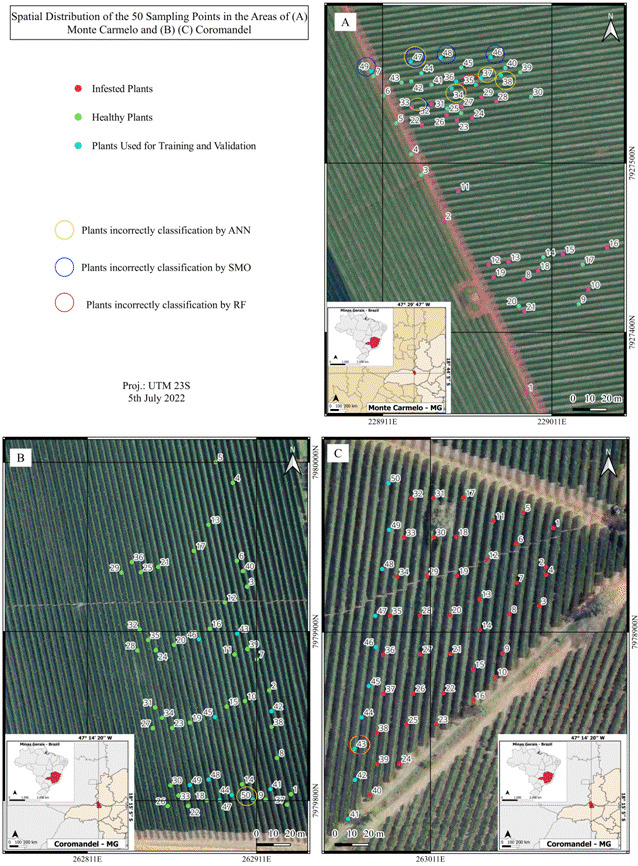
The study was conducted in three areas growing the coffee species Coffea arabica L., located in the municipalities of Coromandel and Monte Carmelo, Minas Gerais, Brazil. In Monte Carmelo, the crop consisted of 3-year-old Arara coffee trees, covering an area of approximately 46 ha and characterized by the presence of plants with and without citrus mealybugs. In Coromandel, the study was conducted in two areas, the first area comprised of 4.5-year-old Topázio coffee trees, covering an area of approximately 17 ha, and characterized by the absence of citrus mealybugs. The second area in Coromandel was comprised of coffee trees of the same cultivar and age, covering an area of approximately 6.4 ha and with a high incidence of citrus mealybugs (Figure 1). The geographic coordinates (latitude and longitude) of each point were collected in both areas. In each area, 50 plants were randomly sampled with a minimum distance of 10 m between points. The sampling was performed in a zigzag pattern, and we counted the number of mealybugs present in 2 plagiotropic branches in the middle third portion of the plants.

Representation maps of healthy and infested plants, validation, and incorrect classification by the Artificial Neural Networks (ANN), Support Vector Machine (SVM) and Random Forest (RF) algorithms for the Monte Carmelo areas (A); Coromandel - healthy (B) and Coromandel - infested (C).
It is worth noting that; although, the sample size of 50 plants is relatively small, it was determined based on a practical analysis. Previous studies that used machine learning for pest detection in crops have also employed similar sample sizes (MARTINS et al., 2017). Moreover, the data collection was planned to cover the variability present in the different levels of infestation.
Flights took place between 11 am and 1 pm in both areas. The images were collected using a Phantom 4 Pro drone equipped with a Mapir Survey 3W camera, flown at a height of 100 m, resulting in a Ground Sample Distance (GSD) of 8 cm, which allowed for the identification of plant-level features essential for infestation detection. The images were initially processed in the Mapir Camera Control (MCC) software for atmospheric correction and subsequently uploaded to Pix4D for orthomosaic generation. Using ENVI Classic 5.3 software, the reflectance values of the sampled plants were extracted from the near-infrared (NIR), red (Red), and green (Green) bands. From these reflectance values, vegetation indices, including the NDVI (Normalized Difference Vegetation Index) and GNDVI (Green Normalized Difference Vegetation Index), were calculated using the formulas:
NDVI = (NIR - Red) (NIR + Red) NDVI
= \frac {(NIR - Red)} {(NIR + Red)} NDVI
= (NIR + Red) (NIR - Red)
GNDVI = (NIR - Green) (NIR + Green) GNDVI
= \frac {(NIR - Green)} {(NIR + Green)} GNDVI
= (NIR + Green) (NIR - Green)
The calculation used the average reflectance values of all pixels within segmented areas of the sampled plants, ensuring spatial representativeness at the proposed analysis scale. Plant segmentation was achieved through masks generated from GPS coordinates collected in the field, processed in QGIS to isolate pixels corresponding exclusively to the plants, avoiding interference from surrounding soil or vegetation. These indices were selected due to their sensitivity to variations in plant biomass and water stress, critical for identifying pest-related stress. Finally, the extracted reflectance data were analyzed using Weka 3.8.5 software and classified with machine learning algorithms, including Neural Networks (Multilayer Perceptron), Support Vector Machine (SVM), and Random Forest.
It is worth highlighting that the choice of a minimum distance of 10 meters between sampled plants was made to minimize the interference of potential edge effects and ensure sample representativeness. The use of the Random Forest, Support Vector Machine, and Artificial Neural Networks algorithms was based on their proven effectiveness in previous supervised classification studies in agronomy (JEONG et al., 2016; OSCO et al., 2020). The choice of NDVI and GNDVI indices is due to their proven sensitivity in detecting changes in plant biomass and water stress, critical aspects for identifying mealybug infestations. Cross-validation, performed using the k-fold method (with k = 5), was used to maximize the robustness of the results and minimize potential biases due to the sample size, which was also crucial in balancing the number of samples used for training and validation.
To evaluate the performance of the models, we used metrics such as precision, Kappa index, and Overall Accuracy, which are essential for a better understanding of misclassification. These metrics allowed us to assess the model’s balance and ensure consistent discrimination between healthy and infested plants.
RESULTS AND DISCUSSION
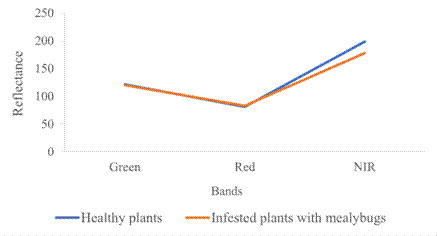
When analyzing the spectral behavior of the areas evaluated, a difference was observed between the reflectance values of healthy plants and those of plants infested with P. citri in the near infrared due to the loss of fruit biomass of the coffee plants (Figure 2).

Spectral behavior of healthy and infested coffee plants, calculated from the reflectance of healthy and infested canopies.
The Random Forest classifier obtained an accuracy of 90% and a Kappa index of 0.8, demonstrating substantial agreement (WANG et al., 2020), thus demonstrating the ability to distinguish between healthy and infected plants. ANN and SVM classifiers obtained an overall accuracy of 73.34% and 83.33%, respectively. The kappa index was 0.47 for the Neural Networks classifier, demonstrating moderate agreement, and 0.67 for the SVM classified, demonstrating substantial agreement (WANG et al., 2020) (Table 1).
Radiometric data and agronomic parameters of healthy and infected plants were classified by two machine learning algorithms (SVM and Naive Bayes) in the seven evaluation intervals of the experiment (4, 8, 12, 16, 20, 24, 28 DAI). The overall accuracy ranged from 29.41 to 100% for the SVM classifier, and the Kappa coefficient ranged from −0.42 to 1 (CARMO et al., 2021).
In general, the best results were observed at 24 DAI, both for the multispectral subsets and the visible sensor. Except for the subset of the multispectral indices, all the other classifiers obtained an overall accuracy of 100% (k = 1), which corresponds to a perfect agreement (WANG et al., 2020). The agronomic parameters obtained substantial agreement (k = 0.76) (CARMO et al., 2021).
Finally, a kappa coefficient below zero was the most common finding at 28 DAI, indicating poor agreement, while agronomic parameters were higher and indicated moderate agreement (k = 0.41 to 0.6) (WANG et al., 2020; CARMO et al., 2021).
The Random Forest classifier obtained an accuracy of 90% for the evaluated areas once it correctly classified 27 plants (14 healthy and 13 infested); however, one healthy plant was classified as infested with P. citri and two infested plants were classified as healthy. The Artificial Neural Networks algorithm correctly classified 22 plants and incorrectly classified 8 plants, wherein three were classified as healthy and five as infested. Twenty-five plants were correctly classified by the SVM classifier, with five healthy plants classified as infested (Table 2).
Figure 1 shows the plants used for training and model validation, as well as the plants incorrectly classified by the Artificial Neural Networks and Support Vector Machine algorithms. The Random Forest algorithm is considered an effective machine learning method to address agriculture-related problems (Table 1), as demonstrated in some studies (JEONG et al., 2016; OSCO et al., 2020).
The results obtained with the Random Forest algorithm were superior to those of ANN and SVM, confirming its effectiveness in distinguishing between healthy and infested plants. These results corroborate previous studies that demonstrated the robustness of Random Forest in classification tasks in precision agriculture (JEONG et al., 2016; OSCO et al., 2020). The accuracy of 90% and the Kappa index of 0.80 indicate substantial agreement, which is essential for practical field implementation.
From an agronomic perspective, early detection of infestations by P. citri is crucial to avoid significant losses in coffee production. Identifying infested areas allows for more targeted application of control measures, reducing the indiscriminate use of insecticides and consequently the production costs and environmental impacts. Studies like that of CARMO et al. (2021) also highlighted the importance of an integrated approach, combining remote sensing data with agronomic parameters for better pest management.
Finally, the use of multispectral images proved to be an effective tool for identifying plant stress due to pest infestation. This study confirmed that infested plants exhibit different reflectance in the near-infrared range due to fruit biomass loss, consistent with existing literature (WEISS et al., 2020). The use of NDVI and GNDVI proved adequate for detecting infestations, aligning with methodologies employed in other remote sensing studies for detecting diseases and pests in agricultural crops (RESENDE et al., 2020).
In the case of spectral bands, the use of the near-infrared (NIR) band proved decisive in differentiating between healthy and P. citri-infested plants. This is due to the fact that mealybug infestations alter the plant’s leaf structure, resulting in a significant reduction in NIR reflectance, caused by biomass loss and physiological stress. This band is widely used in the literature to detect changes in plant cell structure, being particularly sensitive to variations in chlorophyll content and leaf density. Although the other bands (red and green) did not show significant differences, the NIR band was able to accurately capture these changes. Future studies could explore the use of other spectral bands or combine more indices to improve model accuracy.
In addition to the NDVI and GNDVI vegetation indices, which are widely recognized for their sensitivity in detecting changes in plant biomass and water stress, future studies could explore the inclusion of other spectral indices and environmental variables, such as soil temperature and humidity. The integration of multiple data sources can increase the accuracy of prediction models, providing a more comprehensive view of plant conditions and pest infestations. Although the Random Forest algorithm demonstrated a high capacity to distinguish between healthy and infested plants, it is important to consider the limitations of this study. Environmental conditions, such as variations in sunlight and the stage of plant development, can influence the results of multispectral images. Future studies could explore the use of different drone flight altitudes and the incorporation of additional data, such as soil temperature and humidity, to improve the accuracy of prediction models.
Practical applications and scalability
The results of this study suggested that the developed methodology can contribute to the creation of early detection systems for P. citri on a commercial scale. These systems could be integrated into remote monitoring platforms, enabling faster identification of infestations and targeted application of control measures.
To extend the scope of this approach, drone flights over larger areas could be implemented, integrating spectral index analysis with meteorological and soil moisture data. However, mapping should always be conducted on a local scale, as classification algorithms will perform differently depending on the biotic and abiotic factors of each area. This variability emphasizes the importance of customizing training datasets and model parameters for specific environmental conditions to ensure robust and accurate results.
The scalability of the method will depend on the ability to process large volumes of multispectral data, and the development of algorithms adapted to the variability inherent in different agricultural landscapes. Future improvements could include automating workflows for data preprocessing and classification, making the technology more accessible to farmers and agronomists.
Limitations of real-world implementation
While the results are promising, field implementation faces several challenges. Environmental factors, such as variations in sunlight, cloud cover, and plant development stages, can significantly influence multispectral image data. Additionally, the initial costs of equipment, combined with the need for specialized training in data analysis and interpretation, may pose barriers to adoption.
Another critical limitation is the variation in algorithm performance across different regions. Since biotic and abiotic factors vary from one area to another, models trained on data from one location may not generalize well to others without further adjustment. For this reason, local mapping and the development of region-specific models are essential to achieve consistent accuracy and applicability.
Furthermore, the sensitivity of the methodology to factors such as plant density, soil type, and pest distribution requires careful consideration. Future studies could address these limitations by incorporating additional data sources, such as weather conditions and soil properties, and by developing algorithms capable of adapting to diverse agricultural contexts.
CONCLUSION
The findings of this study have important practical implications for farmers, providing an effective tool for monitoring mealybug infestations in coffee plants. The implementation of detection systems based on multispectral images and machine learning can significantly reduce the use of insecticides, promoting more sustainable and economically viable agricultural practices. Additionally, these results can inform integrated pest management policies, encouraging the adoption of remote monitoring technologies and precision agriculture.
The adoption of these technologies can also improve decision-making in the field, allowing for more targeted and timely interventions. The ability to detect pest infestations with high accuracy facilitates the appropriate management of the application of phytosanitary products, reducing production costs and environmental impacts. Thus, this study contributed to promoting more sustainable and efficient agriculture, aligned with ecological and economic criteria.
Algorithms based on machine learning can be used to distinguish between health plants and plants infested with mealybugs. The Random Forest algorithm has a high capacity to distinguish between healthy and infested plants in areas with high variability.
ACKNOWLEDGEMENTS
The authors are thankful to Fundação de Amparo à Pesquisa do Estado de Minas Gerais (FAPEMIG), to Coordenação de Aperfeiçoamento de Pessoal de Nível Superior (CAPES) and the Universidade Federal de Uberlândia (UFU) and the Graduate Program in Agriculture and Geospatial Information for financial support.
REFERENCES
-
APARECIDO, L. E. O. et al. Machine learning algorithms for forecasting the incidence of Coffea arabica pests and diseases. International Journal of Biometeorology, v.64, n.4, p.671-688, 2020. Available from: <Available from: https://pubmed.ncbi.nlm.nih.gov/31912306/ >. Accessed: May, 24, 2024. doi: 10.1007/s00484-019-01856-1.
» https://doi.org/10.1007/s00484-019-01856-1.» https://pubmed.ncbi.nlm.nih.gov/31912306/ -
CARMO, G. J. dos S. et al. Detection of lesions in lettuce caused by Pectobacterium carotovorum subsp. carotovorum by supervised classification using multispectral images. Canadian Journal of Remote Sensing, v.48, n.2, p.144-157, 2021. Available from: <Available from: https://www.tandfonline.com/doi/abs/10.1080/07038992.2021.1971960 >. Accessed: May, 24, 2024. doi: 10.1080/07038992.2021.1971960.
» https://doi.org/10.1080/07038992.2021.1971960.» https://www.tandfonline.com/doi/abs/10.1080/07038992.2021.1971960 -
CHEN, T. et al. Early detection of bacterial wilt in peanut plants through leaf-level hyperspectral and unmanned aerial vehicle data. Computers and Electronics in Agriculture, v.177, p.105708, 2020. Available from: <Available from: https://www.sciencedirect.com/science/article/abs/pii/S0168169920311133 >. Accessed: May, 24, 2024. doi: 10.1016/j.compag.2020.105708.
» https://doi.org/10.1016/j.compag.2020.105708.» https://www.sciencedirect.com/science/article/abs/pii/S0168169920311133 -
DEMIRCI, F. et al. Laboratory evaluation of the effectiveness of the entomopathogen; Isaria farinosa, on citrus mealybug, Planococcus citri Journal of Pest Science, v.84, n.3, p. 337-342, 2011. Available from: <Available from: https://link.springer.com/article/10.1007/s10340-011-0350-9 >. Accessed: May, 24, 2024. doi: 10.1007/s10340-011-0350-9.
» https://doi.org/10.1007/s10340-011-0350-9.» https://link.springer.com/article/10.1007/s10340-011-0350-9 -
FLAHERTY, D. L. et al. Chemicals losing effect against grape mealybug. California Agriculture, v.36, n.5, p.15-16, 1982. Available from: <Available from: https://calag.ucanr.edu/Archive/?article=ca.v036n05p15 >. Accessed: May, 24, 2024.
» https://calag.ucanr.edu/Archive/?article=ca.v036n05p15 - FORMAGGIO, A. R.; SANCHES, I. D. Sensoriamento Remoto em Agricultura. São Paulo: Oficina de Textos, 2017. 256p.
-
JEONG, J. H. et al. Random forests for global and regional crop yield predictions. PLoS One, v.11, n.6, p.15, 2016. Available from: <Available from: https://journals.plos.org/plosone/article?id=10.1371/journal.pone.0156571 >. Accessed: May, 24, 2024. doi: 10.1371/journal.pone.0156571.
» https://doi.org/10.1371/journal.pone.0156571.» https://journals.plos.org/plosone/article?id=10.1371/journal.pone.0156571 -
LU, J. et al. Field detection of anthracnose crown rot in strawberry using spectroscopy technology. Computers and Electronics in Agriculture, v.135, p.289-299. 2017. Available from: <Available from: https://www.sciencedirect.com/science/article/abs/pii/S016816991730114X >. Accessed: May, 24, 2024. doi: 10.1016/j.compag.2017.01.017.
» https://doi.org/10.1016/j.compag.2017.01.017.» https://www.sciencedirect.com/science/article/abs/pii/S016816991730114X -
MARTINS, G. D. et al. Detecting and mapping root-knot nematode infection in coffee crop using remote sensing measurements. IEEE Journal of Selected Topics in Applied Earth Observations and Remote Sensing, p.1-9, 2017. Available from: <Available from: https://ieeexplore.ieee.org/document/8016326 >. Accessed: Sept. 20, 2024. doi: 10.1109/JSTARS.2017.2737618.
» https://doi.org/10.1109/JSTARS.2017.2737618.» https://ieeexplore.ieee.org/document/8016326 - MESQUITA, C. M. et al. Manual do café: distúrbios fisiológicos, pragas e doenças do cafeeiro (Coffea arabica L.). Belo Horizonte: Emater, 2016. 62p.
-
OSCO, L. P. et al. Leaf nitrogen concentration and plant height prediction for maize using UAV-based multispectral imagery and machine learning techniques. Remote Sensing, v.12, n.19, p.1-17, 2020. Available from: <Available from: https://www.mdpi.com/2072-4292/12/19/3237 >. Accessed: May, 24, 2024. doi: 10.3390/rs12193237.
» https://doi.org/10.3390/rs12193237.» https://www.mdpi.com/2072-4292/12/19/3237 -
RESENDE, D. B. et al. Uso de imagens tomadas por aeronaves remotamente pilotadas para detecção da cultura do milho infestada por Spodoptera frugiperda Revista Brasileira de Geografia Física, v.13, n.1, p.156-166, 2020. Available from: <Available from: https://periodicos.ufpe.br/revistas/rbgfe/article/view/242326#:~:text=Pensando%20em%20agilidade%20e%20qualidade,frugiperda >. Accessed: May, 24, 2024. doi: 10.26848/rbgf.v13.1.p156-166.
» https://doi.org/10.26848/rbgf.v13.1.p156-166.» https://periodicos.ufpe.br/revistas/rbgfe/article/view/242326#:~:text=Pensando%20em%20agilidade%20e%20qualidade,frugiperda -
SPONGOSKI, S. et al. Acarofauna of cerrado’s coffee crops in Patrocínio, Minas Gerais. Ciência e Agrotecnologia, v.29, n.1, p.9-17, 2005. Available from: <Available from: https://www.scielo.br/j/cagro/a/c7SbsfyKqFXFjKgZh5ddQWf/abstract/?lang=en >. Accessed: May, 24, 2024. doi: 10.1590/S1413-70542005000100001.
» https://doi.org/10.1590/S1413-70542005000100001.» https://www.scielo.br/j/cagro/a/c7SbsfyKqFXFjKgZh5ddQWf/abstract/?lang=en -
WANG, T. et al. A plant-by-plant method to identify and treat cotton root rot based on UAV remote sensing. Remote Sensing, v.12, n.15, p.1-18, 2020. Available from: <Available from: https://www.mdpi.com/2072-4292/12/15/2453 >. Accessed: May, 24, 2024. doi: 10.3390/rs12152453.
» https://doi.org/10.3390/rs12152453.» https://www.mdpi.com/2072-4292/12/15/2453 -
WEISS, M. et al. Remote sensing for agricultural applications: A meta-review. Remote Sensing of Environment, v.12, n.15, p.1-18, 2020. Available from: <Available from: https://www.sciencedirect.com/science/article/abs/pii/S0034425719304213 >. Accessed: May, 24, 2024. doi: 10.1016/j.rse.2019.111402.
» https://doi.org/10.1016/j.rse.2019.111402.» https://www.sciencedirect.com/science/article/abs/pii/S0034425719304213 -
WHEELER, D. L. et al. Evidence of a trans-kingdom plant disease complex between a fungus and plant-parasitic nematodes. PloS one, v.14, n.2, p.e0211508, 2019. Available from: <Available from: https://pubmed.ncbi.nlm.nih.gov/30759127/ >. Accessed: May, 24, 2024. doi: 10.1371/journal.pone.0211508.
» https://doi.org/10.1371/journal.pone.0211508.» https://pubmed.ncbi.nlm.nih.gov/30759127/