 How much would irrigation increase maize production in Brazil?
ABSTRACT
Maize production in Brazil is notable for its high potential for agricultural expansion and extensive cropland areas. This study evaluated the current yield gap (Yg) in Brazilian maize production and investigated the potential impact of irrigation on closing this gap. Field experiments were conducted in three key maize-producing regions in Brazil to calibrate a crop model and obtain reliable data on yield potential (Yp) and water-limited yield potential (Yw) across different environments. Data on river basin flows were employed to ensure that irrigation would not result in the depletion of water resources for other uses. Our findings suggest that Brazil’s average actual yield (Ya) is 55.4 % below the Yp. It was determined that increasing irrigation levels is a viable method for achieving the potential maize yield without compromising available water resources. The average Yg is approximately 5.2 Mg ha–1, indicating a potential production increase of 41.9 % without expanding cropland areas. Strategic planning is essential to balance increased production and expanded irrigation, particularly to avoid impacting regions with water scarcity. It is underscored that the focus should be on areas with sufficient water resources to close Brazil’s current maize Yg. The results from this study offer valuable data for decision-makers and policymakers to enhance maize production sustainably.
Keywords
corn; simulation; modeling; yield-gap; intensification
Introduction
The world population is projected to increase by two to three billion people by 2050 (Foley et al., 2011; Godfray et al., 2010), with significant impacts on consumption patterns, particularly in developing countries with rising per capita income (FAO, 2016). Agricultural production must increase by 60 % by 2050 to meet these demands (Alexandratos and Bruinsma, 2012; Lobell et al., 2009), and meat demand is projected to double (Godfray et al., 2018), thereby placing additional stress on grain supplies for livestock feed.
Maize is paramount for future food security (Tanumihardjo et al., 2020). Brazil, the third-largest maize producer and largest exporter (FAO, 2016; USDA, 2018), has a production of approximately 112 million Mg of maize annually in 2024, with nearly 50 million Mg of this quantity destined for animal consumption (CONAB, 2024). The Brazilian Midwest is the main maize-producing region in the country, employing a soybean-maize rotation system. Approximately 73 % of the national maize harvest is produced on 13 million hectares. The yield of the off-season maize is more susceptible to fluctuations due to water shortages towards the end of the crop cycle (Andrea et al., 2018; Gouesnard et al., 2002; Llano and Vargas, 2016). In this sense, irrigation could mitigate these losses (Panda et al., 2004). Studies have indicated that the application of irrigation may result in a potential 60 % increase in yield (Nóia Júnior and Sentelhas, 2020).
In light of impending water limitations, this study examines maize water productivity across diverse geographical regions, employing biophysical crop models to elucidate the underlying mechanisms of water consumption (Jones et al., 1986). The concept of water productivity, defined as the yield per volume of water lost to evapotranspiration (Passioura and Angus, 2010), is critical for sustainable intensification, given the constraints on the potential expansion of cropland (Phalan et al., 2013; Strassburg et al., 2014; Marin et al., 2022).
The yield gap (Yg), defined as the difference between the actual yield (Ya) and the yield potential (Yp) or water-limited yield potential (Yw) for rainfed cropping systems, serves as a strategic indicator for agricultural productivity (Lobell et al., 2009). In Brazil, the average maize yield is approximately 5.5 t ha–1, considered lower than contest yields, which exceed 13.5 t ha–1 (Andrea et al., 2018; Syngenta, 2017). This highlights the potential for significant yield improvement. The literature on the Yg for maize in Brazil is limited (Argenta et al., 2003; Andrea et al., 2018). Nevertheless, the few existing studies lack robust protocols for obtaining reliable and scalable results.
The objectives of this study were twofold: first, to estimate the potential area expansion for irrigated off-season maize in Brazil taking into account water availability; and second, to estimate the yield increase from irrigation across Brazilian regions. These insights are crucial for understanding the role of maize in competing for water resources and for informing policy and investment decisions.
Materials and Methods
Brief model description
To estimate Yp, we employed the process-based crop model Hybrid-Maize (Yang et al., 2004), which integrates specific growth and development functions for maize with mechanistic processes that quantify photosynthesis and respiration. The for crop growth and development models are based on previous crop models that have been widely adopted and tested (Jones et al., 1986; Kropff and van Laar, 1993; van Ittersum et al., 2013). The computations include photosynthesis, light interception, and CO2 assimilation for each canopy layer, with temperature relationships adapted from those described by Kropff and van Laar (1993). The approach to maintenance and growth respiration is similar to that employed by INTERCOM (Kropff and van Laar, 1993). In this approach, the process for each organ is estimated as a fraction of live biomass daily. However, the growth respiration coefficients for leaves, stems, roots, and grains were derived from Penning de Vries et al. (1989). The grain-filling functions account for plant population, as individual grain weight decreases in cereal crops with increased plant density (Haegele et al., 2014).
The water balance and soil water dynamics are calculated for each 10 cm layer in the rooting zone, from the top to the bottom. In the top layer, the daily rainfall/irrigation, water losses from runoff, and canopy interception are input values. For the other layers, the inputs are accounted for as drainage from the layer immediately above, as described by Kendy et al. (2003) for a tipping bucket soil water balance model.
Hybrid-Maize requires the utilization of only one hybrid-specific parameter in two different ways, which is employed in two distinct methodologies: the calculation of growing degree-days (GDD) from emergence to silking, or the summation of total GDD from emergence to maturity. This allows for the adjustment of a single generic genotype to represent phenotypic variations across locations by defining one GDD value that statistically matches simulation outputs with observed data from different regions. Generic coefficients for phenology and growth-related model internal parameters such as photosynthesis, respiration, leaf area expansion, light interception, biomass partitioning, and grain filling were used. These were made available by Yang et al. (2004) and adjusted for Brazilian cropping systems by Marin et al. (2022).
Field experiments and crop model calibration
Two field experiments were conducted. The first was conducted under rainfed conditions and involved the sowing of the off-season maize on 06/09/2016 and its subsequent harvesting on 10/20/2016. The second experiment was conducted under both irrigated and rainfed conditions during the summer season and involved the sowing of maize on 11/29/2018 and its subsequent harvesting on 03/27/2019. The experiments allowed for the evaluation of the efficacy of growth models in representing the impact of climate on plant development under distinct water conditions. Both experiments were conducted in the municipality of Piracicaba, São Paulo state, at the Departamento de Engenharia de Biossistemas of the Escola Superior de Agricultura Luiz de Queiroz of the Universidade de São Paulo (22°42’32” S, 47°37’45” W, altitude 548 m). The experiments were conducted in a randomized block design with two blocks totaling four experimental plots. A weather station (WS) was installed near the experimental area. It was used to record global solar radiation (MJ m–2 d–1), photosynthetic photon flux density (MJ m–2 d–1), air temperature (°C), relative humidity (%), wind speed at a height of 2 m above the surface (m s–1), and rainfall (mm d–1). Three additional experiments with similar designs and proximity to WSs over grass were conducted in the municipalities of Júlio de Castilhos and Tupanciretã (Rio Grande do Sul state), and Rio Verde (Goiás state). The details of these experiments are provided in Table 1 (Marin et al., 2022).
The calibration procedure was based on the methodology outlined by Marin et al. (2011). Given the cultivar measurements and the distinct measurement strategies present within each dataset, the leave-one-out cross-validation method (Makowski et al., 2006) was employed to simultaneously include all the variability of conditions and field measurements into the parameter estimation and model prediction evaluation. The leave-one-out cross-validation procedure employed a factorial design whereby each run excluded one treatment at a time. The parameter sets derived from the cross-validation above runs were employed for the evaluation of the predictions pertaining to phenological stages, above-ground biomass, and yield accumulation, as observed during the experiments. Subsequently, the aforementioned predictions were employed to calibrate the crop model parameters through eye-fitting, with the root mean squared error (RMSE), mean absolute error (MAE) (Loague and Green, 1991), the index of agreement (d) (Willmott et al., 2012), and the Nash-Sutcliffe efficiency index (NSE) (Nash and Sutcliffe, 1970) serving as measures of goodness-of-fit.
Spatial representation of soil, climate, and yield data
In order to reconcile the adequate representation of spatial variability with the available database and simulation time, we adopted the concept of a climate homogeneous zone (CZ) as suggested by van Wart et al. (2013). This entailed considering the distribution of WSs within a minimum radius of 100 km and selecting representative soils within a buffer zone around each WS, as Rattalino Edreira et al. (2018) recommended. Data essential for identifying regions with significant maize production were provided by the Automatic Recovery System (SIDRA, https://sidra.ibge.gov.br/) from the Instituto Brasileiro de Geografia e Estatística (IBGE).
We utilized the observed 20-year (2000-2020) daily weather data from the Instituto Nacional de Meteorologia (INMET) in Brazil for simulations. To address data gaps in the series, we utilized daily weather data obtained from the NASAPOWER API Client (Sparks, 2018). It was assumed that the municipality near the center of a given CZ with a WS would represent the entire CZ regarding climate variability. The reference and crop evapotranspiration data necessary for Hybrid-Maize were estimated by the methodologies proposed by Yang et al. (2004) and Allen et al. (1998).
The soil data were extracted from the Brazilian Soil Map (EMBRAPA, 2014) and correlated with each selected CZ. Only soils covering more than 10 % of the area were considered to avoid over-fragmentation and ensure regional representativeness. After identifying soil types, all information was cross-referenced with the WISE Global Soil Profile Database (Batjes, 2002) to determine the physical characteristics of the topsoil and subsoil necessary for crop model simulations. These include the soil hydraulic parameters down to 80 cm depth.
After completing crop model simulations, the outputs were organized, and information on Yp, Yw, and Yg was calculated for each representative maize production region in Brazil. This was achieved by averaging the estimated Yw and Yp, weighted by the proportion of soils within each buffer. The Ya was obtained from SIDRA by averaging data from the last five years in each CZ, to mitigate the effects of technological trends.
Criteria for selecting potential areas of expansion
In order to address concerns regarding the minimization of the impacts on natural water sources resulting from the expansion of irrigated production, a framework established by Ferrarini et al. (2019) was employed to identify existing production areas and select the most suitable locations for potential expansion. The methodology involved defining criteria encompassing Brazil’s socioeconomic and agricultural diversity. The following criteria were used for the selection of municipalities where maize crop expansion should occur (Figure 1).

– Four steps (A, B, C, and D) to quantify available water for potential new off-season maize areas by the defined criteria.
Each municipality is required to produce soybeans during the summer season. This criterion was selected for consideration of the economic feasibility of expansion, as farms that grow soybeans typically have the necessary production logistics, machinery, and inputs for maize cultivation. In regions where off-season maize is cultivated, the area dedicated to maize must be equivalent to or smaller than that allocated for soybeans. The new off-season maize areas are to be established in locations where soybeans are already grown, thereby ensuring that the off-season crop area remains vacant. The data on maize and soybean production, cultivation area, and yield at the municipality level were provided by SIDRA.
Municipalities are required to have irrigated crops already. Not all locations meeting the aforementioned criterion are assumed to have water resources capable of supporting irrigated systems. Consequently, municipalities with existing irrigated areas would encounter fewer obstacles to irrigation or may already possess the necessary infrastructure for new off-season maize areas (Beare et al., 1998; Giannakis et al., 2016). The data for this criterion were obtained from the Brazilian Irrigation Atlas of the Agência Nacional de Águas e Saneamento Básico (ANA).
It is necessary to ensure that the estimated irrigated volume required for the crop is less than the limit of 95 % of the annual flow of the watercourse (Q95), which represents the irrigation capacity. In order to close production gaps, it is essential to consider environmental practices in the management of water resources (Grassini et al., 2011). ANA metadata library provides the water flow of river basins, which forms part of the Sistema Nacional de Informações sobre Recursos Hídricos (SNIRH, 2017). All datasets employed in these three criteria were considered over five year (2015 to 2020), reflecting Brazil’s prevailing conditions of maize production in Brazil.
Once the aforementioned criteria were met and locations were clearly delineated for each CZ, crop model simulations were performed for each weather-soil combination. Sowing dates and plant density for each location were based on governmental reports. Simulations were initially conducted to emulate a fully irrigated maize cropping system, and the resulting output files were then analyzed to determine the irrigated volume for each simulated day.
Subsequently, a new set of simulations was conducted with irrigation applied on the same days. However, the amount of water applied was stratified across 100 to 0 % of total irrigation in steps of ten percentage points, with the final representation being rainfed conditions. This approach was employed to generate simulations with varying irrigation levels, which could then be compared with water flow databases from river basins.
Water requirements and irrigated area quantification
Two distinct methodologies were employed to analyze the previously mentioned stratified irrigation amounts. The initial approach entailed the evaluation of the partially or fully irrigated yield potential (Ypi), which was obtained through the simulation of varying irrigation amounts and subsequently compared to Yw. This approach allowed for a detailed categorization of each prospective area with respect to the potential for irrigation-based water supplementation. The second approach estimated the available natural water resources for irrigation as a percentage of expandable new areas in the given CZ. By identifying the locations and sizes of potential new areas and the applied water in millimeters (i.e., L m–2), we matched this data with available water resources to determine the extent to which area in each CZ could be irrigated. This analysis initially considered only potential new off-season maize areas and the total areas where maize crops are cultivated.
We estimated the total expandable area under full irrigation based on the irrigation levels delineated for each CZ. We quantified the resulting increase in national production, thereby contributing to the closure of the maize Yg between Ya and Ypi, as documented in the Global Yield Gap Atlas (GYGA, https://www.yieldgap.org/brazil). These estimates were then compared with publicly available data on irrigation expansion to assess how governmental policies would meet the requirements to properly fulfill future grain demands.
To compare differences in Ypi resulting from the specified irrigation levels in the context of the rainfed estimate, we performed the Tukey’s test (Tukey, 1953) at a significance level of 5 %. This approach evaluates the potential increase for water consumption in a single CZ to significantly enhance crop production, thereby estimating the required irrigation levels to facilitate the expansion and achieve the average yields necessary to bridge the Brazilian agricultural gaps for maize.
Results
The simulations demonstrated a high degree of correlation with the observed data, with a divergence of less than 1.21 Mg ha–1 for grain yield (Figure 2). For phenological data, the root mean squared error (RMSE) was higher but still within acceptable levels of agreement (Table 2). It was assumed that modern maize genotypes respond to environmental variability in a similar pattern. Therefore, differences among simulated yields, particularly in phenology, were inferred as residual deviations resulting from management actions at the experimental level, such as irrigation, planting dates, and soil properties.

– Model performance evaluation on representing phenology (left) and grain yield (right) from the observed data across regions in Brazil. The two-dashed lines in each graph represent the 95 % confidence interval. DAS = days after sowing.
The optimal estimates were obtained by modifying the standard value for the potential number of kernels per ear parameter in the Hybrid Maize model. The default setting of the model for this parameter is 675 g per ear; however, a better representation based on experimental observations was achieved by setting it to 736 g per ear. This figure was determined by evaluating 95 % of individuals in a sample set of 304 ears obtained from the experiments. Additionally, setting the GDD model parameter to 1553 degree-days improved statistical indexes, achieving satisfactory agreement between observed and simulated data (Table 2).
A total of 25 CZs were identified as relevant for maize expansion in Brazil based on the specified criteria, representing at least 50 % of national maize production (Figure 3). The simulation results indicated that during the off-season, the producing regions of northeastern Brazil (CZs 3 and 4) exhibited reduced Yp due to prolonged periods of water stress in this cropping system (Figure 4A). In both the main season and off-season, the majority of producing regions were concentrated in Brazil’s Midwestern, Southeastern, and Southern regions of Brazil, with most CZs displaying a Yp above 10 Mg ha–1.

– Results of the buffer selections for all central maize-producing regions in Brazil. Numbers next to each polygon represent the climate homogeneous zones described in Table 4.

– A) Water-limited yield potential for crops during season and B) off-season maize. Numbers next to each polygon represent the climate homogeneous zones described in Table 4.
The analysis of the relationship between Ya and Yw reveals that the majority of producing regions during the main season are situated along the Center-South axis of Brazil, with achievable yields ranging between 60 and 80 % of the potential. In contrast, for crops in the off-season, Ya values are below 40 %, indicating that water stress is a significant limiting factor during this period (Figure 4B). Seasonal maize crops generally exhibited the highest Yp and the most notable differences in achievable yields. On average, the Ygs are nearly 5.2 Mg ha–1, suggesting a potential for expanding production by 41.9 % without the need to open new production areas (Table 2).
The most significant differences between the yields of Ya and Yw were observed in CZs 9 and 10, which highlight regions with considerable potential for crop intensification through increased investment. Conversely, the Yg was lower in specific regions, though this did not necessarily correlate with high reported yields (Table 1). CZs 18 and 20, represented by the Cruz Alta (Rio Grande do Sul state) and Encruzilhada do Sul (Rio Grande do Sul state) WSs, respectively, exhibited smaller Ygs. However, the simulated Yw was lower than other regions, indicating that these areas are closer to the genetic potential for maize crops (Table 3).
The estimated Ygs for off-season maize were smaller than for the main season, yet the potential for most regions was also lower. In numerous CZs, there is a considerable difference between Ya and Yw, highlighting the pronounced influence of water deficit. This is evident in CZs 11, 13, and 24, where the implementation of irrigation techniques could result in significant gains in crop yield. CZs 3 and 4, which represent productive regions in the northeast of Brazil, exhibit lower Yw values during the off-season. The observed differences between Yw and Ya in these areas are primarily attributed to genetic limitations of crops in developing in the aforementioned regions.
The application of the expansion selection criteria yielded 22 CZs (Figure 5A, Table 3), distributed across 11 Brazilian states and encompassing 81 % of the area where off-season maize and soybean production is concentrated, with irrigation potential.

– A) Municipalities selected by the criteria for expansion area, with B) their respective water resources containing reported water flow data. Color variation only illustrated the different river watercourses inside the potential areas. C) Representative weather stations that cover selected representative soils in a 100-km buffer. D) Climate homogeneous zones (CZs) distribution across the selected maize producing municipalities in Brazil.
Despite the geographical proximity of the identified CZs in northeastern Brazil, the variability in nearby areas can be attributed to the transition zone that encompasses at least three biomes (Amazon Forest, Cerrado, and Caatinga). The highest prevalence of off-season maize production in the southern regions is observed at latitudes above –25° (Table 3), where temperatures and rainfall (Table 4) remain within the optimal ranges for sustaining crops throughout the autumn. In the midwestern region, production areas are concentrated near the WSs identified at latitudes ranging from –18° to –12° (Figure 5C), which also contain many river courses (Figure 5A). This suggests the presence of areas with greater suitability for irrigation without depleting water resources.
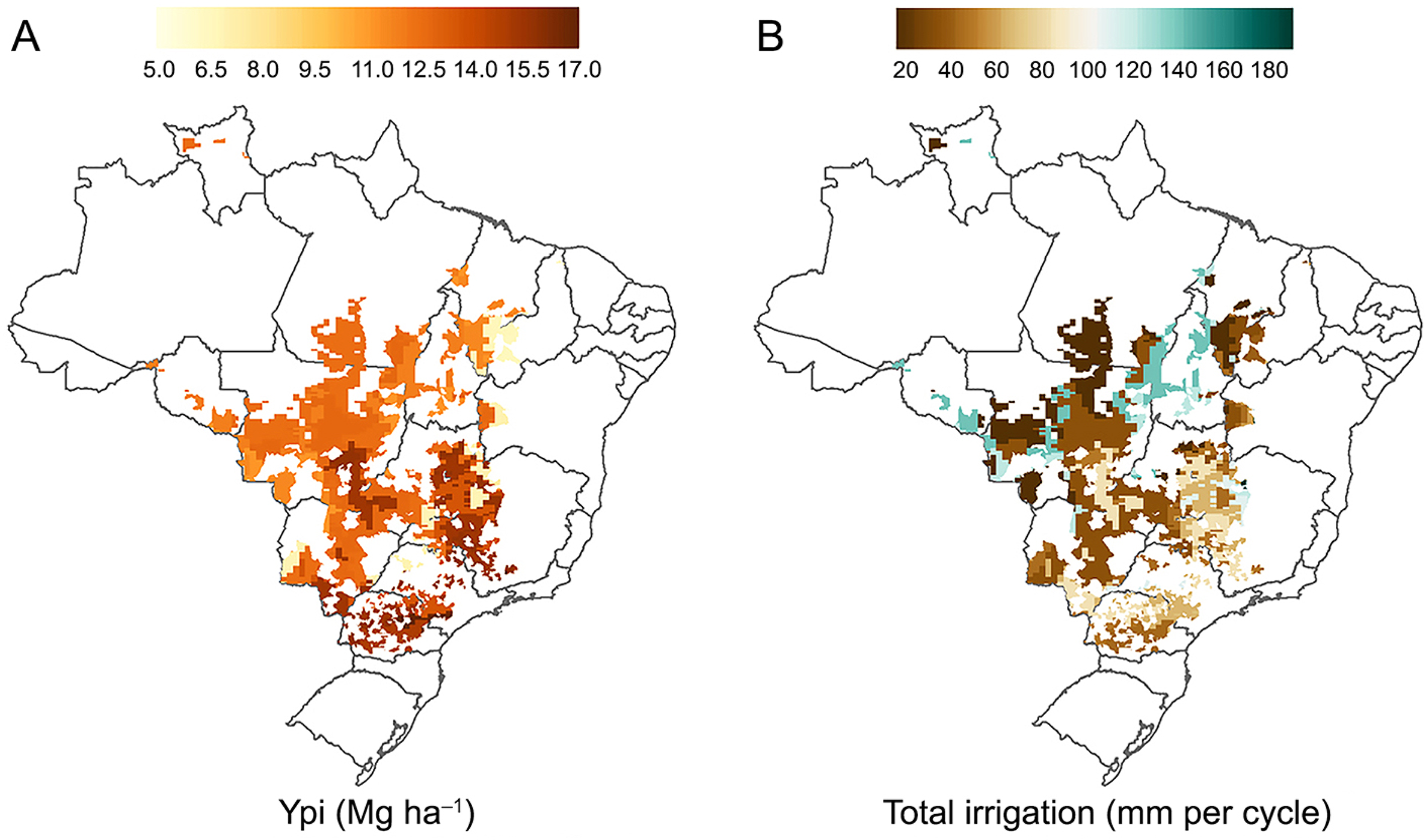
Conversely, river water resources are more limited in Northeastern areas, which may present greater challenges in the incorporation of irrigated systems. As a result, crops in these regions may exhibit reduced yields due to water deficit stress. Across the country, the Yp for off-season maize ranged from 5 to 17 Mg ha–1, requiring an average of 20 to 180 mm of irrigation to achieve the desired grain production per cropped area (Figure 6B). The highest yields were identified in the southern latitudes, encompassed by CZs 6, 5, 4, 19, and 20, where the estimated average yield reached values higher than 15 Mg ha–1 (Figure 6A).

– A) Full-irrigation yield potential (Ypi) and B) average irrigation amount per cycle necessary to fulfilling water requirements in the field during the cycle.
The lowest yields were observed in the Northeastern production regions, where the average grain Yp of CZs 17, 15, 16, 14, and 13 was below 7 Mg ha–1. The disparity between Ypi values in the Southern and Northern regions is primarily attributable to the poor physical properties of soils in the Northern region. Furthermore, the soil conditions in southern and midwestern croplands are more conducive to water storage, which benefits plant growth during period of low rainfall. Consequently, the irrigation requirements necessary to achieve Yp were lower in the Southern and midwestern locations than in the Northern and Eastern ones (Figure 6B). The CZs 0, 8, 11, 14, 9, and 10 exhibited the lowest average of irrigation application rates, consistently below 35 mm per cycle. In contrast, CZs 18, 22, 23, 2, and 6 had the highest estimated irrigation requirements with rates exceeding 100 mm per season.
The stratified analysis of irrigation capacity revealed significant variability in the extent to which rainfed and irrigated production were integrated (Figure 7A). The CZs 18, 22, and 23 exhibited higher yield per irrigation (Ypi). However, it required significant irrigation, as water availability accounted for nearly 100 % of the difference between Yw and Ypi. Conversely, regions represented by CZs 8, 14, and 11 showed minimal response to irrigation, with the Yw and Ypi differing by less than 15 %, indicating that rainfall alone provided adequate water supplementation throughout the season.

– A) The ratio between full-irrigated yield potential (Ypi) and water-limited yield potential (Yw) by the gradual increase of irrigated areas (X-axis) in each climate homogeneous zone (CZ). B) Grouped difference between Ypi and Yw within in each homogenous zone, with the level wherein there is a statistical difference between them, according to color differentiation.
In the remaining CZs, the yields from rainfed and total irrigation scenarios exhibited 50 to 70 % discrepancy, predominantly in locations with high Ypi under relatively lower water demand. The greatest increase in water demand was observed predominantly in the Northern and Northeastern regions (Figure 7B). However, in certain locations, the difference between Ypi and rainfed yields was less pronounced, suggesting that irrigation achieved only modest gains (e.g., CZs 15 and 17).
A comparison of the grouped differences between crop water regimes revealed that CZs 8, 14, 16, and 17 exhibited no significant statistical differences between Ypi and Yw (Figure 7B). However, for the majority of CZs, the achievement of significant production gains will necessitate irrigation above 50 % of the potential areas suitable for expanding the off-season maize cultivation. The results demonstrated that, in CZs 22 and 23, significant yield differences from Yw were observed following the irrigation of only 30 % of the areas, indicating that the cropland areas in those regions are more responsive to irrigation.
In Brazil’s Midwestern and Southern regions, CZs 1, 9, 10, 11, and 20 require irrigation at a depth below 65 mm to achieve their Yp. However, Figure 7B shows notable differences between rainfed yields and irrigated fields only when irrigation is applied at depths exceeding 70 %. This indicates that these regions have lower water requirements to attain the full potential of Yp.
The capacity of water resources to support irrigated off-season maize indicates that, for the majority of CZs, expanding off-season maize crops to areas currently occupied by soybeans in the summer is a viable proposition, provided that 10 to 50 % of the available water volume is utilized (Figure 7A). However, in CZ 18, only 20 % of the potential expansion areas can be irrigated without exceeding the Q95 limit of available water resources. CZs 2, 3, and 6 were identified as regions with sufficient water resources to fully meet crop water requirements. However, despite the proximity of water reservoirs in these regions (Figure 3), the total water usage calculations are uncertain for this specific context. Similarly, CZs 11 to 17, with few river basins and soils with low water retention capacity, may still face water limitations for irrigation specific to their cropland.
The incorporation of maize-occupied areas during the summer months significantly changed the irrigation scenario for specific locations. In CZ 20, only 30 % of the areas could be irrigated without depleting resources, while in CZ 1, the capacity is reduced to a maximum of 20 % (Figure 7B). Previously, CZ 19 could irrigate100 % of its area using only 17 % of the available water volume (Figure 8A). However, when additional areas (Figure 8B) are considered, the water usage exceeds 85 %. For CZ 18, irrigation becomes infeasible as the water needed to irrigate even less than 10 % of the total area surpasses the Q95 limit, which threatens the water supplies for these regions.

– A) Comparison between official governmental data and estimates for the expansion of potential irrigated areas, including only municipalities within the selected regions. B) Grouped statistical difference among climate homogeneous zones. Black dots represent simulated data obtained in this study; blue dots represent official data from the Agência Nacional de Águas e Saneamento Básico (ANA); red dots were sourced from the Global Yield Gap Atlas (GYGA).
Discussion
Brazil’s Northern and Northeastern regions are currently regarded as the most promising agricultural frontiers. However, notable concerns have been raised about the potential impact of water limitations on crop maintenance. Studies conducted on soybean in succession with off-season maize have shown a historical trend of rainfall shortages during critical periods, leading to significant yield losses for both crops (Reis et al., 2020; Medina et al., 2019; Pires et al., 2016; Nóia Júnior and Sentelhas, 2020). The irregular climate observed in these regions represents a significant limitation to potential production, with yields of Yp below 6.5 Mg ha–1. Therefore, the achievement of such yields does not require the provision of substantial supplementary water, thereby rendering these regions a priority for the implementation of public policies and irrigation investments. Even with modest gains in grain yields, public investments returns can be assured by avoiding considerable losses in total maize production (Cunha et al., 2015; Souza et al., 2019; Martins et al., 2019).
In regions such as Barreiras (Bahia state), Cabixi (Rondônia state), and Pimenteiras do Oeste (Rondônia state) (CZs 18, 22, and 23, respectively), the potential for high yields is accompanied by a significant requirement for irrigation. Water stress represents a primary factor contributing to losses in grain yield, with Ygs largely attributable to water demands. However, the available resources are insufficient to irrigate the entirety of the potential new areas. Given the future scenarios wherein climate change will impose constraints on croplands, weather sensitivity is expected to account for over 50 % of yield variations, with water limitations identified as the primary cause of losses (Müller and Robertson, 2014; Wheeler and von Braun, 2013; Frieler et al., 2017). Regions with limited water resources should be regarded as high-risk for food security, requiring concentrated efforts from policymakers and scientists to address these limitations.
The impact of water deficit on Yw has been extensively studied, with strategies to improve crop water productivity (Passioura and Angus, 2010). The implementation of mulching with plastic film and no-tillage systems has been demonstrated to reduce water losses and enhance crop yields (Zhou et al., 2009; Baldé et al., 2011; Bergamaschi et al., 2010; Silva et al., 2019; Delate et al., 2012). Techniques such as free-air CO2 enrichment and advancements in maize breeding programs for drought-tolerant genotypes also present viable solutions for addressing water deficits (Field et al., 1995; Wall et al., 2006; Manderscheid et al., 2014; Cooper et al., 2014; Maazou et al., 2016; Ribaut et al., 2002). However, it remains unclear whether physiological gains will surpass temperature stresses in future climate scenarios (Antolin et al., 2021; Silva et al., 2021; Souza et al., 2019; Bassu et al., 2014; Marin et al., 2013).
Official reports indicate that by 2030, there will be an increase of approximately three million hectares (29.6 %) of irrigated maize in the locations identified as potential areas for off-season maize in Brazil (Figure 7A). However, our projections from GYGA indicate that there is still a gap for increasing yields by 55.4 % to achieve the Yp for current cropland areas. An average increase of this magnitude is estimated to be reached by irrigating approximately 7.8 million hectares (72.6 %) of the selected potential areas (Figure 8A). The total amount of potential new areas is estimated at around 10.7 million hectares.
The expansion of irrigation in Brazil is anticipated to result in a notable increase in the national average maize yield. Crop model estimates indicate that gains would only marginally surpass the current values obtained from rainfed crops (Figure 8B). Statistically, an increase of approximately 20 % in irrigated areas demonstrates no significant difference in yield gains compared to those obtained under rainfed regimes. Moreover, if agricultural objectives aim to close the Brazilian maize Yg, average increases in crop production would necessitate irrigation of at least 50 % of the potential areas intended for expansion.
It is imperative that public investments be made to meet future grain demands. An increase in water usage efficiency to the 20th yield percentile could ensure food provision for millions and significantly reduce domestic water consumption (Brauman et al., 2013). The government’s projections indicate that the irrigated area will be 10 Mha for all crops by 2030, with nearly 3 Mha allocated for off-season maize. This falls below the required 7.8 Mha to close the maize Yg. It is, therefore, recommended that public projections be adjusted accordingly. The expansion of irrigated areas should be balanced against water scarcity levels to ensure sustainable crop production without depleting water resources (Multsch et al., 2020).
The identified CZ locations align with known major production regions, providing valuable information for decision-makers on strategies to close Ygs. It is imperative that scientists and policymakers collaborate to ensure the efficient use of natural resources and the sustainability of key crops that are essential for human food, livestock, and global economies. Given the prospective environmental changes and constrained crop land, the trade-off between increased production and irrigated area expansion should prioritize regions where water scarcity represents a substantial challenge. The transition to rainfed areas from other crops, such as soybeans, should be approached by implementing water efficiency measures to ensure meaningful yield increases and bridge the Ygs in regions with limited water resources.
Acknowledgments
This project was funded by the Fundação de Amparo à Pesquisa do Estado de São Paulo (FAPESP – 2021/00720-0), the Conselho Nacional de Desenvolvimento Científico e Tecnológico (CNPq – 302597/2021), the Fundação de Amparo à Pesquisa do Estado do Rio Grande do Sul (FAPERGS – 17/2551-0000775-1). The authors thank Prof. Patricio Grassini for his valuable insights and contributions to this research.
References
- Alexandratos N, Bruinsma J. 2012. World Agriculture Towards 2030/2050: The 2012 Revision. FAO, Rome, Italy.
- Allen RG, Pereira LS, Raes D, Smith M. 1998. Crop Evapotranspiration: Guidelines for Computing Crop Water Requirements. FAO, Rome, Italy.
-
Alvares CA, Stape JL, Sentelhas PC, Gonçalves JLM, Sparovek G. 2013. Köppen's climate classification map for Brazil. Meteorologische Zeitschrift 22: 711-728. http://dx.doi.org/10.1127/0941-2948/2013/0507
» http://dx.doi.org/10.1127/0941-2948/2013/0507 -
Andrea MCS, Boote KJ, Sentelhas PC, Romanelli TL. 2018. Variability and limitations of maize production in Brazil: potential yield, water-limited yield, and yield gaps. Agricultural Systems 165: 264-273. http://dx.doi.org/10.1016/j.agsy.2018.07.004
» http://dx.doi.org/10.1016/j.agsy.2018.07.004 -
Antolin LAS, Heinemann AB, Marin FR. 2021. Impact assessment of common bean availability in Brazil under climate change scenarios. Agricultural Systems 191: 103174. http://dx.doi.org/10.1016/j.agsy.2021.103174
» http://dx.doi.org/10.1016/j.agsy.2021.103174 -
Argenta G, Sangoi L, Silva PRF, Rampazzo C, Gracietti LC, Strieder ML, et al. 2003. Maize grain yield potential at two environments and five production systems. Scientia Agraria 4: 27-34 (in Portuguese, with abstract in English). http://dx.doi.org/10.5380/rsa.v4i1.1062
» http://dx.doi.org/10.5380/rsa.v4i1.1062 -
Baldé AB, Scopel E, Affholder F, Corbeels M, Silva FAM, Xavier JHV, et al. 2011. Agronomic performance of no-tillage relay intercropping with maize under smallholder conditions in central Brazil. Field Crops Research 124: 240-251. http://dx.doi.org/10.1016/j.fcr.2011.06.017
» http://dx.doi.org/10.1016/j.fcr.2011.06.017 -
Bassu S, Brisson N, Durand J-L, Boote K, Lizaso J, Jones JW, et al. 2014. How do various maize crop models vary in their responses to climate change factors? Global Change Biology 20: 2301-2320. http://dx.doi.org/10.1111/gcb.12520
» http://dx.doi.org/10.1111/gcb.12520 - Batjes NH. 2002. A Homogenized Soil Profile Data Set for Global and Regional Environmental Research: WISE, Version 1.1. International Soil Reference and Information Centre, Wageningen, The Netherlands.
-
Beare SC, Bell R, Fisher BS. 1998. Determining the value of water: the role of risk, infrastructure constraints, and ownership. American Journal of Agricultural Economics 80: 916-940. http://dx.doi.org/10.2307/1244183
» http://dx.doi.org/10.2307/1244183 -
Bergamaschi H, Dalmago GA, Bergonci JI, Krüger CAMB, Heckler BMM, Comiran F. 2010. Intercepted solar radiation by maize crops subjected to different tillage systems and water availability levels. Pesquisa Agropecuária Brasileira 45: 1331-1341. http://dx.doi.org/ 10.1590/S0100-204X2010001200001
» http://dx.doi.org/ 10.1590/S0100-204X2010001200001 -
Brauman KA, Siebert S, Foley JA. 2013. Improvements in crop water productivity increase water sustainability and food security: a global analysis. Environmental Research Letters 8: 024030. http://dx.doi.org/10.1088/1748-9326/8/2/024030
» http://dx.doi.org/10.1088/1748-9326/8/2/024030 -
Cooper M, Gho C, Leafgren R, Tang T, Messina C. 2014. Breeding drought-tolerant maize hybrids for the US corn-belt: discovery to product. Journal of Experimental Botany 65: 6191-6204. http://dx.doi.org/10.1093/jxb/eru064
» http://dx.doi.org/10.1093/jxb/eru064 -
Companhia Nacional de Abastecimento [CONAB]. 2024. Acompanhamento da Safra Brasileira: Graõs 11º Levantamento Safra 2023/2024 (in Portuguese). Available at: https://www.conab.gov.br/info-agro/safras/graos/boletim-da-safra-de-graos/item/download/54460_ac5ec041ecc80ebcefb26d898f2b33da [Accessed June 02, 2024]
» https://www.conab.gov.br/info-agro/safras/graos/boletim-da-safra-de-graos/item/download/54460_ac5ec041ecc80ebcefb26d898f2b33da -
Cunha DA, Coelho AB, Féres JG. 2015. Irrigation as an adaptive strategy to climate change: an economic perspective on Brazilian agriculture. Environment and Development Economics 20: 57-79. http://dx.doi.org/10.1017/S1355770X14000102
» http://dx.doi.org/10.1017/S1355770X14000102 -
Delate K, Cwach D, Chase C. 2012. Organic no-tillage system effects on soybean, corn and irrigated tomato production and economic performance in Iowa, USA. Renewable Agriculture and Food Systems 27: 49-59. http://dx.doi.org/10.1017/S1742170511000524
» http://dx.doi.org/10.1017/S1742170511000524 - Empresa Brasileira de Pesquisa Agropecuária [EMBRAPA]. 2014. Sistema de Informação de Solos Brasileiros. Embrapa Solos, Rio de Janeiro, RJ, Brazil (in Portuguese).
- Ferrarini ASF, Ferreira Filho JBS, Cuadra SV, Victoria DC, Horridge M. 2019. The expansion of irrigated agriculture in Brazil and potential regional limitations. p. 139-157. In: Wittwer G. eds. Economy-Wide Modeling of Water at Regional and Global Scales. Advances in applied general equilibrium modeling. Springer, Berlin, Germany.
-
Field CB, Jackson RB, Mooney HA. 1995. Stomatal responses to increased CO 2: implications from the plant to the global scale. Plant, Cell and Environment 18: 1214-1225. http://dx.doi.org/10.1111/j.1365-3040.1995.tb00630.x
» http://dx.doi.org/10.1111/j.1365-3040.1995.tb00630.x -
Foley JA, Ramankutty N, Brauman KA, Cassidy ES, Gerber JS, Johnston M, et al. 2011. Solutions for a cultivated planet. Nature 478: 337-342. http://dx.doi.org/ 10.1038/nature10452
» http://dx.doi.org/ -
Food and Agriculture Organization [FAO]. 2016. FAOSTAT. Available at: http://www.fao.org/faostat/en/#data/QC [Accessed July 27, 2018]
» http://www.fao.org/faostat/en/#data/QC -
Frieler K, Schauberger B, Arneth A, Balkovic J, Chryssanthacopoulos J, Deryng D, et al. 2017. Understanding the weather signal in national crop-yield variability. Earth's Future 5: 605-616. http://dx.doi.org/ 10.1002/2016EF000525
» https://doi.org/10.1002/2016EF000525» http://dx.doi.org/ -
Giannakis E, Bruggeman A, Djuma H, Kozyra J, Hammer J. 2016. Water pricing and irrigation across Europe: opportunities and constraints for adopting irrigation scheduling decision support systems. Water Science and Technology: Water Supply 16: 245-252. http://dx.doi.org/10.2166/ws.2015.136
» http://dx.doi.org/10.2166/ws.2015.136 -
Godfray HCJ, Beddington JR, Crute IR, Haddad L, Lawrence D, Muir JF, et al. 2010. Food security: the challenge of feeding 9 billion people. Science 327: 812-818. http://dx.doi.org/10.1126/science.1185383
» http://dx.doi.org/10.1126/science.1185383 -
Godfray HCJ, Aveyard P, Garnett T, Hall JW, Key TJ, Lorimer J, et al. 2018. Meat consumption, health, and the environment. Science 361: 6399 http://dx.doi.org/10.1126/science.aam5324
» http://dx.doi.org/10.1126/science.aam5324 -
Gouesnard B, Rebourg C, Welcker C, Charcosset A. 2002. Analysis of photoperiod sensitivity within a collection of tropical maize populations. Genetic Resources and Crop Evolution 49: 471-481. http://dx.doi.org/10.1023/A:1015577303317
» http://dx.doi.org/10.1023/A:1015577303317 -
Grassini P, Yang H, Irmak S, Thorburn J, Burr C, Cassman KG. 2011. High-yield irrigated maize in the western U.S. corn belt. II. Irrigation management and crop water productivity. Field Crops Research 120: 133-141. http://dx.doi.org/10.1016/j.fcr.2010.09.013
» http://dx.doi.org/10.1016/j.fcr.2010.09.013 -
Haegele JW, Becker RJ, Henninger AS, Below FE. 2014. Row arrangement, phosphorus fertility, and hybrid contributions to managing increased plant density of maize. Agronomy Journal 106: 1838-1846. http://dx.doi.org/10.2134/agronj2013.0382
» http://dx.doi.org/10.2134/agronj2013.0382 - Jones CA, Kiniry JR, Dyke PT. 1986. CERES-Maize: A Simulation Model of Maize Growth and Development. Texas A&M University Press, College Station, TX, USA.
-
Kendy E, Gérard-Marchant P, Walter MT, Zhang Y, Liu C, Steenhuis TS. 2003. A soil-water-balance approach to quantify groundwater recharge from irrigated cropland in the North China Plain. Hydrological Process 17: 2011-2031. http://dx.doi.org/10.1002/hyp.1240
» http://dx.doi.org/10.1002/hyp.1240 - Kropff MJ, van Laar HH. 1993. Modelling crop-weed interactions. International Rice Research Institute, Los Baños, Philippines.
-
Llano MP, Vargas W. 2016. Climate characteristics and their relationship with soybean and maize yields in Argentina, Brazil and the United States. International Journal of Climatology 36: 1471-1483. http://dx.doi.org/10.1002/joc.4439
» http://dx.doi.org/10.1002/joc.4439 -
Loague K, Green RE. 1991. Statistical and graphical methods for evaluating solute transport models: overview and application. Journal of Contaminant Hydrology 7: 51-73. https://doi.org/10.1016/0169-7722 (91)90038-3
» https://doi.org/10.1016/0169-7722 (91)90038-3 -
Lobell DB, Cassman KG, Field CB. 2009. Crop yield gaps: their importance, magnitudes, and causes. Annual Review of Environmental Resources 34: 179-204. http://dx.doi.org/10.1146/annurev.environ.041008.093740
» http://dx.doi.org/10.1146/annurev.environ.041008.093740 -
Maazou AS, Tu J, Qiu J, Liu Z. 2016. Breeding for drought tolerance in maize (Zea mays L.). American Journal of Plant Sciences 7: 1858-1870. http://dx.doi.org/ 10.4236/ajps.2016.714172
» http://dx.doi.org/ 10.4236/ajps.2016.714172 - Makowski D, Hillier J, Wallach D, Andrieu B, Jeuffroy MH. 2006. Parameter estimation for crop models. p. 101-141. In: Wallach D, Makowski D, Jones JW. eds. Working with Dynamic Crop Models. Elsevier, Amsterdam, The Netherlands.
-
Manderscheid R, Erbs M, Weigel HJ. 2014. Interactive effects of free-air CO 2 enrichment and drought stress on maize growth. European Journal of Agronomy 52: 11-21. http://dx.doi.org/ 10.1016/j.eja.2011.12.007
» https://doi.org/10.1016/j.eja.2011.12.007» http://dx.doi.org/ -
Marin FR, Jones JW, Royce F, Suguitani C, Donzeli JL, Pallone Filho, WJP, et al. 2011. Parameterization and evaluation of predictions of DSSAT/CANEGRO for Brazilian sugarcane. Agronomy Journal 103: 304-315. http://dx.doi.org/10.2134/agronj2010.0302
» http://dx.doi.org/10.2134/agronj2010.0302 -
Marin FR, Jones JW, Singels A, Royce F, Assad ED, Pellegrino GQ, et al. 2013. Climate change impacts on sugarcane attainable yield in southern Brazil. Climatic Change 117: 227-239. http://dx.doi.org/10.1007/s10584-012-0561-y
» http://dx.doi.org/10.1007/s10584-012-0561-y -
Marin FR, Zanon AJ, Monzon JP, Andrade JF, Silva EHFM, Richter GL, et al. 2022. Protecting the Amazon forest and reducing global warming via agricultural intensification. Nature Sustainability 512: 1018-1026. http://dx.doi.org/10.1038/s41893-022-00968-8
» http://dx.doi.org/10.1038/s41893-022-00968-8 -
Martins MA, Tomasella J, Dias CG. 2019. Maize yield under a changing climate in the Brazilian northeast: impacts and adaptation. Agricultural Water Management 216: 339-350. http://dx.doi.org/10.1016/j.agwat.2019.02.011
» http://dx.doi.org/10.1016/j.agwat.2019.02.011 -
Medina H, Tian D, Marin FR, Chirico GB. 2019. Comparing GEFS, ECMWF, and post-processing methods for ensemble precipitation forecasts over Brazil. Journal of Hydrometeorology 20: 773-790. http://dx.doi.org/10.1175/JHM-D-18-0125.1
» http://dx.doi.org/10.1175/JHM-D-18-0125.1 -
Müller C, Robertson RD. 2014. Projecting future crop productivity for global economic modeling. Agricultural Economics 45: 37-50. http://dx.doi.org/10.1111/agec.12088
» http://dx.doi.org/10.1111/agec.12088 -
Multsch S, Krol MS, Pahlow M, Assunção ALC, Barretto AGOP, de Jong van Lier Q, et al. 2020. Assessment of potential implications of agricultural irrigation policy on surface water scarcity in Brazil. Hydrology and Earth System Sciences 24: 307-324. http://dx.doi.org/10.5194/hess-24-307-2020
» http://dx.doi.org/10.5194/hess-24-307-2020 -
Nash JE, Sutcliffe JV. 1970. River flow forecasting through conceptual models. Part I. A discussion of principles. Journal of Hydrology 10: 282-290. http://dx.doi.org/10.1016/0022-1694 (70)90255-6
» http://dx.doi.org/10.1016/0022-1694 (70)90255-6 -
Nóia Júnior RS, Sentelhas PC. 2020. Yield gap of the double-crop system of main-season soybean with off-season maize in Brazil. Crop and Pasture Science 71: 445-458. http://dx.doi.org/10.1071/CP19372
» http://dx.doi.org/10.1071/CP19372 -
Panda RK, Behera SK, Kashyap PS. 2004. Effective management of irrigation water for maize under stressed conditions. Agricultural Water Management 66: 181-203. http://dx.doi.org/10.1016/j.agwat.2003.12.001
» http://dx.doi.org/10.1016/j.agwat.2003.12.001 -
Passioura JB, Angus JF. 2010. Improving productivity of crops in water-limited environments. p. 37-75. In: Sparks DL. eds. Advances in Agronomy. Elsevier, Amsterdam, The Netherlands. http://dx.doi.org/10.1016/S0065-2113 (10)06002-5
» http://dx.doi.org/10.1016/S0065-2113 (10)06002-5 - Penning de Vries FWT, Jansen DM, Ten Berge HFM, Balema A. 1989. Simulation of ecophysiological processes of growth in several annual crops. International Rice Research Institute, Los Baños, Philippines.
-
Phalan B, Bertzky M, Butchart SHM, Donald PF, Scharlemann JPW, Stattersfield AJ, et al. 2013. Crop expansion and conservation priorities in tropical countries. PLoS One 8: e51759. http://dx.doi.org/10.1371/journal.pone.0051759
» http://dx.doi.org/10.1371/journal.pone.0051759 -
Pires GF, Abrahão GM, Brumatti LM, Oliveira LJC, Costa MH, Liddicoat S, et al. 2016. Increased climate risk in Brazilian double cropping agriculture systems: implications for land use in northern Brazil. Agricultural and Forest Meteorology 228-229: 286-298. http://dx.doi.org/10.1016/j.agrformet.2016.07.005
» http://dx.doi.org/10.1016/j.agrformet.2016.07.005 -
Rattalino Edreira JI, Cassman KG, Hochman Z, van Ittersum MK, van Bussel L, Claessens L, et al. 2018. Beyond the plot: technology extrapolation domains for scaling out agronomic science. Environmental Research Letters 13: 054027. https://doi.org/10.1088/1748-9326/aac092
» https://doi.org/10.1088/1748-9326/aac092 -
Reis LC, Silva CMS, Bezerra BG, Mutti PR, Spyrides MHC, Silva PE. 2020. Analysis of climate extreme indices in the MATOPIBA region, Brazil. Pure and Applied Geophysics 177: 4457-4478. http://dx.doi.org/10.1007/s00024-020-02474-4
» http://dx.doi.org/10.1007/s00024-020-02474-4 -
Ribaut JM, Bänziger M, Betran J, Jiang C, Edmeades GO, Dreher K, et al. 2002. Use of molecular markers in plant breeding: drought tolerance improvement in tropical maize. p. 85-99. In: Kang MS. eds. Quantitative genetics, genomics, and plant breeding. CABI, Wallingford, UK. https://doi.org/10.1079/9780851996011.0085
» https://doi.org/10.1079/9780851996011.0085 -
Silva EHFM, Gonçalves AO, Pereira RA, Fattori Júnior IM, Sobenko, LR, Marin FR. 2019. Soybean irrigation requirements and canopy-atmosphere coupling in Southern Brazil. Agricultural Water Management 218: 1-7. http://dx.doi.org/10.1016/j.agwat.2019.03.003
» http://dx.doi.org/10.1016/j.agwat.2019.03.003 -
Silva EHFM, Antolin LAS, Zanon AJ, Andrade Junior AS, Souza HA, Carvalho KS, et al. 2021. Impact assessment of soybean yield and water productivity in Brazil due to climate change. European Journal of Agronomy 129: 126329-126330. http://dx.doi.org/10.1016/j.eja.2021.126329
» http://dx.doi.org/10.1016/j.eja.2021.126329 -
Sistema Nacional de Informações sobre Recursos Hídricos [SNIRH]. 2017. Disponibilidade Hídrica Superficial (in Portuguese). Available at: https://metadados.snirh.gov.br/geonetwork/srv/por/catalog.search#/metadata/7ac42372-3605-44a4-bae4-4dee7af1a2f8 [Accessed Feb 15, 2021]
» https://metadados.snirh.gov.br/geonetwork/srv/por/catalog.search#/metadata/7ac42372-3605-44a4-bae4-4dee7af1a2f8 -
Souza TT, Antolin LAS, Bianchini VJM, Pereira RAA, Silva EHFM, Marin FR. 2019. Longer crop cycle lengths could offset the negative effects of climate change on Brazilian maize. Bragantia 78: 622-631. https://doi.org/10.1590/1678-4499.20190085
» https://doi.org/10.1590/1678-4499.20190085 -
Sparks AH. 2018. Nasapower: a NASA power global meteorology, surface solar energy and climatology data client for R. Journal of Open Source Software 3: 1035. http://dx.doi.org/10.21105/joss.01035
» http://dx.doi.org/10.21105/joss.01035 -
Strassburg BBN, Latawiec AE, Barioni LG, Nobre CA, Silva VP, Valentim JF, et al. 2014. When enough should be enough: improving the use of current agricultural lands could meet production demands and spare natural habitats in Brazil. Global Environmental Change 28: 84-97. http://dx.doi.org/ 10.1016/j.gloenvcha.2014.06.001
» https://doi.org/10.1016/j.gloenvcha.2014.06.001» http://dx.doi.org/ -
Syngenta. 2017. Portal Syngenta: campeões em produtividade de milho de alta qualidade (in Portuguese). Available at: https://www.portalsyngenta.com.br/direto-do-campo/noticias/produtividade-em-milho-de-alta-qualidade [Accessed July 27, 2018]
» https://www.portalsyngenta.com.br/direto-do-campo/noticias/produtividade-em-milho-de-alta-qualidade -
Tanumihardjo SA, McCulley L, Roh R, Lopez-Ridaura S, Palacios-Rojas N, Gunaratna NS. 2020. Maize agro-food systems to ensure food and nutrition security in reference to the sustainable development goals. Global Food Security 25: 100327. http://dx.doi.org/10.1016/j.gfs.2019.100327
» http://dx.doi.org/10.1016/j.gfs.2019.100327 -
Tukey JW. 1953. Some selected quick and easy methods of statistical analysis. Transactions of the New York Academy of Sciences 16: 88-97. http://dx.doi.org/10.1111/j.2164-0947.1953.tb01326.x
» http://dx.doi.org/10.1111/j.2164-0947.1953.tb01326.x - United States Department of Agriculture [USDA]. 2018. Grain: World Markets and Trade. USDA, Washington, DC, USA.
-
van Ittersum MK, Cassman KG, Grassini P, Wolf J, Tittonell P, Hochman Z. 2013. Yield gap analysis with local to global relevance: a review. Field Crops Research 143: 4-17. http://dx.doi.org/10.1016/j.fcr.2012.09.009
» http://dx.doi.org/10.1016/j.fcr.2012.09.009 -
van Wart J, van Bussel LGJ, Wolf J, Licker R, Grassini P, Nelson A, et al. 2013. Use of agro-climatic zones to upscale simulated crop yield potential. Field Crops Research 143: 44-55. http://dx.doi.org/10.1016/j.fcr.2012.11.023
» http://dx.doi.org/10.1016/j.fcr.2012.11.023 -
Wall GW, Garcia RL, Kimball BA, Hunsaker DJ, Pinter PJ, Long SP, et al. 2006. Interactive effects of elevated carbon dioxide and drought on wheat. Agronomy Journal 98: 354-381. http://dx.doi.org/ 10.2134/agronj2004.0089
» https://doi.org/10.2134/agronj2004.0089» http://dx.doi.org/ -
Wheeler T, von Braun J. 2013. Climate change impacts on global food security. Science 341: 508-513. http://dx.doi.org/10.1126/science.1239402
» http://dx.doi.org/10.1126/science.1239402 -
Willmott CJ, Robeson SM, Matsuura K. 2012. A refined index of model performance. International Journal of Climatology 32: 2088-2094. http://dx.doi.org/10.1002/joc.2419
» http://dx.doi.org/10.1002/joc.2419 -
Yang HS, Dobermann A, Lindquist JL, Walters DT, Arkebauer TJ, Cassman KG. 2004. Hybrid-maize: a maize simulation model that combines two crop modeling approaches. Field Crops Research 87: 131-154. https://doi.org/10.1016/j.fcr.2003.10.003
» https://doi.org/10.1016/j.fcr.2003.10.003 -
Zhou LM, Li FM, Jin SL, Song Y. 2009. How two ridges and the furrow mulched with plastic film affect soil water, soil temperature and yield of maize on the semiarid Loess Plateau of China. Field Crops Research 113: 41-47. https://doi.org/10.1016/j.fcr.2009.04.005
» https://doi.org/10.1016/j.fcr.2009.04.005
-
Data availability statement
The data that support the findings of this study are available from the corresponding author upon reasonable request.
-
Declaration of use of AI Technologies
The authors confirm that no artificial intelligence (AI) technologies were used in the creation of this manuscript. All research, analysis, and writing were performed by the authors without the assistance of AI tools.
Edited by
-
Edited by:
Quirijn de Jong van Lier
The data that support the findings of this study are available from the corresponding author upon reasonable request.