 PROFESSIONAL AUTONOMY AND NURSES' PERFORMANCE IN INTEGRATIVE PRACTICES: A MIXED STUDY
ABSTRACT
Objective: to analyze the insertion and perception of autonomy with the use of integrative and complementary practices in the daily work of nurses.
Method: sequential mixed explanatory research from a national multicenter project. The cross-sectional stage took place from June to October 2021, with a total of 386 nurses, via a virtual questionnaire. The qualitative stage took place from November to December 2021, through 18 semi-structured interviews with professionals who have training in the practices, based on participatory analysis. Integration took place by connection.
Results: of the 142 nurses trained in integrative practices, 76 use them in their work routines. 69 use them in primary health care and had a greater autonomy perception (p <0.001). The practices are inserted into this daily routine across the board in nursing consultations, with individual consultations showing a greater autonomy perception when compared to collective consultations (X² = 4.06; p<0.004). Focusing on movement and individual effort, the testimonies show dissatisfaction with the way in which the practices are inserted into everyday work. Even so, 125 nurses perceive greater autonomy when using the practices, stating that, combined with nursing knowledge, they provide solutions and a different perception of healthcare.
Conclusion: the practices are inserted into daily work in a more expressive way in primary care. They perceive greater autonomy in incorporating them into nursing consultations, promoting resolution. Regulations for professional practice and clinical care protocols could support these practices.
DESCRIPTORS:
Professional autonomy; Nursing; Nursing care; Complementary therapies; Traditional medicine; Integrative medicine; Primary health care; Public health
RESUMO
Objetivo: analisar a inserção e a percepção de autonomia com o uso das práticas integrativas e complementares no cotidiano de trabalho de enfermeiras(os).
Método: pesquisa explanatória sequencial mista, oriunda de um projeto multicêntrico nacional. A etapa transversal ocorreu de junho a outubro de 2021, com 386 enfermeiras(os), via questionário virtual. Já a etapa qualitativa ocorreu de novembro a dezembro de 2021, mediante 18 entrevistas semiestruturadas com profissionais que possuem formação nas práticas, fundamentada na análise participativa. A integração se deu por conexão.
Resultados: dentre as 142 enfermeiras(os) com formação em práticas integrativas, 76 as utilizam em suas rotinas de trabalho. 69 utilizam-nas na atenção primária à saúde, e tiveram maior percepção de autonomia (p <0,001). As práticas estão inseridas nesse cotidiano transversalmente na consulta de enfermagem, com atendimentos individuais, que mostraram percepção de maior autonomia quando comparados aos atendimentos coletivos (X² = 4,06; p<0,004). Voltados ao movimento e esforço individual, os depoimentos evidenciam a insatisfação com a forma de inserção das práticas no cotidiano de trabalho. Ainda assim, 125 enfermeiras(os) possuem a percepção de maior autonomia ao utilizar as práticas, referindo que, aliadas aos conhecimentos da enfermagem, proporcionam resolutividade e uma percepção distinta sobre o fazer saúde.
Conclusão: as práticas estão inseridas no cotidiano de trabalho de forma mais expressiva na atenção primária. Elas(es) percebem maior autonomia ao incorporá-las nas consultas de enfermagem, promovendo resolutividade. Regulamentações para o exercício profissional e protocolos clínicos assistenciais poderiam apoiar as práticas.
DESCRITORES:
Autonomia profissional; Enfermagem; Cuidados de enfermagem; Terapias complementares; Medicina tradicional; Medicina integrativa; Atenção primária à saúde; Saúde pública
RESUMEN
Objetivo: analizar la inserción y percepción de autonomía en el uso de prácticas integradoras y complementarias en la rutina de trabajo de enfermeras(os).
Método: investigación explicativa secuencial mixta, proveniente de un proyecto multicéntrico nacional. La etapa transversal se desarrolló de junio a octubre de 2021, con 386 enfermeras(os), mediante cuestionario virtual. La etapa cualitativa se desarrolló de noviembre a diciembre de 2021, por medio de 18 entrevistas semiestructuradas a profesionales que cuentan con formación en prácticas, a partir de análisis participativos. La integración se llevó a cabo por conexión.
Resultados: entre las 142 enfermeras(os) con formación en prácticas integradoras, 76 las utilizan en sus rutinas de trabajo, mientras que 69 las utilizan en atención primaria de salud, y tuvieron mayor percepción de autonomía (p<0,001). Las prácticas se insertan en ese cotidiano de forma transversal en la consulta de enfermería, con cuidados individuales, que mostraron percepción de mayor autonomía en comparación con los cuidados colectivos (X² = 4,06; p<0,004). Centradas en el movimiento y el esfuerzo individual, las declaraciones muestran insatisfacción con la forma en que se insertan las prácticas en la rutina de trabajo. Aún así, 125 enfermeras tienen la percepción de mayor autonomía en el uso de las prácticas, afirmando que, combinadas con el conocimiento de enfermería, brindan resolución y una percepción diferente sobre la atención en salud.
Conclusión: las prácticas se insertan en el cotidiano del trabajo de manera más significativa en la atención primaria. Las enfermeras/os perciben mayor autonomía a la hora de incorporarlas a las consultas de enfermería, favoreciendo la resolución. Las regulaciones para la práctica profesional y los protocolos de atención clínica podrían respaldar las prácticas.
DESCRIPTORES:
Autonomía profesional; Enfermería; Cuidados de enfermería; Terapias complementarias; Medicina tradicional; Medicina integradora; Atención primaria de salud; Salud pública
INTRODUCTION
Integrative and Complementary Health Practices (Práticas Integrativas e Complementares em Saúde, PICS) are a set of actions, supported by scientific evidence, recognized and recommended in a Public Policy of the Unified Health System (Sistema Único de Saúde, SUS) since 2006, and aim to expand care to the population1. There is a growing demand for PICS, thus increasing the need for research and training in the area. The biomedical model alone does not cover health needs and PICS, aligned with the principle of SUS integrality, is linked to health promotion.
This historical milestone in the recognition of PICS by the different professions in Brazil goes back to the 1990s, with nursing as a forerunner1. Despite its pioneering spirit, the registration of the Brazilian Association of Nurse Acupuncturists and Integrative Practice Nurses (Associação Brasileira de Enfermeiros Acupunturistas e Enfermeiros de Práticas Integrativas, ABENAH) for the purpose of recognizing specialization titles in the PICS area with the Federal Nursing Council (Conselho Federal de Enfermagem, COFEN) is recent, dating from 20192. With the exception of acupuncture, which dates back to 2018, it was in 2024, with COFEN resolution no. 739 of February 5, presenting, for the first time, a minimum workload definition for training in the 29 practices contained in the National Policy for Integrative and Complementary Health Practices (Política Nacional de Práticas Integrativas e Complementares em Saúde, PNPIC)3.
The PICS' applicability to nursing care is seen as a possibility for deeper nurse-patient interaction, allowing for new strategies to deal with existing health problems4. Nurses, already supported by the aforementioned resolution3, need adequate training and, if they have an affinity with the subject, they will be prepared to take on PICS in their professional work, exercising their actions autonomously in the most diverse contexts.
The training and work of nurses provides an affinity with PICS, since the theoretical foundations of undergraduate nursing courses are generally interchangeable5. Although the inclusion of PICS in nursing training is still incipient, it is necessary to recognize the advances, especially those that articulate these practices with the provision of complex care. Reflection on access and comprehensive care are recurring themes in the improvement of the profession, which can be strengthened through the use of PICS.
The legal aspects and the academic panorama of PICS in the field of nursing were investigated in a study which points out that, “[...] the techniques, as well as being used in the SUS, can be offered as private services, opening up a range of activities and professional autonomy”5:7. A descriptive quantitative study carried out in 2022, in the municipality of Florianópolis, Santa Catarina, Brazil, aimed to find out the profile of professional nurses in relation to the use of PICS in Primary Health Care (PHC) in the capital of Santa Catarina through an online form, and of the 63 participants, 98.4% understood that PICS confer more professional autonomy6.
The lack of data on the day-to-day work of nurses in integrative practices throughout Santa Catarina State is due to the geographical, cultural and health access differences from the capital. In addition, the possibility of carrying out inferential analyses with the autonomy variable in order to understand the convergences and divergences of the quantitative data with the autonomy perception with the use of PICS, support the method used.
Understanding this detailed panorama of the insertion of PICS in nursing practice and how they influence professional autonomy will enable advances in public policies, training and the implementation of practices in health services. Thus, this research not only fills a gap, but also offers results that can improve the quality of health care and the professional satisfaction of nurses in their care, strengthening PICS in the SUS and promoting more comprehensive, person-centered health care.
In this sense, this research is justified, and the question arises: what is the inclusion of integrative and complementary practices in nurses' day-to-day work and what is the relationship with the perception of professional autonomy? The aim of this research is to analyze the inclusion and perception of autonomy with the use of integrative and complementary practices in the daily work of nurses. This study is interested in weaving relationships with the nurses' perception of autonomy based on the use of PICS.
METHOD
The mixed method was adopted, with a sequential explanatory strategy (QUAN → qual), in which the quantitative data was collected and analyzed first, and the qualitative part was developed based on the quantitative results. The use of the mixed method allows different perspectives to be analyzed in order to understand the research problem, providing greater depth to the results7. Therefore, the method was justified by the fact that quantitative data on the daily work with PICS was not sufficient to understand aspects that influence the autonomy perception of nurses who use them. The criteria established by the Mixed Methods Appraisal Tool (2018 version) were taken into account and the Strengthening the Reporting of Observational Studies in Epidemiology (STROBE) and Standards for Reporting Qualitative Research (SRQR) guidelines were used for the quality of the writing.
Originating from a national multicenter project, the research setting was the state of Santa Catarina and the population was made up of nurses working there.
Quantitative phase
Characterized by a cross-sectional design, the quantitative stage had a minimum sample of 376 professionals, calculated using simple random sampling for finite populations, considering 16,620 nurses registered with the Regional Nursing Council of Santa Catarina8 at the time the project was submitted to the Research Ethics Committee (Comitê de Ética em Pesquisa, CEP). The inclusion criteria for the quantitative stage were having a degree in nursing and having some professional activity in Santa Catarina.
The collection took place from June 16, 2021 to October 15, 2021, reaching a sample of 386 nurses and was operationalized through a virtual questionnaire. Structured in the LimeSurvey software, the questionnaire was submitted to peer review by four nurses from the south and southeast regions to adapt the language, through a pilot test with six participants from the five Brazilian regions, ending up with 63 questions. Of these, 26 were answered by all the nurses (13 questions related to the sociodemographic profile, eight to the professional profile and five to training). The other 36 questions were answered specifically by nurses who had some training in PICS (18 about training in PICS and 18 about professional practice). The final question was about willingness to take part in a virtual interview (qualitative stage). In order to minimize memory bias, in the description of the questionnaire, participants were asked to refer to the last month in questions about professional practice. As this was a virtual questionnaire, agreement to take part in the study was expressed by reading the Informed Consent Form (ICF) and selecting the option “I agree to take part in the study”.
The study was publicized through messages sent via WhatsApp, Facebook, Instagram, email and institutional websites. Due to the difficulties imposed by the pandemic, contacts available in open access on university websites and the “pyramid” strategy, in which each nurse referred new participants, were used as collection strategies. Volunteers and fellows were trained virtually to help with the dissemination and data collection stages.
The data was organized and analyzed using SPSS® 26.0 software in a descriptive manner and the relationship between the variables was verified using Pearson's Chi-square test, considering a p-value <0.05 to be significant in the two-tailed test.
Qualitative phase
The qualitative stage was guided by a comprehensive, hermeneutic approach, and the participants were drawn from among those who reported using PICS in the care of people with hypertension (this aspect is justified by the matrix project that aimed to map the use of PICS with this population). Santa Catarina has seven health macro-regions: 1-Grande Oeste, 2-Meio Oeste and Serra Catarinense, 3-Planalto Norte and Nordeste, 4-Foz do Rio Itajaí, 5-Vale do Itajaí, 6-Grande Florianópolis and 7-Sul. In order to ensure that the responses were more representative, an online lottery was conducted using a free program to select at least two nurses per health macro-region, which varied according to the results' saturation. Three professionals from macro-regions 1, 5 and 7 were excluded because they didn't get back to us after three attempts to contact them. Three nurses from macroregions 1, 5 and 7 declined due to lack of time, one from macroregion 1, who didn't feel capable due to her lack of PICS experience, and one from macroregion 3, on the grounds that she worked in urgent and emergency care and didn't use PICS. A new draw was made in the same macro-regional until all the contacts were exhausted, and then a draw was made in those closest geographically. Macro-regional 4 had no nurses who met the inclusion criteria, macro-regional 2 had only one nurse, and macro-regional 5 had three nurses who met the inclusion criteria and one who was available to take part.
Data was collected from November 1, 2021 to December 20, 2021, using a semi-structured interview with 12 questions. A pilot test of the interview script was carried out with a nurse from Rio Grande do Sul, in order to adapt and qualify it. The interviews took place online via the Google Meet platform, using a video call created with an institutional email address, thus ensuring greater data protection.
The ICF was previously sent by email, read and consent was recorded on video at the start of the interview. The interviews were recorded after consent, then downloaded and transcribed manually in Microsoft Word and deleted from Google Drive, avoiding access by outsiders or invasions. The participating nurses were identified by crystal names in order to maintain their anonymity.
The testimonies were analyzed using participatory analysis, a form of analysis that aims to construct the narratives with the participants, providing a process of data validation and reflection9. According to the participatory analysis proposed by Onocko-Campos, the interviews were analyzed in three stages: 1st stage (narrative construction): the interview was audio-recorded and transcribed in the usual way. It is on the basis of these transcripts that the researchers draw up the narratives and a preliminary analysis; 2nd moment (hermeneutic or validation moment): the narrative was presented to the interviewees, via a video call, in order to validate the data and also produce intervention effects. As well as validating the data, this moment allowed the nurses to listen to what they said and reflect on their professional practice with the use of PICS for care, realizing their autonomy or even the lack of it, which is an expected effect of the participatory method. These effects of narrativity are evidenced in the deepening of issues or themes that were little developed in the first discussion; 3rd moment (consensus building): discussion, review of positions, meetings and disagreements. After consensus, the narrative is ready for analysis and identification of the argumentative nuclei. In other words, there were two video calls, one for the interview and one for the validation of the interviews.
Combination
The points of connection between the quantitative and qualitative perspectives, in order to determine convergences and divergences, occurred from the moment the participants were chosen, and the sequential explanatory mixed method itself had participants from the qualitative stage coming from the quantitative stage. The aim was to present the results using joint displays and a talking table10, in order to better understand the combination of results.
Approved by the CEP of the coordinating center with a Certificate of Presentation of Ethical Appreciation, the research was carried out in accordance with Resolutions n. 466/2012 and n. 510/2016 of the National Health Council.
RESULTS
A total of 386 (100.0%) nurses took part in the quantitative stage, of whom 142 (36.8%) had training in PICS, and 18 were interviewed. Among the participants with training in PICS, 132 (93%) were female, the mean age was 38 years (+9.06), and the most frequent training was auriculotherapy (n=99; 69.7%). Table 1 shows the nurses' personal and work characteristics in relation to their autonomy perception.
In relation to employment relationship, there was a small difference between those working in public and private services (n=66 (46.5%) and n=76 (53.5%), respectively), and this difference was not statistically significant in relation to nurse work autonomy (X²= 2.579 p>0.108).
In relation to the PICS being included in the daily work of SC nurses, 76 (53.5%) use PICS in their work routines and 66 (46.5%) do not. The dedication to PICS per week was distributed as follows: 35 (46.1%) dedicate one to two hours of their weekly routine to applying PICS, 27 (35.5%) three to four hours, five (6.6%) five to ten hours, two (2.6%) 11 to 20 hours, three (3.9%) 21 to 30 hours and four (5.3%) nurses dedicate more than 30 hours to PICS. The places in which the nurses work with PICS, as well as the way in which they are inserted into this daily routine, can be seen in Chart 1. It should be noted that some nurses work with PICS in more than one context.
The inclusion of PICS in a variety of nurses' work contexts was noted, as well as their use in the public health context. Despite the motivating testimonies, there was a great deal of individual effort to implement them, with resistance from colleagues, diverging from the quantitative data, which shows that working in PHC promotes a greater perception of autonomy (X²=393.731; p-value<0.001) in the nurses' work with PICS. In other words, it is a favorable space, but progress is still needed.
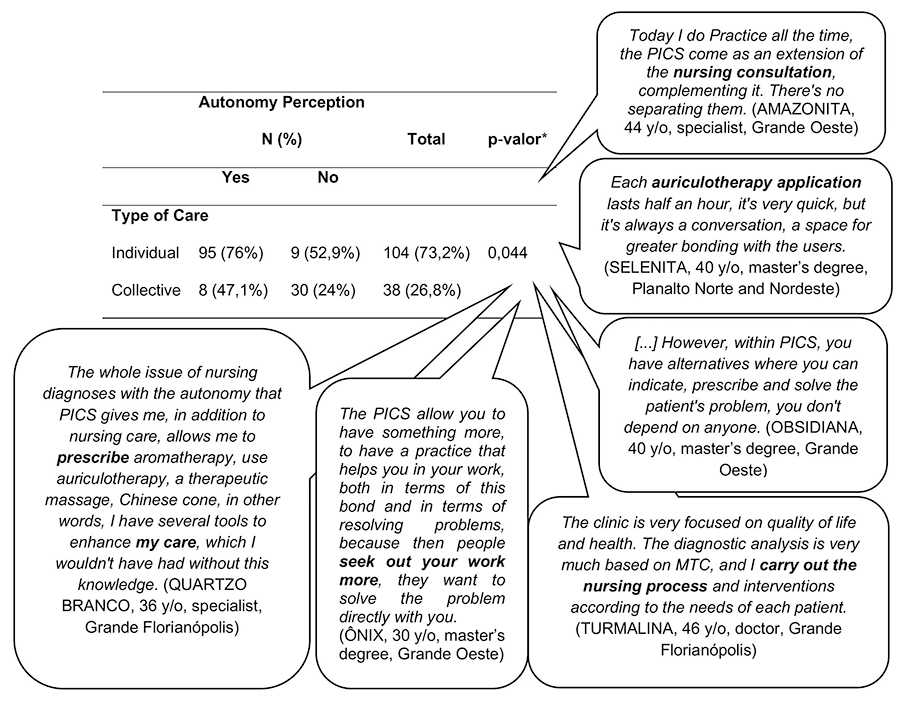
In these respects, individual care was statistically significant in the perception of greater autonomy in the nurse's work when compared to collective care (X²=4.06; p<0.004), highlighting the nursing consultation in the various contexts, in addition to the other knowledge of the profession. Also noteworthy is the care provided by nurses in nursing offices, demonstrating the inclusion of nursing in this area of activity.
Figure 1, structured as a talking table10, shows the integration of the results and illustrates the types of care and the autonomy perceived in professional practice.

The professional profile of nurses reveals a reality in which just over half use PICS in their work routine. There is a strong presence of PICS in PHC, in individual care. In addition, the testimonies show dissatisfaction with the way in which PICS are included in their professional practice, much more focused on movement and individual effort than with the support of management and staff. There are successful experiences in their day-to-day work, but few mention well-established and strengthened policies.
In relation to autonomy as a nurse, the participants answered the questionnaire about whether the use of PICS resulted in greater autonomy. In the interview, the narratives demonstrate the perception of this statement, which is a point of convergence, as can be seen in Chart 2.
In relation to the use of PICS as a possibility for autonomy, the nurses refer in their statements to the knowledge of nursing combined with PICS as something positive, given the vast generalist training of the profession, which can be seen in the narratives: I have more autonomy as a nurse due to my experience with PICS (AMETISTA, 42 y/o, specialist, Sul).
Another aspect to be highlighted is the holism that PICS carries with it. Even if they don't use PICS in their care, integrative practice nurses develop a different perception of health care: The knowledge that develops from this training in PICS does allow you to have more autonomy, to be more confident in relation to health care. Precisely because it emphasizes and prepares you for this holistic, more integral view of the person. The way I started to look at people's processes of getting sick and being healthy based on what I learned in Traditional Chinese Medicine continues to influence my decisions and choices, regardless of whether I use therapeutic techniques from the area (LÁPIS-LAZÚLI, 66 y/o, PhD, Grande Florianópolis). I think the introduction of PICS has improved my work and given me more autonomy, especially in terms of seeing the patient as a whole (QUARTZO ROSA, 33 y/o, specialist, Grande Oeste). Even in the way the nursing process is carried out, the nurses end up perceiving greater resolutiveness when using PICS: PICS imply my autonomy as a professional who has PICS training to be recommending and applying them to users who I think need them, without depending on referrals from other professionals (SODALITA, 45 y/o, specialist, Grande Oeste). Patients begin to value your work much more when you talk to them more, when you try to find an alternative, when you try to really solve their problem, not just medicalize and send them away. But it's a process and you have to break down a lot of barriers to make it work (PIRITA, 35 y/o, master's degree, Sul).
When considering the nursing protocols, it's clear that some aspects need to be improved: [...] I use herbal medicine more in women's health, because it's in the nursing protocol (ESMERALDA, 32 y/o, specialist, Grande Florianópolis). I have autonomy to conduct that case, the care of that person, so the PICS give me total autonomy in care. Precisely because they are multidisciplinary, I am able to expand my workforce for this care. With PICS I'm not so tied down, because the protocols are very good, they help, they favor, but they tie you down at the same time, because I can prescribe paracetamol for a pregnant woman, but I can't prescribe paracetamol in another situation. So, these are things that tie us down and PICS don't, they allow me to create much more, and this gives me autonomy (OLHO DE TIGRE, 39 y/o, teacher, Vale do Itajaí).
Among the aspects that hinder autonomy, legal issues were mentioned, focused on legal support, which needs to advance: The issue of prescription strengthens, qualifies the nurse's consultation and our place in the world. I think a lot of nurses want to do this and don't because they're afraid, because legally we still have some issues to resolve (AMAZONITA, 44 y/o, specialist, Grande Oeste). At the health department we had health protocols where we could prescribe medication, but in private practice COREN doesn't allow this (OBSIDIANA, 40 y/o, master's degree, Grande Oeste). But there are some things I know how to do, I'm trained, but I don't have the autonomy as a nurse to do them because of the lack of recognition and support from the Council. There's also the lack of recognition and discrimination against PICS from some colleagues, whether in our profession or not. There's also the issue of the population itself not knowing who a nurse is. What they really do and what they can do. But that comes from a visibility that we ourselves don't give to our profession (PEDRA DA LUA, 36 y/o, specialist, Planalto Norte and Nordeste). Professional recognition and the visibility of nurses' work are elements that need to be strengthened for greater autonomy.
DISCUSSION
Although the majority of nurses mention working with PICS in their work routines, a significant number of professionals do not use them. It is therefore necessary to raise the issue that nurses' professional practice of PICS is far from depending solely on their interest or understanding of their contribution to care. The reasons given in this study for not using PICS in their daily work are in line with research carried out with participants in the auriculotherapy course developed by the Federal University of Santa Catarina in 2016 and 2017. These reasons were: insecurity to practice, lack of time, management support and supplies11, thus highlighting the need for greater investment in the area, so “training must be accompanied by favorable conditions for the development of practice”12:405.
On January 22, 2019, Law No. 17,706 was sanctioned, which deals with PICS in the SUS of Santa Catarina, which must be implemented in accordance with the PNPIC, in addition to contributing to the resolutiveness of the public health network13. Partial data from the latest PICS monitoring report in Brazil in 2019 shows that 245 municipalities in Santa Catarina offer PICS, considering that this number may be underreported, given the need for the establishment to be registered with code 134 (specialized PICS service) for accounting14. It should also be pointed out that by registering a PICS once, the municipality will appear as a provider in government statistics, but this is not always the case.
As observed in the testimonies, the offer of PICS comes from individual initiatives that are extinguished by adversity. Despite this, it is clear that PICS are at an advanced stage of implementation in PHC in the Santa Catarina state, which is reflected in the findings of this study. However, it is believed that there is a strong individual effort on the part of PHC professionals, with courses and materials often being self-financed, and starting with little support. The results show that among the places where PICS are used, PHC predominates to the detriment of other spaces. Research into the situation of PICS in Brazil shows that almost 80% of them take place in PHC15,16. The adversities observed follow a pattern with this research.
The PNPIC, in the managers' view, is the guarantee of the user's choice of treatment and ensures access to the SUS, as a principle of universal health care17. However, it is known that not all managers have such a vision. A study shows that although managers/coordinators understand the context in which PICS are inserted, they have difficulties and insecurity in conceptualizing them18. This aspect is also evident in the testimonies of this study. By including marginalized care practices in the SUS, it is necessary to consider and reflect on the impact that the PNPIC has had by interfering in the market for products and services of biomedical rationality19-20. By reflecting on this, it is possible to understand the nurses when they emphasize the challenge of PICS being accepted by managers, professionals and users/patients.
Research shows that the majority of professionals practicing PICS are conventional PHC professionals who have had previous training or have been trained on the job, so access to PICS is restricted to the place where these professionals work15. “The presence of PICS in health services represents an advance in care, due to its approach centered on the health of subjects, communities and the environment, its significant contribution to the unification of care/healing with health promotion and disease prevention, supported self-knowledge and self-care, to name a few of its main potentials. But these contributions will only be effective if professional training in PICS complies with strict quality and safety criteria”21:2.
As seen in this research's narratives, the majority of professionals are part of PHC and offer PICS in a complementary way, some with greater support or success than others, due to factors inherent to the characteristics of the population, management and colleagues. It is important to point out that, although PICS are a potential and are aligned with the logic of PHC, they can be inserted “[...] in specialized teams and services that matrix PHC, contributing to its permanent education (as well as in hospital spaces, not discussed here)”15:183.
A survey of nurses working in public hospitals in the city of Rio de Janeiro, evaluating the use of PICS in this context, points out that they have little space22, because the hospital environment is still centered on the biomedical model23 “[...] it is not a question of praising one therapeutic proposal to the detriment of others, because the systemic thinking that underpins PICS presupposes openness to dialogue between different conceptions, practices and knowledge. But what strikes us as incoherent and deserves attention so as not to reproduce this attitude, is when a professional commits to an integrative intervention and backs up their practice with a reductionist model. After all, what we must provide to the user as an ethical imperative is the quality of the care we provide. Whether, based on an integrative or Cartesian model, we are coherent and consistent in our choices and options, also paying attention to those expressed by the subjects to whom we dedicate our care”22:845.
PICS are part of a different paradigm from the biomedical one and are considered to belong to an integrative paradigm24. Authors point out that PICS are very close to PHC15. In this sense, a study points out that “[...] preparing professional nurses to situate themselves between the two models of health care is fundamental so that PICS are not confused as yet another therapeutic tool applied from the conventional biomedical perspective, ‘allopatizing’ PIC [complementary integrative practice] and weakening its therapeutic dimensions”25:41. In relation to the nurses' work, the changes that have been taking place due to the strengthening of the nursing consultation, regulated by the Nursing Practice Law No. 7,498, of June 25, 198626 and by the regulation of nursing offices and clinics recently, in 2018, by COFEN Resolution No. 56827, amended by COFEN Resolution No. 606/201928 are notorious. It should be noted that from 2021, when the survey results were collected, until 2024, we had COFEN Resolution No. 739 of February 5, which establishes and coordinates nursing offices and clinics with a focus on PICS, following current legislation3.
In the meantime, a recent study analyzed the use of the nursing process in the acupuncture practice from 1997 to 2015. This study points to the strengthening of care in treatment and rehabilitation, based on the nursing consultation, when acupuncture is implemented29, marking the advances that Brazilian nursing has made in terms of its autonomy and empowerment in the use of acupuncture in the nursing consultation, which can serve as a basis for the other PICS regulated in the profession's work.
In this context, it is reaffirmed that the perception of autonomy is associated with the finding of resolutiveness, contributing to professional practice with freedom and the possibility of making decisions in the presence of health problems reported by users30.
Despite the statistical significance of the quantitative sample and the guarantee of interviews with nurses from the seven health macro-regions of Santa Catarina, this study's main limitation was the number of nurses interviewed. This was due to the fact that they were concentrated in the Grande Oeste and Grande Florianópolis, due to the bias of researchers being more concentrated in these places.
The research maps the incorporation of PICS in the work process of nurses in Santa Catarina, as well as the reference to the professionals' perception of autonomy, making up the scientific evidence as an unprecedented profile in the state and strengthening the role of nurses in its application. Also, reiterating its position as a forerunner in PICS, nursing stands out for its generalist training which is close to the precepts of integrative care. It is recommended that further studies be carried out to improve training in PICS in Brazilian nursing.
CONCLUSION
PICS are inserted into the daily work of nurses in SC in a more expressive way in the context of PHC, through individual care. PHC nurses are the largest group in the category in terms of the use of PICS; this context was significantly associated with a greater autonomy perception; however, the narratives differ on some aspects that weaken this perception, such as the bureaucratic demands assumed by nurses and the lack of public policies. In the majority of the narratives, nurses perceive greater autonomy when incorporating PICS into nursing consultations, promoting greater resolution, which is in line with the statistical finding.
The participants in this study said that regulations and standards for professional practice in PICS, as well as clinical care protocols, could provide greater support for the Practices.
The professional autonomy conferred by the use of PICS appears in this study as a counterpoint to the hegemony of medicalization.
ACKNOWLEDGMENT
We would like to thank the PIBIC EM scholarship holders, Giovana Soares de Moraes and Luiz Eduardo Santos Junges, and all the research volunteers for their valuable contributions that made the research possible. We would also like to thank all the ENFPICS researchers.
REFERENCES
-
1. Mildemberg R, Paes MR, Santos BA, Dalmolin IS, Brusamarello T. Práticas integrativas e complementares na atenção primária. Esc Anna Nery [Internet]. 2023 [cited 2024 Aug 29];27:e20220074. Available from: https://doi.org/10.1590/2177-9465-EAN-2022-0074pt.
» https://doi.org/10.1590/2177-9465-EAN-2022-0074pt. -
2. Conselho Federal de Enfermagem. Decisão COFEN nº 114/2019: Autoriza o registro da Associação Brasileira de Enfermeiros Acupunturistas e Enfermeiros de Práticas Integrativas - ABENAH no Conselho Federal de Enfermagem para fins de reconhecimento de títulos de especialização na área de Práticas Integrativas e Complementares [Internet]. 2019 [cited 2023 Dec 14]. Available from: https://www.cofen.gov.br/decisao-cofen-no-114-2019/
» https://www.cofen.gov.br/decisao-cofen-no-114-2019/ -
3. Conselho Federal de Enfermagem. Resolução COFEN nº 739 de 05 de fevereiro de 2024: Normatiza a atuação da Enfermagem nas Práticas Integrativas e Complementares em Saúde [Internet]. 2024 [cited 2024 Mar 10]. Available from: https://www.cofen.gov.br/resolucao-cofen-no-739-de-05-de-fevereiro-de-2024/
» https://www.cofen.gov.br/resolucao-cofen-no-739-de-05-de-fevereiro-de-2024/ -
4. Freitas JR, Silva AJ, Silva JAA, Ramos JRB, Silva FMV. The importance of nurses in integrative and complementary practices in the unique health system. Saúde coletiva [Internet]. 2021 [cited 2024 Feb 18];11(63):5376-89. Available from: https://doi.org/10.36489/saudecoletiva.2021v11i63p5376-5389
» https://doi.org/10.36489/saudecoletiva.2021v11i63p5376-5389 -
5. Azevedo C, Moura CC, Corrêa HP, Mata LRF, Chaves ÉCL, Chianca TCM. Complementary and integrative therapies in the scope of nursing: Legal aspects and academic-assistance panorama. Esc Anna Nery [Internet]. 2019 [cited 2024 Feb 18];23(2):e20180389. Available from: https://doi.org/10.1590/2177-9465-EAN-2018-0389
» https://doi.org/10.1590/2177-9465-EAN-2018-0389 -
6. Ávila MES. Utilização de Práticas Integrativas e Complementares (PIC) por enfermeiros nos Centros de Saúde de Florianópolis [dissertation]. Florianópolis, SC(BR): Universidade Federal de Santa Catarina; 2022 [cited 2022 Feb 28]. Available from: https://repositorio.ufsc.br/bitstream/handle/123456789/242884/TCC.pdf?sequence=1&isAllowed=y
» https://repositorio.ufsc.br/bitstream/handle/123456789/242884/TCC.pdf?sequence=1&isAllowed=y - 7. Creswell JW, Clark VLP. Pesquisa de métodos mistos. 2nd ed. Porto Alegre, RS(BR): Penso; 2013. 288 p.
-
8. Conselho Federal de Enfermagem. Enfermagem em Números [Internet]. Brasília: Conselho Federal de Enfermagem; 2020 [cited 2021 Apr 05]. Available from: https://www.cofen.gov.br/enfermagem-em-numeros
» https://www.cofen.gov.br/enfermagem-em-numeros -
9. Campos RO. Talk to them! The interpretative work and the production of consensus in qualitative health research: Innovations from participatory design. Physis [Internet]. 2011 [cited 2024 Feb 16];21(4):1269-86. Available from: https://doi.org/10.1590/S0103-73312011000400006
» https://doi.org/10.1590/S0103-73312011000400006 -
10. Jantsch LB, Neves ET. “Tabela falante” como estratégia de integração de dados em uma pesquisa de métodos mistos. Esc Anna Nery [Internet]. 2023 [cited 2024 Aug 24];27:e20220029. Available from: https://doi.org/10.1590/2177-9465-EAN-2022-0029pt.
» https://doi.org/10.1590/2177-9465-EAN-2022-0029pt. -
11. Tesser CD, Santos MC, Silva EDC, Moré AOO, Pelachini FFT, Botelho LJ. Capacitação em auriculoterapia para profissionais do SUS de 2016-2017. REVISE [Internet]. 2020 [cited 2022 Mar 4];5:1-18. Available from: http://dx.doi.org/10.46635/revise.v5ifluxocontinuo.1769
» http://dx.doi.org/10.46635/revise.v5ifluxocontinuo.1769 -
12. Silva PHB, Barros LCN, Barros NF, Teixeira RAG, Oliveira ESF. Formação profissional em Práticas Integrativas e Complementares: o sentido atribuído por trabalhadores da Atenção Primária à Saúde. Ciênc Saúde Coletiva [Internet]. 2021 [cited 2024 Aug 29];26(2):399-408. Available from: https://doi.org/10.1590/1413-81232021262.40732020.
» https://doi.org/10.1590/1413-81232021262.40732020. -
13. Governo do Estado de Santa Catarina. Lei nº 17.706 de 22 de janeiro de 2019. Dispõe sobre as Práticas Integrativas e Complementares (PICs) no âmbito do Sistema Único de Saúde (SUS), no Estado de Santa Catarina [Internet]. 2019 [cited 2024 Aug 29]. Available from: https://leis.alesc.sc.gov.br/html/2019/17706_2019_lei.html
» https://leis.alesc.sc.gov.br/html/2019/17706_2019_lei.html -
14. Brasil. Ministério da Saúde. Relatório de Monitoramento Nacional das Práticas Integrativas e Complementares em Saúde nos Sistemas de Informação em Saúde [Internet]. Brasília, Ministério da Saúde, 2020 [cited 2022 Feb 21]. Available from: https://189.28.128.100/dab/docs/portaldab/documentos/pics/Relatorio_Monitoramento_das_PICS_no_Brasil_julho_2020_v1_0.pdf.
» https://189.28.128.100/dab/docs/portaldab/documentos/pics/Relatorio_Monitoramento_das_PICS_no_Brasil_julho_2020_v1_0.pdf. -
15. Tesser CD, Sousa IMC, Nascimento MC. Traditional and Complementary Medicine in Primary Health Care in Brazil. Saúde Debate [Internet]. 2018 [cited 2022 Mar 07];41(1):174-188. Available from: https://doi.org/10.1590/0103-11042018S112
» https://doi.org/10.1590/0103-11042018S112 -
16. Habimorad PHL, Catarucci FM, Bruno VHT, Silva IB, Fernandes VC, Demarzo MMP, et al. Potencialidades e fragilidades de implantação da Política Nacional de Práticas Integrativas e Complementares. Ciênc Saúde Coletiva [Internet]. 2020 [cited 2024 Apr 04];25(2):395-405. Available from: https://doi.org/10.1590/1413-81232020252.11332018
» https://doi.org/10.1590/1413-81232020252.11332018 -
17. Santos LSF, Medeiros WRC, Shiraishi R, Azevedo SF. As práticas integrativas e complementares em saúde na atenção primária a saúde: uma revisão integrativa. Rev Eletr Acervo Saúde [Internet]. 2023 [cited 2024 Apr 04];23:1. Available from: https://doi.org/10.25248/REAS.e11393.2023
» https://doi.org/10.25248/REAS.e11393.2023 -
18. Barros LCN, Oliveira ESF, Hallais JAS, Teixeira RAG, Barros NF. Práticas Integrativas e Complementares na Atenção Primária à Saúde: Percepções dos Gestores dos Serviços. Esc Anna Nery [Internet]. 2020 [cited 2024 Aug 29];24(2):e20190081. Available from: https://doi.org/10.1590/2177-9465-EAN-2019-0081
» https://doi.org/10.1590/2177-9465-EAN-2019-0081 -
19. Silva PHB, Oliveira ESF. Práticas integrativas e complementares na Atenção Primária à Saúde: percepções dos profissionais sobre a oferta dos serviços na região metropolitana de Goiânia. Physis [Internet]. 2023 [cited 2024 Aug 24];33:e33027. Available from: https://doi.org/10.1590/S0103-7331202333027
» https://doi.org/10.1590/S0103-7331202333027 -
20. Queiroz NA, Barbosa FES, Duarte WBA. Uso das Práticas Integrativas e Complementares em Saúde por profissionais dos Núcleos Ampliados de Saúde da Família e Atenção Básica. Physis [Internet]. 2023 [cited 2024 Apr 04];3:e33037. Available from: https://doi.org/10.1590/S0103-7331202333037
» https://doi.org/10.1590/S0103-7331202333037 -
21. Associação Brasileira de Saúde Coletiva. Nota técnica sobre formação em RM-PICS [Internet]. 2020 [cited 2021 Feb 17]. Available from: https://abrasco.org.br/nota-tecnica-sobre-formacao-em-rm-pics/
» https://abrasco.org.br/nota-tecnica-sobre-formacao-em-rm-pics/ -
22. Melo SCC, Santana RG, Santos DC, Alvim NAT. Complementary health practices and challenges of its applicability in hospital: Nurses’ point of view. Rev Bras Enferm [Internet]. 2013 [cited 2022 Feb 21];66(6):840-6. Available from: https://doi.org/10.1590/s0034-71672013000600005
» https://doi.org/10.1590/s0034-71672013000600005 -
23. Silva IG, Pereira EL, Silva CF, Brito KMS. Espaço multipics: a utilização das práticas integrativas e complementares como estratégia de cuidado na atenção à saúde do trabalhador. Rev Ciênc Plural [Internet]. 2022 [cited 2024 Aug 29];8:e25653. Available from: https://doi.org/10.21680/2446-7286.2022v8n1ID25653
» https://doi.org/10.21680/2446-7286.2022v8n1ID25653 -
24. Glass L, Lima NW, Nascimento MM. Práticas integrativas e complementares: o que diz a literatura da área em educação em ciências sobre essa questão sociocientífica? Alexandria: Rev Educ Ciênc Tecnol [Internet]. 2021 [cited 2022 Feb 28];14:1. Available from: https://doi.org/10.5007/1982-5153.2021.e72024
» https://doi.org/10.5007/1982-5153.2021.e72024 -
25. Novaes AM. Publicações sobre a atuação da(o) enfermeira(o) em consulta com práticas integrativas, destacando o Ayurveda [dissertation]. Florianópolis, SC(BR): Universidade Federal de Santa Catarina ; 2019 [cited 2022 Feb 28]. Available from: https://repositorio.ufsc.br/handle/123456789/202354
» https://repositorio.ufsc.br/handle/123456789/202354 -
26. Brasil. Lei n 7.498, de 25 de junho de 1986: Dispõe sobre a regulamentação do exercício da enfermagem, e dá outras providências [Internet]. Diário Oficial da República Federativa do Brasil [Internet]. 1986 [cited 2022 Feb 28]. Available from: https://www.planalto.gov.br/ccivil_03/leis/l7498.htm.
» https://www.planalto.gov.br/ccivil_03/leis/l7498.htm. -
27. Conselho Federal de Enfermagem. Resolução COFEN n° 568/2018: alterada pela resolução COFEN n° 606/2019. Aprova o Regulamento dos Consultórios de Enfermagem e Clínicas de Enfermagem [Internet]. 2018 [cited 2024 Aug 29]. Available from: https://www.cofen.gov.br/resolucao-cofen-no-0568-2018/
» https://www.cofen.gov.br/resolucao-cofen-no-0568-2018/ -
28. Conselho Federal de Enfermagem. Resolução COFEN n° 606/2019: Inclui na resolução n° 568, de 9 de fevereiro de 2018, Anexos contendo modelo de requerimento de cadastro de consultório e de clínicas de Enfermagem e modelo de registro de consultório e clínicas de enfermagem, no âmbito dos Conselhos Regionais de Enfermagem [Internet]. 2019 [cited 2024 Aug 29]. Available from: https://www.cofen.gov.br/resolucao-cofen-no-606-2019/
» https://www.cofen.gov.br/resolucao-cofen-no-606-2019/ -
29. Bousfield APS, Padilha MI, Bellaguarda MLR, Costa R. Processo de Enfermagem como potencializador da prática da acupuntura. Esc Anna Nery [Internet]. 2021 [cited 2024 Feb 15];25(4):e20200148. Available from: https://doi.org/10.1590/2177-9465-EAN-2020-0148
» https://doi.org/10.1590/2177-9465-EAN-2020-0148 -
30. Sousa MF. Práticas de Enfermagem no Contexto da Atenção Primária à Saúde (APS): Estudo Nacional de Métodos Mistos (Relatorio final). Núcleo de Estudos em Saúde Pública, Centro de Estudos Avançados Multidisciplinares (CEAM), Universidade de Brasília (UnB), Conselho Federal de Enfermagem (COFEN) [Internet]. Brasília: Editora ECoS; 2022 [cited 2024 Aug 29]. Available from: https://www.cofen.gov.br/wp-content/uploads/2022/06/Relatorio-Final-Web-1.pdf.
» https://www.cofen.gov.br/wp-content/uploads/2022/06/Relatorio-Final-Web-1.pdf.
NOTES
-
ORIGIN OF THE ARTICLE
Taken from the multicenter research entitled - Estudo brasileiro: inquérito nacional sobre o perfil educacional e profissional de enfermeiros(as) de saúde integrativa e práticas tradicionais- ENFPICS, which involved the participation of the Universidade Federal do Rio Grande do Sul (proponente), Universidade Federal de Santa Maria, Universidade Federal do Rio Grande, Universidade Federal de Sergipe, Universidade Federal de Catalão, Universidade Federal do Acre, Universidade Federal do Espírito Santo, Universidade Federal de Goiás, Universidade Estadual de Campinas, Instituto Aggeu Magalhães- Fiocruz PE and Grupo Hospitalar Conceição, developed from 2021 to the present.
-
FUNDING INFORMATION
Financial support from the Conselho Nacional de Desenvolvimento Científico e Tecnológico (CNPq), call CNPq/MCTI/FNDCT No. 18/2021 - Track A - Emerging Groups, process number 404534/2021-0, Brazil. Support from the Coordenação de Aperfeiçoamento de Pessoal de Nível Superior (CAPES) - Funding Code 001, Brazil.
-
APPROVAL OF ETHICS COMMITTEE IN RESEARCH
Approved by the Ethics Committee in Research of the Universidade Federal do Rio Grande do Sul, opinion n.º 4.618.324/2021, Certificate of Presentation for Ethical Appraisal 43306921.6.0000.5347.
-
TRANSLATED BY
Agência Latintrad - Leonardo Parachú.