
 The Social Construction of Biomedical Prevention of HIV
Abstract
This article analyzes the ways in which biomedical HIV prevention strategies have been socially constructed in the production of scientific knowledge, in debates on HIV policies, and in the design and implementation of public health programs. It examines different perspectives, shifts in public health research and practice related to HIV prevention, how these shifts are historically shaped, and the complex and often contradictory political and economic interests they articulate. It places both the invention of new technologies (rapid testing and the use of Pre-Exposure and Post-Exposure Prophylaxis to HIV) and the rediscovery of old technologies (Voluntary Medical Male Circumcision and condoms) within the framework of the history of responses to the pandemic. It further explores the ways in which the will to know and the will to power intertwine in the seemingly necessary fictions that have been produced in and through the HIV response (and global health more broadly). The analysis highlights how such narratives illuminate the workings of the global health industry, the unresolved contradictions in global health governance, and its complicated engagement with contemporary sexuality politics.
Keywords:
HIV; AIDS; Biomedicalization; Prevention; Technologies.
Resumo
O artigo analisa as maneiras pelas quais as estratégias biomédicas de prevenção do HIV têm sido socialmente construídas na produção do conhecimento científico, nos debates sobre as políticas de HIV e no desenho e implementação de programas de saúde pública. Examina as mudanças de diferentes perspectivas nas pesquisas e na prática de saúde pública relacionadas à prevenção do HIV, como essas mudanças são historicamente moldadas e os interesses políticos e econômicos complexos e muitas vezes contraditórios que elas articulam. Situa tanto a invenção de novas tecnologias (testagem rápida e o uso das Profilaxias Pré-Exposição e Pós-Exposição ao HIV) quanto a redescoberta de tecnologias antigas (Circuncisão Masculina Médica Voluntária e o preservativo) no marco da história das respostas à pandemia. Ademais, explora os modos pelos quais a vontade de saber e a vontade de poder se entrelaçam nas ficções aparentemente necessárias que têm sido produzidas na e através da resposta ao HIV (e da saúde global de forma mais ampla). A análise destaca como tais narrativas iluminam o funcionamento da indústria global da saúde, as contradições não resolvidas na governança global da saúde e seu complicado engajamento com as políticas contemporâneas da sexualidade.
Palavras-chave:
HIV; AIDS; Biomedicalização; Prevenção; Tecnologias.
Introduction
This article aims to examine the genealogy of HIV prevention strategies over nearly five decades of the global response to the AIDS pandemic, with special attention to the biomedical approaches that dominated the pandemic response during the late 2000s and throughout the 2010s. It intends to analyze the social construction of “biomedical prevention” as a process of “assemblage”: a relational construction composed of heterogeneous and emergent components, organized together for certain strategic purposes, made in a particular space and time (Savage, 2022). Finally, it tries to investigate how this process was built from the results of clinical and behavioral research on various techniques and technologies, new and old, to develop innovations in preventive approaches, highlighting the economic, political and social interests that were articulated in the construction of this new approach to prevention.
It is important to highlight, from the outset, that the genealogical approach that we are going to use in this text is positioned within a perspective that is usually described as a “history of the present” (Foucault, 1977; Garland, 2014; Knauft, 2017). Very much inspired by the work of Michel Foucault and other similar thinkers, this approach, as it has been developed in anthropology and sociology, seeks to identify a current problem (in our case, “biomedical prevention,” a category considered almost hegemonic in HIV prevention today) and seeks to problematize it, critically examining it in order to better understand what constitutes it, how it was developed in practice and what the consequences of this are. It is a perspective that seeks to link the present to the past not as its inevitable outcome, but as the product of contingent changes in power relations and in the ideas through which such relations are conceived (The Editors, 2011). Perhaps most important for this text is that this is a mode of inquiry that seeks to question the social processes that make the categories of contemporary debate seem inevitable, natural, or culturally necessary (Garland, 2014; Marinković; Major, 2020; The Editors, 2011).
In this sense, throughout the text, we have tried to understand the biomedical prevention of HIV transmission not as it is normally understood by biomedicine - as a “solution” - but, on the contrary, as a contemporary problem. We analyze how this approach to HIV prevention has been constructed and articulated by experts, especially biomedical and behavioral scientists, but also managers of public health systems (perhaps most important and problematic) and representatives of the international pharmaceutical industry. We examine how this expert-led approach has gradually replaced other strategies and perspectives on HIV prevention - especially those approaches that had emerged earlier in the history of the pandemic in the very communities and populations most affected by HIV and AIDS - as supposedly the most effective way to prevent infection and illness. Our goal is to examine the genealogy of this process, what it is made up of, and how and why it sometimes disempowers the very people it is supposed to help. Along this path, we have tried to critically analyze the ways in which the category of biomedical prevention is intertwined not only with the political economy of contemporary globalized capitalism (Corrêa, Petchesky; Parker, 2008), but also with biopower in the classic Foucaultian sense of a way of governing bodies and populations (Foucault, 1976), as well as Mbembe’s necropolitics (2016) in which social and political power is capable of determining who can live and who needs to die in contemporary societies.
Change of strategy in HIV prevention
As a starting point for understanding the meaning of the concept of biomedical prevention that dominates the field of HIV prevention at present, it would be important to recognize how different it is from other prevention approaches that preceded it - as well as the history of omissions that characterized early responses to the pandemic. The first cases of AIDS mainly affected members of communities and population groups that were highly marginalized during the early years of the pandemic crisis, in addition to stigma and discrimination against those perceived to be at risk of infection. This meant that almost no formal programs were developed for HIV prevention, with the most affected communities having to fend for themselves against the virus. They did this with great creativity and persistence in the early to mid-1980s, inventing approaches such as “safe sex” and “harm reduction” as community-based HIV prevention strategies - approaches that remain today, almost 50 years later, as among the most effective in response to the pandemic that have ever been developed (despite their relatively limited professionalization) (Calazans; Parker; Terto Júnior, 2022).
It was only after this community-based response emerged that governments and public health systems finally, belatedly, began to act, especially in the mid-1980s. Over the next two decades, from the late 1980s through the 1990s and early 2000s, a number of new approaches were used to prevent HIV infection. At least three different perspectives dominated the field of prevention throughout this period and sought to take advantage of the lessons of community prevention, but at the same time to better systematize their methodologies (Parker, 2000, 2001). The first approach, present since the mid-1980s, focused on the “behaviors that created the risk of infection,” such as the ways in which public health could intervene to change risk behaviors of individuals and groups. Based primarily on theoretical models of social psychology, this approach sought to develop changes in individual behavior that would result in a measurable reduction in viral infection rates at the population level - especially by what were perceived as “risk groups” (Parker, 2000, 2001).
In the late 1980s, a second important approach to HIV prevention began to emerge that placed greater emphasis on “social and cultural contexts and meanings” (Parker, 2000, 2001). This approach underscored the importance of paying attention to the details of sexual and drug-use cultures, focusing on the importance of social and community identities in shaping sexual practices and drug use (Aggleton, 1996; Connell et al., 1993). It highlighted the importance of community-based prevention programs - developed not only for, but especially by affected communities. It placed special emphasis on the process of transforming community norms and values not in response to the instructions of external experts, but as part of an internal process of reflection and community mobilization in order to promote safer practices (Connell et al., 1993; Dowsett, 1993; Parker, 2000, 2001).
In the mid-1990s, behavioral and cultural approaches began to be questioned for not addressing what began to be described as “structural and environmental factors” (Sweat; Dennison, 1995). This new focus was more strongly based on political science and economics, highlighting the importance of social vulnerability (Mann; Tarantola; Netter, 1993) and structural violence (Farmer; Connors; Simmons, 1996; Parker, 2000). The role of issues such as economic development, work, housing, migration, and population movement, as well as structural and social inequalities, such as poverty, gender power inequality, racism and ethnic discrimination, stigma, and sexual oppression, as key determinants of risk and vulnerability (Parker; Camargo, 2000; Parker; Easton; Klein, 2000).
However, perhaps precisely because of the emphasis on scale-up that seemed to almost explode around the world after the United Nations General Assembly Special Session (UNGASS) on HIV/AIDS in June 2001, the focus on structural approaches to HIV prevention would be relatively short-lived. Indeed, HIV prevention of any kind would temporarily take a back seat to the urgent challenge of scaling up the global response to the pandemic by expanding access to treatment, despite the high cost of existing antiretroviral therapies - a cost that had made access to treatment out of reach for the vast majority of lowand even middle-income countries. Expanding access to treatment would be the dominant focus of the next five years of the global AIDS response. This was the main justification for the creation of a series of new and important Global Health Initiatives (GHIs), such as the Global Fund for AIDS, Tuberculosis and Malaria (Global Fund), whose creation was announced at the close of UNGASS and which began operating in 2002. The following year, 2003, the U.S. President’s Emergency Plan for AIDS Relief (PEPFAR) was founded, the largest HIV initiative ever created (Parker, 2024). Together with the World Bank’s existing Multi-country HIV and AIDS Program (MAP) and newly initiated private philanthropic initiatives focused on HIV treatment by agencies such as the Bill & Melinda Gates Foundation (BMGF) and the Clinton Foundation’s Health Access Initiative, these new GHIs focused on access to treatment tended to eclipse prevention as a major concern in the early to mid-2000s. This also created a significant mobilization of key sectors, such as the biomedical scientific research community, public health administrators and agencies, and perhaps most of all, the global pharmaceutical industry, as partners (stakeholders) in the expanding companies/ventures.
But this context focused on expanding access to treatment was also important to stimulate a renewed concern with innovation in relation to prevention. Throughout the 1990s, one of the most significant tensions in global AIDS policy debates focused on “prevention versus treatment” precisely because key institutional actors (including the WHO, but especially development agencies such as the World Bank and the U.S. Agency for International Development - USAID) defended primary prevention as much more “cost-effective” when compared to the significant expenditure of providing treatment to all who needed it (Parker, 2000). The success of advocating for access to treatment in the late 1990s, advocating for access as a human rights and social justice issue, ultimately endorsed even by the World Bank and the international development establishment, did not mean that concern about cost-effectiveness had disappeared. In an “era of expanded access to treatment,” the emphasis on prevention as more cost-effective than treatment remained an important consideration. This was evident in 2002 with the creation of a new initiative by the BMGF in conjunction with the Kaiser Family Foundation, the Global HIV Prevention Working Group, which throughout the 2000s would issue a series of reports and develop a series of advocacy activities aimed at revitalizing the field of prevention in line with the new realities of the global response to the pandemic (Global HIV Prevention Working Group, 2002, 2004). Over the next decade, as part of an intense dialogue with other global actors (key agencies such as UNAIDS, the Global Fund, PEPFAR, etc., but also the international scientific community, the pharmaceutical industry, and even, occasionally, civil society, community-based organizations, and the global AIDS activist movement), new concepts such as “comprehensive prevention” (esp. PEPFAR) and “combination prevention” (esp. UNAIDS) would be gradually articulated and refined to try to rethink and reprioritize prevention not only in relation to HIV, but also in the field of global health in the twenty-first century.
Throughout the 2000s, with the expansion of access to treatment more consolidated, the concern with prevention issues began to return to the discussion and debate and the new approach to “biomedical prevention” (in a very broad sense) began to dominate debates in the field. This biomedical emphasis in relation to prevention is perhaps not too surprising, as it is precisely the rallying point for the coalition of funders, biomedical scientists, public health and development administrators, and pharmaceutical industry representatives that have formed through the process of administering HIV treatment scale-up since the early 2000s. It was at this point of intersection that new ideas about biomedical prevention could develop. This came to the fore most clearly during the XVI International AIDS Conference in Toronto, where what was described as “euphoria over biomedical interventions to prevent HIV... initiated the 2006 International AIDS Conference” (Imrie et al., 2007, p. 10). But the actual content of this category of biomedical prevention, of how it would be conceptualized and how it would be implemented, was certainly not entirely clear - it was still being worked out, and this would continue to be the case for some time.
The following section of this article examines the process of inventing the biomedical prevention of HIV in greater detail. Although the focus is on the ways in which this process took shape internationally, it also examines the ways in which this global construction was adapted and incorporated in the response to AIDS specifically in Brazil. Because Brazil has been a leader in responding to HIV and AIDS, the interface between transnational and national articulation of this new approach to prevention offers important insights into both the players and the processes involved in constructing biomedical prevention both globally and locally.
Inventing biomedical prevention
Developing new technologies and products
Regarding the history of the HIV/AIDS pandemic, the focus here is on the evolution of biomedical responses. This begins with the emergence of the first HIV treatment, AZT (Zidovudine), in 1987, passing on to combination antiretroviral therapy (ART) in 1996. Over the last three decades, there has been the emergence of new technologies and HIV prevention products in the context of the biomedicalization of the pandemic, combined with old approaches. Among them, there are the internal condom (popularly called the female condom), microbicidal gels, Preand Post-Exposure Prophylaxis (PrEP and PEP), “Test and Treat” and Treatment as Prevention (TasP) as new technologies in the field of HIV. Among the old techniques and approaches are Voluntary Medical Male Circumcision (VMMC) and the external condom (male condom), which already existed and began to be used as a form of HIV prevention in the first decades of the pandemic, especially by the communities that were becoming infected with the virus1. It was only in the 2000s that these old technologies were included as part of the proposal for combination prevention2.
ART (a combination of several antiretrovirals - ARVs) brought the possibility of quality of life after HIV diagnosis for people infected with HIV and sick with AIDS, considered an advance in treatment and which underwent continuous progress in the following decades, such as, for example, the development of ARVs with reduced side effects and reduced number of doses, “surrounding” the virus to prevent its replication (resulting in the idea of PrEP). It was in the early 2000s that the notion of “combination prevention” began to be created, especially by the Global HIV Prevention Working
Group and the Joint United Nations Program on HIV/AIDS (UNAIDS), at first without much conceptual clarity, but which gained strength between 2007 and 2008 and was consolidated from publications from 2010 onwards (Hankins; De Zalduondo, 2010; Global HIV Prevention Working Group, 2002, 2004; UNAIDS, 2004, 2007a, 2007b, 2010, 2015).
The use of ARVs for HIV prevention began with PEP, which in 1998 began to be used for occupational exposure to the virus (especially for health workers) or even in cases of sexual violence from the 2000s onwards (Körner; Hendry; Kippax, 2005). In 2005, the WHO, together with the International Labor Organization, consulted experts in the area around occupational or non-occupational PEP, developing a document with protocols. However, PEP for consensual sexual relations was mentioned as being of international interest, but without the development of a specific protocol (WHO; ILO, 2007). In other countries, such as Australia and the United States, since the late 1990s and early 2000s, “sexual PEP” was already being used among men who have sex with men (MSM), in conjunction with other HIV prevention strategies, such as the use of condoms, knowledge of the partner’s serological status, and self-perception of risk behavior (Körner; Hendry; Kippax, 2005; Maksud; Fernandes; Filgueiras, 2015). In Brazil, the use of “sexual PEP” was implemented at the policy level in 2010 for people who had unprotected sexual intercourse, based on the principle of seeking it in health services of the Unified Health System (SUS) within 72 hours of possible exposure to HIV, with the use of ARVs for 28 consecutive days (Maksud; Fernandes; Filgueiras, 2015).
During the same period, there have also been studies around microbicidal gels, both vaginal and rectal, for HIV prevention. This idea emerged in the 1980s, based on concerns from researchers in the area about the effects of gender power inequalities, but since the 2000s there has been clinical research on the effectiveness of this technology for the prevention of the virus, especially if it was under the control of heterosexual cisgender women with difficulty negotiating the use of external condoms with their partners (an idea similar to that of spermicides). Despite the ease of adherence for those with partners with no expectation of fidelity and who achieved privacy at times when they were expecting to have sexual relations, some problems for its acceptability by men have been identified in clinical research (Greene et al., 2018). Those with steady partners had a decreased perception of risk, such as fear of disapproval of the partner, making it difficult for them to adhere and indicating dependence on contextual and related factors, influencing the use or not of microbicidal gels during sexual intercourse (Greene et al., 2018; Mweemba et al., 2017).
An analogous idea was thought of for the internal condom, created as a way to prevent HIV, other Sexually Transmitted Infections (STIs) and pregnancy in the 1990s (arriving in Brazil in 1997). In Brazil, there was a study on the implementation of the internal condom between 1998 and 1999 in partnership between the State University of Campinas (UNICAMP) and the Brazilian Center for Analysis and Planning (CEBRAP) in some Brazilian cities, with excellent receptivity (Berquó; Barbosa; Kalckman, 1999). Despite this and other studies, the internal condom only began to be distributed in the SUS in 2012, more than a decade after the first implementation study and as part of the “Plan for the Feminization of the HIV/AIDS Epidemic and other STDs”, in 2007, which defined this strategy as important to guarantee the health and expansion of the autonomy of sexuality and reproduction of Brazilian women (Barbosa; Robinson; Parker, 2011).
On the other hand, Treatment as Prevention (TasP), announced by the “Swiss Federal Commission for AIDS-Related Problems” in 2008, proven by the randomized clinical trial HPTN 052 in 2012, was implemented in Brazil based on the “Clinical protocol and therapeutic guidelines for the management of HIV infection in adults”, published by the government in 2013 and which recommended the immediate start of ART after HIV diagnosis, regardless of the clinical status of the person infected with the virus (Maksud; Fernandes; Filgueiras, 2015; Monteiro et al., 2019). We understand that the “Test and Treat” strategy, linked to TasP by some authors (Maksud; Fernandes; Filgueiras, 2015), is an approach promoted a little earlier by doctors and the SUS to encourage HIV testing, especially so that people infected with HIV can start ART as soon as possible (early intervention to improve clinical outcomes).
This conjuncture has meant that the advance of the biomedicalization of the HIV epidemic has brought the risk of medical prescription of technologies without bringing the HIV/AIDS social movement to the debate, co-opting part of the community structure for biomedical prevention. This was clearly seen in the expansion of rapid testing in Brazil, where non-governmental organizations (NGOs), whether AIDS or LGBTQIAPN+, became reference centers3 for people afraid to take the HIV test in health services (whether in Primary Care or in Anonymous Testing Centers - ATCs) or in private laboratories, such as in access to self-testing (oral fluid and digital pulse), among others (Monteiro et al., 2019). The arrival of rapid screening testing was of paramount importance for the implementation of new HIV prevention biotechnologies, such as TasP, “Test and Treat” and, later, oral PrEP (daily or on-demand), being incorporated into combination prevention approach in the SUS.
Finally, oral PrEP, with studies started in 2007 in the world (including Brazil), was a new bet for the biomedical prevention of HIV, with the use of ARVs for the most vulnerable populations and implemented in the SUS in late 2017 and early 2018, after long being promised by policymakers (Zucchi et al., 2018). The daily dose of Truvada® (tenofovir + emtricitabine) was initially recommended for gays/MSM, trans women/transvestites, sex workers and serodiscordant couples, with an expansion of its implementation since 2019. It was from Technical Note No. 8/2023 that on-demand PrEP was officially implemented in the country, used for people who have less than two sexual relations per week (Brasil, 2023).
PrEP is considered an important strategy for combination prevention, and it can give autonomy of choice to individuals vulnerable to HIV who have difficulty negotiating condoms, such as those who are in situations of violence or sex work (Zucchi et al., 2018; Castro et al., 2024), but we understand that access is given to people who are informed and have an understanding of prophylaxis. Injectable PrEP has been researched since 2016 as an alternative to the daily pill through the long-acting cabotegravir ARV (CAB-LA), but this technology is not yet available in the SUS. At the same time, in 2024, the pharmaceutical company Gilead revealed that the biannual injection of ARV lenacapavir proved 96% effective, but Brazil was excluded from voluntary license agreements because the country was considered “upper middle income.” Although PrEP is considered important for a possible “end to AIDS,4” there is inequality in access to prophylaxis in the world. Rich countries continue to fund clinical trials and hold patents on HIV prevention technologies, while lowand middle-income countries are left to receive clinical research, but they are left out of agreements to make such technologies cheaper and that would guarantee access (Bernays et al., 2021).
Rediscovering old technologies and techniques as new forms of biomedical prevention
The world has seen a revolution in the treatment and prevention of HIV using ARVs, but old techniques already known also began to be thought of to combat the infection of the virus and that we consider important in the history of prevention. An example is the external condom, used for the prevention of other STIs and to avoid pregnancy, it was the method recommended at the beginning of the HIV/AIDS pandemic at a time when the forms of infection of the virus were not fully understood and there were no drugs to treat people who had AIDS - and at the beginning of the pandemic it was promoted not by doctors or public health professionals, but by members of the then LGBT community at the time, primarily as part of community approaches to preventing HIV and promoting safer sex.
In the 2000s, some research was also carried out for the prevention of HIV without the use of ARVs, as in the case of VMMC. UNAIDS (2007a) had indicated in a publication that male circumcision would be the most effective evidence-based prevention strategy to avoid HIV infection since the discovery of AZT in vertical transmission, corroborated by the WHO in the same year. Despite its use in heterosexual men5 in sub-Saharan Africa (mainly in PEPFAR programs, due to its low cost in low-income countries with widespread epidemics), VMMC for HIV prevention in the UK and the US was recognized, but the rates of this type of procedure were lower. Although the notion of VMMC has been thought of as a possibility in relation to the HIV pandemic since 1986, it was only in the 2000s that several studies proved its efficacy and its positive results were published, but it was not as effective in many populations more vulnerable to HIV infection, especially when used to the detriment of behavioral, social, and cultural responses to HIV (Bell, 2015).
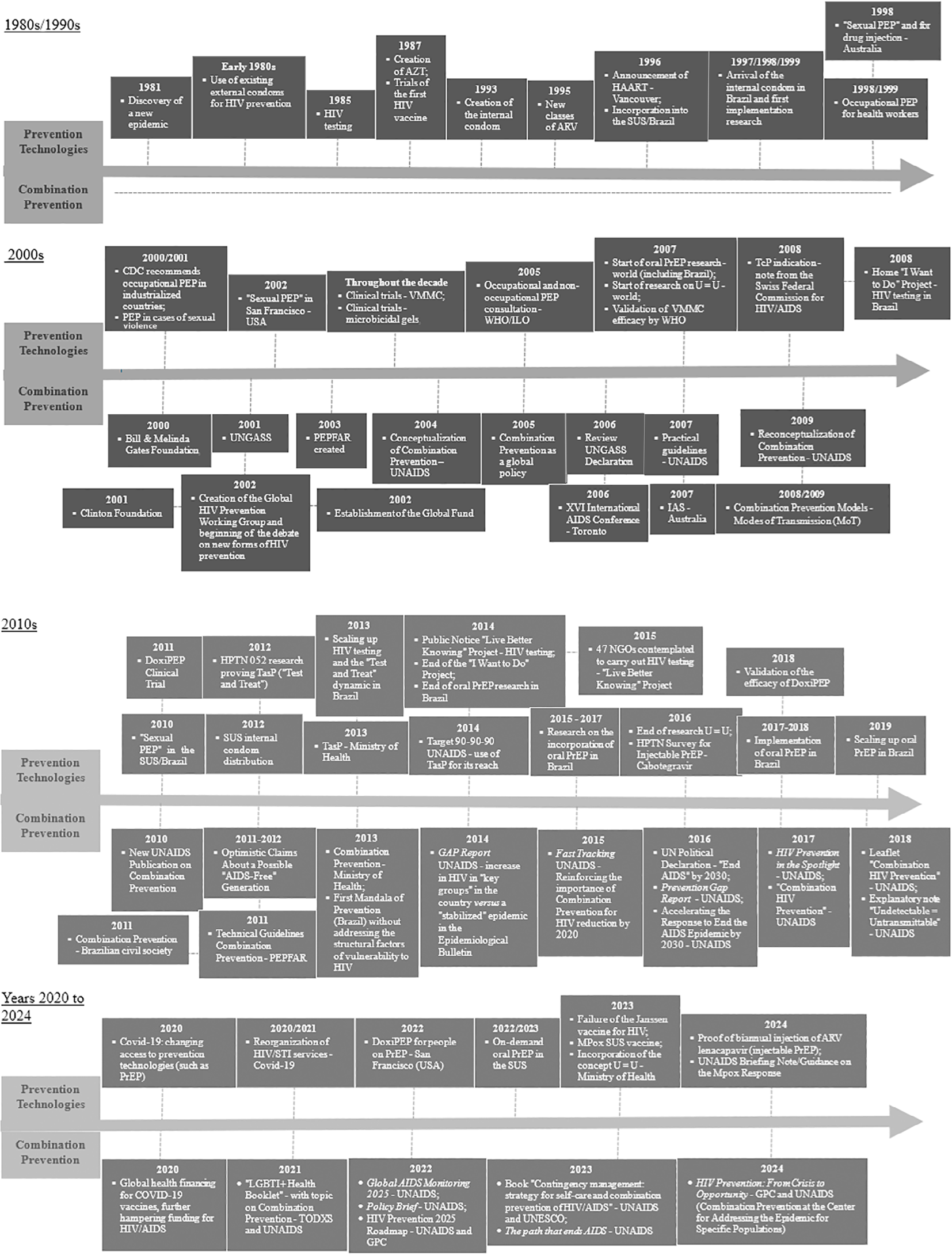
The development of new technologies, products, and drugs used in the biomedical prevention of HIV and STIs, such as the use of old techniques designed for the prevention of the virus, continued throughout the past two decades of the HIV/AIDS pandemic (see Table 1).
Technologies, devices and medicines for the sexual (HIV/STI) and reproductive prevention for men and women over the years.
Creating the concept of “combination prevention”
It can be said that in the early 2000s, “combination prevention” began to be built, bringing the idea of using all available strategies for a “maximum effect” of protection against HIV (Global HIV Prevention Working Group, 2004; Hankins; De Zalduondo, 2010). At least since the discussions of UNGASS (in 2001, which highlighted the expansion of the response to AIDS), groups such as the Global HIV Prevention Working Group, the BMGF, the global movement for access to treatment and, slightly later, PEPFAR began to take inspiration from the recognition that the use of biomedical, behavioral, and structural approaches in some countries, such as Brazil, Uganda, and Thailand had achieved a decline in HIV incidence (Ferraz, 2016; Hankins; De Zalduondo, 2010; UNAIDS, 2010).
UNAIDS (2004) defined combination prevention as strategies of individuals who have information about forms of HIV prevention and who can choose them at each moment of their lives, either to reduce the risk of infection for themselves and/or for others (though with limitations for women and girls). This was formulated as an “ABC” of combination prevention with a moralistic and conservative nature, as follows: A = Abstinence (delaying or not having sexual intercourse); B = Be faithful (reducing sexual partnerships); C = correct and consistent use of Condoms. We understand that this first definition of combination prevention by UNAIDS was developed in a superficial way, especially due to a dispute of narratives about a new model of HIV prevention to be followed in the world (mentioned in the first part of this article) and that it promoted the expansion of biomedical prevention of the pandemic. The main idea of combination prevention was to “save money” that would be invested in the treatment of people infected with HIV/AIDS versus the human rights to access treatment. It is noteworthy that the introduction of the “ABC” approach to prevention came from PEPFAR after its creation, in 2003, during the Bush administration and within debates on two fronts: (1) the field of religious and conservative sex education in the USA, which defended sexual abstinence; and (2) from the scientific perspective of public health, which defended “comprehensive” or holistic sex education. UNAIDS, in its 2004 document, in addition to mentioning comprehensive prevention, also adopts combination prevention, hence the confusion in the first concept of combination prevention, encompassing a kind of combination of methods.
The year 2005 was important for the implementation of combination prevention as a policy at the global level, creating simultaneous strategies combined with programmatic actions, biomedical and behavioral approaches, such as the promotion of gender equality and protection of human rights (UNAIDS, 2005). This policy was endorsed by other publications in the following years. The first was the document revising the UNGASS Declaration of Commitments in 2006, whose signatory countries committed to intensify and expand HIV prevention efforts considering local circumstances and ethical issues, in addition to overcoming structural barriers (UNGASS, 2006). The following year, UNAIDS published the practical guidelines to be followed, reinforcing the proposals included in the UNGASS review document, in addition to indicating evidence-based HIV prevention strategies adapted to local realities, such as respect for human rights and meeting the needs of people most vulnerable to exposure to the virus (UNAIDS, 2007b).
Between 2008 and 2009, biomedical prevention gained strength in the HIV pandemic response. UNAIDS (2010) indicated that biomedical HIV prevention comprised: (1) biomedical intervention strategies to reduce exposure, transmission and/or infection through the provision of internal and external condoms, drug treatment (including harm reduction) and male circumcision; (2) biomedical prophylaxis, including ARVs in health services (prevention of mother-to-child transmission of HIV, PEP, etc.), appropriate and accessible STI services, use of antiretrovirals for prevention, blood safety, precautions in health care settings, among others. At this point, UNAIDS changes its discourse, indicating that what is being agreed are not prevention methods (e.g., condoms, PEP, etc.), but combinations of approaches: behavioral, structural, and biomedical (Hankins; De Zalduondo, 2010). The 2011 PEPFAR technical guidance on combination prevention focused on strategies for the most vulnerable and discriminated populations, particularly MSM, in lowand middle-income countries.
In 2015, UNAIDS had launched Fast Tracking Combination Prevention on the reduction of HIV infection by 2020 (less than 500,000 by the year indicated) (UNAIDS, 2015). The document highlighted the importance of combination prevention, arguing that it is one of the most comprehensive ways to prevent HIV from six stages. However, it failed to mention the structural changes necessary for this goal to be achieved. While the document recognized the importance and necessity of strong community empowerment, such as the synergies between structural health and development, it continued to separate the combination prevention approach from its central element: human rights (Hankins; De Zalduondo, 2010; UNAIDS, 2015). In more recent years, UNAIDS has continued to promote combination prevention together with key players in the global AIDS scene, such as the Global HIV Prevention Coalition6, as shown in Figure 1.

In Brazil, the government took a long time to discuss combination prevention and this debate came from civil society, with ABIA (the Associação Brasileira Interdisciplinar de AIDS, or Brazilian Interdisciplinary AIDS Association) and the GIV (the Grupo de Incentivo à Vida, or Grupo for Incentive for Life) being the first to launch a booklet on the subject in 2011 (ABIA; GIV, 2011). But the focus of HIV prevention in the country from 2010 onwards was, and still is, biomedical and combination prevention began to be discussed by the government more seriously from 2013 onwards, but in a restrictive way and without addressing the structuring vulnerabilities of HIV, neglected in the first version of the “Mandala of Prevention” (prevention education material produced by the Brazilian Ministry Health). This broke with the traditional human rights approach of the Brazilian AIDS response (Ferraz, 2016).
Although the current conception of combination prevention tries to rescue the structural and behavioral dimensions beyond the biomedical approach, there is a lack of recognition of the community and cultural dimensions that were important at the beginning of the HIV/AIDS pandemic (e.g., safe sex, community education, etc.), such as the joint construction of knowledge and not just the recognition of the knowledge of researchers, managers and health professionals, that is, specialists in the area (Calazans; Parker; Terto Júnior, 2022).
Political economy, biopolitics, necropolitics and the social construction of biomedical prevention
By drawing attention to these diverse components of the category of “biomedical prevention,” and to their equally diverse histories, our goal is not to question the undeniable importance that this category has in the contemporary world of HIV prevention. On the contrary, we recognize and value the importance of various options for diverse needs (Gavigan et al., 2015). But, at the same time, we think it is important to question - to think critically - about its ontology and about the epistemological perspectives used in its construction. Precisely because the term “biomedical” evokes notions of nature, the category of “biomedical prevention” is easily interpreted to suggest a kind of “naturalness” - and thus a kind of inevitability - that a closer and more critical examination quickly calls into question. Thus, it covers up important aspects and processes that we think need to be interrogated.
On the contrary, instead of constituting a natural and necessary phenomenon, we want to draw attention to how much biomedical prevention was in fact socially constructed. We want to emphasize the remarkable diversity of the elements or components that have been brought together in this supposedly unified category: condoms (used externally and internally), antiretroviral drugs (used after and before infection), abstinence, circumcision, and so on. Indeed, at first glance, it is tempting to characterize the category of biomedical prevention as a kind of “bricolage” - a kind of “heterogeneous repertoire” of elements that have been brought together in the same way that Lévi-Strauss suggested that mythical thinking involves the reuse of available materials to create new solutions to new and emerging social problems (Lévi-Strauss, 1962). And indeed, there is a sense in which the notion of biomedical prevention produces a kind of mythical faith in the ability of biomedicine (and its operators) to solve all of our most serious problems in the HIV/AIDS response.
But as we have interrogated this category more carefully over time, we have also become convinced that the notion of bricolage tends to gloss over important aspects - especially those related to power and political economy - of the processes that have been brought together in the category of biomedical prevention. Therefore, we suggest that the notion of “assemblage”, originally associated with the work of Deleuze and Guattari (1980), that is developed in a growing literature described as “assemblage theory” (Savage, 2022), and analysis of assemblages in English (see, for example, Ong and Collier, 2005). By emphasizing an understanding of the social world as a set of complex configurations, characterized precisely by their heterogeneity and in constant motion, rather than a fixed ontology, assemblage has the advantage of bringing to the fore questions of power and political economy, highlighting ever-changing arrangements that bring together (albeit mutably) continuously moving configurations rather than a defined conceptual framework. It suggests a type of “machinery” capable of producing social relations of the most diverse kinds: desiring, unequal relations of power and knowledge, of submission and domination, of profit and risk (Deleuze; Guattari, 1980).
Conceptualizing the world of biomedical prevention in this way can help us explain many of the dimensions that a more static and naturalistic understanding hides. It helps to foreground the obvious (but strangely hidden in many discussions) financial interest of the pharmaceutical industry and its investments in the development of PEP and PrEP - as well as the financial flows that must be understood in order to make sense of the role of academic institutions and researchers, biomedical and behavioral, who conduct the necessary laboratory studies and clinical trials to ensure possible profit margins for the industry. At the same time, it helps to highlight the interface between political-economic power and the structures of biopower (Foucault, 1976) that establish the authority of physicians and public health managers in charge of determining who will deserve access to such technologies. In different ways, different modalities of biomedical prevention have transformed healthy people into patients and, in some cases, extended tutelage to biomedical professionals (benefiting the profit of the pharmaceutical industry over an extended time period). But if the webs of economic power and biopower become clearer, this can also be said about the structures of necropower (Mbembe, 2016) that are exercised in determining who will be excluded (for various reasons) from access to biomedical prevention methods. Especially when, at a specific time, public policies are changed, funding is drastically reduced, and public health programs and services are extinguished (in line with the current moment of transformation of support for the global HIV/AIDS response promoted by the administration of Donald Trump in the USA).
It also helps us better understand how long-standing policy debates in global health, such as the contrasting positions of cost-effectiveness versus human rights and health justice, that dominated debates about prioritizing primary prevention over access to antiretroviral treatment in HIV policy during the 1990s (Parker, 2000, 2023), were replicated in the 2000s and 2010s in promoting VMMC in low-income, high-prevalence settings, such as sub-Saharan African countries, rather than prioritizing access to PrEP for vulnerable populations as in middleand high-income countries. Or, in this case, it may help us unravel the factors underlying seemingly irrational debates about licensing and pricing decisions by pharmaceutical producers relative to different nations in the North and South (as in the recent case of long-acting PrEP applications such as injectable lenacapavir). Perhaps most strikingly, it can help us better analyze the reasons how, and why, prevention strategies such as the use of the male condom (or the external male condom), which were adopted in the early 1980s by many members of gay communities facing the impact of AIDS even before HIV was isolated, should have later been reappropriated by physicians in the late 2000s as a method of biomedical prevention - effectively denying the validity of community-based prevention approaches, and valuing instead only medical expertise (and scientific experts).
Final considerations
While the analysis of these strange juxtapositions and shifts in power relations could be extended much further if space permitted, only the few examples offered in this article about the social and economic machinery that the assemblage of biomedical prevention produces can also help us focus on what we see as perhaps the greatest limitation of the biomedical prevention machine to date:the extreme ways in which power and authority have been placed almost entirely in the hands of the so-called (and usually self-defined) “specialists” (or, perhaps most frequently in English, the mother tongue of most of them, the “experts”) rather than the communities most affected by the pandemic. Everywhere we look, the social output of biomedical prevention - and its many variants, such as “comprehensive prevention,” “combination prevention,” and so on - has emphasized the definitions outlined by interdisciplinary groups of experts in devising top-down approaches to education (as well as strategies for social and political mobilization - we live in a world where transnational pharmaceutical companies and their philanthropic foundations fund NGOs to develop “training” programs for “community activists”), with little or no emphasis on treatment pedagogy (or literacy) (Heywood, 2009) let alone prevention pedagogy (Gavigan, 2015; Parker et al., 2016). No matter how many “community advisory boards” these experts may point to in an attempt to soften this reality, perhaps the most problematic aspect of the entire biomedical prevention assemblage is precisely the fact that, from the outset, it has constructed those perceived to be theoretically at risk or vulnerable as “objects” rather than “subjects” of the experience it produces. This in no way denies its potential importance or the very real advances in innovative technologies it has produced, but it nevertheless creates a kind of Achilles heel that the naturalization of the biomedical prevention category has consistently glossed over and sought to deny.
-
1
Gay communities were already aware of the use of a kind of condom in World War II to prevent STIs among soldiers.
-
2
Although the idea of HIV vaccines has been thought of since the 1980s, and is central to any concept of biomedical prevention, there has been no significant progress in their development due to various difficulties (e.g., reservoirs of the virus in the body) and, therefore, they are not centrally included in the current concept of biomedical HIV prevention.
-
3
Specific projects for the expansion of rapid testing in Brazil, such as “Live Better Knowing” (“Vive Melhor Sabendo”), financed testing in NGOs.
-
4
Composed of: 2 tablets from 2 to 24 hours before sexual intercourse + 1 tablet 24 hours after the first dose + 1 tablet 24 hours after the second dose.
-
5
VMMC was criticized by researchers and activists who argue that men who have had VMMC may feel protected and, therefore, find the use of external condoms unnecessary, creating a risk of infection for their partners due to the lack of 100% protection from VMMC, as well as the lack of protection from STIs.
-
6
Created by UNAIDS in 2017, it aims to revitalize HIV prevention, ensuring greater investment for prevention programs and mapping possible paths to achieve global goals.
Data Availability Statement
The research data are available within the main text of the article.
References
-
ASSOCIAÇÃO BRASILEIRA INTERDISCIPLINAR DE AIDS (ABIA); GRUPO DE INCENTIVO À VIDA. Prevenção combinada: barreiras ao HIV. Rio de Janeiro: ABIA, Grupo de Incentivo à Vida, 2011. Available from: https://abiaids.org.br/prevencao-combinada-barreiras-ao-hiv/27434 Access in: 14 nov. 2024.
» https://abiaids.org.br/prevencao-combinada-barreiras-ao-hiv/27434 - AGGLETON, P. Global priorities for HIV/AIDS intervention research. International journal of STD & AIDS, v. 7, n. suppl 2, p. 13-16, 1996.
- BARBOSA, R. M.; ROBINSON, H.; PARKER, R. (Orgs.). Preservativo feminino: das políticas globais à realidade brasileira. Brasília: UNFPA - Fundo de População das Nações Unidas, 2011.
-
BELL, K. HIV prevention: Making male circumcision the ‘right’ tool for the job. Global Public Health, v. 10, n. 5-6, p. 552-572, 2015. DOI: https://doi.org/10.1080/17441692.2014.903428
» https://doi.org/10.1080/17441692.2014.903428 - BERQUÓ, E.; BARBOSA, R. M.; KALCKMAN S. O uso do método: Estudo revela a aceitabilidade do condom feminino. Boletim ABIA - Associação Brasileira Interdisciplinar de Aids, Rio de Janeiro, n. 43, p. 14-15, out./dez. 1999.
- BERNAYS, S. et al. Remaking HIV Prevention: The Promise of TasP, U=U and PrEP. In: BERNAYS, S.; BOURNE, A.; KIPPAX, S.; AGGLETON, P.; PARKER, R. (Eds.). Remaking HIV Prevention in the 21st Century The- Promise of- TasP, U=U and PrEP Switzerland: Springer, 2021, p. 1-17.
- BRASIL. Nota Técnica Nº 8/2023. Dispõe sobre recomendações e atualizações acerca do uso da Profilaxia Pré-Exposição de risco à infecção pelo HIV (PrEP) oral, incluindo a modalidade “sob demanda”. Diário Oficial [da] República Federativa do Brasil, Brasília, DF, 16 jan. 2023.
-
CALAZANS, G. J.; PARKER, R.; TERTO JÚNIOR, V. Refazendo a prevenção ao HIV na 5ª década da epidemia: lições da história social da Aids. Saúde Debate, Rio De Janeiro, v. 46, n. especial 7, p. 207-222, 2022. DOI: https://doi.org/10.1590/0103-11042022E715
» https://doi.org/10.1590/0103-11042022E715 -
CASTRO, C. G. et al. Incorporação da PrEP no Brasil segundo a Teoria Fundamentada em Dados. Physis: Revista de Saúde Coletiva, Rio de Janeiro, v. 34, e34010, 2024. DOI: https://doi.org/10.1590/S0103-7331202434010pt
» https://doi.org/10.1590/S0103-7331202434010pt - CONNELL, R. W. et al. Sustaining safe sex: Gay communities respond to AIDS. London: Routledge, 1993.
- CORRÊA, S.; PETCHESKY, R.; PARKER, R. Sexuality, health and human rights London; New York: Routledge, 2008.
- DELEUZE, G.; GUATTARI, F. Mille plateaux Paris: Les éditions de minuit, 1980.
- DOWSETT, G. W. Sustaining safe sex: sexual practices, HIV and social context. AIDS, London, v. 7, n. suppl. 1, p. S257-262, 1993.
- FARMER, P.; CONNOR, M.; SIMMONS, J. (Orgs.). Women, poverty and AIDS: Sex, drugs and structural violence. Monroe: Common Courage Press, 1996.
-
FERRAZ, D. A. S. Prevenção Combinada baseada nos Direitos Humanos: por uma ampliação dos significados e da ação no Brasil. Boletim ABIA - Associação Brasileira Interdisciplinar de Aids, Rio de Janeiro, n. 61, p. 9-12, 01 dez. 2016. Available from: https://abiaids.org.br/boletim-abia-61/29629 Access in: 28 nov. 2024.
» https://abiaids.org.br/boletim-abia-61/29629 - FOUCAULT, M. História da sexualidade I: a vontade de saber. Rio de Janeiro: Graal, 1976.
- FOUCAULT, M. Vigiar e punir: nascimento da prisão. Rio de Janeiro: Graal, 1977.
- GARLAND, D. O que significa escrever uma ‘História do Presente’?: A abordagem Genealogica de Foucault explicada. Revista Justiça e Sistema Criminal, v. 6, n. 10, p. 73-96, 2014.
-
GAVIGAN, K. et al. Pedagogia da Prevenção: Reinventando a prevenção do HIV no século XXI. Perspectiva Política. Rio de Janeiro: Observatório Global/Observatório Nacional de Políticas de AIDS; ABIA, 2015. Available from: https://abiaids.org.br/pedagogia-da-prevencao/28753 Access in: 08 dez. 2024.
» https://abiaids.org.br/pedagogia-da-prevencao/28753 - GLOBAL HIV PREVENTION WORKING GROUP. Global mobilization for HIV prevention: a blueprint for action. Global HIV Prevention Working Group, 2002.
- GLOBAL HIV PREVENTION WORKING GROUP. HIV prevention in the era of expanded treatment access Global HIV Prevention Working Group, 2004.
-
GREENE, E. et al. Acceptability and adherence of a candidate microbicide gel among high-risk women in Africa and India. Global Public Health, v. 13, n. 7, p. 931-943, 2018. DOI: https://doi.org/10.1080/13691051003728599
» https://doi.org/10.1080/13691051003728599 -
HANKINS, C. A.; DE ZALDUONDO, B. O. Combination prevention: A deeper understanding of effective HIV prevention. AIDS, v. 24, n. suppl. 4, p. S70-S80, 2010. DOI: https://doi.org/10.1097/01.aids.0000390709.04255.fd
» https://doi.org/10.1097/01.aids.0000390709.04255.fd -
HEYWOOD, M. South Africa’s treatment action campaign: combining law and social mobilization to realize the right to health. Journal of Human Rights Practice, v. 1, n. 1, p. 14-36, 2009. DOI: https://doi.org/10.1093/jhuman/hun006
» https://doi.org/10.1093/jhuman/hun006 -
IMRIE, J. et al. Biomedical HIV prevention-and social science. The Lancet, v. 370, n. 9581, p. 10-11, 2007. DOI: https://doi.org/10.1016/S0140-6736(07)61026-5
» https://doi.org/10.1016/S0140-6736(07)61026-5 -
KNAUFT, B. M. What is genealogy?: An anthropological/philosophical reconsideration. Genealogy, v. 1, n. 5, p. 1-16, 2017. DOI: https://doi.org/10.3390/genealogy1010005
» https://doi.org/10.3390/genealogy1010005 -
KÖRNER, H.; HENDRY, O.; KIPPAX, S. Negotiating risk and social relations in the context of post-exposure prophylaxis for HIV: Narratives of gay men. Health, Risk & Society, v. 7, n. 4, p. 349-360, 2005. DOI: https://doi.org/10.1080/13698570500390218
» https://doi.org/10.1080/13698570500390218 - LÉVI-STRAUSS, C. La pensée sauvage Paris: Plon, 1962.
-
MAKSUD, I; FERNANDES, N; FILGUEIRAS, S. Tecnologias de Prevenção do HIV e desafios para os serviços de saúde. Revista Brasileira de Epidemiologia, v. 18, n. suppl. 1, p.104-119, 2015. DOI: https://doi.org/10.1590/1809-4503201500050008
» https://doi.org/10.1590/1809-4503201500050008 - MANN, J. M.; TARANTOLA, D. J. M.; NETTER, T. W. (Orgs.). A AIDS no mundo. Rio de Janeiro: Relume Dumará; ABIA; IMS-UERJ, 1993.
-
MARINKOVIC´, D.; MAJOR, S. COVID-19 and the genealogies of biopolitics: a pandemic history of the present. Sociologija, v. 62, n. 4, p. 486-502, 2020. DOI: https://doi.org/10.2298/SOC2004486M
» https://doi.org/10.2298/SOC2004486M - MBEMBE, A. Necropolítica. Arte & Ensaios, v. 32, p. 122-151, 2016.
-
MONTEIRO, S. S. et al. Desafios do tratamento como prevenção do HIV no Brasil: uma análise a partir da literatura sobre testagem. Ciência & Saúde Coletiva, v. 24, n. 5, p. 1793-1807, 2019. DOI: https://doi.org/10.1590/1413-81232018245.16512017
» https://doi.org/10.1590/1413-81232018245.16512017 -
MWEEMBA, O. et al. The influence of social constructs of hegemonic masculinity and sexual behaviour on acceptability of vaginal microbicides in Zambia. Global Public Health, v. 13, n. 7, p. 931-943, 2017. DOI: https://doi.org/10.1080/17441692.2017.1337800
» https://doi.org/10.1080/17441692.2017.1337800 - ONG, A.; COLLIER, S. J. (Orgs.). Global Assemblages: Technology, Politics, and Ethics as Anthropological Problems. Oxford: John Wiley & Sons, 2005.
- PARKER, R. Na contramão da AIDS: Sexualidade, intervenção, política. Rio de Janeiro: ABIA; Editora 34, 2000.
- PARKER, R. Evolution in HIV/AIDS prevention, interventions and strategies. Interamerican Journal of Psychology, Austin, v. 35, n. 2, p. 155-165, 2001.
-
PARKER, R. On the Genealogy of the Global Health Justice Movement. Global Public Health, v. 18, n. 1, 2288686, 2023. DOI: https://doi.org/10.1080/17441692.2023.2288686
» https://doi.org/10.1080/17441692.2023.2288686 -
PARKER, R. Epidemias de significação e políticas de saúde global: Do fim da AIDS ao fim da ampliação da resposta global da AIDS. Global Public Health, v. 19, n. 1, 2386920, 2024. DOI: https://doi.org/10.1080/17441692.2024.2386920
» https://doi.org/10.1080/17441692.2024.2386920 -
PARKER, R. G.; CAMARGO, K. R. Pobreza e HIV/AIDS: aspectos antropológicos e sociológicos. Cadernos de Saúde Pública, Rio de Janeiro, v. 16, n. suppl. 1, p. S89-102, 2000. DOI: https://doi.org/10.1590/S0102-311X2000000700008
» https://doi.org/10.1590/S0102-311X2000000700008 -
PARKER, R. G.; EASTON, D.; KLEIN, C. H. Structural barriers and facilitators in HIV prevention: a review of international research. AIDS, London, v. 14, n. suppl. 1, p. S22-S32, 2000. DOI: https://doi.org/10.1097/00002030-200006001-00004
» https://doi.org/10.1097/00002030-200006001-00004 -
PARKER, R. G. et al Prevention literacy: community-based advocacy for access and ownership of the HIV prevention toolkit. Journal of the International AIDS Society, v. 19, n. 1, 21092, 2016. DOI: https://doi.org/10.7448/IAS.19.1.21092
» https://doi.org/10.7448/IAS.19.1.21092 - PEPFAR. Technical Guidance on Combination HIV Prevention. Washington, DC: The U.S. President’s Emergency Plan for AIDS Relief, 2011.
-
SAVAGE, G. C. O que é agenciamento de políticas? Práxis Educativa, v. 17, p. 1-21, 2022. DOI: https://doi.org/10.5212/PraxEduc.v.17.20018.022
» https://doi.org/10.5212/PraxEduc.v.17.20018.022 - SWEAT, M. D.; DENISON, J. A. Reducing HIV incidence in developing countries with structural and environmental interventions. AIDS, London, v. 9, n. suppl. A, p. S251-S257, 1995.
- UNITED NATIONS PROGRAMME ON HIV/AIDS. Report on the global AIDS epidemic Geneva: Joint United Nations Programme on HIV/AIDS, 2004.
-
UNITED NATIONS PROGRAMME ON HIV/AIDS. Intensifying HIV prevention: UNAIDS policy position paper. Geneva: Joint United Nations Programme on HIV/AIDS, 2005. Available from: https://www.unaids.org/en/resources/documents/2005/20051205_jc1165-intensif_hiv-newstyle_en.pdf Access in: 16 nov. 2024.
» https://www.unaids.org/en/resources/documents/2005/20051205_jc1165-intensif_hiv-newstyle_en.pdf - UNITED NATIONS PROGRAMME ON HIV/AIDS. Male circumcision: Africa’s unprecedented opportunity. Geneva: World Health Organization; 2007a.
- UNITED NATIONS PROGRAMME ON HIV/AIDS. Practical guidelines for intensifying HIV prevention Geneva: Joint United Nations Programme on HIV/AIDS, 2007b.
-
UNITED NATIONS PROGRAMME ON HIV/AIDS. Combination HIV Prevention: Tailoring and Coordinating Biomedical, Behavioural and Structural Strategies to Reduce New HIV Infections. A UNAIDS Discussion Paper. Geneva: Joint United Nations Programme on HIV/AIDS; 2010. Available from: https://www.unaids.org/en/resources/documents/2010/20101006_JC2007_Combination_Prevention_paper Access in: 17 nov. 2024.
» https://www.unaids.org/en/resources/documents/2010/20101006_JC2007_Combination_Prevention_paper -
UNITED NATIONS PROGRAMME ON HIV/AIDS. Fast Tracking Combination Prevention: Towards Reducing new HIV Infections to Fewer Than 500 000 by 2020. Geneva: Joint United Nations Programme on HIV/AIDS, 2015. Available from: https://www.unaids.org/en/resources/documents/2015/20151019_JC2766_Fast_tracking_combination_prevention Access in: 17 nov. 2024.
» https://www.unaids.org/en/resources/documents/2015/20151019_JC2766_Fast_tracking_combination_prevention -
UNITED NATIONS GENERAL ASSEMBLY SPECIAL SESSION. Declaration of commitment on HIV/AIDS: five years later. New York: United Nations, 2006. Available from: https://digitallibrary.un.org/record/573159?v=pdf Access in: 17 nov. 2024.
» https://digitallibrary.un.org/record/573159?v=pdf -
WORLD HEALTH ORGANIZATION (WHO); INTERNATIONAL LABOUR ORGANIZATION (ILO). Post-exposure prophylaxis to prevent HIV infection: joint WHO/ILO guidelines on post-exposure prophylaxis (PEP) to prevent HIV infection. Geneva: World Health Organization; International Labour Organization, 2007. Available from: https://www.who.int/publications/i/item/9789241596374 Access in: 18 nov. 2024.
» https://www.who.int/publications/i/item/9789241596374 -
ZUCCHI, E. M. et al. Da evidência à ação: desafios do Sistema Único de Saúde para ofertar a profilaxia pré-exposição sexual (PrEP) ao HIV às pessoas em maior vulnerabilidade. Cadernos de Saúde Pública, Rio de Janeiro, v. 34, n. 7, e00206617, 2018. DOI: https://doi.org/10.1590/0102-311X00206617
» https://doi.org/10.1590/0102-311X00206617 - THE EDITORS. Introducing history of the present. History of the Present, v. 1, n. 1, p. 1-4, 2011.
-
Editors: Ivia Maksud, Mauro Brigeiro

 AZT - Zidovudine; ARVs - Antiretrovirals; CDC - Centers for Disease Control and Prevention; VMMC - Voluntary Male Medical Circumcision; DoxiPEP - use of the antibiotic doxycycline for PEP of STIs; Global Fund - Global Fund for AIDS, Tuberculosis and Malaria; GPC - Global HIV Prevention Coalition; HAART - Highly Active Antiretroviral Therapy; HPTN - HIV Prevention Trials Network; IAS - International AIDS Society; MPox - Monkeypox; ILO - International Labor Organization; WHO - World Health Organization; NGOs - Non-Governmental Organizations; UN - United Nations; PEP - HIV Post-Exposure Prophylaxis; PEPFAR - U.S. President’s Emergency Plan for AIDS Relief; PrEP - HIV Pre-Exposure Prophylaxis; SUS - Unified Health System/Brazil; TasP - Treatment as Prevention; TODXS - Non-profit association that promotes the inclusion of LGBTI+ people in Brazil; UNAIDS - Joint United Nations Programme on HIV/AIDS; UNESCO - United Nations Educational, Scientific and Cultural Organization;