 Valorization of passion fruit: development, characterization and optimization of biodegradable edible films
Abstract
This work aimed to develop biodegradable films from yellow passion fruit (Passiflora edulis f. flavicarpa) peel flour. The Central Composite Rotational Design was used in a total of 11 tests, in which the independent variables were the concentrations of starch and glycerol, characterized with regard to physical, mechanical and barrier properties. The films were classified as soluble and showed low permeability to water vapor. The tensile strength, elastic modulus and deformation rate were directly related to the concentration of starch and glycerol. The film of test 7 had the best characterization results; therefore, it was analyzed for biodegradability. As for biodegradability, the film obtained an average mass loss of 92.77 ± 4.28%, being a great alternative to the use of non-biodegradable polymers. The films showed acceptable degree of plasticization, which was favored by intermolecular interactions between the components of the flour, starch and glycerol.
Keywords:
by-products; coating; fruits; packaging
1. Introduction
Wastes generated by the disposal of packaging produced from non-renewable sources is increasing in quantity every year and constitute a major environmental problem. Approximately 30 to 40% of the total solid wastes produced in Brazil are the plastic materials used for packaging, such as that for food, for example[1]. Thus, there are numerous problems generated by the complexity of recycling most synthetic packaging available, associated with the generation of waste. With that, research is being carried out in order to develop biodegradable materials such as biodegradable films obtained from biopolymers, with features that allow their use in the industry[2,3].
Edible or biodegradable coatings work as a barrier to external elements deposited on the surface of the food. They are characterized by their small thickness, so they can protect the product and increase its lifetime[4,5]. The peel of the passion fruit Passiflora edulis, known as yellow passion fruit, is a residue of the food industry, rich in phenolic compounds with antioxidant activity, pectin, fibers and carbohydrates[6,7]. Several studies on passion fruit peel and peel flour demonstrate their technological potential for use in the food industry[8-10] among others.
As for the coatings, these constitute one of the methods with significant impact on the processes of preservation, distribution and marketing of food[11,12]. Therefore, the use of coatings produced from biodegradable compounds such as passion fruit peel, in addition to contributing to the environment, minimizing the environmental impact for not generating waste, can also increase the shelf-life of foods, allowing their marketing for a longer period and contributing to scientific development in the Food Science field. In this context, the present study aimed to develop and characterize biodegradable films prepared with passion fruit (P. edulis) residue flour.
2. Materials and Methods
2.1 Material
The raw material was obtained from passion fruit peels (Passiflora edulis f. flavicarpa), acquired in the retail trade of the city of Belo Horizonte, MG, Brazil. Cornstarch (Maizena®, Unilever Brasil Industrial Ltda., Garanhuns, PE, Brazil) was purchased in a market in Belo Horizonte. Glycerol (Dinâmica Química Contemporânea Ltda., Indaiatuba, SP, Brazil) and all chemicals employed in this work were reagent grade.
2.2 Methods
Rigid and yellowish peels of passion fruit, were sanitized in running water and subjected to drying in an oven with forced air circulation (FANEM, 320, Brazil) at 60 ± 5 °C for 24 hours. After drying, the peels were crushed in a blender (Philips Walita, Walita Brasilia LB model, Brazil), and sieved through a sieve (Bertel Indústria Metalúrgica Ltda., 32 mesh, 500 mm, Brazil).
2.3 Statiscal design
In this work, for the preparation and characterization of the biodegradable films, we decided to conduct a second-order experimental design: the Central Composite Rotational Design (CCRD), which contains a central point carried out with replicates, which provides an estimate of pure error, and axial points, which in turn, determine the quadratic terms. As parameters for this design, as the chosen independent variables the concentration of starch (w/w), in relation to the Passion Fruit Peel Flour (PFPF), and the content of plasticizer (w/w), in relation to PFPF. The dependent variables were the physical properties (thickness and water solubility), barrier properties (water vapor permeability), and mechanical properties (tensile strength, percentage of elongation,elastic modulus, puncture strength and deformation). Thus, this CCRD covered a total of 11 tests, comprising 3 central points, 4 factorial points and 4 axial points, as described in Table 1.
Statistical design for preparation and characterization of biodegradable films from passion fruit peel flour.
2.4 Development of biodegradable films
For the development of biodegradable films, the casting technique was used according to Pelissari et al.[13], varying the amount of starch and plasticizer. In this way, the films were produced from aqueous filmogenic solutions, with the mixture of PFPF (10 g) and distilled water (375 mL), addition of cornstarch (at concentrations of the experimental design); heated under constant stirring (magnetic stirrer VELP Scientifica, Italy; water bath GMA Médica, Brazil) at 90 °C for 15 minutes; homogenization (Ultra-turrax Ultra Stirrer, Ultra80-II model) at 18000 rpm for 5 min; addition of glycerol (at concentrations of the experimental design); heated under stirring (magnetic stirrer VELP Scientifica, Italy; bath GMA Médica, Brazil) at 90 °C for 15 minutes; filtering; distribution (50 g) on polystyrene plates with 15 cm diameter and drying in forced air ventilation oven (FANEM, 320, Brazil) at 40 °C for 24 hours. The films obtained were then stored (58 ± 2% relative humidity RH, 25 °C) in desiccators containing saturated solution of sodium bromide for 48 hours before the analysis.
2.5 Film characterization
All films were characterized with regard to physical properties, barrier properties and mechanical properties, according to the standards of the ASTM[14-17]. The film that showed the best parameters of continuity, homogeneity, handling and characterization was selected for determination of the biodegradability.
2.5.1 Hydrogen potential of filmogenic solutions
Hydrogen potential (pH) was measured in the filmogenic solutions of each test of the experimental planning. The pH reading was conducted using a benchtop pHmeter (Bante, 920 model), according to the procedures described in the analytical standards of the Adolfo Lutz Institute[18]. All tests were carried out in triplicate.
2.5.2 F ilm thickness
Film thickness was determined using a digital micrometer (Digimess Model, Electronic Outside Micrometer, São Paulo) with 0-25 mm scale and precision of 0.001 mm. The values represented an average of 10 measurements randomly taken along each sample evaluated, following the ASTM F2251-13[15].
2.5.3 Solubility in water
Water solubility was determined according to the method proposed by Gontard et al.[19].
2.5.4 Water vapor permeability (WVP)
WVP was determined gravimetrically, following the standard method E96/E96M[17].
2.5.5 Mechanical properties
The determination of the mechanical properties of the films, tensile strength (TS) (MPa), percent elongation at break (ε) (%), elastic modulus (EM) (MPa), puncture test (PT) (MPa) and puncture deformation (PD) (%), followed ASTM D638-14[16] and ASTM D882-12[14], using a texturometer (Stable Micro Systems, TA.XT2i, England).
2.5.6 Biodegradability
The degree of biodegradation of the film was determined as the weight loss (WL;%), conducted according to the methodology proposed by Martucci and Ruseckaite[20].
2.6 Data analysis
After performing all experiments, a quadratic model was fitted to the response data using Statistica software (Statsoft, Tulsa, OK, USA) version 10. The significant terms (p < 0.05) in the model were found by analysis of variance (ANOVA) and the interactive effects between the factors were observed using response surface and contour plot, derived from the fitted quadratic model.
3. Results and Discussions
3.1 Hydrogen potential (pH) of the filmogenic solutions
The pH values of the filmogenic solutions corresponding to the experimental planning tests are shown in Table 2. In this study, the different filmogenic solutions did not differ statistically, showing average pH of 4.48 ± 0.06, which classifies a medium with acidic pH. According to Guilbert and Gontard[21] the use of edible coatings or films that promote pH reduction on food surface can reduce microbial growth. Thus, the use of a coating with low pH value may be desirable and beneficial to food preservation.
Average values of pH of the filmogenic solutions and thickness of the films obtained by tests of the experimental planning.
3.2 Thickness
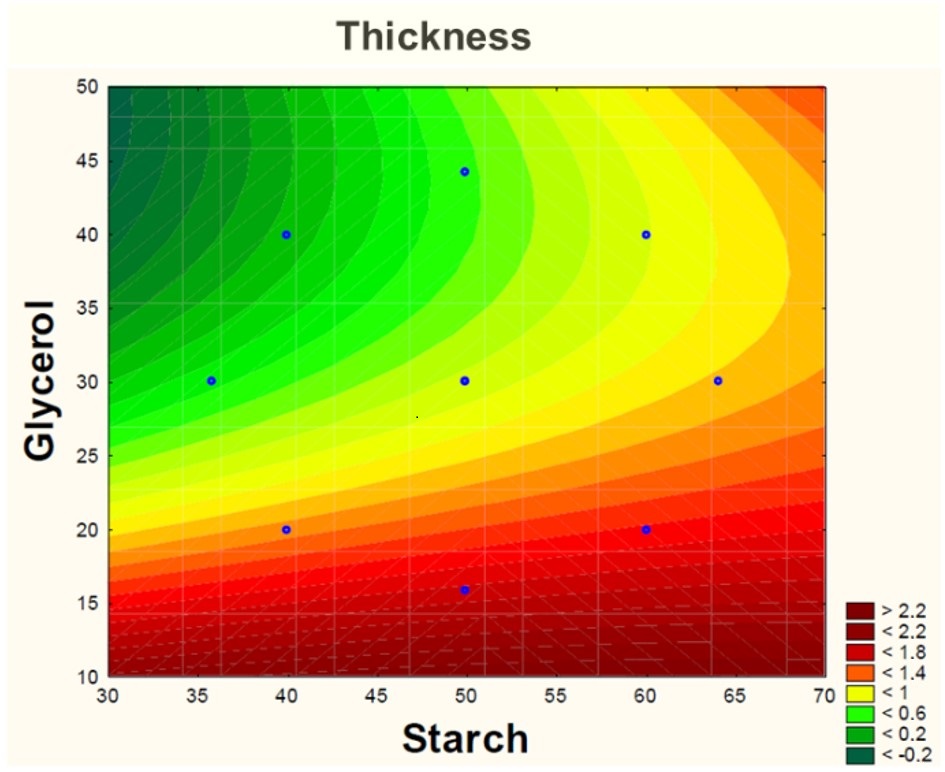
As shown in Table 2, the film with the highest amount of plasticizer (film 8, with 44.14% w/w of glycerin) was thicker, while the one with lowest amount of plasticizer (film 7, with 15.85% w/w of glycerin) showed lower value of this parameter when compared to the others. The concentration of the raw materials used may interfere with the thickness of the films formed, because viscous solutions tend to form thicker films[22].
Nascimento et al.[8] developed and characterized flexible films from starch and passion fruit mesocarp flour with nanoparticles and the values found for their thickness ranged from 0.133 to 0.185 mm. These values are higher than those measured in the present study for the films prepared with the PFPF. Therefore, depending on the form of processing, raw material used, homogeneity, among other factors, the films can have different values of thickness.
When evaluating the regression coefficients and the p-value, it was observed that the linear effect of glycerol content was significant at a 95% confidence interval. Thus, a mathematical model for thickness can be defined, Equation 1:
where y corresponds to the concentration of glycerol.
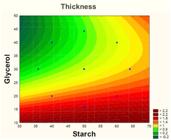
The model of thickness was satisfactory and valid, with determination coefficient of 83.44%. Thickness values are higher at maximum contents of glycerol (44.14% glycerol w/w) and lower at minimum contents (15.85% glycerol w/w) (Figure 1).
3.3 Mechanical properties
The values of mechanical properties concerning tensile strength, elongation at break, elastic modulus, puncture resistance and puncture deformation are shown in Table 3.
3.3.1 Tensile strength
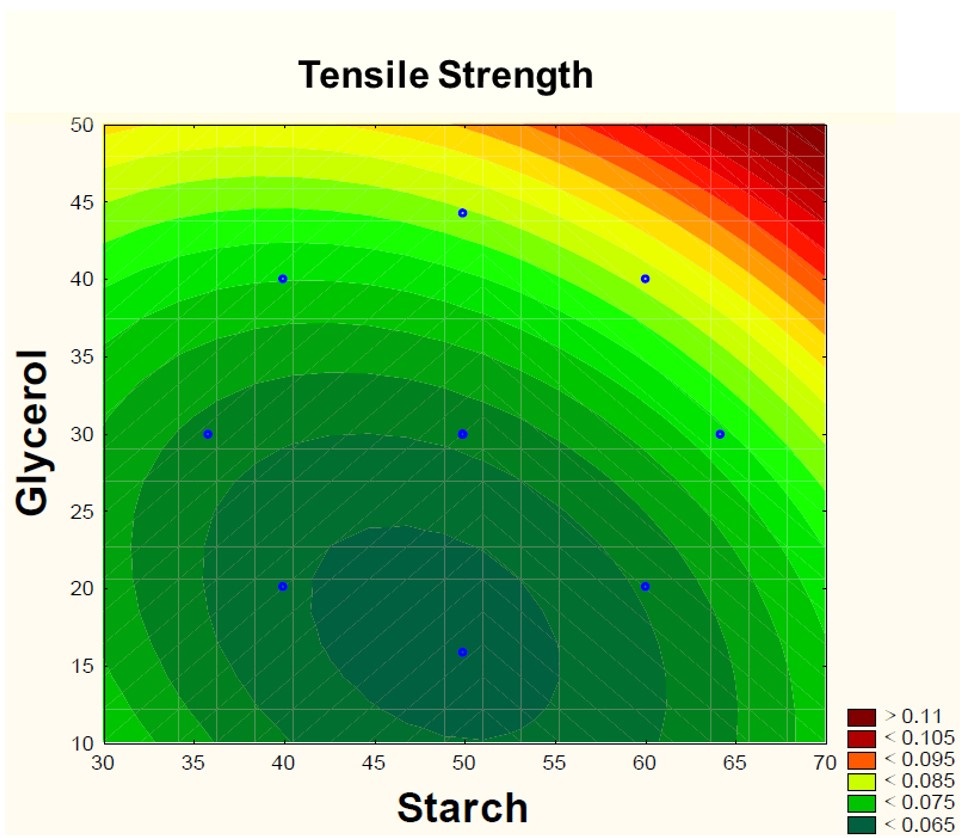
The film with the lowest levels of glycerol (film 7, 15.85% glycerol w/w) had greater tensile strength, 1.60 ± 0.24 MPa, while film 8, with the highest concentration of glycerol (44.14%), showed lower resistance (0.52 ± 0.14 MPa). This result is due to the presence of glycerol in the filmogenic solutions, which increases the molecular mobility, thus reducing the strength of the hydrogen bonds between the starch molecules, making the films less resistant[23].
According to the analysis of the regression coefficients, the levels of starch and glycerol influenced the response, generating the following mathematical model, Equation 2:
where x corresponds to the concentration of starch and y to the concentration of glycerol.
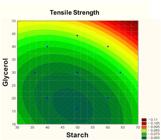
Based on the ANOVA, the fitted model for the response was satisfactory, with R2 = 0.86071, and it was possible to observe (Figure 2) that higher levels of glycerol led to lower TS, while higher values of starch led to higher values of TS.
3.3.2 Elongation
In this study, the elongation of the films ranged from 49.56 to 21.25%, and the films with the highest values (1, 2, 4, 6, 7, 8, 9, 10, and 11) differed significantly (p < 0.05) only from film 5, which was developed with lowest starch content. Starch also has hydrophilic character, which is responsible for increasing the mobility of the chains, increasing elasticity.
The presence of PFPF in films produced from starch may favor an increase in the percentage of elongation, as shown in Table 3, where, with the exception of film 5, all others showed greater elongation, even with high levels of plasticizer. This is interesting because higher values of elongation indicate high flexibility[24] and make it easier for films to adhere, when applied to the surface of the food[25].
In general, films with greater thickness (> 0.100 mm) have values of elongation greater than 100%[26]. The developed films show small thickness, between 0.061 ± 0.011 mm and 0.087 ± 0.025 mm, i.e., they are thinner, consequently having elongation percentage lower than 100%.
3.3.3 Elastic modulus
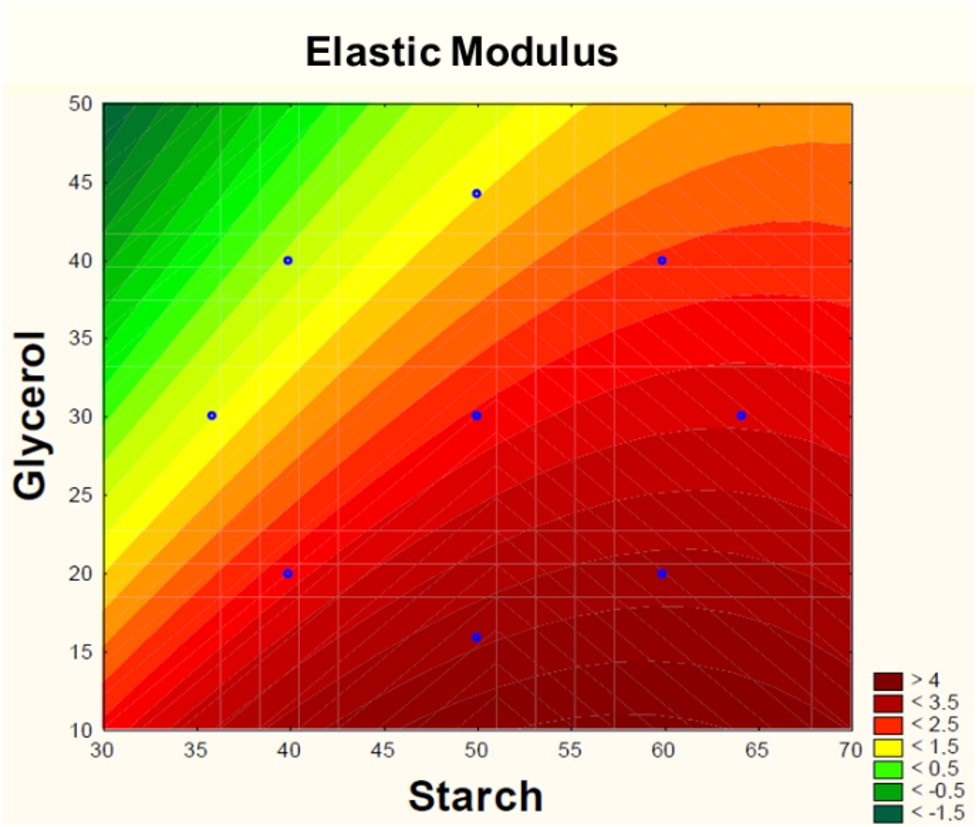
The films with lowest rigidity were those from the test 3 (40.00% starch and 40.00% glycerol), test 5 (35.85% starch and 30.00% glycerol) and test 8 (50.00% starch and 44.14% glycerol). The films 3 and 8 were developed with higher levels of glycerol, while film 5 was prepared with an intermediate content of glycerol, but with the lowest content of starch among the other films.
Larger quantities of plasticizers in the preparation of films can reduce the intermolecular forces between the polymer chains[23]. Consequently, films with high glycerol concentrations and low starch concentrations are less rigid. Values close to that of this study were found by Arquelau et al.[27], in films developed with flour from ripe “Prata” banana peels, with lower concentrations of starch.
In the present study, the average pH value of the filmogenic solutions was 4.47, that is, acidic pH, which was one of the factors that influenced the lower values of the elastic modulus. Maniglia et al.[28] stated that, in alkaline medium, the turmeric proteins may have reached maximum dissolution, undergoing some conformation changes, which affected the mechanical properties of the films. Other studies also report how high pH values are able to produce a stronger and denser polymer matrix, with higher values of elastic modulus[29]. The elastic modulus was influenced by the contents of starch and glycerol, according to the analysis of the regression coefficients, generating the following mathematical model, Equation 3:
where x corresponds to the concentration of starch and y to the concentration of glycerol.
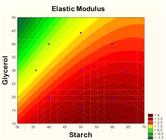
Based on the ANOVA, the fitted model for the response was satisfactory, with R2= 0.89407, with a tendency of increase in EM at higher concentrations of starch and lower concentrations of glycerol (Figure 3).
3.3.4 Puncture resistance
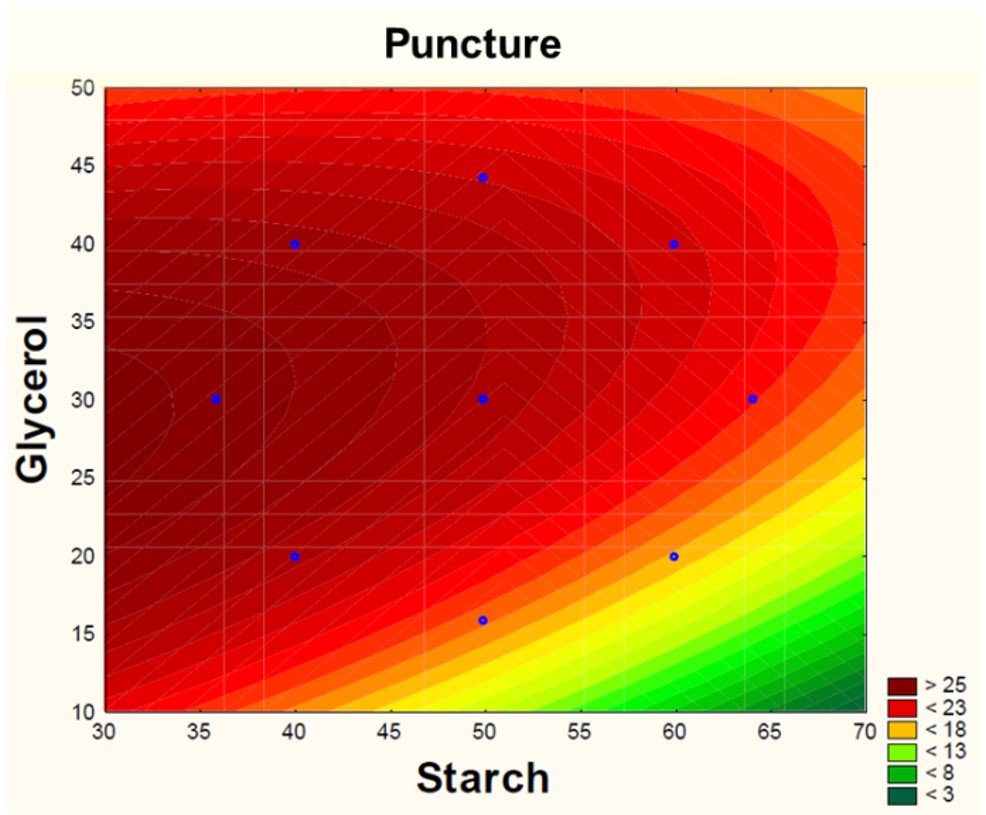
It is possible to see that the films prepared with the lowest values of plasticizers, for example, film 1 (20.00% glycerol and 40.00% starch), film 2 (20.00% glycerol and 60% starch, w/w) and film 7 (15.85% glycerol and 50% starch), have better mechanical resistance in the puncture test. By contrast, the films 6, 9 and 10, which did not differ from those with lower levels of plasticizers, were developed with intermediate concentrations of glycerol (30% w/w) and starch (films 9 and 10), while the film 6 was developed with the highest starch concentration among all tests. I
Another parameter that has direct influence on resistance to puncture is thickness, because the higher the thickness, the greater the resistance of the film[30]. When compared with other studies, the films of the present study have intermediate thickness, which makes them more flexible.
In relation to the puncture test, the analysis of the regression coefficients revealed along with p-value that the analyzed parameters (concentrations of starch and glycerol) are not statistically significant. Therefore, it was not possible to generate the mathematical model, variance analysis and the response surface and contour graphs.
3.3.5 Puncture deformation
The deformation rate or puncture deformation is related to how far the film extends without breaking, so it is also a parameter involved with the flexibility of the material. For the puncture deformation, there was a variation from 18.49 ± 0.43% (film 7) to 29.10 ± 0.38% (film 5). In regard to the puncture deformation, the analysis of the regression coefficients and the p-value revealed that the concentrations of glycerol and starch were statistically significant. Hence, it was possible to generate the mathematical model predicted for PD, with a significance level of 5%, Equation 4:
where x is the concentration of starch and y corresponds to the concentration of glycerol.
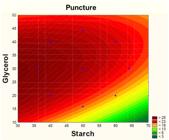
The fitted model for PD is satisfactory (Table 2), with R2 = 0.96313. There is a higher rate of deformation for films with higher levels of glycerol and lower concentrations of starch, Figure 4.
3.4 Barrier properties
The values of the barrier properties for permeability to water vapor and solubility are presented in Table 4.
Average solubility (%) and average water vapor permeability (g mm h-1 m-2 kPa-1) of the films obtained by tests of the experimental planning.
3.4.1 Water vapor permeability
The average values of water vapor permeability of the films processed with PFPF are presented in Table 4. The values of WVP for the films were on average 0.32 ± 0.05 g mm h-1 m-2 kPa-1, with the exception of the film 7, with WVP of 0.029 ± 0.00 g mm h-1 m-2 kPa-1, statistically differing from the others. The developed films had low WVP, an extremely important factor in the development of materials used in food coating.
Han and Aristippos[31] classified films and common plastics with respect to barrier properties and, for water vapor permeability values lower than 0.1 (g.mm h-1 m-2 kPa-1), the films are characterized as of top quality, between -1 and 1 (0.1g mm h-1 m-2 kPa-1) as good, between 1 and 10 (g mm h-1 m-2 kPa-1) as intermediate, and greater than 10 g (mm h-1 m-2 kPa-1) as of lower quality. As for the classification of Han and Aristippos[31], it can be inferred that the developed films, except for film 7, are good in relation to WVP and can be compared to cellophane, for example, which is a natural polymer derived from cellulose and has the appearance of a thin, transparent, flexible and stress-resistant film. For film 7, a mean WVP of 0.029 ± 0.00 g mm h-1 m-2 kPa-1 was obtained. This assay was performed with the lowest plasticizer content and intermediate amount of starch (50.00% starch and 15.85% glycerol, w/w), and the film was classified as a good with respect to the barrier properties. Considering this parameter, the film is comparable to materials such as polyethylene terephthalate (PET) and polyvinyl chloride (PVC)[31].
The presence of higher plasticizer contents increased the WVP of the films, regardless of the amount of starch. Glycerol has the ability to increase water absorption of the material[32]. However, films with higher WVP values are still good barrier materials.
Values very close to that of this study were found by Rocha et al.[33] when developing biodegradable films based on cassava starch and soy protein, where the maximum WVP was 0.393 g mm h-1 m-2 kPa-1 for films made with the maximum content of soy protein extract (47%) and glycerol (47%), at pH 4.0. WVP is influenced by pH. It is known that, when the filmogenic solution is in an acidic medium, the glycosidic/peptide bonds undergo hydrolysis, resulting in fragments of smaller size, with the possibility of forming empty spaces in the film, leading to increase in WVP[33]. As for the WVP of the films developed with PFPF, the pH did not show influence on this parameter, since all the tests presented good characteristics for WVP.
3.4.2 Solubility in water
The solubility of the films with PFPF (Table 4) ranged from 34.32 ± 4.49% (film 3) to 67.22 ± 8.64% (film 1), classifying them as soluble. Films that have high solubility are not inferior to films with low solubility because each film, with its characteristic solubility, will be used according to the application.
High solubility in films is required for foods that, throughout the processing, are in direct contact with water and when the coating can be consumed. Water-soluble films can be used in products that, prior to consumption, need a certain amount of hydration, in encapsulated food additives and even in the agro sector, for example in agricultural seeds that require accelerated germination in the field[34].
Eça et al.[35], when developing films made of pectin, glycerol and calcium chloride containing fruit extract (acerola, cashew and strawberry), also found high solubility in water: 65.3 ± 1.5% using acerola extract, 73.1 ± 4.3% using cashew extract, and 70.5 ± 3.7% using strawberry extract, which are close to the maximum solubility values of the films developed.
The analysis of the regression coefficients for elongation, puncture test, WVP (water vapor permeability) and solubility revealed, together with the p-value, that the analyzed parameters (starch and glycerol concentrations) were not statistically significant, making it not possible to generate the mathematical model, analysis of variance and o response surface and contour plots.
3.5 Biodegradability
The quantitative index of degradability of the films was calculated based on the mass loss. At the end of 10 days, the test film 7 (50% starch w/w; 15 min of heating, 15.86% plasticizer w/w), which had the best barrier properties, used for evaluation of biodegradability, obtained an average mass loss of 92.77 ± 4.28%, being a great alternative to the use of non-biodegradable polymers.
It is known that products derived from natural fibers in general are characterized by high biodegradability[36]. In other words, in this experiment, during the 10 days, microorganisms and their enzymes used the organic compounds present in the films as food source, converting and redistributing them in cycles, such as the carbon and nitrogen cycles, promoting their biodegradation[36].
For a plastic to be considered biodegradable in the soil under real field conditions, it must not only disintegrate, but also undergo biodegradation, which should be greater than 90% without detrimental effects on the soil[37]. Therefore, with the loss of mass of 92.77 ± 4.28, the films developed with PFPF can be considered as biodegradable materials, and the short degradation period can reduce expenses in the processing of materials, besides not affecting the environment because they are developed with polymers from natural sources.
4. Conclusion
Passion fruit peel flour has technological potential for the development of biodegradable films, due to the results obtained for mechanical, physical and barrier properties in the films developed. For the experiment, the concentration of cornstarch in the films influenced resistance to stress, elastic modulus and deformation rate, while the glycerol interfered in thickness, resistance to stress, elastic modulus, resistance to puncture and deformation rate in the films. The developed films have low WVP, an extremely important factor in materials used in food coating, especially the film 7 (50 g starch /100 g of flour and 15.85 g glycerol/ 100 g of flour), which is comparable to materials such as PET and PVC. With regard to biodegradability, the films showed significant loss of mass and were characterized as biodegradable. The production of films from passion fruit peel can contribute to the development of an environmentally correct technology that can allow food preservation time to be increased at low cost.
6. Acknowledgements
The authors are grateful for the financial support from the Coordenação de Aperfeiçoamento de Pessoal de Nível Superior – CAPES and Fundação de Amparo à Pesquisa do Estado de Minas Gerais (FAPEMIG).
How to cite:
7. References
-
1 Das, P., & Tiwari, P. (2018). Valorization of packaging plastic waste by slow pyrolysis. Resources, Conservation and Recycling, 128, 69-77. http://doi.org/10.1016/j.resconrec.2017.09.025
» http://doi.org/10.1016/j.resconrec.2017.09.025 -
2 Razavi, S. M. A., Mohammad Amini, A., & Zahedi, Y. (2015). Characterisation of a new biodegradable edible film based on sage seed gum: influence of plasticiser type and concentration. Food Hydrocolloids, 43, 290-298. http://doi.org/10.1016/j.foodhyd.2014.05.028
» http://doi.org/10.1016/j.foodhyd.2014.05.028 -
3 Sun, X.-Z., Minowa, T., Yamaguchi, K., & Genchi, Y. (2015). Evaluation of energy consumption and greenhouse gas emissions from poly(phenyllactic acid) production using sweet sorghum. Journal of Cleaner Production, 87, 208-215. http://doi.org/10.1016/j.jclepro.2014.09.041
» http://doi.org/10.1016/j.jclepro.2014.09.041 -
4 Assis, O. B. G., & Britto, D. (2014). Revisão: coberturas comestíveis protetoras em frutas: fundamentos e aplicações. Brazilian Journal of Food Technology, 17(2), 87-97. http://doi.org/10.1590/bjft.2014.019
» http://doi.org/10.1590/bjft.2014.019 -
5 Luvielmo, M., & Lamas, S. (2012). Edible coating in fruits. Estudos Tecnológicos em Engenharia, 8(1), 8-15. http://doi.org/10.4013/ete.2012.81.02
» http://doi.org/10.4013/ete.2012.81.02 -
6 Alcântara, S. R., Sousa, C. A. B., Almeida, F. A. C., & Gomes, J. P. (2013). Caracterização físico-química das farinhas do pendúnculo do caju e da casca do maracujá. Revista Brasileira de Produtos Agroindustriais, 15(4), 349-355. http://doi.org/10.15871/1517-8595/rbpa.v15n4p349-355
» http://doi.org/10.15871/1517-8595/rbpa.v15n4p349-355 -
7 Zeraik, M. L., Yariwake, J. H., Wauters, J.-N., Tits, M., & Angenot, L. (2012). Analysis of 570 passion fruit rinds (Passiflora edulis): isoorientin quantification by HPTLC and 571 evaluation of antioxidant (radical scavenging) capacity. Quimica Nova, 35(3), 541-545. http://doi.org/10.1590/S0100-40422012000300019
» http://doi.org/10.1590/S0100-40422012000300019 -
8 Nascimento, T. A., Calado, V., & Carvalho, C. W. P. (2012). Development and characterization of flexible film based on starch and passion fruit mesocarp flour with nanoparticles. Food Research International, 49(1), 588-595. http://doi.org/10.1016/j.foodres.2012.07.051
» http://doi.org/10.1016/j.foodres.2012.07.051 -
9 Pineli, L. L. O., Rodrigues, J. S. Q., Costa, A. M., Lima, H. C., Chiarello, M. D., & Melo, L. (2015). Antioxidants and sensory properties of the infusions of wild passiflora from Brazilian savannah: potential as functional beverages. Journal of the Science of Food and Agriculture, 95(7), 1500-1506. http://doi.org/10.1002/jsfa.6852 PMid:25087571.
» http://doi.org/10.1002/jsfa.6852 -
10 Seixas, F. L., Fukuda, D. L., Turbiani, F. R. B., Garcia, P. S., Petkowicz, C. L. O., Jagadevan, S., & Gimenes, M. L. (2014). Extraction of pectin from passion fruit peel (Passiflora edulis f.flavicarpa) by microwave-induced heating. Food Hydrocolloids, 38, 186-192. http://doi.org/10.1016/j.foodhyd.2013.12.001
» http://doi.org/10.1016/j.foodhyd.2013.12.001 -
11 Silva, J. B. A., Nascimento, T., Costa, L. A. S., Pereira, F. V., Machado, B. A., Gomes, G. V. P., Assis, D. J., & Druzian, J. I. (2015). Effect of source and interaction with nanocellulose cassava starch, glycerol and the properties of films bionanocomposites. Materials Today: Proceedings, 2(1), 200-207. http://doi.org/10.1016/j.matpr.2015.04.022
» http://doi.org/10.1016/j.matpr.2015.04.022 -
12 Silva-Weiss, A., Ihl, M., Sobral, P. J. A., Gómez-Guillén, M. C., & Bifani, V. (2013). Natural additives in bioactive edible films and coatings: functionality and applications in foods. Food Engineering Reviews, 5(4), 200-216. http://doi.org/10.1007/s12393-013-9072-5
» http://doi.org/10.1007/s12393-013-9072-5 -
13 Pelissari, F. M., Andrade-Mahecha, M. M., Sobral, P. J. A., & Menegalli, F. C. (2013). Comparative study on the properties of flour and starch films of plantain bananas (Musa paradisiaca). Food Hydrocolloids, 30(2), 681-690. http://doi.org/10.1016/j.foodhyd.2012.08.007
» http://doi.org/10.1016/j.foodhyd.2012.08.007 - 14 American Society for Testing and Materials – ASTM. (2001). ASTM D882-12: Standard test method for tensile properties of thin plastic sheeting West Conshohocken: ASTM International.
- 15 American Society for Testing and Materials – ASTM. (2013). ASTM F2251-13: standard test method for thickness measurement of flexible packaging material. West Conshohocken: ASTM International.
- 16 American Society for Testing and Materials – ASTM. (2015). ASTM D638-14: standard test method for tensile properties of plastics West Conshohocken: ASTM International.
- 17 American Society for Testing and Materials – ASTM. (2016). ASTM E96/E96M-16: standard test methods for water vapor transmission of materials West Conshohocken: ASTM International.
- 18 Instituto Adolfo Lutz – IAL. (1985). Analytical norms of the Adolfo Lutz Institute: physical-chemical methods for food analysis (2nd ed.). São Paulo: IAL.
-
19 Gontard, N., Duchez, C., Cuq, J.-L., & Guilbert, S. (1994). Edible composite films of wheat gluten and lipids: water vapour permeability and other physical properties. International Journal of Food Science & Technology, 29(1), 39-50. http://doi.org/10.1111/j.1365-2621.1994.tb02045.x
» http://doi.org/10.1111/j.1365-2621.1994.tb02045.x -
20 Martucci, J. F., & Ruseckaite, R. A. (2009). Biodegradation of three-layer laminate films based on gelatin under indoor soil conditions. Polymer Degradation & Stability, 94(8), 1307-1313. http://doi.org/10.1016/j.polymdegradstab.2009.03.018
» http://doi.org/10.1016/j.polymdegradstab.2009.03.018 -
21 Guilbert, S., & Gontard, N. (2005). Agro-polymers for edible and biodegradable films: review of agricultural polymeric materials, physical and mechanical characteristics. In J. H. Han (Ed.), Innovations in food packaging (pp. 263-276). London: Academic Press. http://doi.org/10.1016/B978-012311632-1/50048-6
» http://doi.org/10.1016/B978-012311632-1/50048-6 -
22 Cuq, B., Aymard, C., Cuq, J.-L., & Guilbert, S. (1995). Edible packaging films based on fish myofibrillar proteins: formulation and functional properties. Journal of Food Science, 60(6), 1369-1374. http://doi.org/10.1111/j.1365-2621.1995.tb04593.x
» http://doi.org/10.1111/j.1365-2621.1995.tb04593.x -
23 Orue, A., Corcuera, M. A., Peña, C., Eceiza, A., & Arbelaiz, A. (2016). Bionanocomposites based on thermoplastic starch and cellulose nanofibers. Journal of Thermoplastic Composite Materials, 29(6), 817-832. http://doi.org/10.1177/0892705714536424
» http://doi.org/10.1177/0892705714536424 -
24 Silva, V. D. M., Macedo, M. C. C., Rodrigues, C. G., Santos, A. N., Loyola, A. C. F., & Fante, C. A. (2020). Biodegradable edible films of ripe banana peel and starch enriched with extract of Eriobotrya japonica leaves. Food Bioscience, 38, 100750. http://doi.org/10.1016/j.fbio.2020.100750
» http://doi.org/10.1016/j.fbio.2020.100750 -
25 Cardoso, T., Demiate, I. M., & Danesi, E. D. G. (2017). Biodegradable films with Spirulina platensis as coating for cambuci peppers (Capsicum sp.). American Journal of Food Technology, 12(4), 236-244. http://doi.org/10.3923/ajft.2017.236.244
» http://doi.org/10.3923/ajft.2017.236.244 -
26 Fakhouri, F. M., Martelli, S. M., Caon, T., Velasco, J. I., & Mei, L. H. I. (2015). Edible films and coatings based on starch/gelatin: film properties and effect of coatings on quality of refrigerated Red Crimson grapes. Postharvest Biology and Technology, 109, 57-64. http://doi.org/10.1016/j.postharvbio.2015.05.015
» http://doi.org/10.1016/j.postharvbio.2015.05.015 -
27 Arquelau, P. B. F., Silva, V. D. M., Garcia, M. A. V. T., Araújo, R. L. B., & Fante, C. A. (2019). Characterization of edible coatings based on ripe “Prata” banana peel flour. Food Hydrocolloids, 89, 570-578. http://doi.org/10.1016/j.foodhyd.2018.11.029
» http://doi.org/10.1016/j.foodhyd.2018.11.029 -
28 Maniglia, B. C., Domingos, J. R., Paula, R. L., & Tapia-Blácido, D. R. (2014). Development of bioactive edible film from turmeric dye solvent extraction residue. Lebensmittel-Wissenschaft + Technologie, 56(2), 269-277. http://doi.org/10.1016/j.lwt.2013.12.011
» http://doi.org/10.1016/j.lwt.2013.12.011 -
29 Andrade-Mahecha, M. M., Tapia-Blácido, D. R., & Menegalli, F. C. (2012). Development and optimization of biodegradable films based on achira flour. Carbohydrate Polymers, 88(2), 449-458. http://doi.org/10.1016/j.carbpol.2011.12.024
» http://doi.org/10.1016/j.carbpol.2011.12.024 -
30 Mali, S., Sakanaka, L. S., Yamashita, F., & Grossmann, M. V. E. (2005). Water sorption and mechanical properties of cassava starch films and their relation to plasticizing effect. Carbohydrate Polymers, 60(3), 283-289. http://doi.org/10.1016/j.carbpol.2005.01.003
» http://doi.org/10.1016/j.carbpol.2005.01.003 -
31 Han, J. H., & Aristippos, G. (2005). Edible films and coatings: a review. In J. H. Han (Ed.), Innovations in food packaging (pp. 239-262). London: Academic Press. http://doi.org/10.1016/B978-012311632-1/50047-4
» http://doi.org/10.1016/B978-012311632-1/50047-4 -
32 Silva, E. C. O., Silva, W. P., Silva, E. T., Lopes, J. D., & Gusmão, R. P. (2016). Obtenção e caracterização da farinha do albedo de maracujá (Passiflora edulis f. Flavicarpa) para uso alimentício. Revista Verde de Agroecologia e Desenvolvimento Sustentável, 11(3), 69-74. http://doi.org/10.18378/rvads.v11i3.4062
» http://doi.org/10.18378/rvads.v11i3.4062 -
33 Rocha, G. O., Farias, M. G., Carvalho, C. W. P., Ascheri, J. L. R., & Galdeano, M. C. (2014). Biodegradable composite films based on cassava starch and soy protein. Polímeros: Ciência e Tecnologia, 24(5), 587-595. http://doi.org/10.1590/0104-1428.1355
» http://doi.org/10.1590/0104-1428.1355 -
34 Bertuzzi, M. A., Armada, M., & Gottifredi, J. C. (2007). Physicochemical characterization of starch based films. Journal of Food Engineering, 82(1), 17-25. http://doi.org/10.1016/j.jfoodeng.2006.12.016
» http://doi.org/10.1016/j.jfoodeng.2006.12.016 -
35 Eça, K. S., Machado, M. T. C., Hubinger, M. D., & Menegalli, F. C. (2015). Development of active films from pectin and fruit extracts: light protection, antioxidant capacity, and compounds stability. Journal of Food Science, 80(11), C2389-C2396. http://doi.org/10.1111/1750-3841.13074 PMid:26444565.
» http://doi.org/10.1111/1750-3841.13074 -
36 Azwa, Z. N., Yousif, B. F., Manalo, A. C., & Karunasena, W. (2013). A review on the degradability of polymeric composites based on natural fibres. Materials & Design, 47, 424-442. http://doi.org/10.1016/j.matdes.2012.11.025
» http://doi.org/10.1016/j.matdes.2012.11.025 -
37 Briassoulis, D., & Dejean, C. (2010). Critical review of norms and standards for biodegradable agricultural plastics part I. biodegradation in soil. Journal of Polymers and the Environment, 18(3), 384-400. http://doi.org/10.1007/s10924-010-0168-1
» http://doi.org/10.1007/s10924-010-0168-1