 Methodologies for analyzing Corporate Sustainability and their impact on the social dimension
Abstract
Abstract This study investigates and compares corporate sustainability methodologies and initiatives with respect to their social dimension, examining their connection to Environmental, Social, and Governance (ESG) practices while using the Corporate Sustainability Index (ISE B3) of the Brazilian stock exchange (B3) as a benchmark. A systematic content analysis approach was employed, guided by three practical stages: (1) rigorous selection of materials for study, (2) coding and categorization of these materials, and (3) interpretation of the results. The analysis revealed that while some methodologies—such as the FTSE4Good, Dow Jones Sustainability Index (DJSI), and MSCI ESG Ratings—address social aspects similar to the ISE B3, none match the comprehensiveness of social criteria covered by the reference index. However, certain themes identified in other methodologies could be incorporated to enhance the scope of social issues assessed, thereby improving their utility as parameters for selecting socially responsible companies. This work contributes to the study of sustainability methodologies with a focus on social aspects and advances discussions on the social pillar of ESG.
Keywords:
Corporate social responsibility (CSR); Environmental, social, and governance (ESG); Social dimension; Corporate sustainability index (ISE B3)
Resumo
Resumo O atual estudo tem como objetivo investigar e comparar as metodologias e iniciativas de sustentabilidade empresarial em relação à dimensão social, analisando sua conexão com as práticas Environmental, Social, and Governance, utilizando o Índice de Sustentabilidade Empresarial da B3 como referência. Para isso, foi utilizada a análise sistemática de conteúdo, orientada por três etapas práticas, em que foi realizado uma escolha rigorosa dos materiais a serem estudados, codificação e categorização desses materiais e, assim, a interpretação dos resultados obtidos. Dessa forma, após a realização das análises dos resultados e tendo como parâmetro a metodologia do ISE B3, observou-se que, apesar de algumas das metodologias analisadas, como, FTSE4GOOD, DJSI e MSCI, abordarem aspectos sociais semelhantes ao ISE, nenhuma se assemelha à completude de questões sociais abordadas pelo índice de referência. Entretanto, foi possível identificar alguns assuntos levantados por outras metodologias, os quais poderiam ser incorporados, no intuito de apresentar maior abrangência possível em questões sociais, para que seja um melhor parâmetro na escolha de empresas socialmente responsáveis. Portanto, esse trabalho traz contribuições no estudo de metodologias sustentáveis com foco em aspectos sociais, além de contribuir para ampliação das discussões sobre esse pilar no ESG.
Palavras-chave:
Responsabilidade social corporativa; Environmental, social, and governance (ESG); Dimensão social; Índice de sustentabilidade empresarial (ISE B3)
1 Introduction
Companies worldwide have been facing challenges and obstacles due to new investment trends. As a result, a growing number of investors are relying on sustainable and environmentally sound principles to make more responsible decisions committed to the future of nations (Krisprimandoyo et al., 2023). To help overcome global challenges, environmental, social, and corporate governance (ESG) criteria are increasingly linked to investments and investor decision-making (PwC, 2021). For these actions to be feasible, investors use indices, metrics, and sustainability reports to support their decision-making based on formal and up-to-date sources (Cunha et al., 2020).
Recently, the social pillar of ESG has gained prominence in digital searches and academic research due to post-COVID-19 discussions on labor issues, socioeconomic inequalities, and diversity. Consequently, this study focuses on the social dimension of ESG (Oliveira et al., 2023), given the growing emphasis on sustainable development combined with social accountability. Companies are increasingly attentive to this niche within the stock market (Sobrosa et al., 2020).
Janeiro & Patel (2015) assessed sustainability and concluded that it is essential to consider environmental, economic, and social indices and indicators to establish a foundation for a comprehensive sustainability assessment. Meanwhile, Sobrosa et al. (2020) analyzed the economic and financial performance of companies listed on the Corporate Sustainability Index (ISE B3) of the Brazilian Stock Exchange (B3) in comparison to other firms comprising the IBOVESPA.
By establishing this reasoning, the study highlights the importance of leveraging the ISE B3 to evaluate sustainable methodologies adopted by stock exchanges worldwide (e.g., DJSI, FTSE4Good), with a focus on the social pillar of ESG and other corporate performance assessment initiatives aligned with this objective. Therefore, this study addresses the following research questions:
RQ 1: Based on ISE B3, would it be possible to compare the scope of other corporate sustainability methodologies and initiatives regarding the social dimension?
RQ 2: How do these methodologies address the social dimension of sustainability, and what are the similarities and differences between the corporate sustainability practices highlighted by these methodologies and the criteria evaluated by ISE B3?
Thus, this study aims to investigate and compare corporate sustainability methodologies and initiatives regarding their social dimension, analyzing their alignment with Environmental, Social, and Governance (ESG) practices, using B3's Corporate Sustainability Index as a benchmark.
Despite growing academic and corporate interest in ESG practices, there remains a scarcity of studies specifically examining the social dimension - particularly comparative analyses of social methodologies and initiatives adopted by companies listed on sustainability indices such as Brazil's ISE B3. A review of peer-reviewed literature revealed no prior work with this focus, highlighting a significant research gap and underscoring this study's original contribution.
As such, this research does not build upon previous analyses. The selection of ISE B3 as the primary benchmark is justified by both its prominence in the Brazilian context and the detailed transparency of its social criteria. However, we acknowledge that applying this comparative approach to international indices (e.g., DJSI, FTSE4Good, or MSCI ESG Indexes) could yield valuable insights into global convergences and divergences in social dimensions. Such cross-contextual comparison — while methodologically challenging due to the need for criteria harmonization, conceptual translation of social categories, and access to comparable datasets—represents a promising avenue for future research.
This study will systematically identify the social issues addressed by each of the analyzed sustainability index methodologies, thereby contributing to: (1) improved corporate social responsibility practices, and (2) more informed decision-making by investors and stakeholders. The selected methodologies were chosen based on their comprehensive coverage of diverse aspects of sustainability and corporate responsibility. While differing in scope, these methodologies share common ground in employing standardized tools and frameworks to assess corporate ESG performance.
It should be noted that while this study focuses specifically on the social dimension of corporate sustainability, the proposed methodology could theoretically be extended to encompass environmental and governance dimensions as well. However, such expansion would present significant challenges, including: Increased complexity when comparing indicators across dimensions; Divergent approaches employed by different sustainability frameworks; Heterogeneous data availability and reporting quality. Furthermore, environmental and governance dimensions typically demonstrate greater thematic dispersion and require specialized analytical approaches. Nevertheless, applying this study's comparative framework to other ESG dimensions could facilitate the development of more integrated and consistent models for corporate sustainability assessment.
2 Literature review
This study is based on the intersection between Corporate Social Responsibility (CSR) and business management practices, providing a comprehensive analysis of how the social pillar of ESG is addressed across sustainability indices, organizational frameworks, and regulatory standards.
2.1 Corporate social responsibility
Edmondson (2022) defines CSR as the business practice of aligning environmental and social policies with a company's economic goals and operations. Rooted in the premise that businesses can mitigate their adverse social and environmental impacts, CSR concepts are consistently incorporated into the sustainability indices, organizational standards, and regulatory frameworks examined in this study. The author further emphasizes that CSR involves proactive measures to: (1) enhance environmental and social outcomes, (2) adopt fairer and more ethical business practices, which collectively strengthen financial performance and employee morale.
Research demonstrates that corporate social responsibility positively influences environmental and social strategy, subsequently improving financial performance in large corporations (Kraus et al., 2020). Consequently, the methodologies employed by major sustainability indices must maintain comprehensive and rigorous criteria when evaluating companies' social, environmental, and governance compliance.
Carroll's CSR pyramid (Figure 1) provides a foundational model, articulating how CSR principles should permeate all organizational activities, processes, and objectives across four interconnected tiers: economic, legal, ethical, and philanthropic responsibilities (Carroll, 2009).

These principles establish a hierarchical framework of organizational responsibilities across four core areas, requiring simultaneous fulfillment of all pillars to achieve successful CSR implementation (Carroll, 2009).
CSR substantially aligns with ESG concepts in promoting socioeconomically responsible principles within organizations. However, key distinctions exist: CSR operates as an internal management framework, while ESG functions as an external evaluation metric (Liang & Renneboog, 2020). Furthermore, CSR-derived data primarily serves corporate self-improvement and social impact enhancement, whereas ESG metrics inform investor decision-making processes.
2.2 Environmental, social and governance
The growing awareness of corporate impacts on ESG outcomes has created demand for more holistic business management approaches (Żelazna et al., 2020). This context gave rise to ESG criteria, which represent the integration of environmental, social, and governance considerations into corporate practices and strategies (Clark et al., 2015).
ESG encompasses three interconnected dimensions: (1) environmental, addressing ecological preservation, natural resource management, carbon emission reduction, and sustainable practices (Clark et al., 2015); (2) social, covering human rights, diversity and inclusion, workplace health and safety, employee wellbeing, and community impact (Vadi, 2011); and (3) governance, concerning corporate leadership structures, transparency, business ethics, anti-corruption measures, and shareholder accountability (Clark et al., 2015).
The adoption of ESG criteria carries significant managerial implications. First, ESG affects corporate reputation as stakeholders - including investors, consumers, and communities - increasingly prioritize sustainable and responsible practices (Clark et al., 2015). Second, ESG enhances talent acquisition and retention, with employees valuing organizational commitment to environmental and social issues (Vadi, 2011). Third, ESG correlates with financial performance, as research demonstrates positive relationships between robust ESG practices and long-term corporate success (Kotsantonis & Serafeim, 2019).
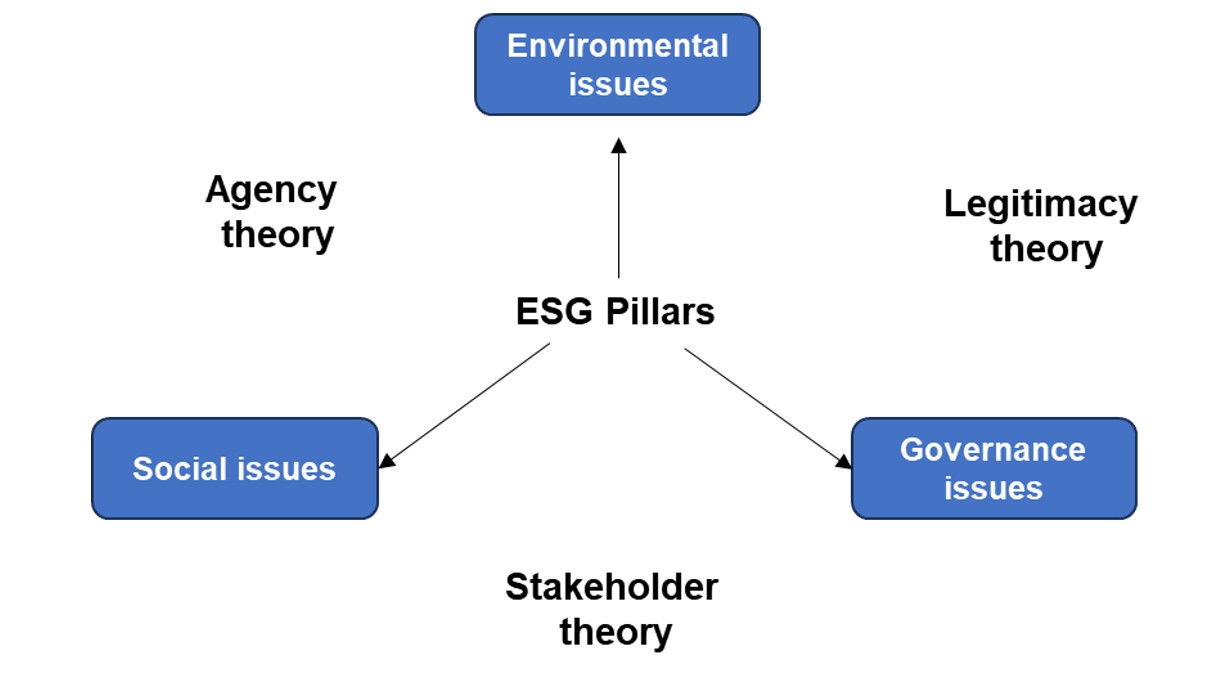
To examine the practical application of these ESG pillars in business operations and social impact analysis through sustainability indices, this study employs theoretical frameworks presented in Figure 2. These frameworks establish clear relationships between each pillar and its corresponding operational dimensions.

Relationship between ESG Theories and Pillars. Source: Adapted from Bellostas et al. (2023).
Freeman (2010) discusses the importance of considering and engaging all stakeholders in organizational decision-making processes, establishing the foundation of Stakeholder Theory. The author argues that corporations should not focus solely on shareholder profit maximization, but must also consider the impact of business actions on employees, customers, suppliers, local communities, and other involved parties. Consequently, this theory aligns closely with both the social and corporate governance pillars of ESG.
Stakeholder theory demonstrates that addressing the needs and interests of relevant parties contributes to more sustainable and ethical outcomes, thereby supporting long-term corporate success. Furthermore, the theory emphasizes corporate social responsibility and strategic stakeholder relationship management as fundamental components of corporate governance (Uribe et al., 2018).
Donaldson & Preston (1995) examine the concept of organizational legitimacy as perceived and acknowledged by stakeholders. Their theoretical framework posits that corporations must maintain a legitimate image within society and among interest groups by meeting social expectations and needs. The authors contend that legitimacy is essential for organizational survival and success, as it directly affects stakeholder relationships and market positioning. They maintain that companies must manage not only financial interests but also their societal and environmental relationships, recognizing that legitimacy plays a pivotal role in corporate management and value creation over time.
Jensen & Meckling (1998) present Agency Theory, which seeks to understand organizational operations and decision-making processes. The authors focus on owner-manager relationships, arguing that the separation of ownership and control creates inherent conflicts of interest. Thus, Agency Theory explains mechanisms through which shareholders ensure managerial decisions align with their interests, while implementing governance structures - including contracts, incentives, and monitoring systems - to minimize agency costs.
2.3 Stock exchanges and indices
Stock exchanges are organized marketplaces for trading securities including corporate stocks, real estate investment trusts (REITs), corporate and government debt instruments, and other financial products. These markets enable investors to buy and sell assets with the objective of generating profits through capital appreciation and dividend income (Cavalcante et al., 2009). Table 1 ranks the world’s largest stock exchanges by Q4 2023 market value (in US$ trillions), listing country, exchange, and data source. The data underscores disparities in economic influence and capital flows, highlighting key regional and global equity market dynamics.
Similarly, sustainability indices and indicators measure corporate performance regarding socio-environmental issues. Currently, numerous initiatives worldwide seek to assess and analyze these ESG aspects. Given that the ISE B3 is Latin America’s pioneering sustainability index and the world’s fifth (Orsato et al., 2015), it served as the benchmark for comparing other global ESG initiatives. Table 2 presents the indices and initiatives examined in this study.
Numerous methodologies and tools have been developed, both nationally and internationally, to assess the social performance of companies within the context of ESG practices. Among the key indices used in Brazil, the ISE B3 stands out. Launched in 2005 by B3 — the Brazilian stock exchange (Silva et al., 2015) — this tool serves as a benchmark for the financial market in identifying companies with strong sustainability practices. It evaluates organizational commitment to social aspects such as local community impact, employee well-being, diversity and inclusion, business ethics, respect for human rights, and social responsibility across the value chain (B3, 2020, 2022).
Globally, the FTSE4Good, created in 2001 by FTSE Russell, is widely used as a reference for socially responsible investments (FTSE Russell, 2022; Pinillos et al., 2018). This index identifies companies with robust ESG practices, employing a comprehensive approach to social indicators. Criteria include diversity and inclusion policies, eradication of child and forced labor, occupational health and safety, community engagement, and financial inclusion. The FTSE4Good methodology emphasizes compliance with international human rights standards and ethical business practices, fostering greater corporate transparency and accountability (Curran & Moran, 2007; Fowler & Hope, 2007).
Another prominent index is the Dow Jones Sustainability Index, launched in 1999 by S&P Dow Jones Indices in partnership with RobecoSAM (Fowler & Hope, 2007). The DJSI assesses corporate financial performance based on ESG criteria, with a strong focus on social dimensions. Metrics include employee well-being, organizational diversity, human rights adherence, and access to essential products and services in underserved communities. The index also highlights the integration of social factors into corporate strategy and risk management, promoting a long-term sustainability-oriented business culture (S&P DJSI, 2022; Zago et al., 2018).
Complementing these frameworks, the MSCI ESG Ratings provide an in-depth analysis of companies’ ESG risk exposure and management, including a robust social dimension. MSCI’s sustainability-focused indices include the pioneering Domini 400 Social Index (established in 1990) (Pinillos et al., 2018). MSCI’s evaluation covers occupational health, supplier relations, community engagement, and access to goods and services, tailored to sector-specific materiality. This enables investors to compare and analyze corporate social practices in detail (MSCI, 2021).
The Carbon Disclosure Project (CDP), founded in 2000 as a nonprofit, incorporates social indicators into its multi-tiered questionnaires despite its primary environmental focus (Makiya & Fraisse, 2015). The initiative acknowledges that issues like diversity, inclusion, worker health and safety, and human rights in supply chains are intrinsically tied to climate risk management and corporate sustainability. Thus, CDP fosters an integrated view of environmental and social sustainability pillars (CDP, 2021).
Beyond market indices, methodologies developed by civil society organizations and research institutes also play a significant role. For instance, the Ethos Institute for Business and Social Responsibility offers a measurement system for corporate social and environmental performance through its Ethos Indicators of Corporate Social Responsibility (Instituto Ethos, 2019). These indicators serve as a self-assessment tool for organizations, addressing diversity, ethics, decent labor practices, transparency, and contributions to sustainable development (Nakayama & Teixeira, 2012; Soares et al., 2011).
Similarly, the Social Balance Sheet IBASE, created by the Instituto Brasileiro de Análises Sociais e Econômicas (IBASE), functions as a social accountability mechanism. It measures and communicates organizational social performance, focusing on human resources, equal opportunity, community engagement, and ethical governance, thereby enhancing transparency and social responsibility (Soares et al., 2011).
Though primarily environmental, the Ecological Footprint—developed in 1996 by Mathis Wackernagel and William Rees—also reveals indirect social impacts. By quantifying human demand for natural resources against Earth’s regenerative capacity, the tool highlights issues like community displacement, food security, and environmental justice, underscoring the link between ecological pressures and social inequalities (Borucke et al., 2013; Global Footprint Network, 2025).
Lastly, the Brazilian Accounting Standards (NBC), introduced in 2011 by the Conselho Federal de Contabilidade (CFC), incorporate social elements despite their financial transparency focus. These include reporting on labor benefits, employee training investments, and corporate social responsibility initiatives. By expanding accounting beyond financial results, the NBC facilitates the integration of social factors into governance and organizational performance evaluation (Brasil, 2011).
3 Methodology
For researching and diagnosing extensive sustainable methodology reports, content analysis stands as one of the most widely employed methods for qualitative data examination. This article adopts this approach based on the methodological framework developed by Bardin (2011), given its extensive application and recognition in the field. As Bardin (2011) explains, content analysis is a methodological approach applicable to various types of documented material, relying on a structured set of analytical procedures that aim to ensure systematicity and objectivity in the description and interpretation of content.
The method consists of three developmental phases: (1) Pre-analysis, (2) Material Exploration, and (3) Results Processing. Figure 3 presents a visual representation of these stages and their associated tasks, adapted from Bardin’ (2011) most current content analysis framework.

In the first phase of content analysis for this study, following Bardin (2011) methodology, we organized the initial dataset to develop and analyze preliminary ideas in subsequent stages. This process began by selecting the most relevant sustainability indices, socio-environmental initiatives, and organizations, guided by bibliometric analysis of ESG-related search trends (Oliveira et al., 2023). We then established comparative relationships between the methodologies and questionnaires developed by these organizations, identifying gaps and potential improvements by benchmarking them against the ISE B3—the study's primary reference. Table 3 summarizes the methodologies incorporated into this content analysis, highlighting their alignment with the social dimension of corporate sustainability.
After selecting the terms to be studied, it was necessary to gather the relevant materials for analysis. Given that the research hypotheses and objectives had already been defined, an active search was conducted for the questionnaires and forms provided by each of the selected organizations. These documents were essential for parameterizing the data submitted by companies seeking alignment with the guidelines of these initiatives, organizations, and indices.
Following the initial review of the collected materials, Bardin (2011) states that the next step in content analysis is the exploration of the material. According to the author, this stage involves the stratification of the data, assessing the embedded information and coding the volume of data gathered. For the exploration of the material, as well as the organization and management of the qualitative data from the analyzed methodologies, the MaxQDA software was employed. This software stands out for its capacity to segment codes and generate qualitative spreadsheets and reports based on these segmentations.
To identify and define the relevant codes, the methodology of the ISE B3 was used as a reference. This approach served as a basis for identifying the coded segments in the other methodologies. Thus, the segments most aligned with the following codes and categories were selected: Purpose, Type of Index, Eligible Assets, Inclusion Criteria, Exclusion Criteria, and Weighting Criteria.
This methodological approach enabled a more detailed and accurate analysis of the qualitative data obtained from multiple sources. The use of MaxQDA as a support tool allowed for efficient structuring and organization of the data, facilitating a consistent and objective interpretation of the information. It is important to note that using the ISE B3 as a reference contributed to the standardization and uniformity in the identification of relevant codes, making the process more reliable and reproducible in future research.
Building upon this structured approach, the subsequent phase of analytical development involved the process of inference, defined as “[…] the performance of a logical operation, by which a proposition is accepted due to its connection with other propositions already assumed to be true” (Petit Robert, as cited in Bardin, 2011, p. 45). This stage of analysis development was of critical importance, as the propositions must always be anchored in principles and statements previously established and studied within the academic sphere. Furthermore, during the data interpretation phase, it was essential that the researcher’s attention remained focused on the theoretical framework to comprehensively understand the results in light of the systematic context of the topic—not merely as isolated outcomes.
4 Results and dicussions
After all coding, stratification, and analysis of the results using MaxQDA, a comparative assessment was conducted based on the requirements outlined in each of the initiatives. Table 4 presents the terms and parameters identified in each of the methodologies.
Considering that the methodologies analyzed stem from three indices, three organizations, and three distinct conceptual approaches, differences in content and focus were to be expected. However, a considerable similarity in ideas and objectives was observed across them.
An analysis of social issues within the main sustainability indices reveals a significant convergence in the themes they address. Although there are some variations, these indices consistently demonstrate a shared concern for evaluating and promoting corporate performance in relation to relevant social matters.
From the qualitative analysis, it is evident that certain social aspects are consistently addressed across corporate sustainability assessment methodologies. For instance, diversity and inclusion are universally addressed across all indices. Nevertheless, there are specific differences, such as the emphasis on child labor, which is highlighted by the CDP but not uniformly addressed by the other methodologies.
The most frequently addressed social issues across all indices include:
-
Employee well-being: Policies and practices related to health, safety, and the general well-being of employees are regarded as critically important across all indices;
-
Diversity and inclusion: The promotion of diversity in terms of gender, ethnicity, sexual orientation, and other relevant characteristics is a broadly valued concern in all indices;
-
Human rights: Respect for human rights within companies and throughout their supply chains is a common and shared concern;
-
Supplier relations: The adoption of ethical and fair practices in supplier selection and engagement is recognized as a relevant social issue by all indices;
● Community engagement: Active engagement with civil society and participation in social responsibility initiatives are valued by all indices.
The analysis further reveals that each index may place specific emphasis on certain social issues depending on its methodology and evaluation criteria. For example, the ISE B3 highlights issues such as community impact and responsibility across the value chain, while the DJSI places greater emphasis on themes like financial inclusion and access to essential products and services.
In addition, different sustainability assessment methodologies—such as those of FTSE4GOOD, DJSI, MSCI, CDP, Ecological Footprint, Ethos, Social Balance Sheet, and NBC—address a range of social issues not covered by the ISE B3, yet highly relevant for analyzing companies’ social performance (Table 5). Each of these instruments has its own criteria and specific approaches for evaluating corporate practices regarding social issues.
FTSE4GOOD, for example, stands out for addressing financial inclusion, ensuring that companies develop strategies to promote access to financial products and services for underserved communities. It also emphasizes occupational health and safety, ensuring that companies take adequate measures to protect workers’ health and safety.
The DJSI and MSCI also share a strong focus on occupational health and safety, as well as on child labor and forced labor, ensuring that companies do not engage in exploitative practices either directly or within their supply chains. Moreover, both indices highlight access to essential products and services, urging companies to consider the affordability and accessibility of their offerings for disadvantaged groups—an aspect not addressed by ISE B3.
The CDP includes occupational health and safety, along with child and forced labor concerns, and also adds financial inclusion as a key area, encouraging companies to expand access to financial services in underserved communities.
The Ecological Footprint, while primarily environmentally focused, indirectly touches on social issues such as food security, water availability, and community displacement. These socio-environmental dimensions relate to how the use of natural resources impacts community well-being—topics not mapped by the ISE B3.
Ethos, the Social Balance Sheet, and NBC emphasize decent work conditions and occupational health and safety, ensuring companies provide a safe and healthy work environment and respect labor rights. Furthermore, Ethos highlights transparency, corporate governance, sustainable development, and the social impact of corporate activities. The Social Balance Sheet addresses broader issues of human resources and corporate social responsibility, while NBC includes topics such as labor practices, compensation, employee benefits, and social responsibility.
This analysis shows that, while the ISE B3 is a key reference in the field of sustainability, other indices and tools expand the scope and depth of the social issues considered. These complementary approaches allow for a more holistic and comprehensive understanding of corporate social practices, encouraging companies to enhance their actions in support of social responsibility and sustainable development. Given the variety of social issues addressed by different indices, investors and other stakeholders are better equipped to make informed decisions when evaluating corporate social performance and their broader contributions to society.
The practice of ESG-related actions in companies also involves dimensions beyond risk assessment and socio-environmental performance. According to Sobrosa et al. (2020), all these indices aim to guide the capital market in highlighting companies that integrate social and environmental risks into their operations, positively influencing their public image. The ISE B3 is considered by some scholars as the leading benchmark for investors seeking portfolios of companies that combine social and environmental practices with financial returns and alignment with the Sustainable Development Goals (SDGs).
As highlighted by Sobrosa et al. (2020), the ISE B3 plays a key role in selecting companies aligned with the SDGs and in supporting strategic business planning. Additionally, it helps organizations through the use of questionnaires as planning tools for sustainability-oriented actions, fulfilling its mission to support investors in making socially responsible investment decisions and thus encouraging companies to adopt sustainable practices.
5 Final considerations
At the conclusion of the analysis conducted in this study, it is possible to compare the breadth of the social dimension covered by other sustainability methodologies and initiatives in relation to the ISE B3, through qualitative and content analysis supported by software such as MaxQDA. The findings indicate that the ISE B3 proves to be quite comprehensive among the selection of methodologies analyzed. Although some additional social aspects were identified in other frameworks that are not explicitly highlighted in the ISE B3, these aspects may be implicitly encompassed within the dimensions established by the ISE methodology.
Among the analyzed methodologies, FTSE4GOOD, DJSI, and MSCI are the most similar to the base methodology, although they are still less comprehensive than the ISE. The remaining methodologies partially address the social aspects listed and present certain compatibilities with the ISE; however, none of them—even when combined—match the overall scope and completeness of the ISE B3 framework.
The present study contributes to the investigation and comparison of leading corporate sustainability assessment methodologies in relation to the social dimension, by analyzing their connection with corporate social practices, using the ISE B3 as the primary benchmark. However, it encountered certain limitations, particularly in mapping aspects present in other methodologies that extend beyond those covered by the ISE B3—precisely due to the latter being adopted as the main reference. Nonetheless, the study’s findings highlight the existence of overlapping content across different methodologies and reporting frameworks, which may pose a challenge for organizations seeking to report their practices in a consistent and non-redundant manner.
In this regard, the study also provides valuable insights for regulatory bodies and sustainability framework developers by highlighting the need for greater harmonization across reporting standards and the revision of potential redundancies. These contributions can support initiatives aimed at streamlining and aligning regulatory frameworks, with a view to reducing the reporting burden on organizations and enhancing the clarity and usefulness of the information disclosed to stakeholders.
Therefore, future studies are encouraged to further explore the additional social aspects present in each of the evaluated methodologies, in order to support the development of a more comprehensive social index—one that can both quantify and qualify social aspects in their entirety. Moreover, this study may stimulate further research comparing the selected methodologies with the support of decision-making techniques, such as Data Envelopment Analysis (DEA), which can be used to assess the relative efficiency of reported social practices; factor analysis, to uncover latent structures among social variables; or cluster analysis, to group methodologies according to similarities in adopted social criteria.
The application of these statistical and multicriteria tools can complement the qualitative approach adopted in this study, providing a more robust foundation for the development of composite indices and enabling objective comparisons across different reporting models. Such methodological combinations also enhance data triangulation and expand the potential applicability of the results by policymakers, regulators, and corporate stakeholders.
Acknowledgements
The authors gratefully acknowledge the support provided by the University of São Paulo (USP) and the ADESP Research Group at the São Carlos School of Engineering (EESC-USP). Their institutional backing and collaborative environment were instrumental in the development of this research.
Statement on Data Availability
The datasets used and/or analyzed during the current study are available from the cor-responding author on reasonable request.
Financial support:
How to cite:
References
-
Australian Securities Exchange – ASX. (2023). ASX Colo OnDemand. Retrieved in 2025, June 17, from https://www.asx.com.au
» https://www.asx.com.au -
B3. (2020). O que é o ISE B3 Retrieved in 2025, April 16, from http://iseb3.com.br/o-que-e-o-ise
» http://iseb3.com.br/o-que-e-o-ise -
B3. (2022). Metodologia do índice de sustentabilidade empresarial (ISE B3) Retrieved in 2025, April 16, from www.b3.com.br
» www.b3.com.br -
B3. (2025). Quem somos. Retrieved in 2025, June 17, from https://www.b3.com.br/pt_br/b3/institucional/quem-somos/
» https://www.b3.com.br/pt_br/b3/institucional/quem-somos/ - Bardin, L. (2011). Análise de Conteúdo. São Paulo: Edições 70.
-
Bellostas, A., Del Río, C., González-Álvarez, K., & López-Arceiz, F. J. (2023). Cultural context, organizational performance and Sustainable Development Goals: a pending task. Green Finance, 5(2), 211-239. http://doi.org/10.3934/GF.2023009
» http://doi.org/10.3934/GF.2023009 -
Borucke, M., Moore, D., Cranston, G., Gracey, K., Iha, K., Larson, J., Lazarus, E., Morales, J. C., Wackernagel, M., & Galli, A. (2013). Accounting for demand and supply of the biosphere’s regenerative capacity: the National Footprint Accounts’ underlying methodology and framework. Ecological Indicators, 24, 518-533. http://doi.org/10.1016/j.ecolind.2012.08.005
» http://doi.org/10.1016/j.ecolind.2012.08.005 - Brasil. Conselho Federal de Contabilidade – CFC. (2011). Resolução CFC N.o 1.328/11. Dispõe sobre a Estrutura das Normas Brasileiras de Contabilidade Brasília, DF: Diário Oficial da República Federativa do Brasil.
-
Carroll, A. B. (2009). A history of corporate social responsibility. In A. Crane, D. Matten, A. McWilliams, J. Moon, & D. S. Siegel (Eds.), The Oxford handbook of corporate social responsibility (pp. 19-46). Oxford: Oxford University Press. http://doi.org/10.1093/oxfordhb/9780199211593.003.0002
» http://doi.org/10.1093/oxfordhb/9780199211593.003.0002 -
Cavalcante, L. R. M. T., Bruni, A. L., & Costa, F. J. M. (2009). Sustentabilidade empresarial e valor das ações: uma análise na bolsa de valores de São Paulo. Revista de Gestão Social e Ambiental, 3(1). http://doi.org/10.5773/rgsa.v3i1.118
» http://doi.org/10.5773/rgsa.v3i1.118 -
CDP. (2021). CDP Climate Change 2021 Scoring Methodology Retrieved in 2025, April 16, from www.cdp.net
» www.cdp.net - Clark, G. L., Feiner, A., & Viehs, M. (2015). From the Stockholder to the Stakeholder: how sustainability can drive financial outperformance. SSRN Electronic Journal http://doi.org/10.2139/ssrn.2508281.
-
Cunha, F. A. F. S., de Oliveira, E. M., Orsato, R. J., Klotzle, M. C., Cyrino Oliveira, F. L., & Caiado, R. G. G. (2020). Can sustainable investments outperform traditional benchmarks? Evidence from global stock markets. Business Strategy and the Environment, 29(2), 682-697. http://doi.org/10.1002/bse.2397
» http://doi.org/10.1002/bse.2397 -
Curran, M. M., & Moran, D. (2007). Impact of the FTSE4Good Index on firm price: an event study. Journal of Environmental Management, 82(4), 529-537. http://doi.org/10.1016/j.jenvman.2006.02.010 PMid:16678334.
» http://doi.org/10.1016/j.jenvman.2006.02.010 -
Deutsche Börse Group – DBG. (2025, May 15). About us. Retrieved in 2025, June 17, from https://www.deutsche-boerse.com/dbg-en/about-us
» https://www.deutsche-boerse.com/dbg-en/about-us -
Donaldson, T., & Preston, L. E. (1995). The stakeholder theory of the corporation: concepts, evidence, and implications. Academy of Management Review, 20(1), 65. http://doi.org/10.2307/258887
» http://doi.org/10.2307/258887 -
Edmondson, B. (2022, July 13). What is Corporate Social Responsibility (CSR)? The Balance Money. Retrieved in 2025, April 16, from https://www.thebalancemoney.com/corporate-social-responsibility-csr-4772443
» https://www.thebalancemoney.com/corporate-social-responsibility-csr-4772443 -
Euronext. (2023). Euronext: the European stock market and infrastructure. Retrieved in 2025, June 17, from https://www.euronext.com
» https://www.euronext.com -
Fowler, S. J., & Hope, C. (2007). A critical review of sustainable business indices and their impact. Journal of Business Ethics, 76(3), 243-252. http://doi.org/10.1007/s10551-007-9590-2
» http://doi.org/10.1007/s10551-007-9590-2 -
Freeman, R. E. (2010). Managing for stakeholders: trade-offs or value creation. Journal of Business Ethics, 96(S1), 7-9. http://doi.org/10.1007/s10551-011-0935-5
» http://doi.org/10.1007/s10551-011-0935-5 - FTSE Russell. (2022). FTSE4Good Index Series F FTSE Russell.
-
Global Footprint Network. (2025, April 10). Our history. Retrieved in 2025, April 16, from https://www.footprintnetwork.org/about-us/our-history/
» https://www.footprintnetwork.org/about-us/our-history/ -
HKEX. (2023). Who we are. Retrieved in 2025, June 17, from https://www.hkexgroup.com/about-hkex/about-hkex?sc_lang=en
» https://www.hkexgroup.com/about-hkex/about-hkex?sc_lang=en - Instituto Ethos. (2019). Indicadores Ethos para negócios sustentáveis e responsáveis São Paulo: Instituto Ethos.
-
Janeiro, L., & Patel, M. K. (2015). Choosing sustainable technologies. Implications of the underlying sustainability paradigm in the decision-making process. Journal of Cleaner Production, 105, 438-446. http://doi.org/10.1016/j.jclepro.2014.01.029
» http://doi.org/10.1016/j.jclepro.2014.01.029 -
Japan Exchange Group – JPX. (2023). Retrieved in 2025, June 17, from http://www.jpx.co.jp/english
» http://www.jpx.co.jp/english -
Jensen, M. C., & Meckling, W. H. (1998). Theory of the firm: managerial behavior, agency costs and ownership structure. SSRN Electronic Journal http://doi.org/10.2139/ssrn.94043
» http://doi.org/10.2139/ssrn.94043 -
JSE. (2025). History. Retrieved in 2025, June 17, from https://group.jse.co.za/group-overview/history
» https://group.jse.co.za/group-overview/history -
Kotsantonis, S., & Serafeim, G. (2019). Four things no one will tell you about ESG data. The Bank of America Journal of Applied Corporate Finance, 31(2), 50-58. http://doi.org/10.1111/jacf.12346
» http://doi.org/10.1111/jacf.12346 -
Kraus, S., Rehman, S. U., & García, F. J. S. (2020). Corporate social responsibility and environmental performance: the mediating role of environmental strategy and green innovation. Technological Forecasting and Social Change, 160, 120262. http://doi.org/10.1016/j.techfore.2020.120262
» http://doi.org/10.1016/j.techfore.2020.120262 -
Krisprimandoyo, D. A., Jayusman, H., Arpianto, Y., Sulistyo, A. B., & Simbolon, B. (2023). Integrating environmental principles in sustainable corporate management strategies. The International Journal of Science in Society, 5(4), 475-486. http://doi.org/10.54783/ijsoc.v5i4.806
» http://doi.org/10.54783/ijsoc.v5i4.806 -
KRX. (2023). Global KRX. Retrieved in 2025, June 17, from https://global.krx.co.kr/main/main.jsp
» https://global.krx.co.kr/main/main.jsp -
Liang, H., & Renneboog, L. (2020). Corporate social responsibility and sustainable finance: a review of the literature. SSRN Electronic Journal http://doi.org/10.2139/ssrn.3698631
» http://doi.org/10.2139/ssrn.3698631 -
London Stock Exchange – LSEG. (2025). Retrieved in 2025, March 17, from https://www.londonstockexchange.com/discover/who-we-are
» https://www.londonstockexchange.com/discover/who-we-are -
Makiya, I. K., & Fraisse, C. W. (2015). Sustainability initiatives driving supply chain: climate governance on beef production system. Journal of Technology Management & Innovation, 10(1), 215-224. http://doi.org/10.4067/S0718-27242015000100016
» http://doi.org/10.4067/S0718-27242015000100016 - MSCI. (2021). MSCI KLD 400 Social Index Methodology Berkeley, CA: MSCI Inc.
- Nakayama, R. M., & Teixeira, R. M. (2012). Ações de responsabilidade social com relação ao stakeholder fornecedor: estudo de caso baseado nos indicadores Ethos em uma empresa brasileira do setor de cosméticos social. Contabilidade, Gestão e Governança, 15(1), 60-79.
-
Nasdaq. (2023). About Nasdaq. Retrieved in 2025, June 17, from https://www.nasdaq.com/about
» https://www.nasdaq.com/about -
National Stock Exchange of India – NSE. (2023). Retrieved in 2025, June 17, from https://www.nseindia.com
» https://www.nseindia.com -
New York Stock Exchange – NYSE. (2023). Retrieved in 2025, June 17, from https://www.nyse.com/index
» https://www.nyse.com/index -
Oliveira, M. J. E. M., Cunha, Í. G. F., Policarpo, R. V. S., Abdala, E. C., & Rebelatto, D. A. N. (2023, October 27). ESG e Objetivos de Desenvolvimento Sustentável na produção acadêmica: análise bibliométrica da agenda social. In Anais do Encontro Nacional de Engenharia de Produção (pp. 1-15). Rio de Janeiro: ABEPRO. http://doi.org/10.14488/ENEGEP2023_TN_WG_407_2006_45460
» http://doi.org/10.14488/ENEGEP2023_TN_WG_407_2006_45460 -
Orsato, R. J., Garcia, A., Mendes-Da-Silva, W., Simonetti, R., & Monzoni, M. (2015). Sustainability indexes: why join in? A study of the ‘Corporate Sustainability Index (ISE)’ in Brazil. Journal of Cleaner Production, 96, 161-170. http://doi.org/10.1016/j.jclepro.2014.10.071
» http://doi.org/10.1016/j.jclepro.2014.10.071 -
Pinillos, A. A., Fernández-Fernández, J. L., & Fernández Mateo, J. (2018). Revisión crítica de la dimensión Gobierno Corporativo en los cuestionarios de los Índices de Sostenibilidad. Revista de Comunicación, 17(2), 9-40. http://doi.org/10.26441/RC17.2-2018-A1
» http://doi.org/10.26441/RC17.2-2018-A1 -
PwC. (2021). Private equity’s ESG journey: from compliance to value creation Retrieved in 2025, April 16, from https://www.pwc.com/gx/en/private-equity/private-equity-survey/pwc-pe-survey-2021.pdf
» https://www.pwc.com/gx/en/private-equity/private-equity-survey/pwc-pe-survey-2021.pdf - S&P DJSI. (2022). Dow Jones Sustainability Indices: methodology S&P DJSI.
-
Saudi Exchange. (2025). About Saudi Exchange. Retrieved in 2025, June 17, from https://www.saudiexchange.sa/wps/portal/saudiexchange/about-saudi-exchange/aboutus/saudi-exchange?locale=en
» https://www.saudiexchange.sa/wps/portal/saudiexchange/about-saudi-exchange/aboutus/saudi-exchange?locale=en -
Shanghai Stock Exchange – SSE. (2023). Retrieved in 2025, June 17, from http://english.sse.com.cn
» http://english.sse.com.cn -
Shenzhen Stock Exchange – SZSE. (2023). Overview Shenzhen Stock Exchange. Retrieved in 2025, June 17, from http://www.szse.cn/English/about/overview/index.html
» http://www.szse.cn/English/about/overview/index.html -
Silva, E. H. D. R., Lima, E. P., Costa, S. E. G., & Sant’Anna, Â. M. O. (2015). Análise comparativa de rentabilidade: um estudo sobre o Índice de Sustentabilidade Empresarial. Gestão & Produção, 22(4), 743-754. http://doi.org/10.1590/0104-530X1889-14
» http://doi.org/10.1590/0104-530X1889-14 -
SIX Swiss Exchange. (2023). Retrieved in 2025, June 17, from https://www.six-group.com/en/products-services/the-swiss-stock-exchange.html
» https://www.six-group.com/en/products-services/the-swiss-stock-exchange.html - Soares, S. V., Lanzarin, J., & Pfitscher, E. D. (2011). Investimentos sociais e ambientais de uma instituição financeira: evidenciação por meio de balanço social. Revista de Contabilidade e Controladoria, 3(2), 57-77.
-
Sobrosa, R. C., No., Lima, C. R. M., Bazil, D. G., de Oliveira Veras, M., & de Andrade Guerra, J. B. S. O. (2020). Sustainable development and corporate financial performance: a study based on the Brazilian Corporate Sustainability Index (ISE). Sustainable Development, 28(4), 960-977. http://doi.org/10.1002/sd.2049
» http://doi.org/10.1002/sd.2049 -
Taiwan Stock Exchange Corporation – TWSE. (2023). Retrieved in 2025, June 17, from https://www.twse.com.tw/en/about/company/welcome.html
» https://www.twse.com.tw/en/about/company/welcome.html -
Tehran Stock Exchange – TSE. (2025). Retrieved in 2025, June 17, from https://www.tse.ir/en
» https://www.tse.ir/en -
TMX. (2023). TMX group. Retrieved in 2025, March 17, from https://www.tsx.com/
» https://www.tsx.com/ -
Uribe, D. F., Ortiz-Marcos, I., & Uruburu, Á. (2018). What Is Going on with stakeholder theory in project management literature? A symbiotic relationship for sustainability. Sustainability, 10(4), 1300. http://doi.org/10.3390/su10041300
» http://doi.org/10.3390/su10041300 -
Vadi, V. (2011). Corporate social responsibility in the twenty-first century: debates, models and practices across government, law and business. Legal Studies, 31(4), 667-670. http://doi.org/10.1111/j.1748-121X.2011.00210.x
» http://doi.org/10.1111/j.1748-121X.2011.00210.x -
Zago, A. P. P., Jabbour, C. J. C., & Bruhn, N. C. P. (2018). Corporate sustainability and value creation: the case of the “Dow jones sustainability index”. Gestão & Produção, 25(3), 531-544. http://doi.org/10.1590/0104-530x2958-16
» http://doi.org/10.1590/0104-530x2958-16 -
Żelazna, A., Bojar, M., & Bojar, E. (2020). Corporate social responsibility towards the environment in lublin region, poland: a comparative study of 2009 and 2019. Sustainability, 12(11), 4463. http://doi.org/10.3390/su12114463
» http://doi.org/10.3390/su12114463
Editor-in-Chief