 Firewood and charcoal production in northeastern of Brazil
ABSTRACT
Background: Brazil has the largest tropical forest cover in territorial extension, although it is subject to different forms of threat. We analyzed a time series of the firewood and charcoal production from the extractivism of native forests between the years 2010 and 2020 in Northeast Brazil, in order to support future reflections on the impacts of these uses on the sustainability of the production chain of exploration and on the conservation of native forests in the region. Considering the time frame from 2010 to 2020, data on the volume of firewood and charcoal produced from plant extraction in the Northeastern, were obtained via the official platform of Brazilian Institute of Geography and Statistics.
Results: The total production of firewood was 157,771,059 m3 and charcoal 4,137,418 t., while the states of Bahia (29.3%), Ceará (21.4%) and Maranhão (14.1%) accounted for 74.8% of total firewood produced in the Northeastern. As for charcoal production, Maranhão (51.0%), Bahia (20.3%) and Piauí (23.8%) accounted for 95.1% of total produced. Production stationarity was found for all states, with the exception of Paraíba and Piauí in firewood, and Paraíba and Rio Grande do Norte in charcoal. A downward trend was identified in most states, with the exception of Paraíba and Piauí in firewood and Paraíba and Rio Grande do Norte in charcoal, both without any type of trend.
Conclusion: Considering the economic sustainability of the production chain, efforts to encourage energy plantations should focus on regions with lower production, using species of fast-growing species that can meet demand and conserve native caatinga vegetation.
Key words:
Plant extraction; sustainable forest; management plan, conservation of the caatinga
HIGHLIGHTS
Firewood and charcoal production in Northeastern followed an annual cyclical pattern. There was a downward trend in production in most states in the Northeastern. The pandemic period in 2020 influenced the downward in states of greater production. Forestry of fast-growing species as alternative sources in underutilized sites.
INTRODUCTION
Brazil is the leading producer of woody phytomass per unit area of the world, used mainly as sawn wood, from planted forests and one of the major producers in tropical forests (Stape et al., 2010; Silva et al., 2012; Cunha et al., 2021). The tropical climate favors plant growth fast than other environments. In addition, Brazil has the largest forest cover in territorial extension in the tropical zone and the second largest cover in the world (second only to Russia in extension) (Roma and Andrade, 2013; Chudy and Hagler, 2020).
The area occupied by native vegetation in Brazil corresponds to 66.3% of its territorial extension, mostly composed of protected areas (terrestrial and marine areas in conservation units, legal reserves, indigenous lands, quilombolas, and permanent preservation areas) (Brasil 2006a; Miranda, 2017). A large area of conserved native forests and successor formations, in the public or private domain, is subjected to exploitation, as in the Caatinga and Amazon biomes, for example, provided they are submitted to Sustained Forest Management Plans (SFMP), approved by the National Environmental System (SISNAMA), as established in Decree 5,975 of November 30, 2006 (Brasil, 2006b). However, historically, practices of unsustainable use in natural areas have generated losses of productive surfaces. Added to this are the losses of the gene pool, observed through the loss of species richness and biodiversity; loss of environmental services, and; no less relevant, social impacts and economic opportunities losses (Zaú, 2014).
Logging in Northeastern of Brazil (NB) has still occurred, especially in the Caatinga vegetation, including inappropriately firewood and charcoal exploitation without SFMP, which can compromise environmental quality and biodiversity, and deplete natural stocks of wood caused by cutting speed above the vegetation regeneration capacity (Gama, 2021; Souza et al., 2018; Tabarelli et al., 2018). For example, firewood is used as an energy matrix in calcination for the production of gypsum in the Araripe region of Pernambuco, where only 3% of consumed firewood is from areas of vegetation submitted to SFMP (Gadelha et al., 2015).
Nevertheless, Brazil is still a major world producer and consumer of firewood and wood for energy production, in which the South and Northeastern are the two largest producers of firewood in the country, differing in the origin of the firewood produced. While the South produces primarily from planted forests, the Northeastern production is based mainly on the native forests (Moreira, 2011a). Thus, although silviculture prevails over plant extraction, firewood still stands out as the main extractive product in Brazil (Gioda, 2019; Bichel and Telles, 2016), with greater emphasis, therefore, in the Northeastern (Moreira, 2011a). Therein, more than 95% firewood produced comes from plant extraction (Moreira, 2011a), corresponding to 59.8% of total produced in the country (Bichel and Telles, 2016).
For understanding purposes, native logging, according to the definition of the IBGE (Brasil, 2021a), comprises the process of collecting wood in a rational way (allowing sustainable production to be obtained over time), or in a primitive, itinerant way (generally enabling only a single production).
The use of wood resources for energy purposes in Brazil has been demanded by the residential sector, which represents 28% of total firewood energy offered in the country, followed by the industrial sector (23%), agriculture (8.9%), and the commercial sector represented by 0.3% (Moreira, 2011a). It is noteworthy that, economically, the residential use of firewood, for example, is the most viable energy strategy because it has a lower purchase price than natural gas, which generally becomes incompatible with income and demand (Medeiros et al., 2011). In this regard, it is important to highlight that the NRB is highly dependent on native forest resources for firewood extraction and charcoal production (Coelho Júnior et al., 2019). About 25% of the energy consumed by industrial and commercial sectors of this region comes from forest biomass, generating about 900,000 direct and indirect jobs (Silva et al., 2021).
Understanding the dynamics of wood energy production in its space-time aspect is an important diagnosis to support alternatives, mainly socioeconomic and environmental, within a perspective of renewable energy sources, which in this case can be explained by different causes using the time series technique. According to Reimbold et al., (2017), time series is a collection of observations made sequentially over time, whose order and occurrence in uniform intervals are relevant in its analysis.
On the other hand, the information generated on the extraction of wood from native Caatinga vegetation in the Northeast region of Brazil, regarding the intensity produced at regular intervals throughout the studied period, is important in the national timber sector, since it can directly impact planted forests, supplementing production projections due to inadvertent demands for firewood and charcoal. In this context, our goal was to analyze a time series of firewood and charcoal production from the extractivism of native forests, between the years 2010 and 2020 in Northeastern of Brazil, in order to support future evaluations in terms of environmental, social, and economic sustainability.
MATERIAL AND METHODS
Characterization of the study region
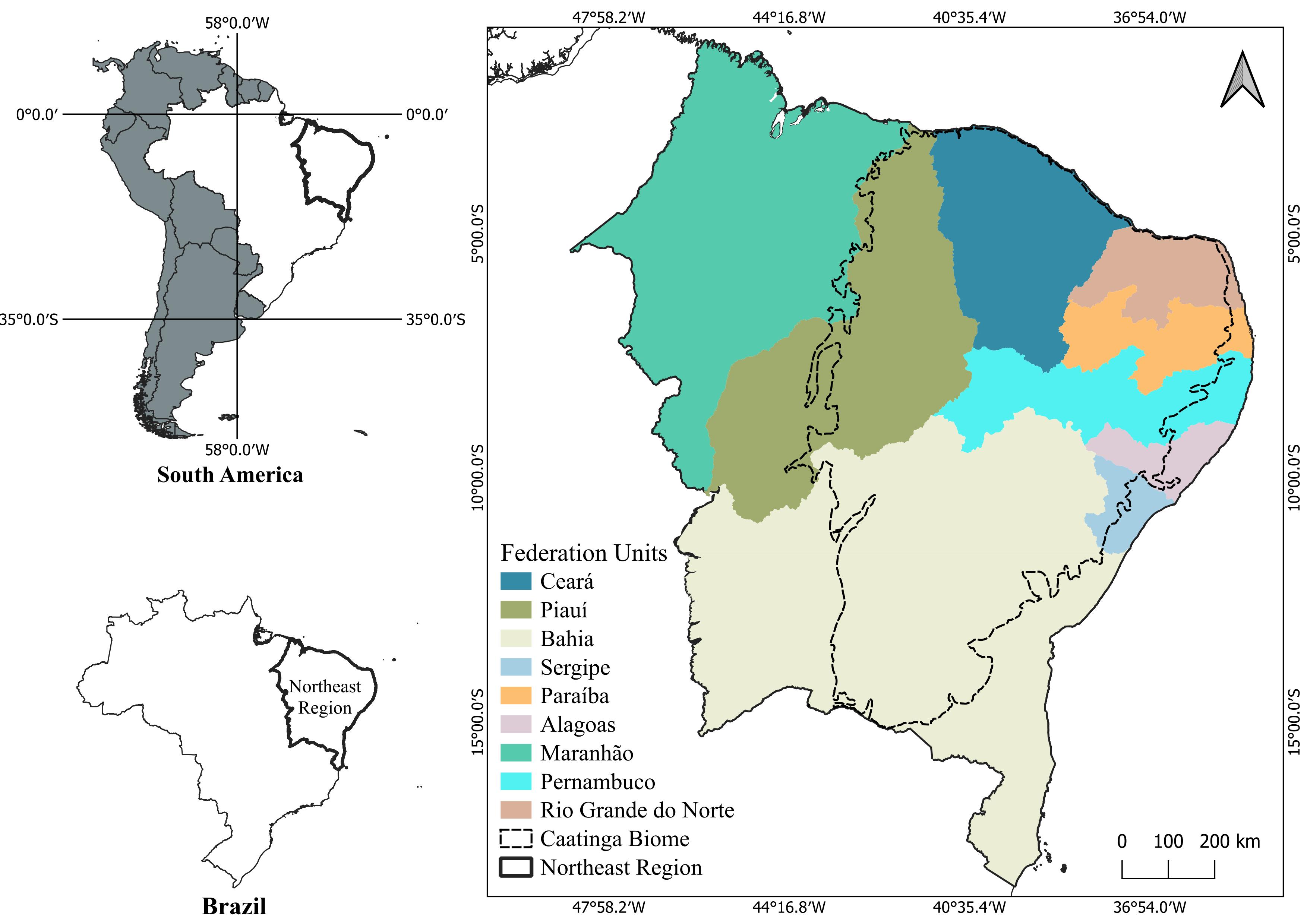
The territory of the Northeastern of Brazil (NB) occupies an area of 1,552,175.419 km² (18.2% national territory) with an estimated population of 57,667,842 in habitants (Brasil 2021b; 2021c). It is located east of the continent of South America, between the coordinates 1° and 18° S and 35° and 47° W, and is formed by nine states: Alagoas-AL, Bahia-BA, Ceará-CE, Maranhão-MA, Paraíba-PB, Pernambuco-PE, Piauí-PI, Rio Grande do Norte-RN, and Sergipe-SE (Figure 1).

Belonging to the Neotropical Biogeographical Region, designated by typical vegetation with peculiar fauna in a given climatic condition (Morrone, 2014; Figueiró, 2015), the NRB is predominantly occupied by three Biomes: the Cerrado, originally present in 20.8% of NRB occupying western parts of Bahia and Piauí and eastern Maranhão (Castro and Martins, 1999); the Caatinga covering in an original area 53.2% of NRB, with presence in all states, except for Maranhão (Brasil, 2009); and the Atlantic Forest, occurring in the coastal strip from Rio Grande do Norte to the south of Bahia, originally occupying 10.6% of NRB (Rosa, 2016). In addition, the Amazon Biome occupies 7.2% of NRB in the state of Maranhão (Lemos and Silva, 2012).
Four types of climates occur in the NRB: The Humid Equatorial Climate (in a part of Maranhão); the Humid Coastal Climate (from the coast of Bahia to Rio Grande do Norte); the Tropical Climate (including Bahia, Ceará, Maranhão and Piauí) and the Tropical Semi-arid Climate present in much of the central region of the Northeastern (Silva et al., 2011). The semi-arid climate, in particular, corresponds to 64.9% of NRB and concentrates around 50% of the population in the Northeastern (Brasil, 2017; 2021b).
Rainfall distribution, number of rainy days and temperature for the RNB is not uniform, varying significantly according to geographic location. Temperatures are lower in the rainy period compared to the dry period, with average annual variations from 18 °C to 26 °C. Rainfall variability ranges from less than 700 mm.year-1 to over 2,500 mm.year-1 in some regions and municipalities in the Northeastern (Silva et al., 2011; Alvares et al., 2013; 2023), with differences still varying between states (Table 1).
Regarding soils in NRB, types of Latosol predominate distributed in 29.5% of the Northeastern, followed by Neosol (24%) and Argisol in 16.7%, which together account for 70.2% occupation in this region. They are mostly weathered, deep, sandy soils with low natural fertility (Marques et al., 2014).
Data collection and analysis
Historical series information was obtained from the database available on the official platform of the governmental Brazilian Institute of Geography and Statistics (IBGE), referring to plant extraction in the last 11 years (2010 - 2020) in Northeastern of Brazil (Brasil, 2022). With data obtained from charcoal production in tons and firewood production data in volume (m³) independent of each other. In which the volume of firewood used for charcoal production, from the carbonization process, does not include in the volume of firewood presented.
Subsequently, data were organized and tabulated using a Microsoft Office Excel 2010 spreadsheet for descriptive statistics, construction of bi-themed graphs and self-explanatory tables. For statistical analysis, Action Stat 3.6® (Action, 2016) was used.
Data were subjected to the non-parametric Mann-Kendall test (Mann, 1945; Kendall, 1975) to check for an upward or downward time trend or data stability in the historical series. The Mann-Kendall test does not require previous data transformation, since they do not depend on normal or non-normal frequency distributions.
Stationary analysis was carried out using the unit root test [H0 (|φ| < 1); H1 (φ = 1)] of KPSS (Kwiatkowski-Phillips-Schmidt-Shin), at 5% probability (Kendall, 1975) taking into account the stationarity of the variables under study, verifying the level of randomness of firewood and charcoal production over the course of time series.
For the KPSS test, the null hypothesis was represented by the stationary series, that is, not having a unit root (Kwiatkowski, 1992). The test specification assumes two defined equations (1 and 2): where rt is the random variable and its initial value r0 is fixed and serves as an intercept; and μt is a normal and identically distributed distribution (0, σ2).
The adaptation of the model was verified using Mean Absolute Deviation (MAD) errors, which represent the sum of absolute deviations of the periods, divided by the number of periods, according to Moreira (2011b) and Mean Absolute Percentage Error (MAPE), which evaluates the mean absolute percentage deviation in error calculation, according to Lustosa et al., (2008), represented by equations 3 and 4:
where Dt is the actual value; Ft = predicted value; n = number of periods.
RESULTS
Behavior of firewood production and charcoal from 2010 to 2020 in Northeastern of Brazil
In NRB the total general volume of firewood production was 179,844,892 m³ and of charcoal production was 4,753,958 t. The total average volume of firewood and charcoal was 1,816,615.07 m3 and 48,019.78 t, respectively. The states of Bahia and Ceará are the main producers of firewood with 30.7% and 21.5%, respectively, followed by Maranhão with 13.7%. Charcoal production is concentrated in three States, Maranhão accounted for 51.6% of total production which, added to the production of Bahia (20.1%) and Piauí (23.6%), totaled 95.3% of charcoal produced throughout the Northeastern (Table 2).
The variation in production over the time series pointed to higher firewood production in 2010 in the states of Alagoas, Maranhão, and Sergipe. In 2011, there was greater production in the states of Bahia and Ceará, followed by Pernambuco. In 2012, there was greater production in Rio Grande do Norte and Piauí. Finally, in Paraíba, it occurred in 2020. Regarding charcoal, the states of Alagoas, Bahia, Paraíba, Piauí, and Sergipe had the highest production peak in 2010. The states of Pernambuco, Maranhão, Ceará, Piauí, and Rio Grande do Norte had peaks, respectively, in the years of 2011, 2012, 2013, 2015 and 2019.
In general production, Bahia was the largest producer in firewood in the entire historical series, followed by Ceará. Whereas for charcoal production Maranhão, followed by Piauí and Bahia were the main producers (Figure 2).

Behavior of firewood production in cubic meters (m³) and charcoal in tons (t) during the time series from 2010 to 2020 in Northeastern of Brazil.
Considering the difference in production between the first (2010) and last year (2020), there was a sharp drop of just over 69% in the case of charcoal, and approximately 50% for firewood (Table 3). Only the state of Rio Grande do Norte presented an increase of 22.2% in charcoal production, and the states of Paraíba (with 5%) and Piauí (with 3.5%), increases in terms of firewood production.
Trend for firewood production and charcoal from 2010 to 2020 in Northeastern of Brazil
The KPSS test between the totals of each year for each state indicated non-stationarity production in the states in the time series, with exception only for the states of Paraíba and Piauí in firewood production, and Paraíba and Rio Grande do Norte, in terms of charcoal production (Table 4).
Considering the 2010-2020 series, regarding to the firewood production, stability was identified in Piauí and Paraíba (Mann-Kendall; p > 0.05), Table 5.
For charcoal production, stability was found for the states of Paraíba and Rio Grande do Norte (Mann-Kendall; p > 0.05), Table 6.
According to the trend line, a downward trend was identified for all states in relation to firewood and charcoal production, except for the states of Piauí and Paraíba for firewood production (Figure 3), and Paraíba and Rio Grande do Norte, for charcoal production, remaining stabilized, according to the Mann-Kendall test (Figure 4).

Trend analysis for firewood production based on the time series between 2010 and 2020 in Northeastern of Brazil.

Trend analysis for charcoal production based on the time series between 2010 and 2020 in Northeastern of Brazil.
DISCUSSION
Behavior of firewood production and charcoal from 2010 to 2020 in Northeastern of Brazil
Data on the total production rate and average total production of firewood (179,844,892 m³ and 1,816,615.07 m³, respectively) and charcoal (4,753,958 t and 48,019.78 t) in the 11 years of the analyzed time series in Northeastern of Brazil (NB), show a high energy capacity available in the region for phytomass production through plant extraction.
Regarding the states with the highest productions, Bahia and Maranhão stood out whit in great potential. Economically, this can contribute to greater employment generation capacity in these states for this sector, potentially expanding and diversifying industries and other uses of biomass with greater added value and future perspectives of locals biorefineries implementation future perspectives (Antar et al., 2021; Chandel et al., 2021).
In terms of type of vegetation, although the origin of these woods is not known, it is possible that a large part comes from the Caatinga vegetation, followed by the Cerrado vegetation, since 100% Ceará and a large part of the territory of the states of Bahia and Piauí are occupied by these biomes. Coelho Junior et al. (2019) corroborate this conception, since approximately 80% of total volume of charcoal and firewood produced in the Northeastern comes from the Caatinga.
Also considering that planted forests play a key role in offsetting the pressure and negative impacts on natural forests exploitation, until 2015, the annualized rates showed a 1.2% drop in planted forest areas, which is concerning, since an increase rate of 2.4% is required to meet the world’s future wood and fiber demands and offset the impacts of deforestation (Payn et al., 2015).
We can infer that is possible from the Amazon is also supplying this material, due to the large volume of firewood and charcoal produced by Maranhão, a state in which 34% of its territory is occupied by tropical forests (Lemos and Silva, 2012). Still in this respect, we cannot exclude the possibility that part of the Atlantic Forest is being used as a possible source of woody material for firewood and charcoal.
Trend for firewood production and charcoal from 2010 to 2020 in Northeastern of Brazil
It is observed that the downward trend of this historical series is still a recent process, as over the last few decades, vegetation cover, especially in the Cerrado and Caatinga, has suffered constant reduction, with net loss rates of around 0.35% of area per year in the Cerrado, and 0.25% per year in the Caatinga (Beuchle et al., 2015). Possibly because the supply of firewood and charcoal production from forest cultivation it wouldn’t have been sufficient to satisfy demand in Brazil (Simioni et al., 2017). Reason why, according to Moreira (2011a) and Simioni et al. (2017), it must have stimulated a greater demand for firewood and charcoal for energy purposes extracted from native forests, leading to an increase in pressure for these products and increasing deforestation.
In a general way, the drop in charcoal production, greater than in firewood production, can be explained by the economic disincentive of the market (Simioni et al., 2017). This is because, in places where production is not yet significant, price increases become less competitive, which enables smaller demand (Simioni et al., 2017). That is, this process generates, in a way, a balance between supply and demand, which results in a relative decrease in prices and, consequently, in lower production. On the other hand, the constant demand for firewood as an energy source is more attractive in terms of logistical cost, although less remunerated because there is no added value (Lima-Júnior et al., 2015).
This reduction in firewood and charcoal production in the Northeastern may also be related to new, more convenient sources of energy such as gas or electricity or a consequence of the reduction in native vegetation itself (Sanquetta et al., 2019).
Furthermore, the demand for firewood and/or charcoal from extractivism would also occur as a result of the increase in the price of wood from planted forests, caused by demand for this wood for other purposes, reducing its quantity offered for energy. In addition, the supply of wood from planted forests is relatively inflexible in the short term (Moreira, 2011a), extending the impacts on the groups depending on such biomass.
However, the results show that over the time series the production of firewood and charcoal tended to fall sharply. However, it is necessary to mention that the time series end (mainly, 2020) may have been heavily influenced by the COVID-19 pandemic period, since many services and work fronts were interrupted during this period. As observed in a recent study published in 2020 (Chudy and Hagler, 2020), the recession in the world timber market between 1995 to 2017, with a large drop in demand and the consequent devaluation, has indirectly affected logging in Brazil, in addition to the national recession. It is worth highlighting that, although Brazil does not export this type of biomass (firewood and charcoal), the pandemic period possibly interfered in a similar way in the production of these inputs, since this event interfered with the entire global market as a whole.
Charcoal, in relative terms, showed a greater drop than the production of firewood, with a 20% greater percentage difference compared to the volume of firewood. Considering the coefficient of variation of the states with the highest production of firewood and charcoal, Bahia and Piauí had the highest values, 55.1% and 48.9%, respectively, which indicates the occurrence of high variability in production (Gomes, 1990), providing irregular characteristics to the volumes during the time series.
Based on the stationarity observed in the states of Paraíba and Piauí for firewood production, and Paraíba and Rio Grande do Norte for charcoal production, the behavior of the oscillations may imply randomness in production throughout the time series, following a constant average pattern and cyclical, sometimes high, sometimes low, year after year. And even when non-stationary, as seen in other states, there is an equilibrium relationship between the variables in the long run with integration (Silveira et al., 2016).
The downward trend observed in NRB, mainly in those States with high production of firewood (Bahia, Ceará, and Maranhão) and charcoal (Maranhão, Bahia, and Piauí) was also reported by Bichel and Telles (2021), on the spatial dynamics of extractive production in Brazil between 1998 and 2017. The authors also highlighted that the greatest reduction occurred mainly in the Northeastern, with emphasis on vegetation from Caatinga. It is also worth remembering that all studies that use time series data performed currently and, in the future, must carefully analyze the period between 2020 and 2022 since the effects of the COVID-19 pandemic may show a tendency towards a decrease in production outside of normality.
Regarding the few trends for stability, it can be understood, according to Penereiro and Meschiatti (2018), as a sequential occurrence of values independently, always maintaining the same probability distribution. Furthermore, the probability for some kind of trending behavior is pre-setting the statistical significance of the test. In this sense, Yevjevich (1972) explains that a time series trend is an ordered and successive change of a given sample, with the exception of periodic or quasi-periodic changes.
Studying the production and consumption of wood in an Atlantic Forest region in the municipality of Igarassu, state of Pernambuco, Medeiros et al. (2011) found that the use of wood as firewood for energy purposes was the most demanded locally, representing 92% of annual consumption of wood. Bichel and Telles (2021) understood that the dynamics of firewood and charcoal production may be a result of changes in public policies, especially by institutions responsible for regulating the use of forest resources. Further, the increase in inspections and monitoring performed by environmental agencies, valuing sustainability in the production processes of Brazilian industries, can potentialize a rational use of renewable energy sources. Besides, this inspection and control process are essential, since, in theory, a large part of the volume of wood produced is illegally and improperly extracted.
This fall may be related to the expansion of planting of fast-growing species in recent decades, especially Eucalyptus species (Almeida et al. 2008; Oliveira et al. 2020; Rodrigues et al. 2021; Cruz et al. 2023). Where from 2004 to 2018, considering only in this period the states with the greatest expansion of Eucalyptus planting (Mato Grosso, Mato Grosso do Sul, Paraná, Santa Catarina, Maranhão, Rio Grande do Sul, and Goiás), there was an increase of 1,511.4% in plantings in Brazil, with Maranhão participating in 337.4% of the increase, going from 75,852 ha to 253,043 ha of planted area (Rodrigues et al. 2021). This generated a greater supply of planted wood throughout the period of study what has possibly caused a low production of native wood in the Caatinga.
The fall in the production of firewood and charcoal, based on plant extractivism, is largely positive, from an environmental point of view, by reducing the impact on native forests, environmental goods, and services, as well as inhibiting the processes of climate change. However, according to Moreira (2011a), it can also result in serious social consequences in the future, both in the generation of employment in industrial activities that depend on firewood as a source of energy and for domestic consumption. It is also noted that this temporal reduction in the production of firewood and charcoal may be associated with the reduction of areas of caatinga vegetation, according to Travassos and Souza (2014), and Santos et al. (2023), which makes it a very worrying environmental problem.
Thus, the incentive the planting of wood within the norms, especially using already degraded areas, would be an important alternative to supply the demands for firewood and charcoal, avoiding economic losses and environmental destruction. Moreover, energy alternatives from other renewable sources must be adopted to fill the gap left by non-sustainable extractive sources. In this sense, Araújo et al. (2017) emphasize the development of assertive public policies aiming at the implementation of planted forests of exotic and native species together with the certified management of native forests, which will stimulate the scale production of renewable raw materials in a sustainable way (Beuchle et al. 2015). Finally, we can also reflect on the aspect that, in Brazil, there is no export or import of firewood, insofar as domestic production is equal to its consumption (Moreira, 2011a).
CONCLUSIONS
The analysis of the time series (2010-2020) on the production of firewood and charcoal in Northeastern of Brazil (NB) made it possible to understand a dynamic behavior over the years. The stationarity allowed to infer that there is a behavior of production along the time series, following a constant average and cyclic pattern of repetition in the production year after year.
There was a downward trend for most states in the Northeastern, mainly in states with greater production of firewood and charcoal, influenced, in 2020, by the pandemic period.
As future actions, efforts must be made to encourage energy plantations focusing on regions that are currently underused or even degraded and based on the use of fast-growing species that can meet demand and conserve native caatinga vegetation.
All studies that use time series data performed currently and, in the future, must carefully analyze the period between 2020 and 2022 since the effects of the COVID-19 pandemic may show a tendency towards a decrease in production outside of normality.
ACKNOWLEDGMENTS
DCG thanks the Coordenação de Aperfeiçoamento de Pessoal de Nível Superior (CAPES) for granting a scholarship. FFO thanks the Conselho Nacional de Desenvolvimento Cientifico e Tecnologico (CNPq), from Brazil, for granting a research productivity grant (Process: 316639/2021-4).
REFERENCES
-
ACTION, P. Software Action Stat. versão 3.6.331.450 build 7. / R version 3.3.2 - 31.10, 2016. Available at: Available at: http://www.portalaction.com.br/sobre-oaction Accessed in: May 28 2019.
» http://www.portalaction.com.br/sobre-oaction -
ALMEIDA, T. M. D.; MOREAU, A. M. S. D. S.; MOREAU, M. S.; et al. Reorganização socioeconômica no extremo sul da Bahia decorrente da introdução da cultura do eucalipto. Sociedade & Natureza, v.20, n.2, p. 5-18, 2008. doi:https://doi.org/10.1590/S1982-45132008000200001
» https://doi.org/10.1590/S1982-45132008000200001 -
ALVARES, C. A.; STAPE, J. L.; SENTELHAS, P. C.; et al. Köppen’s climate classification map for Brazil. Meteorologische zeitschrift, v. 22, n. 6, p. 711-728, 2013a. doi:https://doi.org/10.1127/0941-2948/2013/0507
» https://doi.org/10.1127/0941-2948/2013/0507 -
ALVARES, C. A.; STAPE, J. L.; SENTELHAS, P. C.; et al. Modeling monthly mean air temperature for Brazil. Theoretical and applied climatology, v. 113, p. 407-427, 2013b. doi:https://doi.org/10.1007/s00704-012-0796-6
» https://doi.org/10.1007/s00704-012-0796-6 -
ANTAR, M.; LYU, D.; NAZARI, M.; et al. Biomass for a sustainable bioeconomy: An overview of world biomass production and utilization. Renewable and Sustainable Energy Reviews, v. 139, p. 110691, 2021. doi:https://doi.org/10.1016/j.eneco.2020.104913
» https://doi.org/10.1016/j.eneco.2020.104913 -
ARAÚJO, V. A. D.; GARCIA, J. N.; CORTEZ-BARBOSA, J.; et al. Importância da madeira de florestas plantadas para a indústria de manufaturados. Pesquisa Florestal Brasileira. v. 37, n. 90, p. 189-200, 2017. doi: https://doi.org/10.4336/2017.pfb.37.90.824
» https://doi.org/10.4336/2017.pfb.37.90.824 -
BEUCHLE, R.; GRECCHI, R. C.; SHIMABUKURO, Y. E.; et al. Land cover changes in the Brazilian Cerrado and Caatinga biomes from 1990 to 2010 based on a systematic remote sensing sampling approach. Applied Geography, v. 58, p. 116-127, 2015. doi: https://doi.org/10.1016/j.apgeog.2015.01.017
» https://doi.org/10.1016/j.apgeog.2015.01.017 -
BICHEL, A.; TELLES, T. S. Spatial dynamics of firewood and charcoal production in Brazil. Journal of Cleaner Production, v.313, p.127714, 2021. doi: https://doi.org/10.1016/j.jclepro.2021.127714
» https://doi.org/10.1016/j.jclepro.2021.127714 -
BRASIL. Áreas Territoriais. Instituto Brasileiro de Geografia e Estatística - IBGE, 2021c. Available at: Available at: https://www.ibge.gov.br/geociencias/organizacao-do-territorio/estrutura-territorial/15761-areas-dos-municipios.html?=&t Accessed in: Jul 10, 2021.
» https://www.ibge.gov.br/geociencias/organizacao-do-territorio/estrutura-territorial/15761-areas-dos-municipios.html?=&t -
BRASIL. Decreto n° 5.758, de 13 de abril de 2006. Institui o “Plano Estratégico Nacional de Áreas Protegidas - PNAP, seus princípios, diretrizes, objetivos e estratégias, e dá outras providências”, 2006a. Available at: Available at: https://www.planalto.gov.br/ccivil_03/_Ato2004-2006/2006/Decreto/D5758.htm Accessed in: Mar 9, 2023.
» https://www.planalto.gov.br/ccivil_03/_Ato2004-2006/2006/Decreto/D5758.htm -
BRASIL. Decreto n°. 5.975 de 30 de novembro de 2006, dispõe sobre “Regulamentação de Plano de Manejo Florestal Sustentável e dá outras providências”, 2006b. Available at: Available at: http://www.planalto.gov.br/ccivil_03/_Ato2004-2006/2006/Decreto/D5975.htm#art32 Accessed in: Feb 15, 2023.
» http://www.planalto.gov.br/ccivil_03/_Ato2004-2006/2006/Decreto/D5975.htm#art32 -
BRASIL. Estimativa da População do Nordeste do Brasil. Instituto Brasileiro de Geografia e Estatística-IBGE, 2021b. Available at: Available at: https://www.ibge.gov.br/estatisticas/sociais/populacao/9103-estimativas-de-populacao.html?edicao=31451&t=resultados Accessed in: Oct 14, 2023.
» https://www.ibge.gov.br/estatisticas/sociais/populacao/9103-estimativas-de-populacao.html?edicao=31451&t=resultados -
BRASIL. Extração de Madeira Nativa Produzida mo Nordeste do Brasil. Diretoria de Pesquisas, Coordenação de Agropecuária, Produção da Extração Vegetal e da Silvicultura (2010-2020). Instituto Brasileiro de Geografia e Estatística-IBGE, 2022. Available at: Available at: https://www.ibge.gov.br/estatisticas/economicas/agricultura-e-pecuaria/9105-producao-da-extracao-vegetal-e-da-silvicultura.html?edicao=18032&t=outros-links Accessed in: Jun 03, 2022.
» https://www.ibge.gov.br/estatisticas/economicas/agricultura-e-pecuaria/9105-producao-da-extracao-vegetal-e-da-silvicultura.html?edicao=18032&t=outros-links -
BRASIL. Monitoramento do Bioma Caatinga: área total, remanescentes e desmatadas até 2009. Instituto Brasileiro de Geografia e Estatística-IBGE, 2015. Available at: Available at: https://sidra.ibge.gov.br/tabela/3915 Accessed in: Nov 16, 2019.
» https://sidra.ibge.gov.br/tabela/3915 -
BRASIL. Produção da Extração Vegetal e da Silvicultura. Notas Técnicas, 36: 1-16. Instituto Brasileiro de Geografia e Estatística-IBGE, 2021a. Available at: Available at: https://biblioteca.ibge.gov.br/visualizacao/periodicos/74/pevs_2021_v36_notas_tecnicas.pdf Accessed in: Jun 09, 2023.
» https://biblioteca.ibge.gov.br/visualizacao/periodicos/74/pevs_2021_v36_notas_tecnicas.pdf -
BRASIL. Relação dos municípios da região do semiárido brasileiro. Superintendência do Desenvolvimento do Nordeste-SUDENE, 2017. Available at: Available at: https://www.gov.br/sudene/pt-br/centrais-de-conteudo/relao-de-municpios-semirido pdf/@@download/file/relacao_de_municipios_semiarido.pdf Accessed in: Jul, 2022.
» https://www.gov.br/sudene/pt-br/centrais-de-conteudo/relao-de-municpios-semirido pdf/@@download/file/relacao_de_municipios_semiarido.pdf - CASTRO, A. A. J. F.; MARTINS, F. R. Cerrados do Brasil e do Nordeste: caracterização, área de ocupação e considerações sobre a sua fitodiversidade. Pesquisa em Foco. v.7, n.9, p. 147-178, 1999.
-
CHANDEL, A. K.; FORTE, M. B.; GONÇALVES, I. S.; et al. Brazilian biorefineries from second generation biomass: critical insights from industry and future perspectives. Biofuels, Bioproducts and Biorefining. v. 15, n. 4, p. 1190-1208, 2021. doi: https://doi.org/10.1002/bbb.2234
» https://doi.org/10.1002/bbb.2234 -
CHUDY, R. P.; HAGLER, R. W. Dynamics of global roundwood prices-Cointegration analysis. Forest Policy and Economics. v. 115, p. 02155, 2020..doi: https://doi.org/10.1016/j.forpol.2020.102155
» https://doi.org/10.1016/j.forpol.2020.102155 -
COELHO JÚNIOR, L. M.; BURGOS, M. C.; SANTOS JÚNIOR, E. P.; et al. Regional concentration of the gross production value of firewood in Paraíba. Floresta e Ambiente, v. 26, n.3, e20170887, 2019. doi: https://doi.org/10.1590/2179-8087.088717
» https://doi.org/10.1590/2179-8087.088717 -
CRUZ, J. E.; LOPES, C. R.; SOUZA, L. R. D. S.; et al. Expansão da silvicultura do eucalipto em áreas do Cerrado: fatores condicionantes e implicações econômicas, sociais e ambientais. Revista Mirante, v. 16, n. 1, p. 241-262, 2023. doi: https://doi.org/10.31668/mirante.v16i1.14041
» https://doi.org/10.31668/mirante.v16i1.14041 -
CUNHA, T, Q. G. D.; SANTOS, A. C.; NOVAES, E.; et al. Eucalyptus expansion in Brazil: Energy yield in new forest frontiers. Biomass and Bioenergy. v. 144, p. 105900, 2021. doi: https://doi.org/10.1016/j.biombioe.2020.105900
» https://doi.org/10.1016/j.biombioe.2020.105900 - FIGUEIRÓ, A. Biogeografia: dinâmicas e transformações da natureza. Oficina de Texto, 2015, 400p.
-
GADELHA, F. H. L. D.; SILVA, J. A. A. D.; FERREIRA, R. L. C.; et al. Produtividade de clones de eucaliptos em diferentes sistemas de manejo para fins energéticos. Pesquisa Florestal Brasileira, v. 35, n. 83, p. 263-270, 2015. doi: https://doi.org/10.4336/2015.pfb.35.83.827
» https://doi.org/10.4336/2015.pfb.35.83.827 -
GAMA, D. C. Manejo florestal sustentado da Caatinga: aspecto legal e técnico-científico. Advances in Forestry Science, v. 8, n. 1, p. 1363-1376, 2021. doi: https://doi.org/10.34062/afs.v8i1.10844
» https://doi.org/10.34062/afs.v8i1.10844 -
GIODA, A. Características e procedência da lenha usada na cocção no Brasil. Estudos Avançados, v.33, n.95, p.133-150, 2019. doi: https://doi.org/10.1590/s0103-4014.2019.3395.0009
» https://doi.org/10.1590/s0103-4014.2019.3395.0009 - GOMES, F. P. Curso de estatística experimental. Nobel, 1990. 467p.
- KENDALL, M. G. Rank correlation measures. Charles Griffin: London, U.K, 1975, 220p.
-
KWIATKOWSKI, D.; PHILLIPS, P. C.; SCHMIDT, P.; et al. Testing the null hypothesis of stationarity against the alternative of a unit root. How sure are we that economic time series have a unit root? Journal of Econometrics, v.54, n.1-3, p. 159-178, 1992. doi: https://doi.org/10.1016/0304-4076(92)90104-Y
» https://doi.org/10.1016/0304-4076(92)90104-Y - LEMOS, A. L. F.; SILVA, J. D. A. Desmatamento na Amazônia Legal: evolução, causas, monitoramento e possibilidades de mitigação através do Fundo Amazônia. Floresta e Ambiente, v. v. 18, n. 1, p. 98-108, 2012.
-
LIMA-JÚNIOR, C.; LIMA, R. L. F. de. A..; LIBERAL, B. G.; et al. Viabilidade econômica do uso energético de lenha da caatinga sob manejo sustentável. Revista Brasileira de Geografia Física, v.8, n.1, p.156-166, 2015. doi: https://doi.org/10.26848/rbgf.v8.1.p156-166
» https://doi.org/10.26848/rbgf.v8.1.p156-166 - LUSTOSA, L.; MESQUITA, M. A.; OLIVEIRA, R. J. Planejamento e Controle da Produção. Rio de Janeiro: Elsevier, 2008, 376p.
-
MANN, H. B. Econometrica. The econometric society, v. 13, n. 3, p. 245 -259, 1945. doi: https://doi.org/10.2307/1907187
» https://doi.org/10.2307/1907187 - MARQUES, F. A.; NASCIMENTO, A. F. D.; ARAUJO FILHO, J. C. D.; et al. Solos do Nordeste. Embrapa Solos: Recife-PE, 2014, 8p.
-
MEDEIROS, P. M. D.; ALMEIDA, A. L. S. D.; SILVA, T. C. D.; et al. Pressure indicators of wood resource use in an Atlantic forest area, northeastern Brazil. Environmental Management, v. 47, p. 410-424, 2011. doi: https://doi.org/10.1007/s00267-011-9618-3
» https://doi.org/10.1007/s00267-011-9618-3 -
MIRANDA, E. E. D. Meio ambiente: a salvação pela lavoura. Ciência e cultura, v. 69, n. 4, p. 38-44, 2017. doi: https://doi.org/10.21800/2317-66602017000400013
» https://doi.org/10.21800/2317-66602017000400013 - MOREIRA, D. A. Administração da Produção e Operações. São Paulo: Cengage Learning, 2011b.
- MOREIRA, J. M. M. Á. P. Potencial e participação das florestas na matriz energética. Pesquisa Florestal Brasileira, v. 31, n. 68, p. 363-363, 2011a.
-
MORRONE, J. J. Biogeographical regionalisation of the Neotropical region. Zootaxa, v. 3782, n. 1, p. 1-110, 2014. doi: https://doi.org/10.11646/zootaxa.3782.1.1
» https://doi.org/10.11646/zootaxa.3782.1.1 -
OLIVEIRA, A. B.; PAZ, D. A. S.; SILVEIRA, K. C. D. Expansão da silvicultura do eucalipto e transformações no uso da terra em municípios do oeste maranhense. Revista InterEspaço, v. 6, p. 1-24, 2020. doi: https://doi.org/10.18764/2446-6549.202006
» https://doi.org/10.18764/2446-6549.202006 -
PAYN, T.; CARNUS, J. M.; FREER-SMITH, P.; et al. Changes in planted forests and future global implications. Forest Ecology and Management. v. 352, p. 57-67, 2015. doi: https://doi.org/10.1016/j.foreco.2015.06.021
» https://doi.org/10.1016/j.foreco.2015.06.021 -
PENEREIRO, J. C.; MESCHIATTI, M. C. Tendências em séries anuais de precipitação e temperaturas no Brasil. Engenharia Sanitaria e Ambiental, v. 23, n. 2, p. 319-331, 2018. doi: https://doi.org/10.1590/S1413-41522018168763
» https://doi.org/10.1590/S1413-41522018168763 - REIMBOLD, M. M. P.; JOZIEL, D.; VALER, L.; et al. Aplicação de teste de raiz unitária às variáveis de propulsores eletromecânicos. Vivências, v. 13, n. 25, p. 46-54, 2017.
- RODRIGUES, G. S. D. S. C.; ROSS, J. L. S.; TEIXEIRA, G.; et al. Eucalipto no Brasil. Uberlândia-MG: Composer, 2021, 178 p.
- ROMA, J. C.; ANDRADE, A. L. C. D. Economia, concessões florestais e a exploração sustentável de madeira. Ipea: Boletim Regional, Urbano e Ambiental, v. 8, p. 91-96, 2013.
- ROSA, M. R. Comparação e análise de diferentes metodologias de mapeamento da cobertura florestal da Mata Atlântica. Boletim Paulista de Geografia, v. 95, p. 25-34, 2016.
-
SANQUETTA, C. R.; ROSÁRIO, P. H.; MAAS, G.; et al. Produção e consumo de energéticos de madeira no brasil entre 2012 e 2017. Enciclopédia Biosfera. V. 16, n. 29, p. 1261-1267, 2019. doi: https://doi.org/10.18677/EnciBio_2019A109
» https://doi.org/10.18677/EnciBio_2019A109 -
SANTOS, J. P. D. O.; ABREU, K. G.; ARAÚJO, J. R. E. S.; et al. Pressões antrópicas em Floresta Tropical Sazonalmente Seca em área suscetível a desertificação no Nordeste do Brasil. Revista em Agronegócio e Meio Ambiente, v. 16, n. 3, p. 1-14, 2023. doi: https://doi.org/10.17765/2176-9168.2023v16n3e10535
» https://doi.org/10.17765/2176-9168.2023v16n3e10535 -
SILVA, A. G. D.; VILAR, L. O.; VILAR, V. O.; et al. O manejo florestal sustentável da caatinga. Revista Ibero-Americana de Humanidades, Ciências e Educação, v. 7, n. 5, p. 872-884, 2021. Doi: https://doi.org/10.51891/rease.v7i5.1299
» https://doi.org/10.51891/rease.v7i5.1299 - SILVA, L. F. D.; SILVA, M. L. D. A.; CORDEIRO, S. A. Análise do mercado mundial de madeiras tropicais. Revista de Política Agrícola. v. 21, n. 3, p. 48-54, 2012.
-
SILVA, V.P. D.; PEREIRA, E. R.; AZEVEDO, P. V. D.; et al. Análise da pluviometria e dias chuvosos na região Nordeste do Brasil. Revista Brasileira de Engenharia Agrícola e Ambiental, v. 15, n. 2, p. 131-138, 2011. doi: https://doi.org/10.1590/S1415-43662011000200004
» https://doi.org/10.1590/S1415-43662011000200004 - SILVEIRA, A. G.; MATTOS, V. L. D. D.; KONRATH, A. C. Avaliação da estacionariedade e teste de cointegração em séries temporais o caso da demanda de energia elétrica residencial no Brasil. Revista de Tecnologias, v. 9, n. 3, n. 75-79, 2016.
-
SIMIONI, F. J.; MOREIRA, J. M. M. Á. P.; FACHINELLO, A. L.; et al. Evolução e Concentração da Produção de Lenha e Carvão Vegetal da Silvicultura no Brasil. Ciência Florestal. v. 27, n. 2, p. 731-742, 2017. doi: https://doi.org/10.5902/1980509827758
» https://doi.org/10.5902/1980509827758 -
SOUZA, A. P.; COSTA, F. C. P.; ALENCAR, R. F.; et al. Exploração e utilização do potencial madeireiro da Caatinga no município de Aurora-estado do Ceará. Pesquisa e Ensino em Ciências Exatas e da Natureza, v. 2, n. 2, p. 158-168, 2018. doi: https://doi.org/10.29215/pecen.v2i2.1070
» https://doi.org/10.29215/pecen.v2i2.1070 -
STAPE, J. L.; BINKLEY, D.; RYAN, M. G.; et al. The Brazil Eucalyptus Potential Productivity Project: Influence of water, nutrients and stand uniformity on wood production. Forest Ecology and Management, v.259, n.9, p.1684-1694, 2010. doi: https://doi.org/10.1016/j.foreco.2010.01.012
» https://doi.org/10.1016/j.foreco.2010.01.012 -
TABARELLI, M.; LEAL, I. R.; SCARANO, F. R.; et al. Caatinga: legado, trajetória e desafios rumo à sustentabilidade. Ciência e Cultura, v. 70, n. 4, p. 25-29, 2018. doi: https://doi.org/10.21800/2317-66602018000400009
» https://doi.org/10.21800/2317-66602018000400009 -
TRAVASSOS, I. S.; SOUZA, B. I. Os negócios da lenha: indústria, desmatamento e desertificação no Cariri paraibano. Espaço e Tempo (Online), v. 18, n. 2, p. 329-340, 2014. doi: https://doi.org/10.11606/issn.2179-0892.geousp.2014.84536
» https://doi.org/10.11606/issn.2179-0892.geousp.2014.84536 - YEVJEVICH, V. Probability and statistics in hydrology. Fort Collins: Water Resources Publication, 1972, 276 p.
-
ZAÚ, A. S. A conservação de áreas naturais e o Ecoturismo. Revista Brasileira de Ecoturismo v. 7, n. 2, p. 290-321, 2014. doi: https://doi.org/10.34024/rbecotur.2014.v7.6315
» https://doi.org/10.34024/rbecotur.2014.v7.6315
-
Scientific Editor:
Paulo Ricardo Gherardi Hein