 Cultivation under photoselective shade nets alters the morphology and physiology of Begonia Megawatt varieties
ABSTRACT
Light intensity and quality play a key role in plant growth and development. Photoselective shade nets control light quality, temperature, and humidity, improving plant growth, color, and flowering, and resulting in better commercial quality of ornamental plants. This study aimed to assess the growth and quality parameters of two varieties of Begonia Megawatt plants cultivated under photoselective shade nets. The experiment followed a randomized block design with subdivided plots. The plots included blue, red, and black shade nets and a control group without shading. The sub-plots were Begonia Megawatt varieties ‘Pink Green’ and ‘Red Bronze’. We evaluated temperature, relative humidity, illuminance level, plant growth and flowering parameters, leaf chlorophyll and flavonoids, and colorimetric indices of tepals. Begonia ‘Red Bronze’ had greater height and root mass, while ‘Pink Green’ had more inflorescences. The blue photoselective net increased leaf number by 14%, and the red photoselective net enhanced inflorescence dry mass by 30.6%. The use of photoselective shade nets contributed to optimal conditions for plant growth, reducing light intensity by 28% and lowering maximum temperatures, resulting in potted plants with improved commercial quality. The use of blue and red shade nets is recommended for potted begonias.
Index terms:
Begonia x semperflorens-cultorum Hort.; potted flower; ornamental plants; growth; plasticulture
RESUMO
A intensidade e a qualidade da luz desempenham um papel fundamental no crescimento e no desenvolvimento das plantas. As telas fotosseletivas controlam a qualidade da luz, a temperatura e a umidade, melhorando o crescimento, a coloração e a floração das plantas, resultando em uma qualidade comercial superior para plantas ornamentais. O objetivo deste estudo foi avaliar o crescimento e qualidade de duas variedades de Begônia Megawatt cultivadas sob telas de sombreamento fotosseletivas. O experimento foi conduzido com um delineamento de blocos casualizados em parcelas subdivididas. As parcelas incluíam telas de sombreamento azuis, vermelhas e pretas e um grupo de controle sem sombreamento. As subparcelas foram as variedades de Begônia Megawatt “Pink Green” e “Red Bronze”. Foram avaliadas as condições de temperatura, umidade relativa e nível de iluminação, parâmetros de crescimento e floração das plantas, os níveis de clorofila e flavonoides das folhas e os índices colorimétricos das tépalas. A Begônia ‘Red Bronze’ apresentou maior altura e massa de raízes, enquanto ‘Pink Green’ teve mais inflorescências. A tela fotosseletiva azul aumentou o número de folhas em 14%, e a tela fotosseletiva vermelha aumentou a massa seca das inflorescências em 30,6%. O uso de telas de sombreamento fotosseletivas contribuiu para condições ótimas de crescimento das plantas, reduzindo a intensidade luminosa em 28% e diminuindo as temperaturas máximas, resultando em plantas em vaso com maior qualidade comercial. O uso de telas azul e vermelha é recomendado para begônias em vaso.
Termos para indexação:
Begonia x semperflorens-cultorum Hort.; flor de vaso; plantas ornamentais; crescimento; plasticultura
Introduction
In the cultivation of ornamental plants, light plays a key role regulating significant aspects of their commercialization, including growth, flowering, and appearance (Almeida, Calaboni & Rodrigues, 2021; Gaurav et al., 2016). This regulation influences photomorphogenetic and physiological processes to enhance production and quality and is achieved by adjusting the intensity and quality of light (Mills-Ibibofori et al., 2019).
Techniques to modify the intensity and quality of light are widespread in horticulture, and shade nets are often favored for their cost-effectiveness compared to artificial lighting. These nets, commonly made from materials such as polypropylene or woven polyethylene and available in various aperture sizes, offer precise control to reduce light intensity (Cruz et al., 2020; Zare et al., 2019). Additionally, they can be enhanced with chromophores of diverse colors to selectively filter light according to specific needs (Champaneri & Patel, 2022, Mditshwa, Magwaza & Tesfay, 2019). In many parts of the world, the production of ornamental crops is hindered without the use of net shading (Hatamian & Salehi, 2014; Souri; Neumann, 2018).
High summer light intensity can stress ornamental plants in open fields and greenhouses, especially in tropical regions where excessive light and heat negatively impact growth. Implementing effective shading strategies is essential for optimizing plant development and quality (Singh et al., 2023). Blue photoselective nets selectively filter waves in the ultraviolet, red, and far-red spectral regions, enabling the transmission of waves within the blue region (Zare et al., 2019). This filtration exerts various effects on plants, including reduced growth, leaf expansion, and shoot elongation (Gaurav et al., 2016). Furthermore, the presence of blue light induces the accumulation of anthocyanins and promotes early flowering (Cruz et al., 2020). On the other hand, red photoselective nets filter out waves in the blue, green, and yellow regions while enhancing the transmission of waves in the red and far-red spectral range (Zare et al., 2019). They enhance photosynthetic light absorption, resulting in improved growth and development of the aerial parts (Kazemi et al., 2024; Meas, Luengwilai & Thongket, 2020).
The potential benefits of employing shade nets in plant growth and development have been well-documented across various research fields, including orcharding (Manja & Aoun, 2019; Bastías et al., 2021), olericulture (Díaz-Pérez et al., 2020; Cruz et al., 2024), and floriculture (Gaurav et al., 2016; Singh et al., 2023; Zare et al., 2019). Studies in these areas have revealed positive outcomes such as increased foliage density, larger stems in cut flowers, and more compact, higher-quality potted flowers (Cruz et al., 2020). However, responses to the use of shade nets can vary depending on the plant species, with different genotypes exhibiting distinct effects (Singh et al., 2023).
Research conducted by Kazemi et al. (2024) on Begonia rex demonstrated that the quality of light significantly influences plant morphology and growth by directly affecting photosynthetic efficiency. In their study, the authors found that blue light, in particular, can reduce plant growth. This highlights the importance of considering the specific light requirements and responses of different plant species when implementing shade net strategies in horticultural practices.
Begonias are highly appreciated in the ornamental plant market for their diverse array of colors, shapes, and sizes, making them a popular choice for interior decorations and landscaping projects (Moonlight et al., 2018). Among these, the Begonia hybrid ‘Megawatt’ (Begonia x semperflorens-cultorum Hort.) stands out for its vibrant and sustained flowering throughout the year, which is highly promising for commercialization in pots. However, using potted begonia requires strategies to compact the plant, such as pruning as well as growth regulators, although these methods are not ideal (Sabatino et al., 2019).
This study aimed to evaluate the growth, flowering patterns, and commercial potential of two varieties of Begonia ‘Megawatt’ cultivated in pots under shade nets (black, blue, and red) to assess the growth and quality of pot cultivation. We hypothesized that blue photoselective nets would reduce plant growth and leaf expansion while promoting early flowering and anthocyanin accumulation. Conversely, we hypothesized that red photoselective nets would enhance overall plant growth and development by increasing light absorption and photosynthetic efficiency, thus improving the quality of pot cultivation.
Material and Methods
The experiment was conducted in a controlled environment. Three shade nets (photoselective red, photoselective blue, and black, Ginegar Plastic Products Ltd.) with a thickness of 5 mm and offering a shade index ranging from 12 to 16% were employed. These shade nets were attached to cubic wooden structures measuring 0.512 m³ (0.8 m³, edge), with all sides covered to maintain uniformity. The control treatment comprised delimited spaces measuring 0.64 m², where no covering was applied (i.e., exposed to natural light).
This study used two varieties of Begonia Megawatt (Begonia x semperflorens-cultorum Hort.), namely ‘Pink Green Leaf’ and ‘Red Bronze Leaf’, both meeting commercial standards of 10 cm in size and possessing two pairs of leaves (Ball Horticultural®). Plants of these varieties were transplanted into plastic pots (nº 17: 14.5 cm high, 16.5 cm wide at the top, 12.5 cm wide at the bottom, and 2.2 L capacity) filled with 1,200 g substrate (Basaplant®: pine bark, charcoal, fibrous peat, and vermiculite).
To ensure proper nutrition and growth, fertigation was implemented every other morning, following the recommendations outlined by Kämpf (2005). Each pot received 400 mL of a nutrient solution of 200 mg L-1 nitrogen (20.29% N; 21.96% P; 33.12% K; 9.04% Ca; 0.0021% Mg; 0.88% S; 0.0959% B; 0.0015% Cu; 0.0030% Fe; 0.0060% Mn; 0.000075% Mo; 0.0045% Zn) during each fertigation cycle.
The experiment was conducted following a randomized block design, comprising five blocks, with a subdivided plot layout. Treatments were combinations of shade nets (main plots) and Begonia Megawatt varieties (subplots). Two plants of the same variety were allocated to each experimental unit, totaling 80 experimental units.
Temperature and relative humidity conditions, including both minimum and maximum values were recorded daily using digital thermo-hygrometers (Incoterm®) positioned at the height of the crop canopy, approximately 20 cm from the ground and 60 cm from the top of the structure. Additionally, the illuminance levels within each plot, at the height of the plants, were measured weekly using a digital portable lux meter (AKSO®).
At 60 days, plant height was measured by determining the distance from the root-stem transition to the last node. The number of leaves, stems, and inflorescences was also counted. Additionally, the dry mass of the roots, shoots, and inflorescences was assessed using a forced air circulation oven set to 65°C until weight stabilization occurred. Furthermore, the Leaf Area Index (LAI) was determined using a leaf area integrator (LI-COR®, LI-3100). For chlorophyll a, b, and total indices, as well as flavonoids, an optical sensor (Dualex®) was used on the first pair of fully developed leaves (Liu et al., 2021). Colorimetric analyses on the two largest tepals were made using a portable colorimeter (Minolta®, CR 400). The results were calculated based on the parameters L*, a*, and b*, and expressed as luminosity (range between light and dark), hue angle (color tone), and chromaticity (color intensity).
The data were subjected to analysis of variance using the F test, and when significance was observed, the means were compared with the Tukey test (p < 0.05) in the R 4.3.0 software (R Core Team, 2022).
Results and Discussion
Throughout the experiment, recorded temperatures and relative humidities varied within each treatment. The control exhibited an average maximum temperature 1.3 ºC higher than that observed under the shade nets. Among the nets, the red net treatment led to higher average maximum temperatures compared to the blue and black nets. Regarding relative humidity, the control displayed the lowest average minimum relative humidity, whereas treatments involving shade nets maintained averages exceeding 22% (Table 1).
Although the shade nets have a commercial indication of 12 to 16% shading, the results of maximum light intensity indicated that all shade nets allowed averages approximately 28% lower than those recorded under control conditions. Similarly, minimum light intensity measurements indicated that the shade nets exhibited averages approximately 30% lower than those of the control (Figure 1).

Levels of light intensity (Lux) in the different treatments: blue, red, and black nets and without net (control). Data are means ± standard deviation (n= 9). Significant differences (Tukey Test, P< 0.05) are shown by different letters.
The shade nets impacted the microclimate by reducing temperature and preserving relative humidity, thereby creating a more conducive environment for species growth (Mupambi et al., 2018). These outcomes are primarily attributed to the shading effect of the net, which prevents direct sunlight and consequently results in diminished light intensity (Zare et al., 2019) (Figure 1). Furthermore, the nets protect from external atmospheric influences, leading to higher relative humidity levels due to reduced transpiration (Vuković et al., 2022).
Almeida, Calaboni and Rodrigues (2021) similarly noted the capacity of photoselective colored nets to mitigate the temperature increase within the cultivation environment of Lisianthus (Eustoma grandiflorum), with a pronounced cooling effect by shading from the blue net. This observation aligns with findings from the current study, underscoring the dual functionality of the shade nets in not only intercepting light but also regulating temperature.
We observed no interaction between the shade nets and the varieties across all parameters analyzed. Regarding varietal differences, ‘Red Bronze’ exhibited greater height and root mass, whereas ‘Pink Green’ displayed a higher number of inflorescences. Furthermore, the shade nets did not lead to differences in plant height, stem count, or the dry matter mass of stems and roots (Table 2).
Plants cultivated under shade nets exhibited variations in leaf area, leaf count, and flowering characteristics. Specifically, begonias grown under the blue net displayed a 14% increase in leaf number compared to the control, while those under both the blue and red nets exhibited an average leaf area approximately 19% larger than the control. Regarding flowering, the shade nets diverged from the control in terms of both the number and dry matter mass of the inflorescences. Notably, the black net resulted in nearly 30% more inflorescences, while the red net contributed to a 30.6% increase in flower dry mass (Figure 2).

Leaf area (A), number of leaves (B), flower dry mass (C), and number of flowers (D) at harvest time (9 weeks after transplanting) of the ‘Pink Green’ and ‘Red Bronze’ varieties of Begonia Megawatt subjected to the different shade nets. Data are means ± standard deviation (n=10). Significant differences (Tukey Test, P< 0.05) are shown by different letters.
Manipulating light intensity and quality directly impacts plant morphology and growth. However, as indicated by various authors, the effects can vary significantly depending on the species under investigation as well as the natural lighting conditions (Hatamian; Salehi; 2017; Cruz et al., 2020; Kazemi et al., 2024; Singh et al., 2023). The cultivation of Begonia Megawatt under photoselective shade nets resulted in notable alterations in plant composition. These modifications proved advantageous, ultimately enhancing the marketability of potted begonia by ensuring greater uniformity and improved quality.
Plants are strongly influenced by light, with information from light signals being intricately processed by the photosynthetic system and photomorphogenic processes, leading to adaptive responses and some changes in plant tissue morphology (Souri; Neumann, 2018; Souri, 2016; Folta & Carvalho, 2015). Beyond their impact on microclimate, the colored shade nets directly modulated the quality of light, thereby eliciting significant alterations in plant morphology (Gaurav et al., 2016; Zare et al., 2019).
The perception of light signals by distinct specialized photoreceptors elucidates the observed effects of blue and red nets. This phenomenon can be attributed to the activation of auxin synthesis, particularly pronounced in young leaves and leaf primordia, in response to wavelengths within the red, far-red, and blue spectrum (Taiz et al., 2017). Consistently, Zare et al. (2019) documented an increase in leaf number in potted marigold (Calendula officinalis L.) and violet (Viola tricolor) plants cultivated under shade nets, with those under the red net exhibiting a leaf area 1.5 times larger than control plants. Similarly, Gaurav et al. (2016) observed enhanced leaf area and leaf number in cordyline (Cordyline terminalis) grown under shade nets. Together, these results indicate that plant species have different lighting requirements for highest quality. Many ornamentals, particularly those potted and kept indoors, are not tolerant to direct sunlight.
By modulating light intensity and quality, shade nets optimized light absorption and plant development. However, the treatments did not exert discernible effects on growth or accumulation of dry matter in leaves, stems, and roots. It was anticipated that the red net would stimulate greater plant height and an increased number of stems, while the blue net would yield more compact plants. Nevertheless, the begonias exhibited remarkably similar average heights and stem counts across the treatments, with no significant differences observed (Table 2).
Singh et al. (2023) also noted in their study on Begonia ‘Olympia Red’ that photoselective nets did not impact plant growth, as evidenced by similar plant heights across treatments. However, plants grown under the black net exhibited lower dry mass. Similarly, Lima et al. (2010) reported significant effects of the black net on the height of Anthurium andraeanum plants compared to the red and blue shade nets. In contrast, Sampaio et al. (2020) observed in their investigation of Costus lasius that plants subjected to the red net attained greater heights than those cultivated under other conditions, underscoring the species-specific variation in growth response.
Aspects related to flowering can also vary depending on the species, spectral quality, and light intensity according to different shade nets (Mupambi et al., 2018). The highest averages for variables involved in flowering were found in the shading treatments, in contrast to the lowest averages in the control (Figure 2). This response may be attributed to the production of hormones involved in flowering and the modulation of photosynthetic processes, particularly the synthesis of gibberellic acid. Gibberellic acid is a phytohormone crucial for flowering, synergistically influenced by blue and red light wavelengths, which interact with similar pathways regulating both plant growth and flowering (Mills-Ibibofori et al., 2019).
Furthermore, it is worth mentioning that phytochromes possess the ability to reverse the photosensory response to far-red and red light, playing a pivotal role in flowering, particularly under shaded conditions. This phenomenon occurs because red light induces flowering, whereas far-red light inhibits it (Sheerin & Hiltbrunner, 2017). Consequently, it is reasonable to observe high averages of flowering-related variables in treatments involving the black net.
We observed no differences in the chlorophyll a, b, and total indices among the treatments. However, the leaf flavonoid content varied, with control plants displaying higher levels compared to those grown under shade nets. Regarding the tepal colorimetry, no significant interaction was observed between the shade nets and the varieties for any of the analyzed variables. However, the interaction between the varieties was highly significant for all variables. This is because the two varieties exhibit different tepal colors: ‘Pink Green’ with pink tepals and ‘Red Bronze’ with red tepals. Conversely, the interaction between the shade nets was significant for the Lightness (L*) and Hue Angle (h°) (Table 3).
The control exhibited a lower luminosity value compared to the black net, indicating that the control prompted the production of more intensely colored tepals, whereas the black net resulted in tepals with a paler and whiter appearance. Furthermore, concerning the hue angle(h°), it is noteworthy that the values observed fell within the red/green axis grid and were proximate to 0°, signifying that the tepals exhibited a hue closely resembling intense red (Table 3). This response is believed to occur from the direct exposure of control plants to radiation, leading to the accumulation of photoprotective pigments within the tepals (Matos, 2020).
According to Trojak and Skowron (2017), photoprotective pigments exhibit high reactivity to light intensity, absorbing excess radiation to mitigate photooxidative damage. Additionally, Zoratti et al. (2015) have asserted that direct light exposure plays a pivotal role in enhancing vibrant colors in flowers and fruits, whereas shading tends to diminish color intensity. Zhao, Hao & Tao (2012) observed that reduced light intensity in peony (Paeonia lactiflora) resulted in lighter and brighter flower coloration due to decreased expression of genes associated with anthocyanin synthesis.
Shaded leaves typically exhibit higher levels of chlorophyll a, b, and total contents compared to unshaded leaves grown in the control condition, serving as an adaptation to enhance photosynthetic activity in low-light environments. However, in the present study, no significant differences were observed for any of the chlorophyll-related variables (Table 3). Conversely, the results obtained for the flavonoid index align with expectations: under high light intensity, such as those in the control, flavonoids serve as selective filters of ultraviolet (UV) radiation, thereby playing a pivotal role in safeguarding plants against stresses induced by light (Zhang et al., 2018).
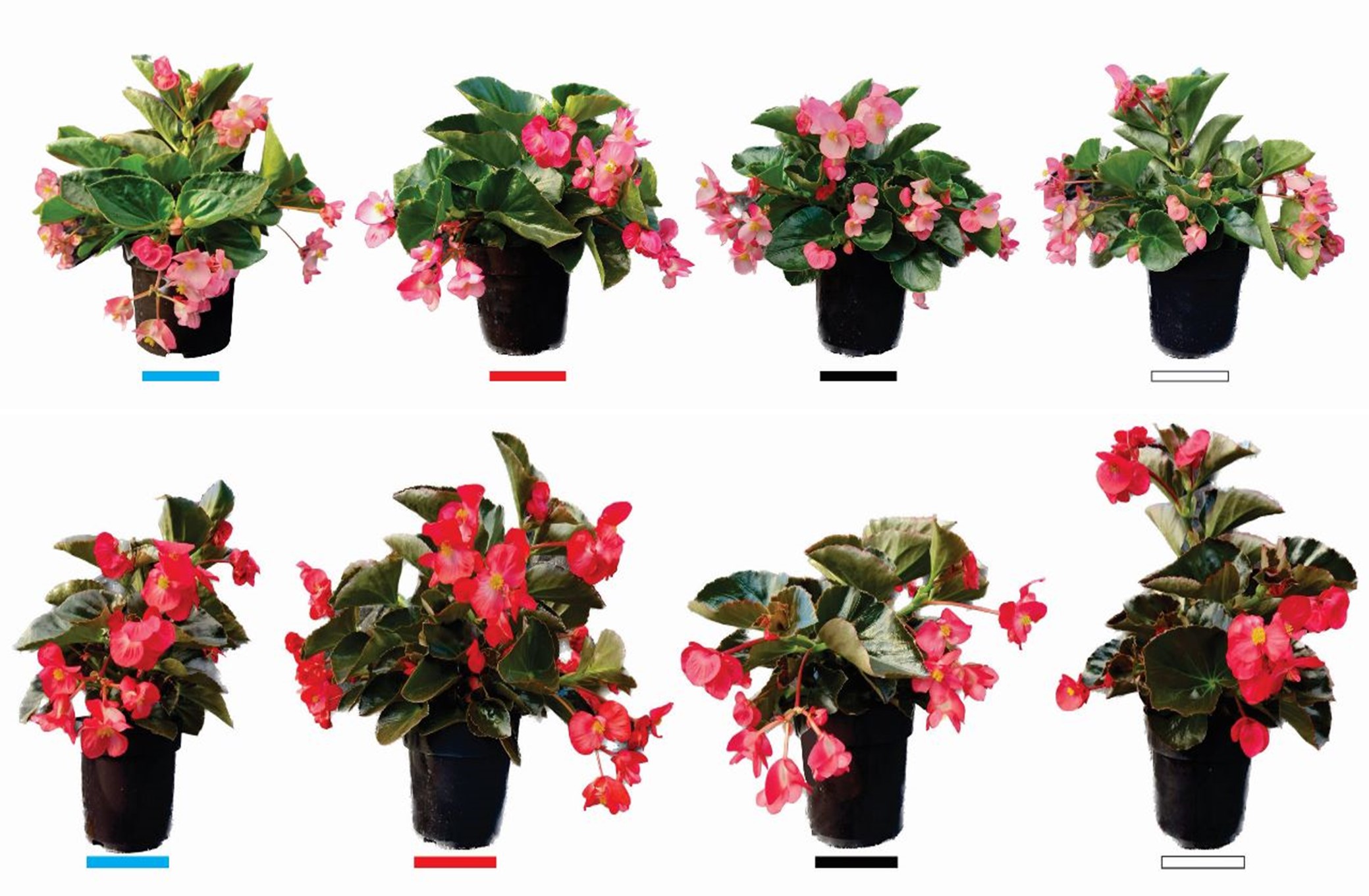
Figure 3 shows the qualitative effects arising from the different growth patterns observed in the ‘Pink Green’ and ‘Red Bronze’ varieties cultivated under various shade nets. Specifically, plants of the ‘Pink Green’ variety exhibited a compact, rounded morphology across treatments. Conversely, in the case of the ‘Red Bronze’ variety, plants subjected to the blue net displayed a more uniform and compact growth habit compared to those under the red net. Notably, both treatments exhibited uniform flowering and an overall desirable appearance. However, plants grown under the black net exhibited a pendulous or tiered architectural form, which is typically perceived as commercially undesirable. On the other hand, begonias in the control exhibited an imbalance between lateral stem branching, leaf count, and flower production, resulting in an appearance deemed less desirable compared to other treatments.

‘Pink Green’ (1st line) and ‘Red Bronze’ (2nd line) varieties of Begonia Megawatt grown with different shade nets at the point of marketing, 9 weeks after transplanting. Blue shade net (▬), red shade net (▬), black shade net (▬), and control (▬) treatments.
Based on the results obtained, all treatments yielded healthy plants from a phytosanitary standpoint, exhibiting similar heights and biomass. However, when considering the number of inflorescences and plant morphology, notable differences emerged. Specifically, the control plants exhibited inferior performance compared to the shade nets, resulting in plants of diminished market value. Conversely, plants cultivated under the blue and red nets, characterized by greater leaf area and leaf count, had a better overall appearance, thereby enhancing aesthetic appeal (Figure 3).
The market value of ornamental plants is intricately tied to their visual quality, predominantly influenced by archetypal attributes such as size, branching, and flowering. Therefore, effective control of light quality emerges as a crucial factor for plant appearance and composition, ultimately leading to improved commercial value (Zheng & Labeke, 2017).
Conclusions
Photoselective shade nets are efficient for the cultivation of Begonia Megawatt ‘Pink Green’ and ‘Red Bronze’ in pots. They regulate light intensity and quality, creating a more favorable microclimate. Furthermore, blue and red nets yielded plants with superior architectural characteristics, thereby producing potted flowers of high commercial quality.
References
- Almeida, J. M., Calaboni, C., & Rodrigues, P. H. V. (2021). Pigments in flower stems of lisianthus under different photoselective shade nets. Ornamental Horticulture, 27(4):535-543.
- Bastías, R. M. et al. (2021). Red and blue netting alters leaf morphological and physiological characteristics in apple trees. Plants, 10(1):127.
- Champaneri, D. D., & Patel, N. K. (2022). Photo selective shade net: An effective tool to reduce the impact of global warming and pesticide residues in vegetable production: A review. Agricultural Reviews, 43(2):135-144.
- Cruz, R. R. P. et al. (2020). Redes fotosseletivas na agricultura. Research, Society and Development, 9(8):e590985921.
- Cruz, R. R. P. et al. (2024). Production and quality of ornamental peppers cultivated under colored shade nets. Comunicata Scientiae, 15:e4144.361.
- Díaz-Pérez, J. C. et al. (2020). Bell Pepper (Capsicum annum L.) under colored shade nets: fruit yield, postharvest transpiration, color, and chemical composition. HortScience, 55(2):181-187.
- Folta, K. M., & Carvalho, S. D. (2015). Photoreceptors and control of horticultural plant traits. HortScience, 50(9):1274-1280.
- Gaurav, A. K. et al. (2016). Effect of different coloured shade nets on production and quality of cordyline. Indian Journal of Agricultural Sciences, 86(7):865-869.
- Hatamian, M., & Salehi, H. (2017). Physiological characteristics of two rose cultivars (Rosa hybrida L.) under different levels of shading in greenhouse conditions. Journal of Ornamental Plants, 7(3):147-155.
- Kämpf, A. N. (2005). Produção comercial de plantas ornamentais Guaíba: Agrolivros, v. 2, 254p.
- Kazemi, D. et al. (2024). Research on the differences in phenotypic and photosynthetic biophysical parameters of Begonias (Begonia rex) cultivars under various light spectral compositions. Journal of Plant Growth Regulation, 43:106-121.
- Lima, J. D. et al. (2010). Variáveis fisiológicas de antúrio cultivado sob diferentes malhas de sombreamento. Scientia Agraria, 11(3):193-200.
- Liu, Y. et al. (2021). Diversity analysis of chlorophyll, flavonoid, anthocyanin, and nitrogen balance index of tea based on Dualex. Phyton International Journal of Experimental Botany, 90(5):1549.
- Manja, K., & Aoun, M. (2019). The use of nets for tree fruit crops and their impact on the production: A review. Scientia Horticulturae, 246(1):110-122.
- Matos, F. S. (2020). Folha seca: Introdução à fisiologia vegetal Curitiba: Editora Appris, 189p.
- Mditshwa, A., Magwaza, L. S., & Tesfay, S. Z. (2019). Shade netting on subtropical fruit: Effect on environmental conditions, tree physiology and fruit quality. Scientia Horticulturae, 256:e108556.
- Meas, S., Luengwilai, K., & Thongket, T. (2020). Enhancing growth and phytochemicals of two amaranth microgreens by LEDs light irradiation. Scientia Horticulturae, 265:109-204.
- Mills-Ibibofori, T. et al. (2019). Effect of LED lighting and gibberellic acid supplementation on potted ornamentals. Horticulturae, 5(3):51.
- Moonlight, P. W. et al. (2018). Dividing and conquering the fastest-growing genus: Towards a natural sectional classification of the mega-diverse genus Begonia (Begoniaceae). Taxon, 67(2):267-323.
- Mupambi, G. et al. (2018). The influence of protective netting on tree physiology and fruit quality of apple: A review. Scientia Horticulturae, 236:60-72.
-
R Core Team (2022). R: A language and environment for statistical computing R Foundation for Statistical Computing, Vienna, Austria. Available in: <https://www.R-project.org/>.
» https://www.R-project.org/ - Sabatino, L. et al. (2019). Arbuscular mycorrhizal inoculation and shading enhance crop performance and quality of greenhouse Begonia semperflorens Acta Scientiarum Polonorum - Hortorum Cultus, 18(3):17-33.
- Sampaio, P. R. F. et al. (2020). Photo-selective nets and potassium concentrations on Costus lasius crop. Revista Brasileira de Engenharia Agrícola e Ambiental, 24(3):143-148.
- Sheerin, D. J., & Hiltbrunner, A. (2017). Molecular mechanisms and ecological function of far-red light signalling. Plant, Cell & Environment, 40(11):2509-2529.
- Singh, H. et al. (2023). Colored shade nets affect growth but not flowering of four greenhouse-grown potted ornamental species. HortScience, 58(9):1075-1076.
- Souri, M. K., & Neumann, G. (2018). Indications for passive rather than active release of natural nitrification inhibitors in Brachiaria humidicola root exudates. Journal of Plant Nutrition, 41(4):477-486.
- Souri, M. K. (2016). Plants adaptation to control nitrification process in tropical region; case study with Acrocomia totai and Brachiaria humidicola plants. Open Agriculture, 1(1):144-150.
- Taiz, L. et al. (2017). Fisiologia e desenvolvimento vegetal Porto Alegre: Artmed Editora, 6ªed., 888p.
- Trojak, M., & Skowron, E. (2017). Role of anthocyanins in high-light stress response. World Scientific News, 81(2):150-168.
- Vuković, M. et al. (2022). Sustainable food production: Innovative netting concepts and their mode of action on fruit crops. Sustainability, 14(15):9264.
- Zare, S. K. A. et al. (2019). The effect of light variations by photoselective shade nets on pigments, antioxidant capacity, and growth of two ornamental plant species: Marigold (Calendula officinalis L.) and violet (Viola tricolor). Cogent Food & Agriculture, 5:1650415.
- Zhang, Y. et al. (2018). Effects of shading on some morphological and physiological characteristics of Begonia semperflorens Pakistan Journal of Botany, 50(6):2173-2179.
- Zhao, D., Hao, Z., & Tao, J. (2012). Effects of shade on plant growth and flower quality in the herbaceous peony (Paeonia lactiflora Pall.). Plant Physiology and Biochemistry, 61:187-196.
- Zheng, L., & Labeke, M. C. (2017). Long-term effects of red-and blue-light emitting diodes on leaf anatomy and photosynthetic efficiency of three ornamental pot plants. Frontiers in Plant Science, 8:917.
- Zoratti, L. et al. (2015). Modification of sunlight radiation through colored photo-selective nets affects anthocyanin profile in Vaccinium spp. berries. PloS One, 10(8):e0135935
-
Editor de seção:
Renato Paiva