 Spreading and evaporation of glufosinate solution with adjuvants on different weed species
ABSTRACT
The addition of adjuvants to herbicides to improve the effectiveness of spray solutions for weed control has been widely adopted. This research aimed to determine the spread, contact angle, and evaporation time of glufosinate, with and without adjuvants, on the leaf surfaces of four weed species Digitaria insularis (L.) Fedde, Cenchrus echinatus L., Amaranthus viridis L., and Bidens pilosa L.). We used a completely randomized design and a 4 x 4 factorial scheme, with ten replications. The surfaces of four weed species were the first factor and the applied solutions (distilled water, glufosinate herbicide, glufosinate + surfactant, and glufosinate + mineral oil) were the second factor. Concerning droplet deposition, the wide-leaved weeds showed a broader spread and a greater contact angle in contrast to the narrow-leaved ones. The droplet spreading area was negatively correlated with evaporation time and contact angle. We conclude that the spreading area and evaporation time of herbicide droplets depend on the characteristics of each surface area and vary among different weed species. The addition of adjuvants to spray solutions is essential for glufosinate herbicide, particularly on leaf surfaces with higher wax content.
Index terms:
Application technology; wetting area; surfactant; drop-target interaction
RESUMO
A prática de adicionar adjuvantes aos herbicidas, visando aprimorar a eficácia das caldas de aplicação e o controle efetivo de plantas daninhas, tem sido amplamente adotada. O objetivo desta pesquisa foi determinar o espalhamento, ângulo de contato e tempo de evaporação do Glufosinato de amônio, com e sem adjuvantes, em quatro superfícies foliares de plantas daninhas. Foi utilizado o delineamento inteiramente casualizado, no esquema fatorial 4 x 4, composto de dez repetições. Como primeiro fator, foram utilizadas superfícies de quatro plantas daninhas: Digitaria insularis (L.) Fedde, Cenchrus echinatus L., Amaranthus viridis L. e Bidens pilosa L. Enquanto, como segundo fator, foram utilizadas quatro substâncias: água destilada, Herbicida glufosinate, glufosinate + surfactante, e glufosinato + óleo mineral. Na deposição das gotas, as plantas daninhas com folhas largas apresentaram maior espalhamento e maior ângulo de contato em comparação com as de folhas estreitas. A área de espalhamento das gotas tem correlação negativa com tempo de evaporação e ângulo de contato. Conclui-se que a área de espalhamento e o tempo de evaporação de gotas de herbicidas são dependentes das características de cada superfície, variando entre espécies de plantas daninhas. O uso de adjuvantes em caldas de pulverização é fundamental no herbicida glufosinate, principalmente nas superfícies foliares com quantidade de cera elevada.
Termos para indexação:
Tecnologia de aplicação; área de molhamento; surfactante; interação gota-alvo
Introduction
Various factors can significantly reduce crop yield, including weed infestations estimated to account for a 15% reduction in global agricultural production. This is primarily due to the competition between weeds and crops for essential resources such as water, light, nutrients, and physical space (Amorim et al., 2018).
The application of herbicides has emerged as the predominant strategy for weed control in agriculture (Ferreira et al., 2018), thereby enhancing crop productivity. However, to effectively control weeds, it is crucial to focus on accurate identification and the quality of the spraying process. Each weed species has unique characteristics that can impact management outcomes with the use of herbicides (Wandscheer & Rizzardi, 2013; Ferreira et al., 2017).
Optimal herbicide efficacy requires uniform droplet deposition across the targeted weed leaf surface. Hence, understanding what occurs after the deposition of droplets, such as evaporation time, reduction of surface tension, and maximum spreading area can help in developing products that increase leaf absorption (Appah et al., 2019; Oliveira et al., 2019).
Leaves have a protective layer called cuticle, which is a multifunctional structure crucial for plant survival. The cutin, along with a complex mixture of lipophilic substances known as waxes, makes up the plant cuticle, limiting the amount of products that penetrate the leaf (Silva et al., 2018; Matos et al., 2021; Ferreira et al., 2023).
Considering the leaf weed characteristics, the spray solution should result in reduced surface tension of droplets. This enhances wettability, facilitates product penetration into the leaf, and promotes adhesive properties, retention, and absorption of these substances by the plant. Consequently, droplet spreading across the surface become more uniform (Baio et al., 2015; De Campli et al., 2022).
Adjuvant incorporation into spray solutions is one of the most frequent approaches to enhance application efficiency because it reduces the liquid surface tension. By reducing the surface tension, the spreading area is increased and the contact angle is reduced. Consequently, the adjuvants enable the spray solutions to penetrate the epicuticular waxes of the cuticle, thereby improving the interaction between the liquid and the leaf surface (Costa et al., 2017; Cunha, Alves & Marques, 2017; Salvalaggio et al., 2016). Therefore, adding adjuvants to the glufosinate herbicide solution can improve droplet spreading, contact angle, and evaporation time when applied to weed leaves. This research aimed to determine the effect of adding two adjuvants (surfactant and mineral oil) to the glufosinate herbicide by depositing droplets of each solution on leaf surfaces of different weed species.
Material and Methods
The research was conducted at the Center for Research in Application Technology and Agricultural Machinery Laboratory, of the State University of Northern Paraná - UENP, Luiz Meneghel Campus, Bandeirantes - PR, Brazil.
Four leaf surfaces from different weed species were tested: Digitaria insularis L. Fedde (sourgrass), Cenchrus echinatus L. (southern sandbur), Amaranthus viridis L. (green amaranth), and Bidens pilosa L. (hairy beggarticks). Weeds were grown in a greenhouse under controlled irrigation and cultural practices. For the tests and experiments, leaves were detached from A. viridis and B. pilosa when plants reached 2 to 4 true leaves, and from D. insularis and C. echinatus when plants had up to one tiller.
To develop the spray solutions, glufosinate herbicide (Finale® 2.0 L ha-1) was applied with and without adjuvants. The activator adjuvant Disperse Ultra® (0.05%, v/v) is a non-ionic surfactant with the following composition: humectant agent: 1.0 to 8.0%; polydimethylsiloxane: 10 to 20%; and antifoam emulsion: 3 to 12%. The mineral oil-based adjuvant Assist® (0.5%, v/v) is from the aliphatic hydrocarbon chemical group with a concentration of 78% (v/v).
A completely randomized design was used in a 4 x 4 factorial scheme, with ten replications. The surfaces of four weed species were the first factor and the applied solutions (distilled water, glufosinate herbicide, glufosinate + surfactant, and glufosinate + mineral oil) were the second factor.
Spray solution surface tension was determined with the gravimetric method by weighing sets of 30 drops per replication (n = 4) using a beaker and an analytical balance (0.1 mg accuracy). Droplets were obtained with the help of a droplet generator containing a syringe and a capillary (used in chromatography), which allowed horizontal positioning at a predetermined constant speed, increasing droplet uniformity. Droplet weight data were converted to surface tension, assuming an average droplet weight of distilled water near 72.6 mN m-1 (Oliveira et al., 2015).
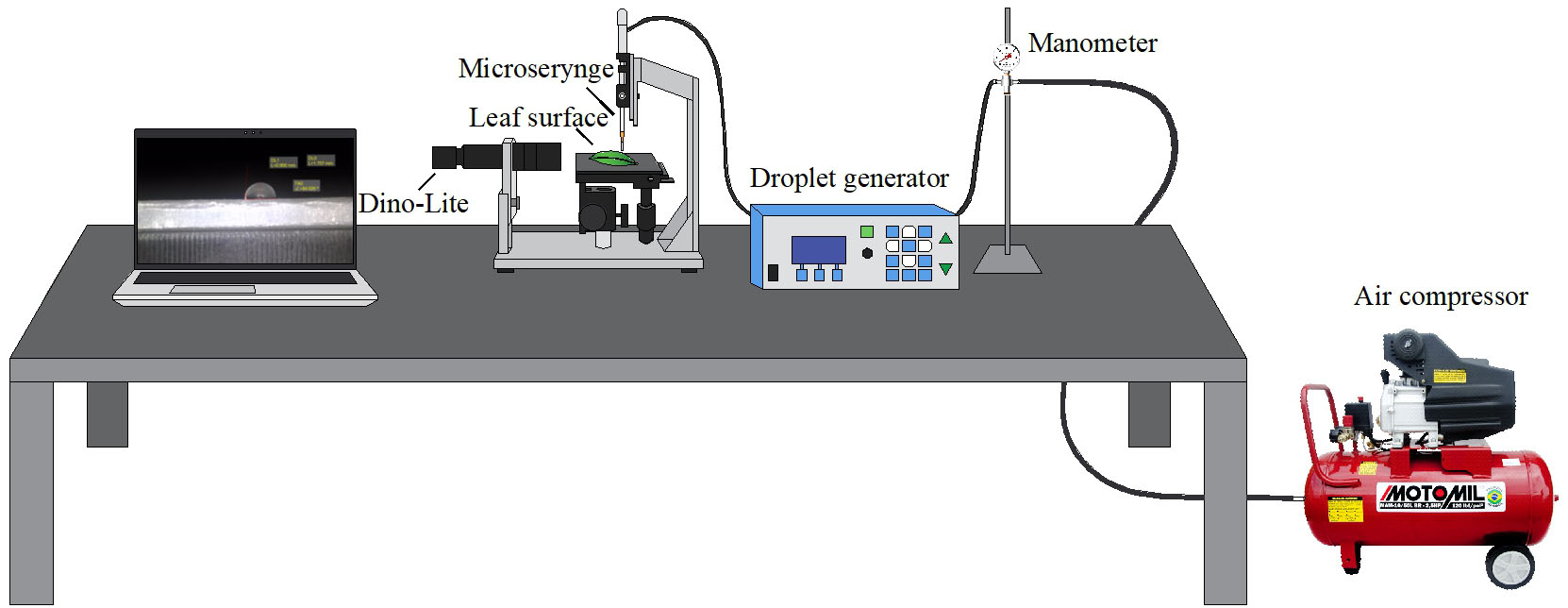
The entire process was first conducted with distilled water, before adding any herbicides or herbicides with adjuvants. We used an automatic droplet generation system to assess the spreading area and the time needed for evaporation (Figure 1). This system controlled the release of liquid based on time, air, liquid pressure, and vacuum, regardless of the viscosity and density of the liquid (Model Ultimus V, Inc; East Providence (IFD), RI). A drop with a Volume Median Diameter (VMD) of 600 µm was deposited on the leaf surfaces of the weeds in each treatment, so that the spreading area, evaporation time, and contact angle analysis could be performed.

Experimental system with controlled temperature, droplet size, and relative humidity for image analysis of droplets on natural and artificial surfaces.
Twenty droplets were deposited on silk threads attached to a support for calibration and standardization of droplet size, allowing them to remain spherical to measure their diameter. Droplet ejection interval, pressure, and droplet generator vacuum were altered until the droplets formed a 600 µm diameter. This calibration was done for each solution to analyze droplets of the same size (Precipito et al., 2018).
The deposited droplets were visualized through a digital microscope camera (zoom 1.5x) and range extensions with 10x magnification in a combination of objective-special eyepieces (Bel Engineering), generating bitmap images with a resolution of 1260 x 960 dpi. Droplet diameter (in mm) was measured with the function line of the software Iscapture 2.2.1 (Scienon Technology Co. Ltda).
The program was calibrated with a ruler of 0.01 μm in the same objective and zoom lens used to take photographs. The photos were taken on the top view of the drop, right after droplets were deposited on the surfaces, at intervals of 3 s until complete evaporation of the droplet liquid, leaving only the solution solids on the surface.
The wetting area (mm2) was determined by delimiting the droplet edges by the polygon function, considering the maximum area of each replication. Evaporation time was measured through the interval between droplet deposition and evaporation of the liquid part, recorded by the sequential images taken during evaporation. Thus, evaporation time was calculated using the number of photos multiplied by the interval between photos, according to the methodology applied by Precipito et al. (2018) and Oliveira et al. (2019). The camera used to measure the contact angle has a magnification of up to 200 times, a resolution of 640x480 pixels, and a USB input (Figure 2).
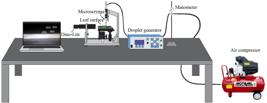
Illustration of the structure designed to determine the contact angle. Source: NITEC/UENP.
To visualize the contact angle, a digital microscope camera (Dino-Lite) was strategically positioned at the front of the acrylic support, 16 cm above the rod base, optimizing the viewing angle. The digital microscope camera focus was adjusted on the side, and a scale featuring the camera software was used for calibration. The contact angle between the leaf and the deposited droplet was analyzed using the methodology proposed by Xu et al. (2010). When the droplet is deposited on the leaf surface, it forms a spherical cap shape, which can be described by the following Equation 1:
Where θ = Contact angle between droplet and leaf surface (°);
arctg = arc tangent;
S = spherical cap base (mm);
h = spherical cap height (mm).
In the statistical analyses, the variables spreading, evaporation time, and contact angle were considered as a function of the factors spray solutions and weed species, evaluated using ANOVA with a 4 x 4 factorial design. The value of each factor and their interactions was studied and, when relevant, the breakdown was performed. The analysis of canonical variables and Pearson correlation (<0.01), along with their graphical representation, were conducted using R software (R Core Team, 2022).
Results and Discussion
All herbicide solutions significantly reduced surface tension compared to distilled water (72.6 mN m-1, p<0.05). The surface tension decreased to 33.5 mN m-1 when using the glufosinate herbicide, even without incorporating an adjuvant in the spray solutions. Addition of adjuvants further decreased the surface tension in a similar manner (30.5 mN m-1 with mineral oil and 29.5 mN m-1 with the surfactant). This is due to alterations in the physical and chemical properties of the herbicide, which enhance its capacity to spread on leaf surfaces (Salvalaggio et al., 2018).
The variance analysis revealed a significant interaction between weed species and solutions, demonstrating that the spread area, contact angle, and evaporation time depended on the characteristics of the weed leaf surfaces and the applied solutions. Notably, the coefficients of experimental variation were maintained below 20%.
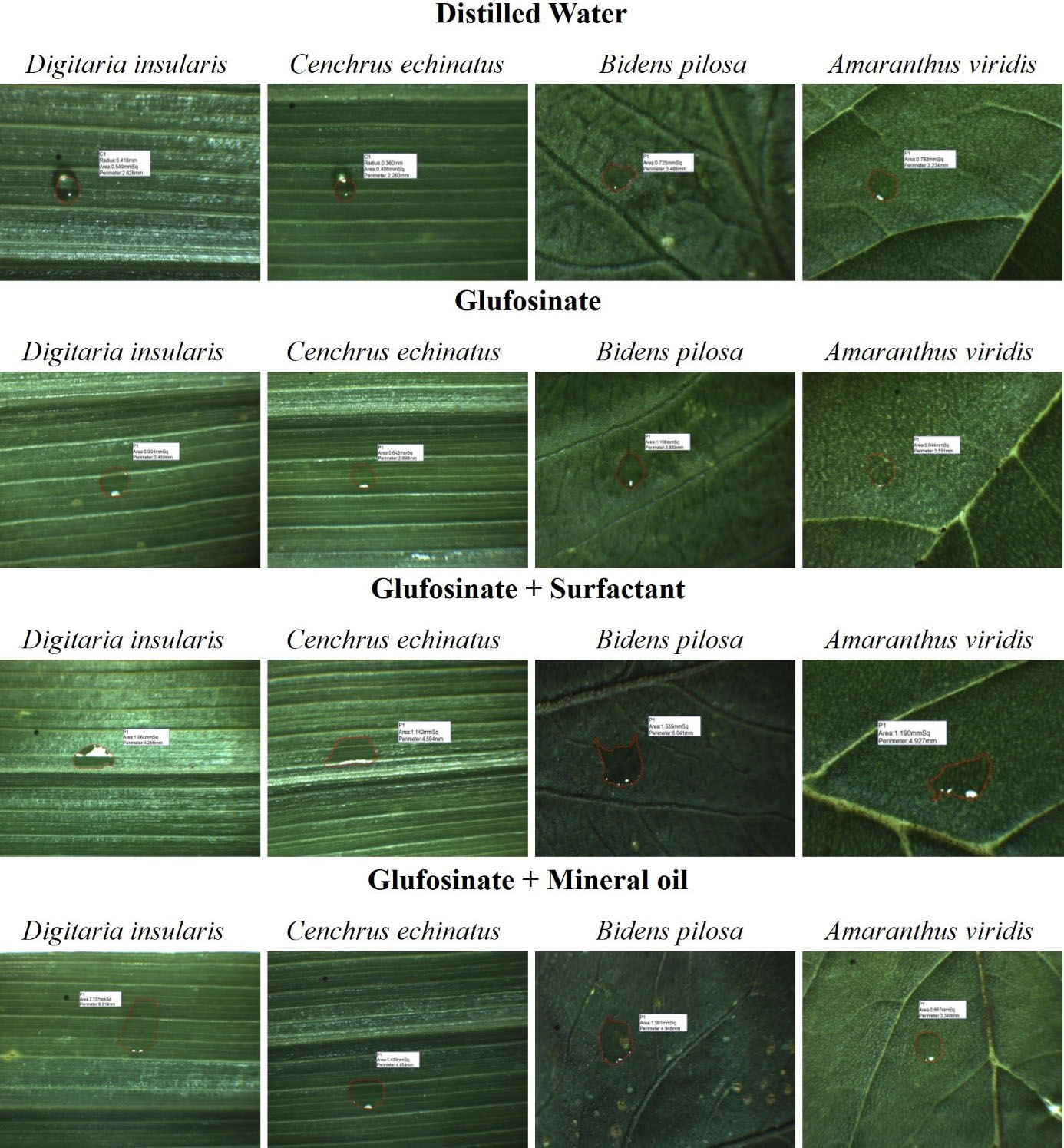
Figure 3 illustrates the maximum spreading areas of droplets on different weed leaf surfaces, with each studied solution. Droplets spread broader on larger weed leaves (A. viridis and B. pilosa) and less on the surfaces of narrow-leaf weeds (D. insularis and C. echinatus). This phenomenon can be attributed to the distinct characteristics of the leaf surface, which either facilitate or hinder the liquid spreading.

The B. pilosa leaf surface has stomata arranged at the same levels as the other epidermal cells, which are anomocytic, i.e. they do not have subsidiary cells with tector and glandular trichomes (Sá, Silva & Randau, 2017). Similar to B. pilosa, A. viridis also exhibits stomata arranged at the same levels as other epidermal cells (lacking subsidiary cells), but with unbranched, multicellular glandular trichomes found at low densities along the veins (Ferreira et al., 2003). This characteristic facilitates a broader spread of the deposited droplet on both surfaces.
Both D. insularis and C. echinatus are narrow-leaved weeds from the Poaceae family. Their leaf surfaces are slightly waxy and have a low density of trichomes, which hinders the surface wettability, resulting in poor spreading of the deposited drop (Ferreira et al., 2018; Oliveira et al., 2015).
Regardless of the plant surface characteristics, adding mineral oil or surfactant to the spray mixture containing glufosinate resulted in more efficient spreading on all surfaces tested (Figure 3). Droplet spreading varies according to the dynamics of surface tension, therefore using adjuvants can improve product penetration and absorption by reducing surface tension and increasing the contact angle of the droplet on leaf surfaces increasing spreading area (Cunha, Alves & Reis, 2010).
The variations in spreading with the addition of the adjuvants can be explained by the reduction in surface tension which contributes to the breaking of the epicuticular waxes, allowing the liquid to interact with the surface. This is a result of the morphological characteristics of the leaf surface as well as the properties of the liquid (Salvalaggio et al., 2016).
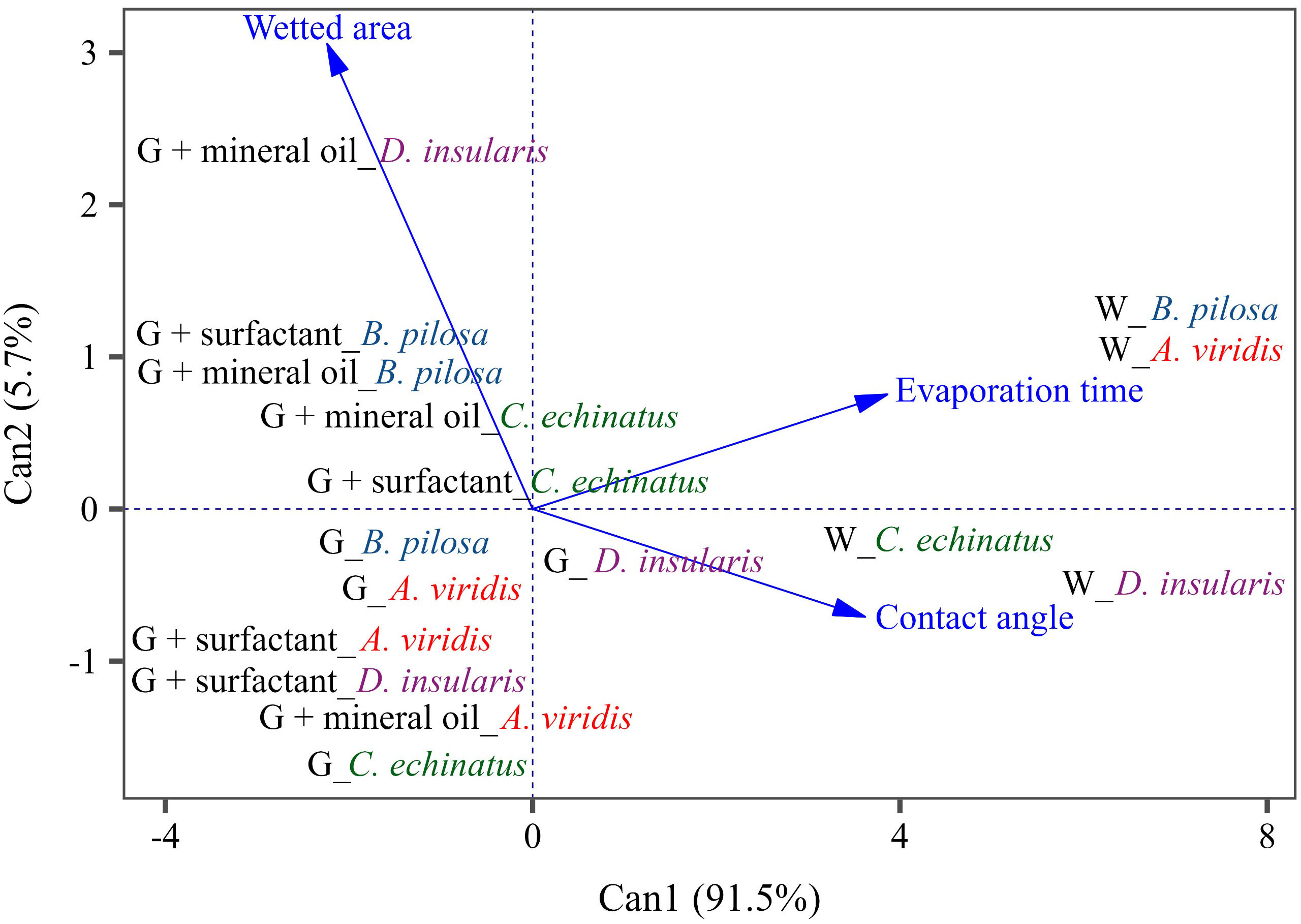
The analysis of canonical variables for the spreading area, surface tension, and the contact angle of spray droplets on D. insularis, C. echinatus, A. viridis, and B. pilosa leaf surfaces are presented in Figure 4. The canonical component 1 (Can1 = 91.5%) separated the spreading area from the evaporation time and contact angle, while the canonical component 2 (Can2 = 5.7%) distinguished the evaporation time and contact angle.

Analysis of canonical variables for the spreading area, surface tension, and contact angle of spray droplets deposited on leaf surfaces of four different weed species. G = Glufosinate and W = Distilled water.
When comparing the spread of solutions on each weed species, glufosinate + mineral oil had the broadest spread on D. insularis and B. pilosa, and the least spread on A. viridis.
For glufosinate + surfactant, the spreading was broader in B. pilosa (43.2% higher than the average spreading area observed on the other species surfaces subjected to the same solution. The spreading of the solution composed of glufosinate alone was also greater on B. pilosa. The distilled water solution had the least spread, especially in narrow-leaved weeds (D. insularis and C. echinatus).
Narrow and broad leaf surfaces have many distinct characteristics. The spreading process is determined not only by the physical and chemical characteristics of the spray solution but also by the specific plant surface where the solution is deposited. Plant leaves exhibit a variety of morphological features, including trichomes and the cuticle (composed of cutin and waxes), which greatly influence the wetting capacity of sprayed solutions. These features can significantly affect the solution’s ability to spread and be absorbed by the leaf surface (Oliveira et al., 2015; Ferreira et al., 2017; Ferreira et al., 2023).
In plants with greater levels of wax, such as D. insularis and C. echinatus, wettability is reduced, meaning they exhibit less spreading capacity compared to plants with lower wax levels, like A. viridis and B. pilosa. The wax on the leaves acts as a repellent to deposited solutions (Oliveira et al., 2015).
The droplet contact angle values appeared to be influenced by the type of solution used (Figure 4). The glufosinate + surfactant mix demonstrated the greatest efficacy in reducing the droplet contact angle on the leaf surfaces, followed by glufosinate alone, glufosinate + mineral oil, and only water, which exhibited the lowest contact angle. The difference in the contact angle of the droplets between the narrow-leaved (D. insularis and C. echinatus) and the broad-leaved weeds (A. viridis and B. pilosa) was evident, particularly in the case of applications involving only water.
Therefore, when the herbicide glufosinate is combined with a surfactant or mineral oil, the wetting capacity of the solution is modified. Specifically, the deposited droplets exhibit a broader spreading capacity and a further reduction in the surface tension of the solution, thus decreasing the contact angle on all surfaces to which the solution is applied.
According to Costa et al. (2020), the reduction in surface tension is directly correlated with a decrease in contact angle. Thus, as surface tension decreases, the droplet’s contact angle with the surface also decreases, leading to a broader droplet spreading on the target. This results in increased deposition and coverage on the target surface.
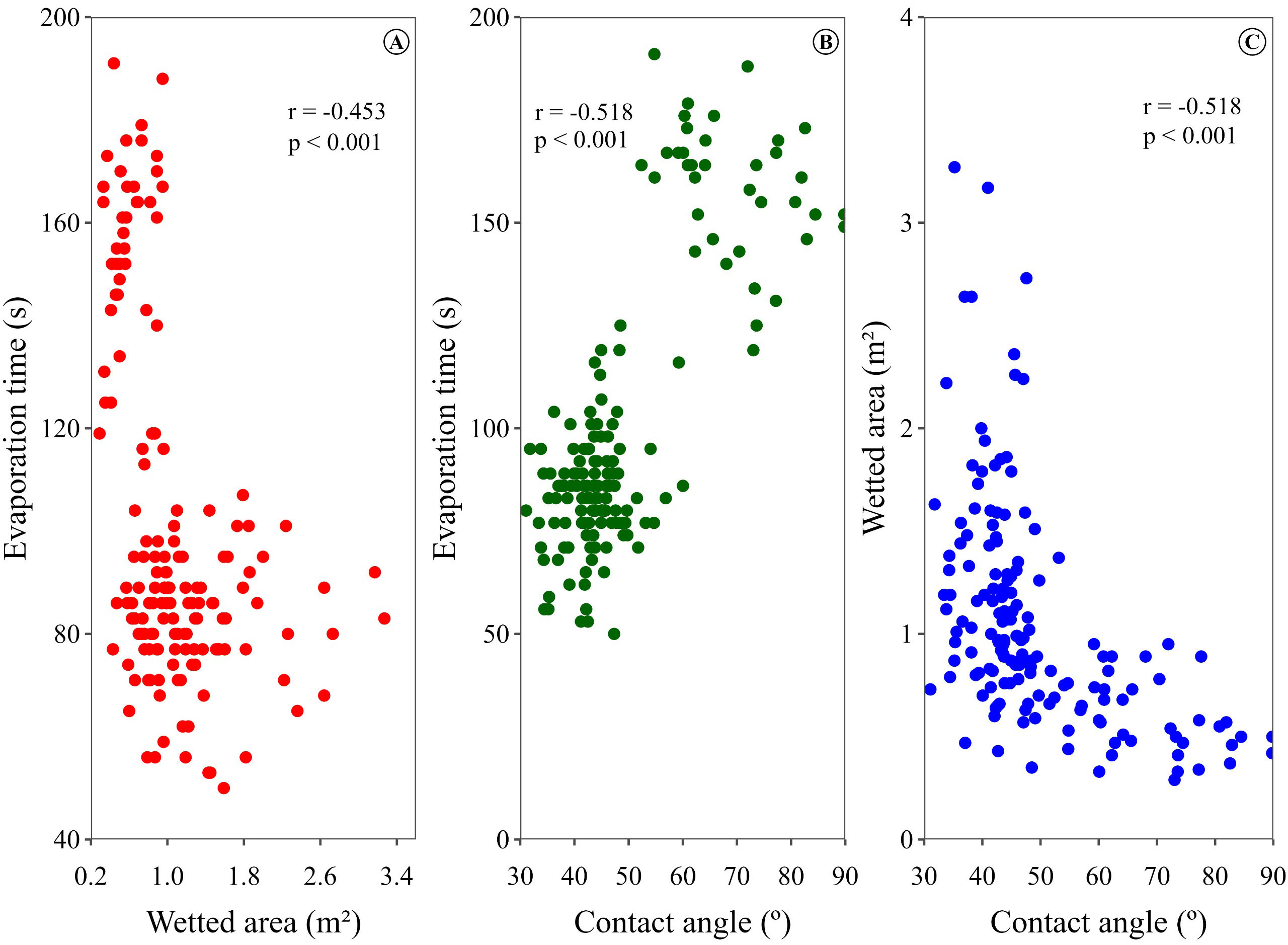
Correlation analysis considering solutions of water or glufosinate only, and mixtures with mineral oil or surfactant is shown in (Figure 5). The droplets’ evaporation time and the spreading area showed a negative correlation (r = -0.453), and the longest evaporation time occurs when the spreading area decreases or vice versa (Figure 5A).

Correlation between evaporation time, spreading area, and contact angle of the droplets from different solutions applied to four weed species.
The positive correlation between evaporation time and the contact angle of droplets (r = 0.773) indicates the greater the contact angle, the faster the evaporation time (Figure 5B). Reducing the evaporation time of droplets in mixtures can enhance the quality of herbicide application, particularly under certain environmental conditions such as high temperature and low relative humidity. In low humidity, rapid evaporation can shorten the herbicide’s contact time on the leaf, which is especially critical for contact herbicides (De Campli et al., 2022).
The negative correlation between the spreading area and the contact angle of the droplets (r = -0.518, Figure 5C) indicates a greater surface hydrophobicity (greater droplet contact angle with the leaf), meaning that the largest spreading area occurs when the droplet contact angle is smaller. Therefore, it is important to add adjuvants to the herbicide solutions to break the droplet’s surface tension and decrease the contact angle. Consequently, broader droplets spreading over the leaf surface may occur, making it ideal for contact herbicides such as glufosinate. The droplet spreading and evaporation begin soon after their deposition on leaf surfaces, so the droplet evaporation time is influenced by the type of leaf surface and the use of adjuvants (Baio et al., 2015; Oliveira et al., 2019).
In addition, the differences in the spreading areas found in this study occur due to the variety of spray mixtures and the morphological diversity of the weed leaf surfaces. However, it is critical to monitor evaporation time, as rapid acceleration can impair absorption and compromise herbicide efficiency.
We suggest that similar studies should be conducted with other weed species and herbicides (mixed with adjuvants). Research of this nature is essential for improving herbicide application techniques and offering farmers a wider range of mechanisms of action for weed management.
Conclusions
The spreading area, evaporation time, and contact angle of herbicide droplets depend on the specific characteristics of each weed species’ leaf surface. Incorporating adjuvants in spray solutions is essential when using glufosinate herbicide, particularly on leaves with highly waxy surfaces such as D. insularis and C. echinatus.
Acknowledgments
The authors would like to express their gratitude to all the students from the Laboratory of the Core Research Group in Application Technology and Agricultural Machinery (NITEC) at the State University of Northern Paraná (UENP) who contributed to the data collection. The authors also wish to express their gratitude to the staff of the Academic Writing Center at UENP for their assistance in proofreading and translating this manuscript.
References
- Amorim, S. D. et al. (2018). Caracterização de plantas daninhas em área rotacionada de milho e feijão-caupi em plantio direto. Scientia Agropecuaria, 9(1):7-15.
- Appah, S. et al. (2019). Charged monosized droplet behaviour and wetting ability on hydrophobic leaf surfaces depending on surfactant-pesticide concentrate formulation. Journal of Electrostatics, 100:103356.
- Baio, F. H. R. et al. (2015). Alteração das propriedades físicoquímicas na aplicação contendo adjuvantes. Brazilian Journal of Biosystems Engineering, 9(2):151-161.
- Costa, L. L. et al. (2020). Compatibilidade físico-química de diferentes doses e misturas de herbicidas.Revista Brasileira de Herbicidas, 19(3):1-8.
- Costa, L. L. et al. (2017). Droplet spectra and surface tension of spray solutions by biological insecticide and adjuvants. Engenharia Agrícola, 37:292-301.
- Cunha, J. P. A. R., Alves, G. S. & Marques, R. S. (2017). Tensão superficial, potencial hidrogeniônico e condutividade elétrica de caldas de produtos fitossanitários e adjuvantes. Revista Ciência Agronômica, 48:261-271.
- Cunha, J. P. A. R., Alves, G. S. & Reis, E. F. (2010). Efeitos da temperatura nas características fisico-químicas de soluções aquosas com adjuvantes de uso agrícola. Planta Daninha, 28(3):665-672.
- De Campli, C. M. et al. (2022). Espalhamento e evaporação de produtos fitossanitários em tomateiro Wetting and evaporation of pesticide on tomato leaves. Brazilian Journal of Development, 8(4):24722-24736.
- Ferreira, E. A. et al. (2003). Estudos anatômicos de folhas de espécies de plantas daninhas de grande ocorrência no Brasil: IV-Amaranthus deflexus, Amaranthus spinosus, Alternanthera tenella e Euphorbia heterophyllaPlanta Daninha, 21(2):263-271.
- Ferreira, S. D. et al. (2018). Biological cycle of susceptible and glyphosate-resistant sourgrass biotypes in two growth periods. Planta Daninha, 36:e018175923.
- Ferreira, S. D. et al. (2017). Controle de espécies de Commelinas com dessecantes isolados e em misturas. Planta Daninha, 35:e017165664.
- Ferreira, S. D. et al. (2023). Foliar structural differences between glyphosate-resistant and glyphosate-susceptible biotypes of Digitaria insularis (L.) Fedde. Revista Ceres, 70:e70516.
- Matos, T. M. et al. (2021). The morphology and chemical composition of cuticular waxes in some Brazilian liverworts and mosses, Journal of Bryology, 43(2):129-137.
- Oliveira, R. B. et al. (2019). Effect of droplet size and leaf surface on retention of 2, 4-D formulations.Crop Protection, 119:97-101.
- Oliveira, R. B. et al. (2015). Influence of the glyphosate formulations on wettability and evaporation time of droplets on different targets.Planta Daninha, 33(3):599-606.
- Precipito, L. M. B. et al. (2018). Evaporation and wettability of fungicide spray, with or without adjuvant, on leaves of vegetables. Horticultura Brasileira, 36:320-324.
-
R Core Team (2022). R:A language and environment for statistical computingR Foundation for Statistical Computing, Vienna, Austria. Available in: https://www.R-project.org/
» https://www.R-project.org/ - Sá, R. D., Silva, F. R., & Randau, K. P. (2017). Caracterização farmacobotânica de Bidens pilosa L.Journal of Environmental Analysis and Progress, 2(3):349-357.
- Salvalaggio, A. C. et al. (2018). Espalhamento e tensão superficial de gotas de soluções com herbicidas e adjuvantes em folhas de Digitaria insularis.Revista de Agricultura Neotropical, 5(3):60-64.
- Salvalaggio, A. C. et al. (2016). Spreading area of drops of solutions with biological insecticide and adjuvants in cassava. Scientia Agraria Paranaensis, 15(1):82-87.
- Silva, M. H. M. et al. (2018). Relação entre a composição química de cera epicuticular foliar e a interação com insetos galhadores em espécies de Croton L. (Euphorbiaceae).Journal of Environmental Analysis and Progress, 3(3):287-295.
- Wandscheer, A. C. D., & Rizzardi, M. A. (2013). Interference of soybean and corn with Chloris distichophylla Ciência e Agrotecnologia, 37(4):306-312.
- Xu, L. et al. (2010). Adjuvant effects on evaporation time and wetted area of droplets on waxy leaves. Transactions of the ASABE, 53(1):13-20.
-
Editor de seção:
Renato Paiva