 Colorectal cancer diagnosis and screening exams in Brazil during the COVID-19 pandemic: a linear regression model
Abstract
Background: The COVID-19 pandemic negatively impacted the health sector leading to multiple negative outcomes in individual and collective health.
Objective: This study aimed to assess the pandemic’s impacts on the performance of diagnostic and screening exams for colorectal cancer (CRC) in Brazil in 2020.
Method: Based on Log10 of secondary data from 2008 to 2019, linear regression models were developed. Then, the expected number of colonoscopies, rectosigmoidoscopies, and fecal occult blood tests (FOBT) were calculated for 2020. The projections were compared with the real number of exams in each region and in Brazil in 2020.
Results: Most regions presented, from 2008 to 2019, significant decreasing trends in rectosigmoidoscopies, while significant increasing trends in FOBT were found in most regions and in colonoscopies in all regions. None of the regions reached the expected number of any of the procedures in 2020, with the exception to rectosigmoidoscopies in the Midwest. In 2020, compared to the projections, there were found, percentage differences of -39.2% colonoscopies, -40.2% rectosigmoidoscopies and -34.8% FOBT were found for Brazil.
Conclusion: The COVID-19 pandemic seems to have negatively affected the performance of exams for screening and diagnosis of CRC in Brazil. Therefore, consequences such as late diagnosis and worse prognosis for patients can be expected in the future.
Keywords:
colorectal neoplasms; COVID-19; delayed diagnosis; early detection of cancer
Resumo
Introdução: A pandemia de COVID-19 impactou negativamente o setor da saúde levando a múltiplos desfechos negativos na saúde individual e coletiva.
Objetivo: Este estudo objetivou avaliar os impactos da pandemia na realização de exames para diagnóstico e rastreamento de câncer colorretal (CRC) no Brasil em 2020.
Método: Baseado no Log10 de dados secundários de 2008 a 2019, modelos de regressão linear foram desenvolvidos. Calculou-se, então, a quantidade esperada de colonoscopias, retossigmoidoscopias e pesquisa de sangue oculto nas fezes (PSOF) para 2020. As projeções foram comparadas com o quantitativo real de exames em cada região e no Brasil em 2020.
Resultados: A maioria das regiões apresentou, de 2008 a 2019, tendências significativas de redução no número de retossigmoidoscopias, enquanto foram encontradas tendências significativas de aumento na quantidade de PSOF na maioria das regiões e de colonoscopias em todas as regiões. Nenhuma das regiões alcançou o quantitativo esperado de nenhum dos exames em 2020, com exceção de retossigmoidoscopias no centro-oeste. Em 2020, comparativamente às projeções, encontraram-se, para o Brasil, diferenças percentuais de -39,2% colonoscopias, -40,2% retossigmoidoscopias e -34,8% PSOF.
Conclusão: A pandemia parece ter afetado negativamente a realização de exames para rastreamento e diagnóstico de CRC no Brasil. Pode-se, portanto, esperar consequências como diagnóstico tardio e pior prognóstico para os pacientes no futuro.
Palavras-chave:
neoplasias colorretais; COVID-19; diagnóstico tardio; detecção precoce de câncer
INTRODUCTION
Colorectal cancer (CRC), combining both sexes, is the third most diagnosed cancer in the world1. When analyzed by sex, it is the third most incident type in males and the second in females1. In Brazil, excluding non-melanoma skin cancers, CRC was expected to be the second most incident type of cancer for both men and women in 20202. Furthermore, approximately 41,000 new cases of CRC were estimated for each year of the 2020-2022 triennium2.
There are regional differences in CRC incidence in Brazil, with higher rates in the Southeast and South when compared to the North and Northeast2. CRC is the second most incident neoplasm for men (28.62/100,000) and women (26.18/100,000) in the Southeast, while it is the fourth for men (5.27/100,000) and the third for women (6.48/100,000) in the North2. This pattern may be explained by differences in lifestyle, socioeconomic status, and access to health services between regions3.
It is also noteworthy that CRC incidence is increasing in all regions of Brazil, with a “South to North” gradient4. This can be related to the improvements in CRC screening and diagnosis, as well as to the spread of environmental risk factors throughout the country4. There are several risk factors for CRC, with age, genetics, and environmental factors, such as obesity, sedentarism, smoking, alcoholism, red and processed meat, playing crucial roles5,6. Some of these, such as consumption of meat and processed food, are more frequent in the regions with the highest incidences (South and Southeast)7.
Regarding mortality, CRC occupied, in 2020, the third position among neoplasms for both men and women8. It is even more important to note that there has also been an upward trend in CRC mortality rate in Brazil in the last few years3, and that it was also predicted that the rates would continue to increase, mostly because of population ageing9.
Screening for CRC can be a valuable tool, since it can detect precancerous lesions and early-stage CRC, reducing morbidity, mortality, and excess treatment cost10. The Brazilian Ministry of Health currently considers that it is not viable and cost-effective to implement population screening programs for CRC in the country11. However, many physicians choose to screen for CRC following foreign protocols, such as the one from the U.S. Preventive Services Task Force, which recommends screening all asymptomatic adults aged 45-75 years old12. Among the strategies are annual fecal occult blood test, flexible sigmoidoscopy every five years and colonoscopy every ten years12.
Nevertheless, the Brazilian Ministry of Health strongly recommends an early diagnosis strategy, which includes dissemination of warning signs of CRC for the population and health professionals, immediate access to diagnostic procedures for suspected cases, and access to adequate and timely treatment11.
The COVID-19 pandemic may be an obstacle to both screening and early diagnosis of CRC, since the new disease needed to be prioritized over others to halt the pandemic’s progression and prevent the collapse of health systems. In Brazil, for example, until July 2nd, 2022, there had been more than 30 million confirmed cases of COVID-19, with the highest number of cases in the Southeast and the lowest in the North13. However, the mortality rate was the highest in the Midwest (393/100,000) and the lowest in the Northeast (227.2/100,000)13.
A survey conducted by the World Health Organization revealed that health services, including public screening programs, have been completely or partially disrupted in the surveyed countries during the pandemic14. Accordingly, regarding Brazil, reductions have already been demonstrated in 2020, compared to 2019, in the number of cytopathological exams (-44.6%), mammograms (-42.6%), biopsies (-35.3%) and oncological surgeries (-15.7%)15.
This scenario will certainly have consequences in the future. Among them, we hypothesize the diagnosis of diseases at advanced stages, worse prognosis for patients, decompensation of chronic diseases and the increase in public expenditures on medicine and treatments. Therefore, it is essential that studies are carried out to ascertain the impact of the COVID-19 pandemic on the most diverse diseases, enabling the health system to prepare for the consequences that are to come.
The objective of this study was to analyze whether the COVID-19 pandemic had any impact on the number of tests performed in Brazil for the screening and diagnosis of CRC in 2020. The reduction in the number of exams would possibly indicate a decrease in the amount of people screened or diagnosed with precancerous lesions or CRC, which could lead to negative outcomes in the future.
METHODS
This is an ecological time series study analyzing the performance of tests for screening and diagnosis of CRC in Brazil and its regions during the period from 2008 to 2020. Secondary data from the Outpatient Information System of the Brazilian Unified Health System (Sistema de Informações Ambulatoriais do Sistema Único de Saúde - SIA/SUS16), a public nationwide database, were used to carry out the analyses. The procedures of interest were colonoscopy, rectosigmoidoscopy, and fecal occult blood test (FOBT).
Information was obtained from the system by location (regions of Brazil - North, Northeast, Southeast, South and Midwest) and by the year of provision of the service. The variable of interest was the number of procedures approved in each region of Brazil between 2008 and 2020. Each procedure was analyzed independently.
The year 2020, referring to the COVID-19 pandemic period, was compared to the previous years (2008 to 2019), representatives of the pre-pandemic period, through the following operations:
-
Data from 2008 to 2019 were used to build a linear regression model based on Log10 of the approved number of procedures for each region individually. The year 2008 was equivalent to “x=1”, while 2019 was equal to “x=12”.
-
From the regression line, the expected Log10 number of procedures for each region in 2020 (x=13) was calculated, and then converted, resulting in the “expected amount” of procedures for 2020.
-
The “expected amount” of procedures for 2020 was subtracted from the “real amount” of exams in 2020, resulting in the “absolute difference” of procedures. The “absolute difference” was divided by the “expected amount” of procedures and represented in percentage values, resulting in the “percentage difference” of procedures. A negative “percentage difference” indicated fewer tests performed in 2020 than expected, while a positive result indicated the opposite.
The coefficient of determination (R2) obtained for each of the regression models was used to assess whether the regression line found had a good correlation with the data used for its preparation. p<0.05 values were considered as statistically significant.
Finally, the impact of the COVID-19 pandemic on each of the analyzed exams was evaluated for Brazil as a whole. The expected amount of procedures in each region was combined for each exam independently and compared to the real amount of exams through the calculation of the “absolute difference” and “percentage difference”.
The software used to carry out the analyses and produce the graphics was Microsoft Excel for Microsoft 365 MSO.
RESULTS
North: The study found, from 2008 to 2019, a non-significant decreasing trend in rectosigmoidoscopies (R2=0.09; p=0.339; Figure 1A), a significant decreasing trend in FOBT (R2=0.54; p=0.007; panel 2A; Figure 2), and a significant increasing trend in colonoscopies (R2=0.43; p=0.021; panel 3A; Figure 3). In 2020, the North did not reach the expected number of exams for any procedure, resulting in percentage differences of -34.8% (-2,539) for colonoscopies, -57.7% (-753) for rectosigmoidoscopies, and -28.1% (-17,625) for FOBT (Table 1).

Log10 number of rectosigmoidoscopies between 2008 and 2019 (circles), Log10 number of rectosigmoidoscopies in 2020 (square) and Log10 linear regression based on 2008-2019 data (dotted line). Brazilian Regions, 2008-2020.

Log10 number of fecal occult blood tests between 2008 and 2019 (circles), Log10 number of fecal occult blood tests in 2020 (square) and Log10 linear regression based on 2008-2019 data (dotted line). Brazilian Regions, 2008-2020.
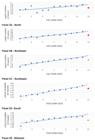
Log10 number of colonoscopies between 2008 and 2019 (circles), Log10 number of colonoscopies in 2020 (square) and Log10 linear regression based on 2008-2019 data (dotted line). Brazilian Regions, 2008-2020.
Comparison between the actual number of procedures in 2020 (“real amount”) with the projections for this year (“expected amount”). Brazil and its regions, 2020.
Northeast: From 2008 to 2019, a non-significant decreasing trend was found in rectosigmoidoscopies (R2=0.001; p=0.917; panel 1B), and significant increasing trends in FOBT (R2=0.86; p<0.001; panel 2B) and colonoscopies (R2=0.94; p<0.001; panel 3B) (Figure 2). The region did not reach the projections for 2020 for any procedure, resulting in percentage differences of -43.4% (-19,867) for colonoscopies, -42.4% (-3,521) for rectosigmoidoscopies, and -22.1% (-27,762) for FOBT (Table 1).
Southeast: From 2008 to 2019, there was a significant decreasing trend in rectosigmoidoscopies (R2=0.59; p=0.003; panel 1C), while there were significant increasing trends in FOBT (R2=0.97; p<0.001; panel 2C) and colonoscopies (R²=0.96; p<0.001; panel 3C). In 2020, the Southeast region did not reach the expected number of exams for any procedure, resulting in percentage differences of -40.8% (-96,778) for colonoscopies, -38.8% (-8,083) for rectosigmoidoscopies, and -37.7% (-446,262) for FOBT (Table 1).
South: There was, from 2008 to 2019, a significant decreasing trend in rectosigmoidoscopies (R2=0.38; p=0.034; panel 1D), and significant increasing trends in FOBT (R2=0.99; p<0.001; panel 2D) and colonoscopies (R2=0.98; p<0.001; panel 3D). The region did not reach the projections for 2020 for any procedure, resulting in percentage differences of -28.4% (-21,157) for colonoscopies, -47.3% (-2,699) for rectosigmoidoscopies, and -27.4% (-77,838) for FOBT (Table 1).
Midwest: From 2008 to 2019, a significant decreasing trend was found in rectosigmoidoscopies (R2=0.91; p<0.001; panel 1E), and significant increasing trends were found in FOBT (R2=0.88; p<0.001; panel 2E) and colonoscopies (R2=0.82; p<0,001; panel 3E). In 2020, the Midwest region reached the expected number of exams only for rectosigmoidoscopies. There were percentage differences of -47.9% (-14,027) in colonoscopies and -41.5% (-45,876) in FOBT, while there was a positive balance of 18.4% (168) rectosigmoidoscopies in 2020 (Table 1).
Brazil: Compared to the projections, there were, in 2020, absolute differences of -154,367 (-39.2%) colonoscopies, -14,888 (-40.2%) rectosigmoidoscopies, and -615,363 (-34.8%) FOBT in the country (Table 1).
DISCUSSION
This study found significant decreasing trends, between 2008 and 2019, in the number of rectosigmoidoscopies in most regions of Brazil, while there were significant upward trends in the number of FOBT in most regions and in the number of colonoscopies in all regions. Most regressions with significant trends presented R2 with high values (R2>0.5), with some reaching values close to one, indicating that the regression lines have a good correlation with the data used for its elaboration. Regardless of the mentioned trends, the main finding of this study was that all regions did not reach the expected number of exams during the COVID-19 pandemic, in 2020, except for rectosigmoidoscopies in the Midwest.
CRC characteristics make it a neoplasm with a favorable screening profile. Among them are its high incidence and long pre-clinical period (development usually from precancerous lesions over 7-10 years), the favorable prognosis in early stages, and evidence that colonoscopic polypectomy results in lower incidence of CRC17,18,19. Despite that, the Brazilian Ministry of Health considers that it is currently not viable nor cost-effective to implement a population screening program for CRC in the country11.
Among the reasons are the fact that FOBT, which is the “first-level”, most available and least expensive exam used for CRC screening, has a low positive predictive value and a high rate of false positives11. This would result in an increase in the demand for additional exams (“second-level”), such as colonoscopies11, that would hardly be accompanied by a proportional increase in the offer of these exams. Other factors include the patients’ fear and resistance in searching medical care, the unawareness of doctors of the importance of CRC, the regional disparities regarding access to health services, the underfund of the public health system, and the demand for continuous longitudinal care, which is often not accomplished18,19,20,21. All these factors would contribute to reducing the effectiveness of a public screening program for CRC.
The present study found decreasing trends in the number of rectosigmoidoscopies and increasing trends in FOBT in most regions of Brazil. In addition, the unanimous upward trends in the number of colonoscopies may reflect good changes. Colonoscopy is considered the gold standard exam for CRC screening, considering its high sensitivity and specificity21. It also allows for the lowest screening frequency12, which can increase patients’ adherence. Furthermore, it is the “final” test in the screening chain, in addition to being the exam of choice in the early diagnosis strategy of symptomatic patients, as it allows the performance of biopsies and resection of lesions during the exam21. Therefore, it can be hypothesized that colonoscopies are progressively becoming more available and may be replacing rectosigmoidoscopies for screening and early diagnosis purposes.
Furthermore, in addition to the already reported possible reasons for the increase in colonoscopies, we hypothesize a further one: the upward trends in the number of FOBT in most regions would result in a higher number of positive FOBT, culminating in the performance of more “second-level” exams, such as colonoscopies.
The finding that Brazil performed, in 2020, fewer exams than predicted, with percentage differences of more than a third in relation to what was expected for all three exams, is very concerning. Among the possible reasons for this scenario are the overcrowding of health services with COVID-19 patients; the prioritization of COVID-19 over other diseases to halt the pandemics progression; relocation of healthcare staff to new functions to do with COVID-19 assistance22; patients’ fear of contracting the coronavirus in health services23; and adherence to social distancing measures.
It is even more worrisome that individuals who may have had signs and symptoms of CRC, such as weight loss, abdominal pain, and weakness, may have delayed seeking medical attention. Therefore, among the consequences of the reduction in the number of exams are the possible lower diagnosis of CRC and its precursor lesions during 2020, future diagnosis of the disease at later stages (“upstaging”)24, with a worse prognosis, higher expenses with treatments for more advanced diseases and deterioration in health care for the Brazilian population.
Furthermore, the performance of fewer colonoscopies and FOBT than expected in all regions of Brazil in 2020 may be an obstacle to the previous continuous growth that has been occurring, while the performance of less rectosigmoidoscopies may accelerate the previous decreasing trends in the number of this exam. However, it must be noted that there are two exceptions: the higher number of rectosigmoidoscopies performed in 2020 in the Midwest, and the downward trend regarding FOBT in the North. Both situations require additional studies to clarify the reasons for these different scenarios. Either way, the drops in the number of exams in 2020 are worrisome, since they reflect a “step-back” in the screening and early diagnosis strategy for CRC in Brazil.
It must be noted that even regions with previously lower incidence rates of CRC, such as the North and the Northeast, presented negative percentage differences for the three procedures. Additionally, one of the North states, Amazonas, became at a certain point the epicenter of the pandemic in the country25. As already discussed, the previously lower incidence of CRC may be partially related to the lower access to health services in these regions. Therefore, the impacts of the pandemic in these already compromised regions can further increase regional inequalities and compromise access to quality primary and preventive health care even more.
It is noteworthy that the reductions observed in the number of exams in the Southeast region, which showed the largest share of performed exams, were the ones that most influenced the final negative differences of exams for Brazil as a whole. This exposes the consequences of historic inequalities in terms of population distribution and health access throughout the country.
Similarly to the findings of the present study, global impacts of the COVID-19 pandemic in CRC related care have already been found. The DECOR-19 survey showed that, among 1,051 respondents, 70.9% of the participants were in the CRC “delay” group, which included, among others, delays in endoscopy, radiology, surgery, and histopathology procedures26. Additionally, a systematic review has shown that CRC screening has decreased, depending on the country and time after onset of pandemic, from 28 to 100%27. Furthermore, a 43% decline has also been found in referrals to colonoscopy, as well as a decrease in surveillance colonoscopy ranging from 44.6 to 79%27.
Regarding Brazil, one study carried out in an oncology center in São Paulo found, in 2020, when compared to 2019, a decrease of 46.3% in newly diagnosed CRC admitted in the service28. The authors theorize that this might be partially related to the collapse of the health systems, particularly the public ones, and to an increased difficulty in performing colonoscopy during the pandemic28.
It must be noted that the present study has some limitations, mostly related to the use of secondary data. It is worth noting that the data from the SIA/SUS are related to the procedures performed, limiting the analysis to the use of services. That is, it is not possible to establish morbidity profiles using the SIA/SUS. In addition, the SIA/SUS was implemented for the purpose of paying for the procedures performed, which can interfere with data recording, since the greater the production of services, the greater the transfer29. However, the establishment of health care floor financing has established a per capita value for the cost of Primary Care actions and services and, presumably, greater data reliability, since the registration of outpatient production no longer interferes with the transfer of resources29. However, even with these limitations, it is important to explore existing data on procedures effectively performed, which can support data on incidence, prevalence and mortality, qualifying them even more.
Finally, the findings of the present study indicate the great impacts of COVID-19 on CRC-related care, and they also indicate the need for urgent planning of measures, at regional and national levels, that aim at progressively returning the performance of exams for the diagnosis and screening of CRC. A return to the pre-pandemic growth trend in the number of annual colonoscopies is of particular importance, considering the test’s great relevance in the context of CRC. It is certain that the COVID-19 pandemic did not affect CRC alone, so its collateral damages are still difficult to measure and will most likely have severe consequences in the future. Further studies should be carried out in order to quantify the damage resulting from this event. The health sector must therefore be prepared to deal with future adversities in order to guarantee access to universal and quality health for all people in Brazil.
REFERENCES
-
1 Sung H, Ferlay J, Siegel RL, Laversanne M, Soerjomataram I, Jemal A, et al. Global Cancer Statistics 2020: GLOBOCAN estimates of incidence and mortality worldwide for 36 cancers in 185 countries. CA Cancer J Clin. 2021;71(3):209-49. https://doi.org/10.3322/caac.21660
» https://doi.org/https://doi.org/10.3322/caac.21660 - 2 Instituto Nacional de Câncer José de Alencar Gomes da Silva. Estimativa 2020: incidência de câncer no Brasil. Rio de Janeiro: INCA; 2019.
-
3 Dutra VGP, Parreira VAG, Guimarães RM. Evolution of mortality for colorectal cancer in Brazil and regions, by sex, 1996-2015. Arq Gastroenterol. 2018;55(1):61-5. https://doi.org/10.1590/S0004-2803.201800000-12
» https://doi.org/https://doi.org/10.1590/S0004-2803.201800000-12 -
4 Sampaio APN, Souza LP, Moreira JPL, Luiz RR, Fogaça HS, Souza HS. Geographic distribution and time trends of colorectal cancer in Brazil from 2005 to 2018. Dig Dis Sci. 2022;67(10):4708-18. https://doi.org/10.1007/s10620-021-07357-9
» https://doi.org/https://doi.org/10.1007/s10620-021-07357-9 -
5 Thanikachalam K, Khan G. Colorectal cancer and nutrition. Nutrients. 2019;11(1):164. https://doi.org/10.3390/nu11010164
» https://doi.org/https://doi.org/10.3390/nu11010164 - 6 Macrae FA. Epidemiology and risk factors for colorectal cancer. In: Seres D, Shah SM, eds. UpToDate. Waltham: UpToDate; 2022.
- 7 Instituto Brasileiro de Geografia e Estatística. Pesquisa de orçamentos familiares 2008-2009: despesas, rendimentos e condições de vida. Rio de Janeiro: IBGE, 2010.
-
8 Instituto Nacional de Câncer. Estatísticas de câncer [Internet]. 2022 [cited 2022 Jul 04]. Available from: Available from: http://www.inca.gov.br/numeros-de-cancer
» http://www.inca.gov.br/numeros-de-cancer -
9 Souza DL, Jerez-Roig J, Cabral FJ, Lima JR, Rutalira MK, Costa JAG. Colorectal cancer mortality in Brazil: predictions until the year 2025 and cancer control implications. Dis Colon Rectum. 2014;57(9):1082-9. https://doi.org/10.1097/DCR.0000000000000186
» https://doi.org/https://doi.org/10.1097/DCR.0000000000000186 -
10 Simon K. Colorectal cancer development and advances in screening. Clin Interv Aging. 2016;11:967-76. https://doi.org/10.2147/CIA.S109285
» https://doi.org/https://doi.org/10.2147/CIA.S109285 - 11 Brasil. Ministério da Saúde. Secretaria de Atenção à Saúde. Departamento de Atenção Básica. Rastreamento. Brasília: Ministério da Saúde; 2010.
-
12 US Preventive Services Task Force, Davidson KW, Barry MJ, Mangione CM, Cabana M, Caughey AB, et al. Screening for colorectal cancer: US preventive services task force recommendation statement. JAMA. 2021;325(19):1965-77. https://doi.org/10.1001/jama.2021.6238
» https://doi.org/https://doi.org/10.1001/jama.2021.6238 -
13 Brasil. Ministério da Saúde. Painel Coronavírus [Internet]. 2022 [cited 2022 Jul 02]. Available from: Available from: https://covid.saude.gov.br/
» https://covid.saude.gov.br/ -
14 World Health Organization. COVID-19 significantly impacts health services for noncommunicable diseases [Internet]. 2020 [cited 2022 Jul 04]. Available from: Available from: http://www.who.int/news/item/01-06-2020-covid-19-significantly-impacts-health-services-for-noncommunicable-diseases
» http://www.who.int/news/item/01-06-2020-covid-19-significantly-impacts-health-services-for-noncommunicable-diseases -
15 Ribeiro CM, Correa FM, Migowski A. Short-term effects of the COVID-19 pandemic on cancer screening, diagnosis and treatment procedures in Brazil: a descriptive study, 2019-2020. Epidemiol Serv Saude. 2022;31(1):e2021405. https://doi.org/10.1590/S1679-49742022000100010
» https://doi.org/https://doi.org/10.1590/S1679-49742022000100010 -
16 Brasil. Ministério da Saúde. DATASUS. Produção ambulatorial (SIA/SUS) [Internet]. [cited 2021 Oct 02]. Available from: Available from: https://datasus.saude.gov.br/acesso-a-informacao/producao-ambulatorial-sia-sus/
» https://datasus.saude.gov.br/acesso-a-informacao/producao-ambulatorial-sia-sus/ -
17 Coy CSR. Colorectal cancer prevention in Brazil - where are we? J Coloproctol (Rio J.). 2013;33(3):111-2. https://doi.org/10.1016/j.jcol.2019.09.001
» https://doi.org/https://doi.org/10.1016/j.jcol.2019.09.001 -
18 Souza RHS, Maluf EMCP, Sartor MC, Carvalho DS. Colorectal cancer: factors related to late diagnosis in users of the public health system treated at an Universitary Hospital in Curitiba, Paraná State, Brazil. Arq Gastroenterol. 2016;53(2):68-75. https://doi.org/10.1590/S0004-28032016000200004
» https://doi.org/https://doi.org/10.1590/S0004-28032016000200004 -
19 Guimarães DP, Mantuan LA, Oliveira MA, Luiz Junior R, Costa AM, Rossi S, et al. The performance of colorectal cancer screening in brazil: the first two years of the implementation program in Barretos Cancer Hospital. Cancer Prev Res (Phila). 2021;14(2):241-52. https://doi.org/10.1158/1940-6207.CAPR-20-0179
» https://doi.org/https://doi.org/10.1158/1940-6207.CAPR-20-0179 -
20 Jones RM, Devers KJ, Kuzel AJ, Woolf SH. Patient-reported barriers to colorectal cancer screening: a mixed-methods analysis. Am J Prev Med. 2010;38(5):508-16. https://doi.org/10.1016/j.amepre.2010.01.021
» https://doi.org/https://doi.org/10.1016/j.amepre.2010.01.021 -
21 Issa IA, Noureddine M. Colorectal cancer screening: an updated review of the available options. World J Gastroenterol. 2017;23(28):5086-96. https://doi.org/10.3748/wjg.v23.i28.5086
» https://doi.org/https://doi.org/10.3748/wjg.v23.i28.5086 -
22 Del Vecchio Blanco G, Calabrese E, Biancone L, Monteleone G, Paoluzi OA. The impact of COVID-19 pandemic in the colorectal cancer prevention. Int J Colorectal Dis. 2020;35(10):1951-4. https://doi.org/10.1007/s00384-020-03635-6
» https://doi.org/https://doi.org/10.1007/s00384-020-03635-6 -
23 Carr S. Missed and delayed diagnoses of non-COVID conditions - collateral harm from a pandemic [Internet]. 2020 [cited 2022 Jul 04]. Available from: Available from: https://www.improvediagnosis.org/improvedx-newsletter/improvedx-july-2020/missed-and-delayed-diagnoses-of-non-covid-conditions-collateral-harm-from-a-pandemic/
» https://www.improvediagnosis.org/improvedx-newsletter/improvedx-july-2020/missed-and-delayed-diagnoses-of-non-covid-conditions-collateral-harm-from-a-pandemic/ -
24 Sharpless NE. COVID-19 and cancer. Science. 2020;368(6497):1290. https://doi.org/10.1126/science.abd3377
» https://doi.org/https://doi.org/10.1126/science.abd3377 -
25 Orellana JDY, Cunha GM, Marrero L, Horta BL, Leite IC. Explosão da mortalidade no epicentro amazônico da epidemia de COVID-19. Cad Saúde Pública. 2020;36(7):e00120020. https://doi.org/10.1590/0102-311x00120020
» https://doi.org/https://doi.org/10.1590/0102-311x00120020 -
26 Santoro GA, Grossi U, Murad-Regadas S, Nunoo-Mensah JW, Mellgren A, Di Tanna GL, et al. DElayed COloRectal cancer care during COVID-19 Pandemic (DECOR-19): global perspective from an international survey. Surgery. 2021;169(4):796-807. https://doi.org/10.1016/j.surg.2020.11.008
» https://doi.org/https://doi.org/10.1016/j.surg.2020.11.008 -
27 Mazidimoradi A, Tiznobaik A, Salehiniya H. Impact of the COVID-19 pandemic on colorectal cancer screening: a systematic review. J Gastrointest Cancer. 2022;53(3):730-44. https://doi.org/10.1007/s12029-021-00679-x
» https://doi.org/https://doi.org/10.1007/s12029-021-00679-x -
28 Aguiar S, Riechelmann RP, Mello CAL, Silva JCF, Diogenes IDC, Andrade MS, et al. Impact of COVID-19 on colorectal cancer presentation. Br J Surg. 2021;108(2):e81-e82. https://doi.org/10.1093/bjs/znaa124
» https://doi.org/https://doi.org/10.1093/bjs/znaa124 -
29 Barros SG, Chaves SCL. A utilização do Sistema de Informações Ambulatoriais (SAI-SUS) como instrumento para caracterização das ações de saúde bucal. Epidemiol Serv Saúde. 2003;12(1):41-51. https://doi.org/10.5123/S1679-49742003000100005
» https://doi.org/https://doi.org/10.5123/S1679-49742003000100005
-
Funding:
none.
-
How to cite:
Furlam TO, Gomes LM, Abreu LHD, Pereira CCA, Machado CJ. Colorectal cancer diagnosis and screening exams in Brazil during the COVID-19 pandemic: a linear regression model. Cad Saúde Colet. 2025;33(2):e33020511. https://doi.org/10.1590/1414-462X202533020511
-
DATA AVAILABILITY STATEMENT
The datasets generated and/or analyzed during the current study are available from the corresponding author upon reasonable request.
Edited by
-
Editor:
Guilherme Werneck - https://orcid.org/0000-0003-1169-1436
The datasets generated and/or analyzed during the current study are available from the corresponding author upon reasonable request.


