 Development of a pharmacotherapeutic assistance protocol in pediatrics: contributions to nursing care
Abstract
Objective to describe the development of a pharmacotherapeutic protocol regarding prevalent medications in a pediatric unit.
Method methodological research, conducted between February and June 2024, in two phases: 1st) situational diagnosis; 2nd) construction of a protocol that was subdivided into three moments: integrative literature review; survey of medication monographs in Drugdex-Micromedex® and WeMEDS®; and protocol structuring, whose validity will be a later phase.
Results the scope of the protocol called “Pharmacotherapeutic care protocol in pediatrics” was based on the preparation guide of the Ministry of Health and Regional Nursing Council of São Paulo and Appraisal of Guidelines for Research and Evaluation II. It was composed of 12 pharmacological and pharmaceutical properties of intravenous medications (therapeutic class, clinical uses, hydrogen potential, osmolarity, stability, storage, reconstitution, dilution, infusion time, medication interaction, therapeutic management, and adverse reactions and laboratory alterations) and seven properties of oral medications (therapeutic class, clinical uses, presentation, administration, medication interaction, therapeutic management, and adverse reactions and laboratory alterations).
Conclusion and implications for practice the protocol configures a technological option that will permeate access to reliable information on the pharmacological and pharmaceutical properties of medications prevalent in the pediatric unit, expanding the nursing team’s knowledge in a practical and accessible manner, ensuring safe medication care for hospitalized children.
Keywords:
Chil, Hospitalized; Medication Errors; Nursing Methodology Research; Nursing, Team; Protocol
Resumo
Objetivo descrever o desenvolvimento de protocolo farmacoterapêutico acerca dos medicamentos prevalentes em unidade pediátrica.
Método pesquisa metodológica, conduzida entre fevereiro e junho de 2024, em duas fases: 1ª) diagnóstico situacional; 2ª) construção do protocolo que se subdividiu em três momentos: revisão integrativa de literatura; levantamento das monografias dos medicamentos no Drugdex-Micromedex® e WeMEDS®; e estruturação do protocolo, cuja validação será posterior.
Resultados o escopo do protocolo denominado “Protocolo assistencial farmacoterapêutico em pediatria” se embasou no guia de elaboração do Ministério da Saúde e Conselho Regional de Enfermagem de São Paulo e Appraisal of Guidelines for Research and Evaluation II. Foi composto por 12 propriedades farmacológicas e farmacêuticas dos medicamentos intravenosos (classe terapêutica, usos clínicos, potencial hidrogeniônico, osmolaridade, estabilidade, armazenamento, reconstituição, diluição, tempo de infusão, interação medicamentosa, manejo terapêutico, e reações adversas e alterações laboratoriais) e sete propriedades dos medicamentos orais (classe terapêutica, usos clínicos, apresentação, administração, interação medicamentosa, manejo terapêutico, e reações adversas e alterações laboratoriais).
Conclusão e implicações para a prática o protocolo configura uma opção tecnológica que permeará acesso às informações fidedignas sobre propriedades farmacológicas e farmacêuticas dos medicamentos prevalentes na unidade pediátrica, ampliando o conhecimento da equipe de enfermagem de modo prático e acessível, assegurando uma assistência medicamentosa segura à criança hospitalizada.
Palavras-chave:
Criança Hospitalizada; Erros de Medicação; Equipe de Enfermagem; Pesquisa Metodológica em Enfermagem; Protocolo
Resumen
Objetivo describir el desarrollo de un protocolo farmacoterapéutico sobre medicamentos prevalentes en una unidad pediátrica.
Método investigación metodológica, realizada entre febrero y junio de 2024, en dos fases: 1ª) diagnóstico situacional; 2a) construcción del protocolo, el cual se subdividió en tres momentos: revisión integradora de la literatura; levantamiento de monografías de medicamentos en Drugdex-Micromedex® y WeMEDS®; y estructuración del protocolo, cuya validación será una fase posterior.
Resultados el alcance del protocolo denominado “Protocolo de asistencia farmacoterapéutica en pediatría” se basó en la guía de elaboración del Ministerio de Salud y Consejo Regional de Enfermería de São Paulo y la Appraisal of Guidelines for Research and Evaluation II. Estaba compuesto por 12 propiedades farmacológicas y farmacéuticas de los medicamentos intravenosos (clase terapéutica, usos clínicos, potencial de hidrógeno, osmolaridad, estabilidad, almacenamiento, reconstitución, dilución, tiempo de infusión, interacción farmacológica, manejo terapéutico, y reacciones adversas y cambios de laboratorio) y siete propiedades de los medicamentos orales (clase terapéutica, usos clínicos, presentación, administración, interacciones medicamentosas, manejo terapéutico, y reacciones adversas y cambios de laboratorio).
Conclusión e implicaciones para la práctica el protocolo configura una opción tecnológica que permitirá acceder a información confiable sobre las propiedades farmacológicas y farmacéuticas de los medicamentos prevalentes en la unidad pediátrica, ampliando el conocimiento del equipo de enfermería de forma práctica y accesible, garantizando una asistencia segura con la medicación. al niño hospitalizado.
Palabras-clave:
Errores de Medicación; Grupo de Enfermería; Investigación Metodológica en Enfermería; Niño Hospitalizado; Protocolo
INTRODUCTION
Medication administration is an intrinsically multidisciplinary process, involving several healthcare professionals. Although it is not restricted exclusively to nursing professionals, it is undeniable that this team plays a crucial role in this context, encompassing activities ranging from scheduling to medication administration, all under their responsibility, in order to ensure safe and effective practices.1,2
In this process, there is a complex interaction of factors involving nurses, individuals and safety. Thus, this practice is characterized as one of the most critical activities in nursing, especially in neonatology and pediatrics, requiring in-person assistance from nurses, a priority professional in the execution and supervision of this practice.3
According to Decree 94,406 of June 8, 1987, which regulates the Professional Practice Law 7,498 of June 25, 1986, in its Article 8, item II, letter f, it is up to this professional to participate in the elaboration of prevention measures and systematic control of damages that may be caused to patients during nursing care.4 The Code of Ethics for Nursing Professionals, approved by COFEN Resolution 564 of December 6, 2017 establishes, in its Article 78, that the nursing team must not administer medications without knowing the purpose, action of the medication, route of administration and potential risks, respecting the different professional backgrounds that make up the team.5
However, medication administration is a topic widely discussed in scientific and academic circles, due to its association with high incidences of complications for patients undergoing this procedure.6 For this reason, the importance of adopting good practices that result in scientific knowledge and skills necessary for establishing and maintaining safe and quality practices in medication preparation and administration stands out, aiming to prevent and control errors.7
This need can be explained by the technical-scientific knowledge required in this practice, since medication administration is not characterized as a simple procedure. On the contrary, it is a process that requires professionals involved to have knowledge of pharmacology, including pharmacodynamics, pharmacokinetics, side effects, adverse reactions, incompatibility and medication interactions, in addition to knowledge of methods, routes of administration, actions, reconstitution, dilutions and properties of medications regarding their vesicant and irritant characteristics, osmolarity and hydrogen potential (pH).3,8
In pediatrics, medication administration presents additional challenges due to the physiological immaturity of children and the lack of public and pharmaceutical policies that consider the specificities of this age group, making them more susceptible to medication errors. It is estimated that the possibility of an error causing harm is three times greater in hospitalized children, which requires specific measures to ensure treatment safety and efficacy.9
A study reports concerns expressed by nursing staff regarding difficulties in understanding and memorizing care associated with the preparation and administration of medications, especially antimicrobial agents, due to the high prescription of this class and the emergence of adverse reactions, such as hepatotoxicity and nephrotoxicity. Lack of knowledge about specific actions related to medications can negatively impact the care provided, culminating in medication errors.10
A study conducted in a neonatal unit reported 511 adverse events, of which 68.1% involved errors in medication administration and 65.4% were related to failure to administer the medication at the appropriate interval. The most frequent errors involved the use of antimicrobial agents, sedation and analgesia.8 Both this study and another conducted in a pediatric clinic of a public hospital highlight the need for healthcare professionals to have theoretical and practical knowledge about the physical-chemical, pharmacological and pharmaceutical characteristics of medications in order to minimize risks to patients. It is important to emphasize the urgent need for the health team to reflect on the responsibility inherent in prescribing, preparing and administering medications. It is essential to create an appropriate environment that promotes the practice of “safe medication”, ensuring the safety of the child population in the use of medications.8,9
It is understood that it is not enough for medications to be safe in its intrinsic sense, the safety of its use process must also be guaranteed.11 Therefore, it is imperative to equip nurses with specific knowledge about each medication used, indicating the need to restructure processes and create strategies and tools aimed at patient safety to reduce avoidable risks and harm associated with care.3
Challenges of this nature may require the production of technological alternatives, such as the construction of protocols, which consist of the description of a specific care/assistance situation, containing operational details and specifications about what is done, who does it and how it is done, guiding professionals in care decisions for health prevention, recovery or rehabilitation. It is up to nurses to develop and improve their work process in relation to medication therapy, and may use instruments and technologies supported by scientific evidence to qualify the care provided and act in the prevention of damage caused by the incorrect use of medications.12
The use of protocols tends to improve care, favor scientifically supported practices, minimize variability in information and conduct among health team members, and establish limits for action and cooperation among professionals. Protocols are legal instruments built within the principles of evidence-based practice, offering the best care options available.13
Considering the above, the development of this study is justified for the creation of “Pharmacotherapy care protocol in pediatrics”, which aims to improve care and ensure the safety of medication therapy through knowledge of the intrinsic characteristics of medications, in order to favor informed decision-making in clinical practice. The protocol aggregates information that represents the best care alternative available based on research. It is recommended that nursing duties be regulated by protocols, ensuring organization of work and compliance with legislation related to medication preparation and administration.12
Furthermore, literature searches were conducted on the creation of pharmacotherapeutic protocols in pediatrics, but the results are incipient, which justifies this study. Therefore, for the development of this study, the following question was proposed: how to develop a pharmacotherapeutic protocol regarding prevalent medications in pediatric units? Therefore, the objective was to describe the development of a pharmacotherapeutic protocol regarding prevalent medications in pediatric units.
METHOD
This is methodological research in nursing indicated in the investigation of methods, involving production-construction, validity and assessment, with a focus on the development of new instrument-products, such as a care protocol.14
Thus, two phases were followed in elaboration: 1st) situational diagnosis; 2nd) protocol construction, which was subdivided into three moments, namely: a) integrative literature review (ILR); b) survey of medication monographs in Drugdex-Micromedex® and WeMEDS®; c) protocol structuring (Figure 1). The content validity of the constructed protocol will be the next phase.

- Methodological operationalization for the construction of a protocol on pharmacotherapeutic properties in pediatrics at a public hospital in the countryside of the state of Rio de Janeiro, Brazil, 2024.
First phase
The first phase consisted of performing a situational diagnosis in order to identify the most prescribed medications in the pediatric clinic to compose the protocol. To this end, a survey of medical records was carried out, specifically from the pediatric inpatient unit, between August and October 2023, in the archives sector of a public hospital located in the countryside of the state of Rio de Janeiro, Brazil. As for the study population, all patients admitted to the pediatric unit in the time frame that comprised the period from May 2022 to May 2023 were retrospectively assessed. This period was chosen in order to survey the most prescribed medications in the last year.
It is worth noting that the sampling was intentional and non-probabilistic, aiming to capture the largest possible number of medical records within the established time frame. Prescriptions containing two or more medications, regardless of the route, prescribed in medical records of children aged 0 to 12 years were included. Medical records unavailable for access at the time of data collection and/or those with low data completeness were excluded. It is worth noting that there was no sample calculation aiming to collect the maximum number of medical records available within the determined time frame.
The setting studied was a public hospital of a municipal authority, intended for care by the Brazilian Health System (In Portuguese, Sistema Único de Saúde - SUS). This institution was selected due to its high patient turnover, receiving not only the population of the municipality where it is located, but also from neighboring regions, constituting a gateway for requesting units, as it is large and has a referral maternity hospital in the region. Moreover, it has a nursery, an “open door” pediatric emergency room, and a pediatric inpatient unit, which treat a wide variety of clinical diagnoses, enabling the study of the intrinsic characteristics of the most prescribed medications in the pediatric unit. However, it does not have a pediatric or neonatal intensive care center; in these cases, it relies on the bed regulation center to refer children with more serious conditions to another health unit.
Data collection was conducted using physical medical records of each child’s medical prescription. It is important to note that patients were identified by alphanumeric codes (newborn 1 (NB 1); child 1 (Chi 1), etc.), which serve only to validate the individuality of information and are not considered an object of analysis. Data were entered into a Microsoft Excel® spreadsheet created by the researchers, containing variables related to sociodemographic data, such as sex, age, race, medical diagnosis, etc., and variables related to pharmacological therapy, such as the name of medication according to the Brazilian Common Name, therapeutic classification adopted by the World Health Organization, Anatomical Therapeutic Chemical Classification System (ATC), quantity of prescribed medications, dose, route and time of administration.
Data collection was carried out by two undergraduate students, under the supervision of a supervisor and co-supervisor. In order to verify whether the objectives would be met, three medical records were tested, but these were not included in the sample. To analyze the medications collected, proportions and measures of central tendency were calculated, which make up the basic statistics.
The second phase refers to the protocol construction carried out between February and June 2024, which was subdivided into three moments, namely:
Second phase - first moment - literature review
At this point, ILR was carried out, aiming to seek updated information on the methodological path and constituent elements to identify, analyze and synthesize reliable and current data on the subject, in order to guide the protocol theoretical content. The construction of nursing protocols must comply with the precepts of evidence-based practice, the standards and regulations of the institution where it will be used.
The research question was formulated based on the search strategy known by the acronym PICo, in which: Population (P): child; Interest (I): methodological path in the construction of protocols; Context (Co): nursing.
In this directive, the search was guided by the research question: what is the methodological approach used in nursing to construct protocols? Data collection occurred using the advanced search form of the following information resources: Latin American and Caribbean Literature in Health Sciences (LILACS); Scientific Electronic Library online (SciELO); US National Library of Medicine National Institutes of Health (PubMed); and the Coordination for the Improvement of Higher Education Personnel (In Portuguese, Coordenação de Aperfeiçoamento de Pessoal de Nível Superior - CAPES) Journal Portal.
The survey was carried out in June 2024, using controlled/standardized descriptors from the Health Sciences Descriptors (DeCS) and Medical Subject Heading (MeSH) in Portuguese, English and Spanish, associated in pairs and in trios using the Boolean operator “AND”, using quotation marks (“”) to restrict and establish the order of the compound terms. Thus, the search strategy was: (tw:(“Study Guides as Topic”)) AND (tw:(“Validation Studies”)) AND (tw:(“Nursing Assessment”)) AND (tw:(“Clinical Protocols”)) AND (Tw:(“Nursing”)).
Original studies available in full and answering the research question, published in the last five years, were included. Letters, editorials, manuals and productions that covered any type of technology other than clinical protocols were excluded. The filters applied included full articles published in Portuguese, Spanish and English, addressing the elements of the research question. The time frame was the last five years, aiming to obtain updated information that would support the knowledge base that constitutes the protocol.
The search and selection phase of studies was carried out by two authors independently. However, the two reviewers used the same search strategies, thus reading and assessing the titles and abstracts of articles selected in information resources, in accordance with defined inclusion/exclusion criteria. There were no disagreements among reviewers, as both agreed on which studies met the necessary elements to answer the research question.
An instrument developed by the authors was used to characterize each production selected for the study. Thus, the studies were organized in a Microsoft Excel® 2007 spreadsheet containing the study title, objective, journal, informational resource, year, authors and design.
Second phase - second moment - survey of medication monographs in Micromedex® and WeMEDS®
A survey of monographs (technical information) of the most prescribed medications in pediatrics previously identified (1st stage) was carried out. To this end, the Drugdex-Micromedex® platform was consulted to obtain information about medication interactions, therapeutic management and therapeutic class, as it is a clinical decision support system that provides the necessary tools for healthcare professionals’ work.15 Furthermore, this platform is used in Brazil and around the world to prepare official documents on medicines, such as the Brazilian National Therapeutic Formulary, technical reports and Brazilian National Commission for the Incorporation of Technology into the Unified Health System Clinical Protocols and Therapeutic Guidelines, supporting several works published in national and international scientific journals.16-18
However, as this is an international information resource, some medication formulations, widely used in Brazil, were not found.19 In view of this, WeMEDS®20 was consulted. This is an application created by Brazilian universities that contains information on medical specialties. In this application, information about commercial name, generic name, dilution, reconstitution, therapeutic conduct, and adverse reactions and laboratory alterations were consulted. Additionally, a study19 points to WeMEDS® as one of the applications with a high score regarding checking medication interactions, ongoing educational activities and availability of medications in the SUS, as some of the functions offered by the application, which continues to innovate and constantly make improvements, ratifying its access in the present study. The two platforms consulted can be accessed free of charge, and can be downloaded from available access platforms.
It is worth noting that some intrinsic characteristics of prevalent medications were not found in the aforementioned applications; therefore, other specific sources/evidence on the subject were consulted regarding information about pH, osmolarity, stability, storage and clinical use.21-27
All data collected in both databases were compiled and formatted in a table created in Microsoft Excel®.
Second phase - third moment - protocol structuring
At this point, the protocol was structured, which, due to the specific theme for nursing, in addition to the scientific evidence found, other recommendations were accepted as a way of guiding the theoretical content and the methodological path used in the protocol construction in line with competent bodies and societies focused on nursing care. Thus, the guidelines followed supported the scope of information, demonstrating the rigor of construction given the local reality and the feasibility of using the protocol in clinical practice.
The protocol was based on the Development Guide: Scope for Clinical Protocols and Therapeutic Guidelines,28 in the Guide for the Construction of Nursing Care Protocols,12 as well as in the Appraisal of Guidelines for Research and Evaluation II.29 The latter was observed up to item 12 of domain 3 (rigor of development), since the other items refer to the instrument validity, which will be a later phase.29
The study complied with Resolution 466 of 2012 of the Brazilian National Health Council, being submitted to the Universidade Federal Fluminense Research Ethics Committee, under Opinion 6.102.295 and Certificate of Presentation for Ethical Consideration 69759523.1.0000.8160. The exemption from the use of an Informed Consent Form is based on the terms: retrospective collection of data from medical records and, therefore, non-interventionist; as there are no physical and/or biological risks to patients; study population without follow-up at the institution, in addition to confidentiality of patient identification through alphanumeric codes.
RESULTS
In this section, the results will be presented according to the stages used to construct a protocol entitled “Pharmacotherapeutic protocol in pediatrics”.
First phase - situational diagnosis
A total of 664 medical records that met the inclusion criteria were selected. Of these, 36 were excluded due to incomplete data and medication suspension during hospitalization. A total of 628 prescriptions were analyzed, containing a total of 3,030 medications. The mean number of medications per prescription was 4.8, ranging from 2 to 14 medications, with intravenous administration being the most commonly used route, as described below. The most frequent age group was 29 days to 2 years, corresponding to 329 cases (52.4%).
Among the medications prescribed in the pediatric inpatient unit, five therapeutic classes were identified, such as class N (central nervous system) and class J (anti-infective for systemic use), with 93.9% (n=590), being the most prevalent, followed by class A (alimentary tract and metabolism), with 89.7% (n=563), and class R (respiratory system), with 74.8% (n=470). Among the anti-infectives for systemic use, ceftriaxone was the most prescribed, accounting for 31.7% (n=199). Regarding the route of administration, parenteral was the most prevalent, with 71.7% (n=2163), followed by oral, with 10.4% (n=314).
Second phase - protocol construction
Based on the phases and moments described above, a version of the care protocol was outlined regarding the pharmacological and pharmaceutical properties of medications prescribed to children hospitalized in a pediatric unit. Seeking to identify the methodological path used in nursing to construct protocols, ILR was carried out.
The search resulted in the following distribution among the studies found in each information resource, totaling 393 studies: LILACS (n = 65); SciELO (n = 20); PubMed (n = 93); and CAPES Portal (n = 215). Subsequently, the studies found were analyzed and duplicate manuscripts by title and abstract were excluded (n = 18). Then, studies were excluded by reading each title and abstract and using the inclusion criteria. Thus, after reading and final evaluation, five studies were included in the review.
In view of selected evidence and through the convergence of subjects, in addition to the methodological path followed to construct the protocol, the studies presented the elements that constitute a protocol, such as presentation form, protocol name, introduction, scope reviewers, justification for the proposal, objective, target population, description of procedure, glossary, references and annexes, in addition to information focused on the specific clinical circumstances of each protocol.
In this understanding, the identification of the predominant medications in prescriptions, added to the synthesis of information obtained in ILR30-34 and in the recommendations of the preparation guide of the Ministry of Health and Regional Nursing Council of São Paulo and Appraisal of Guidelines for Research and Evaluation II,12,28,29 guided the preparation of a protocol that is easy to read, reliable and based on scientific evidence. The objective is for the protocol to respond to relevant questions in health practice, addressing the intrinsic characteristics of each medication, referred to here as pharmacological and pharmaceutical properties that contribute to improving the nursing team’s knowledge, attitudes and practices in relation to medication therapy implemented in pediatric clinical practice.
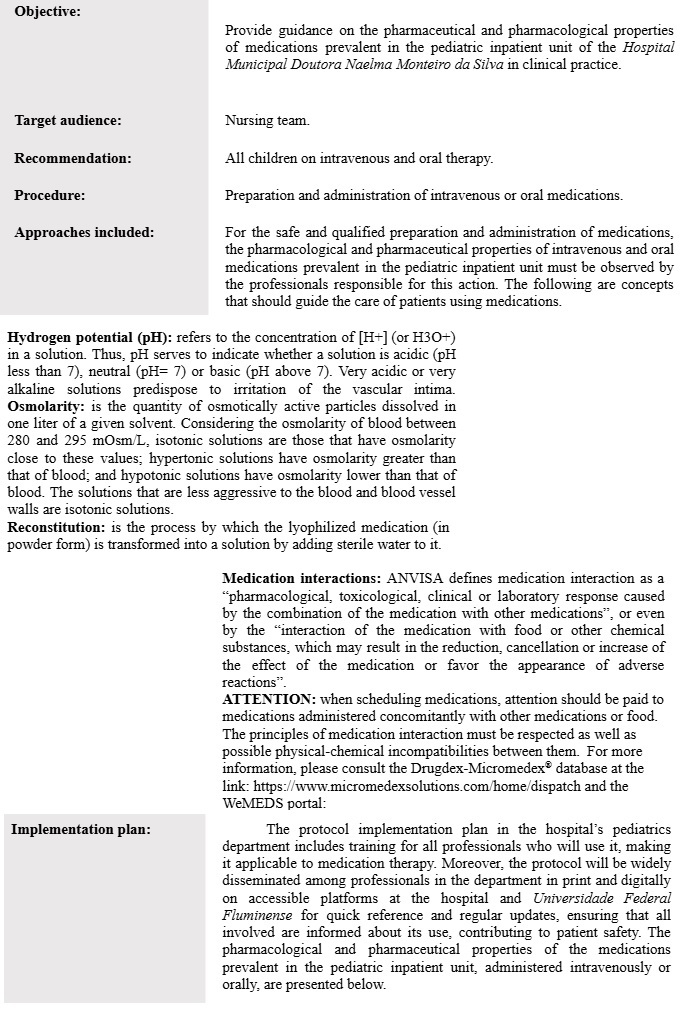
Thus, the protocol called “Pharmacotherapeutic care protocol in pediatrics” (Supplementary 1) was composed of: 12 pharmacological and pharmaceutical properties of intravenous medications (therapeutic class, clinical uses, pH, osmolarity, stability, storage, reconstitution, dilution, infusion time, medication interaction, therapeutic management, and adverse reactions and laboratory alterations); seven properties of oral medications (therapeutic class, clinical uses, presentation, administration, medication interaction, therapeutic management, and adverse reactions and laboratory alterations); medications prevalent in the pediatric unit (dipyrone sodium, bromopride, ceftriaxone sodium, amoxicillin with potassium clavulanate, oxacillin sodium, ampicillin sodium, gentamicin sulfate, clarithromycin, benzylpenicillin potassium, metronidazole, hydrocortisone sodium succinate, methylprednisolone and ondansetron hydrochloride); and oral medications (dipyrone sodium, bromopride, ondansetron hydrochloride, simethicone, paracetamol, dexchlorpheniramine maleate, ibuprofen and prednisolone). Chart 1 shows the stages for preparing the protocol.
Figure 2 and Charts 2 and 3 schematically present parts of “Pharmacotherapeutic care protocol in pediatrics”.

- Pharmacological and pharmaceutical properties of intravenous medications in the pediatric inpatient unit. Rio das Ostras, RJ, Brazil, 2024.
- Pharmacological and pharmaceutical properties of oral medications in the pediatric inpatient unit. Rio das Ostras, RJ, Brazil, 2024.
DISCUSSION
To prepare the protocol, the elements described in the Preparation Guide: Scope for Clinical Protocols and Therapeutic Guidelines,28 Guide for the Construction of Nursing Care Protocols12 as well as the Appraisal of Guidelines for Research and Evaluation II were used.29 The use of these materials, combined with the scientific evidence selected in ILR, supported the construction, highlighting the legal aspects and constituent elements related to the use of the protocol. Furthermore, in its preparation, the objective was to construct a protocol of good formal quality, easy to read, valid, reliable and based on scientific evidence.12 However, this implies a rigorous process of construction, adaptation to local reality and implementation, in addition to monitoring through indicators of use (process) and effectiveness (result), which will be carried out in a later phase of the study.
To exemplify the content and the way in which the protocol was constructed, medication errors stand out, which are multifactorial and may be related to professional practice, physical-chemical characteristics of medications used, procedures performed, dose preparation and distribution by the pharmacy, and are therefore used as indicators of patient safety in hospital institutions because they are the most frequent in these places, with the rate of occurrence being higher in the pediatric population.35 This fact reaffirms the need to implement assistance technologies that permeate the improvement of nursing team’s knowledge, attitude and practice given the specificities that medication therapy encompasses, aspects highlighted in the assistance protocol in question.
Additionally, studies demonstrate several causes for the incidence of errors, such as overwork, lack of nursing experience, little pharmacological knowledge and difficulties in performing the calculations necessary to prepare the dose to be administered. Nursing teams spend 40% of their time preparing medications, hence the reports of the difficulties faced in clinical practice.35
Given the above, the protocol can help to expand professional knowledge in this area of care, improve care and increase the quality and safety of care provided to children. It can also be used in teaching clinical practice and for management, offering support for the systematization of nursing care, in the face of medication therapy, in addition to supporting it scientifically, permeating the adoption of good practices and, therefore, greater responsibility in medication preparation and administration.12
It is known that medication administration is an essential part of a patient’s recovery. However, inadequate practice, even if unintentional, can cause serious harm to patients’ health, including compromising their life. Therefore, the healthcare team must be prepared, trained and aware of the magnitude that this procedure, however daily it may be, implies, culminating in greater responsibility for everyone involved in this process.36
Pediatric patient safety is an even greater challenge, as this is the population most vulnerable to medication errors, due not only to the peculiarities inherent to this segment, but also to the unavailability of medication formulations suitable for children, in which approximately 80% of medications used in adults are also used in children and newborns.3 However, there has not yet been any movement by the pharmaceutical industry to adapt medication formulations for pediatric use, leaving healthcare professionals with doubts regarding the correct use of these medications.37
In this directive, the protocol developed seeks to expand knowledge in a practical and accessible manner, providing information on the pharmacological and pharmaceutical properties of prevalent medications used in the pediatric inpatient unit, which can be used by nursing professionals quickly when faced with the need for specific knowledge, often without the support of scientific evidence, facilitating decision-making in pediatric clinical practice.38
Thus, the development of studies of this nature helps to foster the development and applicability of care/clinical protocols in clinical practice. In this regard, research reports that non-compliance with and lack of knowledge of protocols established in health institutions contribute to the occurrence of medication errors, even influencing their reporting.38
Given the high rate of errors in the preparation and administration of medications and their negative impact on the safety and clinical recovery of hospitalized children, the development of the protocol aims to improve the quality of service in a pediatric unit.39 It is therefore understood that the creation of a care protocol can constitute a promising strategy, filling identified gaps and contributing to the continuous improvement of the care provided.
Regarding this perspective, a study supports this finding when it points out that the chances of errors in medication administration were almost six times higher among nurses with insufficient knowledge compared to those with greater knowledge about the correct use of medications. The explanation for this discrepancy lies in the fact that knowledge provides a solid basis for decision-making and its implementation. Thus, a lack of knowledge results in erroneous decisions, which inevitably culminates in inadequate performance.38
Medication administration is a complex procedure that requires significant intellectual activity and critical thinking, involving a series of interrelated considerations, such as the correct dosage regimen, side effects, dilution, reconstitution, osmolarity, storage, stability, pH, among others, all of which are the responsibility, for the most part, of nursing professionals. It is therefore clear that inadequate pharmacological knowledge and the inability to transfer this knowledge to clinical practice can result in errors during medication preparation and administration. Thus, it is understood that, in order to keep medication safe, nurses need to have adequate pharmacological knowledge about the medications they handle, which are covered in the protocol developed.37
In this understanding, protocols are considered important methodological tools, as they are configured as guides for care, directing and standardizing a course of action to be taken, thus reducing the length of hospital stay, the mortality rate and therapeutic costs, supporting the reduction of risks involving patients.40 To this end, their construction must follow systematically structured recommendations, with the purpose of guiding decisions by healthcare professionals and/or users regarding appropriate care in specific clinical circumstances, respecting the ethical and legal principles of the profession.40
In addition to the above, it is understood that the creation of a care protocol containing information on the pharmacological and pharmaceutical properties of prevalent medications for use in a pediatric unit is valid, since the provision of this information empowers the nursing team in its management, in addition to directing the provision of care by all those involved in the process, since, given the protocol, understanding these properties will lead to safe and qualified clinical practice for hospitalized children.41
Furthermore, the macro objective of constructing a protocol is to assist professionals and managers in making decisions on specific clinical issues that present variability in clinical practice or scientific uncertainties regarding efficacy, safety, cost-effectiveness, applicability or other relevant aspects, with the aim of optimizing the efficiency of SUS and quality of care.28
CONCLUSIONS AND IMPLICATIONS FOR PRACTICE
The “Pharmacotherapeutic care protocol in pediatrics” was developed based on the identification of prevalent medications, and is comprised of information about their pharmacological and pharmaceutical properties capable of expanding the knowledge of the pediatric unit nursing team in a practical and accessible manner. The provision of this content in a protocol facilitates care and provides scientific guidance, aiming to reduce adverse medication events and ensure safe and qualified medication care for hospitalized children.
As a limitation, we pointed out the incipience of studies on the construction of protocols about medications in pediatric nursing practice, which limited the construction and discussion of the findings. Furthermore, there was a need for peer validity and, consequently, to establish implementation strategies and construction of expected outcomes or results in the institution where it will be implemented, highlighting the need for continuity of the study.
The promotion of safe practices in medication administration and the elimination of risk factors should be a constant concern of the nursing team, such as a care protocol as a way of resolving possible doubts throughout this process, in addition to minimizing the helplessness of these professionals who need to obtain information about the medications they use, often without prior knowledge and/or scientific evidence. This fact ratifies the development of this tool, which aims to integrate access to reliable and updated information on the pharmacological and pharmaceutical properties of the main medications used in pediatrics, and can be used to fill these gaps.
SUPPLEMENTARY MATERIAL
The following online material is available for this article:
Supplementary 1 -
ACKNOWLEDGMENTS
None.
References
-
1 Abi AX, Cruz ED, Pontes L, Santos T, Felix JV. The Healthcare Failure Mode and Effect Analysis as a tool to evaluate care protocols. Rev Bras Enferm. 2022;75(3):e20210153. http://doi.org/10.1590/0034-7167-2021-0153 PMid:35137884.
» http://doi.org/10.1590/0034-7167-2021-0153 - 2 Silva BR, Saraiva KC, Reverte LA, Hott SC. Erro de medicação na assistência de enfermagem: uma revisão de literatura. Rev Saude Vales. 2023;7(1):1-12. http://doi.org/10.61164/rsv.v7i1.1946.3.
-
3 Silva AC, Silva TP, Alves DN, Amarante LH, Góes FG, Goulart MC. Prática clínica da equipe de enfermagem acerca da terapia intravenosa em Unidade Neonatal e Pediátrica. Rev Baiana Enferm. 2019;33:e33828. http://doi.org/10.18471/rbe.v33.33828
» http://doi.org/10.18471/rbe.v33.33828 -
4 Decreto-Lei nº 94.406, de 8 de junho de 1987 (BR). Regulamenta a Lei n. 7.498, de 25 de junho de 1986, que dispõe sobre o exercício da Enfermagem, e dá outras providências. Diário Oficial da União [periódico na internet], Brasília (DF), 9 jun 1987 [citado 2024 dez 6]. Disponível em: https://www.cofen.gov.br/decreto-n-9440687/
» https://www.cofen.gov.br/decreto-n-9440687/ -
5 Resolução COFEN nº 564, de 6 de novembro de 2017 (BR). Aprova o novo Código de Ética dos Profissionais de Enfermagem. Diário Oficial da União [periódico na internet], Brasília (DF), 6 nov 2017 [citado 2024 dez 6]. Disponível em: https://www.cofen.gov.br/resolucao-cofen-no-5642017/
» https://www.cofen.gov.br/resolucao-cofen-no-5642017/ -
6 Lazaretto FZ, Santos CO, Millão LF. Erros de medicação em pediatria: avaliação das notificações espontâneas em hospital pediátrico em Porto Alegre/RS, Brasil. Mundo Saude. 2020;44(1):e1862019. http://doi.org/10.15343/0104-7809.202044068075
» http://doi.org/10.15343/0104-7809.202044068075 -
7 Paiva JV, Souza JT, Tavares TC, Almeida Jr VS, Silva BM. Administração segura de medicamentos via endovenosa. Rev Cient Tocantins [Internet]. 2023; [citado 2024 dez 6];3(1):1-11. Disponível em: https://itpacporto.emnuvens.com.br/revista/article/view/142/115
» https://itpacporto.emnuvens.com.br/revista/article/view/142/115 -
8 Martínez Reyes CR, Álvarez Reyes F, Garzón Martínez CA, Rave Henao IC. Eventos adversos en niños hospitalizados: un desafío para el cuidado de enfermería. Rev Cienc Cuid. 2019;16(1):111-23. http://doi.org/10.22463/17949831.1547
» http://doi.org/10.22463/17949831.1547 -
9 Baraki X, Abay M, Tsegay L, Gerensea H, Kebede A, Teklay H. Medication administration error and contributing factors among pediatric inpatient in public hospitals of Tigray, northern Ethiopia. BMC Pediatr. 2018;18(1):321. http://doi.org/10.1186/s12887-018-1294-5 PMid:30305080.
» http://doi.org/10.1186/s12887-018-1294-5 - 10 Camargo PT, Renovato RD, Ganassin FM. Nursing team’s perceptions of preparation and administration of medicines in pediatrics. Cienc Cuid Saude. 2021;20:e54294. http://doi.org/10.4025/cienccuidsaude.v20i0.54294.
-
11 Correia GB, Batista AM. Levantamento de informações para elaboração de guia de estabilidade de medicamentos injetáveis pós reconstituição e diluição em hospital materno-infantil. Infarma-Ciências Farmacêuticas. 2021;33(1):81-5. http://doi.org/10.14450/2318-9312.v33.e1.a2021.pp81-85
» http://doi.org/10.14450/2318-9312.v33.e1.a2021.pp81-85 -
12 Pimenta CA, Lopes CT, Amorim AF, Shimoda GT, Jensen R. Guia para construção de protocolos assistenciais de Enfermagem [Internet]. São Paulo: COREN-SP; 2017 [citado 2024 dez 6]. Disponível em: http://www.coren-sp.gov.br/sites/default/files/Protocolo-web.pdf
» http://www.coren-sp.gov.br/sites/default/files/Protocolo-web.pdf -
13 Rodrigues JA, Lacerda MR, Galvão CM, Gomes IM, Cubas MR, Fernandes AP. Construction of a nursing care protocol for children in post-hematopoietic stem cell transplantation. Rev Gaúcha Enferm. 2022;43:e20210028. http://doi.org/10.1590/1983-1447.2022.20210028.en PMid:35613236.
» http://doi.org/10.1590/1983-1447.2022.20210028.en -
14 Teixeira E. Interfaces participativas na pesquisa metodológica para as investigações em enfermagem. Rev Enferm UFSM. 2019;9:e1. http://doi.org/10.5902/2179769236334
» http://doi.org/10.5902/2179769236334 -
15 Truven Health Analytics. DRUGDEX® System [Internet]. Greenwood Village, CO: Truven Health Analytics; 2024 [citado 2024 dez 6]. Disponível em: https://www.micromedexsolutions.com
» https://www.micromedexsolutions.com -
16 Ministério da Saúde (BR). Formulário terapêutico nacional [Internet]. 2. ed. Brasília: Departamento de Assistência Farmacêutica e Insumos Estratégicos, Secretaria de Ciência, Tecnologia e Insumos Estratégicos; 2010 [citado 2024 out 2]. Disponível em: https://bvsms.saude.gov.br/bvs/publicacoes/formulario_terapeutico_nacional_2010.pdf
» https://bvsms.saude.gov.br/bvs/publicacoes/formulario_terapeutico_nacional_2010.pdf -
17 Aburamadan HA, Sridhar SB, Tadross TM. Assessment of potential drug interactions among psychiatric inpatients receiving antipsychotic therapy of a secondary care hospital, United Arab Emirates. J Adv Pharm Technol Res. 2021;12(1):45-51. http://doi.org/10.4103/japtr.JAPTR_110_20 PMid:33532354.
» http://doi.org/10.4103/japtr.JAPTR_110_20 -
18 Costa HTML, Florencio AP, Bezerra PKV, Cavalcanti JEC, Costa TX, Fernandes FEM et al. Evaluación comparativa de la prescripción off-label y unlicensed de fármacos en cuidados intensivos neonatales: guías de la FDA versus guías brasileñas. An Pediatr. 2021;94(3):153-60. http://doi.org/10.1016/j.anpedi.2020.07.010
» http://doi.org/10.1016/j.anpedi.2020.07.010 -
19 Oliveira Fo SN, Alves IA, Viana MD. Aplicativos móveis de saúde como facilitadores à clínica farmacêutica. J Biol Pharm Agric Manag [Internet]. 2023; [citado 2024 out 2];17(4):1215-29. Disponível em: https://revista.uepb.edu.br/BIOFARM/article/view/2287
» https://revista.uepb.edu.br/BIOFARM/article/view/2287 -
20 WeMeds [Internet]. São Paulo; 2023 [citado 2024 out 2]. Disponível em: https://www.wemeds.com.br
» https://www.wemeds.com.br -
21 Alves DN, Silva AC, Amarantes LH. Cartilha para o uso correto dos principais medicamentos injetáveis em pediatria [Internet]. Rio das Ostras: Universidade Federal Fluminense; 2021 [citado 2024 out 2]. Disponível em: https://app.uff.br/riuff/handle/1/25791
» https://app.uff.br/riuff/handle/1/25791 -
22 Souza AC, Barros JC, Rocha SO, Santos MJ, Nunes C. Manual para o preparo e administração de medicamentos intravenosos [Internet]. Rio de Janeiro: Hospital Universitário Pedro Ernesto; 2023 [citado 2024 out 2]. Disponível em: https://www.hupe.uerj.br/wp-content/uploads/2023/07/Manual-para-Preparo-e-Administra%C3%A7%C3%A3o-de-Medicamentos-Intravenosos_Final_02jul23-1.pdf
» https://www.hupe.uerj.br/wp-content/uploads/2023/07/Manual-para-Preparo-e-Administra%C3%A7%C3%A3o-de-Medicamentos-Intravenosos_Final_02jul23-1.pdf -
23 Moraes RS. Manual de orientações para preparo e administração de medicamentos injetáveis [Internet]. Distrito Federal: Hospital Materno Infantil de Brasília; 2019 [citado 2024 out 2]. Disponível em: https://apsredes.org/manual-sobre-medicamentos-injetaveis-visa-reduzir-erros-e-danos-associados-a-assistencia-prestada-pela-enfermagem/
» https://apsredes.org/manual-sobre-medicamentos-injetaveis-visa-reduzir-erros-e-danos-associados-a-assistencia-prestada-pela-enfermagem/ -
24 Ballesteros-Peña S, Fernández-Aedo I, Vallejo-De la Hoz G, Tønnesen J, Miguelez C. Identificación de medicamentos intravenosos potencialmente irritantes. Enferm Intensiva. 2022;33(3):132-40. http://doi.org/10.1016/j.enfi.2021.05.003
» http://doi.org/10.1016/j.enfi.2021.05.003 -
25 Hospital Israelita Albert Einstein. Tabela de diluição de medicamentos intravenosos - UTI Neonatal [Internet]. São Paulo: Albert Einstein; 2023 [citado 2024 out 2]. Disponível em: https://aplicacoes.einstein.br/manualfarmaceutico/Paginas/Termos.aspx?filtro=Tabelas&itemID=166#detalheTermo
» https://aplicacoes.einstein.br/manualfarmaceutico/Paginas/Termos.aspx?filtro=Tabelas&itemID=166#detalheTermo -
26 Manrique-Rodríguez S, Heras-Hidalgo I, Pernia-López MS, Herranz-Alonso A, Del Río Pisabarro MC, Suárez-Mier MB et al. Standardization and chemical characterization of intravenous therapy in adult patients: a step further in medication safety. Drugs R D. 2021;21(1):39-64. http://doi.org/10.1007/s40268-020-00329-w PMid:33346878.
» http://doi.org/10.1007/s40268-020-00329-w -
27 Oliveira HC, Negrão NY. I guia prático de incompatibilidades entre os principais medicamentos utilizados na unidade de terapia intensiva do HUJM [Internet]. Cuiabá: Hospital Universitário Júlio Muller; 2022 [citado 2024 out 2]. Disponível em: https://www.gov.br/ebserh/pt-br/hospitais-universitarios/regiao-centro-oeste/hujm-ufmt/ensino-e-pesquisa/setor-de-gestao-de-pesquisa-e-inovacao-tecnologica-segpit/unidade-de-gestao-da-inovacao-tecnologica-em-saude/centro-de-informacoes-sobre-medicamentos-cim-1/2016/i-guia-de-incompatibilidades-medicamentosas.pdf
» https://www.gov.br/ebserh/pt-br/hospitais-universitarios/regiao-centro-oeste/hujm-ufmt/ensino-e-pesquisa/setor-de-gestao-de-pesquisa-e-inovacao-tecnologica-segpit/unidade-de-gestao-da-inovacao-tecnologica-em-saude/centro-de-informacoes-sobre-medicamentos-cim-1/2016/i-guia-de-incompatibilidades-medicamentosas.pdf -
28 Ministério da Saúde. Guia de elaboração: escopo para protocolos clínicos e diretrizes terapêuticas [Internet]. Brasília: Ministério da Saúde; 2019 [citado 2024 out 2]. Disponível em: https://bvsms.saude.gov.br/bvs/publicacoes/guia_elaboracao_protocolos_delimitacao_escopo_2ed.pdf
» https://bvsms.saude.gov.br/bvs/publicacoes/guia_elaboracao_protocolos_delimitacao_escopo_2ed.pdf -
29 AGREE Research Trust. Appraisal of guidelines for research and evaluation II [Internet]. London: AGREE Research Trust; 2009 [citado 2024 out 2]. Disponível em: https://www.agreetrust.org/wp-content/uploads/2017/12/AGREE-II-Users-Manual-and-23-item-Instrument-2009-Update-2017.pdf
» https://www.agreetrust.org/wp-content/uploads/2017/12/AGREE-II-Users-Manual-and-23-item-Instrument-2009-Update-2017.pdf -
30 Moura RBB, Barbosa JM, Araújo RG, Feitosa GAM, Araújo PPA, Bogo AIM et al. Validação de protocolo de nutrição para idosos em cuidados paliativos. CLCS. 2023;16(6):3260-76. http://doi.org/10.55905/revconv.16n.6-013
» http://doi.org/10.55905/revconv.16n.6-013 -
31 Rebouças GF, Primo CC, Freitas PS, Nunes EM, Quitério MM, Lima EF. Risk management: implementation of a clinical protocol for the prevention and management of pediatric falls. Rev Gaúcha Enferm. 2022;43(spe):e20220050. http://doi.org/10.1590/1983-1447.2022.20220050.en PMid:36449834.
» http://doi.org/10.1590/1983-1447.2022.20220050.en -
32 Krepker FF, Arreguy-Sena C, Braga LM, Krempser P, Santos JC, Dutra HS. Nursing protocol in chronic kidney disease prevention in older adults in primary care. Rev Bras Enferm. 2023;76(1):e20220052. http://doi.org/10.1590/0034-7167-2022-0052 PMid:36449972.
» http://doi.org/10.1590/0034-7167-2022-0052 -
33 Silva AM, Sousa CS, Melo MC. Tecnologia Assistencial no processo de elaboração de protocolo para aplicação do Brinquedo Terapêutico na pediatria. Com Ciências Saúde. 2023;33(4). http://doi.org/10.51723/ccs.v33i04.1114
» http://doi.org/10.51723/ccs.v33i04.1114 -
34 Mustelier Duanes Y. Diseño de un protocolo de intervenciones de enfermería para personas con enfermedades anorrectales que requieren cirugía ambulatoria. Rev Cubana Enferm [Internet]. 2022; [citado 2024 out 2];38(4):e5580. Disponível em: http://scielo.sld.cu/scielo.php?pid=S0864-03192022000400015&script=sci_arttext
» http://scielo.sld.cu/scielo.php?pid=S0864-03192022000400015&script=sci_arttext -
35 Lazaretto FZ, Santos CO, Millão LF. Erros de medicação em pediatria: avaliação das notificações espontâneas em hospital pediátrico em Porto Alegre/RS, Brasil. Mundo Saude. 2020;44(1):68-75. http://doi.org/10.15343/0104-7809.202044068075
» http://doi.org/10.15343/0104-7809.202044068075 -
36 D’Errico S, Zanon M, Radaelli D, Padovano M, Santurro A, Scopetti M et al. Medication errors in pediatrics: proposals to improve the quality and safety of care through clinical risk management. Front Med. 2022;8:814100. http://doi.org/10.3389/fmed.2021.814100 PMid:35096903.
» http://doi.org/10.3389/fmed.2021.814100 -
37 Mekonen EG, Gebrie MH, Jemberie SM. Magnitude and associated factors of medication administration error among nurses working in Amhara Region Referral Hospitals, Northwest Ethiopia. J Drug Assess. 2020;9(1):151-8. http://doi.org/10.1080/21556660.2020.1841495 PMid:33235815.
» http://doi.org/10.1080/21556660.2020.1841495 -
38 Puma-Quito RS, Mesa-Cano IC, Ramírez-Coronel AA, Pacururu-Ávila NJ. Efectividad de intervenciones de enfermería basada en protocolos de administración segura de medicamentos por vía venosa: revisión sistemática. AVFT. 2021;40(3). http://doi.org/10.5281/zenodo.5039444
» http://doi.org/10.5281/zenodo.5039444 -
39 Carvalho No FJ, Oliveira FG, Fontes JH, Neves IS, Azevedo JV, Vieira Jr D et al. Educational technology on home medication disposal. Rev Enferm UFPE on line. 2020;14:1-6. http://doi.org/10.5205/1981-8963.2020.244267
» http://doi.org/10.5205/1981-8963.2020.244267 -
40 Holanda OQ, Oliveira VA, Fernandes FE, Xavier SB, Mola R. Efetividade do protocolo para prevenção de lesões por pressão implantado em Unidade de Terapia Intensiva. Rev Espaço Saúde. 2018;19(2):64-74. http://doi.org/10.22421/15177130-2018v19n2p64
» http://doi.org/10.22421/15177130-2018v19n2p64 -
41 Veras RE, Moreira DP, Silva VD, Rodrigues SE. Avaliação de um protocolo clínico por enfermeiros no tratamento da sepse. J Health Biol Sci. 2019;7(3):292-7. http://doi.org/10.12662/2317-3076jhbs.v7i3.2466.p292-297.2019
» http://doi.org/10.12662/2317-3076jhbs.v7i3.2466.p292-297.2019
Edited by
-
ASSOCIATED EDITOR
Aline Okido https://orcid.org/0000-0003-4309-5612
-
SCIENTIFIC EDITOR
Marcelle Miranda da Silva https://orcid.org/0000-0003-4872-7252
Data will be available on demand to authors.