 Temporal analysis of mortality from traffic accidents in a municipality in southern Brazil
Abstract
Objective to identify the profile and temporal trend of mortality from traffic accidents in Maringá from 2000 to 2020.
Method ecological time series study on mortality from traffic accidents in the municipality of Maringá. The data referred to all deaths from traffic accidents between 2000 and 2020, and the corresponding annual mortality rates were obtained.
Results a predominance of deaths was observed among motorcyclists, males, whites, singles, those aged 20 to 29 years, and those with 8 to 12 years of schooling. The temporal trend was stable in both sexes and most age groups, except for the 30-39 age group.
Conclusions and implications for practice the findings reaffirm traffic accidents as a significant public health problem in the municipality, with a social impact and an overload on urgent and emergency services. There is a clear need for targeted and effective public policies, as well as prevention strategies that prioritize the most vulnerable groups, with the aim of reducing the occurrence and health impacts of these events. The findings support educational and preventive nursing actions, as well as strengthening public policies to reduce traffic accidents and their impact on health.
Keywords:
Accidents, Traffic; Health Education; Mortality; Health Policy; Health Services
Resumo
Objetivo identificar o perfil e a tendência temporal da mortalidade por sinistros de trânsito em Maringá, no período de 2000 a 2020.
Método estudo ecológico de séries temporais sobre a mortalidade por sinistros de trânsito no município de Maringá, Brasil. As informações corresponderam a todos os óbitos por sinistros de trânsito entre 2000 e 2020, e foram obtidas as respectivas taxas anuais de mortalidade.
Resultados foi observada a predominância de óbitos entre motociclistas, do sexo masculino, brancos, solteiros, na faixa etária de 20 a 29 anos e com escolaridade entre 8 e 12 anos. A tendência temporal se apresentou estacionária em ambos os sexos e na maioria das faixas etárias, exceto no grupo de 30 a 39 anos.
Conclusões e implicações para a prática os achados reafirmam os sinistros de trânsito como problema relevante de saúde pública no município, com impacto social e sobrecarga aos serviços de urgência e emergência. Evidencia-se a necessidade de políticas públicas direcionadas e efetivas, além de estratégias de prevenção que priorizem os grupos mais vulneráveis, visando reduzir a ocorrência e as consequências desses eventos na saúde. Os achados subsidiam ações educativas e preventivas de enfermagem, além de fortalecer políticas públicas na redução dos sinistros de trânsito e dos impactos na saúde.
Palavras-chave:
Acidentes de Trânsito; Educação em Saúde; Mortalidade; Políticas Públicas de Saúde; Serviços de Saúde
Resumen
Objetivo identificar el perfil y la tendencia temporal de la mortalidad por accidentes de tránsito en Maringá, de 2000 a 2020.
Método estudio ecológico de series temporales sobre la mortalidad por accidentes de tránsito en el municipio de Maringá. La información se refería a todas las muertes por accidentes de tránsito entre 2000 y 2020, y se obtuvieron las tasas anuales de mortalidad correspondientes.
Resultados se observó una predominancia de muertes entre motociclistas, hombres, blancos, solteros, con edades entre 20 y 29 años y con un nivel de escolaridad de entre 8 y 12 años. La tendencia temporal se mantuvo estable en ambos sexos y grupos de edad, excepto en el grupo de 30 a 39 años.
Conclusiones e implicaciones para la práctica los hallazgos reafirman que los accidentes de tránsito son un problema de salud pública relevante en el municipio, con impacto social y sobrecarga para los servicios de urgencia y emergencia. Se evidencia la necesidad de políticas públicas específicas y eficaces, además de estrategias de prevención que prioricen a los grupos más vulnerables, con el fin de reducir la ocurrencia y los impactos de estos eventos en la salud. Los hallazgos respaldan las acciones educativas y preventivas de enfermería, además de fortalecer las políticas públicas para reducir los accidentes de tránsito y sus impactos en la salud.
Palabras clave:
Accidentes de Tránsito; Educación en Salud; Mortalidad; Política de Salud; Servicios de Salud
INTRODUCTION
Traffic accidents are a serious public health issue, responsible for approximately 1.19 million deaths worldwide each year and ranking among the leading causes of death in the 5–29 age group. Several risk factors are associated with these events, including speeding, driving under the influence of alcohol and psychoactive substances, and failure to use safety equipment.1
In Brazil, mortality from traffic accidents has remained high since the 1950s, mainly due to the growing vehicle fleet, insufficient enforcement and health education, and the precarious state of road infrastructure.2,3 These events represent the second leading cause of preventable non-natural deaths, with around 150,000 fatal and non-fatal victims per year, placing the country among the five with the highest absolute number of traffic deaths worldwide.4
In the state of Paraná, between 2018 and 2022, the mortality rate was 67.8 per 100,000 inhabitants, while in Maringá it was 48.7 per 100,000.5,6 Local studies indicate that traffic accidents in the city mainly affect young men, especially motorcyclists.7,8 Despite this, few municipal-level studies have evaluated the temporal trend of traffic accident mortality, particularly in medium-sized cities located in the southern region of the country.
In this context, Maringá exhibits relevant characteristics related to traffic accidents, including a growing vehicle fleet, a high motorization rate, and a significant morbidity and mortality burden. Temporal analysis can therefore reveal specific patterns, supporting decision-making and the development of targeted public policies, while complementing the national literature.
Given the above, this study aimed to identify the profile and temporal trend of mortality from traffic accidents in Maringá from 2000 to 2020.
METHOD
This was an ecological time series study on traffic accident mortality rates in the municipality of Maringá, Brazil. The data used corresponded to all deaths resulting from traffic accidents that occurred in Maringá between 2000 and 2020, based on records from the Mortality Information System (SIM) and made available through the Tabnet platform, a division of the Department of Informatics of the Brazilian Unified Health System (Datasus).
Data on mortality from traffic accidents were obtained from SIM-SUS, and information on the population living in the municipality was obtained from the Brazilian Institute of Geography and Statistics (IBGE), both of which are available on the DATASUS website. To collect data on the resident population, the available variable was used: Population estimates studies by municipality, sex, and age, for the period from 2000 to 2020, available in the same system mentioned above.
To construct the indicators, all deaths resulting from traffic accidents were included and coded in categories V-01 to V-89 according to the 10th Revision of the International Classification of Diseases (ICD-10).9 From this, all deaths between the ages of 15 and 49 were selected, whose outcome was death due to traffic accidents, coded in categories V01 to V49, when all categories (general) were analyzed and subsequently subdivided into the categories selected for the study, according to the category of the victim at the time of the accident, namely: pedestrian (V01 to V09); cyclist (V10 to V19); motorcyclist (V20 to V29); and car occupant (V40 to V49).
The sociodemographic profile of individuals who died in traffic accidents was characterized using the following variables of interest: 1) Year of death (2000, 2001, 2002, 2003, 2004, 2005, 2006, 2007, 2008, 2009, 2010, 2011, 2012, 2013, 2014, 2015, 2016, 2017, 2018, 2019, and 2020); 2) Sex (male, female); 3) Age group (15–19, 20–29, 30–39, 40–49 years); 4) Race/color (white, black, mixed race, Asian, Indigenous, unknown); 5) Education (none, 1–3 years, 4–7 years, 8–11 years, 12 years or more); 6) Marital status (single, married, legally separated, widowed, other); and 7) Accident victim category (pedestrian, cyclist, motorcyclist, car occupant).
It should be noted that codes V50–V59, which refer to accidents involving pickup trucks, were not included in this analysis. These events are typically grouped with the car category in other studies, but we chose not to include them to maintain comparability with certain national studies of a similar profile.
The data were exported and tabulated using Microsoft Excel. The absolute and relative frequencies of the selected variables of interest were calculated and then arranged in spreadsheets to allow visualization of the population characterization data.
To identify the annual mortality rate, the following formula was used: number of annual deaths, by sex and age group, divided by the number of residents in the same location and period, multiplied by 100,000 inhabitants.
The analysis of the temporal trend in annual traffic accident mortality rates in the municipality was performed using joinpoint regression. This type of regression analysis allows adjustments to be made to a series of lines and their inflection points (joints), which indicate a significant change in the trend (p < 0.05).10 Analyses were conducted using the Joinpoint Trend AnalysisⓇ, version 4.9.1.0, which tests whether changes in the series are statistically significant. Trends were classified as increasing (↑), decreasing (↓), or stationary (↔).
In this analysis, annual traffic accident mortality rates were used as the dependent variable (y), and the years of the series as the independent variable (x). The regression model applied the Monte Carlo permutation method, estimating multiple trend models and selecting the one that best fit the data. Results were expressed as Annual Percent Change (APC).
Since the study utilized secondary data from publicly available databases, it was exempt from review by a Research Ethics Committee. Nevertheless, the authors emphasize that all ethical principles and legal requirements in effect at the time of the research were strictly adhered to throughout the study.
RESULTS
During the study period, 1,176 deaths from traffic accidents in Maringá were analyzed. There was a predominance of deaths among motorcyclists (49.6%), males (82.5%), and individuals aged 20 to 29 years (37.4%). Most victims were single, white, and had 8 to 12 years of schooling. Regarding the place of occurrence, more than 56% of deaths took place in hospitals, as shown in Table 1.11
Sociodemographic profile of traffic accident deaths in the municipality of Maringá, Paraná, Brazil, 2000 to 2020.
The time series analysis by sex showed an increase in mortality rates between 2000 and 2008, followed by a decline until 2020, resulting in an overall stable trend for both sexes (Figure 1).
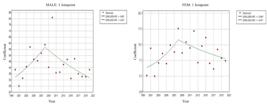
Time series analysis of traffic accident deaths in Maringá by sex. Maringá, Paraná, Brazil, 2000 to 2020. *Indicates APC significantly different from zero at alpha = 0.05.
Table 2 presents the APC for the time series, showing agreement between the sex variable and the curves presented in the analysis, as well as the respective trends.
Trend in traffic accident mortality in Maringá by sex. Maringá, Paraná, Brazil, 2000 to 2020.
Regarding age, similar patterns were identified, with initial growth followed by subsequent reduction. However, the 30–39 age group showed an overall increasing trend, while the other age groups remained stable or decreased (Figure 2).
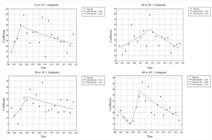
Time series analysis of traffic accident deaths in Maringá by age group. Maringá, Paraná, Brazil, 2000 to 2020. *Indicates APC significantly different from zero at alpha = 0.05.
As observed with sex, age group was also a variable that showed variations according to the analyzed context. In this sense, each age group presented segments with distinct periods and trends that differed from one another, as presented in Table 3.
Trend in traffic accident mortality in Maringá by age group. Maringá, Paraná, Brazil, 2000 to 2020.
Overall, the results showed that traffic accident deaths were concentrated among young male motorcyclists, with variations in trends by sex and age group.
DISCUSSION
In January 2023, the municipality of Maringá recorded a vehicle fleet of over 330,000 vehicles and a traffic accident mortality rate of 48.7 per 100,000 inhabitants.6,12 This scenario of a massive vehicle fleet, combined with factors such as population growth and urban expansion, contributes to increased exposure to risk factors and helps explain the magnitude of this study’s findings.
The predominance of deaths among young males, especially motorcyclists, is consistent with and corroborates national literature, but also reflects local specificities.5,7 Motorcycles, in addition to being considered an affordable means of transportation, are widely used for work-related activities, further increasing the vulnerability of this group to traffic accidents. This reality, coupled with other social and economic factors, highlights how this mode of transportation has become widespread in contemporary society and is heavily used as a source of income.
The high mortality rates in this group—predominantly of working age—underscore the social and economic impact of traffic accidents, affecting the labor force and placing additional strain on health services in the care of victims. The high number of deaths in this group can also be associated with risk behaviors, such as speeding and alcohol or drug use, which are among the most common factors recorded in fatal accidents.13,14
The time series analysis revealed a downward trend after 2008, especially among men and younger age groups. This behavior may be associated with changes in national regulations and policies, such as the enactment of the “Lei Seca” (Zero Tolerance Law) and the strengthening of the Brazilian Traffic Code. Previous studies have already demonstrated the association between intensified enforcement and penalties and reduced mortality rates.15,16 However, the persistence of stable trends in some age groups reinforces that, although these measures are relevant, their effects are not homogeneous across the entire population.
Road infrastructure, as well as other factors such as urban conditions and local enforcement, modulate the effectiveness of national policies. In cities like Maringá, the rapid increase in the vehicle fleet has not always been accompanied by structural adaptations, such as safer roads, proper signage, and consistent local public transportation policies, which limit the impact of legal interventions. Therefore, the articulation between national policies and local actions is crucial to reducing mortality from this cause.
Although the results demonstrate the contribution of national policies to reducing mortality rates, traffic accidents remain a significant cause of death in the municipality, particularly among motorcyclists and young adults. This highlights the need for integrated strategies that include health education, effective enforcement, improvements in road infrastructure, and urban mobility policies tailored to local realities.
In this context, nursing professionals play a crucial role in preventing traffic accidents, acting both in the immediate care of victims and in promoting health education initiatives. Awareness campaigns and guidance on road safety contribute to reducing risky behaviors and raising awareness among drivers, passengers, and pedestrians, thereby bridging the gap between research findings and concrete health promotion interventions.
This study has limitations inherent to the use of secondary data, which may contain inconsistencies, underreporting, or delays in record updates. Additionally, the presence of ill-defined or nonspecific cause-of-death codes may compromise the accuracy of traffic accident morbidity and mortality estimates, affecting the robustness of the results. Another limitation is that the analysis was conducted in a single municipality and did not include contextual variables, which prevents direct generalization of the findings to other municipalities with different characteristics.
Despite these limitations, replicating this methodology in different contexts may provide a more comprehensive understanding of the epidemiological situation regarding traffic accidents at the regional or national level.
CONCLUSIONS AND IMPLICATIONS FOR PRACTICE
The study findings reaffirm the magnitude of traffic accidents as a public health issue in Maringá, with unequal distribution among population groups and a significant social and economic impact. Despite the limitations resulting from the use of secondary data and the analysis of a single municipality, the results contribute to a deeper understanding of the local situation.
Strengthening public policies aimed at preventing these events is essential, including health education initiatives, enforcement measures, and improvements in road infrastructure. Such actions can reduce mortality rates from this cause and minimize their effects on both individual and collective health, reinforcing the importance of well-planned intervention strategies in the short, medium, and long term.
ACKNOWLEDGMENTS
None.
-
a
Extracted from the dissertation – Análise espaço-temporal da mortalidade por acidentes de trânsito em Maringá e Estado do Paraná (Spatio-temporal analysis of mortality from traffic accidents in Maringá and the State of Paraná), presented to the Graduate Nursing Program at the Universidade Estadual de Maringá, in 2025.
-
FINANCIAL SUPPORT
None.
DATA AVAILABILITY RESEARCH
The content underlying the research text is contained in the article.
References
-
1 Organização Mundial da Saúde. Lesões no trânsito [Internet]. 2022 [citado 2024 fev 27]. Disponível em: https://www.who.int/health-topics/road-safety
» https://www.who.int/health-topics/road-safety -
2 Hoinatski C. The Military Police of Paraná as a component of the national traffic system in the application of the national plan to reduce death and injury in traffic. Braz J Dev. 2022;8(2):13564-80. http://doi.org/10.34117/bjdv8n2-338
» http://doi.org/10.34117/bjdv8n2-338 - 3 Duarte MB, Santos ABBV, Sobral FCM. Mortalidade por acidentes de trânsito em idosos nas regiões do Brasil no período de 2009 a 2018. Prát Cuid Rev Saude Colet. 2021;2:e10392.
- 4 Aquino ÉC, Antunes JLF, Morais No OL. Mortality by road traffic injuries in Brazil (2000-2016): capital cities versus non-capital cities. Rev Saude Publica. 2020;54:122. PMid:33237129.
- 5 Santos CJ, Silva JP, Rocha TJM. Análise da ocorrência de acidentes de trânsito fatais nas capitais do Nordeste do Brasil. Hygeia. 2022;18:44-53.
-
6 Ministério da Infraestrutura (BR). Registro Nacional de Acidentes e Estatísticas de Trânsito [Internet]. 2023 [citado 2023 mar 27]. Disponível em: https://www.gov.br/transportes/pt-br/assuntos/transito/arquivos-senatran/docs/renaest
» https://www.gov.br/transportes/pt-br/assuntos/transito/arquivos-senatran/docs/renaest -
7 Melo WA, Mendonça RR. Caracterização e distribuição espacial dos acidentes de trânsito não fatais. Cad Saude Colet. 2021;29(1):e1036. http://doi.org/10.1590/1414-462x202129010364
» http://doi.org/10.1590/1414-462x202129010364 -
8 Zelleroff AVB, Pereira RS, Fernandes S. Caracterização das ocorrências de atropelamentos na cidade de Maringá-PR. Arq Mudi. 2023;27(Esp 2):1-7. http://doi.org/10.4025/arqmudi.v27i3.70045
» http://doi.org/10.4025/arqmudi.v27i3.70045 - 9 Organização Mundial da Saúde. Classificação Estatística Internacional de Doenças e Problemas Relacionados à Saúde: Décima Revisão (CID-10). 10ª ed. São Paulo: EDUSP; 2010.
-
10 Kim HJ, Fay MP, Feuer EJ, Midthune DN. Permutation tests for Joinpoint regression with applications to cancer rates. Stat Med. 2000;19(3):335-51. http://doi.org/10.1002/(SICI)1097-0258(20000215)19:3<335::AID-SIM336>3.0.CO;2-Z PMid:10649300.
» http://doi.org/10.1002/(SICI)1097-0258(20000215)19:3<335::AID-SIM336>3.0.CO;2-Z -
11 Brasil. Ministério da Saúde. Departamento de Informática do SUS (DATASUS). Sistema de Informações sobre Mortalidade – SIM [Internet]. Brasília: Ministério da Saúde; 2023 [citado 2025 Nov 7]. Disponível em: http://tabnet.datasus.gov.br/cgi/deftohtm.exe?sim/cnv/obt10pr.def/
» http://tabnet.datasus.gov.br/cgi/deftohtm.exe?sim/cnv/obt10pr.def/ -
12 Departamento de Trânsito do Paraná. Ocorrências de acidentes de trânsito no Estado do Paraná [Internet]. 2023 [citado 2023 mar 27]. Disponível em: http://www.detran.pr.gov.br
» http://www.detran.pr.gov.br -
13 Sousa RA, Lima MDA, Barbosa IR, Costa IC. Transport accident mortality time trend and spatial distribution in Piauí, Brazil, 2000-2017. Epidemiol Serv Saude. 2020;29(5):e2019558. http://doi.org/10.1590/s1679-49742020000500005 PMid:33146322.
» http://doi.org/10.1590/s1679-49742020000500005 - 14 Souza EC, Lima EO, Sousa GJB, Silva LMS, Silva MRF, Cavalcante ASPC. Mortalidade por acidentes de trânsito em Picos, Piauí, Brasil. Essentia. 2021;22(2):11-7.
-
15 Oliveira-Friestino JK, Barbato PR, Nakalski LR, Baldissera VG, Luzardo AR, Batista J. Distribuição espacial da mortalidade por acidentes de trânsito terrestre antes e após a Lei Seca em Santa Catarina, Brasil. Rev Enferm Contemp. 2023;12:e5026. http://doi.org/10.17267/2317-3378rec.2023.e5026
» http://doi.org/10.17267/2317-3378rec.2023.e5026 -
16 Albertini ABN, Vieira Garcia T, De Paulo LG, Rodrigues Da Silva Toledo E, Bossolani Charlo P, Da Silva M. Caracterização epidemiológica e sociodemográfica de acidentes de trânsito: uma revisão integrativa da literatura. Saúde Colet (Barueri). 2020;10(55):2797-814. http://doi.org/10.36489/saudecoletiva.2020v10i55p2797-2814
» http://doi.org/10.36489/saudecoletiva.2020v10i55p2797-2814
Edited by
-
ASSOCIATED EDITOR
Gerson Luiz Marinho https://orcid.org/0000-0002-2430-3896
-
SCIENTIFIC EDITOR
Marcelle Miranda da Silva https://orcid.org/0000-0003-4872-7252

 Source: Data from the authors, 2024.
 Source: Data from the authors, 2024.