 Antimicrobial Activity of Lapachol-Based Semicarbazones Against Drug-Resistant Bacterial Strains and in Silico ADMET Evaluation
Abstract
Leveraging the antimicrobial potential of both naphthoquinones and semicarbazones, four semicarbazones (SMC1-SMC4) from lapachol with inherent antibacterial potential were designed. For the synthesis of the semicarbazones, a two-step synthetic route was proposed. Initially, lapachol was extracted from the Tabebuia genus tree and subsequently subjected to acid cyclization to yield α-lapachone (2), β-lapachone (3), β-lapachone-3-sulfonic acid (4), and 3-iodo-β-lapachone (5). To synthesize the semicarbazones (SMC1-SMC4), the naphthoquinones reacted with semicarbazide hydrochloride, resulting in products with yields ranging from 30% to 79%. Following this, the antibacterial efficacy of the compounds was evaluated against methicillin-resistant and non-resistant Staphylococcus aureus, Escherichia coli, Acinetobacter baumannii, and Klebsiella pneumoniae. Compounds 3, 4, and SMC4 demonstrated antimicrobial potential against resistant bacterial strains, and with MIC values of 0.03, 0.78 and 1.18 mM, respectively, against methicillin-resistant S. aureus. Naphthoquinone 3 demonstrated antimicrobial potential against susceptible S. aureus, E. coli, A. baumannii, and K. pneumoniae, and MIC values of 0.03, 0.52, 0.52 and 0.52 mM, respectively. Additionally, in silico assays suggested that compounds 3, 4 and SMC4 possess suitable ADMET pharmacokinetic profiles alongside low toxicity.
Keywords:
β-lapachone; α-lapachone; β-lapachone-3-sulfonic acid; 3-iodo-β-lapachone; Naphthoquinone
HIGHLIGHTS
Synthesis of the naphthoquinones and semicarbazones derived from lapachol.
Compounds 3, 4, and SMC4 demonstrated activity against methicillin-resistant S. aureus.
Compounds 3 demonstrated activity against E. coli, A. baumannii, and K. pneumoniae.
In silico assays indicate that compounds 3, 4, and SMC4 exhibit adequate ADMET profiles.

INTRODUCTION
Bacteria are disease-causing microorganisms responsible for a significant number of deaths worldwide, in addition to compromising the quality of life for millions of individuals [1]. The growth of bacterial infectious diseases is a serious public health problem, particularly due to the increasing microbiological resistance to available treatments. Regarding public health, it is essential to highlight that bacterial resistance poses a risk to the quality of human life achieved over the years through advances in microbiology, engineering, pharmacy, and medicine. This is because it affects the budgets of healthcare systems, whether public or private [2].
The Global Antimicrobial Resistance Report and Antimicrobial Usage Surveillance System, published in 2022, underscores the rise in cases of bacterial resistance from 2017 to 2022. Furthermore, it notes an increase in deaths related to sepsis caused by infections from resistant or multidrug-resistant bacteria [3].
Methicillin-resistant Staphylococcus aureus, Escherichia coli, Acinetobacter baumannii, and Klebsiella pneumoniae are examples of multidrug-resistant bacteria that cause infections, primarily in hospital environments. However, there are reports of cases occurring outside of these settings. These bacteria are generally implicated in severe pneumonia, urinary tract infections, meningitis, and sepsis. Consequently, there is a pressing need to develop new pharmaceuticals that not only exhibit antimicrobial activity but also can overcome known microbiological resistance mechanisms [4-7].
The planning and development of drugs constitute a lengthy, rigorous, and expensive process fraught with risks and uncertainties. The development of bioactive molecules, starting from the design and planning of reaction pathways, through synthesis, and structural characterization, aims to yield effective compounds for the treatment of specific diseases. The pursuit of new bioactive compounds is a key objective in Medicinal Chemistry. According to Guido, Andricopulo, and Oliva, the multidisciplinary nature of this science is a relevant characteristic, encompassing various fields of knowledge such as organic chemistry, biochemistry, pharmacology, informatics, and molecular and structural biology. In Medicinal Chemistry, it is the responsibility to minimize failures during the compound development process, and concerning time and cost in research, in silico tests are employed [8].
In silico assays can predict pharmacokinetic and toxicological parameters based on the chemical structure of compounds [9]. Properties such as absorption, distribution, metabolism, excretion, and toxicity (ADMET) can be anticipated through the quantitative structure-activity relationship technique, which relies on molecular descriptors, such as physicochemical ones [10]. Thus, in silico assays are important tools for the development of new active molecules with favorable therapeutic actions and reduced side effects [11].
Quinones are representatives of a broad and diverse family of natural occurrence secondary metabolites, with interest attributed to their pharmacological significance. Among natural naphthoquinones, lapachol and β-lapachone stand out for their antimicrobial, antitumor, antiviral, and trypanocidal activities [12-14]. The pharmacological versatility of semicarbazones and their complexes is extensively documented, particularly focused on antitumor, antimicrobial, antiparasitic, and anticonvulsant activities [15-17].
In this study, semicarbazones derived from lapachol were synthesized, and antimicrobial activity against multidrug-resistant bacterial strains was assessed in vitro. Subsequently, their pharmacokinetic ADMET properties were predicted in silico.
MATERIAL AND METHODS
General Experimental Procedures
All reagents and solvents, except lapachol (1), were purchased from commercial suppliers and used without further purification. Reactions were monitored by thin-layer chromatography (TLC), employing an eluent solution of ethyl acetate/hexane (EtOAc/Hex) at various polarity ranges. The TLCs were conducted on aluminum plates (2 x 4 cm) coated with silica gel 60 with a UV 254 nm fluorescent indicator. The compounds' melting points (MP) were determined in triplicate using a Microquimica® digital melting point apparatus (model MQPF-302). Purification of the obtained products was performed through recrystallization in ethanol or by using a chromatographic column (CC) containing silica gel 60 (70-230 mesh) and an elution system of ethyl acetate/hexane (EtOAc/Hex) with increasing polarity. After preparation and purification, all synthesis products were stored under refrigeration and protected from light. The synthesized compounds were characterized using the following techniques: Nuclear Magnetic Resonance (NMR) spectroscopy of ¹H and ¹³C, and Infrared Spectroscopy (FTIR). ¹H and ¹³C NMR spectroscopy included both one- and two-dimensional homonuclear correlation techniques, such as ¹H-¹H COSY, and heteronuclear correlation techniques, such as ¹H-¹³C HSQC and HMBC, in addition to ¹³C-DEPT 135° NMR. The NMR experiments were recorded on a Bruker® instrument (AscendTM 400 model), operating at 400 MHz for ¹H nuclei and 100 MHz for ¹³C nuclei. Chemical shifts (δ) were determined in parts per million (ppm) using tetramethylsilane (TMS) as an internal standard. The samples were dissolved in deuterated solvents (CDCl₃ or DMSO-d₆). Infrared spectra were obtained via transmittance using an IRTracer-100 apparatus from SHIMADZU®.
Synthesis of naphthoquinones (2-5)
Synthesis of α-lapachone (2)
Lapachol (1) was extracted from the heartwood of the yellow ipê tree (Tabebuia sp), as described by Santos and coauthors, 2023 [18]. α-lapachone (2) was synthesized following the methodology outlined by Guimarães and coauthors, 2021 [19]. 198 mg of α-lapachone (2) were obtained with a pale-yellow color and a yield of 82%, MP: 117-118 °C. ¹H NMR (400 MHz, CDCl₃) δ: 8.08 (2H, m), 7.78 - 7.59 (2H, m), 2.63 (2.0, t, J = 6.6 Hz), 1.83 (2H, t, J = 6.6 Hz), 1.44 (6H, s). ¹³C NMR (100 MHz, CDCl₃) δ: 184.59, 179.94, 154.39, 133.87, 132.93, 132.07, 131.16, 126.33, 125.97, 120.15, 78.17, 31.41, 26.42, 16.74 (Figures 1S - 6S).
Synthesis of β-lapachone (3)
β-lapachone (3) was synthesized according to Santos and coauthors, 2023 [18], through the acid-catalyzed cyclization of lapachol (1). 217 mg of β-lapachone (3) were obtained with a yield of 90%, MP: 154 °C. ¹H NMR (400 MHz, DMSO-d₆) δ: 7.90 (1H, d, J = 7.6 Hz), 7.76 (2H, m), 7.66 - 7.53 (1H, m), 2.40 (2H, t, J = 6.6 Hz), 1.82 (2H, t, J = 6.6 Hz), 1.42 (6H, s). ¹³C NMR (100 MHz, DMSO-d₆) δ: 179.16, 177.78, 160.65, 135.02, 132.15, 130.72, 129.85, 127.72, 123.70, 112.51, 79.07, 30.81, 26.33, 15.97 (Figures 7S - 12S).
Synthesis of β-lapachone-3-sulfonic acid (4)
In a reaction vessel, lapachol (1) (242 mg, 1.0 mmol) was weighed, and then acetic anhydride (Ac2O) (1.0 mL) was added, forming a paste-like mixture. The reaction vessel containing the reaction mixture was placed in an ice bath, and 0.2 mL of concentrated sulfuric acid (98%) was added. The system was stirred for 1 hour at a temperature between 25 and 40 ºC. After this period, 3.0 mL of ethyl acetate was added, precipitating a red solid. The product was filtered and allowed to dry at room temperature [20]. β-lapachone-3-sulfonic acid (4) was obtained as a brick-red solid with a yield of 78%, MP: 160 °C. ¹H NMR (400 MHz, DMSO-d₆) δ: 7.89 (1H, d, J = 7.4 Hz), 7.77 - 7.71 (2H, m), 7.59 (1H, m), 2.87 - 2.79 (2H, m), 2.53 - 2.41 (1H, m), 1.74 (3H, s), 1.41 (3H, s). ¹³C NMR (100 MHz, DMSO-d₆) δ: 179.53, 178.00, 160.26, 135.42, 132.29, 131.32, 130.49, 128.26, 124.24, 113.31, 82.43, 59.88, 29.08, 21.52, 20.89 (Figures 13S - 18S).
Synthesis of 3-iodo-β-lapachone (5)
3-iodo-β-lapachone (5) was synthesized using molecular iodine in a basic medium. In a reaction vessel, lapachol (1) (484 mg; 2 mmol) was weighed and dissolved in 40 mL of dichloromethane. Iodine (504 mg; 4 mmol) and pyridine (95 mg; 1.2 mmol) were then added. The reaction was stirred for 24 hours at room temperature. After completion, the system was left open for complete solvent evaporation, resulting in a dark-colored paste. This paste was treated with 3.0 mL of absolute ethanol and sonicated for 180s, forming a dark orange precipitate. The precipitate was filtered and left to dry at room temperature [21]. The reaction mixture was purified by CC with a progressively polar elution system. 3-iodo-β-lapachone (5) was obtained as an orange crystalline solid with a yield of 20% and MP: 130-131 °C. ¹H NMR (400 MHz, DMSO-d₆) δ: 7.95 (1H, d, J = 7.5 Hz), 7.83 - 7.76 (2H, m), 7.69 - 7.62 (1H, m), 4.73 (1H, t, J = 5.8 Hz), 3.20 (1 H, dd, J = 18.2 and 5.3 Hz), 2.98 (1H, dd, J = 18.2, 6.3 Hz), 1.60 (3H, s), 1.59 (3H, s). ¹³C NMR (100 MHz, DMSO-d₆) δ: 179.03, 177.82, 160.32, 135.55, 131.92, 131.68, 130.44, 128.54, 124.28, 112.02, 81.19, 30.94, 30.71, 27.40, 25.05 (Figures 19S - 24S).
Synthesis of semicarbazones (SMC1-SMC4)
The methanolic solution (10 mL) of the respective naphthoquinone (2-5) (1.0 mmol), a methanolic solution (3.0 mL) was added of the semicarbazide hydrochloride (111 mg; 1.0 mmol). Subsequently, drops of concentrated H₃PO₄ were added, and the reaction mixture was left stirring at room temperature, monitored by TLC to check the consumption of the naphthoquinone. At the end of the process, the solid formed in the reaction medium was filtered and left to dry at room temperature.
1-(2,2-dimethyl-5-oxo-3,4-dihydro-2H-benzo[g]chromen-10(5H)ylidene)semicarbazide (SMC1)
The reaction proceeded under stirring for 96 hours at room temperature, yielding a light brown solid with a 49% yield, MP: 181 °C. ¹H NMR (400 MHz, CDCl₃) δ: 11.04 (1H, s), 8.15 (1H, dd, J = 7.8, 1.2 Hz), 8.09 (1H, dd, J = 8.0, 0.8 Hz), 7.56 (1H, td, J = 7.6, 1.5 Hz), 7.50 (1H, td, J = 7.5, 1.3 Hz), 2.66 (2H, t, J = 6.7 Hz), 1.87 (2H, t, J = 6.7 Hz), 1.51 (6H, s). ¹³C NMR (100 MHz, CDCl₃) δ: 183.34, 155.92, 155.32, 133.24, 131.82, 129.70, 128.96, 128.54, 125.94, 123.01, 115.87, 79.78, 31.30, 26.77, 16.88. IR (KBr): cm⁻¹: 3475, 3337, 1712, 1602, 1440, 1228 (Table S1, Figures 25S - 30S, and 49S, available in the supplementary material).
1-(2,2-dimethyl-5-oxo-3,4-dihydro-2H-benzo[h]chromen-6(5H)ylidene)semicarbazide (SMC2)
The reaction was stirred for 180 seconds at room temperature, yielding a yellow solid with a 79% yield, MP: 170 °C. ¹H NMR (400 MHz, DMSO-d₆) δ: 14.17 (1H, s), 8.47 (1H, d, J = 0.9 Hz), 7.82 (1H, d, J = 0.9 Hz), 7.54 - 7.46 (2H, m), 2.50 - 2.45 (2H, m), 1.83 (2H, t, J = 6.6 Hz), 1.40 (6H, s). ¹³C NMR (100 MHz, DMSO-d₆) δ: 181.13, 161.22, 155.93, 131.80, 130.35, 129.26, 128.67, 126.06, 123.93, 123.06, 111.81, 78.95, 31.31, 26.78, 16.28. IR (KBr) cm⁻¹: 3466, 3207, 1712, 1596, 1395, 1299 (Table S1, Figures 31S - 36S, and 49S, available in the supplementary material).
6-(2-carbamoylhydrazono)-2,2-dimethyl-5-oxo-3,4,5,6-tetrahydro-2H-benzo[h]chromene-3-sulfonic acid (SMC3)
The reaction was stirred for 24 hours at room temperature, yielding a yellow solid with a 44% yield, MP: 189 °C. ¹H NMR (400 MHz, DMSO-d₆) δ: 14.17 (1H, s), 9.72 (2H, sl), 8.60 (1H, s), 8.50 - 8.46 (1H, m), 7.80 - 7.76 (1H, m), 7.54 - 7.44 (2H, m), 6.58 (1H, s), 2.96 (1H, dd, J = 17.5, 5.1 Hz), 2.84 (1H, dd, J = 11.9, 5.1 Hz), 2.54 (1H, m), 1.76 (3H, s), 1.39 (3H, s). ¹³C NMR (100 MHz, DMSO-d₆) δ: 180.89, 160.17, 158.27, 155.88, 131.90, 130.30, 129.47, 128.54, 125.79, 124.07, 123.17, 112.16, 81.70, 60.00, 29.16, 21.42, 20.80. IR (KBr) cm⁻¹: 3482, 3308, 1726, 1697, 1580, 1299, 1393, 1191 (Table S2, Figures 37S - 42S, and 49S, available in the supplementary material).
1-(3-iodo-2,2-dimethyl-5-oxo-3,4-dihydro-2H-benzo[h]chromen-6(5H)ylidene)semicarbazide (SMC4)
The reaction was stirred for 24 hours at room temperature, yielding a yellow solid with a 30% yield, MP: 131 °C. ¹H NMR (400 MHz, DMSO-d₆) δ: 14.07 (1H, s), 8.52 (1H, d, J = 8.0 Hz), 7.83 (1H, d, J = 7.6), 7.59 - 7.49 (2H, m), 4.76 (1H, t, J = 5.7 Hz), 3.28 - 2.93 (2H, m), 1.58 (3H, s), 1.56 (3H, s). ¹³C NMR (100MHz, DMSO-d₆) δ: 180.48, 160.05, 155.72, 132.00, 130.72, 129.12, 128.74, 125.39, 124.10, 123.13, 110.87, 80.49, 31.72, 30.67, 27.05, 24.94. IR (KBr) cm⁻¹: 3500, 1700, 1580, 1400 (Table S2, Figures 43S - 48S, and 49S, available in the supplementary material).
In vitro Antibacterial Activity
The determination of the minimum inhibitory concentration and minimum bactericidal concentration was carried out using the broth microdilution method [22]. For this purpose, solutions of 2,000 μg/mL in 10% dimethyl sulfoxide of naphthoquinones (2-5) and semicarbazones (SMC1-SMC4) were prepared.
Stock solutions were diluted (1:2) in a 96-well microplate containing Mueller Hinton Broth, with a final volume of 100 μL. Subsequently, in test tubes containing 5 mL of 0.85% saline solution, a bacterial suspension equivalent to 0.5 on the McFarland Scale (1.5 x 10⁸ CFU/mL) was prepared. This suspension was diluted in MHB to 1.5 x 10⁶ CFU/mL, and 10 μL were added to all wells of the microplate, including the bacterial viability control. Sterility control was performed in wells containing only MHB. A control to rule out the antimicrobial action of the diluents was also conducted. The microplate was incubated at 37 °C for 24 hours.
Then, the content of the wells was inoculated, using a multichannel replicator, onto a plate containing Mueller Hinton Agar (MHA, Kasvi), with incubation at 37 °C for 24 h, for subsequent determination of MBC by observing bacterial growth. In each well of the microplate, 30 µL of 1% 2,3,5-triphenyl-tetrazolium chloride (TTC, Dinamica, Indaiatuba, Brazil) was added with incubation for one hour. The MIC reading was performed by observing the color change to pink. The assay was performed in triplicate.
In silico ADMET Study
The ADMET properties of the semicarbazones (SMC1-SMC4), as well as naphthoquinones (2-5), were predicted using the online platforms ADMETlab 2.0 (https://admetmesh.scbdd.com/) and ProTox II (https://tox-new.charite.de/protox_II/). All molecules analyzed in the in silico study were entered into the platform in SMILES format (simplified molecular-input line-entry system). Regarding pharmacokinetics, the following predictors were analyzed: permeability in CaCo-2 cell line (ADMETlab 2.0), degree of binding to plasma proteins, volume of distribution, interaction with cytochrome P450 enzyme complex, half-life plasm, and renal clearance. For toxicity assessment, ADMETlab 2.0 was used to consider mutagenicity, and acute oral toxicity in rats and lethal dose in 50% of individuals was predicted through ProToxII.
RESULTS
Synthesis of naphthoquinones (2-5) and semicarbazones (SMC1-SMC4)
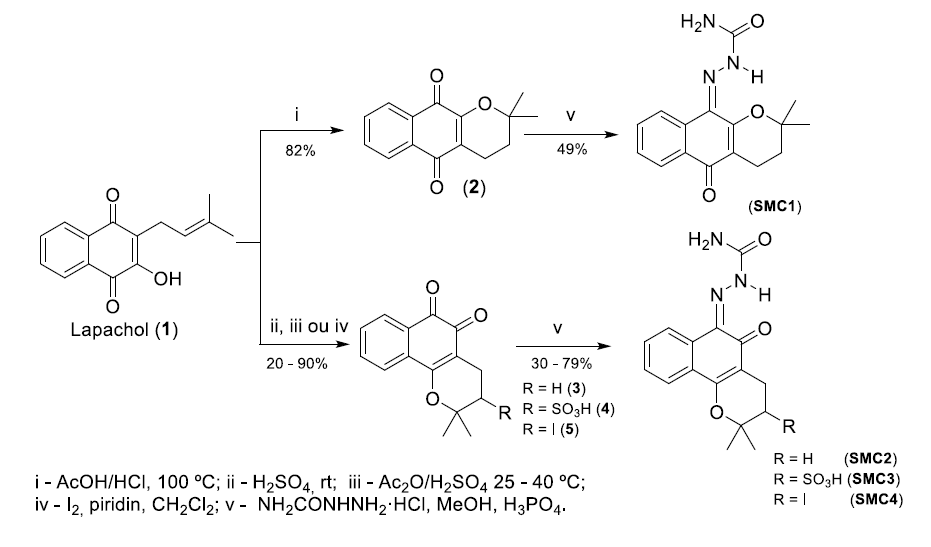
The semicarbazones (SMC1-SMC4) were synthesized in two steps from lapachol (1). To begin the synthetic route, natural 1,4-naphthoquinone 1 was obtained in 3% yields from the heartwood of Tabebuia genus trees through acid-base extraction. In the first stage of the synthesis, α-lapachone (2) and the ortho-naphthoquinones 3, 4, and 5 were obtained through acid cyclization of lapachol (1), with yields of 82%, 90%, 98%, and 20%, respectively. In this step, acetic acid/HCl, H2SO4, acetic anhydride/H2SO4, and iodine/pyridine were used, respectively, for the synthesis of α-lapachone (2) [19], β-lapachone (3) [18], β-lapachone-3-sulfonic acid (4) [20], and 3-iodo-β-lapachone (5) [21].
In the subsequent stage, the semicarbazones (SMC1-SMC4) were synthesized through the imine bond formation reaction between the carbonyl group of naphthoquinones (2-5) and semicarbazide hydrochloride, under acidic catalysis of H3PO4, with reaction yields ranging from 30 to 79%, as shown in Figure 1.

In vitro antimicrobial activity of naphthoquinones (2-5) and semicarbazones (SMC1-SMC4)
Semicarbazones (SMC1-SMC4) and naphthoquinones (2-5) were analyzed for their antimicrobial activity against susceptible Staphylococcus aureus (ATCC 25923) and methicillin-resistant Staphylococcus aureus (ATCC 33591), Escherichia coli (ATCC 25922), Acinetobacter baumannii (ATCC 1605), and Klebsiella pneumoniae (ATCC 13883). SMC1, SMC2, and SMC3 exhibited minimum inhibitory concentration (MIC) and minimum bactericidal concentration (MBC) values exceeding 1,000 µg/mL. SMC4 was the semicarbazone that stood out for its antimicrobial activity, a novel compound, with MIC values of 250 µg/mL (0.59 mM) and 500 µg/mL (1.18 mM) against susceptible and methicillin-resistant Staphylococcus aureus strains, respectively (Table 1).
In silico ADMET study
The physicochemical properties of naphthoquinones (2-5) and synthetic semicarbazones (SMC1-SMC4) were estimated using ADMETLab 2.0. The absorption stage's parameters were also evaluated in silico, including the logarithm of the molar concentration (log mol/L), called LogS, and the permeability in human intestinal adenocarcinoma tumor cells (CaCo-2 cells), and are presented in Table 2
In silico-predicted parameters assessed distribution and elimination included the degree of plasma proteins binding (PPB), volume of distribution (VD), plasma half-life (t1/2), and renal clearance (CL), and are presented in Table 3.
Plasma protein binding (PPB), rate volume of distribution (VD), plasma half-life (t1/2), and renal clearance (CL) for naphthoquinones (2-5) and semicarbazones (SMC1-SMC4), as predicted by ADMETLab 2.0
To analyze the metabolism of the naphthoquinones (2-5) and semicarbazones (SMC1-SMC4), the capacity of these compounds to inhibit P450 complex enzymes and the likelihood of being substrates for these enzymes were predicted, Table 4.
To predict the toxicity of naphthoquinones (2-5) and semicarbazones (SMC1-SMC4), mutagenicity was analyzed through the Ames test, along with acute oral toxicity in rats and the lethal dose for 50% of the studied population (LD50), Table 5.
DISCUSSION
The molecular structures of naphthoquinones (2-5) and semicarbazones (SMC1-SMC4) were determined through analysis of 1H and 13C NMR spectra, both one- and two-dimensional, and FTIR, available in the supplementary material. In β-lapachone (3), the signal for methylene hydrogens is a singlet (δ 1.42 ppm) with integration for 6 hydrogens, as both methyl groups are in the same chemical environment. However, in compounds 4 (δ 1.74 ppm and 1.41 ppm) and 5 (δ 1.60 ppm and 1.59 ppm), there are two singlets, each with integration for three hydrogens, resulting from the chiral center present in these compounds, making the chemical environment of the methyl groups different. Similar to naphthoquinones 3 and 5, semicarbazones SMC4 and SMC5 have a chiral center, so the signals for methylene hydrogens are two singlets, each with integration for three hydrogens.
In the 1H NMR spectra of the semicarbazones, the signal of the hydrogen in this functional group (R2C=N-NH-CONH2) is engaged in intramolecular hydrogen bonding. Thus, it is inferred that the semicarbazones (SMC1-SMC3) were obtained in the Z configuration, a configuration that allows for intramolecular hydrogen bonding [23-25]. On the other hand, SMC4 was obtained as a mixture of E and Z, as evidenced by the signal duplication in the 1H and 13C NMR spectra (Figures 43S-48S, available in the supplementary material).
Naphthoquinones 2, 3, and 4 exhibited antibacterial activity against the analyzed strains. α-lapachone (2) and β-lapachone-3-sulfonic acid (4) were active against both gram-positive bacteria, methicillin-resistant and non-resistant S. aureus, with MIC values of 500 µg/mL (2.1 mM) and 250 µg/mL (0.78 mM), respectively, for compounds 2 and 4. β-lapachone (3) stood out, being active against all analyzed strains, both gram-positive and gram-negative, with a MIC of 125 µg/mL (0.52 mM) for E. coli and K. pneumoniae. Against S. aureus strains, the MIC and MBC of β-lapachone (3) were 7.81 µg/mL (0.03 mM), as shown in Table 1.
Comparing the in vitro antibacterial assay results of the semicarbazones with their precursor naphthoquinones, a reduction in activity was observed for SMC1, SMC2, and SMC3 compared to analogs 2, 3, and 4. However, there was an increase in the antibacterial activity of SMC4 compared to its precursor, 3-iodo-β-lapachone (5), as shown in Table 1.
Given the significance of drug bioavailability for its efficacy, coupled with the advantages of oral administration, it is crucial that, during the development of new compounds with pharmacological potential, the violation or adherence to Lipinski's Rule of Five (RO5) be assessed [22]. The RO5 provides a reliable prediction of the oral bioavailability profile for new molecules. According to the RO5, a compound has the potential for oral pharmacokinetic administration if it exhibits: logP between -0.4 to +5.6, MM less than or equal to 500 g/mol, the nHA less than or equal to 10, the nHD less than or equal to five, and TPSA not exceeding 140 Å [26-27]. As a result, a molecule may exhibit a violation of one of these parameters and still be considered a promising drug candidate.
Except for SMC3, none of the other studied molecules violated the parameters established by the RO5, indicating that they are compounds with promising physicochemical properties. SMC3 presented a higher TPSA value, attributed to the sulfonic group that differentiates it from the other compounds. The sulfonic group contains oxygen atoms, contributing to its increased potential for chemical interactions. TPSA is defined as the surface area occupied by nitrogen and oxygen atoms, whether bonded or not to hydrogen and is directly associated with the capacity for hydrogen bond formation and polarity [28]. The same rationale applies to explain the higher TPSA in the semicarbazones (SMC1-SMC4) compared to the precursor naphthoquinones (2-5), as shown in Table 2.
The initial stage in the drug absorption process involves the disintegration of the tablet or capsule, followed by the dissolution of the active pharmaceutical ingredient. Low solubility is detrimental to effective and complete oral absorption, making early measurement of this property crucial in drug discovery. Compounds with LogS in the range of -4.0 to 0.5 are considered suitable [29-30]. Except for SMC1 (LogS -4.246), the other semicarbazones (SMC2-SMC4), like the naphthoquinone precursors (2-5), exhibited LogS values within the specified range, aligning with the solubility parameter (Table 2).
CaCo-2 cells are human intestinal adenocarcinoma tumor cells, commonly employed in vitro models to depict intestinal absorption properties. Regarding this parameter, Xiong and colleagues [30] demonstrate that compounds with permeability results in CaCo-2 cells exceeding -5.15 cm/s are highly likely to exhibit a favorable pharmacokinetic absorption profile. Therefore, except for SMC3, all naphthoquinones (2-5) and semicarbazones SMC1, SMC2, and SMC4 excelled in this parameter (Table 2).
The pharmacokinetic property of drug distribution in tissues depends on the degree of concentration of binding to plasma proteins. PPB is crucial in the design and development of new drug candidates, and the more pronounced the PPB, the greater the drug's ability to remain in the organism. A lower PPB corresponds to a higher amount of free drug in the systemic circulation, which relates to the drug's capacity to diffuse through extravascular spaces and reach its site of action. However, it is associated with a higher elimination rate [30-32]. PPB above 85% indicates strong binding of the drug to plasma proteins. However, when PPB exceeds 90%, there is a compromise in efficacy. The naphthoquinones (2-5) and SMC3 exhibit moderate PPB, while SMC1, SMC2, and SMC4 fall within a range considered suitable for PPB (88.387-89.631), as detailed in Table 3.
The VD is a pharmacological parameter used to quantify the uniform distribution of a substance throughout the body after administration [31]. ADMETLab 2.0 suggests that VD in the range of 0.04 to 20.0 L/kg is considered suitable. Therefore, all evaluated compounds fall within the appropriate distribution range [29-30].
Metabolism is a pharmacokinetic parameter that can directly impact other factors, as well as toxicity. Therefore, the predicted capacity of naphthoquinones (2-5) and semicarbazones (SMC1-SMC4) to undergo metabolism or inhibit isoforms of enzymes within the cytochrome P450 system was assessed. Cytochrome P450 enzymes constitute the primary enzymatic system responsible for the oxidative metabolism of drugs. Notable isoforms include CYP1A2, CYP2C19, CYP2C9, CYP2D6, and CYP3A4, as they account for over 90% of the oxidative metabolism of available drugs [31].
Analyzing the results related to the inhibition capacity of the main isoforms of the P450 enzyme complex, it can be observed that the synthesized semicarbazones (SMC1-SMC4) do not possess the ability to inhibit the vast majority of the complex's isoenzymes. However, isoform CYP1A2 is potentially inhibited by SMC1 and SMC2, and semicarbazone SMC4 will inhibit isoform CYP2C19, as shown in Table 4. These findings suggest that these substances can be used without the occurrence of drug interactions with other medications metabolized by the same enzymatic complex.
Regarding the ability of these enzymes to metabolize the semicarbazones (SMC1-SMC4), it was predicted that each semicarbazone undergoes metabolism with a probability exceeding 50% by at least two isoforms of cytochrome P450 enzymes. CYP1A2 and CYP2C9 stand out as the most promising enzymes for metabolizing semicarbazones (SMC1-SMC4), as shown in Table 4. These results suggest that the semicarbazones will be metabolized satisfactorily.
The elimination parameters measured in this study included the calculation of t1/2, measured in hours (h), and the CL, representing the plasma clearance measured in mL/min/kg. CL refers to the total elimination of a drug from a specific plasma volume per unit of time [29-30].
The values predicted in the ADMETLab 2.0 platform for the CL parameter indicate that values greater than 15 mL/min/kg represent high clearance, values between 5 and 15 mL/min/kg indicate moderate clearance and values less than 5 mL/min/kg represent low clearance [29-30]. Therefore, the semicarbazone that exhibited an acceptable, i.e., moderate, clearance was SMC2. Regarding t1/2, the evaluated compounds are categorized into periods of short and long half-lives, where short half-lives are less than 3 hours and long half-lives are greater than 3 hours, respectively [29-30]. Thus, all evaluated compounds demonstrated a short t1/2 (Table 3).
The Ames test is a primary experiment used to assess mutagenicity, utilizing different strains of Salmonella typhimurium to identify the potential for genetic mutations following exposure to specific chemical compounds. Mutagenicity and acute oral toxicity in rats were predicted using ADMETlab 2.0, with values closer to 100 indicating a higher potential for compounds to be mutagenic and toxic [30].
Only naphthoquinone 5 and semicarbazone SMC3 exhibited mutagenic potential below 50%, and it was predicted that all compounds have acute oral toxicity in rats. Therefore, using ProTox II, LD50 values were predicted, and except for 2 and SMC1, the remaining compounds were classified as safe, with an LD50 of 8000 mg/kg, as shown in Table 5.
CONCLUSION
Taking into consideration the WHO's warning about the public health risk posed by infections caused by multi-resistant bacteria and the imperative to develop effective antimicrobials, this study highlights β-lapachone (3), β-lapachone-3-sulfonic acid (4), and semicarbazone SMC4 due to their synthetic accessibility, with reaction yields of 90%, 78%, and 30%, respectively. These compounds demonstrated antimicrobial potential against multidrug-resistant bacterial strains. β-lapachone (3) exhibited the best antibacterial results, including bactericidal action, with MIC and MBC of 0.03 mM against methicillin-resistant and non-resistant S. aureus. Against A. baumannii, K. pneumoniae, and E. coli, the MIC was 0.52 mM. Naphthoquinone 4 showed an MIC of 0.78 mM against methicillin-resistant and non-resistant S. aureus. The SMC4 had a MIC of 0.59 and 1.18 mM, respectively, against non-resistant and methicillin-resistant S. aureus. Moreover, in silico assays indicated that naphthoquinones 3 and 4 and semicarbazone SMC4 have suitable ADMET pharmacokinetic profiles. These in silico assays suggested that compounds 3, 4, and SMC4 possess physicochemical characteristics conducive to good oral absorption and low toxicity.
REFERENCES
-
1 Fiocruz. Resistance to antimicrobials [cited 2023 Nov 25]. Available from: https://portal.fiocruz.br/noticia/antibioticos-resistencia-de-microrganismos-e-grave-ameaca-saude-global
» https://portal.fiocruz.br/noticia/antibioticos-resistencia-de-microrganismos-e-grave-ameaca-saude-global -
2 Muteeb G, Rehman MT, Shahwan M, Aatif M. Origin of Antibiotics and Antibiotic Resistance, and Their Impacts on Drug Development: A Narrative Review. Pharmaceuticals (Basel) 2023;5;16(11):1615. https://doi.org/10.3390/ph16111615
» https://doi.org/10.3390/ph16111615 -
3 Global antimicrobial resistance and use surveillance system (GLASS) report 2022. Geneva: World Health Organization; 2022. Available from: https://www.who.int/publications/i/item/9789240062702
» https://www.who.int/publications/i/item/9789240062702 -
4 Harkins CP, Pichon B, Doumith M, Parkhill J, Westh H, Tomasz A, et al. Methicillin-resistant Staphylococcus aureus emerged long before the introduction of methicillin into clinical practice. Genome Biol 2017;18:130. https://doi.org/10.1186/s13059-017-1252-9
» https://doi.org/10.1186/s13059-017-1252-9 -
5 Pfizer, multi-resistant bacteria. Available from: https://www.pfizer.com.br/napalmadamao/conheca-bacterias-multirresistentes
» https://www.pfizer.com.br/napalmadamao/conheca-bacterias-multirresistentes -
6 Almasaudi SB. Acinetobacter spp. as nosocomial pathogens: Epidemiology and resistance features. Saudi J Biol Sci 2018;25:586-96. https://doi.org/10.1016/j.sjbs.2016.02.009
» https://doi.org/10.1016/j.sjbs.2016.02.009 -
7 Klebsiella pneumoniae in Healthcare Settings [cited 2023 Nov 25]. Available from: https://www.cdc.gov/hai/organisms/klebsiella/klebsiella.html
» https://www.cdc.gov/hai/organisms/klebsiella/klebsiella.html -
8 Guido RVC, Andricopulo AD, Oliva G. Drug design, biotechnology and medicinal chemistry: applications to infectious diseases. Estud Av 2010;24:81-98. https://www.revistas.usp.br/eav/article/view/10494/71119
» https://www.revistas.usp.br/eav/article/view/10494/71119 -
9 Dolabela MF, Silva ARPD, Ohashi LH, Bastos MLC, Silva MCMD, Vale VV. Estudo in silico das atividades de triterpenos e iridoides isolados de Himatanthus articulatus (Vahl) Woodson. Rev Fitos 2018;12:227-42. https://doi.org/10.17648/2446-4775.2018.602
» https://doi.org/10.17648/2446-4775.2018.602 -
10 Wu F, Zhou Y, Li L, Shen X, Chen G, Wang X, et al. Computational approaches in preclinical studies on drug discovery and development. Front Chem 2020;8:726. https://doi.org/10.3389/fchem.2020.00726
» https://doi.org/10.3389/fchem.2020.00726 -
11 Waterbeemd HV, Gifford E. ADMET in silico modelling: towards prediction paradise?. Nat Rev Drug Discov 2003;2:192-204. https://doi.org/10.1038/nrd1032
» https://doi.org/10.1038/nrd1032 -
12 Hussain H, Green IR. Lapachol and lapachone analogs: a journey of two decades of patent research (1997-2016). Expert Opin Ther Pat 2017;27:1111-21. https://doi.org/10.1080/13543776.2017.1339792
» https://doi.org/10.1080/13543776.2017.1339792 -
13 Gong Q, Hu J, Wang P, Li X, Zhang X. A comprehensive review on β-lapachone: Mechanisms, structural modifications, and therapeutic potentials. Eur J Med Chem 2021;210:112962. https://doi.org/10.1016/j.ejmech.2020.112962
» https://doi.org/10.1016/j.ejmech.2020.112962 -
14 Ferreira SB, Gonzaga DTG, Santos WC, Araújo KGL, Ferreira VF. [β-Lapachone: its importance in medicinal chemistry and structural modifications]. Rev Virtual Quim 2010;2:140-60. https://doi.org/10.5935/1984-6835.20100013
» https://doi.org/10.5935/1984-6835.20100013 -
15 Oliveira VS, Sá IAG, Silva GAO, Santos VLA, Araújo CRM, Gonsalves AA. [Semicarbazones: interdisciplinary teaching sequence in experimental classes of organic chemistry and medicinal chemistry]. Quim. Nova 2023;46:207-217. http://dx.doi.org/10.21577/0100-4042.20170962
» http://dx.doi.org/10.21577/0100-4042.20170962 -
16 More MS, Joshi PG, Mishra YK, Khanna PK. Metal complexes driven from Schiff bases and semicarbazones for biomedical and allied applications: a review. Mater Today Chem 2019;14:100195. https://doi.org/10.1016/j.mtchem.2019.100195
» https://doi.org/10.1016/j.mtchem.2019.100195 -
17 Beraldo, H. [Semicarbazones and thiosemicarbazones: the broad pharmacological profile and clinical uses]. Quim Nova 2004;27:461-471. Available from: https://s3.sa-east-1.amazonaws.com/static.sites.sbq.org.br/quimicanova.sbq.org.br/pdf/Vol27No3_461_16-RV03207.pdf
» https://s3.sa-east-1.amazonaws.com/static.sites.sbq.org.br/quimicanova.sbq.org.br/pdf/Vol27No3_461_16-RV03207.pdf -
18 Santos VLA, Gonsalves AA, Guimarães DG, Simplicio SS, Oliveira HP, Ramos LPS, et al. Naphth [1,2-d]imidazoles bioactive from β-Lapachone: fluorescent probes and cytotoxic agents to cancer cells. Molecules 2023;28:3008. https://doi.org/10.3390/molecules28073008
» https://doi.org/10.3390/molecules28073008 -
19 Guimarães DG, Gonsalves AA, Rolim LA, Araújo EC, Santos VLA, Silva MFS, et al. Naphthoquinone-based hydrazone hybrids: synthesis and potent activity against cancer cell lines. Med Chem 2021;17:945-55. https://doi.org/10.2174/1573406416666200817164308
» https://doi.org/10.2174/1573406416666200817164308 -
20 Fernades AWC, Santos VLA, Araujo CRM, Araujo ECC, Oliveira HP, Matiuzzi MC. Antimicrobial activity and FTIR characterization of lapachol derivatives against Staphylococcus aureus. Afr J Microbiol Res 2017;11:915-19. https://doi.org/10.5897/AJMR2017.8432
» https://doi.org/10.5897/AJMR2017.8432 - 21 Barbosa-Filho JM, da Silva TMS, Giulietti AM, Soares MBP, Santos RR, Camara CA. Instituto Nacional de Propriedade Intelectual - República Federativa do Brasil, PI 0403686-7, 2004.
- 22 CLSI. Methods for Dilution Antimicrobial Susceptibility Tests for Bacteria That Grow Aerobically. 11 th ed. CLSI standard M07. Wayne, PA: Clinical and Laboratory Standards Institute; 2018.
-
23 Tenório RP, Góes AJS. [Thiosemicarbazones: methods of production, synthetic applications and biological importance]. Quim Nova 2005;6:1030-37. https://www.scielo.br/j/qn/a/vYXQYZGhkzxmG3Hfmg4c7qF/?format=pdf⟨=pt
» https://www.scielo.br/j/qn/a/vYXQYZGhkzxmG3Hfmg4c7qF/?format=pdf⟨=pt -
24 Venkatachalam TK, Bernhardt PV, Noble CJ, Fletcher N, Pierens JK, Thurecht KJ, et al. Synthesis, characterization and biological activities of semicarbazones and their copper complexes. J Inor Biochem 2016; 162:295-308. https://doi.org/10.1016/j.jinorgbio.2016.04.006
» https://doi.org/10.1016/j.jinorgbio.2016.04.006 -
25 Chattopadhyay D, Mazumdar SK, Banerjee T, Sheldrick WS. Structure of 1-(3,4-dichlorophenyl)-4-methylthiosemicarbazide. Acta Crystallogr Sect C - Struct Chem 1989;C45:314-17. https://doi.org/10.1107/S0108270188009977
» https://doi.org/10.1107/S0108270188009977 -
26 Lipinski CA. Lead- and drug-like compounds: the rule-of-five revolution. Drug Discov Today: Technol 2004;1:337-41. https://doi.org/10.1016/j.ddtec.2004.11.007
» https://doi.org/10.1016/j.ddtec.2004.11.007 -
27 Santos VLA, Gonsalves AA, Araújo CRM. [Didactic approach for the development of bioactive molecules: Lipinski's rule of five and preparation of 1,3,4-oxadiazole heterocycle in a domestic microwave oven]. Quim Nova 2018;41:110-15. https://doi.org/10.21577/0100-4042.20170135
» https://doi.org/10.21577/0100-4042.20170135 -
28 Rodrigues GS, Júnior AA, Siqueira ALN, Ramos LFP, Santos GB. [The use of free software in a practical class on molecular filters for oral bioavailability of drugs]. Quim Nova 2021;44:1036-44. https://doi.org/10.21577/0100-4042.20170739
» https://doi.org/10.21577/0100-4042.20170739 -
29 ADMET [cited 2023 Oct 25]. Available from: https://admetmesh.scbdd.com/explanation/index
» https://admetmesh.scbdd.com/explanation/index -
30 Xiong G, Wu Z, Yi J, Fu L, Yang Z, Hsieh C, et al. ADMETlab 2.0: an integrated online platform for accurate and comprehensive predictions of ADMET properties. Nucleic Acids Res 2021;2:W5. https://doi.org/10.1093/nar/gkab255
» https://doi.org/10.1093/nar/gkab255 - 31 Brunton LL. [Goodman & Gilman: The Pharmacological Basis of Therapeutics]. 12ª ed. Rio de Janeiro: McGraw-Hill, 2012.
-
32 Sousa VC, Carvalho RCV, Barcelar KGR, Melo DS, Nunes JM, Sousa PSA, et al. Synthetic hydrazones: In silico studies and in vitro evaluation of the antileishmania potential. Toxicol in Vitro 2023;88:105560. https://doi.org/10.1016/j.tiv.2023.105560
» https://doi.org/10.1016/j.tiv.2023.105560
-
Funding:
This research was funded by the Foundation for the Support of Science and Technology of the State of Pernambuco, process number APQ-0788-1.06/22, and by the Coordination for the Improvement of Higher Education Personnel (PDPG-CONSOLIDAÇÃO-3-4) process number nº 88881.708019/2022-01.
-
Supplementary Material:
The one- and two-dimensional 1H and 13C NMR spectra and IR spectra are available as a PDF file, with free access, at: https://www.documentador.pr.gov.br/documentador/pub.do?action=d&uuid=@gtf-escriba-tecpar@5eb7a97c-7f00-4576-b3dd-0124cde1c55c