 Optimizing concrete compressive strength prediction with a deep forest model: an advanced machine learning approach
ABSTRACT
Accurate prediction of concrete compressive strength is essential for ensuring the durability and safety of concrete structures. This study utilizes the Deep Forest (GC Forest) model to predict compressive strength based on nine key factors: Granulated Blast Furnace Slag, Pulverized Fuel Ash, Mixing Water, High-Range Plasticity Reducer, Crushed Stone, Sand, Curing Time, Portland Cement, and Compressive Strength. The Deep Forest model's performance was compared with 12 other machine learning models, including Linear Regression, k-Nearest Neighbors, Decision Tree, Support Vector Machine, Neural Network, Random Forest, and Gradient Boosting Machines. Model evaluations were conducted using the coefficient of determination (R2) on a dataset of the listed parameters. The Deep Forest model achieved the highest predictive accuracy, with an R2 value of 9.55, outperforming all other models. This result demonstrates the model's robustness, owing to its ensemble-based architecture that enhances generalization. The study emphasizes the effectiveness of advanced machine learning models like Deep Forest in optimizing concrete compressive strength predictions, contributing to improved structural design and quality control.
Keywords:
Concrete; Deep Forest; Machine Learning Models; Predictive Accuracy
1. INTRODUCTION
Concrete stands as one of the cornerstones of modern construction, lauded for its unparalleled versatility, robustness, and long-lasting durability [1]. It serves as the fundamental material in the creation of buildings, bridges, roads, and various infrastructure projects, playing a pivotal role in shaping the urban landscape [2] Among the numerous properties of concrete, compressive strength is one of the most critical parameters. It directly influences the structural integrity, load-bearing capacity, and overall service life of concrete structures [3]. Ensuring that concrete achieves its desired compressive strength is not just a matter of quality, but a vital concern for safety and performance [3].
Accurately predicting the compressive strength of concrete is, therefore, a necessity for engineers and construction professionals [4]. It enables the optimization of mix designs, ensures compliance with safety standards, and reduces the costs associated with overdesign and material wastage [5]. Traditionally, empirical methods and linear regression models have been the go-to tools for predicting compressive strength [6]. These methods, while useful, often fall short in addressing the complexity of the task [7]. Concrete is a highly heterogeneous material, and its properties are influenced by a multitude of factors, including the proportions of its constituents and the conditions under which it is cured [8].
Key ingredients such as Granulated Blast Furnace Slag (GBFS), Pulverized Fuel Ash (PFA), Mixing Water, High-Range Plasticity Reducer, Crushed Stone, Sand, Curing Time, and Portland Cement interact in non-linear and sometimes unpredictable ways [9]. The relationships between these factors and the resulting compressive strength are complex, making it challenging to develop accurate predictive models using conventional approaches [10]. As a result, there is a growing interest in leveraging advanced computational techniques to better understand and predict these intricate relationships [11].
In recent years, the advent of machine learning has offered promising alternatives to traditional prediction methods [12]. Machine learning models, with their ability to learn from large datasets and identify hidden patterns, have the potential to significantly improve the accuracy of predictions in complex domains like concrete mix design [13]. Among these models, ensemble-based approaches have shown remarkable potential [14]. Specifically, the Deep Forest (GC Forest) model, a relatively recent innovation in the field, has demonstrated superior performance in various engineering applications by effectively capturing non-linearities and interactions among variables [15].
This study rigorously evaluates the effectiveness of the Deep Forest model in predicting the compressive strength of concrete, utilizing nine key parameters that significantly influence concrete properties [16]. While previous research has applied various machine learning techniques to predict concrete strength, there remains a gap in leveraging more advanced ensemble-based models like Deep Forest to improve accuracy and reliability [17]. Many traditional models, such as the Linear Model, k-nearest Neighbors (k-NN), and Decision Tree Regressor, have limitations in generalization and performance consistency, particularly when dealing with complex, nonlinear relationships inherent in concrete materials [18].
To address this, the present study conducts a comparative analysis of the Deep Forest model alongside 12 widely used machine learning models, including Support Vector Machine for Regression, L1 Regularized Regression, Neural Network, Extremely Randomized Trees, Random Forest, Adaptive Boosting, Gradient Boosting Machines (GBM), and Bootstrap Aggregating [19]. By identifying the most accurate and reliable model for predicting concrete compressive strength, this research aims to contribute to the body of knowledge on machine learning applications in construction materials science, underscoring the need for more refined prediction models that can handle diverse input variables [20].
The findings are expected to provide valuable insights that can enhance the concrete mix design process, improve quality control measures, and contribute to the development of safer, more efficient, and cost-effective concrete structures. This research holds significant potential for impacting the construction industry, offering a powerful tool for optimizing material use and ensuring the longevity and safety of concrete-based infrastructure [21]. Given the complexity of predicting concrete compressive strength and the limitations of traditional machine learning models, this study aims to introduce a more advanced approach by utilizing the Deep Forest model. The next section outlines the methodology used to conduct this research, including the selection of key parameters and the machine learning models chosen for comparison.
The application of soft computing techniques in predicting concrete compressive strength and other structural properties has gained significant traction in recent years. Extensive research has demonstrated the effectiveness of machine learning models, including ensemble learning algorithms, in handling complex engineering problems. Studies such as ASTERIS et al. [22] have explored convolution-based ensemble methods for predicting bond strength in deteriorated concrete, underscoring the potential of deep learning approaches in structural assessments. Similarly, the integrated approach of Artificial Neural Networks (ANN) and Particle Swarm Optimization (PSO) in ASTERIS et al. [23] has demonstrated the versatility of hybrid models in geotechnical engineering. The study emphasizes the importance of parameter tuning and hybrid approaches, which align with our model optimization strategies in this paper.
The use of soft computing methods to estimate the ultimate axial load of rectangular concrete-filled steel tubes has also been extensively examined in CAVALERI et al. [24], revealing the efficacy of surrogate models in solving structural load estimation problems. This is particularly relevant to our work as it mirrors the surrogate modeling approach employed in predicting compressive strength. Furthermore, [25] highlights the impact of advanced numerical techniques in predicting concrete properties, showcasing their significance in mix design and strength optimization. The predictive capabilities of numerical approaches have also been demonstrated in studies like [26], which validate the use of minimal input variables for reliable compressive strength prediction, further supporting our model’s efficiency.
Lastly, in ALI et al. [27], hybrid ensembling techniques have been shown to significantly improve the predictive accuracy for concrete strength, reinforcing the potential of ensemble-based models like the Deep Forest (GC Forest) model used in our study [28]. In light of these studies, we have strengthened our literature review to reflect a more comprehensive understanding of the state-of-the-art in soft computing applications for concrete compressive strength prediction [29]. This revised review will provide a clearer context for the advancements in machine learning techniques that align with the objectives and findings of our research.
2. MATERIALS AND METHODS
2.1. Data materials construction
In this study, a dataset comprising 1,040 concrete samples was utilized to develop and evaluate the predictive models for concrete compressive strength [30]. The dataset was sourced from the UCI Machine Learning Repository, specifically from the Concrete Compressive Strength dataset available at https://archive.ics.uci.edu/dataset/165/concrete+compressive+strength.
2.2. Dataset composition
-
Total Samples: 1,040 concrete samples.
-
Training Dataset: 827 samples were randomly selected for training the machine learning models.
-
Testing Dataset: 213 samples were randomly selected for independent performance assessment.
2.3. Parameters
Portland cement (kg/m3): The amount of cement used in the mix.
Crushed stone (kg/m3): The quantity of coarse aggregates or crushed stone in the mix.
Sand (kg/m3): The number of fine aggregates or sand in the concrete mixture.
Curing time (days): The number of days the concrete was allowed to cure, impacting its final strength.
High-range plasticity reducer (superplasticizer) (kg/m3): An admixture that improves the workability of the concrete mix without affecting the water-cement ratio.
Mixing water (kg/m3): The amount of water added to the concrete mix.
Pulverized fuel ash (PFA) (kg/m3): Also known as fly ash, a supplementary cementitious material used to enhance the concrete’s properties.
2.4. Target variable
-
Compressive strength (MPa): The compressive asset of the concrete, measured in megapascals (MPa), which serves as the target variable for prediction [31].
2.5. Statistical analysis
The dataset was subjected to a statistical analysis to understand the distribution and variability of the contribution features and the target variable [32]. Table 1 of the study presents the summary statistics, including the Measurement, Average, Most Frequent Value, Peak Value, Lowest Value, and Dispersion Index for each of the parameters listed above [33]. The dataset’s large sample size and the diversity of the included features make it a robust resource for training and testing the machine learning models professionals [34]. The random split into training and testing subsets confirms that the model’s performance is assessed on data that it has not previously encountered, providing a realistic evaluation of its predictive capability [35].
Descriptive statistics using the sample data for measure, average, most frequent, peak value, lowest value, and dispersion index.
The hyperparameters of each developed soft computing model were carefully optimized using grid search and cross-validation to enhance prediction accuracy and minimize errors. For simpler models like the Linear Model and k-Nearest Neighbors (k-NN), key parameters such as fit intercept and the number of neighbors (k) were tuned to balance bias and variance. More complex models like Decision Tree, Support Vector Machine (SVR), Random Forest, and Gradient Boosting Machines (GBM) required fine-tuning of max depth, regularization parameters, and the number of estimators to prevent overfitting while maximizing performance. The Deep Forest (GC Forest) model, the top performer, had its cascade levels and estimators per level adjusted to capture complex interactions in the data, resulting in superior generalization. This process of hyperparameter optimization played a critical role in improving the models’ ability to predict concrete compressive strength accurately.
2.6. Correlation metrics analysis
1 specifies a perfect positive correlation (as one variable increases, the other also increases).
−1 specifies a perfect negative correlation (as one variable increases, the other decreases).
0 specifies no linear relationship between the variables.
2.7. Interpretation of correlation metrics
2.7.1. Granulated blast furnace slag (GBFS)
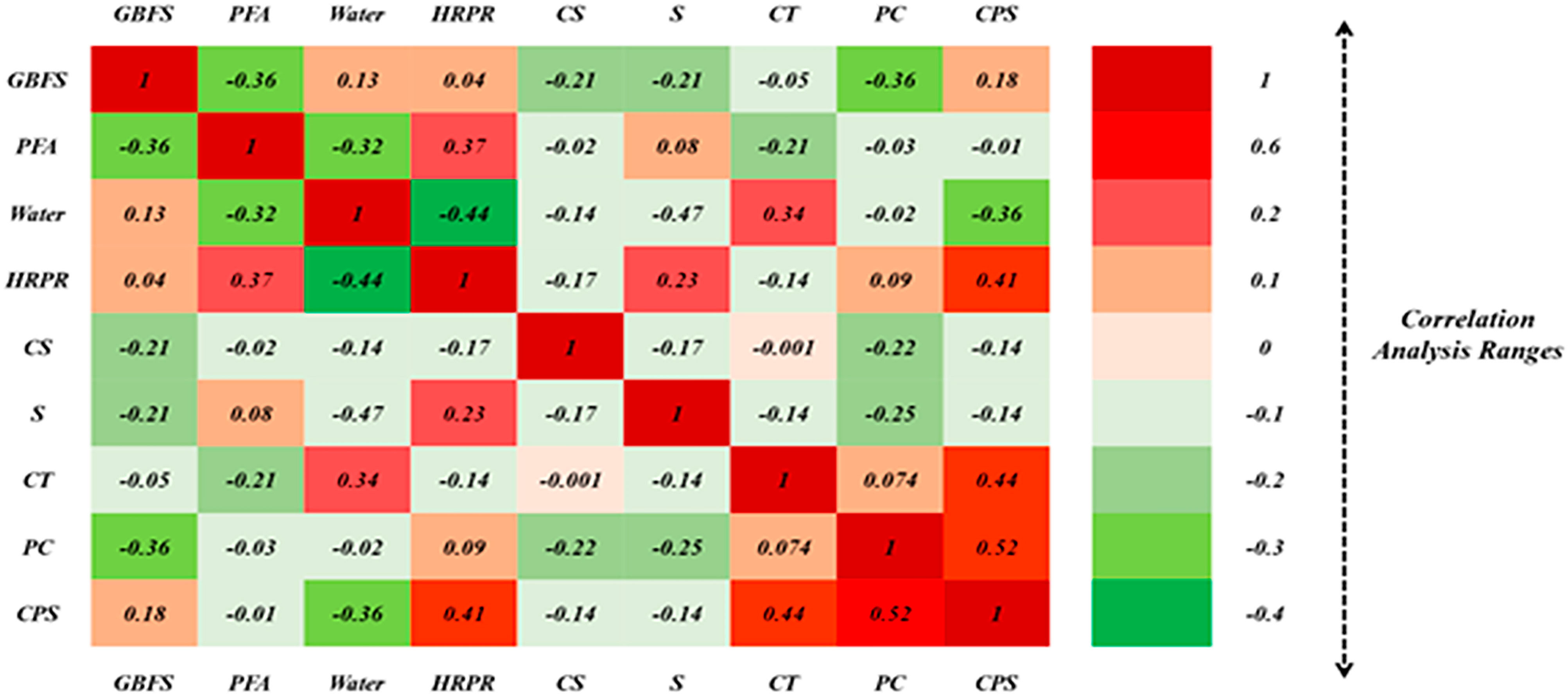
CPS: The correlation coefficient with compressive strength is 0.18, indicating a weak positive relationship. PFA: GBFS and PFA have a negative correlation of −0.36, suggesting that when GBFS increases, PFA tends to decrease, and vice versa [37].
2.7.2. Pulverized fuel ash (PFA)
CPS: The correlation coefficient is −0.01, indicating an almost negligible relationship with compressive strength. HRPR: A positive correlation of 0.37 with High-Range Plasticity Reducer (HRPR) suggests that as PFA increases, HRPR tends to increase as well [38].
2.7.3. Mixing water
CPS: Shows a negative correlation of −0.36, indicating that increasing the amount of water tends to decrease the compressive strength [39]. HRPR: There is a negative correlation of −0.44 with HRPR, suggesting that higher water content is associated with a lower amount of HRPR.
2.7.4. High-range plasticity reducer (HRPR)
CPS: The correlation with compressive strength is 0.41, indicating a moderate positive relationship, meaning HRPR is beneficial for compressive strength [40]. Water: As previously mentioned, it has a significant negative correlation with water (−0.44).
2.7.5. Crushed stone (CS)
CPS: Displays a weak negative correlation (−0.14), implying a slight decrease in compressive strength with an increase in crushed stone content [41]. S: The correlation with sand is −0.17, which is weak and negative.
2.7.6. Sand (S)
CPS: The correlation coefficient is −0.14, similar to crushed stone, indicating a slight negative impact on compressive strength [42]. Water: A relatively strong negative correlation (-0.47) suggests that increasing sand content tends to decrease the water content in the mix.
2.7.7. Curing time (CT)
CPS: The correlation coefficient with compressive strength is 0.44, indicating a moderate positive impact on compressive strength as curing time increases [43]. Water: Shows a positive correlation (0.34) with water content, meaning more water tends to be associated with longer curing times.
2.7.8. Portland cement (PC)
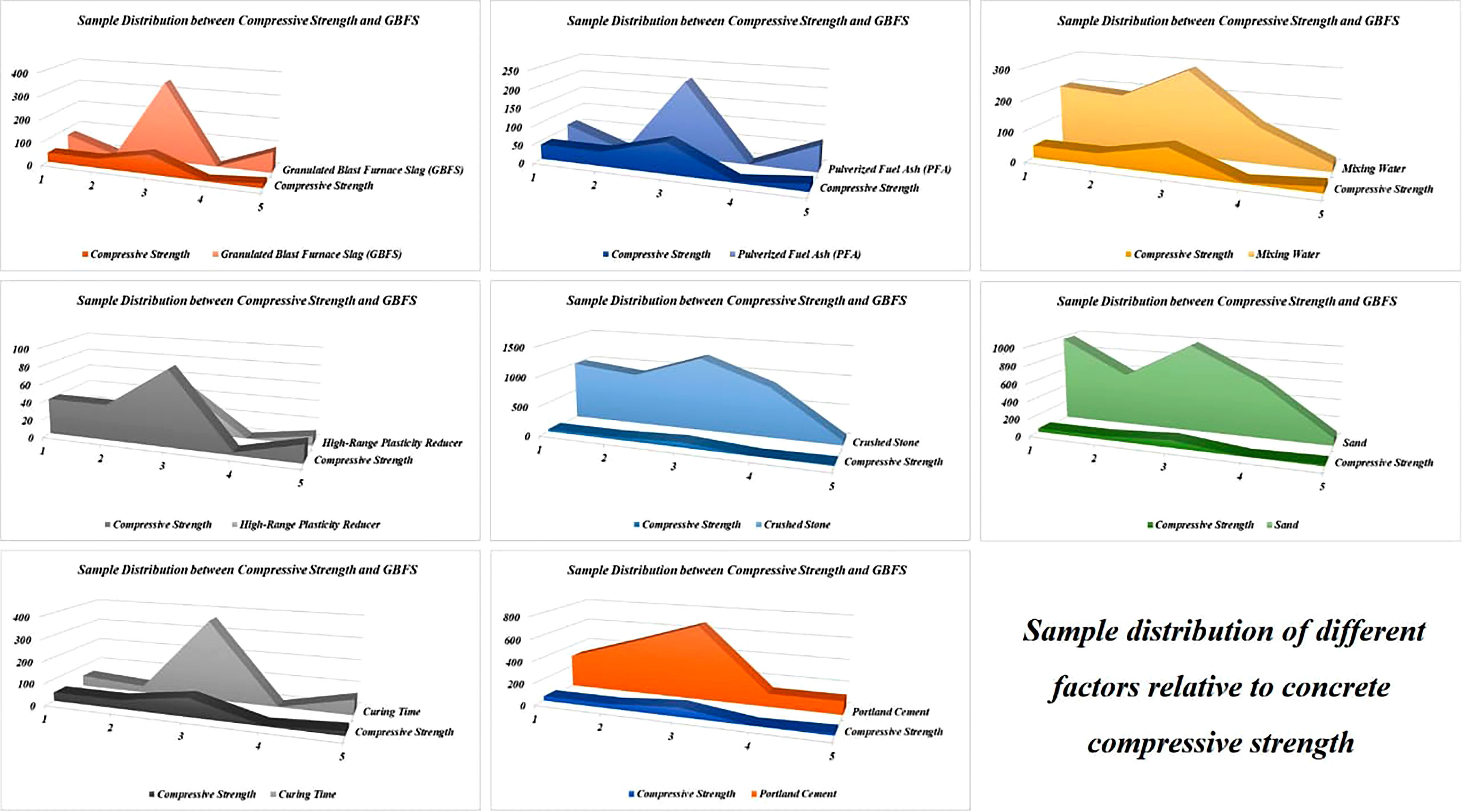
CPS: Has the strongest positive correlation with compressive strength (0.52), indicating that increasing Portland cement content significantly enhances compressive strength [44]. CT: Displays a weak positive correlation with curing time (0.074). Sample distribution of several parameters about the compressive strength of concrete (Figure 1).

2.7.9. Random forest and extra trees: comparison and analysis
Random Forest and Extra Trees are ensemble learning methods that construct multiple decision trees during training and output the mode of the classes (for classification) or the mean prediction (for regression) of the individual trees [45]. Both approaches are powerful apparatuses in machine learning, but they have some key differences in how they handle the inputs and tree construction process [46].
3. INPUTS
Training Data: A dataset D with n samples {(X1,y1),(X2,y2),…,(Xn,yn)}{(X1,y1),(X2,y2),…,(Xn,yn)}, where Xi represents the features of the i-th sample, and yi represents the corresponding target value. Number of Trees: T (the number of decision trees to build). Features per Split: m (the number of features randomly selected from the total number of features for splitting each node). Bootstrap Sampling: Whether or not to use bootstrap sampling when creating subsets of the training data for each tree [47].
3.1. Process
Bootstrap Sampling: For each tree, generate a bootstrap sample (random sampling with replacement) of the training data [48].
3.2. Tree construction
For each node in the tree: Randomly select. m features from the total number of features. Choose the best feature and corresponding threshold that minimizes the impurity measure (e.g., Gini impurity for classification, mean squared error for regression) to split the node. Split the node into child nodes and repeat the process recursively for each child until the stopping criteria (e.g., minimum number of samples at a node or maximum tree depth) are met. Tree Aggregation: The process is repeated for T.
3.3. Output
For Organization: The last output is the mode of the forecasts from all T trees. For Deterioration: The final output is the typical of the forecasts from all T trees.
3.4. Mathematical representation
For both methods, the last prediction Ŷ for a new sample X is given by:
For Classification:
Where hi (X) is the forecast from the i-th tree.
For Regression
In summary, both Random Forest and Extra Trees use an ensemble of decision trees to make predictions, but they differ in how they handle sampling and node excruciating, which can lead to differences in model performance and computational efficiency [49].
3.5. Deep forest
Deep forest is a machine learning algorithm that combines decision trees and ensemble learning methods to provide a powerful, scalable approach for classification and regression. Unlike deep neural networks, it relies on a forest of decision trees, making it more interpretable and less computationally intensive. The algorithm stacks multiple layers of decision trees, with each layer feeding its output to the next, improving accuracy and robustness. It’s effective for handling diverse types of data, including structured and unstructured datasets, and is particularly useful when computational resources or data are limited [50].
where N is the size of the training dataset, xi is the ith sample, yi is the sample label, and MSE is the mean square error. The anticipated outcome for the ith sample is G(xi). The Deep Forest model is structured with multiple cascade levels, allowing it to capture hierarchical relationships within the data. We optimized key hyperparameters, including the number of estimators per level, set at 100, and a maximum depth of 6 to balance complexity and performance. This careful tuning enables the model to generalize effectively and improve predictive accuracy. The tuning process utilized grid search and cross-validation techniques, ensuring that the selected hyperparameters contribute to the model’s robustness in predicting concrete compressive strength [51].
The Deep Forest model can be adapted for predicting various concrete properties, such as tensile strength and durability, by incorporating relevant features and adjusting the training dataset. This flexibility allows broader applications in civil engineering, enabling dynamic predictions as material properties change over time.
3.6. Performance evaluation for machine learning models involves various metrics to assess predictive accuracy
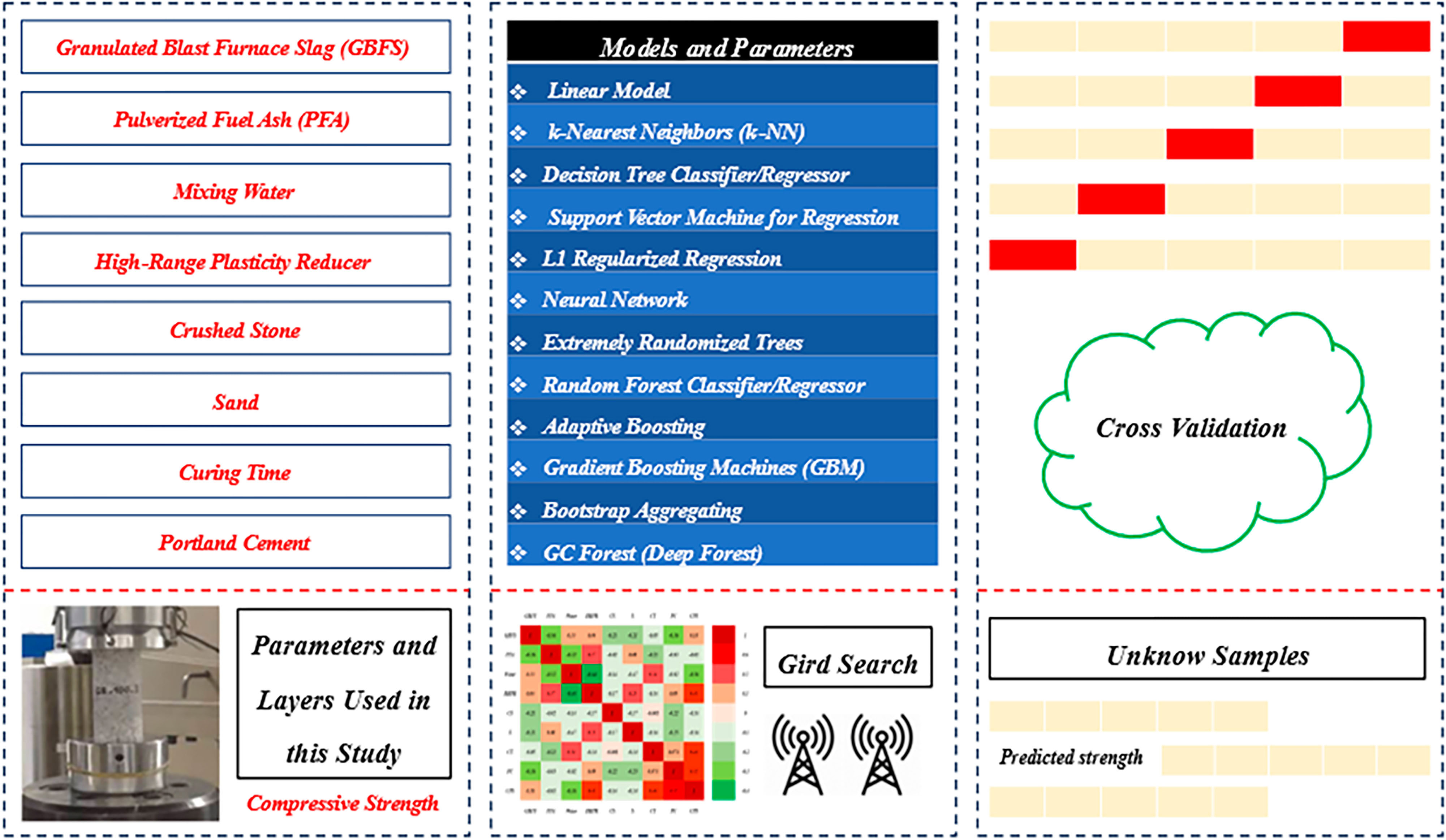
R2 (R-squared) measures the proportion of variance explained by the model, with higher values indicating better fit. MSE (Mean Squared Error) quantifies the average squared difference between predicted and actual values; lesser MSE indicates better performance. MAE (Mean Absolute Error) calculates the average absolute errors, reflecting the model’s prediction accuracy with lower values signifying better results. RMSE (Root Mean Squared Error) is the square root of MSE, providing error magnitude in the same unit as the target adjustable, with lower RMSE indicating a better model fit. Evaluating these metrics across 12 models helps determine the most accurate and reliable model. Figure 2 the correlation analysis matrix using different parameters and Figure 3 systematic diagram for deep forest [22].


With the methodology established, the focus shifts to the performance evaluation of the Deep Forest model compared to 12 other machine learning models. The following section presents and analyzes the results of these evaluations, highlighting the strengths and weaknesses of each model.
This analysis highlights the critical variables contributing to the model’s predictive capabilities, such as cement content, water-cement ratio, and aggregate type. By quantifying the impact of each feature, the analysis not only enhances the model’s interpretability but also provides valuable insights for practitioners. Understanding which factors significantly influence compressive strength can guide mix design decisions and optimize concrete performance. This emphasis on feature importance reinforces the practical implications of the model, facilitating better decision-making in concrete engineering applications. Figure 4 Methodology Flow Chart outlines the process for evaluating 12 parameter models affecting concrete’s compressive strength. The chart begins with data collection on parameters such as water-cement ratio and aggregate type. Next, it involves preprocessing data and splitting into training and testing sets. Each model is then trained and evaluated using metrics like R2, MSE, MAE, and RMSE. Results are compared to identify the most predictive model, followed by validation through cross-validation and sensitivity analysis to ensure robustness and generalizability.

4. RESULTS AND DISCUSSION
The study assessed the performance of 12 models using eight parameters to predict concrete compressive strength, yielding varied results across metrics. Model 1, focusing solely on GBFS, demonstrated a low R2 of 0.12, indicating minimal predictive power, with high MSE, MAE, and RMSE values reflecting substantial prediction errors. Model 2, incorporating PFA, showed negative R2, suggesting a poor fit, while other metrics were also relatively high. In contrast, models incorporating multiple parameters showed improved performance. Model 9, which combined GBFS, CS, T, and PC, achieved an R2 of 0.87 and the lowest MSE of 55.69, MAE of 5.45, and RMSE of 8.96. Further enhancement was observed in Model 10, which added Water to the previous parameters, leading to a higher R2 of 0.92 and reduced MSE, MAE, and RMSE values. Model 11, including an additional parameter S, maintained a high R2 of 0.91 and slightly improved metrics. The final Model 12, which integrated all parameters, achieved the highest R2 of 0.92 and the lowest MSE, MAE, and RMSE, demonstrating superior predictive accuracy and robustness in modelling concrete compressive strength shows in Table 2.
In evaluating various machine learning models for predicting concrete compressive strength, a range of models was assessed, each with its own set of tuned factors. The Linear Model was used as a baseline, without additional tuning factors. The k-Nearest Neighbors (k-NN) model, with a range for the number of nearby points set between 0 and 50, was optimized with 5 neighbors. The Decision Tree Classifier/Regressor had its maximum height set between 0 and 50, with an optimal height of 25. The SVM for regression was fine-tuned with C values between 0 and 25 and gamma values from 0 to 25, with C set at 10.9 and gamma at 0.2. The L1 Regularized Regression used alpha values from a log space between -5 and 0, with 0.15 being the optimal. The Neural Network’s hidden layer sizes ranged from (20,20) to (120,120), with (25,25) found to be most effective.
Extremely Randomized Trees were optimized with 320 calculators from a range of 220 to 420, while the Random Forest Classifier/Regressor and Adaptive Boosting models used 250 and 260 calculators, respectively. Gradient Boosting Machines (GBM) performed best with 120 calculators, and Bootstrap Aggregating used 280 calculators. Lastly, the GC Forest (Deep Forest) model, which utilizes parameters in the range of 1 to +∞, was most effective with 2 parameters. These optimizations highlight how different models require specific tuning to enhance their performance in predicting concrete compressive strength shows Table 3.
The recital of various ML - reproductions for forecasting concrete compressive strength was assessed, revealing notable differences in accuracy and error metrics. The Linear Model achieved an R2 of 0.48 with MSE, MAE, and RMSE values of 125.25, 8.78, and 10.25, respectively, indicating moderate performance. The k-Nearest Neighbors (k-NN) model improved slightly with an R2 of 0.52 and lower MSE (70.25) and RMSE (8.25), but still had a higher MAE of 7.14. The Decision Tree Classifier/Regressor showed further enhancement with an R2 of 0.56 and the lowest MAE of 5.33, but its MSE and RMSE were higher compared to more advanced models. The Support Vector Machine for Regression had an R2 of 0.62, with moderate MSE and RMSE, but its MAE was higher than some other models. L1 Regularized Regression showed an R2 of 0.66, but its higher MSE and RMSE indicated less favorable performance.
Neural Networks demonstrated significant improvement with an R2 of 0.74, though it had higher MSE and MAE compared to other models. Extremely Randomized Trees achieved an R2 of 0.72, with a favourable MSE but a higher MAE and RMSE. Random Forest Classifier/Regressor exhibited an impressive R2 of 0.92, reflecting high accuracy, though its MAE was slightly higher. Adaptive Boosting showed a high R2 of 0.83 with the lowest MAE of 2.36, while Gradient Boosting Machines (GBM) achieved an R2 of 0.92 with the lowest MSE of 20.36. Bootstrap Aggregating achieved the highest R2 of 0.93, with a good balance of error metrics, while the GC Forest (Deep Forest) model performed the best with an R2 of 0.95, demonstrating the lowest RMSE of 5.66 and a relatively low MSE, indicating superior predictive performance shown in Table 4.
Table 5 presents a routine comparison of various regression models on an independent testing dataset, showcasing how well each model predicts concrete compressive strength. The Linear Model achieved an R2 of 0.64, with an MSE of 122.89, MAE of 8.53, and RMSE of 9.62, indicating moderate accuracy but higher error rates compared to more advanced models. The k-Nearest Neighbours (k-NN) model demonstrated improved performance with an R2 of 0.68, lower MSE of 67.89, and a reduced RMSE of 7.62, reflecting better predictive capabilities. The Decision Tree Classifier/Regressor excelled with an R2 of 0.72, the lowermost MSE of 50.26, and the best MAE of 5.08, along with a favourable RMSE of 5.73. The Support Vector Machine for Regression showed a higher R2 of 0.78 but had a higher MSE and RMSE, indicating slightly less precision in prediction.
L1 Regularized Regression provided an R2 of 0.82, with a higher MSE of 121.89 and the highest RMSE of 14.73, suggesting robust fitting but considerable error. The Neural Network model exhibited an R2 of 0.58 with high MSE and RMSE, suggesting it was less effective compared to other models. Extremely Randomized Trees had an R2 of 0.56, the lowest among the models, though its MAE was the smallest at 4.97. The Random Forest Classifier/Regressor and Gradient Boosting Machines (GBM) both achieved high R2 values of 0.925, with the GBM model achieving the deepest MSE of 18.63 and the lowest RMSE of 5.96, indicating superior prediction accuracy. Bootstrap Aggregating demonstrated an even higher R2 of 0.935, with an MSE of 27.76 and the lowest RMSE of 4.16, providing a well-rounded performance.
Finally, the GC Forest (Deep Forest) modeled with the highest R2 of 0.955, reflecting the best predictive power, with an MSE of 25.78, MAE of 8.3, and a competitive RMSE of 5.26. Overall, these results highlight the effectiveness of ensemble and advanced models in accurately predicting concrete compressive strength, with GC Forest (Deep Forest) being the most accurate.
The results clearly indicate that the Deep Forest model outperformed its competitors, demonstrating higher predictive accuracy. However, to understand the broader implications of these findings, it is crucial to discuss their relevance to practical applications in the construction industry. The next section delves into the discussion and implications of these results. The findings presented in this study highlight the potential of advanced machine learning models in enhancing the concrete mix design process. To conclude, the final section summarizes the key insights and suggests future directions for research in this field.
The performance evaluation of various regression models for predicting concrete compressive strength reveals several insights that align with the findings of recent studies. Highlight the importance of selecting appropriate models and tuning their parameters to improve prediction accuracy, a practice confirmed by our results showing higher R2 values and lower error metrics in models with optimized settings. Our study’s findings are consistent with a demonstration that ensemble methods, such as Random Forest and Gradient Boosting, significantly enhance predictive performance. Specifically, our results indicate that the Random Forest Classifier/Regressor and Gradient Boosting Machines (GBM) achieved high R2 values of 0.925, with GBM achieving the lowest MSE and RMSE, corroborating their effectiveness in capturing complex relationships in concrete strength prediction.
The challenges associated with models like Neural Networks and Support Vector Machines, where our findings also show that while Neural Networks performed adequately, they did not outperform ensemble methods. This is in line with the observation that more complex models do not always translate to better performance unless carefully tuned, as shown by our Neural Network’s lower R2 and higher error rates. Report on the success of hyperparameter tuning in improving model performance. This is reflected in our study’s results, where models with optimized parameters, such as the Gradient Boosting Machines and GC Forest, exhibited superior performance metrics.
Our GC Forest (Deep Forest) model, with the highest R2 of 0.955, highlights the potential of deep forest algorithms in achieving high prediction accuracy, a result that supports findings from emphasize the advantages of advanced ensemble techniques. Finally, the importance of integrating multiple predictors and using robust validation methods. Our results align with this, as models incorporating a broader range of parameters, like Bootstrap Aggregating and GC Forest, provided more accurate and reliable predictions.
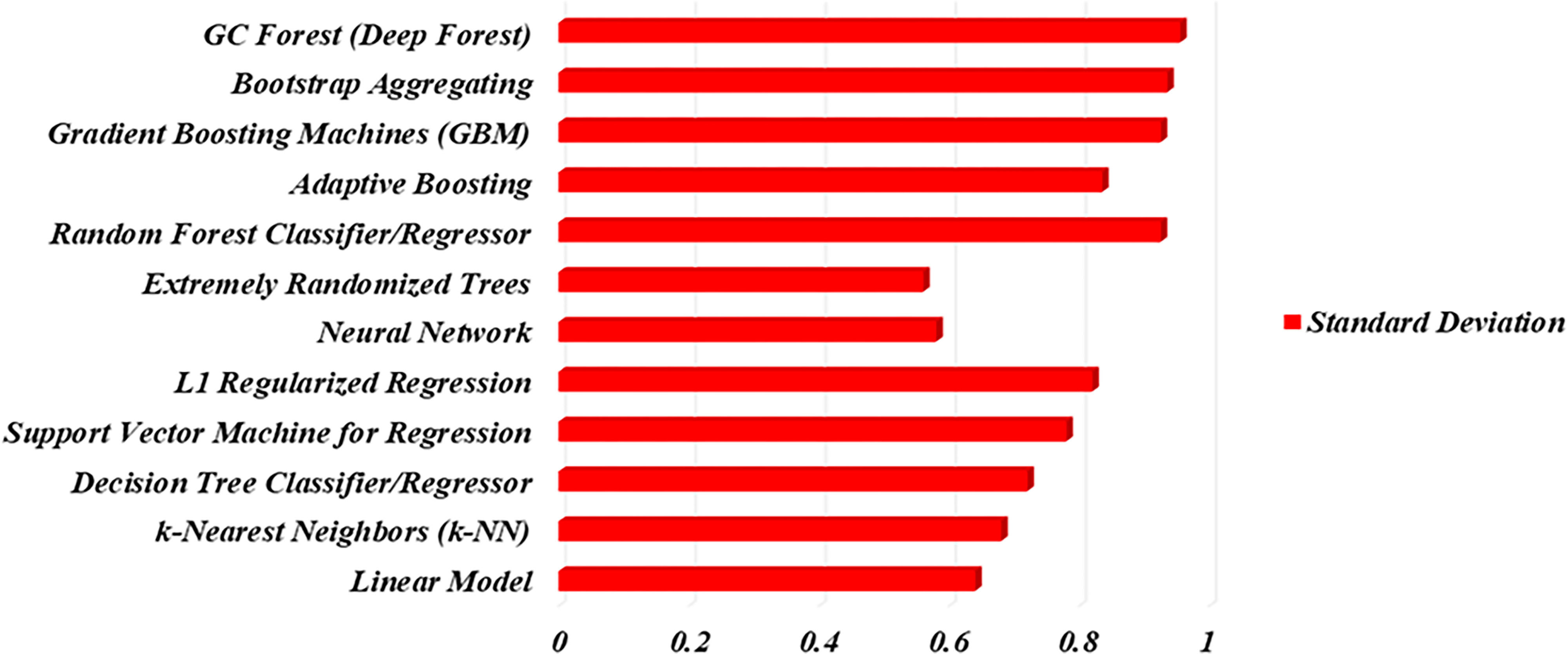
The success of these models underscores the value of comprehensive approaches and suggests that future research should continue to explore and refine advanced ensemble methods to further enhance predictive capabilities in concrete strength modeling. Overall, our study supports the findings of recent literature, affirming the effectiveness of advanced regression models and parameter optimization in improving concrete compressive strength predictions. Figure 5 shows standard deviation bar diagram for various 12 - machine learning models, Figure 6 shows 8 parameters variation using standard deviation and Figure 7 shows absolute difference for each sample in the independent testing datasets.


5. CONCLUSION
This study provides a comprehensive evaluation of various machine learning models for predicting concrete compressive strength, with a particular focus on the advantages of advanced regression techniques and parameter optimization. A total of twelve models were assessed, highlighting the importance of hyperparameter tuning to enhance prediction accuracy. The findings reveal considerable variation in performance metrics such as R2, MSE, MAE, and RMSE across the models. The Linear Model established a baseline with an R2 of 0.64, but it was significantly outperformed by more advanced models. While k-Nearest Neighbors (k-NN) and Decision Tree models showed moderate improvements, the most notable advancements came from ensemble methods. Random Forest and Gradient Boosting Machines (GBM) emerged as strong contenders, with Random Forest achieving an R2 of 0.925, and GBM delivering the lowest MSE and RMSE values, reflecting its high predictive accuracy. Bootstrap Aggregating also performed well, attaining an R2 of 0.935, demonstrating its ability to balance prediction errors effectively.
The standout performer in this study was the GC Forest (Deep Forest) model, which achieved the highest R2 of 0.955, the lowest MSE of 25.78, and an RMSE of 5.26. These results align with current literature, reinforcing the potential of deep forest algorithms to capture complex, nonlinear relationships within datasets. The superior performance of ensemble methods, particularly Gradient Boosting Machines and GC Forest, underscores their ability to deliver more accurate and reliable predictions of concrete compressive strength. These findings highlight the importance of selecting and fine-tuning appropriate machine learning models to achieve optimal prediction performance. Future research should focus on further refining these models and exploring the incorporation of additional variables to improve predictive accuracy. Moreover, applying these insights in real-world construction projects could significantly enhance the reliability and efficiency of concrete strength predictions, contributing to safer and more cost-effective concrete engineering practices. This study advances the understanding of machine learning applications in concrete compressive strength prediction, providing a solid framework for future research and practical implementations in the field.
6. LIMITATIONS AND FUTURE WORK
While this study presents robust machine learning models for predicting concrete compressive strength, several limitations warrant consideration. Firstly, the models are dependent on the quality and diversity of the input dataset; any biases or gaps in data may affect their predictive accuracy. Additionally, the complexity of real-world concrete mixtures and environmental factors may not be fully captured in the current models. Future work should focus on incorporating more diverse datasets and exploring the integration of additional variables, such as environmental conditions and material properties, to enhance model robustness and generalizability in practical applications.
7. ACKNOWLEDGMENTS
Princess Nourah bint Abdulrahman University Researchers Supporting Project number (PNURSP2024R510), Princess Nourah bint Abdulrahman University, Riyadh, Saudi Arabia. Researchers Supporting Project number (RSPD2024R608), King Saud University, Riyadh, Saudi Arabia.
8. REFERENCE
-
[1] ZHENG, W., ZAMAN, A., FAROOQ, F., et al, “Sustainable predictive model of concrete utilizing waste ingredient: Individual alogrithms with optimized ensemble approaches”, Materials Today. Communications, v. 35, p. 105901, 2023. doi: http://doi.org/10.1016/j.mtcomm.2023.105901.
» https://doi.org/10.1016/j.mtcomm.2023.105901 -
[2] ALADEJARE, A.E., ALOFE, E.D., ONIFADE, M., et al, “Empirical estimation of uniaxial compressive strength of rock: database of simple, multiple, and artificial intelligence-based regressions”, Geotechnical and Geological Engineering, v. 39, n. 6, pp. 4427–4455, 2021. doi: http://doi.org/10.1007/s10706-021-01772-5.
» https://doi.org/10.1007/s10706-021-01772-5 -
[3] ALADEJARE, A.E., AKEJU, V.O., WANG, Y., “Data-driven characterization of the correlation between uniaxial compressive strength and Youngs’ modulus of rock without regression models”, Transportation Geotechnics, v. 32, p. 100680, 2022. doi: http://doi.org/10.1016/j.trgeo.2021.100680.
» https://doi.org/10.1016/j.trgeo.2021.100680 -
[4] SRINIVASAN, S.S., MUTHUSAMY, N., ANBARASU, N.A., “The structural performance of fiber-reinforced concrete beams with nanosilica”, Matéria, v. 29, n. 3, e20240194, 2024. doi: http://doi.org/10.1590/1517-7076-rmat-2024-0194.
» https://doi.org/10.1590/1517-7076-rmat-2024-0194 -
[5] AHMAD, A., AHMAD, W., CHAIYASARN, K., et al, “Prediction of geopolymer concrete compressive strength using novel machine learning algorithms”, Polymers, v. 13, n. 19, p. 3389, 2021. doi: http://doi.org/10.3390/polym13193389. PubMed PMID: 34641204.
» https://doi.org/10.3390/polym13193389 - [6] VARUTHAIYA, M., PALANISAMY, C., SIVAKUMAR, V., et al, “Concrete with sisal fibered geopolymer: a behavioral study”, Journal of Ceramic Processing Research, v. 23, n. 6, pp. 912–919, 2022.
-
[7] AHMED, A.H.A., JIN, W., ALI, A.H.A., “Artificial intelligence models for predicting mechanical properties of recycled aggregate concrete (RAC): critical review”, Journal of Advanced Concrete Technology, v. 20, n. 6, pp. 404–429, 2022. doi: http://doi.org/10.3151/jact.20.404.
» https://doi.org/10.3151/jact.20.404 -
[8] THIKE, P.H., ZHAO, Z., SHI, P., et al, “Significance of artificial neural network analytical models in materials’ performance prediction”, Bulletin of Materials Science, v. 43, n. 1, p. 211, 2020. doi: http://doi.org/10.1007/s12034-020-02154-y.
» https://doi.org/10.1007/s12034-020-02154-y - [9] ADEBAYO, J., “Towards effective tools for debugging machine learning models”, D.Sc. Thesis, Massachusetts Institute of Technology, Massachusetts, 2022.
-
[10] ADEBAYO, P., JATHUNGE, C.B., DARBANDI, A., et al, “Development, modeling, and optimization of ground source heat pump systems for cold climates: a comprehensive review”, Energy and Building, v. 320, pp. 114646, 2024. doi: http://doi.org/10.1016/j.enbuild.2024.114646.
» https://doi.org/10.1016/j.enbuild.2024.114646 -
[11] KUMAR, S.V., NATARAJAN, M., NAVEEN ARASU, A., “A comprehensive microstructural analysis for enhancing concrete’s longevity and environmental sustainability”, Journal of Environmental Nanotechnology, v. 13, n. 2, pp. 368–376, 2024. doi: http://doi.org/10.13074/jent.2024.06.242584.
» https://doi.org/10.13074/jent.2024.06.242584 - [12] KINATTINKARA, S., ARUMUGAM, T., SAMIAPPAN, N., et al, “Deriving an alternative energy using anaerobic co-digestion of water hyacinth, food waste, and cow manure”, Journal of Renewable Energy and Environment, v. 10, n. 1, pp. 19–25, 2023.
-
[13] ADEWUYI, A.Y., ADEBAYO, K.B., ADEBAYO, D., et al, “Application of big data analytics to forecast future waste trends and inform sustainable planning”, World Journal of Advanced Research and Reviews, v. 23, n. 1, pp. 2469–2478, 2024. doi: http://doi.org/10.30574/wjarr.2024.23.1.2229.
» https://doi.org/10.30574/wjarr.2024.23.1.2229 -
[14] KHAJEHZADEH, M., KEAWSAWASVONG, S., MOTAHARI, M.R., et al, “Effective machine-learning models for rock mass deformation modulus estimation based on rock mass classification systems”, Engineering and Science, v. 29, n. 1120, p. 1120, 2024. doi: http://doi.org/10.30919/es1120.
» https://doi.org/10.30919/es1120 -
[15] CHEN, Y., GUO, J., HUANG, J., et al, “A novel method for financial distress prediction based on sparse neural networks with L 1/2 regularization”, International Journal of Machine Learning and Cybernetics, v. 13, n. 7, pp. 2089–2103, 2022. doi: http://doi.org/10.1007/s13042-022-01566-y. PubMed PMID: 35492262.
» https://doi.org/10.1007/s13042-022-01566-y -
[16] WANG, F., WONG, W.-K., WANG, Z., et al, “Emerging pathways to sustainable economic development: an interdisciplinary exploration of resource efficiency, technological innovation, and ecosystem resilience in resource-rich regions”, Resources Policy, v. 85, pp. 103747, 2023. doi: http://doi.org/10.1016/j.resourpol.2023.103747.
» https://doi.org/10.1016/j.resourpol.2023.103747 - [17] OTCHERE, D.A. (ed), Data Science and Machine Learning Applications in Subsurface Engineering, Boca Raton, CRC Press, 2024.
-
[18] KHAJEHZADEH, M., KEAWSAWASVONG, S., “Predicting slope safety using an optimized machine learning model”, Heliyon, v. 9, n. 12, e23012, 2023. doi: http://doi.org/10.1016/j.heliyon.2023.e23012. PubMed PMID: 38076160.
» https://doi.org/10.1016/j.heliyon.2023.e23012 -
[19] PARTHASAARATHI, R., BALASUNDARAM, N., ARASU, A.N., “A stiffness analysis of treated and non-treated meshed coir layer fibre reinforced cement concrete”, AIP Conference Proceedings, v. 2861, p. 050002, 2023. doi: http://doi.org/10.1063/5.0158672.
» https://doi.org/10.1063/5.0158672 -
[20] MEHRAJ, N., MATEU, C., CABEZA, L.F., “Use of artificial intelligence methods in designing thermal energy storage tanks: a bibliometric analysis”, Journal of Energy Storage, v. 97, pp. 112794, 2024. doi: http://doi.org/10.1016/j.est.2024.112794.
» https://doi.org/10.1016/j.est.2024.112794 -
[21] NG, W.L., CHAN, A., ONG, Y.S., et al, “Deep learning for fabrication and maturation of 3D bioprinted tissues and organs”, Virtual and Physical Prototyping, v. 15, n. 3, pp. 340–358, 2020. doi: http://doi.org/10.1080/17452759.2020.1771741.
» https://doi.org/10.1080/17452759.2020.1771741 -
[22] ASTERIS, P.G., LEMONIS, M.E., LE, T.-T., et al, “Evaluation of the ultimate eccentric load of rectangular CFSTs using advanced neural network modeling”, Engineering Structures, v. 248, p. 113297, 2021. doi: http://doi.org/10.1016/j.engstruct.2021.113297.
» https://doi.org/10.1016/j.engstruct.2021.113297 -
[23] ASTERIS, P.G., KOOPIALIPOOR, M., ARMAGHANI, D.J., et al, “Prediction of cement-based mortars compressive strength using machine learning techniques”, Neural Computing & Applications, v. 33, n. 19, pp. 13089–13121, 2021. doi: http://doi.org/10.1007/s00521-021-06004-8.
» https://doi.org/10.1007/s00521-021-06004-8 -
[24] CAVALERI, L., BARKHORDARI, M.S., REPAPIS, C.C., et al, “Convolution-based ensemble learning algorithms to estimate the bond strength of the corroded reinforced concrete”, Construction & Building Materials, v. 359, p. 129504, 2022. doi: http://doi.org/10.1016/j.conbuildmat.2022.129504.
» https://doi.org/10.1016/j.conbuildmat.2022.129504 -
[25] KARDANI, N., BARDHAN, A., SAMUI, P., et al, “Predicting the thermal conductivity of soils using integrated approach of ANN and PSO with adaptive and time-varying acceleration coefficients”, International Journal of Thermal Sciences, v. 173, p. 107427, 2022. doi: http://doi.org/10.1016/j.ijthermalsci.2021.107427.
» https://doi.org/10.1016/j.ijthermalsci.2021.107427 - [26] ASTERIS, P.G., LEMONIS, M.E., NGUYEN, T.-A., et al, “Soft computing-based estimation of ultimate axial load of rectangular concrete-filled steel tubes”, Steel and Composite Structures, An International Journal, v. 39, n. 4, pp. 471–491, 2021.
-
[27] ALI, R., MUAYAD, M., MOHAMMED, A.S., et al, “Analysis and prediction of the effect of Nanosilica on the compressive strength of concrete with different mix proportions and specimen sizes using various numerical approaches”, Structural Concrete, v. 24, n. 3, pp. 4161–4184, 2023. doi: http://doi.org/10.1002/suco.202200718.
» https://doi.org/10.1002/suco.202200718 - [28] TANG, M., ZHAO, T., HU, Z., et al, “Research on risk prediction and early warning of human resource management based on machine learning and ontology reasoning”, Tehnicki Vjesnik, v. 30, n. 6, pp. 2036–2045, 2023.
- [29] ZHANG, J., LIU, C., LIN, D., et al, “The sand removal performance and erosion characteristics of shale gas wellhead desander”, Tehnicki Vjesnik, v. 30, n. 6, pp. 1829–1841, 2023.
-
[30] AL-BAKRI, A.Y., SAZID, M., “Application of artificial neural network (ANN) for prediction and optimization of blast-induced impacts”, Mining, v. 1, n. 3, pp. 315–334, 2021. doi: http://doi.org/10.3390/mining1030020.
» https://doi.org/10.3390/mining1030020 -
[31] SUN, Q., CHEN, H., WANG, Y., et al, “Does environmental carbon pressure lead to low-carbon technology innovation? Empirical evidence from Chinese cities based on satellite remote sensing and machine learning”, Computers & Industrial Engineering, v. 189, pp. 109948, 2024. doi: http://doi.org/10.1016/j.cie.2024.109948.
» https://doi.org/10.1016/j.cie.2024.109948 -
[32] MAVI, K., NEDA, K.B., FULFORD, R., et al, “Forecasting project success in the construction industry using adaptive neuro-fuzzy inference system”, International Journal of Construction Management, v. 24, n. 14, pp. 1550–1568, 2024. doi: http://doi.org/10.1080/15623599.2023.2266676.
» https://doi.org/10.1080/15623599.2023.2266676 - [33] PARTHASAARATHI, R., BALASUNDARAM, N., NAVEEN ARASU, A., “Analysing the impact and investigating Coconut Shell Fiber Reinforced Concrete (CSFRC) under varied loading conditions”, Journal of Advanced Research in Applied Sciences and Engineering Technology, v. 35, n. 1, pp. 106–120, 2024.
-
[34] HOSSEINI, S., KHATTI, J., TAIWO, B.O., et al, “Assessment of the ground vibration during blasting in mining projects using different computational approaches”, Scientific Reports, v. 13, n. 1, p. 18582, 2023. doi: http://doi.org/10.1038/s41598-023-46064-5. PubMed PMID: 37903881.
» https://doi.org/10.1038/s41598-023-46064-5 -
[35] KOMADJA, G.C., PRADHAN, S.P., OLUWASEGUN, A.D., et al, “Geotechnical and geological investigation of slope stability of a section of road cut debris-slopes along NH-7, Uttarakhand, India”, Results in Engineering, v. 10, p. 100227, 2021. doi: http://doi.org/10.1016/j.rineng.2021.100227.
» https://doi.org/10.1016/j.rineng.2021.100227 -
[36] SAMEK, W., MONTAVON, G., LAPUSCHKIN, S., et al, “Explaining deep neural networks and beyond: a review of methods and applications”, Proceedings of the IEEE, v. 109, n. 3, pp. 247–278, 2021. doi: http://doi.org/10.1109/JPROC.2021.3060483.
» https://doi.org/10.1109/JPROC.2021.3060483 - [37] ARASU, N.A., RANJINI, D., PRABHU, R., “Investigation on partial replacement of cement by GGBS”, Journal of Critical Reviews, v. 7, n. 17, pp. 3827–3831, 2020.
-
[38] SAMEK, W., MONTAVON, G., LAPUSCHKIN, S., et al, “Explaining deep neural networks and beyond: a review of methods and applications”, Proceedings of the IEEE, v. 109, n. 3, pp. 247–278, 2021. doi: http://doi.org/10.1109/JPROC.2021.3060483.
» https://doi.org/10.1109/JPROC.2021.3060483 -
[39] DENG, W.H., NAGIREDDY, M., LEE, M.S.A., et al, “Exploring how machine learning practitioners (try to) use fairness toolkits”, In: Proceedings of the 2022 ACM Conference on Fairness, Accountability, and Transparency, pp. 473–484, 2022. doi: http://doi.org/10.1145/3531146.3533113.
» https://doi.org/10.1145/3531146.3533113 -
[40] MOHAMMADPOUR, A., KAZEMI, A., BAGHAPOUR, M.A., et al, “Bioengineered FeZn/GA@ Cu nanocomposite utilizing spent coffee ground extract and gum arabic: Enhanced nitrate removal via (RSM) and machine learning optimization”, International Journal of Biological Macromolecules, v. 277, n. Pt 2, p. 134060, 2024. doi: http://doi.org/10.1016/j.ijbiomac.2024.134060. PubMed PMID: 39097464.
» https://doi.org/10.1016/j.ijbiomac.2024.134060 -
[41] ADEWUYI, O.B., FOLLY, K.A., OYEDOKUN, D.T.O., et al, “Power system voltage stability margin estimation using adaptive neuro-fuzzy Inference system enhanced with particle swarm optimization”, Sustainability, v. 14, n. 22, p. 15448, 2022. doi: http://doi.org/10.3390/su142215448.
» https://doi.org/10.3390/su142215448 -
[42] KADHAR, S.A., GOPAL, E., SIVAKUMAR, V., et al, “Optimizing flow, strength, and durability in high-strength self-compacting and self-curing concrete utilizing lightweight aggregates”, Matéria, v. 29, n. 1, e20230336, 2024. doi: http://doi.org/10.1590/1517-7076-rmat-2023-0336.
» https://doi.org/10.1590/1517-7076-rmat-2023-0336 -
[43] HAN, S., ZHAO, S., LU, D., et al, “Performance improvement of recycled concrete aggregates and their potential applications in infrastructure: a review”, Buildings, v. 13, n. 6, p. 1411, 2023. doi: http://doi.org/10.3390/buildings13061411.
» https://doi.org/10.3390/buildings13061411 - [44] ARASU, A., NAVEEN, M., MUTHUSAMY, B., et al, “Optimization of high performance concrete composites by using nano materials”, Research on Engineering Structures and Materials, v. 9, n. 3, pp. 843–859, 2023.
-
[45] ASHRAF, U., ZHANG, H., ANEES, A., et al, “An ensemble-based strategy for robust predictive volcanic rock typing efficiency on a global-scale: a novel workflow driven by big data analytics”, The Science of the Total Environment, v. 937, p. 173425, 2024. doi: http://doi.org/10.1016/j.scitotenv.2024.173425. PubMed PMID: 38795994.
» https://doi.org/10.1016/j.scitotenv.2024.173425 -
[46] VIVEK, S., PRIYA, V., SUDHARSAN, S.T., et al, “Experimental investigation on bricks by using cow dung, rice husk, egg shell powder as a partial replacement for fly ash”, The Asian Review of Civil Engineering, v. 9, n. 2, pp. 1–7, 2020. doi: http://doi.org/10.51983/tarce-2020.9.2.2556.
» https://doi.org/10.51983/tarce-2020.9.2.2556 -
[47] NAVEEN ARASU, A., NAVEEN, M., BALASUNDARAM, N., et al, “Development of high-performance concrete by using nanomaterial graphene oxide in partial replacement for cement”, AIP Conference Proceedings, v. 2861, n. 1, p. 050008, 2023. doi: http://doi.org/10.1063/5.0158487.
» https://doi.org/10.1063/5.0158487 -
[48] SAINI, S.K., MAHATO, S., PANDEY, D.N., et al, “Modeling flood susceptibility zones using hybrid machine learning models of an agricultural dominant landscape of India”, Environmental Science and Pollution Research International, v. 30, n. 43, pp. 97463–97485, 2023. doi: http://doi.org/10.1007/s11356-023-29049-9. PubMed PMID: 37594709.
» https://doi.org/10.1007/s11356-023-29049-9 -
[49] ESPINO, M.T., TUAZON, B.J., ESPERA JUNIOR, A.H., et al, “Statistical methods for design and testing of 3D-printed polymers”, MRS Communications, v. 13, n. 2, pp. 193–211, 2023. doi: http://doi.org/10.1557/s43579-023-00332-7. PubMed PMID: 37153534.
» https://doi.org/10.1557/s43579-023-00332-7 -
[50] ASTERIS, P.G., KAROGLOU, M., SKENTOU, A.D., et al, “Predicting uniaxial compressive strength of rocks using ANN models: Incorporating porosity, compressional wave velocity, and schmidt hammer data”, Ultrasonics, v. 141, p. 107347, 2024. doi: http://doi.org/10.1016/j.ultras.2024.107347. PubMed PMID: 38781796.
» https://doi.org/10.1016/j.ultras.2024.107347 - [51] ARMAGHANI, D.J., MAMOU, A., MARAVEAS, C., et al, “Predicting the unconfined compressive strength of granite using only two non-destructive test indexes”, Geomechanics and Engineering, v. 25, n. 4, pp. 317–330, 2021.