 Public Health Emergency: Assessment of the political cycle in response to microcephaly associated with Zika virus in Pernambuco, Brazil
Abstract
Objectives: to evaluate the political cycle in response to the public health emergency due to microcephaly in Pernambuco.
Methods: evaluative research, approach and the Modelo Teórico de Análise do Ciclo de Políticas (Theoretical Model of Political Cycle Analysis in the phases: agenda setting, policy formulation and decision making, used as theoretical categories. A total of 13 key informants were interviewed and the findings were triangulated based on document analysis. The theoretical categories studied were: unusual problem agenda setting, insufficient structure and crisis management; policy formulation – guideline development, research management and risk communication; Decision Making Investment Management, Definitions of Institutional Competencies and Investment in Surveillance and Assistance.
Results: the microcephaly event entered the government agenda based on an agenda set up with well-defined problems. The formulation of the policy was based on technical-scientific parameters and incorporated critical issues such as the elaboration of regulations, structuring of services, research and media. The decision-making process was favored by the experience of the team and by the social and media pressure that provided the investment setting, especially directed to the structure of the services and the research performance.
Conclusions: the response to the emergency related to microcephaly in Pernambuco occurred in a logical chained political cycle, intertwined and negotiated in all its phases.
Key words:
Health evaluation; Policy making; Capacity to respond to emergencies Microcephaly; Public health
Resumo
Objetivos: avaliar o ciclo político da resposta à emergência em saúde pública por microcefalia em Pernambuco.
Métodos: pesquisa avaliativa abordando as políticas de saúde, utilizando o Modelo Teórico de Análise do Ciclo de Políticas nas fases: montagem da agenda, formulação da política e tomada de decisão, usadas como categorias teóricas. Entrevistou-se 13 informantes chaves e os achados foram triangulados a partir da análise de documentos. As categorias teóricas estudadas foram: montagem da agenda – problema inusitado, insuficiência da estrutura e gestão da crise; formulação da política – elaboração de diretrizes, gestão de pesquisa e comunicação de risco; tomada de decisão – gestão de investimentos, definições de competência institucionais e investimento na vigilância e assistência.
Resultados: o evento da microcefalia entrou na pauta governamental a partir de agenda montada com problemas bem definidos. A formulação da política, baseou-se em parâmetros técnico-científicos e incorporou questões críticas como a elaboração de normativas, estruturação dos serviços, pesquisa e mídia. A tomada de decisão foi favorecida pela experiência da equipe, pressão social e midiática que propiciou cenário de investimento, especialmente para a estrutura dos serviços e realização de pesquisas.
Conclusões: a resposta à emergência relacionada à microcefalia em Pernambuco ocorreu em um ciclo político logicamente encadeado, imbricado e negociado em todas as suas fases.
Palavras-chave:
Avaliação em saúde; Formulação de políticas; Capacidade de resposta ante emergências; Microcefalia; Saúde pública
Introduction
Public health emergencies (PHE) are a challenge for all countries, particularly those that do not have universal, capillary health systems with the capacity to respond in a timely manner. In recognition of this, the World Health Organization (WHO) drew up the International Health Regulations (IHR), which established a political, legal and governmental mechanism for dealing with collective problems related to the spread of diseases and situations that potentially require global coordination.1,2
Based on the criteria adopted in the IHR, the WHO declared a Public Health Emergency of International Concern (PHEIC) in six situations: Influenza A pandemic (H1N1 in 2009); Wild Polio and Ebola (2014); expansion of cases of Zika virus infection (ZIKV) in 2016; Ebola (2018), and COVID-19 in 2020.3
In Brazil, the ZIKV epidemic began in 2014, but it was not until October 2015 that a change in the number of babies born with microcephaly was detected in Pernambuco, which became the epicenter of this event. In view of the seriousness of the situation and the hypothesis that microcephaly is associated with ZIKV, in November 2015 the Ministry of Health (MH) declared PHE of National Interest. In view of the spread to other territories, the increase in neurological disorders and congenital alterations, the WHO announced PHEII in February 2016.4,5
By January 2017, Brazil had accumulated 2,366 confirmed cases of microcephaly suggestive of an association with ZIKV, accounting for 89.8% of the world's cases.6 In Pernambuco, the prevalence of cases was 23.9 per 10,000 live births between the end of 2015 and 2016, higher than most States in the country.7 During this period, advances in knowledge associating cases of microcephaly with a congenital syndrome linked to ZIKV occurred rapidly.7 However, little has been explored how the formulation of the response to microcephaly-related PHEII has influenced organizational practices and the provision of health services, in order to better understand institutional dynamics.
Ex-post evaluations of unusual situations that required rapid responses can help to build and strengthen public health policies. As a result, an analysis of the institutional response to the situation in the State at the epicentre of the event and the protagonist of public strategies to deal with it will contribute to the organization in facing the future PHEIIs. The aim of this study was to evaluate the political cycle of the response to the microcephaly public health emergency in Pernambuco.
Methods
An evaluative research focusing on health policies in response to microcephaly-related PHE and their influence on the organization and provision of services between October 2015 and July 2017 in Pernambuco. The State is 98,146 km2 in size and has an estimated population of 9,345,173 inhabitants (2015), 80.0% of whom live in urban areas distributed across 184 cities and the District of Fernando de Noronha. The public health system covers 85.0% of the population and has a care network of 8,125 establishments, 51.5% of which are public.8
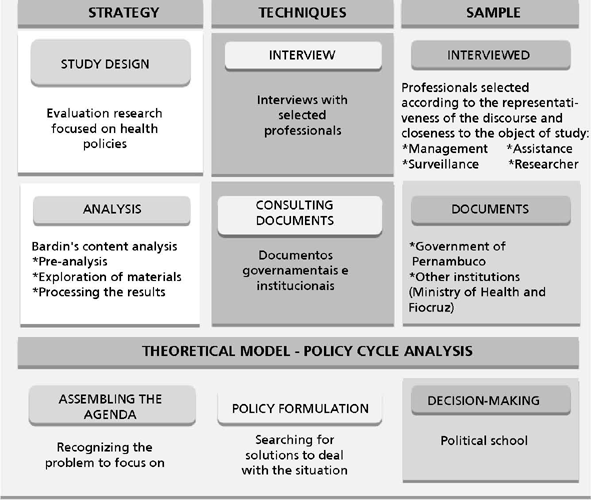
The analysis used three of the five phases of the theoretical model of the Public Policy Analysis Cycle proposed by Howlett and Ramesh,9 which includes: 1) Agenda Setting (AS), defined as the identification of problems on which the government should focus its attention; 2) Policy Formulation (PF), which involves the search for solutions to deal with the situation, defining principles and guidelines; and 3) Decision Making (DM), which corresponds to the coalitions built on the basis of negotiations, including regulations, resources and timing of the intervention.10
In-depth interviews were conducted and documents consulted to triangulate the data. A previously prepared script was used, based on the theoretical framework and with the following sections: the microcephaly emergency, emergency response, information production, research and communication. The sample was defined cumulatively and sequentially during the fieldwork, carried out between August and November 2017, until saturation of responses was reached.11 The selection was based on the representativeness of the discourse and relevance to the object of study. The inclusion criteria were: having been a member of public policy decision-making or research groups during the PHE; had participated directly in the response to the PHE in Pernambuco throughout the period; being a public worker or manager in the area of management, assistance and surveillance and a national researcher for at least ten years. All the interviews were carried out by just one researcher, in locations (Health Secretaries, Health Units, Universities or residences) and at times chosen by the interviewees. The sample consisted of four management professionals (G1-G4), four care professionals (A1-A4), three surveillance professionals (V1-V3) and two researchers (P1 and P2), all identified with the codes.
We analyzed 279 official documents from the government of Pernambuco, four from the Ministry of Health and two from Fiocruz. They were all retrieved from the SES Cievs/PE, the official gazette of Pernambuco, the Ministry of Health and Fiocruz. Details of the main documents analyzed are contained in Supplementary Table 1.
Thematic content analysis was carried out by adapting the stages proposed by Bardin12: 1) Pre-analysis – recording and transcribing the interview and reading the data; 2) Exploring the material – 2.1) Pre-defined theoretical categorization based on the three phases of the political cycle (AS, PF, DM); 2.2) Definition of Themes – identification of keywords representative of the phases of the political cycle in the interviews (Table 1), incorporation of their core understanding into the text, grouping by similarity of theme; 3) Treatment of results – frequency of appearance of the theme according to phase, selection of the three most frequent, clipping of excerpts from the interviews and triangulation with documents to verify the facts reported. The inference and interpretation of similar and divergent opinions was carried out in the light of information on the political cycle, the context of insertion and the temporal evolution of the microcephaly emergency. Figure 1 summarizes the methodological model used.

The themes identified (Table 1) were submitted to two independent and separate judges, linked to the academic area and the service, to verify their reliability, in order to ensure rigor in the analysis. The data was systematized in a package developed to help process non-numerical and unstructured data in qualitative analyses, the NUD*IST program (Non-Numerical Unstructured Data Indexing, Searching and Theorising), v4.0, 1997.
The research was approved by the Ethics and Research Committee of the Complexo do Hospital Universitário Oswaldo Cruz e do Pronto Socorro Cardiológico de Pernambuco – HUOC/Procape in 2017, CAAE 64419417.1.0000.5192.
Results and Discussion
Among the main findings of the study was that microcephaly entered the governmental agenda from an AS with well-defined problems. PF was based on technical-scientific parameters that incorporated critical issues such as the drafting of standards, the structuring of services, research and the media.DM was favored by the experience of the team, social pressure and the media, which stimulated investment, especially in the structure of services and research.
The interviewees were aged between 35 and 69. Most were female (69.2%), physicians (61.5%), between 10 and 48 years of age, SES employees (76.9%), with experience in PHE (76.9%) and management positions (53.8%) (Table 2).
We identified 185 keywords alluding to the political cycle, with AS being the most mentioned with 41.1% of the terms. By area of activity, the interviewees mentioned assistance, AS (53.3%) and DM (31.7%); management, DM (36.7%) and PF (34.7%); surveillance, AS (38.6%) and PF (31.8%) and research, AS (40.6%) and PF (37.5%) (Table 3). The interviewees highlighted the following phases of the cycle: in AS, the unusual problem, structural deficiency and crisis management; in PF, the development of guidelines, research management and risk communication; and in DM, investment management, definitions of institutional competence and investment in surveillance and care (Table 4). The details of each phase of the policy cycle and their interrelationship are presented below in terms of the most relevant aspects.
Distribution of the keywords of the political cycle recruited for the interviews according to the area of activity of the interviewees. Pernambuco, 2017.
Agenda Setting
In the AS, the interviewees reported difficulties in organizing the policy to deal with what they considered to be an unusual event. Since the AS involves social actors with different views and interests, it generated difficulties in formulating the policy. In this study, three conflicting situations were identified: the definition of the problem as relevant and whether the increase in cases of microcephaly required government attention; the hypotheses about the causes of this increase and knowledge of the problem through the media. This situation has generated concern, uncertainty and fear in the scientific community, health services and society.
The uncertainties were described by some interviewees by the changing characteristics of the birth pattern, with no parameters to give consistency to the hypotheses. Others emphasized the limits to defining strategies due to the lack of research and monitoring of births with congenital malformations in the country, while in the Americas, malformations were already the second leading cause of neonatal death.13 In addition, after formulating several hypotheses, the studies tended to accept the one that associated the cases of microcephaly with ZIKV in Brazil, given the space-time coherence between the events.14,15
According to Göttems,16 a government agenda does not follow an intentional course, but has the characteristics of "the recognition of a problem by society; the existence of ideas and alternatives to conceptualize them and a political, administrative and legislative context favourable to the development of action". The political context influences the entry of problems onto the decisionmaking agenda.16,17,18 The governmental response to the increase in microcephaly cases as a relevant problem was shaped by the interpretation and experience of the actors involved, media pressure, social commotion and compliance with international agreements,10,19 in the midst of global economic crises and national politics marked by a presidential impeachment process.7
In the context of Brazilian health work, the study shows the importance of a professional career in health for the formation of consistent and experienced teams.20 In addition, previous local experience in dealing with other PHE5 has provided professionals with technical qualifications, facilitating the definition of the problem and the formulation of alternatives. Authors believe that the presence of expertise in the face of a problem makes it easier for the issue to be put on the decision-making agenda, making up the flow of solutions.16,17
The interviewees highlighted the structural deficiency of the health services to respond to the routine, which has worsened with the PHE. Public underfunding results in a mismatch between the health needs of the population and the supply of services, which is one of the reasons for the dissatisfaction of SUS users. Research into the perception of mothers of children with microcephaly related to congenital infection attributes underfunding, the fragmentation of the system and the lack of effective public policies as reasons for mothers' dissatisfaction with the care provided to their children.21
In all the speeches, the existence of a management crisis in the conduct of actions was highlighted. Difficulties occurred in the areas of surveillance and care, conducting research, defining regulations, resource management and risk communication. There were divergences between what was recommended by the health authorities at State and national level, which was also seen in their protocols.
In addition, research groups and the media were essential in pushing for a government response. Academic participation in the production of research preceded the declarations of the PHE by Brazil and the WHO,5 integrated researchers in the management of the crisis and promoted the scientific race in search of answers to the uncertainties of the situation. The integration of researchers and policy-makers is recognized as crucial, even though they do not have governance over the response to social demands. The scientific knowledge produced can indicate political alternatives,17,22 since its contribution to the flow of solutions16 adjusts valid technical-scientific criteria.
The interviewees showed that an international group sought to lead research, to the detriment of locally established guidelines, but government action reaffirmed local leadership. Low-income countries tend to be lenient with ethical and research-related issues, so many groups rely on the lack of scientific production and social contexts in these countries.23
The attention of the media goes to the problem that helped speed up the AS. There is evidence that publicizing social problems is an instrument of pressure for government bodies, and the media is part of the flow of solutions.24 Despite its importance, the media excessive demand for information, the dissemination of rumors on social networks and the fact that it requires the ability to articulate, the media was also seen as a problem. Social interest in the microcephaly epidemic was revealed by the presence of this topic on 41.0% of the front pages of nine printed newspapers in Brazil.24
Policy Formulation
The transition between the AS and PF phases generated actions without complete knowledge of the problem and required the construction of alternatives as new needs arose. In this phase, the policymakers, based on the alternatives, decide on the actions, based on a clash of ideas involving conflicts, negotiations and limited knowledge of their effectiveness.18,25 The institutional diversification of the formulators and their interaction with the implementers are seen as factors that make a policy successful.10,17
For the PF, a single command was defined to lead the actions, led by the State entity. The space for debate was the Comitê de Operações de Emergência em Saúde Pública (COES),26 (Public Health Emergency Operations Committee) where priorities were agreed on the development of guidelines, research management and risk communication. In this space, strategies were established for dialogue with society and risk communication management, which some interviewees highlighted as essential, given the recurrence of rumors surrounding the epidemic.
In the midst of the conflicts inherent in the implementation of public policies,22 in particular the interfederative ones, interest in prioritizing research groups, pressure for answers from society and uncertainties about developments,5,7,15,21 emergency guidelines were established from the COES. The most requested were financial and institutional support; the publication of standards to guide the city health and care services; support to carry out research and risk communication strategies. Political will, coordination and planning are recognized as essential pillars for strengthening the capacity to respond to PHE.19
One of the interviewees' concerns was the drafting of regulations that would integrate surveillance and care actions, as well as regulating the health network. As this was an unusual problem, there was no national or international experience to guide actions. It began with the classification of notifications to define cases and efforts to integrate services. According to the interviewees, the high number of cases led to increased demand for services, rapid changes in care and many new documents. Authors agree with the interviewees when they point out the need for coordination and integrated planning and its implications for AS and PF to minimize institutional weaknesses toface certain situations, particularly PHE.17,19
This research showed that the intensity of the response from surveillance and care was different at different times. In Brazil, despite the fact that the public management of PHE has legislation that is shared between federations, its operationalization by health authorities has different capacities for action.27 Studies on the IHR corroborate our findings. States and cities have greater capacity to detect, assess and notify than to investigate, intervene and communicate. In addition, they have deficits in organizational activities and in hiring and training staff.27 Small towns have greater difficulty in guaranteeing responses, requiring the support of State and federal entities in order to implement measures.
Risk communication raised the need for political alternatives and acted on two fronts: one aimed at the population and the other at health professionals. Investment was made in increasing the logistics of communication and promoting transparency in the actions taken. One interviewee highlighted the role of the press in keeping the population engaged, minimizing the noise of myths and rumours. Dealing with communication was as essential as instituting care guidelines. Although the spread of rumors and misinformation is part of the history of global health, real-time communication and dissemination via the internet has amplified changes in social behavior.28 A recent study showed the growing popular interest in health related topics on the internet and social networks and highlighted its value in reducing the spread of misinformation.29 The spread of content challenges authorities to adopt measures to combat fake news, conspiracy theories, magic cures and situations that increase fear, limit effective care and threaten human life.
The interviewees reported experiences with individual and family dilemmas related to ongoing pregnancies and the project of procreation interrupted at the PHE. Many people went to the SES, out of fear and apprehension, to find out about the risks involved in reproduction and pregnancy. Similarly, previous studies have pointed out the dilemmas of mothers of children with microcephaly or reflected on the suffering, fears, risks and stigmatization related to PHE and the news dissemination.21,24
Decision-making
The main focus of DM was on care and surveillance actions to transcend the problem. In all public PF, particularly PHE, DM runs parallel to the other stages of the policy cycle. In a short period of time, the AS takes place, the PF takes place, decisions are made and actions are implemented, with dynamic feedback. The course of action adopted, according to the interviewees, pointed to the need to manage investments, provide financial support for the proper functioning of care and surveillance actions, and distinguish between care and scientific competencies.
The DM was characterized by the State Executive Act, which used the law to speed up public administration in the context of the disaster, guaranteeing funding and the use of resources. Ordinary acts, such as ordinances and technical notes, fulfilled the function faster of regulating compulsory notifications, committee formation, information flow, laboratory collection, and among others.5,7,26 The alternatives for PF are administrative measures that legitimize and formalize the choices,25 being subject to interpretation by the implementers, and not just uncritical advance10 The actions of those who decide are cited by authors as being limited by institutional rules and requiring the mobilization of other bodies to achieve the proposed objectives.10,22
The alignment between planning and actions was favored by the multidisciplinary work in the COES, creating a promising environment for the implementation of measures and financial viability. A study shows that knowledge and scientific evidence, ideas and interests, and capacity and resources22 provide an environment for DM. The implementation of research management, with a local counterpart and national and international investment, was one of the first actions.7 Promises without funding represent unfulfilled intentions.18,22
The definition of physical and virtual spaces and official and unofficial means of public communication was essential to establish a flow with the press and manage rumors.28 However, the lack of a communication plan revealed cultural gaps that make it difficult to integrate this issue with the normative work of PHE responses.
In this PHE, surveillance led the planning, strategy-building, structuring and integration of services, which may be related to training in basic surveillance skills and previous experience.27 The intensity of the care response came after surveillance, perhaps because of the structural nature required.
With the increase in the number of microcephaly cases in the countryside, priority was given to investments in decentralizing the care and surveillance network. One of the interviewees highlighted the mismatch between the decentralization of surveillance and care. Despite the investments, there were difficulties in guaranteeing specialized services in places far from the capital, a discrepancy between supply and demand for services in the public network, and obstacles to contracting private services based on the amounts paid by the SUS. As a result, interviewees pointed to children traveling to other cities, in line with what was reported by research in Sergipe.21 In order to implement complex policies, such as PHE of microcephaly, stakeholders are required to take dialogic actions to increase the chances of achieving the objectives of the response.22
Pandemics have exposed the underfunding of the health system in the world. While developed countries with universal service coverage spend an average of 8% of their Gross Domestic Product (GDP) on health, Brazil spends 3.9%.30 The PHE has seen a shortage of hospital beds, intensive care, diagnostic and rehabilitation facilities, while contracting the private sector has not always been possible given to the obstacles that the sector has faced.
The limitations of the political cycle model adopted in this study include the fact that there is no perfect sequential operating mechanism and that the moments of reformulation were not identified, but despite this, its dynamic, successive and interconnected phases added value in understanding the organizational context of PHE of microcephaly. In order to minimize this limitation, in addition to the interviews, institutional documents were consulted as a way of validating what was reported.
Like other policies, the PHE of microcephaly to become part of the governmental agenda followed a conflictive course, in which it was necessary to formulate alternatives and circumscribed DM. The AS emphasizes the identification of well-defined problems. In PF, technical-scientific parameters were sought and critical issues such as drafting regulations, structuring services, research and the media were incorporated into planning. The experience of the teams, together with social and media pressure, favored rapidly DM and led to investments, especially in the structure of services and research. The current model in the state health system was reorganized and resized to respond to the event in question.
The diversity of factors involved in PHE of microcephaly contributed to understanding the evolution of the administrative, technical, scientific, structural, regulatory, financial and risk communication spectra. The political cycle model proved to be pertinent for identifying problems, alternatives, solutions and decision-making, as well as being didactic for understanding the chain of phases that could be analyzed separately and articulated.
Supplementary Table 1
References
- 1 Hamblion E, Saad NJ, Greene-Cramer B, Awofisayo-Okuyelu A, Selenic Minet D, Smirnova A, et al. (2023) Global public health intelligence: World Health Organization operational practices. PLOS Glob Public Health. 3(9): e0002359.
- 2[Editorial]. The future of the International Health Regulations. Lancet Glob Health. 2022; 10 (7): e927.
- 3 Jee Y. WHO International Health Regulations Emergency Committee for the COVID-19 outbreak. Epidemiol Health. 2020; 42: 1-4.
- 4 Oliveira WK, França GVA, Carmo EH, Duncan BB, Kuchenbecker RS, Schmidt MI. Infection-related microcephaly after the 2015 and 2016 Zika virus outbreaks in Brazil: a surveillance-based analysis. Lancet.2017; 390: 861-70.
- 5 Lima SS, Sivini MAVC, Oliveira RC, Azevedo BAS, Dias CC, Lopes ASA, et al. Estratégia de atuação do Cievs/Pernambuco na resposta à emergência da Síndrome Congênita associada à infecção pelo vírus Zika: uma ação integrativa. Rev Bras Saúde Mater Infant. 2018; 18 (2): 443-8.
-
6 World Health Organization (WHO). Situation report: zika virus, microcephaly, guillain-barré syndrome: 20 January 2017. [access in 2019 Jun 10]. Available from: https://apps.who.int/iris/bitstream/handle/10665/250633/zikasitrep270ctl6-eng.pdf?sequence=l&isAllowed=y
» https://apps.who.int/iris/bitstream/handle/10665/250633/zikasitrep270ctl6-eng.pdf?sequence=l&isAllowed=y - 7 Albuquerque MFPM, Souza WV, Araújo TVB, Braga MC, Miranda-Filho DB, Ximenes RAA, et al. Epidemia de microcefalia e vírus Zika: a construção do conhecimento em epidemiologia. Cad Saúde Pública. 2018; 34 (P): 1-14.
-
8 Pernambuco. Secretaria de Saúde de Pernambuco. Plano Estadual de Saúde 2016-2019 [acesso em 2021 Jul 1]. Disponível em: http://portal.saude.pe.gov.br/documentos/planos-estaduais-de-saude
» http://portal.saude.pe.gov.br/documentos/planos-estaduais-de-saude - 9 Howlett M, Ramesh M. Studying Public Policy: policy cycles and policy subsystems. Canadá: Oxford University Press; 1995. p. 239.
- 10 Baptista TWF, Rezende M. A ideia de ciclo na análise de políticas públicas. In: Mattos RA, Baptista TWF, editors. Caminhos para Análise das Políticas de Saúde. Porto Alegre: Rede Unida; 2015. p.221-72.
- 11 Luciani M, Campbell K, Tschirhart H, Ausili D, Jack SM. How to Design a Qualitative Health Research Study. Part 1: Design and Purposeful Sampling Considerations Come Disegnare uno Studio di Ricerca Sanitaria Qualitativa. Prof Inferm.2019; 72 (2): 152-61.
- 12 Câmara RH. Análise de conteúdo: da teoria à prática em pesquisas sociais aplicadas às organizações. Rev Interinst Psicol. 2013; 6 (2): 179-91.
- 13 Szwarcwald CL, Leal MC, Almeida WS, Barreto ML, Frias PG, Theme-Filha MM, et al. Child Health in Latin America. In: Oxford Research Encyclopedia, Global Public Health. USA: Oxford University; 2019. p. 1-49.
- 14 Souza WV, Araújo TVB, Albuquerque MFPM, Braga MC, Ximenes RAA, Miranda-Filho DB, et al. Microcephaly in Pernambuco State, Brazil: epidemiological characteristics and evaluation of the diagnostic accuracy of cutoff points for reporting suspected cases. Cad Saúde Pública. 2016; 32 (4): 1-8.
- 15 Teixeira MG, Costa MCN, Oliveira WK, Nunes ML, Rodrigues LC. The epidemic of Zika virus-related microcephaly in Brazil: Detection, control, etiology, and future scenarios. Am J Public Health. 2016; 106 (4): 601-5.
- 16 Göttems LBD, Pires MRGM, Calmon PCDP, Alves ED. O modelo dos múltiplos fluxos de Kingdon na análise de políticas de saúde: aplicabilidades, contribuições e limites. Saúde Soe. 2013; 22 (2): 511-20.
- 17 Henrique AC. Montagem da Agenda e Formulação da Política Pública: Austeridade Fiscal no Brasil. Rev Direito Setorial Regul. 2018; 4 (1): 111-30.
- 18 Fadlallah R, El-Jardali F, Nomier M, Hemadi N, Arif K, Langlois EV, et al. Using narratives to impact health policy-making: A systematic review. Heal Res Policy Syst. 2019; 17 (1): 1-22.
- 19 Ugarte C, Alcala PA, Mauvernay J. Political Will, Coordination and Planning: Key Components for Strengthening National Response to Public Health Emergencies and Disasters in Latin America and the Caribbean Countries [Editorial]. Am J Public Health. 2018; 108 (S3): 209-11.
- 20 Viana DL, Martins CL, Frazão P. Gestão do trabalho em saúde: sentidos e usos da expressão no contexto histórico brasileiro. Trab Educ Saúde. 2018; 16 (1): 57-78.
- 21 Santos DBC, Silva EF, Lima SO, Reis FP, Oliveira CCC. Rede de Atenção à Saúde: Percepção materna quanto à qualidade de atendimento de crianças com microcefalia. Esc Anna Nery. 2019; 23 (4): 1-10.
- 22 Campos PA, Reich MR. Political Analysis for Health Policy Implementation. Heal Syst Reform. 2019; 5 (3): 1-12.
- 23 Milium J, Beecroft B, Hardcastle TC, Hirshon JM, Hyder AA, Newberry JA, et al. Emergency care research ethics in low-income and middle-income countries. BMJ Glob Health. 2019; 4: 1-8.
- 24 Aguiar R. A mídia em meio às 'emergências' do vírus Zika:questões para o campo da comunicação e saúde. Rev Eletron Comun Inf Inov Saúde. 2016; 10 (1): 1-15.
- 25 Dalfior ET, Lima RCD, Contarato PC, Andrade MAC. Análise do processo de implementação de políticas de saúde: um estudo de caso baseado no enfoque da política institucional. Saúde Debate. 2016; 40 (111): 128-39.
-
26 Pernambuco. Secretaria de Saúde de Pernambuco. Nota técnica SEVS/DGCDA nº 44/2015-Atualização sobre o aumento da ocorrência de microcefalia em nascidos vivos em Pernambuco [access in 2019 Ago 1]. Available from: https://12ad4c92-89c7-4218-9ell-eel36fa4b92.filesusr.com/ugd/3293a8_el0elaec30d7450abeefddc251b0016c.pdf
» https://12ad4c92-89c7-4218-9ell-eel36fa4b92.filesusr.com/ugd/3293a8_el0elaec30d7450abeefddc251b0016c.pdf - 27 Teixeira MG, Costa MCN, Souza LPF, Nascimento EMR, Barreto ML, Barbosa N, et al. Evaluation of Brazil's public health surveillance system within the context of the International Health Regulations (2005). Rev Panam Salud Publica. 2012; 32 (1): 49-55.
- 28 Wang Y, McKee M, Torbica A, Stuckler D. Systematic Literature Review on the Spread of Health-related Misinformation on Social Media. Soc Sci Med. 2019; 240: 112552.
- 29 Rovetta A, Bhagavathula AS. COVID-19-related web search behaviors and infodemic attitudes in Italy: Infodemiological study. J Med Internet Res.2020; 22 (5): 1-10.
- 30 Figueiredo JO, Prado NMBL, Medina MG, Paim JS. Gastos público e privado com saúde no Brasil e países selecionados. Saúde Debate. 2018 Oct; 42 (spe 2): 37-47.
-
Associated Editor:
Ana Albuquerque