 Ant assemblages (Hymenoptera: Formicidae) and spatial patterns of diversity along Cerrado remnants in Central-West Brazil
Abstract
Ants are a diverse and ecologically important group of social insects, playing a key role in ecosystem functioning. However, significant gaps remain in our understanding of their distribution across the Brazilian biomes. In this study, we surveyed four sites within a poorly sampled region of the Cerrado, located between Mato Grosso (MT) and Goiás (GO) states in Brazil. Using attractive baits for ants foraging on the ground and in the vegetation, we conducted two rounds of sampling across 20 transects using 40 baits each, totaling 1,600 baits. We recorded 133 ant species from 34 genera and 8 subfamilies. Myrmicinae and Formicinae showed the highest species richness. The five most frequent species were from the genera Camponotus and Pheidole. Notably, 12 species are officially new records for MT and GO, including two rare species for Cerrado’s myrmecofauna. Species richness per site ranged from 59 to 80 species, with the lowest richness occurring where all sampling comprised only savanna habitat, while sites harboring savanna and forest habitats yielded higher species counts, suggesting that vegetation heterogeneity promotes ant diversity. We also recorded more species on the ground (118) than in the vegetation (78). There were marked differences in richness and composition between strata, highlighting the vertical stratification of ant communities. These findings improve our understanding of ant diversity, but additional surveys are needed to better characterize the myrmecofauna across this region of the Cerrado. Furthermore, we encourage biologists to share their consultancy species lists, which could help to fill many knowledge gaps existing about Brazilian biodiversity.
Keywords:
arboreal ants; ground-dwelling ants; insect inventory; myrmecofauna; Neotropical region
Resumo
As formigas são um grupo diversificado e ecologicamente importante de insetos sociais, desempenhando um papel fundamental no funcionamento dos ecossistemas. No entanto, lacunas significativas permanecem em nossa compreensão de sua distribuição nos biomas brasileiros. Neste estudo, coletamos formigas em quatro locais em uma região pouco amostrada do Cerrado, localizada entre os estados brasileiros de Mato Grosso (MT) e Goiás (GO). Utilizando iscas atrativas para formigas que forrageiam no solo e na vegetação, realizamos duas rodadas de amostragem ao longo de 20 transectos, usando 40 iscas cada, totalizando1.600 iscas. Registramos 133 espécies de formigas de 34 gêneros e 8 subfamílias. Myrmicinae e Formicinae apresentaram a maior riqueza de espécies. As cinco espécies mais frequentes pertenciam ao gênero Camponotus e Pheidole. Notavelmente, 12 espécies são oficialmente registros novos para o MT e GO, com a inclusão de duas espécies raras para a mirmecofauna de Cerrado. A riqueza de espécies por local variou de 59 a 80 espécies, com a menor riqueza ocorrendo onde todas as amostragens compreenderam apenas hábitat de savana, enquanto os locais que abrigavam savana e florestas produziram contagens de espécies mais altas, sugerindo que a heterogeneidade da vegetação promove a diversidade de formigas. Também registramos mais espécies no solo (118) do que na vegetação (78). Houve diferenças marcantes na riqueza e na composição entre os estratos, destacando a estratificação vertical das comunidades de formigas. Esses resultados contribuem para melhor compreendermos a diversidade de formigas, mas são necessárias coletas adicionais para melhor caracterizar a mirmecofauna nessa região do Cerrado. Além disso, incentivamos os biólogos a compartilharem suas listas de espécies de consultorias ambientais, o que poderia ajudar a preencher muitas das lacunas de conhecimento existentes sobre a biodiversidade brasileira.
Palavras-chave:
formigas arborícolas; formigas de solo; inventário de insetos; mirmecofauna; região neotropical
1. Introduction
Ants (Hymenoptera: Formicidae) are ecologically dominant social insects, playing crucial roles in various ecosystem processes and services. They are key contributors to ecosystem engineering, decomposition, seed dispersal, pollination, and biological control (Folgarait, 1998; Del Toro et al., 2012) and serve as an important food source for numerous animals (e.g., Sabagh et al., 2012; Jiménez et al., 2018; Keis et al., 2019). Consequently, the energy flow and nutrient cycling in ecosystems are significantly influenced by the ecological interactions that ants establish, with critical implications for biodiversity maintenance in many biological communities (Alonso, 2010). These insects are not only essential due to their abundance and their contribution to a significant portion of terrestrial animal biomass (Schultheiss et al., 2022; Rosenberg et al., 2023), but also because of their diversity. Indeed, ants (Hymenoptera: Formicidae) are the most diverse group of social insects, with over 14,000 known species distributed across 16 subfamilies and 342 genera, inhabiting nearly all terrestrial ecosystems (Bolton, 2024). However, despite their immense biodiversity and ecological importance, basic information - such as the spatial patterns of ant richness and composition - remains limited for many ecosystems worldwide (Kass et al., 2022).
Brazil, with its vast continental dimensions and a wide variety of terrestrial biomes (Fiaschi and Pirani, 2009), is home to one of the richest ant fauna globally (Baccaro et al., 2015), comprising more than 10% of all currently described ant species (1,541 out of 14,259; Bolton, 2024). Much of this diversity is found in the Brazilian savannas known as the Cerrado, South America’s second largest ecosystem, originally covering approximately 2 million km2 of Central Brazil (Oliveira and Marquis, 2002). Recognized as a global biodiversity hotspot (Myers et al., 2000), the Cerrado has been the focus of numerous diversity and conservation studies (Colli et al., 2020), and notably, there have been 106 ant diversity studies between 1945-2020 (Schmidt et al., 2022). However, large portions of the Cerrado remain poorly sampled, and our knowledge of their ant diversity is still incomplete (Divieso et al., 2020). This is particularly alarming given that nearly 50% of the Cerrado’s original area has already been replaced by pastures or crops (Souza Júnior et al., 2020). Moreover, projections indicate that one-third of the remaining habitats could be lost by 2050-2070 (Colman et al., 2024), leading to significant extinctions of endemic species (Strassburg et al., 2017). Therefore, filling these knowledge gaps through surveys is essential to better understand the Cerrado’s ant diversity, which is the first necessary step toward conservation efforts (Alonso, 2010).
In this study, we surveyed ants across four sites of Cerrado remnants located in the states of Mato Grosso and Goiás, in the Central-Western region of Brazil. We used attractive baits to sample ants foraging on the ground and in the arboreal vegetation. Our goal was to determine the differences in species richness and composition across different sites and strata (ground and vegetation) to understand better the local and regional ant diversity patterns. We expect the mirmecofauna to vary spatially, showing a substantial turnover in ant diversity among different locations (Vasconcelos et al., 2018; Maravalhas and Vasconcelos, 2020), and a marked stratification between ground-dwelling and arboreal ant assemblages (Campos et al., 2008; Rodrigues et al., 2019; Vasconcelos et al., 2023b).
2. Material and Methods
2.1. Study area
We sampled ants at four sites across the Mato Grosso (MT) and Goiás (GO) states, in Brazil (Figure 1). The sites were in the municipalities of Santo Antônio de Levenger-MT (hereafter SAL), Poxoréu-MT (POX), Ribeirãozinho-MT (RIB), and Caiapônia-GO (CAI), comprising a maximum distance of 450 km between them. The region has a subtropical, highly seasonal climate with a well-defined dry season from May to September and a rainy season from October to April. The annual average temperature and accumulated precipitation vary between 22-24 °C and 1,600-1,900 mm, respectively (Alvares et al., 2013). In total, we surveyed 20 transects distributed across 10 natural remnants present at the studied sites (areas between 50-1,000 ha; Supplementary Material: Table S1). Cerrado sensu stricto (a savanna physiognomy) is the dominant natural vegetation throughout these remnants, typically characterized by a ground layer composed of grasses, herbs, and small shrubs, with a sparse woody layer formed by small-sized trees (3-6 m in height) that reaches a canopy cover of ~ 40% (sensu Ribeiro and Walter, 2008). Semideciduous forests, formed by tall trees (> 12 m in height) and a continuous canopy formation (cover > 80%; sensu Ribeiro and Walter, 2008), were also present and were sampled in one-quarter of the transects (Table S1).

Distribution of ant fauna sampling sites. Collection was conducted within a large section of 450-km in the Cerrado biome, across the states of Mato Grosso (MT) and Goiás (GO), Central-West Brazil. Localities: SAL - Santo Antônio de Levenger-MT, POX - Poxoréu-MT, RIB - Ribeirãozinho-MT, and CAI - Caiapônia-GO.
2.2. Ant fauna survey
Ants were collected using the sardine bait attraction method (Lopes and Vasconcelos, 2008; Vasconcelos et al., 2008). We established five line transects with 0.4 km long per site, keeping approx. 1.0 km distant from each other. In each transect, 20 sampling stations were placed at 20 m intervals. For each station, two baits consisting of a few grams of sardine canned in vegetable oil were placed on white paper pieces (~10 x 15 cm) on the ground and in the arboreal stratum. We randomly selected trees as close as possible to the corresponding soil baits, regardless of the plant species. We only used trees ranging between 2 and 4 m in height with branches at 1.5 m to support the vegetation baits. Each bait was checked after 30 and 60 minutes, typically resulting in the collection of three specimens per visiting species. Two sampling campaigns were conducted per study site: one during the dry season (July 2016) and another during the rainy season (December 2016). Sampling was conducted between 9h and 16h during ten consecutive days in each campaign. We sampled 20 transects and 40 baits per area across campaigns and strata, totaling 400 baits per area and 1,600 baits altogether. The collected specimens were incorporated into the entomological collection of the Museu de Biodiversidade do Cerrado, at the Universidade Federal de Uberlândia. The taxonomic identification was carried out to the lowest possible taxonomic level with the help of specialist, using several dichotomous keys (Camacho et al., 2020; Oliveira et al., 2021; AntWiki, 2024; Feitosa and Dias, 2024; Marcineiro and Lattke, 2024; França et al., 2024), and comparisons with photos of types in AntWeb (AntWeb, 2024). Species distribution records were searched in Google Scholar, Scielo, Science Direct, Web of Science, and AntMaps (GABI project; Economo and Guénard, 2024). The nomenclature review was standardized according to the AntCat (Bolton, 2024).
2.3. Data analysis
We used sample-based rarefaction curves to compare the accumulated ant species richness among SAL, POX, RIB, and CAI sites (Gotelli and Colwell, 2001). Rarefaction curves were built using the packages “iNEXT (Hsieh et al., 2016) and “ggplot2” (Wickham, 2016). To compare the level of similarity in ant species composition between the four sites overall and by stratum (ground and vegetation), we used the Sørensen index for presence or absence data (Koleff et al., 2003). We used the “betapart” package to calculate the overall dissimilarity between each pair of localities, partitioning this dissimilarity into its turnover and nestedness of components (Baselga, 2010). We conducted a paired t-test to compare the ant species richness between the two strata. To visualize the differences in ant species composition between strata, we also performed an ordination analysis (Borcard et al., 2011), building a non-metric multidimensional scaling (nMDS) based on abundance data (i.e., frequency of records over the sampling stations) using the Bray-Curtis index of dissimilarity with the package “vegan” (Oksanen et al., 2024). Additionally, we used Analysis of Similarities (ANOSIM) to statistically test differences in ant species composition as visualized by the nMDS. All analyses and figures were performed using R software version 4.4.2 (R Core Team, 2023).
3. Results
We collected 8,174 ants from 133 species/morphospecies, representing 36 genera and 8 subfamilies (Table 1). Species-level identification was possible for 76.7% of the species collected due to the lack of taxonomic resolution for some genera. The subfamily Myrmicinae showed the highest richness (S = 58), followed by Formicinae (S = 22), Dolichoderinae (S = 16), Ponerinae (S = 12), Pseudomyrmecinae (S = 11), Ectatomminae (S = 9), Dorylinae (S = 4), and Paraponerinae (S = 1). The most species-rich genus was Pheidole Westwood, 1839 (S = 19), followed by Camponotus Mayr, 1861 (S = 13), and Pseudomyrmex Lund, 1831 (S = 11). The five most frequent species (i.e., recorded in more than 25% of collection points) belonged to the genera Camponotus and Pheidole, with a high proportion of rare species (32.3% of the total) collected only once or twice (Table 1). The species Pheidole diligens (Smith, 1858), Camponotus fastigatus Roger, 1863, and Camponotus senex (Smith, F., 1858) were the most recorded in savanna habitats, while Crematogaster limata Smith, F., 1858, C. fastigatus, and Pheidole oxyops Forel, 1908 were the most found in forest habitats. Likewise, P. diligens, C. fastigatus, and C. senex were also the most recorded species on the ground, while in the vegetation stratum those were Crematogaster rochai Forel, 1903, C. fastigatus, and C. senex.
List of ant species recorded in Cerrado remnants sampled in four areas located in the states of Mato Grosso (MT) and Goiás (GO), Central-West Brazil.
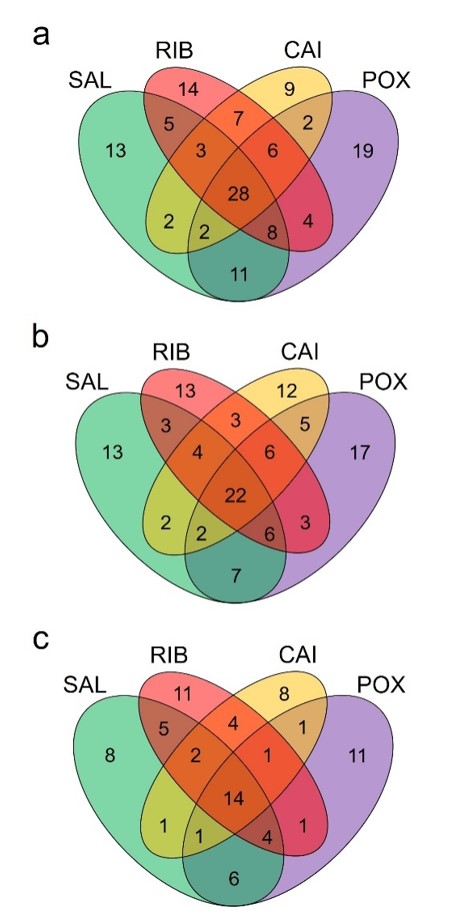
Comparatively, more species were recorded in POX (S = 80), followed by RIB (S = 75), SAL (S = 72), and CAI (S = 59). However, the sample-based rarefaction/extrapolation curve revealed that species richness was relatively similar between POX, RIB, and SAL, while it was lower only in CAI (Figure 2). The estimated collection success ranged from 82.0% (POX) to 93.5% (CAI), based on the extrapolation of the expected richness for double the sampling effort (Figure 2). Only 21.1% of the recorded species were found in all four sampled sites, while the total of exclusive species (i.e., recorded in only one of the sites) corresponded to 41.4% (Figure 3a). The average dissimilarity (Sørensen Index) in species composition between the sampled sites in pairwise comparisons was 0.404 (± 0.050 SD), with turnover (Simpson Index) accounting for 87.0% (± 9.1% SD) of the total dissimilarity (Table S2).

Rarefaction (solid lines) and extrapolation (dashed lines) curves, showing the cumulative number of ant species recorded in four sampling sites across the Cerrado biome in the states of Mato Grosso (MT) and Goiás (GO), Central-West Brazil. Localities: SAL - Santo Antônio de Levenger-MT, POX - Poxoréu-MT, RIB - Ribeirãozinho-MT, and CAI - Caiapônia-GO.

Venn diagram showing the number of ant species recorded within each sampling site and the number of species shared among four sampling sites across the Cerrado biome in the states of Mato Grosso (MT) and Goiás (GO), Central-West Brazil. Numbers represent the ant assemblage diversity of the (a) total data, (b) ground stratum and (c) arboreal stratum. Localities: SAL - Santo Antônio de Levenger-MT, POX - Poxoréu-MT, RIB - Ribeirãozinho-MT, and CAI - Caiapônia-GO.
More species were collected on the ground (S = 118) than in the vegetation (S = 78). In addition, a higher number of exclusive species was recorded on the ground (55 species) than in the vegetation (S = 15). Consequently, ant assemblages showed a significant difference between strata for both the species richness (tpaired = 8.410, df = 19, p < 0.001; Figure 4) and composition (ANOSIM: r = 0.633, P ≤ 0.001; Figure 5). Sampling sites shared 18.5% of species collected on the ground, with 46.6% belonging exclusively to a single area (Figure 3b), while species sharing in the vegetation was 18.2% with the unique species rising to 48.7% (Figure 3c). In pairwise comparisons, the average dissimilarity between sites was greater for the ant assemblage recorded in the vegetation (Sø = 0.457 ± 0.063) than on the ground (Sø = 0.427 ± 0.028), but dissimilarity due to turnover was greater on the ground (92.8 ± 4.6%) than in the vegetation (90.8 ± 7.1%; Table S2).

Box-plot showing ant richness recorded by strata across the sampling transects (n = 20) in four sampling sites across the Cerrado biome in the states of Mato Grosso and Goiás, Central-West Brazil. Gray lines indicate the pairwise comparison between ground and vegetation strata.

Ordination of the non-metric multidimensional scaling (nMDS) of the ground-dwelling and arboreal ant assemblages recorded in four sampling sites across the Cerrado biome in the states of Mato Grosso and Goiás, Central-West Brazil.
4. Discussion
Ants constitute a diverse and abundant group of social insects, being key elements of ecosystem functioning (Folgarait, 1998; Del Toro et al., 2012). Despite this, there are many knowledge gaps regarding their distribution across the Brazilian biomes (Schmidt et al., 2022). Here we present an ant inventory conducted in four locations within a poorly sampled region of the Cerrado (Brazilian savannas), across the states of MT and GO, Brazil. The species richness recorded per site varied from 59 to 80 species, totaling 133 species across the sampled sites. Previous studies, using the same methodology with equal or greater sampling effort, achieved similar species richness per location in savanna ecosystems (range: 50 to 85 species; (Silvestre and Brandão, 2000; Diehl et al., 2004; Silvestre et al., 2004; Silva et al., 2004; Vasconcelos et al., 2008; Brandão et al., 2011; Souza et al., 2012; Lutinski et al., 2023). Moreover, the total number of species recorded may represent ca. 20% of the estimated ant diversity for the entire Cerrado biome (~700 species; Andersen and Vasconcelos, 2022). These results suggest that our sampling effort was effective, despite conducting only two repeated collections with a single sampling method.
Furthermore, the ant diversity found in the area sampled across both states follows previous records for the Cerrado. Myrmicinae and Formicidae are the most diverse ant subfamilies, comprising more than two-thirds of existing species (Bolton, 2024), and they have predominated in inventories across this biome (Silvestre et al., 2004; Pacheco and Vasconcelos, 2012; Pacheco et al., 2013; Vasconcelos et al., 2018). The numerical superiority of these two subfamilies may be partly attributed to the hyperdiverse genera Pheidole and Camponotus (> 1,000 species each; Bolton, 2024). These genera are composed mostly of opportunists and omnivorous species (Hölldobler and Wilson, 1990; Wilson, 2003), and likely because of this, they not only show the highest richness but also comprise the most common species throughout the studied area. On the other hand, we recorded the bullet ant Paraponera clavata (Fabricius, 1775) in 3 out of 4 sampled sites. This is the only living species known of the subfamily Paraponerinae, commonly found in forest ecosystems, with a few records in the Cerrado savannas (Bolton 2024; Economo and Guénard, 2024). Moreover, considering taxonomic issues, unpublished data, and lack of revision among collections, our inventory also formalizes the geographical occurrence of 12 species in both Brazilian states (Table 1), including some common species such as C. fastigatus, C. senex, and P. diligens (Rocha et al., 2015; Vicente et al., 2016, 2018; Arruda et al., 2020; Przybyszewski et al., 2022; Lopes et al., 2024; Economo and Guénard, 2024). This includes the geographical distribution expansion of the two rare species for the Cerrado biome, Alfaria striolata Borgmeier, 1957 and Nylanderia docilis (Forel, 1908), which were previously collected only in a few sparse locations throughout South America (Franco et al., 2019; Camacho et al., 2020; Economo and Guénard, 2024).
The Cerrado landscape comprises a mosaic of physiognomies, ranging from open grasslands to dense forests (Oliveira-Filho and Ratter, 2002). Such vegetation heterogeneity tends to favor local ant diversity (Pacheco and Vasconcelos, 2012; Neves et al., 2013; Vasconcelos et al., 2023a). Indeed, the lowest species richness was recorded in Caiapônia-GO, where all sampling points were in the same savanna vegetation type. Other sites included both savanna and forest vegetation, likely contributing to the higher number of species collected (Pacheco and Vasconcelos, 2012; Vasconcelos et al., 2023a). Despite the spatial distance, the similarity between sites was relatively high, reflecting the broad distribution and low regional differentiation of Cerrado ant species (Andersen and Vasconcelos, 2022). Compared by stratum, ant species richness collected on the ground was higher than in the vegetation. This aligns with previous observations for the Cerrado, where more than three-quarters of ant species (76.3%) are classified as ground-dwellers, with a minor part showing arboreal nesting-foraging habits (18.7%) or mixed habits (3.7%; Vasconcelos et al., 2018). Moreover, there is a clear distinction in the species composition between the assemblages of ground-dwelling and arboreal ants, with Camponotus, Ectatomma, and Pheidole being the most diverse and frequent genera on the ground, while Camponotus, Cephalotes and Pseudomyrmex genera predominated in the vegetation. These results demonstrate the vertical stratification of the ant fauna in the Cerrado (Campos et al., 2008; Rodrigues et al., 2019; Vasconcelos et al., 2023b). When inter-site comparisons are fitted by stratum, the average dissimilarity between locations increases slightly more in the vegetation than on the ground ant assemblages, revealing that spatial variation of diversity tends to be more pronounced among arboreal ant species (Vasconcelos et al., 2023b).
Despite the important findings, there are some caveats and areas that require further attention. Although we have reached the significant mark of 133 ant species collected in total, the diversity in a single well-sampled Cerrado remnant can reach up to 275 species (Camacho and Vasconcelos, 2015). Certainly, our results reflect only a partial representation of the ant diversity existing in the studied area, since the technique used in the present study has its limitations in terms of foraging habits and access generated by competition/monopolization of resources (Lopes and Vasconcelos, 2008; Souza et al., 2012, 2024). Therefore, we recognize that a relevant part of the ant fauna in the studied area remains unknown, and more extensive collections, especially using complementary sampling methods, are necessary to reveal all local diversity. Moreover, identification was possible for 102 of the 133 species collected, with 31 remaining as morphospecies due to the lack of taxonomic resolution for their genera. This result highlights not only the need to increase sampling efforts but also the importance of describing the new species collected to improve our taxonomic knowledge about ant diversity (Feitosa et al., 2023). Finally, information about the occurrence of species in space and time is necessary to direct efforts to avoid, mitigate, restore, or compensate for the impacts of human activities on biodiversity. In this context, data from inventories of Environmental Impact Assessments and monitoring projects – such as the results presented here – are invaluable. However, these surveys often remain as consultancy reports, and very few are formally published. Making these species lists more accessible to a broader audience – such as publishing online in open scientific journals – would increase their value over time and contribute to understanding the current and future human impacts on natural environments (Cadman et al., 2011). Therefore, we encourage biologists to share their consultancy species lists, since thousands of available inventories could certainly help us fill many knowledge gaps about our biodiversity, improving conservation efforts.
Our study presents a list of ant species inhabiting a poorly sampled region of the Cerrado in Central-West Brazil (Divieso et al., 2020; Schmidt et al., 2022). Despite using a single sampling method repeated twice (in dry and wet seasons), we recorded a considerable number of ant species. In this inventory, 12 ant species are officially new records for the fauna of MT and GO states and expanded the geographical distribution of two rare species for the Cerrado biome. However, despite the sampling success, additional surveys are still necessary to further expand our knowledge about the existing diversity in the region. The sampling sites were relatively distant (~150 km), yet the similarity of ant assemblages was high between locations, reinforcing the assumption of low regional differentiation of the ant fauna in the Cerrado (Andersen and Vasconcelos, 2022). Moreover, our results indicate that both vegetation heterogeneity and vertical stratification promote ant diversity, corroborating previously observed patterns (Campos et al., 2008; Pacheco and Vasconcelos, 2012; Vasconcelos et al., 2023a,b). These findings contribute to improving our understanding of ant diversity in the Brazilian Cerrado, which is invaluable given the rates of natural land destruction and conversion faced by this highly endemic ecosystem.
Supplementary Material
Supplementary material accompanies this paper.
Table S1.
Table S2.
This material is available as part of the online article from https://doi.org/10.1590/1519-6984.290806
Acknowledgements
To Arthur and Adriano for their help with the fieldwork and for the support of EKOS Planejamento Ambiental. To Alexandre A.F. Souza for his help with ant species identification and Gabriela P. Camacho for confirming Alfaria species identification. To the editors and anonymous reviewers for taking the time to review this manuscript. To the Research Foundation of Minas Gerais state (FAPEMIG, grant no. 11782) and Coordination for Improvement of Higher Education Personnel (CAPES, grant no. 88882.428793/2019-01) by scholarships provided to RMM and JVS, respectively. To research support of PELD-TMSG (CNPq grants 479135/2010-0 and 441142/2020-6, and FAPEMIG grant APQ 03372-21).
References
- ALONSO, L.E., 2010. Ant conservation: current status and a call to action. In: L. LACH, C.L. PARR and K.L. ABBOT, eds. Ant ecology New York: Oxford University Press., pp. 59-74.
-
ALVARES, C.A., STAPE, J.L., SENTELHAS, P.C., GONÇALVES, J.L.M. and SPAROVEK, G., 2013. Köppen’s climate classification map for Brazil. Meteorologische Zeitschrift (Berlin), vol. 22, no. 6, pp. 711-728. http://doi.org/10.1127/0941-2948/2013/0507
» http://doi.org/10.1127/0941-2948/2013/0507 -
ANDERSEN, A.N. and VASCONCELOS, H.L., 2022. Historical biogeography shapes functional ecology: inter-continental contrasts in responses of savanna ant communities to stress and disturbance. Journal of Biogeography, vol. 49, no. 4, pp. 590-599. http://doi.org/10.1111/jbi.14343
» http://doi.org/10.1111/jbi.14343 -
ANTWEB, 2024 [viewed 29 November 2024]. AntWeb: version 8.112 [online]. Available from: https://www.antweb.org/
» https://www.antweb.org/ -
ANTWIKI, 2024 [viewed 29 November 2024]. AntWiki: the ants [online]. Available from: http://antwiki.org/
» http://antwiki.org/ -
ARRUDA, F.V., IZZO, T.J., TERESA, F.B. and CAMAROTA, F., 2020. Different burning intensities affect cavity utilization patterns by arboreal ants in a tropical savanna canopy. Ecological Indicators, vol. 116, pp. 106493. http://doi.org/10.1016/j.ecolind.2020.106493
» http://doi.org/10.1016/j.ecolind.2020.106493 - BACCARO, F.B., FEITOSA, R.M., FERNANDEZ, F., FERNANDES, I.O., IZZO, T.J., SOUZA, J.L.P. and SOLAR, R., 2015. Guia para os gêneros de formigas do Brasil Manaus: Editora INPA, 388 p.
-
BASELGA, A., 2010. Partitioning the turnover and nestedness components of beta diversity. Global Ecology and Biogeography, vol. 19, no. 1, pp. 134-143. http://doi.org/10.1111/j.1466-8238.2009.00490.x
» http://doi.org/10.1111/j.1466-8238.2009.00490.x -
BOLTON, B., 2024 [viewed 29 November 2024]. AntCat: an online catalog of the ants of the world [online]. Available from: https://antcat.org/
» https://antcat.org/ -
BORCARD, D., GILLET, F. and LEGENDRE, P., 2011. Numerical Ecology with R 2nd ed. New York: Springer, 688 p. http://doi.org/10.1007/978-1-4419-7976-6
» http://doi.org/10.1007/978-1-4419-7976-6 -
BRANDÃO, C.R.F., SILVA, R.R. and FEITOSA, R.M., 2011. Cerrado ground-dwelling ants (Hymenoptera: Formicidae) as indicators of edge effects. Zoologia, vol. 28, no. 3, pp. 379-387. http://doi.org/10.1590/S1984-46702011000300012
» http://doi.org/10.1590/S1984-46702011000300012 - CADMAN, M., CHAVAN, V., KING, N., WILLOUGHBY, S., RAJVANSHI, A., MATHUR, V., ROBERTS, R. and HIRSCH, T., 2011. Publishing EIA-Related Primary Biodiversity Data: GBIF-IAIA Best Practice Guide. IAIA Special Publication Series, vol. 7, pp. 1-6.
-
CAMACHO, G.P. and VASCONCELOS, H.L., 2015. Ants of the Panga Ecological Station, a Cerrado Reserve in Central Brazil. Sociobiology, vol. 62, no. 2, pp. 281-295. http://doi.org/10.13102/sociobiology.v62i2.281-295
» http://doi.org/10.13102/sociobiology.v62i2.281-295 -
CAMACHO, G.P., FRANCO, W. and FEITOSA, R.M., 2020. Additions to the taxonomy of Gnamptogenys Roger (Hymenoptera: Formicidae: Ectatomminae) with an updated key to the New World species. Zootaxa, vol. 4747, no. 3, pp. 450-476. http://doi.org/10.11646/zootaxa.4747.3.2 PMid:32230096.
» http://doi.org/10.11646/zootaxa.4747.3.2 -
CAMPOS, R.I., LOPES, C.T., MAGALHÃES, W.C.S. and VASCONCELOS, H.L., 2008. Vertical stratification of ants in savanna vegetation in the Serra de Caldas Novas State Park, Goiás, Brazil. Iheringia. Série Zoologia, vol. 98, no. 1, pp. 311-316. http://doi.org/10.1590/S0073-47212008000300004
» http://doi.org/10.1590/S0073-47212008000300004 -
COLLI, G.R., VIEIRA, C.R. and DIANESE, J.C., 2020. Biodiversity and conservation of the Cerrado: recent advances and old challenges. Biodiversity and Conservation, vol. 29, no. 5, pp. 1465-1475. http://doi.org/10.1007/s10531-020-01967-x
» http://doi.org/10.1007/s10531-020-01967-x -
COLMAN, C.B., GUERRA, A., ALMAGRO, A., ROQUE, F.O., ROSA, I.M.D., FERNANDES, G.W. and OLIVEIRA, P.T.S., 2024. Modeling the Brazilian Cerrado land use change highlights the need to account for private property sizes for biodiversity conservation. Scientific Reports, vol. 14, no. 1, pp. 4559. http://doi.org/10.1038/s41598-024-55207-1 PMid:38402243.
» http://doi.org/10.1038/s41598-024-55207-1 -
DEL-TORO, I., RIBBONS, R.R. and PELINI, S.L., 2012 [viewed 29 November 2024]. The little things that run the world revisited: a review of ant-mediated ecosystem services and disservices (Hymenoptera: Formicidae). Myrmecological News [online], vol. 17, pp. 133-146. Available from: https://www.researchgate.net/publication/260866190
» https://www.researchgate.net/publication/260866190 -
DIEHL, E., SANHUDO, C.E. and DIEHL-FLEIG, E., 2004. Ground-dwelling ant fauna of sites with high levels of copper. Brazilian Journal of Biology = Revista Brasileira de Biologia, vol. 64, no. 1, pp. 33-39. http://doi.org/10.1590/S1519-69842004000100005 PMid:15195362.
» http://doi.org/10.1590/S1519-69842004000100005 -
DIVIESO, R., RORATO, A., FEITOSA, R.M., MEYER, A.L.S. and PIE, M.R., 2020. How to prioritize areas for new ant surveys? Integrating historical data on species occurrence records and habitat loss. Journal of Insect Conservation, vol. 24, no. 6, pp. 901-911. http://doi.org/10.1007/s10841-020-00262-y
» http://doi.org/10.1007/s10841-020-00262-y -
ECONOMO, E. and GUÉNARD, B., 2024 [viewed 29 November 2024]. AntMaps: The Global Ant Biodiversity Informatics Project (GABI) [online]. Available from: https://antmaps.org/
» https://antmaps.org/ -
FEITOSA, R.M. and DIAS, A.M., 2024. An illustrated guide for the identification of ant subfamilies and genera in Brazil. Insect Systematics & Evolution, vol. 55, no. 5, pp. 451-571. http://doi.org/10.1163/1876312X-bja10062
» http://doi.org/10.1163/1876312X-bja10062 -
FEITOSA, R.M., SILVA, T.S.R., CAMACHO, G.P., ULYSSÉA, M.A., LADINO, N., OLIVEIRA, A.M., DE ALBUQUERQUE, E.Z., RIBAS, C.R., SCHMIDT, F.A., MORINI, M.S.C., DA SILVA, R.R., DÁTTILO, W., DE QUEIROZ, A.C.M., BACCARO, F.B., SANTOS, J.C., CARVALHO, K.S., SOBRINHO, T.G., QUINET, Y.P., MORAES, A.B., VARGAS, A.B., TOREZAN-SILINGARDI, H.M., SOUZA, J.L.P., MARQUES, T., IZZO, T., LANGE, D., DOS SANTOS, I.A., DEL-CLARO, K., NAHAS, L., PAOLUCCI, L., SOARES, S.A., HARADA, A.Y., RABELLO, A.M., DA COSTA-MILANEZ, C.B., DIEHL-FLEIG, E., CAMPOS, R.B.F., SOLAR, R., FRIZZO, T., DAROCHA, W. and NOGUEIRA, A., 2023. From species descriptions to diversity patterns: the validation of taxonomic data as a keystone for ant diversity studies reproducibility and accuracy. Royal Society Open Science, vol. 10, no. 2, pp. 221170. http://doi.org/10.1098/rsos.221170 PMid:36778958.
» http://doi.org/10.1098/rsos.221170 -
FIASCHI, P. and PIRANI, J.R., 2009. Review of plant biogeographic studies in Brazil. Journal of Systematics and Evolution, vol. 47, no. 5, pp. 477-496. http://doi.org/10.1111/j.1759-6831.2009.00046.x
» http://doi.org/10.1111/j.1759-6831.2009.00046.x -
FOLGARAIT, P., 1998. Ant biodiversity and its relationship to ecosystem functioning: a review. Biodiversity and Conservation, vol. 7, no. 9, pp. 1221-1244. http://doi.org/10.1023/A:1008891901953
» http://doi.org/10.1023/A:1008891901953 -
FRANÇA, E.C.B., FERNANDES, I.O. and LATTKE, J.E., 2024. Looking at upside-down ants: taxonomic revision of the Neotropical species of Odontomachus Latreille, 1804 (Hymenoptera: Formicidae: Ponerinae). Zootaxa, vol. 5502, no. 1, pp. 1166. http://doi.org/10.11646/zootaxa.5502.1.1 PMid:39647086.
» http://doi.org/10.11646/zootaxa.5502.1.1 -
FRANCO, W., LADINO, N., DELABIE, J.H.C., DEJEAN, A., ORIVEL, J., FICHAUX, M., GROC, S., LEPONCE, M. and FEITOSA, R.M., 2019. First checklist of the ants (Hymenoptera: Formicidae) of French Guiana. Zootaxa, vol. 4674, no. 5, pp. 509-543. http://doi.org/10.11646/zootaxa.4674.5.2 PMid:31715984.
» http://doi.org/10.11646/zootaxa.4674.5.2 -
GOTELLI, N.J. and COLWELL, R.K., 2001. Quantifying biodiversity: procedures and pitfalls in the measurement and comparison of species richness. Ecology Letters, vol. 4, no. 4, pp. 379-391. http://doi.org/10.1046/j.1461-0248.2001.00230.x
» http://doi.org/10.1046/j.1461-0248.2001.00230.x -
HÖLLDOBLER, B. and WILSON, E.O., 1990. The ants Cambridge: Belknap Press, 732 p. http://doi.org/10.1007/978-3-662-10306-7
» http://doi.org/10.1007/978-3-662-10306-7 -
HSIEH, T.C., MA, K.H. and CHAO, A., 2016. iNEXT: an R package for rarefaction and extrapolation of species diversity (Hill numbers). Methods in Ecology and Evolution, vol. 7, no. 12, pp. 1451-1456. http://doi.org/10.1111/2041-210X.12613
» http://doi.org/10.1111/2041-210X.12613 -
JIMÉNEZ, N.L., BLANCO, Y.E. and CALCATERRA, L.A., 2018. Ant diversity in the diet of giant anteaters, Myrmecophaga tridactyla (Pilosa: Myrmecophagidae), in the Iberá Nature Reserve, Argentina. Mastozoología Neotropical, vol. 25, no. 2, pp. 305-318. http://doi.org/10.31687/saremMN.18.25.2.0.16
» http://doi.org/10.31687/saremMN.18.25.2.0.16 -
KASS, J.M., GUÉNARD, B., DUDLEY, K.L., JENKINS, C.N., AZUMA, F., FISHER, B.L., PARR, C.L., GIBB, H., LONGINO, J.T., WARD, P.S., CHAO, A., LUBERTAZZI, D., WEISER, M., JETZ, W., GURALNICK, R., BLATRIX, R., LAURIERS, J.D., DONOSO, D.A., GEORGIADIS, C., GOMEZ, K., HAWKES, P.G., JOHNSON, R.A., LATTKE, J.E., MACGOWN, J.A., MACKAY, W., ROBSON, S., SANDERS, N.J., DUNN, R.R. and ECONOMO, E.P., 2022. The global distribution of known and undiscovered ant biodiversity. Science Advances, vol. 8, no. 31, eabp9908. http://doi.org/10.1126/sciadv.abp9908 PMid:35921404.
» http://doi.org/10.1126/sciadv.abp9908 -
KEIS, M., TAMMELEHT, E., VALDMANN, H. and SAARMA, U., 2019. Ants in brown bear diet, and discovery of a new ant species for Estonia from brown bear scats. Hystrix, vol. 30, no. 2, pp. 112-119. http://doi.org/10.4404/hystrix-00168-2019
» http://doi.org/10.4404/hystrix-00168-2019 -
KOLEFF, P., GASTON, K.J. and LENNON, J.J., 2003. Measuring beta diversity for presence-absence data. Journal of Animal Ecology, vol. 72, no. 3, pp. 367-382. http://doi.org/10.1046/j.1365-2656.2003.00710.x
» http://doi.org/10.1046/j.1365-2656.2003.00710.x -
LOPES, C.T. and VASCONCELOS, H.L., 2008. Evaluation of three methods for sampling ground-dwelling Ants in the Brazilian Cerrado. Neotropical Entomology, vol. 37, no. 4, pp. 399-405. http://doi.org/10.1590/S1519-566X2008000400007 PMid:18813741.
» http://doi.org/10.1590/S1519-566X2008000400007 -
LOPES, F.J.A., VICENTE, R.E. and GARLET, J., 2024. Contribution to knowledge of Amazonian Myrmecofauna: new records for the state of Mato Grosso, Brazil. Brazilian Journal of Biology = Revista Brasileira de Biologia, vol. 84, e249802. http://doi.org/10.1590/1519-6984.249802 PMid:34705948.
» http://doi.org/10.1590/1519-6984.249802 -
LUTINSKI, J.A., DORNELES, F.E., GUARDA, C., LUTINSKIC, C.J., BUSATOA, M.A., GIOVENARDID, R. and GARCIAET, F.R.M., 2023. Ant diversity (Hymenoptera: Formicidae) in Turvo State Park, municipality of Derrubadas, state of Rio Grande do Sul, Brazil. Brazilian Journal of Biology = Revista Brasileira de Biologia, vol. 83, e239642. http://doi.org/10.1590/1519-6984.239642 PMid:34133487.
» http://doi.org/10.1590/1519-6984.239642 -
MARAVALHAS, J.B. and VASCONCELOS, H.L., 2020. Ant diversity in Neotropical savannas: hierarchical processes acting at multiple spatial scales. Journal of Animal Ecology, vol. 89, no. 2, pp. 412-422. http://doi.org/10.1111/1365-2656.13111 PMid:31556096.
» http://doi.org/10.1111/1365-2656.13111 -
MARCINEIRO, F.S.R. and LATTKE, J.E., 2024. Review of ant genus Pachycondyla Smith, 1858 in Brazil (Hymenoptera: formicidae). Zootaxa, vol. 5461, no. 1, pp. 1-62. http://doi.org/10.11646/zootaxa.5461.1.1 PMid:39646913.
» http://doi.org/10.11646/zootaxa.5461.1.1 -
MYERS, N., MITTERMEIER, R.A., MITTERMEIER, C.G., FONSECA, G.A.B. and KENT, J., 2000. Biodiversity hotspots for conservation priorities. Nature, vol. 403, no. 6772, pp. 853-858. http://doi.org/10.1038/35002501 PMid:10706275.
» http://doi.org/10.1038/35002501 -
NEVES, F.S., QUEIROZ-DANTAS, K.S., ROCHA, W.D. and DELABIE, J.H.C., 2013. Ants of three adjacent habitats of a transition region between the Cerrado and Caatinga biomes: the effects of heterogeneity and variation in canopy cover. Neotropical Entomology, vol. 42, no. 3, pp. 258-268. http://doi.org/10.1007/s13744-013-0123-7 PMid:23949808.
» http://doi.org/10.1007/s13744-013-0123-7 -
OKSANEN, J., SIMPSON, G., BLANCHET, F., KINDT, R., LEGENDRE, P., MINCHIN, P., O’HARA, R., SOLYMOS, P., STEVENS, M., SZOECS, E., WAGNER, H., BARBOUR, M., BEDWARD, M., BOLKER, B., BORCARD, D., CARVALHO, G., CHIRICO, M., DE CACERES, M., DURAND, S., EVANGELISTA, H., FITZJOHN, R., FRIENDLY, M., FURNEAUX, B., HANNIGAN, G., HILL, M., LAHTI, L., MCGLINN, D., OUELLETTE, M., RIBEIRO CUNHA, E., SMITH, T., STIER, A., TER BRAAK, C. and WEEDON, J. 2024 [viewed 9 September 2024]. vegan: Community Ecology Package version 2.6-7 [online]. Available from: https://vegandevs.github.io/vegan/
» https://vegandevs.github.io/vegan/ -
OLIVEIRA, A.M.H., POWELL, S. and FEITOSA, R.M.H., 2021. A taxonomic study of the Brazilian turtle ants (Formicidae: Myrmicinae: Cephalotes). Revista Brasileira de Entomologia, vol. 65, no. 3, e20210028. http://doi.org/10.1590/1806-9665-rbent-2021-0028
» http://doi.org/10.1590/1806-9665-rbent-2021-0028 -
OLIVEIRA, P.S. and MARQUIS, R.J., 2002. The Cerrados of Brazil: Ecology and Natural History of a Neotropical Savanna New York: Columbia University Press. 398 p. http://doi.org/10.7312/oliv12042
» http://doi.org/10.7312/oliv12042 -
OLIVEIRA-FILHO, A.T. and RATTER, J.T., 2002. Vegetation physiognomies and woody flora of the cerrado biome. In P.S. OLIVEIRA and R.J. MARQUIS, eds. The Cerrados of Brazil: Ecology and Natural History of a Neotropical Savanna New York: Columbia University Press, pp. 91-120. http://doi.org/10.7312/oliv12042-007
» http://doi.org/10.7312/oliv12042-007 -
PACHECO, R. and VASCONCELOS, H.L., 2012. Habitat diversity enhances ant diversity in a naturally heterogeneous Brazilian landscape. Biodiversity and Conservation, vol. 21, no. 3, pp. 797-809. http://doi.org/10.1007/s10531-011-0221-y
» http://doi.org/10.1007/s10531-011-0221-y -
PACHECO, R., VASCONCELOS, H.L., GROC, S., CAMACHO, G.P. and FRIZZO, T.L.M., 2013. The importance of remnants of natural vegetation for maintaining ant diversity in Brazilian agricultural landscapes. Biodiversity and Conservation, vol. 22, no. 4, pp. 983-997. http://doi.org/10.1007/s10531-013-0463-y
» http://doi.org/10.1007/s10531-013-0463-y -
PRZYBYSZEWSKI, K.R., VICENTE, R.E., FERREIRA, J.V.A., PEREIRA, M.J.B., IZZO, T.J. and STORCK-TONON, D., 2022. Legal reserves ensure alpha and beta ant diversity in highly modified agricultural landscapes. Perspectives in Ecology and Conservation, vol. 20, no. 4, pp. 330-337. http://doi.org/10.1016/j.pecon.2022.08.001
» http://doi.org/10.1016/j.pecon.2022.08.001 -
R CORE TEAM, 2023 [viewed 9 September 2024]. R: a language and environment for statistical computing version 4.2.2 [online]. Vienna: R Foundation for Statistical Computing. Available from: http://www.r-project.org
» http://www.r-project.org - RIBEIRO, J.F. and WALTER, B.M.T. 2008. As principais fitofisionomias do Bioma Cerrado. In: S.M. SANO, S.P. ALMEIDA and J.F. RIBEIRO, eds. Cerrado: ecologia e flora Brasilia: Embrapa Cerrados, pp. 153-188.
-
ROCHA, W.O., DORVAL, A., FILHO, O.P., VAEZ, C.A. and RIBEIRO, E.S., 2015. Formigas (Hymenoptera: Formicidae) bioindicadoras de degradação ambiental em poxoréu, Mato Grosso, Brasil. Floresta e Ambiente, vol. 22, no. 1, pp. 88-98. http://doi.org/10.1590/2179-8087.0049
» http://doi.org/10.1590/2179-8087.0049 - RODRIGUES, C.A., ARAÚJO, M.S., ROCHA, E.C., SILVA, D.A., MARTINELLI, N.M. and DELABIE, J.H.C., 2019. Vertical stratification of ant assemblage in Brazilian Savanna phytophysiognomies. Bosque, vol. 40, no. 3, pp. 379-385. http://doi.org/10.4067/S0717-92002019000300379.
-
ROSENBERG, Y., BAR-ON, Y.M., FROMM, A., OSTIKAR, M., SHOSHANY, A., GIZ, O. and MILO, R., 2023. The global biomass and number of terrestrial arthropods. Science Advances, vol. 9, no. 5, eabq4049. http://doi.org/10.1126/sciadv.abq4049 PMid:36735788.
» http://doi.org/10.1126/sciadv.abq4049 - SABAGH, L.T., CARVALHO-E-SILVA, A.M.P.T. and ROCHA, F.C.D., 2012. Diet of the toad Rhinella icterica (Anura: Bufonidae) from Atlantic Forest Highlands of southeastern Brazil. Biota Neotropica, vol. 12, no. 4, pp. 258-262. http://doi.org/10.1590/S1676-06032012000400027.
-
SCHMIDT, F.A., RIBAS, C.R., FEITOSA, R.M., BACCARO, F.B., DE QUEIROZ, A.C.M., SOBRINHO, T.G., QUINET, Y., CARVALHO, K.S., IZZO, T., DE CASTRO MORINI, M.S., NOGUEIRA, A., TOREZAN-SILINGARDI, H.M., SOUZA, J.L.P., ULYSSÉA, M.A., VARGAS, A.B., DÁTTILO, W., DEL-CLARO, K., MARQUES, T., MORAES, A.B., PAOLUCCI, L., RABELLO, A.M., SANTOS, J.C., SOLAR, R., DE ALBUQUERQUE, E.Z., ESTEVES, F., CAMPOS, R.B.F., LANGE, D., NAHAS, L., DOS SANTOS, I.A., SILVA, R.R., SOARES, S.A., CAMACHO, G.P., DA COSTA-MILANEZ, C.B., DAROCHA, W., DIEHL-FLEIG, E., FRIZZO, T., HARADA, A.Y. and MARTELLO, F., 2022. Ant diversity studies in Brazil: an overview of the myrmecological research in a megadiverse country. Insectes Sociaux, vol. 69, no. 1, pp. 105-121. http://doi.org/10.1007/s00040-022-00848-6
» http://doi.org/10.1007/s00040-022-00848-6 -
SCHULTHEISS, P., NOOTEN, S.S., WANG, R., WONG, M.K.L., BRASSARD, F. and GUÉNARD, B., 2022. The abundance, biomass, and distribution of ants on Earth. Proceedings of the National Academy of Sciences of the United States of America, vol. 119, no. 40, e2201550119. http://doi.org/10.1073/pnas.2201550119 PMid:36122199.
» http://doi.org/10.1073/pnas.2201550119 -
SILVA, R.R., BRANDÃO, C.R.F. and SILVESTRE, R., 2004. Similarity between Cerrado localities in central and southeastern Brazil based on the dry season bait visitors ant fauna. Studies on Neotropical Fauna and Environment, vol. 39, no. 3, pp. 191-199. http://doi.org/10.1080/01650520412331271783
» http://doi.org/10.1080/01650520412331271783 - SILVESTRE, R. and BRANDÃO, C.R.F., 2000. Formigas (Hymenoptera, Formicidae) atraídas a iscas em uma “ilha” de Cerrado no município de Cajuru, estado de São Paulo, Brasil. Revista Brasileira de Entomologia, vol. 44, pp. 71-77.
- SILVESTRE, R., BRANDÃO, C.R.F. and SILVA, R.R., 2004. Grupos funcionales de hormigas: El caso de los gremios del Cerrado. In: F.C. FERNÁNDEZ, ed. Introducción a las hormigas de la región Neotropical Bogotá: Instituto Humboldt, pp. 113-143.
-
SOUZA JÚNIOR, C.M., SHIMBO, J., ROSA, M.R., PARENTE, L.L., ALENCAR, A., RUDORFF, B.F.T., HASENACK, H., MATSUMOTO, M., FERREIRA, L., SOUZA-FILHO, P.W.M., OLIVEIRA, S.W., ROCHA, W.F., FONSECA, A.V., MARQUES, C.B., DINIZ, C.G., COSTA, D., MONTEIRO, D., ROSA, E.R., VÉLEZ-MARTIN, E., WEBER, E.J., LENTI, F.E.B., PATERNOST, F.F., PAREYN, F.G.C., SIQUEIRA, J.V., VIERA, J.L., FERREIRA NETO, L.C., SARAIVA, M.M., SALES, M.H., SALGADO, M.P.G., VASCONCELOS, R., GALANO, S., MESQUITA, V.V. and AZEVEDO, T., 2020. Reconstructing three decades of land use and land cover changes in Brazilian biomes with Landsat archive and earth engine. Remote Sensing, vol. 12, no. 17, pp. 2735. http://doi.org/10.3390/rs12172735
» http://doi.org/10.3390/rs12172735 -
SOUZA, J.L.P., BACCARO, F.B., LANDEIRO, V.L., FRANKLIN, E. and MAGNUSSON, W.E., 2012. Trade-offs between complementarity and redundancy in the use of different sampling techniques for ground-dwelling ant assemblages. Applied Soil Ecology, vol. 56, pp. 63-73. http://doi.org/10.1016/j.apsoil.2012.01.004
» http://doi.org/10.1016/j.apsoil.2012.01.004 -
SOUZA, J.L.P., VICENTE, R.E. and BARTHOLOMAY, P.R., 2024. How the choice of habitat and sampling technique affects biodiversity knowledge: the case of Cylindromyrmex (Hymenoptera, Formicidae) in the Atlantic Forest. Sociobiology, vol. 71, no. 1, e9548. http://doi.org/10.13102/sociobiology.v71i1.9548
» http://doi.org/10.13102/sociobiology.v71i1.9548 -
STRASSBURG, B.B.N., BROOKS, T., FELTRAN-BARBIERI, R., IRIBARREM, A., CROUZEILLES, R., LOYOLA, R., LATAWIEC, A.E., OLIVEIRA FILHO, F.J.B., SCARAMUZZA, C.A.M., SCARANO, F.R., SOARES-FILHO, B. and BALMFORD, A., 2017. Moment of truth for the Cerrado hotspot. Nature Ecology & Evolution, vol. 1, no. 4, pp. 99. http://doi.org/10.1038/s41559-017-0099 PMid:28812670.
» http://doi.org/10.1038/s41559-017-0099 -
VASCONCELOS, H.L., LEITE, M.F., VILHENA, J.M.S., LIMA, A.P. and MAGNUSSON, W.E., 2008. Ant diversity in an Amazonian savanna: relationship with vegetation structure, disturbance by fire, and dominant ants. Austral Ecology, vol. 33, no. 2, pp. 221-231. http://doi.org/10.1111/j.1442-9993.2007.01811.x
» http://doi.org/10.1111/j.1442-9993.2007.01811.x -
VASCONCELOS, H.L., MARAVALHAS, J.B., FEITOSA, R.M., PACHECO, R., NEVES, K.C. and ANDERSEN, A.N., 2018. Neotropical savanna ants show a reversed latitudinal gradient of species richness, with climatic drivers reflecting the forest origin of the fauna. Journal of Biogeography, vol. 45, no. 1, pp. 248-258. http://doi.org/10.1111/jbi.13113
» http://doi.org/10.1111/jbi.13113 -
VASCONCELOS, H.L., FEITOSA, R.M., DURIGAN, G., LEÃO, R.E.O.S. and NEVES, K.C.F., 2023a. The ground-dwelling ant fauna from a Cerrado reserve in southeastern Brazil: vegetation heterogeneity as a promoter of ant diversity. Neotropical Entomology, vol. 52, no. 1, pp. 36-45. http://doi.org/10.1007/s13744-022-01010-4 PMid:36447115.
» http://doi.org/10.1007/s13744-022-01010-4 -
VASCONCELOS, H.L., NEVES, K.C. and ANDERSEN, A.N., 2023b. Vertical stratification of ant assemblages varies along a latitudinal gradient in Brazilian savanna. Journal of Biogeography, vol. 50, no. 8, pp. 1331-1340. http://doi.org/10.1111/jbi.14628
» http://doi.org/10.1111/jbi.14628 -
VICENTE, R.E., FERREIRA, A.C., SANTOS, R.C.L. and PRADO, L.P., 2018. Ants (Hymenoptera: Formicidae) from an Amazonian fragmented landscape, Juara, Mato Grosso, Brazil, with new records of ant species. Papéis Avulsos de Zoologia, vol. 58, e20185840. http://doi.org/10.11606/1807-0205/2018.58.40
» http://doi.org/10.11606/1807-0205/2018.58.40 -
VICENTE, R.E., PRADO, L.P. and IZZO, T.J., 2016. Amazon rainforest ant-fauna of Parque Estadual do Cristalino: understory and ground-dwelling ants. Sociobiology, vol. 63, no. 3, pp. 894-908. http://doi.org/10.13102/sociobiology.v63i3.1043
» http://doi.org/10.13102/sociobiology.v63i3.1043 - WICKHAM, H., 2016. ggplot2: elegant graphics for data analysis 2nd ed. New York: Springer-Verlag, 260 p.
- WILSON, E.O., 2003. Pheidole in the New World Cambridge: Harvard University Press, 818 p.