 Morphometric characteristics of Bambu Apus rabbit
Abstract
Rabbit meat is a source of protein and is beneficial to health. Bambu Apus rabbits are formed from crosses of several rabbit breeds and have adapted to the environment of DKI Jakarta. The development of rabbits is expected to support an integrated and sustainable urban livestock farming program (sustainable integrated urban farming). The samples used were 65 adult Bambu Apus rabbits and secondary data from 40 adult Rex rabbits and 40 adult New Zealand White rabbits. The observed variables included body weight and morphometrics such as head length, head width, head height, chest circumference, chest width, chest depth, radius ulna length, humerus length, tibia length, femur length, backbone length, hip width, ear length, and ear width. Variance analysis of each variable was carried out through SAS software version 9.4 using PROC GLM procedure, PROC DISCRIM was used for Mahalanobis distance analysis, PROC CANDISC was used for canonical analysis, and MEGA11 software for phenogram tree. The results of discriminant analysis showed that the Bambu Apus rabbit had different morphometric characteristics from the Rex and New Zealand White rabbit. The average weight of Bambu Apus rabbits was 2473.54±480.13 g higher (P<0.05) than Rex rabbit, chest depth 8.69±1.11 cm greater (P<0.05) than Rex and New Zealand White rabbit, backbone length 37.84±3.51 cm longer (P<0.05) than Rex rabbit. Genetic distance and phenogram tree construction showed low kinship relationship between Bambu Apus rabbit with Rex rabbits and New Zealand White rabbit. The results suggested that the genetic of Bambu Apus rabbit has a predisposed to be produced as tropical climate adapted broiler rabbits.
Keywords:
Bambu Apus rabbit; characterization; genetic distance; morphometric characteristics; tropical climate
Resumo
A carne de coelho é uma fonte de proteína e é benéfica para a saúde. Os coelhos Bambu Apus são formados a partir de cruzamentos de várias raças de coelhos e adaptaram-se ao ambiente do DKI Jacarta. Espera-se que o desenvolvimento dos coelhos apoie um programa de pecuária urbana integrado e sustentável, de forma análoga à agricultura urbana integrada sustentável. As amostras utilizadas foram 65 coelhos adultos Bambu Apus e dados secundários de 40 coelhos adultos Rex e 40 coelhos adultos New Zealand White. As variáveis observadas incluíram o peso corporal e a morfometria, como comprimento da cabeça, largura da cabeça, altura da cabeça, circunferência do tórax, largura do tórax, profundidade do tórax, comprimento do rádio ulna, comprimento do úmero, comprimento da tíbia, comprimento do fêmur, comprimento da coluna vertebral, largura da anca, comprimento da orelha e largura da orelha. A análise de variância de cada variável foi realizada através do software SAS versão 9.4 utilizando o procedimento PROC GLM, sendo o PROC DISCRIM utilizado para a análise da distância de Mahalanobis, o PROC CANDISC para a análise canônica e o software MEGA11 para a árvore de fenogramas. Os resultados da análise discriminante mostraram que o coelho Bambu Apus apresentou características morfométricas diferentes do coelho Rex e do coelho New Zealand White. O peso médio dos coelhos Bambu Apus foi 2.473,54±480,13 g superior (P<0,05) ao coelho Rex, a profundidade do tórax 8,69±1,11 cm superior (P<0,05) aos coelhos Rex e New Zealand White, o comprimento da coluna vertebral 37,84±3,51 cm maior (P<0,05) que o coelho Rex. A distância genética e a construção da árvore do fenograma mostraram uma baixa relação de parentesco entre o coelho Bambu Apus e o coelho Rex e o coelho branco da Nova Zelândia. Os resultados sugerem que a genética do coelho Bambu Apus tem uma predisposição para ser produzida como coelhos de corte adaptados ao clima tropical.
Palavras-chave:
coelho Bambu Apus; caracterização; distância genética; características morfométricas; clima tropical
1. Introduction
Rabbit meat naturally contains many nutritionally beneficial qualities, including a high percentage of omega-3 polyunsaturated fatty acids, protein, vitamin contents, phosphorus, and calcium, as well as lower fat and cholesterol contents than other meats indicating that rabbit meat can play a functional role in consumer health (Dalle and Szendro, 2011; Delis-Hechavarria et al., 2023; Grădinaru, 2017; Nistor et al., 2013). Rabbits also have good production and reproductive potential. Generally, rabbits can give birth six times a year with 4-10 litters per birth (Pranatasari et al., 2021). Behind its superior characteristics, rabbit farming also has an inhibiting factor, namely being sensitive to changes in environmental factors, especially heat stress (hyperthermia). The level of development of rabbit livestock is also still relatively low, one of which is caused by the low availability and quality of rabbit strains.
In October 2020, the DKI Jakarta Provincial Government opened the Bambu Apus Rabbit Park, which succeeded in attracting the interest of the people of Jakarta and its surroundings. The rabbits in the Bambu Apus Rabbit Park have been developed since 2018 from the crossbreeding of New Zealand White, Flemish Giant, and other unidentified rabbits that were previously in the rabbit park. Then, as time goes by and natural selection occurs, these rabbits adapt and breed to give birth to Bambu Apus rabbit, which have adapted to the tropical environment and climate of DKI Jakarta, which has an average temperature of 28.8oC with a maximum temperature reaching 35oC (Central Bureau Statistics of Indonesia, 2021).
The breeding of Bambu Apus rabbits in the Bambu Apus Rabbit Park is expected to be carried out sustainably and adequately as a source of animal protein for meat rabbits whose growth is expected to continue to increase in line with the DKI Jakarta Urban Agriculture Grand Design Target in 2030, there are 1000 rabbits spread and maintained in the community supporting an integrated and sustainable urban livestock farming program. This is also in line with the implementation of PERDA No. 4/2007 of DKI Jakarta Province on Control of Poultry Maintenance and Distribution, which prohibits the people of DKI Jakarta from keeping poultry in order to prevent avian influenza. Bambu Apus rabbits have been distributed to 8 sub-districts throughout the DKI Jakarta Province, including Central Jakarta, West Jakarta, East Jakarta, South Jakarta, and North Jakarta.
One of the parents of the Bambu Apus rabbit family is the Flemish Giant rabbit, which weighs >5 kg. However, the Bambu Apus rabbit population does not show the same characteristics as the Flemish Giant rabbit. Most of the Bambu Apus rabbit population shows characteristics and sizes almost identical to their parents, namely the New Zealand White and Rex rabbits. According to (Setiaji et al., 2022), the characterization of rabbit breeds is essential for livestock breeding, conservation, genetic improvement, and sustainable use of a species. Therefore, the morphometric characterization of Bambu Apus rabbits is necessary as a foundation to establish a specific local rabbit strain in DKI Jakarta
2. Materials and Methods
2.1. Experimental animals
Data collection of morphometric characteristics of Bambu Apus rabbit was held at the Bambu Apus Rabbit Park, Jakarta. The samples used in this study included 65 adult Bambu Apus rabbits, and for comparisons using 40 adult Rex rabbits, and 40 adult New Zealand White rabbits obtained from the Poultry and Miscellaneous Animal Instrument Standard Testing Centre, Ciawi. The ethical clearance for this exploration had been approved by the Indonesian Agency for Agricultural Research and Development, Ministry of Agriculture with registration number: Balitbangtan/Livestock Research Center BRIN/NRm/01/2022.
2.2. Preparation
The preparation stage includes providing livestock identification and installing a digital thermohygrometer in the rearing cage. Rabbits identification is carried out by attaching a label with the livestock ID written on it to an iron plate in each cage. Rabbits identification is provided to facilitate the livestock identification process so that data is not confused between each livestock.
2.3. Bambu Apus rabbits maintenance
The cages used were individual wire cage with the size of each cage was 70 cm x 60 cm x 40 cm. Each cage is equipped with a metal feeder and drinking water was provided in the nipple made of metal. The feed given is 70 g of concentrate/day and 500 g of field grass/day, while drinking water is given ad libitum. The concentrate feed given is in the form of pellets from PT. Citra Ina Feed (CitraFeed). The diet used in this study contained ash 14%, crude protein by 15%, crude fiber by 14%, crude fat by 2% for concentrate, and ash 11.78%, crude protein by 11.55%, crude fiber by 40.97%, crude fat by 1.28% for field grass (Nawangsari and Hendrarti, 2021).
2.4. Data collection
Body weight data was collected using digital scales. The measurements of morphometric characteristics were carried out according to Brahmantiyo et al. (2016). The morphometric variables measured on individual rabbit body parts can be seen in Figure 1. Head length (1) is distance between the highest point (base of the ear) and the foremost point of the skull (tip of the nose bone), measured using a measuring tape (cm), head width (2) is distance between the left and right protrusion points of the skull, measured using a caliper (cm), head height (3) is distance between the highest point of the skull to the lowest point of the lower jaw, measured using a caliper (cm), chest circumference (4) is the circumference of the chest cavity behind the shoulder joint (os scapula), measured using a measuring tape (cm), chest depth (5) is distance between the highest point of the shoulder and sternum, measured using a caliper (cm), chest width (6) is distance between the chest frame behind the right scapula and the left scapula, measured using a caliper (cm), humerus length (7) is length of the upper front leg, measured using a measuring tape (cm), radius ulna length (8) is length of the lower forefoot, measured using a measuring tape (cm), femur length (9) is length of the upper hind leg, measured using a measuring tape (cm), tibia length (10) is length of the lower hind leg, measured using a measuring tape (cm), backbone length (11) is length from the first backbone to the base of the tail, measured using a measuring tape (cm), hip width (12) is distance between the left groin bone and the right groin bone, measured using a caliper (cm), ear length (13) is distance between the base of the earlobe to the tip of the ear, measured using a measuring tape (cm), ear width (14) is distance between the two farthest points of the earlobe perpendicular to the length of the ear, measured using a measuring tape (cm).

2.5 Statistical analysis
The size difference of the observed body parts was analyzed by the PROC GLM procedure using SAS ver. 9.4 (SAS, 2020). Determination of rabbit kinship relationships within and between populations using a simple discriminant function (Manly, 1989). The discriminant function is used through the Mahalanobis distance approach, as described by (Nei, 1987). Software SAS ver. 9.4 (SAS, 2020) is used to assist in the statistical analysis of Mahalanobis by using the PROC DISCRIM procedure. Furthermore, rooting is carried out by calculating the squared distance obtained. The results of the rooting of genetic distances were then analyzed using MEGA11 software as directed by Tamura et al., (2021) to obtain a phenogram tree. The phenogram tree-making technique was carried out using the UPGMA (Unweight Pair Group Method with Arithmetic) method, assuming no difference in the rate of evolution between rabbit clumps. To determine the distribution map of rabbit breeds and similarity and mixture values within and between rabbit breeds using canonical analysis (Manly, 1989). This analysis is also used to determine some changes that strongly influence the occurrence of rabbit clump groupings (differentiating rabbit clumps). The analysis procedure is performed using PROC CANDISK via SAS ver. 9.4 (SAS, 2020).
3. Results
3.1. Geographical conditions of the research site
Table 1 presents the average temperature, humidity and Temperature Humidity Index (THI) at both locations. Bambu Apus Rabbit Park, Jakarta has higher temperature (30.99 oC) and lower in humidity (60.30%) than Poultry and Miscellaneous Animal Instrument Standard Testing Centre, Ciawi with average temperature 26.07oC and humidity 80.67%. THI index of Bambu Apus Rabbit Park, Jakarta higher (28.63) than than Poultry and Miscellaneous Animal Instrument Standard Testing Centre, Ciawi (27.19).
Daily temperature and humidity averages and THI values at Bambu Apus Rabbit Park, DKI Jakarta and Poultry and Miscellaneous Animal Instrument Standard Testing Centre, Ciawi.
3.2. Body weight and morphometrics
The results of rabbit weight and morphometric observations are presented in Table 2. The average weight of the Bambu Apus rabbit is smaller than New Zealand White (P<0.05) but not significantly different from Rex (P>0.05). Bambu Apus rabbit significant difference head size (length, width, and height) with Rex and New Zealand White. The average ear length of the Bambu Apus rabbit is not significantly different from the New Zealand White but higher than Rex (P<0.05). Bambu Apus rabbit has chest circumference, chest width, and radius ulna that are not significantly different with Rex and New Zealand White (P>0.05), but the chest depth is significantly different with Rex and New Zealand White (P<0.05). Femur and tibia of Bambu Apus rabbit are similar to Rex (P<0.05) but smaller than New Zealand White (P<0.05). Bambu Apus rabbit has a spine that is similar to New Zealand White (P>0.05) and has the smallest pelvic width compared to the Rex and New Zealand White rabbit (P<0.05).
3.3. Discriminant analysis
The results of the discriminant function analysis of morphometric measures between Bambu Apus rabbit with Rex rabbit and New Zealand White rabbit produce groupings based on the percentage of similarity and mixture values within and between breeds as presented in Table 3. The results show a very high similarity between the Bambu Apus rabbit (98.46%), with the remaining value (1.54%) influenced by the mixture with the New Zealand White breeds.
The similarity percentage and mixed values within and between the breed of Bambu Apus rabbit, New Zealand White, and Rex.
The discriminant analysis results in Bambu Apus rabbit, New Zealand White and Rex showed that morphologically there were significant differences between rabbit clumps displayed in the form of discriminant analysis graphs (Figure 2). The discriminant analysis chart shows that each breed occupies a different quadrant. The Bambu Apus rabbit spreads between quadrants I and II. In contrast, the Rex rabbit occupies quadrant III, and the New Zealand White rabbit occupies quadrant IV.

Discriminant analysis graphic showed the distribution of rabbit breeds according to the morphometric size. Bambu Apus rabbit (B), Rex (R), and New Zealand White (N). I, II, III and IV is the quadrant, while B, R, and N is the identity (breed of the rabbit) of the distributed data as showed in the figure.
3.4. Genetic distance analysis
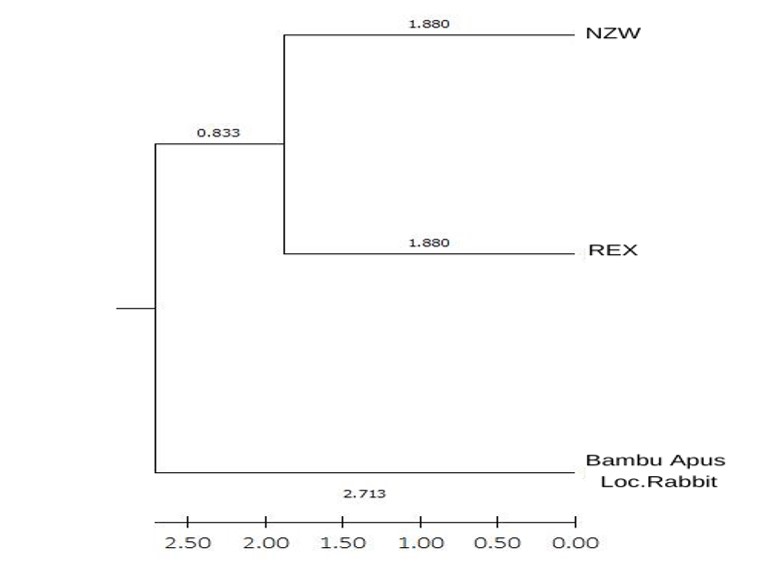
The matrix value of the genetic distance between each rabbit breed is presented in Table 4. The genetic distance value showed that the Bambu Apus rabbit has an immense value of 5.57 with New Zealand White rabbits and 5.28 with Rex rabbits.
This genetic distance matrix value is then used to create a phenogram tree construction as presented in Figure 3.

3.5. Canonical analysis
The entire canonical structure is presented in Table 5. Morphological variables that have a strong influence on distinguishing between Bambu Apus, New Zealand White, and Rex rabbit breeds include ear length (0.85), chest depth (0.96), and spine length (0.78) in Canonical 1 and head width (0.70), head height (0.87), ear width (0.99), chest circumference (0.99), chest width (0.98), humerus bone length (0.76), ulna radius bone length (0.94), femur bone length (0.99) and tibia bone length (0.90) in Canonical 2.
4. Discussion
4.1. Geographical conditions of the research site
Bambu Apus Rabbit Park, Jakarta has higher temperature and lower in humidity than Poultry and Miscellaneous Animal Instrument Standard Testing Centre, Ciawi and THI index of Bambu Apus Rabbit Park, Jakarta also higher than Poultry and Miscellaneous Animal Instrument Standard Testing Centre, Ciawi. Ratchamak et al. (2021) stated that Temperature Relative Humidity Index (THI) is a value that represents the combined effect of air temperature and humidity associated with the level of heat stress.
The relationship between THI values and heat stress categories has been determined by LPHSI (1990), where THI values are classified as follows: <27.8 = no heat stress; 27.8-28.9 = moderate heat stress; 29.0-30.0 = severe heat stress; >30.0 = very severe heat stress. Based on the provisions of LPHSI (1990), the temperature and humidity conditions at the Poultry and Miscellaneous Animal Instrument Standard Testing Centre, Ciawi do not have the potential to cause heat stress, while the conditions at the Bambu Apus Rabbit Park have the potential to cause moderate heat stress.
4.2. Body weight and morphometrics
Referring to Congyan et al. (2016), rabbits have an ideal temperature range of 15-25oC and optimal humidity between 55-65%. When the temperature is higher than 35oC, rabbits can no longer regulate body temperature resulting in heat failure, which can lead to death. Heat stress will negatively affect production performance, such as growth rate, carcass and meat quality, and reproductive performance in rabbits (Liang et al., 2022).
Body size describes the meat production ability of rabbits. Padilha et al., (2017) stated that morphometric is a method of measuring variations and changes in the shape and size of the body of an organism, such as linear length. Morphometric measurements are carried out in order to compare different morphological forms. The measurement results showed that the Bambu Apus rabbit had an average weight of 2473.54±480.13 g. Referring to Prebble et al. (2015) body weight of the Bambu Apus rabbit is determined as the medium category, which is in the range of 2-5 kg. Bambu Apus rabbit has characteristics of head height, head width as well as smaller head length than New Zealand White rabbit and Rex rabbit.
The Bambu Apus rabbit has an average ear length of 13.14±1.31 cm and an ear width of 5.87±0.65 cm, the average is higher than the Rex rabbit. The quite large size of the ears is thought to be the result of the crossing of its elder clump, the New Zealand White rabbit, which also has relatively large ears. Ear size itself has a positive correlation with heat regulation, and this follows the statement of (Jimoh and Ewuola, 2018) that rabbit's main method of releasing body heat is through the ears, but it also uses body position, breathing rate and peripheral temperature. However, respiration and ear are the most important dissipation pathways.
The size of the chest circumference and chest width in the Bambu Apus rabbit does not show any significant differences compared to the New Zealand White rabbit and the Rex rabbit. However, there is a significant difference in the chest depth, where the Bambu Apus rabbit has a chest depth of 8.69±1.11 cm, which is higher compared to New Zealand White rabbit and Rex rabbit. In addition, the Bambu Apus rabbit has a longer spine length (37.84±3.51 cm) than the Rex rabbit. Referring to Abdel-Kafy et al. (2018), rabbit productivity can be reflected by spine length and chest circumference.
4.3. Discriminant analysis
The grouping of rabbit breeds aims to look at kinship relationships and differentiating changing factors between breeds. Grouping is based on the discriminant analysis functions and the canonical analysis correlations of morphometric measures. There are some similarities in the body shape and size of the Bambu Apus rabbit with the Rex rabbit and the New Zealand White rabbit, this proves the existence of a genetic relationship between the Bambu Apus rabbit with the Rex rabbit and New Zealand White rabbit.
A proportion of mixed values to the New Zealand White breed is caused by traits inherited due to crossing. The crossing led to morphometric similarities and differences between the Bambu Apus rabbit, the New Zealand White rabbit, and the Rex rabbit. Agung et al. (2014) reported that livestock clumps with high similarity values explain that the gene mix of other clump populations is relatively low. However, environmental differences are thought to cause the different morphometric sizes of the Bambu Apus rabbit and its elders. Referring to (Brahmantiyo et al., 2016) the change in body size can be due to differences in the location of the origin of rabbits.
4.4. Genetic distance analysis
Genetic distance can be defined as the degree of gene differences (genomic differences) between species or populations measured by several numerical methods (Doğan and Doğan, 2016). In understanding the process of the genetic evolution of a rabbit breed, research on genetic characteristics has been carried out a lot, one of which is through the morphometric analysis approach one of which is in rabbit research by (Brahmantiyo et al., 2016).
A close genetic relationship is seen from a slight genetic distance and vice versa, a significant genetic distance indicates a distant genetic relationship (Ukurta et al., 2016). Bambu Apus rabbit have a large genetic distance from their parents, in this case New Zealand White and Rex rabbits. This is because the Bambu Apus rabbit results from crosses from other breeds besides New Zealand White rabbits and Rex rabbits. In addition, environmental differences, especially temperature, and humidity, can also cause morphometric differences. Bambu Apus rabbits can survive and thrive with temperatures and humidity outside the comfortable range for rabbits, which can occur due to adaptation. Before adaptation, early-generation Bambu Apus rabbit might experience heat stress. The phenogram tree illustrates the genetic distance of the three rabbit breeds. Also, it depicts the genealogical relationships between organisms or populations in a diagram.
4.5. Canonical analysis
Canonical analysis was conducted to determine the distribution map of rabbit breeds and the similarity and mixture values within and between rabbit breeds (Wickramasinghe, 2019). This analysis was also used to determine some variables that strongly influence the clustering of rabbit breeds or distinguish between rabbit breeds.
A distinguishing variable in the canonical has a high correlation as a differentiator if it has a high positive canonical structure value or a positive number close to one. The first component in the morphometric application of principal component analysis is characterized as size, and the second component as shape (Hayashi et al., 1988). The distribution diagram of the 3 rabbit breeds constructed by Canonical 1 and Canonical 2 is presented in Figure 2. Through this, the observed rabbit clumps can be distinguished by the size of these variables.
5. Conclusion
Bambu Apus rabbits have morphometric characteristics that differ from New Zealand White and Rex rabbits based on discriminant analysis and genetic distance. The Bambu Apus rabbit has the genetic potential to be developed as a tropical adaptive broiler rabbit. Therefore, further studies are required for genetic characterization and sustainable genetic conservation.
Acknowledgements
The authors would like to thank the DKI Jakarta Animal Health and Livestock Services Centre (Pusyankeswannak) and the Poultry and Miscellaneous Animal Instrument Standard Testing Centre (BPSI-UAT) for providing the facilities for conducting the research.
References
-
ABDEL-KAFY, E.M., AHMED, S.S., EL-KEREDY, A., ALI, N.I., RAMADAN, S. and FARID, A., 2018. Genetic and phenotypic characterization of the native rabbits in Middle Egypt. Veterinary World, vol. 11, no. 8, pp. 1120-1126. http://doi.org/10.14202/vetworld.2018.1120-1126 PMid:30250372.
» http://doi.org/10.14202/vetworld.2018.1120-1126 -
AGUNG, P.P., RIDWAN, M., HANDRIE, H., INDRIAWATI, I., SAPUTRA, F., SUPRAPTONO, S. and ERINALDI, E., 2014. Profil morfologi dan pendugaan jarak genetik sapi Simmental hasil persilangan. Jurnal Ilmu Ternak dan Veteriner, vol. 19, no. 2, pp. 112-122. http://doi.org/10.14334/jitv.v19i2.1039
» http://doi.org/10.14334/jitv.v19i2.1039 -
BRAHMANTIYO, B., PRIYONO, P. and ROSARTIO, R., 2016. Pendugaan jarak genetik kelinci hyla, hycole, hycolex nzw, rex, dan satin melalui analisis morfometrik estimation of rabbit genetic distance hyla, hycole, hycolexnzw, nzw, rex and satin through morphometric analysis. Jurnal Veteriner, vol. 17, no. 2, pp. 226-234. http://doi.org/10.19087/jveteriner.2016.17.2.226
» http://doi.org/10.19087/jveteriner.2016.17.2.226 -
CENTRAL BUREAU STATISTICS OF INDONESIA, 2021 [viewed 10 November 2022]. Suhu Udara di Stasiun Tanjung Priok Menurut Bulan 2019-2021 [online]. Available from: https://jakarta.bps.go.id/id/statistics-table/2/NzU2IzI=/suhu-udara-di-stasiun-tanjung-priok-menurut-bulan.html
» https://jakarta.bps.go.id/id/statistics-table/2/NzU2IzI=/suhu-udara-di-stasiun-tanjung-priok-menurut-bulan.html -
CONGYAN, L., LIANGDE, K., YONGJUN, R., XIULI, M., CHAO, Y., MIN, L., ZHIQIANG, G. and XIAOHONG, X., 2016. Preliminary observation on the behavior of meat rabbits under the condition of continuous heat stress. Heilongjiang Animal Science and Veterinary Medicine, vol. 22, pp. 10-12. http://doi.org/10.13881/j.cnki.hljxmsy.2016.2031.html.
» https://doi.org/10.13881/j.cnki.hljxmsy.2016.2031.html -
DALLE, Z.A. and SZENDRO, Z., 2011. The role of rabbit meat as functional food. Meat Science, vol. 88, no. 3, pp. 319-331. http://doi.org/10.1016/j.meatsci.2011.02.017 PMid:21392894.
» http://doi.org/10.1016/j.meatsci.2011.02.017 -
DELIS-HECHAVARRIA, E.A., GUEVARA-GONZALEZ, R.G., OCAMPO-VELAZQUEZ, R.V., GOMEZ-SOTO, J.G., VARGAS-HERNANDEZ, M., PAROLA-CONTRERAS, I. and TORRES-PACHECO, I., 2023. Functional food for rabbits. current approaches and trends to increase functionality. Food Reviews International, vol. 39, no. 4, pp. 2057-2074. http://doi.org/10.1080/87559129.2021.1939711
» http://doi.org/10.1080/87559129.2021.1939711 -
DOĞAN, İ. and DOĞAN, N., 2016. Genetic distance measures. Turkiye Klinikleri Journal of Biostatistics, vol. 8, no. 1, pp. 87-93. http://doi.org/10.5336/biostatic.2015-49517
» http://doi.org/10.5336/biostatic.2015-49517 - GRĂDINARU, A.C., 2017. The transylvanian giant rabbit: an efficient selection for qualitative and quantitative genetic traits. Rabbit Genetics, vol. 7, pp. 1-6.
-
HAYASHI, Y., OTSUKA, J. and NISHIDA, T., 1988. Multivariate craniometrics of wild banteng, bos banteng, and five types of native cattle in eastern Asia. Nihon Chikusan Gakkaiho, vol. 59, no. 7, pp. 660-672. http://doi.org/10.2508/chikusan.59.660
» http://doi.org/10.2508/chikusan.59.660 -
JIMOH, O.A. and EWUOLA, E.O., 2018. Thermophysiological traits in four exotic breeds of rabbit at least temperature-humidity index in humid tropics. Journal of Basic & Applied Zoology, vol. 79, no. 1, pp. 345-356. http://doi.org/10.1186/s41936-018-0031-9
» http://doi.org/10.1186/s41936-018-0031-9 -
LIANG, Z.L., CHEN, F., PARK, S., BALASUBRAMANIAN, B. and LIU, W.C., 2022. Impacts of heat stress on rabbit immune function, endocrine, blood biochemical changes, antioxidant capacity and production performance, and the potential mitigation strategies of nutritional intervention. Frontiers in Veterinary Science, vol. 9, pp. 906084. http://doi.org/10.3389/fvets.2022.906084 PMid:35720853.
» http://doi.org/10.3389/fvets.2022.906084 - LPHSI, 1990. Livestock and poultry heat stress indices agriculture engineering technology guide Clemson: Clemson University.
- MANLY, B.F.J., 1989. Multivariate statistical methods. 3rd ed. New York: Chapman and Hall Ltd., 224 p.
-
NAWANGSARI, N.D. and HENDRARTI, N.E., 2021. Analisis proksimat rumput lapangan sebagai pakan ternak ruminansia di kabupaten magelang, jawa tengah analysis of proximate native grass as ruminant cattle feed in magelang regency, Central Java. Jurnal Pengembangan Penyuluhan Pertanian, vol. 18, no. 33, pp. 25-31. http://doi.org/10.36626/jppp.v18i33.612
» http://doi.org/10.36626/jppp.v18i33.612 -
NEI, M., 1987. Molecular evolutionary genetics Chichester: Columbia University Press, 514 p. http://doi.org/10.7312/nei-92038
» http://doi.org/10.7312/nei-92038 -
NISTOR, E., BAMPIDIS, V.A., PĂCALĂ, N., PENTEA, M., TOZER, J. and PRUNDEANU, H., 2013. Nutrient content of rabbit meat as compared to chicken, beef and pork meat. J. Anim. Prod. Adv, vol. 3, no. 4, pp. 172-176. http://doi.org/10.5455/japa.20130411110313
» http://doi.org/10.5455/japa.20130411110313 -
PADILHA, F.G.F., ANDRADE, A.M., FONSECA, A.B.M., DE GODOI, F.N., ALMEIDA, F.Q.D.E. and FERREIRA, A.M.R., 2017. Morphometric measurements and animal-performance indices in a study of racial forms of Brazilian Sport Horses undergoing training for eventing. Revista Brasileira de Zootecnia, vol. 46, no. 1, pp. 25-32. http://doi.org/10.1590/s1806-92902017000100005
» http://doi.org/10.1590/s1806-92902017000100005 -
PRANATASARI, D., ISMAYA. and PANJONO., 2021. Reproductive performance of rex and rex-satin cross reza does and their bunny growth in Tebonan Village, Hargobinangun, Pakem, Sleman. Journal of Livestock Science and Production, vol. 4, no. 1, pp. 295-304. http://doi.org/10.31002/jalspro.v5i1.3510
» http://doi.org/10.31002/jalspro.v5i1.3510 -
PREBBLE, J.L., SHAW, D.J. and MEREDITH, A.L., 2015. Bodyweight and body condition score in rabbits on four different feeding regimes. The Journal of Small Animal Practice, vol. 56, no. 3, pp. 207-212. http://doi.org/10.1111/jsap.12301 PMid:25529986.
» http://doi.org/10.1111/jsap.12301 -
RATCHAMAK, R., RATSIRI, T., CHUMCHAI, R., BOONKUM, W. and CHANKITISAKUL, V., 2021. Relationship of the temperature-humidity index THI with ovarian responses and embryo production in superovulated thai-holstein crossbreds under tropical climate conditions. Veterinary Sciences, vol. 8, no. 11, pp. 1-2. http://doi.org/10.3390/vetsci8110270 PMid:34822643.
» http://doi.org/10.3390/vetsci8110270 -
SETIAJI, A., SUTOPO, S., LESTARI, D.A., KURNIANTO, E. and NOVIANTI, M.E., 2022. Morphometric characterization of new zealand white rabbit raised at different areas. Online Journal of Animal and Feed Research, vol. 12, pp. 350-355. http://doi.org/10.51227/ojafr.2022.46
» http://doi.org/10.51227/ojafr.2022.46 - STATISTICAL ANALYSIS SYSTEM – SAS, 2020. Statistical Procedures 6th ed. North Carolina: SAS Institute Inc.
-
TAMURA, K., STECHER, G. and KUMAR, S., 2021. MEGA11: molecular evolutionary genetics analysis version 11. Molecular Biology and Evolution, vol. 38, no. 7, pp. 3022-3027. http://doi.org/10.1093/molbev/msab120 PMid:33892491.
» http://doi.org/10.1093/molbev/msab120 -
UKURTA, P., HAMDAN, and HANAFI, N.D., 2016. Genetic distance estimation and variable differential factor through analysis of morphometrics on rabbit. Jurnal Peternakan Integratif, vol. 2, pp. 264-284. http://doi.org/10.32734/jpi.v2i3.2730
» http://doi.org/10.32734/jpi.v2i3.2730 -
WICKRAMASINGHE, N.D., 2019. Canonical correlation analysis: an introduction to a multivariate statistical analysis. Journal of the College of Community Physicians of Sri Lanka, vol. 25, no. 1, pp. 37-45. http://doi.org/10.4038/jccpsl.v25i1.8204
» http://doi.org/10.4038/jccpsl.v25i1.8204