 Salacia crassifolia (Celastraceae) as a host of armored scale insects (Hemiptera: Diaspididae): two new reports and expansion of occurrence in Brazil
Abstract
Salacia crassifolia (Mart. Ex Schult.) G. Don. (Celastraceae) is a species native to the Brazilian Cerrado that has fruits highly appreciated by local fauna and population. Recent studies show that this species has a rich biodiversity of armored scale insects (Hemiptera: Diaspididae) associated with its leaves, with the first reports of occurrence recording the species Pseudoparlatoria argentata Hempel and Melanaspis aristotelesi Lepage and Giannott. In this work, two new unpublished records are presented, Dinaspis paulistana Lepage and Vinculaspis montei (Lepage), expanding the knowledge of scale insects that use their leaves as their main source of food. The two scale insects were found in two areas, D. paulistana, in Alto Paraíso de Goiás, State of Goiás, Brazil and V. montei in Altiplano Leste, municipality of Brasília, Federal District, Brazil. Additionally, P. argentata and M. aristotelesi were also found in Altiplano Leste, Distrito Federal. This work brings unprecedented illustrations and descriptions of armored scale insects and a dichotomous identification key for the species Vinculaspis that occur in Brazil. This is the first report of D. paulistana and V. montei feeding on S. crassifolia and the first report of their occurrence in Central Brazil.
Keywords:
biodiversity; Dinaspis paulistana; entomology; taxonomy; Vinculaspis montei
Resumo
Salacia crassifolia (Mart. Ex Schult.) G. Don. (Celastraceae) é uma espécie nativa do Cerrado brasileiro que possui frutos altamente apreciados pela fauna e população local. Estudos recentes evidenciam que essa espécie apresenta uma rica biodiversidade de cochonilhas (Hemiptera: Diaspididae) associadas com suas folhas, com os primeiros relatos de ocorrência com o registro das espécies Pseudoparlatoria argentata Hempel e Melanaspis aristotelesi Lepage e Giannott. Neste trabalho, dois novos registros inéditos são apresentados, Dinaspis paulistana Lepage e Vinculaspis montei (Lepage), ampliando o conhecimento de cochonilhas que utilizam as suas folhas como principal fonte de alimento. As duas cochonilhas foram encontradas em duas áreas: D. paulistana em Alto Paraíso de Goiás, Estado de Goiás, Brasil e V. montei no Altiplano Leste, município de Brasília, Distrito Federal, Brasil. Adicionalmente, P. argentata e M. aristotelesi também foram encontrados no Altiplano Leste, Distrito Federal. Esse trabalho traz ilustrações e descrições inéditas das cochonilhas e uma chave dicotômica de identificação para as espécies de Vinculaspis que ocorrem no Brasil. Esse é o primeiro relato de parasitismo de D. paulistana e V. montei em S. crassifolia e o primeiro relato de ocorrência de ambas no Brasil Central.
Palavras-chave:
biodiversidade; Dinaspis paulistana; entomologia; taxonomia; Vinculaspis montei
1. Introduction
The Brazilian Cerrado is recognized as a biome that presents a great biodiversity of plants, animals and microorganisms (Klink and Machado, 2005). Many of these organisms are endemic, occurring exclusively in this environment (Damasco et al., 2018). Due to the high degree of human occupation of the Cerrado, especially due to agricultural activities, the occurrence of fires and increased urban expansion, many of these species may be lost and become extinct (Ganem et al., 2013). Studies aimed at expanding the knowledge of these organisms are important so that protective measures can be carried out and implemented to ensure the preservation of biodiversity in this important biome (Strassburg et al., 2017).
Scale insects (Hemiptera: Coccomorpha) are phytophagous insects that have a parasitic relationship with their hosts, carrying out intense sap sucking (Grazia et al., 2024). This relationship can be so intimate that many scale insects are associated with one or a few plant species (Grazia et al., 2024). These insects can transmit plant pathogens and induce the formation of sooty molds caused by dematiaceous fungi that grow on the surface of various parts of the plant, such as leaves, trunk, fruits and flowers, and prevents the photosynthesis process (Chomnunti et al., 2014). Several species of scale insects have been observed and reported in association with native plants of Cerrado, demonstrating that there is a rich entomofauna to be discovered, documented, and reported by science (Castro et al., 2020, 2022, 2024).
Salacia crassifolia (Mart. Ex Schult.) G. Don. (Celastraceae), popularly known as “bacupari” or “bacupari-do-cerrado”, is a Cerrado native plant that has gained prominence as a host of scale insects, especially armored scale insects (Diaspididae). Salacia crassifolia is a shrubby plant that produces fruits highly appreciated by the local fauna and the local population, occurring in several Brazilian states, and in the Federal District (Braga Filho et al., 2007). It has a high morphological variation between individuals, with alternate, elliptical or oblong leaves, with acute, obtuse, or retained apices (Silva Júnior, 2005). To date, two scale insects have been reported on S. crassifolia worldwide: Pseudoparlatoria argentata Hempel and Melanaspis aristotelesi Lepage and Giannott, both from the family Diaspididae (Castro et al., 2020). Recent observations in the field indicate that this number may be higher, in addition to the expansion of the distribution of the scale insects already reported in other Brazilian municipalities or states.
This work aimed to report two new occurrences of armored scale insects on S. crassifolia, expand the record of the phytophagous entomofauna associated with this species in Brazil, and provide an identification key to the species of the genus Vinculaspis that occur in Brazil, based on the adult female.
2. Material and Methods
Armored scale insects associated with S. crassifolia were collected in July 2024 in Cerrado sensu stricto in Alto Paraíso de Goiás, Goiás State, Brazil (14°05’49.7”S; 47°29’39.5”W), and October 2024, in an area of Cerrado sensu stricto at a fragment in Altiplano Leste, municipality of Brasília, Federal District, Brazil (15°79’67.8”S; 47°75’90.0”W). Cerrado is a biome that has two well-defined seasons, and the regional climate is classified as AW (i.e., a tropical climate with rain in summer and drought in winter), in which the rainy season runs from October to April and the drought from May to September (Köppen and Geiger, 1928). The average temperature in July in Alto Paraíso de Goiás was 27.0 °C, without precipitation. In the Federal District, in October, the average temperature was 23.6 °C, with a minimum of 16.3 °C and a maximum of 36.1 °C, and precipitation of 291.6 mm (Brasil, 2024).
Four S. crassifolia plants were analyzed in the first area (Goiás) and thirty in the second area (Federal District), observing the presence of the insects on the leaves, stems, flowers and fruits. The plants were identified using the manual elaborated by Silva Júnior (2005). Other plant species around S. crassifolia were also analyzed for the occurrence of scale insects.
The scale insects were fixed in a Falcon tube containing 70% alcohol until identification. Slides were slide-mounted for subsequent analysis under an optical microscope, according to the methodology described by Wolff et al. (2014). Specimens were identified using the key to genus and species descriptions and diagnoses by Ferris (1941, 1942), Lepage (1937, 1938, 1942), and Fonseca (1973). A dichotomous key for the species of the genus Vinculaspis is herein provided due to the lack of information and bibliography available in the literature.
The slides containing the diaspidids were deposited on the “Coleção Entomológica do Museu Ramiro Gomes Costa (MRGC)”. The insect material was collected with authorization from the Brazilian government granted to the first author by the Chico Mendes Institute for Biodiversity Conservation (ICMBio), Ministry of the Environment (MMA) (Collection Permit No. 96628-1).
3. Results
Four armored scale insects species were found on S. crassifolia plants: one in Alto Paraíso de Goiás, Goiás State: Dinaspis paulistana Lepage; and three in Altiplano Leste, Federal District: Vinculaspis montei (Lepage), M. aristotelesi, and P. argentata. Dinaspis paulistana and V. montei are newly reported on S. crassifolia. Injuries caused by the scale insects were observed during the collections on the evaluated plants, especially on the leaves. No scale insects were found on other plant species in the proximity of S. crassifolia in the two analyzed areas.
3.1. Dinaspis paulistana
3.1.1. Injuries observed on plants with D. paulistana
All the four plants observed were highly infested with the scale insect in Alto Paraíso de Goiás, Goiás State, Brazil. Infestations by the armored scale left the leaves of the plants with a whitish appearance, similar to snow, caused by a white layer that covers the scale insect tests (scale cover) (Figure 1). A large number of individuals were found on both sides of the leaves, with a predominance on the upper side. The injured leaves were slightly twisted and deformed (Figure 1B). No yellowing or chlorosis was observed in the infested leaves.

Dinaspis paulistana on S. crassifolia collected in Goiás State, Brazil. (A) Plants with high infestation of the diaspidid; (B) Detail of the leaf with the scale insects with a whitish appearance; (C) Armored scale insects on the upper side of the leaf.
After removing the layer of white wax produced by the scale insects by fixing them in alcohol (Figure 2A), it was possible to observe the black color of the scale tests (Figure 2B).

Dinaspis paulistana. (A) White wax produced by the insects; (B) Black shields after removing the layer of white wax with alcohol.
3.1.2. Macroscopic and microscopic diagnosis of D. paulistana
The body of the adult female is covered by a black test which provides protection to the sedentary insect. The scale test is elongated in shape, approximately 2.5 mm long, with two yellow exuviae attached to it at the apical end, from the first and second nymphal stages. The test of the adult female of D. paulistana is superficially similar to the test of the adult female of Ischnaspis longirostris (Signoret), in terms of shape and color. Therefore, it is not possible to identify the genus and species of the scale insect based only on the characteristics of the tests. To determine the species, it is necessary to examine the microscopic characteristics of the adult female’s body.
Microscopic characteristics of the adult female of D. paulistana: the body is elongated and narrow, approximately 2 mm long and 0.3 mm wide, most of which is formed by the metathorax. The derm at maturity is strongly sclerotized, both on the dorsal and ventral sides, remaining membranous on the extremities; on the head, second, third and fourth abdominal segments with lateral lobular expansions, as well as on the pygidium.
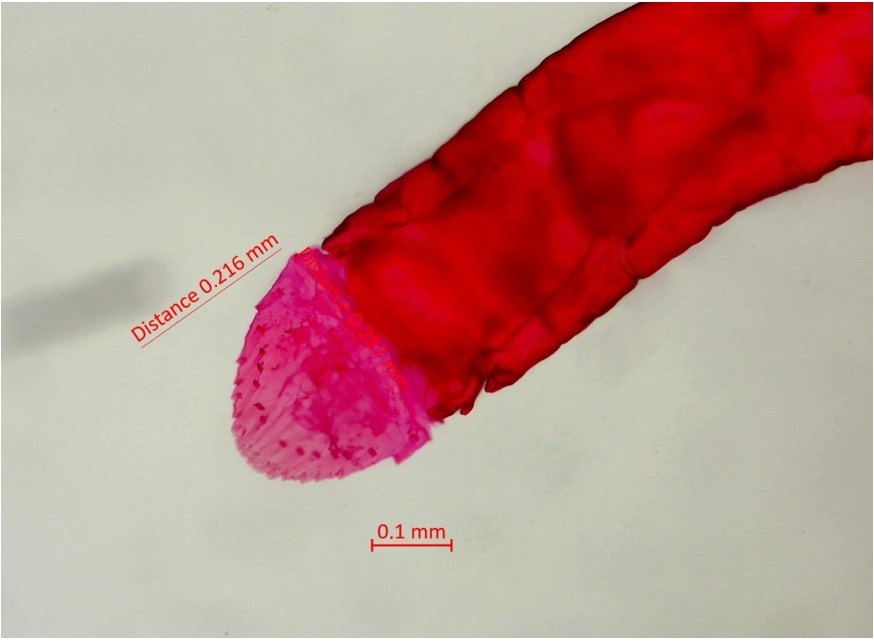
The rounded pygidium is formed by the fusion of the last abdominal segments, and has three pairs of lobes at the margin (Figure 3): a median pair (Lm), rounded; the second pair (L2) bilobed, that is, divided into two by a deep incision and the third pair (L3) is rounded and simple. In the spaces between the pygidial lobes, there are simple glandular plates between them: a pair between the Lm and one between each next interlobular space. On the dorsal surface, there are seven pairs of marginal macroducts whose pores open at the following locations: one between Lm and L2, two between L2 and L3, three equally spaced on the margin of the pygidium, and one pair on the lobe of the fourth abdominal segment.

3.2. Vinculaspis montei
3.2.1. Damages observed on plants with V. montei
Vinculaspis montei was found on two S. crassifolia plants (6.66%) in Altiplano Leste, Federal District, Brazil. The main damage caused by the insect on the evaluated plants consisted in the formation of circular to irregular chlorotic spots around the insect's suction point, mainly on the upper surface of the leaves (Figure 4).

Vinculaspis montei on S. crassifolia in Federal District, Brazil. (A) and (B) Plants with high infestation of the diaspidid; (C) Armored scale insects on the upper side of the leaf, with circular to irregular chlorotic spots.
3.2.2. Macroscopic and microscopic description of V. montei
This type of scale insect is defined as pupillarial because adult females lose some structures that they had in the previous phase. The female second-instar nymph has three pairs of lobes on the margin of the pygidium: the median ones (Lm) rounded in shape, the second pair (L2) bilobed and the third pair (L3) very reduced; between the Lm there is a bifurcated, well-developed glandular plate and between the other lobes a simple glandular plate; with a dorsal macroduct has in each interval between the pairs of lobes Lm and L2, L2 and L3 and posterior to L3.
In the adult stage, the female remains inside the black test or scale formed by the exuvia of the second stage, about 2 mm in diameter, on which the first subcentral exuvia is located. The adult female's body is about 1 mm long, membranous, quadrangular in shape from the head to the first abdominal segment and the apex of the pygidium has a more or less triangular shape. At the margin of the pygidium, the median lobes are well developed, but the second and third pair of lobes are less developed, without dorsal macroducts.
3.3. Pseudoparlatoria argentata and Melanaspis aristotelesi
3.3.1. Injuries observed on plants with P. argentata and M. aristotelesi
Pseudoparlatoria argentata was found on eight S. crassifolia plants (26.66%). The individuals were found mainly on the underside leaf surface and on the upper surface showed symptoms of chlorosis (Figures 5A and 5B). Melanaspis aristotelesi was found on ten plants (33%) and, unlike P. argentata, the scale insects were concentrated on the upper surface of the leaves (Figures 5C and 5D). Some leaves were completely yellow, and others had already fallen to the ground.

Injuries caused by armored scales on the S. crassifolia leaves. Pseudoparlatoria argentata: (A) Chlorosis on the upper surface of the leaf; (B) Concentration of scale insects on underside of the leaf; Melanaspis aristotelesi: (C) Yellowed leaves with a high population of scale insects; (D) Detail of armored scales on the upper surface of the leaf.
3.3.2. Other comments
Descriptions of the macroscopic and microscopic morphology of P. argentata and M. aristotelesi can be found in Castro et al. (2020).
Dinaspis paulistana was described by Lepage in association with a plant species of the family Combretaceae in Jardim da Luz, São Paulo, Brazil, and on a wild plant on Porchat island, municipality of São Vicente, São Paulo, Brazil (Lepage, 1942; Vernalha, 1953; Silva et al., 1968; Claps et al., 1999). Nine species of Dinaspis Leonardi occur worldwide, with D. paulistana being the only species that occurs in Brazil (García-Morales et al., 2016; Peronti et al., 2024a).
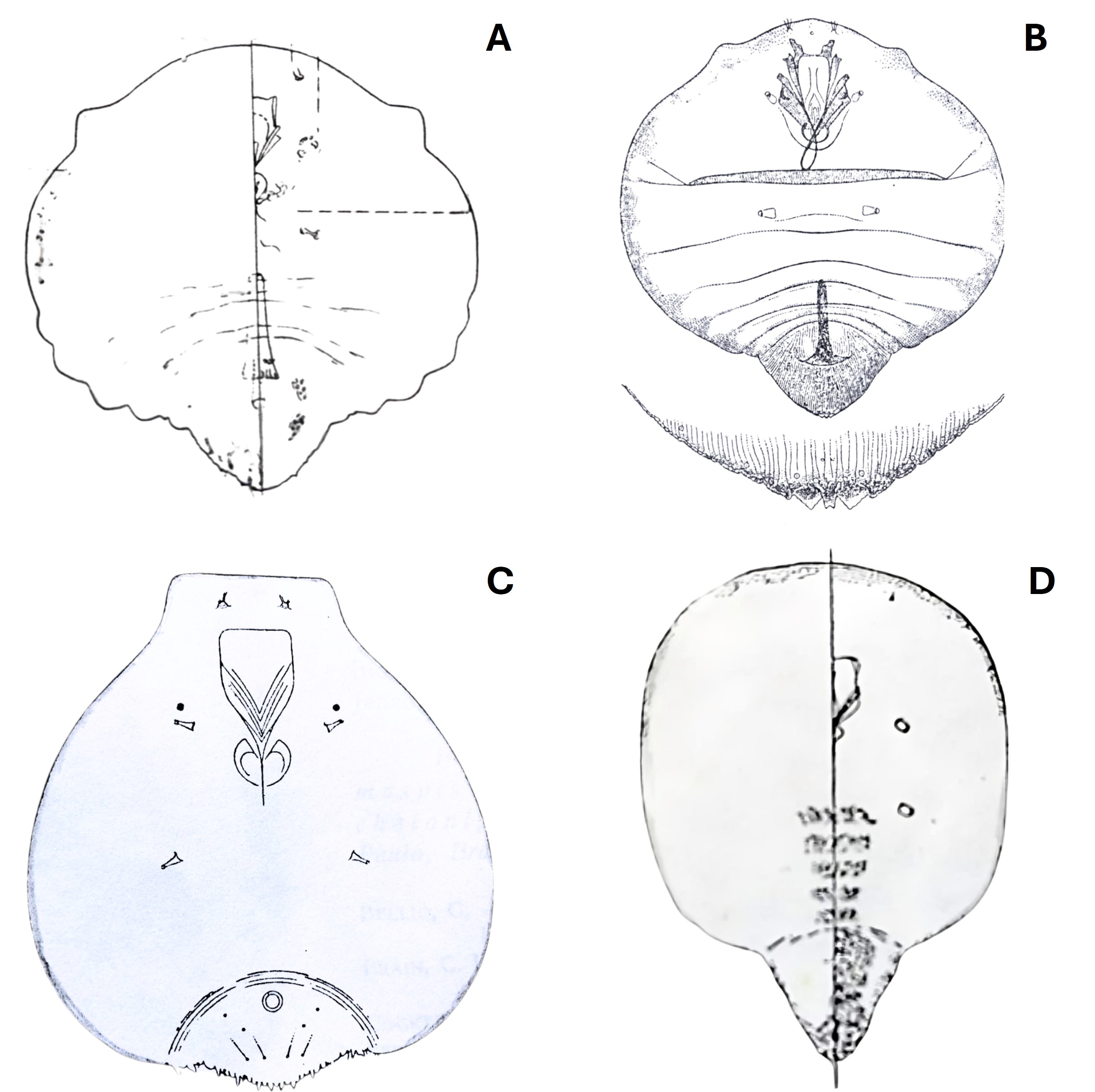
Vinculaspis montei was described in Minas Gerais, Brazil, on a host plant commonly known as birdwort, Lorantus sp. (Loranthaceae) (Lepage, 1942; Vernalha, 1953; Silva et al., 1968; Claps et al., 1999). Normark et al. (2019) considered Vinculaspis Ferris, 1941 related to Pseudoparlatoria Cockerell, 1892 due to its bifurcated median gland spine and the arrangement of the macroducts on the pygidium being characteristic of this group (Ferris, 1941). There are nine species of Vinculaspis in the world, four of which have been recorded in Brazil: Vinculaspis atibaiensis (Lepage, 1937), V. cheloniformis (Lepage, 1937), V. mamillataFonseca (1973) and V. montei (García-Morales et al., 2016; Peronti et al., 2024b). The following key is proposed to separate the species of the genus Vinculaspis that occur in Brazil:
Key to Vinculaspis species that occur in Brazil, based on the adult female (Lepage, 1937; 1938; 1942; Fonseca, 1973):
1- Body shape of the adult female, in the head region, rounded with a lateral expansion on each side …………………………………………………………………………………………... 2
- Body shape of the adult female, in the head region, rounded without lateral expansions or quadrate …………………….……………………………………………………………….... 3
2 (1) – Pygidium with a pair of triangular-shaped median lobes (Lm) with one incision on the inner margin and two on the outer margin, second and third pairs of lobes bilobed, followed by three or four, more or less equidistant and slightly crenulated indentations ………………………………………………….. Vinculaspis mamillata Fonseca (Figure 6A)

Vinculaspis species that occur in Brazil. (A) V. mamillata; (B) V. cheloniformis; (C) V. atibaiensis; (D) V. montei. Extracted from Lepage (1937, 1938, 1942) and Fonseca (1973).
- Pygidium with a pair of triangular median lobes (Lm) with serrated margins, no second and third pairs of lobes, only 3 or 4 shallow indentations …………………………………………….. Vinculaspis cheloniformis (Lepage) (Figure 6B)
3 (1’) – Adult female quadrangular; anterior cephalic part narrow and straight, widening mainly in the thoracic region, and gradually narrowing in the abdominal region until the pygidium which presents itself in a very large curve; the pygidium without defined lobes, just a series of expansions arranged asymmetrically ……………………………………………… Vinculaspis atibaiensis (Lepage) (Figure 6C)
- Adult female of pyriform shape, with rounded angles; pygidium acute, more or less triangular, with triangular median lobes with toothed lateral margins, second pair of lobes poorly developed with serrated margins, third pair inconspicuous …………………………………………………….. Vinculaspis montei (Lepage) (Figure 6D)
4. Discussion
Two species of diaspidids, namely D. paulistana and V. montei are herein for the first time reported on S. crassifolia. Furthermore, P. argentata and M. aristotelesi were found in a different location than previously reported by Castro et al. (2020), more than 50 kilometers away. The four armored scale insect species reported here are considered native to Brazil.
Both D. paulistana and V. montei were described in Southeastern Brazil, in São Paulo and Minas Gerais, respectively. Therefore, this work expands the occurrence of these two scale insects to Central Brazil.
The family Diaspididae is the most species-rich in the infraorder Coccomorpha, with more than 410 genera and 2,700 species described, feeding on more than 180 families and 1,830 plant genera (Miller and Davidson, 2005; Garcia-Morales et al., 2016). It has great economic importance as many species are considered pests and harmful to agricultural crops, including cultivated plants in the families Anacardiaceae, Euphorbiaceae, Fabaceae, Myrtaceae, Poaceae, and Moraceae, among others (Miller and Davidson, 2005; Garcia-Morales et al., 2016; Costa-Lima et al., 2022; Martins et al., 2022). Some S. crassifolia infested plants with armored scales observed in this work had almost completely yellowed and chlorotic leaves (Figures 2 and 3), interrupting the photosynthetic process. Furthermore, due to the large number of individuals on the leaves, this problem is exacerbated, increasing its damage and harming plant development. As previously reported by Castro et al. (2020), in a single leaf, hundreds of individuals can be counted, covering much or all the leaf surfaces.
Salacia crassifolia is an evergreen species that has simple, leathery, glabrous leaves, covered by a smooth waxy layer (Silva Júnior, 2005). This foliar microenvironment can provide a favorable environment for the occurrence of this group of insects, combined with compounds found in leaves, like pentacyclic triterpenes that have antimicrobial, antiparasitic, antioxidant and anti-inflammatory activities (Rodrigues et al., 2015; Espíndola et al., 2018).
Armored scale insects in this study were collected in the drought (July) and raining periods (October). However, scale insects from the family Diaspididae are strongly attached to plant tissues and can remain for long periods even if the insect is no longer alive. When studying them macro and microscopically, the tests (scale covers) may be dry and the armored scale insects dead, either because the development cycle has already been completed, or mortality may have occurred due to parasitoid attack. Therefore, to conduct a population dynamics study, it is necessary to carry out a two-year survey studying the insects by removing the tests and monitoring the insect's life cycle, as well as quantifying mortality throughout the collections (Wolff et al., 2018; Souza et al., 2019).
The main injury observed in the attacked plants was chlorosis and yellowing of the leaves, which, in intense attacks, will cause the leaves to dry and fall from the host plants (Miller and Davidson, 2005).
5. Conclusions
A rich armored scale insect entomofauna native to Brazil is found in association with S. crassifolia plants, where two new records presented in this work (D. paulistana and V. montei), in addition to finding two others previously reported diaspidids but in a different region (P. argentata and M. aristotelesi). Furthermore, D. paulistana and V. montei are reported for the first time in Central Brazil. This study shows that more research about scale insects in the Cerrado should be carried out with the aim of cataloging and expand the knowledge about native species from Brazil.
Acknowledgements
We would like to thank Luísa Metz, trainee at the Ramiro Gomes Costa Entomology Laboratory and Museum, who helped with the photos of the scale insect with the Canva program.
References
- BRAGA FILHO, J.R., VELOSO, V.R.S., NAVES, R.V. and FERREIRA, G.A., 2007. Entomofauna associada aos frutos do bacupari, Salacia crassifolia (Mart.) Peyr, nos Cerrados do Brasil Central. Pesquisa Agropecuária Tropical, vol. 31, no. 1, pp. 55-59.
-
BRASIL. Instituto Nacional de Meteorologia – INMET [online], 2024 [viewed 26 November 2024]. Available from: https://portal.inmet.gov.br/
» https://portal.inmet.gov.br/ -
CASTRO, M.T., MONTALVÃO, S.C.L. and WOLFF, V.R.S., 2022. First report of Umbaspis regularis (Newstead, 1911) (Hemiptera: Diaspididae) Associated with Agonandra brasiliensis Miers ex Benth. & Hook.f. (Opiliaceae) in the Brazilian Cerrado. Entomological Communications, vol. 4, ec04033. http://doi.org/10.37486/2675-1305.ec04033
» http://doi.org/10.37486/2675-1305.ec04033 -
CASTRO, M.T., MONTALVÃO, S.C.L. and WOLFF, V.R.S., 2024. First report of Acutaspis oliveirai (Lepage & Giannotti, 1942) (Hemiptera: Diaspididae) in Central Brazil: occurrence on Myrsine guianensis (Aubl.) Kuntze (Primulaceae) in the Brazilian Cerrado. Entomological Communications, vol. 6, ec06037. http://doi.org/10.37486/2675-1305.ec06037
» http://doi.org/10.37486/2675-1305.ec06037 - CASTRO, M.T., MONTALVÃO, S.C.L., WOLFF, V.R.S. and MONNERAT, R.G., 2020. First association of scale insects (Hemiptera: Diaspididae) with Salacia crassifolia (Mart. Ex Schult.) G. Don. (Celastraceae). Insecta Mundi, vol. 0774, pp. 1-5.
-
CHOMNUNTI, P., HONGSANAN, S., AGUIRRE-HUDSON, B., TIAN, Q., PERSOH, D., DHAMI, M.K., ALIAS, A.S., XU, J.C., LIU, X.Z., STADLER, M. and HYDE, K.D., 2014. The sooty moulds. Fungal Diversity, vol. 66, no. 1, pp. 1-36. http://doi.org/10.1007/s13225-014-0278-5
» http://doi.org/10.1007/s13225-014-0278-5 - CLAPS, L.E., WOLFF, V.R.S. and GONZÁLEZ, R.H., 1999. Catálogo de las especies de Diaspididae (Hemiptera: Coccoidea) nativas de Argentina, Brasil y Chile. Insecta Mundi, vol. 13, no. 3-4, pp. 239-256.
-
COSTA-LIMA, T.C., PERONTI, A.L.B.G., WOLFF, V.R.S., PEREIRA, E.P.A. and PARANHOS, B.A.J., 2022. New scale insects (Hemiptera: Coccomorpha) records as mango pests in Northeast Brazil. International Journal of Tropical Insect Science, vol. 42, no. 2, pp. 2013-2017. http://doi.org/10.1007/s42690-021-00660-y
» http://doi.org/10.1007/s42690-021-00660-y -
DAMASCO, G., FONTES, C., FRANÇOSO, R. and HAIDAR, R., 2018. The Cerrado biome: a forgotten biodiversity hotspot. Frontiers for Young Minds, vol. 6, pp. 22. http://doi.org/10.3389/frym.2018.00022
» http://doi.org/10.3389/frym.2018.00022 -
ESPINDOLA, L.S., DUSI, R.G., DEMARQUE, D.P., BRAZ-FILHO, R., YAN, P., BOKESCH, H.R., GUSTAFSON, K.R. and BEUTLER, J.A., 2018. Cytotoxic Triterpenes from Salacia crassifolia and metabolite profiling of Celastraceae species. Molecules, vol. 23, no. 6, pp. 1494. http://doi.org/10.3390/molecules23061494 PMid:29925807.
» http://doi.org/10.3390/molecules23061494 - FERRIS, G.F., 1941. Atlas of the scale insects of North America: series 3. Palo Alto: Stanford University Press, pp. SIII-321.
- FERRIS, G.F., 1942. Atlas of the scale insects of North America: series 4. Palo Alto: Stanford University Press, pp. SIV-423, SIV-446:41.
- FONSECA, J.P., 1973. Contribuição ao conhecimento dos coccídeos do Brasil (Homoptera - Coccoidea). Arquivos do Instituto Biológico, vol. 40, no. 3, pp. 247-261.
-
GANEM, R.S., DRUMMOND, J.A. and FRANCO, J.L.A., 2013. Conservation polices and control of habitat fragmentation in the Brazilian Cerrado biome. Ambiente & Sociedade, vol. 16, no. 3, pp. 99-118. http://doi.org/10.1590/S1414-753X2013000300007
» http://doi.org/10.1590/S1414-753X2013000300007 -
GARCÍA-MORALES, M., DENNO, B., MILLER, D.R., MILLER, G.L., BEN-DOV, Y. and HARDY, N.B., 2016 [viewed 25 November 2024]. ScaleNet: a literature-based model of scale insect biology and systematic [online]. Available from: http://scalenet.info
» http://scalenet.info -
GRAZIA, J., TAKIYA, D.M., WOLFF, V.R.S., SCHWERTNER, C.F., MEJDALANI, G., CAVICHIOLI, R.R., PERONTI, A.L.B.G., QUEIROZ, D.L., BURCKHARDT, D., FERNANDES, J.A.M., MOREIRA, F.F.F., GIL-SANTANA, H.R., FERREIRA, P.S.F., CARRENHO, F., BRUGNERA, R. and GUIDOTI, M., 2024. Hemiptera Linnaeus, 1758. In: J.A. RAFAEL, G.A.R. MELO, C.J.B. CARVALHO, S. CASARI and R. CONSTANTINO, eds. Insetos do Brasil: diversidade e taxonomia. 2. ed. Manaus: Instituto Nacional de Pesquisas da Amazônia, cap. 25, pp. 368-456. http://doi.org/10.61818/56330464c25
» http://doi.org/10.61818/56330464c25 - KLINK, C.A. and MACHADO, R.B., 2005. A conservação do Cerrado brasileiro. Megadiversidade: Desafios e Oportunidades para a Conservação da Biodiversidade no Brasil, vol. 1, no. 1, pp. 147-155.
- KÖPPEN, W. and GEIGER, R., 1928. Klimate der Erde. Gotha: Verlag Justus Perthes. Wall-map 150 cm × 200 cm.
- LEPAGE, H.S., 1937. O novo gênero diaspineo “Costalimaspis” com três espécies novas (Hom.-Coccoidea). Arquivos do Instituto Biológico, vol. 8, pp. 239-248.
- LEPAGE, H.S., 1938. Catálogo dos coccídeos do Brasil. Revista do Museu Paulista, vol. 23, pp. 327-491.
- LEPAGE, H.S., 1942. Descrição de onze espécies novas de coccídeos do Brasil (Homoptera-Coccoidea). Arquivos do Instituto Biológico, vol. 13, pp. 173-189.
-
MARTINS, D.S., WOLFF, V.R.S., CULIK, M.P., SANTOS, B.C., FORNAZIER, M.J. and VENTURA, J.A., 2022. Diversity, distribution and host plants of armored scale insects (Hemiptera: Diaspididae) in Espírito Santo, Brazil. Biota Neotropica, vol. 22, no. 2, e20211248. http://doi.org/10.1590/1676-0611-bn-2021-1248
» http://doi.org/10.1590/1676-0611-bn-2021-1248 - MILLER, D.R. and DAVIDSON, J.A., 2005. Armored scale insect pests of trees and shrubs Ithaca: Cornell University Press, 442 p.
-
NORMARK, B.B., OKUSU, A., MORSE, G.E., PETERSON, D.A., ITIOKA, T. and SCHNEIDER, S.A., 2019. Phylogeny and classification of armored scale insects (Hemiptera: Coccomorpha: Diaspididae). Zootaxa, vol. 4616, no. 1, pp. 1-98. http://doi.org/10.11646/zootaxa.4616.1.1 PMid:31716328.
» http://doi.org/10.11646/zootaxa.4616.1.1 -
PERONTI, A.L.B.G., WOLFF, V.R.S. and PACHECO DA SILVA, V.C., 2024a [viewed 25 November 2024]. Dinaspis paulistana Lepage, 1942. In: JARDIM BOTÂNICO DO RIO DE JANEIRO, ed. Coccoidea Handlirsch, 1903 [online]. Rio de Janeiro: JBRJ. Available from: http://fauna.jbrj.gov.br/
» http://fauna.jbrj.gov.br/ -
PERONTI, A.L.B.G., WOLFF, V.R.S. and PACHECO DA SILVA, V.C., 2024b [viewed 25 November 2024]. Vinculaspis Ferris, 1941. In: JARDIM BOTÂNICO DO RIO DE JANEIRO, ed. Coccoidea Handlirsch, 1903 [online]. Rio de Janeiro: JBRJ. Available from: http://fauna.jbrj.gov.br/
» http://fauna.jbrj.gov.br/ -
RODRIGUES, V.G., DUARTE, L.P., SILVA, R.R., SILVA, G.D.F., MERCADANTE-SIMÕES, M.O., TAKAHASHI, J.A., MATILDES, B.L.G., FONSECA, T.H.S., GOMES, M.A. and VIEIRA FILHO, S.A., 2015. Salacia crassifolia (Celastraceae): chemical constituints and antimicrobial activity. Química Nova, vol. 38, no. 2, pp. 237-242. http://doi.org/10.5935/0100-4042.20150001
» http://doi.org/10.5935/0100-4042.20150001 - SILVA JÚNIOR, M.C., 2005. 100 árvores do cerrado: guia de campo Brasília: Rede de Sementes do Cerrado.
- SILVA, A.G.A., GONÇALVES, C.R., GALVÃO, D.M., GONÇALVES, A.J.L., GOMES, J., SILVA, M.N. and SIMONI, L., 1968. Quarto catálogo dos insetos que vivem nas plantas do Brasil: seus parasitos e predadores: parte 2, tomo 1º, insetos, hospedeiros e inimigos naturais Rio de Janeiro: Ministério da Agricultura, 622 p.
-
SOUZA, G.C., REDAELLI, L.R. and WOLFF, V.R.S., 2019. Abundance, seasonality and parasitism of Diaspididae (Hemiptera) on olive trees. Pesquisa Agropecuária Gaúcha, vol. 25, no. 1-2, pp. 85-93. http://doi.org/10.36812/pag.2019251/285-93
» http://doi.org/10.36812/pag.2019251/285-93 -
STRASSBURG, B.B.N., BROOKS, T., FELTRAN-BARBIERI, R., IRIBARREM, A., CROUZEILLES, R., LOYOLA, R., LATAWIEC, A.E., OLIVEIRA FILHO, F.J.B., SCARAMUZZA, C.A.D.M., SCARANO, F.R., SOARES-FILHO, B. and BALMFORD, A., 2017. Moment of truth for the Cerrado hotspot. Nature Ecology & Evolution, vol. 1, no. 4, pp. 0099. http://doi.org/10.1038/s41559-017-0099 PMid:28812670.
» http://doi.org/10.1038/s41559-017-0099 - VERNALHA, M.M., 1953. Coccideos da coleção I.B.P.T. Arquivos de Biologia e Tecnologia, vol. 8, pp. 111-304.
-
WOLFF, V.R.S., BOTTON, M. and SILVA, D.C., 2014. Diaspidídeos e parasitoides associados ao cultivo da videira no Rio Grande do Sul, Brasil. Revista Brasileira de Fruticultura, vol. 36, no. 4, pp. 835-841. http://doi.org/10.1590/0100-2945-145/13
» http://doi.org/10.1590/0100-2945-145/13 - WOLFF, V.R.S., EFROM, C.F.S., AQUINO, D.A. and TONIETTO, A., 2018. Taxonomic study and population variation of scale insects (Hemiptera: Coccidae and Diaspididae) and associated parasitoids (Hymenoptera: Chalcidoidea) in an olive grove at Rio Grande do Sul, Brazil. Insecta Mundi, vol. 0669, pp. 1-8.