 Biometric and biochemical characterization for potential uses of Euterpe edulis (Martius) seeds
Abstract
Sustainable use of Euterpe edulis for fruit pulp production is an alternative to illegal cutting of the plant. The use of its seeds, a by-product of pulp extraction, may add value to fruit production. However, characterization of the seeds is necessary to guide this use. This study characterized the fruit and seeds of E. edulis in a pulp production management area in the state of Espírito Santo, Brazil. The fruit was evaluated regarding size, volume, and color and was then pulped, quantifying the pulp yield, which was a mean of 21%. The seeds mostly consisted of crude fiber (58.9%) and lipids (18.1%). Low soluble (2.11%) and insoluble (11.15%) lignin content and high energy potential (16.25 MJ kg-1) were observed. From initial biochemical sampling, the composition of the seeds was determined by near infrared (NIR) spectroscopy for all the plants. The sugar, starch, lipid, and protein contents was more variable than the biometric profile (diameter, weight, and volume). The largest variation was observed for soluble sugar content, whereas the crude fiber content of the seeds showed little variation. The high content of fiber, as well as carbohydrates and lipids, suggests that juçara seeds can be used for producing meal for human and animal consumption. More studies are recommended on the use of oil from the seeds. The physical hardness of the seeds, the difficulty of grinding them, and their low lignin content and high energy potential indicate the use of intact seeds as biochar.
Keywords:
agroecology; juçara palm tree; plant genetic resource; sustainable management
Resumo
O uso sustentável de Euterpe edulis para produção de polpa de frutas é uma alternativa ao corte ilegal da planta. O uso de suas sementes, um subproduto da extração da polpa, pode agregar valor à produção de frutas. No entanto, a caracterização das sementes é necessária para orientar esse uso. Este estudo caracterizou os frutos e sementes de E. edulis em uma área de manejo de produção de polpa no estado do Espírito Santo, Brasil. O fruto foi avaliado quanto ao tamanho, volume e cor e então foi despolpado, quantificando o rendimento de polpa, que foi em média 21%. As sementes consistiam principalmente de fibra bruta (58,9%) e lipídios (18,1%). Baixo teor de lignina solúvel (2,11%) e insolúvel (11,15%) e alto potencial energético (16,25 MJ kg-1) foram observados. A partir de uma amostragem bioquímica inicial, a composição das sementes foi determinada por espectroscopia no infravermelho próximo (NIR) para todas as plantas. Os teores de açúcar, amido, lipídios e proteínas foram mais variáveis do que o perfil biométrico (diâmetro, peso e volume). A maior variação foi observada para o teor de açúcar solúvel, enquanto o teor de fibra bruta das sementes apresentou pouca variação. O alto teor de fibra, bem como carboidratos e lipídios, sugere que as sementes de juçara podem ser utilizadas para a produção de farinha para consumo humano e animal. Mais estudos são recomendados sobre o uso do óleo das sementes. A dureza física das sementes, a dificuldade de moê-las, seu baixo teor de lignina e alto potencial energético indicam o uso de sementes intactas como biocarvão.
Palavras-chave:
agroecologia; palmeira juçara; recurso genético vegetal; manejo sustentável
1. Introduction
The juçara palm (Euterpe edulis Martius, Arecaceae) is native to the Atlantic Forest of Brazil and plays an important ecological role as a key resource. Agroecological systems aiming at pulp production have been established for juçara as a sustainable practice to avoid illegal cutting, and this has become increasingly profitable (Tibério et al., 2012; Troian et al., 2014). This sustainable use can be carried out more effectively through characterization of the seeds and recommendation of possible uses of this by-product of pulp extraction.
When growing juçara palm for pulp production is strategically established, it can maintain or even expand the genetic variability of the species, assisting in its conservation (Moraes et al., 2020; Mengarda et al., 2022). The yield in pulp production is around 1 kg of pulp for every 4 kg of fruit; this consequently generates a large volume of waste (seeds). Most of the seeds are used in production of seedlings or handicrafts (Troian et al., 2014), and it is necessary to evaluate new possibilities for their use.
Bioactive properties of juçara pulp have been reported through its high nutraceutical value and functional food potential (Silva et al., 2013; Carvalho et al., 2022; Souza-Pereira et al., 2023); however, little is known of the seed composition. Studies of the physical-chemical composition of juçara seeds generate direct information regarding possible uses, which can direct utilization of this waste from the pulping operation. Agroecological plantations of juçara palm can then become increasingly profitable and viable.
Characterization of the composition of E. edulis seeds has shown that they are a rich carbon source, fiber for the most part (76.91%); and 12,21% of starch reserves (amylopectins) were identified, indicating that hulled seed meal may be a non-conventional source of starch (Carpiné et al., 2020). In juçara seeds, the embryo and cotyledon are small, and the endosperm occupies most of the seed (Panza et al., 2004). Characterization of the endosperm of E. edulis showed linoleic, palmitic, oleic, and stearic acids, and glycosylated proteins (Panza et al., 2009). The content of the compounds from the seeds varies with the maturity stage (Mello et al., 2022).
Juçara palm growing areas are established from seeds from natural populations. These populations are distributed throughout the Brazilian Atlantic Forest and in gallery forests of the Cerrado. The populations are subject to evolutionary, environmental, and anthropic forces that affect genetic diversity (Pereira et al., 2022). Given the reproductive traits of the species, natural and managed populations exhibit considerable heterogeneity and phenotypic variation, as well as greater interactive complexity among the morphological traits (Canal et al., 2023). E. edulis shows wide variation in the size and weight of its fruit and seeds (Paludo et al., 2012; Oliveira et al., 2015). Thus, the biochemical composition of the fruit and seeds is also believed to be variable and this is may verificated in a greather scale in a populations, according to propuset in this work.
In this respect, studies of the biometric and biochemical variation of the juçara palm fruit and seeds can generate direct information regarding their physiology, yield, and use. Thus, the fruit and seeds were biometrically characterized and variation in the physical-chemical composition of the seeds was evaluated in E. edulis plants in order to guide the use of juçara palm seeds.
2. Materials and Methods
Two hundred (200) mother plants of E. edulis were studied in a management area for pulp production and processing of the Açaí Juçara company in the municipality/county of Rio Novo do Sul in the state of Espírito Santo, Brazil. Adult plants in the reproductive stage, with bunches in formation, were selected for the study. The population was monitored up to the beginning of fruit ripeness. Bunches were collected from 138 plants (all that produced fruit from May to September 2015), using an adapted collection device on the plants that had ripe fruit in visual analysis. Approximately 300 grams of fruit were collected per plant or otherwise all the fruit from the mother plants with lower yield. The fruit was washed, dried, and placed in cold storage (4 °C).
2.1. Biometric characterization of fruit and seeds and pulp yield from 138 mother plants
The fruit was evaluated regarding fruit color intensity (CHROMA), obtained using a colorimeter (Konica Minolta®), with four replications of ten pieces of fruit evaluated in an individual manner. After that, the characteristics of the fruit were measured and then, after manual pulping, seed biometric measurements were carried out. The traits evaluated were a) fruit equatorial diameter (FED) and seed equatorial diameter (SED), fruit longitudinal diameter (FLD) and seed longitudinal diameter (SLD), expressed in millimeters (mm) and obtained using a 6” digital caliper (Zaasprecision®) on 40 pieces of fruit and seeds from each mother plant, each one constituting a replication; b) fruit fresh weight (FFW) and seed fresh weight (SFW), expressed in grams (g) through weighing 40 pieces of fruit, divided into four replications of ten pieces of fruit, using an analytical balance (0.0001g); c) fruit volume (FV) and seed volume (SV), expressed in mL, obtained through the water displacement method in which 200 mL of distilled water was placed in a beaker and then the material was added – the volume corresponded to the variation in the quantity measured; four replications of ten pieces of fruit or seeds were evaluated per mother plant; d) pulp yield based on volume (PYLD): PYLD = [(FV - SV)/FV]×100. The seeds were washed and dried at ambient temperature and then placed in cold storage (4 °C) for biochemical analysis.
2.2. Biochemical characterization of the seeds
Seeds from 30 individual E. edulis plants were evaluated regarding content of moisture, crude fiber, ash, soluble sugars, starch, lipids, total proteins, lignin, and gross energy. For that purpose, the stored seeds were ground in a knife mill (Marconi®), obtaining samples of fresh matter, from which moisture was determined.
Moisture: samples of fresh matter were placed in aluminum capsules and then in a laboratory oven at 105±2 °C until reaching constant weight (approximately 48 h) and then weighed once more, obtaining the moisture content, with the data expressed in %.
Samples of fresh matter were dried in an air circulation laboratory oven at 70±2 °C for 72 h to obtain dry matter, then sieved and stored in a refrigerator (7±2 °C), from which the following determinations were made: Fiber and Ash: To obtain the crude fiber content, the samples underwent acid and base digestion in a digester apparatus (Marconi MA-444/CI®), and the organic residue was dried in a laboratory oven at 105±2 °C for 8 h, followed by burning in a muffle furnace at 550±2 °C for 2 h. The crude fiber content was obtained by the difference in weight before and after burning. The ash content, for inferring the mineral content, was obtained by incineration in a muffle furnace (GP Científica) at 550 °C for 2 h, until the ash became white or grayish and cooled; and then in a desiccator, the ash sample was weighed (Silva and Queiroz, 2006). Soluble Sugars, Starch, and Total Lipids: For characterization of soluble sugars, starch, and lipids, the samples underwent the same extraction process in MCW (methanol, chloroform, and water in a 1:1:1 ratio). The quantity of 200 µL of chloroform and 400 µL of methanol were added to 100 mg of plant material, and this was shaken for 15 minutes. Another 200 µL of chloroform was added and shaken for 10 minutes more. After that, the samples were centrifuged at 4000 rpm for 5 minutes, obtaining the solid phase and liquid phase. The solid phase (pellet) was hydrolyzed using 3% (v/v) HCl in a water bath at 90 °C, and the content of starch hydrolyzed in glucose was determined by the Anthrone technique. To the liquid phase (supernatant), 400 µL of water was added, homogenized in a vortex, and centrifuged once more, obtaining two liquid phases: the upper phase (methanol + water), with which the soluble sugar content was quantified, as well as by the Anthrone method, with reading in a spectrophotometer at 620 nm (Yemm and Willis, 1954); and the lower phase (chloroform), without passing through purification steps, was transferred to new microtubes (previously weighed), placed in a laboratory oven at 60 °C until complete evaporation of the solvent, and it was once more weighed for quantification of total lipids (Bligh and Dyer, 1959). Total Proteins: Protein quantification was based on quantification of organic nitrogen by the Kjeldahl method (AOAC, 1990). Samples of 100 mg were digested in a block digester at the temperature of 300 °C and clarified with hydrogen peroxide, obtaining ammonium sulfate. N was detected by the distillation method with 40% NaOH in boric acid, forming ammonium borate, and titration with a standard acid solution (0.01 mol L-1 HCl); the total nitrogen (NT) content was determined, and the value found was multiplied by 6.25 to estimate the percentage of total proteins. Lignin and Gross Energy: lignin content was obtained using the Klason method (Theander and Westerlund, 1986), with digestion in 72% sulfuric acid in a water bath at 30 °C, dilution, and boiling in an autoclave, and filtration in a vacuum blanket. For soluble lignin, the filtrate was read in a spectrophotometer at 215 and 280 nm; for insoluble lignin, the filtrate residue was dried in a laboratory oven for 24 h at 105 °C and then weighed. Four samples and two replications per sample were used, and values were expressed in percentage. Gross energy was quantified in a calorimeter (IKA C200®) based on four samples and two replications per sample, with values expressed in MJ Kg -1.
The information obtained by biochemical analyses on these 30 samples provided data for creating calibration curves of the near-infrared spectroscopy (NIR) equipment, with which the seeds of the other juçara mother plants were biochemically prospected.
2.3. Comparison of seed composition and biometric and biochemical variation
Of of the 138 plants studied, 116 had a sufficient amount of dry matter samples of ground and stored seeds to be analyzed in NIR. Comparison of the chemical composition of the seeds was determined by analyses of soluble sugars, starch, lipids, proteins, total fiber, and ash using a near-infrared spectrophotometer (NIR – near-infrared spectroscopy – Interline®, DQ Bottle accessory - QIA1020 - bottle sampler for pelleted or ground agricultural products).
To obtain calibration curves on NIR for these organic constituents, data from 30 seed samples were used. With the mean value of the content of soluble sugars, starch, lipids, proteins, total fiber, and ash for each sample, the absorbance spectra and wavenumber were collected using the GRAMS IQ software, obtaining the PLS-1 type curves [Cross-validation/self prediction, with factor 14, removing outliers, R2 ≥ 0.62 (except for protein)]. The content of the seed compounds was obtained by the InfraQuant software and expressed in percentage.
In order to identify the amplitude of the variation of the biometric traits and of the biochemical composition, the data obtained were analyzed in a descriptive manner by observation of the mean, standard deviation of the mean, and coefficient of variation. The distribution and variation of the biometric data were checked by boxplot analysis, and Pearson correlation analysis was carried out among the traits evaluated and presented on a Heatmap, using the R statistical program (R Core Team, 2017).
3. Results
3.1. Biometric characterization of fruit and seeds and pulp yield
The mean pulp yield observed was 21%; thus, the seeds represent 79% of the fruit volume (Table 1). The fruit has a globular shape, with mean longitudinal and equatorial diameter of 13.2 mm; fruit fresh weight is 1.49 g (mean), and 78.5% of this is made up of seed weight (1.17 g, on average). The chroma (ripeness) and yield traits had the highest coefficients of variation.
Biometric characterization of E. edulis fruit and seeds, based on evaluation of 138 mother plants.
3.2. Seed biochemical characterization
The main components of the E. edulis seeds were crude fiber (58.9%), lipids (18.1%), and carbohydrates (starch and soluble sugars, adding up to 12.54%). The mean protein content was 4.97%. There was low soluble (2.11%) and insoluble (11.15%) lignin content and high energy potential (16.25 MJ kg-1) (Table 2). The greatest variations occurred for total sugars and lignin.
3.3. Comparison of seed composition, variation, and correlations of the traits
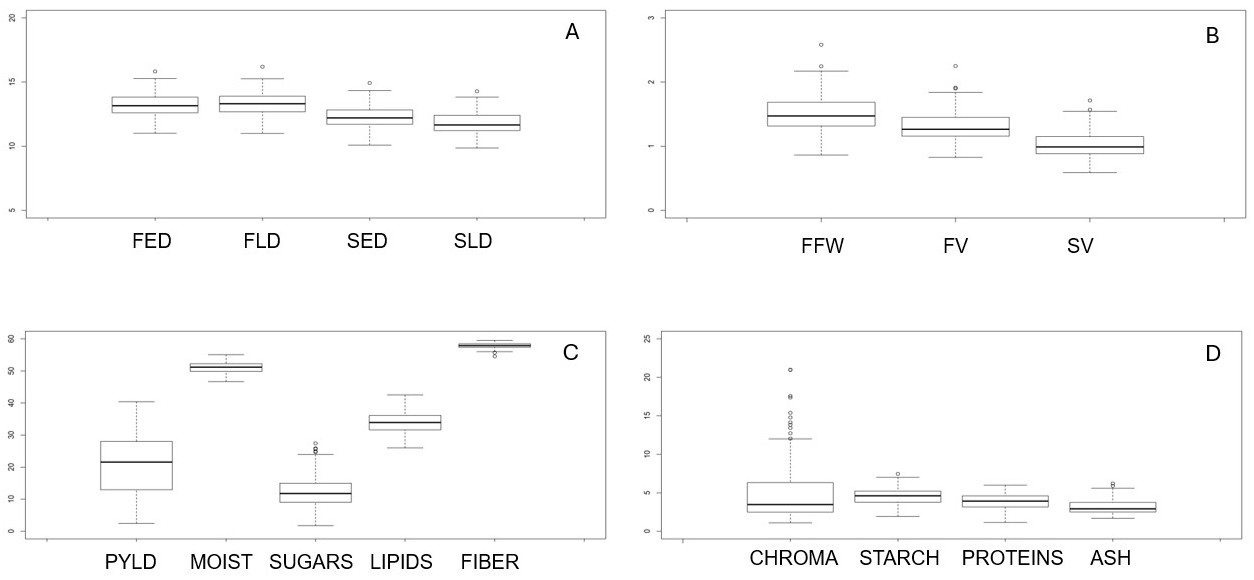
In NIR analyses, the main compounds of the seeds were fiber, with a mean of 57.9% and little variation among samples (CV = 1.42%). Another main compound was lipids, with a mean of 33.9% and low variation (CV = 9.73%). The compound with greatest variation was the soluble sugar content of the seeds (from 0.92% to 18.2%, CV = 42.6%), with a mean value of 12%. The mean starch content was 4.5%, and mean protein content was 3.8% (Figure 1).

Boxplot of the fruit and seed biometric data (evaluated in 138 mother plants) and seed biochemical data (evaluated in 116 mother plants by NIR) of E. edulis. (A) FED = fruit equatorial diameter; FLD = fruit longitudinal diameter; SED = seed equatorial diameter; SLD = seed longitudinal diameter; (B) FFW = fruit fresh weight; FV = fruit volume; SV = seed volume; (C) PYLD = pulp yield based on volume; MOIST = seed moisture content; SUGARS = soluble sugar content of the seeds; LIPIDS = seed lipid content; FIBER = seed crude fiber content; (D) CHROMA = fruit color intensity; STARCH = seed starch content; PROTEINS = total protein content of the seeds; ASH = seed ash content.
The fruit and seed biometric data (diameter, weight, and volume) showed less variation than seed composition did (Figure 2). For FED, FLD, SED, SLD, FFW, FV, and SV, the maximum and minimum values are not far from the mean, and there are few outliers.

Heatmap based on the correlations between the traits of the fruit and seed biometric data and seed biochemical data of E. edulis. FFW = fruit fresh weight; FV = fruit volume; FED = fruit equatorial diameter; FLD = fruit longitudinal diameter; SED = seed equatorial diameter; SV = seed volume; SLD = seed longitudinal diameter; ASH = seed ash content; SUGARS = seed soluble sugar content; CHROMA = fruit color intensity; MOISTURE = seed moisture; PYLD = pulp yield; PROTEIN = seed total protein content; FIBER = seed crude fiber content; LIPIDS = seed lipid content; STARCH = seed starch content.
Pulp yield was the most variable trait (mean = 21%; CV of 39.2%), and it had wide amplitude in the boxplot (Table 2 and Figure 1C). Seed soluble sugar content and the chroma (related to color intensity and fruit ripeness) also had wide variation. Furthermore, these traits had many points of atypical value (outliers), indicating values greater than the mean (Figures 1C, D). Starch, proteins, and ash had little variation (Figure 1D); moisture and fiber showed the least variation among the traits evaluated.
Significant correlations were observed among the biometric traits, correlating the volume data with weight and the fruit and seed diameters (FV with FFW and FED; SV with SED) (Figure 2).
4. Discussion
Seeds represent around 79% of the volume of the fruit, which indicates the large amount of residue (seeds) generated from pulping E. edulis. The juçara pulp yield (21%) has high phenotypic variation and it was not directly correlated with fruit size.
Fiber was the main compound of the seeds (58%), corroborating the data of Carpiné et al. (2020) who found 76% fiber, of which 68.6% was insoluble and 1.3% soluble.
The total lipid content in the seeds ranged from 12.18% to 27.20%. Carpiné et al. (2020) did not detect lipids in the seeds, possibly due to the extraction method used (Schoch and Maywald, 1968), which prepared the samples for starch characterization. Given the high content observed in the present study compared to other studies, standardization of the methodology regarding collection, sample preparation, storage, and extraction is recommended, to validate the comparison. Furthermore, complementary studies are necessary to determine the use of the oil from seeds, such as quantification and qualification of fatty acids.
Studies reported by Panza et al. (2004, 2009) show that the endosperm tissue of E. edulis is very hard, and the cells store lipids and proteins. The cytoplasm is reduced to the interstices between the protein and lipid bodies and the nucleus, which occupies most of the volume of the cells. The cell structure of the endosperm and its large nucleus may be related to the predominance of linoleic acid, which is one of the main fatty acids associated with membrane construction in plants. These authors report that among the free fatty acids in the endosperm of juçara seeds, 65% are unsaturated, predominantly linoleic acid (Panza et al., 2009), unlike seeds from other palm trees, in which saturated fatty acids predominate, such as lauric, myristic, and palmitic acids.
The high unsaturation of fatty acids in membranes increases their fluidity and increases the susceptibility of fatty acids to degradation (Panza et al., 2009), which raises the hypothesis that the E. edulis seeds are subject to rapid degradation of lipids. That may occur especially as a result of factors of the collection environment, in preparation, and in storage. These factors may have led to the variable lipid contents detected in this and in other studies on E. edulis seeds.
Carpiné et al. (2020) identified that juçara seed meal can be used as a non-conventional source of starch, with a 12.21% level of starch reserves, and it can be used as a product of nutritional value with gelling properties through the presence of amylopectin. These authors also identified 4.55% proteins. In the present study, the starch content was on average 6.19% and soluble sugars 6.35%, for a total of 12.54% carbohydrates; the soluble sugar content was quite variable. The protein content was 4.97% on average.
The results obtained in the present study and in the aforementioned literature suggest the use of juçara seeds for production of meal for human and animal consumption, as it is composed of high fiber content and important carbohydrate and lipid levels.
Due to the physical hardness of the seeds and the difficulty in grinding them, analyses were made of lignin content. However, low levels were observed, and the seeds are not recommended for use for industrial purposes with the aim of obtaining lignin. However, the high energy potential found indicates possible use of intact seeds as biochar.
From NIR analyses, it was possible to characterize the diversity of the biochemical composition of E. edulis seeds, confirming fiber as the main compound, with little variation among the samples. It exhibited a mean of 57.9%, a value quite near that observed in initial sampling, which was 58.91%. The compound found in second largest quantity, lipids, had a greater mean value by NIR analysis than by conventional analysis, with low variation. The compound that had the greatest variation among the samples was the soluble sugar content of the seeds.
Both in prospection by NIR and by conventional analysis, the high coefficient of variation observed indicates the highly variable biochemical composition among the 116 individuals, which is expected, since E. edulis is a plant resource with wide genetic variability (Carvalho et al., 2020; Mengarda et al., 2022; Pereira et al., 2022) and tends to show considerable phenotypic variation (Carvalho et al., 2020; Canal et al., 2023).
In addition, mobilization of the juçara seed reserves is singulary, since the seeds are recalcitrant (Panza et al., 2004, 2009; Mello et al., 2022). Regarding the lipid reserves of the seeds, upon associating information on the predominant composition of unsaturated fatty acids in the endosperm, which leads to membranes more prone to lipid degradation, it is understood that lipid levels are quite subject to variation.
In light of the above, analysis of the composition of the seeds of this sample of individuals by NIR validates the methodology for analysis of the composition of juçara seeds. Near-infrared (NIR) spectroscopy is a highly flexible and non-destructive analysis tool for remote detection of the physical-chemical composition of samples; it can be applied to research and to industrial processes. Thus that need to be optimized, and it can be better utilized.
By exploratory analysis of the biometric and biochemical data obtained from fruit and seeds of E. edulis, moisture and fiber content showed the least variation in the data, whereas pulp yield is quite variable. The seed soluble sugar content and the chroma (related to color intensity and fruit ripeness) also exhibited wide variation. Furthermore, these traits showed many points of atypical values (outliers), indicating values above the mean observed. The variation in the data observed in this study is not only expected, but also positive. The performance of an individual (phenotype) is the result of genetic effects together with the environmental effects, a potential that can be taken advantage of in breeding programs with the aim of increasing yield.
However, given this variation, the correlations might not be clearly seen. Significant correlations were observed among the biometric traits. It was clear that the volumes, both of the fruit and of the seed, are related to greater equatorial diameters.
Furthermore, some interesting observations can be made from the biochemical and physiological perspective: pulp yield of the fruit was not correlated with fruit size. The chroma (indicator of fruit ripeness) and the soluble sugar content of the seeds may be positively related, which would be expected, since the degree of fruit ripeness affects seed reserve mobilization, considering coordinated mobilization and availability of the energy and reserve sources, especially soluble sugar and lipids during the seed physiological maturation process.
According to Mello et al. (2022), the greatest accumulation of lipids and fibers is in physiological maturation of the juçara seed. It was observed that lipid and sugar content of the seeds may be negatively related, which would be expected since lippids may convert in sugars, and vice versa, during the mobilization of reserves to achieve physiological maturity.
Furthermore, the embryonic cells of E. edulis do not have many energy reserves, but they are in an active state, indicating a strategy of continuous development without interposition of a state of desiccation, which is consistent with the recalcitrant response of its seeds (Panza et al., 2004). This subtle dynamic leads us to believe that the maturity stage of the fruit and seeds at the time of collection and the processing that occurs from the time of collection, transport, preparation of the samples, and storage are related to the biochemical composition of the E. edulis seeds of the sample of individuals studied.
5. Conclusions
The pulp yield of Euterpe edulis was estimated at 21%; thus, 79% of biomass is seeds. The seeds are mainly composed of fiber, as well as important levels of carbohydrates and lipids. Thus, this suggests the production of meal for human and animal consumption as a possible use for the seeds and more studies are recommended on the use of oil from the seeds. It also suggests the use of intact seeds as biochar.
The sustainability of the agribusiness and of the production processes is confirmed and when encouraging production of juçara pulp and suggesting alternatives for the use of seeds (reducing waste), this study contributes to placing value on and conserving genetic resources, as well as development of new technologies that enable agroforestry production with maximum social and economic returns, but with minimal environmental impact.
Acknowledgements
Our thanks to the Empresa Açaí Juçara of Rio Novo do Sul, ES - Brazil. Fundação de Amparo à Pesquisa e Inovação do Espírito Santo – FAPES. To CAPES and to the CNPq.
-
Data Availability Statement
We sent the article “Biometric and biochemical characterization for potential uses of Euterpe edulis seeds” to Brazilian Journal of Biology for publication. The manuscript is unpublished and has not been submitted for publication anywhere else. The authors may declare that data is available upon request.
References
- ASSOCIATION OF OFFICIAL AGRICULTURAL CHEMISTS – AOAC, 1990. Official methods of analysis Arlington: AOAC, vol. 1.
-
BLIGH, E.G. and DYER, W.J., 1959. A rapid method of total lipid extraction and purification. Canadian Journal of Biochemistry and Physiology, vol. 37, no. 8, pp. 911-917. http://doi.org/10.1139/o59-099 PMid:13671378.
» http://doi.org/10.1139/o59-099 -
CANAL, G.B., BARRETO, C.A.V., DE ALMEIDA, F.A.N., ZAIDAN, I.R., COUTO, D.P., AZEVEDO, C.F., NASCIMENTO, M., FERREIRA, M.F.S. and FERREIRA, A., 2023. Single and multi-trait genomic prediction for agronomic traits in Euterpe edulis. PLoS One, vol. 18, no. 4, e0275407. http://doi.org/10.1371/journal.pone.0275407 PMid:37027420.
» http://doi.org/10.1371/journal.pone.0275407 -
CARPINÉ, D., DAGOSTIN, J.L.A., MAZON, E., BARBI, R.C.T., ALVES, F.E.S.B., CHAIMSOHN, F.P. and RIBANI, R.H., 2020. Valorization of Euterpe edulis Mart. agroindustrial residues (pomace and seeds) as sources of unconventional starch and bioactive compounds. Journal of Food Science, vol. 85, no. 1, pp. 96-104. http://doi.org/10.1111/1750-3841.14978 PMid:31872872.
» http://doi.org/10.1111/1750-3841.14978 -
CARVALHO, L.M.J.D., ESMERINO, A.A. and CARVALHO, J.L.V.D., 2022. Jussaí (Euterpe edulis): a review. Food Science and Technology, vol. 42, e08422. http://doi.org/10.1590/fst.08422
» http://doi.org/10.1590/fst.08422 -
CARVALHO, M.S., FERREIRA, M.F.S., OLIVEIRA, W.B.S., MARÇAL, T.S., GUILHEN, J.H.S., MENGARDA, L.H.G. and FERREIRA, A., 2020. Genetic diversity and population structure of Euterpe edulis by REML/BLUP analysis of fruit morphology and microsatellite markers. Crop Breeding and Applied Biotechnology, vol. 20, no. 4, e31662048. http://doi.org/10.1590/1984-70332020v20n4a61
» http://doi.org/10.1590/1984-70332020v20n4a61 -
MELLO, T., ROSA, T.L.M., SIMÕES, I.M., LIMA, P.A.M., ANJOS, B.B., ARAUJO, C.P., HEGEDUS, C.E.N., SANTOS, H.O., OTONI, W.C., ALEXANDRE, R.S. and LOPES, J.C., 2022. Reserve mobilization and in vitro germination of Euterpe edulis (Martius) seeds at different maturation stages. Trees, vol. 36, no. 1, pp. 415-426. http://doi.org/10.1007/s00468-021-02216-6
» http://doi.org/10.1007/s00468-021-02216-6 -
MENGARDA, L.H.G., CANAL, G.B., CARVALHO, M.S., FERREIRA, A. and FERREIRA, M.F.S., 2022. Genetic diversity of juçara palm: an alternative for selection and conservation in cash crop for fruit production. Frontiers in Forests and Global Change, vol. 5, e859081. http://doi.org/10.3389/ffgc.2022.859081
» http://doi.org/10.3389/ffgc.2022.859081 -
MORAES, M.C., MENGARDA, L.H.G., CANAL, G.B., PEREIRA, P.M., FERREIRA, A. and FERREIRA, M.F.S., 2020. Diversidade genética de matrizes e progênies de Euterpe edulis Mart. em área manejada e em populações naturais por marcadores microssatélites. Ciência Florestal, vol. 30, no. 2, pp. 583-594. http://doi.org/10.5902/1980509837647
» http://doi.org/10.5902/1980509837647 - OLIVEIRA, W.B.S., FERREIRA, A., GUILHEN, J.H.S., MARÇAL, T.S., FERREIRA, M.F.S. and SENRA, J.F.B., 2015. Análise de trilha e diversidade genética de Euterpe edulis Martius para caracteres vegetativos e de frutos. Scientia Forestalis, vol. 43, no. 106, pp. 303-311.
- PALUDO, G.F., SILVA, J.Z. and REIS, M.S., 2012. Estimativas de produção de frutos de palmiteiro (Euterpe edulis Mart.) a partir da densidade de Indivíduos. Biodiversidade Brasileira, vol. 2, no. 2, pp. 92-102.
-
PANZA, V., LAINEZ, V. and MALDONADO, S., 2004. Seed structure and histochemistry in the palm Euterpe edulis. Botanical Journal of the Linnean Society, vol. 145, no. 4, pp. 445-453. http://doi.org/10.1111/j.1095-8339.2004.00293.x
» http://doi.org/10.1111/j.1095-8339.2004.00293.x -
PANZA, V., PIGHIN, D., LÁINEZ, V., POLLERO, R.J. and MALDONADO, S., 2009. Storage lipids and proteins of Euterpe edulis seeds. Biocell, vol. 33, no. 2, pp. 99-106. http://doi.org/10.32604/biocell.2009.33.099 PMid:19886037.
» http://doi.org/10.32604/biocell.2009.33.099 -
PEREIRA, A.G., FERREIRA, M.F.S., SILVEIRA, T.C., SOLER-GUILHEN, J.H., CANAL, G.B., ALVES, L.B., ALMEIDA, F.A.N., GAIOTTO, F.A. and FERREIRA, A., 2022. Patterns of genetic diversity and structure of a threatened palm species (Euterpe edulis Arecaceae) from the Brazilian Atlantic Forest. Heredity, vol. 129, no. 3, pp. 161-168. http://doi.org/10.1038/s41437-022-00549-7 PMid:35697755.
» http://doi.org/10.1038/s41437-022-00549-7 -
R CORE TEAM, 2017 [viewed 20 August 2024]. R: a language and environment for statistical computing [online]. Vienna: R Foundation for Statistical Computing. Available from: https://www.r-project.org/
» https://www.r-project.org/ - SCHOCH, T.J. and MAYWALD, E.C., 1968. Preparation and properties of various legume starches. Cereal Chemistry, vol. 45, pp. 564.
- SILVA, D.J. and QUEIROZ, A.C., 2006. Análise de alimentos: métodos químicos e biológicos. 3. ed. Viçosa: UFV, 235 p.
- SILVA, P.P.M., CARMO, L.F., SILVA, G.M., SILVEIRA-DINIZ, M.F., CASEMIRO, R.C. and SPOTO, M.H.F., 2013. Physical, chemical, and lipid composition of juçara (Euterpe edulis Mart.) pulp. Brazilian Journal of Food and Nutrition, vol. 24, no. 1, pp. 7-13.
-
SOUZA-PEREIRA, D.C., SANTOS-GOMES, F., TONON, R.V., BERES, C. and CABRAL, L.M.C., 2023. Towards chemical characterization and possible applications of juçara fruit: an approach to remove Euterpe edulis Martius from the extinction list. Journal of Food Science and Technology, vol. 60, no. 2, pp. 429-440. http://doi.org/10.1007/s13197-021-05342-8 PMid:36712206.
» http://doi.org/10.1007/s13197-021-05342-8 -
THEANDER, O. and WESTERLUND, E.A., 1986. Studies on dietary fiber: 3 improved procedures for analysis of dietary fiber. Journal of Agricultural and Food Chemistry, vol. 34, no. 2, pp. 330-336. http://doi.org/10.1021/jf00068a045
» http://doi.org/10.1021/jf00068a045 -
TIBERIO, F.C.S., SAMPAIO-E-SILVA, T.A., DODONOV, P., GARCIA, V.A. and SILVA-MATOS, D.M., 2012. Germination and allometry of the native palm tree Euterpe edulis compared to the introduced E. oleracea and their hybrids in Atlantic rainforest. Brazilian Journal of Biology = Revista Brasileira de Biologia, vol. 72, no. 4, pp. 955-962. http://doi.org/10.1590/S1519-69842012000500025
» http://doi.org/10.1590/S1519-69842012000500025 - TROIAN, L.C., CORBELLINI, L.M. and BUFALO, H.B., 2014. Cartilha da juçara (Euterpe edulis): informações sobre boas práticas e manejo Rio de Janeiro: Ministério do Meio Ambiente.
-
YEMM, E.W. and WILLIS, A.J., 1954. The estimation of carbohydrates in plant extracts by anthrone. The Biochemical Journal, vol. 57, no. 3, pp. 508-514. http://doi.org/10.1042/bj0570508 PMid:13181867.
» http://doi.org/10.1042/bj0570508
Edited by
-
Editor:
Takako Matsumura Tundisi
We sent the article “Biometric and biochemical characterization for potential uses of Euterpe edulis seeds” to Brazilian Journal of Biology for publication. The manuscript is unpublished and has not been submitted for publication anywhere else. The authors may declare that data is available upon request.