 Effects of agronomic practices on the technological quality of narrow-leaved lupine seeds under northern Kazakhstan conditions
Abstract
The global shortage of protein in animal feed has increased interest in legume crops due to their high nutritional value. Narrow-Leaved lupine (Lupinus angustifolius L.) is a promising crop for dryland farming, especially in Northern Kazakhstan, thanks to its adaptability and protein-rich seeds. This study aims to evaluate the effects of sowing dates, seeding rates, and seed treatments with plant growth regulators on the productivity and technological quality of lupine seeds. Field experiments were conducted under arid steppe conditions. Three sowing dates (May 5, 10, and 15), three seeding rates (0.8, 1.0, and 1.2 million viable seeds per hectare), and seed treatments with “Megamix Seeds” and “Megamix Phosphorus” were tested. The highest seed quality and yield were obtained with sowing on May 5 at a rate of 1.0 million viable seeds per hectare. Combined treatment with both growth regulators led to the maximum protein (868 kg/ha) and oil content (315 kg/ha). These results demonstrate the potential of specific agronomic practices to improve seed quality in narrow-leaved lupine and offer a basis for recommendations in dry farming systems of Northern Kazakhstan.
Keywords:
lupine; sowing dates; seeding rates; growth regulators; seed quality
Resumo
A escassez global de proteína na alimentação animal tem impulsionado o interesse por culturas leguminosas, em razão de seu alto valor nutricional. O tremoço-de-folha-estreita (Lupinus angustifolius L.), conhecido por seu alto valor biológico e adaptabilidade às condições secas, é uma cultura promissora para o norte do Cazaquistão. Este estudo apresenta os resultados de ensaios de campo destinados a avaliar os efeitos das datas de semeadura, densidades de semeadura e tratamentos de sementes com reguladores de crescimento na produtividade e na qualidade tecnológica das sementes de tremoço. Os experimentos foram conduzidos nas condições de estepe árida do norte do Cazaquistão. Foram testadas três datas de semeadura (5, 10 e 15 de maio), três densidades de semeadura (0,8; 1,0 e 1,2 milhão de sementes viáveis/ha) e tratamentos de sementes com os produtos biológicos “Megamix Seeds” e “Megamix Phosphorus”. Os melhores resultados de produtividade e qualidade das sementes foram obtidos com semeadura em 5 de maio e densidade de 1,0 milhão de sementes viáveis por hectare. O tratamento combinado em ambos os reguladores de crescimento resultou no teor máximo de proteína (até 868 kg/ha) e óleo (até 315 kg/ha). Esses resultados confirmam a eficácia dos métodos agronômicos para melhorar a qualidade das sementes de tremoço-de-folha-estreita e podem servir como base para o desenvolvimento de recomendações para o cultivo da cultura em condições áridas do norte do Cazaquistão.
Palavras-chave:
tremoço; datas de semeadura; densidade de semeadura; reguladores de crescimento; qualidade da semente
1. Introduction
Legume crops represent a crucial component in global feed and food systems due to their high protein content, typically ranging from 20% to 50% in both green biomass and seeds. Among these, narrow-leaved lupine (Lupinus angustifolius) is emerging as a promising forage and protein crop, particularly suitable for cultivation under dry and nutrient-limited conditions such as those in the steppe zone of Northern Kazakhstan. One of the most critical quality traits of lupine grain is its protein content, which plays an essential role in animal nutrition. A deficiency in dietary protein can lead to reduced livestock productivity and impaired metabolic health. Although narrow-leaved lupine remains a relatively new and underutilized crop in Kazakhstan, its cultivation has been steadily expanding in recent years due to its drought tolerance and high protein value. Globally, lupine is grown on over 1 million hectares, with major production areas located in Australia, Russia, Poland, and Germany (FAO, 2022). These countries utilize lupine primarily for livestock feed, green manure, and as a sustainable alternative to imported soybean meal.
Kazakhstan’s agriculture faces a significant challenge in addressing protein shortages in animal feed, primarily due to climatic constraints and limited cultivation of legume crops. Increasing the area under lupine cultivation and optimizing its agro-technological practices may offer a viable solution to this problem. Agronomic factors such as sowing date, seeding rate, and nutrient availability are known to influence seed productivity and quality, particularly the accumulation of protein and oil content (Smith and Johnson, 2019).
In the context of Kazakhstan, narrow-leaved lupine is a relatively new crop and is not yet widely integrated into existing crop rotations. Due to limited prior experience, a standardized national production system has not yet been developed. However, valuable insights can be drawn from adjacent regions with similar agroclimatic conditions—such as the Volga region, Altai Krai, and Orenburg Oblast in Russia, as well as Belarus, Ukraine, and parts of Eastern Europe—where lupine has been successfully cultivated for decades (Kurlovich et al., 2015).
In these areas, lupine is typically sown in early spring (late April to early May), when the soil temperature reaches 5-7 °C and field conditions allow for timely mechanized seeding. Optimal seeding rates range from 0.8 to 1.2 million viable seeds per hectare, adjusted according to soil moisture and seed size. Minimal nitrogen fertilization is used, as lupine fixes atmospheric nitrogen via symbiotic rhizobia, but phosphorus and potassium are often applied pre-sowing to improve root development and seed formation. Seed inoculation with nitrogen-fixing bacteria or biostimulants is a common practice (Ngafwan et al., 2022).
Weed management relies on either pre-emergence herbicides or mechanical inter-row cultivation, as lupine seedlings are initially less competitive. Soil surface loosening (harrowing) is sometimes carried out in early stages to break crusts and enhance emergence. These components form the basis of a low-input yet effective cultivation strategy for lupine in dryland systems. Adoption of these best practices in Kazakhstan, adapted to local soil and climate conditions, could facilitate successful scaling of lupine production in the region.
Lupine protein is considered complete, containing essential amino acids, with fractions including albumins (38%), globulins (35%), glutelins (4.5%), and prolamins (0.6%). In some cultivars, the protein content of lupine approaches or exceeds that of soybean. However, its protein concentration is highly sensitive to agroclimatic conditions, cultivar characteristics, and technological practices. Previous studies (Antipova and Bogatyreva, 2018) have shown that suboptimal cultivation practices often lead to reduced protein levels in harvested seed, emphasizing the need for agronomic optimization to maximize quality traits (Farooq et al., 2012)
Sowing time is a key factor influencing seed composition. Early sowing tends to enhance vegetative development and protein accumulation, while delayed sowing shortens the vegetation period and increases the risk of heat or drought stress during the flowering and seed-filling stages, which negatively affects yield and quality (Smith and Johnson, 2020). Optimal sowing dates allow better use of spring moisture and reduce exposure to environmental stressors during critical phenophases (Primi et al., 2019).
Seeding rate is another critical variable. Excessive density may lead to competition for water and nutrients, while sparse stands reduce yield and crop competitiveness. Optimizing plant population improves canopy structure, reduces lodging risk, and enhances seed quality. Growth regulators, including auxins and micronutrient-based formulations, have also shown positive effects on seed composition by improving nitrogen and carbon metabolism, photosynthesis, and enzymatic activity (Zaharova and Andreeva, 2021).
However, the efficiency of growth regulators can vary depending on environmental conditions. Under drought stress, the impact of biostimulants on protein and oil synthesis may be limited due to restricted plant growth and reduced photosynthetic activity (Chen et al., 2006).
Therefore, this study aims to evaluate the effects of selected agronomic practices—including sowing dates, seeding rates, and seed treatment with growth regulators—on the technological quality of narrow-leaved lupine seeds under the agroclimatic conditions of Northern Kazakhstan.
2. Materials and Methods
The aim of this study was to evaluate the effects of sowing dates, seeding rates, plant growth regulators, and seed priming techniques on the yield and technological seed quality of Narrow-Leaved lupine (Lupinus angustifolius) under the conditions of the steppe zone of Northern Kazakhstan.
The following agronomic treatments were included in the two experiment:
Experiment 1. Sowing dates: May 5, May 10, and May 15 and Seeding rates: 0.8, 1.0, and 1.2 million viable seeds per hectare;
Experiment 2. Plant growth regulators and seed priming treatments:
-
Control (untreated) – Seeds were sown without any pre-sowing treatment;
-
Megamix Seeds – фcommercial micronutrient formulation applied to seeds at 1.5 L/t prior to sowing. Composition: zinc (Zn) – 2.0%, manganese (Mn) – 1.5%, copper (Cu) – 0.5%, molybdenum (Mo) – 0.05%, iron (Fe) – 0.3%, along with organic acids and growth-promoting additives.Function: Stimulates seed germination, root initiation, and improves early vigor by enhancing enzymatic and respiratory activity;
-
Megamix Seeds + Megamix Profi – Seeds were treated with Megamix Seeds (1.5 L/t) and later received a foliar application of Megamix Profi at 0.7 L/ha during the vegetative stage. Megamix Profi Composition: nitrogen (N) – 5.0%, phosphorus (P2O5) – 4.0%, potassium (K2O) – 3.0%, magnesium (MgO) – 0.5%, plus Zn, Mn, Fe, B, and Mo in chelated form. Function: Supports chlorophyll synthesis, improves photosynthesis efficiency, and stimulates cell division and metabolism under abiotic stress;
-
Megamix Seeds + Boron – Seeds treated with Megamix Seeds (1.5 L/t) and foliar-sprayed with a boron formulation (1.0 L/ha) at the beginning of flowering. Boron formulation composition: boron (B) – 11.0% in the form of boric ethanolamine. Function: Promotes pollen viability, fertilization, and pod set, preventing flower and pod abortion under heat and moisture stress;
-
Megamix Seeds + Phosphorus – Combined seed treatment with Megamix Seeds (1.5 L/t) and foliar application of a phosphorus-based fertilizer (0.5 L/ha), applied according to leaf tissue diagnosis during branching. Phosphorus formulation composition: phosphorus (P2O5) – 15.0%, potassium (K2O) – 10.0%, chelated micronutrients (Fe, Zn, Mn). Function: Enhances energy metabolism (ATP synthesis), root development, and protein synthesis;
-
Hydropriming – Seeds were soaked in clean distilled water at room temperature for 2.5 hours, followed by drying to original moisture content before sowing. Function: Initiates metabolic reactivation and pre-germinative enzyme activity, enhancing uniformity and speed of germination;
-
Nutripriming – Seeds were soaked in a dilute nutrient solution of Megamix Seeds (1.5 L/t) for 2.5 hours, combining hydration and micronutrient uptake. Function: Integrates the benefits of hydropriming and micronutrient enrichment, potentially improving emergence and seedling resilience under suboptimal humid conditions.
2.1. Experimental conditions
The field trials were conducted during the 2023-2024 growing seasons in the steppe zone of Northern Kazakhstan. The tested variety was the medium-ripening Lupinus angustifolius Orlovsky Kormovoy. The soil type was ordinary black soil (chernozem) with neutral pH (6.8-7.2), humus content of 4-6%, low available phosphorus (9.6-12 mg/kg), and nitrogen (4-6 mg/kg).
According to the North Kazakhstan Agricultural Experimental Station, the 2023 growing season was dry, with only 145.4 mm of precipitation from May to August (75% of the climatic norm). Active temperatures totaled 2313 °C, sufficient for lupine maturity. Moderate conditions in June (19.1 °C, 41.1 mm) supported early flowering, while hot and dry July weather (24.1 °C, 22.7 mm) limited biomass accumulation. In 2024, rainfall was significantly higher, especially in May (62.2 mm), slightly delaying emergence without reducing plant density. June (21.1 °C, 50.4 mm) stimulated vegetative growth, while July provided optimal conditions for flowering and seed development, contributing to stable productivity. These patterns are summarized in Table 1.
2.2. Field plot experiment
Field experiments were laid out according to the methodology of B.A. Dospekhov (1985), using a randomized complete block design with four replications. The area of each plot was 20 m2. The preceding crop was clean fallow. In the autumn prior to sowing, ammonium phosphate (ammophos) was applied as a base fertilizer at a rate of 90 kg/ha of active ingredient under primary tillage. No additional mineral fertilizers were applied during the growing season.
2.2.1. Yield and structural productivity
Yield and structural productivity components were assessed according to the methodology of V.M. Lukomets (2010). The harvested area was 20 m2 (entire plot area), and yield was adjusted to 14% standard moisture content and recalculated per hectare.
2.2.2. Seed quality assessment
Crude protein and oil content were determined using a Granolyser device, based on near-infrared spectroscopy (NIR) with a wavelength range of 950-1550 nm and a resolution of 256 pixels.
2.3. Leaf diagnostic
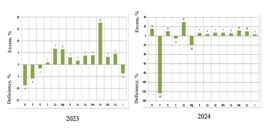
At the budding stage, leaf nutrient status was assessed using the portable laboratory Phytoscan. A pronounced phosphorus deficiency was recorded in both years of study, along with nitrogen deficiency in 2023. Based on diagnostic results, foliar application of Megamix Phosphorus (containing 242 g/L phosphorus and 63 g/L nitrogen) was carried out, as illustrated in Figure 1.
2.4. Statistical analysis
The data were subjected to one-way analysis of variance (ANOVA) using STATISTICA and Microsoft Excel. When significant differences were detected (p < 0.05), treatment means were compared using Tukey’s Honest Significant Difference (HSD) post-hoc test to identify pairwise differences between groups.
3. Results
3.1. Yield and technological seed quality depending on sowing date and seeding rate
The results indicated that both sowing date and seeding rate had a significant effect on the yield, protein content, and oil content in narrow-leaved lupine seeds. The highest seed yield was observed with sowing on May 5 across all seeding rates, especially at 1.0 million viable seeds/ha in 2024 (1.63 t/ha). In contrast, late sowing on May 15 resulted in the lowest yields, down to 0.78 t/ha in 2023 and 1.31 t/ha in 2024.
Protein content ranged from 34% to 39%, with the highest values found under early sowing and lower seeding rates. However, a higher protein concentration did not always correspond to higher total protein yield due to reduced productivity. Oil content remained relatively stable across treatments, but slightly higher values (up to 13.7%) were recorded with earlier and mid-May sowings.
The most balanced and productive combination of traits (yield, protein, and oil content) was achieved with sowing on May 5 and a seeding rate of 1.0 million viable seeds/ha.
The detailed results are presented in Table 2.
Yield and Technological seed quality of Narrow-Leaved Lupine depending on sowing date and seeding rate.
The calculated yield of protein and oil per hectare varied significantly depending on both sowing date and seeding rate. Early sowing (May 5) consistently provided the highest protein and oil yield across both years, particularly under the seeding rate of 0.8 million viable seeds/ha, where maximum values reached 655 kg/ha (protein) and 227 kg/ha (oil) in 2024.
A seeding rate of 1.0 million seeds/ha also demonstrated high and stable productivity, with oil yields exceeding 230 kg/ha across early and mid-May sowing. In contrast, the latest sowing date (May 15) resulted in the lowest protein and oil yields, likely due to a shorter reproductive period and less favorable humid conditions during seed filling. Detailed values are presented in Table 3
3.2. Effect of plant growth regulators and seed priming on yield and seed composition
The results demonstrated a significant effect of seed treatments on yield performance and the technological quality of Narrow-leaved lupine in both years of the study (Table 4, Figure 2). In 2023, the highest grain yield (1.59 t/ha) was obtained with the treatment “Megamix Seeds + Boron,” while “Megamix Seeds + Phosphorus” also produced a statistically comparable result (1.40 t/ha). These treatments exceeded the control by 29-45%. In contrast, the control and hydropriming variants showed the lowest yields (1.09 and 1.12 t/ha, respectively).

Changes in protein and oil yield (kg/ha) of Narrow-leaved lupine under different seed treatments.
Protein content varied between 35% and 37% in 2023, with the highest values recorded under hydropriming and nutripriming (37%). However, due to lower overall yields, the total protein output in these treatments remained limited (Figure 2). Treatments with micronutrient complexes, particularly “Megamix Seeds + Phosphorus” and “Megamix Seeds + Boron,” resulted in both high protein concentration (36%) and superior biomass accumulation.
Oil content followed a similar trend, with values ranging from 12.1% to 12.5%. The highest oil content was observed in the “Megamix Seeds + Profi” and “Megamix Seeds + Phosphorus” treatments. These variants also produced the highest oil yields, confirming their technological advantage. The results of the growth regulator and seed priming treatments on yield, protein, and oil content are presented in Table 4 and Figure 1.
In 2024, yield levels increased across all treatments due to more favorable climatic conditions. The treatment “Megamix Seeds + Phosphorus” yielded the highest grain output (2.06 t/ha), as well as the greatest protein and oil yields—868 kg/ha and 315 kg/ha, respectively. This confirms the effectiveness of this treatment under both moderate and optimal growing conditions. Protein concentration peaked at 40% in both “Megamix Seeds + Phosphorus” and “Megamix Seeds + Boron” treatments. Similarly, oil content was highest (14.5%) in several treatments involving foliar micronutrients.
Statistical analysis confirmed significant differences among treatments for all parameters (p < 0.05). The control variant consistently showed the lowest values for yield, protein, and oil content in both years.
4. Discussion
Our study revealed that the productivity and technological quality of Lupinus angustifolius seeds in the dry steppe zone of Northern Kazakhstan are significantly influenced by the sowing date, seeding rate, and seed treatment methods. The early sowing date (5 May) consistently ensured higher yields and protein output across two contrasting seasons. These results are in agreement with the findings of Smith and Johnson (2020), who emphasized that early sowing extends the vegetative period, enhances root system development, and enables better moisture utilization before the onset of summer drought.
Similarly, Primi et al. (2019) demonstrated that early-sown legumes benefit from cooler spring temperatures and more stable soil moisture, leading to improved biomass accumulation and nutrient uptake. In our trials, higher biomass and pod set observed in early sowings likely contributed to the greater total protein and oil yield, even when percentage content remained moderate (35-36%).
Seeding rate also played a pivotal role: moderate densities (0.8-1.0 million seeds/ha) outperformed higher rates (1.2 million seeds/ha) in both dry and humid conditions. These results align with those of Primi et al. (2019), who found that optimal seeding rates prevent excessive interplant competition, enhance photosynthetically active radiation (PAR) penetration, and improve nutrient use efficiency. In contrast, higher plant densities can limit airflow, light distribution, and root zone space—factors that negatively impact seed filling and quality of seeds (Li et al., 2018).
One of the most remarkable findings was the significant improvement in protein and oil content achieved through foliar applications, especially the combined use of Megamix Seeds + Phosphorus and Megamix Seeds + Boron. These treatments not only increased total yield but also led to the highest protein content (up to 40%) and oil accumulation (up to 14.5%).
This effect can be explained by several physiological and biochemical mechanisms:
Phosphorus is crucial for ATP production and energy transfer during key growth stages, including seed filling. Its foliar application enhances source-sink dynamics by improving assimilate transport to developing seeds (Jha and Warkentin, 2020). In our study, the significant improvement in seed protein and oil content following phosphorus application may be attributed to a suboptimal phosphorus supply in the soil. This assumption is supported by the results of leaf tissue analysis conducted at the branching stage, which revealed phosphorus concentrations below the optimal threshold. These findings suggest that foliar phosphorus supplementation played a corrective role, allowing more efficient nutrient mobilization and metabolic activity during critical phases of seed development (Henderson and Veal, 1948).
Boron plays a key role in maintaining cell wall integrity, membrane functions, and reproductive development, particularly during pollen viability and fertilization. Its presence is also associated with improved nitrogen metabolism and protein synthesis in legume crops (Afzal et al., 2020).
The synergistic use of micronutrient complexes like Megamix appears to stimulate chlorophyll synthesis and photosynthetic efficiency, leading to better carbon and nitrogen assimilation—critical for high protein yield (Taylor et al., 2017).
In contrast, seed priming (both hydropriming and nutripriming) showed limited influence on final seed quality but may still be useful for improving early germination and stand uniformity. Finch-Savage and Bassel (2016) argued that priming prepares seeds for more rapid metabolic activation, particularly under stress conditions. However, as also noted by Ashraf and Foolad (2005), unless followed by favorable post-emergence conditions and nutrient supply, its impact on storage compounds such as protein and oil remains minimal.
The consistency of our results across two distinct growing seasons (dry in 2023 and moderately wet in 2024) reinforces the reliability of these findings. Moreover, they underline the adaptability of narrow-leaved lupine to Kazakhstan's climate and the potential for optimizing crop management strategies to meet the growing demand for high-protein feed crops. The influence of environmental conditions on the productivity and quality of Lupinus angustifolius seeds observed in this study is in line with findings from Portugal, where two-year field trials revealed that both climatic variability and cultivar-specific responses significantly impacted protein content and alkaloid profiles in Lupinus spp. (Valente et al., 2023). These data support the hypothesis that selecting optimal sowing dates and applying tailored agronomic practices can improve not only yield but also qualityof seeds parameters under semi-arid conditions.
Future studies should explore:
-
-the molecular basis of nutrient responsiveness in lupine cultivars;
-
-the interaction between seed treatments and soil microbiota;
-
-and the economic feasibility of micronutrient application in large-scale farming.
Ultimately, integrating early sowing with moderate seeding rates and targeted foliar nutrition represents a promising and sustainable approach to enhance legume productivity in semi-arid zones worldwide.
5. Conclusion
Early sowing on 5 May with a seeding rate of 1.0 million viable seeds/ha demonstrated the best agronomic and quality outcomes across both years. Yields reached 1.37 t/ha in 2023 and 1.63 t/ha in 2024, accompanied by 35-37% protein (441-613 kg/ha) and 12.3-13.7% oil content (155-232 kg/ha). Application of growth regulators significantly enhanced these results: Megamix Seeds + Boron showed the best performance under drought (1.59 t/ha), while Megamix Seeds + Phosphorus achieved the highest productivity in 2024 (2.06 t/ha) and superior quality—40% protein (868 kg/ha) and 315 kg/ha oil. These findings highlight the critical role of optimized sowing time and targeted nutrient-based treatments in improving both yield and seed quality. Therefore, integrating early sowing with phosphorus and boron foliar nutrition is recommended as a sustainable approach to enhance narrow-leaved lupine production in the semi-arid conditions of Northern Kazakhstan.
Based on the two-year experimental results, it is recommended to sow narrow-leaved lupine in early May (preferably May 5) to ensure optimal vegetative development and avoid exposure to late-season heat or drought stress. Regarding plant density, a seeding rate of 1.0 million viable seeds per hectare provided the most consistent results in terms of total seed yield, protein, and oil output, especially under varying climatic conditions. While lower rates (0.8 million/ha) occasionally resulted in higher protein concentrations, the overall protein yield per hectare was maximized at 1.0 million seeds/ha due to higher productivity. Thus, the combination of early sowing and a seeding rate of 1.0 million viable seeds/ha can be considered optimal for balancing seed quality and yield performance in dryland conditions of Northern Kazakhstan.
Data Availability Statement
The dataset supporting the findings of this study is fully presented within the article. No additional data are available.
References
-
AFZAL, I., JAVED, T., AMIRKHANI, M. and TAYLOR, A.G., 2020. Modern seed technology: seed coating delivery systems for enhancing seed and crop performance. Agriculture, vol. 10, no. 11, pp. 526. http://doi.org/10.3390/agriculture10110526
» http://doi.org/10.3390/agriculture10110526 - ANTIPOVA, L.V. and BOGATYREVA, Z.I., 2018. Vliyanie agrotekhnologicheskih elementov na soderzhanie belka v semenah lyupina [Influence of agro-technological elements on protein content in lupine seeds]. Agrochemistry, no. 7, pp. 42-46.
-
ASHRAF, M. and FOOLAD, M.R., 2005. Pre‐sowing seed treatment: a shotgun approach to improve germination, plant growth, and crop yield under saline and non‐saline conditions. Advances in Agronomy, vol. 88, pp. 223-271. http://doi.org/10.1016/S0065-2113(05)88006-X
» http://doi.org/10.1016/S0065-2113(05)88006-X -
CHEN, C., MILLER, P., MUEHLBAUER, F.J., NEILL, K., WICHMAN, D. and MCPHEE, K.E., 2006. Winter pea and lentil response to seeding date and micro- and macro-environments. Agronomy Journal, vol. 98, no. 6, pp. 1655-1663. http://doi.org/10.2134/agronj2006.0085
» http://doi.org/10.2134/agronj2006.0085 - DOSPEKHOV, B.A., 1985. Methodology of field experiments (with basics of statistical processing of research results) 5th ed. Moscow: Agropromizdat, 351 p.
-
FAROOQ, M., WAHID, A. and SIDDIQUE, K.H.M., 2012. Micronutrient application through seed treatments: A review. Journal of Soil Science and Plant Nutrition, vol. 12, no. 1, pp. 125-142. http://doi.org/10.4067/S0718-95162012000100011
» http://doi.org/10.4067/S0718-95162012000100011 -
FINCH-SAVAGE, W.E. and BASSEL, G.W., 2016. Seed vigour and crop establishment: extending performance beyond adaptation. Journal of Experimental Botany, vol. 67, no. 3, pp. 567-591. http://doi.org/10.1093/jxb/erv490
» http://doi.org/10.1093/jxb/erv490 -
FOOD AND AGRICULTURE ORGANIZATION OF THE UNITED NATIONS – FAO, 2022 [viewed 14 June 2025]. FAOSTAT statistical database [online]. Rome: FAO. Available from: http://www.fao.org/faostat/en/
» http://www.fao.org/faostat/en/ -
HENDERSON, J.H. and VEAL, M.P., 1948. The effect of the interrelationship of boron and manganese on the growth and calcium uptake of blue lupine (Lupinus angustifolius L.). Plant Physiology, vol. 23, no. 4, pp. 609-620. http://doi.org/10.1104/pp.23.4.609
» http://doi.org/10.1104/pp.23.4.609 -
JHA, A.B. and WARKENTIN, T.D., 2020. Biofortification of pulse crops: status and future perspectives. Plants, vol. 9, no. 1, pp. 73. http://doi.org/10.3390/plants9010073
» http://doi.org/10.3390/plants9010073 - KURLOVICH, B.S., STANKEVICH, S.V. and KARTUZOVA, L.T., 2015. Lupins (geography, classification, genetic resources and breeding) St. Petersburg: VIR.
- LI, R., LIU, P. and ZHAO, X., 2018. Seeding rate effects on soybean yield and protein content. Agronomy Journal, vol. 110, no. 5, pp. 1470-1480.
- LUKOMETS, V.M., 2010. Experimental fieldwork and analysis of productivity elements in crops Moscow: Kolos, 288 p.
-
NGAFWAN, N., RASYID, H., ABOOD, E.S., ABDELBASSET, W.K., AL-SHAWI, S.G., BOKOV, D. and JALIL, A.T., 2022. Study on novel fluorescent carbon nanomaterials in food analysis. Food Science and Technology, vol. 42, e37821. http://doi.org/10.1590/fst.37821
» http://doi.org/10.1590/fst.37821 -
PRIMI, R., RUGGERI, R., RONCHI, B., BERNABUCCI, U., ROSSINI, F., MARTIN-PEDROSA, M. and DANIELI, P.P., 2019. Sowing date and seeding rate affect bioactive compound contents of chickpea grains. Animals, vol. 9, no. 8, pp. 571. http://doi.org/10.3390/ani9080571
» http://doi.org/10.3390/ani9080571 - SMITH, J. and JOHNSON, L., 2019. Agronomic optimization for pulse-based protein security. Journal of Agronomic Science, vol. 112, no. 2, pp. 212-220.
- SMITH, J. and JOHNSON, L., 2020. The effect of sowing date on quality parameters in legumes. Journal of Agronomic Science, vol. 92, no. 3, pp. 213-219.
- TAYLOR, P., NGUYEN, L. and DUARTE, M., 2017. Micronutrient synergy in legume photosynthetic function. Journal of Plant Nutrition, vol. 40, no. 12, pp. 1710-1724.
-
VALENTE, I.M., SOUSA, C., ALMEIDA, M., MIRANDA, C., PINHEIRO, V., GARCIA-SANTOS, S., FERREIRA, L.M.M., GUEDES, C.M., MAIA, M.R.G., CABRITA, A.R.J., FONSECA, A.J.M. and TRINDADE, H., 2023. Insights from the yield, protein production, and detailed alkaloid composition of white (Lupinus albus), narrow-leafed (Lupinus angustifolius), and yellow (Lupinus luteus) lupin cultivars in the Mediterranean region. Frontiers in Plant Science, vol. 14, pp. 1231777. http://doi.org/10.3389/fpls.2023.1231777
» http://doi.org/10.3389/fpls.2023.1231777 - ZAHAROVA, M.V. and ANDREEVA, S.P., 2021. Auxin-induced changes in oil content of lupine seeds. Plant Biology and Biotechnology, vol. 12, no. 1, pp. 51-56.
Edited by
-
Editor:
Takako Matsumura Tundisi