 Molecular characterization of creole inbred lines from Magdalena, Colombia using Inter Simple Sequence Repeats (ISSRs)
Abstract
The success of hybrid breeding programs depends heavily on the genetic variability present in the breeding material. Molecular characterization is a key approach for conserving native germplasm and optimizing its use in crop improvement. At the University of Magdalena (Colombia), a collection of maize (Zea mays L.) inbred lines remains genetically uncharacterized. This study assessed the genetic diversity of 15 maize genotypes—14 inbred lines and one commercial hybrid—using seven Inter-Simple Sequence Repeat (ISSR) markers distributed throughout the genome. A total of 2.160 bands were amplified, with fragment sizes ranging from 200 to 1.500 base pairs. The percentage of polymorphic loci varied between 45% and 76.19%, and the expected heterozygosity (He) ranged from 0.17 to 0.39, indicating limited allelic diversity among lines. A fixation index (Fst) of 0.26 revealed moderate genetic differentiation, likely due to restricted gene flow and genetic drift from repeated selfing. Analysis of Molecular Variance (AMOVA) showed that 86% of the total genetic variation occurred within lines rather than between them. Cluster analysis using the UPGMA method grouped genotypes into two main clusters with several sub-clusters. The highest genetic similarity (Nei and Li coefficient = 0.63) was observed between two lines, indicating minimal divergence. Genotype distribution was not associated with geographic origin. These findings provide a foundation for selecting genetically divergent parental lines to enhance heterosis in maize hybrid breeding programs and highlight the value of molecular tools in characterizing and utilizing underexplored germplasm collections.
Keywords:
genetic diversity; inbred lines; molecular markers; native germplasm; Zea mays
Resumo
O sucesso de programas de melhoramento híbrido depende fortemente da variabilidade genética presente no material de melhoramento. A caracterização molecular é uma abordagem fundamental para conservar germoplasma nativo e otimizar seu uso no melhoramento de culturas. Na Universidade de Magdalena (Colômbia), uma coleção de linhagens endogâmicas de milho (Zea mays L.) permanece geneticamente não caracterizada. Este estudo avaliou a diversidade genética de 15 genótipos de milho – 14 linhagens endogâmicas e um híbrido comercial – utilizando sete marcadores de repetição de sequência intersimples (ISSR) distribuídos por todo o genoma. Um total de 2.160 bandas foi amplificado, com tamanhos de fragmentos variando de 200 a 1.500 pares de bases. A porcentagem de loci polimórficos variou entre 45% e 76,19%, e a heterozigosidade esperada (He) variou de 0,17 a 0,39, indicando diversidade alélica limitada entre as linhagens. Um índice de fixação (Fst) de 0,26 revelou diferenciação genética moderada, provavelmente devido ao fluxo gênico restrito e à deriva genética resultante de autofecundação repetida. A Análise de Variância Molecular (AMOVA) mostrou que 86% da variação genética total ocorreu dentro das linhagens, e não entre elas. A análise de agrupamento usando o método UPGMA agrupou os genótipos em dois grupos principais com vários subgrupos. A maior similaridade genética (coeficiente Nei e Li = 0,63) foi observada entre duas linhagens, indicando divergência mínima. A distribuição dos genótipos não foi associada à origem geográfica. Essas descobertas fornecem uma base para a seleção de linhagens parentais geneticamente divergentes para aumentar a heterose em programas de melhoramento de híbridos de milho e destacam o valor das ferramentas moleculares na caracterização e utilização de coleções de germoplasma pouco exploradas.
Palavras-chave:
diversidade genética; linhagens endogâmicas; marcadores moleculares; germoplasma nativo; Zea mays
1. Introduction
Globally, Zea mays (corn) is a critical resource, serving as both a staple food for human consumption and a high-quality feed for livestock. It also functions as a fundamental raw material for thousands of industrial products, including those in the starch, oil, protein, alcoholic beverage, food sweetener, pharmaceutical, cosmetic, textile, gum, packaging, and paper industries, among others (Hou et al., 2024). Consequently, its cultivated area has expanded significantly. Among the world's cereal crops, maize holds the first position in total production, although wheat covers a larger acreage. In terms of annual output, global maize production reached 1137 million tons, which is more than 50% higher than both rice and wheat (each at 757 million tons). This substantial difference reflects the considerably higher maize grain yields (5.8 tons/ha), primarily attributed to widespread hybrid cultivation and optimized input utilization (Erenstein et al., 2022).
Maize is widely cultivated across diverse Colombian ecosystems, serving as a vital resource for both human and animal nutrition. Its recent adoption for biofuel production has significantly increased demand (FENALCE, 2023). Indigenous, Afro-descendant, and peasant communities in Colombia's Sierra Nevada de Santa Marta have historically conserved and cultivated local maize ecotypes adapted to various microenvironments (Clemente-Fuente et al., 2022). While these local maize varieties typically exhibit lower yields compared to commercial hybrids, they demonstrate superior agroecological adaptability (Cuesta-Hoyos et al., 2022), for example wild mays like Z. diploperennis and Z. nicaraguensis, they have demonstrated adaptation to stressful environments and water scarcity (Kaur et al., 2025)
Consequently, the characterization of local maize germplasm is imperative for developing high-yielding local seed varieties. Various types of markers, including morphological, biochemical, and DNA-based, have been employed to analyze the diversity and genetic structure of maize populations (Patel et al., 2024). However, despite their widespread use, morphological and biochemical methods are highly susceptible to environmental influences (Patel et al.,2024). To overcome these limitations, a novel approach utilizing molecular markers is now being employed to investigate the relationships among different lines and varieties (Kumar et al., 2022). The expression of DNA-based molecular markers is minimally affected by environmental factors, thus mitigating genotype × environment interactions. This inherent stability allows these markers to accurately reflect the true level of genetic variation within populations. As a result, their application in population analyses has led to significant advancements (Mukhlif et al., 2023).
DNA-based markers such as restriction fragment length polymorphisms (RFLPs) (Jajoriya et al., 2025), random amplified polymorphic DNAs (RAPDs) (Berhitu et al., 2019), amplified fragment length polymorphisms (AFLPs) (Tafa and Abenezer, 2022), inter- simple sequence repeats (ISSRs) (Al-Naggar et al., 2022) and single nucleotide polymorphism (SNPs) (Song et al., 2025) markers have been used extensively in various genetic analyses in maize. Microsatellite sequences border areas in the genome known as inter-simple sequence repeats (ISSRs). These markers leverage microsatellite sequences bordering regions in the genome. When these regions are amplified via PCR using a single primer, they yield multiple products. These products serve as a dominant multilocus marker system, enabling the study of genetic variation across diverse organisms. Compared to other prevalent markers, ISSR markers are less methodologically demanding, cost-effective, and straightforward to implement (Al-Naggar et al., 2022) and other crops (Peña-Ortega et al., 2025). Numerous studies have concluded that ISSR markers are effective for evaluating genetic variability due to their high reproducibility and strong polymorphism detection capabilities (Mukhlif et al., 2023).
In Colombia, research on maize germplasm has revealed significant genetic variability, underscoring the importance of its conservation and potential utilization in plant breeding programs (Rojas-Pantoja, 2015; Pardey-Rodríguez and Moreno-Cortes, 2015; Peña-Cuellar, 2017). The molecular evaluation of inbred maize lines is crucial for assessing their diversity and guiding their inclusion in breeding initiatives (Mukhlif et al., 2023). Molecular markers based on allele frequencies describe the level of genetic differentiation through distance or fixation indices; Genetic patterns detect inbreeding and its possible consequences for the viability of individuals in allogamous populations where the inbreeding effect affects the viability of individuals due to the loss of alleles (Kumar et al., 2022). Therefore, this research aims to employ ISSR (Inter-Simple Sequence Repeat) markers as molecular tools. These will be used to estimate genetic similarity and analyze the genetic variability within inbred lines of landrace maize. The ultimate goal is to identify suitable parental lines for crosses, thereby producing hybrid seed for reintroduction into Colombia's mountainous regions.
2. Material and Methods
2.1. Plant material
Fourteen inbred maize lines from the University of Magdalena's working collection, along with one commercial hybrid from the Caribbean region (Table 1), were cultivated in identified trays under greenhouse conditions. The plant material, called CIMMYT Sinfín, comes from the department of Magdalena; UNAL, is a material donated by the National University of Colombia, Palmira Campus, which originates in the department of Magdalena; Synko, a commercial hybrid of Syngenta, sold in the Caribbean Region of Colombia; and ZmMag Col, a germplasm donated by CIMMYT and originating in the department of Magdalena.
At 15 days post-emergence, leaf tissue was harvested from each row and stored at -80 °C until molecular analysis. The parental lines of these 14 inbreds have been previously phenotypically characterized by Pardey-Rodríguez and Moreno-Cortes (2015) and Pardey-Rodríguez et al. (2016).
2.2. Extraction DNA
Genomic DNA was extracted from approximately 200 mg of healthy young maize leaf tissue, which was macerated in liquid nitrogen. The extraction followed a modified protocol based on Dellaporta et al. (1983), adapted for maize seedlings. DNA integrity was verified via electrophoresis on a 0.8% agarose gel using a Maxicell Primo EC-340 Electrophoresis Gel System chamber, and visualized with GelRed dye (Biotium, USA). DNA concentration and purity were determined spectrophotometrically using an-Agilent Bio Tek Epoch 2 NS-SI, measuring absorbance ratios at A260/A280 nm. Finally, DNA was diluted to a working concentration of 10 ng/µl in HPLC water, with a total volume of 100 µl, and stored at -20 °C (Table 2).
2.3. ISSR amplification
For each sample, seven pre-selected ISSR primers were amplified (Table 2). These primers were chosen from a database of previously applied ISSRs due to their high polymorphic content and broad genomic coverage (Morillo et al., 2023). Amplification reactions were prepared in sterile 1.5 mL microcentrifuge tubes, with a total reaction volume of 25 µL. Each reaction mixture contained: 20 ng of genomic DNA; 2 µmol primers, 1 µl Taq DNA polymerase; 0.2 mM dNTPs; 1.5 mM MgCl2 and 1X Buffer. The amplification program was carried out in a PTC-100 Programmable Thermal Controller thermocycler from MJ Research, Inc. Initial denaturation was 95 °C for 5 minutes; 37 cycles of denaturation at 95 °C for 30 seconds, Hybridization: 50 °C (AG primer); 41 °C (CT and CA primer); 55 °C (CCA-TG- primer); 58 °C (GT primer) and 61 °C (CGA primer) for 45 seconds. With an extension step at 72 °C for 2 minutes, and the final Extension at 72 °C for 7 minutes (Table 3). Amplification products were then separated by electrophoresis on a 2% agarose gel. Gels were run in 0.5X TBX buffer at 40 volts for 45 minutes using a Maxicell Primo EC 340 gel electrophoresis system, stained with GelRed dye, and subsequently visualized under a transilluminator.
2.4. Statistical analysis
The analyses were carried out only with those bands that showed clear amplification. A binary matrix of presence (1) and absence (0) was generated. The genetic diversity parameters that were estimated with the TFPGA program (Tools for Population Genetic Analysis, version 1.3, 1997) (Miller, 1997) were the percentage of polymorphic loci, the heterozygosity index (He). The unbiased statistical F diversity index was determined with an interval of 95% confidence. The genetic similarity analysis was performed with the coefficient Nei and Li (1979), using the SIMQUAL program from the Numerical Taxonomy System for Personal Computer package (NTSYS-pc 2.1) (Rohlf, 2000) which generates a dendrogram. The GenAlex 6.5 program was used for Analysis of Molecular Variance (AMOVA), who establishes the existence of groups in the population.
3. Results
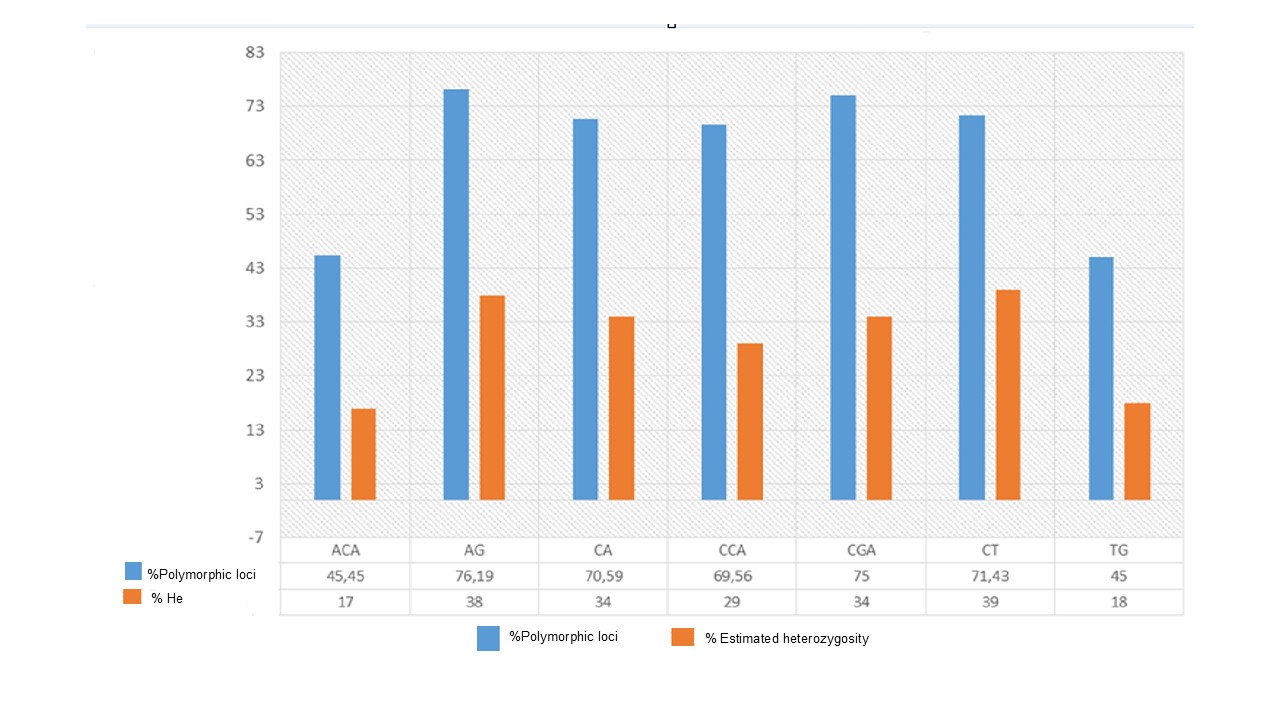
The molecular analysis of 14 inbred lines and one commercial hybrid using seven ISSR primers generated a total of 2160 bands. These bands exhibited molecular weights ranging from 200 to 1500 pb. The expected heterozygosity (He) among the lines ranged from 0.17 to 0.39, with an average value of 0.29. Five of the primers (AG, CA, CCA, CGA, CT) yielded He values higher than this average (Figure 1), with the highest theoretical value being 0.5. These findings suggest the presence of genetic diversity within the creole maize working collection, attributed to the occurrence of heterozygous individuals (Table 4). Furthermore, these five primers were the ones that presented percentages of polymorphic loci greater than 70% (Figure 1).

The fixation index (Fst) for the entire population was 0.25, which means that there is a high genetic differentiation (Wright, 1978), due to the allogamous nature of the species which tends to favor the presence of heterozygous individuals (Table 5). The analysis of molecular variance (AMOVA) revealed that the genetic structure of the 14 inbred lines and the commercial genotype showed that greatest genetic variation occurring within each group (86%) rather than between groups (14%) (Table 6). The analysis utilized the Nei-Li coefficient (Nei and Li, 1979) with a similarity level of 0.63, it formed six groups in which a loose distribution of individuals could be observed and there was no defined pattern of association (Figure 2).

Dendrogram of creole maize from the Colombian Caribbean coast based on the similarity coefficient Nei and Li (1979).
4. Discussion
Based on these results using ISSR as molecular markers on 15 maize genotypes from East Nusa Tenggara, revealed that some of the cultivars show a variety of DNA concentration and DNA purity from the department of Magdalena. The observed number of bands and polymorphism percentages in this study are suitable for robust genetic diversity estimation, aligning with findings from other ISSR-based investigations (Soliman et al., 2021). ISSRs are recognized as highly polymorphic markers, effective for discriminating even closely related maize genotypes, which has been demonstrated in the evaluation of the genetic diversity of both wild and cultivated germplasm (Al-Naggar et al., 2022; Mukhlif et al., 2023). For instance, Valiyeva et al. (2019) reported a 94.6% polymorphism rate using ISSR markers in dark-seeded maize from Azerbaijan. Similarly, Amoon and Abdul-Hamed (2020) found 88.3% predominant polymorphism proportion with ISSRs, further demonstrating their utility in detecting maize genetic variability. Our current study corroborates these findings, with ISSR markers generating over 80% polymorphic bands (Table 4).
Molecular characterization using seven ISSR markers effectively revealed polymorphism and allowed for the discrimination between maize lines. These seven primers identified genomic DNA variation sites, yielding bands ranging from 200 to 1500 pb. The average genetic variation observed was 64.58% polymorphism, indicating a high degree of diversity within the lines. Primers AG (76.19%), CGA (75%), CT (71.43%), CA (70.59%), and CCA (69.56%) were the most significant contributors to this polymorphism. The expected heterozygosity (He) index reflects the probability that two randomly selected alleles within a population are different. As shown in Figure 1, the primers used in this study exhibited an average estimated heterozygosity of 0.29. This value is considered high and is typically associated with cross-pollination. The findings of this study confirm that all 14 maize inbred lines are genetically distinct at the DNA level. Maize inherently displays a high degree of genetic diversity, largely attributed to the observed variation in crosses between modern and wild maize varieties (Yang et al., 2023).
The estimated heterozygosity (He) was more high for the CT (0.39) and AG (0.38) primers (Figure 1), reflecting the frequency of variation at their respective hybridization sites. Given an average fixation index (FST) of 0.25 ± 0.022 (Wright, 1978), these Zea mays materials exhibited limited genetic exchange, contributing to their observed genetic differentiation (Table 4). The founder effect suggests that if a new population originates from a small number of individuals, alleles present in these founders can become prevalent in subsequent generations. The genetic structure of these Creole maize populations may be further impacted by subsistence agricultural practices, where the genetic composition of subsequent plantings is often derived from a limited sample size, potentially putting the germplasm at risk (de Souza et al., 2020). Nonetheless, the unique genetics of native maize hold significant value for improving grain quality (de Souza et al., 2021) and enhancing resistance to pests and diseases (Maanju et al., 2023).
The Analysis of Molecular Variance (AMOVA) revealed that 86% of the total genetic variation occurred within groups, while 14% of the variation was observed between groups (Table 6). These findings are consistent with studies on native maize in the Philippines using microsatellites (Guevarra et al., 2022) and in accidental Africa (Nelimor et al., 2020). Similarly, Rojas-Pantoja (2015) reported an 88% variation within groups and 12% between groups. This pattern indicates that the maize lines harbor significant genetic diversity among them, yet possess fixed genes within individual lines. This supports the notion of distinct maize races, each characterized by specific uses. Furthermore, genetic introgression is recognized among these populations, largely attributed to farmers' practices of seed sharing, which contributes to moderate levels of genetic diversity and potentially low differentiation (Aragón-Martínez et al., 2023).
The genetic organization of 14 inbred lines of Creole maize was analyzed using the Nei-Li coefficient (Nei and Li, 1979) and the UPGMA (Unweighted Pair Group Method with Arithmetic Mean) classification method. An initial similarity value of 0.56 differentiated the lines into two main groups, though these groups did not show a strict correlation with their geographical origin. Applying a stricter cut-off threshold at a similarity level of 0.66 revealed six distinct genetic groups (Figure 2). Group A comprises three inbred lines derived from germplasm originating from San Pedro de la Sierra, Pivijai and Fundación. Group B comprises four lines from Fundacion. Group C comprises three lines from Pivijai and Fundación and is closely associated with Synko hybrid corn. Group D comprises two lines from Ciénaga and Fundación. Group E comprises two lines from San Pedro de la Sierra and Ciénaga. Group F comprises one line from Fundación. These patterns suggest that seed exchanges are a significant mechanism for conserving diversity within rural communities (Grupo Semillas, 2023). As Shojaei et al. (2024) propose, the unique characteristics of maize races are influenced by both selection pressures and environmental factors.
Considering the groupings formed and the corresponding genetic distances, it is important to select those individuals that belong to groups with greater genetic distance, which has shown that their use as parents in hybridization schemes can lead to the expression of heterosis. Furthermore, the need to conserve this germplasm is highlighted, since in the study area they have shown a strong response to stress conditions, which is necessary to generate new genetic materials considering the current climate change scenario (Shojaei et al., 2024).
The findings of this study demonstrate the utility of ISSR markers for genetic fingerprinting and estimation of genetic parameters in inbred maize lines (Al-Naggar et al., 2022). This technique successfully detected polymorphisms both between and within the evaluated maize genotypes. Moreover, ISSR analysis enabled the identification of unique bands, which can serve as specific markers for differentiating inbred maize lines. To gain a comprehensive understanding of the genetic diversity of this crucial crop, further intensive molecular investigation involving a large set of diverse maize inbred lines and an expanded panel of primers is warranted (Al-Naggar et al., 2022; Mukhlif et al., 2023).
ISSR markers effectively assessed the genetic diversity of inbred maize lines originating from the University of Magdalena's native corn working collection in the Magdalena department. These lines exhibited a moderate degree of genetic variability. Expanding the sample size will further contribute to a comprehensive understanding of the genetic diversity present in native maize varieties across Colombia's Caribbean region.
Acknowledgements
This study was provided with financial support by the Vice President of Research at Magdalena University, with the aim of funding research.
Data Availability Statement
The data obtained in the research are available upon request to anyone from the corresponding author.
References
-
AL-NAGGAR, A., SOLIMAN, A., HUSSIEN, M., IBRAHIM, S. and MOHAMED, E., 2022. Genetic relatedness among maize inbred lines based on ISSR markers and its association with Heterosis and hybrid performance. Innovare Journal of Agricultural Science, vol. 10, pp. 5-9. http://doi.org/10.22159/ijags.2022.v10i6.46548
» http://doi.org/10.22159/ijags.2022.v10i6.46548 - AMOON, M.H. and ABDUL-HAMED, Z.A., 2020. Determination genetic diversity of inbred lines and hybrids of maize using ISSR Technic. Iraqi Journal of Agricultural Sciences, vol. 51, pp. 269-277. .
-
ARAGÓN-MARTÍNEZ, M.D.C., SERRATO-DÍAZ, A., ROCHA-MUNIVE, M.G., RAMÍREZ-CORONA, F., VARGAS-MENDOZA, C.F. and RENDÓN-AGUILAR, B., 2023. Traditional management of maize in the Sierra Sur, Oaxaca, maintains moderate levels of genetic diversity and low population differentiation among landraces. Economic Botany, vol. 77, no. 3, pp. 282-304. http://doi.org/10.1007/s12231-023-09580-z
» http://doi.org/10.1007/s12231-023-09580-z -
BERHITU, E.C., HIARIEJ, A. and SEUMAHU, C.A., 2019. Genetic characterization of maize Kisar Var. Kuning Genjah and maize Var. Bisi-II-Hibrida based on molecular RAPD marker. Agrotechnology Journal, vol. 4, no. 2, pp. 91-98. http://doi.org/10.31327/atj.v4i2.1127
» http://doi.org/10.31327/atj.v4i2.1127 -
CLEMENTE-FUENTE, A., MENESES-HERNÁNDEZ, M.H. and PARDEY-RODRÍGUEZ, K., 2022. Evaluación del rendimiento de híbridos provenientes de líneas endocriadas de maíz criollo (Zea mays) del departamento del Magdalena, Caribe colombiano. Intropica, vol. 17, pp. 88-96. http://doi.org/10.21676/23897864.4039
» http://doi.org/10.21676/23897864.4039 - CUESTA-HOYOS, C., OVIEDO, L. and MARÍN, N., 2022. Morphological characterization of landrace maize (Zea mays L.) collected in the municipality of Tuchín, Colombia. Cultivos Tropicales, vol. 43, pp. 1-11.
- DE SOUZA, R., OGLIAR, J.B. and PINTO, T.T., 2020. Analysis of on farm conservation of sweet corn in a diversity microcenter of Zea mays L. in Southern Brazil. Maydica, vol. 66, pp. 1-11.
-
DELLAPORTA, S.L., WOOD, J. and HICKS, J.B., 1983. A plant DNA minipreparation version ll. Plant Molecular Biology Reporter, vol. 1, no. 4, pp. 19-21. http://doi.org/10.1007/BF02712670
» http://doi.org/10.1007/BF02712670 -
ERENSTEIN, O., JALETA, M., SONDER, K., MOTTALEB, K. and PRASANNA, B.M., 2022. Global maize production, consumption and trade: trends and R&D implications. Food Security, vol. 14, no. 5, pp. 1295-1319. http://doi.org/10.1007/s12571-022-01288-7
» http://doi.org/10.1007/s12571-022-01288-7 -
FEDERACIÓN NACIONAL DE CULTIVADORES DE CEREALES, LEGUMINOSAS Y SOYA – FENALCE, 2023 [viewed 3 September 2023]. Acuerdo de Competitividad Consejo Nacional del Maíz Colombiano [online]. Cundinamarca, CO. Available from: https://fenalce.co/wp-content/uploads/2023/10/Acuerdo-de-Competitividad-para-la-cadena-del-maiz.pdf
» https://fenalce.co/wp-content/uploads/2023/10/Acuerdo-de-Competitividad-para-la-cadena-del-maiz.pdf -
GRUPO SEMILLAS, 2023 [viewed 3 September 2023]. Semillas nativas y criollas: bien común de los pueblos [online]. Available from: https://www.semillas.org.co/es/semillas-nativas-y-criollas-bien-comun-de-los-pueblos-documento-de-posicion-de-la-alianza-por-la-agrobiodiversidad
» https://www.semillas.org.co/es/semillas-nativas-y-criollas-bien-comun-de-los-pueblos-documento-de-posicion-de-la-alianza-por-la-agrobiodiversidad -
GUEVARRA, P.R., PARIL, J.F., GARDOCE, R.R., SALAZAR, A.M. and CANAMA-SALINAS, A.O., 2022. Genetic diversity among the Philippine traditional maize (Zea mays L.) populations based on SSR markers. SABRAO Journal of Breeding and Genetics, vol. 54, no. 3, pp. 469-482. http://doi.org/10.54910/sabrao2022.54.3.1
» http://doi.org/10.54910/sabrao2022.54.3.1 -
HOU, J., ZHANG, J., BAO, F., ZHANG, P., HAN, H., TAN, H., CHEN, B. and ZHAO, F., 2024. The contribution of exotic varieties to maize genetic improvement. Molecular Plant Breeding, vol. 15, pp. 198-208. http://doi.org/10.5376/mpb.2024.15.0020
» http://doi.org/10.5376/mpb.2024.15.0020 - JAJORIYA, R., SHARMA, R., MEENA, V.K., VADITHYA, A.S., SINGH, K., KUMAR, P., MEEMROT, S. and NATHAWAT, T.S., 2025. Emergence of molecular marker from RFLP to SNP: a review. Plant Archives, vol. 25, pp. 2062-2074.
-
KAUR, N., SANDHU, S.S., SANDHU, S. and KAUR, H., 2025. Performance of maize (Zea mays L) under elevated temperature regimes: a field study on pollen viability, yield and yield attributes. Cereal Research Communications, vol. 1, pp. 12. http://doi.org/10.1007/s42976-025-00693-w
» http://doi.org/10.1007/s42976-025-00693-w -
KUMAR, A., LONGMEI, N., KUMAR, P. and KAUSHIK, P., 2022. Molecular marker analysis of genetic diversity in maize: A review. OBM Genetics, vol. 6, no. 1, pp. 1-19. http://doi.org/10.21926/obm.genet.2201150
» http://doi.org/10.21926/obm.genet.2201150 -
MAANJU, S., JASROTIA, P., YADAV, S.S., SHARMA, P., KASHYAP, P.L., KUMAR, J., JAT, M.K. and SINGH, G.P., 2023. Genetic diversity and population structure analyses in barley (Hordeum vulgare) against corn-leaf aphid, Rhopalosiphum maidis (Fitch). Frontiers in Plant Science, vol. 14, pp. 1188627. http://doi.org/10.3389/fpls.2023.1188627 PMid:37736612.
» http://doi.org/10.3389/fpls.2023.1188627 -
MILLER, M.N., 1997 [viewed 3 September 2023]. Tools for population genetic analysis (TFPGA) [online]. Available from: https://www.scienceopen.com/document?vid=91146e4d-17b1-42e6-b5e0-7717b8d6600d
» https://www.scienceopen.com/document?vid=91146e4d-17b1-42e6-b5e0-7717b8d6600d -
MORILLO, A.C., MUÑOZ, D.A. and MORILLO, Y., 2023. Molecular characterization of Passiflora edulis f. flavicarpa Degener with ISSRs markers. Brazilian Journal of Biology = Revista Brasileira de Biologia, vol. 83, e278167. http://doi.org/10.1590/1519-6984.278167 PMid:38126647.
» http://doi.org/10.1590/1519-6984.278167 -
MUKHLIF, F.H., RAMADAN, A.S.A., HAMMODY, D.T., MOUSA, M.O. and SHAHATHA, S.S., 2023. Molecular assessment of genetic divergence among maize genotypes. SABRAO Journal of Breeding and Genetics, vol. 55, no. 3, pp. 739-748. http://doi.org/10.54910/sabrao2023.55.3.12
» http://doi.org/10.54910/sabrao2023.55.3.12 -
NEI, M. and LI, W.H., 1979. Mathematical model for studying genetic variation in terms of restriction endonucleases. Proceedings of the National Academy of Sciences of the United States of America, vol. 76, no. 10, pp. 5269-5273. http://doi.org/10.1073/pnas.76.10.5269 PMid:291943.
» http://doi.org/10.1073/pnas.76.10.5269 -
NELIMOR, C., BADU-APRAKU, B., GARCÍA-OLIVEIRA, A.L., TETTEH, A., PATERNE, A., N’GUETTA, A.S.P. and GEDIL, M., 2020. Genomic analysis of selected maize landraces from Sahel and Coastal West Africa reveals their variability and potential for genetic enhancement. Genes, vol. 11, no. 9, pp. 1054. http://doi.org/10.3390/genes11091054 PMid:32906687.
» http://doi.org/10.3390/genes11091054 - PARDEY-RODRÍGUEZ, C. and MORENO-CORTES, N., 2015. Descripción morfológica de 13 introducciones de maíz procedente del Departamento del Magdalena Magdalena: Editorial Unimagdalena.
-
PARDEY-RODRÍGUEZ, C., GARCÍA-DÁVILA, M.A. and MORENO-CORTES, N., 2016. Caracterización de maíz procedente del departamento del Magdalena, Colombia. Ciencia y Tecnología Agropecuaria, vol. 17, no. 2, pp. 167-190. http://doi.org/10.21930/rcta.vol17_num2_art:487
» http://doi.org/10.21930/rcta.vol17_num2_art:487 -
PATEL, R., MEMON, J., KUMAR, S., PATEL, D.A., SAKURE, A.A., PATEL, M.B., DAS, A., KARJAGI, C.G., PATEL, S., PATEL, U. and ROYCHOWDHURY, R., 2024. Genetic diversity and population structure of maize (Zea mays L.) inbred lines in association with phenotypic and grain qualitative traits using SSR genotyping. Plants, vol. 13, no. 6, pp. 823. http://doi.org/10.3390/plants13060823 PMid:38592835.
» http://doi.org/10.3390/plants13060823 -
PEÑA-CUELLAR, R.D., 2017 [viewed 3 September 2023]. Variables morfométricas y análisis molecular para la identificación de raza colombianas de Maíz (Zea mays L.) [online]. Palmira: Universidad Nacional de Colombia, 78 p. Tesis de Magister en Ciencias Biológicas. Available from: https://bffrepositorio.unal.edu.co/server/api/core/bitstreams/b89f1ef0-10dd-41a0-ba75-8ca8677c7987/content
» https://bffrepositorio.unal.edu.co/server/api/core/bitstreams/b89f1ef0-10dd-41a0-ba75-8ca8677c7987/content -
PEÑA-ORTEGA, M.G., CASTILLO-GIL, M.J., MARTÍNEZ-SOLÍS, J., MORILLO-CORONADO, A.C. and CRUZ-CASTILLO, J.G., 2025. Caracterización molecular de Zantedeschia aethiopica mediante marcadores ISSR en México. The Journal of Agriculture of the University of Puerto Rico, vol. 109, pp. 15-33. http://doi.org/10.46429/jaupr.v109i1.22144.
» https://doi.org/10.46429/jaupr.v109i1.22144 - ROHLF, F.J. 2000. NTSYS-pc: numerical taxonomy and multivariate analysis system. Version 2.1. New York: Exceter Software.
- ROJAS-PANTOJA, R., 2015. Evaluación de la diversidad genética en las razas criollas e indígenas de maíz en Colombia mediante marcadores moleculares RAMS Palmira: Universidad Nacional de Colombia, 79 p. Tesis de Maestría en Ciencias Biológicas.
- SHOJAEI, S.H., BIHAMA, M.R., MOUSAVI, S.M.N., QASEMI, S.H. and OMRANI, A., 2024. Application of graphical analysis and principal components in investigating the effect of genotype x trait (GT) in maize hybrids. Agrosytems. Geoscienciences & Environment, vol. 7, e20548.
-
SOLIMAN, E.R., EL-SHAZLY, H.H., BÖRNER, A. and BADR, A., 2021. Genetic diversity of a global collection of maize genetic resources in relation to their subspecies assignments, geographic origin, and drought tolerance. Breeding Science, vol. 71, no. 3, pp. 313-325. http://doi.org/10.1270/jsbbs.20142 PMid:34776738.
» http://doi.org/10.1270/jsbbs.20142 -
SONG, Y., WANG, J., MA, Y., WANG, J., BAO, L., SUN, D., LIN, H., FAN, J., ZHOU, Y., ZENG, X., WANG, X., WANG, Z., ZHANG, L., LI, C. and DI, H., 2025. Genetic Diversity and construction of salt-tolerant core germplasm in Maize (Zea mays L.) based on phenotypic traits and SNP markers. Plants, vol. 14, no. 14, pp. 2182. http://doi.org/10.3390/plants14142182 PMid:40733419.
» http://doi.org/10.3390/plants14142182 -
SOUZA, R., OGLIARI, J.B., SELEDES, R.M., MAGHELLY, O.R. and REICHERT-JÚNIOR, F.W., 2021. Agronomic potential and indications for the genetic breeding of sweet corn local varieties carrying the sugary1 gene. Pesquisa Agropecuária Tropical, vol. 51, e69486. http://doi.org/10.1590/1983-40632021v5169486
» http://doi.org/10.1590/1983-40632021v5169486 - TAFA, Z. and ABENEZER, A., 2022. Review on: relationship of hybrid performance and AFLP based genetic distance in maize (Zea mays L.). International Journal of Science Academic Research, vol. 3, pp. 3695-3700.
- VALIYEVA, L.S., RAHIMOVA, G.K. and NABIYEVA, N.A., 2019. Application of ISSR markers for study of genetic polymorphism of dark grain maize varieties. In: Current Challenges in Plant Genetics, Genomics, Bioinformatics, and Biotechnology: Proceedings of the Fifth International Scientific Conference PlantGen2019, 2019, Novosibirsk, Russia. Novosibirsk: Institute of Cytology and Genetics, Siberian Branch of the Russian Academy of Sciences Novosibirsk State University. .
- WRIGHT, S., 1978. Evolution and the genetics of populations: variability within and among natural populations. Chicago: University of Chicago Press, vol. 4.
-
YANG, N., WANG, Y., LIU, X., JIN, M., VALLEBUENO-ESTRADA, M., CALFEE, E., CHEN, L., DILKES, B.P., GUI, S., FAN, X., HARPER, T.K., KENNETT, D.J., LI, W., LU, Y., DING, J., CHEN, Z., LUO, J., MAMBAKKAM, S., MENON, M., SNODGRASS, S., VELLER, C., WU, S., WU, S., ZHUO, L., XIAO, Y., YANG, X., STITZER, M.C., RUNCIE, D., YAN, J. and ROSS-IBARRA, J., 2023. Two teosintes made modern maize. Science, vol. 382, no. 6674, eadg8940. http://doi.org/10.1126/science.adg8940 PMid:38033071.
» http://doi.org/10.1126/science.adg8940
Edited by
-
Editor:
Takako Matsumura Tundisi