 Genotype x sowing time interaction on agronomic parameters of corn sown in no-tillage in the Brazilian semiarid region
Abstract
This study aimed to identify genotypes that present better agronomic performance by evaluating the genotype x sowing time interaction in a no-tillage system in the semiarid region of Pernambuco. The experimental design was a randomized block design, in a 7x4 factorial scheme, with four replications, the first factor being the seven hybrids (1-BM 815 PRO3; 2- BM 930 PRO 3; 3-SHS 7939 PRO3; 4-SHS 8525PRO3; 5-B2856 VYHR; 6- B2612 PWU and 7- B2433 PWU) and the second the four sowing dates (1- 04/03/2024; 2-11/03/2024; 3-18/03/2024 and 4-25/03/2024). The agronomic and yield parameters of the corn hybrids were evaluated. It was concluded that the principal component analysis showed that the sowing dates influenced the agronomic characteristics of the corn hybrids mainly due to temperature, rainfall and relative humidity; the hybrids that presented greater productive stability due to the different sowing dates were B2612PWU and SHS7938PRO3; the dendrogram showed that there was a phenotypic distinction between the hybrids and separated them into three distinct groups according to their agronomic characteristics; the sowing date influences the agronomic characteristics of corn hybrids.
Keywords:
Zea mays; adaptability; stability; multivariate analysis
Resumo
Objetivou-se identificar genótipos que apresentem melhor desempenho agronômico por meio da avaliação da interação genótipo x época de semeadura, em um sistema de plantio direto no semiárido pernambucano. O delineamento experimental utilizado foi em blocos casualizados, em esquema fatorial 7x4, com 4 repetições, sendo sete híbridos (1-BM 815 PRO3; 2- BM 930 PRO 3; 3-SHS 7939 PRO3; 4-SHS 8525PRO3; 5-B2856 VYHR; 6- B2612 PWU e 7- B2433 PWU) e quatro épocas de semeadura (1- 04/03/2024; 2-11/03/2024; 3-18/03/2024 e 4-25/03/2024). Foram avaliados os parâmetros agronômicos de rendimentos dos híbridos de milho. Concluiu-se que a análise de componentes principais mostrou que as épocas de semeadura influenciaram nas características agronômicas dos híbridos de milho em função principalmente da temperatura, precipitação pluviométrica e umidade relativa do ar; os híbridos que apresentaram maior estabilidade produtiva em função das distintas épocas de semeadura foram o B2612PWU e SHS7938PRO3; o dendograma mostrou haver distinção fenotípica entre os híbridos e os separou em três grupos distintos em função de suas características agronômicas; a época de semeadura exerce influência sobre as caraterísticas agronômicas de híbridos de milho.
Palavras-chave:
Zea mays; adaptabilidade; estabilidade; análise multivariada
1. Introduction
Currently, climate change—especially related to drought—has created a growing demand for genetic materials with phenotypic plasticity and genetic variability, as well as resistance to diseases and pests, to maintain productivity over time under the various edaphoclimatic conditions around the world (Kogo et al., 2021; Castilhos et al., 2022).
The semiarid environment is characterized by climatic factors' seasonality, making agricultural production a high-risk activity. In Brazil, the Northeast region shows significant interannual variability, mainly in rainfall patterns, with some years being arid and others very rainy. Annual precipitation ranges between 200 and 800 mm, and the region includes humid coastal, tropical, and semiarid tropical climates (Costa et al., 2020). Nevertheless, maize production has become increasingly profitable and has grown significantly in cultivated areas and productivity in recent years (Brasil, 2023).
To support farmers in their decision-making processes, the Ministry of Agriculture, Livestock and Supply (MAPA) annually establishes the Agricultural Zoning of Climate Risk (ZARC), a tool capable of indicating the level of climate-related risk for each planting season in a given location. This tool is based on temperature, crop cycle and phenological stages, soil water holding capacity, estimated crop cycle duration, harvest-time rainfall, and soil type for each location (Amaral et al., 2023).
However, given the climatic instability in semiarid conditions, the agronomic performance of different maize genotypes across different sowing periods still needs to be studied (Costa et al., 2020). In light of this, several studies have been carried out to identify the best sowing times and the most suitable genotypes for different regions (Costa et al., 2022; Pires, 2022; Hanisch et al., 2024). The results indicate that genotypes are sensitive to environmental changes.
In this context, carrying out studies to identify the best sowing period becomes crucial. Evaluating a group of genotypes across various sowing times is recommended to assess the existence and magnitude of genotype × sowing time (G×E) interactions. This is a key activity for breeding programs, as it can help classify the evaluated genotypes according to each tested period. If such interaction exists, it implies that the best-performing genotype in one environment may not be the best in another, making the selection of superior genotypes more difficult (Cruz et al., 2001; Lara, 2022). Therefore, it is imperative to identify genotypes that maintain their characteristics under different sowing times in semiarid environments, through adaptability and stability analysis (Borém et al., 2021).
Given the above, this study aimed to identify genotypes that exhibit better agronomic performance by evaluating genotype × sowing time interaction, under a no-tillage system in the semiarid region of Pernambuco.
2. Materials and Methods
2.1. Experimental site
The study was conducted from January to July 2024 under field conditions at the Agronomic Institute of Pernambuco (IPA), located at Fazenda Saco, in the municipality of Serra Talhada, Pernambuco State, Brazil, at the geographical coordinates 7°57'1.64'' S and 38°17'36.4'' W, in the microregion of Sertão do Pajeú, within the mesoregion of Sertão Pernambucano.
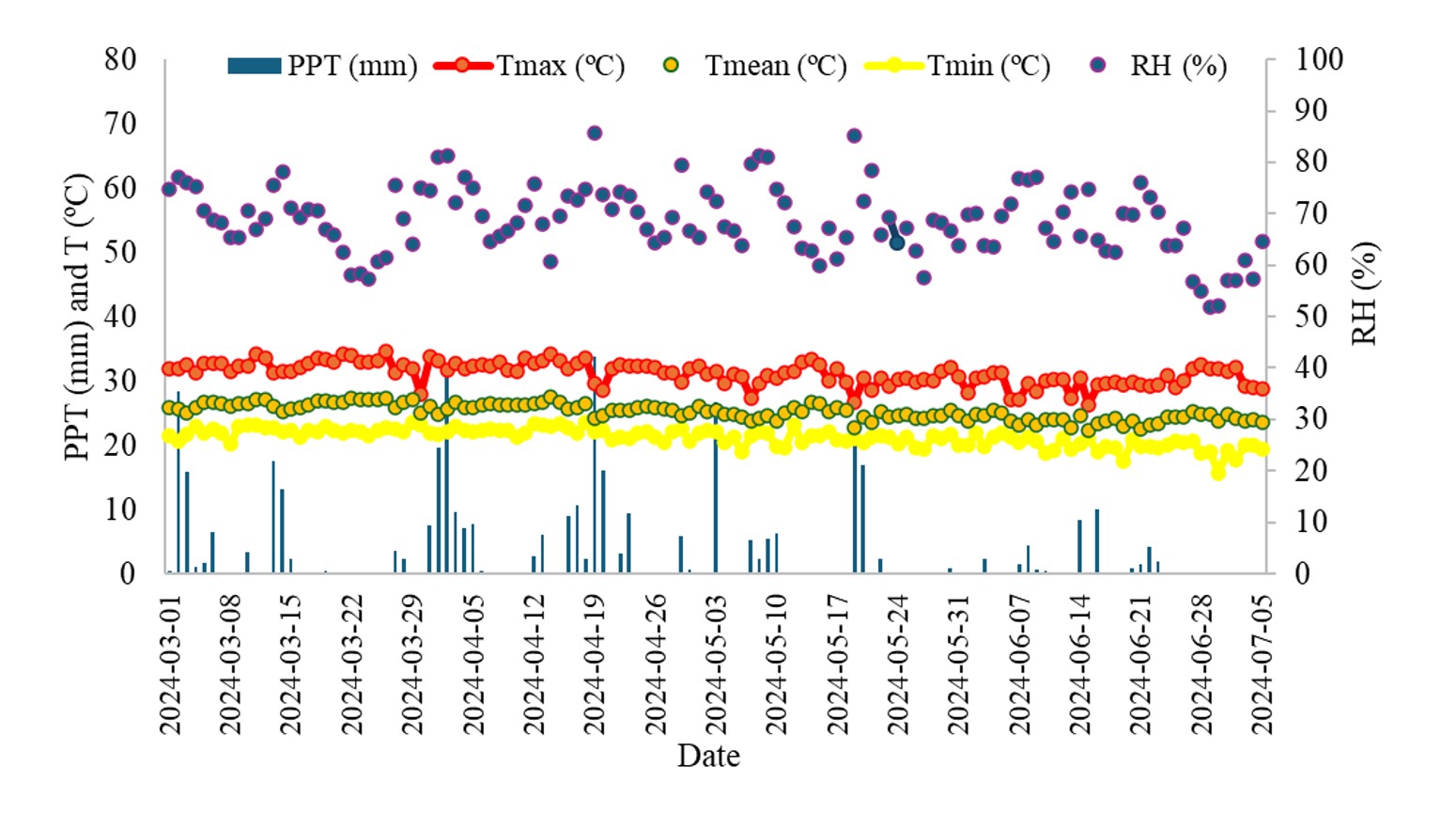
The area's climate is classified as BSh according to Köppen's classification, characterized as hot and dry semiarid. It has an altitude of 481 meters, an average annual air temperature above 25°C, an average global solar radiation of 17.74 MJ m−2, a mean relative humidity of 64.85%, and an average annual rainfall of 647 mm (Alvares et al., 2013). Climatic data during the crop development cycle, from February to July 2024, are presented in Figure 1.

Meteorological conditions in the Serra Talhada, PE municipality during the experimental period. (PPT) Precipitation (mm day−1); (Tmax) Maximum temperature (°C); (Tmean) Average temperature (°C); (Tmin) Minimum temperature (°C); and (RH) Relative humidity, during the experimental period. Source: INMET, 2024.
The soil of the experimental area was previously sampled at depths of 0–20 cm and 20–40 cm and chemically analyzed before the experiment was installed for characterization purposes (Table 1).
Chemical characteristics of the soil used in the experiment, at depths of 0–20 cm and 20–40 cm.
2.2. Experimental design and treatments
The experimental design used was a randomized complete block design (RCBD) in a 7×4 factorial scheme, with four replications. The first factor consisted of seven maize hybrids (1–BM815PRO3; 2–BM930PRO3; 3–SHS7939RO3; 4–SHS8525PRO3; 5–B2856VYHR; 6–B2612PWU; and 7–B2433PWU), and the second factor consisted of four sowing dates (1–March 4, 2024; 2–March 11, 2024; 3–March 18, 2024; and 4–March 25, 2024). Each block covered an area of 54.4 m2, totaling an experimental area of 380.8 m2.
The maize hybrids used in the study contain biotechnological traits for pest control that commonly affect maize crops: PRO3 = incorporates the proteins Cry1A.105, Cry2Ab2, and Cry3Bb1, which provide protection against Diabrotica speciosa (rootworm) larvae, as well as tolerance to lepidopteran insects and the herbicide glyphosate; VYHR = the Leptra technology includes the proteins Cry1F, Cry1Ab, and Vip3Aa20, offering protection against major susceptible caterpillar species that attack maize crops, such as fall armyworm, elasmo caterpillar, wheat armyworm, stalk borer, pod borer, corn earworm, and cutworm, along with tolerance to the herbicides glufosinate ammonium and glyphosate; PWU = the PowerCore® Ultra technology includes four insecticidal proteins (Cry1F, Cry1A.105, Cry2Ab2, and Vip3Aa20) that assist in controlling the main susceptible lepidopteran pests of maize, combined with tolerance to glufosinate ammonium and glyphosate herbicides.
2.3. Experimental procedures
The area has been managed under a no-tillage system for several years. For this study, the site preparation involved desiccation of Urochloa mosambicensis (Hanck) (capim-corrente), which originated from the soil seed bank and acted as a cover crop. Desiccation was carried out using an application of 3 L ha−1 glyphosate + 1.5 L ha−1 2,4-D with a self-propelled sprayer applying a spray volume of 200 L ha−1.
Ten days after desiccation, the hybrids were manually sown on the following dates: the first sowing (March 4, 2024), the second sowing (March 11, 2024), the third sowing (March 18, 2024), and the fourth sowing (March 25, 2024), respectively.
The sowing dates were determined based on the planting window established by the Agricultural Zoning for Climate Risk (ZARC) for Serra Talhada, PE. For the base fertilization, 80 kg ha−1 of phosphorus (P) and 60 kg ha−1 of potassium (K) were applied, supplied by single superphosphate and potassium chloride, respectively, in addition to 30 kg ha−1 of nitrogen (N) at planting and 60 kg ha−1 at the V4 growth stage (when four leaves are fully developed), with urea used as the nitrogen source.
2.4. Data collection
At 60 days after sowing, at full flowering, the following parameters were measured using a portable chlorophyll meter (ClorofiLOG CFL1030, Falker): total chlorophyll index (CL T), chlorophyll a (CL a), chlorophyll b (CL b), and a/b chlorophyll ratio (RZ a/b). Three plants per subplot were randomly selected, and six readings were taken on the middle third of the leaf opposite and below the first ear (Vargas et al., 2012). These leaves were then collected for chemical analysis of nitrogen (N) and crude protein (CP) content using the Kjeldahl method (Matejovic, 1995).
At harvest, the following parameters were recorded: plant height (PH, m); ear insertion height (EIH, cm); stalk diameter (SD, mm); leaf area (LA, cm2); dry biomass yield (DBY, t ha−1); number of grains per ear (NG/E); average number of ears per plant (NE/P); ear diameter (ED, mm); ear length (EL, cm); number of grain rows (NGR); number of grains per row (NG/R); 1,000-grain weight (TGW, g); grain yield (GY, t ha−1); total soil organic carbon (TOC, g kg−1); and soil organic matter (SOM, g kg−1). TGW was calculated from eight subsamples of 100 grains per subplot, adjusted to 13% moisture. Grain yield was determined by weighing the ears from the functional area of each experimental unit, adjusting to 13% moisture, and converting the results to t ha−1. According to Yeomans and Bremner (1988), TOC was determined, and SOM was calculated by multiplying TOC by 1.724.
2.5. Data processing and statistical analysis
The data were subjected to analysis of variance (ANOVA) to evaluate the effect of genotype × sowing date interactions (G×E). In the case of significance, graphs were plotted to illustrate the performance of each hybrid at each sowing date. Subsequently, Pearson correlation analysis was conducted, and principal component analysis (PCA) was applied to examine the interrelationships among the studied variables. Significant principal components (PCs) were selected based on the Kaiser criterion (Kaiser, 1960), considering only eigenvalues greater than 1.0 to validate the application of PCA (Lamichhane et al., 2021). Next, a radar chart was plotted to demonstrate the hybrid with the most outstanding productive stability across different sowing dates. All statistical analyses were performed using R Studio software (RStudio Team, 2021).
3. Results
In the analysis of variance table evaluating the interaction of genotypes according to sowing date (G×E) (Table 1), a significant interaction was observed only for the variables fresh mass (FM), dry mass (DM), and harvest index (HI) (p < 0.05). In contrast, the genotypes showed significant differences (p < 0.05) only for the number of leaves (NL) (Table 2). The hybrids did not influence the other variables (p > 0.05). The sowing dates showed significant differences for the variables plant height (PH), number of leaves (NL), stem diameter (SD), fresh mass (FM), dry mass (DM), ear weight without husk (EWH), ear weight with husk (EWHk), productivity (Prod.), and harvest index (HI) (p < 0.05).
Summary of the analysis of variance for seven maize hybrids and four sowing dates under a no-tillage system. Serra Talhada, PE, 2024.
The fresh mass (FM) production is shown, where hybrids B2433PWU and B2856VYHR exhibited the highest averages at the sowing date of March 25, 2024. The hybrid B2856VYHR showed an increase of more than 200% compared to the averages obtained in the first three sowing dates.
The dry mass (DM) values are presented in Figure 2c. The highest averages were observed in the last two sowing dates (March 18 and March 25, 2024), with hybrids B2433PWU, B2856VYHR, and BM930PRO3 showing the greatest averages. Overall, the March 4, 2024 sowing date exhibited the lowest dry mass production averages for all studied hybrids.

Mean values of harvest index (a), fresh mass (b), and dry mass (c) of different maize hybrids sown at four sowing dates under a no-tillage system. Serra Talhada, PE, 2024. DM = dry mass, FM = fresh mass, and HI = harvest index. Source: authors, 2025.
The radar chart (Figure 3) illustrates productive stability according to the sowing dates. This analysis showed that the hybrids SHS7938PRO3 and B2612PWU exhibited greater stability, maintaining high productivity across different sowing dates. In contrast, B2433PWU showed superior productivity during the second sowing date (March 11, 2024) but lower productivity in the other periods. The hybrid SHS8525PRO3 had the lowest productivity in all sowing dates and was the least stable under these edaphoclimatic conditions.

Evaluation of the productivity stability of maize genotypes sown at different sowing dates under a no-tillage system. Serra Talhada, PE, 2024. Source: authors, 2025.
Figure 4 shows the Pearson correlation analysis, where values range from -1 to 1. The closer the value is to 1, the stronger the positive correlation between variables; the closer to -1, the stronger the negative correlation. Values near 0 indicate no correlation between variables. Thus, productivity (Prod.) showed positive correlation with ear weight without husk (EWH) (0.99), grain weight per ear (GWE) (1.00), ear weight with husk (EWHk) (0.82), and plant height (PH) (0.54). The harvest index (HI) showed negative correlation with dry mass production (DM) (-0.38) and fresh mass (FM) (-0.56), and positive correlation with EWH (0.58), GWE (0.58), and Prod. (0.58).

Pearson correlation analysis of agronomic variables of seven maize hybrids sown at four sowing dates under a no-tillage system. Serra Talhada, PE, 2024. Legend: PH = plant height (cm), NL = number of leaves, SD = stem diameter (mm), FM = fresh mass (g), DM = dry mass (g), EWH = ear weight without husk (g), GWE = grain weight per ear (g), EWHk = ear weight with husk (g), Prod. = productivity (kg ha−1), HI = harvest index (%), EL = ear length (cm), EW = ear width (mm), HGW= 100-grain weightand EIH = ear insertion height (cm). Source: authors, 2025.
From Figure 5a, it can be observed that the second sowing date (March 11, 2024) showed the most significant association with the crop yield traits, while the last sowing date (March 25, 2024) was the most distant from the yield variables, indicating lower crop development and yield when sown at this time. It is also noticeable that the climatic conditions (maximum temperature, average temperature, minimum temperature, precipitation, and solar radiation) were positively associated with the yield parameters. In contrast, relative humidity (RH) had a negative association with productivity and a positive association with dry mass, fresh mass, number of leaves, and stem diameter.

Principal component analysis for sowing dates (a) and maize hybrids (b) sown under a no-tillage system. Serra Talhada, PE, 2025. Legend: PH = plant height (cm), NL = number of leaves, SD = stem diameter (mm), FM = fresh mass (g), DM = dry mass (g), EWH = ear weight without husk (g), GWE = grain weight per ear (g), EWHk = ear weight with husk (g), Prod. = productivity (kg ha−1), HI = harvest index (%), EL = ear length (cm), EW = ear width (mm), HGW = 100-grain weight (g), PC1 = principal component 1, PC2 = principal component 2, and EIH = ear insertion height (cm). Source: authors, 2025.
Figure 5b presents the results of the principal component analysis (PCA) of the different hybrids, showing that the variables contributing most to the variation among hybrids in PC1 were: number of leaves, ear weight with husk, grain weight per ear, ear weight without husk, productivity, ear length, and harvest index, all positively associated. In PC2, plant height and productivity were the variables with the highest loadings. Also in Figure 5b, it can be observed that the hybrid BM930PRO3 showed the strongest association with yield characteristics. At the same time, B2344PWU was distant from these parameters, indicating lower productivity than the others, with a greater association with productivity.
The dendrogram of maize hybrids identified three main groups (Figure 6). Group I comprised the hybrids SHS7938PRO3, SHS8525PRO3, B2856VYHR, and BM815PRO3. Group II comprised the hybrid B2433PWU, and Group III included the hybrids BM930PRO3 and B2612PWU.

Dissimilarity among groups was established by Euclidean distance of maize hybrids based on their agronomic characteristics. (Cophenetic correlation coefficient (r) = 0.82). Serra Talhada, PE, 2025. Source: Authors, 2025.
4. Discussion
The study of the behavior of seven maize genotypes across four sowing dates showed the influence of several factors on maize yield. In addition, environmental factors such as lack or irregularity of precipitation, temperatures above 30ºC—especially during the flowering period—and relative humidity oscillating between 40 and 70% contributed to differentiate adaptability and define the productive behavior of the genotypes.
Ma et al. (2024), studying the influence of the genotype × environment (G×E) interaction on yield stability of 11 maize hybrids across 10 different environments using the AMMI model and GGE biplot, observed that productivity varied significantly with environmental changes, mainly regarding water availability and soil conditions. This results in different genotypes performing variably depending on the growing environment. Their study suggests that selecting suitable genotypes for diverse environments is essential to recommend varieties that enable optimized planting for each location.
In another study published in 2018, Cargnelutti Filho and Guadagnin (2018) observed that the stability capacity of a genotype can be characterized as predictable behavior in response to environmental stimuli.
According to Borém et al. (2021), the environment is responsible for the non-genetic factors that affect plant development. Being a natural condition, the interaction of genotypes with environments is part of the species' evolutionary process. It promotes the emergence of more stable genotypes adapted to specific environments or genotypes with broad adaptation (Vasconcelos et al., 2010).
The variations observed among maize genotypes across different sowing dates reflect the influence of environmental conditions on agronomic performance, indicating that planting time can significantly alter the phenotypic expression of hybrids (Omar et al., 2022). The greater stability shown by the BM930PRO3 and SHS8525PRO3 genotypes suggests higher physiological plasticity under variable climatic conditions, a desirable trait in agricultural systems facing environmental changes (Elazab et al., 2025).
The positive correlations among yield-related variables, such as ear weight without husk and grain weight per ear, demonstrate the interdependence of these components for final yield, corroborating studies that identify these traits as reliable predictors of maize productivity (Krivosheev and Ignatiev, 2021). The negative correlation observed between fresh mass and yield suggests a possible imbalance between vegetative growth and reproductive efficiency, which may be related to nutrient management and environmental conditions during the crop cycle.
Under these circumstances, Bastos (2019) highlights that these characteristics are strongly influenced by genotype and edaphoclimatic conditions. Thus, selecting materials with optimal values for these attributes is desirable, which consequently influences the genotypes' agronomic performance.
In Figure 2, the mean values of harvest index (HI), fresh mass (FM), and dry mass (DM) are shown, where hybrid B2433PWU exhibited the highest HI in the second sowing date (March 11, 2024), with a linear decrease in the later sowing dates of March 18 and March 25, respectively (Figure 2a). Studies such as Albuquerque et al. (2022), Silva et al. (2021), Olivoto et al. (2019), Santos et al. (2016), Paramesh et al. (2016), and Silva et al. (2011), focusing on adaptability and stability in different crops using biplots, have confirmed the effectiveness of this analysis to recommend genotypes and group favorable and unfavorable environments.
Conversely, Santos et al. (2017) and Kang (2014) concluded that the GGE biplot analysis is efficient because it allows predicting the average productivity of a genotype in a specific environment and aids in recommending more stable and adapted genotypes for the region of interest. This graphical analysis identifies which genotype gains the most productivity in each sowing date, visually and comparatively, through the area formed by the graph, where a larger area indicates greater productive stability (Oliveira, 2015).
In this context, it is evident that genotypes respond differently to environmental changes. Therefore, the environmental effect can cause correlations significant in one environment to be absent or even opposite in another, being positive in one location and negative in another. Nevertheless, phenotypic correlations can be helpful in decision-making within conventional breeding programs, since within specific population sets, genetic origin trends can be observed and complementary crosses planned in diallel schemes (Ramalho et al., 2008; Cruz et al., 2001).
To evaluate the trends of the studied variables, principal component analysis (PCA) was performed for sowing dates (Figure 5a) and hybrids (Figure 5b). Only the first two principal components (PC1 and PC2) were considered to explain the total variance of the data. Figure 5a shows that PC1 accounted for 62.01% of the data variation and PC2 for 27.41%. Figure 5a also displays the interrelationships between the studied variables, where angles less than 90° indicate positive correlation, angles greater than 90° indicate negative correlation, and 90° indicates no correlation.
Cluster analysis (Figure 6) revealed three distinct groups among the evaluated maize hybrids, indicating significant genetic or agronomic variability. Group I consisted of SHS7938PRO3, SHS8525PRO3, B2856VYHR, and BM815PRO3. Group II included B2433PWU and BM815PRO3. BM930PRO3 and B2612PWU formed group III.
These results show that hybrids within each group share similar characteristics, possibly related to productivity, plant architecture, or response to agronomic management. This similarity may reflect common breeding strategies or a close genetic background. Thus, cluster analysis divided the hybrids into three distinct groups of similar hybrids based on their agronomic traits (Devesh et al., 2019).
5. Conclusions
The principal component analysis showed that the sowing dates influenced the agronomic characteristics of the maize hybrids, mainly due to temperature, precipitation, and relative humidity.
The hybrids that exhibited the greatest productive stability across different sowing dates were B2612PWU and SHS7938PRO3.
The dendrogram revealed phenotypic distinction among the hybrids, separating them into three groups based on their agronomic traits.
The sowing date exerts an influence on the agronomic characteristics of maize hybrids.
Data Availability Statement
The datasets generated and analyzed during the current study are available from the corresponding author upon reasonable request.
References
-
ALBUQUERQUE, J.R.T., LINS, H.A., DOS SANTOS, M.G., FREITAS, M.A.M., OLIVEIRA, F.S., SOUZA, A.R.E., SILVEIRA, L.M., HENRIQUE DE SOUSA NUNES, G., BARROS JÚNIOR, A.P. and DE MELO JORGE VIEIRA, P.F., 2022. Adaptability and stability of soybean (Glycine max L.) genotypes in semiarid conditions. Euphytica, vol. 218, no. 5, pp. 61. https://doi.org/10.1007/s10681-022-03012-0
» https://doi.org/10.1007/s10681-022-03012-0 -
ALVARES, C.A., STAPE, J.L., SENTELHAS, P.C. and DE MORAES GONÇALVES, J.L., 2013. Modeling monthly mean air temperature for Brazil. Theoretical and Applied Climatology, vol. 113, no. 3–4, pp. 407-427. https://doi.org/10.1007/s00704-012-0796-6
» https://doi.org/10.1007/s00704-012-0796-6 - AMARAL, T. A., ANDRADE, C. L. T., CUADRA, S. V.; MONTEIRO, J. E. B. A., GUIMARAES, P. E. O., TRINDADE, R. S., 2023. Metodologia para o zoneamento agrícola de risco climático da produtividade do milho: ZarcPro-Milho. Sete Lagoas: Embrapa Milho e Sorgo. Documentos, no. 279.
-
BASTOS, M., 2019 [viewed 5 July 2025]. Características agronômicas de híbridos de milho para produção de silagem cultivados em quatro estados brasileiros [online]. Lavras: Universidade Federal de Lavras, 68 p. Dissertação de Mestrado em Zootecnia. Available from: https://repositorio.ufla.br/items/148cdf47-08a8-45d6-b306-b076f5f4e9b9
» https://repositorio.ufla.br/items/148cdf47-08a8-45d6-b306-b076f5f4e9b9 - BORÉM, A., MIRANDA, G.V. and FRITSCHE-NETO, R., 2021. Melhoramento de plantas 8. ed. São Paulo: Oficina de Textos.
-
BRASIL. Ministério do Desenvolvimento Agrário e Agricultura Familiar. Companhia Nacional de Abastecimento – CONAB, 2023 [viewed 5 July 2025]. Acompanhamento da safra brasileira de grãos: quinto levantamento. Available from: https://www.conab.gov.br/info-agro/safras/graos
» https://www.conab.gov.br/info-agro/safras/graos -
CARGNELUTTI FILHO, A. and GUADAGNIN, J.P., 2018. Sufficient number of experiments for the adaptability and stability analyses of maize using the Eberhart and Russell method. Pesquisa Agropecuária Brasileira, vol. 53, no. 6, pp. 673-683. https://doi.org/10.1590/s0100-204x2018000600003
» https://doi.org/10.1590/s0100-204x2018000600003 -
CASTILHOS, R.V., PARIZOTTO, C., BERMUDEZ, F., RIBEIRO, L.D.P. and CANALE, M.C., 2022. Severity of corn stunt disease on maize genotypes in the Midwest of the Brazilian state of Santa Catarina. Revista Brasileira de Milho e Sorgo, vol. 21, pp. e1278. https://doi.org/10.18512/rbms2022v21e1278
» https://doi.org/10.18512/rbms2022v21e1278 -
COSTA, R.L., BAPTISTA, G.M.M, GOMES, H.B., SILVA, F.D.S., ROCHA JÚNIOR, R.L., SALVADOR, M.A. and HERDIES, D.L., 2020. Analysis of climate extremes indices over northeast Brazil from 1961 to 2014. Weather and Climate Extremes, vol. 28, pp. 100254. https://doi.org/10.1016/j.wace.2020.100254
» https://doi.org/10.1016/j.wace.2020.100254 - COSTA, R.V., ALMEIDA, R.E.M., CAMPOS, L.J.M., SOUZA, M.R., CUSTODIO, D.P., SILVA, D.D., COTA, L.V., ROCHA, B.R., BERNARDES, F.P., SILVA, F.R., PEREIRA, G.C., LIMA, B.O.C., SANTOS, Á.C., CAMPOS, V.S., ARAÚJO, T.A., 2022. Desempenho de cultivares de milho em Tocantins-safrinha 2022: época de semeadura e tipo de solo. Sete Lagoas: Embrapa. Circular Técnica, no. 282.
- CRUZ, C.D., CARNEIRO, P.C.S., REGAZZI, A.J., 2001. Modelos biométricos aplicados ao melhoramento genético. 2. ed. Viçosa: Editora UFV.
- DEVESH, P., MOITRA, P.K., SHUKLA, R.S., PANDEY, S., 2019. Diversidade genética e análises de componentes principais para rendimento, componentes de rendimento e características de qualidade de linhagens avançadas de trigo. Journal of Pharmacognosy and Phytochemistry, vol. 8, no. 3, pp. 4834-4839.
-
ELAZAB, A., CASTILLO, D., MATUS, I., ROMERO-BRAVO, S., ESPINOZA-MEZA, S., SADRAS, V. and DEL POZO, A., 2025. The role of phenotypic plasticity of physiological and agronomic traits on the adaptation of spring wheat genotypes to Mediterranean environments. Field Crops Research, vol. 322, pp. 109740. https://doi.org/10.1016/j.fcr.2025.109740
» https://doi.org/10.1016/j.fcr.2025.109740 -
HANISCH, A.L., DALGALLO, D., PEREIRA, F.B., NOERNBERG, D.J. and RECH, Â.F., 2024. Avaliação de três variedades de milho de polinização aberta para a produção de silagem em duas épocas de plantio. Agropecuária Catarinense, vol. 37, no. 3, pp. 46-53. https://doi.org/10.52945/rac.v37i3.1880
» https://doi.org/10.52945/rac.v37i3.1880 -
KAISER, H.F., 1960. The application of electronic computers to factor analysis. Educational and Psychological Measurement, vol. 20, no. 1, pp. 141-151. https://doi.org/10.1177/001316446002000116
» https://doi.org/10.1177/001316446002000116 -
KANG, M.S., 2014. Crop variety trials: data management and analysis. Crop Science, vol. 54, no. 6, pp. 2910-2911. https://doi.org/10.2135/cropsci2014.08.0002br
» https://doi.org/10.2135/cropsci2014.08.0002br - KOGO, B.K., KUMAR, L. and KOECH, R., 2021. Sustaining agricultural production in Pakistan: obstacles and prospects. Current Politics and Economics of the Middle East, vol. 10, no. 3, pp. 331-356.
-
KRIVOSHEEV, G. and IGNATIEV, A., 2021. Correlation between quantitative traits that affect grain yield of maize hybrids. Grain Economy of Russia, vol. 1, no. 6, pp. 27-32. https://doi.org/10.31367/2079-8725-2021-78-6-27-32
» https://doi.org/10.31367/2079-8725-2021-78-6-27-32 -
LAMICHHANE, S., EĞILMEZ, G., GEDIK, R., BHUTTA, M.K.S. and ERENAY, B., 2021. Benchmarking OECD countries’ sustainable development performance: A goal-specific principal component analysis approach. Journal of Cleaner Production, vol. 287, pp. 125040. https://doi.org/10.1016/j.jclepro.2020.125040
» https://doi.org/10.1016/j.jclepro.2020.125040 -
LARA, L.P., 2022 [viewed 5 July 2025]. Interação entre genótipos de sorgo biomassa e ambientes de cultivo no estado de Mato Grosso [online]. Cáceres: Universidade do Estado de Mato Grosso, 37 p. Dissertação de Mestrado em Genética e Melhoramento de Plantas. Available from: http://portal.unemat.br/media/files/DissertacaoFinal_LizandraPaesanoLara_Publicada_UNEMAT_1.pdf
» http://portal.unemat.br/media/files/DissertacaoFinal_LizandraPaesanoLara_Publicada_UNEMAT_1.pdf -
MA, C., LIU, C. and YE, Z., 2024. Influence of genotype × environment interaction on yield stability of maize hybrids with AMMI Model and GGE Biplot. Agronomy, vol. 14, no. 5, pp. 1000. https://doi.org/10.3390/agronomy14051000
» https://doi.org/10.3390/agronomy14051000 -
MATEJOVIC, I., 1995. Nitrogênio total em material vegetal determinado por meio de combustão seca: uma possível alternativa à determinação por digestão de Kjeldahl. Communications in Soil Science and Plant Analysis, vol. 26, no. 13, pp. 2217-2229. https://doi.org/10.1080/00103629509369441
» https://doi.org/10.1080/00103629509369441 -
OLIVEIRA, G.E., 2015 [viewed 5 July 2025]. Capacidade geral de combinação e análise multivariada de caracteres econômicos em couve-flor [online]. Lavras: Universidade Federal de Lavras, 56 p. Tese de Doutorado em Genética e Melhoramento de Plantas. Available from: https://repositorio.ufla.br/items/105f4ea6-d7b1-46a9-8c90-ec8fea599466
» https://repositorio.ufla.br/items/105f4ea6-d7b1-46a9-8c90-ec8fea599466 -
OLIVOTO, T., LÚCIO, A.D.C., DA SILVA, J.A.G., SARI, B.G. and DIEL, M.I., 2019. Mean performance and stability in multi-environment trials II: selection based on multiple traits. Agronomy Journal, vol. 111, no. 6, pp. 2961-2969. https://doi.org/10.2134/agronj2019.03.0221
» https://doi.org/10.2134/agronj2019.03.0221 -
OMAR, M., RABIE, H., MOWAFI, S., OTHMAN, H., EL-MONEIM, D., ALHARBI, K., MANSOUR, E. and ALI, M., 2022. Multivariate analysis of agronomic traits in newly developed maize hybrids grown under different agro-environments. Plants, vol. 11, no. 9, pp. 1187. https://doi.org/10.3390/plants11091187 PMid:35567188.
» https://doi.org/10.3390/plants11091187 -
PARAMESH, M., REDDY, D.M., PRIYA, M.S., SUMATHI, P., SUDHAKAR, P. and REDDY, K.H.P., 2016. GT biplot analysis for yield and drought related traits in mung bean (Vigna radiata L. Wilczek). Electronic Journal of Plant Breeding, vol. 7, no. 3, pp. 538-543. https://doi.org/10.5958/0975-928X.2016.00069.7
» https://doi.org/10.5958/0975-928X.2016.00069.7 - PIRES, E.W., 2022. Produtividade de híbridos de milho em função de épocas de semeadura e doses de nitrogênio Dois Vizinhos: Universidade Tecnológica Federal do Paraná, 32 p. Trabalho de Conclusão de Curso em Agronomia.
- RAMALHO, M. A. P., SANTOS, J. B. and PINTO, C. A. B. P. (2008). Genética na agropecuária Lavras: Editora UFLA.
-
RSTUDIO TEAM, 2021 [accessed 5 July 2025]. RStudio: Integrated development environment for R. Version 1.4 [software]. Boston: RStudio, PBC. Available from: https://www.rstudio.com/
» https://www.rstudio.com/ -
SANTOS, A.D., CECCON, G., TEODORO, P.E., CORREA, A.M., ALVAREZ, R.C.F., SILVA, J.F. and ALVES, V.B., 2016. Adaptability and stability of erect cowpea genotypes via REML/BLUP and GGE biplot. Bragantia, vol. 75, no. 3, pp. 299-306. https://doi.org/10.1590/1678-4499.280
» https://doi.org/10.1590/1678-4499.280 -
SANTOS, A.D., AMARAL JÚNIOR, A.T., KUROSAWA, R.N.F., GERHARDT, I.F.S. and FRITSCHE NETO, R., 2017. GGE biplot projection in discriminating the efficiency of popcorn lines to use nitrogen. Ciência e Agrotecnologia, vol. 41, no. 1, pp. 22-31. https://doi.org/10.1590/1413-70542017411030816
» https://doi.org/10.1590/1413-70542017411030816 -
SILVA, G.O., CARVALHO, A.D.F., VIEIRA, J.V. and BENIN, G., 2011. Verificação da adaptabilidade e estabilidade de populações de cenoura pelos métodos AMMI, GGE biplot e REML/BLUP. Bragantia, vol. 70, no. 3, pp. 494-501. https://doi.org/10.1590/S0006-87052011005000003
» https://doi.org/10.1590/S0006-87052011005000003 -
SILVA, K.J., TEODORO, P.E., SILVA, M.J., TEODORO, L.P.R., CARDOSO, M.J., GODINHO, V.P.C., MOTA, J.H., SIMON, G.A., TARDIN, F.D., SILVA, A.R., GUEDES, F.L. and MENEZES, C.B., 2021. Identification of mega-environments for grain sorghum in Brazil using GGE biplot methodology. Agronomy Journal, vol. 113, no. 4, pp. 3019-3030. https://doi.org/10.1002/agj2.20707
» https://doi.org/10.1002/agj2.20707 -
VARGAS, V.P., SANGOI, L., ERNANI, P.R., SIEGA, E., CARNIEL, G. and FERREIRA, M.A., 2012. Os atributos nas folhas são mais eficientes que o N mineral no solo para avaliar a disponibilidade desse nutriente para o milho. Bragantia, vol. 71, no. 2, pp. 245-255. https://doi.org/10.1590/S0006-87052012000200014
» https://doi.org/10.1590/S0006-87052012000200014 -
VASCONCELOS, E.S., REIS, M.S., CRUZ, C.D., SEDIYAMA, T. and SCAPIM, C.A., 2010. Adaptability and stability of semilate and late maturing soybean genotypes in Minas Gerais state. Acta Scientiarum. Agronomy, vol. 32, no. 3, pp. 411-415. https://doi.org/10.4025/actasciagron.v32i3.8249
» https://doi.org/10.4025/actasciagron.v32i3.8249 -
YEOMANS, J.C. and BREMNER, J.M., 1988. A rapid and precise methodfor routine determination of organic carbon in soil. Communications in Soil Science and Plant Analysis, vol. 19, no. 13, pp. 1467-1476. https://doi.org/10.1080/00103628809368027
» https://doi.org/10.1080/00103628809368027
Edited by
-
Editor:
Takako Matsumura Tundisi