 Isolation and characterization of actinobacteria of the genus Streptomyces under salt stress conditions
Abstract
This study presents a comprehensive characterization of actinobacteria isolated from soils subjected to both anthropogenic pollution and secondary salinization. As a result of microbiological screening, two promising strains were selected — Streptomyces violaceorubidus strain N3 and Streptomyces rochei strain N4 — which demonstrated high salt tolerance, active colony and biomass formation, and pronounced antagonistic activity against several phytopathogenic fungi. Molecular genetic identification based on 16S rRNA gene sequencing, followed by phylogenetic analysis, confirmed the taxonomic affiliation of the isolates. Experimental data showed that both strains produce the phytohormone indole-3-acetic acid (IAA), exopolysaccharides (EPS), and the enzyme ACC deaminase, both under normal conditions and under salt stress (300 mM NaCl). Under saline conditions, an increase was observed in IAA production (by 31–34%), EPS synthesis (by 39–47%), and ACC deaminase activity (up to 42.8 nmol α-ketobutyrate/mg protein/h). The revealed physiological and biochemical traits suggest that S. violaceorubidus N3 and S. rochei N4 have high potential as microbial inoculants for enhancing plant resistance to abiotic (salt stress) and biotic (phytopathogens) environmental factors.
Keywords:
actinobacteria; Streptomyces; salt stress; pollutants; antagonistic activity; exopolysaccharides
Resumo
Este estudo apresenta uma caracterização abrangente de actinobactérias isoladas de solos submetidos tanto à poluição antrópica quanto à salinização secundária. Como resultado da triagem microbiológica, foram selecionadas duas linhagens promissoras — Streptomyces violaceorubidus linhagem N3 e Streptomyces rochei linhagem N4 —, que demonstraram alta tolerância ao sal, formação ativa de colônias e biomassa, além de acentuada atividade antagonista contra diversos fungos fitopatogênicos. A identificação molecular genética baseada no sequenciamento do gene 16S rRNA, seguida de análise filogenética, confirmou a afiliação taxonômica dos isolados. Os dados experimentais mostraram que ambas as linhagens produzem o fito-hormônio ácido indol-3-acético (AIA), exopolissacarídeos (EPS) e a enzima ACC desaminase, tanto em condições normais quanto sob estresse salino (300 mM NaCl). Em condições salinas, observou-se aumento na produção de AIA (31%–34%), na síntese de EPS (39%–47%) e na atividade da ACC desaminase (até 42,8 nmol de α-cetobutirato/mg de proteína/h). As características fisiológicas e bioquímicas reveladas sugerem que S. violaceorubidus N3 e S. rochei N4 possuem alto potencial como inoculantes microbianos para aumentar a resistência das plantas a fatores ambientais abióticos (estresse salino) e bióticos (fitopatógenos).
Palavras-chave:
actinobactérias; Streptomyces; estresse salino; poluentes; atividade antagonista; exopolissacarídeos
1. Introduction
Soil salinization is one of the most critical abiotic stress factors that suppress plant growth, disrupt ionic homeostasis, reduce water and nutrient uptake, and induce oxidative damage in plants (Akbari et al., 2020; Rao et al., 2022). Under such conditions, plant resilience and productivity decline significantly, necessitating the development of environmentally safe approaches to mitigate these stress effects (Usmonkulova et al., 2025). One promising solution involves the use of actinomycetes of the genus Streptomyces — Gram-positive, highly adaptive microorganisms with a rich arsenal of metabolites. This genus is responsible for the biosynthesis of an extraordinary diversity of secondary metabolites, including several key pharmaceutical compounds such as antibiotics, anticancer agents, and anti-obesity drugs (Kumar et al., 2022). The application of Streptomyces strains for industrial-scale production of valuable bioactive compounds has been known for several decades, beginning with the use of S. griseus for the production of streptomycin (Quinn et al., 2020; Chater, 2006). Accordingly, Streptomyces actinomycetes remain the leading bacterial genus in terms of antibiotic production.
Recent studies have demonstrated that Streptomyces species retain a high potential as a source of novel and diverse natural products, including a wide range of chemical structures such as cyclic and linear peptides, polyketides, terpenoids, polyaromatic compounds, macrocycles, and furans (Berdy, 2012; Antoraz et al., 2015, Lacey and Rutledge, 2022). These organisms exhibit significant salt tolerance and are capable of producing phytohormones (e.g., auxin/IAA), exopolysaccharides (EPS), and enzymes such as ACC deaminase, all of which contribute to their plant-protective properties (Sadeghi et al., 2012; Akbari et al., 2020; Rao et al., 2022).
Auxin (IAA) promotes cell division and elongation, enhances root development, and improves root architecture—functions especially critical under saline conditions (Sadeghi et al., 2012; Egamberdieva et al., 2019). For instance, a Streptomyces isolate (C) was shown to increase IAA production under 300 mM NaCl, correlating with improved wheat growth (Sadeghi et al., 2012). ACC deaminase (ACCD) cleaves 1-aminocyclopropane-1-carboxylate (ACC), the immediate precursor of ethylene, thus lowering ethylene levels and alleviating stress-induced growth inhibition (Egamberdieva et al., 2019; Orozco-Mosqueda et al., 2020). Streptomyces sp. PGPA39, for example, exhibited ACC deaminase activity, tolerated up to 1 M NaCl, produced IAA, and promoted tomato growth under saline stress (Palaniyandi et al., 2014). In another study, genetically enhanced S. venezuelae strains with elevated ACCD activity significantly improved rice growth under salt stress (Yoolong et al., 2019). Additionally, Streptomyces sp. GMKU 336 was shown to reduce ROS accumulation, restore ion balance, and decrease lipid peroxidation in salt-stressed rice plants (Jaemsaeng et al., 2018).
The isolation and physiological characterization of Streptomyces strains capable of surviving and maintaining functional activity in hypersaline environments is a critical step toward the development of microbial bioproducts. Such strains hold strong potential for use in biotechnology as biocontrol agents and plant growth promoters to enhance crop resilience and productivity on salt-affected soils.
The aim of this study was to perform a comprehensive analysis of salt-tolerant actinomycetes of the genus Streptomyces, including their isolation from saline-polluted soils, examination of physiological and morphological adaptations, assessment of IAA and EPS production, evaluation of ACC deaminase activity, and exploration of their plant-protective potential and mechanisms of interaction under salt stress conditions.
2. Materials and Methods
2.1. Isolation and cultivation of actinomycetes
Soil samples (~1 g) were collected from a depth of 5–20 cm from a saline and contaminated site of an abandoned agricultural airfield located in the Syrdarya region of Uzbekistan (40°23'53.9"N, 68°31'34.1"E). The samples were stored at 4 °C until further use. To suppress non-sporulating contaminants, the samples were dried at 50 °C for 30 minutes (Meenakshi et al., 2024). Suspensions were prepared by mixing 1 g of soil with 9 mL of sterile distilled water, followed by shaking for 30 minutes at 200 rpm. Serial dilutions were performed up to 10−5 (Meenakshi et al., 2024). An aliquot of 100 µL from each dilution was spread on Starch Casein Agar (SCA) supplemented with nystatin or amphotericin B to inhibit fungal contamination (Bo et al., 2019). The inoculated Petri dishes were incubated at 28 °C for 7–21 days to allow the formation of sporulating colonies. Colonies with typical actinomycete morphology were purified by repeated streaking on glucose yeast agar (GYA) plates (Bo et al., 2019). Pure cultures were preserved in 20% glycerol at –20 °C for long-term storage (Hamid et al., 2020).
2.2. Evaluation of salt tolerance of Streptomyces strains
Previously isolated and purified Streptomyces strains were used for salt stress experiments. Prior to testing, the strains were activated by culturing on glucose-yeast agar at 28 °C for 5–7 days. For liquid inoculation, a spore suspension (~106 CFU/mL) was prepared from mature cultures. The basal growth medium was glucose-yeast-malt (GYM) broth with the following composition: glucose – 4 g/L; yeast extract – 4 g/L; malt extract – 10 g/L; agar (for solid medium) – 15 g/L; pH – 7.2. Sodium chloride (NaCl) was added to the medium at final concentrations of 300 mM (≈17.5 g/L), 500 mM (≈29.2 g/L), 800 mM (≈46.8 g/L), and 1 M (≈58.4 g/L). A control medium without NaCl was also included. For each salt concentration, 10 µL of the spore suspension was inoculated onto the agar plates. Petri dishes were incubated at 28 °C for 7–10 days. Growth was assessed daily based on colony diameter (mm), substrate and spore pigmentation, density, and mycelial texture, and compared to control conditions (Tresner et al., 1968; Cai et al., 2009).
2.3. Identification of isolated Streptomyces strains
Genomic DNA was extracted from the actinomycete cultures using the RIBO-prep reagent kit (InterLabServis, Russia). The 16S rRNA gene was amplified via polymerase chain reaction (PCR). The total reaction volume was 20 µL, performed using a lyophilized PCR Core Kit (Isogene, Russia). The reaction mixture included 2 µL of primers, 2.5 µL of each dNTP, and 2 µL of genomic DNA (20 ng/µL). An additional 20 µL of deionized water and 10 µL of buffer were added to complete the reaction. PCR products were analyzed by electrophoresis on 2% agarose gels. The concentration of PCR amplicons was measured using a Qubit 2.0 fluorometer (Invitrogen, USA). Sequencing reactions were performed with the BigDye Terminator Kit (Thermo Fisher Scientific, USA) using the purified PCR product. Sequencing and product purification were carried out according to the manufacturer’s instructions. The obtained sequences were processed using CodonCode Aligner software and compared with sequences in the NCBI database using the BLAST algorithm. The confirmed sequences were submitted and registered in the NCBI GenBank database under appropriate accession numbers.
Primers used for 16S rRNA gene amplification (PDB-3):
-
27F:5'-AGAGTTTGATCCTGGCTCAG-3'
-
1492R: 5'-GGTTACCTTGTTACGACTT-3'
2.4. Phylogenetic analysis
The 16S rRNA gene sequences of Streptomyces strains were retrieved from the NCBI GenBank database. Multiple sequence alignment was carried out using the ClustalW algorithm implemented in MEGA11 software. A phylogenetic tree was constructed using the Neighbor-Joining method with 1000 bootstrap replications to assess branch reliability. Evolutionary distances were computed using the Tamura two-parameter model (Tamura et al., 2021; Narmukhamedova et al., 2025). Positions containing gaps or missing data were excluded from the final analysis.
2.5. Antagonistic activity of Streptomyces against phytopathogenic fungi
Streptomyces strains were cultivated in liquid Actinomyces broth at 28 °C, under agitation at 130–200 rpm for 5–7 days. After centrifugation and filtration (0.22–0.45 µm), the resulting filtrate (20 µL) was applied into wells cut into glucose-yeast extract agar (GYM) plates previously inoculated with a monospore culture of phytopathogenic fungi (Prapagdee et al., 2008). Wells of approximately 6–8 mm in diameter were prepared in the agar medium, filled with the filtrate, and the fungal isolates were uniformly distributed over the surface of the medium. After incubation at 25–28 °C for 3–7 days, the diameter of inhibition zones was measured (Li et al., 2024). All experiments were conducted in three biological replicates. Mean values, standard deviations, and percent inhibition (PI) were calculated, and statistical significance was determined using ANOVA (p ≤ 0.05) (Prapagdee et al., 2008).
2.6. Determination of Auxin (IAA) synthesis under salt stress
Streptomyces strains were pre-activated on glucose-yeast extract agar at 28 °C for 7–10 days. For liquid culture, Actinomyces broth was used, supplemented with L-tryptophan at a concentration of 0.5 mg/mL. The medium was autoclaved, cooled, and inoculated to an optical density of OD600 ≈ 0.5. Two experimental conditions were established: control (no NaCl) and treatment (300 mM NaCl). Cultures were incubated at 28–30 °C, 150 rpm in the dark for 72 hours. After incubation, cultures were centrifuged (8,000 × g, 10 min), and the supernatant was collected for further analysis.
Salkowski’s reagent was prepared in a 1:50 ratio (0.5 M FeCl3: 35% HClO4). In each test tube, 1 mL of the culture supernatant was mixed with 2 mL of Salkowski’s reagent, vortexed, and incubated in the dark at room temperature for 30 minutes. Optical density (OD) was measured at 530 nm, and the IAA concentration was determined using a standard curve generated from serial dilutions of IAA standards (0–25 µg/mL) (Guardado-Fierros et al., 2024). All samples were analyzed in three biological replicates, and the results were expressed as mean ± standard deviation (SD). Statistical analysis was performed using ANOVA where applicable (p ≤ 0.05).
2.7. Determination of Exopolysaccharide (EPS) production by Streptomyces under salt stress
Streptomyces strains were pre-cultured on glucose-yeast extract agar at 28 °C for 5–7 days. For EPS production, the following liquid medium was used (per 1 L): glucose – 30 g, yeast extract – 5 g, NaNO3 – 3 g, MgSO4·7H2O – 0.5 g, K2HPO4 – 1 g, CaCO3 – 1 g; pH adjusted to 7.0. Two conditions were tested: control (no NaCl) and salt stress (supplemented with 300 mM NaCl). Cultures were incubated at 28 °C with shaking at 150 rpm for 4 days. After incubation, the culture broth was centrifuged, and the supernatant was precipitated with cold absolute ethanol (3 volumes) and incubated overnight at 4 °C.
The resulting precipitates were collected and dried in a drying cabinet to remove residual ethanol. The dry weight of the EPS was determined and compared to the control condition (Sardari et al., 2017).
2.8. Quantitative Analysis of ACC Deaminase Activity
Streptomyces strains were cultivated in Dworkin-Foster (DF) broth supplemented with 3 mM 1-aminocyclopropane-1-carboxylic acid (ACC) and incubated on a rotary shaker for 48 hours at 37 °C, 150 rpm. After incubation, the cultures were centrifuged at 10,000 rpm for 10 minutes at 4 °C. The supernatant was collected, and the amount of α-ketobutyrate produced from ACC deamination was quantified spectrophotometrically at 540 nm.
The concentration of α-ketobutyrate released by bacterial isolates was calculated using a standard calibration curve prepared from known concentrations of α-ketobutyrate (Pandey et al., 2013).
3. Results
3.1. Isolation and screening of soil-derived actinomycete isolates
As a result of the conducted study, more than 15 morphologically distinct actinomycete isolates were obtained from soil samples collected from areas exposed to both technogenic pollution and secondary salinization. Isolation was carried out using selective nutrient media that promote the growth of Streptomyces and other actinobacteria. The isolated actinomycete strains exhibited considerable morphological diversity in colony appearance, growth rates, and biomass accumulation capacity.
Preliminary screening allowed for the selection of the most promising strains based on vigorous growth and stable formation of well-developed aerial and substrate mycelia. The most active isolates in terms of colony formation and biomass production were:
-
Strain 3, isolated from soil simultaneously contaminated with pollutants and saline (salinity level exceeding 2.5%), formed a dense reddish-burgundy colony with a diameter of 4.5–5.8 mm within 5 days of cultivation. Biomass yield in liquid Actinomyces broth reached 5.6 g/L.
-
Strain 4, also isolated from complexly disturbed (polluted and saline) soil, exhibited stable growth at NaCl concentrations up to 3.0%. It formed a pigmented cream-white colony with a diameter of 5.0–5.5 mm, and biomass production reached 6.4 g/L.
3.2. Salt tolerance of Streptomyces isolates to different NaCl concentrations
A comparative analysis of salt tolerance for the isolates Streptomyces sp. 3 and Streptomyces sp. 4 was conducted using solid growth media supplemented with NaCl at concentrations of 300 mM, 500 mM, 800 mM, and 1 M. The results demonstrated that Streptomyces sp. 4 exhibited significantly higher tolerance to salt stress. It showed consistent growth and development at all tested NaCl concentrations, including 800 mM and 1 M, indicating high halotolerance. Streptomyces sp. 3 demonstrated comparable growth to strain 4 at 300 mM and 500 mM NaCl. However, as the salt concentration increased to 800 mM and 1 M, a marked suppression of colony growth and development was observed in Streptomyces sp. 3 compared to Streptomyces sp. 4 (Figure 1).
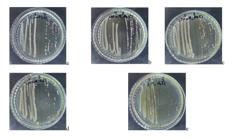
Growth and development of Streptomyces sp. 3 (3) and Streptomyces sp. 4 (4) under different sodium chloride (NaCl) concentrations: control (a); 300 mM (b); 500 mM (c); 800 mM (d); and 1 M (e).
3.3. Identification of Streptomyces strains
To determine the taxonomic position of the active actinomycete isolates, molecular genetic identification was carried out based on the analysis of 16S rRNA gene sequences. The obtained amplicons were sequenced and compared with known sequences in the GenBank database using the BLAST algorithm.
To confirm the taxonomic affiliation of the isolates Streptomyces sp. 3 and Streptomyces sp. 4 (hereafter referred to as Streptomyces violaceorubidus strain N3 and Streptomyces rochei strain N4, respectively), phylogenetic analysis was performed based on their 16S rRNA gene nucleotide sequences. Phylogenetic trees were constructed using the Neighbor-Joining method with bootstrap analysis (1000 replications) to assess the reliability of the clusters.
3.4. Streptomyces violaceorubidus strain N3
In the first phylogenetic tree (Figure 2), the Streptomyces violaceorubidus strain N3 (GenBank accession number OQ848464.1) forms a distinct cluster with high bootstrap support values (up to 93%), together with several sequences of S. violaceorubidus NRRL B-16381 derived from whole-genome shotgun sequencing contigs. This indicates a close phylogenetic relationship between the studied isolate and reference strains, confirming its classification as S. violaceorubidus.

Phylogenetic tree of Streptomyces violaceorubidus strain N3 based on 16S rRNA gene sequence analysis. The tree was constructed using the Neighbor-Joining method with bootstrap analysis (1000 replications).
3.5. Streptomyces rochei strain N4
In the second phylogenetic tree (Figure 3), the sequence of Streptomyces rochei strain N4 (GenBank accession number OQ918226.1) clusters within a clade that includes both whole-genome and partial 16S rRNA gene sequences of various S. rochei strains. The bootstrap support values of the nodes reach up to 93%, indicating high confidence in the formed clusters. The closest phylogenetic relationship is observed between strain N4 and other S. rochei strains isolated from a variety of sources, including natural environments and agrobiological samples.
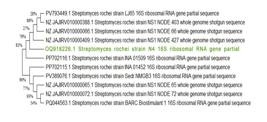
Phylogenetic tree of Streptomyces rochei strain N4 based on 16S rRNA gene sequence analysis. The phylogenetic analysis was performed using the Neighbor-Joining method with bootstrap support (1000 replications).
3.6. Antagonistic activity of Streptomyces strains
The antagonistic activity of Streptomyces violaceorubidus strain N3 and Streptomyces rochei strain N4 was evaluated against a range of phytopathogenic fungi: Fusarium oxysporum, Fusarium graminearum, Fusarium culmorum, Rhizoctonia solani, Alternaria alternata, and Alternaria sp., using the agar well diffusion method. Both strains exhibited pronounced antagonistic effects, manifested by inhibition of mycelial growth of the pathogens. The inhibition zones varied depending on the phytopathogen species and the antagonist strain.
Streptomyces violaceorubidus strain N3 demonstrated the highest activity against Fusarium graminearum, with inhibition zones reaching up to 28 mm, as well as significant growth suppression of Alternaria alternata (22 mm inhibition zone) and Alternaria sp. (36 mm inhibition zone) (Table 1).
Antagonistic activity of Streptomyces violaceorubidus strain N3 and Streptomyces rochei strain N4 against phytopathogenic fungi.
Streptomyces rochei strain N4 also showed strong antagonistic activity against the tested phytopathogenic fungi. The isolate effectively inhibited the growth of several economically important pathogens (Figure 4). The largest inhibition zone was observed against Fusarium culmorum (44 mm), indicating potent antagonistic action. Considerable growth suppression was also recorded for Alternaria alternata (38 mm) and Fusarium graminearum (25 mm) (Table 1).

Inhibition zones of phytopathogenic fungi growth caused by Streptomyces violaceorubidus strain N3 (3) and Streptomyces rochei strain N4 (4).
3.7. Indole-3-Acetic Acid (IAA) and ACC-deaminase production by Streptomyces
This study quantitatively assessed the production of indole-3-acetic acid (IAA) by two actinobacterial strains, Streptomyces violaceorubidus strain N3 and Streptomyces rochei strain N4, under normal cultivation conditions and salt stress (300 mM NaCl). L-tryptophan was added to the culture medium at a concentration of 0.5 mg/L as a precursor for IAA synthesis.
Results demonstrated that both strains are capable of synthesizing IAA in control conditions as well as under salt stress, indicating their phytohormone-producing activity. Under control conditions, IAA production levels were 10.5 µg/mL for S. violaceorubidus strain N3 and 12.2 µg/mL for S. rochei strain N4. Upon addition of 300 mM NaCl to the medium, IAA synthesis increased in both strains to 13.8 µg/mL and 16.4 µg/mL, respectively (Figure 5).

Quantitative production of IAA (µg/mL) by Streptomyces strains under control conditions and in the presence of 300 mM NaCl.
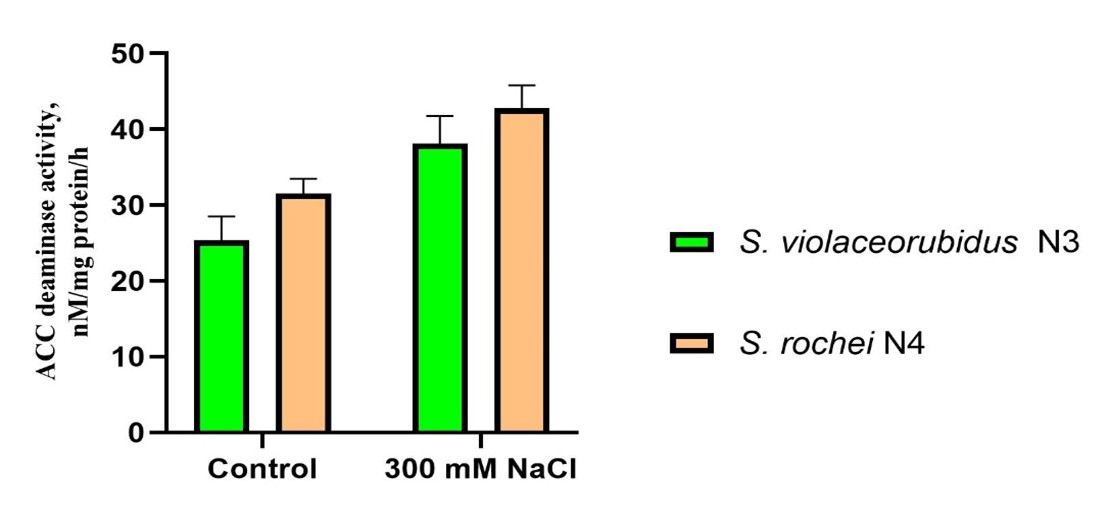
This study analyzed the ACC deaminase activity of two actinobacterial strains—Streptomyces violaceorubidus N3 and Streptomyces rochei strain N4—under normal cultivation conditions (control) and salt stress conditions (300 mM NaCl).
It was found that under control conditions, ACC deaminase activity in S. violaceorubidus N3 was 25.2 nmol α-ketobutyrate/mg protein/h, whereas in S. rochei strain N4, this value reached 31.3 nmol/mg/h. Under salt stress, enzyme production increased in both strains: ACC deaminase activity rose to 38.6 nmol/mg/h in S. violaceorubidus N3 and to 42.8 nmol/mg/h in S. rochei N4 (Figure 6).

3.8. Exopolysaccharide (EPS) production by Streptomyces
The ability of Streptomyces violaceorubidus strain N3 and Streptomyces rochei strain N4 to synthesize exopolysaccharides (EPS) was analyzed under normal cultivation conditions (control) and under salt stress induced by the addition of 300 mM NaCl to the culture medium.
The results demonstrated that both strains are active EPS producers under standard conditions as well as in the presence of elevated salt concentration. Notably, salt stress caused a significant increase in EPS production compared to the control: EPS synthesis by S. violaceorubidus strain N3 increased by 39%, while S. rochei strain N4 showed a 47% increase (Table 2).
Quantitative production of exopolysaccharides (mg/mL) by Streptomyces violaceorubidus N3 and Streptomyces rochei N4 under control conditions and with 300 mM NaCl.
4. Discussion
The isolation of more than 15 morphologically distinct actinomycete isolates from soils subjected to both anthropogenic pollution and salinization demonstrates significant ecological resilience and adaptive plasticity of microbial communities under extreme environmental conditions. Among these, the most promising isolates exhibited pronounced colony formation, biomass accumulation, and tolerance to elevated NaCl concentrations.
Particularly notable was Streptomyces rochei strain N4, which showed stable growth at NaCl concentrations up to 1 M, substantially exceeding the typical salt tolerance range reported for Streptomyces strains (~300 mM) (Nozari et al., 2021). This high level of tolerance suggests well-developed adaptive mechanisms, consistent with findings on salt-tolerant Streptomyces isolated under similar conditions (Jenifer et al., 2015; Gao et al., 2022). Members of the genus Streptomyces are also known to adapt to osmotic stress through metabolic adjustments and the expression of stress-associated genes (Kol et al., 2010; Viollier et al., 2003; Bhowmick et al., 2023; Martínez et al., 2009).
Under 300 mM NaCl, both strains N3 and N4 demonstrated increased exopolysaccharide (EPS) synthesis by 39% and 47%, respectively. EPS are recognized as crucial adaptive components that stabilize cellular structures, bind sodium ions, form biofilms, and provide osmotic protection to microorganisms under stress conditions (Romano-Armada et al., 2020; Liu et al., 2017).
Both strains also synthesized indole-3-acetic acid (IAA) under control and salt stress conditions, with production increasing to 13.8 and 16.4 µg/mL for N3 and N4, respectively. Similarly, ACC deaminase activity was enhanced (up to 38.6 and 42.8 nmol α-ketobutyrate/mg protein/h), indicating their potential to mitigate plant stress ethylene levels (Usmonkulova et al., 2024). Comparable functions of Streptomyces have been reported in other studies; for example, strain PGPA39 exhibited ACC deaminase activity and survived 1 M NaCl, reducing stress effects in plants (Palaniyandi et al., 2014). Additionally, several isolates from saline soils possess genetic markers related to these mechanisms, including ACC deaminase, IAA, ectoine, and other osmoprotectants (Rao et al., 2022). These functional traits (IAA, EPS, ACC deaminase) support the role of these strains in plant adaptation to salt stress, as noted in various studies on PGPR Streptomyces (Nozari et al., 2021).
Assessment of antagonistic activity by the agar well diffusion method revealed that S. rochei N4 exhibited strong inhibitory effects against phytopathogens such as Fusarium graminearum, Fusarium culmorum, Rhizoctonia solani, and Alternaria alternata. Notably, both S. violaceorubidus strain N3 and S. rochei strain N4 showed pronounced antagonism against a range of phytopathogenic fungi, with mycelial growth inhibition zones up to 44 mm. This aligns with previously documented antagonistic potential of extremotolerant Streptomyces strains isolated from saline environments, which demonstrate strong antimicrobial properties (Jenifer et al., 2015). The antagonistic activity of Streptomyces strains is well documented and attributed to the production of antibiotics, hydrolytic enzymes, and volatile compounds (Viaene et al., 2016; El Tarabily and Sivasithamparam, 2006).
Salt stress is known to induce increased EPS production, which was observed in our study. Under saline conditions, the tested strains enhanced EPS synthesis, with S. rochei N4 producing significantly higher polysaccharide levels than S. violaceorubidus N3. EPS play vital roles in cell protection, biofilm formation, and water retention, contributing to resistance against osmotic and ionic stress (Roberson and Firestone, 1992; Upadhyay et al., 2011). Furthermore, both S. violaceorubidus N3 and S. rochei N4 were active ACC deaminase producers under control and 300 mM NaCl conditions, suggesting their ability to alleviate salt stress in plants by reducing stress-induced ethylene synthesis. S. rochei N4 exhibited particularly high enzyme activity. Literature reports that ACC deaminase production by soil bacteria and actinomycetes promotes plant growth under stress by lowering ACC, the ethylene precursor (Glick et al., 2007; Orozco-Mosqueda et al., 2020).
The comprehensive functional activity of S. violaceorubidus N3 and S. rochei N4—including salt tolerance, production of adaptive metabolites (IAA, EPS, ACC deaminase), and antagonistic properties—confirms their potential as multifunctional plant growth-promoting rhizobacteria (PGPR) for application in saline and polluted soils. These strains may enhance plant adaptation to osmotic and Na+ toxicity stress (via EPS and biofilm formation), reduce stress ethylene and stimulate growth (via IAA and ACC deaminase), and provide protection against pathogens (antimicrobial effects). Such traits align with current bioinoculation approaches demonstrating the efficacy of Streptomyces spp. in mitigating soil salinization (Gao et al., 2022).
Acknowledgements
We acknowledge the Institute Microbiology of Academy Sciences of the Republic of Uzbekistan, which carried out a basic topic, for creating sufficient conditions to the experiments in the laboratory.
-
Data Availability Statement
The entire data set that supports the results of this study was published in the article itself.
References
-
AKBARI, A., GHARANJIK, S., KOOBAZ, P. and SADEGHI, A., 2020. Plant growth promoting Streptomyces strains are selectively interacting with the wheat cultivars especially in saline conditions. Heliyon, vol. 6, no. 2, pp. e03445. https://doi.org/10.1016/j.heliyon.2020.e03445 PMid:32095655.
» https://doi.org/10.1016/j.heliyon.2020.e03445 -
ANTORAZ, S., SANTAMARÍA, R.I., DÍAZ, M., SANZ, D. and RODRÍGUEZ, H., 2015. Toward a new focus in antibiotic and drug discovery from the Streptomyces arsenal. Frontiers in Microbiology, vol. 6, pp. 461. https://doi.org/10.3389/fmicb.2015.00461 PMid:26029195.
» https://doi.org/10.3389/fmicb.2015.00461 -
BO, A.B., KIM, J.D., KIM, Y.S., SIN, H.T., KIM, H.J., KHAITOV, B., KO, Y.K., PARK, K.W. and CHOI, J.S., 2019. Isolation, identification and characterization of Streptomyces metabolites as a potential bioherbicide. PLoS One, vol. 14, no. 9, pp. e0222933. https://doi.org/10.1371/journal.pone.0222933 PMid:31545849.
» https://doi.org/10.1371/journal.pone.0222933 -
BERDY, J., 2012. Thoughts and facts about antibiotics: where we are now and where we are heading. The Journal of Antibiotics, vol. 65, no. 8, pp. 385-395. https://doi.org/10.1038/ja.2012.27 PMid:22511224.
» https://doi.org/10.1038/ja.2012.27 -
BHOWMICK, S., SHENOUDA, M.L. and TSCHOWRI, N., 2023. Osmotic stress responses and the biology of the second messenger c-di-AMP in Streptomyces. microLife, vol. 4, pp. uqad020. https://doi.org/10.1093/femsml/uqad020 PMid:37223731.
» https://doi.org/10.1093/femsml/uqad020 -
CAI, Y., XUE, Q., CHEN, Z. and ZHANG, R., 2009. Classification and salt-tolerance of actinomycetes in the Qinghai Lake water and lakeside saline soil. Journal of Sustainable Development, vol. 2, no. 1, pp. 107-110. https://doi.org/10.5539/jsd.v2n1p107
» https://doi.org/10.5539/jsd.v2n1p107 -
CHATER, K.F., 2006. Streptomyces inside-out: a new perspective on the bacteria that provide us with antibiotics. Philosophical Transactions of the Royal Society of London. Series B, Biological Sciences, vol. 361, no. 1469, pp. 761-768. https://doi.org/10.1098/rstb.2005.1758 PMid:16627293.
» https://doi.org/10.1098/rstb.2005.1758 -
EGAMBERDIEVA, D., WIRTH, S., BELLINGRATH-KIMURA, S.D., MISHRA, J. and ARORA, N.K., 2019. Salt-tolerant plant growth-promoting rhizobacteria for enhancing crop productivity of saline soils. Frontiers in Microbiology, vol. 10, pp. 2791. https://doi.org/10.3389/fmicb.2019.02791 PMid:31921005.
» https://doi.org/10.3389/fmicb.2019.02791 -
EL TARABILY, K. and SIVASITHAMPARAM, K., 2006. Potential of yeasts as biocontrol agents of soilborne fungal plant pathogens and as plant growth promoters. Mycoscience, vol. 47, no. 1, pp. 25-35. https://doi.org/10.1007/S10267-005-0268-2
» https://doi.org/10.1007/S10267-005-0268-2 -
GAO, Y., HAN, Y., LI, X., LI, M., WANG, C., LI, Z., WANG, Y. and WANG, W., 2022. A salt-tolerant Streptomyces paradoxus D2-8 from rhizosphere soil of Phragmites communis augments soybean tolerance to soda saline-alkali stress. Polish Journal of Microbiology, vol. 71, no. 1, pp. 43-53. https://doi.org/10.33073/pjm-2022-006 PMid:35635168.
» https://doi.org/10.33073/pjm-2022-006 -
GLICK, B.R., CHENG, Z., CZARNY, J. and DUAN, J., 2007. Promotion of plant growth by ACC deaminase-producing soil bacteria. European Journal of Plant Pathology, vol. 119, no. 3, pp. 329-339. https://doi.org/10.1007/s10658-007-9162-4
» https://doi.org/10.1007/s10658-007-9162-4 -
GUARDADO-FIERROS, B.G., TUESTA-POPOLIZIO, D.A., LORENZO-SANTIAGO, M.A., RODRIGUEZ-CAMPOS, J. and CONTRERAS-RAMOS, S.M., 2024. Comparative study between Salkowski reagent and chromatographic method for auxins quantification from bacterial production. Frontiers in Plant Science, vol. 15, pp. 1378079. https://doi.org/10.3389/fpls.2024.1378079 PMid:38947947.
» https://doi.org/10.3389/fpls.2024.1378079 -
HAMID, M.E., MAHGOUB, A., BABIKER, A.J.O., BABIKER, H.A.E., HOLIE, M.A.I., ELHASSAN, M.M. and JOSEPH, M.R.P., 2020. Isolation and identification of Streptomyces spp. from desert and savanna soils in Sudan. International Journal of Environmental Research and Public Health, vol. 17, no. 23, pp. 8749. https://doi.org/10.3390/ijerph17238749 PMid:33255614.
» https://doi.org/10.3390/ijerph17238749 -
JAEMSAENG, R., JANTASURIYARAT, C. and THAMCHAIPENET, A., 2018. Molecular interaction of 1-aminocyclopropane-1-carboxylate deaminase (ACCD)-producing endophytic Streptomyces sp. GMKU 336 towards salt-stress resistance of Oryza sativa L. cv. KDML105. Scientific Reports, vol. 8, no. 1, pp. 1950. https://doi.org/10.1038/s41598-018-19799-9 PMid:29386629.
» https://doi.org/10.1038/s41598-018-19799-9 -
JENIFER, J.S.C.A., DONIO, M.B.S., MICHAELBABU, M., VINCENT, S.G.P. and CITARASU, T., 2015. Haloalkaliphilic Streptomyces spp. AJ8 isolated from solar salt works and its pharmacological potential. AMB Express, vol. 5, no. 1, pp. 143. https://doi.org/10.1186/s13568-015-0143-2 PMid:26307214.
» https://doi.org/10.1186/s13568-015-0143-2 -
KOL, S.M.R.V.M., VONK, R.J., KIKKERT, N.A., DIJKHUIZEN, L., BREITLING, R. and TAKANO, E., 2010. Metabolomic characterization of the salt stress response in Streptomyces coelicolor. Applied and Environmental Microbiology, vol. 76, no. 8, pp. 2574-2581. https://doi.org/10.1128/AEM.01992-09 PMid:20190082.
» https://doi.org/10.1128/AEM.01992-09 -
KUMAR, P., DUBEY, K.K., USMANI, Z., SHARMA, M. and GUPTA, V.K., 2022. Biotechnological and industrial applications of Streptomyces metabolites. Biofuels, Bioproducts & Biorefining : Biofpr, vol. 16, no. 1, pp. 244-264. https://doi.org/10.1002/bbb.2294
» https://doi.org/10.1002/bbb.2294 -
LACEY, H.J. and RUTLEDGE, P.J., 2022. Recently discovered secondary metabolites from Streptomyces species. Molecules (Basel, Switzerland), vol. 27, no. 3, pp. 887. https://doi.org/10.3390/molecules27030887 PMid:35164153.
» https://doi.org/10.3390/molecules27030887 -
LI, S., LIANG, W., HUANG, H., WU, H., LUO, H., MO, J., ZHANG, Z. and HU, S., 2024. Antagonistic and plant growth-promoting properties of Streptomyces F2 isolated from vineyard soil. Agronomy (Basel), vol. 14, no. 7, pp. 1489. https://doi.org/10.3390/agronomy14071489
» https://doi.org/10.3390/agronomy14071489 -
LIU, X., LUO, Y., LI, Z., WANG, J. and WEI, G., 2017. Role of exopolysaccharide in salt stress resistance and cell motility of Mesorhizobium alhagi CCNWXJ12–2T. Applied Microbiology and Biotechnology, vol. 101, no. 7, pp. 2967-2978. https://doi.org/10.1007/s00253-017-8114-y PMid:28097405.
» https://doi.org/10.1007/s00253-017-8114-y -
MARTÍNEZ, L.F., BISHOP, A., PARKES, L., DEL SOL, R., SALERNO, P., SEVCIKOVA, B., MAZURAKOVA, V., KORMANEC, J. and DYSON, P., 2009. Osmoregulation in Streptomyces coelicolor: modulation of SigB activity by OsaC. Molecular Microbiology, vol. 71, no. 5, pp. 1250-1262. https://doi.org/10.1111/j.1365-2958.2009.06599.x PMid:19154327.
» https://doi.org/10.1111/j.1365-2958.2009.06599.x -
MEENAKSHI, S., HIREMATH, J., MEENAKSHI, M.H. and SHIVAVEERAKUMAR, S., 2024. Actinomycetes: isolation, cultivation and its active biomolecules. Journal of Pure & Applied Microbiology, vol. 18, no. 1, pp. 118-143. https://doi.org/10.22207/JPAM.18.1.48
» https://doi.org/10.22207/JPAM.18.1.48 -
NARMUKHAMEDOVA, M., KHUSANOV, T., KADIROVA, G., JUMAYOROV, S., AKHMEDOVA, Z. and KADIROVA, Z., 2025. An extracellular ribonuclease from Bacillus subtilis TM and Bacillus velezensis TM with antiviral activity against TMV. Han’guk Misaengmul, Saengmyong Konghakhoe Chi = Korean Journal of Microbiology and Biotechnology, vol. 53, no. 2, pp. 253-260. https://doi.org/10.48022/mbl.2503.03005
» https://doi.org/10.48022/mbl.2503.03005 -
NOZARI, R.M., ORTOLAN, F., ASTARITA, L.V. and SANTARÉM, E.R., 2021. Streptomyces spp. enhance vegetative growth of maize plants under saline stress. Brazilian Journal of Microbiology : Publication of the Brazilian Society for Microbiology, vol. 52, no. 3, pp. 1371-1383. https://doi.org/10.1007/s42770-021-00480-9 PMid:33834385.
» https://doi.org/10.1007/s42770-021-00480-9 -
OROZCO-MOSQUEDA, M.D.C., GLICK, B.R. and SANTOYO, G., 2020. ACC deaminase in plant growth-promoting bacteria (PGPB): an efficient mechanism to counter salt stress in crops. Microbiological Research, vol. 235, pp. 126439. https://doi.org/10.1016/j.micres.2020.126439 PMid:32097862.
» https://doi.org/10.1016/j.micres.2020.126439 -
PALANIYANDI, S.A., DAMODHARAN, K., YANG, S.H. and SUH, J.W., 2014. Streptomyces sp. strain PGPA39 alleviates salt stress and promotes growth of ‘Micro Tom’ tomato plants. Journal of Applied Microbiology, vol. 117, no. 3, pp. 766-773. https://doi.org/10.1111/jam.12563 PMid:24909841.
» https://doi.org/10.1111/jam.12563 -
PANDEY, S., GHOSH, P.K., GHOSH, S., KUMAR, T.D. and MAITI, T.K., 2013. Role of heavy metal resistant Ochrobactrum sp. and Bacillus spp. strains in bioremediation of a rice cultivar and their PGPR-like activities. The Journal of Microbiology, vol. 51, no. 1, pp. 11-17. https://doi.org/10.1007/s12275-013-2330-7 PMid:23456706.
» https://doi.org/10.1007/s12275-013-2330-7 -
PRAPAGDEE, B., KUEKULVONG, C. and MONGKOLSUK, S., 2008. Antifungal potential of extracellular metabolites produced by Streptomyces hygroscopicus against phytopathogenic fungi. International Journal of Biological Sciences, vol. 4, no. 5, pp. 330-337. https://doi.org/10.7150/ijbs.4.330 PMid:18825279.
» https://doi.org/10.7150/ijbs.4.330 -
QUINN, G.A., BANAT, A.M., ABDELHAMEED, A.M. and BANAT, I.M., 2020. Streptomyces from traditional medicine: sources of new innovations in antibiotic discovery. Journal of Medical Microbiology, vol. 69, no. 8, pp. 1040-1048. https://doi.org/10.1099/jmm.0.001232 PMid:32692643.
» https://doi.org/10.1099/jmm.0.001232 -
RAO, M.P.N., LOHMANEERATANA, K., BUNYOO, C. and THAMCHAIPENET, A., 2022. Actinobacteria–plant interactions in alleviating abiotic stress. Plants, vol. 11, no. 21, pp. 2976. https://doi.org/10.3390/plants11212976 PMid:36365429.
» https://doi.org/10.3390/plants11212976 -
ROBERSON, E.B. and FIRESTONE, M.K., 1992. Relationship between desiccation and exopolysaccharide production in a soil Pseudomonas sp. Applied and Environmental Microbiology, vol. 58, no. 4, pp. 1284-1291. https://doi.org/10.1128/aem.58.4.1284-1291.1992 PMid:16348695.
» https://doi.org/10.1128/aem.58.4.1284-1291.1992 -
ROMANO-ARMADA, N., YAÑEZ-YAZLLE, M.F., IRAZUSTA, V.P., RAJAL, V.B. and MORAGA, N.B., 2020. Potential of bioremediation and PGP traits in Streptomyces as strategies for bio-reclamation of salt-affected soils for agriculture. Pathogens (Basel, Switzerland), vol. 9, no. 2, pp. 117. https://doi.org/10.3390/pathogens9020117 PMid:32069867.
» https://doi.org/10.3390/pathogens9020117 -
SADEGHI, A., KARIMI, E., DAHAJI, P.A., JAVID, M.G., DALVAND, Y. and ASKARI, H., 2012. Plant growth promoting activity of an auxin and siderophore producing isolate of Streptomyces under saline soil conditions. World Journal of Microbiology & Biotechnology, vol. 28, no. 4, pp. 1503-1509. https://doi.org/10.1007/s11274-011-0952-7 PMid:22805932.
» https://doi.org/10.1007/s11274-011-0952-7 -
SARDARI, R.R., KULCINSKAJA, E., RON, E.Y., BJÖRNSDÓTTIR, S., FRIÐJÓNSSON, Ó.H., HREGGVIÐSSON, G.Ó. and KARLSSON, E.N., 2017. Evaluation of the production of exopolysaccharides by two strains of the thermophilic bacterium Rhodothermus marinus. Carbohydrate Polymers, vol. 156, pp. 1-8. https://doi.org/10.1016/j.carbpol.2016.08.062 PMid:27842803.
» https://doi.org/10.1016/j.carbpol.2016.08.062 -
TAMURA, K., STECHER, G. and KUMAR, S., 2021. MEGA11: molecular evolutionary genetics analysis version 11. Molecular Biology and Evolution, vol. 38, no. 7, pp. 3022-3027. https://doi.org/10.1093/molbev/msab120 PMid:33892491.
» https://doi.org/10.1093/molbev/msab120 -
TRESNER, H.D., HAYES, J.A. and BACKUS, E.J., 1968. Differential tolerance of streptomycetes to sodium chloride as a taxonomic aid. Applied Microbiology, vol. 16, no. 8, pp. 1134-1136. https://doi.org/10.1128/am.16.8.1134-1136.1968 PMid:5675504.
» https://doi.org/10.1128/am.16.8.1134-1136.1968 -
UPADHYAY, S.K., SINGH, J.S. and SINGH, D.P., 2011. Exopolysaccharide-producing plant growth-promoting rhizobacteria under salinity condition. Pedosphere, vol. 21, no. 2, pp. 214-222. https://doi.org/10.1016/S1002-0160(11)60120-3
» https://doi.org/10.1016/S1002-0160(11)60120-3 -
USMONKULOVA, A., MALUSA, E., KADIROVA, G., KHALILOV, I., CANFORA, L. and ABDULMYANOVA, L., 2025. Ni2+ and Cd2+ biosorption capacity and redox-mediated toxicity reduction in bacterial strains from highly contaminated soils of Uzbekistan. Microorganisms, vol. 13, no. 7, pp. 1485. https://doi.org/10.3390/microorganisms13071485 PMid:40731995.
» https://doi.org/10.3390/microorganisms13071485 -
USMONKULOVA, A.A., KADIROVA, G.K.H., KHUSANOV, T.S., SHONAKHUNOV, T.E. and SHUKUROV, N., 2024. Determination of local bacteria synthesizing ACC deaminase on plant growth indicators under nickel and cadmium stress conditions. SABRAO Journal of Breeding and Genetics, vol. 56, no. 5, pp. 2033-2044. https://doi.org/10.54910/sabrao2024.56.5.26
» https://doi.org/10.54910/sabrao2024.56.5.26 -
VIAENE, T., LANGENDRIES, S., BEIRINCKX, S., MAES, M. and GOORMACHTIG, S., 2016. Streptomyces as a plant’s best friend? FEMS Microbiology Ecology, vol. 92, no. 8, pp. fiw119. https://doi.org/10.1093/femsec/fiw119 PMid:27279415.
» https://doi.org/10.1093/femsec/fiw119 -
VIOLLIER, P.H., KELEMEN, G.H., DALE, G.E., NGUYEN, K.T., BUTTNER, M.J. and THOMPSON, C.J., 2003. Specialized osmotic stress response systems involve multiple SigB-like sigma factors in Streptomyces coelicolor. Molecular Microbiology, vol. 47, no. 3, pp. 699-714. https://doi.org/10.1046/j.1365-2958.2003.03302.x PMid:12535070.
» https://doi.org/10.1046/j.1365-2958.2003.03302.x -
YOOLONG, S., KRUASUWAN, W., PHAM, T.H.T., JAEMSAENG, R., JANTASURIYARAT, C. and THAMCHAIPENET, A., 2019. Modulation of salt tolerance in Thai jasmine rice (Oryza sativa L. cv. KDML105) by Streptomyces venezuelae ATCC 10712 expressing ACC deaminase. Scientific Reports, vol. 9, no. 1, pp. 1275. https://doi.org/10.1038/s41598-018-37987-5 PMid:30718781.
» https://doi.org/10.1038/s41598-018-37987-5
Edited by
-
Editor:
Takako Matsumura Tundisi
The entire data set that supports the results of this study was published in the article itself.