 Entomovirological Surveillance in Aedes (Stegomyia) aegypti Linnaeus, 1762 and Aedes (Stegomyia) albopictus Skuse, 1894 (Diptera, Culicidae) in new housing areas in eastern Maranhão, Brazil
Abstract
Aedes aegypti is the primary vector of dengue virus (DENV), Zika virus (ZIKV), and chikungunya virus (CHIKV), while Aedes albopictus is considered a potential vector for these arboviruses. Therefore, monitoring the spatial and temporal distribution of these vectors through entomovirological surveillance is essential. This study aimed to conduct entomovirological monitoring of Ae. aegypti and Ae. albopictus populations in newly established housing areas in eastern Maranhão, Brazil. Eggs and adults were collected monthly for one year across residential complexes comprising approximately 3,000 households. Detection of DENV, ZIKV, and CHIKV was performed using real‑time reverse transcription polymerase chain reaction (RT‑qPCR). A total of 122,378 Aedes spp. eggs were collected. The Ovitrap Positive Index (OPI) varied across locations, with similar averages (71.0%, 67.6%, and 67.9%), and higher values recorded from February to May. The Egg Density Index (EDI) showed pronounced variation, reaching a peak of 376.1. A total of 304 adult mosquitoes were collected, of which 205 were Ae. aegypti (67.43%). Heat maps indicated wide distribution of mosquitoes across the three study areas, with higher densities and hotspots during the rainy months. No arboviruses were detected in the analyzed female pools. The study demonstrated the population dynamics of Ae. aegypti and Ae. albopictus in new housing developments and confirmed the effectiveness of ovitraps in estimating vector density, with an overall OPI of 68.83%.
Keywords:
arboviruses; vectors; ovitraps; entomo-virology
Resumo
Aedes aegypti é o principal vetor do vírus da dengue (DENV), do vírus Zika (ZIKV) e do chikungunya (CHIKV), e Aedes albopictus é um vetor potencial para esses arbovírus; portanto, é importante monitorar a distribuição desses vetores por meio da vigilância entomovirológica. O objetivo foi realizar uma investigação entomovirológica nas populações de Ae. aegypti e Ae. albopictus em novas áreas residenciais, no leste do Maranhão, Brasil. Ovos e adultos foram coletados usando ovitrampas e um aspirador mecânico, durante um ano, em áreas residenciais com 3.000 residências. A presença dos arbovírus DENV, ZIK e CHINK foi avaliada por meio da reação em cadeia da polimerase com transcrição reversa em tempo real (RT-qPCR). Um total de 122.378 ovos de Aedes spp. foram coletados. O Índice de Positividade de Ovos (IPO) variou entre os locais, com médias semelhantes (71,0%), (67,6%) e (67,9%) para as três áreas, com taxas mais altas em fevereiro, março, abril e maio. O Índice de Densidade de Ovos (IDO) apresentou grande variação, com um pico de 376,1. Foram coletados 304 mosquitos adultos, sendo 205 Ae. aegypti (67,43%). Os mapas de calor indicaram que os mosquitos estão amplamente distribuídos nas três áreas de estudo, com densidade e pontos críticos mais evidentes nos meses chuvosos. As fêmeas não apresentaram a presença dos arbovírus. O estudo mostrou a dinâmica populacional de Ae. aegypti e de Ae. albopictus em novas áreas habitacionais e a eficácia das ovitrampas na estimativa da densidade dos vetores com o IPO de 68,83%.
Palavras-chave:
arboviroses; vetores; ovitrampas; entomovirologia
1. Introduction
The mosquitoes Aedes (Stegomyia) aegypti (Linnaeus, 1762) and Aedes (Stegomyia) albopictus (Skuse, 1894) are important from an epidemiological point of view, as they are vectors of etiological agents to humans (WHO, 2023). They are the main spreaders of arboviruses such as Orthoflavivirus denguei (dengue virus - DENV), Orthoflavivirus zikaense (Zika virus - ZIKV) and Alphavirus chikungunya (chikungunya virus - CHIKV) (ICTV, 2025).
Ae. aegypti, native to Africa, is considered a tropical and subtropical species (Brasil, 2001). It is the main vector of the dengue virus in Brazil (Vidal, 2015; Paiva et al., 2021). Although originally wild, it has adapted well to the urban environment, developing synanthropic and anthropophilic behavior over time. Ae. aegypti reproduces mainly in areas with poor basic sanitation, irregular water supply systems and interaction between climate change and human mobility (Foratinni, 2002; Gibb et al., 2023). The abundance of breeding sites near homes and the availability of food allow this species to inhabit both the intra and peridomiciliary environment (Maia et al., 2019; Rodrigues et al., 2023).
Ae. albopictus is also an exotic species that has invaded the Neotropical region (Forattini, 1996). It has a great capability to colonize various habitats, being present in rural, urban and peri-urban environments (Oliveira and Biazoto, 2012; Medeiros-Sousa et al., 2013; Variza et al., 2022). In Brazil, this species is widely disseminated, with records in all states; however, its occurrence is more expressive in the Southeast and Central-West regions, compared to the North, Northeast and South regions (Variza et al., 2022). In the Americas, Ae. albopictus acts as a secondary vector in the transmission of dengue. Studies also highlight its vector competence for the transmission of chikungunya and Zika viruses in Brazil (Vega-Rúa et al., 2014; Brasil, 2015; Rezende et al., 2020).
Global, ecosystem and climate changes, together with the adaptability of mosquitoes to changing environments, have facilitated the spread of diseases and the introduction of new species into previously unaffected areas. Given these changes, it is necessary to intensify the efforts to track and control mosquitoes in areas that may become habitable for Ae. aegypti and Ae. albopictus (Kamal et al., 2018; Paz-Bailey et al., 2024).
In Brazil, dengue, Zika and chikungunya fevers are endemic diseases with a substantial epidemiological impact on public health (Sousa et al., 2023). Dengue fever produces major challenges to Brazilian public health, due to the numerous cases, hospitalizations and deaths that are widespread in all regions of the country (Brasil, 2017, 2025; Oliveira and Lira Neto, 2024).
In the state of Maranhão, the arboviruses scenario reflects the national and global context (Maranhão, 2024a, b). The incidence of dengue fever in the state has been increasing over the years, with significant fluctuations in different periods, which is aggravated by the predominant tropical climate throughout the year and the lack of new technologies that provide an efficient and rapid diagnosis (Silva et al., 2022). In 2024, 7,389 cases of Dengue, 691 confirmed cases of Chikungunya and 179 cases of Zika were confirmed in the state (Maranhão, 2024a; Brasil, 2025).
An effective alternative to monitor insect vectors and their interaction with the environment is the entomological surveillance (Brasil, 2024), since it allows calculating indicators that track the presence, distribution and density of vectors, in addition to identifying seasonal and geographic variations in mosquito abundance, helping to predict disease transmission risks and plan control interventions (Kosoltanapiwat et al., 2020). This process is especially useful in integrated vector management (IVM) (Liu et al., 2023; Brasil, 2024).
Specific techniques are used to control each stage of the vector. The stage of egg capture is done using ovitraps, while capture of adult mosquitoes uses other traps, such as the mechanical aspirator designed by Nasci (1981). This approach allows us to assess both the density and prevalence of insects in a given area (Brasil, 2024). Therefore, the objective of this study is to perform entomovirological investigation in populations of Ae. aegypti and Ae. albopictus and map the areas of infestation in three residential areas in the city of Codó, Maranhão.
2. Methodology
2.1. Study area
The research was carried out in the municipality of Codó, Eastern Maranhão, with an area of 4,361.344 km2, whose geographic coordinates are 04º27'12.8" South latitude and 43º53'01.7" West longitude (IBGE, 2022). The vegetation of the municipality is of the open forest/babaçu and cerrado type, with an equatorial climate, characterized by rainy periods (January to June) and dry periods (July to December). The average annual temperature varies around 26 ºC to 27 ºC, with a maximum of 36 ºC (Correia-Filho et al., 2011).
2.2. Study design
The three residential areas are located in the peripheral area of the city, and have each housing center has approximately 1,000 units (Corrêa and Lima, 2021). The three studied residential centers are part of band 1 of the Minha Casa Minha Vida Program (Corrêa and Lima, 2021). Codó city is subdivided into 21 neighborhoods (Codó, 2019), of which the São Pedro, Santa Rita and Zito Rolim neighborhoods (Figure 1) were chosen to perform.

Location of the urban area of the municipality of Codó, Maranhão, Brazil, highlighting the three residential areas: São Pedro, Zito Rolim and Santa Rita.
2.3. Eggs surveillance
The eggs and adults mosquitoes were collected bimonthly during a year (October 2023 to September 2024). Mosquito eggs were collected using ovitraps placed at 200-meter radiuses between collection points. After five days, the ovitraps were collected and were sent to the Biology Laboratory of the Federal University of Maranhão - UFMA, Codó Science Center, in which they were left to dry for 48 hours. Then, the eggs in each duratree pallets were counted per residence using a Stemi 2000-C binocular stereomicroscope (ZEISS®).
2.4. Adults surveillance - Aedes aegypti and Aedes albopictus
The adults mosquitoes were collected in six cycles by performing suctions in 60 residences per housing center for each stage. A total of 180 suctions were performed per cycle (Figure 2). The samplings were done using the mechanical aspirator designed by Nasci (1981), following the guidelines of the Ministry of Health (MS) (Brasil, 2020, Nota Informativa No. 8/2020-CGARBDEIDT/SVS/MS). Suction was done for a time range of 10 to 15 minutes in each residence, covering all rooms authorized by the residents. The operation was intensified in strategic locations, such as sinks, bathrooms and bedrooms, where the presence of mosquitoes was more likely.

Bimonthly collection scheme for monitoring Aedes aegypti and Aedes albopictus in the municipality of Codó - MA.
The collect mosquitoes were taken alive to the UFMA Biology Laboratory in Codó, MA, where they were anesthetized in the freezer at -20ºC, stored in 5 mL tubes and then identified using identification keys Consoli and Oliveira (1994) and WRBU (2022). They were then transported to the Medical Entomology Laboratory – LABEM – of the State University of Maranhão, Caxias Campus, in the city of Caxias – MA, and stored in a freezer at -80ºC until they were sent to the Laboratory of Morphology and Physiology of Culicidae and Chironomidae – LAMFIC2 – at the Federal University of Paraná (UFPR), in Curitiba – PR, for identification of arboviruses.
2.5. Spatial analysis of vector density estimation
The data were organized in CSV format (Comma-separated values), containing geographic information (latitude and longitude), number of eggs or mosquitoes collected, and the monitoring time frame, segmented by two-month periods. Subsequently, the points were imported into the QGIS 3.34.5 software and projected onto the same reference system as the base map, represented by a shapefile of the neighborhood boundaries. The density maps were created using QGIS, based on the gathering and processing of data on the presence of Ae. aegypti and Ae. albopictus in ovitraps and adult specimens harvested in residential areas.
For spatial analysis, the Kernel density technique with a radius of 100 meters was applied. The variable of interest was defined based on the count of harvested eggs and mosquitoes, producing a density raster. To classify the infestation on the maps, the following classes were adopted: very low (≤ 100), represented by the color blue; low (100 – 400), in light green; medium (400 – 800), in yellow; high (800 – 1200), in orange; and very high (> 1200), highlighted in red. This categorization allowed us to identify priority areas for vector control actionsThis categorization allowed us to identify priority areas for vector control actions, with the regions in red concentrated in hotspots, that is, places with the highest concentration of eggs and/or vectors.
2.6. Arboviruses identification
Nucleic acids were extracted from 130 females of Ae. aegypti and 71 females of Ae. albopictus, totaling 201 females. Pools containing between 15 and 39 females of each species were formed per microtube. Each pool was macerated with 140 μL of phosphate-buffered saline (PBS) using a pestle. Viral RNA extraction was then executed using the QIAamp Viral RNA Mini Kit (Qiagen®), following the manufacturer's instructions. RNA was eluted from the membrane using 40 μL of elution buffer. RNA was subsequently quantified using a Nanodrop spectrophotometer. Each tube was properly identified with information about the species, number of individuals, residence and city of harvest.
Simultaneous identification of DENV, ZIK and CHIKV arboviruses was performed using the XGEN MULTI ZDC multiplex kit (Mobius® - ANVISA registration: No. 80502070063). Specific primers were used to transcribe viral RNA into cDNA by reverse transcription, followed by a single-tube PCR reaction (One-step) according to the manufacturer's guidelines.
The temperature conditions were applied as follows: 15 min at 42°C, 3 min at 94°C, 40 cycles of 8s at 94°C and 1 min at 60°C. The results were interpreted by comparing the amplification of the samples with the curves of the positive controls for each arbovirus, allowing the determination of the presence or absence of viral RNA in each case.
2.7. Data analysis
The data was divided into six bimonthly periods, which were organized as follows: 1st bimester: October and November; 2nd bimester: December and January; 3rd bimester: February and March; 4th bimester: April and May; 5th bimester: June and July and 6th bimester: August and September.
The Ovitrap Positive Index (OPI) and the Egg Density Index (EDI) were evaluated to measure the infestation by Ae. aegypti and Ae. Albopictus (Gomes, 1998). Using the formulas:
a) Ovitrap Positive Index (OPI):Positive trap percentage.
Where NPT is the number of positive traps and NET is the number of examined traps.
b) Egg Density Index (EDI): Average number of eggs per positive trap.
Where NE is the number of eggs and NPT is the number of positive traps.
In addition, the climatic variables of temperature and humidity were recorded for each location and bimester during each harvest using a digital thermo-hygrometer. Statistical analysis was done using the Kruskal-Wallis test for comparisons between bimesters and locations, and Spearman's correlation to evaluate the associations between the climatic variables and the entomological indicators. The tests were performed using Software SPSS for Windows with a 95% confidence level, ensuring the robustness of the results and the validity of the observed correlations.
3. Results
A total of 122,378 Aedes spp. eggs were collected in 1,202 ovitraps at the three locations. Of those, 41,068 were collected in the Santa Rita area (33.5%), 39,614 in the São Pedro (32.3%) and 42,011 in the Zito Rolim (34.3%). The analysis of entomological indicators (OPI and EDI) over the six two-month periods reveals significant variations in the infestation by Aedes spp. in the three locations analyzed.
The Ovitrap Positive Index (OPI) presented bimonthly variations in all sites, with similar averages among the residential areas. The highest values were recorded in the third and fourth two-month periods, indicating an increase in infestation in these periods (Table 1).
Variation of Entomological Indicators (OPI and EDI) in the localities of Santa Rita, São Pedro and Zito Rolim over the Bimonthly Periods.
The Egg Density Index (EDI) presented great variation over time, with peaks in the third bimester in all sites, especially in Zito Rolim, which reached an average of 376.1 eggs per trap. The high dispersion of the data, evidenced by the high standard deviation, demonstrates significant seasonal variations in egg deposition (Table 1).
It can be observed that, at the beginning of the studied period, the average number of eggs in the three locations is relatively close, with values of 43.1, 52.0 and 42.8, respectively, in the 1st two-month period. However, from the 3rd two-month period onwards, there is a substantial increase in the average number of eggs, especially in Zito Rolim, which reaches 376.1, followed by São Pedro (282.0) and Santa Rita (284.6). From the 4th two-month period onwards, the averages begin to gradually decrease, with Santa Rita and Zito Rolim showing a more notable reduction in the last two-month periods (Table 1).
A negative association was observed between temperature and the number of eggs, showing that, as temperatures decreased, there was an increase in the number of eggs harvested in all locations. This association was higher in São Pedro (-0.575; p < 0.001) and Zito Rolim (-0.494; p < 0.001) than in Santa Rita (-0.164; p = 0.005). On the other hand, humidity exhibited a significant positive correlation with the total number of eggs. This association was more evident in Zito Rolim (0.595; p < 0.001), followed by Santa Rita (0.572; p < 0.001) and São Pedro (0.531; p < 0.001) (Table 2).
Spearman Correlation between Temperature, Humidity and Total Eggs in the Localities of Santa Rita, São Pedro and Zito Rolim.
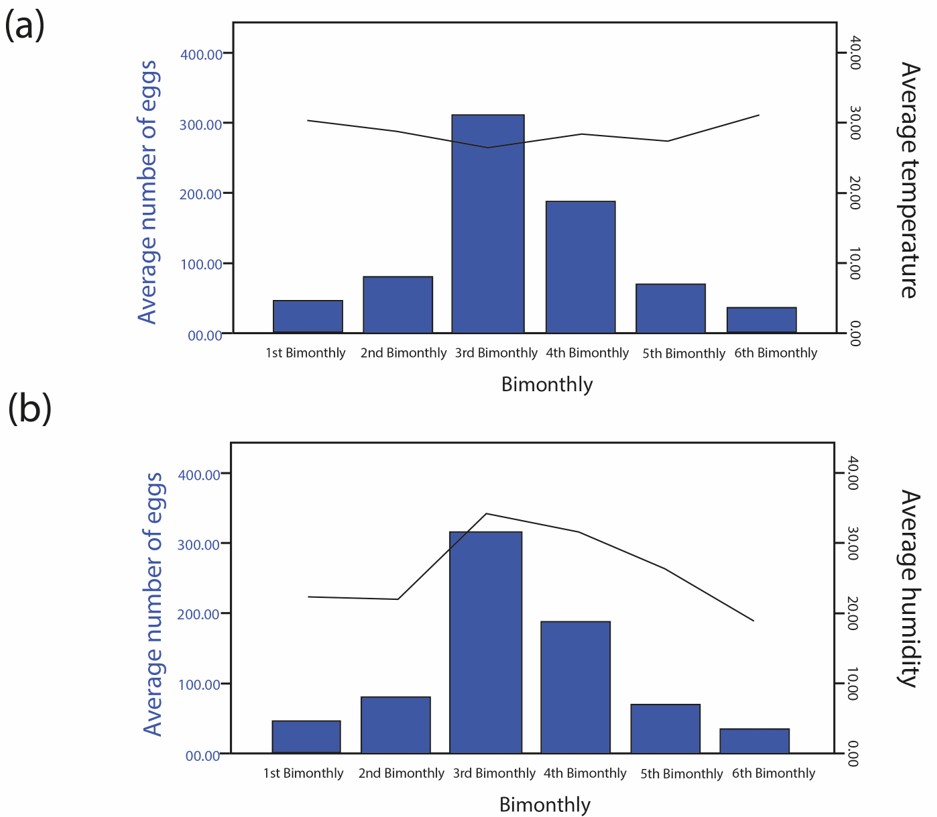
The data presented in Figure 3 demonstrate the variation in the average number of mosquito eggs at the studied areas. In all locations, a tendency of significant increase in the number of eggs was observed during the third two-month period, coinciding with an increase in relative humidity and a reduction in average temperature, especially in São Pedro and Zito Rolim, where humidity levels reached the highest levels.

Average number of Aedes spp. eggs collected per two-month period in relation to the climatic variables in the three study areas. (A) Relationship between the average number of eggs and the average temperature (°C). (B) Relationship between the average number of eggs and the average relative humidity (%).
However, during periods of lower humidity (such as the sixth bimester), the number of eggs decreased significantly. The Kruskal-Wallis test revealed statistical significance (p < 0.05) in all comparisons, indicating that variations in temperature and humidity can directly influence mosquito oviposition in the three analyzed locations.
Regarding adult individuals, 304 specimens of Ae. aegypti and Ae. albopictus were collected (Table 3). Of those, 205 specimens belonged to the species Ae. aegypti (67.43%), 130 females (63.41%) and 75 males (36.59%) and 99 specimens belonged to the species Ae. albopictus (32.57%), 71 females (71.71%) and 28 males (28.28%) (Table 3).
Distribution of Aedes aegypti and Aedes albopictus per bimonthly periods in the localities of Santa Rita, São Pedro and Zito Rolim.
Ae. aegypti was found to be negatively correlated with temperature in all sites, with the strongest effect in São Pedro (-0.489). On the other hand, humidity displayed a significant positive correlation, especially in São Pedro (0.493). The same occurs for Ae. Ae. albopictus, in which case temperature also displayed a negative correlation, while in Santa Rita the correlation was not statistically significant (p=0.083). On the other hand, humidity has a significant positive correlation for this species in all sites (Table 4).
Correlation between Climate Variables and the Presence of Aedes aegypti and Aedes albopictus in the Localities of Santa Rita, São Pedro and Zito Rolim.
Residencial Zito Rolim registered the highest occurrence of Ae. aegypti (41.47%) and also the highest number of females of this collected species (n = 54). For Ae. albopictus, the highest percentage was found in Residencial São Pedro (49.49%), which also had the highest number of females of this species (n = 37).
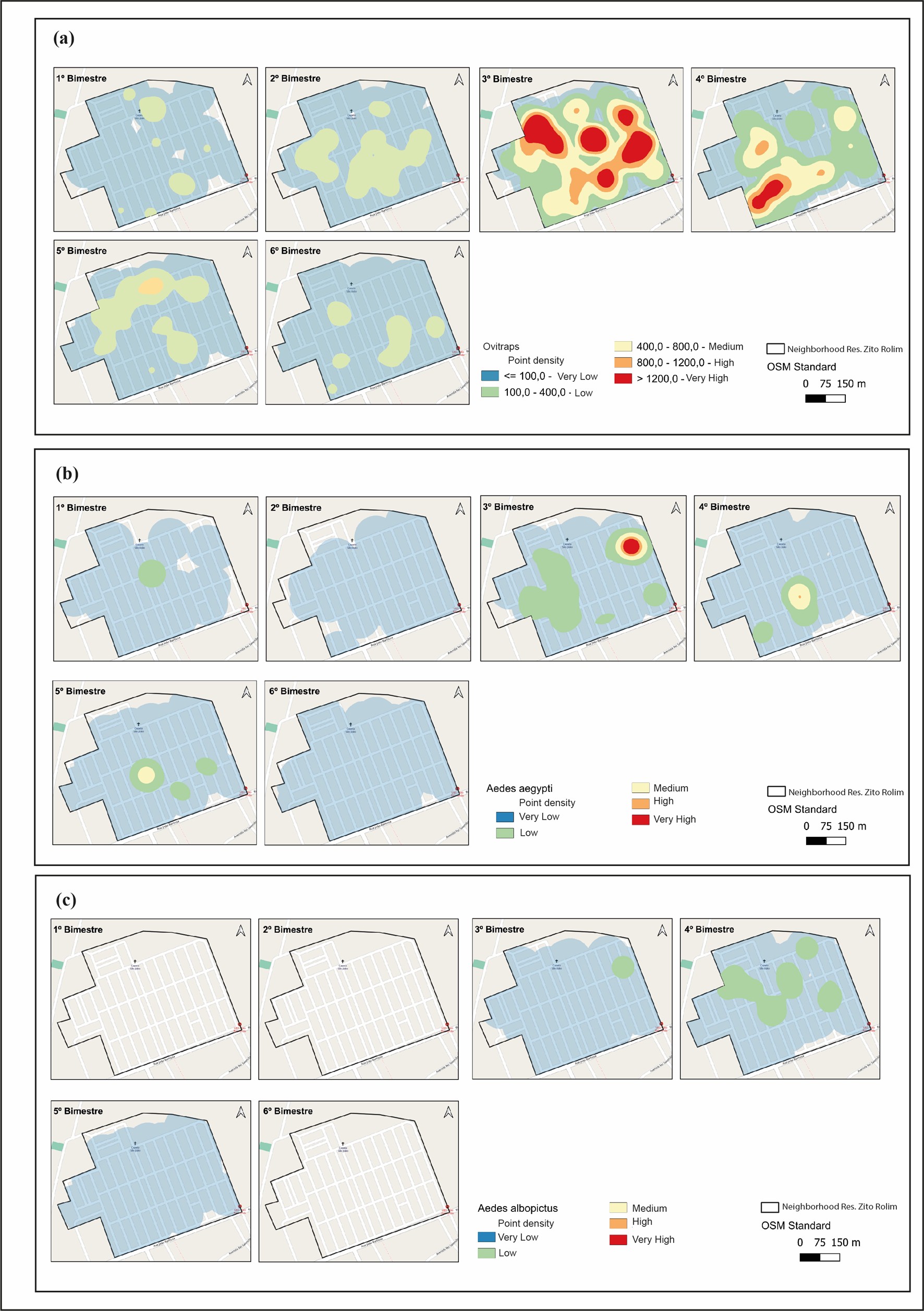
The spatial distribution of Aedes spp. eggs was broad in all two-month periods, covering the three analyzed residential areas. Hot spots were more intense in the 3rd and 4th bimesters (Figure 4A, Figure 5A, Figure 6A). The density of collected eggs increased significantly and areas with high egg concentrations were observed. After that, egg density decreased in the 5th bimester, indicating a decline in mosquito activity, while low egg densities were observed in the 1st, 2nd and 6th bimesters, with isolated areas presenting low egg concentration, suggesting the end of the intensive reproductive cycle.

Seasonal and spatial distribution by Kernel Aedes spp. in Residencial Santa Rita, Codó, Maranhão, Brazil: (A) Density of Aedes spp eggs; (B) Aedes aegypti (C) Aedes albopictus.

Seasonal and spatial distribution by Kernel Aedes spp. in Residencial São Pedro, Codó, Maranhão, Brazil: (A) Density of Aedes spp eggs; (B) Aedes aegypti (C) Aedes albopictus.

Seasonal and spatial distribution by Kernel Aedes spp. in Residencial Zito Rolim, Codó, Maranhão, Brazil: (A) Density of Aedes spp eggs; (B) Aedes aegypti (C) Aedes albopictus.
Regarding the spatial distribution of the adult mosquito Ae. aegypti (Figure 4B, Figure 5B, Figure 6B), it is possible to observe that only Residencial Zito Rolim presented hot spots during the analyzed period, which was verified in the 3rd bimester.
Regarding the spatial distribution of Ae. albopictus, the presence of this mosquito was not detected in the three areas during the 1st, 2nd and 6th bimesters (Figures 4C, 5C, 6C). And only the São Pedro residential area, in the 4th bimester, presented hot spots and medium and high concentrations during the analyzed period.
Spatial analysis revealed a higher frequency of Ae. aegypti compared to Ae. albopictus. The presence of Ae. albopictus was recorded only in the two-month periods corresponding to the rainy season, which were also the periods that recorded the highest average humidity levels.
The 201 females of Ae. aegypti and Ae. albopictus distributed in seven pools did not present RNA from DENV, CHIKV or ZIKV viruses.
4. Discussion
The high number of eggs harvested in this study indicates high rates of infestation by Aedes spp., the EDI and OPI values presented similar averages in the three residential areas, and a peak in the 3rd and 4th two-month periods in the rainy season (February to May).
The egg density index (EDI) was here confirmed as important and effective to verify the density of pregnant female mosquitoes in a region, which serves as a parameter for measuring the real risk of transmission of arboviruses. This data helps to prevent future epidemics and outbreaks, with the use of low-cost methodologies (Donalisio et al., 2017).
With the ovitrap method, it was possible to observe the presence of vector eggs throughout over period and female mosquitoes of the Aedes genus in the studied areas. Therefore, it is important to emphasize that control measures must be applied throughout the year, with intensification during the period of greatest vector abundance (Custódio et al., 2019).
According to Nascimento et al. (2020), EDI values from 0 to 20 indicate a satisfactory level of infestation, while 21 to 35 indicate an alert situation, and above 35 represents a risk situation of infestation. Therefore, all areas presented a risk situation in relation to the EDI with values above 35. Therefore, it is observed that residential areas offer conducive conditions for the development of these vectors, possibly due to the presence of breeding sites, such as the accumulation of stagnant water, in addition to factors that favor their proliferation, such as the ones described by Gibb et al., (2023), which indicates that factors such as sanitation, water supply and long-term urban growth are significant predictors of local spatial patterns of Dengue incidence.
Rodrigues et al. (2023) identified that the main breeding sites for both species in the city of Codó, Maranhão, include containers such as water tanks, buckets, tires, and disposable bottles that accumulate water, creating ideal conditions for the development of the larvae of those insects. This scenario is no different from other studies conducted around the world, which reported that the incidence of mosquitoes in urban and peri-urban areas occurs mainly in artificial breeding sites that facilitate vector reproduction in the synanthropic environment (Baldacchino et al 2017).
Wilke et al. (2020) highlight that urban centers have several places suitable for the reproduction of Ae. aegypti and Ae. albopictus, with inadequate garbage disposal and lack of a regular garbage removal being the main causes of the formation of breeding sites.
Climatic factors, such as temperature and humidity, may be influencing the vector’s population dynamics, justifying the need for differentiated control strategies throughout the year (Lubna et al., 2023). The combination of high temperatures and humidity fostered the vector’s reproduction and proliferation (Attaullah et al., 2021). Furthermore, these two factors are correlated with abundance and possibly with an extension of the mosquito's biting season (Orlandin et al., 2016).
It was observed that the presence of the vector was superior in high humidity conditions, and although there is no definitive evidence that humidity can predict the incidence of the Aedes mosquito and the transmission of Dengue, humidity is clearly linked to the survival and prevalence of the mosquito. This means that in conditions of high humidity, the mosquito tends to live longer, which increases the period in which it can be active and in contact with humans. As a result, this greater longevity may eventually increase the mosquito's ability to transmit the Yellow Fever virus, Chikungunya virus, Zika virus and especially the Dengue virus (Ferreira et al., 2017; Rizzi et al., 2017).
That fact can be explained by the climate of the studied area, which is characterized as a tropical equatorial climate with two clearly defined periods: a rainy period with average rainfall of 202.05 mm and a dry period with 24.12 mm (Correia-Filho et al., 2011, SEMA 2024). Additionally, Santos et al. (2020) highlight in their study that the combination of high temperatures and humidity significantly favors the increase in egg density and, therefore, creates ideal conditions for mosquito reproduction.
The infestation of Ae. aegypti and Ae. albopictus varies throughout the year, being more present in hot and rainy seasons, following a seasonal pattern. In the hottest and rainiest months, especially during summer, there is a significant increase in the population density of those vectors (Fonseca Júnior et al., 2019; Acero-Sandoval, Palacio-Cortés and Navarro-Silva, 2023).
In Codó - MA, the increase in the number of mosquitoes harvested during the rainy season can be explained by the region's climatic characteristics. Unlike other areas, the rainy season in the state of Maranhão is marked by a combination of high temperatures and high humidity, creating favorable environmental conditions for the reproduction and survival of vectors. The intense heat and the grander availability of breeding sites, due to the rains, favor the development of those insects, intensifying their presence. In Caxias - MA, a study on the reproductive profile of Ae. aegypti and Ae. albopictus also indicated the higher prevalence of those mosquitoes in the rainy season (Sousa et al., 2021).
Although Ae. aegypti is resistant to low humidity, a decrease in the number of specimens was recorded in the two-month periods included in the dry season (1st, 2nd and 6th), which corroborates the findings of Serpa et al. (2006) and Custódio et al. (2019).
Kernel maps allowed the observation of changes in spatial distribution throughout the sampling period. In the two-month periods included in the rainy season (3rd and 4th), hot spots indicate high concentrations of both eggs and vectors in the three residential areas studied.
Since there is no data from other years, it is not yet possible to confirm whether this variation is seasonal. However, it is expected that this tendency will continue with the gathering of more data in future research, considering the region's climate history and biological factors related to the Aedes life cycle. Still, our data indicates that the harvest of eggs and adult forms was larger during the two-month periods included in the rainy season.
A larger number of Ae. aegypti were harvested in the studied area. According to Acero-Sandoval et al. (2023), the presence of Ae. aegypti is more associated with areas with a higher concentration of housing and industrial zones, while Ae. albopictus, which presents an eminently wild behavior, has been presenting urban and peri-urban habits, evidencing the overlap of niches between those species (Lwande et al., 2020, Rios et al., 2022).
The number of Ae. albopictus specimens was lower than that of Ae. aegypti, which can be attributed to the predominance of urban characteristics in the study area. However, the presence of forest fragments enhances the occurrence of Ae. albopictus, a species that better adapts to environments with larger vegetation cover. This scenario justifies its detection, although in smaller numbers, evidencing the influence of the environment on the vectors’ distribution.
The mosquito Ae. albopictus still preserves more wild habits. For example, it uses peridomestic breeding sites to oviposit, which makes it more vulnerable to precipitation and in less urbanized areas (Montagner et al., 2018) According to Oliveira and Almeida Neto (2017), Ae. albopictus is well adapted to habitats such as forest fragments and rural areas, although its presence has also been reported in urban environments, where it cohabits with Ae. aegypti, using the same breeding sites.
Therefore, one of the factors that may have influenced the presence of Ae. albopictus in the most peripheral areas of the neighborhoods may be related to the location where this species was harvested, where was in residential areas built in recently anthropized regions (Oliveira Corrêa and Sousa Lima, 2021), which still have a large presence of wooded areas in their surroundings, as found by other authors (Honorio et al., 2009, Martin et al., 2010).
The adaptation of Ae. albopictus in densely urbanized areas is a cause for concern, as this mosquito has been shown to be a significant vector for the transmission of arboviruses in both urban and rural environments (Ayllón et al., 2018). It is worth noting that the presence of Zika virus’ RNA in mosquitoes of the species Ae. albopictus was confirmed in a study effectuated in São Paulo (Parra et al., 2022). These findings reinforce the need to monitor this mosquito and intensify surveillance in recently anthropized areas.
If control measures are not implemented, the situation may favor the transmission of arboviruses, increasing the risk of outbreaks, negatively affecting public health. This highlights the relevance of this method in assessing vector density, enabling the identification of high-risk areas and the implementation of targeted control strategies. Those strategies, which include reducing breeding sites, have proven effective for mosquito control (Malarvizhi et al., 2023).
Although no mosquito pools tested positive for DENV, ZIKV, or CHIKV, viral investigation in these areas remains essential. The number of harvested winged mosquitoes and the high density of eggs collected indicate that residential areas harbor a large number of vectors, reinforcing the need for continued monitoring.
This result may also be related to the significant reduction in disease notifications in Codó - MA between 2023 and 2024, during which 25 cases of Dengue, 11 cases of Chinkungunya and two cases of Zika were reported (Brasil, 2025). However, it is also important to highlight that this low number of cases in the municipality of Codó may be related to underreporting in the Notifiable Diseases Information System (Sinan). Additionally, the harvests were performed in areas without case monitoring, which reduces the probability of detecting infected mosquitoes.
Recent studies highlight the importance of viral detection in mosquitoes, which is essential for entomovirological surveillance. Aragão et al. (2019) confirmed the infection of Ae. aegypti by the Chikungunya virus in Codó, MA, and by type 2 Dengue in Caxias, MA. On the other hand, viral investigation in mosquitoes in the city of Codó is still inchoate. A recent study by Sousa et al. (2025) identified the presence of DENV-1 in two samples from patients suspected of arboviruses in the region, emphasizing the need to intensify this monitoring. In addition, the greater sensitivity of viral detection tests in patients' blood, when compared to the investigation of arboviruses in mosquitoes, reinforces the importance of integrating different surveillance strategies.
The species Ae. albopictus has been shown to be a significant vector for the transmission of arboviruses in urban and rural areas. Parra et al. (2022) confirmed the presence of Zika virus RNA in Ae. aegypti and Ae. albopictus mosquitoes harvested in São Paulo, demonstrating that both mosquito species are capable of carrying and potentially transmitting the Zika virus. The competence of this Culicidae as a potential vector for YFV was also confirmed by Damasceno-Caldeira et al. (2023), which, under laboratory conditions, it was possible to detect the presence of the virus in the saliva, head, thorax/abdomen, and legs of the mosquito.
The detection of these species, combined with an understanding of their ecology and dispersion in the study area, is essential for vector control teams to develop effective measures to mitigate the proliferation of these mosquitoes. Implementing these actions continues to be the most efficient strategy to prevent diseases caused by arboviruses transmitted via Ae. aegypti and Ae. albopictus.
5. Conclusion
The presence of Ae. aegypti and Ae. albopictus was confirmed in the three studied residential areas, with Ae. aegypti being widely adapted to the urban environment, while Ae. albopictus is in the process of adaptation and dispersion in urban and peri-urban environments.
Furthermore, it was observed that the frequency of eggs and winged mosquitoes was higher during the rainy season, when temperatures are lower and humidity is higher, demonstrating the preference of those vectors for conditions of higher humidity. Analysis of entomological indicators over the bimesters reveals seasonal variations, with peaks of infestation in the third bimester (February and March), especially in Zito Rolim, when humidity was higher.
The significant influence of climate variables, such as temperature and humidity, on the population dynamics of Ae. aegypti and Ae. albopictus in the areas of Santa Rita, São Pedro and Zito Rolim was demonstrated. Relative humidity and high temperatures favor oviposition and the presence of those mosquitoes. The ovitraps were efficient in estimating the density of the vectors, with the competence to detect mosquitoes even at low density, in this case, during the dry season.
This work provides an opportunity to inform public health authorities about the high abundance of Aedes mosquitoes in the municipality of Codó - MA, where through the maps it was possible to observe the locations of greatest concentrations of vectors that should be priority areas in actions to combat the mosquito and prophylaxis of arboviruses, aiming at the prevention of epidemics in the state.
Data Availability Statement
The entire data set that supports the results of this study was published in the article itself.
Acknowledgements
We thank to the Fundação de Amparo à Pesquisa e ao Desenvolvimento Científico e Tecnológico do Maranhão (FAPEMA), Universidade Estadual do Maranhão Campus Caxias and the Postgraduate Program in Biodiversity, Environment, and Health for granting the Lucas Santos Ribeiro master's scholarship. This work received public funding of a scientific nature through the project “Inovações tecnológicas para monitoramento, controle vetorial e agentes etiológicos da malária e dengue na Amazônia, Chamada Pública 14/2022 - Iniciativa Amazonia+10”.
References
-
ACERO-SANDOVAL, M.A., PALACIO-CORTÉS, A.M. and NAVARRO-SILVA, M.A., 2023. Surveillance of Aedes aegypti and Aedes albopictus (Diptera: Culicidae) as a method for prevention of arbovirus transmission in urban and seaport areas of the Southern Coast of Brazil. Journal of Medical Entomology, vol. 60, no. 1, pp. 173-184. https://doi.org/10.1093/jme/tjac143 PMid:36305159.
» https://doi.org/10.1093/jme/tjac143 -
ARAGÃO, C.F., PINHEIRO, V.C.S., NUNES NETO, J.P., SILVA, E.V.P.D., PEREIRA, G.J.G., NASCIMENTO, B.L.S.D., CASTRO, K.D.S., MAIA, A.M., CATETE, C.P., MARTINS, L.C., TADEI, W.P., SILVA, S.P.D. and CRUZ, A.C.R., 2019. Natural infection of Aedes aegypti by chikungunya and dengue type 2 virus in a transition area of north-northeast Brazil. Viruses, vol. 11, no. 12, pp. 1126. https://doi.org/10.3390/v11121126 PMid:31817553.
» https://doi.org/10.3390/v11121126 -
ATTAULLAH, M., GUL, S., BIBI, D., ANDALEEB, A., ILAHI, I., SIRAJ, M., AHMAD, M., ULLAH, I., ALI, M., AHMAD, S. and ULLAH, Z., 2021. Diversity, distribution and relative abundance of the mosquito fauna (Diptera: Culicidae) of Malakand and Dir Lower, Pakistan. Brazilian Journal of Biology = Revista Brasileira de Biologia, vol. 83, pp. e247374. https://doi.org/10.1590/1519-6984.247374 PMid:34431916.
» https://doi.org/10.1590/1519-6984.247374 -
AYLLÓN, T., CÂMARA, D.C.P., MORONE, F.C., GONÇALVES, L.D.S., SAITO MONTEIRO DE BARROS, F., BRASIL, P., CARVALHO, M.S. and HONÓRIO, N.A., 2018. Dispersion and oviposition of Aedes albopictus in a Brazilian slum: initial evidence of Asian tiger mosquito domiciliation in urban en. PLoS One, vol. 13, no. 4, pp. e0195014. https://doi.org/10.1371/journal.pone.0195014 PMid:29684029.
» https://doi.org/10.1371/journal.pone.0195014 -
BALDACCHINO, F., MARCANTONIO, M., MANICA, M., MARINI, G., ZORER, R., DELUCCHI, L., ARNOLDI, D., MONTARSI, F., CAPELLI, G., RIZZOLI, A. and ROSÀ, R., 2017. Mapping of Aedes albopictus abundance at a local scale in Italy. Remote Sensing (Basel), vol. 9, no. 7, pp. 749. https://doi.org/10.3390/rs9070749
» https://doi.org/10.3390/rs9070749 - BRASIL. Ministério da Saúde, 2015. Plano de contingência nacional para epidemias de dengue Brasília (DF): Ministério da Saúde.
- BRASIL. Ministério da Saúde, 2017. Guia de vigilância em saúde. Serviços CgdDdEe Brasília (DF): Ministério da Saúde.
-
BRASIL. Ministério da Saúde, 2020 [viewed 12 June 2023]. Nota Informativa nº 8/2020-CGARB/DEIDT/SVS/MS [online]. Brasília (DF): Ministério da Saúde. Available from: https://www.gov.br/saude/pt-br/centrais-de-conteudo/publicacoes/estudos-e-notas-informativas/2020/recomendacoes-aos-agentes-de-combate-a-endemias-ace-para/view
» https://www.gov.br/saude/pt-br/centrais-de-conteudo/publicacoes/estudos-e-notas-informativas/2020/recomendacoes-aos-agentes-de-combate-a-endemias-ace-para/view -
BRASIL. Ministério da Saúde, 2024 [viewed 21 March 2024]. Vigilância e controle do vetor[online]. Available from: https://www.gov.br/saude/pt-br/assuntos/saude-de-a-a-z/a/aedes-aegypti/vigilancia-entomologica#
» https://www.gov.br/saude/pt-br/assuntos/saude-de-a-a-z/a/aedes-aegypti/vigilancia-entomologica# -
BRASIL. Ministério da Saúde, 2025 [viewed 25 January 2025]. Painel de Monitoramento das Arboviroses [online]. Available from: https://www.gov.br/saude/pt-br/assuntos/saude-de-a-a-z/a/aedes-aegypti/monitoramento-das-arboviroses
» https://www.gov.br/saude/pt-br/assuntos/saude-de-a-a-z/a/aedes-aegypti/monitoramento-das-arboviroses - BRASIL. Ministério da Saúde. Fundação Nacional de Saúde. 2001. Dengue instruções para pessoal de combate ao vetor: manual de normas técnicas. Brasília: Ministério da Saúde.
-
CODÓ. Câmara Municipal, 2019 [viewed 15 April 2025]. Atos administrativos. Transparência Município. Lei Municipal nº1.850, de 19 de julho de 2019. Delimitação dos bairros de Codó [online]. Available from: http://www.transparenciadministrativa.com.br/portal/exibePDF
» http://www.transparenciadministrativa.com.br/portal/exibePDF -
CONSOLI, R.A.G.B and OLIVEIRA, R.L., 1994. Principais mosquitos de importância sanitária no Brasil Rio de Janeiro: Editora Fiocruz. https://doi.org/10.7476/9788575412909
» https://doi.org/10.7476/9788575412909 - CORRÊA, A.O. and LIMA, A.S., 2021. Estudo sobre as políticas de habitação na cidade de Codó/MA, no período de 1960 a 2019.Revista GEOMAE, vol. 12, n. esp., pp. 188-207.
- CORREIA-FILHO, F.L., et al., 2011. Projeto de Fontes de Abastecimento por Água Subterrâneo, estado do Maranhão: relatório diagnóstico do município de Codó Teresina: CPRM-Serviço Geológico do Brasil.
-
CUSTÓDIO, J.M.O., NOGUEIRA, L.M.S., SOUZA, D.A., FERNANDES, M.F., OSHIRO, E.T., OLIVEIRA, E.F., PIRANDA, E.M. and OLIVEIRA, A.G., 2019. Abiotic factors and population dynamic of Aedes aegypti and Aedes albopictus in an endemic area of dengue in Brazil. Revista do Instituto de Medicina Tropical de São Paulo, vol. 61, pp. e18. https://doi.org/10.1590/s1678-9946201961018 PMid:30970109.
» https://doi.org/10.1590/s1678-9946201961018 -
DAMASCENO-CALDEIRA, R., NUNES-NETO, J.P., ARAGÃO, C.F., FREITAS, M.N.O., FERREIRA, M.S., CASTRO, P.H.G., DIAS, D.D., ARAÚJO, P.A.D.S., BRANDÃO, R.C.F., NUNES, B.T.D., SILVA, E.V.P.D., MARTINS, L.C., VASCONCELOS, P.F.D.C. and CRUZ, A.C.R., 2023. Vector competence of Aedes albopictus for yellow fever virus: risk of reemergence of urban yellow fever in Brazil. Viruses, vol. 15, no. 4, pp. 1019. https://doi.org/10.3390/v15041019 PMid:37112999.
» https://doi.org/10.3390/v15041019 - DONALISIO, L.M.R., FREITAS, A.R.R. and ZUBEN, A.P.B.V., 2017. Arboviroses emergentes no Brasil: desafios para a clínica e implicações para a saúde pública. Revista de Saúde Pública, vol. 51, no. 30, pp. 1-6.
- FERREIRA, D.A.C., DEGENER, C.M., MARQUES-TOLEDO, C.A., BENDATI, M.M., FETZER, L.O., TEIXEIRA, C.P. and EIRAS, Á.E., 2017. Meteorological variables and mosquito monitoring are good predictors for infestation trends of Aedes aegypti, the vector of dengue, chikungunya and Zika. Parasites & Vectors, vol. 10, no. 1, pp. 1-11. PMid:28049510.
-
FONSECA JÚNIOR, D.P., SERPA, L.L.N., BARBOSA, G.L., PEREIRA, M., HOLCMAM, M.M., VOLTOLINI, J.C. and MARQUES, G.R.A.M., 2019. Vectors of arboviruses in the state of São Paulo: 30 years of Aedes aegypti and Aedes albopictus. Revista de Saúde Pública, vol. 53, pp. 84. https://doi.org/10.11606/s1518-8787.2019053001264 PMid:31576944.
» https://doi.org/10.11606/s1518-8787.2019053001264 - FORATTINI, O.P., 1996. Culicidologia médica: identificação, biologia, epidemiologia São Paulo: Edusp. Vol. 2.
- FORATTINI, O.P., 2002. Culicidologia médica: identificação, biologia e epidemiologia Vol. 2. São Paulo: Universidade de São Paulo.
-
GIBB, R., COLÓN-GONZÁLEZ, F.J., LAN, P.T., HUONG, P.T., NAM, V.S., DUOC, V.T., HUNG, D.T., DONG, N.T., CHIEN, V.C., TRANG, L.T.T., KIEN QUOC, D., HOA, T.M., TAI, N.H., HANG, T.T., TSAROUCHI, G., AINSCOE, E., HARPHAM, Q., HOFMANN, B., LUMBROSO, D., BRADY, O.J. and LOWE, R., 2023. Interactions between climate chan. Nature Communications, vol. 14, no. 1, pp. 8179. https://doi.org/10.1038/s41467-023-43954-0 PMid:38081831.
» https://doi.org/10.1038/s41467-023-43954-0 -
GOMES, A.C., 1998. Medidas dos níveis de infestação urbana para Aedes (Stegomyia) aegypti e Aedes (Stegomyia) albopictus em Programa de Vigilância Entomológica. Informe Epidemiológico do Sus, vol. 7, no. 3, pp. 49-57. https://doi.org/10.5123/S0104-16731998000300006
» https://doi.org/10.5123/S0104-16731998000300006 -
HONÓRIO, N.A., CASTRO, M.G., BARROS, F.S., MAGALHÃES, M.A. and SABROZA, P.C., 2009. The spatial distribution of Aedes aegypti and Aedes albopictus in a transition zone, Rio de Janeiro, Brazil. Cadernos de Saúde Pública, vol. 25, no. 6, pp. 1203-1214. https://doi.org/10.1590/S0102-311X2009000600003 PMid:19503951.
» https://doi.org/10.1590/S0102-311X2009000600003 - INSTITUTO BRASILEIRO DE GEOGRAFIA E ESTATÍSTICA - IBGE, 2022. Censo Brasileiro de 2022 Rio de Janeiro: IBGE.
-
INTERNATIONAL COMMITTEE ON TAXONOMY OF VIRUSES – ICTV, 2025 [viewed 15 January 2025]. ICTV: Master Species List[online]. Available from: https://ictv.global/
» https://ictv.global/ -
KAMAL, M., KENAWY, M.A., RADY, M.H., KHALED, A.S. and SAMY, A.M., 2018. Mapping the global potential distributions of two arboviral vectors Aedes aegypti and Ae. albopictus under changing climate. PLoS One, vol. 13, no. 12, pp. e0210122. https://doi.org/10.1371/journal.pone.0210122 PMid:30596764.
» https://doi.org/10.1371/journal.pone.0210122 -
KOSOLTANAPIWAT, N., TONGSHOOB, J., SINGKHAIMUK, P., NITATSUKPRASERT, C., DAVIDSON, S.A. and PONLAWAT, A., 2020. Entomological surveillance for Zika and dengue virus in Aedes mosquitoes: implications for vector control in Thailand. Pathogens (Basel, Switzerland), vol. 9, no. 6, pp. 442. https://doi.org/10.3390/pathogens9060442 PMid:32512828.
» https://doi.org/10.3390/pathogens9060442 -
LIU, Q.-M., GONG, Z.-Y. and WANG, Z., 2023. A review of the surveillance techniques for Aedes albopictus. The American Journal of Tropical Medicine and Hygiene, vol. 108, no. 2, pp. 245-251. https://doi.org/10.4269/ajtmh.20-0781 PMid:36315996.
» https://doi.org/10.4269/ajtmh.20-0781 -
LUBNA, RASHEED, S.B. and ZAIDI, F., 2024. Species diversity pattern of mosquitoes (Diptera: Culicidae) breeding in different permanent, temporary and natural container habitats of Peshawar, KP Pakistan. Brazilian Journal of Biology = Revista Brasileira de Biologia, vol. 84, pp. e271524. https://doi.org/10.1590/1519-6984.271524
» https://doi.org/10.1590/1519-6984.271524 -
LWANDE, O.W., OBANDA, V., LINDSTRÖM, A., AHLM, C., EVANDER, M., NÄSLUND, J. and BUCHT, G., 2020. Globe-trotting Aedes aegypti and Aedes albopictus: risk factors for arbovirus pandemics. Vector Borne and Zoonotic Diseases, vol. 20, no. 2, pp. 71-81. https://doi.org/10.1089/vbz.2019.2486 PMid:31556813.
» https://doi.org/10.1089/vbz.2019.2486 -
MAIA, C.V., DE LIMA, G.S., ROCHA, A.D.S., DE OLIVEIRA, E.L., DA SILVA, M.C.F., DA SILVA, H.H. and BARROS, G.D.S., 2019. Distribuição espacial de criadouros de Aedes aegypti em Jaguaruana–Ce–Brasil e suas correlações com indicadores sociodemográficos. Hygeia; Revista Brasileira de Geografia Médica e da Saúde, vol. 15, no. 31, pp. 71-81. https://doi.org/10.14393/Hygeia153146811
» https://doi.org/10.14393/Hygeia153146811 -
MALARVIZHI, B., ZEHRA, A. and POONGUZHALI, G., 2023. Dengue vector (Aedes aegypti) control in south Chennai using ovitraps through community participation. International Journal of Mosquito Research, vol. 10, no. 5, pp. 58-63. https://doi.org/10.22271/23487941.2023.v10.i5a.698
» https://doi.org/10.22271/23487941.2023.v10.i5a.698 -
MARANHÃO. Governo do Estado, 2024b [viewed 26 January 2025]. Sistema de Monitoramento de Arboviroses[online]. Available from: https://monitora.saude.ma.gov.br/indicador/aa5572d8-f719-454f-934a-4ebfa1971124
» https://monitora.saude.ma.gov.br/indicador/aa5572d8-f719-454f-934a-4ebfa1971124 -
MARANHÃO. Secretaria de Estado da Saúde, 2024a [viewed 9 July 2024]. Boletins Epidemiológicos de Arboviroses [online]. Available from: https://www.saude.ma.gov.br/boletins-epidemiologicos-arboviroses/
» https://www.saude.ma.gov.br/boletins-epidemiologicos-arboviroses/ -
MEDEIROS-SOUSA, A.R., CERETTI-JUNIOR, W., URBINATTI, P.R., NATAL, D., CARVALHO, G.C., PAULA, M.B., FERNANDES, A., MELLO, M.H.S.H., OLIVEIRA, R.C., ORICO, L.D., GONÇALVES, E.F.B. and MARRELLI, M.T., 2013. Biodiversidade de mosquitos (Diptera: Culicidae) nos parques da cidade de São Paulo I. Biota Neotropica, vol. 13, no. 1, pp. 317-321. https://doi.org/10.1590/S1676-06032013000100030
» https://doi.org/10.1590/S1676-06032013000100030 -
MONTAGNER, F.R.G., SILVA, O.S. and JAHNKE, S.M., 2018. Mosquito species occurrence in association with landscape composition in green urban areas. Brazilian Journal of Biology = Revista Brasileira de Biologia, vol. 78, no. 2, pp. 233-239. https://doi.org/10.1590/1519-6984.04416 PMid:28793030.
» https://doi.org/10.1590/1519-6984.04416 - NASCI, R.S., 1981. A light weight battery-powered aspirator for collecting mosquitoes in the field. Mosquito News, vol. 41, pp. 808-811.
-
NASCIMENTO, K.L.C., DA SILVA, J.F.M., ZEQUI, J.A.C. and LOPES, J., 2020. Comparison between larval survey index and positive ovitrap index in the evaluation of populations of Aedes (Stegomyia) aegypti (Linnaeus, 1762) North of Paraná, Brazil. Environmental Health Insights, vol. 14, pp. 1178630219886570. https://doi.org/10.1177/1178630219886570 PMid:31933523.
» https://doi.org/10.1177/1178630219886570 -
OLIVEIRA CORRÊA, A. and SOUSA LIMA, A., 2021. Estudo sobre as políticas de habitação na cidade de Codó/MA, no período de 1960 a 2019.Revista GEOMAE, v. 12, n. esp, pp. 188-207. https://doi.org/10.33871/21783306.2021.12.e.188-207.
» https://doi.org/10.33871/21783306.2021.12.e.188-207 -
OLIVEIRA, C.C.S. and LIRA NETO, P.O.P., 2024. Vacina da dengue x sorotipo circulante: uma discussão da cobertura vacinal de acordo com a epidemiologia das regiões do Brasil. Revista JRG de Estudos Acadêmicos, vol. 7, no. 14, pp. e14951. https://doi.org/10.55892/jrg.v7i14.951
» https://doi.org/10.55892/jrg.v7i14.951 - OLIVEIRA, E.S. and BIAZOTO, C.D.S., 2012. Breeding sites distribution of Aedes aegypti (Linna. US, 1762) and Aedes albopictus (Skuse, 1894)(Diptera: Cullicidae) in the municipality of Assis Chateaubriand, State of Paraná, Brazil. Bioscience Journal, vol. 28, no. 6, pp. 1051-1060.
-
OLIVEIRA, V.C. and ALMEIDA NETO, L.C., 2017. Ocorrência de Aedes aegypti e Aedes albopictus em bromélias cultivadas no Jardim Botânico Municipal de Bauru, São Paulo, Brasil. Cadernos de Saúde Pública, vol. 33, no. 1, pp. e0007101. https://doi.org/10.1590/0102-311x00071016 PMid:28125119.
» https://doi.org/10.1590/0102-311x00071016 -
ORLANDIN, E., SANTOS, E.B., PIOVESAN, M., FAVRETTO, M.A., SCHNEEBERGER, A.H., SOUZA, V.O., MULLER, G.A. and WAGNER, G., 2016. Mosquitoes (Diptera: Culicidae) from crepuscular period in an Atlantic Forest area in Southern Brazil. Brazilian Journal of Biology = Revista Brasileira de Biologia, vol. 77, no. 1, pp. 60-67. https://doi.org/10.1590/1519-6984.09815 PMid:27383000.
» https://doi.org/10.1590/1519-6984.09815 - PAIVA, M.D.B., BARRETO, V.P., SILVA, B.C.O., SILVA, I.K.M. and FEIJÃO, A.R., 2021. Caracterização sociodemográfica e clinica dos casos de Dengue, Chikungunya e Zika No Rio Grande do Norte, Brasil-2015-2017. Revista Salusvita, vol. 40, no. 1, pp. 89-107.
-
PARRA, M.C.P., LORENZ, C., DE AGUIAR MILHIM, B.H.G., DIBO, M.R., GUIRADO, M.M., CHIARAVALLOTI-NETO, F. and NOGUEIRA, M.L., 2022. Detection of Zika RNA virus in Aedes aegypti and Aedes albopictus mosquitoes, São Paulo, Brazil. Infection, Genetics and Evolution : Journal of Molecular Epidemiology and Evolutionary Genetics in Infectious Diseases, vol. 98, pp. 105226. https://doi.org/10.1016/j.meegid.2022.105226 PMid:35085788.
» https://doi.org/10.1016/j.meegid.2022.105226 -
PAZ-BAILEY, G., ADAMS, L.E., DEEN, J., ANDERSON, K.B. and KATZELNICK, L.C., 2024. Dengue. Lancet, vol. 403, no. 10427, pp. 667-682. https://doi.org/10.1016/S0140-6736(23)02576-X PMid:38280388.
» https://doi.org/10.1016/S0140-6736(23)02576-X -
REZENDE, H.R., ROMANO, C.M., CLARO, I.M., CALEIRO, G.S., SABINO, E.C., FELIX, A.C., BISSOLI, J., HILL, S., FARIA, N.R. and SILVA, T.C.C., 2020. First report of Aedes albopictus infected by Dengue and Zika virus in a rural outbreak in Brazil. PLoS One, vol. 15, no. 3, pp. e0229847. https://doi.org/10.1371/journal.pone.0229847 PMid:32163449.
» https://doi.org/10.1371/journal.pone.0229847 -
RIOS, F.G.F., MENEZES, C.A., SILVA, L.R., FEITOZA, L.H.M., MEIRELES, A.C.A. and JULIÃO, G.R., 2022. Culex quinquefasciatus predominance during integrated mosquito surveillance in an urban area of the Brazilian Amazon. Brazilian Journal of Biology = Revista Brasileira de Biologia, vol. 82, pp. e266219. https://doi.org/10.1590/1519-6984.266219 PMid:36383798.
» https://doi.org/10.1590/1519-6984.266219 -
RIZZI, C.B., RIZZI, R.L., PRAMIU, P.V., HOFFMANN, E. and CODEÇO, C.T., 2017. Considerações sobre a dengue e variáveis de importância à infestação por Aedes aegypti. Hygeia; Revista Brasileira de Geografia Médica e da Saúde, vol. 13, no. 24, pp. 24-40. https://doi.org/10.14393/Hygeia1335133
» https://doi.org/10.14393/Hygeia1335133 -
RODRIGUES, G.O., PEREIRA, B.G.V., PEREIRA, M.A.F., TRINDADE-BEZERRA, J.M., GUIMARÃES-E-SILVA, A.S., SOARES-PINHEIRO, V.C. and SOARES-DA-SILVA, J., 2023. Potential breeding containers of Aedes aegypti (Linnaeus, 1762) and Aedes albopictus (Skuse, 1894) at strategic points in a city in the eastern region of Maranhão. Brazilian Journal of Biology =. Brazilian Journal of Biology = Revista Brasileira de Biologia, vol. 83, pp. e275582. https://doi.org/10.1590/1519-6984.275582 PMid:38055505.
» https://doi.org/10.1590/1519-6984.275582 -
SAN MARTÍN, J.L., BRATHWAITE, O., ZAMBRANO, B., SOLÓRZANO, J.O., BOUCKENOOGHE, A., DAYAN, G.H. and GUZMÁN, M.G., 2010. The epidemiology of dengue in the Americas over the last three decades: a worrisome reality. The American Journal of Tropical Medicine and Hygiene, vol. 82, no. 1, pp. 128-135. https://doi.org/10.4269/ajtmh.2010.09-0346 PMid:20065008.
» https://doi.org/10.4269/ajtmh.2010.09-0346 -
SANTOS, I.C.S., BRAGA, C., SOUZA, W.V., OLIVEIRA, A.L.S. and REGIS, L.N., 2020. The influence of meteorological variables on the oviposition dynamics of Aedes aegypti (Diptera: Culicidae) in four environmentally distinct areas in northeast Brazil. Memórias do Instituto Oswaldo Cruz, vol. 115, pp. e200046. https://doi.org/10.1590/0074-02760200046 PMid:32667460.
» https://doi.org/10.1590/0074-02760200046 -
SECRETARIA DE ESTADO DO MEIO AMBIENTE E RECURSOS NATURAIS – SEMA, 2024 [viewed 2 August 2024]. As chuvas no Maranhão [online]. Available from: https://www.sema.ma.gov.br/noticias/as-chuvas-no-maranhao
» https://www.sema.ma.gov.br/noticias/as-chuvas-no-maranhao -
SERPA, L.L.N., COSTA, K.V., VOLTOLINI, J.C. and KAKITANI, I., 2006. Variação sazonal de Aedes aegypti e Aedes albopictus no município de Potim, São Paulo. Revista de Saúde Pública, vol. 40, no. 6, pp. 1101-1105. https://doi.org/10.1590/S0034-89102006005000008 PMid:17173169.
» https://doi.org/10.1590/S0034-89102006005000008 -
SILVA, A.C., VIEIRA, S.M.S., SILVA, A.C., CASTRO, P.A.S.V., ARAÚJO, G.R. and BEZERRA, J.M.T., 2022. Aspectos epidemiológicos da dengue no estado do Maranhão: uma revisão sistemática. Journal of Education Science and Health, vol. 2, no. 2, pp. 1-18. https://doi.org/10.52832/jesh.v2i2.91
» https://doi.org/10.52832/jesh.v2i2.91 -
SOUSA, S.S., CRUZ, A.C.R., ARAGÃO, C.F., CEREJA, G.J.G.P., SILVA, S.P.D., SOUSA, R.M.M., AMORIM, M.T., DA SILVA, E.V.P., NUNES, B.T.D. and PINHEIRO, V.C.S., 2025. Retrospective Study of Arbovirus Circulation in Northeast Brazil in 2019 and 2022: Insights into the Re-Emergence of DENV-3 and the Co-Infection of DENV-1 and CHIKV. Viruses, vol. 17, no. 4, pp. 475. https://doi.org/10.3390/v17040475 PMid:40284918.
» https://doi.org/10.3390/v17040475 -
SOUSA, S.S.S., CRUZ, A.C.R., OLIVEIRA, R.S. and PINHEIRO, V.C.S., 2023. Características clínicas e epidemiológicas das arboviroses epidêmicas no Brasil: Dengue, Chikungunya e Zika. Revista Eletrônica Acervo Saúde, vol. 23, no. 7, pp. e13518. https://doi.org/10.25248/reas.e13518.2023
» https://doi.org/10.25248/reas.e13518.2023 - SOUSA, S.S.S., SILVA, B.P., TADEI, W.P., SILVA, J.S., BEZERRA, J.M.T. and PINHEIRO, V.C.S., 2021. Perfil reprodutivo de Aedes aegypti e Aedes albopictus de uma área urbana endêmica para arboviroses da região Nordeste do Brasil.Research, Social Development, vol. 10, no. 9, pp. e6310917631.
-
VARIZA, P.F., LORENZ, C., OLIVEIRA, J.G., FERNANDES, M., NETTO, S.A. and PROPHIRO, J.S., 2022. Updated spatio-temporal distribution of Aedes (Stegomyia) albopictus in Brazil. Acta Tropica, vol. 232, pp. 106511. https://doi.org/10.1016/j.actatropica.2022.106511 PMid:35568071.
» https://doi.org/10.1016/j.actatropica.2022.106511 -
VEGA-RÚA, A., ZOUACHE, K., GIROD, R., FAILLOUX, A.B. and LOURENÇO-DE-OLIVEIRA, R., 2014. High level of vector competence of Aedes aegypti and Aedes albopictus from ten American countries as a crucial factor in the spread of Chikungunya virus. Journal of Virology, vol. 88, no. 11, pp. 6294-6306. https://doi.org/10.1128/JVI.00370-14 PMid:24672026.
» https://doi.org/10.1128/JVI.00370-14 - VIDAL, P.O., 2015.Caracterização molecular e morfológica de populações de Aedes aegypti (Diptera: Culicidae) no estado de São Paulo Universidade de São Paulo. Tese de Doutorado.
-
WALTER REED BIOSYSTEMATICS UNIT – WRBU, 2022 [viewed 15 April 2025]. Mosquito identification resources[online]. Available from: http://www.wrbu.org/VecID_MQ.html
» http://www.wrbu.org/VecID_MQ.html -
WILKE, A.B.B., VASQUEZ, C., CARVAJAL, A., MEDINA, J., CHASE, C., CARDENAS, G., MUTEBI, J.P., PETRIE, W.D. and BEIER, J.C., 2020. Proliferation of Aedes aegypti in urban environments mediated by the availability of key aquatic habitats. Scientific Reports, vol. 10, no. 1, pp. 12925. https://doi.org/10.1038/s41598-020-69759-5 PMid:32737356.
» https://doi.org/10.1038/s41598-020-69759-5 - WORLD HEALTH ORGANIZATION – WHO, 2023. Dengue and severe dengue Geneva: WHO.
Edited by
-
Editor:
Takako Matsumura Tundisi